Indexing Multi-dimensional Data in a Cloud System
Jinbao Wang
#1, Sai Wu
§2, Hong Gao
#3, Jianzhong Li
#4, Beng Chin Ooi
§5#School of Computer Science and Technology, Harbin Institute of Technology, Harbin, China
§School of Computing, National University of Singapore, Singapore
1,3,4
{wangjinbao, honggao, lijzh}@hit.edu.cn,
2,5{wusai, ooibc}@comp.nus.sg
ABSTRACT
Providing scalable database services is an essential require-ment for extending many existing applications of the Cloud platform. Due to the diversity of applications, database ser-vices on the Cloud must support large-scale data analytical jobs and high concurrent OLTP queries. Most existing work focuses on some specific type of applications. To provide an integrated framework, we are designing a new system, epiC, as our solution to next-generation database systems. In epiC, indexes play an important role in improving overall performance. Different types of indexes are built to provide efficient query processing for different applications.
In this paper, we propose RT-CAN, a multi-dimensional indexing scheme in epiC. RT-CAN integrates CAN [23]-based routing protocol and the R-tree [23]-based indexing scheme to support efficient multi-dimensional query processing in a Cloud system. RT-CAN organizes storage and compute nodes into an overlay structure based on an extended CAN protocol. In our proposal, we make a simple assumption that each compute node uses an R-tree like indexing struc-ture to index the data that are locally stored. We propose a query-conscious cost model that selects beneficial local R-tree nodes for publishing. By keeping the number of per-sistently connected nodes small and maintaining a global multi-dimensional search index, we can locate the compute nodes that may contain the answer with a few hops, making the scheme scalable in terms of data volume and number of compute nodes. Experiments on Amazon’s EC2 show that our proposed routing protocol and indexing scheme are ro-bust, efficient and scalable.
Categories and Subject Descriptors
H.2.4 [Systems]: Distributed databases; C.2.4 [Distributed System]: Distributed databases
General Terms
Algorithm, Design, Experimentation, Performance
Permission to make digital or hard copies of all or part of this work for personal or classroom use is granted without fee provided that copies are not made or distributed for profit or commercial advantage and that copies bear this notice and the full citation on the first page. To copy otherwise, to republish, to post on servers or to redistribute to lists, requires prior specific permission and/or a fee.
SIGMOD’10, June 6–11, 2010, Indianapolis, Indiana, USA.
Copyright 2010 ACM 978-1-4503-0032-2/10/06 ...$10.00.
Keywords
Cloud, Index, Query Processing
1.
INTRODUCTION
Deploying database services on the Cloud poses new chal-lenges to the community. Lacking scalability and reliability, conventional database designs and principles cannot be di-rectly applied to the new platform. Therefore, a new archi-tecture that is specially tailored for the Cloud is essential.
Analytical jobs and online transactions are two basic data-base workload types. Most recent work on the Cloud fo-cuses on large-scale data analytical jobs [22, 5, 12] while some work such as [10] attempts to support high concurrent OLTP queries. epiC (elastic power-aware data-instensive Cloud) [2], is a cloud-based data management system that is being implemented jointly by the National University of Singapore and Harbin Institute of Technology as an inte-grated solution for both analytical jobs and OLTP transac-tions. epiC is designed to provide primitive operators based on the principle offilterandrefineto serve as basic building blocks for more complex operators so as to achieve the nec-essary parallelism and fault tolerance. An SQL query will then be translated into a DAG (Directed Acrylic Graph) of primitive operators, and a master server schedules and mon-itors the processing of such operators. As in conventional DBMS, these operators may apply index-based processing or scan-based processing. Indexes can indeed improve query performance by orders of magnitude for both large-scale an-alytical jobs [16] and OLTP queries [10]. In epiC, indexing schemes adopt a two-layer approach, which is light weight and query-pattern conscious, and ride on local indexes.
The first application that we are implementing is a com-munity travelog system designed to help travelers plan their travel itinerary and share their experiences and photos. In such a system, we need to support photo search via key-words/tags and geo-tags. Specifically, each photo object is expressed as {g0, g1, ..., gm, k0, k1, ..., kn}, where gi
repre-sents its geographic information (e.g., latitude, longitude, location name, etc.) and ki describes the features of the
photo (date, topic, photo type, color histogram, textures, etc.). Typical queries include searching photos with spe-cific tags in a given location and finding the geo informa-tion about a specific photo. To efficiently support the above queries, a multi-dimensional indexing strategy, called RT-CAN, is designed for epiC.
In this paper, we present our implementation of RT-CAN. We target internet-scale applications, where hundreds of servers are used to support tera-byte data and millions of
users; the index must therefore be able to scale up when more servers are added or more data are inserted. One pop-ular solution is to apply a master server to maintain the global index. All queries are sent to the master server to search the global index and then forwarded to correspond-ing servers. Due to the fact that the size of the global index is proportional to the size of the data and the number of concurrent requests is huge, the master server risks being a bottleneck. Therefore, we propose distributing the global index across servers. Each server only maintains a portion of the global index. The distributed approach improves scal-ability and fault tolerance.
To distribute the global index, servers are organized into an overlay network. Specifically, CAN (Content Addressable Network) is adopted as it is suitable for multi-dimensional search. Our global index is built on top of the local indexes. To search the local data efficiently, an R-tree like multi-dimensional index should be built for the local database. In the global index, instead of indexing every tuple, we publish local R-tree nodes into the global index. Consequently, the global index in our system plays the role of an “overview” in-dex, composed of R-tree nodes from different servers. There-fore, we name our global index RT-CAN (the R-Tree based index in CAN). Indexing R-tree nodes reduces the size of the global index and hence lowers maintenance cost. Once we have located an R-tree node in the global index, we can continue search in the local R-tree, starting from the node registered in the global index.
The main challenge to the design of an efficient RT-CAN scheme is the distribution of the global index onto compute servers. In RT-CAN, the multi-dimensional search space is partitioned into zones based on CAN’s protocols, which is similar in concept to that of the grid-file and the kd-tree [9]. Each server maintains a zone, and the partitions are adjusted adaptively. A “hot” zone can balance its load with its neighbors by shrinking its zone. For the fact that an R-tree node represents a multi-dimensional hyper-cube, we build a mapping function between R-tree nodes and CAN servers. If an R-tree node is inserted into the global index, it will be published to mapped servers. To process a query, we search the global index and route the query to servers whose zones overlap with the query. Upon receiving the query, the servers will process the query in parallel. We apply CAN’s routing protocols to forward R-tree nodes and queries from their owners to the mapped servers. Ind-dimensional CAN, the average routing cost is d4N1d, whereN is the number of servers. To reduce routing cost, we apply a variant of CAN [11] by maintaining Chord-like routing neighbors along each dimension on the same grid interval, where the routing cost is reduced to logN4. Moreover, a routing buffer is maintained in each server to further reduce routing cost.
It is not practical to publish every R-tree node to the global index as that incurs high maintenance overhead. There-fore, it suffices to select a portion of R-tree nodes that are useful for routing purposes and publish them in the global in-dex. Since different selections incur different costs (routing cost, maintenance cost and query cost), the challenge lies in choosing an index strategy which incurs the least total cost. We present a scheme to estimate the cost of a possi-ble indexing strategy. Based on the statistics about query distribution and updates, our scheme can dynamically tune the indexing strategy to minimize cost.
This paper makes the following contributions:
1. A distributed global index, the RT-CAN index, is pro-posed to support efficient multi-dimensional search. The RT-CAN index is built on top of local R-trees and published to cluster servers.
2. We present a method to map a selected R-tree node to a CAN node. Query processing algorithms are de-signed to support point, range and KNN queries for the RT-CAN index.
3. A cost model is proposed to estimate the cost of dif-ferent indexing strategies, based on which a dynamic tuning algorithm is proposed to selectively publish lo-cal R-tree nodes onto the global index. The tuning algorithm optimizes maintenance cost and query cost. 4. Experiments on Amazon’s EC2 verify the effectiveness
and efficiency of the RT-CAN index.
The rest of this paper is organized as follows: Section 2 presents related works while Section 3 gives an overview of our indexing scheme. Section 4 presents our query process-ing algorithms, includprocess-ing the point, range and KNN queries. Section 5 presents index selection and tuning methods, and describes the selection of R-tree nodes and the method to tune them according to the current workload. Section 6 presents the performance evaluation, and we conclude in Section 7.
2.
RELATED WORK
2.1
Distributed Data Processing System
Much effort has been invested in designing distributed storage systems to manage large amounts of data, such as Google File System[18] (GFS), which serves Google’s appli-cations with large data volume. BigTable[13] is a distributed storage system for managing structured data of very large scales. There are some open source implementations of GFS and BigTable such as HDFS[1], HBase and HyperTable, which have indeed provided a good platform for research and development. Yahoo proposed PNUTS [10], a hosted, centrally controlled parallel and distributed database sys-tem for Yahoo’s applications. These syssys-tems organize data into chunks, and then randomly disseminate chunks into clusters to improve data access parallelism. Some central servers working as routers are responsible for guiding queries to nodes which hold query results. In [25], bulk insertion
were proposed to insert data efficiently in these systems. Unlike these work, we build a scalable second-level index which provides data location functionality based on the dis-tributed storage system. Our indexing scheme is designed to route a large amount of queries among a large cluster of storage nodes. Amazon’s Dynamo[17] is a readily avail-able key-value store based on geographical replication, and it can provide eventual consistency. Each cluster in Dynamo organizes nodes into a ring structure, which uses consistent hashing to retrieve data items. Consistent hashing is de-signed to support key-based data retrieval and is not a good candidate to support range and multi-dimensional queries. To support query processing over multi-dimensional data, we use CAN (Content Addressable Network) to build our database storage system. Commercial distributed storage systems such as Amazon’s S3 (Simple Storage System) and
Microsoft’s CloudDB tend to have little implementation de-tails published. Some other systems such as Ceph[7], Sinfo-nia[6], etc., are designed to store objects, and they aim to provide high performance in object based retrievals instead of set based database retrieval. MapReduce[22] was pro-posed to process large datasets disseminated among clusters. MapReduce assigns mappers and reducers to process tasks, where mappers produce intermediate results in parallel and reducers pull the intermediate results from mappers to do aggregations. Recent work, such as [30] and [5], attempt to integrate MapReduce into database systems.
These works form a parallel framework for processing large datasets. Our work is to build a second level overview in-dex, which can also be employed in systems such as GFS and MapReduce, among cluster nodes. Our work follows the framework proposed in [29]. However, to support multi-dimensional data, new routing algorithms and query pro-cessing algorithms are proposed. Furthermore, both range queries and KNN queries are studied in this paper.
2.2
Overlay Networks
Besides CAN, other overlay structures, such as tree topol-ogy overlays (e.g., BATON[21][20], Pastry[24], P-grid[4] and P-tree[14]) and ring topology overlays (e.g., Chord[26] and P-ring[15]), have also been proposed. Chord and Pastry are very effective for exact match queries. Others can process one-dimensional range queries. However, except CAN, none of the above overlays can support multi-dimensional queries naturally. Much work has been done to enhance the overlay network with the capability of handling multi-dimensional queries [28]. Most of them consider a datum as a point in multi-dimensional search space and index it accordingly. In contrast, we group data into hypercubes and index the hy-percubes in CAN. An original overlay structure is defined for dynamic networks such as a peer-to-peer network. In our case, the overlay is only used to build a logical network for partitioning data and routing queries. The overlay can be considered a static network as nodes in the Cloud system will stay online till the hardware fails.
2.3
Content Addressable Network
CAN (Content Addressable Network) is a scalable, self-organized structured peer-to-peer overlay network. A d-dimensional CAN partitions a virtual d-d-dimensional Carte-sian coordinate space among nodes in CAN, and assigns each node a d-dimensional zone. A node in CAN maintains data mapped to its zone.
CAN applies a hash function hashCAN to map a data
item via its key to a point in the coordinate space. Data item (key, value) is stored in the CAN node whose zone con-tains the pointP =hashCAN(key). CAN NodeNi
main-tains a routing table storing theipaddresses of other CAN nodes whose zones are adjacent toNi’s zone. OnceNigets
a query for a certainkey, it routes the query to a neighbor whose zone is nearest the pointP =hashCAN(key). In a
d-dimensional CAN with N nodes, the average number of routing hops for a query is d4N1d, and each node maintains 2dneighbors in its routing table.
A node can freely join or leave a CAN network because CAN is totally self-organized, and the join or departure of a node incurs 2dmessages to update its neighbors’ routing table. In this paper, we use CAN to organize cluster nodes. These cluster nodes are much more stable than peers in P2P
A B C D E F G H I J K 20 21 22 20 21 20 21 22 20 21
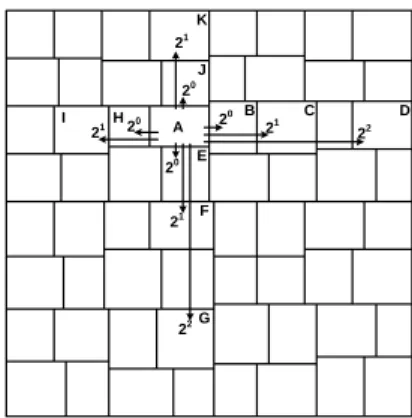
Figure 1: An Example of 2-dC2 Overlay.
networks, and thus, we will not consider the update cost of node join or departure in our cost model.
CAN’s routing cost is slightly higher than other overlay networks. Therefore, instead of applying CAN, we adopt a CAN’s variant,C2[11]. C2is a hybrid overlay of Chord and CAN. It extends CAN by adding Chord-like neighbor links on each dimension. Specifically, neighbor links are added between nodes with distance of 20, 21, ... on each dimension. Figure1 shows an example of a 2-dC2, made up of 64 nodes. NodeAkeeps a neighbor link to nodeB,C,Dsince they are at a distance of 20, 21 and 22 on the horizontal dimension, respectively. Similarly, nodeAalso keeps neighbor links to node E, F, G, H, I, J and K. On average, an C2 node maintainsO(log√dN) neighbors on each dimension. Thus, the total number of neighbors is O(logN). Therefore, C2 actually maintains the same number of routing neighbors as the other overlay networks. C2 reduces the average routing hop number tologN4.
In the following part, we also use CAN node to refer to a C2 node, since CAN is the original overlay structure.
3.
RT-CAN INDEX
The RT-CAN index is built on top of the local indexes. The key problem of the RT-CAN index lies in mapping a lo-cal R-tree node to a CAN server. In this section, we present an overview of the RT-CAN index scheme in our Cloud data management system. Specifically, we focus on the mapping function of the RT-CAN index. We also present a general index publication algorithm for building the RT-CAN index.
3.1
Work Flow and Node Structure
The RT-CAN index is built on a shared-nothing cluster, where application data are partitioned and distributed over different servers. As shown in Figure 2, a cluster server Ni assumes two roles, namely, storage nodeNsi and
over-lay node Noi. Nsi joins a distributed storage system and
maintains a portion of application data. To facilitate multi-dimensional search,Nsi builds an R-tree for its local data.
Nsipublishes its index by interacting withNoi.Noiis a node
in the structured overlay, CAN. It responds for a partition of CAN. Nsi adaptively selects a set of R-tree nodes from
its local R-tree and publishes them into the overlay network via the interface ofNoi. The format of the published R-tree
node is (ip, mbr), whereipisNi’s IP address andmbris the
minimal bounding range of the R-tree node. On receiving a publication request from Nsi,Noi maps the corresponding
C2
Overlay Attribute 1 Attribute 2
Online Service Local Data
Local Index Global Index Overlay Interface Global Index Storage Node Overlay Node Storage Node Overlay Node Storage Node Overlay Node Cluster Node Index Publish Data Insert
Figure 2: Data Service for Online Applications
R-tree node to a CAN node and forwards the request based on CAN’s routing protocol. Noiis responsible for
maintain-ing the global index. After it receives a publication request, it checks whether it is the receiver of the request based on the mapping function. If it is, it keeps a copy of the pub-lished R-tree node and buffers the index in memory. In this way, the global index composes of some R-tree nodes from the local indexes and is distributed over the cluster.
The global index can be considered as a secondary index on top of the local R-trees. This design splits the processing of a query into two phases. In the first phase, the processor looks up the global index by mapping the query to some CAN nodes. These CAN nodes search their buffered R-tree nodes and return the entries that satisfy the query. In the second phase, based on the received index entries, the query is forwarded to the corresponding storage nodes, which re-trieve the results via the local R-tree. The detailed query processing algorithm can be found in Section 4.
Data insertion or deletion may trigger an update to the local R-tree, which violates the global index. To handle this problem, we need to synchronize the global index with the local R-trees. If a local R-tree node has been split or merged and it is marked as being published, we publish it again to replace the outdated global index. The RT-CAN index reduces update cost by publishing only a portion of R-tree nodes. If we index every tuple in the global index (traditional P2P systems adopt this idea), any update to the local database will trigger an update to the global in-dex. However, the RT-CAN index introduces false positive cost. As higher level R-tree nodes cover a large range, a query overlapping the R-tree nodes does not guarantee that valid results will be retrieved. To balance update cost and false positive cost, we propose a tuning approach. The clus-ter server occasionally re-selects R-tree nodes for publishing based on recent query and update patterns.
3.2
Mapping Scheme in CAN
We use d-dimensional C2 [11] to maintain index items for d-dimensional data. C2 is a variant of CAN with en-hanced search capability. It reduces routing hops by increas-ing neighborincreas-ing links in each dimension, and search cost is bounded byO(logN). To facilitate index publishing, a map-ping function is created to map an R-tree node to a CAN node. Specifically, the center and radius of the R-tree node’s bounding box are used as the criteria for mapping. If the
ra-A C D G N R1 R2 J K B E F H M I O P L
Figure 3: Different Search Space of An Exact Query With DifferentRmax Values (R1 andR2)
dius is smaller than a threshold, sayRmax, the R-tree node
is mapped to one CAN node. Otherwise, it is mapped to multiple CAN nodes. The mapping function works as fol-lows: For an R-tree noden, we first map it to the overlay nodeNcwhose zone containsn’s center. ThenNccompares
n’s radius and Rmax. Ifn’s radius is larger thanRmax,Nc
will send n to all the overlay nodes whose range overlaps withn’s range. The center is used in the mapping function, as R-tree nodes with close centers may contain similar data with high probability.
The above mapping scheme creates multiple replicas of R-tree nodes with larger ranges (radius larger thanRmax).
This strategy works on the basis of update cost and search cost. An R-tree node with a small range refers to a low-level node in the tree with high probability. Low-low-level node always incurs more updates than the up-level ones. There-fore, keeping multiple replicas introduces high overhead. In contrast, for an R-tree node with a larger range, multiple CAN nodes are covered. If we only maintain one copy of the index for it, all queries need to search that CAN node, which reduces query efficiency.
Rmax has a significant impact on the search space of a
query. A query may need to access more CAN nodes for a largerRmax. Figure 3 shows an example of the search space
of a queryQ(key) with differentRmaxvalues in a 2-d CAN
overlay. The circles with radius R1 and R2 are the search spaces of point query when Rmax is set toR1 or R2. The
query has to access more compute nodes to obtain all index items which contain the searchkeyif we increaseRmaxfrom
R1 to R2. Rmax is a tunable parameter. In an RT-CAN
indexing system, a largerRmaxdegrades query performance
as more space must be searched to retrieve complete results. On the other hand, a smaller Rmax increases maintenance
cost by creating too many replicas. In our system, we set Rmaxto a value larger than the radiuses of most leaf nodes
of local R-trees.
3.3
Publishing In The RT-CAN Index
Initially, due to lack of information about the query pat-tern and the update patpat-tern, we cannot select R-tree nodes based on our cost model. Therefore, in an L-level R-tree, we select R-tree nodes in the L-1 level (nodes above the leaf nodes) to publish since these nodes are usually not fre-quently updated and they do not introduce too many false positives either. After a cluster server Ni selects a set of
R-tree nodes, Si, for indexing, it publishes the index for
cn and radius rn, and publishes n based on our mapping
function. For example, in a two-dimensional space, suppose node Ni wants to publish an R-tree node n whose range
is [l1, u1],[l2, u2]. Ni first computes n’s center and radius
ascn= (l1+2u1,l2+2u2) andrn= 12
(u1−l1)2+ (u2−l2)2. We use the center as the key to publish the node, namely keyn=cn. If the dimensionality of CAN (d) is larger than
the search space d, Ni will generate a (d−d)-vector vn
and append it tokeyn. Then,nhas ad-length combination
key keyn = (vn, keyn). The index of the R-tree node n is
sent to the cluster nodeNjwhose zone containsn’s center,
cn. The CAN dimensiondshould be chosen properly to
en-sure that it is not smaller than the largest dimensionality of data. We can choose a large enoughdto keep this condition since the dimensionality of a table is usually not very large.
Algorithm1 describes howNi publishes an index item for
an R-tree noden. Ifn.radius > Rmax, all CAN nodes
over-lapping withn need to maintain n in its global index. In line 1, a subset of R-tree nodes are selected for publishing. In line 4 and 7, we apply the routing protocol of CAN (C2) to retrieve the overlapping cluster servers.
Algorithm 1IndexPublication(cluster nodeNi)
1: Si=getSelectedRT reeN ode(Ni)
2: for eachn∈Sido
3: cn=ns center;rn=ns radius
4: keyn=compositeKey(cn, rn)
5: Nj=CAN.lookup(keyn)
6: Njinsertsninto its global index set
7: if rn> Rmax then
8: Sn=getOverlappedN ode(n)
9: for∀Nk∈Sndo
10: Nk insertsninto its global index set
11: end for
12: end if
13: end for
Given a keyk, routing to the RT-CAN node whose zone containsk will cost logN
4 messages averagely, whereN is
the number of servers in the cluster. So, it will costlogN
4
messages to publish an R-tree node whose radius is less than Rmax. If the node’s radius is larger thanRmax, it will cost
logN4 +mmessages, wheremis the number of CAN nodes whose zones overlap with the published R-tree node. The total cost of indexing the setSiis bounded byO(|Si|logN).
4.
QUERY PROCESSING
In this section, we show how the RT-CAN index can be ap-plied to process various types of queries. We use point, rang and KNN queries as examples. As discussed before, query processing can be split into two phases. In the first phase, we look up the RT-CAN index to retrieve the cluster servers that may provide possible results. In the second phase, the query is routed to the servers and processed locally. We focus on the first phase, as the second phase is similar to any centralized system. Given a queryQ, to guarantee the completeness of the result, we need to retrieve all possible cluster servers that overlap with Q. To achieve this goal, efficient algorithms are proposed to prune the search space, using center and radius of both indexed R-tree nodes and queries. In the rest of this paper, we assume the
dimen-Rmax Key2 E Cq1 Rq2 A B C D F G H I J K L M N O P A B C D E F G H I J K L M N O P Cq2 Rmax Rq2 Rmax Rmax Key1
Figure 4: Search Space of Queries
sionality of RT-CAN to bed, and we discuss the processing algorithms for different queries.
4.1
Point Query Processing
The point query is denoted asQ(key), wherekey= (v1, ..., vd), indicating a d-dimensional point. Given an indexed
R-tree node n and its bounding box [l1, u1], ...,[ld, ud], if
li≤vi≤ui for 1≤i≤d,nshould be searched to retrieve
possible results. Supposekeyis mapped to a CAN nodeN, based on our publishing strategy, ifn’sradiusis larger than Rmax,nmay be maintained by a CAN node other thanN.
Thus, to retrieve all possible results, the search space for a point query Q(key) is a circle C centered at point key with radiusRmax. All the CAN nodes whose zones overlap
withCshould be accessed to retrieve the corresponding R-tree nodes. Theorem 1 guarantees the completeness of the results. Figure 4(a) illustrates the search space whend=2.
Theorem 1. For a point queryQ(key), if we search the circle centered at key with radius Rmax, we can guarantee
the completeness of the results.
Proof. Suppose an indexed R-tree noden has centerc
and radiusr, and it contains the search key, e.g.,distance(key, c)≤r. Based on our mapping function, ifr≤Rmax,nmust
overlap with the search circle, as distance(c, key)< Rmax.
Otherwise, ifr > Rmax, we have created the replicas forn
in every overlapped CAN node. Therefore, the search circle must contain a replica of the R-tree node.
To process a point query Q(key), we first forward the query to the CAN node Ninit, whose zone contains the
key. Ninit searches its buffered global index and returns
matched results to the user. Then, it generates a search cir-cle C for the query and forwards the query to other CAN nodes that overlap with the circle. The query message is for-warded via CAN’s routing protocol. To reduce overhead, we slightly modify the routing algorithm. SupposeNinit’s zone
is [l1, u1], ...,[ld, ud]. We partition the search range (e.g.,C)
based on Ninit’s range iteratively. Specifically, C is first
partitioned by the first dimension. Three sub-ranges are generated, R0,R1 and R2. R0 is the sub-range between l1
and u1. R1 is the sub-range belowl1 and R2 is the sub-range aboveu1. R1 andR2 are routed to the neighbors of Ninit in the first dimension. R0 is continuously partitioned by the second dimension. This process completes when the search range has been partitioned by all dimensions. Be-sides the sub-range handled by Ninit itself, the remaining
sub-ranges are forwarded to the neighbors. The head of the routing message follows the format of{R, Ni}, whereR is
the sub-range andNi is the destination. Ni is responsible
for forwarding the query to all the other CAN nodes that overlap withR.
Algorithm 2 shows the idea of point query processing. We first route the query to the CAN node responsible for the key (line 2). Then, the search circle is generated based on the key and the maximal radiusRmax. From line 4 to 10,
we continuously partition the search circle into sub-ranges and forward the query to the neighbor nodes. Finally, the node searches its buffered global index and returns the cor-responding indexed R-tree nodes to the user(line 11-15). In line 9 and 10, when the neighbor nodes receive the query message, they invoke a similar algorithm to partition and process the query. The only difference is that they do not need to find the initial node and generate the search circle.
Algorithm 2Point Query Processing
Input: Q(key)
Output: Si(the result of indexed R-tree nodes)
1: Si=φ
2: Ninit=CAN.lookup(key)
3: C=generateSearchCircle(key, Rmax)
4: fori=1 toddo
5: partitionCintoR0,R1 andR2based onli andui
6: C=R0
7: N1=getN eighbor(Ninit, R1)
8: N2=getN eighbor(Ninit, R2)
9: Forward query message (N1,R1) toN1
10: Forward query message (N2,R2) toN2 11: end for
12: Si=Ninit.globalIndex
13: for∀I∈Si do
14: if I’s bounding box does not containkeythen
15: Si=Si− {I}
16: end if
17: end for
18: returnSi
The cost of processing a point queryQ(key) is bounded by RT-CAN’s routing cost. Averagely, it costs logN4 messages to forward a message to the initial nodeNinit. Note that
by applying the variant of CAN, we reduce the routing cost fromO(√dN) toO(logN). At the initial node, the message is continuously forwarded to anotherM nodes that overlap with the search circle. Thus the total cost is aboutlogN
4+M.
4.2
Range Query Processing
A range query is denoted as Q(range), whererange = [l1, u1], ...,[ld, ud] is a multi-dimensional hypercube. The
range’s center is defined as (l1+u1
2 , ...,ld+2ud) and its radius
is computed as 12(u1−l1)2+...+ (ud−ld)2. If an R-tree
noden’s bounding box [l1, u1], ...[ld, ud] overlaps withrange,
nshould be searched to retrieve possible query results. Fig-ure 4(b) shows the search space of two range queriesQ1 and Q2. An R-tree noden, contains query results forQ(range) only ifdistance(n.center, range.center)≤Rmax+range.ra−
dius. Thus, the search space of a range query Q(range) is a circle C centered at range.center, and its radius is
Rmax+range.radius. Any server whose zone overlaps with
Cshould be accessed to retrieve possible query results.
Theorem 2. For a range query Q(range), if we search the circle centered atkeywith radiusRmax+range.radius,
we can guarantee the completeness of the results.
Proof. Suppose an indexed R-tree noden has centerc
and radiusrand it overlaps withrange. We havedistance(c,
range.center)< range.radius+r. Ifr≤Rmax,cmust be
contained by the search circle. Ifr > Rmax, we have created
replicas ofnin every overlapped CAN node. Therefore, the search circle must contain a replica of the R-tree node.
Given a d-dimensional range query Q(range), our algo-rithm will return all indexed R-tree nodes whose bounding boxes overlap with range. The processing progresses in a manner similar to point query processing. First, the query is routed to the CAN nodeNinitwhose zone contains the
cen-ter ofQ(range). Then, the query is recursively forwarded to all neighbors that overlap with the search circle. The query is broadcast in a way similar to point query processing. The search space is partitioned for each dimension and sent to the corresponding neighbors. On receiving the query, the CAN node searches its global index and returns candidate R-tree nodes. The detail of the range query algorithm is omitted here as it is similar to Algorithm 2.
4.3
KNN Query Processing
Given a KNN queryQuery(key, k), our algorithm returns top-kdata items which are closest tokey. The intuition of the KNN algorithm is to start with a small range and en-large the search range accordingly. Although our scenario is similar to the KNN problem in the R-tree index, conven-tional algorithms, such as MINDIST-based pruning, cannot be applied directly. The RT-CAN index is disseminated to different cluster servers. Given a pointkey, which is mapped to the CAN nodeNinit, it is challenging to find the closest
in-dexed R-tree node ofkey.Ninitneeds to communicate with
its neighbors in all dimensions to find all candidates. This may incur significant network overhead. To retrieve top-k results, we need several iterations. Each iteration involves communication among a set of CAN nodes. Exploiting the parallelism in Cloud systems, we adopt a simple but effective algorithm.
Algorithm 3 illustrates our KNN algorithm. In lines 3 and 4, we set an initial search radius based on the data distribu-tion. δ = Dk
k , where Dk is the estimated distance between
keyand itsk-nearest neighbor. Dkcan be estimated by the
following equations [27]: Dk≈ 2d Γ(d 2+ 1) √ π (1− 1− d k N) (1)
where d is the dimensionality of RT-CAN, N is the esti-mated number of data in the whole space, Γ(x+ 1) =xΓ(x), Γ(1) = 1 and Γ(12) = π
2. The KNN computation comprises
a series of range queries (line 6). Search(key, r) returns the data, whose distances tokeyare no larger thanr. Suppose key = (x1, ..., xd), Search(key, r) is similar to range query
processing, and the only difference is that Search(key, r) usesr as the radius of the query and useskeyas the center of the query. On receiving the search message, the CAN node will check its global index and forward the request to the corresponding cluster server, where a local search algo-rithm is invoked to return its local data in the search range
(key, r). After each iteration, if we have not obtained enough
Algorithm 3KNN Query Processing Input: Q(key, k)
Output: Si(the result of indexed R-tree nodes)
1: Si=φ
2: Ninit=CAN.lookup(key)
3: δ=estimateRadius(k)
4: r=δ
5: whiletruedo
6: Si=Search(key, r)
7: if |Si| ≥kthen
8: return topk results ofSi
9: else
10: r=r+δ
11: end if
12: end while
The cost of KNN algorithm depends on the value of K. For a largeK, Algorithm 3 has to search a larger range to retrieve enough data, which means more CAN nodes will be contacted and more local search will be invoked. If the data follows uniform distribution, the search space of a KNN queryQ(key, k) is in proportion tok. If the data is skewed, and the estimated radius is not large enough to retrieve enough data, a KNN query will cost more iterations, re-ducing its efficiency.
5.
INDEX MAINTENANCE
We adopt an adaptive indexing strategy in this paper to minimize the maintenance cost of the RT-CAN index. Based on the current query and update patterns, the cluster server adaptively selects a portion of local R-tree nodes for pub-lishing. A low-level R-tree node (node close to the leaf) generates fewer false positives in query processing. How-ever, it may incur more update costs. It is necessary to balance the cost of false positive and updates. When select-ing R-tree nodes for indexselect-ing, we must guarantee that the index is complete and unique.
Definition 1. Index Completeness
Suppose cluster serverNi selects a set of local R-tree nodes
Sr to build its global index. The index is said to be complete,
if and only if for any tuple t in Ni’s local database, t is
contained by one R-tree node inSr.
Definition 2. Unique Index
Suppose cluster serverNi selects a set of local R-tree nodes
Sr to build its global index. The index is said to be unique,
if for an R-tree nodeniand its ancestor nodenj,ni∈Sr →
nj ∈Sr∧nj∈Sr →ni ∈Sr.
Index completeness guarantees the correctness of query processing while the unique index strategy reduces mainte-nance overhead by removing redundancy. Our index selec-tion algorithm satisfies the above two requirements and is a variant of dynamic programming. Its cost isO(V), where V is the number of local R-tree nodes. Our index selection algorithm aims to reduce index maintenance cost and false positive cost at the same time. It is invoked occasionally to adapt to the change of query or update patterns. Be-fore delving into the details of the selection algorithm, we first propose a cost model to estimate the cost of a specific indexing strategy.
5.1
Cost Model
We only consider network cost in our cost model, as: 1) disk I/O is much faster than network I/O, and 2) we have built an R-tree index for the local data, which facilitates data retrieval. In the RT-CAN indexing system, two types of cost dominate the system’s performance: index mainte-nance cost and query processing cost. To estimate the cost, we record queries and updates in a time window T. The cost C(n), incurred by an indexed R-tree node n, consists of query processing cost CP(n) and index maintaining cost
CM(n).
C(n) =CP(n) +CM(n)
As we have discussed, applying the RT-CAN index to query processing generates false positives. Some cluster servers that cannot provide any result are searched as well. This is because we index some high-level R-tree nodes, which cover a wide range. Therefore, the routing cost of query pro-cessing can be classified into essential costCE(n) and false
positive costCF P(n). AsCE(n) cannot be further reduced,
we focus on CF P(n) in this paper. For an indexed R-tree
noden, we record the query incurring false positives in a set QF P(n). QF P(n) is defined as:
QF P(n) ={q|q.range∩n.range=φ∧ |f(n, q)|= 0}
wheref(n, q) returns the result set forq. Suppose there are N cluster servers,CF P(n) can be computed as follows:
CF P(n) = log
N
4|QF P(n)|
The index maintenance operation is triggered by the lo-cal R-tree’s update. A cluster server Ni is responsible for
updating its published index in the overlay. Once an R-tree nodenj in Ni’s published set is split or merged, Ni needs
to notify the cluster server that maintains the index fornj.
Ifnj is split into two R-tree nodes,Niremoves the existing
index for nj and publish the index of the new nodes.
Al-gorithm 4 summarizes the processing of index update. The splitting of an indexed R-tree node incurs logN
4 messages
to delete the published index item. It also takes another 2logN4 messages to publish newly generated R-tree nodes. Thus, the total cost is about 3logN
4. Ifnj is merged with
another R-tree nodenk, we need to replacenj’s old index
with the new one. Based on our index selection algorithm, which we will discuss later,nkis indexed as well. Therefore,
the total cost of merging is 3logN
4.
Algorithm 4UpdateIndex
Input: n
1: if nis split inton1 andn2 then
2: delete(n)
3: publish(n1), publish(n2) 4: end if
5: if nis merged withn intonnew then
6: delete(n), delete(n) 7: publish(nnew)
8: end if
To capture the update pattern, a histogram is built in each cluster server. The histogram partitions the space into equal-size grids. In each grid, we maintain the number of insertions and deletions in the lastT time. Given an R-tree
noden, we can use the histogram to estimate the number of insertions and deletions forn. Applying a two-state markov chain model [19], we can estimate the probabilities of split-ting and merging in the next time T. Let psplit(n) and
pmerge(n) denote the probabilities of splitting and merging
R-tree noden, respectively. We estimate the index mainte-nance cost as:
CM(n) = 3 log
N
4(psplit(n) +pmerge(n))
Supposenhas selected a set of R-tree nodesS for index-ing. The total cost of the current index is estimated as:
C(S) = n∈S C(n) = n∈S (CF P(n, Q) +CM(n, L)) (2) = n∈S logN 4(|QF P(n)|+ 3(psplit(n) +pmerge(n))) The aim of the index selection algorithm is to minimize this cost.
5.2
Index Selection
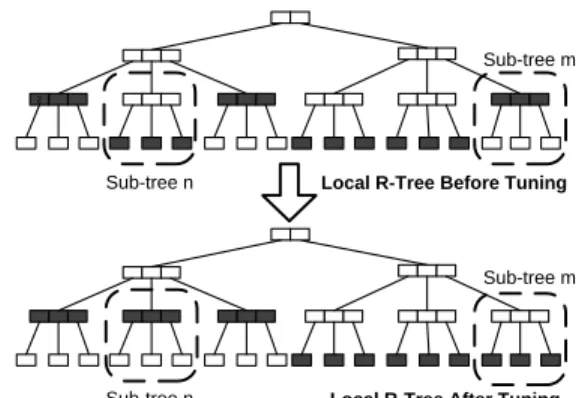
The index selection algorithm must guarantee the com-pleteness and uniqueness of the index. Figure 5 shows an example of R-tree nodes selection, where dark colored nodes are selected. Based on the recent query and update pat-terns, the index selection algorithm should select a set of nodes satisfying the two properties and minimizing the to-tal cost of the published index. The formal definition of index selection is:
Definition 3. Given an R-treeTR and its node set V, the weight of a noden∈V is defined asC(n), namely, its indexing cost. The index selection problem is to select a set of R-tree nodesS, where
1. S⊆V
2. ∀ni, nj∈S, niis not the ancestor ofnj and vice versa
3. For a leaf nodeniofTR,ni∈Sor there is an ancestor
ofni inS
4. The weight ofS, defined as Equation 2, is minimized.
In Equation 2, logN
4 is a constant for a specific overlay
network. Therefore, we discard it and simplify the cost as:
C(S) =
n∈S
(|QF P(n)|+ 3(psplit(n) +pmerge(n)))
and the cost ofnbecomes
C(n) =|QF P(n)|+ 3(psplit(n) +pmerge(n)).
Algorithm 5R-Tree Node Selection Algorithm
Input: local R-TreeTR
Output: A set of R-Tree nodesS 1: foreach R-tree nodeni inTR do
2: update cost ofniusing query and update histograms
3: end for
4: {S, C}=IndexSelect(TR.root)/* invoke Algorithm 6 */
5: returnS
z
Local R-Tree Before Tuning
Local R-Tree After Tuning Sub-tree m
Sub-tree m Sub-tree n
Sub-tree n
Index tuning while Sub-tree n is frequently updated, rarely queried and Sub-tree m is frequently queried, rarely updated
Figure 5: Selective Indexing
Algorithm 6IndexSelect
Input: R-Tree noden
Output: A set of R-Tree nodesS, Total CostC 1: S={n} 2: C=C(n) 3: if nis a leaf then 4: returnSandC 5: else 6: Stemp=∅,Ctemp= 0 7: for∀ni∈n.childdo 8: {S, C}=IndexSelect(ni) 9: Stemp=Stemp∪S 10: Ctemp=Ctemp+C 11: end for 12: if Ctemp< C(n)then
13: returnStempandCtemp
14: else
15: returnS andC
16: end if
17: end if
We use dynamic programming to achieve the minimal to-tal cost by selecting an optimal node setS. For eachn∈V, our algorithm computes the minimal total cost of the sub-tree rooted at n, denoted as C(TR, n). For each internal
noden,
C(TR, n) =min{Σni∈n.childC(TR, ni), C(n)}
C(TR, n) equals to C(n), if n is a leaf node. Algorithm 5
describes the selection of R-tree nodes to minimize the cost. We first update the cost of all R-tree nodes, based on the most recent query and update patterns. Then, we invoke Algorithm 6 to recursively compute the optimal cost and se-lection. In Algorithm 6, if the node is a leaf node, it simply returns its cost and selects itself (lines 3 and 4). Otherwise, we compare the costs of two strategies, combining the op-timal solutions of the child nodes and use the current node as the solution (lines 6-14). We select the solution with the least cost. The cost of Algorithm 6 is bounded by O(|V|), where|V|denotes the number of local R-tree nodes.
Theorem 3. Algorithm 5 returns the optimal indexing set with regard to the query pattern and the update pattern. Proof. Because we apply the dynamic programming
0 2000 4000 6000 8000 10000 12000 14000 16000 32 64 96 128 Query Throughput
Number of Compute Nodes Effect of Selectivity (Traffic Dataset)
selectivity=0.01% selectivity=0.05% selectivity=0.10%
Figure 6: Effect of Selectivity (Traffic Dataset) 0 2000 4000 6000 8000 10000 32 64 96 128 Query Throughput
Number of Compute Nodes Effect of Selectivity (Uniform Dataset)
selectivity=0.01% selectivity=0.05% selectivity=0.10%
Figure 7: Effect of Selectivity
(Uniform Dataset) 0 2000 4000 6000 8000 10000 12000 14000 16000 32 64 96 128 Query Throughput
Number of Compute Nodes Effect of Skewness (Traffic Dataset)
skew factor=0.0 skew factor=0.5 skew factor=1.0
Figure 8: Effect of Skewness (Traf-fic Dataset)
optimal solution of n is either to index n or combine the sub-solutions of n’s children. If indexing n is the best so-lution, the problem is solved. Otherwise, as the solution of one child does not affect the solution of another, the sub-solution is actually independent. Moreover, the total cost is the sum of all costs of the sub-solutions. Therefore, by combining all sub-optimal solutions, we can get the optimal solution.
6.
PERFORMANCE EVALUATION
We evaluate RT-CAN indexing scheme on Amazon’s EC2 platform. We implement our system in Java 1.6.0.13 and run it on a set of EC2 computing units. Each computing unit is a small instance of EC2 with 1.7GHz Xeon processor, 1.7GB memory and 160GB hard disk. The computing units are connected via 250Mbps network links. The number of computing units in our system varies from 32 to 128. We use two different datasets to evaluate our indexing scheme. In the uniform dataset, we generate 500,000N objects, where N is the number of computing nodes. The object has 2 to 5 attributes and values of the attributes are uniformly dis-tributed in the range [0,109]. We partition the data intoNg
equal-size grids, whereNg is several times ofN. The grids
and their corresponding data are randomly disseminated to the computing nodes. In this way, one computing node han-dles multiple grids and all computing nodes roughly main-tain the same number of objects. In the traffic dataset, we apply [3] to generate 100,000N 2-d moving objects based on the city’s map, which represents the real-time traffic. Ob-jects in the traffic dataset follow skewed distribution. And we apply the same approach as in the uniform dataset to partition the data among computing nodes.
In each computing node, we build an R-tree index for its local data. The page size of the R-tree node is 4K and each internal node contains at most 127 entries. We test the performance by generating queries that follow both uniform and skewed distribution. We use zipfian distributions to generate skewed queries that focus on some hotspots. Table 1 lists the experiment parameters and their default values.
Query throughput (processed queries per-second) is used as the metric in the experiments. We use a master node to control the behaviors of all the other compute nodes. The master node partitions the data among the computing nodes and generates queries continuously. The computing node fetches queries from the master node. After finishing its current query, the computing node will pull a new query from the master. All experiments are running for 200
sec-Table 1: Default Experiment Setting
Parameters Default Values
Dimension 3
Query Type Range Query
Query Selectivity 0.01%
Skew Factor 0
Index Tuning Yes
Usage of Routing Cache No
Number of Computing Nodes 128
onds and we collect statistics (number of processed queries) every 10 seconds. And the average results are used.
6.1
Performance of Range Queries
Range queries are most popular queries in web 2.0 appli-cations. Point query can be considered as a special type of range queries by setting the search range to zero. KNN queries are processed via a set of range queries. In this ex-periment, we evaluate the performance of range queries. We define the selectivity as the percent of searched space. For example, if we set selectivity = 0.05% in a 3-d space, the query will search approximately 8% range in each dimen-sion. Figure 6 and Figure 7 show the performances of range queries with different selectivities and network sizes for traf-fic dataset and uniform dataset, respectively. When we in-crease the number of computing nodes, the query through-put increases almost linearly, which verifies the scalability of the RT-CAN index. A larger selectivity value causes more objects to be retrieved and more cluster servers to be in-volved in the query processing. Therefore, the performance degrades significantly. The results of traffic dataset are much better than those of the uniform dataset. This is because the traffic dataset has 2 dimensions, and the uniform dataset has 3 dimensions. Processing a query on the uniform dataset costs more routing hops and local disk searches than process-ing on the traffic dataset.
In real systems, queries follow skewed distributions (e.g. users could be more interested in photos about Liberty Statue, Eiffel Tower and Great Wall). In Figure 8 and Figure 9, we generate queries following zipfian distribution and test the performance of the RT-CAN index. When skewed factor is set to 0, the query follows a uniform distribution. When skewed factor is set to 1, about 80% queries focus on 20%
0 2000 4000 6000 8000 10000 32 64 96 128 Query Throughput
Number of Compute Nodes Effect of Skewness(Uniform Dataset)
skew factor=0.0 skew factor=0.5 skew factor=1.0
Figure 9: Effect of Skewness (Uni-form Dataset) 0 5000 10000 15000 20000 1 2 4 8 16 32 Query Throughput K Performance of KNN Query Uniform data, 100K per node, 128 nodes Traffic data, 100K per node, 128 nodes
Figure 10: Performance of KNN Query (2-d Dataset) 0 2000 4000 6000 8000 10000 12000 14000 16000 1 2 4 8 16 32 Query Throughput K Performance of KNN Query Uniform data, 500K per node, 128 nodes
Figure 11: Performance of KNN Query (3-d Dataset) 0 2000 4000 6000 8000 10000 12000 14000 16000 18000 32 64 96 128 Query Throughput
Number of Compute Nodes Performance of KNN Query Uniform data, 100K per node, k=16 Traffic data, 100K per node, k=16
Figure 12: Performance of KNN
Query (2-d Data Dateset)
0 2000 4000 6000 8000 10000 12000 14000 32 64 96 128 Query Throughput
Number of Compute Nodes Performance of KNN Query Uniform data, 500K per node, k=16
Figure 13: Performance of KNN Query (3-d Dataset) 0 5000 10000 15000 20000 25000 30000 20 40 60 80 100 Throughput
Number of Compute Nodes Performance of Mixed Workload (Traffic Dataset)
System Size=128 System Size=96 System Size=64 System Size=32
Figure 14: Performance of Update (Traffic Dataset)
objects. The experiments show that the RT-CAN index performs best for queries of uniform distribution, because the query skewness causes unbalanced workload among the servers. However, it can still provide a reasonable perfor-mance when both queries and objects follow skewed distri-butions (skewed factor=1 in the traffic dataset).
6.2
Performance of KNN Queries
The KNN query is more complex than the range query. There have been many proposals on pruning the search bran-ches of an R-tree progressively. They are, however, not di-rectly applicable to the RT-CAN structure; therefore, in this paper, a simple but efficient strategy is adopted. We first estimate the distance between the query point and its K -nearest neighbor based on the data distribution. The dis-tance is used as the initial search radius. Then, we iter-atively enlarge the search range until satisfied results are retrieved. In Figure 10 and Figure 11, we vary the value of K from 1 to 32 and show the performances of traffic dataset and uniform dataset, respectively. Figure 10 shows performance on traffic dataset (we also show the diagram of uniform dataset for comparison), where each node holds 100K 2-d data. Figure 11 shows the performance on uniform dataset, where each node holds 500K 3-d data. The through-put decreases when the parameterk increases, because the search space increases withk. More index entries will be involved and more local disk search will be incurred whenk increases. The performance of traffic dataset is worse than the uniform dataset and it is also less effected byk, because of the skewness of data distribution.
Figure 12 and Figure 13 show the performance of KNN query processing at different system sizes, ranging from 32
nodes to 128 nodes. The KNN parameter is set to 16 in the test. As we increase the number of computing nodes, the performance improves dramatically. Comparing the re-sults of KNN queries with the rere-sults of range queries, we find that range query performs better than KNN queries on traffic dataset, and KNN queries performs better than range queries on uniform dataset. This is because in the traffic dataset, KNN query needs to incur several iterations of range query to retrieve enough data. But for the uniform dataset, as the initial estimation of the search range is quite accurate, in most cases, only one range query is required to retrieve the top-k results. And for KNN query, the search range is much smaller than that of the range query.
6.3
Performance of Updates
As in real systems, queries and updates are processed con-currently, we generate a mixed workload by combining the queries and updates. In this experiment, we generate uni-form insertions for the local R-trees. We vary the percentage of updates from 20% to 100%. Figure 14 and Figure 15 show the update performance of RT-CAN index for traffic dataset and uniform dataset, respectively. As a matter of fact, up-dates incur less overheads than queries. First, as we select a portion of R-tree nodes for indexing, we need to update the global index only when the indexed R-tree nodes have been modified. Second, to update an indexed R-tree nodes, we only need 3 logN
4 routing messages, whereas to process
a range query, besides logN4 routing messages, we need to search the local R-trees and return the corresponding re-sults. Increasing the number of compute nodes leads to a better throughput. RT-CAN index can handle both queries and updates efficiently.
0 5000 10000 15000 20000 25000 30000 20 40 60 80 100 Throughput
Number of Compute Nodes Performance of Mixed Workload (Uniform Dataset)
System Size=128 System Size=96 System Size=64 System Size=32
Figure 15: Performance of Update (Uniform Dataset) 0 2000 4000 6000 8000 10000 12000 14000 16000 32 64 96 128 Query Throughput
Number of Compute Nodes Effect of Index Tuning (Traffic Dataset)
with index tuning without index tuning
Figure 16: Effect of Tuning (Traffic Dataset) 0 2000 4000 6000 8000 10000 32 64 96 128 Query Throughput
Number of Compute Nodes Effect of Index Tuning (Uniform Dataset)
with index tuning without index tuning
Figure 17: Effect of Tuning (Uni-form Dataset) 0 2000 4000 6000 8000 10000 12000 14000 16000 18000 32 64 96 128 Query Throughput
Number of Compute Nodes Effect of Routing Cache (Traffic Dataset)
with routing cache without routing cache
Figure 18: Effect of Cache (Traffic Dataset) 0 2000 4000 6000 8000 10000 12000 14000 16000 32 64 96 128 Query Throughput
Number of Compute Nodes Effect of Routing Cache (Uniform Dataset)
with routing cache without routing cache
Figure 19: Effect of Cache (Uni-form Dataset) 0 2000 4000 6000 8000 10000 12000 32 64 96 128 Query Throughput
Number of Compute Nodes Effect of Dimensionality 2 dimension
3 dimension 4 dimension 5 dimension
Figure 20: Effect of Dimensional-ity (Uniform Dataset)
6.4
Effect of Index Tuning
To balance the query processing cost (false positive cost) and index maintenance cost, a tuning approach is adopted in the RT-CAN index to dynamically change the indexing strategy. In our experiment, local R-trees have three lev-els. And initially, we publish the second-level nodes (root node’s children) into the global index. After running for a while, RT-CAN index collects the query pattern and update pattern and apply the cost model to compute a new index-ing strategy. Figure 16 and Figure 17 illustrate the tunindex-ing effect. When applying the tuning algorithm, we record the throughput, after the index becomes stable. We deliberately generate some skewed update operations to trigger the index tuning. The results show that index tuning can effectively reduce the cost by catching the query and update patterns.
6.5
Effect of Routing Cache
Message routing cost is bounded byO(logN) in the RT-CAN index. This is not a big issue in Peer-to-Peer net-work, but in the Cloud systems, due to its high concurrency and high throughput requirements, the routing cost must be reduced toO(1). In Cloud systems, the overlay is stable. Nodes always stay online until hardware fails. Therefore, we apply routing cache to buffer the addresses of cluster servers and their key spaces in CAN. When routing a message, we first look up the routing cache. By checking the key spaces of each buffered server, we know whether it is the receiver of the message. If a server in the cache is exactly the message’s destination, the message is sent out via the buffered informa-tion. Otherwise, the original RT-CAN’s routing algorithm is applied. The cache is maintained in a lazy-update way. If a cache entry is stale and provides wrong routing information,
we will invoke RT-CAN’s routing algorithm to forward the message and update the entry based on the correct routing information.
Figure 18 and Figure 19 show the effect of routing cache. A significant improvement is observed for the cache-based schemes. As a matter of fact, some other Cloud systems, such as Dynamo [8], also adopt routing cache to improve the performance.
6.6
Effect of Dimensionality
The RT-CAN index is designed to support multi-dimen-sional relational data. In this experiment, we show its per-formance by varying the number of dimensions. As the traf-fic dataset is limited to 2 dimensions, we only present the results of the uniform dataset. Figure 20 shows the perfor-mances of the RT-CAN index in different dimensions. The best throughput is achieved for 2 dimensional dataset. The throughput decreases as the number of dimensionality in-creases. This is because ford-dimensional space, the range query will overlap with a large number of index items and hence incurs high communication costs. For example, in a 5-dimensional space, if queryQsearches 0.01% of the whole space, we need to search about 16% of range in each di-mension. A large search circle will be generated based on Algorithm 2.
7.
CONCLUSION
This paper presents RT-CAN, a multi-dimensional index-ing scheme, for our epiC[2] cloud system. RT-CAN is built on top of local R-tree indexes and provides efficient data retrieval service for large-scale shared-nothing clusters. In-stead of indexing objects directly, RT-CAN dynamically
se-lects a portion of local R-tree nodes to publish onto the global index. The global index is disseminated to differ-ent cluster servers, which are organized as a logical CAN-based overlay network. We propose algorithms for process-ing point, range and KNN queries. To reduce query cost and index maintenance cost, a dynamic tuning algorithm is proposed to adaptively select R-tree nodes for indexing. A cost model is used to collect the statistics about query and update patterns and estimate the cost of the current indexing strategy. Extensive experiments were conducted on Amazon’s EC2. The results verify the effectiveness and efficiency of RT-CAN.
8.
ACKNOWLEDGMENTS
The project epiC is in part funded by Singapore Min-istry of Education Grant No. R-252-000-394-112 under the project name of Utab, China National Grand Fundamental Research 973 Grant 2006CB303000, Key Program of Na-tional Natural Science Foundation of China Grant 60773063, National High Technology Research and Development Pro-gram (863 ProPro-gram) of China Grant 2009AA01Z149 and NSF C-RGC grant 60831160525.
9.
REFERENCES
[1] http://hadoop.apache.org/. [2] http://www.comp.nus.edu.sg/∼epic. [3] http://www.fh-oow.de/institute/iapg/personen/brinkhoff/generator/. [4] K. Aberer, P. Cudr´e-Mauroux, A. D. Z. Despotovic,M. Hauswirth, M. Punceva, and R. Schmidt. P-grid: A self-organizing structured p2p system. InSIGMOD 2003.
[5] A. Abouzeid, K. Bajda-Pawlikowski, D. J. Abadi, A. Rasin, and A. Silberschatz. Hadoopdb: An architectural hybrid of mapreduce and dbms technologies for analytical workloads.PVLDB, 2(1):922–933, 2009.
[6] M. K. Aguilera, A. Merchant, M. Shah, A. Veitch, and C. Karamanolis. Sinfonia: A new paradigm for building scalable distributed systems. InSOSP 2007. [7] S. A.Weil, S. A.Brandt, E. L.Miller, and D. D.E.Long.
Ceph: A scalable, high-performance distributed file system. InSODI 2006.
[8] V. Bala, E. Duesterwald, and S. Banerjia. Dynamo: a transparent dynamic optimization system.SIGPLAN Not., 35(5):1–12, 2000.
[9] E. Bertino, B. C. Ooi, R. Sacks-Davis, K. Tan, J. Zobel, B. Shidlovsky, and B. Cantania.Indexing Techniques for Advanced Database Applications. Monograph series, Kluwer Academic, 1997. [10] B.F.Cooper, R.Ramakrishnan, U.Srivastava,
A.Silberstein, P.Bohannon, H.A.Jacobsen, N.Puz, D.Weaver, and R.Yerneni. Pnuts: Yahoo!’s hosted data serving platform. InVLDB 2008.
[11] W. Cai, S. Zhou, W. Qian, L. Xu, K. Tan, and A. Zhou. C2: a new overlay network based on can and chord.Int. J. High Perform. Comput. Netw.,
3(4):248–261, 2005.
[12] R. Chaiken, B. Jenkins, P.-A. Larson, B. Ramsey, D. Shakib, S. Weaver, and J. Zhou. Scope: easy and efficient parallel processing of massive data sets.Proc. VLDB Endow., 1(2):1265–1276, 2008.
[13] F. Chang, J. Dean, S.Ghemawat, W. C. Hsieh, D. A. Wallach, M. Burrows, T. Chandra, A. Fikes, and R. E. Gruber. Bigtable: A distributed storage system for structured data. OSDI 2003.
[14] A. Crainiceanu, P. Linga, J. Gehrke, and J. Shanmugasundaram. Querying peer-to-peer networks using p-trees. InWebDB 2004. [15] A. Crainiceanu, P. Linga, A. Machanavajjhala,
J. Gehrke, and J. Shanmugasundaram. P-ring: an efficient and robust p2p range index structure. In
SIGMOD 2007.
[16] J. Dean and S. Ghemawat. Mapreduce: a flexible data processing tool. Commun. ACM, 53(1):72–77, 2010. [17] G. DeCandia, D. Hastorun, M. Jampani,
G. Kakulapati, A. Lakshman, A. Pilchin, S. Sivasubramanian, P. Vosshall, and W. Vogels. Dynamo: Amazon’s highly available key-value store. InSIGOPS 2007.
[18] S. Ghemawat, H. Gobioff, and S.-T. Leung. The google file system. InSOSP 2003.
[19] W. Gilks, S. Richardson, and D. Spiegelhalter. Markov chain monte carlo in practice. 1996.
[20] H. V. Jagadish, B. C. Ooi, K.-L. Tan, Q. H. Vu, and R. Zhang. Speeding up search in peer-to-peer networks with a multi-way tree structure. InSIGMOD, 2006. [21] H. V. Jagadish, B. C. Ooi, and Q. H. Vu. Baton: A balanced tree structure for peer-to-peer networks. In
VLDB 2005.
[22] J.Dean and S.Ghemawat. Mapreduce: Simplified data processing on large clusters. InOSDI 2004.
[23] S. Ratnasamy, P. Francis, M. Handley, R. Karp, and S. Shenker. A scalable content-addressable network. In
SIGCOMM 2001.
[24] A. Rowstron and P. Druschel. Pastry: Scalable, decentralized object location and routing for large-scale peer-to-peer systems. InInternational Conference on Distributed Systems Platforms 2001. [25] A. Silberstein, B. F. Cooper, U. Srivastava, E. Vee,
R. Yerneni, and R. Ramakrishnan. Efficient bulk insertion into a distributed ordered table. InSIGMOD 2008.
[26] I. Stoica, R. Morris, D. R. Karger, M. F. Kaashoek, and H. Balakrishnan. Chord: A scalable peer-to-peer lookup service for internet applications. InSIGCOMM 2001.
[27] Y. Tao, J. Zhang, D. Papadias, and N. Mamoulis. An efficient cost model for optimization of nearest neighbor search in low and medium dimensional spaces. IEEE Trans. on Knowl. and Data Eng., 16(10):1169–1184, 2004.
[28] Q. H. Vu, M. Lupu, and B. C. Ooi.Peer-To-Peer Computing: Principles And Applications. Springer, November 2009.
[29] S. Wu and K.-L. Wu. An indexing framework for efficient retrieval on the cloud.IEEE Data Engineering Bulletin, 32(1):77–84, 2009.
[30] H.-c. Yang, A. Dasdan, R.-L. Hsiao, and D. S. Parker. Map-reduce-merge: simplified relational data
processing on large clusters. InSIGMOD, pages 1029–1040, 2007.