Copyright by Wei Yang
The Dissertation Committee for Wei Yang Certifies that this is the approved version of the following Dissertation:
TECHNOLOGY ENTREPRENEURSHIP AND VALUE CREATION ON
OPEN INNOVATION PLATFORMS
Committee:
Francisco Polidoro Jr., Supervisor
Puay Khoon Toh
Ramkumar Ranganathan
Wen Wen
TECHNOLOGY ENTREPRENEURSHIP AND VALUE CREATION ON
OPEN INNOVATION PLATFORMS
by
Wei Yang
Dissertation
Presented to the Faculty of the Graduate School of The University of Texas at Austin
in Partial Fulfillment of the Requirements
for the Degree of
Doctor of Philosophy
The University of Texas at Austin
2019
Abstract
Technology Entrepreneurship and Value Creation on Open Innovation Platforms
Wei Yang, PhD
The University of Texas at Austin, 2019
Supervisor: Francisco Polidoro Jr.
This dissertation studies how entrepreneurial firms create economic value from open source technology platforms, interfaces on which firms disclose knowledge and distribute innovation for free without retaining any proprietary rights. Despite their increasing importance in innovation and growing popularity among profit-seeking new ventures, open source platforms present a major challenge for value creation, as they lack price signals to guide ventures’ transactions and forfeit ventures’ control over key resources and knowledge for innovation. Those features are in contrast with the fundamental assumption about price and revenue in economics. They also run counter to the central tenet in strategy research that private knowledge and rare resources are central to competitive advantage and profiting from innovation.
To address this puzzle about value creation from free technologies base on free knowledge and resources, this dissertation specifically focuses on the economic implications of strategies ventures can leverage within and across open source development communities. Chapter I reviews the literature relevant to entrepreneurship in an open and inter-dependent innovation environment. Exploring research opportunities emerged from the literature review, Chapter II explores the possibility that multihoming, a critical growth strategy of ventures as open source complementors
value creation from open source. Chapter III directly addresses value creation by investigating how collaborating with external contributors, another critical open source strategy, influences venture capital investment. Both essays highlight how platform network effects unfold without price signals and proprietary rights of the technologies in shaping the outcome for ventures’ strategies. They also emphasize those strategies’ demand side implications on users, participants on another side of open source platforms.
The empirical analyses of this dissertation are based on multiple open source technologies platforms, with data obtained from on GitHub, the worlds’ largest open source software storage provider, containing 5 Terabytes of information on 2.1 million ventures, 96 million technologies and over 2 billion development activities, under research designs for deriving causal references. Overall, the dissertation seeks to advance the understanding of value creation in entrepreneurship through open source platforms, an increasingly important phenomenon in contemporary economy.
Table of Contents
List of Tables ... viii
List of Figures ... ix
INTRODUCTION ...1
Chapter I. Literature Review: Current Research on Open Source Innovation ...11
Open source innovation ...12
Technology platforms ...44
Innovation ecosystem ...57
Summary ...64
Chapter II. Venture Growth and Expansion across Technology Platforms: Evidence from Open Source Platform Complementors ...67
Abstract ...67
Introduction ...67
Theory development ...72
Data and methods...85
Results ...97
Discussion ...101
Chapter III. Can Free Resources Create Economic Value? Crowd Contributors and Venture Capital Investment to Open Source Technologies ...105
Abstract ...105 Introduction ...106 Theory development ...108 Methods ...114 Results ...128 Discussion ...136
CONCLUSION ...144
LIST OF TABLES ...149
LIST OF FIGURES ...169
List of Tables
Table 1.1. Summary of literature on open source innovation ...149
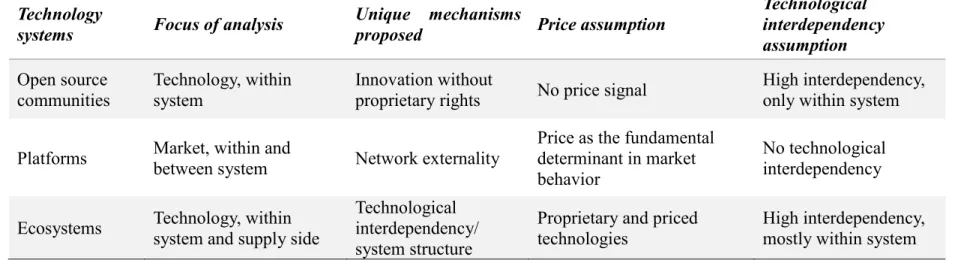
Table 1.2. Comparison of research on open source innovation communities, platforms and ecosystems ...150
Table 2.1. Examples of libraries on platforms ...151
Table 2.2. Summary of measures in Chapter II ...152
Table 2.3. Probit estimation on the likelihood of complementor multihoming ...153
Table 2.4. t-Tests of user adoption and library features before and after matching ....154
Table 2.5. Descriptive statistics for Chapter II ...155
Table 2.6. OLS estimations of the effects of multihoming on user adoption ...156
Table 2.7. OLS estimations of contingencies in multihoming and user adoption ...157
Table 2.8. Model sensitivity to time window specifications...158
Table 2.9. Tests of model sensitively to low usage complementary technologies ...159
Table 3.1. Examples of open source-based ventures with VC investment ...160
Table 3.2. Summary of measures in Chapter III ...161
Table 3.3. Probit estimation on the likelihood of crowd collaborations ...162
Table 3.4. t-Tests of open source-based ventures before and after matching ...163
Table 3.5. Descriptive statistics for Chapter III ...164
Table 3.6. OLS estimations on the effect crowd collaboration on venture capital investment to open source-based ventures ...165
Table 3.7. Tests of model sensitivity to fixed effects specifications, observation periods and log transformation ...166
Table 3.8. Testing mechanisms: OLS estimations on the effect of collation on lead users' learning interest (Forks) and user awareness (Watchers) ...167
Table 3.9. Alternative explanations of crowd collaboration as knowledge sourcing: the effects of collaboration accepted by ventures ...168
List of Figures
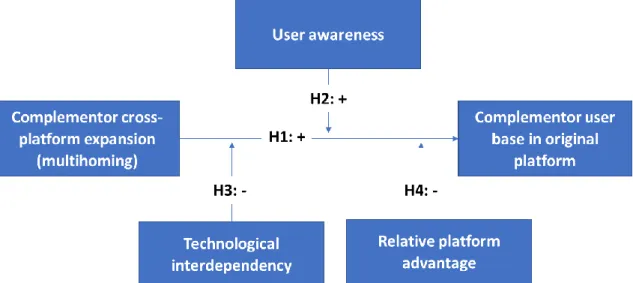
Figure 2.1. Summary of hypotheses (Chapter II) ...169
Figure 2.2A. GitHub repositories of a package library – example of Keras ...170
Figure 2.2B. Program package information on libraries.io – example of Keras ...171
Figure 2.3. Development and distribution process of open source libraries ...171
Figure 2.4. Growth of libraries and usage by month ...172
Figure 2.5. Sample package manager platforms and platform size by number of libraries (complements)...172
Figure 2.6. Percentage of multihoming complementors by platform...173
Figure 2.7. Distribution of the likelihood of complementor multihoming before and after matching ...173
Figure 2.8. Comparison of user adoption pre-post treatment between treated and control complementors ...174
Figure 3.1. Summary of hypotheses (Chapter III)...175
Figure 3.2. Venture capital investment to open source-based ventures by quarter ...175
Figure 3.3. The crowd collaboration process on GitHub ...176
Figure 3.4A. Crowd collaboration on GitHub – example of Elastics (content) ...177
Figure 3.4B. Crowd collaboration on GitHub – example of Elastic (communication) ...178
Figure 3.5. Distribution of ventures’ likelihood of crowd collaboration before and after matching ...179
Figure 3.6. Sample ventures’ frequency of crowd collaboration ...179
Figure 3.7. Average venture capital investment to open source based ventures pre-post crowd collaboration ...180
INTRODUCTION
Protecting intellectual property rights is central for firms to profit from technological innovation. The control of knowledge through well-defined intellectual property rights in tight appropriately regime allows firms to effectively retain rare and valuable knowledge resources, deter imitation, mitigate transactions costs, and reduce hazards of misappropriation, all of which are critical to the creation and capture of value in technology-intensive settings (Barney, 1991; Coase, 1960; Cohen, Nelson, & Walsh, 2000; Gulati & Singh, 1998; Oxley, 1997; Peteraf, 1993; Teece, 1986; Williamson, 1985). Protecting firm knowledge through intellectual property strategies such as patenting is particularly essential for new ventures, as they oftentimes lack the bargaining power and complementary assets and capabilities to compete in the downstream product markets (Gans & Stern, 2003; Pisano, 1990).
However, this long-established view regarding the control of knowledge and value creation has been increasingly challenged by the growing popularity of open source innovation among profit-seeking new ventures (Alexy, West, Klapper, & Reitzig, 2018; Colombo, Piva, & Rossi-Lamastra, 2014; Fosfuri, Giarratana, & Luzzi, 2008; Wen, Ceccagnoli, & Forman, 2015). Different from the proprietary innovation process where firms strategies and competition center on the protection of critical knowledge against misappropriation, in open source, firms not only develop and distribute technologies for free, but also allow public access to all the underlying technical details and knowledge, in a way that any external parties can modify and redistribute the innovation to anyone and for any purpose (Levine & Prietula, 2013; Von Krogh & Von Hippel, 2006).
Although initially emerged as a movement against commercial innovation (Bonaccorsi & Rossi, 2003; Von Krogh & Von Hippel, 2003), open source has become increasingly relevant to profit-seeking firms in many high technology industries. On the one hand, open source is gaining
increasing technological importance, as it breeds considerable path-breaking technologies that are disrupting the existing proprietary technologies with their unprecedented impact on the economy and society (Tucci, Afuah, & Viscusi, 2018)1. The cumulative innovation among open source
technologies, unbounded by intellectual property rights, has enabled the overall knowledge creation to grow at an exponential rate, which makes the practice also appealing to resource constraint values who constant search for valuable knowledge inputs (Nagle, 2018). While earlier literature contends that firms tend to regard open source as a threat and resort to commercial proprietary innovation to compete against such technologies (Bonaccorsi & Rossi, 2003; Economides & Katsamakas, 2006; Von Krogh & Von Hippel, 2003), in recent years, firms, especially resource constraint new ventures, are increasingly prone to participate in open source due to such technological impacts and knowledge benefits it demonstrates (Alexy & Reitzig, 2013; Alexy et al., 2018).
On the other hand, new ventures are increasingly attracted to open source, because it has revealed the huge business opportunities and potential of economic value creation potential for entrepreneurship. Although built on public knowledge and distributed for free, open source technologies have created over $147 billion economic value in entrepreneurship, with nine IPOs currently valuing at $67 billion, over 200 mergers and acquisitions that involved over $20 billion, and over 10 thousands rounds of venture capital investment that involved $10 billion to their developing ventures, which have given rise to over 40 ventures with 100 million valuation and multiple unicorns that exceeds a billion valuation in U.S. dollars in the past decade (Jacks, 2018;
1 Those path-breaking innovations, technologies, while largely within the field of computer science, ranges from
mobile communication, block-chain transactions or automated driving and aviation, to technologies that defeated the smartest chess players of the world, or allow problem-involving based on massive amounts of data and computation,
Myers, 2018; Rowley, 2017). The economic prospect of open source technologies stimulates active entrepreneurship in open source communities (Wen et al., 2015).
The growing popularity and huge economic value of open source present an intriguing puzzle yet to be fully addressed in strategy research. As mentioned at the beginning, open source entrepreneurship without control of knowledge and resources runs counter to the central tenet in strategy research that private knowledge and appropriability regime is key to competitive advantage (e.g., Barney, 1991; Teece, 1986; Wernerfelt, 1984). Moreover, due to the unique presence of developer/user communities in open source innovation, ventures tend to rely more heavily on the external knowledge and inputs from to free external contributors for knowledge creation (Nagle, 2018), which is also in contrast with what we know about the role of knowledge in explaining the very existence of firms (Grant, 1996; Kogut & Zander, 1992; Nickerson & Zenger, 2004). Moreover, as open source technologies are distributed for free, the lack of price mechanisms on the corresponding markets makes the value creation more difficult to comprehend given that given the fundamental role of price in profit commonly assumed in economics. Also, entrepreneurship through open source has demonstrated even greater variance in performance and survival. While a few, as discussed earlier, gained substantial technological and economic success, most open source technologies fail to attract any market attention, even though they are made free with all underlying knowledge disclosed – a drastic heterogeneity that is rarely discussed. Those tensions give rise to the research question of this dissertation - how can firms, especially new ventures gain competitive advantage and profit from developing open source technologies that are
distributed for free and without proprietary rights of their knowledge, on markets with intense
To explore this research question about the value creation from open source technologies, this dissertation specifically investigates the strategies ventures leverage within and across the development communities during open source innovation, and their impacts on the key outcomes of value creation in entrepreneurship. The focus of development communities in value creation first originates from their importance in open source innovation. Different from conventional innovation, the development of open source technologies mostly happens in the communities, through the constant interactions between the sponsoring organization of the key technological infrastructure and a variety of participants, including users, external contributors and suppliers of complementary technologies and the venture (e.g., Foss, Frederiksen, & Rullani, 2016; O'Mahony & Ferraro, 2007; Von Krogh, Spaeth, & Lakhani, 2003). Such unique innovation process makes the strategies that can shape participants’ behavior within communities particularly relevant to the economic value of the open source technologies.
In discussing the value creation of open source innovation, however, current research has not yet explored the implications of strategies and dynamics within those communities, with the current emphasis on business models and competition with proprietary innovation (e.g., Massa, Tucci, & Afuah, 2017; Teece, 2007). The discussion on open source value creation is disconnected from the unique community-based innovation process of open source technologies. At the same time, while other studies on open source communities have explored innovation process in open source technologies, such discussion ignores the value creation possibilities of those communities by emphasizing the voluntary and anti-commercial nature of open source communities and all the participants involved (e.g., Hertel, Niedner, & Herrmann, 2003; Roberts, Hann, & Slaughter, 2006) – an increasingly questionable assumption given the active entrepreneurship and incumbent tech-giants in open source communities (Asay, 2016; Silver, 2018).
Moreover, this underlying assumption of the nonprofit nature of open source technology communities has directed much of the attention to the competition between open source and proprietary technologies. In turn, we lack the understanding of the competitive dynamics within open source technologies and communities. Few studies have addressed the huge variance of success across open source technologies and their communities – that is, why some technologies outcompete others, given they are equally distributed without price and knowledge protection and have the same access to the public who can potentially contribute to the subsequent innovation of the technologies, and how is such heterogeneity related to the strategies of ventures in the open source communities?
Addressing those tensions around the value creation of open source and the influence of ventures’ strategic behavior in the corresponding technology communities, the theory development of this dissertation conceptualizes open source communities as multi-sided technology platforms, with the competition among open source technologies as a platform-based process without price signals. On such platforms, the interactions among users, contributors and new ventures are mediated by a same set of open source technology infrastructures. Ventures can create and capture value by resuming a variety of roles, either by becoming sponsors (owners) of the communities or becoming complementors that supplies add-on technologies and knowledge. By regarding open source communities as multi-sided technology platforms, this dissertation highlights the role of network effects, unique to such environment, in shaping the economic outcome of ventures’ strategies. At the same time, different from the existing literature that focuses on how open source community platforms supply and create knowledge inputs on the upstream (Belenzon & Schankerman, 2015; Stam, 2009), this dissertation highlights the influence of community platforms in the downstream market competition for users, who constitute critical
resources for direct value creation. In doing so, this dissertation connects community platforms with value creation of open source.
More specifically, this dissertation investigates the value creation implications of two critical strategies ventures can leverage on open source community platforms, each corresponding to the two types of roles ventures can take on those platforms, as complementary technology providers (complementors), or as initiators/owners (sponsors) of the community platforms. Chapter I starts with a comprehensive literature review on the current state of research relevant to entrepreneurship based on open innovation without proprietary rights, followed by the identification of research opportunities arising from those pockets of literature regarding the boundary decision made by ventures in such environment. The review of three most relevant pockets of literature namely (1) open innovation and open source technologies (2) multi-sided technology and product platforms (3) technologies ecosystems show that existing literature has yet fully addressed how and why growth and performance of new ventures vary in a competitive environment without price signal, while accounting for the high technological interdependency due to the public nature of innovation and knowledge.
Following the research opportunities identified from the literature review, the first empirical essay in Chapter II focuses on the expansion strategies of ventures as complementors on open source platforms. The essay explores the technological consequences of new venture growth in open source platforms by investigating how a venture’s expansion to multiple open platforms (referred as multihoming) affects its existing user base, a critical prerequisite of value creation through virtually all business model of open source. Due to the cumulative nature of open innovation, technologies are usually platforms based, in a way that creates considerable entrepreneurship opportunities for ventures as complementors to major open source technologies
(Economides & Katsamakas, 2006; West, 2003). Prior research has extensively examined the performance implications of the broadening of a firm’s scope across industries (e.g., Chatterjee & Wernerfelt, 1991; Krishnan, Miller, & Judge, 1997; Miller, 2006; Montgomery & Wernerfelt, 1988). Yet, research is yet to examine whether existing insights apply to open innovation platforms, in which most providers of complementary products are entrepreneurs and small ventures. Unlike incumbent firms possessing slack resources, they are resource-constrained and with the limited protection of intellectual property rights in open source. Strategy research on platforms has highlighted the performance consequences of technological interdependencies within a platform but has stopped short of investigating dynamics that unfold across platforms (Kapoor & Agarwal, 2017). The study proposes that a complementor’s expansion to an alternative open innovation platform, a strategy referred to as multihoming, has a positive effect on its user base in the original platform. The theoretical development of this chapter highlights the transfer of platform network externalities for complementors through multihoming as the mechanism underlying the positive effect. More specifically, users prefer those multihoming complements as they allow boarder scope of interaction (direct inter-platform network effects) while lowering the learning cost of additional adoption on other platforms (indirect inter-platform network effects). Multihoming’s positive effect on user base is also related to from the absence of prices signals on open source platforms. Expansion, then, signals the technological stability and certainty in a way that increases user’s confidence in the technologies on the original platform.
The empirical analysis is based on data on 2 million software technologies in 34 open source software development platforms, under a matching design between multihoming ventures with similar counterfactual ventures that focus on providing complementary technologies to a single open source platform. The results provide strong support to the proposed hypotheses, while
further showing that while user awareness strengthens the positive effect of multihoming, high technological interdependencies with other technologies and competitive advantage of the original open source platform tend to weaken the effect of multihoming in ventures’ growth of user base.
Chapter III, then, shifts the focus to the direct value creation of open source by investigating the venture capital investment made to open source-based ventures. Compared with Chapter II that conceptualizes open source development platforms as two-sided markets, where the common technological infrastructure connected ventures as complementors with users, Chapter III extends the conceptualization of open source communities as multi-sided platforms, with the emphasis of the role another critical actor – the crowd as external contributors on the development communities as platforms. It examines the impacts of collaborating with the crowd, who are fundamental to open source community platforms, on the value creation of ventures sponsoring those platforms. In contrast with the existing literature that highlights the crowd as knowledge inputs, this study highlights the role of the crowd in providing ventures with access to critical market resources. Through the platform-based interaction and communication, the collaboration process familiarizes the crowd with ventures’ innovation in terms of both knowledge and trusts, which create path-dependencies that lock in those external contributors. Furthermore, because the crowd oftentimes composes of lead users, they are also critical in attracting other ordinary users because of their prominent role in generating direct network effects (Lee& Lee 2006), facilitating the technology diffusion on the product market. The value of such market resources established through the crowd will affect venture capital investment, as the major reflection of ventures’ economic value. Based on those mechanisms, the study also proposes that the positive effect of crowd collaboration will be weakened by the amount of knowledge venture disclosed to attract collaboration due to the increasing opportunity cost of making such knowledge non-proprietary. The positive effect of
crowd collaboration is also accentuated by the diversity of the ventures’ knowledge base, which allows ventures to attract different types of lead users while minimizing the overlap of ordinary users in the crowds’ network effects. The hypotheses are fully supported in the empirical analysis, based on data from GitHub, the world’s largest open source technology storage hosts, with information on 450,097 open source-based ventures, 14,472,957 records of collaboration and 10, 742 rounds of venture capital investment from 2013 to 2017.
This dissertation seeks to advance the understanding entrepreneurship based open source innovation from the following perspectives. First, this study directly connects the value creation from open source with the community dynamics and platform strategies of entrepreneurial firms. In contrast with the existing literature that focuses on business model innovation in studying how ventures profit from open source technologies, this dissertation directly explores how the value creation and value capture implications of the strategic behaviors of ventures in the course of such platform based technological innovation, especially with regard to growth and collaboration in platform-based competition. The focus of user base and market resources in such process discussed in the two empirical essays in Chapter II and Chapter III also highlights the demand-side dynamics triggered by key open source strategies, which is rarely explicitly discussed in current research.
Secondly, this study advances the understanding of the heterogeneity and competition among open source technologies. In contrast with most of the current research that focuses on one or a few communities, this demonstrates huge heterogeneity across community platforms and ventures, in terms of both the strategic behavior and related outcome. The highlight of the strategic choices of ventures, including growth and collaboration, seeks to address the origins of the heterogeneity in the value creation among competition open source technologies. In doing so, it also helps address the question that is not fully addressed in the current literature, that is, why only
a few open source technologies are able to succeed, while the majority fail even if ventures fully disclose the knowledge and provide them for free?
Thirdly, as this dissertation conceptualizes open source innovation and competition as a platform-based process, it also contributes to the literature on platforms and two-sided markets. On the one hand, the investigation of open source as platforms that provide free technologies shed lights on the platform dynamics without price signals, a critical assumption and focus in the existing literature. On the other hand, the theorization about the transfer of network effects beyond the boundaries of competing platforms provides new insights in the understanding of platform competition. In addition, the focus of complementors’ strategies also shifts the focus from the platform owners in the current literature to the strategies and implications of other critical actors on platforms in the course of platform competition, opening up new research possibilities to investigate complementor strategies on open platforms in the future.
This dissertation also bears important empirical contributions. The empirical analyses on the essays are based on unprecedentedly large data detailed to activity level, with Terabytes of information, which not only allows detailed measures of ventures’ strategic behavior and outcome, but also the observation of heterogeneities among multiple platforms. On the one hand, the rich information in the data allows detections of variances the existing literature investigating one or a few communities has not captured. The massive data also allows identification of potential counterfactuals, which is the key to deriving causal inferences. On the other hand, this dissertation’s use of unconventional big data to study research questions relevant to strategy and innovation also is among the first efforts that methodologically connect strategy research with the leading data and computation techniques, provides new insights that open up considerable opportunities for strategic research in the era of big data.
Chapter I. Literature Review: Current Research on Open Source Innovation
In this session, I review and critique the current literature that is essential to the theoretical and phenomenological focus of my dissertation. As the dissertation is essentially interested in studying the boundary and performance of high technology ventures when knowledge is open and interconnected, the literature review focuses on the current findings of innovation and competition dynamics in an environment where knowledge system underlying innovation could transcend firm boundaries. More specifically, I will summarize the state of research on the following four topics: (1) open source innovation, which focuses specifically on innovation and technology development based on public and non- proprietary knowledge from the supply side of innovation (2) platform-based competition, which highlights the externality of technology adoption and diffusion from the demand side (3) technology ecosystems, which emphasis on the interdependence of technology and innovation that transcend firm boundaries as a system. For each topic, I also identify the opportunities emerge from those studies, and elucidate they are connected to the potential contribution of my dissertation.To search the relevant literature in those areas, I focused on the top journals in strategic management and entrepreneurship research, including (1) Academy of Management Review (2) Academy of Management Journal (3) Strategic Management Journal (4) Organization Science (5) Management Science (6) Research Policy. Because the platform-based research is partly rooted in economics, I also included several top economics outlets including (1) American Economic Review (2) RAND Journal of Economics (3) Journal of Economics and Management Strategy. While I didn’t limit the year of publication in the search, the majority of the relevant papers are published after the 2000s. The search yielded 45 papers for open source innovation, 53 paper platform-based competition and 15 for platform ecosystem. The following literature review is
OPEN SOURCE INNOVATION Definition and overview
While open innovation is sometimes broadly used to describing inter-firm collaboration for innovation (e.g., Boudreau, 2010; Chesbrough, 2003; Christensen, Olesen, & Kjær, 2005), this dissertation focus on the most strictly defined form of open innovation that poses challenges to the boundary decisions unexplained in currently literature (e.g., Afuah & Tucci, 2013; Lichtenthaler, 2011). More specifically, this dissertation refers open innovation as priced and non-proprietary technologies with underlying knowledge shared and distributed to the public (Kogut & Metiu, 2001; Lerner & Tirole, 2005a; Von Krogh & Von Hippel, 2003). In other words, I focus on entrepreneurship based on open innovation in the form of open source, a model of innovation that is formally defined as “a decentralized…development model that encourages open collaboration…with products such as source code, blueprints, and documentation freely available to the public” (Wikipedia, 2018b)2.
The concept of open source as the most open form of innovation was initially developed as an opposition to commercialized innovations in the context of software technology development (Von Krogh & Von Hippel, 2003). In the 1980s, open source emerged as a “movement” led by university scientists in computer science, as a protest to the university’s decision that allowed a company to incorporate their computer codes in commercial software and profit from their knowledge (Von Krogh & Von Hippel, 2003). Among them, Richard Stallman founded Free Software Foundation, sought to institutionalize the open source practice through open source license. The General Public License (GPL) he developed entails “those possessing a copy of free software…the right to use it at no cost, the right to study its “source code,” to modify it, and to
distribute modified or unmodified versions to others at no cost.” (Von Krogh & Von Hippel, 2003: 1151: 1151). Such basic spirit has become the foundation of current open source innovation practice (Levine & Prietula, 2013).
Early research on open source from the perspective of innovation and technology evolution started in the late 1990s. The discussion open innovation all started with the phenomenon itself gaining importance, with early authors sought to describe it, and makes sense out of the phenomenon from a technological point of view. The earliest influential inquiry in open source is perhaps the book “The Cathedral & the Bazaar: Musings on Linux and Open Source by an Accidental Revolutionary” by Eric Raymond (1998). Observing the huge success of open source software such as Linux and noting that “code for sale is just a tip of the iceberg” (Chapter 4). In the book, he first brought up the concept of open source as a “movement”, as opposed to a mode of innovation. Summarizing the history of open source (up to 1998), he concluded that the rise of open source was driven by individual developers and profoundly rooted a strong sense of “Hecker culture” (Raymond, 1998: 2) that has a strong orientation to problem-solving, sharing and creativity, as opposed to profit maximization and commercialization. At the same time, Raymond also noted several critical issues emerged from the open source, including how ownership is defined without proprietary rights, causes of conflict in decision making, the nature of the contribution and open source community. While the book was largely descriptive, without elaborating mechanisms driving such increasingly important phenomenon, the characterization of the open source innovation as a unique “culture” and “movement”, as well as the critical issues about open source it raised, deeply shaped how open source was regarded and researched in the later works.
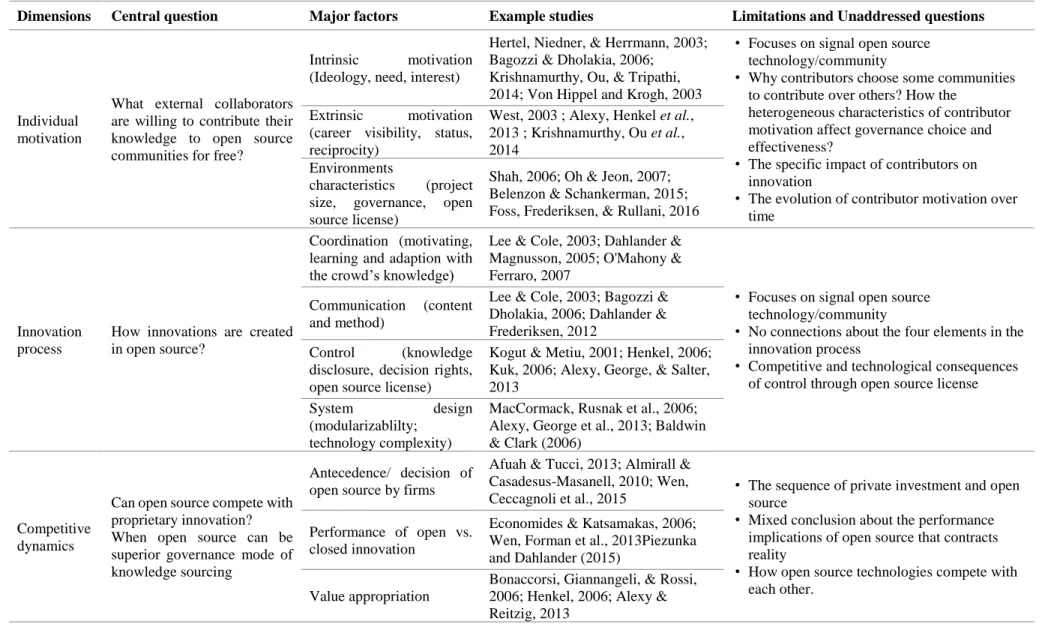
Arguably the first attempt to address open innovation from an academic viewpoint to gain systematize understanding is the editorial of Research Policy in 2003. In 2003, Research Policy launched a special issue on open source software development, almost 20 years after the start of open source. In the editorial, Von Krogh and Von Hippel (2003) summarized three critical research directions of open source at the time, namely, (1) motivation of contributors (2) innovation process, which focuses on the governance and growth of open source community (3) “competitive dynamics”, which highlights how to reconcile open source with proprietary and commercial technologies (Von Krogh and Von Hippel, 2003: 1152-1155). Such distinction is further reinforced in a special issue on open source in Management Science three years later in 2006. The first perspective, the motivation of contributors, explores the formation of external resource supply on open innovation environment without price and clearly defined ownership. Such external supply of human resource capital is a critical alternative to ventures’ internal resource accumulation in open innovation. The second perspective, the innovation process, largely focuses on the how labor supply external to ventures is governed and how technologies are developed based on open knowledge. The third perspective, the dynamics competitive, emphasizes the performance implication of open innovation. This structure gives a clear roadmap on the issues in open innovation relevant to this dissertation. Hence, in the literature review on open innovation, I will largely follow this established template and then summarize the characteristics of open source in current research and discuss important issues that have yet been addressed in the current literature, laying down the fundamental motivation of my dissertation.
Motivation of contributors
Early research on open innovation and open source displayed considerable interest in exploring the motivation of contributors to open source technologies. Different from the traditional
knowledge labor on the market or within firm boundaries, who work in exchange of salary or ownership of the intellectual property from which they can profit, many developers voluntarily develop and improve open source software without financial compensation and to not retain intellectual property. Such phenomenon in open source prompted scholar to explore the question, "Why should thousands of top-notch programmers contribute freely to the provision of a public good?” (Hippel & Krogh, 2003: 212).
To date, the extensive literature on the contributor motivation and the resulting behavior have provided detailed answers. Those answers can be categorized into four categories (1) intrinsic motivation (2) extrinsic motivation (3) technological characteristics, based on the focus of factors underlying contributor’s behavior.
2.1. Intrinsic motivation
The first perspective in open source research explores the intrinsic motivation of contributor behavior (Bagozzi & Dholakia, 2006; Belenzon & Schankerman, 2015; Hertel et al., 2003; Krishnamurthy, Ou, & Tripathi, 2014). Compared with knowledge workers for corporations, innovators in open source are driven by fundamentally different ideologies towards innovation (Von Krogh et al., 2003). Developers are willing to contribute and innovate for free, because they believe that knowledge should be public goods rather than a tool for profit (Krishnamurthy et al., 2014). Bagozzi and Dholakia (2006), for example, demonstrated how the cognitive and affective factor related to contributor’s perception towards open source play a critical role in determining the extent to which developers participate in the development of Linux kernel based on a survey of 191 developers worldwide. Theorizing open source contribution as group-referent intentional actions, they predict and found that developer’s positive attitudes, emotions and social identifies all positive influenced their tendencies to participate the Linux development, because those factors
influence the decision making, as well as developers’ perception of self-worth when joining and contributing to open source innovation. In a qualitative study of 70 open source contributors, O’Mahony (2003) found that the intent to keep their knowledge open and part of the communities contributes significantly to the contributing behavior of participants, further revealing that the important role of developers’ ideological belief in the nature of knowledge is an important factor underlying such behavior. Franke and Von Hippel (2003), on the other hand, understood contributors’ intrinsic motivation in a slightly different way. Through the case study of Apache foundation, another extremely successful open source initiative, they argue that a critical motivation for open source contribution is developer’s own needs of using the innovation. Because the demand of users are highly heterogeneous, to an extent that it is difficult for a single innovator to satisfy, users are motivated to participate and contribute to the innovation, so that they can better utilize the technologies for their own purposes. Shah (2006) further distinguished two types of intrinsic motivation as “hobbyist” and “need driven”. Through inductive studies of two open source communities, she found that hobbyist has a longer duration of participation, because “need driven participants” left as soon as their need is satisfied.
In addition, existing literature has extensively discussed the role of experience in shaping individual participation in open source (e.g., Alexy & Reitzig, 2013; Bagozzi & Dholakia, 2006; Roberts et al., 2006; Von Krogh et al., 2003). Existing literature has argued that experience impact on contributor behavior, as a result of its imprinting effect on both intrinsic and extrinsic motivation. Alexy Alexy, Henkel, and Wallin (2013b) for example, studying a large multinational engineering firm, argued that previous experience with open source increases individual tendency to support open source, because of their familiarity with the community norms and ability to adopt open source with a lower learning cost in their own work. Bagozzi, & Dholakia (2006), in arguing
the role of intrinsic motivation as discussed above, also found that such positive effect of social identification is reinforced by contributors’ experience in the Linux user group, because their involvement and interaction with other members deepen as they gain experience in the community.
2.2. Extrinsic motivation
Research on open source also extensively discussed the role of extrinsic motivation of contributors in open source (e.g., Alexy et al., 2013b; Krishnamurthy et al., 2014; West, 2003). Compared with the literature on contributors’ intrinsic motivation that focuses on the psychological attributes, such as emotion, cognition, self-identify and belief, the extrinsic motivation perspective emphasizes the reward system in open source and how the individual difference in the utility of such reward manifest the heterogeneity in contributing behavior. Reward system in open source seems to be paradoxical, because it strongly emphasizes the public goods nature of knowledge and encourages voluntary sharing (Hippel & Krogh, 2003). However, scholars have uncovered several non-pecuniary reward mechanisms that can also account for the contributing behavior in open source. The first external motivation is developers’ career concerns. For example, Lerner and Tirole (2005a) explored contributor’s motivation and behavior through the cases of Apache, Perl, and Sendmail. They summarized that programmers are motivated by the “the career concern incentives” about “future job offers, shares in commercial open source-based companies, or future access to the venture capital market” (Lerner and Triole, 2005a:14), because such participation in open source allows the performance and efforts of developers to be more visible to “relevant audience (peers, labor market, venture capital community)”. In other words, working on open innovation technologies serves as a bridge for future financial rewards, and access to potential tacit knowledge to claim future intellectual property rights? Similarly, in a
study of a large-scale telecom company, Alexy et al. (2013b) also found that the change of job role for programs, in favor or against open source innovation, would change the individual support of open source, because, for developers, such support can become the cue that allows them to fit in their organizational environment.
Research also investigated the design of monetary rewards in simulating contributing behavior, which also falls into the category of extrinsic motivation. Studying survey and archival data of the Apache project, Roberts et al. (2006) found that being paid can increase developers’ participation in open source, as such extrinsic motivation can promote their perceived importance of the tasks. Krishnamurthy et al. (2014), noticed the particular importance of ideology in open source, found that developers are less motivated by monetary rewards in they hold a strong belief in the open source movement. In this case, they regard monetary rewards as a contamination of their belief and purpose.
Lastly, literature also discusses social norms and expectation of reciprocity that extrinsic motivate contributors. For example, open source was also considered by scholars as a type of “gift economy” (Zeitlyn, 2003). Theorizing from a sociology and anthropology perspective, Zeitlyn (2003) argues that contributing behavior is essentially a gift-giving activity with the expectation of reciprocity, in the process of which contributors can accumulate “symbolic capital” that can cash out later for their own technological needs or career advancement. From a slightly different perspective, several studies investigate how open source contribution is motivated by the status seeking incentives for individuals that try to comply to the social norm of open source. For example, Roberts, Hann & Slaughter (2006) found that contributors’ status seeking intention positively influence contribution in the Apache project. They argue that the need for status motive
developers to showcase their talents through contribution, to gain recognition to the relevant audience.
2.3. Technological characteristics
Lastly, characteristics of open source technologies also shape contributor motivation and their resulting behavior (e.g., Belenzon & Schankerman, 2015; Foss et al., 2016; Oh & Jeon, 2007; Shah, 2006). The first technology level characteristics is the size of open source communities. Larger open source projects encourage contributors with extrinsic motivation, because it allows higher visibility and more effective status-enhancing (Belenzon & Schankerman, 2015). The network externality due to size can also benefit the learning process of contributors (Oh & Jeon, 2007). Another technology-related factor is the openness of the project (e.g., Belenzon & Schankerman, 2015; Shah, 2006). Although open source entails full disclosure and open communication, innovation in such mode can still vary in openness in terms of their control over the innovation process and the outcome of development. For example, studying the mail list of two major open source community, Shah (2006) found that owner’s control of decision rights decreases external contribution, because it lowers potential contributors’ expectation that the open source technology can meet the heterogeneous needs of users and flexibility in the content of contribution. In a more recent study based on 149,956 unique developers from souceforge.com, Belenzon & Schankerman (2015) further argue that the openness of projects impact on the type of contributor that can attract. Measuring openness through open source license as the extent to which the project forbids derivative commercialization (greater openness), they found that project with high openness attracts more anonymous and open developers, because of the alignment between user motivation with the ideology of the project. Meanwhile, existing research shows that the characteristics of the innovation process in open source also interacts with the contributor
behavior. Also studying data from sourceforge.net, Foss et al. (2016) found that contributors are more likely to join projects with artifact-based communication that gears toward specific problem-solving (such as patch files, bug reports, etc) compared with those that rely on open-ended discussion, because artifact-based communication eases the barrier of contribution by explicating specifying subproblems that contributor can solve.
The innovation processes in open source
The second focus in open source research is the development processes. Compared with the motivation that highlights individual-level drivers underlying open source communities, this stream of research focuses more on the community level dynamics. The central question of interest is how innovation is created in open source and how to best manage the open source communities (e.g., Baldwin & Clark, 2006; O'Mahony & Ferraro, 2007; Stam, 2009; Von Krogh & Von Hippel, 2006). Because open source entails knowledge creation to transcend beyond firm boundaries, which is at the same time, no longer protected with prosperity rights (Haefliger, Von Krogh, & Spaeth, 2008; Lakhani & Von Hippel, 2003), scholars have long suspected that the processes and dynamics given rise to open source technologies would differ from that depicted in the innovation research based on commercial technologies.
3.1. Coordination
The first unique process discussed in the literature is the coordination dynamics with contributors (e.g., Dahlander & Magnusson, 2005; Lee & Cole, 2003; O'Mahony & Ferraro, 2007). Because open source innovation relies heavily on the commitment and knowledge of volunteering contributors, how to coordinate, manage and motivate contributors for sustained contribution becomes a critical and unique issue for open source technologies. In practice, coordination in open
summarized that the community-based innovation process fundamentally differs from the firm-based innovation model, because it does not restrict membership within organizational boundary and knowledge creation and retention can be extremely distributed. Studying the Linux development community, they found that the growth of the community in distributed innovation is essentially organized by an evolutionary process of learning from errors and imperfections. In addition, studies explored the management of open source communities. Dahlander and Magnusson (2005) discussed how companies with open source project should balance between their commercial purpose and the communities. Through a comparative case study of four European firms with open source projects, they found that manager invoke several strategies to coordinate with the crowd in open source for more effective innovation, including participating the community discussion, maintain reputation, monetary rewards for problem-solving, creating online-forums and mail lists etc. Those coordination strategies then were theorized into three distinct categories of strategies, named as “symbiotic”, “commensalistic”, and “parasitic” approaches to handle open source communities as proposed by the authors.
3.2. Communication
Accompanied with coordination, communication constitutes another important focus in studying the innovation process in open source. While traditional firm-based innovation relies mostly on daily face to face interaction and communication (Cohen & Levinthal, 1990; Nelson & Winter, 1982), open source are dominated by technology-mediated communication, through online forums, email lists, etc (Bagozzi & Dholakia, 2006; Dahlander & Frederiksen, 2012; Lee & Cole, 2003). Addressing such distinct communication, studies have explored how different types of communication could impact on community dynamics and contributors’ behavior. Studying open source projects from sourceforge.net, Foss et al. (2016) investigated how the two types of
communication emerged in open source, open-ended communication and artifact-based communication based on problems, lead to initiating and contributing behavior in the community. They argue that open-ended communication is essentially a process of problem-formation, and hence can lead to the creation of new projects. On the other hand, artifact-based communication manifests problem-solving and hence will attract more contributing behavior. In addition, frequent communication is also found to give rise to the emergence of lead contributors, because the heterogeneity of open source contributors further reinforces the importance of communication in stimulating other’s motivation and keep interests aligned (O'Mahony & Ferraro, 2007). Similarly, strategic interaction with can also structures of interaction through reciprocal activities by establishing linkages among contributors (Kuk, 2006).
3.3. Control
A third factor discussed in the existing literature is the control over open source communities (e.g., Alexy, George, & Salter, 2013a; Henkel, 2006; Kogut & Metiu, 2001; Kuk, 2006). The first is owners’ control over knowledge sharing. Although open source entails transparency of source codes, it does not mean that firms are required to disclose an entire innovation in open source. To some degree, the knowledge reveals of the firm as a control over community is a firm-level equivalent to contributor behavior. Firms control the decision rights of disclosure and open source content. Such possibility brings the question, what drives the extent to which firms will disclose through open source and what are the consequences? In a theory paper, Alexy, George & Salter (2013) discussed how technological uncertainty, knowledge structure and the value capture potential of a technology affect the firm’s decision of revealing knowledge. In the context of open source, some of those have been supported by empirical evidence. For example, studying the case of Linux, Henkel (2006) found that the code sharing activity is positively related
to the need for technological supported and proprietary complementary assets, because, in such situations, open source lowers development costs without compromising the value capture opportunities backed by private complementary resources. In addition, inter-dependency of knowledge can also increase the tendency of knowledge reveal tendency. Based on the open source project of K Desktop Environment, Kuk (2006) reported knowledge sharing can be stimulated by the cross-thread connectivity in the mail list of the project, as interdependency allows higher chances that the crowd can extract useful information for improvement after revealing the knowledge. Existing literature also noticed the potential risks of excessive knowledge reveal. Kogut and Metiu (2001), for example, caution against the potential risks of “forking” in open source, as such replication of knowledge may create competing versions of technologies that erode the dominance of the originals.
Another consideration is the control over the decision rights during innovation. In study motivation of contributors, Shah (2006) noticed that the two sample communities vary in terms of who can overwrite the existing code and whether they allow different opinions to be voiced through the mail list. Such differences, as she then observed, lead to the variance in the level of contributions from hobbyists, in a way that tighter control reduces hobbyists’ contribution.
The third control strategy is the institution of open source license. Open source license was initially created to specify ownership of open source innovation. Although by design, open source forfeits the proprietary rights of innovation, it does not mean that such innovation leaves ownership or intellectual property rights undefined (Comino, Manenti, & Parisi, 2007; Lerner & Tirole, 2005b). Open source licenses are essentially loosely enforced contracts attached with the disclosure of technology. Through open source licenses, the owner of a technology declares the authorization to the public regarding the use, distribution and modification of the technology, while
retaining copyrights along with other requirements that vary across different forms of licenses. The earliest popular license was GNU General Public License created by Richard Stallman of the Free Software Foundation, one of the most famous pioneers of the open source movement. The GPL license enforces mandated disclosure of the subsequent innovation. That is, once an innovation incorporates open source technologies with the GPL license, it also has to be open sourced and with the same GPL license. In recent years, however, more liberal license such as BSD (Berkeley Software Distribution) and MIT license, which allows commercial derivatives without mandated disclosure, have become more dominant (Fitzgerald, 2006). Existing studies found that open source license constitutes an important control tool to protect open source innovation against private appropriation (O’Mahony, 2003). For example, qualitative studying 5 open source projects, O’Mahony (2003) found that open source license is frequently used to enforce legal and normative sanction on members while deviate from open source community norms, so as to deter the appropriation of open source technology for commercial users. In turn, they argued that such license reduces the involvement of commercial actors. Similarly, Henkel (2006) found that such institutionalize control over the knowledge disclosure can facilitate knowledge sharing from members in the context of Linux, because it mitigates the concern that knowledge shared in open source may be used for commercialization. Belenzon and Schankerman (2015) use open source license to measure the openness of the project and compare licenses with mandated disclosure (as high openness, such as GPL) with those that do not require so (closed, such as MIT). Consistent with prior research, they found that GPL licenses anonymous and open developers, because of the alignment of the ideology. Through formal modeling, Lerner and Tirole (2005b) also found that when the level of trust is high, the owner of the technology is more likely
to adopt a permissive license that allows ex-post value appropriation (BSD or MIT), rather than GPL.
3.4. System design
Lastly, scholars also investigated how to best design the innovation structure in communities. For example, through formal modeling, Baldwin and Clark (2006) proved that a modular architecture can improve the efficiency of open source innovation while attenuating the potential risks of free riding, because such design allows independent search for optimal solutions within each module and hence increase the overall efficiency of the open source system. In a later study of Mozilla, the authors found that as the technology becomes increasingly open, the sponsor of the open source community design the technology in a way that is more modular to improve the efficiency of open source collaboration (Alexy et al., 2013a; MacCormack, Rusnak, & Baldwin, 2006). Studies have also investigated the effect of community structure on the performance of innovation. In general, excessive concentration of active contributors in all participates impede the performance of open source technology by reducing the motivation for others to share and contribute knowledge (e.g., Kuk, 2006).
Competitive dynamics
The literature on competitive dynamics highlights the rivalry between proprietary innovation and open source. To some extent, this stream of literature is most relevant to the traditional strategy and innovation research, because it regards open source as a competing or alternative knowledge sourcing mode for innovation (Waguespack & Fleming, 2009). With the external developers who can scrutinize the technology and correct errors, open source allows easier and more timely improvements in the development processes.
Studies on competitive dynamics are interested in the firm’s decision between open source and closed innovation. That is, when should a firm choose open source? How should firms respond to the open source movement? And how can priced proprietary technologies compete with open source innovation that is distributed for free? In contrast with the innovation process research focuses exclusively on within open source communities, this literature is more interested in the comparison of different innovation models, as well as their technological and commercial consequences. This literature investigates both the antecedents and consequences of open source from the perspective of the firm, regarding closed firm-based innovation as alternative to each other.
1.4.1. Antecedence/decision of open source
Research on the antecedence of open source explored when open source can be more effective than other knowledge sourcing modes. Through simulation, Afuah and Tucci (2012) showed that crowdsourcing for innovation is a distinct governance mode in addition to internal sourcing, alliances or acquisitions. It should be the most effective for modularized problems with a distant solution that can be easily articulated, because the heterogeneity of the crowd increases the likelihood of obtaining optimum solutions outside the firm’s knowledge domain. They specifically point out that open source is a subset of crowdsourcing (Afuah & Tucci, 2013). From a similar perspective, Almirall and Casadesus-Masanell (2010) theorized the impact of knowledge complexity and flexibility of changing partners on the choice of open versus closed innovation. Through simulation, they found that when there are a large number of flexible partners to solve complex problems, open innovation outperforms closed innovation, because it allows recombination of a large number of best solutions for each sub-problems in order to identify the optimum solution for the overall innovation. Felin and Zenger (2014) also argued that open
innovation is superior in solving complex problems, because the extensive knowledge sharing can facilitate problem-solving by forming theories and heuristics to guide the distant search of a solution. In summary, those studies found that open source is particularly favorable when the technology requires distant and complicated knowledge.
The decision of open source can also be driven by the demand side factors. Henkel, Schöberl, and Alexy (2014), investigated how consumers can be an important driver of open source. Studying embedded component manufacturers based on Linux, they found that the choice of open source by companies can be motivated by customer demands. Disclosing source code stimulates demands, not only because it allows higher customizability and the ability to fix bugs, but also customers, who are often part of the Linux communities, are ahead of the firm’s own adaption into the new technology of Linux. Hence, the open source also aids firms’ adaptation and learning by meeting consumers’ demands. Wen et al. (2015) investigated the impact of institutional uncertainty on open source innovation. Studying IBM’s creation of patent commons and waiving litigation against open source communities in the 2000s, they found that lower litigation risks encourage new ventures’ entry to open source technologies.
1.4.2. Performance of open vs. closed innovation
Literature also juxtaposed the innovation performance of open source with closed knowledge sourcing modes in studying innovation performance. To date, the limited results demonstrate that the performance of open source is highly sensitive to the competition proprietary innovation. Studying the impact of potential threats of IPR litigation, Wen, Forman, and Graham (2013) found that open source projects facing such risks are less likely to be adopted by users based on over 24,301 open source projects in Sourceforge.net. Such decrease of adoption is largely due to the potential of litigation induces increases the perceived cost of adoption, particularly when
knowledge such infringement potential can be reused over time during the cumulative innovation in open source. In a simulation analysis, Bonaccorsi and Rossi (2003) considered a market with both commercial and open source software. Without the entrance of incumbents, open source software will become dominant in the market, unless commercial technologies can involve extensive R&D to compete on quality. However, under the present of incumbents, commercial technology can still take considerable market (38%). Through the similar formal modeling and simulation methodology, Economides and Katsamakas (2006) showed because vertically integrated property technology will outperform open source technology in terms of both market share and profitability. The synergy among integrated products created sticky demand that can substitute the need for open source technology that is often modularized. Such situation, however, will change, if the maximum potential demand for open source innovation is larger than the vertically integrated priced products.
Apart from competition, factors that preventing the high performance of open source innovation also emerge from the limited capability of organizations internally. Piezunka and Dahlander (2015) found that crowdsourcing may not achieve the intended technological benefits, because organizations are with limited attention span, and they tend to simplify and rationalize the filtering process based on their existing capabilities and knowledge. The analysis in suggestion forums for large incumbent manufacturing companies showed that even when firms can attract distant solutions, the often few to recognize their potential.
1.4.3. Value appropriation
The next important question in the competitive dynamics is related to value appropriation and capture in open source. It is of central interest for research on strategic management o address the question, even if open source is can produce more effective innovation and superior
technological performance, how can firms without propriety rights? The first answer given in the current literature is selective revealing (e.g., Henkel, 2006). Firms only partially open source their knowledge to learn and develop absorptive capacity from the crowd, while keeping other knowledge that is more critical to value capture private. As evidenced in the studies summarized in the previous session, open source is indeed more likely under technological uncertainty, when the promise of value capture from a technology is ambiguous (Alexy et al., 2013a).
The second answer is the integration between open source and private technologies. Lerner and Tirole (2005a) first propose that there are several ways for companies to exploit open source, including providing priced complementary services and products, proactively waving proprietary rights, initiating open source platforms, etc. Similarly, Von Hippel and Krogh (2003) argued that open source innovation, in nature, is not entirely a collective action of a social movement as depicted in early research. Rather, it resembles more with a “private-collective mode” of innovation that contains both private investment and collective creation of knowledge as public goods. The private investment, often neglected by the literature, happens when the inventor was seeding the innovation before open source, and when the inventor/initiator of the technology offers monetary rewards or other incentives to the crowd for problem-solving. The collective creation knowledge, on the other hand, refers to the further refinement and development of technology after disclosure within the open source community. Alexy and Reitzig (2013) further investigated why firms are motivated to invest in technology for such “private-collection mode”, even though it can severely undermine the value capture of technologies. They propose that, by purchasing exclusion rights on potential future innovations based on the open source technologies, innovators can reshape the appropriability regime of open source innovation. Using an exogenous shock of disclosure of potential patent infringement in open source, they found that firms that open sourced
their innovation under the “private collection mode” is more likely to release the related patents as patent commons (pledge to waive exclusion rights) (e.g., IBM) than those rely on proprietary innovation (e.g., Microsoft) because of the mechanism reasoned above. Similarly, Fosfuri et al. (2008) found that publicly listed software companies with large stocks of intellectual property rights (e.g., patents) are more likely to launch open source-based products, as they have more power to control the innovation, more complementary assets and face lower threats of litigation. This finding echoes an early research (e.g., West, 2003), in which authors study how incumbents adopted a hybrid strategy of innovation in response to the emergence of Linux. West (2003), through multiple case studies in computer software and hardware incumbents, argued that the hybrid strategy can be achieved through establishing open standards and altering the terms of open source licensing that no longer restrict the ex-post value appropriation. In doing so, firms can retain control while reducing duplicative development efforts. Hence, such strategy is particularly preferable to firms that face competition from open source innovation. Bonaccorsi, Giannangeli, and Rossi (2006) also discussed such hybrid model through the survey of over 100 Italian software firms. Against the notion that firms can capture value by offering priced open source solution service, they found that firms rarely use it as a pure business model. Rather, depending on their experiences with open source, the business models of software firms are often a mixture of licensing revenue from proprietary innovation and service revenue from open source technologies.
Critique
In this section, I reviewed the existing studies on open source innovation. The literature to date still focuses on the three broad issues Von Krogh and Von Hippel (2003) raised in the special issue of open source innovation in 2003, namely (1) motivation of contributors (2) innovation