NAVAL
POSTGRADUATE
SCHOOL
MONTEREY, CALIFORNIA
MBA PROFESSIONAL REPORT
A Cost Benefit Analysis of
Radio Frequency Identification (RFID) Implementation
At the Naval Postgraduate School's Dudley Knox Library
By: Joel D. Tiu
Shawn S. Bahk
December 2006
Advisors: Nicholas Dew Ira Lewis
REPORT DOCUMENTATION PAGE Form Approved OMB No. 0704-0188 Public reporting burden for this collection of information is estimated to average 1 hour per response, including the time for reviewing instruction, searching existing data sources, gathering and maintaining the data needed, and completing and reviewing the collection of information. Send comments regarding this burden estimate or any other aspect of this collection of information, including suggestions for reducing this burden, to Washington headquarters Services, Directorate for Information Operations and Reports, 1215 Jefferson Davis Highway, Suite 1204, Arlington, VA 22202-4302, and to the Office of Management and Budget, Paperwork Reduction Project (0704-0188) Washington DC 20503.
1. AGENCY USE ONLY (Leave blank) 2. REPORT DATE December 2006
3. REPORT TYPE AND DATES COVERED
MBA Professional Report
4. TITLE AND SUBTITLE: A Cost Benefit Analysis of Radio Frequency Identification (RFID) Implementation at the Naval Postgraduate School's Dudley Knox Library
6. AUTHOR(S) Joel D. Tiu and Shawn S. Bahk
5. FUNDING NUMBERS
7. PERFORMING ORGANIZATION NAME(S) AND ADDRESS(ES)
Naval Postgraduate School Monterey, CA 93943-5000
8. PERFORMING
ORGANIZATION REPORT NUMBER
9. SPONSORING / MONITORING AGENCY NAME(S) AND ADDRESS(ES)
N/A
10. SPONSORING / MONITORING AGENCY REPORT NUMBER
11. SUPPLEMENTARY NOTES The views expressed in this report are those of the author(s) and do not reflect the official policy or position of the Department of Defense or the U.S. Government.
12a. DISTRIBUTION / AVAILABILITY STATEMENT Approved for public release; distribution is unlimited
12b. DISTRIBUTION CODE 13. ABSTRACT (maximum 200 words)
The purpose of this MBA project is to evaluate the potential of implementing Radio Frequency Identification (RFID) technology at the Naval Postgraduate School's Dudley Knox Library (DKL). DKL is an academic library supporting a graduate student population only. This study has both quantitative and qualitative analyses. A Cost Benefit Analysis (CBA) was conducted using data gathered from research which included personal interviews, site visits, and a survey questionnaire. Time and motion studies of selected library processes were conducted at DKL and a major public library. Vendors were invited to submit proposals for RFID systems to get the latest equipment available and associated cost estimates. The qualitative analysis addressed the advantages and disadvantages of an RFID system as well as privacy and other ancillary issues surrounding its implementation. This study did not attempt to quantify potential savings from collection management, an intangible benefit that could be addressed in future studies. Finally, the study presented several options to aid NPS decision makers on whether or not to implement an RFID system at DKL.
15. NUMBER OF PAGES
65
14. SUBJECT TERMS RFID; Radio Frequency Identification; Libraries; Cost Benefit Analysis
16. PRICE CODE 17. SECURITY CLASSIFICATION OF REPORT Unclassified 18. SECURITY CLASSIFICATION OF THIS PAGE Unclassified 19. SECURITY CLASSIFICATION OF ABSTRACT Unclassified 20. LIMITATION OF ABSTRACT UL
NSN 7540-01-280-5500 Standard Form 298 (Rev. 2-89)
Approved for public release; distribution is unlimited
A COST BENEFIT ANALYSIS OF RADIO FREQUENCY IDENTIFICATION (RFID) IMPLEMENTATION AT THE NAVAL POSTGRADUATE SCHOOL'S
DUDLEY KNOX LIBRARY
Joel D. Tiu, Lieutenant Commander, United States Navy Shawn S. Bahk, Captain, United States Marine Corps
Submitted in partial fulfillment of the requirements for the degree of
MASTER OF BUSINESS ADMINISTRATION
from the
NAVAL POSTGRADUATE SCHOOL December 2006 Authors: _____________________________________ Joel D. Tiu _____________________________________ Shawn S. Bahk Approved by: _____________________________________ Nicholas Dew, Lead Advisor
_____________________________________
Ira Lewis, Support Advisor
_____________________________________
Robert N. Beck, Dean
A COST BENEFIT ANALYSIS OF RADIO FREQUENCY
IDENTIFICATION (RFID) IMPLEMENTATION AT THE NAVAL
POSTGRADUATE SCHOOL'S DUDLEY KNOX LIBRARY
ABSTRACT
The purpose of this MBA project is to evaluate the potential of implementing Radio Frequency Identification (RFID) technology at the Naval Postgraduate School's Dudley Knox Library (DKL). DKL is an academic library supporting a graduate student population only. This study has both quantitative and qualitative analyses. A Cost Benefit Analysis (CBA) was conducted using data gathered from research which included personal interviews, site visits, and a survey questionnaire. Time and motion studies of selected library processes were conducted at DKL and a major public library. Vendors were invited to submit proposals for RFID systems to get the latest equipment available and associated cost estimates. The qualitative analysis addressed the advantages and disadvantages of an RFID system as well as privacy and other ancillary issues surrounding its implementation. This study did not attempt to quantify potential savings from collection management, an intangible benefit that could be addressed in future studies. Finally, the study presented several options to aid NPS decision makers on whether or not to implement an RFID system at DKL.
TABLE OF CONTENTS
I. INTRODUCTION...1
A. INTRODUCTION...1
B. BACKGROUND ...1
C. RFID IN LIBRARIES ...2
II. LITERATURE REVIEW ...3
A. INTRODUCTION...3 B. TECHNOLOGY ...3 C. APPLICATIONS ...5 D. PRIVACY ...6 E. COST...7 1. Tags/Transponders ...7
2. Readers and Tag Printers ...7
F. ADVANTAGES OF LIBRARY RFID IMPLEMENTATION...8
1. Rapid Charging/Discharging ...8
2. Increased Circulation ...8
3. High Reliability ...9
4. High Speed Inventory ...9
5. Automated Materials Handling ...9
6. Long Tag Life ...9
G. DISADVANTAGES OF LIBRARY RFID IMPLEMENTATION...10
1. High Cost ...10
2. Vandalism ...10
3. Exit Sensor Problems...10
4. Vulnerability to Compromise ...11
5. Invasion of Patron Privacy...11
H. CONCLUSION ...12
III. METHODOLOGY ...13
A. BACKGROUND ...13
B. RFID STUDY ...13
C. ANALYSIS ...15
IV. BENEFITS AND SAVINGS ...17
A. BENEFITS...17
1. Quicker Circulation Process ...17
2. High Speed Inventory ...18
3. Intangible Benefits ...19
4. Increased Security...19
5. Higher Level of Customer Service...20
B. SAVINGS...21
1. Cost Reduction ...21
3. Reduction in Inventory Time...21
4. Savings: Missing Items ...25
5. Savings: Self-Check System ...27
V. COST OF SYSTEM...29
A. INTRODUCTION...29
B. HISTORICAL COST ANALYSIS...29
C. FUTURE PRICE OF RFID EQUIPMENT...31
D. COST OF SYSTEM...33
1. Annual Maintenance...33
2. Labor for Converting to RFID ...34
E. COST OF SYSTEM IF PRICES CHANGE ...35
1. Changing Price: One-Year Implementation ...35
2. Changing Price: Multi-Year Implementation ...35
F. COST OF SYSTEM IF PRICES STAYED CONSTANT ...36
1. Constant Price: One-Year Implementation...36
G. COST BENEFIT ANALYSIS...37
1. Cost Benefit Analysis for Changing Prices...38
2. Cost Benefit Analysis for Constant Prices ...41
VI. CONCLUSION ...45
LIST OF REFERENCES ...47
LIST OF FIGURES
Figure 1. RFID TAG (From: rfid-informationen.de/info/rfid-tag.jpg, 2006) ...4
Figure 2. RFID READER (From: Philips/at/assets/at-ge, 2006) ...4
Figure 3. Comparison of Inventory Times: RFID vs. Barcode ...23
Figure 4. Comparison of Inventory Costs: RFID vs. Barcode ...25
Figure 5. Historical RFID Tag Prices...30
Figure 6. Historical RFID Equipment Prices ...30
Figure 7. Prediction of RFID Tag Prices...32
Figure 8. Prediction of RFID Equipment Prices ...32
LIST OF TABLES
Table 1. Inventory Times Comparison ...22
Table 2. GS-05 Step 5 Pay ...23
Table 3. Inventory Costs Comparison...24
Table 4. Percentage of Missing/Lost Items After RFID Implementation...26
Table 5. Projected Missing/Lost Items at DKL ...27
Table 6. Measurement of Change in RFID Equipment Price ...30
Table 7. Prediction of RFID Equipment Prices ...31
Table 8. RFID Price Trend...33
Table 9. RFID System Annual Maintenance Costs ...34
Table 10. RFID Conversion Costs ...34
Table 11. Changing RFID Prices: One-Year Plan ...35
Table 12. Changing RFID Prices: Multi-year Plan...36
Table 13. Constant RFID Prices: One-Year Plan ...37
Table 14. Cost Benefit Analysis of Changing RFID Prices: One-Year Plan...39
Table 15. Cost Benefit Analysis of Changing RFID Prices: Multi-Year Plan ...40
Table 16. Cost Benefit Analysis of Constant RFID Prices: One-Year Plan ...42
ACKNOWLEDGMENTS
We would like to thank our advisors, Drs. Nicholas Dew and Ira Lewis for their outstanding support and expert guidance during the development of this MBA project. We are also very grateful to the librarians and library staff members of DKL, Ms. Eleanor Uhlinger, Ms. Layne Williams, Ms. Irma Fink, Ms. Dorothy Natt, Ms. Judit Sedillos, and Ms. Ann Jacobson, for providing valuable data and resources throughout the course of this project. We would especially like to thank Ms. Greta Marlatt for her unmatched professionalism in providing research and editing assistance. Finally, we would like to thank Ms. Nita Maniego for getting out of her way to ensure our formatting is impeccable.
LCDR Joel D. Tiu: I would like to thank my wonderful wife Vida, and my children, Justine and Derrick, for their understanding and loving support throughout my naval career. "I could fly higher than an eagle, 'cause you are the wind beneath my wings." I would also like to thank my project partner, Capt Shawn Bahk, without whom I would not have been able to complete this task.
Capt Shawn S. Bahk: I would like to thank my loving parents for always encouraging and supporting me throughout my life and career. Without them I would not be the person that I am today. I would also like to deeply thank my project partner and mentor, LCDR Joel D. Tiu, whose wisdom, organizational skills, and dedication I could not have done without.
I. INTRODUCTION
A. INTRODUCTION
Libraries, like many businesses and other organizations, have relied on advances in technology to improve their efficiency and customer service while at the same time reducing costs of operation. Radio Frequency Identification (RFID) is a relatively new technology that has the potential to change the way libraries conduct business by providing savings in time, labor and capital while also delivering improved performance through faster, more accurate service and better security (Engel, 2006, 8).
Regardless of any library's unique size, scope of service or focus, RFID has the potential to bring about a number of benefits. The efficiencies it can bring are hard to overlook, although they do not come without costs, not only in financial terms but also in privacy (Cadoo, 2006, 1). This study specifically aims to evaluate the potential of implementing an RFID system at the Naval Postgraduate School's Dudley Knox Library (DKL) in Monterey, California.
B. BACKGROUND
RFID technology was first used during World War II when American and British aircrafts were identified by scanners strategically positioned along the battlefield. Thus, it could be argued that RFID has been used to pierce the fog of war. With vast improvements in computer power, the emergence of the Internet, and miniaturization of components, the stage has been set for RFID to now pierce the fog of commerce (Lichtenberg, et al., 2004, 206).
RFID is a combination of old and new technology, employing older radio-frequency-based technology with today's microchip technology (Boss, 2006, 1). With its wide variety of applications in government, business and industry, some people have claimed that RFID could be the next World Wide Web (Lichtenberg, et al., 2004, 207).
Wal-Mart, Boeing, Airbus and other big firms including the Department of Defense have embraced the technology and are proponents of RFID use.
C. RFID IN LIBRARIES
Although RFID technology has been in use in business and other sectors for over 20 years, it still has very limited applications in libraries. As of late 2005, there were only about 300 libraries worldwide with installed RFID systems (Boss, 2006, 1).
Singapore, a pioneer in RFID technology, has the distinction of being the first country in the world to install RFID systems in all 21 of its public libraries. This feat was accomplished in April 2002. Wong Tack Wai, the Senior Manager for Services Innovation and Development at the National Library Board (NLB) of Singapore stated that "The revolutionary use of RFID by NLB, has meant better service levels, greater productivity and cost savings." NLB claimed to have saved some $50 million in potential costs, and were able to reduce waiting times by 80 percent, from 1.5 hours down to less than 15 minutes during peak hours. They have also managed to cut down returns processing time to almost zero, i.e., as soon as a book is placed in the book drop, it is automatically checked in (Singapore National Library Board, 2002, 20).
Netherlands has reportedly embarked on a grand plan to implement RFID in all of their public libraries within four to five years. This will enable any Dutch library to read the tags of all the books throughout the country, not just their own (Boss, 2006, 17). In China, the world's second largest RFID enabled library automation system will open in 2006 at the Shenzhen Library, starting with 2 million tags. This will be the largest in China, but second only to the world's biggest RFID enabled library, the Seattle Public Library. Even the Vatican has started using RFID tags on 120,000 of its collection, with
II. LITERATURE
REVIEW
A. INTRODUCTION
Radio frequency identification, also known as RFID, has been used by businesses and governments worldwide to streamline logistics and supply chain management, improve security and reduce cost, just to name a few of the benefits. Although the technology has been around for more than 50 years, it has taken off exponentially only during the last ten years. Currently, RFID is also used in a wide variety of applications such as automatic highway toll systems, anti-theft systems at retail stores, manufacturing controls, and even to track cargo hauling vehicles (Anderson, 2002, 57-60).
This technology is also being adopted by libraries to help modernize their way of doing business. As evidenced from its growing popularity, RFID promises to streamline library operations through faster self-checkout and returns, improved shelf management and inventory control, and better security. However, with better efficiency also come issues of privacy, such as tracking a person's movements and reading habits, which may sound far fetched but entirely possible. Thus, librarians must address these privacy concerns or should at least be aware of their implications (Smart, 2005, 13).
B. TECHNOLOGY
An RFID system is made up of two units, a reader and a transponder. A transponder, also known as a tag, is a small computer chip that can store data. It is also equipped with a tiny antenna that enables it to exchange information with the reader (Kern, 2004, 317). RFID relies on radio waves to automatically identify tagged items, and then transfer data from a transponder to a reader. The reader will then transmit the data to a database in real time. Each tag has a basic identification code and written data for permanent storage. When a tag goes through a reader's radio frequency field, it is activated by the reader to transmit its data (Ward, 2004, 19).
There are two types of transponders, active and passive. An active transponder comes with its own power supply and continuously transmits information while a passive
transponder uses the signal from the reader to activate and communicate information (Anderson, 2002, 57-60). Some tags are read/write capable, allowing libraries to write additional information for circulation purposes, such as adding a physical location that can be used in conjunction with automatic book sorters. Tags are designed to last the life of the item they identify (Ward, 2004, 19). Figure 1 shows a picture of an RFID tag and Figure 2 shows a picture of an RFID handheld reader.
Figure 1. RFID TAG (From: rfid-informationen.de/info/rfid-tag.jpg, 2006)
sent at a frequency of 13.56 MHz. Passive tags use induction to receive energy from the reader (Kern, 2004, 317). They do not require batteries and therefore have the advantage of longer shelf life. Active tags have better range but are limited by their battery life.
Most RFID tags are equipped with an anti-theft security feature, which allows check-out and desensitization all in one sweep. This combined process will potentially reduce repetitive strain injuries. A tagged item that has not been properly checked out will set off an alarm when it passes through the RF field emitted from security gates. RFID provides privacy by using self-check out kiosks. These kiosks also help reduce long lines and shift the task of checking out items from library staff members to patrons (Ward, 2004, 20).
C. APPLICATIONS
RFID tags can be used in a wide variety of ways. Their potential applications are virtually unlimited due to their durability. Tags do not require line of sight unlike barcodes and optical scanners. The read time is typically less than 100 milliseconds, and multiple items can be read simultaneously (Singh, et al., 2006, 24).
RFID tags are simple, small and can be applied to almost any object, from books and grocery goods to vehicles and even under the human skin. Some car manufacturers are looking into the idea of inserting an RFID capsule into a person’s hand and installing a reader in the car to make the use of car keys a thing of the past. Easy Pass or EZ-pass allows you to pay your toll as you pass by the booth at great speeds, without the need for stopping. The RFID chip transmits the information to the transit authority computer which will bill you automatically (Lichtenberg, et al., 2004, 206). Scientists have also inserted tags into wild animals to track their migration and breeding habits. Wal-Mart and a growing list of other businesses use tags to facilitate the movement of pallets of goods and help manage their inventories. The Food and Drug Administration is considering the use of tags to easily identify drugs and help prevent counterfeiting. DVD manufacturers might use tags to prevent movie piracy (Coyle, 2005, 486).
In February 2006, the Department of Defense (DoD) extended its RFID contract with Savi Technology for 2 years and increased it from $207.9 to $424.5 million. Savi Technology, a Lockheed Martin company, helped build DoD's in-transit visibility network which spans more than 45 countries and tracks military supplies through more than 2,000 sites. This contract provides RFID products and services for a common, integrated structure for logistics tracking, locating, and monitoring of assets (Savi, 2006). DoD is also trying to improve asset visibility in its supply chain by requiring suppliers to affix passive RFID tags at the case and pallet level.
Other reasons for the growing popularity of RFID applications include ease of use, miniaturization, and accuracy. As mentioned above, there are already hundreds of ways the technology is being utilized. As it matures and becomes more widespread, RFID tags will be installed practically everywhere.
D. PRIVACY
Aspreviously mentioned, RFID technology is already being used by many private and public entities. Due to this widespread use, some issues have arisen concerning the RFID user's privacy. As William Atkinson points out, “an even greater concern is that, should RFID tags become truly ubiquitous, embedded in virtually all consumer products, they could be used not only to track consumer shopping habits, but also to track the consumer themselves" (Atkinson, 2004, 1).
The very real potential for RFID technology to cause privacy issues exists because when a consumer purchases an RFID tagged item, it is possible for that product to be associated with the consumer’s credit card number. Atkinson added that, “every product is identified and linked to its owner at point of sale or transfer" (Atkinson, 2004, 1). This privacy violation can occur anywhere and can easily fall into the wrong hands because information from the tag and reader is transferred through the air through
article, "RFID Use Raises Privacy Concerns," is one such strategy (Oder, 2003, 19). This mandatory kill switch is turned off by most retailers and businesses once the product is purchased or transferred. In fact, this is probably going to be the standard operating procedure for entities who want to protect their customers. But even with this protective measure, one cannot guarantee that there will not be a device in the future that could undo the kill switch. That is why it is a good idea for the American Library Association to take the lead in adopting a set of principles and regulate the application of RFID technology in libraries.
To maximize consumer privacy, only essential data should be loaded into the RFID chips. Another option is to add encryption to data being transferred between the tag and the reader, that way even if data is compromised, it will be garbled and useless. However, there is no known mechanism that can read tags when they are turned off (Oder, 2003, 19).
E. COST
1. Tags/Transponders
The cost of an RFID system varies depending on an organization’s inventory and system configuration requirements. Generally, a passive tag used in retail business can cost anywhere from 10 cents to 25 cents (Atkinson, 2004, 14). However, library tags cost significantly more since they are designed to last the book's lifetime and average around 68 cents at time of initial purchase (Engel, 2006, 6).
When compared to the cost of putting a barcode on an item, which is a fraction of a cent, the price of an RFID tag may seem expensive. But just like any technology, prices for tags are dropping. Especially with the new paper tags or transponders, engineers say they expect to push RFID technology into low-cost, disposable packaging (Design News, 2001, 52).
2. Readers and Tag Printers
Transponder readers can cost from as low as $1,000 to several thousand dollars for high-functioning models (Shutzberg, 2004, 98). The number of readers required will
depend on the kind of RFID infrastructure an organization wants, as well as taking into consideration the number of exit and entrance areas to be covered. Another factor required to determine the number of readers necessary to run an effective RFID system is to know the number of checkout counters and hand held readers needed. Tag printers, which are required to program tags, cost on average from several thousand dollars to an overall cost of about $25,000 (Shutzberg, 2004, 98).
F. ADVANTAGES OF LIBRARY RFID IMPLEMENTATION 1. Rapid Charging/Discharging
RFID speeds up circulation operations when compared to barcodes because multiple items with tags can be read simultaneously. Early on, this was problematic and unreliable, but with the development of an anti-collision algorithm, it is now possible for an entire stack to be simultaneously charged or discharged reliably well (Boss, 2006, 1).
The Singapore experience is by far the best example of this, reducing their charging waiting times by 80 percent, from 1.5 hours down to less than 15 minutes during peak hours, and by bringing their discharging times completely down to zero (Singapore National Library Board, 2002, 19). This means that the borrowed item is registered as returned as soon as the item is placed in the book drop.
2. Increased Circulation
Self-check-out and check-in is much faster and easier with RFID because tagged items do not require line of sight to be read and stacks of items can be charged at the same time (Boss, 2006, 2-3). This simple procedure speeds up circulation and shifts work from library staff memberss to patrons which results in increased circulation and potentially reduces repetitive strain injuries.
Singapore was able to increase circulation from 22 million loans and 12.8 million customers in 1997 prior to RFID, to a projected 31.7 million loans and 31.5 million
3. High Reliability
Anecdotal evidence suggests that RFID readers have a 100 percent detection rate whenever the item is within 12 to 24 inches of the equipment. Some vendors make the same claim but there is as of yet no statistical weight to these claims. Some libraries have also reported fewer false alarms with RFID systems compared to older technologies (Boss, 2006, 3).
4. High Speed Inventory
RFID handheld readers have the unique advantage of scanning tags without having to remove the books and other items from the shelves. This drastically reduces the amount of time required to conduct an inventory. Not only does the scanner update the inventory count, but it also alerts the library staff member when a book is not in its proper place (Boss, 2006, 4). California State University, Long Beach, had never performed an extensive inventory before RFID, but now has the ability to inventory 5,000 books per hour (Smart, 2004, 5).
According to Wong Tack Wai, the Singapore library can inventory 100,000 items in just four hours whereas it previously took the staff a week to do the same amount (SirsiDynix/Tagsys, 2006, 10).
5. Automated Materials Handling
Automated materials handling using RFID would potentially be cost effective for a large library with a high circulation volume, although not widely used due to the high cost of the equipment and space requirement. It includes a sorter and conveyor which moves items and puts them in the proper bins for reshelving, greatly reducing repetitive motion and time for library staff (Boss, 2006, 4).
6. Long Tag Life
An RFID tag is designed to last the life of the item it identifies. It lasts much longer than a barcode because it does not need to come in contact with anything (Boss, 2006, 4).
G. DISADVANTAGES OF LIBRARY RFID IMPLEMENTATION 1. High Cost
Like any new technology, the biggest hurdle to RFID system implementation is the initial cost outlay. Tags and equipment are still quite costly but will eventually go down in price as demand increases. Library tags, however, are expected to remain more expensive compared to retail tags because they are designed to last the life of the item (Schneider, 2003, 3). A random polling of librarians has determined that $0.50 per tag is the perceived threshold price that will sway many libraries to seriously consider a switch into the technology. A European RFID tag manufacturer, Gemplus, said that it will introduce a $0.50 tag into the market within one year (Boss, 2006, 5).
2. Vandalism
Another disadvantage of RFID is the tags can be easily removed. An organization that has faced this problem due to vandals removing RFID tags is the Skokie Public Library in Illinois (Smart, 2004, 4). As Toni Oberman, head of circulation at the library, says in the article Making Sense of RFID,“I’d love to know how our patrons have figured out how to get the tag out of the book without being seen” (Smart, 2004, 6).
Although vandals can disable an RFID transponder by ripping it out, there are measures to counter this problem. One of the measures is to purchase a more expensive RFID tag that is harder for vandals to identify. This sophisticated system enables the RFID tag to blend in with the book, making it harder for people to locate it. Another measure is to apply a stronger adhesive that would make it harder for vandals to remove tags (Marlatt, 2006).
3. Exit Sensor Problems
When multiple items are read simultaneously by the exit sensor readers, their responsiveness and accuracy decline. In some situations the RFID tag can be missed by the readers altogether. “This degradation may not be apparent when there are only one or
Although this problem can impair the overall performance of the RFID system, as technology improves, this disadvantage is expected to be easily eliminated.
4. Vulnerability to Compromise
An RFID system can be compromised by wrapping the item with a few layers of aluminum foil. This will block the radio signal. Another way to compromise the system is by placing two items so that one tag overlays another. This may intentionally or unintentionally cancel out the signals. These two ways, however, might require premeditated theft and knowledge of the system to defeat it (Boss, 2006, 5).
5. Invasion of Patron Privacy
A negative issue surrounding RFID implementation is privacy. According to University of California, Berkeley, electrical engineers David Molnar and David Wagner, tags are vulnerable to security risks. In their article, they looked at specific threats to RFID architectures in libraries (Molnar, Wagner, 2004, 4-9). To address these concerns, best practices have been developed by the Berkeley Public Library and the Office of the Information and Privacy Commissioner of Ontario. Some recommendations include notifying patrons that RFID is being used, designating a person to oversee security measures, and regularly auditing privacy controls (Smart, 2004, 5). Singapore addressed privacy concerns by encrypting RFID tags to "ensure they don't fall into the wrong hands" (Himmelsbach, 2005, 16).
RFID tags can only be read from a distance of two feet or less because the tags reflect a signal that comes from the reader. Thus, it is almost impossible for someone to read tags from across the street or hallway. It would be easier to look at the book itself than to hack the automated library system. But there is a perception among some people that RFID is a threat to patron privacy. As such, it is important for librarians to address privacy concerns before implementing an RFID system. The Intellectual Freedom Committee of the American Library Association has drafted and adopted a set of principles in response to RFID privacy concerns (Boss, 2006, 6-9).
H. CONCLUSION
An RFID system offers many benefits to a wide variety of industry and business sectors because of its versatility for use and unlimited application. It can potentially streamline the supply chain, improve the asset visibility and inventory management of any organization, and transform it into a modern and efficient one.
Although there are some disadvantages associated with this technology, privacy and cost being the prominent ones, the industry is ceaselessly coming up with new and innovative solutions. "RFID is an advanced technology compared to barcodes" (Coyle, 2005, 486). Constant improvement in technology is making it easier for organizations to transition from aging barcode based platforms to modern RFID based systems.
Libraries must embrace new and emerging technologies in much the same way other businesses and government entities do to remain relevant. They cannot afford to ignore this technology lest it becomes the successor technology to barcodes. Although the technology is very promising and quickly becoming widespread, there are certain limitations to its library applications. When attached to flimsy items such as magazines, sheet music, pamphlets, etc., the tags pose some problems (Coyle, 2005, 486-488).
The potential benefits are obvious and the systems are getting cheaper. When the technology matures even more and competition increases in the industry, better tags and equipment will become more economical. It may only be a matter of time before RFID technology will completely replace barcode systems and become the standard for every organization.
III. METHODOLOGY
A. BACKGROUND
The Dudley Knox Library (DKL) houses and manages a growing number of print and media collections in support of the Naval Postgraduate School's (NPS) mission. This includes books, NPS theses, professional reports, dissertations, technical reports, federal documents, as well as a broad range of scholarly journals, magazines, and reference materials. The collection size has continued to increase while the number of personnel has remained stagnant, so the NPS Library is no longer able to conduct regular inventories, shelf-read, weed larger collections or locate missing materials. Items presented for check-out/check-in are processed individually and require line of sight to be read by a barcode reader. Desensitizing/re-sensitizing of the magnetic strip is also required for security and is a separate function. Media items require a different security strip than that used with books/journals and not all items can be checked out via the self-check out machine (Fink, 2006). There are also a number of items in the collection that do not typically circulate such as reference books, journals, indexes and abstracts (Williams, 2006, interview).
B. RFID STUDY
RFID technology has the potential to improve some or all of the different library processes such as the ones listed above. In addition, it can also improve security and prevent repetitive strain injuries among library staff. Since no two libraries are exactly the same, those that implemented RFID systems have their own unique situation or goals for doing so.
To thoroughly evaluate and analyze the potential of RFID technology, it was necessary to conduct an exhaustive review of available literature. These included scholarly journals, news and magazine articles. During the research portion of the study, it quickly became apparent that library application of RFID technology is still in its early stages. Scholarly journals were in short supply and articles written by Boss (author of
many books and articles on information technology and library automation), Smart (Electronic Resource Cataloger at California State Polytechnic University, Pomona), and Coyle (former University of California librarian, currently Digital Libraries Consultant) were often quoted on other articles. Information on RFID application in foreign countries is especially scarce, and many articles from countries like Japan and the Netherlands were not available in English. A well publicized and often referenced article on the benefits of RFID was written by the National Library of Singapore regarding their RFID experience. Due to the absence of conclusive data, studies can only be considered preliminary and the evidence anecdotal. Even the study of California libraries that have implemented RFID systems conducted by Engel failed to come up with statistically significant data and concluded by saying that "more research is necessary" (Engel, 2006, 7).
The authors developed and sent out a questionnaire to gather pertinent data for the study. The questionnaire was broken down into three separate sections, one for librarians using RFID, a second one for RFID vendors, and a third one tailored to DKL staff. The questionnaire was then sent via email to prospective interviewees. Personal interviews with librarians who are currently using RFID systems were particularly important and useful. Vendors were also interviewed and invited to submit proposals to get information on the latest RFID equipment available on the market with the current prices. The average of these prices became the basis of the costs included in the quantitative analysis. A time and motion study of some library processes were conducted at a major public library currently using an RFID system. The circulation of this library was in excess of 2.6 million per year as compared to DKL's annual circulation of only about 30,000 per year, therefore its focus was on how to accommodate increasing circulation while still maintaining the same level of customer service.
library with limited physical circulation, the primary goal of implementing RFID will be different from other libraries that focus on the check-out/check-in of library materials.
C. ANALYSIS
Methods used to analyze the data for this project include the following: forecasting using historical data, price averaging, break down of government employee salary from annual to hourly, calculating time for inventory and conversion, and finally, using net present value to compare benefits to costs.
Benefits and savings of RFID implementation were analyzed by capturing money and time saved when conducting an inventory using an RFID system versus using a barcode system. Realistically, DKL has not conducted an inventory in over a decade because it is very time consuming and labor intensive. Therefore, data obtained from a time and motion study of a partial inventory were used to calculate the time required to do an inventory of the entire collection. To calculate the time required for an inventory using RFID, data gathered from interviews with librarians with installed RFID systems as well as data provided by vendors were used.
Research data gathered on missing items that libraries were able to find when conducting their first inventory helped in capturing the savings of finding missing items. Three libraries were used in this analysis: University of Nevada, Las Vegas (Lied Library), Naval Research Laboratory Library, Washington DC, and Santa Clara City Library. By getting the percentage of average missing items from all three libraries, a forecast of how many items DKL can expect to find was made and a dollar figure to this savings was calculated.
Costs were analyzed by using price data provided by RFID vendors. Due to the proprietary nature of this information, vendor identities were kept undisclosed and equipment prices for analysis used were the average price of these vendors.
IV.
BENEFITS AND SAVINGS
A. BENEFITS
A study conducted on California Public Libraries by Engel revealed that the two most common benefits realized by libraries that implemented RFID were self-service (i.e., self-checkout and self-check in) at 89% (8 out of 9 libraries) and customer satisfaction at 70% (7 of 9 libraries) (Engel, 2006, 6). However, this study is considered preliminary due to the low number of respondents and the benefits realized by these libraries can only be regarded as anecdotal at best. Further studies have to be conducted in the future to come up with meaningful statistical inferences. An extensive review of RFID literature currently available worldwide reflects a similar finding. Library application of RFID technology is relatively new, and therefore, benefits and savings reported by some libraries do not have the statistical weight or depth to be conclusive.
1. Quicker Circulation Process
RFID reduces charging/discharging times (i.e., check-out/check-in) because tags can be read much faster than barcodes and items can be read simultaneously (Boss, 2006, 2). The use of RFID also encourages self-charging because patrons do not have to carefully line-up items using line of sight the way a barcode reader does. Patron self-check-in has become very convenient by installing readers in book drops, eliminating the need for staff intervention.
Perhaps one of the better known success stories in library RFID system implementation is the Singapore experience. In 2002, Singapore claimed that the island nation became the first country in the world to implement RFID systems in all 21 of its public libraries. A report presented by the Singapore National Library Board (NLB) to the European Library Systems Seminar in Rome, Italy in April 2002 highlighted the benefits and savings realized with RFID. The Singapore model, which is a big proponent of full automation without human intervention, has attained 98% self-check-out among its millions of customers as well as a reduction in self-checkout and self-check-in
processes during peak hours from 1.5 hours down to less than 15 minutes (Singapore National Library Board, 2002, 20).
Another example of faster circulation processing time using RFID was the study conducted by the Mastics-Moriches-Shirley Community Library in New York State. This study compared RFID with Electronic Article Surveillance (EAS) systems and reported an 85 percent reduction in circulation labor time using RFID (Smart, 2005, 14).
The Santa Clara City Library has the distinction of being the first library in California to implement RFID. In a personal interview, Saunders, the library director, stated that her library has an annual circulation volume of 2.6 million. With the same number of library staff members, this increase in circulation volume was made possible by the use of an RFID system (Saunders, 2006, interview).
DKL, with an annual circulation volume of only about 30,000, pales in comparison to that of the Santa Clara City Library. Based on this aspect alone, one could argue that DKL will not significantly benefit from RFID. However, even on a smaller scale, DKL can still realize some benefits such as quicker check-out and lesser human intervention with the self-check machine. This will allow the circulation staff members to attend to other tasks.
2. High Speed Inventory
Compared to a barcode-based system, RFID systems have the unique ability to scan books and other library materials without the need to remove them from shelves. This speeds up the inventory process and minimizes motions which lead to repetitive strain injuries. While conducting an inventory, the portable reader can also locate missing materials and identify items that are not in proper order (Boss, 2006, 4).
The Singapore National Library Board reported that a stock-take exercise or inventory with barcode machines used to take two to three days to accomplish, but with RFID, this evolution now takes less than four hours. Another well publicized example of
capability encourages library staff members to conduct inventories more frequently, which results in a more updated and relevant collection.
Inventory is the area where DKL can potentially reap the most benefits. RFID implementation will identify and help library staff members to weed out undesired materials, shelf-reading will make it easier to locate missing items and result in a more accurate volume collection and, more importantly, it will make room for the growing collection at DKL.
3. Intangible Benefits
Although it is difficult to put a dollar figure on intangible benefits, they are as important as any other benefit associated with the implementation of an RFID system.
One of the major intangible benefits of having an RFID system in a library is in collection management. DKL can keep track of internal circulation of items with RFID technology. Internal circulation refers to items, such as books and journals, which were pulled out and left for re-shelving. These items were more than likely used by patrons inside the library. A library staff member using a portable RFID reader can quickly collect this information by reading the RFID tags on each item. By adding the internal and external circulation data, a library can get a clearer picture on which items are utilized the most by patrons and plan the purchase of new items using this data.
This is very important in helping libraries more efficiently manage their collection. It will also save money and valuable time in allowing libraries to purchase more relevant items that will be used by their patrons. Since a library’s budget for purchasing new items is limited, buying the right item becomes essential.
4. Increased Security
"Tattle-tape" is currently the most common type of security employed by libraries. This type of security is considered unsatisfactory by many librarians because the alarm system does not have the ability to identify the offending item, requiring patrons to empty their bags in search of the item. This often results in delays and causes an embarrassing situation between patrons and library staff members, especially when it
is a false alarm. RFID systems, on the other hand, can improve security by having fewer false alarms and by having the ability to identify the offending item (Engel, 2006, 19).
DKL identified 97 missing books from September 2005 to August 2006 (Fink, 2006). Another issue with the existing library system is the fact that there is no way to tell whether these items were stolen or misplaced around the library. An RFID system would be able to locate misplaced items and, more importantly, provide better security by identifying items that are being improperly removed from the library. If the security alarm is activated, the offending item will appear on the circulation library staff member's computer screen, thereby preventing embarrassing situations between patrons and library staff members. This added security feature will work on the assumption that tags haven't been removed by offenders (Marlatt, 2006).
5. Higher Level of Customer Service
The greatest RFID benefit as reported by the Singapore National Library Board (NLB) is a higher level of customer service. Their system was able to cut down waiting time for item checkout by about 80 percent, from 1.5 hours down to 15 minutes during peak hours. NLB also attained the nearly impossible goal of zero-minute queues (i.e., no waiting time) for item returns because loans are automatically checked in as they go through the book drops. The RFID advantage resulted in higher productivity, lower training costs, and labor cost savings (Singapore National Library Board, 2002, 20).
The California library survey of customer satisfaction reported that patrons are happy with the RFID system (Engel, 2006, 24). At DKL, this would be another intangible benefit that is difficult to quantify. Some of the possible benefits include: the availability of books in the right location when customers need them; quicker library processes with less human intervention which would free up library staff members to devote more time for customer service; and would allow them more time to process inter-library loan requests.
B. SAVINGS
Return on investment (ROI) and savings, like benefits, have not been sufficiently documented by libraries that have implemented RFID. Due to the limited amount of data currently available, it is difficult to make generalizations about potential savings. However, libraries that claim to have realized such savings can still provide useful information and guidance to libraries contemplating implementation (Engel, 2006, 21).
1. Cost Reduction
Cost reduction is expected primarily in the circulation process. The best example in this area again, is the Singapore model, which reported over $50 million in potential savings annually (Singapore National Library Board, 2002, 15). Another widely used example in cost savings is the UNLV Library inventory project which reported an estimated savings of over $40,000 by finding missing books (Marks, 2002, 1).
2. Reduction of Staff Injury
RFID is a promising technology that can reduce staff injury caused by repetitive strain. Jackie Griffin, former director of Berkeley (California) Public Library, disclosed that about $2 million in worker compensation claims due to repetitive motion injuries could be saved by self-checkout machines. This was based on a 2002 study conducted by an independent consultant hired by the city (Goldberg, 2005, 14).
An inquiry into worker compensation claims filed by DKL employees has revealed that no claims have been filed as a result of repetitive motion injuries for the past three years. This could be due to the low circulation volume and the fact that inventories have not been conducted for the past ten years (Fink, 2006). This does not mean, however, that future injuries could not be prevented by implementing RFID.
3. Reduction in Inventory Time
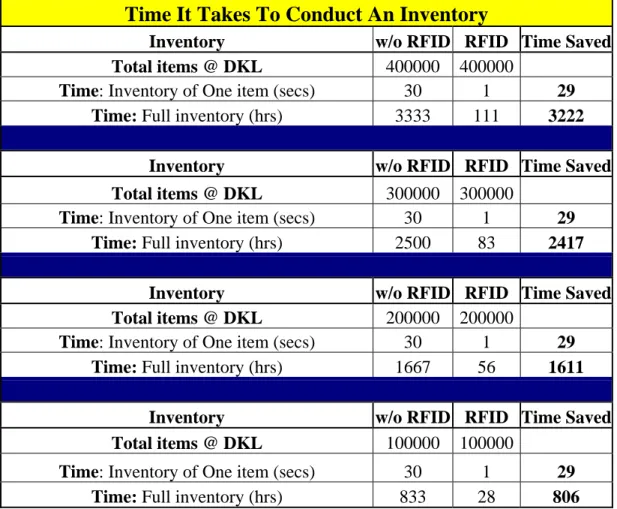
DKL has not conducted an inventory in over a decade. This is due to a variety of factors, two of the major factors being lack of personnel and the time associated with conducting an inventory. With the assistance of RFID vendors, DKL staff, and a site visit to a large public library, time and motion studies were conducted to gather data. Using this information, inventory times using the barcode system were compared to
inventory times using the RFID system. Table 1 shows the results of computations for conducting an inventory of 400,000 items, 300,000 items, 200,000 items, and 100,000 items, respectively. The calculations of inventorying different numbers of items are necessary when implementing RFID tags in multiple years.
Time It Takes To Conduct An Inventory
Inventory w/o RFID RFID Time Saved Total items @ DKL 400000 400000 Time: Inventory of One item (secs) 30 1 29
Time: Full inventory (hrs) 3333 111 3222
Inventory w/o RFID RFID Time Saved Total items @ DKL 300000 300000 Time: Inventory of One item (secs) 30 1 29
Time: Full inventory (hrs) 2500 83 2417
Inventory w/o RFID RFID Time Saved Total items @ DKL 200000 200000 Time: Inventory of One item (secs) 30 1 29
Time: Full inventory (hrs) 1667 56 1611
Inventory w/o RFID RFID Time Saved Total items @ DKL 100000 100000 Time: Inventory of One item (secs) 30 1 29
Time: Full inventory (hrs) 833 28 806 Table 1. Inventory Times Comparison
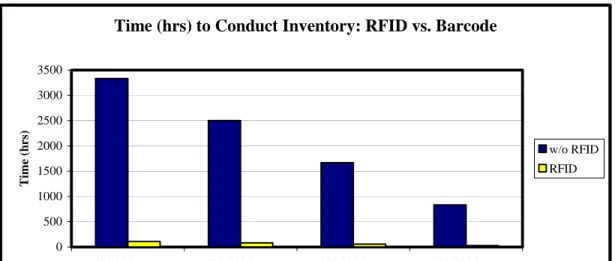
Time (hrs) to Conduct Inventory: RFID vs. Barcode
0 500 1000 1500 2000 2500 3000 3500
400,000 items 300,000 items 200,000 items 100,000 items
Tim e (h rs ) w/o RFID RFID
Figure 3. Comparison of Inventory Times: RFID vs. Barcode
To get a comparison of conducting an inventory with an RFID system versus conducting an inventory without an RFID system, data in Table 1 was used in conjunction with the hourly pay rate of a GS-05 step 5.
At DKL, the most likely pay grade that would conduct an inventory is a GS-05, step 5 federal employee who earns about $36,745 annually. Therefore, using this pay grade for this analysis was necessary. The annual salary in Monterey is higher than the national average due to the higher cost of living. Table 2 shows the breakdown of the annual pay into weekly, daily and hourly rates.
GS-05 Step 5 Pay
Avg GS-05 annual Salary $36,745 GS-05 salary per week (52weeks) $707
GS-05 salary per day (5 days) $141 GS-05 salary per hour (8 hrs) $17.67
Table 2. GS-05 Step 5 Pay
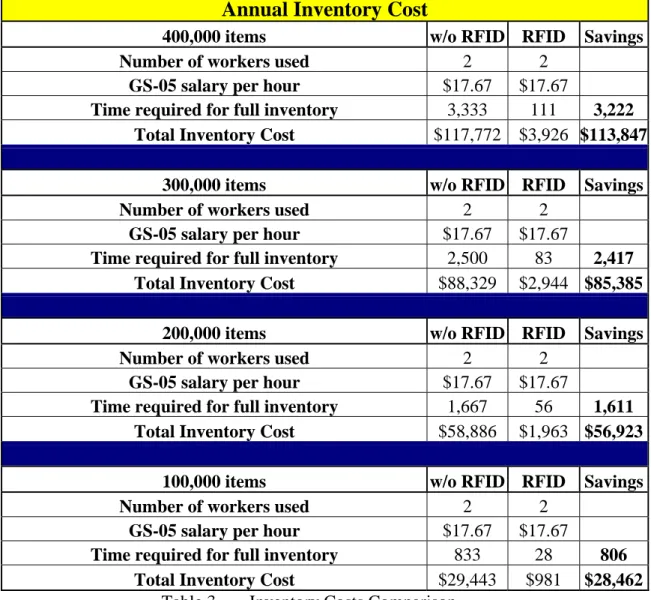
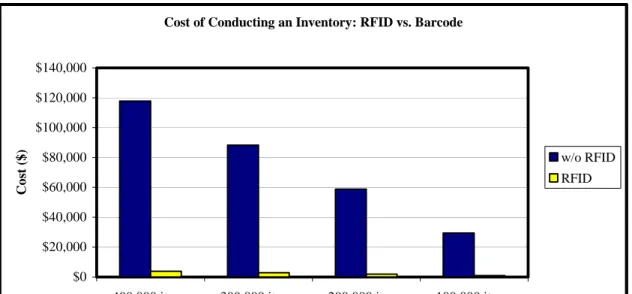
By applying data gathered from Tables 1 and 2, it was easy to arrive at a dollar figure on how much it would cost to conduct an inventory with the barcode system and with the RFID system. Table 3 shows the amount of time and money saved by using an RFID system versus a barcode system when conducting an inventory with two employees. Again, savings were calculated using 100,000 items, 200,000 items, 300,000
items, and 400,000 items, respectively, to capture savings when a multi-year RFID implementation is used.
Table 3. Inventory Costs Comparison
Annual Inventory Cost
400,000 items w/o RFID RFID Savings Number of workers used 2 2
GS-05 salary per hour $17.67 $17.67
Time required for full inventory 3,333 111 3,222 Total Inventory Cost $117,772 $3,926 $113,847
300,000 items w/o RFID RFID Savings Number of workers used 2 2
GS-05 salary per hour $17.67 $17.67 Time required for full inventory 2,500 83 2,417
Total Inventory Cost $88,329 $2,944 $85,385
200,000 items w/o RFID RFID Savings Number of workers used 2 2
GS-05 salary per hour $17.67 $17.67 Time required for full inventory 1,667 56 1,611
Total Inventory Cost $58,886 $1,963 $56,923
100,000 items w/o RFID RFID Savings Number of workers used 2 2
GS-05 salary per hour $17.67 $17.67 Time required for full inventory 833 28 806
Cost of Conducting an Inventory: RFID vs. Barcode $0 $20,000 $40,000 $60,000 $80,000 $100,000 $120,000 $140,000
400,000 items 300,000 items 200,000 items 100,000 items
Co
st ($
)
w/o RFID RFID
Figure 4. Comparison of Inventory Costs: RFID vs. Barcode 4. Savings: Missing Items
In addition to labor and time savings that are achieved by using RFID to conduct an inventory, there is also a one time monetary saving in the missing and misplaced item category. These items are considered lost and therefore have to be reordered unless a complete inventory is conducted.
Missing items should be drastically reduced after a library completes its initial inventory. After RFID implementation, the portable reader can be used to locate missing or misplaced items.
In the first year of RFID implementation, libraries found items that were thought to be missing. Table 4 shows the three libraries with the missing/lost items data.
Percentage of Missing/Lost Items After an Inventory
UNLV Library NRL Santa Clara City Library
Total items 606779 53528 406205
Missing items 566 100 100
Percent Missing 0.093% 0.187% 0.025% Avg. Missing items 0.102%
Table 4. Percentage of Missing/Lost Items After RFID Implementation
The UNLV Lied Library figures were taken from an article published in 2005 (Fabbi, et al., 2005, 319); the Naval Research Laboratory figures were taken during a personal interview of the library head of information resources and services (Ryder, 2006); and the Santa Clara City Library figures were taken during a personal interview of the library director (Saunders, 2006).
The table shows that during the first year of RFID implementation, a library can expect to find .102% of their total items that were missing or misplaced. To translate this percentage to how much dollar savings DKL would have if they were to do an initial inventory using RFID, it was necessary to obtain replacement cost data.
To calculate replacement cost, the average price of an item and the labor costs associated with the different steps required to replace items were obtained. This analysis takes into account the cost of the item plus the cost of labor required to order, process, identify, and reshelf the replaced item.
In 2005, DKL identified 97 items that were missing or lost with an average cost of $72 and a total value of around $7000. However, it would actually cost much more than the price of the book to replace these titles, for example, if the titles are still in print. Labor cost involved was approximately $35.50 per title on top of the cost of the book. This estimate includes ordering, cataloging, processing and shelving – and is a
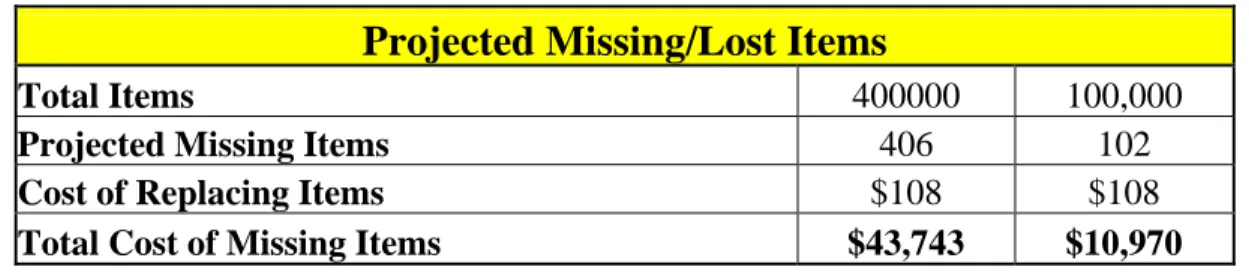
By multiplying the number of items identified as missing/lost when conducting the initial inventory with the cost of replacing the items, it was possible to estimate one time monetary savings for the first year of implementation of the RFID system.
Projected Missing/Lost Items
Total Items 400000 100,000
Projected Missing Items 406 102
Cost of Replacing Items $108 $108
Total Cost of Missing Items $43,743 $10,970 Table 5. Projected Missing/Lost Items at DKL
As shown in Table 5, projected savings in the first year of RFID implementation is over $43,000. The savings calculation for inventorying 100,000 items is necessary when a multi-year implementation is used.
5. Savings: Self-Check System
To calculate the savings from having an RFID self-check system, it was necessary to gather data on the number of library patrons that use the existing barcode self-check machine. On average, 15% of patrons use the self-check system at DKL. It is estimated that having an RFID system would attract at least the same number of patrons, which translates to an estimated 15% labor savings for a GS-05 step 5 employee at the circulation desk. Since either an RFID or barcode system is expected to attract the same number of patrons, the difference in benefits on either system is negligible.
V.
COST OF SYSTEM
A. INTRODUCTION
While RFID is an advanced technology that has the potential to improve library efficiency and therefore reduce the cost of operations, the biggest drawback to its implementation is the initial cost required. This is especially true with libraries that are already equipped with barcode and security systems. There will be sunk costs involved with the decision to convert from a barcode based to an RFID based system.
Since supply from vendors and demand from customers vary for RFID systems, there is no way to give a "typical" cost of a system (Engel, 2006, 31).
B. HISTORICAL COST ANALYSIS
The historical costs of RFID equipment were obtained from an industry leading RFID technology manufacturer. Due to the proprietary nature of this information, the name of the manufacturer will not be revealed and, therefore, will simply be known as Company Alpha.
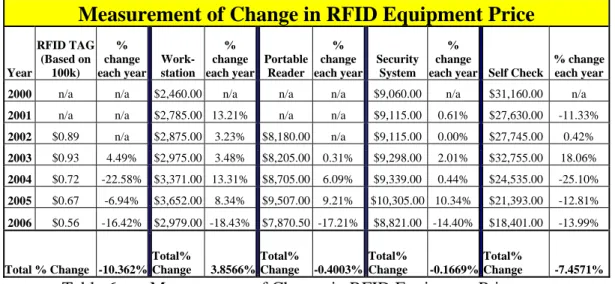
As seen in Table 6, the historical prices go as far back as the year 2000 for the majority of RFID equipment. Using data in Table 6, the changes in RFID equipment prices from year to year were calculated in percentages. After acquiring the percentage change for the RFID equipment, the average annual percentage changes for these items were calculated.
Measurement of Change in RFID Equipment Price
Year RFID TAG (Based on 100k) % change each year Work-station % change each year Portable Reader % change each year Security System % changeeach year Self Check
% change each year
2000 n/a n/a $2,460.00 n/a n/a n/a $9,060.00 n/a $31,160.00 n/a
2001 n/a n/a $2,785.00 13.21% n/a n/a $9,115.00 0.61% $27,630.00 -11.33%
2002 $0.89 n/a $2,875.00 3.23% $8,180.00 n/a $9,115.00 0.00% $27,745.00 0.42% 2003 $0.93 4.49% $2,975.00 3.48% $8,205.00 0.31% $9,298.00 2.01% $32,755.00 18.06% 2004 $0.72 -22.58% $3,371.00 13.31% $8,705.00 6.09% $9,339.00 0.44% $24,535.00 -25.10% 2005 $0.67 -6.94% $3,652.00 8.34% $9,507.00 9.21% $10,305.00 10.34% $21,393.00 -12.81% 2006 $0.56 -16.42% $2,979.00 -18.43% $7,870.50 -17.21% $8,821.00 -14.40% $18,401.00 -13.99% Total % Change -10.362% Total% Change 3.8566% Total% Change -0.4003% Total% Change -0.1669% Total% Change -7.4571%
Table 6. Measurement of Change in RFID Equipment Price
Historical Prices: RFID Tags
$0.00 $0.20 $0.40 $0.60 $0.80 $1.00 Yr 2002 Yr 2003 Yr 2004 Yr 2005 Yr 2006 P ri ce ( $ )
RFID TAG (Based on 100k)
Figure 5. Historical RFID Tag Prices
Historical Prices: RFID Equipment
$5,000.00 $10,000.00 $15,000.00 $20,000.00 $25,000.00 $30,000.00 $35,000.00 Price ( $ ) Work-station Portable Reader Security System Self Check
The calculation of percentage changes in RFID prices, according to Table 6, shows that RFID tags, portable readers, security systems, and self-check booths have a downward trend in annual prices except the work-station which increased in price.
C. FUTURE PRICE OF RFID EQUIPMENT
In forecasting the future prices of RFID equipment, it was necessary to start by obtaining the RFID equipment prices for the current year 2006. Proposals from three major vendors that support the Monterey area were solicited for a system tailored to meet DKL’s requirements. Again, since all three proposals contain proprietary information, these vendors will remain anonymous and will only be identified as Vendors Bravo, Charlie, and Delta.
In determining which vendor’s RFID equipment prices to use, the average price of all three vendors was deemed the best way to capture this information. Therefore, in Table 7, the prices for equipment in the current 2006 are the average of the three vendor’s equipment prices.
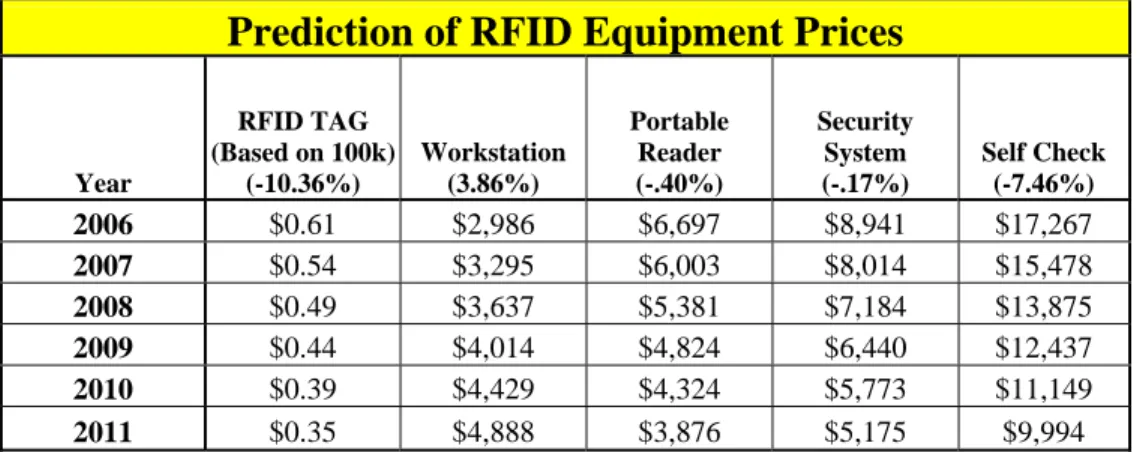
To calculate the forecast for future change in RFID equipment prices, data in Table 6 were used for annual percentage change of the individual equipment and these were applied to each future year, starting with 2006 average base prices. Table 7 displays the results of these calculations.
Prediction of RFID Equipment Prices
Year RFID TAG (Based on 100k) (-10.36%) Workstation (3.86%) Portable Reader (-.40%) Security System (-.17%) Self Check (-7.46%) 2006 $0.61 $2,986 $6,697 $8,941 $17,267 2007 $0.54 $3,295 $6,003 $8,014 $15,478 2008 $0.49 $3,637 $5,381 $7,184 $13,875 2009 $0.44 $4,014 $4,824 $6,440 $12,437 2010 $0.39 $4,429 $4,324 $5,773 $11,149 2011 $0.35 $4,888 $3,876 $5,175 $9,994
Future Price Prediction: RFID Tags $0.00 $0.10 $0.20 $0.30 $0.40 $0.50 $0.60 $0.70 Yr 2006 Yr 2007 Yr 2008 Yr 2009 Yr 2010 Yr 2011 Pr ic e ( $ ) RFID TAG
Figure 7. Prediction of RFID Tag Prices
Future Price Predictions: RFID Equipment
$0 $2,000 $4,000 $6,000 $8,000 $10,000 $12,000 $14,000 $16,000 $18,000 $20,000 Yr 2006 Yr 2007 Yr 2008 Yr 2009 Yr 2010 Yr 2011 P ri ce ($ ) Workstation Portable Reader Security System Self Check
Figure 8. Prediction of RFID Equipment Prices
In the analysis, data in Table 7 were used to calculate the cost of an RFID system if prices continue to change as predicted by the above table. In conjunction with the rate of price changes in Table 6, an analysis of how much an RFID system implementation
D. COST OF SYSTEM
In his article "RFID Technology for Libraries," prepared in May 2004 and updated in February 2006, Boss provided a good comparison of RFID prices presented in three different budget scenarios namely: a library with 40,000 items, one with 100,000 items and another with 250,000 items. Shown below is a 40,000 item library sample with a minimum budget of $70,000 in 2004 (Boss, 2004, 9-10) and $64,000 in 2006 (Boss, 2006, 15-17):
RFID Price Trend
40,000 item library May 2004 (40k tags @ $.85) Feb 2006 40k tags @ $.70
40k tags @ $.85 $34,000 $28,000 1 conveter rental $750 $750 2 staff stations @ $2500 $5,000 $5,000 2 exit sensors @ $4,000 $8,000 $8,000 1 wireless scanner $4,500 $4,500 1 server $15,000 $15,000 222 hrs of labor @ $8 $1,775 $1,775
Carpentry and electrical $975 $975
Total $70,000 $64,000
Table 8. RFID Price Trend
For a library with 100,000 items, Boss recommends a minimum budget of $168,000 in 2004 and $147,000 in 2006. Finally, a library with a collection of 250,000 items should plan on a minimum budget of $333,500 in 2004 and $283,000 in 2006. These samples reflect a downward trend in the prices of tags, which account for the biggest expenditure, and a steady trend in the prices of RFID equipment.
This analysis of the cost of RFID implementation is a good estimate on a national scale, however it is not specific to the local Monterey area. Since DKL uses government employees, it was important to use the GS pay scale in doing the analysis.
1. Annual Maintenance
Annual maintenance was calculated by averaging data obtained from three RFID vendors. Cost variances from equipment to equipment are listed in Table 10. By multiplying maintenance cost with the number of equipment, an estimate of the annual maintenance cost for that particular RFID equipment is computed. After maintenance
cost for individual equipment is identified, the annual maintenance of an RFID system can be calculated by adding the total of each individual equipment. For the equipment needed to implement RFID at DKL, the annual maintenance cost comes out to about $5,640 per year.
Annual Maintenance Costs
Equipment Qty Maintenance Cost Total
Reader 2 $748 $1,496
Work-Station 3 $488 $1,464
Security System 1 $875 $875
Self-Check 1 $1,805 $1,805
Total $5,640
Table 9. RFID System Annual Maintenance Costs
2. Labor for Converting to RFID
The labor needed to convert a library to an RFID system was calculated by first finding the rate of converting one item to RFID. According to Richard Boss, it takes about 20 seconds to convert one item to RFID using a minimum of two workers. This translates to about 2,220 hours of labor to convert a collection of 400,000 items.
After calculating the time it takes to convert 400,000 items into RFID, 2220 hours, it was multiplied by the hourly pay of two GS-05 step 5 employees. As shown in table 10, the total labor cost of converting a library of 400,000 items is $78,436
Conversion Costs
Number of items 400,000 100,000
Number of workers 2 2
E. COST OF SYSTEM IF PRICES CHANGE
According to the analysis in tables 6 and 7, prices are likely to change in the future. The cost analysis below will capture this price change and use the change in price to calculate what it will cost DKL if they were to implement an RFID system in both one year time frame and a multi-year time frame.
1. Changing Price: One-Year Implementation
The one year RFID implementation cost analysis reflects DKL purchasing all RFID equipment in 2007, including a bulk purchase of 400,000 RFID tags. Table 11 shows the cost calculations for implementing an RFID system in one year, taking into account that RFID tag prices will drop from 2006 prices and also the bulk RFID tag discount of 5%. For this cost analysis, equipment prices for 2007 were used.
One-Year Implementation Plan
Costs
Equipment Qty Dollar Value 2007
Tags 400,000 $206,650
Reader 2 $13,394
Work-Station 3 $8,958
Security System 1 $8,941
Rent Mobile Work
Station 4 $12,000
Self-Check 1 $17,267
Annual Maintenance $5,640 per year $5,640
Labor: Convert to RFID (2) $17.67 per hour $78,455
Total Cost $351,305
Table 11. Changing RFID Prices: One-Year Plan
2. Changing Price: Multi-Year Implementation
Table 12 shows cost calculations for implementing an RFID system in a multi-year time span, taking into account changing prices from multi-year to multi-year. The multi-years selected
are from 2007 to 2010. In this four year span, 100,000 RFID tags would be purchased each year and all the RFID equipment would be purchased in 2007. A 5% discount on bulk RFID tag purchases is not available on purchases of 100,000.
The grand total is not adjusted for net present value. The net present value will be taken into account, when costs are analyzed with benefits and savings.
Multi-Year Implementation Plan
Costs
Equipment Qty Dollar Value 2007
Dollar Value 2008 Dollar Value 2009 Dollar Value 2010
Tags per year 100,000 $54,382 $48,748 $43,697 $39,170
Reader 2 $13,394 $0 $0 $0
Work Station 3 $8,958 $0 $0 $0
Security System 1 $8,941 $0 $0 $0
Rent Mobile Work
Station 1 $3,000 $3,000 $3,000 $3,000
Self-Check 1 $17,267 $0 $0 $0
Annual
Maintenance $5,640 per year $5,640 $5,640 $5,640 $5,640
Labor: Convert to
RFID (2) $17.67 per hour $19,614 $19,614 $19,614 $19,614
Total Cost $131,195 $77,001 $71,951 $67,424
Grand Total Cost (Not adjusted for NPV) $347,572
Table 12. Changing RFID Prices: Multi-year Plan
F. COST OF SYSTEM IF PRICES STAYED CONSTANT
An analysis of the costs of implementing an RFID system when equipment prices are constant is important because it gives DKL a range of figures for comparison.
1. Constant Price: One-Year Implementation
Table 13 includes cost calculations for implementing an RFID system in one year if RFID equipment prices were to stay constant. DKL would still receive a 5% discount
One Year Implementation Plan
Costs
Equipment Qty Dollar Value 2007
Tags 400,000 $230,533
Reader 2 $12,006
Work Station 3 $9,886
Sec System 1 $8,014
Rent Mobile Work
Station 4 $12,000
Self Check 1 $15,478
Annual Maintenance $5,640 per year $5,640
Labor: Convert to RFID
(2) $17.67 per
hour $78,455
Total Cost $372,013
Table 13. Constant RFID Prices: One-Year Plan
The Grand total is not adjusted for net present value. The net present value will be taken int