
New applications of blockchain technology to
voting and lending
Mildred Chidinma Okoye
A Thesis in
The Department of
Concordia Institute for Information Systems Engineering
Presented in Partial Fulfillment of the Requirements for the Degree of
Master of Applied Science (Information Systems Security) at Concordia University
Montr´eal, Qu´ebec, Canada
C
ONCORDIA
UNIVERSITY
School of Graduate Studies
This is to certify that the thesis prepared By: Mildred Chidinma Okoye
Entitled: New applications of blockchain technology to voting and lending
and submitted in partial fulfillment of the requirements for the degree of Master of Applied Science (Information Systems Security)
complies with the regulations of this University and meets the accepted standards with re-spect to originality and quality.
Signed by the Final Examining Committee:
Chair Dr. W. Lucia External Examiner Dr. B. Caron Examiner Dr. A. Youssef Supervisor Dr. J. Clark Approved by R. Dssouli, Chair
Department of Concordia Institute for Information Systems Engineering
2017
A. Asif, Dean
Abstract
New applications of blockchain technology to voting and lending
Mildred Chidinma OkoyeWith a lot of attention (even hype) given to blockchain technology, it is not startling that many researchers, developers, journalists, and start-ups have posited blockchain tech-nology as the missing link for solving several problems with major interest within the financial sector.
Motivated by the current burst of interest around blockchains, we examine the feasibil-ity of a few decentralized blockchain applications: specifically, voting and lending. The spiked interest in blockchain is the result of its perceived benefits, ranging from the re-moval of trusted parties and bureaucracy, lower costs, transparency, among others. In this thesis, we explore how the blockchain mechanism works, how it can be integrated with the concept of smart contracts (scripts that exist on the blockchain enabling the automation of processes), and how to create applications that operate on this decentralized platform.
We start by considering the viability of voting on a blockchain. Then, the bulk of this thesis focuses on a lending infrastructure for cryptocurrencies deployed on the Ethereum Virtual Machine. We present a cognitive walk-through for the deployment of a loan (peer to peer lending and bonds) on the blockchain by utilizing the transparency offered. A performance evaluation is given in terms of transparency, cost, security and reliability of the system. Limitations encountered as well as future work are discussed in the later part of this thesis.
Acknowledgments
This thesis embodies not only my effort but that of great people who supported me throughout this journey. First and foremost, I wish to express my gratitude to my supervi-sor, professor Jeremy Clark, assistance professor at Concordia University and an expert at Blockchain technology. He has been supportive from the start of this project, from coming up with a thesis topic to guiding me for over a year of development. I remember he often says “If it is not difficult, then it is not a thesis work” to encourage me during challenging periods. Dr. Clark has supported me not only academically but also financially through grants and moral support through to the completion of this thesis.
I would like to also express my thanks to the great co-authors that accompanied in the publication of the Blockchain voting paper, Yomna Nasser, Jeremy Clark and Peter Y A Ryan.
Lastly, I would like to thank my parents Mr. and Mrs. Emmanuel Okoye, my brothers and close friends for their undying and unfailing support throughout the course of this work.
Contents
List of Figures ix
List of Tables x
1 Introduction 1
1.1 Contributions & Organziation . . . 2
2 Preliminaries 4 2.1 An Overview of Bitcoin . . . 5
2.1.1 History of Cryptocurrency . . . 6
2.1.2 Basic Cryptography . . . 7
2.1.3 Hash chains and trees. . . 8
2.1.4 Proof of Work . . . 10
2.1.5 Currency . . . 11
2.1.6 Scripting . . . 12
2.2 An Overview of Ethereum . . . 13
2.2.1 The Ethereum Virtual Machine. . . 13
2.2.2 Ethereum Accounts. . . 14
2.2.3 Transactions . . . 16
2.3 A Survey on Distributed Ledgers . . . 20
3 Blockchains and voting 24 3.1 Introductory Remark . . . 24
3.2 An abbreviated history of the blockchain . . . 25
3.2.1 A novel consensus mechanism . . . 26
3.2.2 Distributed ledgers . . . 28
3.2.3 Verifiable voting and digital cash are old siblings . . . 29
3.3 A toy blockchain voting system. . . 30
3.3.1 Tokens and coins . . . 31
3.3.2 A running tally . . . 32
3.3.3 Hiding voter choices . . . 32
3.3.4 The mythical bulletin board . . . 34
3.3.5 Carbon dating messages . . . 35
3.4 What would deployment look like? . . . 36
3.4.1 Can a human use that? . . . 38
3.4.2 DRE audit logs . . . 38
3.4.3 Voting through smart contracts . . . 39
3.5 Concluding Remarks . . . 40
4 Lending Infrastructure 42 4.1 Introduction to smart contracts and decentralized apps . . . 44
4.1.1 Structure of a contract . . . 45
4.2 A Simple Loan as Smart Contract . . . 48
4.3 A Simple Bond . . . 50
4.4 Protection . . . 52
4.4.2 Challenge 2: inflation/deflation . . . 55 4.5 Design . . . 57 4.5.1 Loan objects . . . 59 4.5.2 Protection objects. . . 61 4.5.3 CreditEvent . . . 64 4.6 Deployment . . . 65
4.6.1 Explaining the use of Oracles for exchange rates . . . 66
4.6.2 Automatic payments of coupons via smart contracts . . . 68
4.6.3 Implementing the monthly array object . . . 70
4.6.4 Implementing the CreditEvent contract . . . 71
4.6.5 Implementing a Credit Default Swap . . . 73
4.7 Testing. . . 75 4.8 Evaluation . . . 76 4.8.1 Transparency . . . 76 4.8.2 Reliability. . . 77 4.8.3 Security Bugs . . . 77 4.8.4 Cost . . . 84 5 Concluding Remarks 87 5.1 Limitations and Future Work . . . 87
Appendix A Evaluation Framework 90 A.1 Bitcoin/Ethereum Blockchain. . . 90
A.2 CONIKS . . . 93
A.3 Certificate Transparency . . . 97
A.4 Naive Transparency Overlay . . . 100
Appendix B Sample Code 107
B.1 Credit Score contract . . . 107 B.2 Loan contract . . . 110 B.3 Bond contract . . . 119
List of Figures
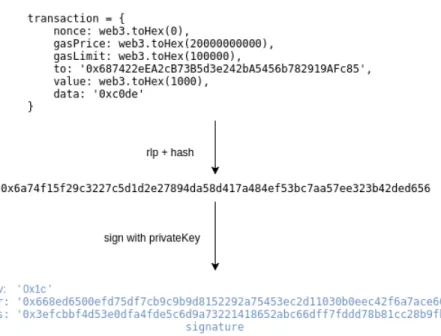
Figure 2.1 The bitcoin Merkle tree and adjoining Hash Chain. [32] . . . 9 Figure 2.2 An Ethereum address derived from its public key. [13] . . . 15 Figure 2.3 A transaction sending 1000 wei (1 ether= 1018wei) of ether with a
0xc0de message. [13] . . . 17 Figure 2.4 The transaction ID generated [13] . . . 18 Figure 3.1 A screenshot from Blockexplorer showing the Scantegrity pre-election
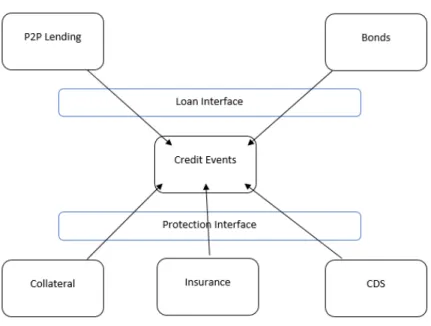
commitments embedded in Bitcoin’s blockchain. . . 36 Figure 4.1 A diagrammatic representation of a loan . . . 56 Figure 4.2 A lending infrastructure showing how the various loan and
protec-tion objects interface with the Credit event object . . . 58 Figure 4.3 A snap shot of the CreditEvent on the Ethereum wallet . . . 74 Figure 4.4 Results of Smart Contract analysis tool called Oyente [29] to find
security bugs on the Peer to peer lending smart contract . . . 82 Figure 4.5 Results of Smart Contract analysis tool called Oyente [29] to find
List of Tables
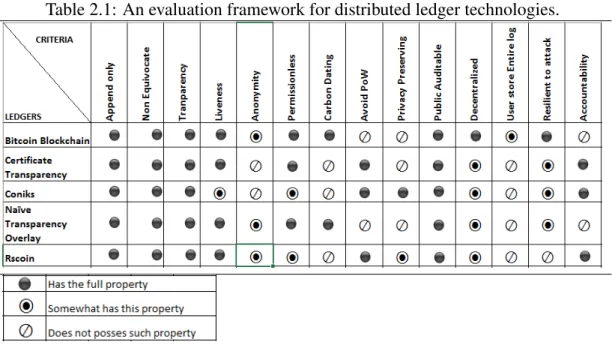
Table 2.1 An evaluation framework for distributed ledger technologies. . . 20
Table 4.1 Cost of running the basic Libraries contract needed . . . 84
Table 4.2 Cost of running the Peer to Peer Lending contract . . . 84
Table 4.3 Cost of running the Bond contract . . . 85
Table 4.4 Cost of running the Collateral contract . . . 85
Table 4.5 Cost of running the Credit default swap loan contract . . . 85
Table 4.6 Cost of running the Credit default swap contract . . . 86
Chapter 1
Introduction
Digital banking relies almost exclusively on financial institutions serving as trusted middle-men to process electronic transactions. Although the scheme is adequate for most transactions, it suffers greatly from the integral weaknesses of the internet — the model is based on trust. Though it is possible, it is very difficult to make transactions non-reversible since financial institutions play the role of mediating disputes to satisfy their customers. This increases the costs of transacting as mediation is expensive and needs to be factored in. It becomes less practical for small casual transactions to be digitized, and limits are imposed: e.g., on the minimum transaction size per day. The possibility that transactions can be reversed also leads to mistrust. In fear, merchants are left with little choice but to hassle customers for more information than they would otherwise need. Only a small percentage of fraud is accepted as unavoidable. By using physical currency, these costs and payment uncertainties can be avoided, but no mechanism existed that allowed payments over the internet without a trusted party until Bitcoin’s introduction in 2008 [32].
Bitcoin, the very first decentralized cryptocurrency, has emerged as the most widely-deployed, virtual global currency, and has awakened many copycat currencies. Not sur-prisingly, Bitcoin has gained much attention from the financial, technology, and academic
sectors. The core technical innovation fueling these schemes is the Nakamoto consen-sus protocol, which consen-sustains a distributed ledger widely referred to as a blockchain. The distributed nature of the blockchain enables trustless networks to agree on transactions, therefore eliminating the need for an intermediary, which in turn boosts the reconciliation period between transacting parties. The substantial use of cryptography, a vital charac-teristic of blockchain networks, puts verifiability and transparency behind the meaningful interactions on the network.
Currently one of the hottest areas within cryptocurrencies, smart contracts are agree-ments between two or more parties that can be automatically enforced without the need for an intermediary. Today’s leading smart-contract platform is called Ethereum, whose blockchain stores long-lived programs, called contracts, and their associated state, which includes both data and currency (ether). These programs are immutable just as data on the blockchain is, and users interact with them with a guarantee that the program will exe-cute exactly as specified [3]. Combining these concepts allow for a distributed and heavily automated workflow [11].
In this thesis, we take two current applications that are highly trust-centric — vot-ing systems and lendvot-ing — and we explore how the transparency characteristic of the blockchain can enable a more transparent and automated application that minimizes the role of trusted third parties.
1.1
Contributions & Organziation
First we contribute an evaluation framework of different distributed ledger technologies, where we present a taxonomy and criteria that is used for comparative analysis. This is given alongside the preliminaries of Bitcoin, blockchains, and Ethereum in Chapter 2.
The next chapter (chapter 3) presents a systematized existing knowledge on blockchain technology and verifiable voting technology, showcasing what the landscape looks like for
their composition and commenting on future work, informed by past work. The goal here is to provide a justified research agenda by bringing into focus where there is potential, and pruning out what seem to be dead-ends.
Finally, the main aim of this project is to introduce some applications of blockchain technology that go beyond the creation of new cryptocurrencies. This is actualized by developing a decentralized lending infrastructure system that harnesses the transparency of the blockchain to provide a system that is translucent and requires less trust on third party. This part of the project is implemented on the Ethereum Virtual Machine via smart contract using Solidity Language. We present a cognitive walk-through for the deployment of a loan on the blockchain by utilizing the transparency offered by the blockchain technology. This chapter also contains the challenges encountered during the deployment stages.
An evaluation performance in terms of transparency, cost, security and reliability of the system was conducted and limitations encountered as well as future work are discussed in the later part of the thesis.
Chapter 2
Preliminaries
Motivated by the current burst of interest around blockchains, we examine the feasi-bility of applications such as voting and a lending infrastructure on the blockchain. The spiked interest in blockchain is because of the benefits it offers ranging from the removal of trusted parties, lowered bureaucracy, lowered costs, transparency, and many more. In this thesis, we explore how these mechanisms work, as well as integrating the concept of smart contracts (scripts that exist on the blockchain that allow for the automation of pro-cesses) to develop an application that operate on a decentralized platform. In this section, we describe Bitcoin in sufficient detail to understand all contribution made in this thesis. Although not necessary for understanding this thesis, additional information on Bitcoin can be found in [32].
The motives behind why majority of the people trust the Bitcoin system are peculiar to each individual perspective and cannot be fully explained. However, from a broader perspective, ample of this trust emerges from the known fact that Bitcoins historical trans-action records, the security control implemented and the software used are virtually open for everyone for verdict which is in part contrary to most traditional organizational system like the banks (who are becoming less trustworthy). This term generally, referred to as
Transparency seems to be valuable to users in almost every facet of life. Also another rea-son why many trust the Bitcoin also lies in the fact that its being managed by the users of the system rather than a government which in turn gives the users more control over their money. It also affords one the option of performing secure transactions across the world rather than using wire transfer. A lot of merchants frown against the ability to reverse transactions and this constitute to another reason why users trust the system. The security controls implemented prevents reversal of transactions when confirmed and also against the risk of fraud associated with credit cards. This also applies to other cryptocurrencies like Ether (Ethereum) that uses the same Nakamotos consensus algorithm.
2.1
An Overview of Bitcoin
While there is some debate about which economic system emerged first historically, it is still informative to consider three basic systems in comparison to each other: barter, credit, and cash. In a barter system, goods trade amongst participants simultaneously without the need for trust (other than in the good itself) but coordinating trades in time and space is problematic, in particular when trades involve more than two people. Credit allows trades to be made without receiving anything immediate in return, but requires counter-party trust. With cash, cash is received in return for goods which resolves the ‘coincidence of wants’ issue or barter and minimizes the counterparty risk of credit (cash still involves some trust: that the cash is legitimate, that it will preserve its value over time, and that others will accept it in the future). Cash also enable anonymous payments. Any payment in cash involves no bank for verification and the merchant is of no obligation to know who the user is. On the other hand, credit cards allow for online payments but have two disadvantages. For one, it offers no anonymity as a credit card is issued with a name and transactions can be traced backed to each user. Second, it enforces trust in third parties as well as high fee due to the
that offers the same benefit as cash arose [33].
2.1.1
History of Cryptocurrency
The study of electronic cash began with David Chaum, an American cryptographer. The desire for privacy and a trustless system for online commerce led to the idea of a tokenized representation of physical coins and paper notes. Thus, in 1983, David Chaum introduced blind signatures [8] which enabled Alice to be issued a coin by a bank with a serial number that Alice could change before transferring it to Bob. The bank would not recognize the new coin however the bank’s signature endorsing the value of the coin would be kept intact. These properties are a product of mathematical operations within the RSA signature scheme (and have since been adapted to other signature algorithms). Chaum’s company DigiCash sprang up as a result and the invention of this blinded caused extraordinary attention from the press and industry. Unfortunately, the company failed to secure a critical mass of banks to support the product and the company filed for bankruptcy in 1998.
In 1998, Wei Dai’s introduced b-money1, the idea of creating money by solving com-putational puzzles, as well as implementing a decentralized consensus. However, the pro-posal was limited on details; a concrete implementation of the decentralized consensus was hand-waved away. In 2005, Hal Finney introduced a concept of ”reusable proofs of work”, a system which uses ideas from b-money together with Adam Back’s computationally dif-ficult Hashcash puzzles to create a concept for a cryptocurrency, but once again fell short of the ideal by relying on trusted computing as a backend [7].
2.1.2
Basic Cryptography
The best known cryptographic function is encryption, which is used to hide messages. Bitcoin does not use encryption however it uses two other cryptographic primitives: hash functions, used to uniquely fingerprint data, and digital signature algorithms used to en-dorse data with a verification key. Functions in cryptography generally either accept an input only (hashes) or an input and a key (signatures) to generate an output.
Hash Functions
A hash function take an arbitrary-sized input and deterministically generates a fixed-sized output that serves as a binding fingerprint of the input. Generally, hashes can be consider a one-way function: the pre-image resistance property of a hash function states that it is computationally infeasible, given an arbitrary hash output y, to find any input x
such that y = H(x). It should also be infeasible to find acollision: two different values
x1 andx2 6= x1 such that H(x1) = H(x2). A weaker form of collision resistance states
the infeasibility of findingx2 6= x1 givenx1 (as opposed to being able to choosex1) such
thatH(x1) = H(x2). The word weak is from the perspective of the designer of the hash
function: insecure hash functions might achieve this property while admitting collisions. In Bitcoin, SHA256 and RIPEMD-160 are used. The former has all three properties, while RIPEMD-160’s collision resistant is well below the NIST standard (which requires at least 224-bit output to acheive a security level of 112 bits). It is speculated that this is not a problem in Bitcoin, with some debate. In Bitcoin, SHA256 is used as a building block for the proof of work (PoW), hash trees, and hash chains. The composition of SHA256 and RIPEMD-160 are used to generate a Bitcoin address from a public key for a digital signature scheme.
Digital Signatures
A digital signature scheme allows an arbitrary-sized input to be signed such that it can-not be modified by anyone other than the signing party. Signatures utilize two keys: a secret private key known only to the signer used to generate the signature, and a mathematically related publicly available key used by anyone to verify that the signature was generated with the associated private key (without revealing the value of the private key). The Dig-ital Signature Algorithm (DSA) is a signature based on the computational intractability of discrete logarithm problem (DLP). DSA works in any mathematical group with a DLP-style intractability problem. Originally it was proposed in prime-ordered groups of positive integers, but later, more efficient and compact groups based on elliptic curves over finite fields were found and analyzed. Bitcoin utlizes the elliptic curve version of DSA, called ECDSA. The advantage of ECDSA over DSA is faster computations, smaller keys, and smaller signatures [24]. In Bitcoin, ECDSA is implemented on the secp256k1 curve.
2.1.3
Hash chains and trees
In Bitcoin, hash trees or merkle trees [31] are essential for ensuring data integrity. Each transaction created by nodes within the network are grouped into blocks. These transactions are first hashed individually and then the resulting hash values are then hashed in pairs (forming a binary tree) until a single hash value is derived. This is referred to as the Merkle root and it serves as a binding commitment to every element in the tree (which can be as big as one wants). Hence each block has a single hash value that represent all transactions contained within the block. This structure allows for the detection of any changes within a block of transactions as a change of even a single bit in any transaction would result in a completely different Merkle root value.
The purpose of the Merkle tree is also to allow for easy retrieval and verification of branches within the blockchain. This is particularly useful for thin clients (like mobile
Figure 2.1: The bitcoin Merkle tree and adjoining Hash Chain. [32]
phones) which use a protocol called Simple Payment Verification, where a semi-trusted server forwards the Merkle branches of transactions that match the client’s keys/addresses. This allows the thin client to do some verification without downloading the full blockchain (which at the time of writing is approaching 100 GB). Since in a Merkle tree, hashes prop-agate upward to the merkle root, a malicious server cannot insert or modify a transaction without changing the Merkle root. An incorrect Merkle root will be ignored by the network and not incorporated into the set of transactions.
Each block is represented by a hash value (the hash of the block header that contains an asserted timestamp, the Merkle root of the transactions in the block, and the previous block hash) that is used as an input to a puzzle to be solved for the next new block (the block header also contains a nonce value used for the purpose of this puzzle, described next). With this format of linking the current block to the previous block, all blocks are chained together thereby ensuring the last block is a binding commitment to the entire past history of the system. This concept is referred to as Hashchain introduced by Haber and Stornetta [22].
2.1.4
Proof of Work
When Alice receives a payment from Bob, she needs to ascertain that Bob did not also send that same money to Eve—in other words she need to be assured that Bob is not double spending the money. She could be certain if there is a central authority that keeps record of all transactions. Then she could verify the state of any transaction she receives. In order to prevent a double spend attack in a decentralized system, a consensus mechanism is needed and this becomes a tricky matter where any node can join or leave. Bitcoin uses a computational puzzle, called a proof of work, to ensure consensus can be formed if the majority of computational power on the network belongs to honest nodes.
The concept used in the Proof of Work can be traced down to Dwork and Naor [17]. They proposed a mechanism for combating spam where the sender would be required to compute a solution to a moderately hard puzzle (something that under normal conditions would take a computer several seconds or minutes) before sending an email. The verifica-tion process is however trivial for the recipient taking only millisecond or microseconds. Messages without a correct solution are ignored. Hashcash [2] implemented this idea in such a way that the puzzle involved computing the hash of the email (including its meta-data) a large number of times. Each time this computation is performed, a counter value (called the nonce) included in the hash input changes, and the computation ends when the output of the hash function happens to have a specified number of leading zeros. Hence the birth of the proof of work concept used in Bitcoin and Ethereum.
As stated earlier, one major problem with previous existing digital currency was decen-tralization (how to make a group of unknown people within a network reach an agreement on the state of the network). To solve the consensus problem in a decentralized setting, con-trolled and censored by no authority, Bitcoin adopted a novel Byzantine consensus protocol called the Proof of Work consensus mechanism (or Nakamoto consensus) [34]. The main condition of Nakamoto consensus is that 51% of the computing power must be controlled
by honest nodes in the network. Because computational power is difficult and expensive to acquire, it is almost impractical for a single entity to control a majority of the power in the network, sidestepping Sybil attacks [16].
It’s necessary to bear in mind that the sustainability of the network depends on repara-materizing the difficulty of the proof of work. Miners search for a nonce that results in a block header hash output that is less than some target number, also referred to as difficulty. This number is recalculated (increased or decreased) every 2016 blocks (roughly every two weeks) to bring the average time between each block to 10 minutes. Nodes are incentivized to perform this computational operation (often called mining) by collecting newly minted coins and transaction fees.
2.1.5
Currency
In the Bitcoin blockchain, the notion of mining requires miners to solve a puzzle to add a block onto the end of the blockchain. The first miner to solve the problem will broadcast their winning block and pay themselves a mining reward, which as of the writing of this thesis is 12.5 BTC. This reward was 50 BTC in 2008 when bitcoin was invented and it halves every four years until it approaches zero. The total number of Bitcoin that will come into circulation is 21M BTC. The reward given to miners is a form of distributing the currency within the network (also known as bootstrapping) since there are no central authority to issue the currency. Miners also receive transaction fees from every transaction included into a block. The fee is a payment to the miner for verification performed on the transaction. The transaction fee is denoted as the difference between the input amount and the output amount of any transaction.
2.1.6
Scripting
Bitcoin’s Script is a simple scripting language that maps human-readable assembly-style code known as ”opcodes” into operations. A script is included in every Bitcoin trans-action and it describes who can spend the money in a future transtrans-action. The vast majority of transactions follow a default script which provides the Bitcoin address of the spender and specifies that the spender must sign their transaction with the key that corresponds to this address. However other scripts are possible.
Scripts are made up of a sequence of instructions given in the transaction holding the funds (called an unspent transaction output) and the new transaction spending the money (called a transaction input). The scripts are concatenated and executed linearly on a stack with no branching (jumps, loops, etc). Hence, execution time is bounded above by the length of the script after the instruction pointer. This constraint prevents denial of service attacks on the nodes validating the blocks [41]. Since every node on the network has to validate every script ever run to synchronize to the latest block without any compensation for doing so, available opcodes are very judiciously chosen with a emphasis on things en-abling currency-based applications. Bitcoin’s scripting language is not Turning complete. Value-blindness prevents Unspent Transaction Outputs from providing fine-grained control over what amount of money can be withdrawn [7]. Unspent Transaction Outputs are ei-ther spent or unspent making it difficult to multi-stage option contracts that are complex. Finally, transactions cannot reference blockchain values, such as the nonce or previous hash, which might otherwise provide a good source of randomness for applications such as gambling.
2.2
An Overview of Ethereum
We now describe Ethereum, a decentralized blockchain-based system that uses a cur-rency, called Ether, in a similar fashion to Bitcoin however also enables a verbose, Turn-ing complete scriptTurn-ing language that allows for full fledge smart contracts and other non-currency applications that will be executed correctly according to the consensus of the de-centralized network of nodes maintaining the state of all Ethereum contracts. Proposed by [7], Ethereum aims to ameliorate the notion of altcoins, on-chain meta-data and scripting thereby resulting in the creation of arbitrary consensus-based application that are standard-ized, inter-operable, feature complete and scalable. We simply a few details of Ethereum; for example, even though its blockchain structure is significantly different from Bitcoin’s, it is inconsequential for the results of this thesis to think of Ethereum contracts running on a blockchain based on Bitcoin’s design.
2.2.1
The Ethereum Virtual Machine
Ethereum much like Bitcoin is a shared transaction database often referred to as Blockchain. It operates in such a way that all participating entities (nodes) within the network can read entries (transactions) and make changes by creating transactions for which a consensus is needed. A transaction in its basic form describes the transfer of Ethereum currency (Ether) from one or more accounts (input addresses) to one or more accounts (output addresses). Ethereum addresses are derived from a digital signature scheme which are not centrally allocated or registered by a third party as these addresses become active during the first transaction.
As a decentralized network, consensus is reached by incentivizing node within the net-work with ability to create (mine) new Ether for every valid block created. Over time, these blocks form a linear sequence which are added roughly every 17 seconds which helps to
maintain and update the blockchain. Further details of the Ethereum Consensus architec-ture are not needed in this section. However, it is useful to note that nodes in the network partake of the consensus protocol by downloading the blockchain and cryptographically verifying the integrity of the transactions contained therein.
The Ethereum Virtual Machine (EVM) is an isolated, sandboxed runtime environment for developing smart contracts in Ethereum. Codes deployed within the EVM have no access to other networks, processes or file system.
2.2.2
Ethereum Accounts
In Ethereum, there are two forms of accounts each sharing the same 20-byte address space: An External account, controlled by private-public keys pairs with no code contained therein and a contract account, controlled by the code stored within the account. Although both addresses are treated equally by the EVM, the address of the external account differs from the contract address in that as the former is determined by the public key, the latter is determined at the contract’s creation time derived from the combination of the creator’s address and a nonce that represent the number of transactions executed by the creator’s address key pair.
Messages can be sent from an external account by generating and digitally signing a transaction. In other for a contract address to read and write to its internal storage, create other contract or send messages, its code needs to be activated by a message received either from an external or internal account. In general, an Ethereum account contain four fields:
• A balance in Ether (usually stored in ’Wei’ by the EVM)
• A contract code (if empty, it represents a normal the account, otherwise it represents a contract account)
Figure 2.2: An Ethereum address derived from its public key. [13]
• A storageRoot which has a persistent key-value store mapping bit words to 256-bit words (default set as empty)
• A nonce that represents a counter to ensure each transaction is processed only once.
An Ethereum address which represents an account is derived as follows:
First, a Private Key, a randomly selected positive integer (represented as a 256-bit data or a byte array of length 32 in big-endian form) is generated [42]. Second, a Pub-lic Key, is derived from the private key generated using the Elliptic Curve Digital Signa-ture Algorithm (ECDSA) with secp256k1s curve. Finally, the address is derived from the keccak-256 hash of the hexadecimal form of a public key where only the last 20 bytes are kept. It useful to note that this differs from the Sha-256 used by Bitcoin. An ex-ample of an Ethereum address usually denoted in hexadecimal format (base 16 notation) is “cd2a3d9f958e13cd977ec05abc7fe734df8cc826”. This is often indicated explicitly by adding 0x prefix to the address.
2.2.3
Transactions
In Ethereum, ‘messages’ are to some extent like ‘transactions’ in Bitcoin, but with three vital variances. First, an Ethereum message can be generated by an external account or a contract account, while a Bitcoin transaction can only be generated by an external account. Second, Ethereum messages have an explicit option to contain data. Finally, if it is a contract account, the recipient of an Ethereum message has the option to return a response; this means that messages in Ethereum also encompass the concept of functions. The term ‘transaction’ is used in Ethereum to refer to the signed data package that stores a message to be sent from an externally owned account [7]. The inputs to an Ethereum transactions or message are as follows:
• The Nonce: a counter for the number of outgoing transactions, starting with 0
• The GasPrice:the price in ether per unit of gas to pay to the miner per computational step. It defaults to a price of 20 GWei (0.000000020 Ether).2
• The GasLimit: the maximum gas allocated by the sender to be spent to process the transaction.
• Value: the amount of ether to be sent to the recipient account of the transaction, if empty, a contract is created
• A Signature: identifies a sender and provides an intention to send the message via the blockchain to the recipient
• Data:could be a function call to a contract, an arbitrary message or a code to create a contract.
Figure 2.3: A transaction sending 1000 wei (1 ether = 1018 wei) of ether with a 0xc0de
message. [13]
Generally, there are three types transactions supported on Ethereum: Transferof Ether from one party to another,Creationof a smart contract andTransactingwith a smart con-tract. These transactions only differ in their inputs. With the gaslimit, nonce and gasprice present in all types of transaction, a Transfer of Ether from one party to another would only require a “to” and “value” input; a transaction to create of a smart contract would require a ‘value’ and a ‘data’ input; a transaction interacting with a smart contract would require ‘to,’ ‘value,’ and ‘data’ inputs.
2.2.4
Gas
When a transaction is created in Ethereum, a fee must be paid to the miner that executes the transaction and update the output of the transaction to the Ethereum Blockchain. This fee is measured in gas, where gas refers to the number of instructions needed to execute a transaction within the Ethereum Virtual Machine. Therefore, there are two parameters used
Figure 2.4: The transaction ID generated [13]
to indicate how much Ether the sender is willing to spend for a transaction to be successful:
• Gas price: This is the amount Ether per unit of gas that started with default price of 9000 Wei (9 x10⁻¹⁵Ether) and now 20 GWei.
• Gas limit: To avoid exponential blowup and infinite loops in code, a limit is to set on the number of computational steps of code execution it can spawn for the transaction, including the initial message and any other messages produced during execution. There is an upper limit on the fees of a single transaction in an Ethereum block which confines this value typically to less than 1,500,000 which at the time of this writing has increased to 6,712,392.
These combined parameters decide the maximum amount of Ether to be spend on trans-action and how quickly a transtrans-action takes place is a factor of the gas price. If a transtrans-action execution ‘runs out of gas,’ all changes to the state are revert — except for the fees paid. In the common case where a transaction execution halts with some unused gas, the rest of the fees is refunded to the sender. A user’s client will test(execute) the transaction and
compute the amount of gas required and set this as a default gas limit before sending the transaction to the Ethereum network. There are however a variety of reasons this estimate might be inaccurate: the most common is that the data structures the code invokes change between sending the transaction and its execution by the miner (e.g., by other simultaneous transfers to the same contract).
2.2.5
Memory, Storage and Stack
Codes in Ethereum contracts are run from a low-level, stack-based bytecode language, referred to as Ethereum virtual machine (EVM) code. The codes are series of bytes, where each byte represents an operation. Generally, code execution is an infinite loop that involves repeatedly executing operations at the current program counter that starts at zero and then incrementing the program counter by one, until the end of the code is reached, an error or STOP or RETURN instruction is detected, or the contract runs out of gas. These operations can store and access data in three different ways,
• Memory: which is linear, and can be addressed at byte level, while reads are restricted to a size of 256 bits, writes can be either 8 bits or 256 bits wide;
• The stack: a 32-byte valued last-in-first-out container can be pushed and popped;
• The storage: the contract’s long-term key/value storage, a store where both keys and values are 32 bytes.
Storage persists for a long time as opposed to memory and stack which reset after computation ends. The value, sender and data of the incoming message, as well as block header data, can also be accessed by the code and the code can also return a byte array of data as an output.
Table 2.1: An evaluation framework for distributed ledger technologies.
2.3
A Survey on Distributed Ledgers
A distributed database can be viewed as duplicates of database stored in different phys-ical locations to ensure availability of information. This enables responses to be received with high certainity for every request made, and reliability even under conditions where some nodes fail. However, distributed databases do not address important security crite-rion: namely, security guarantees that users of the system see the same state at any given time (non-equivocation) and it cannot change (immutability). Hence, the introduction of distributed ledgers. A Distributed ledger is a ledger that is replicated among all the nodes in a peer to peer network without the need of a central party to coordinate actions or be authoritative over any aspect of the protocol. Each node’s copy of the ledger is guaranteed to be identical using a consensus algorithm and the use of cryptographic signatures ensures the ledger is unforgeable.
The following is a set of desirable properties we may want from a distributed ledger. We use them to evaluate and classify several proposals from the literature. A summary of our
evaluation is provided in Table2.1. We provide the details of the evaluation in AppendixA. CRITERIA
(1) Append-only: The logs are denoted by the leaves in a Merkel tree. Each level in the tree is a cryptographic hash of the nodes below where the root is at the top and the leaves are at the bottom following an odd fact that trees grow downward. The properties of a cryptographic hash ensure that each node is a summary of all the nodes below it thereby making the root of the tree a summary of all of the leaves. This property allows data to be added only to the end of a log as the logs are chained to each other in such a way that an insertion of any data in the middle of the log would be detected.
(2) Non-Equivocate or Consistency: A log should be consistent among different users and any attempt to present different views should be detected. Two users can effec-tively verify that they are both seeing the same tree by simply comparing the root hash.
(3) Transparency: All operations within the log should be visible to all users in real time. Transparency of the log does not necessarily mean that the published logs are accu-rate, but users can trust them knowing that the owners of the information (certificates or transactions) will promptly detect any modification, tampering or misbehavior. (4) Liveness: An assurance that data sent to be entered into the log is guaranteed to be
inserted in the log.
(5) Anonymity: No real world identity is tied to the identity obtained within the named system.
(6) Permission to Join: This property states if a permission would be required by user to join the network or participate within the network.
(7) Carbon Dating: The property that an existing data in a log over time accumulate work such that the work cannot be forged.
(8) Avoids Proof of Work (PoW): Mostly the use of PoW by some log is to derive consen-sus on contents of the blocks in a decentralized system, mint coins where applicable and rate limit the time for introduction of new information into the log. This property holds for a given log if the log can achieve any of the listed above without the use of PoW.
(9) Privacy Preserving: This property holds if the contents of the log are visible but encoded in a form that makes it impossible to derive any meaningful data from it to ensure that personal or identifiable information stored on the log are not visible to the users.
(10) Publicly Auditable: The log is public and available to be queried by users, auditors or monitors who want to audit the log to verify that the log is consistent.
(11) Decentralized: In this content, a decentralized system would be defined by the least number of people needed to break the system. The greater the number, the more decentralized the system is and the lesser the number needed the more distributed the system is. If only one party needs to be compromised, then the system is classified as a centralized system.
(12) Do not store entire log: A user might need to store the entire log to be able to audit or verify information stored in the log depending on the structure of the log. Some logs require users to store the entire log to make a full verification and some are required to store only the roots or headers.
(13) Resilient to attack: The more decentralized the system is the harder it is to corrupt the system as this would inevitably mean corrupting very single user in the system.
(14) Accountability: The ability to identity an entity responsible for a misbehavior and apply appropriate discipline.
Chapter 3
Blockchains and voting
This chapter references and excerpts work (under review) co-authored with Yomna Nasser, Jeremy Clark and Peter Y A Ryan.
3.1
Introductory Remark
The blockchain a novel data structure and consensus mechanism designed for the de-centralized currency Bitcoin, is currently being considered, exuberantly, for new applica-tions in the financial and technology sectors. A steady stream of whitepapers from well-established banks (JPMorgan Chase, Deutsche, Barclays, Citi), professional service net-works (PwC, Deloitte, EY, KPMG), and technology companies (IBM, Microsoft) explore how blockchains and distributed ledgers can create new digital assets, smart contracts, and provenance systems that enable direct interactions between participants, eschewing tradi-tional intermediaries.
With all this attention (and some would say “hype”) on new blockchain applications, it is unsurprising that a number of researchers, developers, journalists, and start-ups have
posited blockchain technology as the missing link for transparent, verifiable election sys-tems. Are they really? We approach this question in a systematic way from both direc-tions: (i) beginning with a blockchain, what challenges arise from layering a voting sys-tem on top, and (ii) examining existing verifiable voting syssys-tems, how might a blockchain augment their properties? Our conclusion will not please those looking for one-armed researchers: blockchains are a useful augmentation to verifiable voting in some circum-stances and may introduce interesting ways of voting in non-traditional settings; but on the other hand, blockchains are not a panacea. For current public sector elections in particular, any holistic approach to security will at most use a blockchain as a supporting component in a much larger system, if at all.
In this work, we do not propose a new system. Rather we systematized existing knowl-edge on blockchain technology and verifiable voting technology, and showcase what the landscape looks like for their composition. It is not a survey, per se, because we are com-menting on future work, informed by past work but not summarizing it. Our goal is to provide a justified research agenda by bringing into focus where there is potential, and pruning out what seem to be dead-ends.
3.2
An abbreviated history of the blockchain
At the 1990 CRYPTO conference, a data-structure for appending a series of temporally-ordered messages to each other was introduced by Haber and Stornetta [22] and subse-quently refined (alongside others[4]) . The later designs from this literature propose that a set of messages are aggregated into a single value using a cryptographic primitive (hash function) called a Merkle or Hash tree, such that one can efficiently prove a given message is fingerprinted by this value (called a Merkle root). If the root is widely witnessed (compa-nies like Surety have published such roots in the Financial Times and the New York Times),
can be locked in with the previous messages by hashing together its root with the previous roots to produce a new value called the header.
Two years later at CRYPTO, Dwork and Naor proposed a system for combating spam where the sender of an email would be required to compute the solution to a moderately hard puzzle (e.g., something that would take a normal computer several seconds or minutes) before sending the email [17]. However, verification of the correctness of the solution is relatively trivial and messages without a correct solution are ignored. Hashcash [2] was an instantiation of this idea where the puzzle involved computing the hash of the email (and metadata) iteratively, each time changing a meaningless counter included in the hash input, until the output of the hash function happens to have a specified number of leading zeros.
In late 2008, Satoshi Nakamoto (the pseudonym of a not-yet-identified developer) posted a whitepaper to a cryptography mailing list outlining a new digital cash system called Bitcoin [32]. By this time, many attempts at commercializing some form of cryp-tographic digital cash had been made, none reaching commercial success. The design of Bitcoin is quite different in several regards from previous work, but one vital design deci-sion that distinguishes it from nearly all previous proposals is having a publicly available ledger that records every transaction. The ledger takes the form of the Haber-Stornetta data-structure: a set of transactions (called a block) are accumulated into a root, and the root is hashed with the previous block header to create a new block header (the chain of block headers being called the blockchain). Nakamoto’s subtle but incredibly insightful twist is that each time a new block header is produced, it must integrate the solution to a moderately hard puzzle (the idea of Dwork and Naor).
3.2.1
A novel consensus mechanism
It is difficult to succinctly motivate and describe everything the addition of the puz-zle enables. We refer the interested reader to a more thorough survey [25], but in short,
Nakamoto’s blockchain allows an open network of computers to update the blockchain in a way that (1) no node is in charge (no centralization), (2) all nodes agree on the contents of the ledger (a common consensus), and (3) nodes are incentivized to do the work of updating and maintaining the ledger (via mining).
A blockchain of length L includes the solutions to L puzzles, and these solutions will add up to a considerable amount of computational work. The puzzle difficulty adjusts peri-odically(approximately every 2016 blocks) to keep the average solution time at 10 minutes. If nodes see more than one valid version of the blockchain, they will first prioritize the chain with the most work (the longest chain), and then if chains with equal work co-exist, whichever they saw first. Once a node has prioritized a chain, it will assemble a block of valid transactions (checking for double-spends) and attempt to add it to the chain by solv-ing the puzzle. All nodes are constantly dosolv-ing this, and the first node to find a solution will broadcast it. This new chain should now be prioritized by all nodes (since it is one block longer than any other prioritized chains). The node that solves the block gets a reward and certain fees affiliated with the transactions they chose to put into the block. To ensure they capitalize on this,which in turn secures the blockchain, they must ensure their chain (both their block and each previous block) contains only valid transactions or the network will reject it. This incentivizes every node to validate every block of the chain they prioritize.
If a malicious node were to change or drop a past transaction in a past block, the root of this block would also change and, subsequently, every blockheader that follows it. Thus to get this modified chain prioritized, the attacker would have to ”catch up” to the length of the current blockchain and could only do so if it had more computational power relative to rest of the network. There are important nuances to this process of forming a consensus, but generally it is the case that all nodes will agree on the contents of the blockchain from beginning to nearly the end, with some disagreement over the last few blocks to the tail of the chain [21]. For this reason, it is advised that one waits until a transaction is six blocks
from the last block before considering it effectively immutable [32]. It is also generally the case that any valid transaction will eventually be included in the blockchain [21].
To build a currency on top of a blockchain, users chose a set of unrelated signing keys, for a digital signature scheme (currently ECDSA), and use the public keys as ”addresses” for receiving payments. No other identifying information is used. New currency enters the system via the nodes that solve the blocks (they specify an address they own in their solu-tion) and currency can be sent in any amount to any other public key by digitally signing a transaction specifying the details (requiring the signature counters theft). The transaction is broadcast to the network and eventually added to the blockchain, which has a publicly verifiable history of every transaction (ensuring no double spending) and is generally im-mutable (preventing any future revocation of the transaction). This is a simplification of Bitcoin but a sufficient description for our purposes.
3.2.2
Distributed ledgers
It is useful to think of the blockchain as both a data-structure and a consensus mecha-nism that enables agreement on a ledger of messages amongst a set of mutually distrustful nodes, premised on the assumption that the adversary does not own a considerable fraction of the computational power on the network (e.g., half is sufficient to eventually rewrite the ledger and a quarter is sufficient to attack subtler properties [19]). The way consensus is formed, through a network of devices solving a computational puzzle as fast as they can, is considered by many to be wasteful and not desirable. Many of the companies exploring new blockchain applications are also considering how trusted entities can be added into the system to avoid computational puzzles, shorten block update times from 10 minutes (in Bitcoin) to seconds, and govern network join/write/read privileges. We use the term dis-tributed ledger to refer to the family of technologies that includes both Bitcoin’s blockchain and these relaxed variants. Ironically, most distributed ledger technology strips away all of
Nakamoto’s novel insights, and could have been deployed using 1990s’ state-of-the-art knowledge.
3.2.3
Verifiable voting and digital cash are old siblings
Both digital currency systems and electronic voting systems have a long intertwined history in the cryptography literature. In fact, both originate with the same person: David Chaum. Chaum proposed the first cryptographic voting system in 1981, based on his mix network protocol [10]. The next year, he proposed the first cryptographic payment system based on his blind signature primitive [8]. Blind signatures were later studied extensively for voting (the hallmark paper being [20]), and cryptographic mixing has been used in dig-ital cash, recently to anonymize Bitcoin transactions [6], [35]]. The shared history does not end there, with many cryptographic primitives and protocols being utilized in both payments and voting: zero knowledge proofs, ring signatures, digital credentials, homo-morphic encryption, algebraic MACs, and on and on. We can now add blockchains to the list.
A cryptographic or end-to-end verifiable (E2E) voting system is one that provides a proof to each voter that her ballot was included, unmodified, in the final tally (even in the face of a corrupt election authority and malicious vote capture equipment). This proof generally consists of an obfuscated form of the voter’s ballot choices, called a receipt, as well as public data about all recorded receipts and the tallying process that can be validated by anyone who wants (even those who did not vote). It is a strict condition of cryptographic voting systems that this proof leaks no information about how the voter voted, beyond what can be inferred from the tally alone, including the case where the voter deliberately crafts her ballot to leak how she voted. For in-person voting, we assume the voter’s actions cannot be observed in the voting booth. For online or remote voting, no such assumption can be made and it becomes quite challenging (but theoretically possible [26]) to provide
voter privacy when anyone can look over her shoulder and coerce/pay her to make certain choices.
3.3
A toy blockchain voting system
We now describe a simple voting system, layered on top of Bitcoin, to stack it up against the properties of a true E2E voting system. This is not a proposal for a system. Rather it is a pedagogic device we will tweak to showcase both the strengths and weaknesses of blockchains. It is not purely pedagogical however, as it is the core protocol of a number of blockchain voting projects including Swarm, Ballotchain, BitCongress, Blockchain Voting Machine.
Voters register a Bitcoin address with the election authority (EA). The EA publishes a list of addresses but does not list which address belongs to which voter. Each candidate also publishes an address. Voters then cast a ballot by sending a small payment to their selected candidate. Any deviation from the voting rules (e.g., one vote per voter) can be seen by inspecting the blockchain, and the tally is visible by inspecting the candidate’s received payments.
This scheme has one major benefit and several drawbacks. The main benefit is that when voters cast their ballots, they are doing so to a decentralized global network of com-puters where at least some will have no affiliation to the election authority and will include the transaction in their blocks.
The first drawback of the scheme is that the registration authority knows the mapping between voter identities and keys, and the mapping between keys and candidates voted for is public, so the registration authority can break voter privacy. Known cryptographic tech-niques can address this in the following way. The voter list consists of real voter identities and each voter adds a public key encryption of her address to the list beside her name. A set of mutually distrustful parties takes each encrypted address, with the real identity left
behind, and shuffles it into a new location in the list and then ”obfuscates” the value so that it cannot be recognized but still decrypts to the same value. Once the list is shuffled by each party, the complete set is decrypted with a decryption key shared amongst them. This system is essentially what Chaum originally proposed in 1981! In his scheme, voters chose random signing keys that are shuffled and revealed in the first phase, and used to sign ballots in the second phase [10]. A modern variation could use ECDSA signatures and provably correct shuffling [23].
A fairly equivalent approach could have voters approach the registration authority in order to obtain a signature on their address. By using a “blind signature” scheme, the voter can obfuscate (blind) the address such that the authority just sees random-looking data when it signs, and then de-obfuscate (unblind) the message and signature in tandem such that the signature is properly formed relative to the original address. This is the basis of many voting systems (such as Follow My Vote) and [20], and is largely equivalent to the voter list approach above with the drawback that once a signature is issued, it becomes invisible and cannot be revoked (if a voter becomes ineligible).Also no one can enumerate how many signatures an EA has handed out. A third is that the EA can decide not to respond to a voter who wants to register his public key after ”Unblinding” so that he can populate the list with public addresses that he controls.
3.3.1
Tokens and coins
Because bitcoin payments can be traced on the blockchain, it is possible to flag a small amount of bitcoin to serve as a digital token for some other kind of asset. These tokens can be transacted between parties in the same way as Bitcoin itself (and possibly in new ways). Colored coins, Counterparty and MasterCoin rely on this idea. While a ballot can be tokenized, the difference is largely semantic. In the toy scheme, anyone can send bitcoins to the candidate addresses and the system will have to use a list of authorized voters to filter
out spam transactions from the real ones. Tokens do not solve this issue as the process for checking a token’s validity is also consulting a list of coins that have been tokenized. In a closed distributed ledger, submitting a transaction could require authorization. This would eliminate spam but would reintroduce trust in the network for censorship-resistance and consensus.
3.3.2
A running tally
Even with one of the address anonymization add-ons, our toy blockchain voting scheme has the property that votes can be seen as they come in, enabling a visible running tally for each candidate. From a transparency perspective, this can be either a feature or a bug. Some blockchain voting projects (Follow My Vote) advocate this as a beneficial feature. They argue that when combined with the ability to change one’s vote (this could be accomplished in the system above by giving the voter many tokens with the policy that the ”last vote” counts), a new type of scoring protocol emerges where voters can cast a ballot for their most favored candidate and then manually intervene if it seems they are too far from winning midway through the voting period. In response, we would argue that ranked choice voting is a more direct way of achieving this, and one that removes both the voter’s guesswork and manual intervention. Further, open tallies are a ”bug” in one major sense: they are illegal in essentially all governmental elections today. A second issue concerns ballot secrecy: we know from paper audit trails (added to electronic voting machines) that writing votes into a ledger in the same order as they are cast can reveal how voters voted through simple timing analysis.
3.3.3
Hiding voter choices
These two drawbacks, legality and ballot secrecy, motivates us to consider how the tally might be kept confidential until voting closes. Once again, the E2E literature offers
numerous solutions to this problem and we highlight two general approaches in applying the literature to this issue.
The first approach to hiding the vote itself is to have voters submit their votes as a message instead of moving tokens to a candidate’s address. Bitcoin offers a transaction called OP RETURN that allows a user to burn a small amount of Bitcoin to embed 80 bytes of data into the blockchain. The data could be a public key encryption of the vote with the EA’s public key, to be tallied after the election in a privacy preserving manner (e.g., using additively homomorphic encryption [14] or with a verifiable mix-network [37]). Alternatively, the set of voters might engage in a pre-election protocol that produces for each voter a secret random number they can add to their vote to mask it, such that the sum of all mask values is zero [28]. When the last vote is submitted, the blinding factors all cancel out leaving just the sum of the votes, eliminating the need for an EA. In both cases, this is the core idea of a much larger protocol that needs additional steps and proofs to achieve all the desired properties of an E2E system. A system of the second type has been recently proposed and implemented [30].
The key question this raises is if such a system is really a ”blockchain voting” system any more given it is using the blockchain in a very limited fashion: for posting publicly viewable messages into a ledger. Toward an answer, consider a second approach that can leverage voting through financial transactions, as in our blockchain voting example, while preserving the privacy of the vote until after the election is complete. The main obstacle to accomplishing this is the known, one-to-one mapping between candidates and addresses. Instead, each ballot could have a unique set of one-time use addresses for each candidate. This is closely related to systems like Scantegrity [9] where each candidate on each ballot has a unique code associated with them: in our case, the code happens to be a Bitcoin address. A largely equivalent approach would be to distributed ballots that have the order of candidates shuffled, and have a set of addresses corresponding to the first candidate on
the list, the second, etc. Such a system would correspond to Pret a Voter or vVote [36]. The backend of any of these systems would be able to verifiably map votes back to the correct candidates while preserving ballot secrecy.
Our key observation can now be made. There does not seem to be any difference between a voter sending a token to an address affiliated with their selection with a standard Bitcoin transaction, and simply writing the selection in an OP RETURN message. The latter can do everything the former can (and more). Thus the ability to conduct transactions does not seem necessary for securing a voting system. In attempting to build a blockchain voting system, we have to layer so much additional cryptography on top that it effectively becomes a normal end-to-end voting system from the literature with the one modification that public messages are recorded on a blockchain. This begets an important follow-up question: where do E2E voting systems propose storing their public messages and is it any better than a blockchain?
3.3.4
The mythical bulletin board
Virtually every E2E voting system assumes the existence of a ”bulletin board” which was first formalized by Benaloh and Tuinstra [5] and is considered to be an append-only, broadcast channel. The vast majority of papers adopt this as an assumption without speci-fying exactly how a bulletin board should be constructed. When E2E elections have been run in the real world (e.g., Scantegrity, vVote, Helios, etc), the bulletin board is typically implemented as a website with data signed by the election authority, perhaps with some replication by other interested parties.
Such an implementation is neither strictly append-only nor a broadcast: the data can be modified or reordered at any time the EA choses, the EA can equivocate on what is stored on the bulletin board by sending different records to different voters, and the EA can play gatekeeper and drop messages it does not want published. Of course, the EA might get
caught modifying the bulletin board, and could be held accountable because it signs every version, however this is a detection mechanism more than a prevention mechanism.
By contrast, embedding messages into a popular blockchain offers several improve-ments. First, there is no single entity to serve as gatekeeper and no successful cases of censorship have been observed in Bitcoin’s history. Once a record is incorporated several blocks from the tail-end of the blockchain, it cannot be feasibly modified, and everyone holding the longest chain will see exactly the same records in this part of the chain (this is called a common prefix in the blockchain literature [21]). For these reasons, it is our opinion that a blockchain is the best bulletin board implementation we are aware of.
3.3.5
Carbon dating messages
Blockchains have one more trick that a traditional bulletin board cannot do. Because updating the blockchain requires computational work, a message that is X blocks from the tail-end of the blockchain was embedded X puzzles ago in time. Computing the solution to X puzzles takes a measurable amount of time. We might not be able to be very precise, since the computational power of the network varies, but we cannot shortcut months of the entire network’s computational work in a few days. Thus a message embedded in a blockchain accumulates work over time, much like a fossil accumulates carbon, and this work cannot be faked even if the entire network is malicious.
This unusual property was observed by Clark and Essex [12], two contributors to the Scantegrity system. In Scantegrity, certain commitments are made prior to the election and if a corrupt election authority changed and backdated them after the election, without being noticed, the soundness of the tally is no longer guaranteed. Naturally voters may only be-come interested in verification after some unexpected election result, and such a voter has no way to know from a bulletin board whether the pre-election commitments were really
Figure 3.1: A screenshot from Blockexplorer showing the Scantegrity pre-election commit-ments embedded in Bitcoin’s blockchain prior to the 2011 municipal election in Takoma Park, MD. At the time of writing, this message has been extended by 278062 blocks (each block requiring an average of 10 minutes of computation work from the Bitcoin network). The commitment value itself was embedded as a Bitcoin address since OP RETURN was not supported at the time. The 0.01 BTC at this address is thus unspendable.
made before the election or not. Thus, the researchers embedded the pre-election commit-ments for the 2011 municipal election in Takoma Park, MD (which was using Scantegrity) into Bitcoin’s blockchain so that voters after the election could be reasonably sure that the pre-election commitments must have really been made before the election, since by the time of the election, they had acquired a month of computation work.
3.4
What would deployment look like?
If a blockchain were deployed as a bulletin board in an election, how would that look? For in-person voting systems, voters would use standard voting technology. E2E systems have been built on both optical scan and direct-recording electronic (DRE) architectures.
In this case, the EA equipment (whether the devices the voter operates or some central tabulator) would post the events to the blockchain. The voter would retain some sort of privacy-preserving receipt (e.g., a confirmation code, ciphertext, marked ballot position, etc.) that they would use to cross-check with the data posted on the blockchain. Thus, their first and only interaction with the blockchain would come after the election for the purposes of an audit. This would require a computer program or website they trust. While the blockchain itself will not equivocate on what is stored, the voter’s computational device can certainly display the wrong information (the voter cannot compute hashes in her head to detect something is amiss). The benefit of using Bitcoin’s blockchain is the number of third party software and web-based tools for reading data from the blockchain.
In an online voting setting, voters cast their votes from their device which requires write access to the blockchain in addition to read access. The voter’s device might not be able to obtain the correct software (or client-side scripts) due to a network attack and well-crafted malware can always interfere with a voter’s ability to vote even if the network connections are secured with HTTPS. A malicious device can change a voter’s selections, while simulating the process of casting the correct choices, and then simulate the receipt check should the voter perform one after the election from the same device.
The voting literature has a number of schemes, starting with Chaum’s SureVote, where voters are mailed random-looking codes corresponding to each candidate to type into their devices so the device has no way of knowing how it might modify the vote. These solutions are largely tangential to the use of a blockchain but we make one remark. In an advanced code voting system like Remotegrity [43], the voter and EA exchange codes until the voter is satisfied and then sends a final lock-in code. A blockchain can provide assurances that this lock-in will be eventually incorporated if it is successfully broadcast.
3.4.1
Can a human use that?
End-to-end voting systems have evolved over time to systems where as much crypto-graphic detail is swept under the carpet as possible, especially during voter interactions. In any voting system that requires the voters themselves to authorize a blockchain transaction, the voter will need to safely and reliably store a cryptographic key pair. Key management is known to be difficult for voters whether for secure email or for Bitcoin itself [18]. It is generally not sufficient to use shorter passwords (cryptographically expanding them into keys) as the public keys will be placed on a public blockchain where they can be subject to offline brute-force attacks. In fact, many Bitcoin thefts have occurred because of short password-derived keys. Any system that authenticates voters using cryptographic keys needs to carefully consider usability factors.
3.4.2
DRE audit logs
In E2E voting systems, it is sufficient to only write critical data like voter receipts to the bulletin board. However if an incident were to trigger an E2E system to not validate the final result, election officials would appreciate a finer-grained log of events to uncover issues. In fact, non-verifiable voting technology like DRE (direct-recording electronic) machines record a detailed electronic log of every operation they do across an election. DRE logs are critical in post-election audits. An issue is that the potentially faulty or malicious DRE generates and maintains its own log itself. In 2007 and in subsequent work, Sandler and Wallach propose that DREs broadcast logged events to a private network of nodes (called VoteBoxes) for recordings in a Haber-Stornetta type of data-structure [38]. It would be quite natural to implement their Auditorium system with a private blockchain run between VoteBoxes.
3.4.3
Voting through smart contracts
Blockchain projects like Ethereum enable verbose smart contracts to be expressed and enforced on a blockchain. This opens eligibility to anyone matching a specified algorithmic description. It is hard to imagine all the possible forms this could take but it is one key area for future research to explore. So far in this section, we have concentrated on the use-case common to all government
![Figure 2.1 The bitcoin Merkle tree and adjoining Hash Chain. [32] . . . . . . . 9 Figure 2.2 An Ethereum address derived from its public key](https://thumb-us.123doks.com/thumbv2/123dok_us/857739.2609345/9.918.179.815.361.910/figure-bitcoin-merkle-adjoining-figure-ethereum-address-derived.webp)
![Figure 2.1: The bitcoin Merkle tree and adjoining Hash Chain. [32]](https://thumb-us.123doks.com/thumbv2/123dok_us/857739.2609345/19.918.203.754.120.352/figure-bitcoin-merkle-tree-adjoining-hash-chain.webp)



![Figure 4.4: Results of Smart Contract analysis tool called Oyente [29] to find security bugs on the Peer to peer lending smart contract](https://thumb-us.123doks.com/thumbv2/123dok_us/857739.2609345/92.918.217.756.263.851/figure-results-contract-analysis-oyente-security-lending-contract.webp)
![Figure 4.5: Results of Smart Contract analysis tool called Oyente [29] to find security bugs on the Bond smart contract](https://thumb-us.123doks.com/thumbv2/123dok_us/857739.2609345/93.918.198.778.272.838/figure-results-smart-contract-analysis-oyente-security-contract.webp)
