DEMAND AND SUPPLY OF BASIC SCHOOL TEACHERS
IN GHANA
D. K. MEREKU, (Ph.D., Leeds)
[Department of Mathematics Education, University College of Education of Winneba]
ABSTRACT
This paper examines the demand for, and the supply of, basic school teachers in Ghana for trends that are likely to influence plans currently underway to improve the nation’s teacher education system. The Ghana Education Service (GES) employs over 100,000 teachers of which about 20 per cent are untrained. Besides, while the average pupil enrollment per primary school rose from 232 in 1988 to 256 in 1998, the number of trained teachers per school dropped from 6.8 in 1988 to 5.2 in 1998. Also while the initial teacher training (ITT) colleges turned out in all 60051 teachers between 1989 and 1999 to join the 59648 trained teachers that were in school in 1988, the number of trained teachers dropped by 36088. The decline in teacher supply in the last decade was found to be due to an increase in teacher wastage rate. Out flows from the teaching service due to deaths, retirements, dismissals, resignations and study leave without return, which reached an average as high as 3 per cent per annum by the end of the decade, is going to rise sharply. This is because the number of teachers being granted ‘study leave without return’ began to increase at the dawn of the millenium.
In the light of these, the paper argues that to obtain an appropriate balance in the demand and supply of basic school teachers there is the need:
for the Teacher Education Division of the GES to re-initiate the Modular Training Programme to upgrade the bulk of untrained teachers to Teacher’s Certificate ‘A’ qualification;
for the agents of teacher education – Teacher Education Division of the GES, UCEW and UCC – to establish the proposed college-based Diploma in Basic Education, and INSET Diploma in Basic Education; and
to ensure further teacher education programmes offered by UCEW do not send teachers away from the basic level.
DEMAND AND SUPPLY OF BASIC SCHOOL TEACHERS
IN GHANA
D. K. MEREKU, (Ph.D., Leeds)
[Department of Mathematics Education, University College of Education of Winneba]
ABSTRACT
This paper examines the demand for, and the supply of, basic school teachers in Ghana for trends that are likely to influence plans currently underway to improve the nation’s teacher education system. The Ghana Education Service (GES), which is responsible for the recruitment, training and placement, of all categories of teachers at the basic education level, employs over 100,000 teachers, several of whom are untrained. According to the recent Education Forum report, out of the 101,417 teachers that were teaching in basic schools in the country in 1998, 17,806 of them were not trained.
Besides, while the average pupil enrollment per primary school rose from 232 in 1988 to 256 in 1998, the number of trained teachers per school dropped from 6.8 in 1988 to 5.2 in 1998. Also while the initial teacher training (ITT) colleges turned out in all 60051 teachers between 1989 and 1999 to join the 59648 trained teachers that were in school in 1988, the number of trained teachers dropped by 36088.
The decline in teacher supply in the last decade was found to be due to an increase in teacher wastage rate. That is, out flows from the teaching service due to deaths, retirements, dismissals, resignations and study leave without return, which reached an average as high as 3 per cent per annum as against the 1 per cent per annum projected for the decade.
The wastage rate of 3 per cent per annum being suggested for the last decade was obtained when flows from the teaching service due to study leave without return to the basic level was below a 1000 Certificate ‘A’ trained teachers per year. But in the 1999/2000 academic year alone, UCEW took 2294 Certificate ‘A’ trained teachers away from the classroom. This suggests there is going to be a sharp increase in the wastage rate per annum since many of these teachers are not likely to go back to the basic level after their B.Ed. programme which is intended to make them function effectively at both SSS and basic levels. They usually prefer the higher level for obvious reasons.
In the light of these, the paper argues that to obtain an appropriate balance in the demand and supply of basic school teachers there is the need:
for the Teacher Education Division of the GES to re-initiate the Modular Training Programme to upgrade the bulk of untrained teachers to Teacher’s Certificate ‘A’ qualification;
for the agents of teacher education – Teacher Education Division of the GES, UCEW and UCC – to establish the proposed college-based Diploma in Basic Education, and INSET Diploma in Basic Education; and
to ensure further teacher education programmes offered by UCEW do not send teachers away from the basic level.
DEMAND AND SUPPLY OF BASIC SCHOOL TEACHERS
IN GHANA
D. K. MEREKU, (Ph.D., Leeds)
[Department of Mathematics Education, University College of Education of Winneba]
1. Introduction
For the purpose of the analyses done and discussed in this paper, it is necessary to clarify the terms teacher supply and demand.
Teacher Demand
Demand for teachers however, as explained by Zabalza, Turnbull and Williams (1979), cannot be easily and adequately defined as the demand for other types of labour required in industry. In this paper, the term demand for teachers’ is simply defined as the number of qualified and trained teachers necessary to produce a certain specified output from an educational system. In other words, without teachers of a certain number and description, the output targets of an educational system cannot be achieved.
a person directly engaged in instructing a group of pupils (students). Heads of educational institutions, supervisory and other personnel should be counted as teachers only when they have regular teaching functions (UNESCO, 1958).
Teacher supply
To be able to estimate demand for teachers, clarification is also required on who is to be considered as a teacher. In this regard, the UNESCO definition, quoted in Zabalza (1985), considers the incumbent as
Teacher supply on the other hand can be defined in its broadest sense to mean the number of people serving as teachers for a given year. These are made up of those who enter the profession during that year, and those who having entered before, remained in the profession during that year Zabalza, Turnbull and Williams (1979).
2. Demand for Basic School Teachers in Ghana
Historically, the demand for basic school teachers in Ghana is very high. Some of the indicators of the high teacher demand in the last four decades considered in this paper are:
the substantial number of untrained teachers that have taught at the basic education;
the rate at which the number of primary and middle/JSS schools have increased; and
the increasing realisation that the Certificate ‘A’ qualification held by the majority of trained teachers can not sufficiently meet the changing demands of the educational system.
High Rate of Untrained Teachers
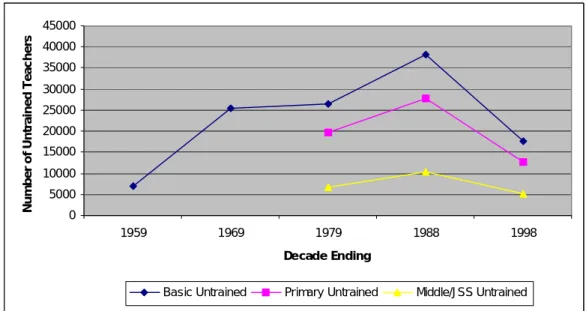
In 1956 the proportion of trained teacher in the assisted primary and middle schools constituted only 35.3 and 84.6 percent respectively of the total number of teachers (Foster, 1965). But as a result of post-independence educational reforms, Foster (1965) observed that these proportions rose to 46.2 %and 91.2 % before the nation gained its republican status in 1960. Almost a decade later, Ghana celebrated her second republic in 1969. Between these two periods, the number of untrained teachers rose from approximately 7000 which constituted 33% of the total teaching force (WCOTP, 1963) to about 25000 which was roughly about 53% of the total teaching manpower (GMOEC, 1972). By 1979, two decades after the country’s first republic, the proportion of untrained teachers remained significantly unchanged. The number of untrained teachers came roughly to 26000 constituting approximately 36% of the total teaching force (GES, 1980).
At the outset of the educational reforms, which began in 1987, the situation had become worse. Data presented in the recent Education Forum Report indicated that in the 1987/88 academic year the number of untrained teachers in primary and junior secondary schools were 27849 and 10423 constituting 43% and 32% respectively (GMOE, 1999). However, analysis of the data presented by the same source (GMOE, 1999) indicated that the first ten years of the educational reforms saw a dramatic improvement in the proportion of untrained teachers teaching in the nation’s basic schools. That is, by the 1997/98 academic year the number of untrained teachers in primary and junior secondary schools had reduced to 12725 and 5081 constituting 20% and 13% respectively.
Table 1 is a summary of the situation described above with respect to the proportions of untrained teachers engaged in teaching at the basic education level in the last four decades.
Table 1 Distribution of Untrained Teachers in Basic Education by Year Year Primary Middle/JSS Total Basic Basic Trained Basic
Untrained Percentage Untrained 1959 21200 14200 7000 33.0 1969 36317 11563 47880 22505 25375 53.0 1979 48397 24329 72726 46248 26478 36.4 1988 65305 32615 97920 59648 38272 39.1 1998 63689 37728 101417 83611 17806 17.6
[Source:Foster (1965), WCOTP (1963), GMOEC (1972), GES, (1980); Asiamah & Pandit (1988), GMOE (1999)]
Even though efforts were made to reduce the proportion of untrained teachers in basic education during the period under review, such efforts were more marked at the Middle/JSS level than the primary. Figure 1, which is a graphic representation of how the untrained teacher situation had been resolved over the decades, indicates improvements did not only begin to occur in the last decade but also the improvements made over the period were more marked at the Middle/JSS level.
Figure 1 Number of Untrained Teachers at Primary, Middle/JSS and Basic
[Source:Foster (1965), WCOTP (1963), GMOEC (1972), GES, (1980); Asiamah & Pandit (1988), GMOE (1999)]
Increase in Enrollments
Another indicator of the high teacher demand is the steady rise in enrollments. As a result of the massive post-independence developments embarked upon by successive governments to improve education, health and social services, there has been a rapid growth in population in the last four decades. According to a World Bank source, the population of school-going age children increased steadily at a rate of 2.6 per cent per annum in the first two decades after independence. The source also indicated that the number of school-going age children was growing more rapidly at a rate of 5.3 per cent during that period and predicted that the number of school-going age children in school would rise steadily to about 3.5% by 2000 (The World Bank, 1988). It is important to reckon the demographic pattern because of its direct relationship with the school-age population and the population of children reaching school-going age. The ‘Ministry of Education Report 1968-71’ indicated that the population of children reaching school-going age enrolled into primary class one, after the enactment of the universal, compulsory, ten-year basic education policy in 1961, averaged approximately 25000 for the latter part of the 1960s and the early 1970s (GMOEC, 1972:18). By 1979, Primary 1 enrollments had reached 400000 (GES, 1980). That is, intake increased by 10 fold in 1979 and since then there have been a steady rise in gross intake rates as can be seen in Table 2.
Table 2 Intake of Children of School-Going Age To Primary Class 1: 1978 to 1998 0 5000 10000 15000 20000 25000 30000 35000 40000 45000 1959 1969 1979 1988 1998 De cade Ending N u m b e r o f U n tr a in e d T e a c h e rs
Year Population of Children of School-Going Age ( Six-year olds)
Intake of Children to Primary Class One (Admissions) Gross Intake Rate 1978/79 409080 286139 69.94 1987/88 406306 347196 85.45 1997/98 582223 457229 78.3
[Source GES, (1980); (1988), GMOE (1999)]
The steady increase in population rate and the improved intake rates led to the establishment of new schools and expansion of existing ones. Table 3 presents a summary of the population of school-age children in school and the number schools that were available in the last four decades.
Table 3 Population of Children of School-going-age in School and Number Schools by Year
Year Population of School-age Children (6-14 year Olds) Number of School-age Children (6-14 year Olds) in School Number of Primary Schools Number of Middle/JS Schools Proportion of School-age Children (6-14 year Olds) in School Number of Trained Teachers per basic school 1960 1559740 630280 40.4 % 1969 1397026 7008 3546 2.1 1979 1784734 1988 3174500 2287168 9561 5260 72.0 % 4.0 1998 4465538 3043930 12326 6020 68.2 % 4.5
[Source:Foster (1965), GMOEC (1972), GES, (1980); Asiamah & Pandit (1988), GMOE (1999)]
The implication of the rapid expansion in enrollment is that schools required more and more teachers each year. But in the last four decades, the number of trained teachers increased from about 23000 to nearly 84000. This only raised the number of trained teachers to a basic school from 2.1 in 1960 to just 4.6 in 1998. Since each primary school require at least six trained teachers for effective functioning, it can be argued that there has since independence been shortage of trained teachers in our basic schools. One reason for the shortage is that the educational system has been expanding at a faster rate than the rate at which trained teachers are being produced or supplied for schools.
The Increasing Realisation that Certificate ‘A’ Qualifications Need Upgrading
In Ghana, the qualification of most trained basic school teachers is the Teacher’s Certificate ‘A’. This is obtained after going through an Initial Teacher Training (ITT) programme in a teacher training college. In their international study on the ‘Education of primary and secondary teachers’, Gimeno and Ibanez (1981) classified such colleges as ‘secondary level’ ITT colleges. The programmes offered by these training colleges lead to ‘certificates in teaching’, which they described as equivalent to School Certificate in Secondary Education (or GCE 'O" Level) qualification. Thus the academic qualifications of the majority of teachers in basic schools is low.
In spite of their low qualifications, teachers after completing their training receive very little in-service education and training (INSET). Even in places where these have been organised, the participants did not take it seriously because they counted very little towards the upgrading or promotion of the teacher (Mereku, 1995).
As a result of their low academic qualifications and the lack of in-service education, the social status of these teachers has sunk very low. Even though other factors like the social origins of teachers, the size of the teaching force, and the teacher’s relationship with clients, also account for their low status, the influence of their low academic qualifications and the lack of opportunities for their further education and upgrading is considerable.
But the academic qualifications of teachers are everywhere considerably higher than most other occupations and higher than the social service occupations with which they might be compared like nurses, agricultural extension officers, sanitation officers, etc. This however not the case today with the Ghanaian Certificate "A" teacher. As a result of improvements in the educational system, the qualification of the social service occupations has risen above that of most teachers. The qualification of most teachers today as compared to other workers in the communities in which they leave is low. This was not the case some two or three decades ago, where many communities the teacher was the only or the most schooled (educated) worker. It can be argued that the effect of teachers low academic qualifications on their social status and its consequences on their authority in both the classroom and community is one of the factors that account for the poor pupil performance in most of the nation’s schools today.
The few primary teachers who achieve some development while in service are the ambitious and intellectually capable ones who pursue academic studies in universities, university colleges, polytechnics, and advanced colleges of education. These teachers do not usually go back to the primary or basic schools after obtaining their diplomas or degrees. This is largely because the further education programmes in most of these institutions are not tailored to the needs of pupils studying in primary or basic schools. The result is that most teachers who complete their further education programmes in these institutions prefer to take up more prestigious teaching appointments in secondary schools and training colleges or are posted there by the GES with the explanation that their services are most needed at these levels.
3 Supply of Basic School Teachers in Ghana
Entrants to Teaching
Entrants to teaching at the basic education level are largely products of initial teacher training colleges. The decade of the 1960s saw a very rapid expansion in teaching manpower in primary and middle schools. This development was necessitated by the universal, compulsory education policy of the government of the first republic. Beside the large numbers of small training colleges that were established all over the country, the expansion was the result of crash schemes orgainised to recruit and give potential primary teachers a six – week emergency training (McWilliam and Kwamena-Poh, 1978).
The output of trained teachers almost doubled towards the end of the 1960s. The output of trained teachers began to make a considerable difference in the percentage of untrained teachers in the primary schools. Hanson (1971) recorded a fall in the number of pupils per trained teachers from a high level of 1 : 80 several years ago to 1 : 47 in 1970/71. This had compelled the government of the second republic to initiate a policy to consolidate the initial teacher training programme by curtailing the output of trained teachers to avoid over production from the mid 1970s (MOEC, 1972:39). Hanson (1971:47) observed that “the development led to the setting of a new target of 3200 trained teachers for each year from 1972”. But as a result of slums of the late 1970s and early 1980s, the target of 3200 set for the 1970s could hardly be met. In 1979 and 1980, the number of trainees in their final year in colleges totaled 2768 and 2703 respectively (GES, 1980).
Besides the shortfall in supply, there was mass exodus of teachers to Nigeria and other neighboring countries during this period. The exodus led to a drastic drop in the supply of trained teachers. That is, the proportion of trained teacher, which rose to about 64% by 1979, had declined to nearly 50% before the educational reforms were initiated in 1987. Asiamah and Pandit (1988) indicated that the number of trained teachers in primary schools dropped to 51.9% in 1986.
In the face of limited financial resources, the Ministry of Education introduced the Modular Teacher Training programme in the 1982/83 academic year to augment the supply situation. It was an attempt to produce teachers at minimum cost and to increase the supply of teachers through a new scheme by which teachers were trained partly on the job. The Modular programme led to massive increase in Training College enrollments raising the proportion of trained teachers in basic schools to about 60% by 1988 (see Table 5).
In 1990 all middle schools in the country were completely phased out as the JSS system reached its third year phase. To this effect, the reform created virtually a legion of redundancies as the 4-year Certificate ‘A’ qualification held by the majority of middle school teachers was considered inadequate for the increased curriculum demands of the JSS system. During this period a bulk of the post-secondary 3-year certificate ‘A’ trained teachers at the primary school level were transferred to fill the new posts at the junior secondary schools. The redundant middle school teachers were transferred to fill the vacant posts created at the primary level. The transformation of the middle schools into the junior secondary system did not lead to any significant improvement in the supply of teachers. It resulted rather in the internal mobility of teachers from one level of basic education to another.
Teacher supply (or the number of people that were teaching) in basic schools toward the end of each of the last four decades is presented in Table 4.
Table 4 Supply of Trained Teachers in Basic Education By Year Year Primary Middle/JSS Total Basic Basic Trained Basic
Untrained Percentage Trained 1959 21200 14200 7000 67.0 1969 36317 11563 47880 22505 25375 47.0 1979 48397 24329 72726 46248 26478 63.6 1988 65305 32615 97920 59648 38272 60.9 1998 63689 37728 101417 83611 17806 82.4
[Source:Foster (1965), WCOTP (1963), GMOEC (1972), GES, (1980); Asiamah & Pandit (1988), GMOE (1999)]
Flows out from the Teaching Service
The table shows that teacher supply improved rapidly in the last decade. It shows that by the end of 1990s the number of trained teachers had gone up by 23963 over the supply at the end of the 1980s. This is a rather misleading picture of the supply situation if the results are compared to the output of the teacher training colleges in the decade. Table 5 is a summary of the number of teachers placed in schools by the Teacher Education Division of the GES between 1987 and 1999.
Table 5 Output of Teacher Training Colleges between 1987 and 1999. Year Number of Teachers Posted to
basic schools since the reforms
Number of Teachers Posted to basic schools in the decade
1987 4718 1988 4777 1989 4280 4280 1990 4772 4772 1991 9189 9189 1992 1671 1671 1993 4847 4847 1994 6434 6434 1995 5576 5576 1996 5446 5446 1997 5698 5698 1998 6190 6190 1999 5948 5948 Total 69546 60051
[Source: GES Teacher Education Division, Statistics Unit (2000)]
has fallen short by 36088 suggesting a wastage rate of about 3000 teachers per annum over the decade.
In their analysis of enrollment and teaching manpower demand, Asiamah and Pandit (1988) took the wastage – i.e. flows from the teaching service due to deaths, retirements, dismissals, resignations, etc. – to be approximately 1% per annum of the stock of teachers. But the above analyses suggest the wastage rate has increased to about 3% per annum. A wastage rate of 3% can have a tremendous effect on the total stock of teachers considering that the wastage could be about 3000 teachers per annum leaving the service.
An interview conducted by the writer with an official at the GES Registry confirmed the wastage rate had increased substantially in the last decade. He explained that this was due the government’s intention to move all workers onto the Social Security scheme – a development which has been designated ‘CAP 40’.
Another major reason for the high wastage rate discussed above concerns teachers taking study leave with pay to do further education programmes that take them away from the basic level. The majority of these teachers leave the basic to pursue programmes in UCEW. Table 6 is the summary of intake into the Diploma programme in UCEW in the last five years.
Table 6 Summary of Intake of Diploma Students in UCEW
Year 1993 1994 1995 1996 1997 1998 1999
Intake to Diploma 255 287 720 905 1250 2294
[UCEW Planning Unit, 2000]
In the 1999/2000 academic year, for instance, UCEW alone took over 2294 Certificate ‘A’ trained teachers away from the classroom. The question is how many of these are likely to go back to the basic level considering the fact that they are no more specializing in teaching at the basic level. The new 4-year B.Ed. programme which was began 1999/2000 academic year but are being given a broad-based teacher education qualification that will make them function effectively at both SSS and basic levels.
The wastage rate of 3 per cent per annum being suggested for the last decade was obtained when flows from the teaching service due to study leave without return to the basic level was below a 1000 Certificate ‘A’ trained teachers per year. But UCEW alone has started taking over 2000 Certificate ‘A’ trained teachers away from the classroom at the dawn of the millenium. This suggests there is going to be a sharp increase in the wastage rate per annum since many of these teachers are not likely to go back to the basic level after their B.Ed. programme which is intended to make them function effectively at both SSS and basic levels. They usually prefer the higher level for obvious reasons.
4. Balancing Teacher Supply and Demand in the First Decade of the Millenium
Asiamah and Pandit (1988) projected that by the year 2000 the enrollment at primary and junior secondary levels of basic education will be almost double the 1987 figure assuming that
enrollment rates will improve from the present rate of 66% to about 84% by 2000. Their projections also suggested that, given a maximum pupil teacher ratio of 46:1, teacher requirements would increase by at least 60000 by the end of the decade. Even though the projected increase in teacher supply was achieved by the end of the decade, the demand for teachers is still higher than supply. This was found to be due to high wastage rate emanating largely from teachers taking study-leave with pay to do further education programmes that take them away from the basic level. How can this problem be solved once and for all?
To balance teacher demand and supply in the shortest possible time will require two major schemes. One is to offer programmes that will upgrade the substantial number of untrained teachers in service to Teacher Certificate ‘A’ qualification. The second is to curb the flows from the teaching service due to retirements, resignations and study-leave that takes the teacher away from the basic level.
Upgrading Untrained Teachers to Teacher Certificate ‘A’ Qualification
One way to eliminate untrained teachers completely from the educational system in the shortest possible time is to step up the supply of teachers from the initial training colleges. But it will not be easy to increase intake into the colleges since most of the colleges are operating at full capacity. Also in the face of limited financial resources, expanding the facilities to increase intake can only be a long-term option.
In view of the limited financial resources, the Teacher Education Division of the Ghana Education Service should re-introduce the ‘Modular Training Programme’, which was used in the 1980s to curb the situation. This was a part in-service and part college-based programme. A report of the Principals’ Conference in 1990, observed that
the ‘Modular Training Programme’ did not only make it possible to train a large number of teachers, but also made it possible to obtain potential trainees who were more willing to take up teaching posts in rural areas which were often the most unfortunate in times of teacher shortages (Amankwah, et al, 1990).
With good planning and the support of the Tutors of the Teacher Training Colleges and Training Officers of the GES District Directorates, the Teacher Education Division of the Ghana Education Service in collaboration with UCC and UCEW can upgrade all untrained teachers within a period of five years. This is therefore the direction in which GES Teacher Education Division should be channeling her resources to eliminate untrained teachers completely at the basic level.
Ensuring Further Teacher Education Programmes Keep Teachers at the Basic Level
The teacher wastage rate can be controlled if further teacher education programmes are tailored to the needs of basic school teachers. This can be done in two different ways. These are
upgrading the status of the initial teacher training colleges to tertiary in order to offer programmes that will lead to Diploma in Basic Education.
designing a further teacher education programme which is part in-service, and part college-based, for the upgrading of teachers.
these plans were proposed over a decade ago and accepted by the government (University Rationalization Committee, 1988), very little progress has been made towards the transformation of ITT colleges into full tertiary level institutions.
Similarly, the second was proposed as far back as 1996 as one of the strategies to ensure improved quality of education in our schools. The Free Compulsory Universal Basic Education (FCUBE) policy document indicated that further education programmes for the upgrading of Certificate ‘A’ teachers should employ modes other than the traditional full time college-based programmes. The document stated categorically that an ‘INSET Diploma in Basic Education’ programme should be mounted for the upgrading of the over 80,000 Cert. ‘A’ holders. This implies the Ministry supports a tertiary-level upgrading programme that will not take the teachers away from the classroom for long periods.
In 1997/98 academic year, the Teacher Education Division of the GES, in collaboration with UCEW and UCC, began an initiative to upgrade the curricula of ITT colleges into modular curricula. That is, workshops were organised on ‘the formulation of strategies and policies for designing syllabuses for the proposed college-based and INSET Diploma in Basic Education. During one of such workshops, a consultant on teacher education was brought down from the UK to facilitate the development of the guidelines. Distinctions were made between
(i) the proposed college-based Diploma in Basic Education, (ii) the proposed INSET Diploma in Basic Education, (iii) the Diploma offered in UCEW.
The consensus was that, with regard to professional studies and education studies, the content and scope of the proposed college-based and INSET Diploma in Basic Education programmes should be comparable to what is contained in up to end of year 2 in the Diploma being offered in UCEW. It is envisaged that the proposed Diploma in Basic Education Diploma graduates can upgrade by a 2-year post-diploma Bachelor of Education programme in UCEW. It was agreed that the course outlines for the proposed INSET Diploma would be designed when that of the college-based Diploma was ready.
As result of the workshops, course outlines for the proposed college-based Diploma were written, credit hour(s) was clearly defined and the number of credit hours for each course stated. The course outlines were sent to 10 colleges selected across the country for trial testing and comments. Curriculum Teams comprising officials from the Teacher Education Division of the GES, UCEW and UCC went round the selected colleges to interact with both the Tutors and trainees in order to assess the appropriateness of the course outlines and obtain comments on what to add or subtract.
In August 1998, at a workshop to incorporate findings from the field testing of the course outlines, a new development cropped up. The Teacher Education Division expressed concern about the pace at which the change of the ITT colleges into full tertiary level institutions was being pursued. It was explained that the Ministry was worried about such problems that the upgrading was likely to lead to like
(i) getting qualified teacher educators to teach in the colleges, (ii) getting good number of qualified students to enter the colleges, (iii) what salaries the new Diplomas will attract,
(iv) whether there will be enough fund to pay teachers if they should all hold Diplomas or tertiary level qualifications, etc.
In view of the above, the courses outline designed for the college-based Diploma in Basic Education programme were re-written using the format that was used in writing the reviewed basic school syllabuses. From this period, the Teacher Education Division has been very careful in making pronouncements about whether or not the colleges are going to be upgraded and when this will really begin.
Besides increasing the teacher retention rate, the advantages of upgrading the ITT colleges into full tertiary level institutions to award Diploma in Basic Education are
the nation’s most promising youths (i.e. the most capable secondary school graduates) will be attracted into the teaching profession,
emphasis in teacher training will shift from general education and mastery of subject disciplines onto the teachers' professional training;
the period of college-based training can be shortened and the ‘on-the-job’ training components can be introduced since trainees will be able to take responsibility of their own learning;
the general culture and way of social interaction will no more be controlled giving students the opportunity to be responsible for their own affairs’
The Way Forward
It is important to point out here that the Teacher Education Division of the GES is not the sole agent of teacher education charged with the task of upgrading the colleges. The FCUBE policy document categorically stated that “UCEW will train certificate ‘A’ teachers already in the system to obtain Diploma in Basic Education” (GMOE, 1996). However, it is sad to observe that very little impact has been made at the University College itself on initiatives taken so far to change of the ITT colleges into full tertiary level institutions.
UCEW has been very slow in responding to this challenge partly because the University College is yet to gain her autonomy from UCC who also the overseers the ITT colleges. Partly also because of disagreement within the University College on the differences between her own diploma and the proposed college-based and INSET Diploma in Basic Education.
Fortunately, the UCEW Diploma programme was phased out in the 1998/99 academic year. Teacher’s Certificate ‘A’ holders entering UCEW now pursue a 4-year B.Ed. programme. The programme, which is an enhanced form of the 3-year Diploma UCEW has offered since 1992, has a 3-year college-based component and a 1-year school-based work. With this development, it should be easy to resolve the disagreement on the differences between the three Diplomas can be resolved.
The college-based Diploma in Basic Education programme being proposed to replace the ITT Certificate programme was not intended to have content and scope that is comparable to the phased out UCEW Diploma. There is need for a compromise that the content and scope of the proposed diploma should be comparable to what is contained in up to end of year 2 in the UCEW Diploma in all areas of study except for subject studies. In place of further studies in the subject areas we should rather have curriculum studies in basic school subjects. Therefore with the right
caliber of entrants, the colleges can produce high quality teachers with the Diploma in Basic Education programme.
Getting enough qualified teacher educators to teach in the colleges is no more a problem. This is because evidence from the UCEW Planning Unit (2000) indicates that the university College has since 1996 graduated 5193 B.Ed. These teachers are not only qualified to teach courses up to the Diploma level at the tertiary level but also capable of handling the various subjects in the Diploma in Basic Education programme.
The solution to the question of whether or not there will be enough funds to pay teachers, and what to pay for which Diploma, is very simple. All that has to be done is put the teacher with Diploma in Basic Education qualification one scale above the starting point for Certificate ‘A’ trained teachers. And this is already being done. Take for instance the next scale above the trained teacher’s starting scale and the starting scale of a Polytechnic Diploma B/S holder working in UCEW, as illustrated in Table 7. You will notice that the salary of the former will not be very different from that of Diploma B/S holders.
Table 7 Salary scales for beginning trained teachers and Diploma B/S in holder GES
Beginning of
Scale End of Scale
Beginning Post Secondary Trained Teacher ¢2435642 ¢2968045 Assistant Superintendent (i.e. proposed entry
point for Diploma in Basic Education) ¢2755105 ¢3358071 Beginning Diploma B/S Holder in UCEW ¢2818785 ¢3451915
In terms of rewards, the additional salary above the Certificate ‘A’ teacher’s earning that a teacher with a Diploma in Basic Education qualification will take is rather insignificant if one thinks of the many new things that the Diploma teacher would be able to do which the certificate trained teacher cannot do.
As it is now clear that the upgrading of the ITT colleges into full tertiary level institutions must be accomplished before the INSET Diploma programme can take off, the Ministry of Education has to hasten efforts to grant the University College her autonomy from UCC.
Finally, it has to be pointed out that tertiary level ITT programmes fall outside the jurisdiction of the GES Teacher Education Division. The Division should therefore not only concentrate on improving quality of work in the secondary level ITT college, but also devote some of her resources in re-initiating the Modular Training programme so as to eliminate untrained teachers completely at the basic level.
References
Amankwah, G. K. et al, (1990) The Report of the National Teacher Training Council Sub-committee on the Modular Programme, Accra: national teacher Training Council
Asiamah, F. & Pandit, H. N., (1988) Forecasting Enrolment and Teaching Manpower Demand for Basic Education in Ghana (1987-2000). Accra: Ministry of Education and Culture. Awuku K. A., (1989) Teacher Education: Options for Course Structures and Offerings in the
Foster P J (1965) Education and Social Change in Ghana, London: Routledge and Kegan Paul, pp189.
GES Teacher Education Division, Statistics Unit (2000) Statistics of Teachers posted From 1987 to 1999 to Basic Schools, Accra: GES Teacher Education Division
Ghana Education Service - GES, (1980) Digest of Educational Statistics: Pre-university, Accra: Ghana Education Service, pp iv & v.
Gimeno, J. B. and Ibanes, I. N. (1981) The Education of Primary and Secondary School Teachers: An International Comparative Study, Paris: UNESCO.
GMOE – Ghana Ministry of Education - (1996) Basic Education Sector
Improvement Programme: [FCUBE Document] Accra: Ghana Ministry of
Education
GMOE – Ghana Ministry of Education - (1999) National Education Forum Report, Accra: Ghana Ministry of Education
GMOEC - Ghana Ministry of Education – (1972) Ghana Ministry of Education Report 1968-71, Accra: Ghana Publishing Corporation.
GMOEC - Ghana Ministry of Education and Culture (1990) Basic Statistics and Planning Parameters, Accra, Ghana. Ministry of Education.
GMOEC- Ghana Ministry of Education and Culture- (1990) The Basic Statistics and Planning Parameters for School Education in Ghana, Accra: Ministry of Education.
Hanson, J. W. (1971) Secondary Level Teachers Supply and Demand in Ghana, Michigan: Michigan state University
McWilliam H O A, and Kwamena-Po M. A. (1975) The Development of Education in Ghana, Hong Kong: Longman Group Ltd.
Mereku, K. D. (1995) A comparison of the official mathematics curriculum with the way in which it is implemented by teachers. Leeds: University of Leeds, School of Education. (Ph.D. Dissertation)
The World Bank, (1988) Education in Sub-saharan Africa: Policies for Adjustment, Revitalization and Expansion, Washington D.C.: The World Bank,pp144,157.
UCEW Planning Unit (2000) Basic Statistics: 2000, Winneba: University College of Education of Winneba.
World Conference of Organisations of the Teaching Profession (WCOTP), 1963, Survey of the Status of the Teaching Profession in Africa, Washington DC: WCOTP-UNESCO.
Zabalza, A. 1985, ‘Demand and Supply of Teachers’ in Husen, T. and Postlethwaite, N.T. (eds),
The International Encyclopedia of Education, Oxford: Pergamon Press.
Zabalza, A., Turnball, P. and Williams, G., 1979, The Economics of Teacher Supply Cambridge: Cambridge University Press.