FAME - International Center for Financial Asset Management and Engineering
THE GRADUATE INSTITUTE OF INTERNATIONAL STUDIES 40, Bd. du Pont d’Arve PO Box, 1211 Geneva 4 Switzerland Tel (++4122) 312 09 61 Fax (++4122) 312 10 26 http: //www.fame.ch E-mail: [email protected] Research Paper N° 19 Revised: May 2002 Stefan ARPING University of Lausanne
and Antitrust
Banking, Commerce,
INTERNATIONAL CENTER FOR FINANCIAL ASSET MANAGEMENT AND ENGINEERING
• • • •
R
ESEARCH
P
APER
S
ERIES
The International Center for Financial Asset Management and Engineering (FAME) is a private foundation created in 1996 at the initiative of 21 leading partners of the finance and technology community together with three Universities of the Lake Geneva Region (Universities of Geneva, University of Lausanne and the Graduate Institute of International Studies).
Fame is about research, doctoral training, and executive education with “interfacing” activities such as the FAME le ctures, the Research Day/Annual Meeting, and the Research Paper Series.
The FAME Research Paper Series includes three types of contributions:
• First, it reports on the research carried out at FAME by students and research fellows.
• Second, it includes research work contributed by Swiss academics and practitioners interested in a wider dissemination of their ideas, in practitioners' circles in particular.
• Finally, prominent international contributions of particular interest to our constituency are included as well on a regular basis.
FAME will strive to promote the research work in finance carried out in the three partner Universities. These papers are distributed with a ‘double’ identification: the FAME logo and the logo of the corresponding partner institution. With this policy, we want to underline the vital lifeline existing between FAME and the Universities, while simultaneously fostering a wider recognition of the strength of the academic community supporting FAME and enriching the Lemanic region.
Each contribution is preceded by an Executive Summary of two to three pages explaining in non-technical terms the question asked, discussing its relevance and outlining the answer provided. We hope the series will be followed attentively by all academics and practitioners interested in the fields covered by our name.
I am delighted to serve as coordinator of the FAME Research Paper Series. Please contact me if you are interested in submitting a paper or for all suggestions concerning this matter.
Sincerely,
Prof. Martin Hoesli
University of Geneva, HEC 40 bd du Pont d'Arve 1211 Genève 4
Tel: +41 (022) 705 8122 [email protected]
Banking, Commerce, and Antitrust
∗Stefan Arping University of Lausanne†
Revised: May 2002
Abstract
We develop a model in order to explore how a bank’s equity stake in a competitor of a borrower affects the financing relationship with the borrower and product market outcomes. The bank’s affiliation with the competitor can give rise to anti– or pro–competitive effects. Large equity stakes can facilitate anti–competitive conduct. In sharp contrast, small equity stakes are pro–competitive. The reason is that the bank’s equity stake in the competitor hardens the borrower’s budget constraint. This alleviates credit rationing problems and enables the borrower to invest more aggressively. These findings suggest that bank equity holdings in industrial firms have non–monotonic effects on product market competition.
∗This paper is based on the first chapter of the author’s PhD dissertation submitted at Universitat
Aut`onoma de Barcelona/Institute of Economic Analysis, CSIC. The author would like to thank Kai–Uwe K¨uhn and Mathias Dewatripont for their comments and encouragement. This paper also benefited from the comments and suggestions of Bruno Cassiman, Gabriella Chiesa, Gyongyi Loranth, Michel Habib, Ines Macho–Stadler, Jan Marth–Smith, Carmen Matutes, Marco da Rin, Guillaume Rocheteau, Frank A. Schmid, Javier Suarez, Elu von Thadden, Xavier Vives, Oved Yosha, Alexandre Ziegler, and seminar participants at EEA 1997 in Toulouse, Universitat Aut`onoma de Barcelona, the 1999 Finance Symposium in Karlsruhe, Ente Einaudi, and the University of Vienna. Much of this work was done while the author was visiting ECARE, Universit´e Libre de Bruxelles. The author would like to thank ECARE for its hospitality and the European Commission for financial assistance. All errors are solely the author’s responsibility.
†Address for correspondence: University of Lausanne, Ecole des HEC, BFSH1, CH–1015 Lausanne,
Banking, Commerce, and Antitrust
Executive Summary
Recent legislation in Europe (Second Banking Directive) and the US (Gramm–Leach– Bliley Act) expands the ability of banking organizations to make equity investments in non–financial firms. This paper addresses the antitrust implications of equity in-vestments by banks. Since the pre–WWI period in the US, when private banks such as J.P. Morgan exerted substantial control over firms and played an important role in facilitating mergers in the steel and railroads industries, there is a persistent debate about bank industrial ownership and its potential anti–competitive effects. Do bank equity investments hamper funding possibilities for companies that would compete against bank–affiliated incumbents? Do affiliations between banks and firms facilitate product market collusion and the cartelization of industries?
The present paper explores these questions within a formal framework. The model elaborates on how a bank’s equity stake in a competitor of a borrower affects the fi-nancing relationship with the borrower and product market outcomes. We show that the bank’s affiliation with the competitor can give rise to anti– or pro–competitive effects. Large equity stakes can facilitate anti–competitive conduct. When the bank holds a large equity stake in a competitor of a borrower, it internalizes much of the competitive externalities imposed on the competitor when providing aggressive financ-ing to the borrower (which would erode the product market rents of the competitor). As such, the bank is less inclined to provide the borrower with aggressive financing when holding a large equity stake in the competitor.
In sharp contrast, small equity stakes havepro–competitiveeffects. When the bank holds a small equity interest in a competitor of a borrower, providing the borrower with aggressive financing is profitable for the bank as long as the borrower’s project has positive net present value. Yet, the equity stake in the competitor enhances the bank’s bargaining power in debt renegotiations with the borrower. In particular, the bank is less inclined to bail out the borrower should the latter behave opportunistically and deviate from an ex ante efficient course of action. This effect alleviates agency conflicts between the bank and its borrower and explains why the bank is willing to provide more funding in the first place.
Concerns that bank equity stake holdings result in anti–competitive effects and as such deserve special regulatory treatment seem overstretched in light of the analysis. Existing antitrust rules already restrict means to engage in anti–competitive conduct. Capital adequacy regulation already restrains banks’ ability and incentives to take large equity stakes and other highly cash flow sensitive claims. At the same time, existing capital adequacy regulation in most countries maintains banks’ ability and incentives to take small equity stakes. As is demonstrated in the present paper, this may very well give rise to pro–competitive effects.
1
Introduction
The merits of banks taking equity stakes in industrial companies are subject to fierce debates.1 Opponents point to various conflicts of interest that might arise if banks
were to play the dual role of creditors and shareholders. It is also argued that financial stability might be impeded if banks were to invest in risky equity. Advocates argue that combining equity with debt financing alleviates agency problems associated with either pure debt or pure equity financing. These arguments have been tackled ex-tensively in the academic literature. This paper addresses an important element of the policy debate which has been largely overlooked by the literature, namely the antitrust implications of bank equity holdings. Do such investments hamper funding possibilities for companies that would compete against bank–affiliated incumbents? Do affiliations between banks and firms facilitate product market collusion and the cartelization of industries?
These questions are highly relevant for a persistent debate about bank industrial ownership and its potential anti–competitive effects. In the US, the debate emerged during the pre–WWI period of “financial capitalism”.2 At that time, private banks
(in particular, J.P. Morgan) exerted substantial control over firms, held equity and board seats, established interlocking directorates in competing firms, and played an important role in facilitating mergers in the steel and railroad industries. This led to the perception among policy makers that bank–commerce affiliations were to foster anti–competitive conduct. For example, in 1914, Louis Brandeis, an influential lawyer, who later became Supreme Court Justice, commented on J.P. Morgan’s role as follows (Cantillo–Simon 1998): “More serious, however, is the effect of [J.P. Morgan’s] Money Trust in directly suppressing competition. Monopoly arrests development, prevents the lessening of cost of production and of the distribution which would otherwise take place.” Eventually, these perceptions led to the passage of Clayton Antitrust Act in 1914, which prohibited interlocking directorates in competing firms. In 1933, Congress passed the Glass–Steagall Act, which not only separated commercial from investment banking, but also prohibited commercial banks from making equity investments for their own account.
While the Glass–Steagall Act was largely repealed in 1999 with the passage of the Gramm–Leach–Bliley Act, commercial banks’ ability to take equity stakes in indus-trial firm remains restricted.3 Fears that lifting such regulatory hurdles could result in
anti–competitive effects played an important role during the policy debate prior to the passage of the Gramm–Leach–Bliley Act. For example, governor Laurence H. Meyer argued that “these types of connections have the potential to restrict the free flow of credit and to create conflicts of interest [. . . ] as banks consider whether to extent credit to an affiliate or a competitor of an affiliate.” (November 12, 1998). Elsewhere,
1See e.g. Krainer 2000, Kroszner 1998, Santos 1998, Saunders 1994, and Shull 1994 for accounts
of the discussion and further references.
2See Cantillo–Simon 1998, De Long 1990, 1992, and Ramirez 1995 for excellent accounts of the
role of banks during the pre–WWI period in the US.
in Japan, where bank have equity stakes in industrial firms, the Anti–Monopoly Act of 1977 forced banks to divest equity stakes larger than 5% of a firm’s outstanding shares. In Germany, there is a long–enduring debate about the competitive effects of bank equity stake holdings. For example, in 1995, Joschka Fischer, now Germany’s foreign minister, asserted that“a company like Microsoft would never have a chance in Germany because big German banks and leading industrial companies form a closed cartel that stifles investment in budding entrepreneurs.” (The Economist, January 21, 1995). Not surprisingly, banks fiercely oppose to such views (see e.g. Bundesverband der deutschen Banken 1995).
The reasoning behind concerns that bank equity stake holdings could give rise to anti–competitive effects seems straightforward: if a bank holds an equity stake in a firm, it participates in the firm’s upside. The bank thus partially internalizes the negative externalities aggressive investment in a competitor impose on the firm. As such, when holding an equity stake in a firm, a bank should be less inclined to aggressively invest in a competitor or to provide funding in the first place. Similarly, the bank may also play an important role in cartelizing industries and facilitating product market collusion. The bank’s role in softening product market competition should be more effective, the larger its equity stake in the firm. Yet, empirical studies about the link between firm value and bank ownership in Japan and Germany point to a non–monotonic, U–shaped relationship between firm value and the size of bank equity stakes (Morck et al. 2000, Schmid 1996). If bank equity holdings were to protect the rents of incumbent firms, one would expect a monotonic relationship between firm value and bank ownership.
This paper presents a theory of the competitive effects of bank equity holdings that is consistent with these empirical patterns. In particular, we find that small
equity holdings give rise to pro–competitive effects, while large equity stakes can be
anti–competitive. We thus find that bank equity holdings in industrial firms have non– monotonic effects on product market competition. Our formal framework elaborates on the financing relationship between a borrower and a bank that holds an equity stake in a product market competitor of the borrower. The financing relationship is subject to moral hazard, giving rise to credit rationing. We explore how the bank’s affiliation with the competitor affects (i) the joint investment objectives of the bank and the borrower, (ii) the bank’s incentives to prevent the borrower from competing against its affiliate, (iii) the borrower’s incentives not to behave opportunistically, and (iv) the borrower’s financing constraints.
The starting point of our theory is the observation that a small equity stake in the competitor will be largely irrelevant for the joint investment objectives of the bank and the borrower. As long as the borrower’s project has positive net present value and the bank’s equity stake in the competitor is small, investment is jointly efficient for the bank and the borrower. In particular, as credit rationing gives rise to underinvestment, it will be jointly efficient to investmore aggressively, even if this comes at the expense of the competitor’s business and consequently at the expense of the bank’s equity interest in the competitor. Paradoxically, then, it is the very feature of equity claims that has been alleged to give rise to anti–competitive effects
which gives rise to pro–competitive effects. The reason is that the equity stake in the competitor improves the credibility of a threat to liquidate the borrower should she behave opportunistically and deviate from an ex ante optimal course of action. The bank’s equity stake in the competitor thus hardens the borrower’s budget constraint. This alleviates the credit rationing problem and enables the borrower to invest (and compete) more aggressively.
Such reasoning holds true as long as the bank’s equity stake in the competitor is not too large. When the bank’s equity stake in the competitor becomes larger than a certain threshold, the objective of the bank and the borrower is no longer to alleviate the credit rationing problem, but tomonopolize the competitor. The joint investment objective switches fromminimizingcredit rationing tomaximizing“credit rationing”. Thus, while small equity stake holdings are pro–competitive, large equity stakes can have anti–competitive effects.
Our central finding mirrors results obtained in the corporate finance literature on hardening firms’ budget constraints (see, among others, Bergl¨of and von Thadden 1994, Bolton and Scharfstein 1996, Dewatripont and Tirole 1994, Hart and Moore 1998, Repullo and Suarez 1998). For example, Bergl¨of and von Thadden (1994) demonstrate that separating short–term and long–term claims and allocating these claims to different classes of investors improve the credibility of liquidation threats and thus commit a firm not to hold up investors ex post. Repullo and Suarez (1998) show that collateral and multiple source financing help to commit a firm’s manage-ment to work harder. Our analysis suggests that a cash flow sensitive claim in a competitor can effectively serve as asubstitute for multiple source financing and col-lateral. This is particularly relevant when multiple source financing is costly due to the presence of monitoring and screening costs (Diamond 1984) or when assets provide little collateral value. The present paper is also related to the literature on common lenders (Bhattacharya and Chiesa 1995, Poitevin 1989) and a recent literature on the role of strategic complementarities in financing (Hellmann 2002) and entry deterrence through financial contract design (Cestone and White 2002). Section 4 provides a more detailed account of how the present paper is related to this research.
The paper is organized as follows. The next section presents the formal framework and the main assumptions. Section 3 analyzes the financial contracting problem between a borrower and a bank that is unaffiliated with a competitor of the borrower. Section 4 explores how an exogenously given equity stake in a competitor of a borrower affects the financing relationship between the bank and the borrower and product market outcomes. The main purpose of this section is to investigate how the bank’s equity stake in the competitor affects the borrower’s ex post liquidity constraints and the bank’s incentives to eventually soften the borrower. Section 5 extends the framework to allow for endogenous acquisitions of equity like claims. The focus of this section is to show how a bank’s ability to take a cash flow sensitive financial claim in an incumbent firm affects the borrower’s initial funding constraints. Section 6 provides a discussion of the paper’s empirical and policy implications, and concludes. Proofs are relegated to the appendix.
2
The Model
The framework elaborates in the most simple fashion on the financing relationship between a firm/borrower in need of outside funding to finance entry into a market and an investor (refereed to as bank) who holds acash flow sensitive financial claim in an incumbent monopolist. The following features of the contracting environment are central to our analysis:
(i) the financing relationship between the bank and the entrant firm is subject to moral hazard, giving rise to credit rationing. We adopt the unverifiable cash flows framework along the lines of Bolton and Scharfstein (1996) and Hart and Moore (1998). Cash flows accrue to the entrant, are unverifiable (but observable), and can be diverted by the entrant. The parties thus have to envision a mechanism that commits the entrant to pay back the bank.
(ii) through holding a cash flow sensitive claim in the incumbent competitor, the bank partially internalizes the negative externalities entry and aggressive investment exert on the incumbent. Similarly, the bank partially internalizes the positive exter-nality exit imposes on the incumbent. The bank’s claim in the incumbent is thus best interpreted as an equity–like claim. Section 4 takes the bank’s claim in the incum-bent asexogenouslygiven. The purpose of this analysis is to show how the financing relationship with the borrower and the latter’s prospects are altered when increasing the size of the bank’s equity stake. Section 5 extends the basic framework in order to allow forendogenous acquisitions of financial claims in the incumbent.
Formally, we consider a two–period model with three dates,t= 0,1,2. All agents are risk neutral in this model and the risk free interest rate is normalized to zero. The timing of events is summarized in figure 1.
t= 0 t= 1 t= 2
-– entry at costI
competition
– cash flows realize – payments made – continue or liquidate assets worthL < I (exit)
competition
– cash flows realize – payments made
Figure 1: Timing
At t = 0, the bank makes a contract offer to the entrant (of course, the bank may offer not to finance the entrant). The entrant either accepts or rejects this offer. If the entrant (“she”) rejects the offer, she approaches one of many banks that do not hold cash flow sensitive claims in the incumbent. Throughout the paper, we refer to the incumbent–affiliated bank as the inside bank. The other banks are referred to as outside banks. For convenience, there is only one inside bank. This introduces an element ofimperfect credit market competition. In particular, if the inside bank’s equity stake in the incumbent equipped the inside bank with a competitive advantage
in funding the entrant, the bank would capture the surplus gains stemming from such a competitive advantage, i.e. make a profit.4
There is a fixed investment outlay I. The entrant has internal funds A < I, i.e. needs outside funding I −A > 0 to finance entry. After the first period, the entrant’s assets can be liquidated and deployed elsewhere. Assets in place have a verifiable and deterministic liquidation value L < I. For simplicity, assets have zero liquidation value after the second period.
After having expended the investment outlay, the entrant competes against the incumbent during the first period. Provided the entrant is not liquidated after the first period, there is a second round of product market competition during the second period. After the second period, there are no further opportunities to generate profits in this market. Conditional on the entrant competing at full scale against the incum-bent in a period, each firm makes duopoly profits ΠDwith probabilityθand zero with
probability 1−θ in this period.5 Conditional on the entrant not competing against
the incumbent (either because the entrant exited the market or did not enter in the first place), the incumbent makes monopoly profits ΠM >ΠD with probabilityθ and
zero with probability 1−θ. For simplicity, cash flows are independently distributed across periods.
We adopt the following parameter assumptions: (A1) duopoly industry profits are strictly inferior to monopoly profits, 2ΠD < ΠM. (A2) the entrant’s going concern
value after the first period is strictly larger than the asset liquidation value,θΠD > L.
(A3) the entrant’s net present value is positive, 2θΠD > I. Assumptions (A2) and
(A3) are standard. Assumption (A1) sharpens the analysis in that it gives rise to a
conflict of interestbetween industry insiders and antitrust authorities (whose interest is to have more competition).6
In the absence of antitrust restrictions, the analysis would be trivial. The incum-bent would simply buy out the competitor or initiate a merger (supposing that the incumbent has deep pockets). We suppose that a merger is bad for overall welfare (profits and consumer surplus). A merger between the two competitors is thus pro-hibited on antitrust grounds. Similarly, non–compete clauses between the incumbent and the entrant cannot be enforced in court. This implies that the incumbent can-not successfully bribe the entrant for staying out: the entrant would never stick to a promise not to enter and instead use the bribe to finance market entry. Also, product market collaborations between the two competitors are prohibited, in particular, the
4It is inessential for the qualitative findings which party captures the surplus gain. Section 5
considers a setting where any bank canacquirea cash flow sensitive claim in the incumbent. Any surplus gains stemming from this opportunity are then naturally captured by the entrant.
5Below we will show that the entrant may compete atpartialscale against the incumbent. In this
case, the incumbent will derive product market income strictly larger than the duopoly profits and strictly smaller than the monopoly profits.
6If products were highly differentiated or the incumbent already faced some competition prior to
the entrant entering, entry might well bejointlyefficient for the incumbent, the inside bank, and the entrant. Our central result holds true as long as entry/exit exerts (some) negative/positive externality on the incumbent (i.e. ΠD<ΠM). However, the antitrust implications may lose their bite. We thus adopt the stronger assumption 2ΠD<ΠM.
incumbent cannot finance the entrant. Finally, exclusive financing contracts between the inside bank and the incumbent are non–enforceable.7
The antitrust restrictions imply that in order for the incumbent–affiliated inside bank and the entrant to be willing to monopolize the incumbent (either by exiting the market or not entering in the first place), entry/exit has to be jointly ineffi-cient/efficient for the inside bank and the entrant, given the bank’s equity stake in the incumbent. This occurs if and only if the bank’s equity stake in the incumbent is sufficiently large. In particular, if the bank holds a small stake in the incumbent, entry will be jointly efficient and exit/liquidation will be jointly inefficient (since 2θΠD > I
andθΠD > L).8 Conversely, if the bank holds a sufficiently large stake in the
incum-bent, entry will be jointly inefficient (sinceL < I and 2ΠD <ΠM). Ideally, if the bank
held such a large stake in the incumbent, the bank would buy out the entrant (before entry) and have the entrant sign a “non–compete clause”. Whether or not the parties can achieve this outcome depends on the legal environment and the inside bank’s ability to effectively prevent the entrant from competing against the incumbent.
The paper’s qualitative findings are largely unaffected by the specific assumptions one adopts regarding the inside bank’s ability to prevent the entrant from competing. For brevity and in order to sharpen the analysis, we suppose that non–compete clauses cannot be enforced in court (a buy out before entry is thus excluded). Moreover, the entrant would always re–enter the market if liquidated immediately after entry (using any compensation she received for not competing against the incumbent). However, the inside bank can “soften” the entrant relative to outside bank financing by invest-ing, keeping the firm running for one period, and (fully or partially) liquidating the firm after the first period (liquidation after the first period is thus irreversible). If a buy out by the inside bank (before or immediately after entry) were feasible, the qualitative results would continue to hold true. The assumption that a buy out is not feasible simplifies the analysis as it allows to focus on the intensity of competition during the second period (measured by the entrant’soperating scale) when comparing inside bank with outside bank financing.
After having put the formal framework and the main assumptions in place, we can turn to the analysis. The next section derives the optimal financial contract between the entrant and anoutside bank. Outcomes under outside bank financing define the inside bank’s and the entrant’sstatus quo payoffsunder inside bank financing. Section 4 turns to inside bank financing and explores how the entrant’s prospects are affected when altering the size of the inside bank’s equity stake in the incumbent. Section 5 extends the framework to allow for endogenous acquisitions of (e.g. equity–like) financial claims in the incumbent.
7Naturally, equity is a claim that would typically reward the inside bank for preventing the entrant
from competing. A crucial insight of the paper is that if the inside bank does not sufficiently partici-pate in the incumbent’s upside such a contract comes to the benefit of the entrant, while hurting the incumbent. In particular, it will induce the entrant to be more aggressive.
3
Outside Bank Financing
In this section, we discuss the financial contracting problem between the entrant and an outside bank. While financial contracts cannot condition on cash flow realizations, payments to and from the entrant are verifiable. Consider the following “Hart–Moore” type of contract: At t = 0, the bank transfers T ≥ I−A to the entrant (provided funding by an outside bank is feasible). In exchange for its contribution, the bank is promised a repaymentR > 0 att = 1. Should the entrant default on this payment, the bank is entitled to seize the entrant’s assets (worth L). The entrant can then use her cash balance K ≡T −(I−A) to buy back part of her assets (this will be of particular importance in the low cash flow state when the entrant must default). This contract can be interpreted as a credit contract, coupled with aliquidity management device (or a credit line).9 There is no repayment after the second period. This is
because there are no further profit opportunities after the second period and assets have zero liquidation value. Hence, the bank has no further leverage over the entrant. Second period cash flows thus represent private benefits that are lost if the entrant were liquidated.
We allow for partial liquidation and consider, for simplicity, constant returns to scale. If the entrant operates with a fractionβ of her assets, she generates expected income βθΠD. Conversely, the incumbent generates expected income βθΠD + (1− β)θΠM. Hence, in order to maximize industry profits the entrant should not operate
at all. In contrast, in order to maximize “competition” the entrant should operate at full scale (formally,β = 1). As the entrant’s scale β increases, she competes more aggressively against the incumbent. The entrant’s operating scale thus measures the intensity of product market competition during the second period.10
Suppose the entrant does not generate any product market income during the first period. Hence, as long as the cash repayment exceeds the cash balance,R > K, the entrant has to default for liquidity reasons, entitling the bank to liquidate her assets.11
However, since θΠD > L, liquidation is inefficient and the entrant still has her cash
balance which she can use to buy back part of her assets. Thus, there is room for renegotiation. For simplicity, the entrant makes a take–it–or–leave–it renegotiation offer to the bank. Formally, she offers the bank some cash paymentR0
l (lfor low cash
flow state) in exchange for the bank letting her continue at scaleβl >0. The entrant’s
continuation payoff from making such an offer amounts toK−R0
l+βlθΠD (the entrant
has K, pays back R0
l, and obtains private benefits βlθΠD). The renegotiation offer
has to satisfy two relevant constraints: (i) the bank must be willing to accept the
9Yet, in our simple setting, one could equally set R = ∞ (as will be shown below), i.e. equip
the bank with unconditional liquidation rights (Hart and Moore’s “slowest debt contract”). Such a contract may very well be interpreted asequity.
10This consideration would be equally relevant for the first period, if partial investment were feasible.
However, extending the model along these lines would not alter the qualitative insights. “Aggressive investment” thus refers to the bank equipping the entrant with a large cash balance and the entrant using this cash balance in order to survive a liquidity squeeze at larger scale.
11The entrant cannot self–liquidate assets in order to avoid default. This is without loss of generality
offer, R0
l+ (1−βl)L ≥ L, and (ii) the entrant cannot pay out more than she has, R0
l≤K. As the bank’s acceptance constraint is binding, the latter constraint reduces
toβl ≤K/L. Hence, as long as K < L, the optimal renegotiation offer after liquidity default involvesβl=K/L <1 andR0
L=K: the entrant uses her entire cash balance
to buy back assets from the bank. Still, partial liquidation cannot be avoided. Next, suppose the entrant is successful during the first period. If the entrant pays backR, she continues to compete during the second period. If the entrant does not pay back R, i.e. defaults strategically (suppose, for a moment, that the entrant can pay back R in the high cash flow state), the bank is entitled to liquidate and renegotiation is triggered. Supposing that the entrant’s cash reserves are sufficient as to fully compensate the bank for not liquidating, K+ ΠD ≥L, she pays R0
h =L (h
for high) after default and renegotiation. In exchange, the bank does not liquidate. An optimal financial contract maximizes the entrant’s payoff, subject to the bank breaking even, the entrant having sufficient incentives not to default strategically, and the entrant’s cash constraint. Formally, the entrant’s problem is to
max R,K≥0 θ(Π D +K−R+θΠD) + (1−θ)K LθΠ D (1) s.t. θR+ (1−θ)L≥I−A+K (2) ΠD+K−R+θΠD ≥ΠD+K−L+θΠD (3) R≤ΠD+K (4)
The optimal financial contract under outside bank financing is easily derived. Note first that the bank’s break even constraint (2) is binding. The cash constraint (4) is implied by the incentive constraint (3). Hence, the cash constraint is not binding. Substituting R from the bank’s binding break even constraint into (1) and (3) and rearranging terms, the problem reduces to:
max
K≤L−(I−A),K≥0
K L(θΠ
D−L) (5)
By inspection, funding by an outside bank is feasible if and only if A ≥ I −L. Intuitively, since the entrant cannot commit to pay out more than the assets’ collateral value L, she has to contribute at least I −L > 0 out of her internal funds to the financing of the initial investment outlay. If outside bank financing is feasible, the entrant commits to the highest incentive compatible repayment. This maximizes the cash balance available to buy back assets in the low cash flow state. An optimal contract thus consists of a cash balanceK∗ =L−(I−A) and a repaymentR∗ =L.
While the optimal contract minimizes inefficient liquidation in the low cash flow state, the first best is not achievable: in the low cash flow state the entrant continues only at scaleβ∗
l = 1−(I−A)/L <1. In other words, there is credit rationing:
Proposition 1 Suppose the entrant is financed by an outside bank. Then, there is credit rationing in that the entrant is partially liquidated in the low cash flow state. Furthermore, the incumbent is partially monopolized. The larger the entrant’s in-ternal funds and asset collateral value, the better the entrant’s prospects to compete aggressively against the incumbent.
Financing constraints channel into product market competition through their effects on the entrant’s prospects to survive a first period liquidity squeeze. High internal funds and a strong collateral value help the entrant to better survive a liquidity squeeze and to compete aggressively against the incumbent (as measured by her second period production scale). Throughout the next section, we assume that outside bank financing is feasible and profitable for the entrant. This implies that the inside bank’s equity stake in the incumbent has no effect on the entrant’s ability to finance entry, i.e. on her initial funding constraint (if the inside bank denied initial funding, the entrant would approach an outside bank). Yet, as will be shown below, the inside bank’s equity stake in the incumbent still affects in important ways the financing relationship with the entrant, the intensity of product market competition, and the incumbent’s monopoly rents.
4
The Competitive Effects of Bank Equity Stakes
Consider now the financing relationship between the entrant and theinsidebank. The payoffs under outside bank funding define the parties’ respective status quo payoffs. If the entrant rejected the inside bank’s contract offer, she would approach an outside bank. Therefore, for the entrant to be willing to accept the inside bank’s contract offer, the entrant’s payoff under the contract must not be lower than her payoff under outside bank financing. Similarly, the inside bank’s payoff must not be lower than its payoff under outside bank financing. Denote the inside bank’s equity stake in the incumbent by τ. For simplicity, an equity stakeτ ∈[0,1] enables the inside bank to obtain a dividend payment τΠ, where ˜˜ Π∈ {0,ΠD,ΠM}.12 The inside bank’s payoff
fromnot financing the entrant is thus given by
τ³θ(ΠD +θΠD) + (1−θ)θ(βl∗ΠD+ (1−β∗l)ΠM)´ (6) whereβ∗
l = 1−(I−A)/L <1. A contract between the entrant and the inside bank
is individually rational if the entrant is not better off switching to an outside bank and the bank’s payoff under this contract is not lower than (6). Up to now, we did not specify what kind of contract the inside bank might offer. In general, the inside bank may offer the entrant not to launch her firm and, in exchange, compensate her for not competing against its affiliate. Since a buy out by the inside bank before or immediately after entry is not feasible, we can restrict attention to contracts under which the entrant’s firm is indeed launched and competes during the first period. As was discussed earlier, this is without loss of generality as long as the inside bank’s equity interest is not too large. As for large equity stakes, financing the entrant is a prerequisite for the inside bank to prevent the entrant from competing during the second period.
The analysis proceeds as follows. We first characterize the outcome of renegotia-tion between the inside bank and the entrant after default for a given contract (R, K),
12Section 5 adopts a more general approach to modelling the inside bank’s financial claim in the
incumbent. For the moment, think of the incumbent as a 100% equity, non–opportunistic firm with deep pockets.
assuming that the entrant has been financed by the inside bank. We subsequently characterize the optimal contracts and equilibrium outcomes for “small” and “large” equity stakes, respectively.
Consider a contract (R, K) and suppose the entrant defaults at t = 1 (either strategically or for liquidity reasons). In cash flow state s ∈ {l, h} (low/high), the entrant has cash reserves K + Πs, where Πs ∈ {0,ΠD}. The entrant makes then
a renegotiation offer (R0
s, βs) in order to maximize her payoff, subject to the bank
accepting the offer and the entrant’s cash constraint not being violated. Formally, in states∈ {l, h}, the entrant’s problem is to
max βs∈[0,1],R0s K+ Πs−R0s+βsθΠD (7) s.t. R0s+ (1−βs)L+τ θ(βsΠD+ (1−βs)ΠM)≥L+τ θΠM (8) R0s≤K+ Πs (9)
where (7) is the entrant’s continuation payoff, (8) is the bank’s acceptance constraint, and (9) is the entrant’s cash constraint. Note that as the inside bank’s equity stake in the incumbent increases, the bank becomes less inclined to accept a renegotiation offer to let the entrant continue (at some scale). Formally, as long asβs >0, the right
hand side of the bank’s acceptance constraint (8) is increasing at a faster rate in τ
than the left hand side. Hence, when the bank’s interest in the incumbent becomes larger, the entrant either has to compensate the bank with a larger cash payment for the bank waiving its liquidation rights after default or there is more liquidation relative to outside bank financing. Crucially, however, as long as liquidation isjointly
inefficient and the entrant has sufficient cash reserves to compensate the bank for not liquidating, liquidation after default can be avoided. The entrant just has to pay more to the inside bank to achieve this outcome. This insight will play a crucial role in the following analysis.
Substituting R0s from the bank’s binding acceptance constraint into the objective function and the cash constraint (9), the problem reduces to
max βs∈[0,1] K+ Πs+βs h θ(ΠD +τΠD)−(L+τ θΠM)i (10) s.t. βs≤ K+ Πs L+τ θ(ΠM −ΠD) (11)
The expression in squared brackets is the joint efficiency gainfrom continuation. If the entrant continues, the joint surplus is given byθ(Π +τΠD). If the entrant is
liqui-dated, the joint surplus amounts toL+τ θΠM, namely the inside bank’s share of the
incumbent’s expected second period monopoly profits plus the liquidation proceeds. By inspection, the joint efficiency gain from continuation is non–negative if and only if the bank’s equity stake in the incumbent is not too large,
τ ≤ θΠD−L
Continuation after the first period is thusjointlyefficient for the entrant and the inside bank if and only ifτ ≤τ˜. Note that ˜τ is strictly interior, increasing in the entrant’s expected second period net present value,θΠD−L, and decreasing in the competitive
externality continuation imposes on the incumbent, θ(ΠM −ΠD). Intuitively, if the
entrant’s going concern value is very large relative to the liquidation value of her assets, continuation is likely to be efficient even if the bank holds a “large” equity stake in the incumbent. If continuation imposes a very strong negative externality on the incumbent (say, the firms’ respective product offerings are very similar from potential customers’ point of view), continuation is likely to be inefficient even if the bank holds only a “small” stake in the incumbent. We are now ready to state the following
Lemma 1 Consider a contract(R, K)and suppose the entrant defaults after the first period. Then, there exists a critical threshold τ˜ ∈ (0,1) such that in cash flow state s∈ {l, h},
• for τ ≤τ˜ (small equity stake in incumbent), the entrant is continued at scale βs= min · K+ Πs L+τ θ(ΠM −ΠD),1 ¸ (13) against a payment R0s=βs(L+τ θ(ΠM −ΠD)) (14)
• conversely, for τ > τ˜ (large equity stake in incumbent), the entrant exits the market, βs=R0s= 0.
When the inside bank’s equity stake in the incumbent is small, continuation is jointly efficient for the bank and the entrant. Hence, the parties should minimize liquidation. Conversely, when the bank’s equity stake in the incumbent is large, continuation is jointly inefficient. Hence, renegotiation does not allow to improve efficiency beyond the status quo outcome (the bank liquidating).
Crucially, as long as the bank’s equity stake in the incumbent is smaller than the critical threshold, the joint objective of the bank and the entrant is tominimize
liquidation. However, first best efficiency may not be achievable due to the entrant’s financing constraints. In particular, the entrant’s cash reserves may be insufficient as to avoid liquidation. As soon as the bank’s stake in the incumbent becomes larger than the threshold, the joint objective is no longer to minimize liquidation but to
monopolize the incumbent. Since default entitles the bank to liquidate the entrant, the status quo outcome is efficient.
The following proposition illustrates that large equity stake holdings (τ >τ˜) can be anti–competitive, i.e. impair product market competition relative to outside bank financing.
Proposition 2 Suppose the inside bank’s equity stake in the incumbent is largeτ >τ˜. Then, the entrant is financed by inside bank and exits after the first period. As a result, there is more liquidation and less competition than under outside bank financing. The inside bank’s equity stake in the incumbent is thus anti–competitive.
When the inside bank’s equity stake in the incumbent is large, exit after the first pe-riod is jointly efficient for the entrant and the bank. This outcome can be achieved by “overleveraging” the entrant (someR >ΠD+K) such that the entrant must default.
From lemma 1, we know that the entrant exits. In exchange for her contribution towards re–monopolizing the incumbent, the entrant is paid some ex ante transfer payment K such that she is not worse off than under commercial banking. A large equity stake holding in the incumbent is thus anti–competitive.13 This confirms policy
makers’ concerns that bank–commerce affiliations could give rise to anti–competitive effects by facilitating the cartelization of industries. We show now that such a con-clusion hinges critically on bank equity stake holdings being large. In particular, small equity stake holdings do not only have no anti–competitive effects, they have
pro–competitiveeffects.
Thus, suppose the inside bank holds a positive but small equity stake in the incumbent, τ ∈ (0,τ˜). Without loss of generality, consider an incentive compatible and feasible (i.e.R≤ΠD+K) contract. Suppose too that the entrant’s cash balance K is not sufficient as to avoid default and partial liquidation in the low cash flow state. The inside bank’s equilibrium payoff thus amounts to
−I +A−K+θ(τΠD+R+θτΠD) + (1−θ)(L+θτΠM) (15) In the high cash flow state, the inside bank obtains R and lets the entrant continue (which is jointly efficient). In the low cash flow state, the entrant’s cash balance is not sufficient as to avoid default and renegotiation is triggered. From (8), the inside bank’s payoff in the low cash flow state thus amounts toL+θτΠM.
The entrant is willing to accept a financing offer (R, K) from the inside bank if and only if θ(ΠD+K−R+θΠD) + (1−θ) K L+τ θ(ΠM −ΠD)θΠD ≥ θ(ΠD+K∗−R∗+θΠD) + (1−θ)K∗ L θΠ D (16)
where the right hand side is the entrant’s payoff under outside bank financing. We refer to (16) as the entrant’s non–switching constraint. Finally, the contract is incentive compatible as long as
R≤L+τ θ(ΠM −ΠD) (17)
An optimal contract maximizes the bank’s payoff (15) subject to the non–switching constraint (16) and the incentive compatibility constraint (17). Forτ = 0, the optimal contract coincides with the optimal contract under outside bank financing. Consider then the effect of an increase in τ. Most importantly, an increase in τ relaxes the incentive constraint (17). The intuition stems from the fact that because of its cash
13A similar conclusion holds of course under alternative assumptions regarding the inside bank’s
ability to prevent the entrant from competing. In particular, if non–compete clauses were enforceable
andthe inside bank had a sufficiently large equity stake in the incumbent, the inside bank would buy out the entrant before entry. We show that anti–competitive effects can even occur if non–compete clauses are non–enforceable.
flow sensitive claim in the incumbent the inside bank has more to lose from letting the entrant continue than an outside bank. Hence, to keep her firm running after default the entrant will have to pay more to the inside bank in renegotiation than to a soft outside bank. The inside bank’s equity stake in the incumbent thushardens the entrant’s budget constraint. This does not imply that the inside bank will extract a larger repayment. The inside bank could offer the entrant to provide her with a low cash balance and, in exchange, contractually commit to extract a low repayment in the high cash flow state. The inside bank may want to do so in order to protect the incumbent’s monopoly rents. The following lemma shows, however, that such a strategy is suboptimal.
Lemma 2 At the optimum, the entrant’s non–switching constraint and the incentive constraint are binding.
Crucially, the inside bank extracts the highest incentive compatible payment. From (17), this payment exceeds the corresponding payment under outside bank financing
R∗ =L. This has an important implication. In particular, the inside bank will have
tocompensate the entrant for extracting a larger payment than under outside bank financing. The inside bank compensates the entrant by providingmore funding such that after the first period liquidity squeeze, default and renegotiation, the entrant is left with more assets than under outside bank financing. Hence, when financed by the incumbent–affiliated inside bank the entrant competesmore aggressively against the incumbent (as measured by her second period operating scale). In contrast, it is not optimal for the inside bank tosoftenthe entrant by providing a low cash balance (and, in exchange, extracting a low repayment in the high cash flow state). This is because liquidation is jointly inefficient. We are ready to state the paper’s central result:
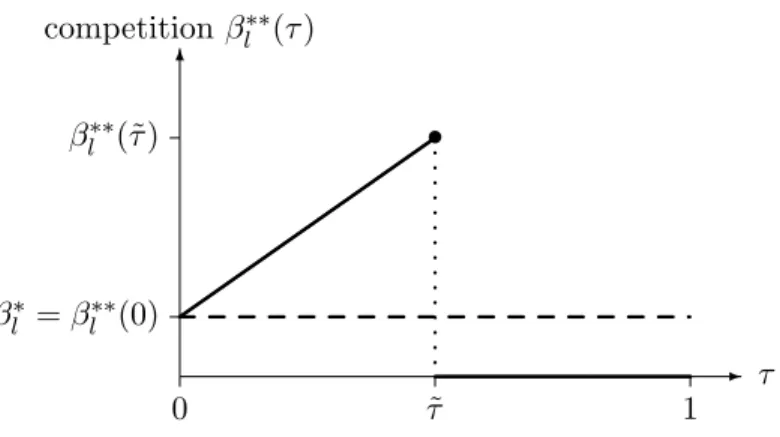
Proposition 3 Suppose the inside bank holds a small equity stake in the incumbent, τ ∈(0,τ˜). Then, the entrant is financed by the inside bank. The inside bank provides more credit than an outside bank and the entrant competes more aggressively against the incumbent than under outside bank financing. The larger is the bank’s equity stake in the incumbent, the more credit the bank provides and the more aggressively the entrant competes against the incumbent. The inside bank’s equity stake in the incumbent is thus pro–competitive.
Propositions 2 and 3 suggest that a bank’s equity stake in a competitor of a borrower affects the borrower’s performance in a non–monotonic fashion. As long as the equity stake in the competitor is not too large, the joint objective of the borrower and the bank is to minimize credit rationing, independent of the actual size of the bank’s equity stake in the incumbent. However, the equity stake enables the bank to more effectively punish opportunistic behavior (here, strategic default). This alleviates credit rationing problems and enables the entrant to compete more aggressively.14 As soon as the
14This finding holds true no matter which party has the ex ante bargaining power. If the entrant
bank’s equity stake in the competitor becomes sufficiently large, the joint objective of the borrower and the bank is no longer to minimize credit rationing, but to protect the competitor’s business (i.e. to maximize “credit rationing”). Hence, provided the bank can solve the twist between rewarding the borrower for staying out while at the same time preventing the borrower from competing, the borrower will not compete against the competitor. Figure 2 depicts the level of product market competition (more precisely, the entrant’s second period operating scale after first period liquidity default) as a function of the inside bank’s equity stake in the incumbent (denoted by β∗∗
l (τ)). The dashed line represents the level of competition under outside bank
financing. Under inside bank financing, competition is first increasing in the inside bank’s equity stake in the incumbent. For τ > τ˜, the entrant exits after the first period (in both the high and the low cash flow states).
0 τ˜ 1 βl∗ =βl∗∗(0) β∗∗ l (˜τ) -6 competitionβ∗∗l (τ) τ • ... ... ... ... ... ... .. .. .. .. .. .. .. .. ... ... ... ... ... ... ... ... ... ... ... ... ... ... ... ... ... ..
Figure 2: The competitive effects of bank equity stakes
The logic behind our findings is similar to the standard result in corporate finance theory that a firm’s performance and prospects are non–monotonic in the firm’s asset collateral value. As long as the going concern value of a firm is larger than its asset liquidation value, liquidation should be minimized. A large liquidation value is, how-ever, beneficial in order to commit a firm’s management to pay back investors which in turn makes investors willing to provide more funding (see e.g. Bolton and Scharfstein 1996, Hart and Moore 1998) or to induce management to work hard (see e.g. Repullo and Suarez 1998). If, however, the firm’s liquidation value exceeds the going concern value, then the firm should be liquidated. Consequently, the firm performs poorly, in fact, it ceases to operate.
At this stage, it will be useful to compare our findings with the literature on com-mon lenders (Bhattacharya and Chiesa 1995, Poitevin 1989), and a recent literature on the role of strategic complementarities in financing (Hellmann 2002) and entry deterrence through financial contract design (Cestone and White 2002). Poitevin the relevant participation constraint would be the inside bank’s break even constraint, while the entrant’s non–switching constraint would not be binding. The entrant’s superior commitment ability not to default strategically would relax the bank’s break even constraint.
(1989) finds that a common lender can soften aggressive product market behavior stemming from Brander and Lewis’ (1986) “limited liability effect” of debt financ-ing. Bhattacharya and Chiesa (1995) show that through financing two competitors with short term debt, a common lender can soften product market competition by terminating one of the competitors and monopolizing the other—to the joint ex ante benefit of both firms. Hellmann (2002) explores how strategic externalities affect an investor’s incentives to provide an entrepreneur with support. He shows that when an entrepreneur’s performance exerts a negative externality on an investor (for example, because the investor is invested in a competitor), the entrepreneur may experience lack of support when being financed by this investor. As a result, the entrepreneur may be better off with an independent (but, eventually, less efficient) investor. The competitor–affiliated investor may take a passive equity stake in the entrepreneur in order to dilute the active investor’s incentives to provide too much support. Cestone and White (2002) suggest another reason why an investor’s equity stake in an incum-bent firm can have anti–competitive effects. They show that as long as an entrant’s ability to source funding elsewhere is sufficiently restrained, taking an equity stake in the incumbent can be optimal as to commit the investor to deny funding to the entrant.15
These contributions suggest that affiliations between investors and firms can have anti–competitive effects.16 This is in line with our result that a large equity interest in
the incumbent can give rise to anti–competitive conduct. A key novelty of our paper is to demonstrate that financing by a common investor (more precisely, the investor’s equity stake in the incumbent) can give rise to pro–competitive effects. In particular, our analysis suggests that it is the very equity stake in the incumbent that equips the incumbent–affiliated investor with a competitive advantage in providing the entrant with more aggressive financing.
Propositions 2 and 3 predict that the entrant is always financed by the incumbent– affiliated inside investor. In our setting, this holds true because under inside bank financing one cannot only implement the same outcome as under outside bank financ-ing, one can do more—to the joint benefit of the contracting parties. Bhattacharya and Chiesa (1995) and Hellmann (2002) suggest, however, two important reasons why the entrant may actually not want to start a financing relationship with the incumbent–affiliated investor. Bhattacharya and Chiesa (1995) show that a common lender may expropriate a borrower by channelling proprietary information to the com-petitor. This suggests that if expropriation risk were an issue in our framework, the
15The perspective of their paper differs from ours. In our setting, the entrant has a credible threat
to source funding elsewhere. As a result, denying funding will not suffice as to keep the entrant out of the market. Rather, the incumbent–affiliated investor has to compensate the entrant for staying out, competing less aggressively, or agreeing to be liquidated at a later stage, the possibility of which is not considered in their setting.
16There is also a relatively large industrial organization literature on the potential anti– or pro–
competitive effects of collaborations between competitors (see e.g. Grossman and Shapiro 1986 and Ordover and Willig 1985; and Shapiro and Willig 1990 for an overview and further references). In this literature, pro–competitive effects stem from cost efficiencies (resource sharing, joint R&D etc.), while anti–competitive effects arise from the internalization of competitive externalities.
entrant would have to tradeoff the beneficial aspects of a common lender with the risk of being expropriated.17 Hellmann’s (2002) analysis suggests that the entrant may
experience lack of support if financed by the incumbent–affiliated investor. Hence, if the entrant relied on a bank’s managerial support and advice in our framework, she would have to tradeoff superior commitment not to default strategically with the potential lack of support under inside bank financing.
The analysis in this section demonstrates that a bank’s equity stake in a competi-tor of a borrower can relax the borrower’s liquidity constraints and thus enable the borrower to better survive an interim liquidity squeeze. The analysis did not show how a bank’s equity stake in the competitor or the bank’s ability to take such a claim affects the borrower’s prospects to obtain funding in the first place. This will be addressed in the next section. We also extend the setting in order to obtain further insights about the nature of the bank’s optimal claim in the competitor.
5
Security Design
The previous section demonstrates that an equity stake in a competitor of a borrower protects a bank against opportunistic actions by the borrower. This suggests that a bank could haveincentivesto acquire an equity like claim in a competitor of a borrower to obtain a competitive advantage in financing the borrower. In particular, in our framework, a bank may want to acquire a cash flow sensitive claim in the incumbent
after having financed the entrant in order to protect itself against strategic default. The main purpose of this section is to explore this possibility. We will show that equipping banks with the opportunity to hold or acquire cash flow sensitive claims in the incumbent not only relaxes the entrant’s ex post liquidity constraints but also facilitatesinitial funding of entry.
To elaborate on these issues, we extend our framework (while at the same time adopting some simplifying assumptions). To start with, suppose that anybank can acquire anyfinancial claim in the incumbent (e.g. equity, debt, combinations of debt and equity, derivatives on financial claims) fromanyof the incumbent’s stakeholders (e.g. shareholders, creditors, management, trade creditors, tax authorities, counter-parties in derivative transactions). Without loss of generality, the entrant is financed by a bank which is not yet affiliated with the incumbent (i.e. an “outside” bank).18
The outside bank can acquire a financial claim in the incumbentafterhaving financed the entrant but before first period cash flows realize in order to protect itself against strategic default.19 We normalize the entrant’s asset collateral value to zero. This
17For a similar reason, the inside bank may not want to finance the entrant. As long as the inside
bank cannot commit not to channel proprietary information to the entrant, switching to a competing bank could be rational for the incumbent. Hence, the inside bank would have to tradeoff its potential profits from financing the entrant with the risk of losing the incumbent to a competitor.
18Alternatively, one could analyze a more elaborate game where an incumbent–affiliated bank may
offer to fund the entrant, knowing that the entrant can always switch to an outside bank—which then may acquire a cash flows sensitive claim in the incumbentafter having financed the entrant. This would generate similar qualitative conclusions.
implies that outside bank financing would not be feasible if outside banks could not acquire a cash flow sensitive claim in the incumbent.
Consider a financial claim in the incumbent and suppose that this claim gives the entrant’s bank an expected income of RM (RD) if the incumbent makes monopoly
(duopoly) profits during the second period (if the entrant competes at partial scale, the bank’s income will adopt accordingly). We refer to ∆ =RM−RD as thecash flow sensitivityof the bank’s financial claim in the incumbent. Without loss of generality, let ∆≥0.
We do not attempt to provide an ambitious treatment of the contracting relation-ship between the bank and the incumbent’s stakeholders. This is unimportant for our purposes. However, various features of the contracting and institutional environment could limit the cash flow sensitivity of the bank’s claim in practice or make it too costly for the bank to acquire a highly cash flow sensitive claim. For example, if the incumbent’s management can hide or divert second period cash flows, then the bank’s claim may exhibit little cash flow sensitivity.20 If the incumbent’s management must
be induced to work, then acquiring a highly cash flow sensitive claim may impede management’s effort incentives. A highly cash flow sensitive claim may also soften the incumbent’s budget constraint. Finally, financial regulation (capital adequacy, regulatory limits to bank equity stakes) will typically limit a bank’s ability or incen-tives to take highly cash flow sensitive claims. We capture these considerations in the most simple fashion by assuming that there is some upper bound ¯∆ to the cash flow sensitivity the bank is willing or able to take. Moreover, an acquisition of a claim with a cash flow sensitivity lower than ¯∆ affects the incumbent’s value only through altering the bank’s financing relationship with the entrant. The bank’s “security de-sign” problem thus boils down to picking some ∆∈[0,∆], i.e. acquiring some claim¯ in the incumbent with some cash flow sensitivity ∆ (against some price).
Suppose the entrant’s bank acquired some claim in the incumbent with cash flow sensitivity ∆∈[0,∆] and consider the problem of the bank and the entrant whether¯ to continue after the first period. By inspection, continuation is jointly efficient if and only if the second period net present value of the entrant is not smaller than the cash flow sensitivity of the bank’s claim in the incumbent,
θΠD ≥∆ (18)
If the bank does not internalize much of the negative externality continuation im-poses on the incumbent (∆ small), continuation is jointly efficient for the bank and the entrant. Conversely, if the bank holds a highly cash flow sensitive claim in the incumbent (∆ large), it is jointly efficient to shut down. For example, if the bank receives 100% of the incumbent’s product market income, then ∆ =θ(ΠM−ΠD) and
continuation is jointly inefficient for the bank and the entrant (from ΠM >2ΠD). If
cash flow sensitive claims in industrial companies (see e.g. James 1995). Here we shall focus solely on a bank’s incentives to acquire cash flow sensitive claims in the incumbent in order to be protected against opportunistic actions by the entrant.
20In particular, if the bank were not able to extract any payments from the incumbent’s stakeholders
the bank holds “riskless” debt (or no claim at all), then ∆ = 0 and continuation is jointly efficient (fromθΠD >0).
Without loss of generality, let R = ∞.21 This amounts to leaving the entrant’s
repayment terms unspecified and equipping the bank with unconditional liquidation rights. The entrant thus always defaults att= 1. The following lemma describes the outcome after default and renegotiation.
Lemma 3 Fix K and suppose the entrant’s bank acquires a claim with cash flow sensitivity∆in the incumbent. Then, after the first period,
• for ∆ ≤ θΠD, the entrant continues at full scale in the high cash flow state against a payment Rh = ∆. In the low cash flow state, the entrant pays out Rl= min[K,∆] and continues at scaleβl = min [1, K/∆]
• conversely, for∆> θΠD the entrant pays outR
s= 0 and exits in both the high and low cash flow states.
By inspection, once the entrant has been financed, the incumbent’s stakeholders have strong incentives to equip the bank with a highly cash flow sensitive claim. In par-ticular, the stronger the cash flow sensitivity of the bank’s claim, the better are the incumbent’s prospects to regain its monopoly position during the second period. This suggests that the entrant with the help of her bank may actually be able to extract part of the incumbent’s rent and use these funds to compete more aggressively. A necessary condition for the bank to be able to extract a premium is that the incum-bent’s stakeholders are not too dispersed. At least one blockholder must internalize the negative impact on the incumbent’s business if the entrant’s bank did not obtain a cash flow sensitive claim in the incumbent (in which case βl = 1 for any K > 0).
For brevity, we focus on the case of fully dispersed stakeholders. This assumption is unimportant for our main argument, but simplifies the analysis.22
The following proposition describes the optimal contract and equilibrium outcomes for the case ¯∆≤θΠD (in other words, the highest feasible cash flow sensitivity of the bank’s claim in the incumbent is insufficient as to commit the bank and the entrant to exit the product market).
21To see whyR=∞is without loss of generality, suppose that in equilibrium the bank acquires a
claim with cash flow sensitivity ∆≤θΠD. Liquidation is thus inefficient. The entrant and the bank will then renegotiate (prior to the realization of cash flows) any contract withR <∆. In particular, the entrant will commit to the highest incentive compatible paymentR= ∆, in exchange for the bank granting more funding. If the bank acquires a claim with cash flow sensitivity ∆> θΠD, liquidation is efficient. Depending on the size ofRthe entrant may then not default and subsequently extract a payment from the bank in renegotiation. In either case, the parties could have equally putR =∞
and a higher ex ante transfer.
22An acquisition of a cash flow sensitive claim in the incumbent involves two different effects. First,
it strengthens the bank’s bargaining power in renegotiation with the entrant. Second, the bank may be able to extract part of the incumbent stakeholders’ gain from equipping the bank with a cash flow sensitive claim. If the bank were indeed able to do so, this premium would be captured by the entrant and used to compete more aggressively (provided that, in equilibrium, the bank acquires a claim with cash flow sensitivity lower thanθΠD). Our assumption that the incumbent’s stakeholders are dispersed allows to abstract from the second effect.