The credit
union difference
How to measure and report it
– a Guide to the Toolkit
Contents
About the Authors
IVForeword
VIIntroduction
10.1 What reporting on social impact involves 3 0.2 What the purpose of social impact measurement is 5
0.3 What the Toolkit contains 5
0.4 Takeaway discussion points 5
Module 1
–
Designing the impact measurement system
6 1.1 Mapping stakeholders’ interests in the impact 6 1.2 Understanding the impact as a theory of change 71.3 Managing the process 11
1.4 Takeaway discussion points 12
Module 2
–
Measuring the impact the credit union makes
13 2.1 In-house and out-of-house options 14 2.2 What qualitative measurement of change involves 14 2.3 What quantitative measurement of change involves 15 2.4 What monetisation of the measured change involves 15 2.5 A ‘mixed methods’ measurement option 16 2.6 Filling out the measurement framework 162.7 Takeaway discussion points 19
Module 3
–
Reporting the impact the credit union makes
20 3.1 How to report on impact in general 21 3.2 How to report on qualitative material 223.3 How to report on a case study 24
3.4 How to report on quantitative material 25 3.5 How to blend material using personas 27
3.6 Takeaway discussion points 28
Module 4
–
Learning about the difference the credit
union makes
294.1 What we learn about from the SIM process 29 4.2 How we learn from the SIM process 30
4.3 Takeaway discussion points 31
Conclusions
32About the
Authors
Small Change
Small Change specialises in bridging the two worlds of charities, voluntary sector and community organisations on the one hand and financial services and management on the other, through social investment and social impact experience and expertise. It specialises in social investment policy and practice, social enterprise start-up, financial exclusion, third sector financial analysis, social impact research, third sector evaluation, community-based economic development. It has worked with a wide range of clients including Joseph Rowntree Foundation, Big Lottery England, Big Local, Institute for Voluntary Action Research, Charity Commission for England & Wales, London & Quadrant Housing Association, Experian, Department of Work and
Pensions, HM Treasury Financial Inclusion Taskforce, European Microfinance Network, Deutsche Bank, Developing Strathclyde and Un Sol Mon Barcelona. Contact: Pat McGinn | [email protected].
Centre for Community Finance
Europe
The Centre for Community Finance Europe is a not-for-profit research organisation incorporated in 2016 in Dublin, Ireland. Its mission is to undertake high quality research, to lead on ideas and innovations, and to explore tested solutions related to credit unions, co-operative banks and similar not-for-profit providers of community-based financial services in Europe. CFCFE is rooted in values of co-operation, participation, social and financial inclusion, transparency, integrity, and excellence. Much of its work is done in collaboration with the Research Unit for Financial inclusion at
Liverpool John Moores University.
Research Unit for Financial
Inclusion
The Research Unit for Financial Inclusion, (RUFI) aims to generate knowledge and understanding that will assist Government, policy makers, financial providers, communities and agencies to build the financial health and resilience of individuals and communities in Britain and internationally. RUFI undertakes independent research into issues central to the development of credit unions, co-operatives and social enterprise, and to the future of low and moderate-income consumer finance. Recognised as a leader in credit union research, the Unit has developed research activities aimed at strengthening credit union capacity and effectiveness. It has wide experience of working collaboratively with the money and debt advice sector.
Contact: Paul A Jones | [email protected].
Acknowledgements:
The authors would like to thank Angela Fishwick and Elaine Chillag, CEO and Chair at Unify, and David Batten and Gwen Crawford, CEO and Director at
Hoot, for their investment of time and energy in developing and piloting this Toolkit. They are the impact champions without whom this Guide would not exist. The following credit unions also contributed ideas and feedback: 1st Alliance; Bradford District; Bristol; Clockwise; Co-op; Enterprise; NHS; No1 CopperPot; Just; Plane Saver; and South Manchester. We would also like to thank the Esmée Fairbairn Foundation and CCLA for their support and guidance. Needless to say, none of the parties mentioned here bear any responsibility for deficiencies or errors you may find. That responsibility is ours alone.
The preferred citation: McGinn, P, Money, N, Jones, P, (2019) The credit union difference: how to measure and report it – a Guide to the Toolkit, Small Change, CFCFE & RUFI
Copyright: This work is licensed under the Creative Commons Attribution 4.0 International License. To view a copy of this license, visit here.
Foreword
Credit unions are co-operative financial institutions which succeed on the basis of good governance and sound management, and on the effective delivery of quality and competitive financial products and services to their customers. In this respect, credit unions are just like any other banking institution or financial provider. Yet that is just one part of the story. For in their constitution and purpose, credit unions are radically different institutions from all the other for-profit providers and stock banks operating in the financial market. Unlike for-profit businesses, credit unions are established not just for an economic but also for a social purpose. It is true that many for-profits may adhere to policies of corporate social responsibility. But these policies are add-ons, often marketing add-ons, to their primary profit-maximising purpose. Whereas credit unions are essentially social businesses, in which social and economic goals combine and have equal status and importance.
In general, credit unions have relatively little difficulty in identifying their economic purpose and in assessing their economic performance against a range of commonly agreed metrics and indicators. But identifying their social purpose and measuring their performance as social businesses can be hazier and less defined. All credit unions know they are social businesses, they know that they are there to serve their members and play a role in the community at large, but clarity of definition is often missing. This Toolkit aims to assist credit unions to identify and clarify the social goals and objectives of their businesses against a wide range of parameters. These include the social goals associated with ownership, membership, participation and the promotion of democracy. In credit unions the customers are the owners and their financial health and well-being is paramount. They also include, among others, social goals related to the financial service of particular communities, particularly the under-served, to financial education and to the building of community cohesion and the resilience of local economies.
The Toolkit is about identifying social goals but importantly, it offers credit unions a systematic way of measuring progress to their achievement. This is central to the rationale of this publication. Even if credit unions can articulate their social goals and objectives, all is in vain if they cannot measure, evaluate and prove the social impact that they are making. The methodology offered in this Toolkit for the measurement of social impact is based on a bespoke iteration of the theory of change, an approach well known among many social enterprises but not as yet in the world of credit unions. It assists credit unions to identify their social goals, to measure and evaluate their social impact and to introduce change to improve performance where necessary.
Demonstrating the credit union difference as a social business is in fact central also to economic success. For a clear articulation of the credit union difference builds brand awareness, establishes member loyalty and, properly presented, offers a unique selling point in an increasingly competitive financial market place. Dr Paul A Jones, Reader in the Social Economy, Research Unit for Financial Inclusion, Liverpool John Moores University, click here.
Introduction
Module 1
Designing the impact
measurement system
Module 2
Measuring the impact
the credit union makes
Module 3
Reporting the impact
the credit union makes
Module 4
Learning about the difference
the credit union makes
Conclusions
Introduction
‘Social impact’ is a term used a lot in the
not-for-profit sector, often by organisations seeking social
finance or competing for public sector contracts.
For Good Finance, an initiative promoted by Big
Society Capital and others in the social investment
space, “social impact is the effect on people and
communities that happens as a result of an action
or inaction, an activity, project, programme or policy”.
So why should credit unions, who are financially independent and generally not in the business of public (or private) service delivery, be interested in measuring and / or reporting on their social impact? The answer is that for credit unions, social impact means ‘the credit union difference’. Credit unions are not simply generic savings and loan businesses with an odd ownership model.
As co-operative organisations they have (several) substantive points of difference from private providers of the same services:
• They are democratically owned and governed, meaning their whole focus is on benefiting their members and their members’ communities;
• They serve a particular community or group of communities (whether geographical, employment-based or some other form of association); • They subscribe to co-operative values and principles, meaning they are
committed to (financial) education and concern for community.
Some credit unions use ‘ethical’ as a short-hand to describe all of the above. But how do credit unions prove that they really are different? How can credit unions show in a rigorous way that their members are better off as a result of their relationship with the credit union, either absolutely or by comparison with privately-owned providers? How can credit unions show that the community is better off in some way from their presence? This must require some
measurement of relevant aspects of the credit union’s activity: not just how many loans, but with what benefit to those members? Not just how much savings growth but among which members?
This Toolkit aims to help credit unions identify and answer the relevant questions that arise in demonstrating and proving their own difference. So, why report on the credit union difference, ie its social impact? The simple answer is that other people want to know about that impact. One part of a fuller answer is that social impact reporting is one way in which the credit union discharges its accountability to people who have a legitimate interest in its work (its stakeholders). Sustaining the support, energy and enthusiasm for the work goes hand-in-hand with communicating the impact to members, staff, directors and partners. If stakeholders pose reasonable questions, the credit union should be in a position to answer those questions. Digging a little deeper into the rationale for social impact reporting, we get to another part of the answer, learning – about whether and how the different loans and savings products you offer to members in particular circumstances have the effects on their financial lives that you intend.
The goal is to report on the reality of the changes in the lives of members that the credit union might typically claim in its strategy, often as a public statement of the mission that the credit union formulates. Through the Toolkit’s modules we describe, you will be in a position to make an evidential report on the impact you deliver. The report that we hope you will use the Toolkit to present will form a narrative / story of impact, one that engages your audience because it informs them about what they want to know. This is a Toolkit to help guide you through the process of putting in place the system that will deliver the reports for accountability to stakeholders, insights for learning about products and the real changes you deliver for the betterment of members’ lives.
This system is not all-or-nothing – there are likely to be benefits to your credit union simply from taking the first of the four steps that are outlined – but it is cumulative, in that the second module builds upon the first and so on. The commitment of time required grows accordingly. We suggest you read this Guide and decide how far along the journey your credit union wants or is ready to go.
This is a Toolkit to help guide you through the process of putting in place
the system that will deliver the reports for accountability to stakeholders,
insights for learning about products and the real changes you deliver for the
betterment of members’ lives.
Introduction
Module 1
Designing the impact
measurement system
Module 2
Measuring the impact
the credit union makes
Module 3
Reporting the impact
the credit union makes
Module 4
Learning about the difference
the credit union makes
0.1 What reporting on social
impact involves
Reporting on social impact involves gathering,
analysing and communicating credible, ie valid and
reliable, evidence that demonstrates real changes
in people’s circumstances and using this to learn
about ‘what works’.
Of course, we intend that the ‘real changes’ that the credit union delivers are positive (for members and other stakeholders) but it is important for the ‘credible evidence’ idea, that the methods we use do, in a reasonable fashion, test whether they are in fact positive, ie beneficial – so we know where to act to stop delivering negative and unintended impacts. As to what sorts of impacts you intend to deliver, this is a core part of Module 1, for now we note that our two impact champions (Hoot and Unify) framed much of their impact in terms of the subjective wellbeing of members.
Unpacking this we should say that for us ‘social impact’ means, the more durable, longer-term differences that the credit union helps to bring about and, importantly, would not have happened without the credit union. The last clause draws our attention to the issue of the ‘counterfactual’, ie if the member had not joined the credit union, if the latter had not existed, if for numerous other possible reasons these people did not use this credit union, what would have happened? There are methods which provide robust evidential answers to this type of question, broadly experimental and related designs and those that emulate the advantages of these through statistical analysis. Many analysts dispute the applicability of such designs to social life in general. That is not our view. We adopt a pragmatic position; we think we should start our measurement system and develop / refine it as required. In our view if the demand is made that we establish conclusively, according to a fairly narrow set of scientific canons, that ‘credit union membership causes enhanced wellbeing’ we will not get far towards the goal. But this is not to deny that the counterfactual question is important.
That said, there is much merit in:
• Estimating the ways in which alternative scenarios would have played out, including commenting on what members report they would have done if they had not made use of the credit union;
• Considering all the available evidence, making sure that there is a consistence across all of it that the causal flow is in the direction you think it is; and
Introduction
Module 1
Designing the impact
measurement system
Module 2
Measuring the impact
the credit union makes
Module 3
Reporting the impact
the credit union makes
Module 4
Learning about the difference
the credit union makes
• Looking seriously at alternative explanations of the findings and using the evidence the system produces to rule these out – or, if you can’t do so, being upfront about this.
The Toolkit we present below on social impact reporting works through this process:
Module 1 – Designing the system through
• working out what is the impact you should measure • guided by stakeholder interests & ‘theory of change’
Module 2 – Evidencing changes you deliver
• for members, esp their wellbeing, financial & other • for partners, esp their enhanced capacity to deliver
Module 3 – Telling the story of your impact
through
• statistical analysis of quantitative data • thematic commentary on qualitative material
Module 4 – learning from findings
• readiness for learning through cooperating, reflecting & adapting
Figure 1. Measuring and reporting the credit union difference – Toolkit modules
Modules 1 on design, 2 on evidence and 3 on reporting are pretty
straightforward. As to Module 4 on learning, this is central to the rationale for the endeavour. At one level we recognise that this is about discovering ‘what works, for whom in which context’1 but the learning implies changing
practices inside the credit union and this may not be straightforward. One may uncover evidence that particular loan or savings products are not delivering the benefit you intended to members, possibly as a consequence of members using products differently than you intended. Being aware of this leaves you in a much better position to adjust the offer to align it better with what members need. In this sense the measurement of social impact
provides an opportunity to lay the evidential basis for business improvement, through retiring some products that may have served their purpose in the past but no longer do so and renewing the product offers to deliver more of the benefits members actually want.
Introduction
Module 1
Designing the impact
measurement system
Module 2
Measuring the impact
the credit union makes
Module 3
Reporting the impact
the credit union makes
Module 4
Learning about the difference
the credit union makes
Introduction
Module 1
Designing the impact
measurement system
Module 2
Measuring the impact
the credit union makes
Module 3
Reporting the impact
the credit union makes
Module 4
Learning about the difference
the credit union makes
Conclusions
0.2 What the purpose of social
impact measurement is
Here, the purpose of social impact measurement (SIM) is to understand more fully the durable, longer-term changes your credit union delivers, which in turn, facilitates it to enhance that impact and enables us to communicate the impact story to members and partners, potentially to future investors. Telling (‘reporting’) the impact story offers the prospect of reputational, public relations and
marketing benefits, but it also resonates strongly with a governance agenda, as it provides you with the means to discharge (part of) your accountability to
members. The pace of change in the provision of financial services is likely to quicken as ‘fin tech’ solutions make some business models uncompetitive. Already such solutions are offering shiny new services that hitherto credit unions considered part of their patch, ‘payroll partner’ arrangements provide one example. If we wish to strengthen the foundations of our sector, we should equip ourselves with the capacity to demonstrate our impact.
0.3 What the Toolkit contains
There are three main parts to the Toolkit:• firstly, this document, ‘the Guide’ to the process, what it involves, what are the issues that one may explore, which is available as an interactive PDF or WORD file, that follow the modules we noted above;
• secondly, the ‘measurement framework’ aka the ‘toolbox’, which comes in the form of an XLS file, with a number of sheets in each of which you will find a ‘tool’, eg a ‘theory of change’ or a questionnaire; and
• thirdly, a facilitation resource, a PPT file, where you will find materials we prepared for workshops with our impact champions, which we invite you to adapt for your own uses. You will find the three files here. The second site is here.
What we have prepared is not the last word on all aspect of SIM for credit unions, far from it, apart from anything else, it is based on our impact champions’ contexts and their perspectives – and we think that is a good thing. However, we do think it is more than enough to get you started on this important work.
0.4 Takeaway discussion points
Discussion Points: Do you tend to agree or disagree with the view
that measuring the difference you make will be important for your
credit union in the next five years? How would you characterise the
difference your credit union makes to the lives of its members?
Introduction
Module 1
Designing the impact
measurement system
Module 2
Measuring the impact
the credit union makes
Module 3
Reporting the impact
the credit union makes
Module 4
Learning about the difference
the credit union makes
Conclusions
Module 1
Designing the impact
measurement system
In this module the goal is to become clear about
the design of the SIM system that the credit union
will develop, manage and put into practice. We
offered our impact champions two complementary
approaches to inform the design of the system.
The first was a matrix (table) that provides a convenient means to record insights you have into what aspects of your impact your stakeholders would wish you to report. The second was a more graphic / diagrammatic technique known as ‘theory of change’ (ToC), which is helpful in understanding what the impact is and how the credit union delivers it. Whereas the stakeholder mapping takes as its starting point, the idea that we should attend to interests ‘outside’ the credit union, the ToC tends to start from the ‘inside’ – what the organisation actually does. This blend of the ‘inside’ and ‘outside’, two sides of the one coin, provides for the fit / complementarity of the two techniques.
1.1 Mapping stakeholders’
interests in the impact
The goal of mapping stakeholders’ interests in the impact of the credit union is to help us focus on what the audiences want to know about, hence what you should report on. Putting this another way, it connects the reporting to what is at stake for these audiences. This shifts attention from what you think is important to measure to what others want to know about. The matrix exercise (see Figure 2 below) encourages you to concentrate on stakeholders’ interest in impacts flowing from saving and loans products, especially where the influence of the stakeholder and their interest in the credit union, is deemed ‘high’. The most important cell is the one shaded red, where interest in, and influence on, the credit union are both ‘high’. The implication is clear – make the reporting work for the legitimate interests of audiences in the pink cell.
Discussion Points: What do your stakeholders who ‘belong’ in the
pink cell want to know about the impact on your members of your
saving and loans offer?
Introduction
Module 1
Designing the impact
measurement system
Module 2
Measuring the impact
the credit union makes
Module 3
Reporting the impact
the credit union makes
Module 4
Learning about the difference
the credit union makes
Conclusions
Stakeholders Stakeholders Interest is high Influence is high high influence but
moderate interest
high influence and high interest
Influence is moderate moderate influence and interest
moderate influence but high interest
Figure 2. Matrix for mapping stakeholder interests
1.2 Understanding the impact
as a theory of change
At root, a ToC is just a summary statement of the effects that follow from what, in this case, the credit union does. It is a general tool that is applicable to many contexts, widely used in evaluation, and it, or its analogues, is common in management studies. ToCs come in many varieties; some are tables (each row tracks the pathway); others are triangles (each tier builds on the one below); others are charts (the process flows through different elements). There is no ‘right and wrong’ in this, people think about impact in different ways. The important question is: does it communicate the impact and the pathway though which the credit union delivers it?
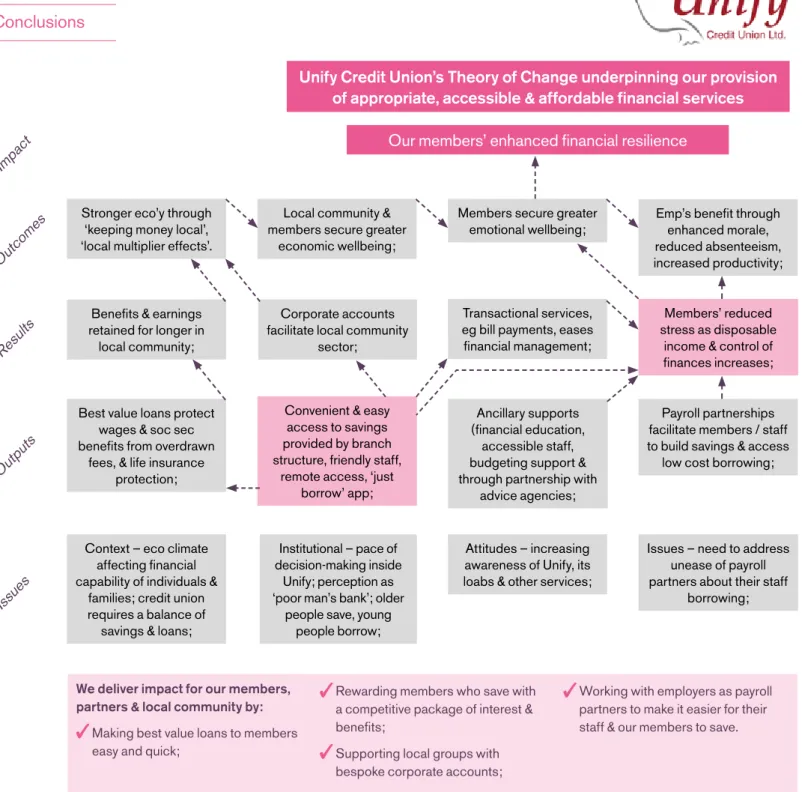
Unify adopted a ‘logic model’ approach which they worked on using a table / matrix to record the pathway process. We wrote up the notes from the table to produce the flowchart in Figure 3 below. One advantage of the flowchart over the matrix is that it becomes easier and clearer to ‘see’ the pathway and how different parts of the impact story fit together. Our discussions with the chair and chief executive clarified important background issues, noted close to the bottom of the graphic, while we summarised the service range in the panel at the bottom. We thought this would help ‘knit’ together the different levels (outputs, results, etc), but one might represent the same information as another level, ‘activities’. The important point is to reflect the theory, as best as possible, not to follow one particular schema or another.2 In choosing between different options, one rule of
thumb is, if it doesn’t communicate to someone who didn’t produce it, it’s still not right – and do remember you will probably need to come back to your ToC many times, theories of change are after all dynamic rather than static.
In Unify’s model, the credit union’s branches facilitate access to savings and loans products, paying / charging competitive rates. The loans protect household incomes as they prevent loss of income from high cost borrowing and ‘account overdrawn’ fees. This allows for more money being retained for longer, circulating in, thus strengthening, the local economy. The branches
The important question is: does it communicate the impact
and the pathway though which the credit union delivers it?
also support local third sector organisations through corporate accounts. Access to savings and loans along with ancillary supports for members (financial education, friendly / accessible staff, budgeting support, partnership working with advice agencies), alongside transactional services, eg for bill payments, all ease the burden of financial management inside the household. This in turn eases financial stress as more disposable income is available and there is a greater sense of being in control of household finances. Reduced stress leads to greater emotional wellbeing, which feeds into the impact on the members’ financial resilience. The local multiplier effects as well as the enhanced functioning of private and third sectors foster a local ethos / context that is conducive of that resilience.
Figure 3. Unify Credit Union’s ToC Pathway
Unify Credit Union’s Theory of Change underpinning our provision of appropriate, accessible & affordable financial services
Impa
ct Our members’ enhanced financial resilience
Outcome
s Stronger eco’y through ‘keeping money local’,
‘local multiplier effects’.
Local community & members secure greater
economic wellbeing;
Members secure greater
emotional wellbeing; Emp’s benefit through enhanced morale, reduced absenteeism, increased productivity;
Resul
ts retained for longer in Benefits & earnings local community;
Corporate accounts facilitate local community
sector;
Transactional services, eg bill payments, eases financial management;
Members’ reduced stress as disposable
income & control of finances increases;
Output s
Best value loans protect wages & soc sec benefits from overdrawn
fees, & life insurance protection;
Convenient & easy access to savings provided by branch structure, friendly staff,
remote access, ‘just borrow’ app;
Ancillary supports (financial education,
accessible staff, budgeting support & through partnership with
advice agencies;
Payroll partnerships facilitate members / staff to build savings & access
low cost borrowing;
Issue s
Context – eco climate affecting financial capability of individuals &
families; credit union requires a balance of
savings & loans;
Institutional – pace of decision-making inside
Unify; perception as ‘poor man’s bank’; older
people save, young people borrow;
Attitudes – increasing awareness of Unify, its loabs & other services;
Issues – need to address unease of payroll partners about their staff
borrowing;
We deliver impact for our members, partners & local community by:
Making best value loans to members easy and quick;
Rewarding members who save with a competitive package of interest & benefits;
Supporting local groups with bespoke corporate accounts;
Working with employers as payroll partners to make it easier for their staff & our members to save.
Introduction
Module 1
Designing the impact
measurement system
Module 2
Measuring the impact
the credit union makes
Module 3
Reporting the impact
the credit union makes
Module 4
Learning about the difference
the credit union makes
Introduction
Module 1
Designing the impact
measurement system
Module 2
Measuring the impact
the credit union makes
Module 3
Reporting the impact
the credit union makes
Module 4
Learning about the difference
the credit union makes
Conclusions
Impacts on members, all associated with financial resilience and emotional
wellbeing facilitates better and more efficient functioning of statutory bodies,
esp in social housing, which in turn feeds into Bolton’s wider civic cohesion
and economic vibrancy.
The most striking feature of the impact pathway is the importance of two connected nodes, pink-filled boxes on the graphic. The first is the branch structure, which with the ‘just borrow’ app, makes saving and borrowing easy for members, much of the impact process flows from here. The second is the node for stress reduction associated with the retention of disposable income inside the household. This result leads directly to the emotional wellbeing outcome, the precursor of the financial resilience impact.
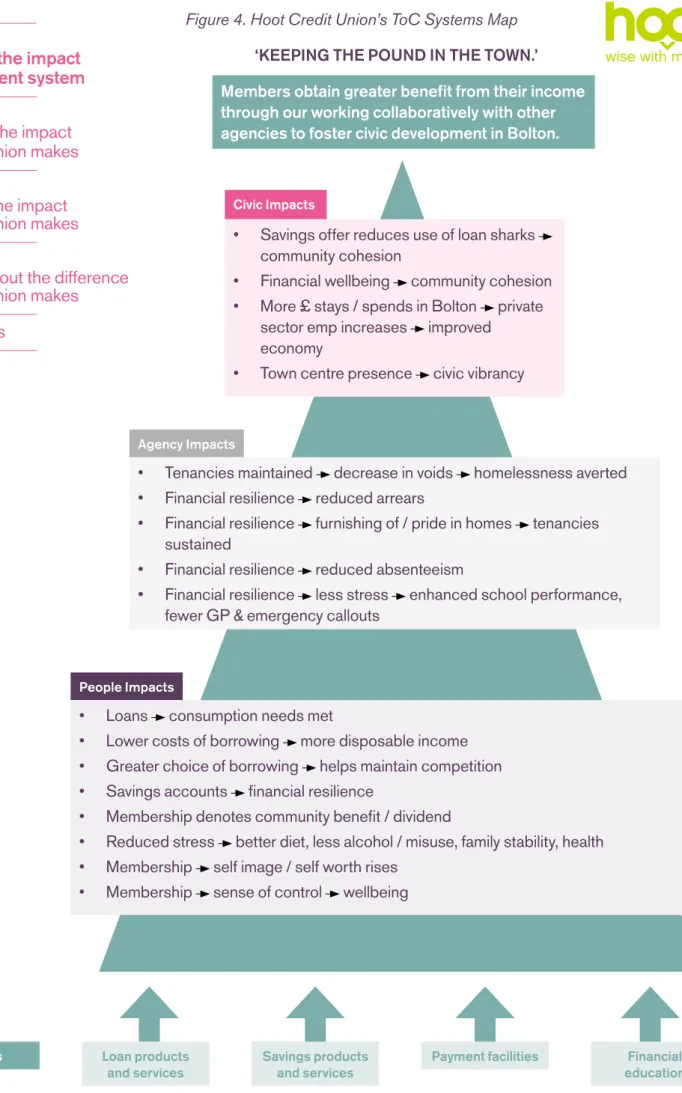
Hoot had a different perspective on their ToC. During the design workshop, a volunteer director and the chief executive articulated the impacts Hoot was working towards using a ‘systems’ mapping approach. A ‘systems’ approach helps us to take a step back from the micro level, to take a take a wider, fuller, arguably, more holistic view of the macro picture, seeing how, in this case, three different levels of impact, ‘fit’ together in the impact story of the credit union (see Figure 4 below).
Practically, this involved brainstorming the outcomes for different stakeholders and grouping these under a smaller number of thematic headings. We then worked on the post-its and flipcharts to frame the material in a form we adapted from the idea of a ‘planning triangle’ here. The savings and loans products range combined with transactional banking services and financial education is close to Unify’s offer, but the way in which Hoot understands their ToC is more akin to a model of three levels, each built on the foundations of the one below. Impacts on members, all associated with financial resilience and emotional wellbeing facilitates better and more efficient functioning of statutory bodies (‘agencies’), esp in social housing, which in turn feeds into Bolton’s wider civic cohesion and economic vibrancy.
Figure 4. Hoot Credit Union’s ToC Systems Map
‘KEEPING THE POUND IN THE TOWN.’
Services Loan products
and services
Savings products and services
Payment facilities Financial
education
People Impacts
• Loans consumption needs met
• Lower costs of borrowing more disposable income • Greater choice of borrowing helps maintain competition • Savings accounts financial resilience
• Membership denotes community benefit / dividend
• Reduced stress better diet, less alcohol / misuse, family stability, health • Membership self image / self worth rises
• Membership sense of control wellbeing
Agency Impacts
• Tenancies maintained decrease in voids homelessness averted • Financial resilience reduced arrears
• Financial resilience furnishing of / pride in homes tenancies sustained
• Financial resilience reduced absenteeism
• Financial resilience less stress enhanced school performance, fewer GP & emergency callouts
Civic Impacts
• Savings offer reduces use of loan sharks community cohesion
• Financial wellbeing community cohesion • More £ stays / spends in Bolton private
sector emp increases improved economy
• Town centre presence civic vibrancy
Members obtain greater benefit from their income through our working collaboratively with other agencies to foster civic development in Bolton.
Introduction
Module 1
Designing the impact
measurement system
Module 2
Measuring the impact
the credit union makes
Module 3
Reporting the impact
the credit union makes
Module 4
Learning about the difference
the credit union makes
Introduction
Module 1
Designing the impact
measurement system
Module 2
Measuring the impact
the credit union makes
Module 3
Reporting the impact
the credit union makes
Module 4
Learning about the difference
the credit union makes
Conclusions
Discussion Points: Which of the two graphics is likely to appeal
most / communicate best to the ‘high interest and high influence’
stakeholders you identified earlier? Who should be involved
(directors, staff, etc) in working up the ToC?
1.3 Managing the process
We need to manage the SIM process. Operationally, of course we want to be realistic about the scheduling of the tasks. The schedule for our impact champions stretched over twelve months from initiation to data analysis. They were test cases for the process, so a time saving for you seems reasonable, they have done much of the heavy lifting, six months should be closer to the mark. It is likely that the first iteration will take longer than that in subsequent years, by the second round of implementation you will be skilled up. An AGM provides a convenient target for the dissemination of a report on the difference you are making. Whether you wish to do the exercise each year or every second or third year really depends on how the SIM relates to other management work. It makes sense to relate SIM’s timing to that of business planning cycles. There are other issues arising from SIM that you will need to manage.
The first of these strategic issues concerns the involvement of Board / directors as well as the senior management. Our impact champions involved the chair or another director in at least the initial planning workshop, ensuring the SIM project had a voice during, hopefully a champion at, board meetings.
One way or another, if the SIM is to become a real / active driver of development inside the credit union, the Board will need to ‘own’ it, to be
appropriately responsible for it. The challenge for the senior management is to sustain directors’ engagement and balance this with other pressing demands for directors’ time.
The second issue is that of how the SIM synchronises with other management priorities. SIM should help sustain positive relationships with stakeholders through providing the evidence that makes the case for that stakeholder to invest in the credit union, whether ‘investing’ their financial or non-financial resources, reputation or influence. Broadly the SIM should leave your agency better able to discharge its accountability to the stakeholders. In addition, it should contribute to the marketing of savings and loans products through feeding persuasive messages into the marketing effort.
SIM should help sustain positive relationships with stakeholders through
providing the evidence that makes the case for that stakeholder to invest in the
credit union, whether ‘investing’ their financial or non-financial resources,
reputation or influence.
Introduction
Module 1
Designing the impact
measurement system
Module 2
Measuring the impact
the credit union makes
Module 3
Reporting the impact
the credit union makes
Module 4
Learning about the difference
the credit union makes
Conclusions
In these different ways the SIM should contribute to better informed operational and strategic decision-making.
Finally, here we should note one important ‘bad news’ issue that may arise through SIM. It may be that the agency is unable to evidence the impact that, in good faith, it claims. Doubtless there are many ways we could deconstruct the reasons why this may arise, but we think it is likely to come down to either a variant of ‘we just need to search harder for the evidence’ or, alternatively, ‘we did not understand the impact we do have’. For ourselves if you have completed the SIM process reasonably diligently, the first option is unattractive. We think the better option is the second one about not understanding the impact you do have. In terms of the ideas we discussed above, one might characterise the issue as being an under-developed ToC, ie one that has insufficient specification of the pathway through which your interaction with members translates into their betterment. At root this is a big part of why you should take the SIM seriously, as it is posing important questions for your credit union and approach it ethically, through addressing the issues it raises openly and straightforwardly. If you can’t evidence the betterment, doesn’t it make more sense to make a claim that you can evidence?
Discussion Point: How do you wish to address the management
issues we discussed above?
1.4 Takeaway discussion points
We did most of the Design work in Workshop 1, all slides are in the PPT file. The finalised ToC templates are in the XLS file, sheet called ‘ToCs’, you can edit them using the ‘Drawing Tools’ tab.
Discussion Points: Bearing in mind the commentary on
stakeholders above, which of your stakeholders has the greatest stake
/ interest in your work? What do they want to know about your social
impact? What are the gaps? What would a SIM report have in it if it
was to fill these gaps? Which of the two graphics for a ToC we
reviewed above, will communicate best to these stakeholders?
Introduction
Module 1
Designing the impact
measurement system
Module 2
Measuring the impact
the credit union makes
Module 3
Reporting the impact
the credit union makes
Module 4
Learning about the difference
the credit union makes
Conclusions
Module 2
Measuring the impact the
credit union makes
In Module 1 we explored how you could think
through questions of who are the people / agencies
that have a legitimate interest in knowing about the
impact you have (stakeholder mapping). We then
showed the ways our impact champions worked
out the changes they bring about and the process
that leads to this (ToC). In Module 2 we will
introduce the basic options you have when it comes
to measuring the impact. There are two parts to
that, the first is about the method we use to collect
evidence and the second relates to its analysis.
It is convenient to think of SIM as having two measurement components, the first is about collecting new ‘primary’ and / or collating existing ‘secondary’ data and the second covers the analysis of this. The experience of working with our impact champions suggests that credit unions’ ToCs will make quantitative claims about numbers (of borrowers, volumes of money, attitudes, etc) and qualitative claims about particular cases or instances (of members in specific circumstances).
The experience of working with our impact champions suggests that credit
unions’ ToCs will make quantitative claims about numbers (of borrowers,
volumes of money, attitudes, etc) and qualitative claims about particular
cases or instances (of members in specific circumstances).
Introduction
Module 1
Designing the impact
measurement system
Module 2
Measuring the impact
the credit union makes
Module 3
Reporting the impact
the credit union makes
Module 4
Learning about the difference
the credit union makes
Conclusions
2.1 In-house and out-of-house
options
It is worth bearing in mind that the staff and directors involved with the credit union need not take on all the responsibility for the SIM. The challenge is to find the right mix of in-house and out-of-house capabilities that will deliver the SIM. The in-house option requires particular attention to the quality assurance of the validity and hence credibility of the work. There may be a perception that the in-house option is ‘marking your own homework’. One might argue that this objection misses an important point – in-house may lead to more learning. Nevertheless, if you choose in-house, the quality assurance issue remains. The other approach is simply to sub-contact the SIM out-of-house, to an external consultant or firm. The quality assurance issue is present here as well but it is a different one, much more to do with the external’s grasp of the
contextual and operational issues. It may be that you can secure this support at no cost, but mostly it will require a budget. One variant of this is to develop a collaborative relationship with a local institution that has capacity to undertake the assignment. By virtue of the on-going cooperation between you and them, they will acquire the requisite understanding of the practical issues. Possible candidates are local colleges, universities or voluntary and community support organisations. It is less a matter of either / or, more one of how to blend the two approaches so that you make best use of the capacity you have, with that of others, to secure the SIM you require.
2.2 What qualitative
measurement of change
involves
In this context, qualitative measurement is the construction of convincing and credible narrative case studies of the factors that come into play through which the credit union delivers the impact for members. The qualitative measurement’s strength lies in the depth understanding of the impact that the narratives present. Its weakness is this depth often renders it atypical of members’ experiences in general. Of course, there is no limitation on how many users’ experiences might be incorporated into the case study, or a series of these.
The case study may incorporate material from multiple sources, including documentation and interviews with members and stakeholder agency staff. Semi-structured Interviews will often be the preferred method. One rule of thumb for the number of interviews required suggests that ‘saturation’ occurs at around twelve to sixteen interviews and further interviews provide little additional insight.
Introduction
Module 1
Designing the impact
measurement system
Module 2
Measuring the impact
the credit union makes
Module 3
Reporting the impact
the credit union makes
Module 4
Learning about the difference
the credit union makes
Conclusions
2.3 What quantitative
measurement of change
involves
In this context, quantitative measurement refers to the collection and analysis of numerical data that bears on the distributions, in the statistical sense, of elements specified in the ToC. It includes financial data, typically measured in monetary terms, attitudinal data, eg ‘feeling in control’, often measured as a point on a scale ranging from 1 to 5, or simply counts of whether a member belongs to a category, eg ‘has / has not £500 buffer’. The important advantage of quantitative measurement is that it facilitates the comparative exploration of the data, eg the impact for women members compared to that for men. As credit unions serve the interests of, and are owned by, their members there is a clear case for quantitative measurement so that we may evidence how many members secure how much change through their engagement.
2.4 What monetisation of the
measured change involves
Social Return on Investment (SROI) offers a useful starting point for the monetisation of the impacts the credit union delivers. HACT sponsored and maintain one substantial development of the SROI approach. This relies on a wellbeing valuation perspective. It has secured acceptance as part of the Treasury approved approach to appraisal and evaluation of public investment in social housing. The approach involves the assessment of the volume of change an intervention delivers in terms of subjective wellbeing and then the monetary valuation of this quantum. At its core is the idea that the value of a change is measured as the average amount of additional money a person would require, controlling for other factors, for s/he to report an equivalent change in the desired outcome, eg, subjective wellbeing or financial inclusion. Helpfully, HACT makes available estimates of some of the changes our two impact champions noted in their ToCs. For example, estimates are available of the monetary value of changes in ‘reduced stress over unmanageable debt’ and ‘feeling more in control of own finances’. After careful consideration our impact champions decided not to place the monetisation method centre stage, but rather to get the SIM system up and running and then possibly incorporate the wellbeing valuation. We think this makes a lot of sense. This SROI approach requires adherence to a reasonably rigorous surveying protocol in terms of sampling and questionnaire design.
Introduction
Module 1
Designing the impact
measurement system
Module 2
Measuring the impact
the credit union makes
Module 3
Reporting the impact
the credit union makes
Module 4
Learning about the difference
the credit union makes
Conclusions
2.5 A ‘mixed methods’
measurement option
‘Mixed methods’ approaches are simply methods of impact measurement that draw on both quantitative and qualitative elements to create a fuller, and more balanced, blend of the two. We explored one such approach with our impact champions through considering what a ‘costed case study’ would involve, bringing together (quantitative) monetary estimates of savings for public sector agencies with (qualitative) interpretative material on the more strategic aspects of value delivered by the credit union for the public sector organisation.
We explored this contribution to partner agencies’ cost savings as one way that ‘makes sense’ to some audiences. A useful source of information about statutory service costs is here. We noted it was important to be up-front about how representative the case study is and that it was not straightforward to obtain the estimates of the cost savings, with some of the difficulty arising from, eg how to apportion, across services, the fixed capital costs of public sector organisations. Some of the costed case study approach are present in the work Hoot intend to report to an important stakeholder, Bolton At Home (BAH). In general, such an approach could be cost-efficient for the credit union and provides an option that can communicate the narrative of impact, drawing together strands of efficiency savings, member experiences and expert opinion from the agency in question.
2.6 Filling out the
measurement framework
Whatever balance you strike between qualitative / quantitative and attitudinal / financial material you will want to maintain a record of the conclusions you have reached about the measurement of the outcomes and ultimately the impact to which they contribute. Spreadsheet software serves this purpose reasonably well, facilitating the impact analyst to locate the specifics of the measurement procedure for a given indicator. Currently, our impact
champions’ Frameworks includes sheets for: each credit union’s outcomes’ indicators; its ToC diagrams and narratives; and questionnaires to be used for surveys of members and partners.
Whatever balance you strike between qualitative / quantitative and attitudinal
/ financial material you will want to maintain a record of the conclusions you
have reached about the measurement of the outcomes and ultimately the
impact to which they contribute.
Introduction
Module 1
Designing the impact
measurement system
Module 2
Measuring the impact
the credit union makes
Module 3
Reporting the impact
the credit union makes
Module 4
Learning about the difference
the credit union makes
Conclusions
The core of the Framework is a sheet in the XLS ‘toolbox’ called ‘SIM System’ which has fields (in cells) that document:
• Domain, broad categories that provide a convenient way of filtering
different outcome measures, reflecting Hoot’s three levels (people, agency and civic) and Unify’s four domains (local economy, financial and emotional wellbeing and financial resilience);
• Linkage, comments on the way in which the ToC suggests that outputs and results lead to the outcomes and impacts, summarising how the ToC proposes the credit union delivers impacts;
• Primary Source, records the main body of data on which the assessment of impact will be made, eg through an ‘Annual Members Survey’;
• Secondary Source, facilitates the recording of existing published material bearing on the indicator;
• Indicator Detail, specifies, eg question wording that might be used in surveys;
• Attribute / Contribute, notes whether the ToC attributes the change to the credit union or claims it contributes to a process along with others;
• Source of Benchmark is a field our impact champions suggested should be included to facilitate easy access to comparative data, eg Financial Capability Survey here and the Organisation of National Statistics here; and
• Notes, available for any other material the analyst considers important.
Throughout the Framework we refer to published evidence on the impacts that other research demonstrated credit unions (or allied agencies adopting comparable business models) deliver. One source that we found to be useful was the data / analytics section inside local government on whom we relied for estimates of local multiplier and related impacts. We reviewed the evidence-base of the Financial Capability Strategy here in addition to sources with which we are familiar.
We have grouped the key evidence-based and published findings into six areas that we summarise below.
1) Financial resilience – By financial resilience we mean people’s ability to withstand financial shock or strain. Examples often used are the ability to meet emergency needs to make repairs to a car or replace a fridge, or having ‘rainy day’ savings. Research has been done to look at how many people have a £500 ‘buffer’ to cope with emergencies – 40% of the population do not. StepChange Debt Charity is campaigning for a target of £1,000 in savings for all adults, to reduce the level of problem debt and drive other social advantages. The credit union perspectives on these indicators might be around: how many members could claim to have either of these cushions
Introduction
Module 1
Designing the impact
measurement system
Module 2
Measuring the impact
the credit union makes
Module 3
Reporting the impact
the credit union makes
Module 4
Learning about the difference
the credit union makes
Conclusions
(whether with the credit union or other institutions); how the credit union enables members to achieve resilience; and how the credit union gets people to have at least some savings which otherwise they would not.
2) Wellbeing – Wellbeing refers to someone’s sense of their whole (physical, mental, emotional, etc) health. There is an increasing body of research looking at how people’s financial situation generates stress, and how that stress can lead to health problems. Remember, this is about people’s perceptions and feelings, not about their ‘objective’ financial health; it is not confined to people on low or marginal incomes. If credit unions can make an impact on the level of stress people feel about their financial situation, either through introducing a savings habit, increasing the level of savings, sorting out problematic debt or providing access to responsible credit that would not otherwise be available, the credit union can help to improve the quality of people’s lives, reduce the demand on health and social services (see also 6 below).
3) Financial inclusion – In this instance we are using inclusion to refer to the benefits of being able to access credit from a responsible lender and at reasonable rates of interest. Credit enables people manage short-term cashflow issues or bring forward the benefits of new appliances or transport options (eg get a season ticket for commuting to work before the first pay packet is received). In addition, the gaining of a credit score, or improvement to a damaged one, has economic benefits in terms of access to better terms for payment for goods, mortgages and other forms of credit, as well as a broader sense of the ability to participate in a society where credit is a pervasive component of personal financial arrangements.
4) Civic and local economic development – The credit union is an
economic actor in the local community, as are its members. The credit union spends money – on wages, rent, materials – and gives money to its members to spend – loans, and dividend or interest on savings. Where this expenditure is within the community, it impacts positively on the local economy. Research suggests that more money that is spent with small and medium sized
businesses or local businesses circulates for longer in the local community than money spent with larger companies from outside. There are also qualitative benefits from the presence in the community of the credit union. For example, it can provide a sense of local pride; it offers opportunities to volunteer, contribute and socialise; it provides services (sometimes unique) to other local enterprises such as budget accounts for housing association residents or payroll deduction services to local employers. All of this contributes to social cohesion.
5) Financial capability – Financial capability refers to people’s understanding of how money works and how to manage it. There is a significant minority of people who are not skilled or knowledgeable in this area, which causes them to be at financial risk, to have financial issues or to worry.
Credit unions have traditionally sought to help their members with
budgeting and saving, in a way that private sector banks have not.
Introduction
Module 1
Designing the impact
measurement system
Module 2
Measuring the impact
the credit union makes
Module 3
Reporting the impact
the credit union makes
Module 4
Learning about the difference
the credit union makes
Conclusions
Credit unions can compare the knowledge and awareness of their own members with what UK-wide research suggests are the averages.
6) Workplace impact – In recent years, employers have begun to understand better the impact of financial issues on their employees, which at its most basic affects productivity if people are distracted and attendance if they are ill. Some have started to offer various kinds of support, and credit unions have been a part of this, offering payroll deduction services for savings and loans. Credit unions can use their own analysis and survey evidence to show a potential relationship between their ability to enhance people’s financial options and the associated commercial benefits for employers.
2.7 Takeaway discussion points
We did most of the Framework during Workshop 2, you will find the material in the PPT file. Most of the specifics on the Framework are in the XLS file. The sheet in the Framework XLS called ‘external benchmarks and indicators’ provides a list of published findings and their sources that could be used as benchmarks or points of context for credit union impact measures. If you decide to investigate published material you may wish to consider using ‘reference management software’. Mendeley is one we like and you will find a selection of material here – you will need to register (free) – please do ‘add’ to, and ‘share’, the material you locate.
Discussion Points: What factors will enhance the credibility of
the reports to directors, members and external stakeholders? What
factors could detract from its credibility? For these stakeholders,
what are the hallmarks of a quality report? Discuss advantages &
disadvantages of the in-house and out-of-house options for the
implementation of the SIM options we noted above. What mix
(qualitative / quantitative, in-house / out-of-house, etc) do you think
will work best for your credit union?
Introduction
Module 1
Designing the impact
measurement system
Module 2
Measuring the impact
the credit union makes
Module 3
Reporting the impact
the credit union makes
Module 4
Learning about the difference
the credit union makes
Conclusions
Module 3
Reporting the impact the credit
union makes
In Module 2 we noted how our impact champions
used their ToCs to populate their Measurement
Frameworks. In this Module we take this a stage
further and outline the way in which one may use
the data that the Framework guides us to collect /
collate to produce the reports for stakeholders.
While a textual report is often not the best means
of communicating results, in our experience it is
often the best way to clarify for oneself, what are
the findings in the first place.
Whatever the method (qualitative, quantitative, ‘mixed methods’), we know that a strong ‘narrative’ / ‘story of impact’ will communicate and persuade much better than a catalogue of findings about members. The challenge is to ensure the narrative of impact you present is factual, engaging and informative. Impact reporting is definitely not a matter of telling stories about ‘satisfied members’. The hallmarks of quality are openness about the limitations of the evidence and caution about the claims you make on the basis of it.
What about analysing before reporting? There is a real difference between the analysis of the data on impact and the reporting of that material to a stakeholder. However, in practice the two will likely go hand-in-hand. As one reads the notes of an interview, say about how the credit union enabled a member to get her finances into better order or looks at the gender breakdown of the size of savings’ buffers for men compared to women, one may be said to be analysing the material. But it is a very short step from this analysis to writing a note about what you read, the gender difference you noted, and this note will become part of the text, that with further commentary, editing and polishing will, when put with other such notes, go to building up the report.
There is a real difference between the analysis of the data on impact
and the reporting of that material to a stakeholder. However, in practice
the two will likely go hand-in-hand.
Introduction
Module 1
Designing the impact
measurement system
Module 2
Measuring the impact
the credit union makes
Module 3
Reporting the impact
the credit union makes
Module 4
Learning about the difference
the credit union makes
Conclusions
We do think analysis and reportage are distinct but in practice they have a ‘side by side’ relationship, one to the other.
We should also note that the work of reporting is not quite as straightforward as one would wish. Below we provide some pointers for the reader, but much will depend on what impacts your ToC commits you to report on. There are many ways we might report on the thematic analysis that is at the heart of qualitative reporting, and perhaps a similar number on the comparative analysis that is central to quantitative data. The interested reader may care to consult two publications that inform much governmental thinking on the issues, the HM Treasury’s ‘Green Book’ here and ‘Magenta Book’ here.
3.1 How to report on impact in
general
The reader will be familiar with the ‘long-form’ report’s section headings:
• executive summary;
• introduction (why we did it, learning questions we posed);
• methodology (how we did it, qualitative and quantitative data, published data, primary and secondary data);
• findings (the outcomes and impacts identified in the ToC, each one forming a sub-section);
• discussion (commentary on the reasoning and the evidence to support it that links the causal process of ‘results outcomes impacts’,
considerations of ‘attribution v contribution’, detailed in the Framework); • conclusions (what works, what seems to require attention, what should be
changed in subsequent impact management); and • appendices (questionnaires, statistical material, etc).
This tried and tested format is a good starting point and will appeal to some stakeholders, esp those with a more ‘technical’ perspective on the issues. Others may want a ‘no-frills’ presentation. One of the many advantages of the digital communications we may now use, is that the analyst needs no longer to limit dissemination / reporting to the traditional ‘long-form’. Blogs especially offer an accessible ‘easy-read’ on key findings that will appeal to many interested but busy people.
Introduction
Module 1
Designing the impact
measurement system
Module 2
Measuring the impact
the credit union makes
Module 3
Reporting the impact
the credit union makes
Module 4
Learning about the difference
the credit union makes
Conclusions
Whatever the choice of media the core issue that the analyst should focus on is what works best for the audience / stakeholder? In general terms we may say that:
• Keeping it simple is the rule, but you will need to avoid it being simplistic; • Make use of graphics where they contribute to the story of impact you
wish to convey;
• Bear in mind that while numbers, percentages, averages, and so on, all have their place, most people want to hear about the story of ‘real’ people’s lives; and
• Don’t over-claim, it will tend not to convince and may well turn the reader off.
3.2 How to report on qualitative
material
In this context qualitative material will most likely arise from interviews with members, partners, agency staff, people with experience in the financial inclusion field. The task for the analyst is to relate the often-disparate
perspectives of such sources to the impact and outcome pathways identified in the ToC and documented in the Measurement Framework. In practice this requires the analyst to weave the narrative of impact from the commentaries of the sources. Both Hoot and Unify make use of stress reduction as a primary outcome on the pathway to impact on wellbeing.
We take the ‘membership stress reduction wellbeing’ pathway as our starting point in the example we present next. The attentive reader will not be surprised that the starting point we suggest for the reporting on the material would be the ToC – it is not an accident that the topics / questions map fairly closely onto the elements of both ToCs our impact champions developed. Using the ToC to guide the reporting makes a lot of sense. Straightaway the analyst has the headings under which to organise the material, eg ‘service offers members took’, ‘anxiety members experienced’, ‘wellbeing members secured’, ‘reality of offers and stress management’, ‘how stress reduction contributes to wellbeing’.
Both Hoot and Unify make use of stress reduction as a primary
outcome on the pathway to impact on wellbeing.
Introduction
Module 1
Designing the impact
measurement system
Module 2
Measuring the impact
the credit union makes
Module 3
Reporting the impact
the credit union makes
Module 4
Learning about the difference
the credit union makes
Conclusions
Our scenario is of twelve interviews with members, selected because they entered the credit union premises on a particular day and were agreeable to taking part, giving an interview, for on average of thirty minutes each, during which the staff member (in a confidential set-aside room) asked them about:
• Whether they ever became anxious about money (how they knew they were anxious, sleeplessness / interrupted sleep, irritability, ‘head in the sand’);
• What aspect of their finances gave rise to worry (levels of income and expenditure, job and promotion / progression, benefits levels and household responsibilities);
• Whether it tended to be a timing issue about when income arrived into their account and quickly disappearing in regular outgoings esp rent / mortgage as opposed to something more about jobs (levels of pay, regularity of employment), benefits (eligibility rules, payment delays, imposed sanctions) or how much money they need for the lifestyle they follow / aspire towards; and
• How the credit union’s offering eased (or not) the anxiety they experienced through facilitating savings for buffers, paying for bigger bills over a more feasible term, building up a credit score that enabled them to secure more competitively priced credit; and
• How the credit union membership enabled them (or not) to manage their finances, the roles different savings and loans products they got through membership fulfilled for their financial management, the way the
membership fitted with their current account or other savings accounts in banks or building societies.
Exploring these sorts of issues will facilitate the analyst to answer these sorts of practical, business questions:
• What was it about the services that the members seemed to hone in on when they mentioned different products? Was it about the product design features or was it the way the credit union communicated a person-centred approach?
• How were the products connected to anxiety and dealing with it? What was their ‘lived experience’ of managing the short-falls between income and expenditure? How did they understand the offers that the credit union made? Did they perceive these as enabling them to manage with less stress or did the offers add to the anxiety they had about debt? • When they experienced stress reduction anticipated in the ToCs, did
this straightforwardly lead on to a greater sense of wellbeing or were there other factors in play, sometimes positive, other-times negative, ie what influenced the impact other than the provision of services by the credit union?