THOMAS J. FLAHERTY III
EXECUTIVE SUMMARYMr. Flaherty is a Senior Vice President in Booz & Company’s Energy & Utilities Practice, based in the Firm’s Dallas, Texas office. Mr. Flaherty has more than 35 years of consulting experience in assisting clients in the Energy Industry and has directed numerous engagements in the areas of strategy development, mergers and acquisitions, corporate growth, organizational restructuring, operational improvement, financial management and capital allocation and, regulatory strategy and assistance.
He has been involved in the majority of the power and gas mergers above $1 billion in the United States, as well as, a number of cross-border transactions involving companies in the United Kingdom, Canada, Australia and, New Zealand. He has also worked with a number of private equity participants on the assessment, modeling and operations transfer of acquisitions related to generation, transmission and distribution assets or segments.
Mr. Flaherty has recently focused on leading enterprise wide cost reduction programs at several major utilities and on financial management process improvement. He is a frequent speaker at industry conferences on topics such as enterprise strategy, M&A strategy, and industry evolution and has recently published articles on business model innovation, M&A, strategic flexibility and, financial management.
RELEVANT EXPERIENCE
Mergers and Acquisitions: Directed over 350 merger, acquisition, carve-out, spin, and sell-side assistance projects related to mergers of equals, unsolicited tenders, buy-side investment assistance, joint ventures and, alliances. The related scope of activities included identification of potential targets, quantification of operational cost synergies, development of revenue enhancement opportunities, financial modeling, development of potential regulatory alternatives, evaluation of customer and shareholder impacts, bid assistance and development of negotiation strategies.
Post-Merger Integration: Directed numerous post-merger integration planning assignments, including developing the strategic framework, defining the integration process, managing integration teams, establishing the governance processes, capturing or meeting revenue targets, managing boundary issues across function and processes, and guidance through the regulatory approval process.
Business Transformation: Directed numerous analyses of operating model and organizational redesign efforts focused on strategic positioning, performance improvement and cost excellence. This focus has been on all aspects of the value chain including corporate/shared services, delivery, customer care, generation, and non-regulated businesses. Activities included operating and organizational model alignment, capabilities assessment, performance improvement, process redesign and alignment, service level agreement development, program management assistance, and executive alignment.
Corporate Strategy: Directed multiple corporate strategy projects focused on identifying growth strategies and opportunities consistent with existing portfolio businesses and client capabilities and competencies. Analysis has included evaluation of target segments, assessment of business model requirements, financial feasibility, shareholder value impacts, and implementation strategies.
Financial Management: Directed a number of assignments related to improving financial management processes and performance execution. These assignments have addressed capital allocation, planning, budgeting and forecasting, performance measurement and reporting, and other stewardship activities. The focus of this involvement has been to reshape the role of the CFO and to transform financial operations including organizational redesign and corporate business unit interfaces.
Capital Project Management: Directed several projects focused on redefining capital management processes, including portfolio allocation, capital budgeting, project management and, project evaluation. Led over 20 prudence analyses of regulated utilities in the areas of nuclear and fossil power plant construction and operations, fuel acquisition, capital investment, management performance and, inter-company cost transfers. These assessments have focused on various corporate and project level processes including: planning, project management, construction, start-up, cost and schedule control, contracting, pricing and, financial management.
Shared Services: Led multiple assignments related to creating, redesigning or improving shared services within utility companies. These projects have focused on organizational modeling, activity responsibility and location, performance target establishment, service and cost level improvement and SLA design.
PRIOR EXPERIENCE
Prior to joining Booz Allen Hamilton, Mr. Flaherty was a senior partner and led the Deloitte Consulting Utilities strategy and operations practice area.
EDUCATION
Mr. Flaherty received a B.B.A in Accounting from the University of Oklahoma. He is a member of the Institute of Management Consultants.
SUMMARY OF REGULATED UTILITY EXPERIENCE
Alaska Public Utilities Commission
Anchorage Sewer Utility
Arizona Corporation Commission
U S WEST Communications - Docket No. E-1051-88-146
Arkansas Public Service Commission
FPL Group, Entergy Corporation, WCB Holding corp. and Entergy Arkansas, Inc. – Docket No. 00-329U
Beaumont, Texas
Entex, Inc.
Gulf States Utilities Company
California Public Utilities Commission
The Washington Water Power Company and Sierra Pacific Power Company - Application No. 94-08-043
Pacific Enterprises and ENOVA Corporation - Application No. A-96-10-038
Clark County, Washington
Washington Public Power Supply
District of Columbia, Public Service Commissions
Baltimore Gas and Electric Company and Potomac Electric Power Company - Formal Case No. 951
Colorado Public Utilities Commission
Public Service Company of Colorado and Southwestern Public Service Company - Docket No. 95A-513EG
Delaware Public Service Commission
Atlantic City Electric Company and Delmarva Power & Light Company - Docket No. 97-65
Federal Energy Regulatory Commission
Baltimore Gas and Electric Company and Potomac Electric Power Company - Docket No. EC96-10-000
IES Utilities Inc., Interstate Power Company, Wisconsin Power & Light Company, South Beloit Water, Gas & Electric Company, Heartland Energy Services and Industrial Energy Applications, Inc. - Docket No. EC96-13-000
Trans-Alaska Pipeline System - Docket No. OR78-1
Middle South Energy, Inc. - Docket No. ER-82-483-000
Middle South Energy, Inc. - Docket No. ER-82-616-000
Kansas Power and Light Company and Kansas Gas and Electric Company - Docket No. EC91-2-000
Southwestern Public Service Company and Public Service Company of Colorado - Docket No. EC96-2-000
The Washington Water Power Company and Sierra Pacific Power Company - Docket No. EC94-23-000
Northern States Power Company and Wisconsin Energy Corporation - Docket Nos. EC95-16-000 and ER95-1357-000
Midwest Power Systems Inc. and Iowa-Illinois Gas and Electric Company – EC95-4
Ohio Edison Company, Pennsylvania Power Company, The Cleveland Electric Illuminating Company, and The Toledo Edison Company – ER97-412-000
Atlantic City Electric Company and Delmarva Power & Light Company – EC97-7
Union Electric and Central Illinois Public Service Company – EC-96-7-000
Federal Power Commission
Organization and Operations Review
Florida Public Service Commission
City of Garland, Texas
General Telephone Company of the Southwest
Lone Star Gas Company
Georgia Public Service Commission
Georgia Power Company - Docket No. 3673-U
City of Houston, Texas
Houston Lighting & Power Company
Idaho Public Utilities Commission
The Washington Water Power Company and Sierra Pacific Power Company - Case Nos. WWP-E-94-7 and WWP-G-94-4
Illinois Commerce Commission
Illinois Power - Docket No. 84-0055
Iowa-Illinois Gas and Electric Company and Mid-American Company Energy - Docket No. 94-0439
Central Illinois Public Service Company, CIPSCO Incorporated and Union Electric Company - Docket No. 95-0551
Indiana Utility Regulatory Commission
IPALCO and PSI Resources
Iowa Utilities Board
Midwest Resources Inc., Midwest Power Systems Inc. and Iowa-Illinois Gas and Electric Company - Docket No. SPU-94-14
IES Industries Inc., Interstate Power Company, WPL Holdings, Inc. – Docket No. SPU-96-6
Iowa Electric Light and Power
Kansas Corporation Commission
Southwestern Bell Telephone Company - Docket Nos. 117,220-U and 123,773-U
Kansas Gas & Electric - Docket No. 120,924-U
Kansas Power and Light Company and Kansas Gas and Electric Company - Docket No. 174,155-U
Western Resources and Kansas City Power and Light - Docket No. 190,362-U
Western Resources, Inc. and Kansas City Power and Light - Docket No. 97-WSRE-676-MER
Kentucky Public Service Commission
Louisville Gas & Electric Company - Case Nos. 5982, 6220, 7799, 8284, 8616 and 8924
South Central Bell Telephone Company - Case Nos. 6848, 7774 and 8150
Kentucky-American Water Company - Case No. 8571
Duke Energy Corporation – Case No. 2005-00228
Louisiana Public Service Commission
American Electric Power Company, Inc., Southwestern Electric Power Company and Central and South West Corporation – Docket No. U-23327
Entergy Louisiana, Inc. and Entergy Gulf States, Inc. Merger with FPL Group, Inc. – Docket No. U-25354
Maryland Public Service Commission of
Baltimore Gas and Electric Company and Potomac Electric Power Company – Order No. 73405, Case No. 8725
Massachusetts Department of Telecommunications and Energy
Boston Edison, Cambridge Electric Light Company, Commonwealth Electric Company and Commonwealth Gas Company – Docket D.T.E. 99-19
Michigan Public Service Commission
Wisconsin Electric Power Company and Northern States Power Company - Case No. U-10913
Minnesota Public Service Commission
Continental Telephone Company - Docket No. PR-121-1
Northern States Power Company - Docket No. E002/GR-89-865
Northern States Power Company and Wisconsin Energy Corporation - Docket No. E, G002/PA-95-500
Mississippi Public Service Commission
Mississippi Power & Light Company - Docket No. U-4285
Entergy Mississippi, Inc., Entergy Corporation, FPL Group, Inc. and WCB Holding Corporation – Docket No. 2000-UA-925
Missouri Public Service Commission
Union Electric Company - Case Nos. ER-84-168 and EO-85-17
Union Electric Company and Central Illinois Public Service Company - Case No. EM-96-149
Kansas City Power & Light Company - Case Nos. ER-85-128 and EO-85-185
Kansas Power and Light Company and Kansas Gas and Electric Company - Case No. EM-91-213
Southwestern Bell Telephone - Case No. TC-93-224
Western Resources and Kansas City Power and Light – EM 97-515
Nevada Public Service Commission
Bell Telephone Company of Nevada - Docket No. 425
Central Telephone Company - Docket No. 91-7026
The Washington Water Power Company and Sierra Pacific Power Company - Docket No. 94-8024
New Jersey Board of Public Utilities
Atlantic City Electric Company and Delmarva Power & Light Company - Docket No. EM-97-020103
New Mexico Public Service Commission
Public Service Company of New Mexico
No. 2678
New Mexico State Corporation Commission
Continental Telephone of the West - Docket No. 942
General Telephone Company of the Southwest - Docket Nos. 937 and 990
Mountain States Telephone and Telegraph Company - Docket Nos. 943, 1052, and 1142
U S WEST Communications - Docket No. 92-227-TC
City of New Orleans, Louisiana
New Orleans Public Service Company
New York, State of, Public Service Commission
Long Island Lighting Company and Brooklyn Union Gas Company - Case 95-G-0761
North Carolina Utilities Commission
Duke Energy Corporation – Docket No. E-7, Sub 795
Ohio Public Utilities Commission
Ohio Bell Telephone Company - Case No. 79-1184-TP-AIR
Cleveland Electric Illuminating Company
Cinergy Corporation – Case No. 05-732-EL-MER and Case No. 05-733-EL-AAM
Oklahoma Corporation Commission
Organization and Operations Review
Southwestern Bell Telephone Company - Cause No. 26755
Public Service Company of Oklahoma - Cause Nos. 27068 and 27639
Southwestern Bell Telephone Company - Cause No. 000662
American Electric Power Company, Inc., Public Service Company of Oklahoma and Central and South West Corporation – Cause No. PUD-980000444
Oregon, Public Utility Commission of
Pacific Power and Light Company - Revenue Requirements Study
Portland General Electric Company - Revenue Requirements Study
No. UM-696
City of Riverside California
San Onofre Nuclear Generating Station
City of Sherman, Texas
General Telephone Company of the Southwest
Tennessee Public Service Commission
United Inter-Mountain Telephone Company - Docket Nos. U-6640, U-6988 and U-7117 Texas Attorney General
Southwestern Bell Telephone Company
Texas, Public Utility Commission
Texas Power & Light Company - Docket Nos. 178 and 3006
Southwestern Bell Telephone Company - Docket Nos. 2672, 3340, 4545 and 8585
Houston Lighting & Power Company - Docket Nos. 2448, 5779 and 6668
Lower Colorado River Authority - Docket No. 2503
Gulf States Utilities Company - Docket No. 2677
General Telephone Company of the Southwest - Docket Nos. 3094, 3690 and 5610
Central Telephone Company - Docket No. 9981
Southwestern Public Service Company and Public Service Company of Colorado Docket No. 14980
FPL Group, Inc. and Entergy Corporation – Docket No. 23335
Reliant Energy HL&P – Docket No. 22355
PNM Resources – Texas-New Mexico Power – Docket No. 30172
Entergy Gulf States – Docket No. 30123
AEP – Central and SouthWest – Docket No. 19265
Entergy Gulf States – Docket No. 34800
Oncor Electric Delivery – Docket No. 35717
PNM Resources – Texas-New Mexico Power – Docket No. 36025
Utah Public Service Commission
Utah Power and Light Company - Docket No. 76-035-06
Vermont Public Service Board
New England Telephone and Telegraph Company - Docket Nos. 3806 and 4546
City of Waco, Texas
Texas Power & Light Company
Washington Utilities and Transportation Commission
The Washington Water Power Company and Sierra Pacific Power Company - Docket No. UE-94-1053 and UE-94-1054
Puget Sound Power and Light Company and Washington Natural Gas Company – UE-960195
Washington D.C. Metropolitan Area Transit Authority
D.C. Transit
Wisconsin Public Service Commission
Northern States Power Company and Wisconsin Energy Corporation – 6630-UM-100 and 4220-UM-101
WPL Holdings, IES Industries Inc., Interstate Power Company, Inc. - Docket No. 6680-UM-100
Wyoming Public Service Commission
Cheyenne Light, Fuel and Power Company (Southwestern Public Service Company and Public Service Company of Colorado) - Docket Nos. 20003-EA-95-40 and 30005-GA-95-39
Mountain States Telephone and Telegraph Company - Docket No. 9343, Subs. 5 and 9
Organization and Operations Review
Report on
Merger
Synergies
I. INTRODUCTION
Booz & Company was retained by Energy East Corporation (the Company) to perform an independent review of selected aspects surrounding its recently finalized acquisition by Iberdrola, S.A. (Iberdrola). Specifically, Booz & Company was requested to assess whether traditional utility combination synergies would potentially be available from a transaction of the scope, nature and structure as that completed by the two companies. This assessment was intended to provide a third-party perspective on the comparability of this transaction to those generally seen within the U.S. utilities industry and on the likelihood that the unique facts and circumstances underlying this transaction would lend themselves to the creation of typical merger synergies.
Booz & Company was retained for this assessment due to the prior experience of several of its partners in synergies identification and quantification in utility merger and acquisition transactions involving electric, gas and water operating companies, as well as holding companies. This prior experience has
encompassed more than 350 proposed, announced and / or completed utility combinations in the U.S. since 1990. These transactions have included U.S. – to – U.S. company mergers, U.S. – to – U.S. company acquisitions, U.S. company cross-border acquisitions and, acquisitions of U.S. companies by foreign companies. In these prior transactions, Booz & Company partners have generally provided a variety of services, including: development of operating business models for combining companies; quantification of merger synergies; provision of synergies testimony before state regulatory agencies, and; post-merger integration, among other areas.
This report is intended to respond to the Order Dismissing the January 2009 Rate filings issued by the New York Public Service Commission (the Commission) on April 8, 2009. Among other discussions, that order reiterated a request from the Commission to include testimony addressing “…the costs and savings related to merger synergies, efficiency gains and the adoption of best practices that in any way affect the management, operation and underlying costs of NYSEG and RG&E’s utility business…” resulting from their acquisition by Iberdrola. This requirement initially appeared in the Commission’s January 9, 2009 Order approving the Iberdrola – Energy East transaction “in order to ensure that the ratemaking process accounts for savings and costs related to operational changes resulting from the transaction.” The Commission went on to state that in the absence of information on identified synergies, information supporting how the operating companies and Iberdrola determined the non-existence of such
benefits or the absence of related operational changes be provided, including a description of the decision-making processes that led to such a conclusion.
Accordingly, the scope of this assessment was structured around several key elements related to the above transaction and the request of the Commission:
Discussion of traditional synergies in utility merger transactions
Description of pre-Iberdrola - Energy East merger transaction
accomplishments
Review of the Iberdrola – Energy East transaction model
Assessment of potential merger synergies from the Iberdrola transaction
Focusing on these four principal areas enabled the development of a
comprehensive perspective on realistic expectations regarding merger synergies from the transaction. This scope: addressed the typical parameters that give rise to merger synergies; compared those to the circumstances prevailing in the current transaction; identified the nature and outcomes of prior Energy East transactions that would bear upon availability of potential synergies, and; evaluated how the governance model for Energy East has changed or is anticipated to change, if at all.
The remainder of this report is organized as follows:
II. Executive Summary
III. Approach to the Assessment
IV. Overview of Typical Merger Synergies
V. Iberdrola – Energy East Transaction
VI. Prior Energy East Integration VII. Availability of Synergies VIII. Conclusions
II. EXECUTIVE SUMMARY
The scope of the assessment to be conducted was clearly defined by Booz & Company prior to initiation of the project. To fulfill this scope, several key areas of analysis were undertaken to provide insights into the potential availability of traditional merger synergies from the Iberdrola - Energy East transaction. These analyses formed the backbone of the assessment conducted and are summarized below:
Review of typical merger synergies
Review of the profile of the current transaction
Review of prior integration efforts at Energy East
Review of the availability of potential merger synergies
The purpose of the assessment was to review the situation as it exists today and to address whether the specific facts of this transaction would give rise to the potential availability of typical merger synergies.
In our experience, a number of sources of merger synergies exist that may be available in any utility merger transaction. These sources relate to the corporate, business support and operations areas, as well as specific categories of synergies, such as capital expenditures or facilities. In addition, certain sources may be available depending on the nature of the transaction being pursued or the financial position of the individual companies, such as financing. The availability of these synergies sources depends on the characteristics of the companies involved and a number of the factors affecting synergies attainment enumerated earlier.
Our prior work also suggests that no two transactions are necessarily the same in enabling the realization of synergies as several factors affect their availability and level including: style and structure of the transaction, relative scale of the
companies, relative business and asset mix of the companies, proximity of the companies, management philosophy of organization and operations and, emphasis on synergies attainment.
Each of these factors can either impact the nature of synergies available, i.e., which categories are relevant, and the level of synergies, i.e., the amount of synergies to be achieved. These factors are not wholly independent of one another; several factors can combine to impact the nature of synergies that may be available or the manner in which these synergies are pursued. In reviewing the relevant characteristics of the Iberdrola – Energy East transaction,
consideration was given to all of these factors in assessing potential synergies availability.
At the time of the announcement, Iberdrola stated that the acquisition of Energy East would enhance the company’s international expansion into additional markets and provide stable returns to shareholders. The company indicated the acquisition represented an important growth element for its North American aspirations. As a practical consideration, the capture of synergies was not a driving force for the transaction. Rather, the intent of the acquisition was to establish a broader platform in the U.S. and to implement its standard
governance model that enabled substantial operating independence at its owned subsidiaries, within a well-specified set of parameters related to alignment of key performance management and reporting processes. This governance model refers to the manner in which the subsidiaries are managed, i.e., how resources are centralized or decentralized, how decision-making is conducted, how reporting requirements are aligned and, how local operations occurs for the benefit of related customers.
Energy East itself was the end-product of multiple prior acquisitions transactions that it had conducted since 2000. The entity that Iberdrola acquired reflected the integration of these acquisitions and the prior capture of synergies related to common operating elements, particularly in the corporate center. As a first step to achieving these synergies from integration, Energy East created a subsidiary company, Energy East Management Corporation (EEMC), to focus on
developing common policies, guidelines and principles that would govern the conduct of Energy East company activities and to coordinate corporate-wide initiatives, and provide corporate finance and treasury services. Subsequently, in connection with the implementation of SAP’s enterprise system, Energy East created an additional subsidiary, Utility Shared Services Corporation, to provide consolidated administrative services to the regulated utilities, including
accounting, human resources, information technology and, supply chain services. To extract savings in supply chain, information technology and process
reengineering areas, the company launched several enterprise-wide programs targeted at reducing costs and inefficiencies, increasing productivity and
maximizing the capabilities across the combined companies. The major projects included the Data Center Consolidation Project, Project Spartan (Supply Chain Consolidation), and Integrating EExcellence (IEE). One of the important aspects of IEE was the decision to pursue a consolidated approach to offering
administrative services to Energy East’s regulated utilities. This has been implemented by using SAP’s enterprise system to provide a common platform offering administrative services to all the regulated utilities. The first initiative in implementing SAP’s enterprise system was the Back Office Project followed by
the Work Management project, which focused on field operations and maintenance.
At the conclusion of these initiatives in December 2005, Energy East had
completed its integration objectives and met all cost reduction targets. Between 2001 and 2005, Energy East reported substantial savings across multiple areas: an 18% reduction in total workforce, and approximately $100 million in electric and gas O&M and capital savings.1 The New York utilities’ share of these savings were contemplated in the RG&E merger approval case and the customers’ share was reflected in the new rates that were established. These savings from
previous Energy East mergers directly benefit customers.
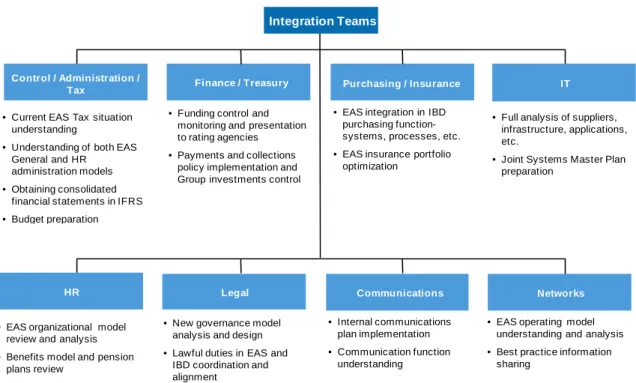
Recognizing the integrated model that had been previously implemented, a new integration planning process for Iberdrola and Energy East was commenced September 2008 that had as its main objective an issue free Legal Day 1
integration of Energy East into Iberdrola. As described previously, the proximity of service territories and commonality of business operations (network-focused) provided for the capture of cost based synergies from previous Energy East integration processes. By contrast, the lack of common business operations (network versus generating assets) between Energy East and Iberdrola shifted the integration focus to that of seamless integration of Energy East’s functional activities into Iberdrola’s established business processes.
The previous integration activities that Energy East performed provided a strong organizational foundation to operate the network businesses. The EEMC and Utility Shared Services organizations provided for the centralization of corporate support services across the EE operating companies. These entities were to remain intact subsequent to the close of the Iberdrola transaction and, therefore, the integration activities allowed for the preservation of the benefits gained from adopting this organizational model.
Through the Iberdrola - Energy East integration process, the companies
implemented a management structure that provides for Iberdrola’s governance and oversight of Energy East’s performance while allowing the core Energy East business structure and operations to remain intact. The result of this integration effort did not identify the potential for obvious merger synergies to be captured. Rather, an ongoing effort to share information regarding best practices within and across the network operations of both Iberdrola and Energy East was identified as a focus area for the future, as well as adopting reporting processes that were similar to the Iberdrola standard.
Given the work that had been performed by the joint Iberdrola and Energy East integration teams, our initial analytical activity was to ascertain the potential for merger synergies based on the circumstances of the current transaction. These activities were designed to provide perspective on: the nature of the transaction completed; the relationship of business elements within the companies; the operating model in effect; efforts within the companies to integrate operations, and; the availability of synergies in light of the above assessments.
Several views of traditional merger synergies were developed to test against the Iberdrola – Energy East transaction. These views first addressed both the types and sources of synergies and then assessed their availability based upon the presence of certain factors in the transaction to enable realization.
These identified merger synergies sources represent those typically found in other utility transactions in the past, although they are not universally available in all transactions. Most of the sources involve an impact on current and future costs, i.e., they are either reduced or avoided. Few transactions produce revenue synergies due to the differences in the business or the difficulty in measuring and realizing benefits in this area. For utility transactions in the U.S. involving
similarly constructed companies, a number of synergies sources would typically be expected to be achieved.
However, aligning general synergies sources against general synergies types only defines the nature of potential benefits. It is also necessary to assess these synergies sources in terms of factors that could influence their realization.
Several factors were identified that could create a “dependency” on the existence of certain facts and circumstances to enable potential synergies to actually occur. These “dependencies” include the structural similarities of the businesses, the complementary nature of the business and the locational proximity of operations. While numerous synergies sources may generally be available in many
transactions, fewer of these sources apply in the Iberdrola – Energy East
transaction. Many of the traditional sources of synergies, particularly those that reflect the operating aspects of the business, will not be available absent certain fundamental characteristics which are not present in this transaction.
The lack of comparability to these other transactions initially extends to the structural similarities of the companies. Iberdrola is an international holding company that has operations throughout the world and an operating model and profile that reflects that dispersion. While Energy East has a holding company and corporate structure, it is more localized and simpler in design. For example, since Iberdrola maintains independent businesses all over the world, the ability to “match up” in many areas, like local facilities, fuel supply and capital
expenditures purpose is limited (capital expenditures) or non-existent (fuel supply).
In addition, differences in operations will complicate the portability of operating practices. For example, even though Iberdrola and Energy East maintain certain similar business unit operations, such as distribution, the businesses have certain elements of difference, e.g., system voltage design, local physical conditions, etc., that make operations less comparable than might be imagined. Thus,
opportunities for formal integration would be limited.
Finally, a fundamental predicate for achieving operational synergies is not present in this transaction, i.e., geographic proximity. Where other transactions have been able to capitalize on location to share and leverage resources across similar work, no such opportunity exists in this transaction.
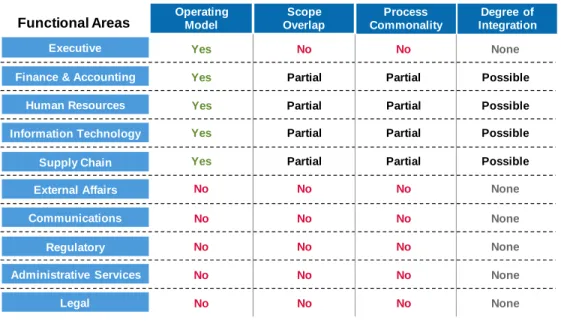
From this assessment, initial conclusions were reached that synergies from the operating areas, i.e., field operations, facilities, fuel supply and, capital
expenditures, were not likely to be available given the dependencies identified. More specifically, the lack of geographic presence of a comparable business would be a limiting factor in any ability to create synergies opportunities. However, several traditional synergies sources were identified as being “possible” areas of applicability in the current transaction. These areas, e.g., corporate and related support, were then reviewed more closely to determine whether they would potentially offer synergies with respect to Energy East. The purpose of this assessment was to determine whether the circumstances
prevailing with respect to Iberdrola and Energy East would enable the capture of potential synergies given the circumstances of operating structure, cost
incurrence and commonality in execution.
Certain non-labor A&G cost areas would, in fact, result in elimination of incurred costs at Energy East. These would include directors fees and shareholder services
which amount to approximately $2 million in foregone costs for Energy East. In
both these areas, Energy East has been able to forego the incurrence of costs since the close of the transaction. However, while cost reductions have been achieved, they do not create synergies in the traditional sense of flow-through in lower rates as these costs have been treated as below-the-line expenses for ratemaking and supported by shareholders rather than customers.
The insurance cost category was also identified as a source of “possible”
synergies given the potential to leverage global insurance brokers for expanded coverage under an umbrella policy. As a result, Energy East has achieved reductions in broker costs and premiums of approximately $3.1 million across
the holding company and operating companies. Part of these reductions ($1.6 million) reflect the elimination of the need to provide D&O coverage to the Board of Directors since Energy East is no longer a publicly traded entity. This cost category also has been treated as a below-the-line item for ratemaking and historically supported by shareholders, rather than included in customer rates. Accordingly, the $3.6 million in reduced costs related to directors fees,
shareholder services, and D&O insurance ($2.0 million for directors fees and shareholder services, and $1.6 million for D&O insurance) have not previously been allocated to Energy East’s operating subsidiaries and, therefore, would not be allocable to customers.
Thus, those corporate and related support staffing and non-labor A&G areas where available synergies were determined most likely to be “possible” do not, in reality, lend themselves to any significant level of benefit. This occurs
because: the businesses themselves have a sufficient degree of difference to preclude the same level of integration as normally observed in U.S. utility transactions. In addition, the operating model of Iberdrola has historically been built around substantial operational independence of its operating subsidiaries, reflecting their unique circumstances, thus broader integration has not been emphasized.
Finally, in those few areas where actual cost eliminations have been realized, these benefits will not flow to customers as related costs have not previously been included in rates. Thus, the potential for synergies that are actually attributable to Energy East’s regulated operations is both limited to a modest number of areas and only reflects de minimis levels (~$1.5 million) across all of Energy East’s operating companies. Thus, the value of these synergies is further diluted once allocation is reflected across all the operating subsidiaries within the Energy East system. This is consistent with our experience with international utility transactions whether in-bound to or out-bound from the U.S.
III. APPROACH TO THE ASSESSMENT
The scope of the assessment to be conducted was clearly defined by Booz & Company prior to initiation of the project. To fulfill this scope, several key areas of analysis were undertaken to provide insights into the potential availability of traditional merger synergies from the Iberdrola - Energy East transaction. These analyses formed the backbone of the assessment conducted and are summarized below:
Review of typical merger synergies
Review of the profile of the current transaction
Review of prior integration efforts at Energy East
Review of the availability of potential merger synergies
The purpose of the assessment was to review the situation as it exists today and to address whether the specific facts of this transaction would give rise to the potential availability of typical merger synergies. This approach did incorporate the consideration of the typical categories that normally comprise merger
synergies and compared the current transaction against the circumstances that exist in other utility industry transactions. The assessment also identified under what circumstances such merger synergies could be attributed to Energy East and Iberdrola and whether those conditions were likely to prevail.
The analysis conducted focused on potential merger synergies that would impact the New York operating utilities. The analysis incorporated several fundamental assumptions:
the operating model for Energy East would remain intact
the previously adopted governance philosophy and model of Iberdrola
would remain intact
the Iberdrola – Energy East integration effort is complete
the assessment focus would be on cost reductions created by the current
transaction, rather than achievable by Energy East on a stand-alone basis To frame the assessment, a series of questions were utilized to guide the ensuing analysis. These questions provided a basis for both scoping the analysis and defining how the evaluation would be conducted. The specific questions that were utilized included:
How does the Iberdrola – Energy East transaction compare to traditional utility combination models?
Does the Iberdrola – Energy East transaction lend itself to the creation of natural synergies?
Are there any potential areas for synergies available through the Iberdrola
– Energy East transaction?
Does the governance model for post-close operations preserve overall
management and local operations control at Energy East?
Are there any plans to change the relative roles of Iberdrola or Energy
East with respect to control of operations?
To support the analysis of the questions referred to above, several initial tasks were undertaken to provide a foundation for the subsequent assessment. These tasks included:
Review of prior Energy East regulatory filings: testimony and orders from relevant Energy East dockets before the Commission were reviewed to provide background data and identify the nature of the issue(s) as discussed in these proceedings.
Interview of Energy East and Iberdrola management: several discussions were held directly with management at the Company to discuss prior merger related actions taken, operating circumstances and conditions currently in place and expectations for subsequent changes, if any. Review of internal Energy East documentation: additional
documentation on Company actions related to prior merger actions and outcomes, as well as underlying organization and governance material was obtained for review and support of analysis refinement.
The conduct of these preliminary tasks enabled the execution of a series of succeeding tasks that were more directly focused on specific areas of analysis regarding the Iberdrola – Energy East transaction and the scope of inquiry identified earlier. These specific analyses addressed the following topical areas:
Review of transaction structure: an initial element of the analysis focused on the identification of the guiding parameters of the Iberdrola – Energy East transaction, such as the planned buyer – operator relationship
between Iberdrola and Energy East. The purpose of this task was to
that would bear upon subsequent operations and relationships. Review of current Energy East operating model: the assessment also
included a review of how Energy East and its operating companies are structured and where responsibilities reside for execution of activities. The purpose of this analysis was to identify the relative roles that existed between the levels of the organization and the location in which activities were performed on behalf of the enterprise as a whole.
Review of prior Energy East transaction integration experience: since the Company had completed several prior transactions in the past, review was conducted of the process and outcomes relative to integration of these entities. The purpose of this activity was to provide an understanding of what had previously been accomplished to provide a baseline for
assessing the extent to which further opportunities might exist.
Review of planned Iberdrola governance model: the manner in which the Company presently interfaces with Iberdrola relative to decision-making was also identified. The purpose of this analysis was to
understand the relative roles of each of the entities going-forward and the manner in which inter-entity interfaces were expected to occur and to potentially evolve.
Review of areas for potential synergies: the final analysis focused on a high-level determination of the potential for synergies availability given the specific parameters of this transaction. The purpose of this task was to assess what, if any, areas would lend themselves to a reduction in costs given the alignment of oversight and / or operating areas between Energy East and Iberdrola.
The above activities reflect the scope of the analysis conducted by Booz &
Company relative to the question of potential synergies availability. The results of these analyses are provided in subsequent sections of this report along with supporting information, where relevant and appropriate, to the conclusions reached.
IV. OVERVIEW OF TYPICAL MERGER SYNERGIES
This section of the report describes the nature of synergies that are typically captured in a utility merger or acquisition transaction. It is intended to provide a common starting place for merger synergies definition and discussion of the situations under which they typically are available for capture.
From our experience, no two transactions are necessarily the same in enabling the realization of synergies as several factors affect their availability and level including: style and structure of the transaction, relative scale of the companies, relative business and asset mix of the companies, proximity of the companies, management philosophy of organization and operations and, emphasis on synergies attainment. Each of these factors is explained below:
Style and structure of the transaction: the manner in which the
transaction is designed can heavily affect the opportunity for synergies. For example, a transaction intended to simply become part of a larger portfolio of businesses, with no direct similarity to other operating assets, will not generate synergies. Similarly, when a transaction is not intended to be integrated with similar businesses, no synergies will be created. Relative scale of the companies: the comparative size of the two
companies can be a limiting factor on the level of synergies available. For example, a company substantially smaller than its acquirer will likely be absorbed into the larger company, where possible. In this case, the synergies will likely directly come from the smaller entity and be limited to a portion of the level of expenditures incurred by that entity, rather than from both entities. Conversely, two more similarly sized companies will offer a broader and a higher level of opportunities for integration and therefore greater synergies.
Relative business and asset mix of the companies: the comparability of the lines of business will affect the sources of potential synergies. For example, a gas distribution utility merging with an electric distribution utility would not enjoy the nature and level of synergies that would other wise be available to two more closely composed companies. Similarly, a utility merging with a merchant generating company would find the options for synergies more constrained given the operating elements of the business that would remain unaffected, compared to a merger between two integrated utilities.
Proximity of the companies: the geographic location of the companies involved in the transaction also can affect the nature and level of synergies
that can be attained. For example, two companies that are reasonably proximate to one another have the opportunity to share operating resources over a broader service territory than would be the case where the companies were farther apart in location. Similarly, where there is substantial distance between the two companies, both corporate and operating synergies may be constrained by an inability to conceive an effective operating model.
Management philosophy of organization and operations: the manner in which management elects to align organizations and operate the business can directly impact the opportunity for synergies attainment. For example, an operating model that leaves the operating companies as fully stand-alone entities, i.e., relatively unchanged from their pre-merger status, would limit the potential for synergies. Conversely, an operating model that emphasizes full integration of similar functions would likely generate greater savings, all other things being equal.
Emphasis on synergies attainment: a fundamental factor underlying the level of potential synergies that can be attained relates to whether the realization of merger synergies is a principal underpinning of the transaction’s economics. If so, then management would be driven to ensure that attainment is maximized. On the other hand, when
managements are concerned about the level of disruption that may affect their businesses, synergies achievement may be less emphasized, and resulting levels lower.
Each of these factors can either impact the nature of synergies available, i.e., which categories are relevant, and the level of synergies, i.e., the amount of synergies to be achieved. And, these factors are not wholly independent of one another; several factors can combine to impact the nature of synergies that may be available or the manner in which these synergies are pursued. In reviewing the relevant characteristics of the Energy East – Iberdrola transaction,
consideration was given to all of these factors in assessing potential synergies availability.
Synergies Categorization: In a typical merger, there are several different categories of savings that can be realized from a transaction. These categories reflect the nature of the benefits that may be available from a range of actions taken by management. The distinction among these synergies categories is important, however, since the manner in which they are often treated in
regulatory proceedings differs. The distinction between merger and non-merger related synergies is highlighted below:
Created synergies: These are savings that are directly related to the completion of a merger and could not be obtained absent the merger. For example, the reduction of total cost through the avoidance of duplication or overlap and the ability to extend resources over a broader base of activity would naturally occur through the consolidation of similar functions. Without the combination, both companies would continue to expend amounts on related activities, and as a result, would incur stand-alone cost levels higher than in consolidation.
Enabled synergies: These savings result from the acceleration or
“unlocking” of certain events that could give rise to savings and therefore are considered merger synergies. For example, technology differences that exist between companies may provide an opportunity to share technology and achieve productivity improvements more rapidly and more cheaply than would have occurred on a stand-alone basis. For example, one company that has adopted an enterprise resource planning approach will likely enjoy more seamless operation and higher
productivity than a company that has individual, customized packaged applications. While the company without the integrated technology environment can obtain such productivity benefit from independent investment, the merger enables an existing technology environment to be more rapidly deployed and costly stand-alone investment to be avoided. Developed synergies: Reductions in cost due to management decisions
that could have been made on a stand-alone basis, e.g., incorporating certain best practices, are unrelated to the merger. For example, a decision to transform an organization will result in reduced costs, but likely would have been achieved without the merger. These categories are not
dependent on a transaction to be completed and are generally not anticipated in traditional synergies analysis.
The distinction among the above synergies categories is relevant to the Energy East and Iberdrola transaction given the scope of the Commission’s inquiry, particularly in light of the factors that can influence synergies availability and realization that were also enumerated above. For most traditional transactions, the “created” synergies category is the most relevant as it captures the normal sources of benefits from consolidation, centralization and economies of scale. For non-traditional transactions, such as Energy East – Iberdrola this category would be less relevant given the characteristics of the situation. In this transaction, synergies that relate to changes in operating model or operating practices would be a more likely source.
Synergies Types
Typically, the synergies from a transaction arise from one of three areas: cost reduction, cost avoidance or revenue enhancement. These types of benefits or outcomes reflect the manner in which two companies align their businesses and functions and are further discussed below:
Cost reduction: the total cost of service is reduced as a result of the merger by avoiding duplication of the cost input required to achieve the same level of output. For example, similar operating functions, such as
corporate planning, could now be integrated and would require less input to achieve results on a combined basis.
Cost avoidance: the total cost of service is reduced due to the ability to forego certain types of parallel expenditures. For example, redundant capital expenditures required by both entities (e.g., information systems) could be avoided by selecting one set of development efforts to forgo duplication.
Revenue enhancement: the creation of additional revenue streams by using existing regulated assets to supplement revenue sources could also be a means to increase benefits for shareholders and customers. These revenue streams would be related directly to integrating portfolio
resources, such as products and services, in a more attractive manner, i.e., to align compatible offerings or extend market position, to grow the business.
Each of these three types of synergies can occur in a transaction, with the circumstances dictating the relative level to be available. However, certain categories, such as revenue enhancement, may not be available in the typical utility-to-utility transaction given the nature of the business. For Energy East – Iberdrola, the factors enumerated above would limit the availability of potential synergies and have an impact on the ability to reduce or avoid costs.
Synergies Sources
Beyond the categories and types of potential synergies discussed above, it is important to recognize the specific operating sources from where these benefits can be derived. While the parameters of each transaction can be different for the reasons discussed earlier, there are several typical sources that contribute to the potential synergies that may be available.
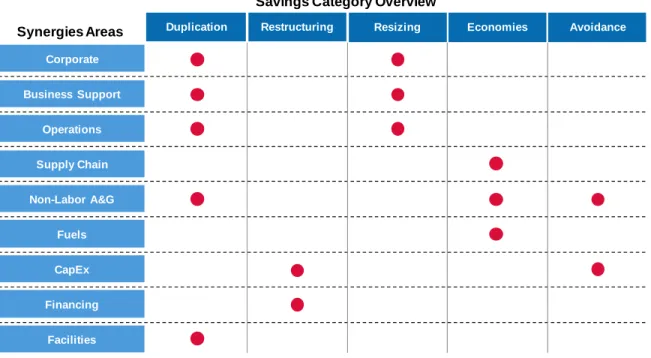
These synergies sources generally relate to operating areas of the business and classifications of costs, both operating and maintenance expense and capital expenditures. The typical sources of merger synergies are captured in Figure 1 below:
Figure 1: Typical Synergies Sources
Savings Category Overview
Duplication Restructuring Resizing
Synergies Areas Economies Avoidance
Corporate Business Support Operations Supply Chain Non-Labor A&G Fuels CapEx Financing Facilities
As the above illustration indicates, there are a number of sources of synergies that may be available in any utility merger transaction. These sources relate to the corporate, business support and operations areas, as well as specific
categories of synergies, such as capital expenditures or facilities. The availability of these synergies sources depends on the characteristics of the companies
involved and a number of the factors affecting synergies attainment enumerated earlier.
In addition, certain sources may be available depending on the nature of the companies involved in the transaction being pursued or the financial position of the individual companies, such as related to financing synergies. However, synergies in these areas are usually dependent on future events that have yet to occur. In addition, they often require speculation about market judgments and outcomes that are difficult to predict with certainty as they relate to conditions that cannot be reasonably anticipated based on the circumstances known.
The assessment conducted of the Iberdrola - Energy East transaction focused on the potential for synergies within the framework established above. The ensuing tests for synergies potential considered the specific categories and types of
synergies and the manner in which this transaction would support their
occurrence and capture. The following sections further assess the availability of synergies within the evaluative framework described above.
V. IBERDROLA – ENERGY EAST TRANSACTION
On June 25, 2007 Iberdrola and Energy East Corporation initiated a merger agreement under which Iberdrola S.A. (Iberdrola) sought to acquire 100% of Energy East for a total transaction value of approximately $8.6 billion. Upon completion of the transaction, Energy East would become a wholly owned subsidiary of Iberdrola S.A.
Subsequently, on August 1, 2007 a petition2 was filed with the New York State
Public Service Commission (the Commission) seeking approval for the
transaction. The transaction was structured as a merger between Energy East and Green Acquisition Capital Inc., a wholly owned subsidiary of Iberdrola that was created solely for the purpose of integrating Energy East into Iberdrola. At the time of the announcement, Iberdrola stated that the acquisition of Energy East would enhance the company’s international expansion into additional markets and provide stable returns to shareholders. The Company believes the acquisition represented an important area for growth and a step forward in its strategy of building a broader North American platform.
Iberdrola is a global utility company headquartered in Bilbao, Spain with diversified operations in generation, transmission and distribution and electric and gas retail operations. Iberdrola’s global holdings consist of over €86 billion in assets and a retail customer portfolio of over 22 million electric and gas customers in Spain, United Kingdom, Mexico, Guatemala, Brazil, Chile and Bolivia. Iberdrola is noted as a global leader in renewable wind energy
generation with assets totaling €18 billion in wind, hydro, solar, and geothermal energy production. The company also maintains a global Engineering &
Construction enterprise with a presence in over 40 countries and a real estate segment focused on land and property acquisition, primarily to support site selection and purchase of land for wind development. Figure 2 presents a view of Iberdrola’s global operating footprint.
2
Submitted to New York State Public Service Commission “Joint Petition of Iberdrola, S.A., Energy East Corporation, RGS Energy Group, Inc., Green Acquisition Capital, Inc., New York State Electric & Gas Corporation and Rochester Gas & Electric Corporation for the Approval of the Acquisition of Energy East Corporation by Iberdrola S.A.”
Figure 2: Iberdrola Global Operation None None None None >1Mn Electric Electric Gas 10.5Mn South America Total Assets: €1.9 Bn Generation Retail Electric Fossil Renewables Gas/Coal Wind HydroBiomass
Fossil Renewables Gas/Coal Wind HydroBiomass
Transmission/Distribution North America Total Assets: €5.0 Bn Renewables Wind Hydro Biomass Thermal Renewables Wind Hydro Biomass Thermal Transmission/Distribution Generation Retail UK Total Assets: €16.5 Bn Spain Total Assets: €32.3 Bn Iberdrola Electric Gas Renewables Fossil
Gas/Coal Wind Hydro Biomass
Nuclear Renewables Fossil
Gas/Coal Wind Hydro Biomass
Nuclear
Electric Gas
Renewables Fossil
Gas/Coal Wind Hydro Biomass
Nuclear Renewables Fossil
Gas/Coal Wind Hydro Biomass Nuclear Rest of World Total Assets: €1.2 Bn Transmission/Distribution Generation Retail Renewables Wind Hydro Biomass Transmission/Distribution Transmission/Distribution Generation Generation Retail Retail Central America Total Assets: €2.0 Bn Electric Fossil Renewables Gas/Coal Wind Fossil Renewables Gas/Coal Wind Transmission/Distribution Generation Retail Electric Gas 3.4Mn 5.3Mn 1Mn Electric
Energy East is a public utility holding company primarily focused on electric and gas distribution operations in the northeast portion of the United States. The company maintains its corporate headquarters in New Gloucester, Maine with administrative services centralized in Rochester, NY. Energy East serves approximately 1.9 million electric customers and 950,000 gas customers. The company’s primary lines of business focus on regulated electric transmission, distribution and generation operations in New York and Maine, and in regulated natural gas transportation, storage and/or distribution operations in
Connecticut, Maine, New York, Massachusetts and New Hampshire.
The current company has been created through several acquisitions over the past 10 years resulting in ownership of six northeast operating subsidiaries.
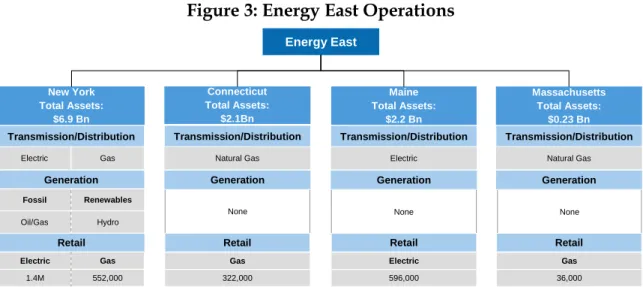
Regulated network operations account for nearly 90% of Energy East revenues, with the remaining 10% coming from energy marketing operations in New York State. Energy East’s New York presence includes the regulated utility companies RG&E and NYSEG. Figure 3 represents the consolidated operations of Energy East.
Figure 3: Energy East Operations
None None None
36,000 Gas 596,000 Electric 322,000 Gas Connecticut Total Assets: $2.1Bn New York Total Assets: $6.9 Bn Maine Total Assets: $2.2 Bn Massachusetts Total Assets: $0.23 Bn Energy East Transmission/Distribution Electric Gas Generation Fossil Renewables Oil/Gas Hydro Generation Fossil Renewables Oil/Gas Hydro Fossil Renewables Oil/Gas Hydro Retail Transmission/Distribution Natural Gas Generation Retail Transmission/Distribution Electric Generation Retail Transmission/Distribution Natural Gas Generation Retail Electric Gas 1.4M 552,000
The Energy East acquisition represents Iberdrola’s initial entry into United States regulated electric and natural gas utility operations. Iberdrola’s prior platform in U.S. energy markets involves several ownership stakes in non-regulated
renewable generation, gas storage, trading, and other energy management activities.
A brief summary of Iberdrola U.S. operating subsidiaries is included below: Iberdrola Renewables, Inc. (IRI) is a non-transmission owning public utility engaged directly, and indirectly through its subsidiaries and affiliates, including Iberdrola Renewable Energies USA, Ltd, in the development and operation of wind and thermal energy facilities, natural gas and electric marketing, and in providing other energy services, including asset management and structured power solutions. IRI and its affiliates had, at the end of the first half of 2009, more than 3,000 MW of installed capacity of wind power, and more than 600 MW of gas-fired generation, in the U.S. IRI's wholly-owned subsidiary, Enstor Inc., is an independent natural gas storage company and, through its
subsidiaries, acquires, develops and operates natural gas storage projects across North America that serve natural gas producers, energy marketers, utilities, electric power generators and natural gas pipeline companies.
The acquisition of Energy East is not a traditional utility transaction by U.S. standards. While certain of the elements of the Iberdrola global portfolio are similar to the scope of Energy East’s utility business, none of these Iberdrola utility businesses reside in the U.S. Consequently, the manner in which the businesses would be able to align and integrate would be limited by structure, comparability and geography. Unlike other recent transactions involving international utility operators in the northeast, e.g., National Grid, no existing
platform of comparable businesses exist for Iberdrola to leverage with respect to Energy East.
The combination of Iberdrola and Energy East closed in September 2008 after which time management began an integration process to fold Energy East in to the Iberdrola structure. The following section will describe the structure and results of that integration process.
VI. PRIOR ENERGY EAST INTEGRATION ACTIVITIES
Before describing the Iberdrola – Energy East integration process it is instructive to understand prior Energy East integration activities. Energy East was created as a holding company in 1997 to facilitate the inorganic expansion activities pursued during the late 1990s and early 2000s through a series of mergers and acquisition. The company focused on enlarging its geographic footprint across the northeast in network or “pipes and wires” businesses. As many states in the northeast required separation of generation from transmission and distribution to facilitate competitive wholesale markets, many of the acquisition targets Energy East pursued did not include generating assets. Figure 5 illustrates the major Energy East acquisitions during this time period.
Figure 5: Timeline of Major Energy East Acquisitions
1997
Energy East formed as Holding Company
2000
Acquired CNE Energy Services for $596M 2002 Acquired RGS Energy Group (RG&E) in 2002 for $2.4B Purchased Ownership of CMP Group ($1.2B), CTG Resources ($572M) and Berkshire Energy ($135M)
Integration Activities Prior to Iberdrola Merger
The rapid expansion of the company through acquisition was driven by a
philosophy that the smaller independent regional utilities in the northeast would operate more efficiently as part of a larger homogenized entity. Standardization of common processes and development of an integrated information technology infrastructure provided significant opportunities for the company to eliminate overlapping and duplicative activities and pursue economies of scale benefits. Management also recognized that certain synergies did not require standard process design or technology integration and, therefore, could be extracted without significant execution risk shortly after merger consummation (e.g., elimination of duplicate investor relations departments). Throughout its acquisition history and as these synergy opportunities became apparent, the
company developed a disciplined approach to merger integration to capture the benefits from consolidation.
Through each acquisition, a broad array of processes, system, personnel and assets were evaluated across the companies to determine the most likely areas to extract integration benefits. The Company’s framework for synergy capture gave considerable weight to level of effort and the length of time to implement the solution. Projects that yielded quick returns for lower levels of effort were given top implementation priority. Ultimately, the company identified three areas as providing the greatest opportunity for synergy capture: information technology, supply chain and process reengineering and focused many of its integration activities in support of these areas.
As a first step in October 2000, Energy East created a subsidiary company,
Energy East Management Corporation (EEMC), to quickly combine the corporate administrative functions of the regulated utilities. EEMC was created to focus on developing common policies, guidelines and principles that would govern the conduct of Energy East company activities and to coordinate corporate-wide initiatives. Corporate back office functions including certain finance, governance and consolidated accounting activities were centralized within a single structure that facilitated the development of common processes, where applicable.
To extract savings in supply chain, information technology and process
reengineering areas, the company launched several enterprise-wide programs targeted at reducing costs and inefficiencies, increasing productivity and
maximizing the capabilities across the combined companies. The major projects included the Data Center Consolidation Project, Project Spartan and Integrating EExcellence. Subsequently, SAP’s enterprise system was implemented,
including the Back Office and Work Management modules.
Data Center Project
The consolidation of Energy East subsidiaries began in 2002 and focused on the integration of information service systems and related personnel, networks and assets. The data center project integrated the information technology operations of six independent utilities into one streamlined organization capable of meeting the IT needs across the enterprise. Rochester, New York was selected as the data center location and the facility was completed in May 2003. A corporate network was created that linked all six utilities to this single data center.
After the physical centralization of IT operations was completed, the company focused on consolidating the IT department staff. From 2002 to 2004, the company reduced IT staff by 27%. Reductions were achieved in executive management, operations, technical services, contractor services, network
infrastructure and applications support. The effort also resulted in the standardization of operating systems and software across the company. For example, the use of Microsoft operating systems and software was mandated throughout the enterprise.
Integrating EExcellence
Integrating EExcellence was a 19 week initiative launched in 2003 and focused on process reengineering across all of Energy East’s network operations. From its inception, the program incorporated several broad themes that served as objectives for the program:
Eliminate unnecessary work
Match salaries with corresponding level of responsibility
Redesign work processes
Reduce span of control
Consolidate wherever possible
Implement common IT systems
The project involved the efforts of approximately 100 employees and resulted in the identification, approval and implementation of over 1,000 improvement opportunities. One significant outcome was the creation of an additional
support subsidiary that significantly changed Energy East’s operating structure. Utility Shared Services (USS) was created to consolidate support functions for the regulated utilities in areas such as treasury, information services, accounting, accounts payable, payroll and supply chain functions. This shared services entity allowed transactional related activities (e.g., volume-based) to be
consolidated and standardized in one entity. This provided for efficiency gains to be extracted through consolidation and Energy East subsidiaries realized the benefit of lower cost from the provision of these services in a central organization. The Integration EExcellence program resulted in significant savings through the adoption of best practices across the enterprise. Other benefits were realized including the alignment of middle and senior management into a cohesive governing body focused on enterprise-wide performance.
SAP’s Back Office Project
The Back Office Project, launched in January 2003, created a singular system for transactions involving finance, HR, payroll, treasury and a host of other back office functions. It was successfully completed on-time and under budget in January 2004. The project resulted in significant savings through process
efficiencies and the reduction of employees in the impacted functional areas. The outcome of the program resulted in:
Reductions of 36% in total shared service staff including reductions in
accounting and finance (51%) and supply chain (49%)
Identical organizational structures, titles, and business processes across the six utilities
Single general ledger system
Identical pay schedules for all employees
Real-time spend data available for all utilities
Common performance metrics across the utilities
Elimination of 50 legacy back office systems
SAP’s Work Management System Program
The Work Management System program, initiated in April 2004, continued the effort to reduce cost and eliminate redundancies across the enterprise. The initiative consolidated functions for plant maintenance, engineering operations, asset management, and training into a single tool that would serve to drive uniform processes across the enterprise. The system improved trouble call response rates and reduced repetitive outages and customer complaints. By the end of the initiative in April 2005, a total of 156 legacy applications were
eliminated.
Project Spartan
Project Spartan, which was initiated in 2002, initially focused on the
identification of the annual spending levels at each of the utilities to work toward consolidated purchasing functions that would leverage the enhanced purchasing power of the consolidated entity. Project Spartan also looked for efficiencies in warehousing, inventory management and in fleet management. A consolidated supply chain organization was established in 2003. Project Spartan utilized a number of strategies to reduce annual spending levels, including:
Expanding the number of vendors to promote competitive bidding
Segmenting and concentrating the volume of materials purchased
Improving product specification processes
Standardizing and consolidating basic supply chain processes across
utilities
Restructuring relationships with vendors