Internship Report
On
Financial Excellence Limited
(FinExcel)
Submitted to
Mohammed Rezaur Razzak
Associate Professor & Head, BRAC Business School
BRAC University
Date of submission: 23
rdFebruary, 2016
Prepared by:
Shejuti Pasha
ID: 12104105
Page | 1
Letter of Transmittal
23rd February, 2016 Md. Rezaur Razzak
Head of BRAC Business School & Director, Centre for Entrepreneurship Development (CED) BRAC Business School
BRAC University
Dear Sir,
With all due respect, I would like to inform you that I have prepared my internship report on “Financial Excellence Limited (FinExcel)” as assigned by you to mark the completion of my internship. I have tried my level best to prepare a creditable report, keeping in mind the tasks I was assigned and considering the fact that I do justice to both the organization I worked in and my respected University. The report contains an insight into the activities and services of FinExcel and encompasses a research conducted on trainee satisfaction. I have prepared this report according to the guidelines provided by you and I will be pleased to clarify any discrepancy or inconsistency that may arise regarding any part of this paper.
I hope to meet your expectations regarding my Internship report. Thank you very much for your guidance and unconditional support.
Yours sincerely,
Shejuti Pasha ID: 12104105
BRAC Business School BRAC University
Page | 2
Acknowledgement
To begin with, I would like to thank my respected academic supervisor, Mohammad Rezaur Razzak, Associate Professor & Head, BRAC Business School, BRAC University, for his tremendous support and guidance during the submission of this report.
I would also like to take this opportunity to express my utmost gratitude to my supervisor, Mr. Rajib Kanti Paul, Executive, Training and Organization Development, and Md. Nurul Haq Majumder, CEO, Financial Excellence Limited (FinExcel), who guided me and supported me throughout the entire process of submitting this report.
Lastly, I would like to thank all the employees and officials of FinExcel who have been very kind and supportive towards me throughout the time I have worked there.
Page | 3
Table of Contents
Chapter Title Page No.
1 Industry Overview 5
1.1 Finance Industry of Bangladesh 6
1.2 Banking Sector of Bangladesh 6
1.3 Challenges in the Banking Sector 7
1.4 Banking Training Institutes in Bangladesh 8 1.5 Prospects of Banking Sector in Bangladesh 11
2 Organization Overview 12
2.1 Introduction 13
2.2 History 14
2.3 Product/ Service Offerings 15
2.4 Operational Network Organogram 18
2.5 Board of Directors 19
2.6 SWOT Analysis 20
2.7 Visions for the future 21
2.8 Achievements 21
2.9 Brand Value and Promotion 21
3 Job Responsibilities 22
3.1 Nature of the job 23
3.2 Specific Responsibilities of the job 23
3.3 Observations and Recommendations 25
4 Research on Trainee Satisfaction 26
4.1 Research on Trainee Satisfaction 27
4.2 Description of the project 27
4.3 Findings and Analysis 29
4.4 Results and Discussion 42
Recommendation 44
Conclusion 45
References 46
Page | 4
Executive Summary
Financial Excellence Limited (FinExcel) is the center of excellence for organizational learning, skill development, capacity building and advisory services for the Bangladesh finance industry. Reputed professionals and institutions formed the company with a vision to provide world class training to the booming Financial Institutions of the country. This report consists of a detailed view of Financial Excellence Limited; its services and activities, my job responsibilities while I worked as an Intern and a Research paper on “Trainee Satisfaction.”
FinExcel has now become a reputed brand amongst the many banking training institutes in Bangladesh and holds potential to be the pioneer in the industry. On the basis of existing condition of the organization, a research has been presented on the satisfaction level of trainees/ participants who undertake training courses at FinExcel. Certain observations and recommendations based on them have been provided so that FinExcel can fulfill its mission and vision and accelerate its performance relative to this sector.
The diversity in team members and hard work of employees has been allowing the FinExcel team to address issues within a multi-dimensional framework and provide effective and sustainable solutions as a whole for the finance industry of this country. And it hopes to achieve more in the upcoming years.
Page | 6 1.1Finance Industry of Bangladesh
Bangladesh has a flourishing finance industry which holds banks in a large portion. The present structure of the financial system comprises of various types of banks, insurance companies and non-bank financial institutions. The commercial banking system dominates this area, where Bangladesh Bank is the Central Bank and chief regulatory authority, and is responsible for assuring prudential administration and central banking activities for all types of banks operating within the banking industry. On the other hand, the Securities and Exchange Commission (SEC) of Bangladesh is the regulatory body and is responsible for monitoring all stock-market related activities.
1.2 Banking Sector of Bangladesh
After its birth as a new nation in 1971, the banking sector of Bangladesh started its journey with a new dream and commitment. The central bank was renamed as Bangladesh Bank, and the banking industry began its journey with 6 Nationalized commercialized banks, 2 State owned specialized banks and 3 Foreign banks. With time, the banking industry expanded and at present, there are 56 banks in our country that operate under the full control and supervision of the Bangladesh Bank, sanctioned to do so through Bangladesh Bank Order, 1972 and Bank Company Act, 1991. The total banks in Bangladesh can primarily be categorized into two types-
Scheduled Banks- banks which have the license to operate under the Bank Company Act, 1991
Non-Scheduled Banks- banks which are established for special and definite objectives and operate under the acts that are enacted for meeting up those objectives. These banks cannot perform all functions of scheduled banks
The scheduled banks can again be classified into the following types:
State Owned Commercial Banks (SOCBs)-
There are 6 SOCBs in Bangladesh which are fully or majorly owned by the Government of Bangladesh
Page | 7 Specialized banks are those banks that have been established for specific objectives like agricultural or industrial development. There are now 2 specialized banks operating in Bangladesh which are fully or majorly owned by the Government of Bangladesh
Private Commercial Banks (PCBs)-
Currently, there are 39 private commercial banks in Bangladesh which are majorly owned by private entities. The private commercial banks can be categorized into two groups, namely, Conventional PCBs and Islami or Shariah based PCBs. The Conventional PCBs perform the banking functions in the conventional fashion, i.e. they carryout interest based operations. There are 31 conventional PCBs operating in the industry now; whereas, the Islami Shariah based PCBs execute their banking activities according to the Islami Shariah based principles, that is, Profit-Loss Sharing (PLC) mode. Currently, there are 8 IslamiShariah based PCBs in our country with around 850 branches.
Foreign Commercial Banks (FCBs)-
Foreign commercial banks have branches that are situated abroad and have been incorporated abroad. According to the present scenario, 9 FCBs are currently operating in Bangladesh.
Apart from this, there are now 4 Non-scheduled banks conducting their activities in Bangladesh. They are:
i. Ansar VDP Unnayan Bank ii. Karmashangosthan Bank iii. Probashi Kollyan Bank iv. Jubilee Bank
1.3Challenges in the Banking Sector
The banking industry of Bangladesh has flourished over the years, making double-digit profit margins, sustaining growth and surviving cut-throat competition. It has also maintained the process of providing attractive returns to shareholders. However, just like any other potential industry, the banking industry has its own share of challenges. The main challenge faced by the
Page | 8 banking sector is Excess Liquidity. It has been seen that Excess Liquidity in the banking sector has been a chronic problem. After the crash in the stock market in 2010, there was a shortage of liquidity in the banking arena. As seen, this problem has been increasing over the years mainly due to a noticeably low level of demand for credits in the private sector. This low level of demand for loans and advances on the part of the private sector has been due to the worsened business situation of the country both in the domestic and international scenarios, consecutive contractionary monetary policy taken by the Bangladesh Bank and persisting problems in supplying gas and power. Also, the political turmoil in our country is another large contributor to the low growth and unstable condition of our economy, causing more frustration in the banking sector. Another reason is the slow growth of credit in institutions. This scenario is the result of the rigid attitude of banks and financial institutions in giving loans due to a number of scams taking place in recent years. If this situation persists, the economy might contract even further and degrade our banking system ever more.
1.4Banking Training Institutes in Bangladesh
Training is by far the most important and crucial event for organizational advancement. Hence, in order to train bank personnel, a number of training institutions have developed over the years to offer high class training to bank employees of several ranks. To name quite a few, the Banking Training Institutes in Bangladesh at present are:
Bangladesh Institute of Bank Management (BIBM)-
Bangladesh Institute of Bank Management (BIBM) is the national Training, Research, Consultancy and Education institute on banking and finance collectively owned by all banks that are in operation in the country. It is registered under the Societies Act 1860 and was established in 1974 with an initial primary focus of providing training to the officials of banks and financial institutions of Bangladesh. Currently, BIBM is engaged in offering training to the mid and senior level executives of banks. Over the years, BIBM has modified its training activities and broadened its operations to cover other areas of activities such as providing education in the form of degree- Masters in Bank Management (MBM) and Evening MBM (EMBM), carrying out research in banking &
Page | 9 finance, holding seminars and roundtable discussions, offering training and research related consultancy services or aiding the banks in their recruitment.
Bangladesh Bank Training Academy (BBTA)-
Bangladesh Bank Training Academy (BBTA) is a training division of the Bangladesh Bank. All members of BBTA are employed by Bangladesh Bank over a period of time.
Islami Bank Training and Research Academy
(IBTRA)-Islami Bank Training and Research Academy (IBTRA) was established in 1984, soon after the inception of Islami Bank Bangladesh Limited (IBBL). The activities of IBTRA cover both training and research on various aspects of Islami banking. The Academy conducts training courses and workshops for the officials of IBBL and other Islamic Banks. In addition to conducting regular training courses, IBTRA arranges seminars on Islamic economics and banking and other related topics. The Academy conducts internship courses for the students of various Universities and also offers Diploma in Islamic Banking (DIB) for bank officials.
Mercantile Bank Limited (MBL) Training Institute (MBTI)-
Mercantile Bank Training Institute (MBTI) is the flagship learning center of Mercantile Bank Limited. The Institute was established in 2002, to deliver value across the banking industry and strengthen the reputation of Mercantile Bank Limited. MBTI provides employees with experiences and tools to develop the skills they require to be successful and to prepare them for future career opportunities. The training programs are designed to meet employees’ specific need and the training activities consist of comprehensive foundation courses for entry level Management Trainees, officers and specialized training programs cover relevant areas of banking and finance such as general banking, credit, foreign exchange, marketing and accounts etc.
EXIM Bank Training and Research Academy (EBTRA)-
EXIM Bank Training and Research Academy (EBTRA) was established in 2004 and since its establishment is playing a significant role in enhancing the capabilities of
Page | 10 Human Resources to face the challenges of globalization as well as to carry out day to day business operations smoothly. The motto of EBTRA is “Transforming Human Resources into Human Capital.” As such, training for the entrants and workshops, seminar and symposiums for the experienced officials on various topics is arranged by the Academy each year.
Shahjalal Islami Bank Training Academy-
Shahjalal Islami Bank believes that an appropriate form of training contributes to the development of Human Resources of an organization and hence, the Shahjalal Islami Bank Training Academy has been developed. The Academy offers training courses on Retail and SME Banking, Application of Technology in Banking and Foundation courses for new officers in General Banking, Investment and Investment Management Financial Foreign Trade and in Business Communication. The Academy also offers workshops on Basel-II, Customer Service Banking Laws and Regulations, Leadership and Team Building, UCP- 600 Islami Banking, Anti-Money Laundering, Investment Risk grading, Investment Risks Management and Documentation, Core Risk Management, MICR Compliance Cheques and its Security Features, etc.
Dhaka Bank Training Institute-
Dhaka Bank Training Institute (DBTI) was founded in the year 2000 when its Board of Directors duly recognized the need for professional excellence at Dhaka Bank. DBTI is committed to develop its human resources through structured modular training programs. With a view to achieve professional excellence in Banking, DBTI conducts various courses, workshops and executive development programs mainly for the Officers and Executives of the Bank. Starting from August 2000 till December 2013, the DBTI has trained as many as 12,490 participants through 489 different training programs covering all diverse courses for banking, credit, foreign exchange and trade finance, management, laws, etc. Besides, conventional banking related training, DBTI also conducts various Executive Development Programs, workshops, discussion meetings and exchanged views for improvements in banking challenges.
Page | 11 1.5Prospects of Banking Sector in Bangladesh
The banking sector is our pride and a major growth engine of our country’s economy. In order to help it prosper and overcome the existing challenges, the regulators, especially the Bangladesh Bank, needs to take appropriate decisions and measures to implement proper regulations at the right time. It has been seen that, despite impressive performance in GDP over the years, Bangladesh still experiences unprecedented volatility in its financial sector. This clearly implies that macro-financial linkage in Bangladesh is still weak and leaves us to the fact that regardless of having a stable growth rate over the years, the financial sector of Bangladesh has to focus more on restructuring in order to take it forward into the world economy. In order to improve the situation, the banking sector of Bangladesh will have to move towards capital openness as capital openness is expected to benefit capital-scarce countries and is said to have a link between the macro-economy and the global financial sector. Thus, it can be said that, facing and overcoming the challenges in a compliant manner should be our goal as it will help us create a sustainable, profitable and forward-looking banking sector. In addition, the Central Bank will have to take a stronghold over the weak governance, influence from political forces and look over the factor of sacrificing quality in place of quantity when it comes to seeking borrowers. In a nutshell, our banking sector holds high potential for growth and success and it can be achieved with good governance and transparent accountability.
Page | 13 2.1 Introduction
Financial Excellence Limited (FinExcel) is the center of excellence for organizational learning, skill development, capacity building and advisory services for the Bangladesh finance industry. The company was born in 2011 and consists of professionals and institutions that are well reputed and well recognized in their fields. The fields include Banking, Finance, Capital Market, Accounting, Marketing, Communications, Economic Research and Information Technology, etc. Renowned economists, bankers, CEOs, Managing Directors and Senior Officials from various foundations of the country formed the FinExcel team together with a vision to provide world class training to the booming Financial Institutions of the country. This diversity in team members has been allowing the FinExcel team for the last five years to address issues within a multi-dimensional framework and provide effective and sustainable solutions as a whole for the finance industry of this country.
The company’s Vision and Mission go as follows:
Vision:
To provide support for building a transformed financial services industry that will be globally competitive and will have the right mix of professionalism and social passion to contribute towards economic and human development.
Mission:
To create a center of Excellence that will endeavour to realize FinExcel’s vision. This entails focusing on Organizational Learning by providing consultancy services to institutions in the areas of financial management, risk management, project management, business process outsourcing, customer services, process re-engineering, strategic partnering and human capital management. FinExcel’s partnerships with its clients aims to achieve these positive changes through learning, team work and professional development programs that will enable individuals and organizations to realize their potentials.
The Values of FinExcel include:
Professionalism
Page | 14 Confidentiality Creativity Teamwork Trust Social Responsibility
FinExcel helps business leaders create pathways to make distinctive, lasting and substantial improvement in their business performance by providing them analytical insights of their organization’s performance and offering them evidence-based diagnosis and solutions. FinExcel relies upon experience and expertise to provide the most effective solutions and to build and expand leadership skills at every level and every opportunity.
2.2 History
Bangladesh’s economy has been growing since its independence in 1971 following the turn of the century. The Gross Domestic Product (GDP) of Bangladesh expanded to 6.12% in 2014 from the previous year. The GDP growth rate in Bangladesh averaged 5.61% from 1992 until 2014, reaching an all-time high of 6.63% in 2006 and a record low of 4.08% in 1994. According to an article published by the Boston Consulting Group in October 2015, Bangladesh is one of the fastest-growing markets worldwide. The advancement of the economy has not only led to the country’s monetary expansion but has also encouraged the Financial Institutions to upgrade as well. In order to expand and perform well, these Financial Institutions need to analyze, plan and implement proper tools; and need to train their people adequately so that productivity can be enhanced to serve the country. Keeping this scenario in mind, FinExcel made its debut five years back with a competent group of individuals and organizations to provide training and end to end solutions to the country’s Finance Industry. The financial sectors in FinExcel’s focus include Micro Credit, SME, Capital Market, Banking & Non-Banking and Insurance. The Finance Industry of Bangladesh is booming for which, the formation of FinExcel was taken as a positive observation in this area.
Page | 15 2.3 Product/ Service Offerings
FinExcel is an organization involved in providing training, capacity building and advisory services for the finance industry. It is the center of excellence for organizational learning, skill development and building human capital for the finance industry. FinExcel has contributed a large portion to the service industry through its various service offerings. The core elements of FinExcel engagement include:
Training:
Training is crucial for the employees of every organization, regardless of the business area in which it is performing. Keeping this in mind, FinExcel took a step forward by providing organizations ways to offer training to its employees. Since its inception, FinExcel has organized around 100 customized, semi-customized and structured training programs for Management Trainees to Senior Executives in Banks & Non-Banks, SME, Insurance and Capital Market Institutions that have been attended by approximately 2000 officials. Amongst these training programs, the flagship curriculums were- Advanced Credit Risk Management, IT Security & IT Audit Management, Structured Finance and Loan Syndication, Retail Banking, Managing Non-Performing Loans, RMG- Risks, Threats & Mitigation, Trade Risk Management, SME Financing, Offshore Banking, Loan Documentation, International Trade and Trade Risk Management in Banks, Corporate Account Management, Capital Market, Environmental and Social Risk Management, Islamic Banking & Finance, Internal Control & Fraud Risk Management, customized training for Dhaka Bank and Eastern Bank Limited and specialized training on Life Insurance, General Insurance, Micro-credit and Capital Market.
Advisory:
As part of its advisory services, FinExcel conducts feasibility studies on business projects and plans of several firms, does financial planning and re-structuring of product/ services and organizations and executes brand building for institutions. In this process, FinExcel carries out loan structuring and evaluates a company’s assets so that the company may obtain the required
Page | 16 working capital to run its business. Throughout its tenure of advisory services, FinExcel has completed the Loan Restructuring program for Mostafa Group of Industries having loan liability of around 1700 Crore with 44 Banks & Financial Institutions. FinExcel also undertook the loan restructuring program of Esack Group of Companies (EGC) with six Banks & Financial Institutions having 352 Crore loan outstanding. Along with these, FinExcel has taken up advisory work for many other companies which are in progress.
Advocacy:
As part of its advocacy services, FinExcel organizes seminars and enhances opinion building in the form of conducting Focus Group Discussions for individuals and institutions. Till now, FinExcel has successfully organized Focus Group Discussions on Rising Bad Debts in Commercial Banks, Monetary Policy in Bangladesh, Bangladesh Insurance Industry: Prospects & Challenges, Reflection on Factory Vulnerability and Prospects of Bangladesh Apparel Industry, Managing Non-Performing Loans, Fall in EURO Price: Impact on Bangladesh Export, Oil Price fall, Commodity Hedging, Bangladesh Capital Market: Challenges Ahead, Retail Banking, Building Human Capital for the Finance Industry and Retail Banking.
Senior Recruitment:
As part of its Advisory and Consultancy work FinExcel also carries out head-hunting for the top management of Banks and Non-Banks. FinExcel has been trying to add value for the Bangladesh finance industry (banking, NBFIs and insurance) by providing senior resources in the area of Credit, IT, HR and Transaction Banking starting from EVP to CEO level. FinExcel maintains a strong database of Banking, Non-Banking and Insurance professionals which allows it to recruit the best candidate in an organization by offering the best person-job fit. FinExcel is also in an advantageous position since it has been formed by five reputed institutions in the area of Banking, Insurance, Capital Market, Microfinance & IT and includes twelve well reputed & experienced bankers of the country as well as accounting and finance professionals.
Page | 17 IT Solution Building:
FinExcel also holds the scope to provide IT related solutions to the entire finance industry of the country since one of its shareholders is Data Edge Limited. Data Edge Limited is a leading IT and technology solution provider in Bangladesh, and specializes in the area of Core Banking and Payment Cards including EMV solutions. Till now, Data Edge has installed the BACH, MICR bank cheque transaction and EFT system for the Bangladesh Bank. It has also fitted Machine Readable Passport (MRP) for the Govt. of Bangladesh. FinExcel has also opened up dialogue with PricewaterHouse Coopers (PwC), the world’s leading tax, audit and consulting firm to join in any project for centralization, IT delivery platform change and customization.
Apart from this, FinExcel also runs specialized programs for the directors of the board, future directors and CEO's by bringing in experts from abroad. The same is done for opening new institutions, bringing in new joint venture partners and strategic investors from home and abroad. The company also assists to facilitate related regulatory approval.
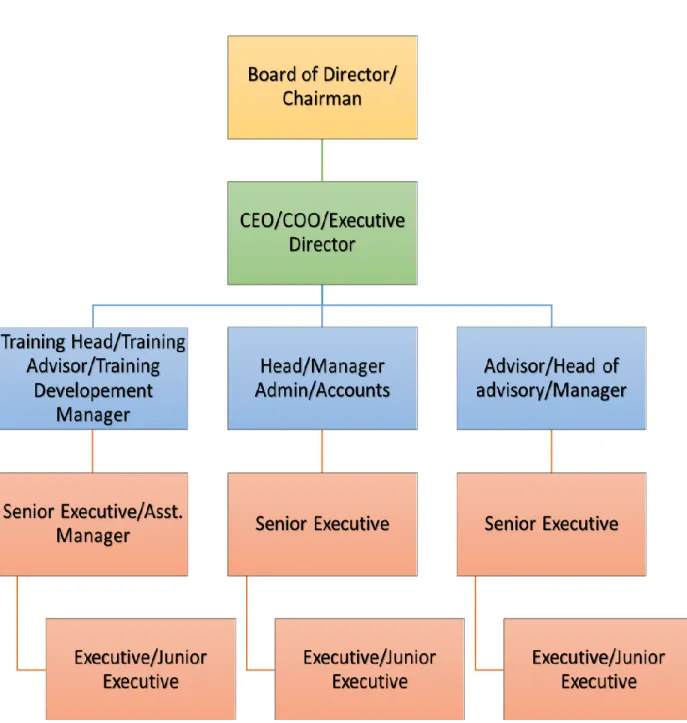
Page | 18 2.4 Operational Network Organogram
Page | 19 2.5 Board of Directors
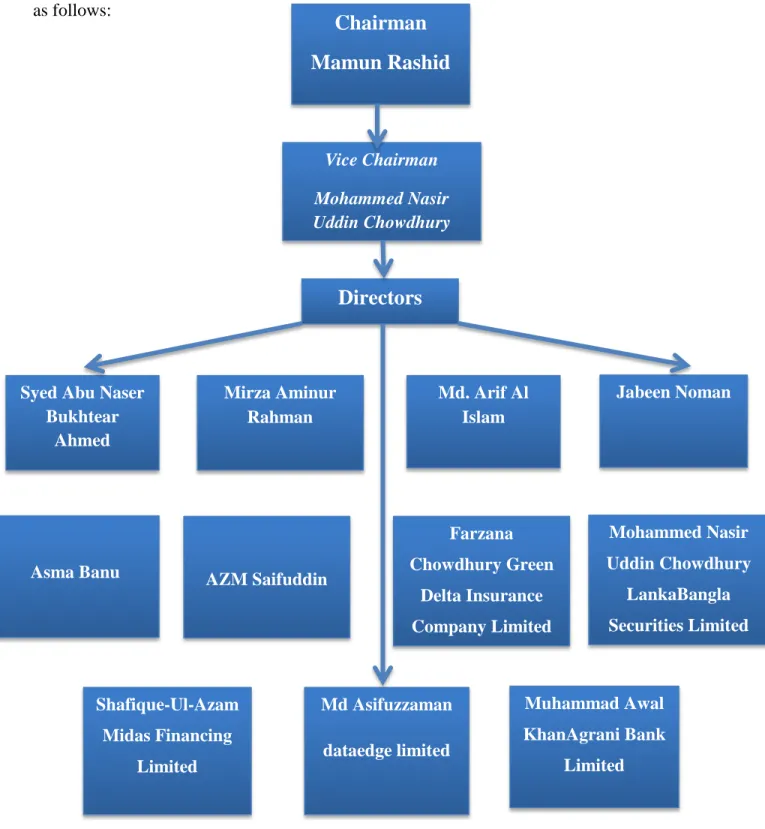
FinExcel was founded in 2011 by the late Shahed Noman who acted as the chairman of the company for a short while until his demise. Currently, the Board of Directors of the company is as follows:
Fig. 2.2 Board of Directors
Chairman
Mamun Rashid
Vice Chairman Mohammed Nasir Uddin ChowdhuryDirectors
Syed Abu Naser Bukhtear Ahmed Muhammad Awal KhanAgrani Bank Limited Md Asifuzzaman dataedge limited Shafique-Ul-Azam Midas Financing Limited Mohammed Nasir Uddin Chowdhury LankaBangla Securities Limited Farzana Chowdhury Green Delta Insurance Company Limited Md. Arif Al Islam Mirza Aminur Rahman AZM Saifuddin Asma Banu Jabeen Noman
Page | 20 2.6 SWOT Analysis
Based on my study of the entire organization I have come up with the following SWOT Analysis for FinExcel:
Strengths Weaknesses
Presence of highly qualified and reputed personnel and institutions in FinExcel Board
Participation of extremely competent and able faculties in the training programs
Fine combination of technical and financial know-how and capabilities
Good mix of revenue generated from training, advisory, advocacy and senior recruitment services
Mid-level management needs to be more skilled in comparison to the experience level of the Board
Weak value proposition
The organization is personality-driven and not process driven
Lacks proper work process structure
Threats Opportunities
Exit of key personnel
Continuous entry of new consultancy and advisory firms in the same sector
Chance of losing business to competitors
Solvency of banks and financial institutions may negatively affect the whole sector
Entry of new banks and financial institutions will create new opportunity for training and advisory services
Competition among banks and other training institutes generate the need to become more efficient, through a combination of stronger management and technology
Page | 21 2.7 Visions for the future
FinExcel aims to be a leading provider of service in the Banking and Finance industry. The company aims to be the leading provider of Advisory, Advocacy and Organizational learning for financial institutions in Bangladesh. FinExcel understands the trend of the emerging economy of Bangladesh and aims to offer more exquisite and expert-based training programs and advisory, advocacy and senior recruitment services to enhance the future of the finance industry.
2.8 Achievements
FinExcel has had numerous internal achievements such as achieving target efficiency and reaching milestones in annual revenue. The Net Income of FinExcel has largely increased over the past four years, along with the number of Training programs, Focus Group Discussions, Consultancy and Recruitment services. FinExcel has constantly remained in the news due to its participation in various events regarding the expansion of the Finance Industry of Bangladesh. FinExcel has successfully organized National Events like Mobile Financial Services in Bangladesh, Bankers’ Summit 2012 and many other notable courses like Customer Excellence Course, Corporate Credit Analysis Course, etc.
2.9 Brand value and Promotion:
By offering consolidated customized and semi-customized training, advocacy and advisory services, FinExcel has managed to create a mark for itself in the arena of training and advisory services. Being in such a position, FinExcel makes sure that no customer is dissatisfied or left unattended. FinExcel focuses on providing the best service for its customers and promotes its services to customers through discounts during training.
Page | 23 3.1 Nature of the job
As part of its Training and Advisory services, FinExcel organizes training programs and Focus Group Discussions on a regular basis. During my Internship period, I worked in the Training and Organization Development department. My tasks mostly included training related activities like organizing training programs and taking care of the list of processes required to arrange and execute the programs. Along with that, my job also included various other tasks outside the training department like taking care of advocacy services, generating new ideas for the programs. Apart from that, I also had to work with different people from different divisions for several purposes.
3.2 Specific responsibilities of the job
My core job responsibilities revolved around training most of the time. During my internship tenure, 6 training programs took place at FinExcel, namely, Loan Documentation (September 09 & 10, 2015), Trade Risk Management (September 16 & 17, 2015), Managing Non-Performing Loans (October 10 & 11, 2015), RMG- Risks, Threats and Mitigation (October 18 & 19, 2015), Corporate Account Management (October 25 to October 29, 2015) and Advanced Credit Risk Management (November 07 to November 08, 2015). My job responsibilities during these training programs were to:
Partly organize the training programs
Act as the training sub-coordinator and assist my supervisor during the training programs
Invite/ Collect participants for the training programs
Prepare list of participants/ invitees
Conduct follow-ups of participants over telephone and e-mail
Prepare and collect ID card, Certificate and Banner for the workshop
Receive the participants and carry out registration of the participants
Go through Case Studies prepared for trainees and check trainee scripts
Evaluate Training Feedback forms
Page | 24
Prepare and send out Press Release of the program to relevant media
As part of working in Advocacy services, I also took part in three Focus Group Discussions during my time. The Focus Group Discussions are Retail Banking: Challenges Ahead, IT in Banking and Building Human Resource Capital for the Finance Industry. My job responsibilities here were:
Organize the Focus Group Discussions
Partly host the Focus Group Discussions
Invite/ Collect participants for the Focus Group Discussions
Prepare list of participants/ invitees
Conduct follow-ups on participants over phone calls and e-mail
Invite particular print and electronic media
Work as a rapporteur in the Focus Group Discussions
Prepare and upload the Press Release of the program on the company’s website and forward it to the invited media
Arrange refreshments and all other necessary equipment for the program
In addition to this, I also carried out the following tasks:
Organizing & Hosting, Mobile Financial Services(MFS) in Bangladesh (21st September, 2015)
Working as a rapporteur in the program Mobile Financial Services (MFS) in Bangladesh Preparing reports post the MFS program
Checking MBA Scripts
Preparing database of all Banks and Financial Institutions
Drafting auto-biography
Conducting an analysis on the FinExcel website and work on ways to improve it
Page | 25 3.3 Observations and Recommendations
My observations and recommendations regarding the organization during my training period are given below:
Observations:
The employees at FinExcel are very friendly and co-operative
The current FinExcel team is small compared to the overall workload
The work process lacks structure- I had to do various works of various departments
The salary package for the entry and mid-level management is considerably low
Recommendations:
FinExcel should recruit more employees
There should be uniform distribution of workload among the executives
Page | 27 4.1 Research on Trainee Satisfaction
Trainee satisfaction is the fulfillment trainees achieve after they complete a training program. The research on Trainee Satisfaction has been done to assess the satisfaction level of the trainees/ participants who participate in the training programs held at FinExcel. In order to prosper more in the long run, it is imperative for FinExcel to know what the participants think about the trainings organized by them. Hence, I have conducted this research to find out the factors influencing trainee satisfaction which will also act as a partial fulfillment of my BBA program.
4.2 Description of the project Objective of the project:
I have conducted this research to accomplish a useful objective. From my perspective, it is very crucial for FinExcel to find out the level of satisfaction of trainees because the success of the training programs depends on trainee satisfaction to a large extent. Through this research, I have tried to find out the level of trainee satisfaction and the factors influencing it. By doing this, I tried to grab an understanding of trainees’ perspectives so that FinExcel may incorporate these factors to further improve their services in the future.
Methodology:
In order to carry out this research, I collected data from the participants who came to FinExcel and availed of the trainings during my internship period. The number of respondents for the entire project was 115.
Data Collection method: Primary source-
The entire data required to conduct this project has been collected through questionnaire survey from the participants at FinExcel.
Page | 28 Calculation Method:
In order to collect data for the research, I asked the trainees a total of 10 questions to obtain their feedback on the training programs. In most of the questions, I asked the trainees to rate the answers using ranks such as Excellent, Very Good, Fair, Completely, Substantially, Highly relevant or with a Yes/ No. After obtaining the ratings for each of the 12 questions, I represented them in a percentage format.
Scope:
This research mainly concentrates on the training related activities and the consummation that trainees at FinExcel receive after they have successfully completed a training program. In this report, I have attempted to measure the level of satisfaction participants receive and to find the relation between training facilities and trainee satisfaction in order to extract the factors responsible for trainee satisfaction.
Limitations:
In order to collect data for the study, I collected feedback from trainees in the form of a questionnaire survey. While collecting the data, I faced a number of difficulties. For instance, some trainees were reluctant to fill up the form and returned the forms without filling them up. Apart from that, some trainees would not fill up the entire form but partial bits of it. Along with that, some of the participants would leave the comments section blank.
Page | 29 4.3 Findings and Analysis
In this part of the report, I am going to present the findings obtained from my research and my analysis on those findings. In order to collect data for the “Research on Trainee Satisfaction,” I asked 115 training participants who took part in 6 training programs during my internship tenure, to fill up a questionnaire to obtain their feedback on the training programs. The questionnaire included a total of 12 questions from where I incorporated 10 of the answers to fuel my research. The findings obtained are given below:
No of respondents and training programs-
No Training Program No. of Participants
1 Loan Documentation 18
2 Trade Risk Management 14
3 Managing Non-performing Loans 21 4 RMG- Risks, Threats and Mitigation 22 5 Corporate Account Management 25 6 Advanced Credit Risk Management 15
Total 115
Fig. 4.1 No. of participants
No. of participants
Loan Documentation Trade Risk Management
Managing Non-performing Loans RMG- Risks, Threats and
Mitigation
Corporate Account Manaegement Advanced Credit Risk Management
Page | 30 The figure shows the total number of participants in all of the six training programs.
The questions asked and the findings obtained go as follows:
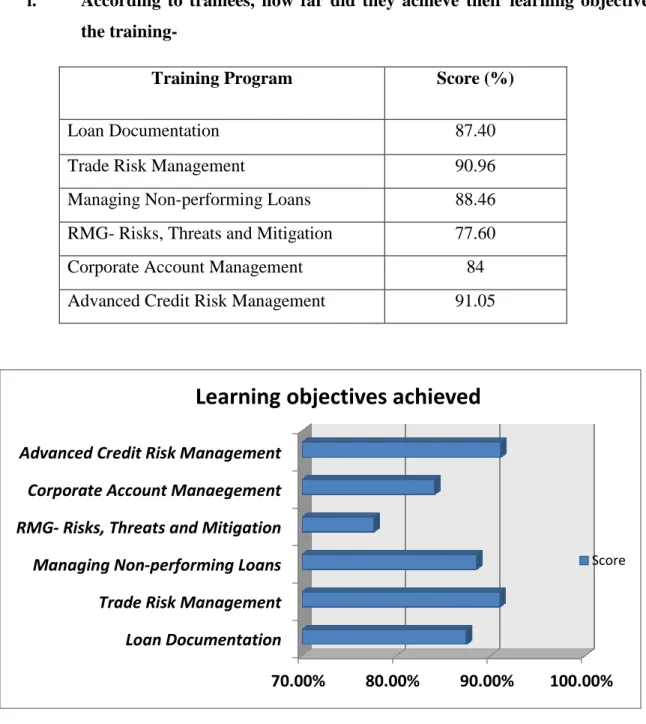
i. According to trainees, how far did they achieve their learning objectives from the training-
Training Program Score (%)
Loan Documentation 87.40
Trade Risk Management 90.96
Managing Non-performing Loans 88.46 RMG- Risks, Threats and Mitigation 77.60 Corporate Account Management 84 Advanced Credit Risk Management 91.05
Fig. 4.2 Learning objectives achieved
The bar graph shows how far trainees achieved their learning objectives from the training program. The amount has been presented as a percentage obtained from each of the six trainings. The figure shows that, in the training program, Advanced Credit Risk Management, the
70.00% 80.00% 90.00% 100.00%
Loan Documentation Trade Risk Management Managing Non-performing Loans RMG- Risks, Threats and Mitigation Corporate Account Manaegement Advanced Credit Risk Management
Learning objectives achieved
Page | 31 participants achieved their learning objectives up to 91.05%, in RMG- Risks, Threats and Mitigation, up to 77.60% and in, Loan Documentation, the participants achieved their learning objectives up to 87.40%. This shows that on average, the trainees believe that around 87% of their learning objectives have been fulfilled by the training programs. The average score is appreciable, but if the company wants to further improve its training services, it should focus on maximizing trainees’ learning objectives from the training programs.
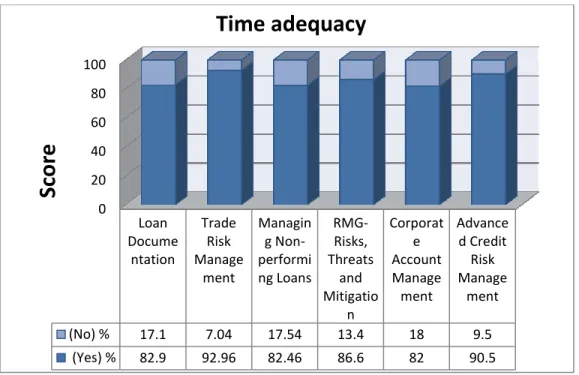
ii. Did the participants find the time of the session adequate to cover the subject and learning the lesson-
Score (%)
Training Program (Yes) (No)
Loan Documentation 82.90 17.1
Trade Risk Management 92.96 7.04
Managing Non-performing Loans 82.46 17.54 RMG- Risks, Threats and Mitigation 86.60 13.40
Corporate Account Management 82 18
Page | 32
Fig. 4.3 Time adequacy of training session
As the table shows, the score for each of the training programs is above 80%, which suggests that the trainees felt that the time of the session was adequate to a large extent to cover the subject matter and learning the lesson. Yet, it can be seen that these scores hold scope for improvement for which the company should modify the time duration of the training session so that it is easier for both the trainers and trainees to provide the lesson in a better manner.
iii. According to trainees how relevant was the training session to their job performance- 0 20 40 60 80 100 Loan Docume ntation Trade Risk Manage ment Managin g Non-performi ng Loans RMG-Risks, Threats and Mitigatio n Corporat e Account Manage ment Advance d Credit Risk Manage ment (No) % 17.1 7.04 17.54 13.4 18 9.5 (Yes) % 82.9 92.96 82.46 86.6 82 90.5
Sc
o
re
Time adequacy
Training Program Score (%)
Loan Documentation 91.90%
Trade Risk Management 92.46%
Managing Non-performing Loans 95.46% RMG- Risks, Threats and Mitigation 85.10% Corporate Account Management 90% Advanced Credit Risk Management 94.55%
Page | 33 Fig. 4.4 Relevancy of training program to job performance
The score obtained for this question is remarkably high, the maximum being above 90% and only one training program’s score being 85.10%. This shows that the highest number of trainees felt that the content of the entire training session was relevant to their job performance and will help them to perform better in their workplace. The scores obtained are very satisfactory and a positive indication for the company.
iv. Were the training materials/ handouts given relevant- Score (%)
Training Program (Yes) (No)
Loan Documentation 89.40 10.6
Trade Risk Management 91.46 8.54
Managing Non-performing Loans 90.96 9.04 RMG- Risks, Threats and Mitigation 82.60 17.4
Corporate Account Management 83 17
Advanced Credit Risk Management 89.55 10.45
70.00% 80.00% 90.00% 100.00%
Loan Documentation Trade Risk Management Managing Non-performing Loans RMG- Risks, Threats and Mitigation Corporate Account Management Advanced Credit Risk Management
Relevancy of Training to job performance
Page | 34 Fig. 4.5 Relevancy of training materials
The results obtained from the question, “Were the training materials and handouts given on the topic relevant to trainees’ job situation?” show us that all the participants felt that the training materials/ handouts given during the training session were relevant to their job situation. Majority scores are above 85%, with only scores from two programs being 82.6% and 83% respectively. This exhibits that the materials/ handouts offered in RMG- Risks, Threats and Mitigation and Corporate Account Management could be more relevant. FinExcel should focus more on this point and improvise the training materials for upcoming trainings under these names. 0% 20% 40% 60% 80% 100% Loan Docum entatio n Trade Risk Manag ement Manag ing Non-perfor ming Loans RMG-Risks, Threat s and Mitigat ion Corpor ate Accou nt Manag ement Advan ced Credit Risk Manag ement (No) % 10.6 8.54 9.04 17.4 17 10.45 (Yes) % 89.4 91.46 90.96 82.6 83 89.55
Sc
or
e
Page | 35 v. Were the training techniques appropriate to convey the lesson-
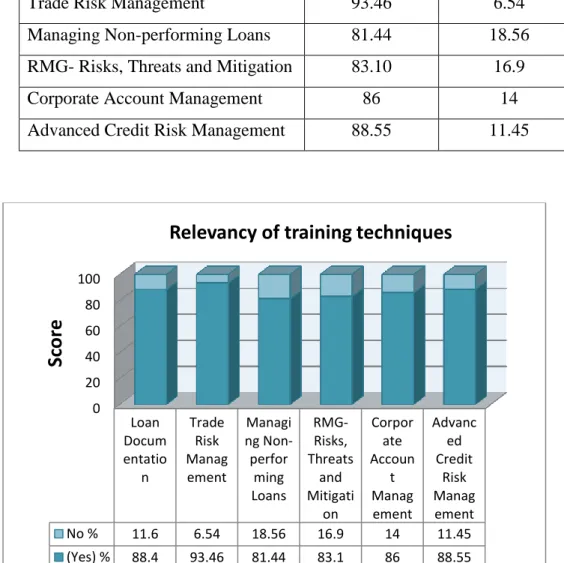
Fig. 4.6 Relevancy of training techniques
This question was set to observe whether the trainees found the training techniques appropriate to convey the lesson. The results are all above 80% which show that the trainees agree that the training techniques were appropriate to convey the topic. But the fact that only one score was above 90% and the rest below shows that the training techniques used to convey the lessons could be improved more.
0 20 40 60 80 100 Loan Docum entatio n Trade Risk Manag ement Managi ng Non-perfor ming Loans RMG-Risks, Threats and Mitigati on Corpor ate Accoun t Manag ement Advanc ed Credit Risk Manag ement No % 11.6 6.54 18.56 16.9 14 11.45 (Yes) % 88.4 93.46 81.44 83.1 86 88.55
Sc
or
e
Relevancy of training techniques
Score (%)
Training Program (Yes) (No)
Loan Documentation 88.4 11.6
Trade Risk Management 93.46 6.54
Managing Non-performing Loans 81.44 18.56 RMG- Risks, Threats and Mitigation 83.10 16.9
Corporate Account Management 86 14
Page | 36 vi. Overall performance rating of trainer-
Fig. 4.7 Overall performance rating of trainer
As a part of Trainer Evaluation, the participants were asked to rate the overall performance of the trainer as facilitator of learning. As the scores above indicate, the participants had very fabourable impressions about the trainers in each training program. This is a very positive feedback both for the trainers and for FinExcel.
80.00% 85.00% 90.00% 95.00% 100.00%
Loan Documentation Trade Risk Management Managing Non-performing Loans RMG- Risks, Threats and Mitigation Corporate Account Management Advanced Credit Risk Management
Overall performance rating of trainer
Score
Training Program Score (%)
Loan Documentation 90.40
Trade Risk Management 95.96
Managing Non-performing Loans 88.96 RMG- Risks, Threats and Mitigation 92.10
Corporate Account Management 88
Page | 37 vii. Rating of food/ refreshments-
Fig. 4.8 Rating of food/ refreshments
Refreshments are a highly contributing factor in each of the trainings since it is vital for participants to get replenished after a class. Hence, FinExcel management greatly focuses on providing high quality food for the participants. The ratings given by trainees are all above 85%
75 80 85 90 95 100 Loan Docu ment ation Trade Risk Mana geme nt Mana ging Non-perfo rming Loans RMG-Risks, Threa ts and Mitig ation Corpo rate Accou nt Mana geme nt Adva nced Credit Risk Mana geme nt Poor % 12.6 3.54 9.54 7.9 9 14.95 Excellent % 87.4 96.46 90.46 92.1 91 85.05
Sc
or
e
Rating of food arrangement
Score (%)
Training Program Excellent Poor
Loan Documentation 87.4 12.6
Trade Risk Management 96.46 3.54
Managing Non-performing Loans 90.46 9.54 RMG- Risks, Threats and Mitigation 92.10 7.90
Corporate Account Management 91 9
Page | 38 and indicate that the quality of food provided to them is extremely good and they are satisfied with the overall food arrangement.
viii. How well was the physical facility in the training room-
Fig.4.9 Physical Facility in the Training Room
This question was set to gather how the trainees felt about the physical facility in the training room. The results show a positive response, since the scores are all above 86%. This shows that the physical facility in the training room is fit to conduct training for participants.
80.00% 85.00% 90.00% 95.00%
Loan Documentation Trade Risk Management Managing Non-performing Loans RMG- Risks, Threats and Mitigation Corporate Account Management Advanced Credit Risk Management
Physical Facility in the Training Room
Score
Training Program Score (%)
Loan Documentation 87.90
Trade Risk Management 94.96
Managing Non-performing Loans 89.46 RMG- Risks, Threats and Mitigation 91.10
Corporate Account Management 86
Page | 39 ix. Did trainees face any inconvenience throughout the training session-
Fig.4.10 Inconvenience faced in the training session
This question was set to observe whether trainees faced any inconvenience during the training sessions. The results show that the trainees hardly faced any inconvenience in the training programs since, on average, 98.11% of the participants agreed that they did not face any
0 50 100 Loan Docum entatio n Trade Risk Manage ment Managi ng Non-perfor ming Loans RMG-Risks, Threats and Mitigati on Corpora te Accoun t Manage ment Advanc ed Credit Risk Manage ment No % 95.9 99.96 100 96.1 100 97.05 Yes % 4.1 0.04 0 3.9 0 2.95
Sc
or
e
Inconvenience in the training session
Score (%)
Training Program Yes No
Loan Documentation 4.10 95.90
Trade Risk Management 0.04 99.96
Managing Non-performing Loans 0 100
RMG- Risks, Threats and Mitigation 3.90 96.10
Corporate Account Management 0 100
Page | 40 inconvenience in the training programs. It means that FinExcel’s management has done a great job in the arrangements.
x. Overall performance rating of the training program as learning experience-
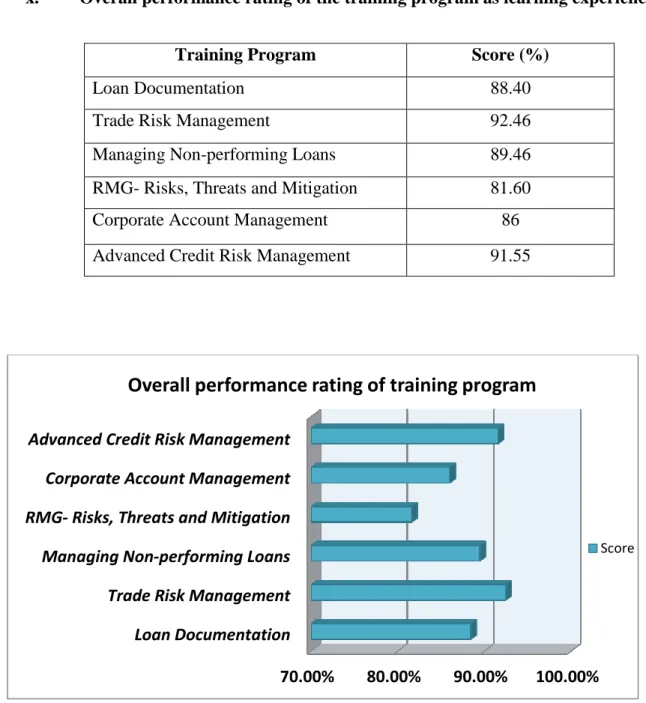
Fig. 4.11 Overall performance rating of the training program
This question was set to observe how the trainees rated the overall performance of the training program as part of their learning experience. All scores are above 85% with only one of them
70.00% 80.00% 90.00% 100.00%
Loan Documentation Trade Risk Management Managing Non-performing Loans RMG- Risks, Threats and Mitigation Corporate Account Management Advanced Credit Risk Management
Overall performance rating of training program
Score
Training Program Score (%)
Loan Documentation 88.40
Trade Risk Management 92.46
Managing Non-performing Loans 89.46 RMG- Risks, Threats and Mitigation 81.60
Corporate Account Management 86
Page | 41 being 81.60% which shows that the participants are satisfied with the training curriculum. But if FinExcel wants to improve more, then it has to focus on customizing the entire training program according to participants’ needs.
xi. Average score in all six trainings
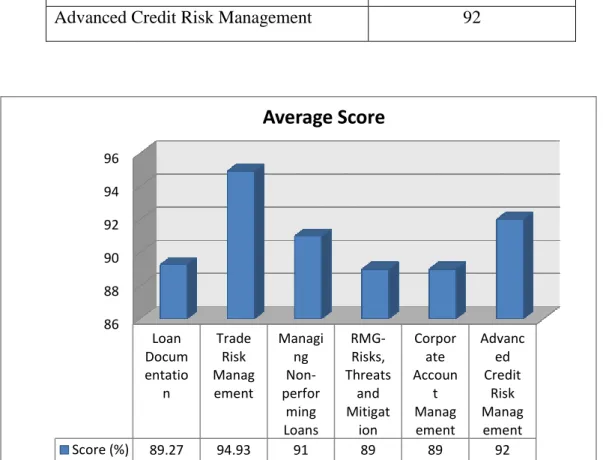
Fig. 4.12 Average Score in all six trainings
86 88 90 92 94 96 Loan Docum entatio n Trade Risk Manag ement Managi ng Non-perfor ming Loans RMG-Risks, Threats and Mitigat ion Corpor ate Accoun t Manag ement Advanc ed Credit Risk Manag ement Score (%) 89.27 94.93 91 89 89 92
Average Score
Training Program Average Score (%)
Loan Documentation 89.27
Trade Risk Management 94.93
Managing Non-performing Loans 91 RMG- Risks, Threats and Mitigation 89
Corporate Account Management 89
Page | 42 The average score for each of the training programs, namely, Loan Documentation, Trade Risk Management, Managing Non-performing loans, RMG- Risks, Threats and Mitigation, Corporate Account Management and Advanced Credit Risk Management have been obtained by totaling all the scores in each of the trainings and then dividing them by the total number of questions. The scores all have a high margin from which we can gather that the trainees are satisfied with the training programs and FinExcel’s management has done a praiseworthy job in arranging each of them.
4.4 Results and discussion
FinExcel is a reputed training institute amongst other Banking Training Institutes in Bangladesh. The training programs offered by FinExcel are one of the finest in comparison to competitive institutes like BIBM, BBTA and Dhaka Bank Training Institute. In order to decipher how these training programs seem to the trainees attending them, I conducted the “Research on Trainee Satisfaction.” The results show that FinExcel’s performance in organizing the training programs is praiseworthy. The average score of the six training programs are all above 89%. This shows that FinExcel is very near to achieving the full 100% score. Nonetheless, there are undoubtedly scopes for further improvement that can be brought about to achieve the best scores. A number of drawbacks as reported by the trainees are given below:
No case studies were given during the training session
Trainee and trainers sometimes used cell phones inside the classroom which created disturbance for others
The time duration of the training programs should be longer
The training should be conducted in a bigger room
The course materials should be provided like a book
Examinations should be taken after each training program
Page | 43 From this study, it can be gathered that a few downsides were present in the training programs which caused slight dissatisfaction amongst the participants. FinExcel must focus on these factors in order to increase the ratings. Hence, it should also be noted that, factors such as, appropriate time duration of the training session, competent facilitators, good food/ refreshments and good facility in the training room highly influence trainee satisfaction. In order to improve its services more, the company has to take these factors into account and overcome its shortcomings.
Page | 44 Recommendations:
FinExcel is a well-known training institute in the banking training industry of Bangladesh. It has come a long way since its inception and holds potential to be the numero uno. In order to do so, FinExcel has to improvise more and work on some factors. A few recommendations for FinExcel are given below:
FinExcel should carryout extensive branding to promote its services FinExcel should increase the number of consultancy services
The organization should be process driven and not personality-driven FinExcel should open a 3-4 month Certification Course/ Degree Course
FinExcel lacks proper service rule and should re-structure factors such as no. of employees needed, employee payroll, bonuses and leave
The organization should strictly follow the organogram
The official website is not updated and should contain details such as- training registration details, location map, careers, past and present activities
Though there is tremendous experience base at the board level, middle management should be grown more
The organization needs stronger value proposition to obtain higher portion of value from advisory projects
FinExcel only focuses on training the banking sector. It should also focus on providing training facilities to other areas like Insurance, Securities and Microfinance
FinExcel should have a Research and Development Division
FinExcel should conduct a robust Market Research in order to find out more about customer needs
In order to further improvise and increase the value of the training programs, FinExcel may consider the following recommendations:
Provide Case Studies after each training session
Make sure trainers and trainees are not using cell phones during the classes Tailor the timing of each session according to the learning content
Page | 45 Conduct the training program in a bigger room when there is a large number of
participants
Provide training course materials/ handouts in the form of a book Take examinations after each training program
Arrange a prayer room for trainees who want to say their prayers
Conclusion:
In today’s competitive world, it is hard to thrive without success. FinExcel is an organization that has proven itself successful from time to time. The company holds potential for expansion and will go ahead in future. By incorporating some recommended procedures it can uplift the quality of its services. Considering the growth rate, FinExcel will establish itself as a bigger brand. FinExcel assures the quality of its services through faculties and is positioned as an open platform for anyone to join.
Page | 46 References
(1) BCG. (2015, October 22). Bangladesh Emerging as One of the World’s Next Great Growth Markets for Consumer Products. BCG Perspectives. Retrieved from http://www.bcgperspectives.com
(2) Islam, (2015). Banking Sector of Bangladesh: Past, present and challenges ahead. The Daily New Nation
(3) Financial System, Banks & FIs. Retrieved November 2015, from Bangladesh Bank: https://www.bb.org.bd/
(4) (2015, March 18). Supervision of Banking Sector. The Financial Express. Retrieved from http://print.thefinancialexpress-bd.com/2015/03/18/85359/
Page | 47 Appendix
Feedback Form: 1115-28
A
DVANCED
C
REDIT
R
ISK
M
ANAGEMENT
N
OVEMBER07
TON
OVEMBER08,
2015
Indicate your reactions to the following aspects of the training by ticking (√) in the appropriate box without any prejudice and help us improve our process.
(Training program evaluation)
1) How far did you achieve your learning objectives from the training program?
Completely Substantially Partially Fairly Very little
2) Did you find the time of the session adequate to cover the subject and learning the lesson?
Lesser time than subject content More time than subject content
Fairly adequate Perfectly adequate
3) To what extent did you find the training program relevant to your job performance?
Highly relevant Substantially relevant Moderately relevant Fairly relevant Least relevant
Comments, if any:
Page | 48 4) Were the training materials and handouts given on the topic relevant to your job
situation?
Highly useful Very useful Useful Fairly useful Little useful
Comments, if any:
5) Did you find training techniques appropriate to convey the lesson of the topic? Not appropriate Appropriate to some extent Highly appropriate Most appropriate
6) How would you rate overall performance of the training program as learning experience? Excellent Very good Good Fair Poor
7) Please provide your comments below on:
A) What course contents was not relevant to bank operations:
i) ii) iii) iv)
B) What course contents should have been included?
i)
ii)
iii)
Page | 49
(Facilitator Evaluation)
8) How do you rate the overall performance of trainer as facilitator of learning?
Excellent Very good Good Fair Poor Comments, if any:
(Training Facility Evaluation)
9) How was the food arrangement?
Excellent Very good Good Fair Poor
10) How was the physical facility in the training room?
Excellent Very good Good Fair Poor
Comments, if any:
(FinExcel Management Evaluation)
11) Did you face any inconvenience throughout the training session? Yes / No
If yes: _____________________________________________________________
12) Give any other comments not covered above and your suggestions:
____________________________________________________________________________ ____________________________________________________________________________ __________________________________________