© Journal of University of Babylon for Pure and Applied Sciences (JUBES) by University of Babylon is licensed under a Creative Commons Attribution 4. 0 International License
171
Dual Heuristic Feature Selection Based on Genetic
Algorithm and Binary Particle Swarm Optimization
Ali Hakem Jabor
University of Al-Qadisiyah College of Computer Sciences and IT
Ali Hussein Ali
Al-Qadisiyah Education Directorate [email protected]
Abstract
The features selection is one of the data mining tools that used to select the most important features of a given dataset. It contributes to save time and memory during the handling a given dataset. According to these principles, we have proposed features selection method based on mixing two metaheuristic algorithms Binary Particle Swarm Optimization and Genetic Algorithm work individually. The K-Nearest Neighbour (K-NN) is used as an objective function to evaluate the proposed features selection algorithm. The Dual Heuristic Feature Selection based on Genetic Algorithm and Binary Particle Swarm Optimization (DHFS) test, and compared with 26 well-known datasets of UCI machine learning. The numeric experiments result imply that the DHFS better performance compared with full features and that selected by the mentioned algorithms (Genetic Algorithm and Binary Particle Swarm Optimization).
Keyword: Data Mining, Features Selection, Genetic Algorithm, Binary Particle Swarm Optimization, Metaheuristic Optimization.
I.
Introduction
Over the last decades the devices, sensors, and users are on increasing, therefore, the dimensions of the datasets are increasing. Logically, the size of data is directly proportional to the execution time. As a result, reducing the dimensions of the data becomes necessary to decrease execution time or processing. Using Data mining technique in many fields such as Artificial intelligence [1], Databases [2], Image and video processing [3], and others, make it in interesting topic for researchers. It is one of the important techniques used for filtering data. The data mining searches of the data (features or instances) that related to the objective of the dataset and removing garbage data from the dataset [4]. The techniques that omitted unimportant features from the dataset called features selection (FS). There are many algorithms used for FS such as Filter [5], Wrapper [6], and Embedded [7] Methods. The metaheuristic algorithms use in optimizing FS of verity styles. The advantages of the stochastic search are fast, flexible, and succeed to solve many hard optimization problems, but disadvantages no grantee to
ARTICLE INFO Submission date: 29/7/2018
Acceptance date: 4/10/2018
172
find a global solution and may be suffering from stagnation at local optimum [8] [9]. The Stagnation phenomena is a problem happens when the algorithm gave the same solution (local optimum) during several search steps. To reduce stagnation need to decrease convergence between candidate solutions. Therefore, went to increase the diversity of new solutions. The increases randomness or number of mutation genes leads to make the population more diversified.
[10] Have proposed a wrapper approach with Harmony Search algorithm (HS) that adaptive for features selection. [11] The Binary Approach of Artificial Bee Colony Optimization (BABC) for features selection. The binary vector generated by BABC represents the FS, which were the features that the corresponding one have been selected. [12] Modify Gravitation Search Algorithm (GSA) in order to find a subset of features that maximize the Optimum-Path Forest (OPF) accuracy over a validation set.
The previous works [10] [11] [12] modify the stochastic search algorithms for FS without trying to reduce the stagnation phenomena in these algorithms. The Binary Particle Swarm Optimization (BPSO) may be suffering from stagnation problem [8] [9] in some points of search (as in Evolutionary Algorithms EA). The hybrid algorithm is more efficient than the algorithms it has built, because it combines the good features of them. Therefore , in order to reduce stagnation in BPSO, we combine it with GA sequentially, and uses both of them for features selection. The sequential of calling for BPSO and GA individually makes the proposed algorithm more robustness with keeping on original formatted of the mentioned algorithm by calling them sequentially. Increasing the number of mutation genes and decreasing the crossover operations during search progress help the proposed algorithm to be more robust to deal with stagnation problem. The wrapper method uses a heuristic to rank the features [10] [11] [12], which are used for FS in the proposed algorithm.The experiments have been performed in 26 well-known datasets of UCI machine learning to compare the proposed algorithm (DHFS), full set classification, and FS by GA and BPSO. The numeric experiments results imply that proposed DHFS is better performance compared to mentioned algorithms.
The remainder of the paper is organized as follows: In Section II we explain the Particle Swarm Optimization (PSO). Section III presents the Binary Particle Swarm Optimization BPSO (BPSO), Genetic Algorithm (GA) is described in Section IV. Section V illustrates the Features selection (FS). Dual Heuristic Feature Selection (DHFS) present in Section VI. Section IX discusses Validate and test algorithm. Finally, the conclusion and future works stated in Section X.
II. Particle Swarm Optimization (PSO)
The PSO is popular metaheuristic algorithm inspired by the behaviour of social animals. The robustness, stability, and simplicity enough to be it quite use for enhancing the different fields [13] such as Data mining [14] medical apply [15] image processing [3] speech recognition [16]. There are many similar features between PSO and other Evolutionary Algorithms (EA) [17]. All EA start with a random population and calculate the fitness of each participant (candidate solution) to evaluate the performance of the population (all candidate solution). It uses the random mathematical model to update the
173
population to search for a local optimum solution. The main difference between the PSO techniques with other EA [14]: (i) The PSO uses the velocity of the particle to update population (particles) rather than uses genetic operation such as parent selection, crossover, and mutation. (ii) The easiness of implementation and does not use complex operations make PSO more popular compared with other EA. (iii), The computational time of PSO is small compared to other EA because it has had a limit number of parameters and calculation formals. (iv) The PSO is simple in both theory and mathematically implementation.
The principal search of PSO based on a group of particles (candidate solutions), each particle has own velocity (random initialization) and current position (solution), meanwhile, the particles stored the best solution figure out by itself, this solution called local best optimum (𝑝𝑏𝑒𝑠𝑡). The PSO select the best solution among whole candidate solutions and update it dynamically during the search process this solution called global best (𝑔𝑏𝑒𝑠𝑡). The velocity of particles updates in each step of a search process according to formula 2.1 [18].
𝑉𝑖𝑑(𝑡 + 1) = 𝑤(𝑡)𝑉𝑖𝑑(𝑡) + 𝑐1𝑟1(𝑝𝑏𝑒𝑠𝑡𝑖𝑑− 𝑥𝑖𝑑(𝑡)) + 𝑐2𝑟2(𝑔𝑏𝑒𝑠𝑡𝑑− 𝑥𝑖𝑑(𝑡))
(2.1) where: 𝑟1 and 𝑟2 are random variables in the range [0, 1]. 𝑐1 and 𝑐2 are positive constants. 𝑤 is the inertia weight. 𝑣𝑖𝑑(𝑡),𝑥𝑖𝑑(𝑡) are indicate the velocity and position of
𝑖𝑡ℎparticle at iteration t in 𝑑 𝑡ℎdimension, respectively. The PSO uses 2.2 to update the
value of the particles (candidate solution) [18].
𝑥𝑖𝑡+1 = 𝑥𝑖𝑡+ 𝑣𝑖𝑡+ 1
(2.2)
Where: 𝑥𝑖𝑡 is old particle value, 𝑥𝑖𝑡+1 is new particle value.
III. Binary Particle Swarm Optimization BPSO (BPSO)
Most versions of metaheuristic algorithms are suitable only for continuous search space, so that, it needed to modify to be suitable for binary search space. The transfer function [19] one of the ways that adaptive continuous metaheuristic algorithm for binary search space. In the proposed method, Formal 3.1 [19] used to modify PSO to be suitable for binary search.
𝑉(𝑣𝑖𝑑(𝑡)) = |2 𝜋 arctan ( 2 𝜋𝑣𝑖 𝑑(𝑡))| (3.1)
After calculating the velocity (𝑉(𝑣𝑖𝑑(𝑡))), the equation 3.2 uses to define the possibility of flipping the value of particles:
𝑋𝑖𝑘(𝑡 + 1) = {𝑋𝑖𝐾(𝑡)−1 𝑖𝑓 𝑟𝑜𝑢𝑛𝑑 < 𝑉(𝑣𝑖𝑘(𝑡))
𝑋𝑖𝑘(𝑡) 𝑖𝑓 𝑟𝑜𝑢𝑛𝑑 ≥ 𝑉(𝑣𝑖𝑘(𝑡)) (3.2)
Where: 𝑋𝑖𝑘(𝑡 + 1) is new particle value, 𝑋𝑖𝑘(𝑡) is old particle value, 𝑋𝑖𝐾(𝑡)−1 the flipping value of particle if the particle is 01, or 1 0.
174
IV. Genetic Algorithm (GA)
The genetic algorithm is a discreet population metaheuristic algorithm inspired by the genetic behaviour of natural life according to Charles Darwin’s theory of natural evolution [18]. It follows the rule of natural selection where the good individuals are contributing produce offspring. The mechanism search of GA essentially based on three genetic operations: a parent selection, crossover, and mutation. The parent selection is a process of selecting two or more parents from the crossover pool to produce new offspring (new candidate solution). The good parents have more chance to be selected for reproduction according to Darwin’s theory [20]. There are other methods to select parents of GA such as a roulette wheel, tournament [21]. The crossover is mix genes of parents that elected for crossover operation. There are many crossover techniques such as one point crossover, two-point crossover [9], Arethematic Crossover[22], heuristic crossover [23]… etc. The mutation is tweak change in genes of offspring. The parent selection and crossover are not enough to solve the stagnation in local optimum [3]. Therefore, the mutation process in GA is important to make diversity and reduce stagnation effect on the search processing [17].
V. Features selection (FS)
During the last decades, many datasets have huge information and high dimensional with hundreds or ten thousand features. Some of these features may be not important to the main object of the dataset [4]. The selection of important features that relate to a dataset goal called features selection. It employs the specific technique to remove garbage features from the dataset. The features selection technique is important tools to save train time and enhance the accuracy ratio of machine learning algorithms [24]. As a result makes the features selection a hot topic area for researchers. There are many features of selection methods: Filter, Wrapper, and Embedded [25]. Filter Methods depends on the relationship between the features and the target of the dataset to select the importance of features [5]. Embedded method for feature selection, which achieves by the insights using in some Machine Learning models such as LASSO Linear Regression and Tree-based models [7]. Wrapper Methods generate models with a subset of feature and gauge their model performances [6]. The stochastic search for important features can be select subset features of the wrapper model [10]. The time complexity of running an algorithm depends on data domination.
VI. Dual Heuristic Feature Selection (DHFS)
In this section, we focus on features selected based on a combination of two population metaheuristic techniques: Genetic algorithm (GA) and Binary Particle Swarm Optimization (BPSO). The hybrid algorithm has the advantages of multiple algorithms when deploy to solve optimization problems [26]. The search process of GA depends on three main operations: parent selection, crossover, and mutation. The parent selection and crossover are not enough to solve stagnation in local optimum [3]. Therefore, the mutation operation of GA tries to reduce stagnation at local optimum by increasing the chance to product diversity solutions [17]. The BPSO also suffering from stagnation problem [8] [9] [19]. The stagnation in BPSO happens when the local best solution Pbest
175
and global best solution Gbset has no change during several steps of the search process. The proposed algorithm reduces the stagnation in BPSO by calling GA to decrease convergence in newly candidate solutions (population). The proposed method (DHFS) as shown in bellowing: 1:𝑝 ← 𝑖𝑛𝑖𝑡𝑖𝑎𝑙 𝑟𝑎𝑛𝑑𝑜𝑚 𝑏𝑖𝑛𝑎𝑟𝑦 𝑝𝑜𝑝𝑢𝑙𝑎𝑡𝑖𝑜𝑛 2:𝑏𝑒𝑠𝑡𝑠𝑜𝑙𝑢𝑎𝑡𝑖𝑜𝑛 = −∞ 3:𝑆1← 0, 𝑆2 ← 0 4:𝑊ℎ𝑖𝑙𝑒 𝑆2 < 4 5: 𝑟𝑒𝑠𝑒𝑡 𝑣𝑒𝑙𝑜𝑐𝑖𝑡𝑦 𝑎𝑛𝑑 𝑆1 6: 𝑓𝑜𝑟 𝑒𝑎𝑐ℎ 𝑖𝑡𝑒𝑟𝑎𝑡𝑖𝑜𝑛 7: 𝑓𝑜𝑟 𝑒𝑎𝑐ℎ 𝑝 8: 𝑠𝑒𝑙𝑒𝑐𝑡 𝑃𝑏𝑒𝑠𝑡 𝑎𝑛𝑑 𝐺𝑏𝑒𝑠𝑡 9: 𝑢𝑝𝑑𝑎𝑡𝑒 𝑣𝑒𝑙𝑜𝑐𝑖𝑡𝑦 (𝑒𝑞 2.1) 𝑎𝑛𝑑 𝑝𝑜𝑠𝑖𝑡𝑖𝑜𝑛 (𝑒𝑞 3.2) 10: 𝑖𝑓𝑏𝑒𝑠𝑡𝑠𝑜𝑙𝑢𝑎𝑡𝑖𝑜𝑛 <𝐺𝑏𝑒𝑠𝑡 11: 𝑏𝑒𝑠𝑡𝑠𝑜𝑙𝑢𝑎𝑡𝑖𝑜𝑛 = 𝐺𝑏𝑒𝑠𝑡 12: 𝑟𝑒𝑠𝑒𝑡 𝑆1 13: 𝑟𝑒𝑠𝑒𝑡 𝑆2 14: 𝐸𝑙𝑠𝑒 15: 𝑆1← +1 16: 𝑆2 ← +1 17: 𝑖𝑓 𝑆1 > 𝜃 𝑏𝑟𝑒𝑎𝑘 18: 𝑖𝑓 𝑆2 > 4 𝑏𝑟𝑒𝑎𝑘 19: 𝑟𝑒𝑠𝑒𝑡 𝑆1 19: 𝑓𝑜𝑟 𝑒𝑎𝑐ℎ 𝑖𝑡𝑒𝑟𝑎𝑡𝑖𝑜𝑛 (𝑐𝑜𝑛𝑡𝑎𝑖𝑛 𝑤𝑖𝑡ℎ 𝐵𝑃𝑆𝑂) 20: 𝑓𝑜𝑟 𝑒𝑎𝑐ℎ 𝑝 21: 𝑝𝑎𝑟𝑒𝑛𝑡 ← 𝑟𝑜𝑢𝑙𝑒𝑡𝑡𝑒 (𝑝) 22: 𝑢𝑝𝑎𝑑𝑎𝑡𝑒 (𝑝) ← 𝑐𝑟𝑜𝑠𝑠𝑜𝑣𝑒𝑟 (𝑒𝑞. 6.1)𝑎𝑛𝑑 𝑚𝑢𝑡𝑎𝑡𝑖𝑜𝑛(𝑒𝑞. 6.2) 23: 𝑢𝑝𝑎𝑑𝑡𝑒 𝑏𝑒𝑠𝑡 24: 𝑖𝑓𝑏𝑒𝑠𝑡𝑠𝑜𝑙𝑢𝑎𝑡𝑖𝑜𝑛 <𝑏𝑒𝑠𝑡 25 𝑏𝑒𝑠𝑡𝑠𝑜𝑙𝑢𝑎𝑡𝑖𝑜𝑛 = 𝑏𝑒𝑠𝑡 26: 𝑟𝑒𝑠𝑒𝑡 𝑆1 27: 𝑟𝑒𝑠𝑒𝑡 𝑆2 28: 𝐸𝑙𝑠𝑒 29: 𝑆1 ← +1 30: 𝑆2 ← +1 31: 𝑖𝑓 𝑆1 > 𝜃 𝑏𝑟𝑒𝑎𝑘 32: 𝑖𝑓 𝑆2 > 4 𝑏𝑟𝑒𝑎𝑘 33: 𝑅𝑒𝑡𝑢𝑟𝑛 𝑏𝑒𝑠𝑡𝑠𝑜𝑙𝑢𝑎𝑡𝑖𝑜𝑛
S1 is a number of steps where no enhance in results when applied an algorithm (BPSO or GA). It reset after calling another algorithm. S2 is a number of calls an algorithm (BPSO or GA) but without enhancing in results. The S2 reset when any algorithms (BPSO, BGA) find a new best solution. The (θ) represents the number of valid steps without a change in results for both algorithms (BPSO or GA). The proposed method consists of four parts: binary metaheuristics optimization algorithms (BPSO and
176
GA), feature selection, switching between algorithms, and termination. Figure 1 illustrate the relation between the main parts of the DHFS.
Figure1: Main steps of DHFS
The algorithm starts with BPSO to grantee find first local optimum early [26]. The PSO when going through the stagnation as progress search in several steps (θ) the proposed algorithm called GA to makes diversity in population (candidate solutions), then recall the BPSO when GA failed to make diversity in candidate solutions. The Arithmetic Crossover (AC) used in GA to produce new offspring has different genes of its parents rather than using segment exchange [22]. AC products offspring by using 6.1
𝑂𝑓𝑓𝑠𝑝𝑟𝑖𝑛𝑔 = 𝛼. 𝑝𝑎𝑟𝑒𝑛𝑡1 + (1 − 𝛼). 𝑝𝑎𝑟𝑒𝑛𝑡2 (6.1)
Where: α either [0, 1].
Generally, the probability of falling into stagnation increases based on the search progress, it must increase the number of genes for a mutation in GA as search progress. Formal 6.2 calculates the number of genes (m) for the mutation to each participant.
177
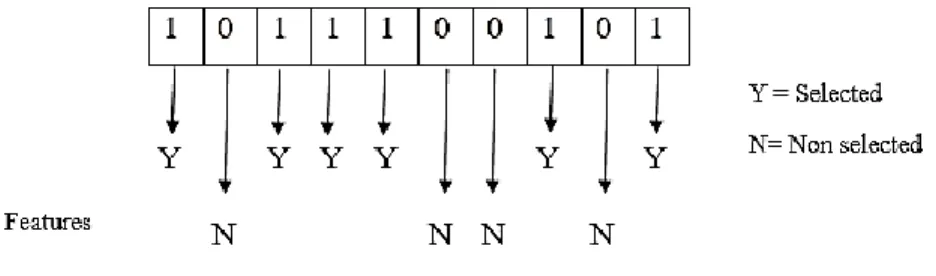
Where:𝑚𝑚𝑖𝑛 is the minimum number of genes for mutation, 𝑚𝑚𝑎𝑥 is the maximum number of genes for mutation. The features that corresponding 1 in the vector that been generating by BPSO or GA as shown in figure 2:
Figure 2 : Features selection strategies (10-dimensional problem. Here ith particle x i
= [1 0 111 00 1 0 0] indicate that the 1st, 3rd,4th ,5th ,8th , 10th features are selected.)
The DHFS stops when satisfying one of the stop criteria: the algorithm reaches to the optimal solution, No change in result during several iterations, or the algorithm gets the maximum iterations. Each metaheuristic algorithm must have the cost function (object function or benchmark function) to evaluate the performance of the search processing on an algorithm. The cost function that uses with the proposed method is the classification result of the dataset by K-NN. In addition, check the validated the proposed method by CEC’15 benchmark functions.
VII. Algorithm Parameters
Table 1 illustrates the parameters of the algorithm Table1: parameters of GA, BPSO, and DHFS
GA Crossover rate 0.8, α random [0 or 1], mutation rate 0.8, m_min=1, m_max = 60% of given vector.
BPSO [29]
c1=c2=2 , maximum velocity =6 ,minimum velocity =0.4, inertia weight (𝑊𝑚𝑖𝑛 = 0.4, 𝑊𝑚𝑎𝑥 = 0.9)
DHFS θ = 20
VIII. Discusses Validate and test algorithm
A- Check Validate by CEC’15
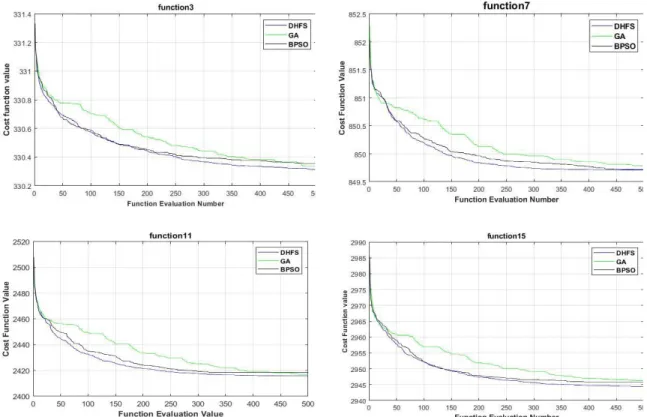
After, combining two of the metaheuristic algorithms for features selection, we have to test the proposed method whether successful or not. The CEC2015 is Congress Evolutionary Computation function uses to test any given search algorithm[27] [28]. The CEC2015 has fifteen functions divided on four-group unimodal, Simple multimodal, hybrid multimodal, and composition multimodal. Four functions of CEC’15 use to check the validate of the DHFS algorithm compared to mention algorithms. Figures 3 shows the
178
DHFS is best in Function3, Function11, and Function15. It overcomes on most stagnation stages in search processing. The proposed algorithm failed to record better performance in Function 7, mainwheel the BPSO get the best result.
Figure 3 : Compare the minimum value found by DHFS , BPSO , and GA over 4 functions of CEC2015, 500 iteration, 20 x100 population, and average 30 run times Table2 illustrates the enhancing in the standard deviation (STD) of the BPSO when combined with GA in the proposed method (DHFS). The same above function used in comparative and same parameters of CEC’15 that set (500 iterations, 20 x100 population, and average 30 runtimes.)
Table2: (STD) of BPSO comparing with DHFS
Function NO STD of DHFS STD of BPSO Function 1 104094969.6 93759278.47 Function 7 0.321599518 0.348831963 Function 11 12.26498303 11.57955552 Function 15 5.543502808 4.880154904 B- Test by K-NN classification
The proposed method test over 26 datasets from UCI machine learning [https://archive.ics.uci.edu]. The dataset that choice from UCI machine learning has deferent domination (Features, sample, and classes). Table 3 shows the descriptions of datasets that use in the comparative study.
179
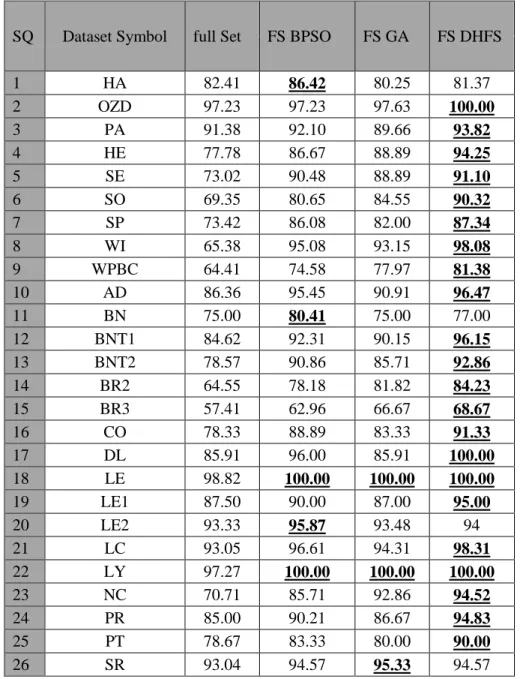
Our approach test is experimenting by KNN classification techniques and table 4 shows the comparison result of the classification datasets with full features and features selection by BPSO, GA, and proposed DHFS. The numeric experiments result imply that the proposed method (DHFS) performance better compared to full features classification and with feature selection by the mentioned algorithm. The DHFS recorded the best result in the most dataset. The BPSO records the best result in the dataset name (Heart, Brain). The results of the SRBCT dataset The GA has a better result. All algorithms get the same results in the dataset (Leukemia, Lymphoma). The rest of the dataset record the best results for the proposed DHFS. Finally, by reviewing all previous results we could say that our algorithm succeeded in 80.7% of mention datasets.
Table3: Datasets descriptions.
SQ Dataset name Symbol Size
classes features samples
1 Heart HA 2 13 270
2 Ozone level detection OZD 2 72 2536
3 Parkinson PA 2 22 195 4 Hepatitis HE 2 19 155 5 Segmentation SE 7 19 210 6 Sonar SO 2 60 208 7 Spectf SP 2 44 267 8 Wine WI 3 13 178
9 Wisc. pronostic breast cancer WPBC 2 33 198
10 Adenocarcinoma AD 2 9868 76 11 Brain BN 5 5597 42 12 Brain_Tumor1 BNT1 5 5921 90 13 Brain_Tumor2 BNT2 4 10368 50 14 breast2 BR2 2 4869 77 15 breast3 BR3 3 4869 95 16 Colon CO 2 2000 62 17 DLBCL DL 2 5470 77 18 Leukemia LE 3 4026 62 19 Leukemia1 LE1 3 5328 72 20 Leukemia2 LE2 3 11226 72 21 Lung_Cancer LC 5 12601 203 22 Lymphoma LY 2 3051 38 23 Nci NC 8 5244 61 24 Prostate PR 2 6033 102 25 Prostate_Tumor PT 2 10510 102 26 SRBCT SR 4 2309 83
180
Table 4: K-NN classification results of the dataset with full features and features selection by BPSO, GA, and proposed DHFS (The K in K-NN is 5)
I.Conclusion and Future works
The stagnation phenomena increase as search progress due to new candidate solutions are convergence. The mutation operation in GA reduce these phenomena by produce diversity in the new population. The BPSO also suffering some time from stagnation at a local optimum. The Stagnation problem increasing as search progress, therefore, the metaheuristic search algorithms need to make diversity in the population for reducing the effects of stagnation on search processing. The DHSF save on the original format of both algorithms (GA and BPSO) by calling them sequentially and
SQ Dataset Symbol full Set FS BPSO FS GA FS DHFS
1 HA 82.41 86.42 80.25 81.37 2 OZD 97.23 97.23 97.63 100.00 3 PA 91.38 92.10 89.66 93.82 4 HE 77.78 86.67 88.89 94.25 5 SE 73.02 90.48 88.89 91.10 6 SO 69.35 80.65 84.55 90.32 7 SP 73.42 86.08 82.00 87.34 8 WI 65.38 95.08 93.15 98.08 9 WPBC 64.41 74.58 77.97 81.38 10 AD 86.36 95.45 90.91 96.47 11 BN 75.00 80.41 75.00 77.00 12 BNT1 84.62 92.31 90.15 96.15 13 BNT2 78.57 90.86 85.71 92.86 14 BR2 64.55 78.18 81.82 84.23 15 BR3 57.41 62.96 66.67 68.67 16 CO 78.33 88.89 83.33 91.33 17 DL 85.91 96.00 85.91 100.00 18 LE 98.82 100.00 100.00 100.00 19 LE1 87.50 90.00 87.00 95.00 20 LE2 93.33 95.87 93.48 94 21 LC 93.05 96.61 94.31 98.31 22 LY 97.27 100.00 100.00 100.00 23 NC 70.71 85.71 92.86 94.52 24 PR 85.00 90.21 86.67 94.83 25 PT 78.67 83.33 80.00 90.00 26 SR 93.04 94.57 95.33 94.57
181
share to find the optimum solution. The future work we suggest to use other metaheuristic algorithms and adaptive it to work in the parallel model.
CONFLICT OF INTERESTS. There are non-conflicts of interest .
II. Reference
[1] Mann, C.J.H. "Handbook of Approximation: Algorithms and Metaheuristics" Kybernetes 37.2 (2008).
[2] Siarry, Patrick, and Zbigniew Michalewicz, eds. Advances in metaheuristics for hard optimization. Springer Science & Business Media, 2007.
[3] Maitra, Madhubanti, and Amitava Chatterjee. "A hybrid cooperative–comprehensive learning based PSO algorithm for image segmentation using multilevel thresholding." Expert Systems with Applications 34.2 (2008): 1341-1350.
[4] Han, Jiawei, Jian Pei, and Micheline Kamber. Data mining: concepts and techniques. Elsevier, 2011.
[5] Weston, Jason, et al. "Feature selection for SVMs." Advances in neural information processing systems. 2010.
[6] Talavera Luis. "An evaluation of filter and wrapper methods for feature selection in categorical clustering." International Symposium on Intelligent Data Analysis. Springer, Berlin, Heidelberg, 2005.
[7] Chandrashekar, Girish, and Ferat Sahin. "A survey on feature selection methods." Computers & Electrical Engineering 40.1 (2014): 16-28.
[8] Zubieta, Francisco Javier Orellana. Metaheuristics in requirements engineering: refining the next release planning problem (meta-heurísticas en ingeniería de requisitos: refinación del problema de planificación de la siguiente versión de software). Diss. Universidad de Almería, 2015.
[9] Luke, Sean. Essentials of metaheuristics. Vol. 113. Raleigh: Lulu, 2009.
[10] C. Ramos, A. Souza, G. Chiachia, A. Falc˜ao, and J. Papa, “A novel algorithm for feature selection using harmony search and its application for non-technical losses detection,” Computers & Electrical Engineering, vol. 37, no. 6, pp. 886–894, 2011. [11] Schiezaro, Mauricio, and Helio Pedrini. "Data feature selection based on Artificial Bee
Colony algorithm." EURASIP Journal on Image and Video Processing 2013.1(2013): 47.
[12] E. Rashedi, H. Nezamabadi-pour, and S. Saryazdi, “GSA: A gravitational search algorithm,” Information Sciences, vol. 179, no. 13, pp. 2232–2248, 2009.
[13] Chen, Wei, Mahdi Panahi, and Hamid Reza Pourghasemi. "Performance evaluation of GIS-based new ensemble data mining techniques of adaptive neuro-fuzzy inference system (ANFIS) with genetic algorithm (GA), differential evolution (DE), and particle swarm optimization (PSO) for landslide spatial modelling." Catena 157 (2017): 310-324. [14] Holden, Nicholas, and Alex A. Freitas. "A hybrid PSO/ACO algorithm for discovering classification rules in data mining." Journal of Artificial Evolution and Applications 2008.
182
[15] Chandra, Satish, Rajesh Bhat, and Harinder Singh. "A PSO based method for detection of brain tumors from MRI." Nature & Biologically Inspired Computing, 2009. NaBIC 2009. World Congress on. IEEE, 2009.
[16] Najkar, Negin, Farbod Razzazi, and Hossein Sameti. "A novel approach to HMM-based speech recognition systems using particle swarm optimization." Mathematical and Computer Modelling 52.11-12 (2010): 1910-1920.
[17] Deb, Kalyanmoy, et al. "A fast and elitist multiobjective genetic algorithm: NSGA-II." IEEE transactions on evolutionary computation 6.2 (2002): 182-197.
[18] Eberhart, Russell, and James Kennedy. "A new optimizer using particle swarm theory." Micro Machine and Human Science, 1995. MHS'95., Proceedings of the Sixth International Symposium on. IEEE, 1995.
[19] Clerc, Maurice. "Stagnation analysis in particle swarm optimisation or what happens when nothing happens." ,2006.
[20] Dréo, Johann, et al. Metaheuristics for hard optimization: methods and case studies. Springer Science & Business Media, 2006.
[21] Mitchell, Melanie. An introduction to genetic algorithms. MIT press, 1998.
[22] Köksoy, Onur, and Tankut Yalcinoz. "Robust design using Pareto type optimization: a genetic algorithm with arithmetic crossover." Computers & Industrial Engineering 55.1 (2008): 208-218.
[23] Kumar, Rakesh, Girdhar Gopal, and Rajesh Kumar. "Novel crossover operator for genetic algorithm for permutation problems." International Journal of Soft Computing and Engineering (IJSCE) 3.2 (2013): 252-258.
[24] Jamuna A. "Efficient Flow based Network Traffic Classification using Machine Learning." (2013).
[25] Tang, Jiliang, Salem Alelyani, and Huan Liu. "Feature selection for classification: A review." Data classification: Algorithms and applications (2014): 37.
[26] Mirjalili, Seyedali, Seyed Mohammad Mirjalili, and Xin-She Yang. "Binary bat algorithm." Neural Computing and Applications 25.3-4 (2014): 663-681.
[27] Banitalebi, Akbar, Mohd Ismail Abd Aziz, and Zainal Abdul Aziz. "A self-adaptive binary differential evolution algorithm for large-scale binary optimization problems." Information Sciences 367 (2016): 487-511.
[28] Liang, J. J., et al. "Problem definitions and evaluation criteria for the CEC 2015 competition on learning-based real-parameter single objective optimization." Technical Report201411A, Computational Intelligence Laboratory, Zhengzhou University, Zhengzhou China and Technical Report, Nanyang Technological University, Singapore (2014). [29] Saremi, Shahrzad, Seyedali Mirjalili, and Andrew Lewis. "How important is a transfer function in discrete heuristic algorithms." Neural Computing and Applications 26.3 (2015): 625-640.
183