MAXIMUM LIKELIHOOD ESTIMATION OF DISCRETE
LOG-CONCAVE DISTRIBUTION WITH APPLICATIONS
YAN HUA TIAN
A DISSERTATION SUBMITTED TO THE FACULTY OF GRADUATE STUDIES IN PARTIAL FULFILLMENT OF THE REQUIREMENTS FOR THE
DEGREE OF DOCTOR OF PHILOSOPHY
GRADUATE PROGRAM IN MATHEMATICS AND STATISTICS YORK UNIVERSITY
TORONTO, ONTARIO March 2018
Abstract
Shape-constrained methods specify a class of distributions instead of a single para-metric family. The approach increases the robustness of the estimation without much loss of efficiency. Among these, log-concavity is an appealing shape constraint in dis-tribution modeling, because it falls into the popular unimodal shape-constraint and many parametric models are log-concave. This is therefore the focus of our work.
First, we propose a maximum likelihood estimator of discrete log-concave dis-tributions in higher dimensions. We define a new class of log-concave disdis-tributions onZd, and study its properties. We show how to compute the maximum likelihood estimator from an independent and identically distributed sample, and establish con-sistency of the estimator, even if the class has been incorrectly specified. For finite sample sizes, the proposed estimator outperforms a purely nonparametric approach (the empirical distribution), but is able to remain comparable to the correct paramet-ric approach. Furthermore, the new class has a natural relationship with log-concave densities when data has been grouped or discretized. We show how this property can be used in a real data example.
Secondly, we apply the discrete log-concave maximum likelihood estimator in one-dimensional space to a clustering problem. Our work mainly focuses on the categorical nominal data. We develop a log-concave mixture model using the discrete log-concave maximum likelihood estimator. We then apply the log-concave mixture
model to our clustering algorithm. We compare our proposed clustering algorithm with the other two clustering methods. Comparing results show that our proposed algorithm has a good performance.
Contents
Abstract ii
Contents iv
List of Tables vii
List of Figures viii
I
eLC maximum likelihood estimator
1
1 Introduction 2
1.1 Motivation . . . 2
1.2 Overview of maximum likelihood estimation . . . 6
1.3 Background . . . 9
1.3.1 MLE of log-concave density on Rd . . . . 9
1.3.2 MLE of log-concave mass function on Z . . . 11
1.3.3 Discrete convex in higher dimensions . . . 15
1.3.4 Generalized log-concave probability mass function . . . 19
2 Introduction of discrete log-concave PMF 23
2.1 Definition of discrete log-concave PMF . . . 24
2.2 Relationship with generalized log-concave PMF . . . 26
2.3 Relationship with continuous log-concave distributions . . . 27
2.4 Properties . . . 29
3 Maximum likelihood estimation of eLC 45 3.1 Computation of the MLE . . . 52
3.2 Finite sample performance . . . 60
3.3 Binned data example . . . 63
3.4 Mixtures and the EM algorithm . . . 64
4 Computing algorithm 65 4.1 Derive the explicit form of σy . . . 65
4.2 Derive the explicit form of gradient of σy . . . 69
4.3 Subgradient algorithm . . . 74
4.4 Computing algorithm and comparison . . . 75
5 Asymptotic Properties 79
II
Application of discrete log-concave in clustering
90
6 Introduction 91 6.1 Motivation and overview . . . 916.2 Techniques review and background . . . 93
6.2.1 Nominal categorical data set . . . 93
6.2.3 Uniform Hamming distance vector . . . 96
6.2.4 HD vector algorithm . . . 100
6.2.5 K-modes algorithm . . . 106
6.3 Outline . . . 108
7 Log-concave mixture model 110 8 Algorithm 117 8.1 Modified reversed KL divergence . . . 117
8.2 Test cluster pattern using bootstrap . . . 122
8.3 HD-LCD algorithm with the bootstrap . . . 124
8.4 Smoothness and limitations of HD-LCD algorithm . . . 129
9 Clustering result comparison 133 9.1 Algorithm evaluation . . . 133
9.2 Examples for HD-LCD algorithm with the bootstrap . . . 134
9.3 Simulation study . . . 138
9.4 Soybean disease data and zoo data . . . 141
10 Conclusion and future work 145 A Appendix: background material 148 A.1 Important Definitions, Theorems and Lemma . . . 148
A.2 List of important symbols and notations . . . 155
List of Tables
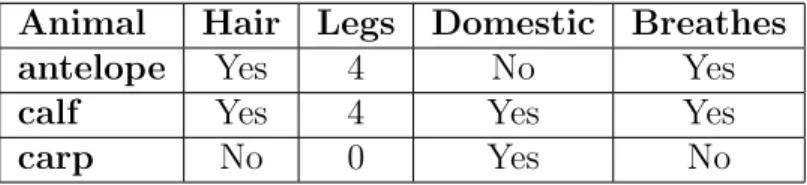
6.1 Example of Hamming distance for zoo data. . . 95
9.1 Examples for HD-LCD algorithm with the bootstrap. . . 137
9.2 Comparison of two simulations . . . 143
9.3 Original simulation study comparison . . . 144
9.4 Modified simulation study comparison . . . 144
9.5 Comparison on soybean disease data . . . 144
List of Figures
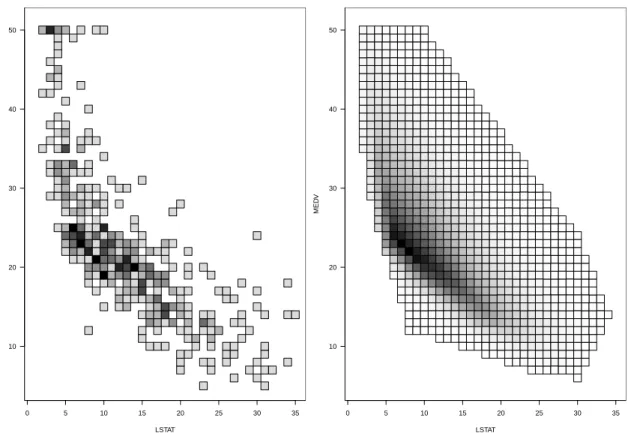
1.1 Relations between three definitions: discrete-convex, convex-extendible, and separable-convex. . . 18 3.1 Grayscale heatmaps of the empirical PMF (left) and its eLC projection
(right). The true distribution is a discrete Gaussian. . . 47 3.2 From the example of Figure 3.1, we compute the marginal
distribu-tions of our eLC MLE, we compare the marginals of elC MLE with empirical marginals and the true marginals in above Figures. . . 48 3.3 Boxplots of l2 distance between estimator and true distribution. . . . 61 3.4 Boston Housing Data: original empirical distribution (left) along with
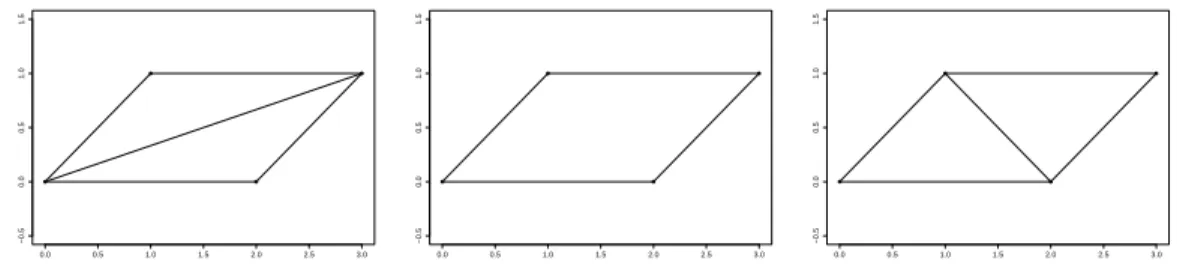
eLC maximum likelihood estimate (right). . . 64 4.1 Subdivisions Sy for cases a.(left), b.(centre), and c.(right). . . 67 6.1 UHD with 25 binary attributes . . . 98 6.2 We take one sample (n 200) which is simulated by original simulation
method, we choose one of the simulated center, compare the center’s HD vector against the corresponding UHD vector. . . 99 7.1 Histogram plot against the mixture log-concave projection pÂω.
8.1 Mixture log-concave projection vs empirical distribution of a selected point from Soybean disease data set (1). HD-LCD version cutoffr 7, cluster radius R r2 5. . . 131 8.2 Mixture log-concave projection vs empirical distribution of a selected
point from Soybean disease data set (2). HD-LCD version cutoffr 8, cluster radius R r2 6. . . 132 9.1 (a) is the histogram of modified reversed KL divergence of example
data, computed in the first round, sample size n 60. (b) is the his-togram of largest modified reversed KL divergence of “cluster” samples with sample size of 60. . . 136
Part I
Chapter 1
Introduction
1.1
Motivation
Estimating probability density/mass function is very important in statistics. Para-metric and nonparaPara-metric methods are two popular methodologies in this area. The parametric method is efficient and has good performance, because specific assump-tions are added to the estimation. The disadvantage is that the estimation has large bias when the assumption is wrong. Some example parametric models include: normal distribution, uniform distribution, poisson distributions. The nonparametric method such as the empirical distribution does not need specific parameter assump-tion, is therefore more robust and data-adaptive, but it is not efficient and has larger variance.
Shape-constrained estimation method is one kind of nonparametric method, which means that the probability density/mass function is estimated with some shape-constrained assumptions. The shape constraint includes but is not limited to uni-modality, monotonicity, symmetric, log-concavity. We refer to Wolters and Braun (2017) for the recent works, as well as the advantages and the challenges of shape-constrained estimation models. Grenander (1956) introduced a nonparametric method to estimate the MLE of non-increasing densities, which is known as the Grenander estimator. Other works focused on monotony densities include Groeneboom (1985); Huang and Wellner (1995). Based on the Grenander estimator, later research at-tempted to estimate the unimodal densities. Birg´e (1997) introduced an estimator for estimating non-smooth unimodal densities, when the mode is known. Other works related to unimodal density estimation include Rao (1969); Bickel and Fan (1996).
Note that shape-constrained estimation method stands in the middle of paramet-ric and nonparametparamet-ric methods. Adding shape-constrained assumptions to distri-bution improves the performance and reduces the variance comparing to nonpara-metric method. On the other hand, shape-constrained models specify a larger class than any specific parametric model. Hence comparing to parametric method, it is more robust. For example, Bickel and Fan (1996) introduced density estimation
methods with unimodal shape-constraint and compared their methods with non-parametric kernel estimation. Their methods do a better job for the tail of density and when the distribution is asymmetric. In Section 3.2, we will show that our proposed shape-constrained estimator has an outstanding better performance than the non-parametric estimator, and remains comparable performance comparing to the strong parametric estimator. Of course, there is no guarantee of this in all cir-cumstances. Among those shape constraints, log-concavity is an attractive shape constraint. It includes a wide range of parametric models. For example: normal, uniform, gamma(r, λ) with r C 1, beta(a, b) with a C1, b C 1 in continuous setting, and multinomial, negative multinomial, multivariate hypergeometric in discrete set-ting, they are all log-concave. Furthermore, log-concave densities provide a natural alternative to the class of unimodal densities, while not being too restrictive by spec-ifying a parametric family. Notably, estimating the maximum likelihood estimator of a unimodal density is not an easy problem. Letddenotes the dimension of space, the maximum likelihood estimator does not even exist whend 1, because the like-lihood function can go to infinity (Birg´e, 1997). Log-concave estimation falls in the larger paradigm of shape-constrained estimation, inherits the advantage of striking a balance of efficiency and robustness, also benefits from such properties as (local) adaptivity and not requiring bandwidth.
Walther (2009) introduced the attractive properties of log-concavity and gave a brief review of recent works. For example, Balabdaoui et al. (2009) found the lim-iting distributions of the nonparametric MLE of a log-concave density; Lutz and Kaspar (2011) and D¨umbgen et al. (2007) discussed algorithms and R packages (logcondens) to compute the log-concave MLE in continuous setting; Cule et al. (2010) presented theoretical properties of MLE of log-concave density in multiple dimensional space, developed algorithm to compute the MLE and proved the con-sistency of the MLE; Works of Doss and Wellner (2016) and Kim and Samworth (2016) focused on global convergence rates for the MLE of log-concave densities. For discrete setting, whend 1,Weyermann (2008) showed the existence and uniqueness of the MLE for the log-concave probability mass function (PMF), and provided an active set algorithm to calculate the MLE, which is much in the spirit of D¨umbgen et al. (2007). Balabdaoui et al. (2013) introduced the log-concave MLE of a dis-crete distribution in one dimensional space, and studied consistency and asymptotic properties of the estimator, while Balabdaoui and Jankowski (2016) compared this estimator with the MLE over the class of unimodal probability mass functions onZ. Among those work, we highlight the works of Cule et al. (2010); Balabdaoui et al. (2013) (will be introduced in the following sections). Our work is much in the spirit of their works. Some of our theoretical results are inspired by the work of Balabdaoui
et al. (2013), for example, the uniqueness, existence and consistency of the MLE. Our algorithm to compute the MLE is much inspired by the work of Cule et al. (2010). We adapt their algorithm and code for discrete setting. In our algorithm, we design and solve the optimization problem following their work. The main difference is that their MLE is in continuous setting, but ours is in discrete setting. More details about the difference will be given in later chapter.
1.2
Overview of maximum likelihood estimation
Maximum likelihood estimation is a well known statistic methodology. With ob-served data, it attempts to estimate distribution and parameters by maximizing the likelihood function. For example, MLE can be used to estimate parameters in a parametric model or the density function with nonparametric shape-constrained methods.
Letx1, ..., xnbenindependent and identically distributed observations from some unknown distribution. We denote the distribution withfxSθ, where θ is a param-eter vector. The likelihood function is defined as:
Lθ;x1, ..., xn n M i 1
For computation convenience, we apply logarithm to both sides of the function, and obtain the log-likelihood function:
lnLθ;x1, ..., xn n Q i 1
lnfxiSθ.
The maximum likelihood estimator Âθmle is defined as:
 θmle argmaxθ>Θ n M i 1 fxiSθ,
where Θ is the family of parameter θ. Equivalently, maximum likelihood estimator (MLE) can also be expressed by maximizing the average of log-likelihood function:
 θmle argmaxθ>Θ 1 n n Q i 1 lnfxiSθ.
The idea behind maximum likelihood estimator is that the most likely parameter maximizes the likelihood function.
MLE is widely used in statistics. Indeed, under certain regulations the MLE has the following properties.
size n large enough. That is, Â θmle p Ð θ0, asnÐ ª. asymptotic normality: º nÂθmleθ0 d Ð N 0,Σmle.
efficiency: MLE is asymptotically efficient since its variance approaches Cramer-Rao lower bound.
Geman and Hwang (1982) mentioned that MLE methodology usually fails when the parameters is in an infinite dimensional space. Hence MLE can not be applied to completely nonparametric statistic models. The MLE of such model does not exist because the likelihood function is unbounded. But situation changes when some constraints are added to the model. MLE works efficiently with shape-constrained nonparametric model. for example Cule et al. (2010) introduced an algorithm to compute the MLE of log-concave densities in multiple dimensional space.
1.3
Background
1.3.1
MLE of log-concave density on
R
dA density function f is said to be log-concave if logfx is a convex function on Rd. A function h is convex if for all x, x >
Rd and for all α > 0,1 it satisfies hαx 1αx Bαhx 1αhx.LetF denote the set of log-concave density functions on Rd, given x
1, ..., xn are a random sample drawn from a log-concave density. The log-concave MLE onRd is defined as:
 fn argmaxf>F n Q i 1 logfxi.
Theorem 1.3.1. (Cule et al., 2010) With probability one, a log-concave maximum likelihood estimatorfn of f0 exists and is unique, where f0 is the true density on Rd.
The above Theorem proved the existence and uniqueness of the log-concave MLE. The algorithm computing the MLE is derived based on the tent functionty. Following Cule (2009), given y>Rn, a tent function can be explicitly defined as
tyx infgx RdÐ RS g is concave, and gxj Cyj, j 1, ..., n.
is, x1, ..., xn>R2. Hence x1, ..., xn correspond points on a plane. We then put poles with height of y1, ..., yn on those points, respectively. Finally, we stretch a piece of rubber over those poles. The surface of rubber is exactly the tent function for the given y1, ..., yn. The tent function actually reflects concave shape constraint, and it is a piece-wise affine function.
Cule et al. (2010) compute their log-concave MLE by minimizing the objective function over y y1, ..., yn >Rn. The objective function is defined as follows:
σRy1, ..., yn 1 n n Q i 1 yi S Cn exptyxdx,
where Cn is the convex hull of x1, ..., xn, that is Cn convx1, ..., xn. Note that the objective function is convex (Cule et al., 2010), and it has a unique minimum. Unfortunately, it is proved not to be smooth everywhere, hence many efficient opti-mization techniques can not be applied to this. Subgradient methodology is finally chosen to solve the problem.
The general idea of subgradient algorithms is to proceed iteratively as follows:
Theorem 1.3.2. (Shor, 1985) Let hi be a positive sequence with hi 0 as i ª
formula
yi1 yihi
∂σyi Õ∂σyi Õ
has the property that either there exists an i0 and y such that yi0 y, or yi y
and σyi σy as i ª.
1.3.2
MLE of log-concave mass function on
Z
In this section we introduce the recent work of log-concave MLE in discrete setting. Whend 1,Weyermann (2008) shows the existence and uniqueness of the maximum likelihood estimator (MLE) for the log-concave probability mass function, and pro-vides an active set algorithm to calculate the MLE, which is much in the spirit of D¨umbgen et al. (2007). Balabdaoui et al. (2013) introduced the log-concave MLE of a discrete distribution in one dimensional space, and studied consistency and asymp-totic properties of the estimator, while Balabdaoui and Jankowski (2016) compare this estimator with the MLE over the class of unimodal probability mass functions onZ.
To our best knowledge, consideration of log-concave probability mass functions in the multidimensional discrete setting is limited to the work of Bapat (1988), see also Dharmadhikari and Joag-Dev (1988). They defined a class of generalized log-concave distribution. But there is no further study about the property or algorithm
to approximate the distribution. Their definition is a more restrictive class than our proposed definition. More detailed review will be given in later section.
Other than the formal definition of the convex function we mentioned in previous section. Alternatively, if h is twice differentiable, then h is convex if and only if hx C 0 for all x >R and if and only if the Hessian matrix of h is positive semi-definite for all x >C, where C is an open convex set on Rd for d A 1 (Rockafellar, 1970, Theorem 4.5, page 27).
Similarly, one can define convex functions in the one-dimensional discrete setting, which naturally leads to a definition of log-concave probability mass functions. That is, letpz Z 0,1denote a probability mass function, where Zdenotes the inte-gers
. . . ,2,1,0,1,2, . . .. The PMFp is said to be log-concave if for any z>Z
Qhz hz1 2hz hz1 C 0, (1.1)
where hz logpz (Balabdaoui et al., 2013, Proposition 1). In the notation aboveQhdenotes the discrete Laplacian operator, which can also be expressed as Qhz hz1 hz hz hz1. This is the second difference of the functionh, and hence this definition matches well that of the continuous setting.
1951) is used to measure the information gain/loss when we use one probability distribution p to approximate another probability distribution p0, which is usually the true distribution. The KL divergence is defined as
ρKLpYp0 Q z>Zd p0zlog pz p0z .
Although it is not a distance but a divergence, it is the natural notion of “distance” associated with maximum likelihood estimation.
Let P1 denote the class of log-concave PMFs on Z. Balabdaoui et al. (2013) proved the following Theorem.
Theorem 1.3.3. (Balabdaoui et al., 2013) Suppose that p0 is a discrete PMF onZ
with finite mean such that
S Q z>Z
p0zlogp0zS @ ª.
Then there is a unique log-concave PMF on Z, Âp0, such that
Â
p0 argminp>P1ρKLpYp0.
divergence and likelihood function, it is not hard to show that the log-concave MLE exists and is unique onZ. We denote the log-concave MLE (d 1) as pÂn.
Let gz denote a finite concave function on Z. A point K >Z is a knot of g if gK A ª, andg changes slope at K.Further, a knot K is called an internal knot if gK 1 A ª and gK 1 A ª. Letx1, ..., xmbe a random sample from p0,we assume there are m distinct ordered values in the sample: z1 @...@zm.
Discrete concave function gz when d 1 can be decomposed to the following form (Balabdaoui et al., 2013):
gz abz p Q i 1
ciKiz, z>Z9 z1, zm
where a, b > R and ci @ 0, K1, ...,Kp denote the internal knots of gz. Here they used the standard notation z zIzC0. This decomposition is the key to active set algorithm (Weyermann, 2008; D¨umbgen et al., 2007). When d A1 the discrete concavity is defined in a totally different way. The definition of discrete concavity is even not unique. There are no decomposition methods for higher dimensional discrete concave function, hence active set algorithm can not be applied to higher dimensions.
For two PMFs p and p0, we define thelk and Hellinger distances as lkp, p0 ¢¨¨¨ ¨¨¨¨ ¦¨¨ ¨¨¨¨¨ ¤ Pz>ZdSpz p0zS k1~k if 1BkB ª, supz>ZdSpz p0zS if k ª, h2p, p0 1 2Qz> Z »pz »p0z 2 .
Balabdaoui et al. (2013) proved that the log-concave MLE onZis consistent in term of the distancelk,0@kB ª or the Hellinger distance.
Theorem 1.3.4. (Balabdaoui et al., 2013) Suppose that p0 is a discrete distribution
on Z with finite mean such that
S Q z>Z
p0zlogp0zS @ ª.
ThendÂpn,pÂ0 0almost surely, wheredis the distancelk,0@kB ªor the Hellinger
distance.
1.3.3
Discrete convex in higher dimensions
In higher dimensions, the definition of a discrete convex (equivalently, concave) func-tion is not straightforward. For a discrete funcfunc-tion defined on Zd for dA1 there are multiple definitions of convexity. Murota and Shioura (2001) provide a detailed
sur-vey of convex functions and sets in the higher-dimensional discrete setting, including a summary of the relationships between the various definitions. Among these def-initions there are three which are relevant to our initial considerations: discretely-convex, separable-discretely-convex, and convex-extendible. To this end, consider a function hZd
R8 ª and define the domain domh z >ZdShz @ ª.
– The function h is said to beseparable-convexif hz Pdi 1hizi z >Zdfor a finite family of discrete convex functions hiZ R8 ª,i> 1, ..., d. That is,Qhiz C0 for all z>Z and all i> 1, . . . , d.
– For x>Rd, let x (respectively, x) denote the floor (respectively, the ceiling) of the vector x, obtained by rounding down (respectively, up) each component of x to its nearest integer. Next, define the set N0x z >ZdS x Bz B x. The function h is said to be discretely-convex if, for any z, z>domh and any α> 0,1, it holds that
minhz Sz>N0αz 1αz B αhz 1αhz.
Similarly, a set S bZd is said to be discretely-convex if, for any z, z >S and any α> 0,1, it holds thatN0αz 1αz 9S is non-empty.
– Define the convex closure ofhz
¯
hx sup α>R,β>Rd
αβTxαβTz Bhz for all z >Zd, x>Rd.
The function h is convex-extendible if ¯hz hz for all z > Zd. Similarly, a set S b Zd is said to be convex-extendible if ¯S9
Zd S, where ¯S b Rd is the convex closure of S, that is, it is the smallest closed convex set (in Rd) containing S. Another useful definition is convex extension: a closed convex function hR
Rd R8 ª is called a convex extension of h if hRz hz for all z >Zd. For a discrete convex-extendible function, its convex extension is a closed continuous convex function which goes through all its points. We may also take a discrete convex-extendible function as a “sub” function of a closed convex function in continuous setting. Note that affine functions are convex. By (Rockafellar, 1970, Theorem 5.5, page 35), the pointwise supremum of an arbitrary collection of convex functions is convex. Hence we conclude that the convex closure ¯his convex. It is also a convex extension ofh.Any convex function is a composition of collections of pointwise affine functions, so convex closure is the greatest convex extension ofh.But clearly not all convex extension is convex closure.
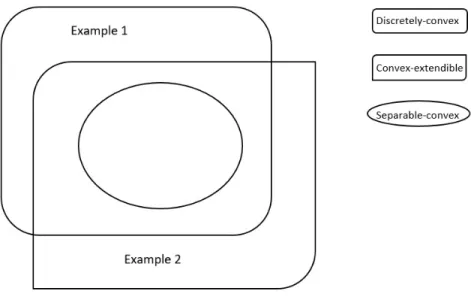
Figure 1.1: Relations between three definitions: discrete-convex, convex-extendible, and separable-convex.
Murota and Shioura (2001) summarize the relationships between the various def-initions of convexity. In particular, some but not all discretely-convex functions are convex-extendible functions and vice versa, while separable-convex functions are both discrete-convex and convex-extendible. Figure 1.1 shows the relations between above three discrete convex definitions. We can see that
Example 1: Consider the set
S z>Z3Sz1z2z3 2, zi C0, i 1,2,3 8 1,2,0,0,1,2,2,0,1
0,1,1,1,0,1,1,1,0,0,0,2,0,2,0,2,0,0,1,2,0,0,1,2,2,0,1.
This set, as well as the function hequal to zero on S and ªonZS,are discrete-convex. However, 1 31,2,0 1 30,1,2 1 32,0,1 1,1,1
is an element of ¯S9Zd, but 1,1,1 ~>S, and hence h is not convex-extendible. Example 2: Let S 0,0,2,1and again define the function h equal to zero onS and ª onZS.The convex closure ofS is the segment between points (0,0) and (2,1), hence ¯S9Zd 0,0,2,1 z
1, z2 S, we conclude thath is convex-extendible. On the other hand, N00.5z1 0.5z2 N01,0.5 1,0,1,1, whence N0αx
1αx 9S g and h is not discrete-convex. Both examples appear in Murota and Shioura (2001).
1.3.4
Generalized log-concave probability mass function
of “generalized log-concavity” on Nd, where
N denotes the natural numbers. A probability mass functionp on Nd with support S z>
Ndpz A0, is said to be generalized log-concave if pz d M i 1 pizi, z> S, (1.2)
where eachpi satisfiesQlogpizi B0.That is, each pi is a univariate discrete log-concave function (though not necessarily a PMF - therefore, this is a much different definition than separable-log-concavity from Remark 2.1.1). We will compare our new defined PMF class with generalized log-concave PMF in later chapter.
1.4
Outline
Note that this thesis is divided into two parts, in this Part I, we focus on the maximum likelihood estimator of discrete log-concave distribution in higher dimensions.
In Chapter 2, we give a new definition of log-concave probability mass functions defined on Zd (see Definition 2.1.1). We call this class extendible-log-concave, as it is closely related to extendible-convex functions (Murota and Shioura, 2001). We show that the new definition is equivalent to discrete log-concave distribution when d 1. We introduce a Lemma which can be used to check if a function falls into our new defined class. We
Notably, We show that random variables from a continuous log-concave density can be grouped/binned (e.g. rounded to some accuracy level), the resulted discrete mass function will fall into our new defined distribution class under certain conditions (Proposition 2.3.1). We also show that under which condition the class of generalized log-concave is concave (Proposition 2.2.1). Moreover we prove there exist a unique extendible-log-concave PMF which minimize the distance to a given true PMF in term of KL divergence, and this minimizer is the true PMF itself if the true PMF is extendible-log-concave.
In Chapter 3, we show that the maximum likelihood estimator of our new defined class PMF exists and is unique. We show some attactive properties of the MLE of extendible-log-concave PMF. We discuss how to compute the MLE, and how to derive the objective functions. We compare the performance of our MLE with other parametric and nonpara-metric method through simulations. We developed two simulation scenarios with finite sample size. The proposed MLE exhibits considerable improvement in efficiency over the empirical distribution in the examples we consider. Moreover, in one of the examples we compare our nonparametric MLE to the correct parametric MLE, and the proposed method does not show a great loss of efficiency over the parametric method. Similar behavior was observed by Balabdaoui et al. (2013). In our opinion, this is one of the key benefits of the balance that the log-concave class is able to strike between robustness and efficiency. Fur-thermore we give example to show that our estimator can be applied to “binned/grouped” continuous data set.
form of the objective function and its gradient. We proved that the objective function is convex but not differentiable everywhere. Hence Subgradient methodology is applied to compute the MLE. An R package is developed to make methodology widely available.
In Chapter 5, we prove the consistency of the MLE. If the true PMF is extendible-log-concave, then our MLE converges to the true PMF in term of KL divergence; if the true PMF is not extendible-log-concave, but is close to extendible-log-concave, our MLE still reveals desirable behavior.
Chapter 2
Introduction of discrete log-concave PMF
Our goal here is to define and study discrete log-concave distributions in higher dimen-sions, and we therefore need to select a class of discretely convex (equivalently, concave) functions to work with. Among the various discrete convex definitions introduced by pre-vious chapter, we choose to focus on the class of convex-extendible functions. There are two main reasons for this: It was shown in Murota and Shioura (2001, Theorem 4.1) that the class of convex-extendible functions is closed under addition. Furthermore, using this definition, our class of log-concave probability mass functions is closed under limits. We will show this property later in Theorem 2.4.1.
2.1
Definition of discrete log-concave PMF
Following the definition of convex-extendible function, naturally a function h Zd R8
ªis concave-extendible ifh is convex-extendible.
Definition 2.1.1. A PMF pz Zd 0,1 is e-log-concave (eLC) if logpz is
concave-extendible.
In what follows, we letP0 denote the class of all eLC probability mass functions onZd.
Remark 2.1.1 (Separable-log-concavity). When d 1,the class P0 agrees with the class
of discrete log-concave distributions defined in Balabdaoui et al. (2013) by Murota (2009,
Theorem 2.1). The maximum likelihood estimation considered here, when d 1, have
al-ready been studied in Balabdaoui et al. (2013). Furthermore, if aZd-valued random variable
X X1, . . . , Xd has a distribution which is e-log-concave and the elements X1, . . . , Xd
are known to be mutually independent, then the PMF can be written as pz eϕz,where
ϕzis separable-convex. In such a situation, the multivariate MLE problem can be solved
using the work of Balabdaoui et al. (2013). Recall that the active set algorithm is for one dimensional discrete log-concave MLE. We apply active set algorithm to compute each marginal distribution, then get the joint distribution by multiplication of marginal distri-butions. Due to the independence,pÂz
d L i 1Â
pizi,where z z1, ..., zd >Zd and pÂizi is
one dimensional log-concave MLE imputed by active set algorithm. Note that
 ϕz logpz log d MpÂizi d QϕÂzi,
where ϕÂi logpÂi is discrete concave (or eLC). HenceÂϕ is separable-convex. We callpÂas
separable log-concave estimation.
Remark 2.1.2 (Checking the class eLC). The following result gives one simple way to verify if a discrete function is convex-extendible.
Lemma 2.1.1. Murota and Shioura (2001, Lemma 2.3) Let hZd R8 ª be some
function. Then, hz hz for any z > Zd if and only if there exists a closed convex
extension ofh.
For example, considerhz zTAz, where z>Zd, andA is a symmetric dd
positive-definite matrix. The “obvious” convex extension ofhz is hRx xTAxfor x>
Rd.Note
that by Rockafellar (1970, Theorem 4.5, page 27)hRx is convex. The function is closed
because it is continuous. By Murota and Shioura (2001, Lemma 2.3) hz is therefore,
convex-extendible.
Remark 2.1.3 (Alternative lattice structures). In this work we limit ourselves to the grid Zd, although potentially other lattice structures could also be explored. Simple linear
transformations and rotations are naturally covered by our work. We conjecture that the convex extendible approach could also be applied to more irregular structures, although we do not explore it here. This is particularly attractive in light of the relationship that our definition has with log-concave densities, see Proposition 2.3.1.
Remark 2.1.4 (Unimodality). Several notions of unimodality exist for both densities in
allz>Zd,the probability mass function is equal to
pz exphz exphR
z,
where hR is a convex extension of hz defined not only on
Zd but also onRd.
2.2
Relationship with generalized log-concave PMF
Clearly, the definition of generalized log-concave needs not be restricted to Nd and can easily be extended to Zd. Even with this extension, the definition is still more restrictive than our eLC definition for certain supports. In fact, the following relationship holds.
Proposition 2.2.1. Suppose that p is generalized log-concave with support S. If S is convex-extendible, then p> P0.
Proof. By definition, for anyz> S,we have that
hz logpz
d Q i 1
logpizi
d Q i 1
hizi,
where each pizi is discrete log-concave onZ, and hence hizi is discrete convex. Note that the definition of generalized log-concavity does not specify the supportS,which means that S can be any form. Hence we make the assumption that S is convex-extendible to make it work for convex-extendible. For each i, let Si k > Z ki > S, where ki
denotes any point ofZd with its ith element equal to k. Each functionhi is defined onSi. Hencehz Pdi 1hizi is separable-convex onS.Thereforehzis convex-extendible by Murota and Shioura (2001), which impliesp> P0.
Based on the Proposition 2.2.1 and the work from Bapat (1988); Johnson et al. (1997), we easily find that distributions such as the multinomial, negative multinomial, multivariate hypergeometric, multivariate negative hypergeometric, as well as multi-parameter versions of the multinomial and negative multinomial are also extendible log-concave. We do this by checking that their supports are convex-extendible set. Hence Proposition 2.2.1 provides another approach to checking if a given probability mass function falls in the classP0.
2.3
Relationship with continuous log-concave
dis-tributions
In the following proposition, we show the relation between our discrete log-concave distri-bution and continuous log-concave distridistri-bution.
Proposition 2.3.1.Suppose thatf is a log-concave density onRd,and letA 1~2,1~2d.
Define the probability mass function pz RzAfydy. Suppose that the support of p is convex-extendible. Then p> P0.
Proof of Proposition 2.3.1. Letf denote a log-concave density onRd.ForA 1~2,1~2d, consider the function qx RxAfydy PY > Ax, letting Y denote the random
variable with densityf. Then, by the property of log-concave distributions (see e.g. Dhar-madhikari and Joag-Dev (1988, (2.6) on page 47)), for anyα> 0,1 and any x, y>Rd we have that
qαx 1αy C qxαqy1α
which implies that the functionhRx logqxis convex. The functionqxis continu-ous by properties of integrals (applying, for example, the dominated convergence theorem and the fact thatf must be bounded). In fact, lettingB denote an upper bound onf, we have that
Sqx qyS B BλAx∆Ay B 4BdλASSxySSª,
whereλA denotes the Lebesgue measure of the setA, and ∆ denotes set difference sym-bol. It follows that hRx logqx is continuous on its effective domain, and therefore it is lower semi-continuous. Therefore, it is closed (Rockafellar, 1970, Theorem 7.1, page 51) on its effective domain. Lastly, hRz logqx logpz by definition on
Zd. It
follows that the restriction ofhR to ¯S is a closed convex extension oflogpz,and hence
p> P0 by Murota and Shioura (2001, Lemma 2.3) (Lemma 2.1.1).
A quick look at the proof reveals that our result is not tied to the lattice Zd nor our particular choice of A. Letting Y denote a random variable with density f as above.
Then the PMFpwithA 1~2,1~2dcorresponds to the probability mass function of the random variableX Y0.5(componentwise). Other choices of lattice andAlead to other discretizations ofY,such asδY~δfor someδA0 (this random variable lives on the lattice
δZd. This means that the class P0 can be used to analyze log-concave random variables which have been discretized or “grouped/binned”. An example is given in Section 3.3.
2.4
Properties
The classP0 has several attractive properties.
Proposition 2.4.1. Suppose that p> P0.
1. The support of p, S zSpz A0,is a convex-extendible set.
Proof. Let hz logpz, then hz is convex-extendible by assumption, and
S zShz @ ª. Hence, by Lemma 2.1.1 (Murota and Shioura, 2001), there exists a convex extensionhRxofhz,which is a closed convex function onRd.Therefore, the effective domain ofhR,xShRx @ ª,is a closed convex set inRd(Rockafellar, 1970, page 23 and Theorem 7.1 on page 51). The latter follows since for a closed function, its epigraph must be closed (Rockafellar, 1970, Theorem 7.1 on page 51) and the effective domain is the projection of the epigraph onto Rd, (Rockafellar, 1970, page 23). Since such a projection of a closed set must be closed (appealing to the characterization of closed sets via Cauchy sequences), it follows that the effective
domain is closed. Therefore, S `S b ¯ xShRx @ ª. Furthermore, we have that S Zd9 xShRx @ ª. Therefore, it follows that ¯S 9Zd S, and hence S is convex extendible. 2. For A ` S, let Ç pz ¢¨¨¨ ¨¨ ¦¨¨ ¨¨¨¤ pz z> A, 0 otherwise. If A is a convex-extendible set, Çp> P0.
Proof. Let hz logpz, then hz is convex-extendible by assumption. By
Lemma 2.1.1 (Murota and Shioura, 2001), there exist a convex extension hRx of
hz,which is a closed convex function on Rd.We define a function
ÇhR x ¢¨¨¨ ¨¨¨¨ ¦¨¨ ¨¨¨¨¨ ¤ hRx logc, x>A¯ ª, x~>A¯, forc P 1
z>Apz,and where ¯A denotes the convex closure ofA.It is obvious thatÇh
R
is also a closed convex function. Also,
logpÇz logcpz hz logc hR
z logc ÇhR
z,
Ç
p> P0.
3. Let p1 > P0 and p2 > P0 with supports S1 z1 > Zd1Sp1z1 A 0 and S2 z2 > Zd2Sp2z2 A 0. Then pz p1z1p2z2 with support S S1 S2 ` Zd1d2 also
satisfiesp> P0.
Proof. Letting h1z1 logp1z1, h2z2 logp2z2 thenh1z, h2z are both convex-extendible by assumption. Let x1 >Rd1, x2>Rd2.By Lemma 2.1.1 (Murota and Shioura, 2001), there exist convex extensions hR
1x1, hR2x2 respectively, of
h1z1, h2z2. These are closed convex functions on Rd1,Rd2. Next, hRx1, x2
hR1x1 hR2x2 is also a convex function on Rd1d2 (see below proof *). Further-more, it is closed, since it is the sum of lower semi-continuous functions, and hence lower semi-continuous (Rockafellar, 1970, Theorem 7.1, page 51). Finally,
hRz hR 1z h
R
2z h1z h2z logp1z1p2z2 logpz,
wherez z1, z2.Thereforep> P0.
Letx, x >Rd1d2, x1, x 1 >Rd1, x 2, x 2 >Rd2 andx x1, x2, x x1, x2. hRαx 1αx hRαx1 1αx1, αx2 1αx2 hR1αx1 1αx1 hR2αx2 1αx2 @αhR1x1 1αhR1x1 αhR2x2 1αhR2x2 αhR1x1 hR2x2 1αhR1x1 hR2x2 αhRx1, x2 1αhRx1, x2 αhRx 1αhRx
4. Suppose that p> P0 with support inZdand letz z1, z2 wherez1>Zd1 andz2>Zd2
withd1d2 d. Then the conditional distributionpz1Sz2 pz1, z2~pz2 > P0.
Proof. Let hz logpz, then hz is convex-extendible by assumption and fix
z2 > Zd2. By Lemma 2.1.1, there exists a convex extension hRx of hz, which is a closed convex function on Rd. Let p2 denote the marginal of p p2z2 Pz1>Zd1pz1, z2.We then defineÇh
Rx
1 hRx1, x2 z2logp2z2,wherex1>Rd1, and z2 > Zd2 ` Rd2 is fixed. We will show that ÇhR is the convex extension of
Firstly, we have that for anyz1>Zd1
ÇhR
z1 hRz1, z2 logp2z2 logpz1, z2 logp2z2 logpz1Sz2.
Secondly,ÇhRx
1 is convex since hRx is convex in x1 and logp2z2 is a constant. Finally, we need thatÇhRis closed. This follows from Rockafellar (1970, Theorem 7.1, page 51) by appealing to the definition of closed sets via Cauchy sequences.
Note that hRx hRx1, x2 is closed implies the level set of hRx1, x2 is closed, let denote the level set as C x > RdShRx B α, α @ ª. By Krantz (1991, Proposition 5.5), for any Cauchy sequencexninsideC,wherexi xi1, xi2, ..., xid, fori 1,2, ..., n, ...,it’s limitx0 x01, x02, ..., x0dis also an element ofC.
For a fixz2 z21, ..., z2d2 >Z
d2, we firstly show that hRx
1, z2 is closed. For the sameα,the level set ofhRx1, z2can be expressed by ˜C x1>Rd1ShRx1, z2 Bα. Note that chosen ofz2 may lead to a empty level set ofhRx1, z2,we then consider two cases:
(a) ifx1, z2 ~>C,then ˜C g,which is closed.
(b) ifx1, z2 >C,then for each Cauchy sequence x˜n inside ˜C, where ˜
xi x˜i1, ...,x˜id1, we can extend it to a d dimensional Cauchy sequencexn withxi x˜i1, ...,x˜id1, z21, ..., z2d2, i 1,2, ..., n, ...Note thatxn>C,hence its
limit, denoted by x0 x01, ..., x0a, z21..., z2d2 x˜0, z2,is inside C. We then have hRx˜0, z2 B α. We conclude that ˜x0 > C.˜ By the process we construct ˜
x0,it is obviously the limit of Cauchy sequence x˜n.Hence by Krantz (1991, Proposition 5.5), ˜C is closed.
Therefore hRx1, z2 is closed. It is obvious that ÇhRx1 hRx1, z2 logp2z2 is also closed since logp2z2is a constant.
Hence our constructed functionÇhR is a closed convex function, and is the convex extension oflogpz1Sz2.Hence pz1Sz2 is also eLC.
5. Let Z be a discrete random variable, with probability mass function p > P0 with
supportS. Consider the linear transformationZÇ AZb, where Ais a dd matrix
andb is a vector of length d. Let Çp denote the PMF of ZÇ with support SÇ.If
(a) SÇis a subset of Zd,
(b) the matrixA is invertible,
thenÇp> P0.
Proof. Firstly, we add the first condition because our work focus on Zd. We need
work to other the lattice structure (which is possible), this condition can be removed easily.
Let hz logpz, then hz is convex-extendible by assumption. Hence, by Lemma 2.1.1 (Murota and Shioura, 2001), there exists a convex extension hRx of
hz,which is a closed convex function. Note thatpÇz pA1zbfor anyz> ÇS.
We then constructÇhRx hRA1xb, for anyx>conv ÇS,whereSÇdenote the convex hull ofS Clearly,ÇhR is also convex and closed. Moreover,
ÇhR
z hR
A1zb hA1zb logpA1zb logpÇz,
for any z>Z.Hence ˜hR is the convex extension ofp,Ç and therefore Çp> P0.
The following Theorem shows that the class P0 is closed under limits under some assumptions.
Theorem 2.4.1. Let pnn 1,2, ..., p be discrete PMFs on Zd,and suppose that for each nC1, pn> P0. If pn p pointwise and the support of p is convex-extendible, then p> P0.
Proof. Define S0 z>ZdSpz A0 and assume (for the moment) that S0 Zd. Define alsohnz logpnz,for eachnC1 andhz logpz.By assumption, hn is convex-extendible, and converges to h pointwise on S0.To prove that p is eLC, we need to show
that h is convex-extendible. To do this, we will use Lemma 2.1.1 (Murota and Shioura, 2001), and find a closed convex extension ofh.
By Lemma 2.1.1 (Murota and Shioura, 2001), there exists a closed convex extension of
hn,for eachn. We denote this byhRnRd R8 ª.By definition,hRn is a closed convex function, andhRnz hnz for any z>
Zd.
Fix K>Z to be a large, positive integer, and let BK x>Rd YxYªBK,a closed
(in Rd) and bounded set. Since pn p for all z >Zd,there exists an n0 such that for all
nCn0, pnz A0, and hencehnz @ ªfor all z> BK.
Note thatBK is a subset ofRd,and also the convex hull ofBK9Zd(inRd). Since each hR
nis closed and convex, we can apply Theorem A.1.8 (Rockafellar, 1970) in the Appendix, and conclude that for eachn,
sup x>BK hRn x B sup z>BK9Zd hRn z sup z>BK9Zd hnz. Therefore, sup nCn0 sup x>BK hRn x B sup nCn0 sup z>BK9Zd hnz MK,n0, (2.1)
where MK,n0 is finite because S0 Zd. Therefore the sequence hRnxnCn0 is finite and pointwise bounded (uniformly) for all x > BK. The statement continues to hold on the relative interior ofBK (again, inRd), which we denote rlBK.By Rockafellar (1970,
Theo-rem 10.6, page 88), TheoTheo-rem A.1.4 in the Appendix, we conclude thathRnx is uniformly bounded and equi-Lipschitzian relative to, say, BK1. By the Arzel`a-Ascoli theorem, we conclude that hR
n is compact and hence there is a subsequence of h R
n that converges uni-formly onBK1.We denote this subsequence ashR
nK,and its limit as h R.
We now argue thathRxis a convex extension of hz on B
K1 : — SincehR is the limit of a sequence of convex functions defined onB
K1, it follows that hR is convex on B K1. — By definition,hRz lim nK ªh R
nKz limnK ªhnKz hz, for any z> BK1. — For anyK, hR
nKxis finite by inequality (2.1). We also know that it is continuous and uniformly converges to hRx on B
K1. Hence hRx is also finite, and continuous on BK1by Krantz (1991, Theorem 9.1, page 201), and thereforehRxis closed onBK1 by the definition of continuous functions (Krantz, 1991, Theorem 6.9, page 142). Hence we can conclude thathRxis a closed convex extension ofhzonB
K1.Therefore
hz is convex-extendible by Murota and Shioura (2001, Lemma 2.3). Recall thathz
logpz,we conclude thatpz is also eLC forz> BK1. Since the above conclusion is true for anyK>Z, thereforepz is eLC forz>Zd.
Now we consider the situation thatS0`Zd.Note thatpn is eLC, hence the supportSn is convex-extendible set by Proposition 2.4.1 1. Therefore, there exists a convex closure ¯Sn of Sn, which is closed and convex on Rd.For large enough n0, We may repeat the above proof, but considering BK 9Sn0¯ instead of BK throughout. Note that BK is closed and
convex by definition, and intersection of two closed convex sets is also closed and convex. The proof may now be repeated as above, andh will be convex-extendible on Sn0,which equals toS0 eventually.
LetYzYª denote maximum norm, YzYª maxSz1S, ...,SzdS.
Theorem 2.4.2. Let p0 be a probability mass function on Zd such that Pz>ZdYzYªp0z @ ª andS Pz>Zdp0zlogp0zS @ ª.Suppose also that the convex hull of the support of p0 is
closed. Then, there exists a uniquepÂ0,such that
Â
p0 argmin p>P0
ρKLpÕp0. (2.2)
Furthermore, ifp0 > P0, then pÂ0 p0.
We will refer to pÂ0 as the KL projection of p0 in what follows. Heuristically, the KL projection is the closest element of the classP0 to the fixed PMFp0.
Before we proof this Theorem, we will give the proof of a Lemma.
Lemma 2.4.1. Suppose p1, p2 > P0. Then a PMF p p1p2α for any α > 0,1 also
satisfiesp> P0.
Proof. Let h1 logp1, h2 logp2 and h αh1 h2 c (defined on Zd) for some
(respectively), which exist by assumption. ThenhR αh
1Rh2R cis closed, convex (see previous proof of *), and by definition satisfies
hR
z αh1Rz h2Rz c αh1z h2z c hz logpz
onZd.Therefore,p> P0.
We now proof the Theorem 2.4.2.
Proof of Theorem 2.4.2. We firstly prove the existence part of the theorem. LetS0 z>
ZdSp0z A0denote the support of p0.Without loss of generality, we assumeS0 Zd.Let
Ç
q eYzYª, where z> Zd,such that Çq x Âp
0 (if pÂ0 eYzYª,then we can put qÇe0.5YzYª instead, say). Note that logÇqz YzYª, and since all norms on Rd are closed convex functions, YxYª, x > Rd is a convex extension of YzYª. Hence Çq is eLC by Murota and Shioura (2001, Lemma 2.3).
We can also show thatρKLÇqÕp0 @ ªunder our assumption.
ρKLÇqÕp0 Q z>Zd p0logp0z Q z>Zd p0logÇqz Q z>Zd p0logp0z Q z>Zd YzYªp0z @ ª. Hence, infq>P0ρKLqÕp0 @ ª.
Therefore, there exists a sequence of eLC PMFsqn, such that
ρKLqnÕp0 inf q>P0
ρKLqÕp0.
Because infq>P0ρKLq Õp0 @ρKLÇq Õp0, there exists an N A0, such that for all nAN, we have
ρKLqnÕp0 B ρKLÇqÕp0.
Because bothlogqnz,logÇqzare positive, hence,
sup nANzQ>Zd S logqnzSp0z B Q z>Zd S logqÇzSp0z Q z>Zd YzYªp0z @ ª.
Let M A0 and consider SM z YzYªBM.Let αM minz>SMp0z, and note that asM ª,we have thatαM 0,since p0 is summable. It follows that
sup nANz>SQMS logqnzS B max z>SM 1 p0z¡ ¢¨¨ ¦¨¨ ¤ sup nANzQ>SMS logqnzSp0z£¨¨§¨¨ ¥ B max z>SM 1 p0z¡ ¢¨¨ ¦¨¨ ¤ sup nANzQ> Zd S logqnzSp0z£¨¨§¨¨ ¥ B max z>SM 1 p0z¡ ¢¨¨ ¦¨¨ ¤zQ>Zd YzYªp0z£¨¨§¨¨ ¥ B αM ,
whereB Ep0 YZYª @ ª.Hence, sup nAN sup z>SM S logqnzS BB~αM, expsup nAN sup z>SM S logqnzS¡ CexpB~αM. Hence inf nANxmin>SM qnz CeB~αM δ M.
Furthermore, we can find an integerM1AM large enough so that
sup nAN sup z>Sc M1 qnz @δM~2.
Therefore, we can find an envelope functionelz,wherelz αYzYªβ withα, β>R, such that supnANqnz Belz.
Let Xn be a sequence of random vectors with PMF qn. Since elz is summable it follows that Xn is tight. Hence, there exists a convergent subsequence qnl, and a limit pointq0 (Rosenthal, 2006). As qn is eLC, by Theorem 2.4.1q0 is also eLC.
By Fatou’s lemma, we have
ρKLq0Õp0 Q z>Zd p0log p0 q0 B lim inf nl zQ> Zd p0log p0 qnl lim inf nl ρKLqnlÕp0.
is, a minimizerÂp0 exists, and the proof of existence is done.
We now prove uniqueness. Let’s assume thatÂp1,pÂ2 are both eLC and minimize ρKL Õ
p0.Let Çp Âp1pÂ21~2 is a proper PMF. Note that by Lemma 2.4.1,Çp is also eLC. Now,
ρKLÇpÕp0 Qp0log p0 Ç p 1~2 Qp0log p0 Â p1 1~2 Qp0log p0 Â p2 logQÂp1Âp21~2 ρKLÂp1Õp0 logQÂp1Âp21~2 B ρKLÂp1 Õp0.
The last inequality follows that PÂp1Âp21~2 B P Âp1P Âp2 1 by Cauchy-Schwarz. However, sinceρKLÇpÕp0 CρKLÂp1Õp0,we find thatPÂp1Âp21~2 P Âp1P Âp2 1.ThereforepÂ1 pÂ2, again by Cauchy-Schwarz. This completes the proof.
The following lemma characterizes the support of Âp0.
Lemma 2.4.2. The support of the KL projection Âp0 is the intersection of Zd with the
(closed) convex hull of S0,which is the support of p0.
Proof of Lemma 2.4.2. LetSÂ0 denote the support ofÂp0.LetSÇ0 convS0 9Zd. Our goal is to show thatSÂ0 SÇ0.Here, we denote the convex hull ofS0 as convS0,and note that by assumption, this is closed.
Firstly, note that if p0z0 A0, then Âp0z0 A0 (we call this fact one). This follows directly from the form of the KL divergence, as PMFs with support strictly smaller than that of p have an infinite KL divergence, and can therefore not act as minimizers. We
thus have thatS0b ÂS0.
Next, consider there exists z0 > ÇS0 convS0 9Zd, but z0 ~> ÂS0, that is pÂ0z0 0. Then by Carath´eodory’s Theorem (Rockafellar, 1970, Theorem 17.1 page 155) we can write z0 Pdi11λizi,where λi A0,Pid11λi 1 and zi > S0 for each i 1, . . . , d1.Since Âp0 is eLC and therefore logpÂ0 has a concave extension equal to logpÂ0 on Zd. By the concave property of the concave extension, we find that
logpÂ0z0 logÂp0 d1 Q i 1 λizi C d1 Q i 1 λilogpÂ0zi.
But then Âp0z0 0 implies that logÂp0z0 ª and hence pÂ0zi 0 for at least one 1BiBd1. But p0zi A0 because zi > S0. This is a direct contradiction with fact one. It follows that SÇ0 S0b ÂS0.Together withfact one (S0b ÂS0), this yieldsSÇ0b ÂS0.
Finally, consider a z0>Zd such that z0> ÂS0,that ispÂ0z0 A0.But z0 ~> ÇS0.Construct a PMF Ç pz ¢¨¨¨ ¨¨¨¨ ¦¨¨ ¨¨¨¨¨ ¤ cpÂ0z z> ÇS0 0 z~> ÇS0
Also, note thatcA1 by assumption, hence Çpz A Âp0z.Then, ρKLÂp0Õp0 Q z>Zd p0zlogp0z Q z>Zd p0zlogÂp0z ρKLÇpÕp0 Q z>Zd p0zlogpÇz Q z>Zd p0zlogpÂ0z ρKLÇpÕp0 Q z>Zd p0zlogÇpz logÂp0z ρKLÇpÕp0 Q z>S0 p0z logÇpz logÂp0z A ρKLÇpÕp0.
Therefore,pÂ0 cannot minimize the KL divergence. Therefore, SÂ0 b ÇS0. Together with the previous conclusionSÇ0 b ÂS0,we have SÇ0 SÂ0.
Chapter 3
Maximum likelihood estimation of eLC
Note that the convex hull of a finite number of points is a closed polygon, from which it follows that the support of the empirical distribution is convex-extendible. The following result is thus a simple consequence of Theorem 2.4.2.
Proposition 3.0.1. Suppose that X1, . . . , Xn are independent and identically distributed
random variables onZd with true PMFp0.Then, with probability one, there exists a unique
eLC maximum likelihood estimator. That is, there exists a unique Âpn which maximizes the
likelihood Ln
i 1
pXi over the class of probability mass functions p> P0. In what follows, we will use the notation Âpn to denote the MLE
 pn argmaxp>P0 n Q i 1 logpXi.
can show that minimizing KL divergence between eLC PMF and the empirical distribution is equivalent to maximizing the likelihood function.
 pn argminp>P0ρKLpÕp¯n argminp>P0 Q z>Zd ¯ pnlogp Q z>Zd ¯ pnlog ¯pn, is equivalent to  pn argminp>P0 Q z>Zd ¯ pnlogp, which is equivalent to  pn argmaxp>P0 1 nzQ> Zd logp.
Therefore the existence and uniqueness of eLC MLE is a quick consequence of Theorem 2.4.2.
Computation of this estimator is, unfortunately, not an easy problem. We again refer to Walther (2009) for a review. In d 1, for example the active set algorithm tends to rely on a special structure of convex functions which holds only for d 1. For dA1, this computational problem was first solved in Cule et al. (2010), and it is their approach which we adapt to the discrete setting in this work. This is described in more detail in the next chapter.
The following is another useful property of the eLC MLE, also known to hold in the continuous and discrete d 1 cases.
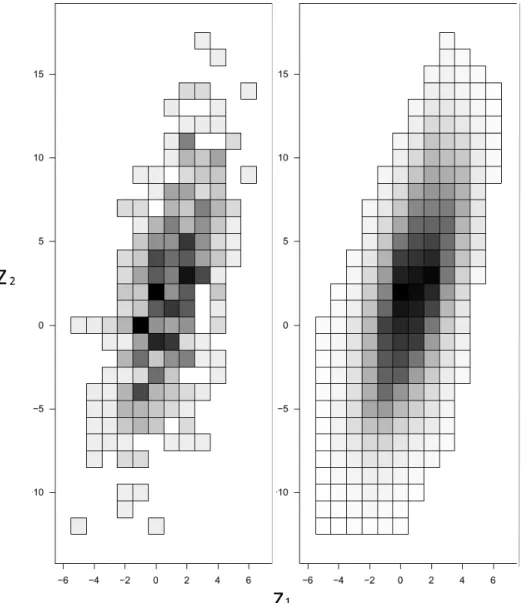
Figure 3.1: Grayscale heatmaps of the empirical PMF (left) and its eLC projection (right). The true distribution is a discrete Gaussian.
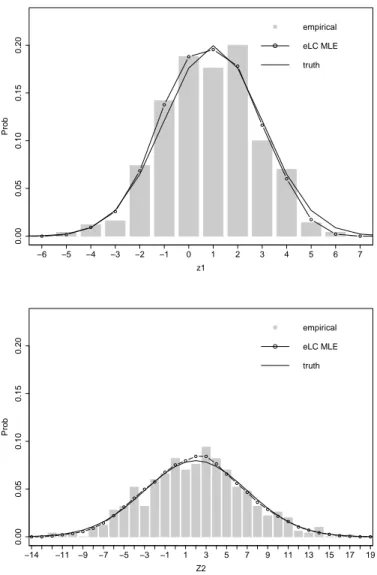
0.00 0.05 0.10 0.15 0.20 z1 Prob −6 −5 −4 −3 −2 −1 0 1 2 3 4 5 6 7 empirical eLC MLE truth 0.00 0.05 0.10 0.15 0.20 Z2 Prob −14 −11 −9 −7 −5 −3 −1 1 3 5 7 9 11 13 15 17 19 empirical eLC MLE truth
Figure 3.2: From the example of Figure 3.1, we compute the marginal distributions of our eLC MLE, we compare the marginals of elC MLE with empirical marginals and the true marginals in above Figures.
random variablesX1, ..., Xn on Zd, let hZd(R be any convex-extendible function, then Q z>Zd hz Âpnz B Q z>Zd hzpnz.
Proof. First, note thatÂpn is obtained by maximizing the following functional
Φϕ n Q i 1 ϕzip¯n Q z>Zd expϕz
over all concave-extendible functions, where ϕz logpz ( see Lemma 3.1.1). Letting Â
ϕn argmax Φϕ,we then haveÂpnz expÂϕnz.
Letgz Zd(Rbe any concave-extendible function, and hence for anyεA0, ϕεg is also concave-extendible (Murota and Shioura, 2001, Theorem 4). Therefore, ΦÂϕnεg B
ΦÂϕn sinceϕÂn maximize Φ. This implies that lim ε 0 ΦÂϕnεg ΦÂϕn ε lim ε 0 n P i 1Â ϕnzi εgzip¯n P z>Zd expÂϕnz εgz Pn i 1Â ϕnzip¯n P z>Zd expÂϕnz ε n Q i 1 gzip¯nlim ε 0 Q z>Zd expÂϕnz εgz expÂϕnz ε n Q i 1 gzip¯n Q z>Zd gzexpÂϕn n Q i 1 gzip¯n Q z>Zd gzÂpn Q z>Zd gzp¯n Q z>Zd gzÂpn B 0.
Note that the third last equality comes from:
lim ε 0 expÂϕnz εgz expÂϕnz ε expÂϕnzlim ε 0 expεgz 1 ε expÂϕnzlim ε 0 gzexpεgz 1 gzexpÂϕnz
Similarly, for any convex-extendible functionh,we have
Q z>Zd
hzÂpn B Q z>Zd
In particular, this implies that the mean of the MLE is equal to the observed mean of the data, because affine functionshz z, z>Zd are both convex-extendible and concave-extendible functions. Hence we have
EÂpnz Q z>Zd zÂpnz BEp¯nz Q z>Zd zp¯nz, EÂpnz Q z>Zd zÂpnz CEp¯nz Q z>Zd zp¯nz. HenceEpÂnz Ep¯nz.
Furthermore, the following Lemma shows that the variance matrix under the eLC MLE is smaller than the variance matrix under empirical distribution, in the sense that Σn ÂΣn is positive semi-definite.
Lemma 3.0.2. let ΣÂn denotes the variance matrix of random variable which follows the
distributionpÂn. LetΣn denotes the empirical variance matrix, which is the variance matrix
of random variable following the empirical distributionpn. Then Σn ÂΣn is positive
semi-definite.
Proof. Let V be any non zero vector on Rd, we define function hz VTzzTV, z > Zd. Note thathzis convex-extendible, becausehz zTVTzTV zTV2, it has convex extensionhx xTV2, x>Rd,which is closed convex function onRd.
Hence Q z>Zd hzÂpnB Q z>Zd hzp¯n, Q z>Zd VTzzTVpÂn Q z>Zd VTzzTVp¯nB0, VT Q z>Zd zzTpÂn Q z>Zd zzTp¯nV B0.
Therefore Σn ÂΣn is positive semi-definite.
An example of the MLE is given in Figures 3.1 and 3.2. The data is an IID sample of size n 1000 from the discrete Gaussian distribution given on later Section. Figure 3.1 shows the empirical distribution (left) and the fitted eLC (right) as a grey-scale heatmap. The marginal distributions are given in Figure 3.2, where the true marginals are also added.
3.1
Computation of the MLE
For shape constraint method, it is a standard trick to add a summation term to the log-likelihood function, such that the optimization problem can be relaxed to general functions set instead of density functions set. That is, maximizing
n P i 1
equiv-alent to minimizing 1 n n Q i 1 ϕXi Q z>Zd expϕz, (3.1)
over all concave-extendible functionsϕ. Complete proof please see below Lemma 3.1.1. Note, however, that the valuesX1, . . . , Xnare expected to have duplicates in our setting. Therefore, letz1, . . . , zm denote the unique observed values of X1, . . . , Xn.
Lemma 3.1.1. When the criterion function
Φϕ m Q j 1 wjϕzj Q z>Zd eϕz
is minimized over all concave extendible functionsϕ, the minimizer satisfies P
z>Zd
eϕz 1.
Proof. Consider any concave extendible ϕ0 minimize Φϕ, and p0 expϕ0 such that
P z>Zd
expϕ0z cx1.LetϕÇ0 ϕ0logc.ThenPz>ZdexpÇϕ0z 1,because Q
z>Zd
expÇϕ0z Q z>Zd
expexpϕ0z logc
Q z>Zd expϕ0z c 1 czQ> Zd expϕ0z 1
Now, ΦÇϕ0 m Q j 1 wjϕÇ0zj Q z>Zd eϕ0Çz Qm j 1 wjϕ0zj logc 1 m Q j 1 wjϕ0zj m Q j 1 wjlogc1 m Q j 1 wjϕ0zj logc1 m Q j 1 wjϕ0zj Q z>Zd eϕ0z Q z>Zd eϕ0zlogc1 Φϕ0 clogc1.
Since logcBc1 for any cA0,we get ΦÇϕ0 BΦϕ0,which is a contradiction.
Let Sn Sn¯ 9Zd, where Sn z1, . . . , zm. Also recall the empirical PMF pn. Using also the characterization of the MLE, we can further re-write the optimization problem above to be equivalent to minimizing
Φϕ m Q j 1 pnzjϕzj Q z> ÂSn expϕz,
again, over all concave-extendible functionsϕ. We denote the minimizer of above function asϕÂz logÂpn.
defined as
tyx infgx Rd RSg is concave, andgzj Cyj forj 1, . . . , m.
It turns out, that in the above we can exchange the function ϕz with the tent func-tions tyz, and optimize over the vector y > Rm instead. Lemma 3.1.2 shows a further simplification of the optimization problem .
Lemma 3.1.2. Consider the function
τy1, . . . , ym m Q i 1 wjtyzj Q z>ÂSn exptyz. (3.2)
Then τ has a minimum over y > Rm. We denote the minimizer as Ây, and pÂnz
exptÂyz. Furthermore, tÂy is a concave extension of logpÂn.
Proof. LetϕÂn logÂpn,which minimizes Φϕ.LetÂyi ϕÂnzi,fori 1, . . . , m,and consider
tÂyx infgx Rd(RSg is concave, andgzi C Âyi for i 1, . . . , m. LetϕÂR
nRd(Rdenote the concave extension ofϕÂn,and note thatϕÂRnzi Âϕnzi Âyi, i 1. . . , m. ThereforeϕÂR
n belongs to the set
AstÂy is the infimum of the above class of functions, we have tyÂz B ÂϕRnz, z>Zd. Assume that for some z0>Zd,ϕÂnz0 AtyÂz0.Then P
z>Zd
expϕÂnz A P
z>Zd
exptÂyz.
Also note thattyÂzi C Âyi, i 1, ..., m. Hence ΦÂϕn m Q i 1 wiϕÂnzi Q z>Zd expϕÂnz Qm i 1 wiÂyi Q z>Zd expϕÂnz A Qm i 1 witÂyzi Q z>Zd exptÂyz ΦtÂy.
However, this creates a contradiction since ϕÂn minimizes Φ. Therefore, ϕÂnz tÂyz, for any z>Zd.This also implies thattyÂis a concave extension of logpÂn.
While the above τ function has extended our optimization problem over y > Rm. It is still not simple enough for computation purpose. We show the objective function in the following Theorem 3.1.1 is convex. Because of convexity, the objective function has a unique minimizer. This objective function is the one we will work on in the sequel.
Theorem 3.1.1. Consider the function
σy1, . . . , ym m Q j 1 pnzjyj Q z>ÂSn exptyz. (3.3)
Proof of Theorem 3.1.1. We first prove thatσ is convex. Foru, v>Rm, λ> 0,1,we have
λtux 1λtvx
λinfg1xSg1 concave, and g1zi Cui, i 1, . . . , m
1λinfg2xSg2 concave, and g2zi Cvi, i 1, . . . , m infλg1x Rd RSg1 is concave, andg1zi Cui, i 1,2, ..., n inf1λg2x Rd RSg2 is concave, andg2zi Cvi, i 1,2, ..., n infg1xSg1 concave, and g1zi Cλui, i 1, . . . , m
infg2xSg2 concave, and g2zi C 1λvi, i 1, . . . , m
C infg1x g2xSg1, g2 are concave,g1zi Cλui, g2zi C 1λvi, i 1, . . . , m.
We also have
¯
hλu1λvx
infhx Rd RSh is concave,hzi Cλui 1λvi, i 1,2, ..., n.
ofgxSh concave,gzi Cλui 1λvi, i 1, . . . , m,we have
λtux 1λtvx Ctλu1λvx, x>Rd. Finally, by convexity of ex (apply to the 2nd inequality below),
σλu 1λv Qm i 1 wiλui 1λvi Q z>Zd exptλu1λvz B Qm i 1 wiλui 1λvi Q z>Zd expλtuz 1λtvz B Qm i 1 wiλui 1λvi Q z>Zd λetuz 1λetvz Qm i 1
wiλui 1λvi λ Q z>Zd etuz 1λ Q z>Zd etvz λσu 1σσv. Hence,σyis convex. Next, for any y>Rm,
σy τy
m Q i 1
wityzi yi C τy,
by definition of the tent function ty, the 2nd term m P i 1
wityzi yi is always positive. Hence σy get its minimum value when
m P i 1
wityzi yi 0. It implies yÂi tyÂzi, i 1, . . . , m,which minimize bothσyandτy.Note that multipley>Rm may lead to same