Algorithms for Portfolio Management based on the Newton Method
Amit Agarwal [email protected]
Elad Hazan [email protected]
Satyen Kale [email protected]
Robert E. Schapire [email protected]
Princeton University, Department of Computer Science, 35 Olden Street, Princeton, NJ 08540
Abstract
We experimentally study on-line investment algorithms first proposed by Agarwal and Hazan and extended by Hazan et al. which achieve almost the same wealth as the best constant-rebalanced portfolio determined in hindsight. These algorithms are the first to combine optimal logarithmic regret bounds with efficient deterministic computability. They are based on the Newton method for of-fline optimization which, unlike previous ap-proaches, exploits second order information. After analyzing the algorithm using the po-tential function introduced by Agarwal and Hazan, we present extensive experiments on actual financial data. These experiments confirm the theoretical advantage of our al-gorithms, which yield higher returns and run considerably faster than previous algorithms with optimal regret. Additionally, we per-form financial analysis using mean-variance calculations and the Sharpe ratio.
1. Introduction
In the universal portfolio management problem, we seek online wealth investment strategies which enable an investor to maximize his wealth by distributing it on a set of available financial instruments without knowing the market outcome in advance. The under-lying model of the problem makes no statistical as-sumptions on the behavior of the market (such as ran-dom walks or Brownian motion of stock prices (Lu-enberger, 1998)). In fact, the market is even allowed to be adversarial. The simplicity of the model per-mits the formulation of the centuries-old problem of wealth maximization as an online learning problem, Appearing in Proceedings of the 23rd International
Con-ference on Machine Learning, Pittsburgh, PA, 2006. Copy-right 2006 by the author(s)/owner(s).
and the application of machine learning algorithms. The study of such a model was started in the 1950s by Kelly (1956) followed by Bell and Cover (1980; 1988), Algoet and Cover (1988).
Absolute wealth maximization in an adversarial mar-ket is of course a hopeless task; we therefore aim to maximize our wealth relative to that achieved by a reasonably sophisticated investment strategy, the constant-rebalanced portfolio (Cover, 1991), abbrevi-ated CRP. A CRP strategy rebalances the wealth each trading period to have a fixed proportion in every stock in the portfolio. We measure the performance of an online investment strategy by its regret, which is the relative difference between the logarithmic growth ra-tio it achieves over the entire trading period, and that achieved by a prescient investor — one who knows all the market outcomes in advance, but who is con-strained to use a CRP. An investment strategy is said to beuniversalif it achieves sublinear regret.
Of equal importance is the computational efficiency of the online algorithm. So far, universal portfolio management algorithms were either optimal with re-spect to regret, but computationally inefficient (Cover, 1991), or efficient but attained sub-optimal regret (Helmbold et al., 1998). In recent work, Agarwal and Hazan (2005) introduced a new analysis technique which serves as the basis of algorithms that are both efficient and have optimal regret. These techniques were generalized by Hazan et al. (2006) to yield even more efficient algorithms.
These new algorithms are based on the well-studied follow-the-leader method, a natural online strategy which, simply stated, advocates the use of the best strategy so far in the game for the next iteration. This method was first proposed and analyzed by Hannan (1957) for the case of Lipschitz regret functions, and later simplified and extended by Kalai and Vempala (2005) for linear regret functions and also by Merhav and Feder (1992). Follow-the-leader based portfolio management schemes were also analyzed by Larson (1986), when the price relative vectors are restricted to
take values in a finite set and by Ordentlich and Cover (1996). The work in this paper and in Hazan et al. (2006) bring out the connection of follow-the-leader to the Newton method for offline optimization. The pre-vious algorithm of Helmbold et al. (1998) can be seen as a variant of gradient descent. On the other hand, the new algorithm Online Newton Steptakes ad-vantage of the second derivative of the functions. We note that this paper does not include comparisons to the recent algorithm of Borodin et al. (2004), de-spite its excellent experimental results. The reason is that their heuristic is not a universal algorithm since it does not theoretically guarantee low regret.
To evaluate our algorithm, we reproduce the previous experiments of (Cover, 1991) and (Helmbold et al., 1998). Also, we test the algorithms on some more datasets, and evaluate their performance on additional metrics such as Annualized Percentage Yields (APYs), Sharpe ratio and mean-variance optimality. The new algorithm outperforms previous algorithms in nearly all these experiments under all the performance met-rics we tested.
2. Notation and preliminaries
Let the number of stocks in the portfolio be n. On every trading period t, for t = 1, . . . , T, the investor observes aprice relative vectorrt∈Rn, such thatrt(j)
is the ratio of the closing price of stockjon daytto the closing price on dayt−1. A portfoliopis a distribution on the n stocks, so it is a point in then-dimensional simplex Sn. If the investor uses a portfolio pt on day t, his wealth changes by a factor of pt·rt , p>trt.
Thus, after T periods, the wealth achieved per dollar invested is QTt=1(pt·rt). The logarithmic growth
ra-tio is PTt=1log(pt·rt). An investor using a CRP p
achieves the logarithmic growth ratioPTt=1log(p·rt).
The best CRP in hindsightp∗ is the one which maxi-mizes this quantity. The regret of an online algorithm,
Alg, which produces portfoliospt for t = 1, . . . , T, is
defined to be Regret(Alg) , T X t=1 log(p∗·rt)− T X t=1 log(pt·rt).
Since scaling rt by a constant affects the logarithmic
growth rations of both the best CRP andAlgby the same additive factor, the regret does not change. So we assume without loss of generality that for all t, rt is scaled so that maxjrt(j) = 1. We also make
the assumption that after this scaling, all the rt(j)
are bounded below by themarket variability parameter
α >0. This has been called theno-junk-bond
assump-tion by Agarwal and Hazan, and can be interpreted to mean that no stock crashes to zero value over the trading period.
With this setup, Cover (1991) gave the first univer-sal portfolio selection algorithm which had the opti-mal regret O(logT), without dependence on the mar-ket variability parameter α. His algorithm, however, needs Ω(tn) time for computing the portfolio p
t and
is clearly impractical. Kalai and Vempala (2003) gave a polynomial implementation of the algorithm us-ing samplus-ing of logconcave functions from convex do-mains (Lov´asz & Vempala, 2003b; Lov´asz & Vempala, 2003a), and this results in a randomized polynomial time algorithm, though the polynomial is still quite large. Helmbold et al. gave an algorithm which needs just linear (in n) time and space per period but has
O(√T) regret, under the no-junk-bonds assumption.
3.
Online Newton Step
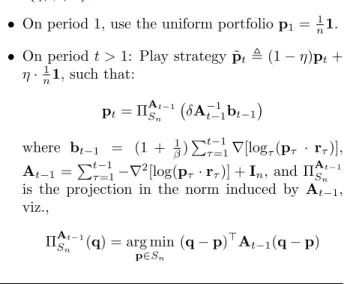
Our algorithm, Online Newton Step, is presented below. It takes parametersη, andβwhich are required for the theoretical analysis. It also takes a heuristic tuning parameter,δ, which we set only for the purpose of experimentation.
ONS(η,β, δ)
• On period 1, use the uniform portfoliop1=n11.
• On periodt >1: Play strategy ˜pt,(1−η)pt+ η· 1 n1, such that: pt= ΠAtSn−1 ¡ δA−t−11bt−1 ¢ where bt−1 = (1 + β1) Pt−1 τ=1∇[logτ(pτ · rτ)], At−1= Pt−1 τ=1−∇2[log(pτ·rτ)] +In, and ΠAtSn−1 is the projection in the norm induced by At−1,
viz., ΠAt−1 Sn (q) = arg min p∈Sn (q−p)>A t−1(q−p)
Figure 1. TheOnline Newton Stepalgorithm. TheOnline Newton Stepalgorithm, shown in Fig-ure 1, has optimal regret and efficient computability. It is a Newton-based approach which utilizes the gra-dient (denoted∇) and the Hessian (denoted∇2) of the
log function. It can be implemented very efficiently: all it needs to do, per iteration, is compute ann×n ma-trix inverse, a mama-trix-vector product, and a projection into the simplex. Aside from the projection, all the
other operations can be implemented in O(n2) time
and space using the matrix inversion lemma (Brookes, 2005). The projection itself can be implemented very efficiently in practice using projected gradient descent methods.
We now proceed to analyze the algorithm theoretically, and show that under the no-junk-bond assumption, the algorithm has O(logT) regret, whereas without the assumption, the regret becomes O(√T).
Theorem 1. The ONS algorithm has the following performance guarantees:
1. Assume that the market has variability parameter
α. Then setting η = 0, β = α 8√n, and δ= 1, we have Regret(ONS) ≤ 10n 1.5 α log · nT α2 ¸ .
2. With no assumptions on the market variabil-ity parameter, by setting η = n1.25
√
Tlog(nT), β = 1
8n0.25√Tlog(nT), andδ= 1, we have
Regret(ONS) ≤ 22n1.25pTlog(nT).
Being a specialization of theOnline Newton Step algorithm of Hazan et al., the analysis proceeds along the same lines. First, define ∇t = ∇[log(pt·rt)] =
1
pt·rtrt. Note that ∇2[log(pt·rt)] = (pt−·rt1)2rtr>t =
−∇t∇>t, soAt=
Pt
τ=1∇τ∇>τ +In. We will use this
expression forAtthroughout the analysis.
Now define the functions ft:Sn→Ras follows:
ft(p) ,log(pt·rt) +∇>t(p−pt)−β
2[∇ >
t(p−pt)]2
where β = α
8√n. Note thatft(pt) = log(pt·rt).
Fur-thermore, by the Taylor expansion applied to the log-arithm function (see also Lemma (2) in (Hazan et al., 2006)), we get that, for allp∈Sn: log(p·rt)≤ft(p).
This implies that max
p X
t
log(p·rt)−log(pt·rt)≤maxp
X
t
ft(p)−ft(pt),
(1) so it suffices to bound the RHS of (1).
Lemma 2. For allt, we have pt = arg max p∈Sn t−1 X τ=1 ft(p)−β 2kpk 2.
Proof. Fort= 1, the uniform portfoliop1= 1n1
max-imizes −β2kpk2. For t > 1, expanding out the
ex-pressions for fτ(p), multiplying by 2
β and getting rid
of constants, the problem reduces to maximizing the following function overp∈Sn:
t−1 X τ=1 · −p>∇τ∇>τp+ 2 µ p>τ∇τ∇>τ + 1 β∇ > τ ¶ p ¸ −p>p = −p>A t−1p+ 2b>t−1p.
The solution of this maximization is exactly the projection ΠAt−1
K (A−t−11bt−1) as specified by Online
Newton Step. Proof. (Theorem 1)
Part 1. We need to bound the RHS of (1), maxpPtft(p) − ft(pt). A simple induction (see
(Hazan et al., 2006)) shows that for anyp,
−β 2kp1k 2+X t ft(pt+1)≥ X t ft(p)−β 2kpk 2.
In Lemma 4 below, we bound Ptft(pt+1)−ft(pt).
Since β
2[kpk2− kp1k2]≤ β2, we can bound the regret
as: Regret(ONS) ≤ 1 βnlog · nT α2 ¸ +β 2.
Now the stated regret bound follows by plugging in the specified choice of parameters.
Part 2. The following lemma can be deduced from Theorem 2 in (Helmbold et al., 1998). The stated re-gret bound follows by using the lemma with the spec-ified choice of parameters with the regret bound from part 1.
Lemma 3. For an online algorithm Alg, let the de-rived algorithmSmoothAlguse the smoothened portfo-lio p˜t = (1−η)pt+η· n11 where pt is the portfolio
computed by Alg on day t. Then the regret can be bounded as:
Regret(SmoothAlg) ≤ Regret(Alg) + 2ηT
whereRegret(Alg)is computed assuming the variabil-ity parameter αis at least nη.
Lemma 4. T X t=1 [ft(pt+1)−ft(pt)] ≤ 1 βnlog · nT α2 ¸ .
Lemma 4. For the sake of readability, we introduce some notation. Define the function Ft , Ptτ−=11fτ. Note that ∇ft(pt) = ∇t by the definition of ft.
Finally, let ∆ be the forward difference operator, for example, ∆pt = (pt+1 −pt) and ∆∇Ft(pt) =
(∇Ft+1(pt+1)− ∇Ft(pt)).
We use the gradient bound, which follows from the concavity of ft:
ft(pt+1)−ft(pt)≤ ∇ft(pt)>(pt+1−pt) =∇>t∆pt.
(2) The gradient ofFt+1can be written as:
∇Ft+1(p) = t X τ=1 [∇τ−β∇τ∇>τ(p−pτ)]. (3) Therefore, ∇Ft+1(pt+1)− ∇Ft+1(pt) = −βAt∆pt. (4) The LHS of (4) is ∇Ft+1(pt+1)− ∇Ft+1(pt) = ∆∇Ft(pt)− ∇t. (5)
Putting (4) and (5) together we get
−βAt∆pt= ∆∇Ft(pt)− ∇t. (6)
Pre-multiplying by −1
β∇>tA−t1, we get an expression
for the gradient bound (2):
∇> t∆pt= 1 β∇ > tA−t1[∆∇Ft(pt)− ∇t] =−1 β∇ > tA−t1[∆∇Ft(pt)] +1 β∇ > tA−t1∇t. (7) Claim 1. The first term of (7) is bounded as follows:
−1
β∇
>
tA−t1[∆∇Ft(pt)] ≤ 0.
Proof. Sincepτ maximizesFτ overSn, we have
∇Fτ(pτ)>(p−pτ) ≤ 0. (8)
for any pointp∈Sn. Using (8) forτ =tandτ=t+1, we get 0 ≥ ∇Ft+1(pt+1)>(pt−pt+1) +∇Ft(pt)>(pt+1−pt) = −[∆∇Ft(pt)]>∆pt = 1 β[∆∇Ft(pt)] >A−1 t [∆∇Ft(pt)− ∇t]
(by solving for ∆ptin (6))
= 1 β[∆∇Ft(pt)] >A−1 t [∆∇Ft(pt)] − 1 β[∆∇Ft(pt)] >A−1 t ∇t ≥ −1 β[∆∇Ft(pt)] >A−1 t ∇t. (since A−1 t º0⇒ ∀p: p>A−t1p≥0) as required.
Now we bound the second term of (7). Sum up from
t = 1 to T, and apply Lemma 5 (see Lemma 6 from (Hazan et al., 2006)) below withA0=Inandvt=∇t.
1 β T X t=1 ∇>tA−t1∇t ≤ 1 β log · |AT| |A0| ¸ ≤ 1 βnlog · nT α2 ¸ .
The second inequality follows sinceAT =
PT t=1∇t∇>t andk∇tk ≤ √ n α , and so|AT| ≤(nTα2)n.
Lemma 5. For t = 1,2, . . . , T, let At = A0 +
Pt
τ=1vτvτ> for a positive definite matrix A0 and
vec-torsv1, v2, . . . , vT. Then the following inequality holds:
T X t=1 v> tA−t1vt ≤ log · |AT| |A0| ¸ . 3.1. Internal regret
Stoltz and Lugosi (2005) extend the game-theoretic notion of internal regret to the case of online portfolio selection problems. The notion captures the follow-ing cause of regret to an online investor: in hindsight, how much more money could she have made, had she transferred all the money she invested in stock i, to stockj on all the trading days?
Formally, for a portfolio p, define pi→j as follows:
pii→j = 0,pij→j=pi+pj, andpik→j =pk ifk6=i, j.
The internal regret is defined to be max ij X t=1 log(pit→j·rt)− T X t=1 log(pt·rt).
A straightforward application of the technique of Stoltz and Lugosi (2005) results in an algorithm, called IR-ONS, that achieves logarithmic internal regret. In the full version of the paper, we prove:
Theorem 6. Assume that the market has variability parameterα. Then settingη= 0,β = α
8√n, andδ= 1, we have InternalRegret(IR-ONS) ≤ 20n 3 α log · nT α2 ¸ .
4. Experimental Results
We implemented the algorithms presented in (Agar-wal & Hazan, 2005) and (Hazan et al., 2006) as well as the algorithms of Cover (1991)1, the Multiplicative
Weights algorithm of Helmbold et al. (1998), and the uniform CRP. We also applied the technique of Stoltz and Lugosi (2005) to the algorithms of Helmbold et al. (1998) and this paper to get variants which minimize internal regret. We implemented Online Newton Stepwith parameters η= 0, β = 1, andδ= 1
8.
Un-less otherwise noted, we omit the results for IR-ONS because it was inferior to ONS.
We performed tests on the historical stock market data from the New York Stock Exchange (NYSE) used by Cover and Helmbold et al. In addition we randomly selected portfolios of various sizes from a set of 50 ran-domly chosen S&P 500 stocks2and performed
experi-ments over the past 4 years data from 12thDecember,
2001 to 30th November, 2005 obtained from Yahoo!
Finance.
Table 1. Abbreviations used in the experiments. BCRP Best CRP
UCRP Uniform CRP Universal (Cover, 1991)
MW (Helmbold et al., 1998) IR-MW Internal regret variant of MW
ONS Online Newton Step
IR-ONS Internal regret variant of ONS Performance Measures. The performance mea-sures we used were Annualized Percentage Yields (APYs), Sharpe ratio and mean-variance optimality. 4.1. Performance vs. Portfolio Size
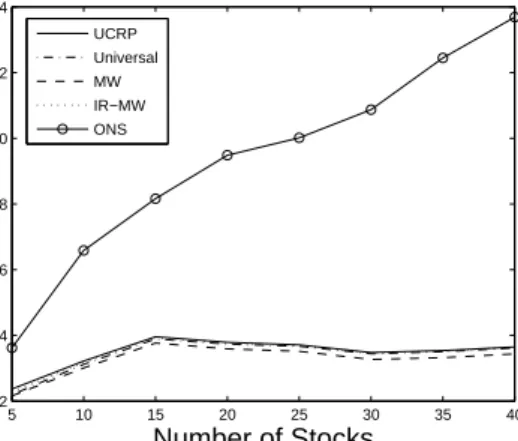
To measure the dependence of the performance of var-ious algorithms on portfolio size we picked 50 sets ofn
random stocks from the data set, for values ofn rang-ing from 5 to 40. All algorithms were run on the data, trading once every two weeks. The choice of trading period was to permit completion of the Universal
al-1Since we implemented Cover’s algorithm by random
sampling, there is a small degree of variability in the mea-surements recorded here. We used 1000 samples, which as suggested by (Stoltz & Lugosi, 2005), is sufficient to get a good estimate of the behavior of that algorithm.
2The set of stocks used was RTN, SLB, ABK, PEG,
KMG, FITB, CL, PSA, DOV, NKE, AT, NEM, VMC, D, CPWR, NVDA, SRE, HPQ, CMX, LXK, GPC, ABI, PGL, QLGC, OMX, QCOM, KO, PMTC, SWK, CTXS, FSH, HON, COF, LH, KMG, BLL, WB, OMX, K, LUV, DIS, SFA, APOL, HUM, CVH, IR, SPG, WY, TYC, NKE.
gorithm in reasonable time. The trading period did not seem to affect the relative performance of the al-gorithms. The results are shown in Figure 4.
5 10 15 20 25 30 35 40 12 14 16 18 20 22 24 Number of Stocks mean APY UCRP Universal MW IR−MW ONS
Figure 2. Performance vs. Portfolio Size
The improvement in the performance of ONS with increasing number of stocks is quite stark. The rea-son for this seems to be that ONS does an extremely good job of tracking the best stock in a given port-folio. Adding more stocks causes some good stock to get added, which ONS proceeds to track. Other al-gorithms behave more like the uniform CRP and so average out the increase in wealth due to the addition of a good stock. Figure 3 shows how ONS tracks CMC, which out-performs Kin-Ark for the test period, in a dataset composed of Kin-Ark and CMC (also used by Cover) while other algorithms have a nearly uniform distribution on both the stocks. This is the reason ONS outperforms all other algorithms on this dataset, as can be seen in Figure 5.
0 1000 2000 3000 4000 5000 6000 0.4 0.5 0.6 0.7 0.8 0.9 1 Trading days Fraction of CMC in portfolio BCRP MW UCRP IR−MW ONS
4.2. Random stocks from S&P 500
We tested the average APYs (over 50 trials of 10 ran-dom stocks from the S&P 500 list mentioned before) of the algorithms, for different frequencies of rebalanc-ing, namely daily, weekly, fortnightly and monthly. As can be seen in figure 4 the performance of the ONS al-gorithm is superior to all other alal-gorithms in all the 4 cases. As is expected the performance of all algo-rithms degrades as trading frequency decreases, but not very significantly. The simple strategy of main-taining a uniform constant-rebalanced portfolio seems to outperform all previous algorithms. This rather sur-prising fact has been observed by Borodin et al. (2004) also.
daily weekly fortnightly monthly 0 5 10 15 20 25 Trading frequency UCRP Universal MW IR−MW ONS
Figure 4. Performance vs. Trading Period.
4.3. Cover’s Experiments
We replicated the experiments of Cover and Helmbold et al. on Iroquios Brands Ltd. and Kin Ark Corp., Commercial Metals (CMC) and Kin Ark, CMC and Meicco Corp., IBM and Coca Cola for the same 22 year period from 3rdJuly, 1962 to 31st December, 1984. As
can be seen from Figure 5, ONS outperforms all other algorithms except on the Iroquios Brands Ltd. and Kin Ark Corp. dataset.
Figure 6 shows how the total wealth (per dollar in-vested) varies over the entire period using the different algorithms for a portfolio of IBM and Coke. The ONS algorithm, and its internal regret variant IR-ONS, out-perform even the best constant-rebalanced portfolio. 4.4. Stock volatility
We took the 50 stock data set used in previous ex-periments which had a history for 1000 days traded fortnightly and sorted them according to volatility and created two sets: the 10 stocks with largest and
small-Iroq.&Kin−Ark CMC&Kin−Ark CMC&MEI IBM&KO 0 5 10 15 20 25 30 APY UCRP Universal MW IR−MW ONS
Figure 5.Four pairs of stocks tested by Cover (1991) and Helmbold et al. (1998). 0 1000 2000 3000 4000 5000 6000 0 5 10 15 20 25 Trading days
Wealth achieved per dollar
BCRP ONS IR−ONS
Figure 6.Wealth achieved by various algorithms on a port-folio consisting of IBM and Coke.
est price variance. Then we applied the different algo-rithms on the two different sets.
Figure 7 shows that the performance of ONS increases with market volatility whereas the performance of other algorithms decreases.
4.5. Margins loans
In line with Cover (1991) and Helmbold et al. (1998), we also tested the case where the portfolio can buy stocks on margin. The data set we tested on was the 22 year IBM and Coca Cola data mentioned earlier. Results for this case are given in Table 4. The margin purchases we incorporate are 50% down and 50% loan. The ONS algorithm in fact enhances its performance edge over other algorithms if margin loans are allowed.
Table 2. Sharpe ratios for various algorithms on different datasets.
Universal UCRP MW IR-MW ONS
Iro.&Kin-Ark 0.4986 0.5497 0.5390 0.5078 0.4578 CMC & Kin-Ark 0.5740 0.6020 0.5980 0.5812 0.7466
CMC & Meicco 0.3885 0.3834 0.3856 0.3854 0.5177
IBM & Coke 0.5246 0.5376 0.5356 0.5295 0.5824
Table 3. Minimum variance CRPs for various algorithms on different datasets. The number to the left of the slash is the volatility of the minimum variance CRP and the number to the right is the volatility of the algorithm on the dataset.
Universal UCRP MW IR-MW ONS
Iro. & Kin-Ark 0.4598/0.4948 0.4929/0.4929 0.4803/0.4928 0.4606/0.4930 0.4603/0.5451 CMC & Meicco 0.1911/0.2728 0.1909/0.2723 0.1909/0.2717 0.1909/0.2718 0.2070/0.3510 low high 0 5 10 15 20 25 volatility mean APY UCRP Universal MW IR−MW ONS
Figure 7.Performance of algorithms on high and low volatility datasets.
Table 4. Incorporating margin loans.
Algorithm APY, no margin APY with margin
UCRP 12.73 14.84
Universal 12.46 14.40
MW 12.57 14.39
IR-MW 12.57 14.62
ONS 13.68 16.15
4.6. Sharpe Ratio and Mean-Variance Optimal CRPs
It is a well-known fact that one can achieve higher re-turns by investing in riskier assets (Luenberger, 1998). So it is important to rule out the possibility of the ONS algorithm achieving higher returns compared to other algorithms by trading more riskily. Parameters like the Sharpe ratio and the optimal mean-variance portfolio are used to measure this risk versus reward tradeoff. Sharpe ratio is defined as Rp−Rf
σp where Rp is the av-erage yearly return of the algorithm, which indicates
reward,Rf is the risk-free rate (typically the average rate of return of Treasury bills), and σp is the stan-dard deviation of the returns of the algorithm, which indicates its volatility risk. Higher the Sharpe Ratio the better is the algorithm at balancing high rewards with low risk.
The mean-variance optimal CRP for an algorithm is the CRP which achieves the same return as the al-gorithm but has minimum variance. This is the least risky CRP one could have used in hindsight to produce the same returns. The closer the volatility of the CRP to that of the algorithm, the better the algorithm is avoiding risk.
Table 2 shows that ONS has either the best or slightly smaller Sharpe ratio among all algorithms. In Table 3, it can be seen that ONS has comparable volatility to the minimum variance CRP, implying that ONS does not take excessive risk in its portfolio selection. In the case of IBM & Coke and Kin-Ark & CMC, ONS beats the Best CRP in hindsight. Hence the concept of the optimal mean-variance CRP does not apply and the results for this case are omitted.
4.7. Running times
As expected, ONS runs slightly slower than MW, but both are much faster than Universal. We measured the running time (in seconds) of these algorithms on the 22 year data sets mentioned earlier. The machine used was a dual Intel 933MHz PIII processor with 1GB operated with Linux Fedora Core 3 operating system. The average running time, on the four data sets we considered, was 4882 seconds for the Universal algo-rithm3, whereas MW and ONS took 3.7 and 26.7
sec-onds, respectively. This clearly shows the significant advantage of ONS over Universal and that it is compa-rable with MW in terms of computational efficiency.
5. Conclusions
We experimentally tested the recently proposed algo-rithms of (Agarwal & Hazan, 2005; Hazan et al., 2006) for the universal portfolio selection problem. The On-line Newton Step algorithm is extremely fast in practice as expected from the theoretical guarantees. Moreover, it seems to be better than previous algo-rithms at tracking the best stock.
It would be interesting to combine the anti-correlated heuristic of Borodin et al. (2004) with the best stock tracking ability of our algorithm. Another open prob-lem is to incorporate transaction costs into the algo-rithm, as done by Blum and Kalai (1999) for Cover’s algorithm.
Acknowledgements
We would like to thank Sanjeev Arora and Moses Charikar for helpful suggestions. Elad Hazan and Satyen Kale were supported by Sanjeev Arora’s NSF grants MSPA-MCS 0528414, CCF 0514993, ITR 0205594. We would also like to thank Gilles Stoltz for providing us with the data sets for experiments and helpful suggestions.
References
Agarwal, A., & Hazan, E. (2005). New algorithms for repeated play and universal portfolio management. Princeton University Technical Report TR-740-05. Algoet, P., & Cover, T. (1988). Asymptotic
optimal-ity and asymptotic equipartition properties of log-optimum investment. Annals of Probability,2, 876– 898.
Bell, R., & Cover, T. (1980). Competitive optimality of logarithmic investment. Mathematics of Operations Research,2, 161–166.
Bell, R., & Cover, T. (1988). Game-theoretic optimal portfolios. Management Science,6, 724–733. Blum, A., & Kalai, A. (1999). Universal portfolios with
and without transaction costs. Machine Learning, 35, 193–205.
Borodin, A., El-Yaniv, R., & Gogan, V. (2004). Can we learn to beat the best stock.Journal of Artificial Intelligence Research, 21, 579–594.
Brookes, M. (2005). The ma-trix reference manual. [online] www.ee.ic.ac.uk/hp/staff/dmb/matrix/intro.html.
Cover, T. (1991). Universal portfolios. Mathematical Finance,1, 1–19.
Hannan, J. (1957). Approximation to bayes risk in repeated play. In M. Dresher, A. W. Tucker and P. Wolfe, editors, Contributions to the Theory of Games,III, 97–139.
Hazan, E., Kalai, A., Kale, S., & Agarwal, A. (2006). Logarithmic regret algorithms for online convex op-timization. To appear in the 19th Annual Confer-ence on Learning Theory (COLT).
Helmbold, D., Schapire, R., Singer, Y., & Warmuth., M. (1998). On-line portfolio selection using multi-plicative updates. Mathematical Finance, 8, 325– 347.
Kalai, A., & Vempala, S. (2003). Efficient algorithms for universal portfolios. Journal Machine Learning Research,3, 423–440.
Kalai, A., & Vempala, S. (2005). Efficient algorithms for on-line optimization. Journal of Computer and System Sciences,71(3), 291–307.
Kelly, J. (1956). A new interpretation of information rate. Bell Systems Technical Journal, 917–926. Larson, D. C. (1986). Growth optimal trading
strate-gies. Ph.D. dissertation, Stanford Univ., Stanford, CA.
Lov´asz, L., & Vempala, S. (2003a). The geometry of logconcave functions and anO∗(n3)sampling
al-gorithm (Technical Report MSR-TR-2003-04). Mi-crosoft Research.
Lov´asz, L., & Vempala, S. (2003b). Simulated anneal-ing in convex bodies and an O∗(n4) volume
algo-rithm.Proceedings of the 44th Symposium on Foun-dations of Computer Science (FOCS)(pp. 650–659). Luenberger, D. G. (1998).Investment science. Oxford:
Oxford University Press.
Merhav, N., & Feder, M. (1992). Universal sequen-tial learning and decision from individual data se-quences. 5th COLT (pp. 413–427). Pittsburgh, Pennsylvania, United States.
Ordentlich, E., & Cover, T. M. (1996). On-line port-folio selection. 9th COLT(pp. 310–313). Desenzano del Garda, Italy.
Stoltz, G., & Lugosi, G. (2005). Internal regret in on-line portfolio selection. Machine Learning, 59, 125–159.