Graph-based Consensus Maximization among
Multiple Supervised and Unsupervised Models
Jing Gao†, Feng Liang†, Wei Fan‡, Yizhou Sun†, and Jiawei Han† †University of Illinois at Urbana-Champaign, IL USA ‡IBM TJ Watson Research Center, Hawthorn, NY USA †{jinggao3,liangf,sun22,hanj}@illinois.edu,‡[email protected]
Abstract
Ensemble classifiers such as bagging, boosting and model averaging are known to have improved accuracy and robustness over a single model. Their potential, however, is limited in applications which have no access to raw data but to the meta-level model output. In this paper, we study ensemble learning with output from multiple supervised and unsupervised models, a topic where little work has been done. Although unsupervised models, such as clustering, do not directly generate label prediction for each individual, they provide useful constraints for the joint prediction of a set of related objects. We propose to consolidate a classi-fication solution by maximizing the consensus among both supervised predictions and unsupervised constraints. We cast this ensemble task as an optimization prob-lem on a bipartite graph, where the objective function favors the smoothness of the prediction over the graph, as well as penalizing deviations from the initial labeling provided by supervised models. We solve this problem through iterative propaga-tion of probability estimates among neighboring nodes. Our method can also be interpreted as conducting a constrained embedding in a transformed space, or a ranking on the graph. Experimental results on three real applications demonstrate the benefits of the proposed method over existing alternatives1.
1 Introduction
We seek to integrate knowledge from multiple information sources. Traditional ensemble methods such as bagging, boosting and model averaging are known to have improved accuracy and robustness over a single model. Their potential, however, is limited in applications which have no access to raw data but to the meta-level model output. For example, due to privacy, companies or agencies may not be willing to share their raw data but their final models. So information fusion needs to be conducted at the decision level. Furthermore, different data sources may have different formats, for example, web video classification based on image, audio and text features. In these scenarios, we have to combine incompatible information sources at the coarser level (predicted class labels) rather than learn the joint model from raw data.
In this paper, we consider the general problem of combiningoutputof multiple supervised and unsu-pervised models to improve prediction accuracy. Although unsuunsu-pervised models, such as clustering, do not directly generate label predictions, they provide useful constraints for the classification task. The rationale is that objects that are in the same cluster should be more likely to receive the same class label than the ones in different clusters. Furthermore, incorporating the unsupervised clustering models into classification ensembles improves the base model diversity, and thus has the potential of improving prediction accuracy.
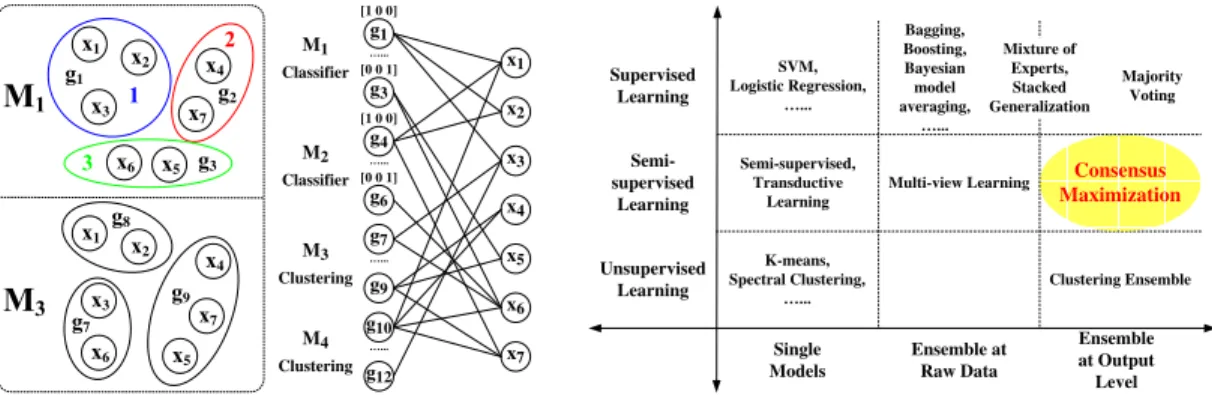
1 5 2 4 3 6 7 1 5 2 4 3 6 7 1 2 3 7 9 8 Figure 1: Groups g1 …... [0 0 1] M1 Classifier [1 0 0] [0 0 1] …... …... …... [1 0 0] g3 g4 g6 g7 g9 g10 g12 x1 x2 x3 x4 x5 x6 x7 M2 Classifier M3 Clustering M4 Clustering
Figure 2: Bipartite Graph
Single Models Ensemble at Raw Data Ensemble at Output Level K-means, Spectral Clustering, …... Semi-supervised, Transductive Learning SVM, Logistic Regression, …... Multi-view Learning Bagging, Boosting, Bayesian model averaging, …... Unsupervised Learning Supervised Learning Semi-supervised Learning Clustering Ensemble Consensus Maximization Majority Voting Mixture of Experts, Stacked Generalization
Figure 3: Position of Consensus Maximization Suppose we have a set of data pointsX = {x1, x2, . . . , xn}fromcclasses. There aremmodels that provide information about the classification ofX, where the firstrof them are (supervised) classifiers, and the remaining are (unsupervised) clustering algorithms. Consider an example where X ={x1, . . . , x7},c= 3andm= 4. The output of the four models are:
M1={1,1,1,2,3,3,2} M2={1,1,2,2,2,3,1} M3={2,2,1,3,3,1,3} M4={1,2,3,1,2,1,1} whereM1andM2assign each object a class label, whereasM3andM4simply partition the objects
into three clusters and assign each object a cluster ID. Each model, no matter it is supervised or unsupervised, partitionsXinto groups, and objects in the same group share either the same predicted class label or the same cluster ID. We summarize the data, models and the corresponding output by a bipartite graph. In the graph, nodes at the left denote the groups output by themmodels with some labeled ones from the supervised models, nodes at the right denote thenobjects, and a group and an object are connected if the object is assigned to the group by one of the models. For the aforementioned toy example, we show the groups obtained from a classifier M1 and a clustering
modelM3in Figure 1, as well as the group-object bipartite graph in Figure 2.
The objective is to predict the class label ofxi ∈ X, which agrees with the base classifiers’ pre-dictions, and meanwhile, satisfies the constraints enforced by the clustering models, as much as possible. To reach maximum consensus among all the models, we define an optimization problem over the bipartite graph whose objective function penalizes deviations from the base classifiers’ pre-dictions, and discrepancies of predicted class labels among nearby nodes. In the toy example, the consensus label predictions forX should be{1,1,1,2,2,3,2}.
Related Work.We summarize various learning problems in Figure 3, where one dimension repre-sents the goal – from unsupervised to supervised, and the other dimension reprerepre-sents the method – single models, ensembles at the raw data, or ensembles at the output level. Our proposed method is a semi-supervised ensemble working at the output level, where little work has been done.
Many efforts have been devoted to develop single-model learning algorithms, such as Support Vector Machines and logistic regression for classification, K-means and spectral clustering for clustering. Recent studies reveal that unsupervised information can also be utilized to improve the accuracy of supervised learning, which leads to semi-supervised [29, 8] and transductive learning [21]. Although our proposed algorithm works in a transductive setting, existing semi-supervised and transductive learning methods cannot be easily applied to our problem setting and we discuss this in more de-tail at the end of Section 2. Note that all methods listed in Figure 3 are for single task learning. On the contrary, multi-task learning [6, 9] deals with multiple tasks simultaneously by exploiting dependence among tasks, which has a different problem setting and thus is not discussed here. In Figure 3, we divide ensemble methods into two categories depending on whether they require access to raw data. In unsupervised learning, many clustering ensemble methods [12, 17, 25, 26] have been developed to find a consensus clustering from multiple partitionings without accessing the features. In supervised learning, however, only majority voting type algorithms work on the model output level, and most well-known classification ensemble approaches [2, 11, 19] (eg. bagging, boosting, bayesian model averaging) involve training diversified classifiers from raw data. Methods such as mixture of experts [20] and stacked generalization [27] try to obtain a meta-learner on top of the model output, however, they still need the labels of the raw data as feedbacks, so we position them as an intermediate between raw data ensemble and output ensemble. In multi-view
learning [4, 13], a joint model is learnt from both labeled and unlabeled data from multiple sources. Therefore, it can be regarded as a semi-supervised ensemble requiring access to the raw data. Summary. The proposed consensus maximization problem is a challenging problem that cannot be solved by simple majority voting. To achieve maximum agreement among various models, we must seek a global optimal prediction for the target objects. In Section 2, we formally define the graph-based consensus maximization problem and propose an iterative algorithm to solve it. The proposed solution propagates labeled information among neighboring nodes until stabilization. We also present two different interpretations of the proposed method in Section 3, and discuss how to incorporate feedbacks obtained from a few labeled target objects into the framework in Section 4. An extensive experimental study is carried out in Section 5, where the benefits of the proposed approach are illustrated on 20 Newsgroup, Cora research papers, and DBLP publication data sets.
2 Methodology
Suppose we have the output ofrclassification algorithms and(m−r)clustering algorithms on a data setX. For the sake of simplicity, we assume that each point is assigned to only one class or cluster in each of themalgorithms, and the number of clusters in each clustering algorithm isc, same as the number of classes. Note that cluster IDzmay not be related to classz. So each base algorithm partitionsX intocgroups and there are totallyv =mcgroups, where the firsts =rc groups are generated by classifiers and the remainingv−sgroups are from clustering algorithms. Before proceeding further, we introduce some notations that will be used in the following discussion: Bn×mdenotes ann×mmatrix withbijrepresenting the(ij)-th entry, and~bi·and~b·jdenote vectors of rowiand columnj, respectively. See Table 1 for a summary of important symbols.
We represent the objects and groups in a bipartite graph as shown in Figure 2, where the object nodes x1, . . . , xnare on the right, the group nodesg1, . . . , gvare on the left. The affinity matrixAn×vof this graph summarizes the output ofmalgorithms onX:
aij = 1, ifxiis assigned to groupgjby one of the algorithms; 0, otherwise. We aim at estimating the conditional probability of each object nodexi belonging tocclasses. As a nuisance parameter, the conditional probabilities at each group nodegj are also estimated. These conditional probabilities are denoted byUn×cfor object nodes andQv×cfor group nodes:
uiz = ˆP(y=z|xi) and qjz = ˆP(y=z|gj).
Since the firsts=rcgroups are obtained from supervised learning models, they have some initial class label estimates denoted byYv×cwhere
yjz = 1, ifgj’s predicted label isz,j= 1, . . . , s; 0, otherwise. Let kj =
Pc
z=1yjz, and we formulate the consensus agreement as the following optimization
problem on the graph:
min
Q,Uf(Q, U) = minQ,U
³Xn i=1 v X j=1 aij||~ui·−~qj·||2+α v X j=1 kj||~qj·−~yj·||2 ´ (1) s.t.~ui·≥~0,|~ui·|= 1,i= 1 :n ~qj·≥~0,|~qj·|= 1,j= 1 :v
where||.||and|.|denote a vector’s L2 and L1 norm respectively. The first term ensures that if an objectxi is assigned to group gj by one of the algorithm, their conditional probability estimates must be close. Whenj = 1, . . . , s, the group nodegjis from a classifier, sokj= 1and the second term puts the constraints that a groupgj’s consensus class label estimate should not deviate much from its initial class label prediction. αis the shadow price payment for violating the constraints. Whenj = s+ 1, . . . , v,gj is a group from an unsupervised model with no such constraints, and thuskj = 0and the weight of the constraint is 0. Finally,~ui·and~qj·are probability vectors, and
therefore each component must be greater than or equal to 0 and the sum equals to 1.
We propose to solve this problem using block coordinate descent methods as shown in Algorithm 1. At thet-th iteration, if we fix the value ofU, the objective function is a summation ofvquadratic components with respect to~qj·. The corresponding Hessian matrix is diagonal with entries equal to
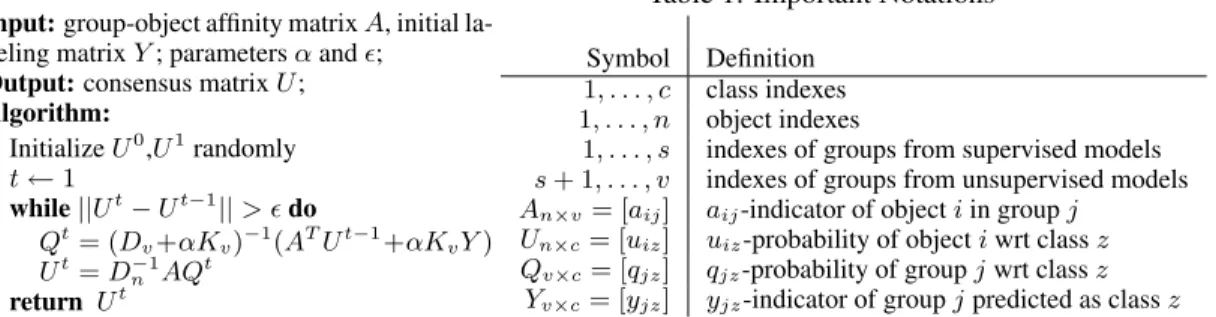
Algorithm 1BGCM algorithm
Input:group-object affinity matrixA, initial la-beling matrixY; parametersαand²;
Output:consensus matrixU;
Algorithm: InitializeU0,U1randomly t←1 while||Ut−Ut−1||> ²do Qt= (Dv+αKv)−1(ATUt−1+αK vY) Ut=D−1 n AQt return Ut
Table 1: Important Notations
Symbol Definition
1, . . . , c class indexes
1, . . . , n object indexes
1, . . . , s indexes of groups from supervised models s+ 1, . . . , v indexes of groups from unsupervised models An×v= [aij] aij-indicator of objectiin groupj
Un×c= [uiz] uiz-probability of objectiwrt classz Qv×c= [qjz] qjz-probability of groupjwrt classz
Yv×c= [yjz] yjz-indicator of groupjpredicted as classz
Pn
i=1aij +αkj >0. Therefore it is strictly convex and∇~qj·f(Q, U
(t−1)) = 0gives the unique
global minimum of the cost function with respect to~qj·in Eq. (2). Similarly, fixingQ, the unique
global minimum with respect to~ui·is also obtained.
~q(jt·)= Pn i=1Paiju~(it·−1)+αkj~yj· n i=1aij+αkj ~u (t) i· = Pv j=1aij~q(jt·) Pv j=1aij (2) The update formula in matrix forms are given in Algorithm 1. Dv =diag
© (Pni=1aij) ª v×vand Dn =diag © (Pvj=1aij) ª
n×nact as the normalization factors. Kv =diag
©
(Pcz=1yjz)
ª
v×v indi-cates the existence of constraints on the group nodes. During each iteration, the probability estimate at each group node (i.e.,Q) receives the information from its neighboring object nodes while retains its initial valueY, and in return the updated probability estimates at group nodes propagate the in-formation back to its neighboring object nodes when updatingU. It is straightforward to prove that
(Q(t), U(t))converges to a stationary point of the optimization problem [3].
In [14], we proposed a heuristic method to combine heterogeneous information sources. In this pa-per, we bring up the concept of consensus maximization and solve the problem over a bipartite graph representation. Our proposed method is related to graph-based semi-supervised learning (SSL). But existing SSL algorithms only take one supervised source (i.e., the labeled objects) and one unsu-pervised source (i.e., the similarity graph) [29, 8], and thus cannot be applied to combine multiple models. Some SSL methods [16] can incorporate results from an external classifier into the graph, but obviously they cannot handle multiple classifiers and multiple unsupervised sources. To apply SSL algorithms on our problem, we must first fuse all supervised models into one by some ensem-ble approach, and fuse all unsupervised models into one by defining a similarity function. Such a compression may lead to information loss, whereas the proposed method retains all the information and thus consensus can be reached among all the based model output.
3 Interpretations
In this part, we explain the proposed method from two independent perspectives.
Constrained Embedding. Now we focus on the “hard” consensus solution, i.e., each point is assigned to exactly one class. SoU andQare indicator matrices:uiz = 1if the ensemble assigns xi to classz, and 0 otherwise; similar forqjz’s. For group nodes from classification algorithms, we will treat their entries inQas known since they have been assigned a class label by one of the classifiers, that is,qjz=yjz for1≤j≤s.
BecauseUrepresents the consensus, we should let groupgjcorrespond to classzif majority of the objects in groupgjcorrespond to classzin the consensus solution. The optimization is thus:
min Q,U v X j=1 c X z=1 ¯ ¯ ¯ ¯qjz− Pn i=1aijuiz Pn i=1aij ¯ ¯ ¯ ¯ (3) s.t. c X z=1 uiz= 1∀i∈ {1, . . . , n} c X z=1 qjz= 1∀j∈ {s+1, . . . , v} uiz∈ {0,1} qjz∈ {0,1} (4) qjz = 1 ∀j∈ {1, . . . , s} ifgj’s label isz qjz= 0 ∀j∈ {1, . . . , s} ifgj’s label is notz (5)
Here, the two indicator matricesU andQcan be viewed as embeddingx1, . . . , xn (object nodes) andg1, . . . , gv (group nodes) into ac-dimensional cube. Due to the constraints in Eq. (4),~ui·and
~qj· reside on the boundary of the (c−1)-dimensional hyperplane in the cube. ~a·j denotes the objects groupgj contains,~qj·can be regarded as the group representative in this new space, and
thus it should be close to the group mean:
Pn i=1aij~ui· Pn
i=1aij . For thesgroups obtained from classification
algorithms, we know their “ideal” embedding, as represented in the constraints in Eq. (5).
We now relate this problem to the optimization framework discussed in Section 2.aijcan only take value of 0 or 1, and thus Eq. (3) just depends on the cases whenaij = 1. Whenaij = 1, no matter qjzis 1 or 0, we have|qjz Pn i=1aij− Pn i=1aijuiz|= Pn i=1|aij(qjz−uiz)|. Therefore, X j:aij=1 c X z=1 ¯ ¯ ¯ ¯qjz− Pn i=1aijuiz Pn i=1aij ¯ ¯ ¯ ¯= X j:aij=1 c X z=1 ¯ ¯qjzPn i=1aij− Pn i=1aijuiz ¯ ¯ Pn i=1aij = X j:aij=1 c X z=1 Pn i=1|aij(qjz−uiz)| Pn i=1aij
Suppose the groups found by the base models have balanced size, i.e.,Pni=1aij =γwhereγis a constant for∀j. Then the objective function can be approximated as:
X j:aij=1 c X z=1 n X i=1 |aij(qjz−uiz)|= n X i=1 X j:aij=1 aij c X z=1 |qjz−uiz|= n X i=1 v X j=1 aij c X z=1 |qjz−uiz| Therefore, when the classification and clustering algorithms generate balanced groups, with the same set of constraints in Eq. (4) and Eq. (5), the constrained embedding problem in Eq. (3) is equivalent to: minQ,U
Pn
i=1
Pv
j=1aij
Pc
z=1|qjz−uiz|. It is obvious that this is the same as the optimization problem we propose in Section 2 with two relaxations: 1) We transform hard constraints in Eq. (5) to soft constraints where the ideal embedding is expressed in the initial labeling matrixY and the price for violating the constraints is set toα. 2)uizandqjzare relaxed to have values between 0 and 1, instead of either 0 or 1, and quadratic cost functions replace the L1 norms. So they are probability estimates rather than class membership indicators, and we can embed them anywhere on the plane. Though with these relaxations, we build connections between the constrained embedding framework as discussed in this section with the one proposed in Section 2. Therefore, we can view our proposed method as embedding both object nodes and group nodes into a hyperlane so that object nodes are close to the group nodes they link to. The constraints are put on the group nodes from supervised models to penalize the embedding that are far from the “ideal” ones.
Ranking on Consensus Structure.Our method can also be viewed as conducting ranking with re-spect to each class on the bipartite graph, where group nodes from supervised models act as queries. Suppose we wish to know the probability of any groupgjbelonging to class 1, which can be regarded as the relevance score ofgj with respect to example queries from class 1. Letwj =
Pn
i=1aij. In
Algorithm 1, the relevance scores of all the groups are learnt using the following equation: ~q·1= (Dv+αKv)−1(ATD−n1A~q·1+αKv~y·1) =Dλ(D−v1ATDn−1A)~q·1+D1−λ~y·1
where thev×vdiagonal matricesDλandD1−λhave(j, j)entries as wjw+jαkj and
αkj
wj+αkj.
Consider collapsing the original bipartite graph into a graph with group nodes only, thenATAis its affinity matrix. After normalizing it to be a probability matrix, we havepij inP =Dv−1ATDn−1A represent the probability of jumping to nodej from nodei. The groups that are predicted to be in class 1 by one of the supervised models have 1 at the corresponding entries in~y·1, therefore these
group nodes are “queries” and we wish to rank the group nodes according to their relevance to them. Comparing our ranking model with PageRank model [24], there are the following relationships: 1) In PageRank, a uniform vector with entries all equal to 1 replaces~y·1. In our model, we use~y·1to
show our preference towards the query nodes, so the resulting scores would be biased to reflect the relevance regarding class 1. 2) In PageRank, the weightsDλ andD1−λare fixed constantsλand
1−λ, whereas in our modelDλ andD1−λ give personalized damping factors, where each group has a damping factorλj = wj+wjαkj. 3) In PageRank, the value of link-votes are normalized by the number of outlinks at each node, whereas our ranking model does not normalizepij on its outlinks, and thus can be viewed as an un-normalized version of personalized PageRank [18, 28]. When each base model generates balanced groups, bothλjand outlinks at each node become constants, and the proposed method simulates the standard personalized PageRank.
Table 2: Data Sets Description
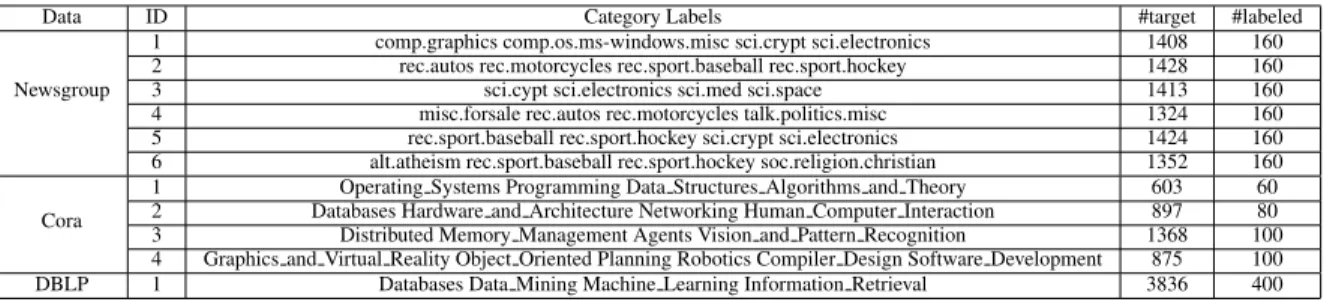
Data ID Category Labels #target #labeled
1 comp.graphics comp.os.ms-windows.misc sci.crypt sci.electronics 1408 160 2 rec.autos rec.motorcycles rec.sport.baseball rec.sport.hockey 1428 160 Newsgroup 3 sci.cypt sci.electronics sci.med sci.space 1413 160 4 misc.forsale rec.autos rec.motorcycles talk.politics.misc 1324 160 5 rec.sport.baseball rec.sport.hockey sci.crypt sci.electronics 1424 160 6 alt.atheism rec.sport.baseball rec.sport.hockey soc.religion.christian 1352 160 1 Operating Systems Programming Data Structures Algorithms and Theory 603 60 2 Databases Hardware and Architecture Networking Human Computer Interaction 897 80 Cora
3 Distributed Memory Management Agents Vision and Pattern Recognition 1368 100 4 Graphics and Virtual Reality Object Oriented Planning Robotics Compiler Design Software Development 875 100 DBLP 1 Databases Data Mining Machine Learning Information Retrieval 3836 400
The relevance scores with respect to class 1 for group and object nodes will converge to
~q·1= (Iv−DλD−v1ATDn−1A)−1D1−λ~y·1 ~u·1= (In−D−n1ADλDv−1AT)−1Dn−1AD1−λ~y·1
respectively. IvandIn are identity matrices with sizev×vandn×n. The above arguments hold for the other classes as well, and thus each column inU andQrepresents the ranking of the nodes with respect to each class. Because each row sums up to 1, they are conditional probability estimates of the nodes belonging to one of the classes.
4 Incorporating Labeled Information
Thus far, we propose to combine the output of supervised and unsupervised models by consensus. When the true labels of the objects are unknown, this is a reliable approach. However, incorporating labels from even a small portion of the objects may greatly refine the final hypothesis. We assume that labels of the firstlobjects are known, which is encoded in ann×cmatrixF:
fiz= 1, xi’s observed label isz,i= 1, . . . , l; 0, otherwise.
We modify the objection function in Eq. (1) to penalize the deviation of~ui·of labeled objects from
the observed label: f(Q, U) = n X i=1 v X j=1 aij||~ui·−~qj·||2+α v X j=1 kj||~qj·−~yj·||2+β n X i=1 hi||~ui·−f~i·||2 (6) wherehi= Pc
z=1fiz. Wheni= 1, . . . , l,hi= 1, so we enforce the constraints that an objectxi’s consensus class label estimate should be close to its observed label with a shadow priceβ. When i=l+ 1, . . . , n,xiis unlabeled. Therefore,hi= 0and the constraint term is eliminated from the objective function. To update the condition probability for the objects, we incorporate their prior labeled information: ~ uti·= Pv j=1aij~qtj·+βhif~i· Pv j=1aij+βhi (7) In matrix forms, it would be Ut = (D
n + βHn)−1(AQt + βHnF) with Hn = diag©(Pcz=1fiz)
ª
n×n. Note that the initial conditional probability of a labeled object is 1 at its observed class label, and 0 at all the others. However, this optimistic estimate will be changed during the updates, with the rationale that the observed labels are just random samples from some multinomial distribution. Thus we only use the observed labels to bias the updating procedure, instead of totally relying on them.
5 Experiments
We evaluate the proposed algorithms on eleven classification tasks from three real world applica-tions. In each task, we have a target set on which we wish to predict class labels. Clustering algorithms are performed on this target set to obtain the grouping results. On the other hand, we learn classification models from some training sets that are in the same domain or a relevant domain with respect to the target set. These classification models are applied to the target set as well. The proposed algorithm generates a consolidated classification solution for the target set based on both classification and clustering results. We elaborate details of each application in the following.
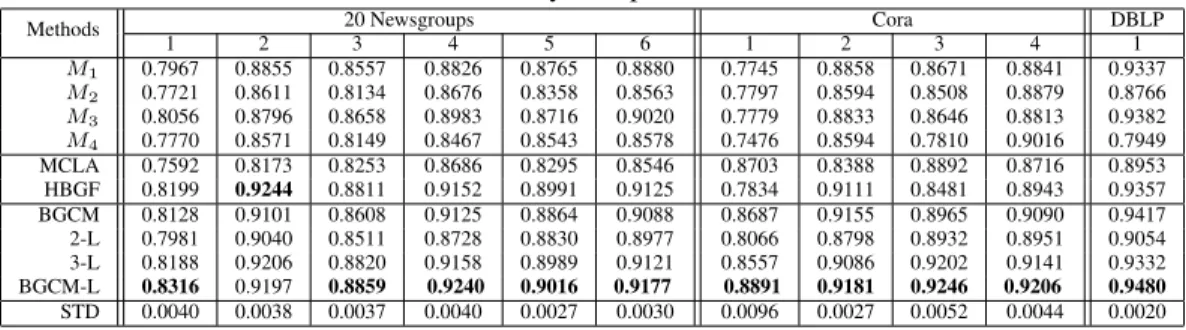
Table 3: Classification Accuracy Comparison on a Series of Data Sets 20 Newsgroups Cora DBLP Methods 1 2 3 4 5 6 1 2 3 4 1 M1 0.7967 0.8855 0.8557 0.8826 0.8765 0.8880 0.7745 0.8858 0.8671 0.8841 0.9337 M2 0.7721 0.8611 0.8134 0.8676 0.8358 0.8563 0.7797 0.8594 0.8508 0.8879 0.8766 M3 0.8056 0.8796 0.8658 0.8983 0.8716 0.9020 0.7779 0.8833 0.8646 0.8813 0.9382 M4 0.7770 0.8571 0.8149 0.8467 0.8543 0.8578 0.7476 0.8594 0.7810 0.9016 0.7949 MCLA 0.7592 0.8173 0.8253 0.8686 0.8295 0.8546 0.8703 0.8388 0.8892 0.8716 0.8953 HBGF 0.8199 0.9244 0.8811 0.9152 0.8991 0.9125 0.7834 0.9111 0.8481 0.8943 0.9357 BGCM 0.8128 0.9101 0.8608 0.9125 0.8864 0.9088 0.8687 0.9155 0.8965 0.9090 0.9417 2-L 0.7981 0.9040 0.8511 0.8728 0.8830 0.8977 0.8066 0.8798 0.8932 0.8951 0.9054 3-L 0.8188 0.9206 0.8820 0.9158 0.8989 0.9121 0.8557 0.9086 0.9202 0.9141 0.9332 BGCM-L 0.8316 0.9197 0.8859 0.9240 0.9016 0.9177 0.8891 0.9181 0.9246 0.9206 0.9480 STD 0.0040 0.0038 0.0037 0.0040 0.0027 0.0030 0.0096 0.0027 0.0052 0.0044 0.0020 20 Newsgroup categorization.We construct six learning tasks, each of which involves four classes. The objective is to classify newsgroup messages according to topics. We used the version [1] where the newsgroup messages are sorted by date, and separated into training and test sets. The test sets are our target sets. We learn logistic regression [15] and SVM models [7] from the training sets, and apply these models, as well as K-means and min-cut clustering algorithms [22] on the target sets. Cora research paper classification. We aim at classifying a set of research papers into their areas [23]. We extract four target sets, each of which includes papers from around four areas. The train-ing sets contain research papers that are different from those in the target sets. Both traintrain-ing and target sets have two views, the paper abstracts, and the paper citations. We apply logistic regression classifiers and K-means clustering algorithms on the two views of the target sets.
DBLP data. We retrieve around 4,000 authors from DBLP network [10], and try to predict their research areas. The training sets are drawn from a different domain, i.e., the conferences in each research field. There are also two views for both training and target sets, the publication network, and the textual content of the publications. The amount of papers an author published in the conference can be regarded as link feature, whereas the pool of titles that an author published is the text feature. Logistic regression and K-means clustering algorithms are used to derive the predictions on the target set. We manually label the target set for evaluation.
The details of each learning task are summarized in Table 2. On each target set, we apply four modelsM1 toM4, where the first two are classification models and the remaining two are
clus-tering models. We denote the proposed method as Bipartite Graph-based Consensus Maximization (BGCM), which combines the output of the four models. As shown in Figure 3, only clustering ensembles, majority voting methods, and the proposed BGCM algorithm work at the meta output level where raw data are discarded and only prediction results from multiple models are available. However, majority voting can not be applied when there are clustering models because the cor-respondence between clusters and classes is unknown. Therefore, we compare BGCM with two clustering ensemble approaches (MCLA[26] andHBGF[12]), which ignore the label information from supervised models, regard all the base models as unsupervised clustering, and integrate the output of the base models. So they only give clustering solutions, not classification results.
To evaluate classification accuracy, we map the output of all the clustering algorithms (the base models, and the ensembles) to the best possible class predictions with the help of hungarian method [5], where cluster IDs are matched with class labels. Actually, it is “cheating” because the true class labels are used to do the mapping, and thus it should be able to generate the best accuracy from these unsupervised models. As discussed in Section 4, we can incorporate a few labeled objects, which are drawn from the same domain of the target set, into the framework and improve accuracy. This improved version of the BGCM algorithm is denoted asBGCM-L, and the number of labeled objects used in each task is shown in Table 2. On each task, we repeat the experiments 50 times, each of which has randomly chosen target and labeled objects, and report the average accuracy. Due to space limit, we only show the standard deviation (STD) for BGCM-L method. The baselines share very similar standard deviation with the reported one on each task.
Accuracy. In Table 3, we summarized the classification accuracy of all the baselines and the pro-posed approach on the target sets of eleven tasks. The two single classifiers (M1andM2), and the
two clustering single models (M3andM4) usually have low accuracy. By combining all the base
models, the clustering ensemble approaches (MCLA and HBGF) can improve the performance over each single model. However, these two methods are not designed for classification, and the reported
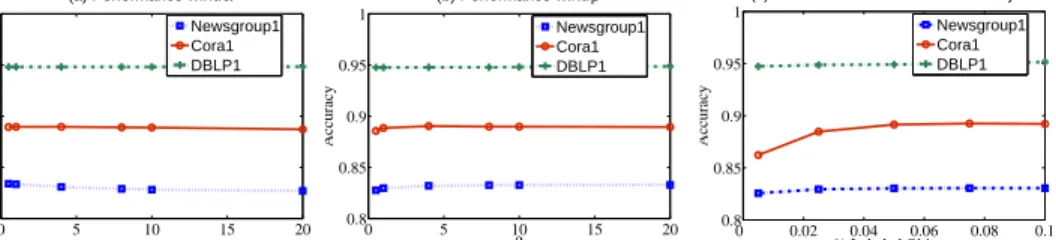
0 5 10 15 20 0.8 0.85 0.9 0.95 1 α Accuracy (a) Performance w.r.t. α Newsgroup1 Cora1 DBLP1 0 5 10 15 20 0.8 0.85 0.9 0.95 1 β Accuracy (b) Performance w.r.t. β Newsgroup1 Cora1 DBLP1 0 0.02 0.04 0.06 0.08 0.1 0.8 0.85 0.9 0.95 1 % Labeled Objects Accuracy
(c) Performance w.r.t. % Labeled Objects Newsgroup1 Cora1 DBLP1
Figure 4: Sensitivity Analysis
accuracy is the upper bound of their “true” accuracy. The proposed BGCM method always outper-forms the base models, and achieves better or comparable performances compared with the upper bound of the baseline ensembles. By incorporating a small portion (around 10%) of labeled objects, the BGCM-L method further improves the performances. The consistent increase in accuracy can be observed in all the tasks, where the margin between the accuracy of the best single model and that of the BGCM-L method is from 2% to 10%. Even when taking variance into consideration, the results demonstrate the power of consensus maximization in accuracy improvements.
Sensitivity.As shown in Figure 4 (a) and (b), the proposed BGCM-L method is not sensitive to the parametersαandβ. To make the plots clear, we just show the performance on the first task of each application. αandβ are the shadow prices paid for deviating from the estimated labels of groups and observed labels of objects, so they should be greater than 0. αandβ represent the confidence of our belief in the labels of the groups and objects compared with 1. The labels of group nodes are obtained from supervised models and may not be correct, therefore, a smallerαusually achieves better performance. On the other hand, the labels of objects can be regarded as groundtruths, and thus the largerβ the better. In experiments, we find that whenαis below 4, andβ greater than 4, good performance can be achieved. We letα= 2andβ = 8to get the experimental results shown in Table 3. Also, we fix the target set as 80% of all the objects, and use 1% to 20% as the labeled objects to see how the performance varies, and the results are summarized in Figure 4 (c). In general, more labeled objects would help the classification task where the improvements are more visible on Cora data set. When the percentage reaches 10%, BGCM-L’s performance becomes stable. Number of Models. We vary the number of base models incorporated into the consensus frame-work. The BGCM-L method on two models is denoted as2-L, where we average the performance of the combined model obtained by randomly choosing one classifier and one clustering algorithm. Similarly, the BGCM-L method on three models is denoted as3-L. From Table 3, we can see that BGCM-L method using all the four models outperforms the method incorporating only two or three models. When the base models are independent and each of them obtains reasonable accuracy, combining more models would benefit more because the chances of reducing independent errors increase. However, when the new model cannot provide additional information to the current pool of models, incorporating it may not improve the performance anymore. In the future, we plan to identify this upper bound through experiments with more input sources.
6 Conclusions
In this work, we take advantage of the complementary predictive powers of multiple supervised and unsupervised models to derive a consolidated label assignment for a set of objects jointly. We propose to summarize base model output in a group-object bipartite graph, and maximize the con-sensus by promoting smoothness of label assignment over the graph and consistency with the initial labeling. The problem is solved by propagating labeled information between group and object nodes through their links iteratively. The proposed method can be interpreted as conducting an embedding of object and group nodes into a new space, as well as an un-normalized personalized PageRank. When a few labeled objects are available, the proposed method uses them to guide the propagation and refine the final hypothesis. In the experiments on 20 newsgroup, Cora and DBLP data, the proposed consensus maximization method improves the best base model accuracy by 2% to 10%. AcknowledgementThe work was supported in part by the U.S. National Science Foundation grants IIS-08-42769, IIS-09-05215 and DMS-07-32276, and the Air Force Office of Scientific Research MURI award FA9550-08-1-0265.
References
[1] 20 Newsgroups Data Set. http://people.csail.mit.edu/jrennie/20Newsgroups/.
[2] E. Bauer and R. Kohavi. An Empirical Comparison of Voting Classification Algorithms: Bagging, Boost-ing, and Variants.Machine Learning, 36:105–139, 2004.
[3] Dimitri P. Bertsekas. Non-Linear Programming (2nd Edition).Athena Scientific, 1999.
[4] A. Blum and T. Mitchell. Combining Labeled and Unlabeled Data with Co-training. InProc. of COLT’ 98, pages 92–100, 1998.
[5] N. Borlin. Implementation of Hungarian Method. http://www.cs.umu.se/∼niclas/matlab/assignprob/. [6] R. Caruana. Multitask Learning.Machine Learning, 28:41–75, 1997.
[7] C.-C. Chang and C.-J. Lin. LibSVM: a Library for Support Vector Machines, 2001. Software available at http://www.csie.ntu.edu.tw/∼cjlin/libsvm.
[8] O. Chapelle, B. Sch¨olkopf and A. Zien (eds). Semi-Supervised Learning.MIT Press, 2006.
[9] K. Crammer, M. Kearns and J. Wortman. Learning from Multiple Sources.Journal of Machine Learning Research, 9:1757-1774 , 2008.
[10] DBLP Bibliography. http://www.informatik.uni-trier.de/∼ley/db/.
[11] T. Dietterich. Ensemble Methods in Machine Learning. InProc. of MCS ’00, pages 1–15, 2000. [12] X. Z. Fern and C. E. Brodley. Solving Cluster Ensemble Problems by Bipartite Graph Partitioning. In
Proc. of ICML’ 04, pages 281–288, 2004.
[13] K. Ganchev, J. Graca, J. Blitzer, and B. Taskar. Multi-view Learning over Structured and Non-identical Outputs. InProc. of UAI’ 08, pages 204–211, 2008.
[14] J. Gao, W. Fan, Y. Sun, and J. Han. Heterogeneous source consensus learning via decision propagation and negotiation. InProc. of KDD’ 09, pages 339–347, 2009.
[15] A. Genkin, D. D. Lewis, and D. Madigan. BBR: Bayesian Logistic Regression Software. http://stat.rutgers.edu/∼madigan/BBR/.
[16] A. Goldberg and X. Zhu. Seeing stars when there aren’t many stars: Graph-based semi-supervised learning for sentiment categorization. InHLT-NAACL 2006 Workshop on Textgraphs.
[17] A. Gionis, H. Mannila, and P. Tsaparas. Clustering Aggregation. ACM Transactions on Knowledge Discovery from Data, 1(1), 2007.
[18] T. Haveliwala. Topic-Sensitive PageRank: A Context-Sensitive Ranking Algorithm for Web Search. IEEE Transactions on Knowledge and Data Engineering, 15(4):1041-4347, 2003.
[19] J. Hoeting, D. Madigan, A. Raftery, and C. Volinsky. Bayesian Model Averaging: a Tutorial. Statistical Science, 14:382–417, 1999.
[20] R. Jacobs, M. Jordan, S. Nowlan, and G. Hinton. Adaptive Mixtures of Local Experts.Neural Computa-tion, 3:79-87, 1991.
[21] T. Joachims. Transductive Learning via Spectral Graph Partitioning. InProc. of ICML’ 03, pages 290– 297, 2003.
[22] G. Karypis. CLUTO – Family of Data Clustering Software Tools. http://glaros.dtc.umn.edu/gkhome/views/cluto.
[23] A. McCallum, K. Nigam, J. Rennie, and K. Seymore. Automating the Construction of Internet Portals with Machine Learning.Information Retrieval Journal, 3:127–163, 2000.
[24] L. Page, S. Brin, R. Motwani, and T. Winograd. The PageRank Citation Ranking: Bringing Order to the Web.Technical Report, Stanford InfoLab, 1999.
[25] V. Singh, L. Mukherjee, J. Peng, and J. Xu. Ensemble Clustering using Semidefinite Programming. In Proc. of NIPS’ 07, 2007.
[26] A. Strehl and J. Ghosh. Cluster Ensembles – a Knowledge Reuse Framework for Combining Multiple Partitions.Journal of Machine Learning Research, 3:583–617, 2003.
[27] D. Wolpert. Stacked Generalization.Neural Networks, 5:241–259, 1992.
[28] D. Zhou , J. Weston, A. Gretton, O. Bousquet and B. Scholkopf. Ranking on Data Manifolds. InProc. of NIPS’ 03, pages 169–176, 2003.
[29] X. Zhu. Semi-supervised Learning Literature Survey. Technical Report 1530, Computer Sciences, Uni-versity of Wisconsin-Madison, 2005.