7
Social Search
Peter Brusilovsky1, Barry Smyth2, and Bracha Shapira3
1 School of Computing and Information, University of Pittsburgh, Pittsburgh, PA 15260,
2 Insight Centre for Data Analytics School of Computer Science, University College Dublin,
Ireland,[email protected]
3 Department of software and Information Systems Engineering, Ben-Gurion University of
the Negev, Beer-Sheva 84105, Israel,[email protected]
Abstract. Today, most people find what they are looking for online by using search engines such as Google, Bing, or Baidu. Modern web search engines have evolved from their roots in information retrieval to developing new ways to cope with the unique nature of web search. In this chapter, we review recent research that aims to make search a more social activity by combining readily available social signals with various strategies for using these signals to influence or adapt more conventional search results. The chapter begins by framing the social search landscape in terms of the sources of data available and the ways in which this can be leveraged before, during, and after search. This includes a number of detailed case studies that serve to mark important milestones in the evolution of social search research and practice.
1 Introduction
Search-based information access is the most popular way for people to locate information online, and the text-based query-box and search button have become a ubiquitous user interface component across the gamut of operating systems and apps. Usually when we have a general information need, we start with a query and a search engine, such as Google or Bing, and simple browsing or recommendation engines play a secondary role. Search-based information access has a long research heritage that began with early work on information retrieval during the early 1970s [169]. Somewhat surprisingly, despite at least 40 years of active research and practice, the world of information retrieval and web search has largely focused on a single-user embodiment that still informs modern search engines. By and large, modern search is framed as a single-user activity in which a lone searcher conducts their search in isolation from others, despite the fact that other users may experience similar information needs, or may have satisfied the same or similar needs in the past. Given this, why shouldn’t search be viewed as a more social or collaborative enterprise by harnessing the past work or present needs of others? While a few visionary projects from Memex [39] to Superbook [165] have suggested some ideas about how to leverage the power of community
for information finding, it was not until the second part of 1990 that this idea of a more social approach to search — what we will refer to as “social search” — enjoyed a sustained and systematic interest from the research community.
In this chapter, we adopt the major theme of this book by defining social search as any approach to information search that harnesses the information access patterns of other users, whether past or present. One way to achieve this is to leverage the query and selection traces of past searchers to help future searchers to find what they are looking for, either by helping them to formulate better queries or to identify more promising leads by promoting more relevant content. Before the age of the web, the opportunities for collecting sufficient vol-ume of user “search traces” were limited. This changed as the world of the web became the world of search. Today, the volume of queries and selections that feed modern search engines provides a unique resource for social search endeavors. In fact, as search engines continuously look for new ways to improve their per-formance, such data doesn’t just enable social search, but provides an appealing opportunity to radically transform how we search. By 1997, the search engines of the day were already collecting increasing volumes of queries and clicks from their users. Even at this early stage, the Web had outgrown traditional query-based, term-matching, information-retrieval techniques as a viable solution to the challenges of general web search. This led to a explosion of creative ideas, by exploring several kinds of novel search data and user traces to address press-ing problems such as query formulation [163, 58, 74, 85] and document rankpress-ing [57, 36, 53, 217].
Indeed, the “big idea” for modern search emerged from this early work, as sev-eral researchers independently highlighted the power of various forms of search traces – what we might now refer to as social, community, or crowd data – to fundamentally change web search from its information-retrieval origins. Most in-fluential were two novel search engines: Google [36], which leveraged community page linking for better ranking; and DirectHit [202], which leveraged user queries and page exploration behavior for query term suggestion [58] and ranking [57]. Over the next 15 years, this stream of work gradually became an important and active research direction at the crossroads of information retrieval, social com-puting, and intelligent interfaces. The work produced over these years explored a much larger variety of social traces and suggested many novel ideas for using social information to enhance search.
This chapter attempts to provide a systematic overview of social search as a research stream, with a comprehensive account of the core ideas that underpin modern social search approaches and by highlighting social search in practice through a variety of case studies. It complements two other chapters in this book that offer a deeper analysis of two specific areas of social search: Chapter 8 on network-based social search [92] and Chapter 9 on using tags for social search [149]. The chapter is structured as follows. The next section attempts to frame social search to define key dimensions for its classification. We position social search in a broader context, compare and contrast various definitions of social search, identify key sources of information for social search, and elucidate the
main stages of the information retrieval process where social information can be leveraged. The subsequent sections go on to review the main approaches for using social data in each of the identified stages. Following that, we examine the problem of making social search more personalized with a review of a number of cases studies to demonstrate different ways of addressing the personalization challenge. We conclude with a final review of two case studies that attempt to go beyond the usual borders of social search by connecting social search with other forms of social information access approaches reviewed in this book.
2 Framing Social Search
In this chapter, we attempt to frame social search as a unique approach to web search and information discovery, which sits at the intersection between infor-mation retrieval, social computing, and intelligent interfaces. We pay particular attention to the sources of information that drive social search and the social search process. But first, it is useful to review the evolution of search search and, in particular, to distinguish between two common viewpoints: using sources of social data to support search versus searching social data sources.
2.1 Defining Social Search
A useful working definition for social search, albeit a very broad one, is that it refers to a group of approaches that use past user behavior to assist current users in finding information that satisfies a specific information need. Such an information need is typically represented by a query or question and is satisfied by the retrieval of some unit of information, which is typically (but not limited to) a web page. This definition follows the original understanding of the term social search, which emerged from several early papers between 1997 and 2007 during the first decade of research on this topic [74, 102, 77, 37, 8, 140, 76]. This perspective can be also considered as a useful match with terminology used in other well-defined types of social information access, such as social navigation and social bookmarking, although with a different emphasis on how information needs are expressed or satisfied.
It is important to note, however, how the increased popularity of social media and social networking in the decade that followed has encouraged a range of other definitions of social search, many of which differ from one another as well as from its original meaning. Most of these recent definitions framed social search as search within social media content or data. For example, Carmel et al. [41] use the term social search “to describe the search process over ‘social’ data gathered from Web 2.0 applications, such as social bookmarking systems, wikis, blogs, forums, social network sites (SNSs), and many others”. Similarly,
Wikipedia defines social search as “a behavior of retrieving and searching on a social searching engine that mainly searches user-generated content such as news, videos, and images related search queries on social media like Facebook, Twitter, Instagram, and Flickr” [203].
On the other hand, Bao et al. [21], who were among the first to use the term “social search” in the context of social media, defined it as “utilizing social annotations for better web search”. Amitay et al. [13] also understand social search as “leveraging social information to enhance search results” where by social information authors mean information collected by social systems such social bookmarking and networking services. McDonnell and Shiri [137] define social search as “the use of social media to assist in finding information on the internet”. Evans and Chi [67, 68] expand this understanding of social search further: “Social search is an umbrella term used to describe search acts that make use of social interactions with others. These interactions may be explicit or implicit, co-located or remote, synchronous or asynchronous.”
The first group of these definitions focus onsearching social data sourcesand, as such, are somewhat orthogonal to our understanding of social search, since they distinguish social search by the type of content to be searched (i.e., social media contents). The second group emphasizes the use of social data during search, regardless of what is being searched, and is fully consistent with the meaning of social search used in this paper. At the same time, this definition narrows the scope of the “social data” that can be used to improve search to those data collected by social systems. In contrast, for the purpose of this work, our definition of social search refers to approaches that can improve search using all kinds of information traces left by past users/searchers, both inside and outside social media systems. As will be explained below, this chapter considers a variety of past information traces that range from queries and clicks, to votes and tags, to comments and social links, and everything in between. The common denominator is the use of any and all information left, or contributed by, users as a side effect of their natural information-seeking behaviors.
2.2 Sources of Social Information
Following the goal of the book, this chapter attempts to show how search pro-cesses can be improved using various kinds of explicit and implicit social infor-mation, and specifically traces left by previous users. The introductory chapter of this book [38] offered a classification of such traces and where they might be sourced. Here we focus on a subset of these traces: those that have been found to be useful for users and that have been used to explore search systems. Below, we review the main sources of social information for social search, along with the types of social information that is usually available within these sources. These sources provide one of the two primary dimensions in our classification of social search techniques.
2.2.1 Search Engine Logs Search engines routinely collect query session logs. A typical query session log includes queries issued by the users and the result pages selected, or “clicked”, by the user on the search engine result page (SERP). More sophisticated logging may include additional data, such as dwell time, within-page behavior, and even post-query browsing. Either way, queries and clicks are perhaps the most important and popular kinds of social information, which can be used alone or in concert to guide social search.
2.2.2 Information Links User-generated links, created by content authors
between information items, such as Web pages, are another important source of community wisdom. Web page authors make extensive use of hyperlinks to create the webs of content that underpin the world wide web. and these links have served as one of the earliest sources of social information used to improve the search process [36, 84]. Moreover, beyond traditional “open Web” and its hyperlinks, social search systems now use links created by users of the many and varied Web-based systems the exist today, such as wikis, blogs, and micro-blogs, for example.
2.2.3 Browsing Trails Surfers of the “open Web” and other Web-based
sys-tems leave extensive browsing trails as they travel from content to content. Within a single Web site, clicked links are also routinely collected in web logs and provide yet another source of information-seeking behavior. Beyond these routine browsing traces, traces of browsing behavior can also be accumulated by using various browsing agents [129], proxy-based intermediaries [23] or browser plugins, such as Alexa or HeyStaks [181]. For the interested reader, a compre-hensive review of user tracking approaches beyond single-site borders can be found in [83].
2.2.4 Annotation and Comments User annotations and comments are
ex-amples of the “secondary” information content that can accumulate to augment primary content such as Web pages or product descriptions. In a Web con-text, annotation functionality is provided by various Web annotation systems including the original Annotea project from the WWW Consortium [108]. In-deed, today user-generated comments and reviews are commonplace across most e-commerce sites and have proven to be a powerful source of collective user opin-ion, helping to guide many users as they consider their choices among an ocean of products and services, from Amazon1to Yelp2.
2.2.5 Curation Systems We use the termcuration systemto distinguish
sev-eral types of systems where users collectively collaborate to collect and organize content for future consumption. This includes hierarchically organized directo-ries, such as the Open Directory Project (dmoz.org), guided path systems [81], and page grouping systems [177, 2]. Most important among the curation systems, from the perspective of Web search, are social bookmarking systems, which allow 1 http://amazon.com
their users to openly share various information items (Web pages, photographs, research papers) while providing textualcomments andtag-based annotations.
2.2.6 Blogs and Microblogs Conventional blogs, as well as micro-blog
sys-tems such as Twitter, have emerged as important contemporary sources of pri-mary user-generated content, and are now increasingly used by search systems. Just like in other contexts, an explicit reference to a Web page (i.e, a Web link) or another item (i.e., a movie) in a blog post or a tweet is a signal of its social value, with surrounding text providing a context for mentioning the link.
2.2.7 Social Links Social links — such as the friendship connections between
social network users — carry important information about relationships between users. There are several examples of social search systems that use direct links of various kinds (trust, friendship, etc.), as well as indirect links, such as those formed by the users who have joined the same social group. Social links originate in the social linking systems — originally systems like Friendster and MySpace, and today, platforms like Facebook and LinkedIn — but today the idea of a social link has evolved beyond a simple friendship connection. For example, Twitter allows user to follow and mention other users, while social bookmarking systems usually support “watch” links that help to keep interested users informed about changes and updates.
2.3 The Social Search Process
While conventional search might appear to be an atomic, mostly single-shot process — “submit a query, get results” — it is naturally comprised of several distinct stages. These various all stand to benefit in different ways from different kinds of social information. To better organize our review of social search, this section presents an “anatomy” of the social search process as a sequence of actions to be performed by both the user and the search system.
A sensible and straightforward decomposition of search identifies three obvi-ous stages: “before search”, “during search”, and “after search”. This decompo-sition was used in the past for the analysis of personalized [139] and social search [68]. It remains useful here because it serves to separate social search enhance-ments into those that might be provided as external supports (before or after search) and therefore potentially provided as third-party enhancements, versus those than are contrived asinternalsupports (during search), and therefore more naturally provided by search engines themselves.
2.3.1 Before Search This stage includes all actions that must be performed
before a query meets the search engine. On the search engine side, it includes resource discovery (known ascrawling in Web search context) and indexing. On the user side, it includes query formulation and query expansion. The reason to separate query formulation from query expansion is to emphasize how these
processes differ from a user engagement perspective. Query formulation is a user-centered stage during which a search support system can offer valuable assistance. Query expansion is conceived of as a fully automatic process that attempts to improve the query after it is formulated by the user, but before it is received by the search engine.
2.3.2 During Search This stage includes two related processes performed by
the search engine: matching items to the query (and retrieving relevant items) and ranking these items. To distinguish the ranking produced by the search engine from various external or secondary re-ranking approaches, we refer to the former as primary item ranking; the latter will usually be referred to as re-ranking.
2.3.3 After Search This stage includes several types of search enhancements
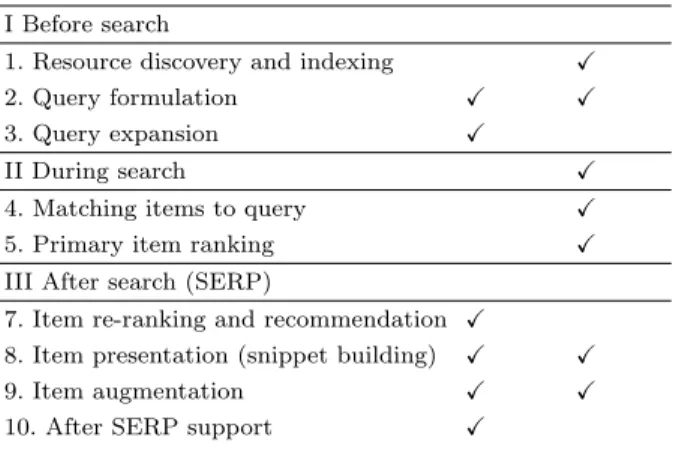
that can be implemented after obtaining an original ranked list of search re-sults in order to produce a better search engine rere-sults page. Historically, these enhancements were produced by “third party” systems, which took the list of results produced by a search engine and returned it in an enhanced form. How-ever, nowadays, some of these enhancements are done by the search engines themselves, as shown in Table 1. The most popular of these enhancements are various kinds of itemre-ranking and recommendation that use social or personal information to change or augment the primary ranking; e.g.[77, 50, 180, 183]. Once the order of presentation is determined, a finalitem presentation needs to be generated, including an item summary or snippet to provide the user with a synopsis of the item. The presentation of individual items may be also aug-mented to emphasize their social or personal relevance. While this concludes the SERP presentation, some projects have explored opportunities to use social informationafter SERP, i.e., to support the user after a specific SERP item has been accessed, as we discuss later in this chapter.
Table 1 Stages of (social) search process
Add-ons Engines I Before search
1. Resource discovery and indexing X
2. Query formulation X X
3. Query expansion X
II During search X
4. Matching items to query X
5. Primary item ranking X
III After search (SERP)
7. Item re-ranking and recommendation X
8. Item presentation (snippet building) X X
9. Item augmentation X X
2.4 The Big Picture View
To summarize, these core stages of the search process are a useful way to organize our review of social search technologies. The following seven sections (3 to 9) review the the use of social information to support each step of the search process listed in Table 1. The unique needs of each step help to frame the approaches taken and the types of social information used. Moreover, by grouping social search approaches by stages, we can clarify their commonalities and connections with their underlying social data sources. To better understand this connection, we also offer Table 2 that groups together approaches, which support the same step of the search process while using the same social information source. In the context of this chapter, Table 2 serves as a “big picture” that provides an overview of the whole social search area and highlighting both well-explored areas and “white spots” on the map of social search. In our review and the organization of Table 2 we mostly follow the order of the search process listed 1. One exception is the section 5, where we review together tightly interrelated social indexing and matching, which belong to different stages in our classification. This section is placed between query expansion and ranking, where its matching aspect belongs.
3 Query Formulation, Elaboration, and Recommendation
Web search is challenging, not only because of the sheer scale of information that exists online, but also because of the simple lack of information retrieval expertise that most searchers exhibit. For example, it is well documented that most searchers begin their searches with vague or under-specified queries. Early work on web search established that most queries contain only 2-3 terms [186, 204, 187] and rarely offer a clear account of the searcher’s real information needs. At the same time, the advanced search features offered by modern search engines (e.g. boolean operators, positional switches, filters etc.) are seldom if ever used; see, for example, [187, 185]. In short, a typical search query is usually woefully incomplete when it comes to the specification of a searcher’s real information needs.
In response to this, there has been a significant amount of work undertaken on how to better support searchers by, for example, elaborating vague queries or recommending better ones. As a source of social information for query elab-oration and recommendation, most systems use search engine logs. The idea of using such logs for accumulating successful queries was originally suggested by [163], and the first simple approach for using search logs to suggest new terms to narrow a search was patented by DirectHit [58]. The first example of a full-scale query recommendation service based on accumulated queries was described in [85] and was followed by a large body of work on query recommendation [60, 101, 75, 19, 132, 22, 184, 121, 192].
Table 2 Stages of Social Search and their support using various sources of social information Source ofSo cial Information Query form ulation Query expansion Indexing Primary Ranking Re-ranking and recommendation Presen tation Augmen tati on After SERP Search Engine Logs [58, 85, 60, 101, 75, 107, 19, 132, 22, 127, 184, 121, 192] [74, 56, 25, 101, 196, 120] [80, 170, 114, 171, 209, 14, 159, 61, 151, 82, 87] [36, 57, 104, 209, 162, 5, 106, 54, 63, 55, 64, 160, 46, 158, 89, 82, 176, 193, 112, 28] [179, 180, 178, 32, 34, 33, 35, 201, 200, 188, 176, 138, 183] [170, 30, 31, 9] [170, 50, 51, 124, 195] [50, 51, 76, 72, 48, 9] Browsing Trails [120] [215] [210, 65, 90, 24, 130, 131, 190, 216, 16] [37, 8, 76, 72, 48, 70] [76, 72, 48] Information Links [15, 119, 59, 52] [44, 53, 153, 198, 215, 78, 151, 117, 87] [43, 36, 84, 44, 115, 53, 198, 153, 215, 78, 160, 117, 205] Annotations and Comments [165, 61] [145, 146] [37, 8, 76, 72, 70] Curation Systems [128, 4, 213, 207] [21, 150, 151, 97, 47, 26, 208, 214, 164, 40, 87] [206, 100, 126, 21, 212, 214, 1, 40] [211, 150, 208, 103] [211, 142, 109, 13] Blogs and Microblogs [66, 168, 157, 144, 191, 62, 123, 45, 11, 87] [136, 7, 87] [168, 157, 7] [157, 13] Social Links [20] [189] [179, 180, 77, 178, 176, 95] [30, 31, 9] [76, 72, 173, 148, 155, 122, 73]
One of the early approaches to query recommendation was the mining of query logs to identify clusters of related queries [197, 19, 17, 156]. For example, in [19] the clustering process was based on the queries, and the terms contained in selected URLs and term-based similarity can be used to rank and recommend a set of queries that are similar to a particular target query. Another popular
approach was based on building query networks using various techniques for query association [85, 132, 18, 156, 127, 184]. Yet another approach [22] bor-rows ideas from recommender systems research to apply collaborative filtering techniques for query recommendations, based on search sessions that contain successful queries.
The approaches reviewed above, and many further variations that exist, rely solely on submitted queries and result selections, and as a result, are less satis-factory as examples of social search, because they lack any real social context other than the set of users who happened to use a particular search engine. The work of Balfe and Smyth [20] serves as a more tangible social counterpoint, in this regard, by applying query-log analysis and recommendation techniques in an early collaborative search setting. They describe a novel query recommenda-tion technique that suggest a queries that have proven to be successful during past search sessionswithin a community of related searchers. In particular, they propose a novel recommendation ranking metric that prioritizes queries for rec-ommendation that are based on their relevance and coverage characteristics, preferring queries that are not only relevant to the user’s likely information need — but that also have the potential to cover a broad set of variations of these needs.
4 Query Expansion
One of the most natural and successful techniques to resolve the query-mismatch problem is to expand the original query with other query terms to better capture the actual user intent or to produce a query that is more likely to retrieve relevant documents. Automatic query expansion (AQE) has been studied since 1960, when it was suggested by Maron and Kuhns [133]. AQE is applied to the original query, as submitted by the user. This query is expanded to include additional terms and is then submitted to the search engine to drive search, and hopefully to retrieve better results. Thus, from the perspective of the user, AQE is a type of query formulation technique that is transparent, in that it is performed in the background in a manner that is typically unseen by the user.
Many techniques have been examined for AQE, such as relevance feedback [167] and term distribution analysis [161]. For many years, until relatively re-cently, the practical benefits of AQE were questioned in web search, as results mainly benefited from improved recall but with a cost to precision [94]; not an ideal combination for most web search tasks.
Recently, and largely due to the huge amount of available data and the low quality of user queries, AQE has been revisited. New AQE techniques have been presented that use new data sources and employ more sophisticated methods for finding new features that can correlate with the query terms. AQE is now regaining popularity as a promising method and has been adopted in various commercial applications, such as intranet and desktop search or domain-specific
search engines [42]. However, it is still not commonly employed in major Web search engines, mainly due to their emphasis on precision, but also due to the need for fast response times, which preclude the costly computations that most AQE methods require.
A recent survey [42] classifies AQE techniques into five main groups accord-ing to the conceptual paradigm used for findaccord-ing the expansion features: lin-guistic methods, corpus-specific statistical approaches, query-specific statistical approaches, search log analysis, and Web data. The linguistic approaches ex-amine global language properties of the query, while the corpus-specific and query-specific techniques analyze the entire database or the query context to identify correlated word features to use for expansion. The search log and web data analysis approaches are more social in nature and are deserving of further discussion.
The use of search logs for AQE was originally suggested in [74]. This paper was one of the first to recognize search improvement based on social data as a type of “social searching”. Search logs typically contain the queries submitted by users, alongwith result URLs that were selected by the searchers. By mining these query-result associations, AQE techniques can, for example, predict the relevance of selected URLs to a given query, as in [175]. Expansion terms can be extracted from the top results, or the clicked results, or from documents that are frequently returned for similar queries [74, 56]. The underlying assumption is that users who click on results usually do not make their choice randomly, but rather select results rationally, based on their perceived relevance to their information need. Even if some of the clicks are erroneous or mistaken, query logs remain a valuable source for automatic query expansion, due to the sheer volume of query and click data that mainstream search engines can provide.
Some systems, such as [56], investigate the association between query terms and the documents that were retrieved for the query during a specific search interaction. Their method is based on probabilistic term correlations that are computed by linking query terms to terms in documents that were retrieved in the same session. When a new query is submitted, for every query term, all correlated document terms are selected based on the probability that was pre-computed between them. For every query, the top-ranked terms, by their probability, can be selected as expansion terms. Another example is described in [25]. The authors suggest and compare some variations of associating queries extracted from a freely available large query log with documents of the corpus that is being searched. The association between pairs of documents from the corpus, and a query from the log, is based on close statistical matches between them. For each document in the corpus, query associations are maintained as document surrogates. Then, the terms of the associated queries are used in the search process, either as expansion terms, or as surrogates for document ranking. The authors describe experiments with almost one million prior query associa-tions, which improved the effectiveness of queries by 26%29%, and showed that their method outperformed a conventional query expansion approach using the corpus of past queries.
Other query log analysis methods for AQE look at the association within query terms in the log. For example [196] analyzes term co-occurrence in queries, to discover association patterns for terms; more specifically, term substitution and addition within multi-word queries. The authors look for terms that can syn-tactically substitute for other terms (e.g. ”auto” - ”car” ; or ”yahoo” - ”google” ) and terms that often occur together (e.g. ”car” - ”insurance”). They frame the term association pattern mining as a probability estimation problem, so that high-probability patterns are used for query expansion and reformulation. Sim-ilarly, [101] also look at the association between terms that appear in queries, but rather than analyzing their co-occurrence in a single query, they consider the entire user’s query session to infer term associations across sequences of related queries. Query logs can be also combined with other social data for the purpose of AQE. For example, Kramar et al. [120] built communities of like-minded users by mining user browsing behavior and then used query analysis within a user community to produce more user-sensitive query expansion.
Another AQE technique, based on social data, harnesses Web data sources – such as web pages, wikis, blogs, and others – for term expansion, especially since query logs are not always available for the developers of AQE approaches, who may be external to the operators of a given search engine. A large variety of external linguistic sources can be used for AQE. One type (not related to social search) is expert-generated data, such as WordNet [213, 143]. However, various kinds of user-generated content, from regular Web pages to Wikipedia, is also a popular choice for AQE. Such data presumably reflects the perception of users about relevant terms and the semantic relationships between their terms.
The anchor text inside Web pages have also been used for AQE and specifically for for query refinement (via expansion or substitution of terms) as suggested by Kraft and Zien [119], and as an alternative to query log analysis. Kraft and Zien [119] developed a simple and elegant approach to automatic query refinement using anchor text and median rank aggregation. Briefly, the query is matched with similar anchor texts and additional terms from the matching anchor texts are then used for query expansion. This is based on the notion that anchor text is an strong surrogate for the document to which a corresponding link connects. While this is a fairly sound assumption to make, a number of challenges exist when it comes to using this approach in practice. For example, popular queries may match too many anchor texts, and some anchor texts might be useless if they are automatically generate – rather than hand-coded by the Web page cre-ator – a ranking algorithm is required to assess the utility of any matching anchor texts, to focus on those that are most likely to act as a source of high-quality additional terms. Kraft and Zien [119] used factors such as the weighted number of occurrences of an anchor text, the number of terms in the anchor text, and the number of characters in the anchor text, to rank the anchor texts. Their experiments successfully demonstrated how mining anchor text for query refine-ment in this way was capable of outperforming similar methods using docurefine-ment collections.
Following on from this work, Dang and Croft [59] constructed an anchor log from the anchor texts in a web test collection. They compared their log-based query reformulation techniques, using both the anchor log and a real query log, and showed that the former produces results that are at least as effective as the latter. Their anchor log was built from the TREC Gov-2 web collection, which contains 25 million web pages crawled from the .gov domain during early 2004. The integration of this algorithm into a search process was based on providing the user with a list of ranked query refinements, from which the user selected one that best suited their needs.
A more recent study by Craswell et al. [52] extended the work of Dang and Croft [59] by fully automating the formulation process. The authors again used a large anchor graph as a linguistic resource for the query rewriting, but introduced new algorithms based on a random-walk approach, which proved to be capable of offering statistically significant improvements in precision.
Wikipedia, DBpedia, FreeBase, and the like, are also considered as effective sources for AQE [4]. Wikipedia is the largest and most popular collaborative effort of volunteer contributors, and is routinely ranked among the ten most popular websites. It is the leading, and most updated open encyclopedia, and offers wide coverage of a diverse range of topics, events, entities, and more. It is considered to be a reliable data source and has found application in many AQEs. DBpedia [125] is a large-scale multilingual, semantic, knowledge base ex-tracted from Wikipedia info-boxes, and is connected to several other linked data repositories on the Semantic Web. FreeBase was a large collaborative knowledge base consisting of data composed mainly by its community members. The data was collected from various sources, including user-submitted wiki contributions. FreeBase data is now being moved to WikiData. All of these sources have been used to enrich and expand queries with new terms that are inferred as relevant based on the content and/or structure of these other resources. Given a query string, the search engine may identify relevant pages or entities within the source that it uses, such as relevant Wikipedia concepts, and use their titles, categories, or other components to infer relatedness between terms to expand the query. Dif-ferent approaches rely on difDif-ferent sources of query terms, use difDif-ferent methods to identify relevant information within a source, and rely on different approaches when it comes to selecting and ranking terms for use in AQE.
For example, Arguello et al. [15] used the links that appear in Wikipedia pages, which are relevant to the query string, and the anchor text associated with these links to expand queries. Li et al. [128] used the categories from Wikipedia pages for AQE. Briefly, the starting query is run against a Wikipedia collection; each category is assigned a weight that is proportional to the number of top-ranked articles assigned to it and articles are re-ranked based on the sum of the weights of their corresponding categories.
Elsewhere, Xiong and Callan [207] used FreeBase as their source. They in-vestigated two methods for identifying FreeBase entities that are relevant to a query, and two methods of using these entities for query expansion, by utilizing information derived from Freebase linked entity’s description and categories, to
select the terms for expansion. Like most of the systems that utilized user gener-ated content for expansion, results are superior to more conventional state of the art AQE methods. According to Xiong and Callan [207], using experiments con-ducted on the ClueWeb09 dataset with TREC Web Track queries, these methods are almost 30% more effective than state-of-the-art query expansion algorithms. This makes sense: query expansion aims at expanding queries with terms that users would consider relevant in order to enhance the queries; therefore AQE should benefit from harnessing user-generated content for expansion, since it re-flects how people view the relationships between terms. A user who assigns a page to a category is signaling that they believe that the topic of the page is related to that category.
5 Social Indexing and Matching
An inherent challenge for all search systems is the surprising degree of variety with which people refer to the same thing. Frequently referred asthe vocabulary problem [79], it means that people with the same information need are liable to describe it using very different query terms. Sometimes people with different information needs will formulate similar queries. This makes it exceedingly dif-ficult to index content for future retrieval. This problem has been recognized in the early days of automated search. based on manual document indexing. Back then, professional indexers were often blamed for conceptualizing a document in-correctly, or at least in a way that was at odds with searchers of the document. The switch to automatic content-based document indexing, which was expected to resolve this problem, served only to highlight the potential for mismatch be-tween the vocabulary used by content producers (i.e, the authors of the item text) and content consumers (i.e., the search system users who are looking for this item).
As early as 1993, Bollmann-Sdorra and Raghavan [27] argued that the struc-ture of the query space is very different from the strucstruc-ture of the document space, and that it makes sense to consider documents and queries to be elements from different term spaces. Cui et al. citecui2002probabilistic attempted to quantify the differences between the document-space and the query-space by measuring the typical similarities between document vectors and query vectors by using two months of query logs from the Microsoft Encarta search engine. They found very low average similarities between queries and document vectors, with the vast majority of similarities at less than 0.4 (using a standard a cosine similarity metric) and a mean similarity value of only 0.28 across the collection as a whole. The lack of correspondence between the query space and the document space in traditional information retrieval settings is only amplified in Web search, for two basic reasons. First, as mentioned above, Web search queries tend to be short and vague, often including no more than 2 or 3 query terms [204]. This limits the opportunity for overlap between queries and documents. Second, Web content is
unusually sensitive to changing trends and fashions, such that documents that were originally produced for one purpose (and indexed accordingly) might later become more relevant in an entirely different context, which may not be captured by their existing index terms.
Fortunately, while exacerbating the potential for vocabulary mismatches, the Web also offers a potential cure: the social information that started to accumu-late rapidly on the Web has emerged as a viable bridge capable of connecting content (producer) and query (consumer) spaces. Indeed, certain unique types of social information are contributed mostly by document consumers who typ-ically refer to a document from the consumer perspective, which may change over time. For example, the query terms used by users seeking a particular item may be useful as a means to augment automatically index terms or extracted item content during query-item matching; other forms of social information in addition to query terms may also be used. These approaches are often referred to as socialdocument expansion or social indexing. A more flexible and, arguably, safer way to achieve this issocial matching, by separating content indexing from social information related to a document while taking both kinds of information into account at the query/matching time. Over the last 15 years, an increased variety of social information has been used for social indexing and matching. The remaining part of this section briefly reviews the most popular approaches, organizing them by the type of social information they endeavor to leverage.
5.1 Link Anchors
The first kind of social information explored as a source for enhanced document representation was the anchor text associated with document links, which we have discussed in the previous section on query formulation, elaboration, and recommendation. When a link is created from one document to some target document, the link creator will typically use anchor text that references the target document in a particular way, revealing their own perspectives and biases. The intuition is that this anchor text will likely contain terms that will appear in queries for the target document that are submitted by future searchers who share a similar perspective. These terms may be absent from the original target document and therefore absent from its index; for example the linking document may be created at a much later date and serves to place the target document in an entirely new context that was unknown when it was originally created. These new anchor text terms may provide useful and novel indexing terms for the target document.
The use of anchor text in this way was pioneered by McBryan [135] in the World Wide Web Worm. A few years later, Brin and Page [36] used it as one of the foundations of their Google search engine, along with Web link structure, and Chakrabarti et al. [44] used it for compiling a list of authoritative web resources on a given topic. Following that, several research teams demonstrated
the value of anchor text as a source of information in the context of site search and known-item Web search [53, 198, 153]. This work attracted broad attention to the use of anchor text and helped the approach to emerge as a mainstream information source for document expansion, which is today used by many (if not all) of the major Web search engines.
The study of anchor text also continued as a research stream. For example, Zhou et al. [215] compared two ways to combine anchor text with Web page content for site-level search: a combined representation with a single ranking and a separate representation with a combined ranking. Fujii [78] separately assessed the value of anchor text for answering informational and navigational queries and showed that anchor-based retrieval is especially effective for navigational queries. Koolen and Kamps [117] demonstrated the value of anchor text during ad-hoc search in sufficiently large Web collections. Ritchie et al. [166] expanded this line of work for research literature search by using the text associated with citations as a form of anchor text to expand document representations. Currently, anchor text is considered to be a gold standard for the social expansion of document representations, and it is typically used as a baseline against which to evaluate alternative social expansion approaches [14, 151, 123, 87].
5.2 Query logs
The second primary source for social document expansion, indexing, and match-ing is search engine logs. The idea to use queries for social indexmatch-ing is a nat-ural one, since queries are, by definition, an expression of a user’s informa-tion needs, albeit a partial one that uses a particular vocabulary. It is there-fore an obvious step to enhance a document representation using query terms [170, 114, 171, 209, 14]; or the terms could be used to create an alternative query-based representation [159].
The main problem with this idea is that it is not always straightforward to create a reliable association between documents and queries by using query logs alone. First-generation research on query-document association focused on two natural ideas: associate a query with each of the top-N retrieved documents [163, 170], or with each of the selected documents on a SERP [114, 197, 209, 159, 82, 151]. Both approaches were found to be satisfactory for such tasks as document labeling or clustering, but were not able to match the quality of anchor-based document expansion.
A breakthrough in the use of query-based document expansion came once re-searchers recognized that query logs served to accumulate social feedback across multiple queries and even across multiple search sessions. For instance, users frequently have to go through a sequence of query reformulation, starting with one or more failed queries that provided no satisfactory results, and ending with successful queries that return some satisfactory results. Somewhat surprisingly, it is the failed queries that turned out to provide some of the best terms for
document expansion, since since these terms indicate the elements of the user’s conceptualization of the document that are missing from the document’s default representation. Moreover, another insight was that not every selected document truly matches user information needs, since clicks are made on the basis of SERP snippets that rarely give a complete picture of the document in question. Docu-ments accessed at the end of the query session or extensively analyzed docuDocu-ments are more likely to represent the information that the searcher was looking for. The idea of using failed queries for document expansion was originally suggested by Furnas [80] and was based on explicit user feedback. The use of automatic query-based document expansion based on “smart” session mining was suggested by Amitay et al. [14] and independently explored in a few other projects [61, 87]. Currently, “smart” mining of query sessions serves as one of the main sources for both social indexing and document ranking. It will be discussed in more detail below.
5.3 Annotations and Tags
While link anchors and queries can be considered as two indirect ways for in-formation consumers to describe their conceptualization of documents, various page annotations and comments offer users a more direct way. The idea to use page annotations for better document indexing was pioneered by the Superbook system [165]. Dmitriev et al. [61] explored the use of annotation for document in-dexing in a much larger context of intranet search, where document annotations were collected using a special corporate browser, Trevi. This project is notable because it also attempted to incorporate all kinds of available social sources for document indexing, including anchors, query chains, and annotations.
The new stage of work on the use of social annotations for document indexing and search was associated with the rapid rise of social bookmarking systems [91, 86] in the middle of 2000. Social bookmarking systems, such as Del.icio.us3
and Flickr4, allowed users to collect and organize various kinds of resources, such
as Web pages and images. Most of the systems allowed their users to add free-text annotations and more structured social tags to the bookmarked resources. The use of both kinds of annotations for document indexing and search within these systems was then quite natural. Indeed, in at least some social systems, such as Flickr, it was the only indexable information.
It was also shown how social annotations could be useful in the broader con-text of Web search. As early as in 2007, two seminal papers [21, 150] proposed social search engines that used social annotations, accumulated by Del.icio.us, to build enhanced document representations and offer better retrieval and rank-ing. A direct comparison of queries, anchors, and annotations as a source of index data demonstrated that tags outperform anchors in several retrieval tasks 3 https://del.icio.us
[151]. This work was expanded in a sequence of follow-up studies that exam-ined the idea using larger datasets [97, 47] and experimented with building bet-ter tag-based document representations using more sophisticated tag analysis techniques[26, 208, 214, 164, 40, 87]. Since this book considers tag-based social search as a separate social information access approach, we refer the reader to Chapter 9 for a more extensive discussion of this topic [149].
5.4 Blogs and Microblogs
Among other sources of social information that could be used for social indexing, it is also worth mentioning various kinds of blogs, and specifically microblogs, such as Twitter. Many blog and microblog posts include links to Web pages or mentions of other kinds of indexable objects (such as people, events, or products). Naturally, the content of these posts could be used as a source of information for enriching representations of these objects, just as link anchors can be used for regular Web pages. Lee and Croft [123] explored several kinds of social media in the context of Web search and referred to this kind of data associal anchors (similarly, Mishne and Lin [144] referred to Twitter text astwanchor).
Over the last five years, this source of information has been extensively ex-plored in several contexts and using several kinds of blogs and microblogs. For example, short posts in Blippr [66] were used to build representations of users and movies, while tweets and Facebook posts were used as a source of terms for Web document representation [168, 157, 144, 191, 11, 87] and user profiling [3]. In addition to their text content, which is similar in nature to anchor text and annotations, blog and microblog posts offer an important temporal dimension. The natural tendency of blog posts to refer to recent events and actual doc-uments could be used for just-in-time crawling and document expansion with reference to time [62, 45], which in turn, is valuable for recency-based ranking.
6 Ranking
When information retrieval systems – from classic search systems to modern web search engines – receive a user query, they have to perform two important tasks: (1) retrieve documents that are relevant to a query (this is also known as query-document matching); and (2) rank these query-documents based on their relevance to the query. While different models of information retrieval offer a variety of approaches to query-document matching, all these approaches are based on some form of document indexing. As a result, from the perspective of using traces of past users, social matching is equivalent to social indexing, which was reviewed above. Ranking, however, and the subject of this section, uses social traces in significantly different ways.
Ranking search results has been always an important problem in information retrieval. The ability to correctly rank search results has been long advocated as a benefit or modern vector and probabilistic models of information retrieval, in comparison with alternative set-based Boolean models [118]. The goal of ranking is to sort results in descending order of their relevance to the user’s true infor-mation need. Getting this right is critically important, given that users have a limited practical ability, or willingness, to examine and access many results; if the right result isn’t near the top of the ranking, then a user is unlikely to be satisfied by the results of their search, and may even abandon their search ses-sion altogether. Eye-tracking studies [105, 88] have shown that results located near the top of the ranked list have a much higher probability of being noticed and examined by the user. This probability rapidly decreases as we move down the ranking. Indeed, [113] demonstrated how the judgments of searchers are sig-nificantly influenced by the rank position of a result, as users tend to inherently trust in the ability of a search engine to correctly rank results by their relevance; so much so that manipulating lists of results to position relevant results at the end of the ranking failed to attract user attention. In other words, it is not suf-ficient for a search engine just to have good results somewhere in the returned list (as ensured by matching). It is equally important to position the best results at the top of the ranking if the user is to notice and attend to them.
Traditional ranking approaches in both vector and probabilistic models of information retrieval are based solely on the content of documents (e.g. web pages). Similarly, primary ranking in early Web search engines and search tools was fully based on document content. While this approach works relatively well for smaller-scale search systems, the world of web search quickly outgrew this approach. With the rapid growth of the Web, almost every query produced an increasingly large number of matched Web pages. In this situation, content-based ranking routinely failed to identify the most relevant documents. It was a perfect context to start harnessing other sources of information for ranking, including the social information that naturally accumulates from traces left by past Web searchers. As mentioned in the introduction, the idea of using social traces for ranking was pioneered in parallel by two novel search engines of the day: Google [36], which leveraged page links, and DirectHit [202], which leveraged user page exploration behavior [57]. This seminal work encouraged a large volume of follow-up research on “social ranking”.
The first two subsections of this section review the use of social traces for the “primary rankings” produced by retrieval systems and engines, as well as search components of various Web systems with the use of data available to these systems. In this respect, primary ranking approaches differ from various re-ranking and other result-promotion approaches produced by third-party systems, which have no access to search engine data, but which leverage other valuable sources of ranking data. These re-ranking approaches are reviewed separately in the following sections.
6.1 Web Links for Primary Ranking
Web links were the first kind of social information leveraged for ranking pur-poses. The authors of link-based ranking approaches argue that the availability of links is a feature that distinguishes valuable pages and suggest different ways to promote pages with more links in the ranked list. The first approach, suggested by Carriere and Kazman [43], didn’t differentiate incoming and outgoing links and used only local link analysis to re-rank results based on the total number of links (both incoming and outgoing). However, it was the other two link-based ranking approaches — PageRank [36] and HITS [84, 115] — that demonstrated the poetntial power of link-based ranking. PageRank and HITS are frequently referred to together because they were introduced almost almost at the same time and inspired by similar ideas. Both approaches focused on incoming links and argued that incoming links created by multiple authors signify page value or “authority” [115].
The key difference between PageRank and HITS was the kind of link analy-sis that was performed. PageRank adopted ideas from citation analyanaly-sis: papers with a larger number of citations (i.e., incoming links) are more important, but citations by more important papers weight more than citations from less impor-tant papers. To combine these two basic ideas, PageRank introduced a recursive calculation of page importance (called PageRank) based on a random walk in the whole Web linking graph [36].
HITS was also based on the results of an analysis of the Web hyperlink struc-ture [44] to identify so-called hubs (sources of outgoing links) and authorities (sources of incoming links) in the web graph. However, the network analysis of HITS is query oriented. It is focused on the top ranked search results and their parent and children pages. Both approaches are explained in more detail in Chapter 8 of this book [92], but suffice it to say that PageRank and HITS inspired a generation of network-based ranking approaches whose reach often extended well beyond web search. Some of these approaches, as they relate to social search, are reviewed below with additional coverage in Chapters 8 [92] and 9 [149] of this book.
Link anchors, the “other side” of Web links, emerged as a popular source of information for ranking at the same time as link topology [36, 44]. For example, the Clever system [44] enhanced the original HITS approach by using an analysis of anchor text to differentially weight the contribution of individual links. The simplest ranking, using anchor text, can be implemented by re-using the regular ranking approach, but using the anchor text instead of the original content [53, 117] or the anchor text merged with the original content [215]. Such approaches can be effective in certain settings. For example, Craswell et al. [53] demonstrated how re-ranking based on link anchor text is twice as effective as ranking based on document content for site finding.
More advanced ranking approaches use separate content-based and anchor-based document representations. The main challenge that remains is to find an appropriate way to combine ranking information produced by these two
indepen-dent sources. One approach is to blend together the indepenindepen-dent rankings; see [198, 215, 205]. Another approach is to incorporate both sources of information into a single probabilistic ranking model; see [198, 153, 78].
6.2 Query Logs for Primary Ranking
The idea of using query logs for ranking is based on an assumption that a click on a specific link in a ranked list of results, generated by a specific query, is an indication of the general importance of a page behind the link as well as its relevance to the query. With this assumption in mind, every click can be considered as a vote in favor of the clicked page, and a query log can be treated as a collection of votes that can be used for ranking. The problem is that this voting data is very noisy, for several different reasons. First, an isolated click on a link is not a reliable vote. As mentioned earlier, link selection is usually based on a small result snippet that might be misleading. Second, as shown by the studies mentioned above, a chance to click on a link depends not only of the true relevance of the document, but also to a large extent on its position of the link in the ranked list; as shown in [113], even highly relevant links tend to be ignored if they are ranked at the bottom of a result list. Third, different users might need different information in response to the same query. Thus, using “click votes” from one group of users could harm the ranking for another group. Due to the noise in the data, the use of query logs for ranking present a considerable practical challenge, as demonstrated by the rather limited success of Direct Hit [202], the first major search engine to use query session clicks as relevance votes for ranking. Direct Hit did attempt to handle the noise in click-through data by accounting for time spent by a user on the actual page, as well as the position of the clicked link in the ranked list [57]. However, its use of query log data did not prevail and could not compete with the link-based ranking system popularized by Google. More recent research using query log-based ranking focused on addressing the problem of noisy click-through data. For example, clustering can be used (query-centered, document-centered, and user-centered clustering) [209, 63, 82, 176, 17] to reduce the noise from isolated “votes”. A switch from absolute to the relative treatment of click-through votes [104, 162, 106], and later, more advanced click models [46, 158, 89] consider the noise associated with different positions of clicked documents in the ranked lists displayed to users. Using a broader set of features in combination with more advanced machine-learning approaches also led to considerable quality improve-ments in log-based ranking approaches [5].
The post-Direct Hit research on log-based ranking can be divided into several strands of research. One popular approach explored various graph-based methods to better leverage connections between the queries and pages accumulated in the log. Another popular strand of research harnessed machine-learning techniques by treating search ranking as a type of learning-to-rank task. The benefits of
this approach include its ability to consider richer feature sets extracted from query logs. Yet another strand of research looked at grouping users into more coherent clusters to generate social ranking within a cluster; namely, using only the click data of like-minded users. This led to good results without the need to use more advanced document representations or ranking approaches.
Graph-based approaches to query log analysis condense the social wisdom represented in the click log in a concentrated graph form that can be explored in several ways. For example, [209, 82] focused on using social data as an addi-tional source offeatures (known as click-though features) to improve document representation for improving matching and ranking. Both groups of authors at-tempted to address two known problems with click-through indexing: (1) the overallreliability of click-based evidence mentioned above; and (2) the sparsity of click-through data. While popular queries and pages appear in many query-click pairs, many queries and pages receive too few associations in the logs to be used reliably. To solve both problems, Xue et al. [209] suggested moving from the level of isolated click “votes” to clusters of similar queries and clicked pages. By representing query log data as a bipartite graph, they applied an iterative re-inforcement algorithm to compute the similarity between web pages and queries, which fully explore the relationships between web pages and queries. After the similarity between web pages are computed, two similar web pages can “share” queries; for example, queries associated with one page can be assigned to similar pages as extra metadata.
Gao et al. [82] followed the same idea for more reliable query-based indexing based on the expansion of sparse click-through data. Defining this approach as “smoothing”, this paper explored two such smoothing techniques: (1) query clustering via Random Walk on click graphs; and (2) a discounting method inspired by the Good-Turing estimator.
Elsewhere, Craswell and Szummer [54] used a random walk approach on a graph-based representation of a click log to produce a probabilistic ranking of documents for a given query. They explored several types of Markov random walk models to select the most effective combination of parameters. Poblete et al. [160] attempted to combine the benefits of link-based and log-based ranking by also applying a random walk model to the integrated graph, which included both static hypertext links between pages and query-page links reconstructed from the log.
The idea of considering log-based ranking as a a machine-learning problem was introduced by Joachims [104] as a to-rank problem. While learning-to-rank has been used in the past with explicit feedback data, the intrinsic noise of log data, based on implicit feedback, made it a challenge to use conven-tional learning-to-rank approaches in this context. To overcome this challenge, Joachims [104] considered more reliablerelative implicit feedback that could be obtained by analyzing user clickthrough patterns in the log; for example, a click on the third link in SERP while ignoring the second link indicates that the third document is more relevant to the query than the second, from the user’s point of view. In follow-up work, Radlinski and Joachims [162] expanded the original
approach by considering multi-query search sessions and using more complex log patterns that allowed for engaging more broadly across sessions with more reliable social wisdom not available within a single query.
Following this pioneering work, learning-to-rank gradually emerged as one of the key approaches to incorporate implicit feedback accumulated in query logs into the ranking of search results. More recent work in this area advanced earlier research by exploring different learning-to-rank approaches and alternative ideas to reduce the impact of log noise. For example, Agichtein et al. [5] re-examined the use of absolute implicit feedback, originally explored in Direct Hit [57]. To deal with the noise, the authors extracted a much larger set of feedback-related features from the log and fused them with a RankNet supervised algorithm to learn a ranking function that best predicts relevance judgments. In particular, they aggregated click frequencies to filter out noisy clicks and used a deviation from expected click probability to more accurately consider the value of a click at different positions in the SERP. Dou et al. [63] followed suit [104] by using the relative feedback approach, but adopted the idea of feedback aggregation and RankNet fusion suggested in [5]. Instead of relying on single feedback cases, the authors aggregated large numbers of user clicks for each query-document pair and extracted pairwise preferences, based on the aggregated click frequencies of documents.
Another important advance in the use of machine-learning techniques for ranking was the introduction of formal click models. Click models attempt to model user search behaviors to address rank position bias in a more holistic way than pairwise preferences. Once learned from data, click models can produce a data-informed ranking of web pages for a given query. The idea of learning a model of user search behavior was introduced by Agichtein et al. [6]. Early exploration of several click models was performed in 2008 by Craswell et al. [55] as well as Dupret and Piwowarski [64]. In the following year, several papers [46, 158, 89] pioneered the use of probabilistic graphical models (i.e., Bayesian networks) to represent and learn click models. In a broad stream of follow-up work, the use of click models and learning-to-rank approaches for log-based ranking have been expanded and refined in many different ways. For example, recently, Katarya et al. [112] extended the approach of [89] using interactive learning. Wang et al. [193] captured non-sequential SERP examination behavior in a click model. Borisov et al. [28] experimented with neural networks as an alternative basis for click models, and Wang et al. [194] explored learning-to-rank approaches in the sparse context of personalized search.
The use of user groups to cluster social wisdom accumulated in query logs into smaller and more coherent communities was pioneered in several projects [111, 179, 180, 77, 10]. Some of these projects suggested using existing social groups, such as the implict communities harnessed by [179, 180] based on the origin of search queries. Others attempted to match users and form groups dynamically [111, 10]. For example, Almeida and Almeida [10] suggested a “community-aware” search engine, which used a graph-based representation of a query log to identify multiple communities of interest and associate these communities with
documents. The engine then helped users in the search process by matching them to existing communities and providing community-biased ranking by fusing community-based relevance and content relevance. The use of static groups based on demography and other characteristics has also been extensively explored. For example, Teevan et al. [189] demonstrated how the value of “groupization” depends on the type of the group and query category. Work-related groups were found to have no cohesion on social queries, while demographic groups have no cohesion on work-related queries. The author also suggested an alternative approach to group-based ranking, by applying ideas from personalized ranking at the group level. More details on several group-based social search approaches can be found in the section on 10.
6.3 Using Browsing Trails and Page Behavior for
Primary Ranking
Browsing trails can offer several types of social wisdom that can be used to improve rankings. First, browsing trails provide some evidence of page value and importance through various implicit indicators, such as reading-time, or, with appropriate instrumentation, within-page scrolling, and and mousing (for desktops) or ”fingering” for mobile browsing [93].
Second, assuming that users have coherent goals when browsing, the sequence of pages followed can help to create associations between pages. This informa-tion can be used to enhance network-based algorithms for estimating page im-portance, such as PageRank. For example, while the fixed links between pages, used by PageRank, already influence navigation pathways, without real user in-formation, PageRank has to assume an equal probability of navigation from one page to all outgoing links. In reality, some pages may be much more important than others, and browsing data could help to capture this information.
The easiest way to collect browsing information is through browsing logs, which are maintained by most Web sites and information systems. However, due to its localized nature, this information can be used only for improving ranking at the site level or for system-level searching. To be useful for Web search, user browsing needs to be captured beyond a single site, which requires some client-side or server-side instrumentation. Client-site instrumentation, such as user agents or browser plug-ins, originally developed for personalized search [83] can be used to collect user browsing data across multiple sites, and usually on a deeper level than site logs. On the other hand, server-side instrumentation, such as the link-following technology used by most modern search engines, can register a user’s continuous browsing session starting from an instrumented page or SERP.
Each of these approaches has its own pros and cons. Browser-level data facil-itates navigation capture in a much broader context, but because browser-based instrumentation must be installed, tits adoption has been limited. In contrast,
link following is now commonplace, but it typically includes only short, truncated browsing segments.
Site-level browsing data, which is the easiest data source to collect, was also the first to be explored for ranking. Xue et al. [210] attempted to improve the PageRank approach by calculating page importance using “implicit links” in-stead of explicit hypertext links between site pages. The authors argued that implicit links exist between pairs of pages if there are frequent transitions be-tween them (as mined from browsing logs), and that such associations are more valuable in a “small web” context, where explicit links might not reliably reflect main navigation pathways. Their study demonstrated that a PageRank-style al-gorithm, based on implicit links, provided the best ranking for site-level search, as it outperformed regular PageRank, HITS, and other approaches. This work was followed by a number of like-minded attempts to improve PageRank by using site-level browsing data. For example, Eirinaki and Vazirgiannis [65] suggested an approach to bias the PageRank calculation to rank pages more highly that previous users visited more often. Guo et al. [90] took time spent on a page into consideration and suggested an approach to bias the PageRank calculation so as to give a higher ranking to pages that previous users visited more frequently and for a longer period of time.
The use of post-search browsing trails, collected by the search engines and through the link-following approach, has been investigated by Bilenko and White [24] in the context of their research on recommending search destinations [200]. The nature of post-search trails is different from site-level browsing trails, since each trail originates from a specific query. As a result, the use of this data is more similar to the use of query sessions, rather than the use of general browsing trails. Each page selection and its dwell time indicates a page value for the original query, rather than its general importance. In their work, Bilenko and White [24] explored several approaches to process and use trail data and confirmed that post-search browsing behavior logs provided a strong signal for inferring document relevance for future queries. In particular, their work indicated that using full trails can lead to better results and that using the logarithm of dwell time is the best approach when using this source of information.
More recent work has attempted to go beyond site-level and post-search trails by using server-side and client side instrumentation to collect a broader set of trails that could be used to improve regular Web searching. The most well-known of the these approaches is BrowseRank, which was introduced in [130]. The authors suggest using a navigation graph, augmented with time data in place of a “timeless” link graph, used by PageRank. Instead of the usual approach, which applies PageRank on the top of browsing data, they used a continuous-time Markov process on the user browsing graph as a model for computing the stationary probability distribution of the process as page importance. The authors argued that this approach could leverage this new kind of data better than the original PageRank, a discrete-time Markov process on the web link graph as a model. In a follow-up paper, [131] suggested and evaluated several other approaches for browsing-based estimation of page importance. Using a