biblio.ugent.be
The UGent Institutional Repository is the electronic archiving and dissemination platform for all UGent research publications. Ghent University has implemented a mandate stipulating that all academic publications of UGent researchers should be deposited and archived in this repository. Except for items where current copyright restrictions apply, these papers are available in Open Access.
This item is the archived peer-reviewed author-version of:
What’s APPening to news? A mixed-method audience centred study on mobile news consumption. Kristin Van Damme1, Cédric Courtois2, Karel Verbrugge1, Lieven De Marez1
In: Mobile Media & Communication, 3(2)
URL: http://mmc.sagepub.com/content/3/2/196.full 1 iMinds-MICT-Ghent University, Belgium
2 KU Leuven, Belgium
To refer to or to cite this work, please use the citation to the published version:
Van Damme, K., Courtois, C., Verbrugge, K., & De Marez, L. (2015). What’s APPening to news? A mixed-method audience centred study on mobile news consumption. Mobile Media & Communication, 3(2). 196-213. doi: 10.1177/2050157914557691
1 Van Damme, K., Courtois, C., Verbrugge, K., & De Marez, L. (2015). What’s APPening to news?
A mixed-method audience centred study on mobile news consumption. Mobile Media & Communication, 3(2). 196-213. doi: 10.1177/2050157914557691
What’s APPening to news?
A mixed-method audience-centred study on mobile news consumption
Authors: Kristin Van Damme1, Cédric Courtois2, Karel Verbrugge1, Lieven De Marez1
1 iMinds-MICT-Ghent University, Belgium 2 KU Leuven, Belgium
Corresponding author Kristin Van Damme: [email protected] Abstract
News is increasingly being consumed on a multitude of media devices, including mobile devices. In recent years, mobile news consumption has permeated individuals’ news consumption repertoires. The main purpose of this study is twofold: (1) gain insight in how mobile news outlets infiltrated the broader news media repertoires of mobile device owners and (2) understand in what circumstances mobile news is consumed within these news media repertoires. The key is to understand how and why this widening agency in appropriating various places and social spaces in everyday life relates to general news media consumption (Peters, 2012). This two-phased study aims to illuminate how mobile device owners position their mobile news consumption in relation to other types of news media outlets. First, a guiding cluster analysis of a large-scale questionnaire (N = 1279) was preformed, indicating three types of news consumers. Second, in order to thicken the originally derived clusters, a mixed-method study was set up, combining objective data originating from mobile device logs with more subjective audience constructions through personal diaries and face-to-face interviews (N = 30). This study reveals the Janus-faced nature of mobile news. On the one hand, the majority of news consumers dominantly relies on traditional media outlets to stay informed, only to supplement with online mobile services in specific circumstances. Even then, there is at least a tendency to stick to trusted brand materials. On the other hand, these mobile news outlets/products do seem to increasingly infiltrate the daily lives of mobile audiences who were previously disengaged with news.
Keywords
mixed method; mobile news consumption; news media repertoires; news mobility; on-device logging study; user-centric research
2
Introduction
With news consumers traversing various online platforms (Pew Research Centre, 2010), mobile media have attained substantial importance as objects of study when it comes to everyday news consumption (Chan-Olmsted, Rim, & Zerba, 2013). Considering their wide diffusion, mobile news media afford audiences to consume news content anywhere, anytime and in various forms (Dimmick, Powers, Mwangi, & Stoycheff, 2011a). Hence, news content counts as the vanguard of media liquefaction (Debrett, 2010; Murray, 2003; Hartmann, 2013), given its status of transferable commodity that is no longer tied to a specific platform. In line with multi-platform corporate strategies, news items are continuously repurposed and adapted in attempt to (re)connect with unserved audiences (Chyi & Chadha, 2011; Westlund, 2013).
Paired with this abundance of choice, audiences develop coping-mechanisms by relying upon relatively small subsets or ‘repertoires’ of their preferred news media (Hasebrink & Domeyer, 2012). News consumption is not a simple choice between traditional and new media: audiences actively combine different news sources into complex patterns of media use (Yuan, 2011). They may hereby compose a diet surpassing the dichotomy ‘traditional versus new’ news media, both on the level of technology (newspaper vs. tablet) and content (established news brands vs. new market players).
News audiences are thus seeking access, navigating in and making sense of the multitude of news messages across print, broadcasting, online and mobile media platforms (Schrøder, 2014). In recent years, mobile media especially permeated individuals’ news consumption repertoires (Picone, Courtois, & Paulussen, 2014). The convergent nature of mobile media and their apparent role as companion devices potentially explain this prominence, creating an environment in which users quickly develop a set of habits related to the medium (LaRose, 2010; Oulasvirta, Rattenbury, Ma, & Raita, 2011), embedding mobile media effectively within the media repertoire of news users. This article presents two interlinked studies that aim to uncover mobile news media consumption practices. The first study observes (RQ 1) how mobile media fit into broader news media repertoires by developing a typology of repertoires of mobile owners; the second study (RQ 2) zooms in on the question: why is mobile news being consumed, taking into account these news media repertoires.
3 Mobile media and news repertoires
As argued, mobile news has infiltrated news audiences’ repertoires at least to some extent. The possibility of consuming news on mobile devices has altered the way audiences consume news on other news carriers, such as newspapers and new sites (Westlund & Färdigh, 2015). More than ever, abundant news media compete for the favour of audiences. A fruitful way of considering media competition is found in Niche Theory (Dimmick, Kline, & Stafford, 2000; Ramirez, Dimmick, Feaster ,& Lin, 2008), which postulates that each medium should hold unique gratification opportunities in order to acquire and maintain its niche. This means that for a medium to survive, it needs to have the ability to offer unique benefits. Within each audience member, media thus have to compete and coexist, resulting in a repertoire niche of media outlets (Feaster, 2009). Previous research on the niches of news media (Sarrina Li, 2001) showed that news media are capable of cannibalizing one another, which is most likely also the case for mobile news media as opposed to others. This view is shared by Nel and Westlund (2012, p. 745), who argue that “while the mobile device has emerged as an opportunity for extending journalism and business activities to a new and potentially complementary medium, it also represents a threat as it may cause displacing effects”.
Yet, evidence on mobile news media points to an apparent symbiosis. The Reuters Institute for the Study of Journalism, for example, found that the increased penetration of smartphones and tablets in the news consumers’ households has generally not come at the expense of other media, but is instead increasing the range of options (Newman & Levy, 2013, p. 63). A repertoire-based approach for news is therefore useful, since it emphasizes patterns of multiple media use, rather than single media selection (Yuan, 2013). In a high choice news environment the aim should be investigating the combination of different amounts of news use, rather than looking to the choices separately (Thorsen, Thorsen, & Sridhar, 2011). The repertoire-based approach thus follows Schrøder’s (2011) assumption that audiences are “inherently cross-media”.
While today the computer remains the primary device for accessing digital news, the key underlying trend is the growth in access from multiple devices (Mitchell & Page, 2014). Hence, the question (RQ 1) remains how these media outlets relate to one another in the broader spectrum of audiences’ media repertoires.
4 Mobile news consumption practices
Besides the broader encapsulation of mobile news consumption it is imperative to inquire (RQ 2) how mobile news consumption practices are able to permeate these strongly routinized arrangements.
This is especially relevant considering mobile media’s ubiquitous qualities, challenging traditional news audience research. Historically, news had a structuring role within families and their household routines (Gauntlett & Hill, 1999). It was consumed in a relatively stable spatial and social configuration. Newspapers were archetypically read in the morning, mostly during breakfast, while newscasts were watched during the evening in the living room right after dinner. The increased degrees of freedom, paired with the evolution of media saturation result in what Courtois, De Marez and Verdegem (2013) refer to as the ‘disentanglement of object and context’. The authors elaborate on the concept of a ‘triple articulation’ of media, arguing that the mundane practice of media consumption derives its meaning from the complex triadic interplay of media texts, their affording media technologies, and the socio-spatial context in which they are embedded.
Applied to multi-platform news consumption, this framework has proved helpful in understanding people’s divergent news media repertoires through the lens of everyday practices (Paulussen, Courtois, & Velghe, 2012). Importantly, it highlights that every instance of media consumption communicates with the multidimensional concept of context, including its social, spatial, technological, and cultural features (Courtois et al., 2013; Press & Williams, 2010). Similarly, Peters (2012) emphasizes the importance of context in mobile news consumption: “is not just something that we do, it is something we do in a particular place” (p. 689).
More specifically, the freedom to roam through ‘where and when’ does not require a default context (Hemment, 2005). This is even further amplified beyond mere consumption by so-called locative media, which cultivate contextual information (location and context) to enhance mobile media experiences (Russell, 2009). Researchers must be aware of the increasingly volatile ‘mobilities’ – or the ‘where’ and ‘when’ – of media experiences (Picone et al., 2014). They profoundly impact the context in which media consumption takes place, and is often referred to as
5 a disconnection from physical space and time, as placeless places or timeless time, or as no-where-places and no-when-times (Caronia, 2005).
These fragmented use patterns in fluid contexts allow for a unique fill-the-gaps approach to media consumption. While long duration and a set context constrained traditional media use, mobile media allow for consumption in the interstices of time, referring to the gaps in the routines of media users between scheduled activities (Dimmick, Feaster, & Hoplamazian, 2011b). This emphasises the idea of media use ‘in transit’, a typical interval in media users’ schedules which are disconnected from a set context and which allow for interstitial consumption. The portability and mobility of mobile media, and perhaps even the form factor-specific content delivered via these media also pave the way for increasingly fragmented consumption patterns.
This amplifies mobile media’s ability to continuously gratify media needs (Dimmick et al., 2011b), but also by the development of typical vocabularies of applications and activity (Tossell, Kortum, Rahmati, Shepard, & Zhong, 2012) that go beyond mere web consumption. Combined with the relatively recent prevalence of notifications and information that is continuously pushed towards the user (e.g. breaking news alerts), mobile news updates could almost force a spot in the media routine of users. In fact, Westlund and Färdigh (2011) suggest that some people initially used mobile news in the interstices, but soon developed the habit to access mobile news both on-the-go and at home. These novel consumption patterns may trigger news producers’ anxieties about its displacement effects on existing media (Nel & Westlund, 2012).
To recapitulate, the main purpose of this study is twofold. Firstly, we wish to gain insight in how mobile media fit into broader news media repertoires. We therefore strive to develop a typology of news media repertoires. Secondly, we aim to understand why mobile news is being used within these repertoires. Due to their inherent qualities, mobile devices afford engaging with news whenever, wherever. We wish to understand how and why this widening agency in appropriating various places and social spaces in everyday life relates to news media consumption (Peters, 2012) and in what circumstances news audiences engage with which kinds of mobile news.
Study 1: Typology of news media repertoires
6 Methods
To position mobile news within news media repertoires (RQ 1), a large-scale questionnaire (N = 1279) was launched in the summer of 2012, targeting owners of a smartphone and/or tablet. The questionnaire was spread both online and on paper, and included topics such as technology adoption, media and news consumption. The sample is representative for gender, age and location in Flanders (the northen part of Belgium).
Results and discussion
To find out how mobile device owners position their mobile news consumption in relation to other types of news media outlets, a cluster analysis was performed, indicating three news consumption profiles among mobile device owners. Based on the questionnaire, the news media repertoires resulted from a K-means cluster analysis on the question “How often do you get news through the following news channels?” The respondents answered on a five-point frequency scale; never (1), rarely (2), monthly (3), weekly (4) and daily (5). In order to identify the appropriate number of clusters (K), a prior hierarchical cluster analysis was conducted on the answers given by the respondents on the previous question (Janssens, Wijnen, & Pelsmacker, 2008). Given the pitfalls of using dendogram cutting methods, ANOVA analysis was used to confirm the three cluster solution which was subsequently used to guide K-means analysis (Kettenring, 2006). The proposed 3-cluster K-means solution proved stable after checking multiple iterations using randomized seeds.
Based on the news repertoires (Table 1) classification labels were assigned to each cluster, referring to the frequency news users consume news on various platforms. This resulted in the labels omnivores (those who combine digital and traditional news platforms), the traditionals (those who consult news on national TV and radio) and the serendips (neologism for ‘serendipitous users', those who tend to consume news less frequently).
7 Table 1. News media repertoires by K-means cluster analysis on centred variables (***<0.001)
a Descriptive socio-demographic statistics of respondents’ corresponding cluster.
A first cluster of omnivores (45%) is predominantly characterised by a highly intensive digital news diet originating from multiple sources. They seek news items across various platforms and favour digital news platforms such as news sites and social media sites. This is further complimented by television and mobile media, which is exemplified by tablet newspapers and news on smartphones. The adoption of mobile news into a larger news diet, composed of both traditional and online outlets, is in line with the expectations based on the literature (Chyi & Chadha, 2011; Van Cauwenberge, Beentjes, d'Haenens, 2011).
The second cluster, the traditionals (34%), tends to a traditional news pattern, finding news on the radio, national television and newspaper. However, news sites too represent a fair share. Mobile news consumption using a smartphone is limited for traditionals; only 12% uses their smartphone as a news carrier at least once a week. As stated earlier, having a marked interest in news is a driver to consume mobile news (Westlund, 2008). However, the group of the traditionals show that being interested in current affairs (and owning a mobile device) does not automatically lead to the incorporation of mobile news in the personal news diet.
The smallest cluster, the serendips, (21%), has far less contact with news. This cluster has not routinely been engaging with news, albeit usually digital in nature when they do. Serendips are less likely to actively seek news updates; rather, they stumble upon news messages. Their main
Omnivores (45%) Traditionals (34%) Serendips (21%) Mean square clusters F-value Newspaper 3 4 3 126.52 56.20*** Newspaper on tablet 3 2 2 105.95 41.70***
News sites desktop/laptop 5 4 3 283.33 168.11***
Social media 5 2 3 725.12 415.07*** National TV 4 5 2 792.02 955.82*** Regional TV 3 3 1 257.17 157.79*** Radio 4 5 3 406.78 318.45*** Smartphone 4 2 2 1073.43 846.72*** Message services 1 1 1 13.58 19.53*** Gendera Male 65% 55% 53% Female 35% 45% 47% Average agea 36.96 36.96 46.35 SD 12.82 12.82 15.44
8 news sources are quick news updates, found online via news sites or social media or while listening to the radio. This is referred to as incidental exposure (Yadamsuren & Erdelez, 2010) or serendipitous news consumption (Van Damme, Courtois, & Afschrift, 2014). Remarkable is that the cluster of serendips seems to be more divided when it comes to mobile news consumption. While a majority (65%) claims to rarely or even never consult news on their smartphone, 26% does this at least once a week.
Based on the survey data we can conclude that mobile news has infiltrated the news media repertoires of mobile audiences, albeit to varying extents. Three different news media repertoires have been distinguished. The key is however to understand the position of mobile news media in these mobile audiences consumption practices.
Study 2: Understanding mobile news use
Methods
Data collection
In this second study, 30 typical news consumers were recruited, matching the revealed profiles. Two criteria were utilized: cluster membership and ownership of a mobile device. As this was an exploratory study, participants were selected to create an equal distribution among these parameters, taking into account age and gender. Table 2 gives an overview of the selected participants. The cluster of serendips was slightly underrepresented. Only a limited number of serendips were willing to participate, most likely due to limited engagement with current affairs and limited personal interest (Logghe, Baccarne, & Schuurman, 2014).
Number of participants
Gender Age
Male Female Mean SD
Omnivores 13 4 7 28 7
Traditionals 11 6 5 37 15
Serendips 6 5 1 37 14
9 The main objective of this study is to better understand mobile news consumption practices (RQ 2). News consumption refers to every contact with news items: both news seeking and unintended contact. News is thus interpreted in the widest possible meaning, including hard news (e.g. politics, economics and crime), soft news (e.g. showbiz and health) and service news (weather and traffic). This includes both editorial news, whether or not completed with interpretation, and short news updates.
To gain insight in the mobile news practices, a mixed-method study was set up combining (1) an introductory in-depth interview on news practices, followed by (2) a week in which the informant’s news-related activities are followed through on-device activity logging and diaries and (3) a debriefing interview.
(1) x
(2) (3)
x
Introductory interview One week on-device activity logging + diaries Debriefing interview Image 1: Mixed-methods research design of study 2
The purpose of the introductory interview (1) was to understand through which appliances, in what context and at what moments during the day, the participants consume news. Additional questions were asked on the context of their news consumption, focusing on three dimensions of context: space, time and company.
The next phase (2) combined qualitative data, user dairies, with quantitative data generated by software logging to provide an insight in the use of mobile devices and their role in news consumption. By drawing upon device-generated objective behavioural data, the inherent limits of self-reports are largely encompassed (i.e. memory, lack of engagement, social desirability). Also, the logged news sessions reveal the paths news messages follow before it is being consulted. Especially serendipitous news patterns (Van Damme et al., 2014; Rubin, Burkell, & Quan-Haase, 2011) are being divulged, such as consuming news following opening one’s mailbox or a social recommendation on Twitter or Facebook. The monitoring software collected three kinds of data: which applications had been activated, where was the device used (through GPS co-ordinates) and
10 which websites had been visited. Taking into account the informants’ privacy, all participants were asked to sign a consent form, acknowledging what data could and could not be monitored by the application.
The raw data was ‘translated’ into a workable file. News related activities were supplemented manually - when available - with the news distributor (e.g. a newspaper’s website or a news aggregator application), the news format (e.g. mobile website or link through social media) and the news type (e.g. current affairs, entertainment or opinions).
The use of diaries was a valuable addition, since not every context parameter that might influence the news consumption can be monitored. The daily survey was conducted using Computer Assisted Personal Interview (CAPI) interviews. The participants were asked when and on which news carrier they consumed news. When a mobile device was selected, additional questions were asked about the news type and the context in which the news was consumed.
After one week of monitoring, the participants were confronted with their news consumption patterns in a second in-depth interview (3). During this debriefing, the logs and diaries were compared and additional information was asked when necessary.
This multi-method research design includes some limitations. Looking at the second research phase, quantitative analyses have been done based on the activities of 30 participants, a small sample. The analysis is highly quantified, but the results remain based on an explorative and qualitative design. The tracking software used for the collection of the digital footprints itself has some limitations. First, the software does not register URLs visited by a browser different than the default browser. Participants were therefore asked to only use the default browser, but two users had forgotten this. This potential gap in the data may influence the results. Second, the software does not know who controls the device. Especially tablets often circulate among family members. Logs generated by family where however removed, based on the debriefing interview. A third limitation is the interpretation bias of the researcher. All log files have been recoded into workable files manually. Even though news is interpreted broadly, this translation could be done differently by other researchers. Finally, an important research limitation is the possible changed behaviour of the participants, due to the fact they were being logged. This reactivity was questioned in the debriefing. The informants stated that they were more conscious of their news consumption, but
11 they did not act differently. The participants did not consider (mobile) news a sensitive matter, so they did not feel spied upon. Reactivity is however likely; news consists of a wide variety of content, including news updates consumers might not be prone to admit (e.g. stories of a sexual nature or celebrity news).
Data analysis
Data collected in the second phase of the research was analysed using different techniques. The starting point of this analysis was the set of log files, completed with information from the diaries. The automatically generated log files were cleaned manually, resulting in 576 news related items. A news item is one specific news-related activity; such as reading a web-based article or opening a news app. Next to the individual news logs, a second file was created based on news sessions. A news session is a time period in which one or more succeeding news items have been registered. 53% of the 228 news sessions include more than one consulted news item, as users open various news applications or browse to more than one news article during one session.
The cleaned logs were coded, enriching each log with various data (i.e. cluster membership, used device, time of use, news type, media type, location and news source). The social context of the news consumption was added as well, based on the diary. Using software, a qualitative analysis has been done on the data, looking for patterns in use.
Results and discussion
Mobile news practices
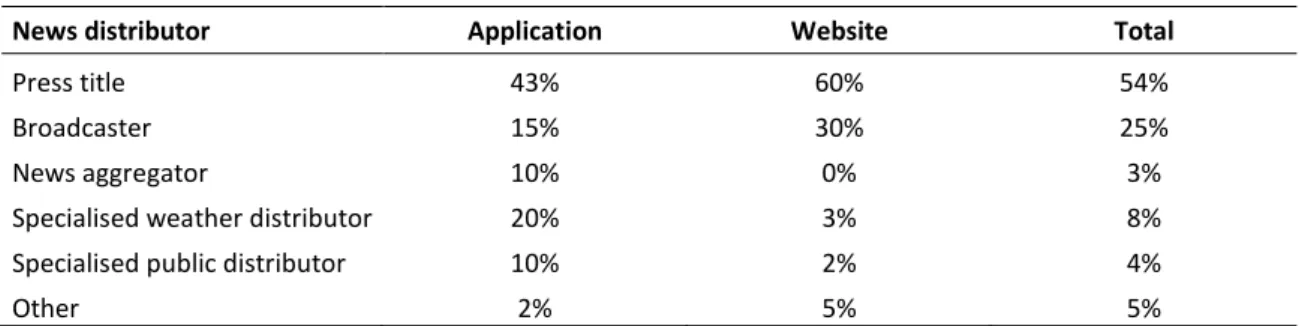
The majority (79%) of the news items origins from trusted news brands. More than half of the news items (54%) refer to a newspaper publisher’s application or mobile website. 25% of the total news items origin from a broadcaster. News aggregators are far less popular among the participants, as only 3% of the news items are generated through applications such as Flipboard or Pulse. A possible explanation for the disengagement with news aggregators is the lack of a local aggregator. First, these applications offer a selection of international, foreign news, while the participants perceive domestic affairs as equally or even more important, due to a larger mental distance, as pointed out by Shoemaker, Lee, Han and Cohen (2007). Second, these applications
12 present news in a foreign language, which might require a higher level of engagement for certain users, whose English language skills are limited. A second explanation for the lack of engagement with news aggregators is the level of trust the audiences have in news brands. This is in line with Starkey’s (2013) statement that, due to news diversity and fragmentation, trust in news media is placed in the strongest, most visible media brands.
When comparing the mobile news format (i.e. application vs website), results show that the importance of press titles and broadcasters as a news distributor is significantly higher for websites. Table 3 compares the news distributors of the consumed news items by news format.
Table 3. Comparison of on-device news items by news distributors - χ² (6) = 122,027*** (p<0.001)
News distributor Application Website Total
Press title 43% 60% 54%
Broadcaster 15% 30% 25%
News aggregator 10% 0% 3%
Specialised weather distributor 20% 3% 8%
Specialised public distributor 10% 2% 4%
Other 2% 5% 5%
90% of the web-based news items result from traditional news brands. Service-based news (weather and public transport) is however significantly more consumed through applications. Various participants state it is a habit to check the weather forecast or public transport schedule in the morning. Opening the application is ‘quick and easy’, offering bite-sized updates, whereas it takes much longer to find the information on websites.
The results thus show that brand name is important for editorial news, i.e. information that needs to be formulated whether or not supplemented with an opinion or additional background information. Well-known news distributors dominate the consulted items in a mobile environment. However, this does not seem to be the case for service-based news. Here, new patterns have infiltrated the daily life of audiences, due to the specific nature of the news type and the context of the news consumption.
13 Yet, while these consulted news distributors remain largely traditional, mobility transplants the consumption of these distributors into a completely flexible context. This illustrates the statement of Press and Williams (2010) that media is always placed in the context audiences function. In line with other audience-centred research on media consumption (Courtois, 2012), the notion of context is divided into three strongly coinciding levels: time, location and social context. Each context parameter has a potential influence on the choice of news channel or news type. Time, space and social context are however often interrelated. Daily routines follow a fixed pattern: different time frames (e.g. morning vs. afternoon) imply different locations (e.g. at home or on the road vs. work) and the company (e.g. children vs. colleagues).
Based on the amount of logged news sessions this close interrelation between different context parameters can be confirmed. Graph 3 maps the different time frames to location, news type and device. The three radars map the close interplay of the variables, showing that mobile news consumers have developed new consumption habits, consulting news in re-occurring patterns. The maps focus on time frames, since time is traditionally the time adds structure into our daily lives.
(a) location (b) device (c) news type
Graph 3. Radars linking different parameters of news consumptions to time frames during the day
First, there is a significant relation between time and location (FET (225) = 43.768, p<0.001). Second, there is a significant relation between the time and device (χ² (6) = 20.708,
14 p<0.01). The participants point out that choice of device is mainly based on the spatial context of the news consumption, as it defines the devices available. Mobile devices are used as a quick access device (e.g. to check the weather when waking up) or when no other device is available (e.g. on the train).
Interviewer: “You point to the laptop as your primary news channel, followed by the tablet. Why did you put them in that order?
Frederic (omnivore): (thinks) “It has little to do with the device, just the location and the time. I do not find a laptop or tablet better than a desktop for example.”
Frederic hereby refers to the changing device order: on various locations, participants put their preference of news devices in a different order. At home, the users prefer the tablet or desktop, at work the fixed computer and on the road their mobile phone. Table 4 compares the logged news sessions by location, making a distinction between smartphones and tablets.
Table 4. Comparison choice of mobile device by location - FET (225) = 43.768*** (p < 0.001)
Smartphone Tablet Total
Home 57% 94% 72%
On the road 24% 2% 15%
Work 16% 2% 10%
Other 3% 2% 3%
Mobile news consumption is thus rather news consumption on a mobile device than ‘mobile’ news, since domestic news consumption exceeds the mobile news consultation throughout the day. Especially the tablet is used at home (94%). A peak of news consumption on the road shows in the morning: 47% of the mobile news sessions were logged on the road, close to all (97%) using a smartphone. News is consumed on smartphones throughout the day, with a peak in the morning (21%) and the late afternoon (17%). The amount of news consulted on the tablet only succeeds the amount of news on smartphones at night.
A third dimension shown on Graph 3 is the link between time frame and type of news consumed on a mobile device (χ² (2) = 43.629, p<0.001). A smartphone is used most between 6 and 9 in the morning to check service news and various news items.
15 Bedsides the location of the news consumption, the social context is investigated too. Based on the diaries and the interviews, results show that parameter ‘social context’ has little influence on the type of consumed news, especially at home. Mobile news is considered to be consumed individually, even when people surround them. Participant Sarah pointed out that, even though her partner was in the room, she still considered the news consumption as done ‘alone’, because “he did not join me checking the news items”. She hereby points out the individual nature of mobile news consumption. The social context of the mobile news use is irrelevant, since informants feel they consult the news items alone because watching a mobile screen together rarely happens. Even though the users are accompanied by family or colleagues, the news use is done alone.
However, the social context may influence the choice of the device for news consumption, as pointed out by Dimitri.
Dimitri (serendip): “If I use my mobile to look something up, I can stay in the couch. My girlfriend is next to me and she likes it when I stay close. (...)”
Interviewer: “And if your girlfriend was not around?”
Dimitri (serendip): “Than I would go to my desktop and probably stay there all night.”
The presence of his girlfriend provokes the news use on his smartphone. The social context of mobile news does thus not influence what news is being consulted on the mobile device, but may steer the news use towards the most suitable device.
Mobile news use per news media repertoire
As pointed out by the first study, mobile news plays a different role in the daily lives of the three clusters. While the clustering was based on the general news consumption, significant differences on the context of mobile news consumption are found. Table 5 gives an elaborate overview of mobile news consumption by the three clusters.
16 Table 5. Cluster profiling on mobile news consumption based on the news sessions
As stated above, the omnivores consult news through various platforms. Omivores claim that they feel the need to constantly stay updated. They complement their former news diet with mobile news. News is consumed at home (58%) and on the road (28%). During moments of free time, often when waiting, they consult news a means to pass time usefully or to get a quick update. Omnivores, like Lisa, check news on their mobile devices at least daily.
Lisa (omnivore): “When I’m sitting on the bus and I get bored, I take my mobile to check [shared news messages on] Facebook. Through Facebook I stay updated and I know what is going on. (…) Traditional media did not lose their value, but mobile news has become important too.”
In other words, omnivores consume mobile news in the interstices or when specifically seeking a news update. For this cluster, mobile news can thus be defined as interstitial news consumption, as proposed by Dimmick et. al (2011b). As stated by Lisa the news use might be seredipitious, for example by opening Facebook. Since they consult news during the interstices, Context parameter Omnivores Traditionals Serendips Total Statistics
Spatial Home 58% 91% 71% 72% FET (225) = 33.665***
On the road 28% 0% 12% 15% Work 11% 7% 14% 11% Other 3% 1% 3% 2% Temporal 6h - 9h 31% 10% 21% 21% Chi2 (12) = 24.033* 9h - 12h 8% 14% 17% 12% 12h - 14h 11% 6% 7% 9% 14h - 16h 7% 18% 16% 13% 16h - 19h 15% 18% 20% 17% 19h - 22h 14% 13% 16% 14% 22h - 6h 14% 21% 3% 14%
Social Alone 98% 65% 98% 88% FET (576) = 134.994***
Partner 0% 0% 2% 0% Family 0% 12% 0% 4% Colleagues 0% 3% 0% 1% Other 0% 7% 0% 2% Unknown 2% 13% 0% 5% Friends 0% 0% 0% 0%
17 mobile news is being consumed thoughout the day, with a peek between 6 and 9 AM. In the morning, omnivores tend to check weather and traffic updated on their smartpones, often while still in the bedroom.
As pointed out by study 1, the traditionals keep loyal to previously developed news routines. To the majority of traditionals, like Tom, mobile news is of no concern.
Tom (traditional): “In the morning I spend 30 to 40 minutes reading my newspaper. I’ve been doing so for years. The same goes for watching the newscast at seven in the evening: those are fixed habits.”
In general, they do not feel the need to add mobile news to their routinized news media repertoire. They want a clear overview of the news messages, and mobile news is “too fast and impossible to follow”, as stated by participant Robin. When no other option is available (e.g. on the train or on vacation), the traditionals will however turn to their mobile device, preferably the tablet.
However, a limited group of traditionals is deeply engaging with mobile news. Peter and Robin for example consult news applications multiple times a week. The applications they mention offer them a news experience traditional media cannot offer.
Peter (traditional): “Some apps add a Twitterfeed to a news emission. Reading the reactions and thoughts of fellow watchers while watching a current affairs program adds the value to the program.”
Robin (traditional, uses news aggregator Pulse): “Mobile news must be personalized. The current model of news sites is out-dated.”
Traditionals mention three types of added value: a rich multimedia experience, extra (often international) news updates and a personalized news offer. In other words, the traditionals have no need to incorporate mobile news in their news media repertoire, but when they see mobile news as a valuable supplement to the routinized news offer, they will use the mobile devices heavily as a news platform. Traditionals too add mobile to their existing news diet, but not as a means to fill up the interstices. To them, mobile news is an enrichment of the news consumption experience. This dual position was also found in the device logs: fewer news sessions were registered in this cluster, but when traditionals consult mobile news, the news sessions take longer.
18 The serendips have a less routinized offline news checking habit. They consume far less news but do have a tendency to consult digital news. However, analysing the actual behaviour on mobile devices through data logging, it becomes clear that the serendips often turn to their mobile for news. While the omnivores and traditionals complement their news diet with mobile, the serendips are developing mobile news habits. Compared to the other clusters, the serendips consult more news on their mobile devices. Moreover, three out of four tablet owners in this cluster sees the tablet as their main news source. The shift to mobile news consumption is recent. One serendip is surprised when he realises during the interview that in only a year’s time his various news platforms have moved towards the tablet.
Serendips consult news on various topics, spread throughout the day, with a dip at lunchtime. Most news sessions are done on their mobile phones (72%). Serendips find themselves consuming news mostly at home when they are on their own.
As mentioned before, this cluster is less engaged with news. The nature of mobile news makes it attractive to this cluster, “because it is quick and easy” (Mia). Johan too addresses the habit of briefly running over for news updates.
Johan (serendip): “When I consume news (on my smartphone), I’m often just scanning the headlines, without reading the articles. I check if updates were added on the news sites.”
In short, the three news clusters are incorporating news differently into their news media repertoire.
General discussion
As stated in the introduction, the main purpose of this study is twofold. First, we wanted to investigate how mobile media outlets relate to the broader spectrum of audiences’ news media repertoires. Based on their cross-platform news diet, a typology is developed with three different news media repertoires among mobile device owners. The omnivores (45%) are actively engaging with news originating from multiple sources, including online, broadcasting and mobile news. The traditionals (34%) too are characterised by an intensive news diet, yet they stay loyal to a traditional news pattern by seeking news updates on the radio, television and newspaper. The
19 serendips (21%) have less specific news routines, though when engaging with news, it mostly results from digital outlets. Based on this typology we argue mobile news indeed claims its place or niche within media repertoires, albeit to various extends. The three clusters force us to moderate the enthusiastic ‘explosion in mobile audiences’ as stated by Mitchell, Rosenstiel, Houston Santhanam and Christian (2012). The shift towards mobile news use is however increasingly noticeable.
The second research question addressed in this paper is how mobile news consumption practices are able to permeate routinized news patterns. A first finding is that the majority of the consumed news items – especially editorial news – originates from trusted brands; mostly news publishers, followed by broadcasters. This hints towards a complementary quality of mobile news outlets. Second, the social context of mobile news is limited, since consuming news on a mobile device is considered an individual activity. Third, results show that mobile news is able to fulfil different needs among different audiences. Mobile news can thus serve as a niche within the repertoire, since it offers unique gratification opportunities within each cluster (Ramirez et. al, 2008). The omnivores construct mobile news consumption as a useful pastime, especially during the interstices of scheduled activities. Omnivores are therefore substantially more prone to use their mobile devices for news on the road. This conforms to the personal qualifications of their use, complying with the urge to stay updated in whatever circumstance, regardless of platform or source. The Traditionals rely far less on their mobile devices to consume news. A personal interest in news is a driver to consume mobile news (Westlund, 2008), however, this cluster shows that being interested in current affairs does not always lead to mobile news use. Participants representing this cluster perceive news on a mobile device as worthwhile in three circumstances: when it allows them to consult news that is otherwise unavailable, when it enriches the news experience or when it provides a personalized news offer. The third cluster, the serendips,has less specific news routines. Though when engaging in news consumption, the participants are relatively more prone to do it mobile and digitally.
In conclusion, this study reveals the Janus-faced nature of mobile news. On the one hand, the majority of news consumers dominantly relies on traditional media outlets to stay informed, only to supplement with online mobile services in specific circumstances. Even then, there is at
20 least a tendency to stick to trusted brand materials. On the other hand, these mobile news outlets do seem to increasingly occupy audiences’ undefined and possibly meaning-lacking entities of time and space, referred to as no-when-times at no-when-spaces (Caronia, 2005). However, this study challenges these notions, since the majority of the news consulted on a mobile device is consumed at home, in the morning (by the omnivores) or in the evening (by the traditionals).
References
Caronia, L. (2005). Mobile culture: ethnography of cellular phone uses in teenagers’ everyday life. Convergence, 11(3) 96-103. doi: 10.1177/135485650501100307
Chan-Olmsted, S., Rim, H., & Zerba, A. (2013). Mobile news adoption among young adults: Examining the roles of perceptions, news consumption, and media usage. Journalism and Mass Communication Quarterly, 90(1), 126-147. doi: 10.1177/1077699012468742
Chyi, H. I. & Chadha, M. (2011). News on new devices. Journalism Practice, 1-19. doi: 10.1080/17512786.2011.629125
Courtois, C. (2012). The triple articulation of audiovisual media technologies in the age of convergence. Phd diss., University of Ghent, Belgium.
Courtois, C., Verdegem, P., & De Marez, L. (2013). The triple articulation of media technologies in audiovisual media consumption. Television & New Media, 14(5), 421-439. doi: 10.1177/1527476412439106
Debrett, M. (2010). Reinventing public service television for the digital future. Intellect Books. Dimmick, J., Feaster, J., & Hoplamazian, G. J. (2011b). News in the interstices: The niches of mobile
media in space and time. New Media & Society, 13(1), 23-39. doi: 10.1177/1461444810363452
Dimmick, J., Powers, A., Mwangi, S. & Stoycheff, E. (2011a). The fragmenting mass media marketplace. In W. Lowrey & P.j. Gade (Eds.), Changing the news. The forces shaping journalism in uncertain times (pp. 177-192). London: Routledge.
Dimmick, J., Kline, S., & Stafford, L. (2000). The gratification niches of personal e-mail and the telephone competition, displacement, and complementarity. Communication Research, 27(2), 227-248.
21 Feaster, J. C. (2009). The repertoire niches of interpersonal media: competition and coexistence at
the level of the individual. New Media & Society, 11(6), 965-984.
Gauntlett, D. & Hill, A. (1999). TV Living: television, culture and everyday life. London: Routledge. Hasebrink, U. & Domeyer, H. (2012). Media repertoires as patterns of behaviour and as meaningful
practices: A multimethod approach to media use in converging media environments. Participations, 9(2), 757-779.
Hartmann, M. (2013). From domestication to mediated mobilism. Mobile Media & Communication, 1(1) 42-49. doi: 10.1177/2050157912464487
Hemment, D. (2005). The mobile effect. Convergence: The International Journal of Research into New Media Technologies, 11(2), 32-40. doi: 10.1177/135485650501100204
Janssens, W., De Pelsmacker, P., Wijnen, K., & Van Kenhove, P. (2008). Marketing research with SPSS. Pearson Education.
Kettenring, J. R. (2006). The practice of cluster analysis. Journal of Classification, 23, 3-30.
LaRose, R. (2010). The problem of media habits. Communication Theory, 20, 194–222. doi:10.1111/j.1468-2885.2010.01360.x
Logghe, S., Baccarne, B., & Schuurman, D. (2014). An exploration of user motivations for participation in Living Labs. Presented at The XXV ISPIM Conference. Dublin (ISPIM - 2014). Mitchell, A., Rosenstiel, T., Houston Santhanam, L., & Christian, L. (2012, 1 October). The future of
mobile news. The explosion in mobile audiences and a close look at what it means for mews.
Retrieved from: http://www.journalism.org/files/legacy/
Futureofmobilenews%20_final1.pdf
Mitchell, A. & Page, D. (2014, 26 March). Key indicators in media and news 2014. Retrieved from: http://www.journalism.org/files/2014/03/Key-Indicators-in-Media-and-News-2014.pdf Murray, S. (2003). Media convergence’s third wave: Content streaming. Convergence, 9(8), 8-18.
doi: 10.1177/135485650300900102
Nel, F., & Westlund, O. (2012). The 4 C's of mobile news. Channels, conversation, content and commerce. Journalism Practice, 6(5/6), 744-753. doi: 10.1080/17512786.2012.667278 Newman, N. & Levy, A. L. (Eds.). (2013). Reuters Institute digital news report 2013: Tracking the
22 Oulasvirta, A., Rattenbury, T., Ma, L., & Raita, E. (2012). Habits make smartphone use more
pervasive. Personal and Ubiquitous Computing, 16(1), 105-114. doi: 10.1007/s00779-011-0412-2
Paulussen, S., Courtois, C., & Velghe, L. (2012). Understanding today’s convergent news media consumption through a triple articulation lens. 4th European Communication Conference, Abstracts. Presented at the 4th European Communication Conference (ECREA - 2012). Peters, C. (2012). Journalism to to. The changing spaces of news consumption. Journalism Studies,
13(5-6), 695-705. doi: 10.1080/1461670X.2012.662405
Pew Research Centre (2010). The state of the news media 2010: Audience behavior. Washington, DC. Retrieved from http://stateofthemedia.org/2010/online-summary-essay/audience-behavior/
Picone, I., Courtois, C., & Paulussen, S. (2014). When news is everywhere. Understanding participation, crossmediality and mobility in journalism from a radical user perspective. Journalism Practice, 1-15. doi: 10.1080/17512786.2014.928464
Press, A. L., & Williams, B. A. (2010). The new media environment: an introduction (1st ed.). Chichester, West Sussex, U.K. ; Malden, MA: Wiley-Blackwell.
Ramirez, A., Dimmick, J., Feaster, J., & Lin, S. F. (2008). Revisiting interpersonal media competition the gratification niches of instant messaging, e-mail, and the telephone. Communication Research, 35(4), 529-547.
Rubin, V. L., Burkell, J., & Quan-Haase, A. (2011). Facets of serendipity in everyday chance encounters: a grounded theory approach to blog analysis. Information Research-An International Electronic Journal, 16.
Russell, B. (1999). Headmap Manifesto. Retrieved from http://technoccult.net/wp-content/uploads/library/headmap-manifesto.pdf
Sarrina Li, S. C. (2001). New media and market competition: a niche analysis of television news, electronic news, and newspaper news in Taiwan. Journal of Broadcasting & Electronic Media, 45(2), 259-276.
Schrøder, K. C. (2011). Audiences are inherently cross-media: audience studies and the cross-media challenge. Communication Management Quarterly, 18(6), 5–27.
23 Schrøder, K. C. (2014). News media old and new: fluctuating audiences, news repertoires and
locations of consumption. Journalism Studies, 1-19. doi: 10.1080/1461670X.2014.890332 Shoemaker, P. J., Lee, J. H., Han, G., & Cohen, A. A. (2007). Proximity and scope as news values.
Media studies: Key issues and debates, 231-248.
Starkey, G. (2013). Trust in the diverging, convergent multi-platform media environment. CM-časopis za upravljanje komuniciranjem, 8(26), 73-97. doi: 10.5937/comman1326073S
Thorson, E., Thorson, K., & Sridhar, H. (2011). Media choice repertoires. Presented at International Communication Association - ICA Conferences. Boston (ICA – 2011).
Tossell, C., Kortum, P., Rahmati, A., Shepard, C., & Zhong, L. (2012, May). Characterizing web use on smartphones. In Proceedings of the 2012 ACM annual conference on Human Factors in Computing Systems (pp. 2769-2778). ACM.
Van Cauwenberge, A., Beentjes, H., & d'Haenens, L. (2011). Een typologie van jonge nieuwsgebruikers in een multimediaal landschap. Tijdschrift voor Communicatiewetenschap, 39(1), 62.
Van Damme, K., Courtois, C., & Afschrift, J. (2014). Serendipitous news consumption. A mixed-method audience-centred study on mobile devices. Presented at Social Media and the Transformation of Public Space. Amsterdam (ASMC – 2014).
Westlund, O. & Färdigh, A. M. (2011). Displacing and complementing effects of news sites on newspapers 1998–2009. International Journal on Media Management, 13(3), 177–94. doi: 14241277.2011.595020
Westlund, O. (2008). From mobile phone to mobile device: news consumption on the go. Canadian Journal of Communication, 33, 443-463.
Westlund, O. (2013). Mobile news: a review and model of journalism in an age of mobile media. Digital Journalism, 1(1), 6-26.
Westlund, O. & Färdigh, A. M. (2015). Accessing the news in an age of mobile media. Mobile Media & Communication, 3(1)
Yadamsuren, B., & Erdelez, S. (2010). Incidental exposure to online news. Proceedings of the American Society for Information Science and Technology, 47(1), 1-8. doi: 10.1002/meet.14504701237
24 Yuan, E. (2011). News consumption across multiple media platforms: A repertoire approach.
Information, Communication & Society, 14(7), 998-1016. doi: 10.1080/1369118X.2010.549235