The Open Access Publication Server of the ZBW – Leibniz Information Centre for Economics
Nutzungsbedingungen:
Die ZBW räumt Ihnen als Nutzerin/Nutzer das unentgeltliche, räumlich unbeschränkte und zeitlich auf die Dauer des Schutzrechts beschränkte einfache Recht ein, das ausgewählte Werk im Rahmen der unter
→ http://www.econstor.eu/dspace/Nutzungsbedingungen nachzulesenden vollständigen Nutzungsbedingungen zu vervielfältigen, mit denen die Nutzerin/der Nutzer sich durch die erste Nutzung einverstanden erklärt.
Terms of use:
The ZBW grants you, the user, the non-exclusive right to use the selected work free of charge, territorially unrestricted and within the time limit of the term of the property rights according to the terms specified at
→ http://www.econstor.eu/dspace/Nutzungsbedingungen By the first use of the selected work the user agrees and declares to comply with these terms of use.
Klanac, Nataša Golik
Article
An integrated approach to customer value: A
comprehensive-practical approach
jbm - Journal of Business Market Management Provided in Cooperation with:
jbm - Journal of Business Market Management
Suggested Citation: Klanac, Nataša Golik (2013) : An integrated approach to customer value: A comprehensive-practical approach, jbm - Journal of Business Market Management, Vol. 6, Iss. 1, pp. 22-37, http://nbn-resolving.de/urn:nbn:de:0114-jbm-v6i1.413
This Version is available at: http://hdl.handle.net/10419/76796
Published online: 29.03.2013 --- © jbm 2013
--- N. Golik Klanac
as2con - alveus ltd., Rijeka, Croatia and Hanken School of Economics, Helsinki, Finland e-mail: [email protected]
An Integrated Approach to Customer Value: A
Comprehensive-Practical Approach
Nataša Golik Klanac
Abstract:
The paper presents a comprehensive and practical approach to studying value from the customer point of view i.e. customer value (CV). It builds on three approaches to CV: the benefit-sacrifice, the means-end and the experiential. The developed integrated approach presents a more complete view on CV and its components than current approaches, offering a more meaningful guidance for marketing management activities.Keywords: Customer value · Integrated approach · Benefit-sacrifice · Means-end · Experiential approach
Introduction
Customer value (CV) i.e. value from the customer point of view plays a relevant role in the marketing discipline and practice (Zeithaml, 1988; Ravald and Grönroos, 1996; Parasuruman, 1997; Lapierre, 2000; Woodall, 2003). It carries a direct impact on customer behavioral outcomes (Zeithaml, 1988; Ulaga and Chacour, 2001; Woodall, 2003). It is considered to lead to customer loyalty, and thus to a better financial performance (Reichheld, 1994; Khalifa, 2004), assisting in predicting customer behavior and in achieving sustainable competitive advantage (Ravald and Grönroos, 1996; Lapierre, 2000). An understanding of CV enables companies to meet customers’ needs and expectations, and to direct resources more efficiently (Ulaga and Chacour, 2001). The knowledge of CV is of importance for marketing strategy and decisions, specifically for segmentation (Wolfinbager and Gilly, 2001). Hence, as the knowledge of CV is the basis for company prosperity, it is critical for organizations to understand their offerings and to learn how they can be enhanced to provide value to their customers (Lapierre, 2000).
Marketing studies apply different approaches to the structure and nature of CV, pointing at the multidimensionality and complexity of CV. Studies agree that the concept of value encompasses multiple components (e.g. Lapierre, 2000; Woodall, 2003; Khalifa, 2004) and that it should be presented so that its complexity and richness are reflected (Woodall, 2003; Khalifa, 2004). However, studies dealing with CV focus on one approach dominantly (Table 6) focusing on only a few CV components therefore failing to capture the richness of the concept. Except Khalifa’s (2004) ideation of an integrated approach to CV, there is no study that focuses on various CV components and their interrelations, and that provides both comprehensive and practically sound theoretical framework to CV.
For the design of an offering and of its marketing strategies, it is important to gain a comprehensive view that will explain how characteristics of the offering influence customer values and experiences. Focusing on characteristics alone, we fail to understand why these are important, loosing a basis for the development of appropriate marketing strategies. Focusing on the consequences only, we neglect the service features that drive those consequences and thus they remain undefined i.e. service design lacks input for improvement of service characteristics. The same goes for the use of methods i.e. various methods combined provide a richer understanding. Even though studies argue for integration of various approaches to CV (Khalifa 2004), there is a gap in research on the integration of the approaches.
This paper outlines a need for a more comprehensive approach to CV that accounts for CV’s complexity and richness. Building on three approaches to CV: the benefit-sacrifice, means-end and experiential approaches, this paper seeks to develop both the comprehensive and the practical approach to CV and to define its components and underlying methodology. The approach aims to be comprehensive in a way that is able to capture various aspects of CV, portraying concept richness and multidimensionality. It also aims to be practical in a sense that it can be implemented in marketing activities of any company. Such an approach would provide inputs for the design of a service and for the service marketing strategy. This study develops the integrative approach to CV through a qualitative case study in the context of a business-to-business website.
The following section reflects on current approaches to customer value outlining their strengths and weaknesses. Section 3 presents the case study through which the integrated approach to customer value is developed; it explains the research method, the analysis and the result of the case study. Afterwards, through an interplay between the theory and the empirical study, the complementariness of the approaches is explained and the integrated approach is presented. The paper ends with its conclusion and recommendations for future research.
Customer Value and the Approaches
The concept of CV received considerable attention in business-to-business (BtoB) marketing studies (e.g. Lapierre, 2000; Eggert and Ulaga, 2002; Ulaga, 2003; Bovik, 2004; Lindgreen and Wynstra, 2005; Ulaga and Eggert, 2006). Current BtoB studies determine the characteristics of products, services and relationships that drive CV (e.g. Lapierre, 2000; Ulaga, 2003; Bovik, 2004), they compare CV with other marketing concepts (e.g Eggert and Ulaga, 2002; Ulaga and Eggert, 2006), review current research on CV (e.g. Ulaga, 2003; Lindgreen and Wynstra, 2005), develop tools and method to measure value (e.g. Ulaga and Chacour, 2001; Hogan, 2001) and examine it in various business contexts (Foster 2005; Golik Klanac 2008a,b).
In particular, the nature of CV is a matter of scholarly discussions (e.g. Ravald and Grönroos, 1996; Lapierre, 2000; Ulaga and Chacour, 2001; Khalifa, 2004). Scholars agree that the concept of CV is characterized by complexity and richness. It is personal, situational and comparative concept.
CV is a personal concept, meaning that it is different among individuals. Diverse customers perceive different value within the same offering (Ulaga and Chacour, 2001; Eggert and Ulaga, 2002). Various members in customer organizations can have different perceptions of a seller’s value delivery (Ulaga, 2003; Foster, 2005).
CV is a situational concept, i.e. it is dependent on a context and its meanings vary across contexts (Zeithaml, 1988; Parasuruman, 1997). CV is dependent on the situation when the product/service is used that is, the context in which interactions between the buyer and the seller take place (Ulaga, 2003). The same item may have differing value to the user depending on time or place of use (Lindgreen and Wynstra, 2005; Foster, 2005).
CV is a comparative concept, i.e. it depends on the rating of one object against another. This means that it is relative to competition (Ulaga and Chacour, 2001; Eggert and Ulaga, 2002). Thus, a company offering a better value than their competition will help create a sustainable competitive advantage (Ulaga and Chacour, 2001; Eggert and Ulaga, 2002).
CV is related to many other marketing concepts such as quality and satisfaction. It is a higher-level concept than the two afore mentioned concepts and may explain customer behavior in a better way (Zeithaml, 1988). CV concerns the interaction between products or services, the user and the use situation requirements whilst satisfaction focuses on products or services only, i.e. on what the organization provides (Woodruff and Gardial, 1996). Also, CV is considered to be a better predictor of customer behavior than quality as it encompasses sacrifices apart from benefits
(Smith Gooding, 1995). It is a richer measure of the customer’s overall evaluation than quality (Patterson and Spreng, 1997).
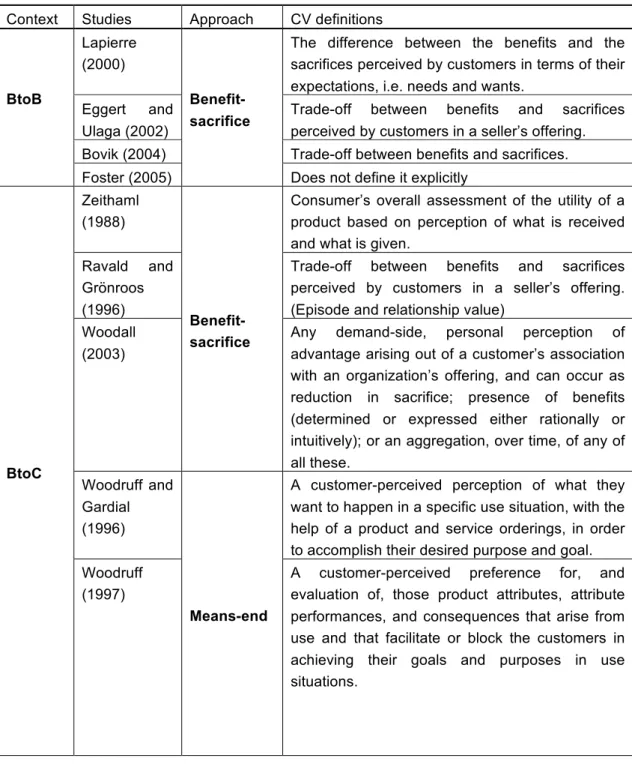
Defining CV is a challenging task due to the concept’s complexity. CV can be defined in various ways (Table 1), depending on the approach to CV. Three main approaches to CV can be outlined: benefit-sacrifice, means-end and experiential approach. The approaches differ in the treatment of the CV’s nature and structure (Table 2).
Table 1: Different definitions of customer’s view of value (CV)
Context Studies Approach CV definitions
BtoB
Lapierre (2000)
Benefit-sacrifice
The difference between the benefits and the sacrifices perceived by customers in terms of their expectations, i.e. needs and wants.
Eggert and Ulaga (2002)
Trade-off between benefits and sacrifices perceived by customers in a seller’s offering. Bovik (2004) Trade-off between benefits and sacrifices. Foster (2005) Does not define it explicitly
BtoC
Zeithaml (1988)
Benefit-sacrifice
Consumer’s overall assessment of the utility of a product based on perception of what is received and what is given.
Ravald and Grönroos (1996)
Trade-off between benefits and sacrifices perceived by customers in a seller’s offering. (Episode and relationship value)
Woodall (2003)
Any demand-side, personal perception of advantage arising out of a customer’s association with an organization’s offering, and can occur as reduction in sacrifice; presence of benefits (determined or expressed either rationally or intuitively); or an aggregation, over time, of any of all these.
Woodruff and Gardial (1996)
Means-end
A customer-perceived perception of what they want to happen in a specific use situation, with the help of a product and service orderings, in order to accomplish their desired purpose and goal. Woodruff
(1997)
A customer-perceived preference for, and evaluation of, those product attributes, attribute performances, and consequences that arise from use and that facilitate or block the customers in achieving their goals and purposes in use situations.
Holbrook (1999)
Experiential
An interactive, relativistic, and preference experience that results from using a product. Helkkula and
Kelleher (2010)
Is a holistic phenomenon, which is subjective, event specific, personal, and individually and socially constructed.
Table 2: The main approaches to CV and their characteristics
Approach CV nature CV components (structure) Method The
benefit-sacrifice
Perception Benefits and sacrifices Interviews and questionnaires The
means-end
Perception Objects’ characteristics,
consequences, end-states, linkages
Interviews and questionnaires The
experiential
Experience Experiences - activities Observation, ethnography
The Benefit-Sacrifice Approach
The benefit-sacrifice approach is the most accepted approach both in BtoB and BtoC studies as shown in Table 1. In fact, it is the only approach adopted in BtoB. The approach stresses the need to assess both positive and negative aspects of customer perceptions. It argues that people consider both gains and losses when involved in any activity and, to increase CV, it is necessary to identify both. The approach defines CV as a trade-off between benefits and sacrifices perceived by customers to a seller’s offering (Zeithaml, 1988; Lapierre, 2000; Eggert and Ulaga, 2002). It treats CV as a perception and distinguishes between two main components: benefits and sacrifice. The benefits/sacrifices involve recognition of all the gains/costs the customer incurs when engaging with different offerings or objects of evaluation (Payne and Holt, 2001). An object of evaluation can be a product (e.g. Zeithaml, 1988), a service (e.g. Ravald and Grönroos, 1996) or an entire relationship (e.g. Lapierre, 2000; Ulaga and Chacour, 2001; Bovik, 2004), the last being the most common in BtoB studies.
However, the benefit-sacrifice approach faces certain downsides. Firstly, the approach fails to address the distinction between the object’s characteristics and higher-level abstractions (Zeithaml, 1988). It classifies under benefits and sacrifices both the offering’s characteristics and the consequences of engagement with the offering. It does not separate these two distinct categories but often merges them under one category (e.g. Patterson and Spreng, 1997; Kim, 2002). It fails to assist in understanding the sources of value (characteristics) and reasons why something is seen to provide or not to provide value while according to the means-end approach, it is necessary to distinguish consequences (benefits and sacrifices) from offering’s characteristics, as these are concepts of different levels of abstractions – characteristics being concrete and consequences being more abstract concepts, where the consequences stem from the characteristics (Reynolds and Gutman, 1988;
Woodruff and Gardial, 1996). The characteristics play a role in the design of an offering while consequences point at the reasons of engaging with the offering (Reynolds and Gutman, 1988). These concepts are on different levels of abstraction, and thus carry different implications for marketing a service. The benefits-sacrifice approach
Finally, the approach is being criticized for treating a customer only as a rational individual, being questionable in the light of experiential aspects of customer activities (Holbrook and Hirshman, 1982; Korkman, 2006; Helkkula and Kelleher, 2010). Methodologically, the approach relies on customer perceptions captured through questionnaires or interviews, which report the customer’s rational perceptions. However, it fails to tackle customer irrational experiences, which can be captured through direct observations of customer activities.
The Means-End Approach
Another approach to customer value – the means-end approach is is being neglected in BtoB entirely while it is used in BtoC studies (e.g. Reynolds and Gutman, 1988; Pitts et al., 1991; Pieters, 1993; Woodruff and Gardial, 1996; Huber et al., 2001; Laukkanen, 2006).
The means-end approach to CV (Reynolds and Gutman, 1988; Pieters, 1993; Woodruff and Gardial, 1996) emphasizes the role of the offering’s characteristics and consequences of the engagement with the offering. It defines value as a customer-perceived preference for, and evaluation of those product attributes, attribute performances, and consequences that arise from use and that facilitate or block the customers in achieving their goals and purposes in use situations (Woodruff 1997). The approach distinguishes three levels of abstraction of CV where the upper levels are less context-dependent:
• Characteristics (attributes) of an object of evaluation (whether it is a product, service, process or a relationship),
• Consequences - results of using the object of evaluation and
• Desired end-states - final reasons of engaging the object of evaluation, equivalent to personal values (Rescher, 1969).
The consequences result from different characteristics while the end-states are outcomes of consequences. Woodruff and Gardial (1996) argue that the means-end approach provides a richer and a more meaningful way to understand the needs and desires of customers than the benefit-sacrifice approach.
Following this approach, it is essential to discern between the characteristics per se and customers’ perceptions of these characteristics, for the reason that customers differ in their views (Howard, 1977). Howard (1977) further explains that the perceptions are those that affect customer behavior, not the characteristics themselves. Botschen et al. (1999) argue for the importance of distinguishing between characteristics of an offering and of the consequences, as characteristics do not explain per se why a customer might choose these.
Apart from illuminating the three different levels of CV, the approach puts forward the importance of linkages between the levels (Reynolds and Gutman, 1988; Pieters, 1993; Pieters et al., 1995; Laukkanen, 2006). Namely, as characteristics lead to higher-level abstractions, the linkages between these stand for a component of CV. Laukkanen (2006) finds that the understanding of linkages between characteristics and the higher-level abstractions is relevant in order to understand how characteristics facilitate the achievement of desired end-states. Several studies (e.g. Gutman, 1982, 1997; Reynolds and Gutman, 1988; Sullivan Mort and Rose, 2004; Laukkanen, 2006) determine the ways in which characteristics lead to consequences.
The studies also argue for the practical implications of knowledge of the means-end chains, emphasizing that marketing practitioners need to understand these three levels of CV of an offering in order to develop more effective marketing strategies (Peter and Olson, 2005; Laukkanen, 2006). By knowing how a particular characteristic of an offering is perceived by a customer, designers can aim at developing the offering in such a way as to diminish the characteristics which incur sacrifices to customers and to energize characteristics which result in benefits. Likewise, marketing communication managers gain knowledge of characteristics driving benefits, which need to be addressed in communication with customers.
The approach also has certain drawbacks. Firstly, the means-end studies focus primarily on positive consequences (benefits), neglecting negative consequences, which are evenly important (Veludo-de-Oliviera et al., 2006). That is, from a marketing strategy point of view, knowledge of both positive and negative consequences and their drivers is greatly relevant. Secondly, method-wise, in the same way as the benefit-sacrifice approach, studies adopting this approach utilize questionnaires and interviews to tackle customer cognition but fail to capture customer experiences through direct observations of customer activities.
The Experiential Approach
Contrary to the two aforementioned approaches, the experiential approach refuses to treat CV as a perception merely. It treats customers not only as thinkers but also as feelers and doers (Holbrook and Hirshman, 1982). The approach maintains that the essence of value proposition is in the customer’s resulting experiences, arguing that value that matters is the one in customer’s experience not in the product or service since people care more about experiences than about offerings (Holbrook 1999). According to this approach, CV is defined as an interactive, relativistic and preference experience that results from customer activities (Holbrook and Hirshman, 1982; Holbrook, 1999; Steenkamp and Geyskens, 2006).
The approach involves essentially constructivist methods (i.e. observations) through which customer activities can be captured. Thus, through such techniques, the approach ventures beyond customer perceptions and looks into what customers do and how they feel. The experiential approach to CV raises the awareness of different methods needed to tackle experiences.
This approach also faces some limitations. Firstly, it is often unfeasible to utilize extensive observations of customer activities due to difficulty of accessing customer premises. Secondly, this approach oversimplifies CV by failing to portray several
aspects of CV: a) different levels of CV abstractions, b) the ways how characteristics of an offering drive value, and c) positive and negative aspects of CV.
Rather, the approach focuses on experiences on a high-level of abstraction that is difficult to transfer into a practice. These concepts of experiences (e.g. utilitarian and hedonic experiences) can be placed on a higher level of abstraction than in the case of the benefit-sacrifice approach where the focus is on more concrete concepts such as saving time or effort. From a marketing manager’s practical point of view, the approach offers weak insights into the way offering’s characteristics drive CV and of the manners they could be managed to increase CV.
An Overview of Strengths and Weaknesses of Current Approaches to CV
The three approaches focus on various aspects of CV. They differ in the view on CV’s nature and on its structure as shown in Table 2. The approaches point out various CV components, discuss different relations of CV components (positive – negative, higher – lower levels of abstraction) and bring a palette of value dimensions (e.g. hedonic, utilitarian, economic and psychological).
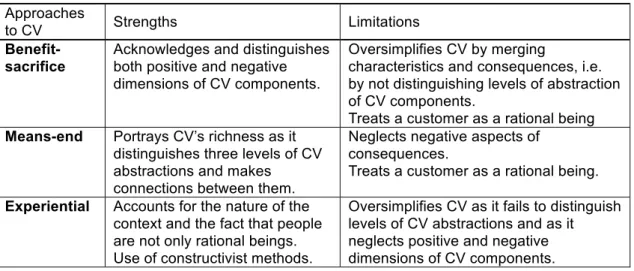
It was found that each approach separately faces limitations to comprehensively conceptualize CV as each approach considers some aspects of CV and neglects others. In that way, the studies fail to capture various aspects of CV and thus fail to portray its richness and complexity. BtoB studies in particular rely on one approach alone (e.g. Lapierre, 2000; Eggert and Ulaga, 2002; Bovik, 2004 and Foster, 2005). Table 3 summarizes the strengths and weaknesses of the current approaches to CV.
Table 3: Strengths and limitations of the approaches to CV Approaches
to CV Strengths Limitations
Benefit
-sacrifice
Acknowledges and distinguishes
both positive and negative
dimensions of CV components.
Oversimplifies CV by merging
characteristics and consequences, i.e.
by not distinguishing levels of abstraction of CV components.
Treats a customer as a rational being
Means-end Portrays CV’s richness as it distinguishes three levels of CV abstractions and makes connections between them.
Neglects negative aspects of
consequences.
Treats a customer as a rational being.
Experiential Accounts for the nature of the
context and the fact that people are not only rational beings. Use of constructivist methods.
Oversimplifies CV as it fails to distinguish levels of CV abstractions and as it neglects positive and negative dimensions of CV components.
Studies argue for the need of integrating various approaches (Khalifa, 2004) as the literature on CV lacks a comprehensive view that would portray CV’s true multifaceted nature. The approaches to CV taken separately fail to provide a comprehensive understanding and could benefit from an integration of multiple perspectives. Khalifa (2004) brought the idea of an integrated approach to CV through
which complexity and richness of the concept would be captured, arguing that such conceptualization of CV would be of greater use in the design of offerings and marketing strategies. Woodall (2003) also advises that value should be viewed holistically. O’Shaughnessy and O’Shaughnessy (2009) suggest that applying multiple perspectives on marketing would allow researchers to use different lenses to study marketing-related phenomena, leading to more multifaceted understanding. Even though studies argue for integration of various approaches, there is a gap in research on the integration of the approaches. This study further examines through an empirical investigation how and whether the approaches could be integrated in order to provide a comprehensive way to study CV.
The Case Study
In order to explore whether and how the approaches to CV could be integrated, a qualitative case study was found suitable for several reasons. The case study method is adequate for the theory developing type of research (Ghauri and Grønhaug, 2002) such as this one, which is exploratory in its nature and aims at developing an integrated approach to CV. In addition, a case study is most suitable when context is of relevance (Ghauri and Grønhaug, 2002). The researcher has to get to know the context of the study in order to: elicit various components of CV, be able to link characteristics with their consequences, and interpret the findings correctly (Reynolds and Gutman, 1988; Grunert and Grunert, 1995). Yin (2003) also advocates a single case study when dealing with a complex and multi-dimensional phenomenon as it enables analysis of the phenomenon in depth.
The case study has a supportive role in developing the theory, meaning that the context of the study (the use of a BtoB website) is of secondary importance while the developed theory (the integrated approach) is of primary importance and can be generalized to any other service context. We examine CV in the context by the use of a website (a service) in business-to-business relationships.
The single embedded case (Yin 2003) focused on customer value of the seller’s website. At the point of conducting the study, the seller’s website represented an information and communication platform. The analysis referred to two customer groups and particular customer companies within these groups. Following all the three approaches to CV, the data collection included techniques that tackle both customer perceptions and experiences: interviews and in-office observations on the customer side. Interviews and observations are particularly useful for discovering new issues (Ghauri and Grønhaug, 2002). Observations in particular can shed light on the behavioral use of which users are often not aware of (Holbrook, 1999).
The semi-structured interviews lasted for about two hours each and covered interviewees’ and company’s background, interviewees’ general usage of the Internet and websites of different companies, and in particular of the seller’s website. They were followed by in-office observations of the ways the customers use the website.
Content analysis of interview transcriptions and observation notes was conducted following Miles and Huberman (1994). It included systematic categorization of the text referring to CV components raised in the three approaches to CV, and outlined in the third column in Table 2. In the case of website use, these CV components are a)
website characteristics, b) customer positive and negative consequences, c) customer end-states (values) to which these consequences are tied and d) ways in which characteristics lead to particular consequences. As the purpose of the empirical part in this study is to portray CV components, comprehensive framework and its practical application, and not to analyze the context of the study in detail, we focus on two websites characteristics impersonal form of communication and user-managed interaction alone. These two characteristics, five types of consequences (three benefits and 2 sacrifices), leading to five types of end-states are considered sufficient to portray the integrated approach as they portray a picture of all the mentioned components and utilized methods.
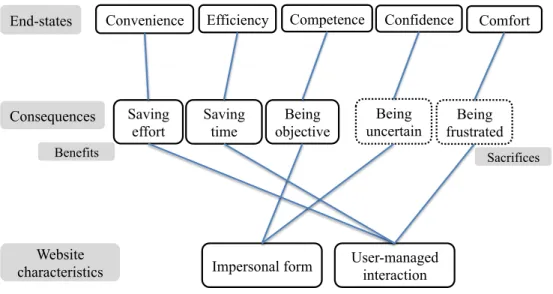
Based on the content analysis, we can map CV of the website related with its two characteristics of impersonal form and user-managed interaction (Figure 1).
Fig. 1: The map of customer value of a website with the focus on two characteristics
The map portrays two characteristics of the website and how these particular characteristics drive value for customers i.e. how they lead to benefits or sacrifices, and in the end to customer desired end-states which are specified in Golik Klanac (2008).
The impersonal form of communication helps customers, amongst others, in being objective, what is connected to its competence. They believe that it prevents them from being biased like they might be with a nice salesperson: Compared to face-to-face contact with people who are selling the company’s products, the Internet is better, because today when you are merchandising - it should not influence your decision if the salesman is polite, and you can have lunch and…it’s out of the world today…so it’s good to have Internet. (I1)
As an example for sacrifice, the same characteristic can make customer feel uncertain, connected to customer’s confidence. Customers may think that they have misunderstood something on the website as the information is written: We are calling
Impersonal form User-managed interaction Saving
effort
Saving time
Convenience Efficiency Competence Confidence Comfort
Being
uncertain frustrated Being
Website characteristics Consequences End-states Being objective Benefits Sacrifices
many times rather than trying to put it through the net, cause’ there are more places for misunderstanding in writing than when speaking - we have recognized. (I8)
Another characteristic, user-managed interaction saves time and efforts. These benefits are related to customer-desired end-states of convenience and efficiency. The direct access to a computer, both physical and temporal, reduces users efforts because they do not need to get up, call and wait in the line: Well, I guess I’m so lazy that it’s much easier to see it here, with my computer and when surfing the website… (I5)
The same characteristic can make customers feel uncertain. When users need to navigate a lot around the website in order to find information, they may become frustrated: I6 is looking for something at the website, she is clicking through different pages, for few minutes. She looks a bit nervous. She is commenting “I can’t find it” and keeps on clicking and browsing the pages for a while, she stops, she leans back, saying with an angry voice “I give up!”. (Observation I6)
The Integrated Approach to Customer Value
The empirical study and the examined approaches consistently confirm that CV is a complex and rich concept. Although the approaches to CV differ, it was found that they are not mutually exclusive but rather complementary. The integration could be done in the following ways:
• The weakness of both the benefit-sacrifice and experiential approaches of oversimplifying CV and failing to separate between characteristics and consequences could be overcome through the means-end approach that accounts for these. Had we focused in the case on consequences (i.e. benefits and sacrifices) alone, we would not be able to gain the understanding of website characteristics driving certain consequences i.e. of the reasons why consequences occur.
• The limitation of both the means-end and the experiential approaches of neglecting the negative aspects of CV could be reduced through the benefit-sacrifice approach, which focuses on negative dimensions also. Had we focused in the case on consequences without distinguishing their negative and positive dimensions we would not be able to grasp which website characteristic enhance and which diminish CV.
• The limitation of the benefit-sacrifice and means-end approaches of relying only on customer cognition can be overcome through the experiential approach and the observation techniques that the approach advises to use. Through the observations, we received a better insight in the use of the website. In particular, psychological and situation specific aspects of the use were captured better through observations than though interviews. Frustration with malfunctioning technology, loss of passwords or reactions to unexpected happenings were not disclosed in the interviews alone. That is probably due to a reason that people are often not aware of mundane things (Korkman, 2006).
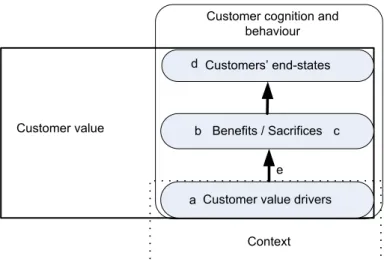
In sum, the weaknesses of each approach could be overcome by integrating the approaches. A new approach to CV can build on that fact and use the strengths of the approaches to overcome their weaknesses. Each of the approaches puts forward some aspects of CV that are important in the representation of CV and should be captured in order to conceptualize it holistically. Taking into consideration the outlined strengths of each approach and the ways they can complement each other, the integrated approach to CV puts forward four main components of CV:
a) CV drivers (a) that are the characteristics of an object of evaluation i.e. of the website, as they provide inputs for service design (website design in the case) and fall into the category of components that the company can manage.
b) Customer consequences that can be benefits (b) and sacrifices (c) are the reasons for customer engagement with a service and reflect their perception and experience of service characteristics. While sometimes customers cannot tell what a particular characteristic means to them, they can easily understand the same in terms of particular consequences for them and provide input for the definition of marketing communication of a company, i.e. how the company will communicate the service to the customers.
c) End-states (values) are final goals guiding customers - the final reasons for using a service or for engaging in an activity such as a website. These are the most abstract and the most general concepts which tell us about the role which a particular service can play in a customer’s life.
d) Linkages between the components as the ways in which service characteristics, customer consequences and end-states are connected. For a company, they tell how CV can be tackled through service design (Golik Klanac, 2012).
Methodologically, the integrated approach finds that CV involves both customer perceptions and experiences and highlights methods that can capture both of these.
Acknowledging the three approaches to value, CV can be defined as an interactive, relativistic, preference perception and experience – i.e. the end-states that encompass multiple benefits and sacrifices that customers link with offering’s characteristics, taking into consideration the available alternatives in specific use situations. Such an integrate approach to CV is presented in Figure 2.
Fig. 2: The integrated / holistic approach to CV
The integrated approach carries several strengths in approaching CV. It acknowledges the multidimensionality of CV, it portrays CV’s richness, and it offers a comprehensive view on CV. However, at the same time, due to that complexity, the approach might face some difficulties in empirical implementation. It may be difficult to gain access to observe customers. In addition, mapping all the components requires significant efforts.
Conclusions
The aim of this study was to develop a comprehensive and practical approach to customer value (CV) that portrays its complexity and multidimensionality. Theoretically, the study builds on three approaches to customer value: the benefit-sacrifice, means-end and experiential approaches. Empirically, we examine the approach through a case study of a business-to-business website, focusing on its two characteristics of impersonal form and user-managed interaction.
It was found in the study that each of the currently employed approaches faces some limitations in providing a comprehensive understanding of CV due to neglecting some aspects of CV. It was also found that even though the approaches offer diverse ways of studying CV, they are complementary and when integrated they allow capturing the CV’s complexity and richness. It is confirmed in the empirical case that the approaches are compatible and that they can be integrated in a manner to form together a more comprehensive configuration of the concept of CV as opposed to the approaches being used separately. The study enriches the conceptualization of the concept of CV. By encompassing the complex and the rich picture of CV, the study offers a more meaningful guide for future industrial marketing management activities.
An understanding of the components of CV allows companies to improve the design of offerings as well as to tailor marketing strategies to the perceptions and experiences of customers. Managers should consider how each service characteristic impacts customers by understanding which characteristics they like or dislike and the
Customer value drivers Benefits / Sacrifices Customers’ end-states Customer value c a b e d Context
Customer cognition and behaviour
reasons behind their perceptions and experiences as their perceptions and experiences might differ.
In the case study, had we focused on one approach alone, some aspects of CV would stay silent. For instance, had we focused on the benefit-sacrifice component we would not distinguish the characteristics from the consequences and would not understand which website characteristics should be tackled in order to diminish the sacrifices. Had we focused on the highest level of final goals (end-states) alone, it would have been hard to provide practical advice on how to improve the website to increase CV. By adopting the comprehensive approach, we can tell how each characteristic of the website is perceived and experienced by the customers.
Through the integrated approach to CV, companies can gain an understanding of the different components of CV that they will need to consider and of the ways that the components are interrelated. Moreover, the integrated approach highlights that companies need to consider all of the CV components through both customer perceptions and experiences if they are to be successful in their decision-making.
The suggested approach is comprehensive as it incorporates various aspects and components of CV. Through the application and the development of the approach in the study, the approach was also shown to be practical. Future research might elicit supplementary aspects that could be incorporated in the approach. The approach could be examined further from the point of value dynamics and by taking into account views on value from the point of all parties in the relationship.
References
Botschen, G., Thelen, E.M. & Pieters, R., (1999). Using means-end structures for benefit segmentation: An application to services. European Journal of Marketing, 33 (1/2), 38-58.
Bovik, C., (2004). Customer-perceived Value in Business Relationships. Doctoral Dissertation, Karlstad Universities Studies, Karlstad.
Eggert, A. & Ulaga, W., (2002). Customer perceived value: a substitute for satisfaction in business markets?. Journal of Business and Industrial Marketing; 17 (2/3), 107-118.
Foster, T., (2005). Creating digital value: at the heart of the I-E-I framework. Journal of Business and Industrial Marketing, 20 (4/5), 245-252.
Golik Klanac, N., (2008). Dimensions of customer value of business-to-business websites. Journal of Business Market Management, 3 (2), 153-165.
Golik Klanac, N., (2012). Types of linkages between service characteristics and customer consequences. European Journal of Marketing, 46 (3/4), 313 – 330. Grönroos, C., (1997). Value-driven relational marketing: from products to resources
and competences. Journal of Marketing Management, 13, 407-419.
Grunert, K.G. & Grunert, S.C., (1995). Measuring subjective meaning structures by the laddering method: theoretical considerations and methodological problems. International Journal of Research in Marketing, 12, 209-225.
Gutman, J., (1982). A means-end chain model based on consumer categorization processes. Journal of Marketing, 46 (Spring), 60-72.
Gutman, J., (1997). Means-end chains as goal hierarchies. Psychology and Marketing, 14 (6), 545-560.
Helkkula, A. & Kelleher, C. (2010). Circularity of customer service experience and customer perceived value. Journal of Customer Behaviour, 9 (1), 37-53.
Holbrook, M.B., (1999). Introduction to consumer value. in Holbrook, M.B. (Ed.). Consumer Value: a Framework for Analysis and Research. Routledge, London, 1-28.
Holbrook, M.B. & Hirshman, E.C., (1982). The experiential aspect of consumption: consumer fantasies, feelings and fun. Journal of Consumer Research, 9 (2), 132-137.
Homburg, C., Kuester, S., Beutin, N. & Ajay, M., (2005). Determinants of customer benefits in business-to-business markets: a cross-cultural comparison. Journal of International Marketing, 13 (3), 1-31.
Howard, J.A., (1977). Consumer Behaviour: Application of Theory. McGraw-Hill Book Company, New York.
Khalifa, A.S., (2004). Customer value: a review of recent literature and an integrative configuration. Management Decision, 42 (5), 645-666.
Kim, Y.K., (2002). Consumer value: an application to mall and Internet shopping. International Journal of Retail and Distribution Management, 30 (12), 595-602. Korkman, O., (2006). Customer Value Formation in Practice: A Practice-Theoretical
Approach. Doctoral Dissertation No. 155, Swedish School of Economics and Business Administration, Helsinki.
Lai, A.W., (1995). Consumer values, product benefits and customer value: A consumption behaviour approach. Advances in Consumer Research, 22, 381-388. Lapierre, J., (2000). Customer-perceived value in industrial contexts. The Journal of
Business and Industrial Marketing, 15 (2/3), 122-140.
Laukkanen, T., (2006). Customer-perceived value of e-financial services: a means-end approach. International Journal of Electronic Finance, 1 (1), 5-17.
Lindgreen, A. & Wynstra, F., (2005). Value in business markets: What do we know? Where are we going?. Industrial Marketing Management, 34 (7), 732-748.
Olson, J.C. & Reynolds, T.J., (1983). Understanding consumers cognitive structures: Implications for advertising strategy. in Percy, L. and Woodside, A.G. (Eds.). Advertising and Consumer Psychology. Lexington, Lexington, 77-90.
O’Shaughnessy, J. & O’Shaughnessy, J.N., (2009). The service-dominant perspective: a backward step?. European Journal of Marketing, 43 (5/6), 784-793.
Parasuruman, A., (1997). Reflections on gaining competitive advantage through customer value. Journal of the Academy of Marketing Science, 25 (2), 154-161. Patterson, P.G. & Spreng, R.A., (1997). Modelling the relationship between perceived
value, satisfaction and repurchase intentions in a business-to-business, services context: en empirical examination. International Journal of Service Industry Management, 8 (5), 414-434.
Payne, A. & Holt, S., (2001). Diagnosing customer value: integrating the value process and relationship marketing. British Academy of Management, 12, 159-182.
Pieters, R., Baumgartner, H. & Alien, D., (1995). A means-end chain approach to consumer goal structures. International Journal of Research in Marketing, 12, 227-244.
Pieters, R., (1993). A control view on the behaviour of consumers: turning the triangle. European Advances of Consumer Research, 1, 507-512.
Pitts, R.E., Wong, J.K. & Whalen, D.J., (1991). Consumers’ evaluative structures in two ethical situations: a means-end approach. Journal of Business Research, 22, 119-130.
Ravald, A. & Grönroos, C., (1996). The value concept and relationship marketing. European Journal of Marketing, 30 (2), 19-30.
Rescher, N., (1969). Introduction to value theory. Prentice Hall, New Jersey
Reynolds, T.J. & Gutman, J., (1988). Laddering theory, method, analysis, and interpretation. Journal of Advertising Research, 28 (1), 11-31.
Slater, S.F. & Narver, J.C., (1994). Market orientation, customer value, and superior performance. Business Horizons, 37 (March-April), 22-28.
Smith Gooding, S.K., (1995). Quality, sacrifice and value in hospital choice. Journal of Health Care Marketing, 15, 24-31.
Steenkamp, J.E.M. & Geyskens, I., (2006). How Country Characteristics Affect the Perceived Value of Web Sites. Journal of Marketing, 70 (July), 136-150.
Sullivan Mort, G. & Rose, T., (2004). The effect of product type on value linkages in the means-end chain: implications for theory and method. Journal of Consumer Behaviour, 3 (3), 221-234.
Ulaga, W., (2003). Capturing value creation in business relationships: A customer perspective. Industrial Marketing Management, 32, 677-693.
Ulaga, W. & Chacour, S., (2001). Measuring customer-perceived value in business markets. Industrial Marketing Management, 30, 525-540.
Ulaga, W. & Eggert, A., (2006). Relationship value in relationship quality. European Journal of Marketing, 40 (3/4), 311-327.
Veludo-de-Oliviera, T.M., Ikeda, A.A. & Campomar, M.C., (2006). Laddering in the practice of marketing research: barriers and solutions. Qualitative Market Research: An International Journal, 9 (3), 297-306.
Woodall, T., (2003). Conceptualising “Value for the customer”: an attributional, structural and dispositional analysis. Academy of Marketing Science Review, 12, 1-41.
Woodruff, R.B., (1997). Customer value: the next source for competitive advantage. Journal of the Academy of Marketing Science, 25 (Spring), 139-153.
Woodruff, R.B. & Gardial, S.F., (1996). Know Your Customer: New Approaches to Understanding Customer Value and Satisfaction. Blackwell Publishing Ltd., Cambridge, MA.
Zeithaml, V.A., (1988). Consumer perceptions of price, quality, and value: a means-end model and synthesis of evidence. Journal of Marketing, 52 (July), 2-22.