Mary G. Visher
Kristin F. Butcher
Oscar S. Cerna
February 2010
G U I D I N G
D E V E L O P M E N T A L
M A T H S T U D E N T S
T O C A M P U S
S E R V I C E S
An Impact Evaluation of
the Beacon Program at
South Texas College
Guiding Developmental Math Students to
Campus Services
An Impact Evaluation of the Beacon Program at
South Texas College
Mary G. Visher
Kristin F. Butcher
Oscar S. Cerna
With Dan Cullinan Emily Schneider February 2010Funding for this report was provided by Lumina Foundation for Education.
Dissemination of MDRC publications is supported by the following funders that help finance MDRC’s public policy outreach and expanding efforts to communicate the results and implica-tions of our work to policymakers, practitioners, and others: The Ambrose Monell Foundation, The Annie E. Casey Foundation, Carnegie Corporation of New York, The Kresge Foundation, Sandler Foundation, and The Starr Foundation.
In addition, earnings from the MDRC Endowment help sustain our dissemination efforts. Contrib-utors to the MDRC Endowment include Alcoa Foundation, The Ambrose Monell Foundation, Anheuser-Busch Foundation, Bristol-Myers Squibb Foundation, Charles Stewart Mott Founda-tion, Ford FoundaFounda-tion, The George Gund FoundaFounda-tion, The Grable FoundaFounda-tion, The Lizabeth and Frank Newman Charitable Foundation, The New York Times Company Foundation, Jan Nichol-son, Paul H. O’Neill Charitable Foundation, John S. Reed, Sandler Foundation, and The Stupski Family Fund, as well as other individual contributors.
The findings and conclusions in this report do not necessarily represent the official positions or policies of the funders.
For information about MDRC and copies of our publications, see our Web site: www.mdrc.org. Copyright © 2010 by MDRC.® All rights reserved.
Overview
This report presents results from a rigorous evaluation of the Beacon Mentoring program, designed and implemented by South Texas College, in McAllen, Texas. As part of their participation in the Achieving the Dream initiative, college leaders developed an innovative intervention targeting students enrolled in lower-level math courses that have high rates of failure. The program was based on three simple ideas: that students who need services often do not access them even when they are available and free; that a mechanism is needed to alert student services staff when students start to fail in class; and that students need a “go to” person on campus who knows them and to whom they can turn for advice, support, and information. The Beacon Mentoring program was a “light touch” intervention, designed to serve large numbers of students at minimal cost. Mentors were college employees who were recruited and trained to make several short classroom presentations about services available on campus and to work with the faculty to identify struggling students and offer them help early on. During spring 2008, the Beacon program targeted over 2,000 students enrolled in 83 sections of either a developmental (remedial) math course or a college-level algebra course. Mentors were random-ly assigned to half of the sections. The impact of the program was assessed by comparing the outcomes of students in the mentored classes with the outcomes of students in the classes that were not assigned a mentor.
The program had no effect on passing the math class or on persistence. However, evidence suggests that the program had a modest and positive impact on other outcomes for the full sample of students and resulted in additional or more pronounced benefits for two subgroups of students most at risk of failure: students enrolled in developmental math and students who attended college part time. Analyses in this report show that:
• The program succeeded in increasing the number of students who used the Center for Learning Excellence, a campus resource that provided tutoring and other forms of academic support.
• The program led to a statistically significant decrease in the likelihood of students in mentored classes withdrawing from their math course before the end of the semester.
• Part-time students were less likely to withdraw from and more likely to pass the math class, earned more credits, and, at least in the developmental math classes, scored higher on the final exam. The program also resulted in enhanced benefits for students enrolled in developmental math classes.
Contents
Overview iii
List of Tables and Figures vii
Preface ix
Acknowledgments xi
Executive Summary ES-1
Chapter
1 Introduction 1
Background 1
Brief Overview of the Beacon Mentoring Program 3
Reaching Out to Students Most at Risk 4
Research Design, Method, and Data Sources 5
Overview of the Report 8
2 Implementing the Beacon Program 9
Data Sources and Methodology 10
Program Goals and Expectations 11
Recruitment and Characteristics of Beacon Mentors 11
Mentor Training and Support 15
The Role of Faculty in the Beacon Program 16
Classroom Visits and Frequency of Out-of-Class Interactions Between
Students and Mentors 17
Use of the Center for Learning Excellence 19
Relationships Between Students and Mentors 19
Summary of Research on Program Implementation 23
3 Program Impacts on Academic Outcomes 25
Introduction 25
Methodology 26
Impact of the Beacon Program on Use of the Center for Learning Excellence 27
Impact of Mentoring on Academic Outcomes 30
Subgroup Analysis: Impacts for Full-Time versus Part-Time Students 34 Subgroup Analysis: Developmental Math versus College Math 37
4 Conclusions and Implications 41
Summary of Findings 41
Implications for Practice, Policy, and Future Research 41 Appendix
A: Technical Appendix: Methodology and Data Sources 45
Random Assignment Method and Research Sample 47
Impact Study 47
Implementation Study 55
B: Supplementary Tables 57
References 67
List of Tables and Figures
Table
ES.1 Key Findings on Program Impacts ES-5
1.1 Characteristics of Sample Members 7
2.1 Project Timeline and Key Dates During the Spring 2008 Semester 12
2.2 Characteristics of Beacon Mentors 13
2.3 Mentor Survey: Responses to Selected Questions 14
3.1 Percentage Who Ever Visited the Center for Learning Excellence, by Subgroup 29 3.2 Number of Visits to the Center for Learning Excellence, by Subgroup 30
3.3 Program Impacts on Academic Outcomes 31
3.4 Program Impacts, by Part-Time/Full-Time Status 35
3.5 Program Impacts, by Math Level 38
A.1 Estimated Program Impacts on Math Course Pass Rate: Alternative Specifications 48
A.2 Estimated Odds Ratio for Not Passing Math Class 53
A.3 Program Impacts, by High Risk/Low Risk of Math Failure 54
B.1 Student Survey: Mentored Students Only 59
B.2 Student Survey: All Students 61
B.3 Program Impacts on Credits Attempted and Earned 63
B.4 Program Impacts on Credits Attempted and Earned, by Part-Time/ Full-Time Status 64 B.5 Program Impacts on Credits Attempted and Earned, by Math Level 65 Figure
2.1 Percentage of Mentors Participating in Activities, as Reported by Mentors 18
2.2 Mentor Activity, as Reported by Students 20
Preface
South Texas College is one of 102 colleges participating in Achieving the Dream: Community Colleges Count, a national initiative funded by Lumina Foundation for Education. Its aim is to help community colleges develop evidence-based interventions to improve the chances of success for students who are most at risk of failure.
Like many community colleges, South Texas College enrolls large numbers of students who are academically underprepared. Many were failing the lower-level math courses required for advancement toward a degree or certificate — both developmental (or remedial) classes and large “gatekeeper” college-level courses — and ultimately leaving college without earning a credential.
With a “light-touch” intervention in mind, using resources and staff already available on campus, the college designed a program in which college employees, “Beacon mentors,” visited both developmental classes and lower college-level algebra classes. They provided information about available academic support services, served as a personal contact for students, and worked with the instructors to identify struggling students and offer timely help.
MDRC’s evaluation found that while the program did not improve students’ math class pass rates or persistence in college, it did have modest results on other outcomes for the full sample. What was particularly interesting was that the program proved to be more helpful for the two subgroups who are at the highest risk of failure — part-time students and those enrolled in developmental math. Programs that connect such students with services, especially when they are integrated into classroom instruction, are promising and worthy of further investigation. MDRC is continuing to evaluate the Achieving the Dream initiative, and we will be releasing additional reports later this year.
Gordon L. Berlin President
Acknowledgments
The authors would like to express their appreciation and gratitude to the many individu-als who helped to make this project and report possible. First on the list are the impressive people of South Texas College who had the vision and fortitude to create and implement the highly innovative Beacon Mentoring program, but also the courage to subject it to a rigorous evaluation. It is precisely this spirit that Lumina Foundation’s Achieving the Dream Initiative inspires and encourages in all of its member colleges. Luzelma Canales, William Serrata, Paul Hernandez, Jr., Brenda Cole, and Kim McKay all deserve special recognition for their support and hard work, and we are deeply grateful for the opportunity to collaborate with these gifted administrators. We would also like to thank Dr. Shirley Reed, President of South Texas Col-lege, whose dedication to helping students succeed through institutional change helped make the study a success. Finally, the study could not have been successful without the efforts of all the hard-working advisers and counselors of South Texas College’s Student Affairs and Enrollment Management Division, student support services staff, institutional research staff, leaders and members of the math faculty, and most of all, the men and women who volunteered to serve as mentors in the study.
In addition, we would like to thank Dan Cullinan for managing and analyzing the data, Emily Schneider for her expert help in pulling the report together, and the following colleagues at MDRC who provided valuable comments on earlier drafts: Thomas Brock, Howard Bloom, Lashawn Richburg-Hayes, John Hutchins, Fred Doolittle, and Elizabeth Zachry.
Executive Summary
This report presents results from a rigorous evaluation of the Beacon Mentoring pro-gram, an intervention that was designed and implemented by South Texas College, in McAllen, Texas. College leaders, alarmed by the high failure rates of students enrolled in lower-level math courses required for advancement toward a degree or certificate, combined several elements in an innovative intervention targeting students enrolled in these large, high-failure courses. The college named its program “Beacon Mentoring” to symbolize the idea that when community college students become overwhelmed by the complexity of college life, feel isolated, or struggle with academic material, they need proactive guidance to the services they need to succeed, most of which already exist on campus. Despite its name, the program was not a traditional mentoring program involving deliberate matching of mentors with mentees, intensive relationships, or other features commonly associated with mentoring programs. The Beacon program was designed instead to be a “light touch” intervention involving minimal contact between students and the college employees who served as mentors.
The Beacon program targeted over 2,000 students enrolled during one semester in either a developmental (remedial) math course or a college-level algebra course. The “theory of change” underlying the program was based on three simple ideas: that students who need services often do not access them even when they are available and free; that a mechanism is needed to alert student services staff when students start to fail in class; and that students need a “go to” person on campus who knows them and to whom they can turn for advice, support, and information.
Community colleges face a formidable challenge as students who are underprepared academically continue to flood through the open doors of these accessible, affordable institu-tions in pursuit of their dream of a college education. Those dreams are often cut short early when students who score low on math placement tests are relegated to a sequence of develop-mental courses that must be completed as a prerequisite to earning a degree or transferring to a four-year institution. While in these courses, students risk depleting financial aid and other resources before gaining access to the college-level, credit-granting courses they need to earn a degree. South Texas College designed the Beacon program to give students taking developmen-tal courses the assistance they need to succeed and move on to college-level classes.
South Texas College and the Achieving the Dream Initiative
South Texas College is one of 102 community colleges in 22 states participating in Achieving the Dream: Community Colleges Count, a national initiative to improve student outcomes funded by Lumina Foundation for Education. Achieving the Dream is designed to
encourage colleges to undertake an intensive, institutional, data-driven improvement process to develop priorities for increasing student success, with a special focus on the needs of students in developmental education and other at-risk student populations. The initiative also expects colleges to evaluate their progress in improving student achievement and develop institutional practices and policies that are based on this evidence. One of the first 27 colleges to join the initiative in 2004, South Texas College designed the Beacon program as one of its data-driven strategies to address the problem of student failure, especially in developmental math courses.
College leaders readily agreed to subject the program to a rigorous evaluation that was developed and managed by MDRC. The evaluation used a random assignment research design, in which 83 sections of three math courses, including two developmental math courses and one college-level algebra course, each with 25 to 30 students, were randomly assigned to a program group or a control group. Each of the 41 math classes in the program group was assigned a mentor. The program operated for a single semester in spring 2008. The impact of the program was assessed by comparing the outcomes of students in the mentored classes with the outcomes of students in the classes that were not assigned a mentor.
The Student Sample
A total of 2,165 students were enrolled in the 83 math classes that were part of the study. Due to random assignment, there were no statistically significant differences in the characteristics of those students enrolled in mentored classes (the program group) and those enrolled in nonmentored classes (the control group). Nearly all (95 percent) of the students were Latino but other than this, their characteristics were similar to those of community college students nationwide: Slightly more than half (57 percent) were women, nearly three-quarters (70 percent) were under age 24, and about half (52 percent) were enrolled full time (12 or more credits).
The Beacon Program: Key Elements and Expected Outcomes
The Beacon program was the brainchild of leaders in the student affairs division at South Texas College and evolved over several semesters as they fine-tuned the model, resulting in the version that was evaluated in 2008. Before the semester began, college leaders enlisted college employees who agreed to volunteer as mentors in addition to carrying out their normal job duties. Mentors were trained before the semester started and received further support during the course of the semester. Each mentor was assigned to one math class.Mentors played three essential roles in delivering the key elements of the Beacon pro-gram:
1. Mentors delivered information directly to students in classrooms about ser-vices such as academic support serser-vices, advising and counseling serser-vices, financial aid, and Priority Registration (early registration for the following semester available to a target group of students, including those in the Bea-con program).
2. Mentors acted as a “go to” person on campus for students in their class when students had a question or just needed someone to talk to.
3. Mentors and math instructors communicated with each other to identify struggling students and offer them help before they failed or dropped out of the class.
The goal of the Beacon program was to improve student success by increasing:
• Student use of campus services such as tutoring and advising • Pass rates in large, high-failure math courses
• Credits earned
• Semester-to-semester persistence
Key Findings on Program Implementation
Overall, the Beacon program was implemented with a reasonable degree of fidelity to its design, although one element — contact between students and their mentors outside of class — occurred less often than anticipated.
• Almost all the mentors reported that they conducted at least three in-class
presentations about campus services and academic support in their assigned math courses.
• About half the students in mentored classes reported having some contact
with their mentors outside of class, primarily by phone or e-mail.
• Many of the math instructors and Beacon mentors reported that they
com-municated with each other about particular students, upcoming exams, and other matters. But some pairs struggled to understand each others’ roles and fell short of developing an effective partnership.
• Students in mentored classes were more likely than those in nonmentored
classes to report that there was someone they could turn to on campus for help and that they knew where to go on campus to get help with math.
Key Findings on Program Impacts
As shown in Table ES.1, the program had no effect on students’ passing the math class or on their persistence in college. However, the evidence suggests that the program had a modest and positive impact on other outcomes.
• The program succeeded in increasing the number of students who used the Center for Learning Excellence, a campus resource that provided tutoring and other forms of academic support.
The evidence shows that the students in mentored classes were much more likely to vis-it the Center for Learning Excellence. Program students were 6 percentage points more likely to visit the center during the study semester, which is about a 30 percent increase relative to the control group.
• The program led to a statistically significant decrease in the likelihood of students in mentored classes withdrawing from their math course be-fore the end of the semester. However, there was no statistically signifi-cant impact of the program on the percentage of students who passed the math course.
Students at South Texas, as in postsecondary institutions in general, are allowed to withdraw from a class for any reason at any time up to a certain date (known as the “census” date). After that date, if they do drop out they receive a “W” on their transcript and no credit for the course. Students who do not withdraw may receive a letter grade, an ungraded pass/no pass, or an incomplete. The evaluation found that students in the mentored classes were less likely to withdraw from their math class by almost 3 percentage points compared with the control group. This finding is consistent with reports in the implementation research that some mentors may have encouraged students to stay in the math course even if they were earning a low grade, in the hope that the students would have a better chance of eventually passing the class if they stuck with it longer. However, the study found no significant differences in pass rates (or failure rates) for mentored and nonmentored students. This implies that among those students who stayed in the math class due to the program, some passed the course, some failed the course, and some received incompletes, but the program had no statistically significant impact on these outcomes.
• The program did not increase the percentage of students who went on to enroll in college the following semester — for students as a whole.
The study found no evidence that having a mentor improved the likelihood of reenrol-ling in the fall semester, despite the focus of mentors’ communications on how to register for classes in the fall.
Program Control Standard
Outcome Group Group Difference Error
Used Center for Learning Excellence 25.5 19.8 5.7 *** 2.0
Math course pass rate (%) 54.81 53.38 1.43 1.86
Part-time students (attempting less than 12 credits) 57.62 51.07 6.55 ** 2.55
Enrolled in developmental math 50.70 47.62 3.09 2.61
Final exam scorea 51.70 50.50 1.21 1.31
Part-time students (attempting less than 12 credits) 54.23 50.87 3.37 * 1.93
Postprogram persistence (%)
Registered spring 2008 and fall 2008 58.31 59.01 -0.70 2.02
Withdrew from math course (%) 15.38 18.20 -2.82 * 1.52
Part-time students (attempting less than 12 credits) 14.11 20.43 -6.32 *** 2.23
Enrolled in developmental math 11.79 17.99 -6.21 *** 2.10
Credits attempted 10.37 10.53 -0.16 ** 0.07
Credits earned 6.56 6.49 0.07 0.16
Developmental credits earned 1.92 1.72 0.20 ** 0.08
Sample size (total students = 2,165) 1,067 1,098
Sections represented (total = 83) 41 42
Achieving the Dream: South Texas College
Table ES.1
Key Findings on Program Impacts
SOURCE: MDRC calculations from South Texas College transcript and final exam data. NOTES: Rounding may cause slight discrepancies in sums and differences.
A two-tailed t-test was applied to differences between research groups. Statistical significance levels are indicated as: *** = 1 percent; ** = 5 percent; * = 10 percent.
Standard errors are clustered by Math 0080, 0085, and 1414 section.
Estimates are adjusted by indicators for developmental class, evening class, teacher effect, top and bottom math placement test quartiles, age less than 24, gender, and full-time status.
The italicized row –final exam score –is nonexperimental. It is calculated only for people who were still attending at the end of the course.
• Students in mentored classes attempted slightly fewer credits than stu-dents in nonmentored classes.
Students in mentored math classes appear to have attempted fewer credits on average than students in nonmentored classes. Mentors may have encouraged students to concentrate on passing their math class and suggested a strategy to drop one of their nonmath courses to improve their chances. There is also evidence that students in mentored classes earned slightly more developmental credits, probably because the help they received from the mentor and support services gave them the boost they needed to pass developmental English.
• The Beacon program resulted in additional benefits for two subgroups most at risk of failure: students who attended college part time (less than 12 credits) and students enrolled in developmental math (as op-posed to college-level math).
Part-time students in the program group seemed to benefit more from the mentoring experience than their counterparts in the control group. They were less likely to withdraw from and more likely to pass the math class, earned more credits, and, at least in the developmental math classes, scored higher on the final exam. This result was in line with the expectations of the college’s leaders, who felt that the program would be particularly helpful to students who were less connected to the campus and its available resources. The program also resulted in enhanced benefits for students enrolled in developmental math classes. The developmental math students in the program group were less likely to withdraw from math class than students in the control group, and they earned significantly more credits in their nonmath developmental courses. Their increased use of the Center for Learning Excellence and other support services may have had an effect on their performance in other classes.
Conclusions
Colleges want to know what they can do as institutions to help more academically underprepared students succeed in achieving their postsecondary education goals. Effective interventions that require relatively little investment of time and resources but can still reach a large portion of students are particularly appealing, especially during these economically challenging times. The evidence presented here suggests that interventions such as the Beacon program may offer one such answer, although potential impacts are not likely to be larger than those reported here unless more interactions between mentors and students and between faculty and mentors occur. “Light touch” programs such as this one should be expected to result in modest impacts. The findings also suggest that more than increased access to services is probably needed to significantly boost achievement in math, one of the greatest stumbling
blocks for community college students as they pursue their postsecondary education and career goals.
This study joins a handful of other evaluations of community college interventions that use random assignment to test interventions in the community college setting. Random assign-ment of whole classes was shown in this study to be both feasible and considerably less difficult than assigning individuals. With a rigorous research design such as random assignment, whether it involves randomly assigning individuals or whole classes, community colleges can trust that the results are worth building upon, whether by strengthening implementation, trying more intense variations of the Beacon model, or investing scarce resources in other interven-tions.
Chapter 1
Introduction
Background
This report describes a rigorous evaluation of the Beacon Mentoring program, a “home-grown” intervention designed and implemented by South Texas College, a community college, to help its students pass math courses that have high rates of failure. As is the case at many colleges across the country, only about half of students at South Texas College manage to get a passing grade in their lower-level math courses. For students taking developmental (remedial) math, the consequences can be particularly serious. Many students spend several semesters trying to pass a sequence of developmental math courses — often retaking them several times — and many ultimately give up and drop out. After experimenting with a number of strategies to improve students’ completion rates, the college came up with an innovative approach, consisting of three key elements:
1. Delivering information directly to students in classrooms about academic support services, advising and counseling services, financial aid, and Priority Registration (early registration for the following semester available to a tar-geted group of students, including those in the Beacon program)
2. Providing each student with a “go to” person on campus who knows them and is trained to offer certain kinds of assistance
3. Improving communication between faculty and student services profession-als so that they can take immediate steps to help students before they fail or drop out of class
The college agreed to allow MDRC, a nonprofit, nonpartisan social policy and educa-tion research organizaeduca-tion, to conduct a rigorous evaluaeduca-tion of the program as it was imple-mented in spring 2008. This report shares findings from that study.
South Texas College is located in McAllen, Texas, near the Mexican border. It serves a population of mostly Latino students on its five campuses, the largest of which is the Pecan Campus, the site of the evaluation. Over 27,000 students are enrolled at the college each year, and enrollments climbed steadily in the years leading up to the study. South Texas College, like most community colleges, serves a large number of academically underprepared students. More and more students do not meet the “cut score” on the placement tests that are generally required for incoming students, and as discussed below, the academic outcomes for these students are
considerably worse than those of their peers who score high enough on the tests to begin taking college-level courses immediately.
As part of the institutional response to this challenge, South Texas College joined 26 other community colleges in the first round of Achieving the Dream: Community Colleges Count, a national initiative funded by Lumina Foundation for Education. Achieving the Dream is designed to encourage colleges to undertake an institutional, data-driven improvement process to develop priorities for reform, with a special focus on the needs of students in developmental education and other at-risk student populations. Participating colleges commit to collecting and analyzing data to improve students’ outcomes — a process known as “building a culture of evidence.” Specifically, colleges mine transcripts and gather other information to understand how students are faring over time and which groups need the most assistance. Based on this work, colleges design and implement strategies to improve academic outcomes and evaluate the results.1
South Texas College began the Achieving the Dream process by analyzing student records and surveying students to learn why so many failed or dropped out of developmental classes as well as large “gatekeeper” college-level courses that have high rates of failure. Their results suggested at least two reasons for these problems. First, students were not getting the help they needed to master the material, even when it was readily available on campus. Second, students reported feeling lost, confused, and isolated, and wished they had someone to turn to when they were struggling with coursework, experiencing problems with transportation or child care, or juggling work and school.
The college began experimenting with various iterations of case management and coun-seling models that involved reaching out to students rather than waiting for students to avail themselves of services. When leaders examined transcript data for the students who were involved in these programs, they were encouraged by what appeared to be some positive outcomes. Convinced that some kind of “personal touch” was needed — but also aware that the program needed to be cost-effective while reaching more than just a handful of students — the core leadership team for the Achieving the Dream initiative at the college came up with the idea of using nonfaculty employees to extend the counseling function on campus and bring help directly into the classroom.2
Three large math courses with high rates of failure were targeted for the intervention with the full support and cooperation of both the developmental math and college-level math departments. The college chose the name “Beacon Mentoring” to symbolize the idea that when
1Brock et al. (2007).
2South Texas College was one of 16 of the 27 Round 1 Achieving the Dream colleges to experiment with enhanced advising, mentoring, or case management models (Zachry, 2008).
community college students become overwhelmed by the complexity of college life, feel isolated, or struggle with academic material, they need proactive guidance to the services they need to succeed, most of which already exist on campus. The program soon became the flagship of the college’s Achieving the Dream strategies. In 2007, the leadership team readily agreed to subject their intervention to a rigorous, external evaluation conducted by MDRC.
Brief Overview of the Beacon Mentoring Program
3For the study, college leaders enlisted 41 college employees who worked on campus in a variety of jobs and assigned each to be a Beacon mentor for a math class of 20 to 35 students. All the mentors had previously participated in a training designed to convey to nonprofessionals the principles of academic advising and student support and had received a few additional hours of training about their role as a Beacon mentor.
The Beacon mentors were instructed to arrange with the math instructor to meet with the students in their assigned class three or four times during the semester, for five to ten minutes at the beginning of class. During these brief periods, the mentors handed out printed information about campus resources and notified students of important dates to remember and other “college knowledge” they would need to successfully navigate a college career. The mentors sometimes escorted their class on visits to the student success center (the Center for Learning Excellence), the financial aid office, or other useful places on campus. They also passed out their e-mail addresses and office phone numbers and encouraged students to contact them outside of class. Throughout the semester, mentors and math instructors were expected to stay in touch by e-mail or phone to discuss students who seemed to be struggling and might be at risk of failing or dropping out of the class. Near the end of the semester, the mentors informed students about Priority Registration — early registration available to a targeted group of students, including those in the Beacon program — and encouraged them to begin the process of registration for the following semester with the help of an academic adviser.
Before turning to the specifics of the research design and the data used to evaluate the program, the report next gives more context for the importance of determining what works to help community college students succeed, particularly students taking developmental classes and students who are enrolled part time.
3The creators of the program called it “Beacon Mentoring,” in part because the idea for the program was derived from an earlier version of the program, which resembled a true mentoring program, and in part to signal to students that the mentor was someone who was available to help and guide them. However, the Beacon program should not be thought of as a true mentoring program. For example, the college intentionally did not include features such as intensive, one-on-one contact, a core feature of traditional mentoring programs.
Reaching Out to Students Most At Risk
South Texas College’s leaders are not alone in their concern about students whose math skills are at lower levels. Across the country, community college students who are directed to developmental math classes are at a particularly high risk of failure. Hundreds of thousands of students are referred every year to developmental math, and a high percentage fail to complete the sequence of courses that are a prerequisite for earning a degree or transferring.4 Perhaps due to this barrier, many do not persist to achieve a degree or transfer to a four-year institution.5
Students who attend college part time may also face special challenges. Many of these students struggle to balance the demands of academics with their personal responsibilities to their families and jobs. Research shows that part-time students have lower rates of persistence and degree completion than their full-time counterparts.
6
Many colleges are working to turn the tide of these discouragingly low success and per-sistence rates. Some are trying “early alert systems” that notify counselors or faculty when a student is at risk of failure. Other colleges are putting students who score just below the cut score on placement tests directly into college-level courses, with added supports, with the goal of accelerating their progress toward a credential. Student success courses, which emphasize study skills, self-esteem-building, and other skills and knowledge deemed important for success in college, are increasing in popularity, and many colleges require all incoming students to enroll in them. Still other colleges create “student success centers” to coordinate access to resources such as tutoring, online help, and study groups.
7
But while there are resources on campus that could provide assistance, far too few of these students seem to know about or take advantage of them. Students often cite “lack of support” or feeling like they don’t have anyone to turn to when experiencing difficulties as among their primary reasons for dropping out of college.
8 Evidence shows that underuse of
support services is particularly acute for students who are marginalized or academically under-prepared.9
4Bailey, Jeong, and Cho (2009).
In many cases, this is because they are unaware that these services exist. How can colleges best inform students about these resources and encourage students to take advantage of them? One idea in recent practice has been to bring the services — or at least, information about them — to the classroom itself, thereby breaking down the traditional barriers between student
5Parsad, Lewis, and Greene (2003); Adelman (2004); Attewell et al. (2006). 6Chen (2007).
7Jenkins and Bailey (2009). 8Matus-Grossman et al. (2002).
services and academic instruction.10
While the program was designed to provide guidance to all math students in lower-level classes, college leaders believed that the Beacon program might be particularly helpful for both students taking developmental classes and part-time students. Because students taking de-velopmental math classes may be those least academically prepared for college, advice on how to manage the challenges of college may have a relatively larger impact on their success. Because part-time students spend a limited amount of time on campus, they may not know about available services and resources, and the Beacon program could be the only support service they are aware of. In addition to informing part-time students about available academic support services, the mentors could help them with problems such as lack of child care and difficulties with transportation.
The Beacon program at South Texas College combines several of these ideas: delivery of information about services to students in classrooms; early intervention triggered by better communication between faculty and student services staff; and ensuring that each student has at least one person on campus to turn to for help.
Research Design, Method, and Data Sources
The goal of the evaluation was to measure the impact of the Beacon program on several key academic outcomes, including passing the math class, passing other classes taken in the same semester as the math class, and persistence in college, measured as reenrollment at the college the following semester. Another goal was to determine if certain subgroups benefited more from the intervention than others, particularly the students considered more at risk: part-time students and those enrolled in developmental math courses.
In order to determine the net effect of any program, it is necessary to compare the expe-riences of a group of students who were exposed to the intervention with a truly comparable group of students who were not. The idea is to provide an absolutely reliable estimate of the student outcomes that would have been observed in the absence of the intervention (that is, a counterfactual) and compare this estimate with the performance of students who received the intervention. Random assignment is the most reliable basis from which to construct estimates of the counterfactual; fortunately, it was feasible in this context. Because the intervention was delivered to whole classes of students rather than to isolated individuals, researchers used classes rather than individual students as the unit of randomization — a relatively rare form of randomized control trial. In the next section, the random assignment procedures used for this study are described in more detail.
10Weissman et al. (2009); Center for Student Success (2007); Carnegie Foundation for the Advancement of Teaching (2008).
Randomization of Math Classes to Program and Control Groups
Between October 2007 and early January 2008, over 2,100 students enrolled as they normally would in 83 sections of the three targeted math courses for the spring semester. The math courses were Math 80 and 85, the two lowest levels of developmental math, and Math 1414, a college-level algebra course. Between 20 and 35 students were enrolled in each section of these three courses. All faculty members who were assigned to teach these sections had agreed to participate in the study and understood that each section they taught had about a 50 percent chance of being assigned a Beacon mentor. In mid-January, during the first week of class, MDRC randomly assigned these 83 sections to either the program group (where the section was assigned a mentor) or the control group (where no mentor was assigned). The procedure used to perform the random assignment ensured that multiple sections taught by the same instructor were evenly divided between the program and control groups, thus effectively controlling for teacher effects. Day and evening classes were also evenly divided between the program and control groups. (See Appendix A for more details on the random assignment procedures). On the same day that MDRC informed the college of the results of random assignment, college leaders assigned mentors to each section. Decisions about which mentor to assign to which class were mostly mechanistic, but in some cases mentors were assigned to a class taught by an instructor with whom they had collaborated earlier during a pilot semester for the program.
The random assignment of classes to the program or control groups is critical for de-termining if the Beacon program had an impact on outcomes. For example, if instructors had been able to volunteer to have a mentor assigned to them, then differences in student outcomes could be attributed to differences in the types of instructors — for example, those who thought the program was important enough to give over class time and those who did not — rather than to the program. Similarly, if students were allowed to choose whether to enroll in a mentored class or a nonmentored class, any differences in outcomes could be due to differences between the students who chose the mentored class, versus those who did not.
The math sections were randomly assigned as described above to ensure that students in the control groups were not different from students in the program group before the program started. However it is important to examine the characteristics of both to verify that random assignment worked. For example, suppose that one instructor is particularly popular, and to get into her class, one must register early — then that instructor’s class may be disproportionately filled with very determined students. If that particular class happens to fall into the control group, and there is no similar class that happens to fall into the program group, one might find that the program has underwhelming impacts because of these underlying differences in the motivation of the students in the two groups.
As Table 1.1 shows, of the 2,165 students in the evaluation, 49.3 percent were in the program group and were therefore eligible to receive the Beacon program’s services. The other 50.7 percent of students were in the control group and did not receive the program’s services. There are no statistically significant differences between students in the program and control groups in terms of their age, gender, academic ability (as measured by high school grade point average), math ability (as measured by rank on math placement tests), time of day for the math class, math class type, or full-time/part-time status.
Data Sources for the Impact Study
Outcome data such as grades, credits earned, and persistence in college were collected from college records within a few months after the end of the program semester. Class
atten-Full Program Control Standard Characteristic Sample Group Group Difference Error Gender (%)
Female 57.6 57.5 57.6 0.0 2.1
Age (%)
Under 24 70.7 70.3 71.1 -0.8 2.0
Part time: fewer than 12 credits attempted (%) 47.3 46.6 48.1 -1.5 2.1 Evening math class 17.2 16.6 17.9 -1.3 1.6
GPA in high school (fraction of highest possible) 0.8 0.8 0.8 0.0 0.0
Ranking on first math placement exam (%)
Top quartile of sample 24.7 23.3 26.0 -2.7 1.9 Bottom quartile of sample 24.5 24.8 24.1 0.8 1.9 Math class
Developmentala (%) 57.6 58.3 56.9 1.4 2.1 Developmental class size 24.0 23.9 24.0 -0.1 0.9 College-levelb (%) 42.3 41.4 43.1 -1.7 2.1 College-level class size 29.5 29.4 29.6 -0.2 0.8 Sample size (total students = 2,165) 1,067 1,098
Sections represented (total = 83) 41 42
Achieving the Dream: South Texas College
Table 1.1
Characteristics of Sample Members
SOURCE: MDRC calculations from South Texas College demographic, transcript, and placement test data. NOTES: Rounding may cause slight discrepancies in sums and differences.
A two-tailed t-test was applied to differences between research groups. Statistical significance levels are indicated as: *** = 1 percent; ** = 5 percent; * = 10 percent.
aMath 0080 and Math 0085 bMath 1414
dance and final exam scores recorded by faculty during the program semester were collected only for the developmental math courses, because only the developmental mathematics depart-ment routinely required its faculty to take attendance, and a standard final was offered in all of the courses, providing an opportunity for comparison. Developmental math classes comprised a little over half of all the classes in the study. Student visits to the student success center (the Center for Learning Excellence) were recorded each time a student logged in to the center, and these data were also collected for both program and control students. Qualitative information — describing the extent to which the program was implemented as intended and the perceptions of faculty, students, volunteers, and administrators — was collected during site visits conducted during the semester of the program. Mentors and students from both the program and control groups were surveyed to complement field research on the program’s implementation. (See Appendix A for further information on data sources and methods).
Overview of the Report
The following chapter describes how the Beacon program was implemented and as-sesses whether it was delivered with a reasonable degree of fidelity to the intentions of the college leaders who designed and operated it. Chapter 3 reports results from the impacts analysis. Chapter 4 summarizes and discusses the findings and their implications.
Chapter 2
Implementing the Beacon Program
At the heart of the Beacon program are the mentors, the college employees who agreed to add this role to their normal campus jobs. Each mentor was assigned his or her own class of students and was expected to support these students in three ways: inform them about campus services during a series of classroom visits; interact with the math instructors so that students who were struggling could be assisted before they dropped out or failed the class; and serve as a “go to” person to whom students could turn for any help. The key findings of the implementa-tion study suggest that the mentors performed these roles with a reasonable degree of fidelity to the program design, although there were a few elements that could have been strengthened. Key findings for the implementation study include:
• All Beacon mentors assigned to math courses completed some training
be-fore the program semester began, and most participated in ongoing informal group sessions designed to help them be effective mentors during the semester.
• Almost all of the mentors made at least three in-class presentations focused
on campus services to students in their assigned math courses. Some led tours to locations on campus where services were provided.
• About half the students reported interacting with their mentors outside of
class. Contact typically occurred by e-mail or phone and sometimes during study sessions outside of class. Students’ busy schedules and, for some, re-luctance to approach mentors on their own were reasons offered for limited interactions outside of class.
• Many of the math faculty and mentors reported positive, collaborative
rela-tionships but others had less contact with each other.
• Students in mentored classes were more likely than students in nonmentored
classes to report that there was someone they could turn to on campus for help and were also more likely to report knowing where to get help with math.
• Students in mentored classes were much more likely to visit the student
suc-cess center (Center for Learning Excellence) at least once during the semester.
Data Sources and Methodology
The implementation study of the Beacon program relied on data collected during spring 2008, the semester the program was under way, and included focus groups and interviews with students, faculty, and administrators; a survey distributed to both program and control group students in their math classes; and an online survey of mentors.
The Student Survey
The goal of the student survey, which was administered toward the end of the semester, was to document differences between students in mentored classes and students in nonmentored classes in their participation in campus services, attitudes toward their math class, expectations of passing the math class, and sense of belonging and feeling supported on campus. For students in mentored classes, the survey also included questions about their experiences with and perceptions of their mentor. Of the 2,165 students in the study, 1,253 responded to the survey, for an overall response rate of 58 percent. (The response rate for the program group was slightly higher than that for the control group but this difference was not statistically significant.) The response rate appears low because the survey was administered during class and toward the end of the semester; due to limited resources, researchers made no attempt to contact students who had dropped out, withdrawn, or were not in attendance during the days when the survey was passed out. This has two implications for interpreting the results of the survey. First, the number of students who could respond to the survey was considerably smaller than the number of students who originally enrolled in the math classes, since many had dropped out. Second, those who were in class the day of the survey may not have been representative of all students enrolled in the study. For example, it is possible that students who were still in the class at this point in the semester were stronger academically or more motivated than those who were not. For these reasons, estimates from the survey may be biased in unknown ways.
The Mentor Survey
The purpose of the survey of mentors was to document their experiences with and per-ceptions of the program by asking questions about topics ranging from how they were recruited to how many times they communicated with students outside of class. The mentor survey was fielded online to 38 mentors.1 After several rounds of follow-up, 74 percent of the mentors who
received the survey (28 individuals) completed it.2
1Two of the 41 mentors declined to receive the survey, and another had left the college and could not be contacted.
Program Goals and Expectations
Each mentor was expected to make at least three short (10 minutes or less) in-class presentations in their assigned math class. As shown in Table 2.1, mentors were asked to cover the following topics on specific visits:
• Initial Presentation: A short introduction about who she/he is, what a mentor
does, how to contact the mentor for help, and an introduction to campus sup-port services. Some led their class to the Center for Learning Excellence.
• Midsemester Presentation: A presentation about academic skill- and
know-ledge-building, preparing for tests or quizzes, and how to arrange for tutoring or study groups. The content of the presentation was determined by conver-sations with the instructor about the needs of the students at that point in the semester. Some mentors visited their classes more than once during this period.
• Final Presentation: A presentation during the Priority Registration period
(early registration available to a targeted group of students, including those in the Beacon program) about course planning and how to register for classes the following semester.
Beacon mentors were also expected to:
• Encourage students to contact them outside of class.
• Communicate with the instructor of their assigned class to schedule visits to
the class and to identify and contact students who were at risk of failing.
• Document each interaction with students and with the instructor on the
cen-tralized BANNER student records data system.3
Recruitment and Characteristics of Beacon Mentors
From a pool of roughly 100 certified staff who completed several days of training (see a description of the training below) by the end of fall 2007, the Dean of Student Support Services, (serving as the program coordinator) was encouraged by the research team to select as mentors
3MDRC researchers requested to access to BANNER data, but so much data was missing or unconfirmed that researchers determined they could not be analyzed.
Achieving the Dream: South Texas College
Table 2.1
Project Timeline and Key Dates During the Spring 2008 Semester
Event Date Notes
Last day to register for classes January 16 First day of instruction January 16 Math classes randomly assigned
to program group or control group January 18
Initial mentor in-class presentation Week of January 21 Mentors introduce themselves to their assigned class and discuss campus support services.
“Census day” February 1 Last day to withdraw from
classes without receiving a “W” on the transcript.
Midsemester mentor in-class
presentations February 4-29 (4th to 7th week of semester)
Mentors discuss study skills and/or test review.
MDRC visits to collect
implementation data April 2-4 Final mentor in-class presentations April 7-11
(12th week of semester) Mentors help students register for next semester during the Priority Registration period.
Student survey distributed and
collected March 31-April 4 Math faculty distribute and collect student survey about Beacon program during class time.
Last day to withdraw from classes April 15 Students can withdraw from a class to avoid receiving a low or failing grade.
Last day of the semester May 9
SOURCES: South Texas College Course 2007-2008 Catalog and MDRC implementation research field notes, Spring 2008.
those whom he considered to be the most capable and committed individuals.4
4South Texas College’s Faculty and Staff Academic Advising Training Program is open to all faculty and staff on a voluntary basis but was required for all Beacon mentors. The training requires participants to attend a series of four workshops that cover different advising techniques, interpersonal communication skills, and an Table 2.2 reports selected characteristics of the 41 mentors selected.
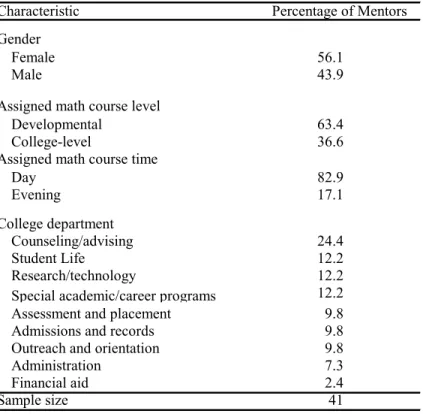
As Table 2.2 shows, a little more than half of the mentors were women. Ten mentors were employed in the counseling and advising department and the remainder in a range of other departments and offices on campus, including institutional research or information technology, the extracurricular activity office (Student Life), admissions and records, assessment and placement, outreach and orientation, and financial aid. Five mentors worked in a variety of specialized academic or career-based programs on campus, and three were upper-level adminis-trators.
Table 2.3 reports results from the survey described above in which mentors were asked to describe their activities and perceptions of the program.
overview of various student needs. Training program participants must also log some hours inside the Counseling and Advising Center on campus.
Characteristic Percentage of Mentors
Gender
Female 56.1
Male 43.9
Assigned math course level
Developmental 63.4
College-level 36.6
Assigned math course time
Day 82.9 Evening 17.1 College department Counseling/advising 24.4 Student Life 12.2 Research/technology 12.2
Special academic/career programs 12.2
Assessment and placement 9.8
Admissions and records 9.8
Outreach and orientation 9.8
Administration 7.3
Financial aid 2.4
Sample size 41
Achieving the Dream: South Texas College
Table 2.2
Characteristics of Beacon Mentors
Program planners expected that staff supervisors would invite employees to volunteer to be mentors, and the evidence suggests that most mentors willingly participated in the pro-gram. Of the 27 mentors who responded to this question on the survey, almost half reported being asked to participate by a supervisor or program representative, and nearly one in five reported volunteering to participate without being asked. However, more than a third of the
Outcome Mentors
Percentage of mentors who agree with the following statements:
My supervisor was supportive of my being a mentor. 89.3 The Beacon Mentor Handbook was useful. 89.3 My responsibilities as a mentor were clearly explained to me. 78.6 I knew who to approach with questions or problems about mentoring. 96.4 The instructor in my assigned math class stayed in touch with me during
the semester.a 57.1
The instructor provided me with information I needed to help struggling students.a 50.0 Most of the students in my assigned math class felt comfortable approaching
me for help. 55.6 Most of the students in my assigned math class who struggled generally did
not approach me for help. 77.8
Percentage of mentors who found the brown-bag lunch sessions useful:b
First Session Second Session Third Session No opinion/not applicable 14.8 30.8 10.7
Not useful at all 0.0 0.0 7.1
A little useful 22.2 11.5 14.3
Generally useful 18.5 19.2 28.6
Very useful 44.4 38.5 39.3
Percentage of mentors who were recruited as follows:a
Volunteered without being asked by an administrator or supervisor 18.5 Asked by an administrator or supervisor who said it was optional 44.4 Told by an administrator or supervisor that it was required 37.0
Sample size 28
Achieving the Dream: South Texas College
Table 2.3
Mentor Survey: Responses to Selected Questions
SOURCE: MDRC calculations from the South Texas College mentor survey. NOTES: aN = 27.
bSample size varies for these responses. Twenty-seven mentors evaluated the first brown-bag
session, 26 the second, and 28 the third.
mentors felt that the decision was not entirely up to them, reporting that they were told by their supervisors that being a mentor was a “part of their job.”
Perhaps because some mentors felt pressured to participate or were not adequately in-formed about what the role would involve, a few mentioned during interviews that they felt somewhat overwhelmed by the responsibilities. Particularly time consuming, according to some, was the effort needed to contact students whose class attendance was low or who had received a poor grade on a test. Others complained about the time it took to enter information about their interactions with students into the data system. While many felt gratified by the feeling that they had made a positive difference in the lives of their assigned students, as one mentor noted during a focus group, “I think we would like to be more active [in the program] than we are, but we all already have too many responsibilities.” Nonetheless, most mentors reported feeling well supported by supervisors. In fact, almost all of the survey respondents agreed with the statement, “My supervisor was supportive of my being a mentor.”
Mentor Training and Support
Beacon mentors were given a variety of training opportunities to prepare for and sup-port them in their roles. Before the program semester began, each mentor was required to be certified through the college’s eight-module Faculty and Staff Academic Advising Training Program, which was designed to convey to nonprofessionals some principles of academic advising and student support. The training series was modeled after the National Academic Advising Association’s training series and was conducted by the program coordinator.
After being selected from the larger pool of staff who had participated in the training program, mentors received their own copy of the “The Beacon Mentoring Handbook,” prepared by the program coordinator. During the semester, Beacon mentors were offered the opportunity to participate in three optional brown-bag lunch sessions to review their roles and responsibili-ties, learn more about how to support students, and share best practices with each other and participating faculty. The first brown-bag session was a refresher on program goals, the second focused on explaining how mentors and faculty pairs could collaborate to increase “college knowledge” among students, and the third featured team-building activities for mentor-faculty pairs. A final gathering, the “Beacon Bash,” celebrated the efforts and accomplishments of mentors, faculty, and students with refreshments and appreciation awards.
Overall, most mentors reported that the training, ongoing support, and resources offered to them were helpful. As shown in Table 2.3 a large majority of the mentors agreed with the statement that “the Beacon Mentoring Handbook was useful,” that their “responsibilities were clearly explained,” and that they “knew who to approach with questions or problems about
mentoring.” Moreover, the majority of the mentor survey respondents indicated that each of the brown-bag sessions was “generally” to “very” useful.
The Role of Faculty in the Beacon Program
Collaboration between the math faculty and the Beacon mentors was essential to the successful implementation of the program. A key element of the program was communication between instructors and mentors so that they could help students before they failed or dropped out of class. Instructors were expected to share information with their mentors, including their class attendance and grading rosters, so that mentors could see if students had stopped showing up for class, received a low score on a test, or otherwise seemed to be having trouble. Adminis-trators from student services worked early on with the chairs of the math department and developmental math studies to build enthusiasm and support for the program among the math faculty. Developing this buy-in was important, as there tends to be a gap between the academic and student services sides of colleges, and faculty are not used to opening up their classrooms to “outsiders.”
Despite the efforts to create buy-in from faculty, the level of communication and inte-raction between the math faculty and the mentors was varied. More than half of the mentors who responded to the survey reported that their math faculty partner stayed in touch with them during the semester, and half reported that the instructor provided them with the information they needed to help struggling students succeed in their class (see Table 2.3).
For many math faculty, working with their mentor proved to be a positive experience. In focus groups, math faculty described their mentors as “motivated,” “very involved and accessible,” and “receptive to students when talking with them in class.” A few faculty mem-bers appreciated their mentor’s efforts to schedule and facilitate study groups before tests and said that they worked with their mentors to schedule more in-class visits than required by the program. One faculty member noted that her mentor spent extra time in class “even when she was not presenting; she helped students become comfortable with her just by sitting in with them [in class] — she made quite a difference to the atmosphere of the class.” Another faculty member mentioned the ease with which her mentor shared his personal educational experiences to help motivate students, and still another faculty member mentioned that her mentor helped students apply for honors programs and scholarships.
But there were also math faculty and Beacon mentors who did not communicate or get along as successfully. Two of the 41 Beacon mentors failed to show up in class at all during the semester. A few faculty were not sure how much their assigned mentors were contacting absentee students, since they were not receiving updates from them, and one instructor said that his mentor would “schedule a time to come to class and then never show up.” Some mentors, on
the other hand, complained that it was their math faculty partners who were the source of a communication gap. They believed that their faculty partners were not sincere in their commit-ment to the program, citing their slowness in responding to voice mail or e-mail requests. A few mentors noted that that faculty did little to make them feel welcome in their class and made them feel as if they “were imposing.”
Classroom Visits and Frequency of Out-of-Class Interactions
Between Students and Mentors
Beacon mentors were expected to visit their assigned classes regularly, refer students to services on campus, and encourage students to contact them outside of class. On the whole, these elements of the program were implemented successfully. The majority of mentors delivered information about campus services as expected during their in-class presentations. Mentors encouraged students to attend class, join study groups, get help from the Center for Learning Excellence, and reach out if they felt they were facing other barriers to success. Anecdotal evidence suggests that some mentors may have encouraged students to persist even if they were earning a low grade, in the hope that they would have a better chance of eventually passing the class if they stuck with it longer, even if it required repeating the class. Other mentors, however, may have recommended that students drop the class to avoid adversely affecting their grade point average.
Most mentors reported visiting their assigned math class at least three or four times dur-ing the semester. In addition, nearly 70 percent of mentors also reported referrdur-ing students from their assigned math class to campus services at least three or more times during the semester (see Figure 2.1).
When contact between mentors and students occurred outside of class, it tended to be mostly by phone or e-mail. Seventy-five percent of mentors communicated with students at least once by phone, and 85 percent communicated by e-mail or online. This was in line with the design of the program, which did not require mentors and students to meet in person outside of class. Even so, two-thirds of mentors reported at least one face-to-face meeting outside of class with students from their assigned math class, and 15 percent reported three or more individual meetings with any student over the semester.
Results from the survey of students who had mentors assigned to their math classes seem to corroborate the mentors’ reports about the level and type of contact between students
# # # # # # # # # # # # # # # # # # # # 18
Achieving the Dream: South Texas College
Figure 2.1
Percentage of Mentors Participating in Activities, as Reported by Mentors
0 10 20 30 40 50 60 70 80 90 100 Visits to assigned math class (N = 27) Referrals of students to other campus services (N = 25) Meetings with students outside of class (N = 26) Communication with students by phone (N = 24) Communication with students by e-mail/online (N = 26) Meetings with students at the Center for Learning Excellence (N = 25) None One or two Three or more
SOURCE: MDRC calculations from the South Texas College mentor survey.
NOTE: Twenty-eight of the 41 mentors responded to the mentor survey. However, sample sizes vary because not all mentors answered all questions.