UNIVERSITY OF NOVI SAD
TECHNICAL FACULTY ”MIHAJLO PUPIN”
ZRENJANIN
REPUBLIC OF SERBIA
X INTERNATIONAL CONFERENCE OF
INFORMATION TECHNOLOGY AND
DEVELOPMENT OF EDUCATION
ITRO 2019
PROCEEDINGS OF PAPERS
X MEĐUNARODNA KONFERENCIJA
INFORMACIONE TEHNOLOGIJE I
RAZVOJ OBRAZOVANJA
ITRO 2019
ZBORNIK RADOVA
ZRENJANIN, JUNE 2019
II
Publisher and Organiser of the Conference:
University of Novi Sad, Technical faculty „Mihajlo Pupin”, Zrenjanin, Republic of Serbia
For publisher:
Dragica Radosav, Ph. D, Professor,
Dean of the Technical faculty „Mihajlo Pupin”, Zrenjanin, Republic of Serbia
Editor in Cheaf - President of OC ITRO 2019:
Jelena Stojanov, Ph. D, Assistant Professor
Proceedings editor:
Marjana Pardanjac, Ph. D, Professor
Technical design:
Ivan Tasic, Ph. D, Professor; Dusanka Milanov MSc, Assistant Dragana Draskovic MSc, Assistant
Circulation: 50
ISBN: 978-86-7672-322-5
By the resolution no. 142-451-530/2019-01/01, Autonomous Province of Vojvodina, Provincial Secretariat For Science and Technological Development donated financial means for publishing this Conference Proceedings.
The Conference is supported by the Autonomous Province of Vojvodina
CIP - Каталогизација у публикацији
Библиотеке Матице српске, Нови Сад
37.01:004(082)
37.02(082)
INTERNATIONAL Conference of Information Technology and Development of
Education ITRO (10 ; 2019 ; Zrenjanin)
Proceedings of papers [Elektronski izvor] / X International Conference of Information
Technology and Development of Education ITRO 2019 = Zbornik radova / X meĎunarodna
konferencija Informacione tehnologije i razvoj obrazovanja ITRO 2019, Zrenjanin, June 2019.
- Zrenjanin : Technical Faculty "Mihajlo Pupin", 2019. - 1 elektronski optički disk (CD-ROM)
: tekst, slika ; 12 cm
Nasl. sa naslovnog ekrana. - Bibliografija uz svaki rad.
ISBN 978-86-7672-322-5
а) Информационe технологијe - Образовање - Зборници б) Образовна технологија -
Зборници
III
PARTNERS INTERNATIONAL CONFERENCE
South-West University „Neofit Rilski”
Faculty of Education, Blagoevgrad,
Republic of Bulgaria
Technical University of Košice
Faculty of Electrical Engineering and Informatics
Slovak Republic
University Goce Delcev Stip
Republic of Macedonia
IV
THE SCIENCE COMMITTEE:
Marina Čičin Šain, Ph.D,
Professor
, University of Rijeka, Croatia
Sashko Plachkov, Ph.D, Professor, South-West University "Neofit Rilski" /Department of
Education, Blagoevgrad, Republic of Bulgaria
Sulejman Meta, Ph.D, Professor, Faculty of Applied Sciences, Tetovo, Macedonia
Márta Takács, Ph.D, Professor, Óbuda University, John von Neumann Faculty of Informatics,
Budapest, Hungary
Nina Bijedić, Ph.D, Professor, Applied mathematics, Bosnia and Herzegovina
Mirjana Segedinac, Ph.D, Professor, Faculty of Science, Novi Sad, Serbia
Milka Oljača, Ph.D, Professor, Faculty of Philosophy, Novi Sad, Serbia
Dušan Starčević, Ph.D, Professor, Faculty of Organizational Sciences, Belgrade, Serbia
Josip Ivanović, PhD, Professor, Hungarian Language Teacher Training Faculty, Subotica, Serbia
Ivanka Georgieva, Ph.D, South-West University "Neofit Rilski", Faculty of Engineering,
Blagoevgrad, Republic of Bulgaria
Miodrag Ivković, Ph.D, Professor, Technical Faculty "Mihajlo Pupin" Zrenjanin, Serbia
Momčilo Bjelica, Ph.D, Professor, Technical Faculty "Mihajlo Pupin" Zrenjanin, Serbia
Dragica Radosav, Ph.D, Professor, Technical Faculty "Mihajlo Pupin" Zrenjanin, Serbia
Dragana Glušac, Ph.D, Professor, Technical Faculty "Mihajlo Pupin" Zrenjanin, Serbia
Dijana Karuović, Ph.D, Professor, Technical Faculty "Mihajlo Pupin" Zrenjanin, Serbia
Ivan Tasić, Ph.D, Professor, Technical Faculty "Mihajlo Pupin" Zrenjanin, Serbia
Vesna Makitan, Ph.D, Assistant Professor, Technical Faculty "Mihajlo Pupin" Zrenjanin, Serbia
Marjana Pardanjac, Ph.D, Professor, Technical Faculty "Mihajlo Pupin" Zrenjanin, Serbia
Sneţana Babić Kekez, Ph.D, Professor,Technical Faculty "Mihajlo Pupin" Zrenjanin, Serbia
Erika Tobolka, Ph.D, Professor, Technical Faculty "Mihajlo Pupin" Zrenjanin, Serbia
Stojanov Ţeljko, Ph.D, Professor, Technical Faculty "Mihajlo Pupin" Zrenjanin, Serbia
Brtka Vladimir, Ph.D, Professor, Technical Faculty "Mihajlo Pupin" Zrenjanin, Serbia
Kazi Ljubica, Ph.D, Assistant Professor, Technical Faculty "Mihajlo Pupin" Zrenjanin, Serbia
Berković Ivana, Ph.D, Professor, Technical Faculty "Mihajlo Pupin" Zrenjanin, Serbia
Nikolić Milan, Ph.D, Professor, Technical Faculty "Mihajlo Pupin" Zrenjanin, Serbia
Dalibor Dobrilović, Ph.D, Professor, Technical Faculty "Mihajlo Pupin" Zrenjanin, Serbia
Anja Ţnidaršič, Ph.D Professor, Faculty of Organizational Sciences, Kranj, Slovenia
Janja Jerebic, Ph.D Professor, Faculty of Organizational Sciences, Kranj, Slovenia
Tatjana Grbić, Ph.D Professor, Faculty of Technical Sciences, Novi Sad, Serbia
Slavica Medić, Ph.D Professor, Faculty of Technical Sciences, Novi Sad, Serbia
Gordana Jotanović, Ph.D Professor, Faculty of Transport and Traffic Engineering, Doboj, BIH
ĐurĎa Grijak, Ph.D Professor, Technical Faculty "Mihajlo Pupin" Zrenjanin, Serbia
Gordana Štasni, Ph.D Professor, Faculty of Philosophy, Novi Sad, Serbia
V
THE ORGANIZING COMMITTEE:
Jelena Stojanov, Ph.D, Ass. Professor, Technical Faculty “Mihajlo Pupin” Zrenjanin, Republic of
Serbia - Chairman of the Conference ITRO 2019
Dragica Radosav, Ph.D, Professor, Technical Faculty “Mihajlo Pupin” Zrenjanin, R. of Serbia
Dijana Karuovic, Ph.D, Professor, Technical Faculty “Mihajlo Pupin” Zrenjanin, R. of Serbia
Marjana Pardanjac, Ph.D, Professor, Technical Faculty “Mihajlo Pupin” Zrenjanin, R. of Serbia
Ivan Tasic, Ph.D, Professor, Technical Faculty “Mihajlo Pupin” Zrenjanin, R. of Serbia
Dragana Glusac, Ph.D, Professor, Technical Faculty “Mihajlo Pupin” Zrenjanin, R. of Serbia
Vesna Makitan, Ph.D, Ass. Professor, Technical Faculty “Mihajlo Pupin” Zrenjanin, R. of Serbia
Erika Tobolka, Ph.D, Professor, Technical Faculty “Mihajlo Pupin” Zrenjanin, R. of Serbia
Dusanka Milanov, MSc, Assistant, Technical Faculty “Mihajlo Pupin” Zrenjanin, R. of Serbia
Dragana Drašković, MSc, Assistant, Technical Faculty “Mihajlo Pupin” Zrenjanin, R. of Serbia
All rights reserved. No part of this Proceeding may be reproduced in any form without written
permission from the publisher.
The editor and the publisher are not responsible either for the statements made or for the opinion
expressed in this publication.
The authors are solely responsible for the content of the papers and any copyrights, which are
related to the content of the papers.
With this publication, the CD with all papers from the International Conference on Information
Technology and Development of Education, ITRO 2019 is also published.
VI
INTRODUCTION
International Conference on Information Technology and Education Development (ITRO 2019),
was held the jubilee tenth time. Since the very beginning, the conference has been connecting
science, profession and experiences in education. Information technologies influence educational
processes and student achievements. Contemporary topics relate to Interactive EBooks and
electronic Teachers logbooks. Thematic fields of the conference are alined with general, but olso
with national trends in education:
Theoretic and methodology questions of contemporary pedagogy
Digital didactics of media
Modern communication in teaching
Curriculum of contemporary teaching
E-learning
Education management
Methodic questions of natural and technical sciences subject teaching
Information and communication technologies
Dual education.
The conference work was contributed by plenary lectures covering various aspects of ICT in
education development:
Digital transformation of educational system in Higher Education
, Branko Perišić, Faculty
of Technical Sciences, University of Novi Sad;
Security issues of e-learning system
, Igor Franc, E-security, Belgrade;
From E to ES teacher logbooks
, Ţarko Mušicki, primary school “Ţarko Zrenjanin”, Novi
Sad;
Canvy, The Thrue Story of Mobile App
, Marius Marcu, Politechnica University of Timisoara,
Romania.
The Proceedings containes 59 articles based on research and scientific work in the field of
information technologies in education.
The conference was financially supported by the Provincial Secretariat for Higher Education and
Scientific Research, Novi Sad. The Technical Faculty “Mihajlo Pupin” has provided the necessary
technical support.
The ITRO Organizing Committee would like to thank to the authors of articles, reviewers and
participants in the Conference who have contributed to its tradition and successful realization.
Regards until the next ITRO Conference,
Chairman of the Organizing Committee
Jelena Stojanov
VII
We are very grateful to:
Autonomous Province of Vojvodina
for donated financial means, which supported publishing of the
Conference Proceedings and organizing of the Conference.
VIII
CONTENTS
SCIENTIFIC PAPERS
G. Kiss, Z. Rajnai
COMPARISON OF INFORMATION SECURITY AWARENESS OF
MECHANICAL ENGINEERING AND SAFETY TECHNICAL
ENGINEERING STUDENTS AT OBUDA UNIVERSITY ... 3
D. D. Nedić
EXAMINATION OF FUNCTIONS IN THE GEOGEBRA PROGRAM
PACKAGE ... 9
T. Dabić, S. Grkavac, Ţ. Stojanov, R. Suzić
LANGUAGE BENEFITS WITH SKYPE IN THE CLASSRОOM ... 12
G. Jotanović, V. Brtka, G. Jauševac, A. Stjepanović, M. Stojčić
THE APPLICATION OF INTELLIGENT TUTORING SYSTEMS IN
EDUCATION ... 18
A. S. Cvetković, S. Jokić, S. Adamović, D. Milanov
CHALLENGES AND DEVELOPMENT OF AN EPORTFOLIO
PLATFORM AND COMPARISON WITH EXISTING SOLUTIONS
... 24
M. Bakator, D. Radosav
ENHANCED LEARNING WITH INTERACTIVE EBOOKS ... 30
M. Miteva, L. K. Lazarova, M. Ljubenovska
CONCEPTUAL ERRORS - SERIOUS BARRIER IN MATH EDUCATION ... 34
N. Radosavlevikj, H. Hajrullai
IMPLEMENTING VIDEO PRESENTATIONS AND STUDENTS
REACTIONS IN ESP CLASSES (STUDY CONDUCTED AT THE
LANGUAGE CENTRE-TETOVO, SEEU) ... 38
L. Tomčić
FROM TRADITIONAL TO MODERN TEACHING BY INTRODUCTION
IX
B. Sobota, Š. Korečko, M. Hudák, M. Sivý
ENHANCEMENT OF EDUCATION PROCESS THROUGH IMMERSIVE
VIRTUAL REALITY: TECHNOLOGICAL SCOPE OF LIRKIS LABORATORY .... 46
B. Tomić, N. Milikić, J. Jovanović, V. Devedţić, D. Đurić, Z. Ševarac
ENCOURAGING ACTIVE LEARNING OF JAVA AND R THROUGH THE
USE OF GIT CODE REPOSITORIЕS... 50
M. Klekovska, C. Martinovska Bande
COMPUTER SUPPORT IN GRAPHIC EDUCATIONAL SUBJECTS ... 57
B. Sobota, Š. Korečko, M. Hudák, J. Ľonc
VIRTUAL TRAINING SPACE ... 62
M. Kocaleva, L. Loku, B. Zlatanovska, N. Stojkovikj, A. Krstev
THEORETICAL BASICS OF STATISTICS VIA EXAMPLES ... 66
N. Stojkovikj, M. Kocaleva, B. Zlatanovska, A. Stojanova
BELLMAN-FORD AND FLOYD WARSHALL ALGORITHMS FOR
EASIER LEARNING ... 70
T. Radmanović, N. Ranković, D. Radosav, D. Ranković, M. Bjelica
DETERMINING FACTORS FOR ENROLLMENT AT THE
TECHNICAL FACULTY “MIHAJLO PUPIN” IN ZRENJANIN ... 73
L. Krstić, M. Krstić, V. Stanković
IMPLEMENTATION OF THE SYSTEM FOR E-LEARNING OF
EMPLOYEES BASED ON CHAMILO LMS ... 79
A. Baggia, D. Gak, T. Grbić, S. Medić, N. Duraković, A. Ţnidaršič, U. Rajkovič,
A. Tratnik, J. Jerebić
AN OVERVIEW OF ANALYSIS OF STUDENTS’ E-MAILS IN
THEIR COMMUNICATION WITH TEACHERS ... 86
E. Tosheva
TECHNOLOGICAL MODEL FOR TRAINING STUDENTS IN THE
CLOUD ENVIRONMENT ... 90
Lj. Kazi, D. Karuović, D. Radosav, T. Lojović, A. K. Vignjević, O. Lakićević
DESIGN OF A WEB PORTAL FOR PRESCHOOL RESOURCES
X
A. Ristić, D. Cvetković, R. Ristić
THE USE OF MOBILE APPLICATIONS IN EDUCATION ... 98
V. Ivanov, R. Ivanov, N. Koceska
DESIGN AND DEVELOPMENT OF A GAME FOR RECOGNIZING
AND EXPRESSING EMOTIONS ... 102
S. Mihajlović, I. Berković, A. Stojkov
A PRELIMINARY REVIEW TEACHING COMPUTER GRAPHICS
AT UNIVERSITY ... 106
K. Davcev, N. Koceska, S. Koceski
TEACHING BASICS OF SERIAL ROBOT CHAINS’S KINEMATICS
TO COMPUTER SCIENCE STUDENTS ... 110
A. Krstev, D. Krstev, B. Krstev, G Milosevski
HUMAN RESOURCES EVIDENCE AND MANAGEMENT
SOFTWARE’S ... 116
M. Bakator, D. Radosav
DISTRIBUTING KNOWLEDGE THROUGH E-LEARNING
PLATFORMS ... 121
R. Jakimov, C. Martinovska Bande, M. Kusevska, B. Ivanovska
INFORMATION RETRIEVAL SERVICES FOR ELECTRONIC
COLLECTIONS OF TEXTS PRODUCED BY LANGUAGE LEARNERS .... 126
A. Ristić, R. Ristić, D. Cvetković
FRAMEWORK FOR TEACHER EDUCATION AND DEVELOPMENT ... 131
S. Mihajlović, E. Brtka
APPLICATION DEVELOPMENT USING WPF ... 138
M. Bogdanović, S. Mironicki, A. Tomić
THE FIRST EXPERIENSES IN USE OF TEACHER LOGBOOK IN
SOMBOR
MUNICIPALITY SCHOOLS ... 141
Z. Zeljković, D. Musulin Kolarov, D. Ţigić, J. Stojanov
ADVANTAGES AND DISADVANTAGES OF E-CLASS REGISTERS
XI
K. Davcev, N. Koceska, S. Koceski
A REVIEW OF ROBOTIC KITS USED FOR EDUCATION PURPOSES ... 152
A. Krstev, D. Krstev, B. Krstev, A. Alili, B. Nedeva, K. Todorov
EFFECTIVE TEAMS FOR SUSTAINABLE PROJECTS– PRINCIPLES,
PRACTICE AND PRESENTATION ... 156
L. K. Lazarova, M. Miteva, A. Stojanova
MODERNIZATION OF MATHEMATICS EDUCATION BY USING
EDUCATIONAL E-PLATFORMS ... 161
I. Tasić, D. Glušac, M. Nikolić, J. Jankov, M. Ćoćkalo-Hronjec
THE IMPACT OF TEACHERS JOB SATISFACTION ON THE QUALITY
OF THE TEACHING PROCESS IN SERBIAN PRIMARY SCHOOLS ... 166
A. Stojanova, B. Zlatanovska, M. Kocaleva, D. Rendjova, N. Stojkovikj, D. Bikov
USING OF MATLAB IN THE MATHEMATICAL EDUCATION ... 175
L.K. Lazarova, M.Miteva, T.A. Pachemska
ERASMUS+ PROJECTS AS TOOL FOR IMPROVEMENT
MATHEMATICS TEACHING ... 180
N. Bobinac, A. Cakić, V. Makitan
USING THE INTERNET FOR STUDENTS’ SELF EDUCATION ... 184
N. Petrović, E. Terek, D. Sajfert, V. Premčevski, T. Petković
THE IMPACT OF LEADERSHIP ON THE DEVELOMPENT OF
EDUCATION ... 189
M. Kovačević, I. Tasić, S. Kovalevskyy, O. Kovalevska
SHORT PROGRAMS OF HIGHER EDUCATION STUDIES IN
THE
REPUBLIC OF SERBIA ...
192
M. Kavalić, S. Vlačić, M. Ćoćkalo Hronjec, S. Stanisavljev, N. Ljubojev
ACCESSING STUDENTS ACCORDING TO THEIR TYPE OF
PERSONALITY REGARDING BIG FIVE ... 197
M. Malić, D. Dobrilović, Ţ. Stojanov, D. Malić, M. Marcu
XII
St. Banjanin, S. Popov, Sa. Banjanin
COMMUNICATION AND USE OF MODERN TECHNOLOGIES IN
TEACHING
PROCESSES IN PRIMARY SCHOOLS OF SERBIAN AND
ROMANIAN BANAT ... 207
N. Petrović, D. Sajfert, E. Terek, M. Vulović, J. Rajković
PRIMARY SCHOOL PRINCIPAL'S ROLE AS A LEADER ... 212
A. Ilić, E. Eleven, M. Pardanjac, M. Hadzić, M. G. Stamenković, J. Barbarić
PROBLEM-BASED TASKS IN TEACHING TECHNICS AND
TECHNOLOGY ... 217
Cs. Szabó, V. Zsók, E. Somova
FOCUSING SOFTWARE ENGINEERING EDUCATION ON
COMPOSABILITY AND COMPREHENSIBILITY ... 222
L. Cveticanin
EDUCATION IN CYBER-PHYSICS ENGINEERING ... 227
I. Ninkov
INCLUSIVE EDUCATION OF TALENTED STUDENTS: LEGAL
ASPECTS ... 231
T. Zorić, V. Makitan
THE IMPACT OF MODERN TECHNOLOGIES ON IT PROJECT
MANAGEMENT ... 236
M. Kovačević, I. Tasić, P. Dašić, N. Tasić
TECHNIQUES AND TECHNOLOGIES IN THE EDUCATIONAL
SYSTEM OF THE REPUBLIC OF SERBIA ... 241
N. Tasić, D. Lacmanović, M. Pardanjac, D. Milanov
A/D AND D/A CONVERTERS ... 247
K. Petrović, N. Ilić, V. Nikoić, B. Markoski, N. Jancev
DEVELOPING NEW APPROACH TO REDUCE RISK IN THE
PROCESS OF ADOPTION DECISION ... 251
S. Arsovski, A. D. Cheok, S. Nurannisa Binti Abu Hamid
XIII
M. Radovanović, J. Pavlović, V. Nikoić, A. Jašić, A. Kostić Zobenica
DECISION MAKING METHODOLOGY TOPSIS FOR SELECTING
THE MOST IDEAL MOBILE PHONE ... 262
K. Nicović, A. Stevović, V. Nikoić, A. Jašić, V. Premčevski
POSSIBILITIES OF USING SIMPLEX METHODS IN INFORMATION
SYSTEMS FOR DECISION SUPPORT ... 266
D. Milanov, I. Palinkaš, E. Terek, J. Bushati
GAMIFICATION OF LEARNING AND EDUCATION ... 271
N. Simić, D. Lacmanović, V. Premčevski
THE EVOLUTION OF BLOCKCHAIN TECHNOLOGY ... 275
V. Brtka, E. Brtka, V. Makitan, D. Karuović, A. Lunjić
APPLICATION OF LOOP LEARNING ... 280
D. Lacmanović, D. Glušac, D. Radosav, N. Ljubojev
ANALYSIS OF THE PRESENCE OF VIOLENCE ON SOCIAL
NETWORKS IN SCHOOL AGE CHILDREN IN THE TERRITORY
116
Human Resources Evidence and Management
Software’s
A. Krstev*, D. Krstev**, B. Krstev***, G Milosevski***
*Faculty of Computer Science - Goce Delchev University, Stip, Republic of Macedonia
**Faculty of Mechanical Engineering - Saints Cyril and Methodius University, Skopje, R. of Macedonia ***Faculty of Natural and Technical Sciences - Goce Delchev University, Stip, Republic of Macedonia
[email protected], [email protected]
Abstract - Human resource records include all the activities that managers undertake to attract and retain employees and ensure that they perform high-level work and contribute to the achievement of organizational goals. These activities shape the organization's human resources management system, a system that has five main components: management and selection, training and development, upgrading of work and feedback, salary and benefits and employee relations. Human resource record is the process by which managers design the components of the human resource management system that are mutually consistent, with other elements in the organizational architecture and with the organization's strategy and goals. The purpose of human resources records is to build a human resource management system that promotes the efficiency, quality and innovation of the organization and the needs of consumers - four carrier blocks of competitive advantage. The human resource record and management software is divided into several modules: systematization, management and selection, personal records freelance cooperation, records of employees' documents, career, absences, performance measurement and reviews.
I. INTRODUCTION
The term human resources are used to explain the individuals who constitute the workforce of an organization. In addition, this notion also applies to the economy of labor, for example, business sectors and even whole nations. HR is also the name for the function within the organization in charge of overall responsibility for implementing strategies and policies related to the management of individuals (i.e. human resources). The "HR" initials are often used as a shortcut to the notion. The word, human resources is a relatively modern concept in management, coined in the 1960s. The origins of the function appear in organizations that have placed practice in welfare management, and also in those that implement the principles of "scientific management". From these notions, a largely administrative management activity has been created, which coordinates a field of employee-related processes and is currently becoming known as "staff". Initially in the United States, as well as in multinational and international
corporations, human resources are rapidly becoming the most common name for this area, affecting the implementation of a more quantitative and strategic approach in managing the workforce, the need for corporate governance in order to obtain a competitive advantage, using rarely skillful and highly skilled workers. Simply put, the organizational strategy for managing human resources should increase the return on investment in the human capital of the organization and reduce financial risk. Human Resource Managers see this as achieving the merging of skilled and skilled people and the skills of the current workforce with current and future business plans of the organization and the need to increase return on investment and ensure future success and survival. To ensure that such objectives are achieved, the objective of the human resources task is to effectively implement the human resources requirements of the organization, taking into account federal, state, and local laws and rules of work, ethical business practices and net cost, in a way that maximizes, as much as possible, the motivation, dedication and productivity of the employees.
II. MANAGEMENT OF HUMAN RESOURCES
Human Resource Management includes all the activities that managers undertake to attract and retain employees and ensure that they perform high-level work and contribute to the achievement of organizational goals. These activities shape the organization's human resources system, which consists of five main components: • recruitment and selection, • training and development, • upgrading of work and feedback, • salary and benefits, • relationships between employees.
Strategic human resource management is the process by which managers design the components of the human resources management system that are mutually consistent, with other elements of
organizational architecture, and with the
117 strategic human resources management is to build a human resource management system that promotes the efficiency, quality and innovation of the organization and the needs of consumers - the four carrier blocks of competitive advantage.
III. COMPONENTS OF HUMAN RESOURCES RECORDS
Managers apply recruitment and selection to attract and hire new people who have the ability, skills and experience to help the organization achieve its goals. For example, Microsoft aims to remain the world's leading computer software company. When Microsoft employs new software designers, hundreds of highly qualified candidates with excellent recommendations are being interviewed and rigorously tested, but only the best are employed1.
After recruiting and selecting employees, managers apply the second component, training and development, for members of the organization to develop skills and abilities that will enable them to carry out their work effectively now and in the future. Training and development are a permanent process; changes in technology and the environment, as well as the goals and strategies of the organization, often require members of the organization to learn new techniques and ways of working. In Microsoft, newly-appointed program designers receive workplace training in small teams with experienced mentors or advisers. Newly-trained students learn from the members of the team according to the needs of consumer programming to develop a computer system. The third component, rewarding work and feedback, has two objectives in human resource management. First, rewarding the work can give managers information to make good decisions on human resources - decisions on how to train, motivate, and reward members of the organization. Thus, the component for rewarding work and feedback is a kind of control system that can be used for management purposes2.
Secondly, the feedback from the work done by rewarding the job serves to improve the members of the organization. When managers regularly evaluate the work of their subordinates, they can provide valuable information to subordinates about their good and bad old and areas in which they need to concentrate.
IV. INFORMATION TECHNOLOGY FOR EVIDENCE
Information technology is one of the most tools used by managers to manage the changes. Computer Hardware is the physical equipment
used for activities related to the input, processing and transfer of data into the information system. It consists of the following: computers of different size and form, different input devices, data transfer and storage, and telecommunication devices that connect computers together. Computer software consists of detailed, programmed instructions that control and coordinate the components of computer hardware in the information system. Data management technology consists of a computer that manages the organization of data on physical storage media. Network and telecommunications technology, which consists of both physical devices and hardware, connects various parts of hardware and transfers data from one physical location to another. The network connects two or more computing devices to share data or resources such as the printer. The Internet is a global network of networks that uses universal standards to connect millions of different networks with more than 1.4 billion users in more than 230 countries around the world. The Internet has created a new universal technology platform that builds on new products, services, strategies and business models.
A. HRIS and e-HRM
Human Resource Information Software (HRIS) is a software or on-line solution used for data entry, data tracking and information requirements for human resource management in the organization, payroll calculation, and bookkeeping. HRIS is usually offered as a database in the human resources sector.
HRIS is focused on increasing the capacity of human resource management by: • Absorb new and promising technologies, • Simplification of work, • Optimizes the precision, stability and reliability of labor force data, • Simplify the deployment and retrieval of data, • Administration of all employee data, • Reporting and evaluation of employee data, • Company-related information, including manuals,
disaster recovery methods and safety
recommendations, • Comprehensive payroll integration, in addition to other accounting systems and financial software, • Monitoring applicants and administering their biographies
An efficient HRIS helps the organization to follow: • Paid free time - Paid time off (PTO) and attendance, • History of pay scales, • Position and degree of payment, • Strategies for developing overall efficiency, • Training was conducted, • Disciplinary measures, • Personal data of employees, • Identification of potential employees, • Administration for job seekers, including the interview process and selection
118 An organization can choose and adapt HRIS so that it meets the requirements. An efficient HRIS provides the organization with information without looking for anything, monitoring and examining the data for the applicant. The customized HRIS helps the human resources department to perform administrative tasks, allowing them to focus on other strategic functions. In addition, the necessary information is provided for the development of knowledge and skills, equal treatment in human resource management and career advancement. Managers can also gain access to the information needed to effectively and legally contribute to the success of their direct reports. Electronic human resource management (e-HRM), as a new phenomenon, is defined in many aspects. There are more generally accepted views, views and definitions. Information technology alters the way in which human resources departments handle record keeping and information sharing. It significantly reduces documentation and provides easy access to bulk data. It is also possible to track the achievements of the employee without going through controversial procedures. Intranet or other channels of web technology are used and can be used to implement various human resource strategies. Authorizations for different human resource functions can be distributed through HRM. There is a fundamental difference between the human resources and e-HRM information systems. HRIS has an application in the human resources department, where users of this
technology are largely human resources
professionals who use the human resources improvement system to improve the service for the business. E-HRM, on the other hand, is aimed at employees and management. The authors identify the main difference between HRIS and e-HRM.
HRIS refers to the automation of human resources services, and e-HRM provides technology support for information about human resources services. "Technically speaking, it can be said that e-HRM is the technical unlocking of HRIS for all employees in an organization." Therefore, e-HRM is defined as a process of integration between human
resources management and information
technology, using web-based technologies in human resource management.
V. THE MOST SPECIFIC SOFTWARE SOLUTIONS FOR RECORDING OF HUMAN RESOURCES
Business success is not only a factor in strategy, product, and technology but rather depends on how the company manages its workforce. This is why it is crucial for employers to effectively manage and manage the human resources department, to keep employees motivated. For companies to achieve maximum output, they need to use modern software technology to effectively manage the quality of human resources. Many software for human resources, and open source software and premium versions have been developed.
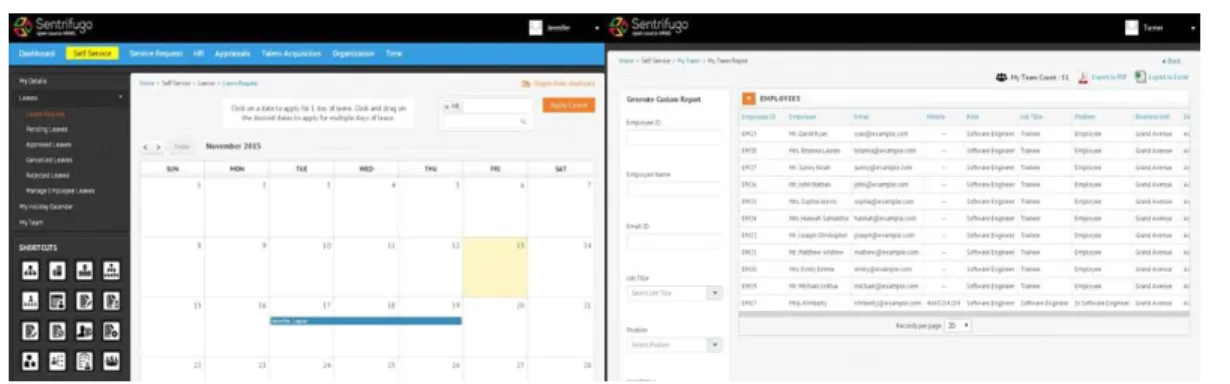
Below is a list of different open source and open source software for human resources: • Sentrifugo. This great software starts from the point that the adjustments should be pre-defined, which gives them all completely free. This human resource management system is easy to install and can easily be adapted to fit into any organizational structure. It is one solution for aligning human resources activities. Sentrifugo features include performance appraisal, employee self-service, good analytics, background checks, service requests, resource requisition, interview scheduling, perfect dashboard, time management module.
119
Figure 9: Menu for creating reports for employees by managers on the system's work screen - Sentrifugo
WebHR software runs as an "employment-to-retirement" strategy, which simplifies day-to-day organizational tasks, not just in the most important capital, human resources, but in the whole organization. Basically it bridges the gap between human resource management and information technology. WebHR includes a rich social HR function, a complete solution for hiring, self-service employees, extremely user-friendly, payroll, low cost biometrics, comprehensive reports and graphs, an on-line internship portal and a good broadband profile of employees. WebHR acts as a bridge between the records of human resources and information technology. It enables businesses to automate many aspects of human resource management, with the dual benefit of reducing the workload of the human resources department, and increasing the efficiency of the department by standardizing human resources processes.
Figure 17: WebHR work window
Bitrix24 offers 35 plus free means of work in one place and is a perfect communication and collaborative platform. Freemium software is free for a limited number, up to a maximum of 12 users. Bitrix24 contains large modules such as Social Intranet, interactive flow of activities, a system that provides chat, badges, company announcements, photo gallery, work processes (holiday requests, business trip expenses and general requirements). In Bitrix24, people are in the spotlight. In the employee directory, you can easily get to the contact information or through a list filter to find the right person for a particular search. By clicking on an employee in the list, it comes to the profile page of that employee. All employee information is visible to the public and has options for instant messaging or comment on the person's blog or photo gallery.
OrangeHRM. The system provides a human resource management platform that provides access to a wide community of users. The modules
include system administration, information
management for employees, time management and attendance, employment, performance, self-service for employees, etc. OrangeHRM software is open source and is a free human resources management system that offers a wealth of modules that suit the needs of every business. This frequently used system is rich in features, intuitive and provides an
important platform for human resource
management, along with free documentation and access to a wide community of users.
120
Figure 19: Directory for employee search and Course of activities
Figure 21: Employee Data Management Module and Global Absentee Management System
VI. CONCLUSION
Rapid development of new technologies is felt around us and constant innovations and changes are increasingly being applied in all areas on a daily basis. So our records did not remain untouched by this technological and Internet "fever". Software companies create and offer software solutions to facilitate certain record functions and activities. Changes in information technology are faster than any other processes in organizations. IT opportunities for human resource management are endless. Regarding the coverage of human resource management functions, the majority of them can be supported by IT, but not all that has been confirmed in our research. Of course, this is in the context of expectations and in terms of support the results and some similar research. It should also be noted that when introducing technological solutions, problems and errors in the database, errors of the server, etc. are possible, which the respondents in our research are aware of (especially emphasized by the older group). But, as a result, in our research, in general, researchers from the younger group with greater awareness of the everyday technological changes, accept them more boldly and are ready for risk, and sufficiently efficient in the direction of modernization, facilitation, and improvement of
work. With the advent of new generations of leading positions in the records sector, IT use will increasingly be accepted, because every day, it is a fact that the numerous benefits of using specific tools, which include saving time, resources, and reducing administrative burdens on employees. Finally, based on all of the foregoing, we can fully conclude that our general assumption was: "The use of e-HRM systems and other HRIS tools in organizations in the Republic of Macedonia. Macedonia is already a developed practice that finds support from the employees.
REFERENCES
[1] Ball, K.S. (2001). The use of human resource information systems: a survey. Personnel Review, 30(5/6), 677
[2] Bodea C., Bodea V., Zsolt M. (2003). Human Resource Management in the Internet Age: e-Recruitment and e-Selection Methods, Economy Informatics, III(3): 5-7.
[3] Bondarouk, T.V., & Ruël, H.M. (2009). Electronic human resource management: Challenges in the digital era. International Journal of Human Resource Management, 20(3), 505-514. [4] Bradford S. Bell (2006). The Impact of e-HR on Professional
Competence in HRM: Implications for the Development of HR Professionals, Center for Advanced Human Resource Studies (CAHRS), 4-1-2006 (Human Resource Management Research p-ISSN: 2169-9607 e-p-ISSN: 2169-9666 2014; 4(4): 75-80. [5] Chapman D. S. and Rowe P. M. (2003). The influence of
videoconference technology and interview structure on the recruiting function of the employment interview: A field experiment, International Journal of Selection and Assessment, 10(3): 185-197