Patrik Fredriksson
Daniel Johansson
Optimizing CRM Readiness
Specifying a CRM Strategy for Volvo Penta
Business Administration
Master‘s Thesis
30 ECTS
Term: Fall 2010 Supervisor: Martin Löfgren
Preface
The authors of this thesis would like to express their sincere gratitude to Professor Martin Löfgren and Professor Patrik Gottfridsson for their supervision and help throughout the process.
Further gratitude is aimed towards the employees of Volvo Penta and especially addressed to Mr. Bjuve, the contact person at Volvo Penta, who has been utmost helpful during the whole process. Without your help and enthusiasm, this thesis would not have been possible.
Patrik Fredriksson Daniel Johansson
Abstract
Purpose The analytical purpose of this thesis is to link
theory on how business processes should be designed to strengthen customer relationships, with empirical data on what these processes presently look like. The empirical purpose is to formulate a CRM strategy for Volvo Penta. This will be done by analyzing how the current processes of the company are designed and what limitations and possibilities the company and market characteristics offer.
Method A triangulated research method with focus on
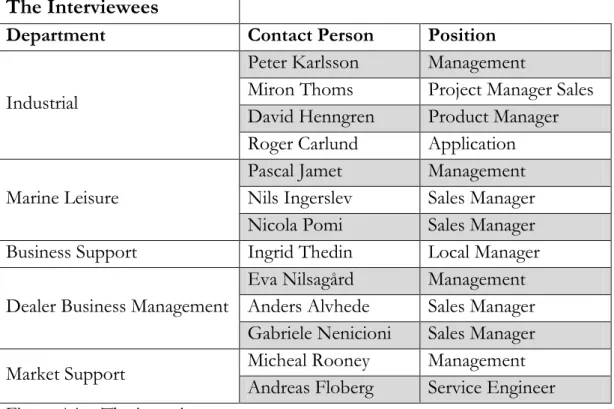
qualitative interviews is used in the form of in-depth, face-to-face interviews. Thirteen such
interviews have been conducted with
representatives of different departments within Volvo Penta.
Findings The empirical data has brought several findings on
what needs to be done and thought through in order to optimize a CRM-strategy. One such finding is that Volvo Penta does not have thorough directions on how their processes and customers should be approached. Another important finding is that the level of cross-functionality within the processes is too low.
Recommendations The authors can make several recommendations by
analyzing the empirical data. These
recommendations have various simplicity of implementation.
Table of Contents
Chapter 1 – Introduction ... 1
1.1 Background ... 1
1.2 Company Profile of Volvo Penta ... 2
1.3 Problem ... 2
1.4 Purpose ... 3
1.5 The Further Structure of the Thesis ... 3
Chapter 2 – Methodology ... 4
2.1 Scientific Approach ... 4
2.2 Research Design and Data Collection ... 5
2.3 The Interviewees ... 6
2.4 Analysis ... 6
2.5 Validity, Reliability and Precision ... 7
2.6 Limitations and Criticism toward the Methodology ... 8
Chapter 3 – Frame of Reference ...10
3.1 Relationship Marketing ... 13
3.2 CRM Definition ... 14
3.3 Strategy development process ... 15
3.3.1 Key Account Management ... 15
3.4 Value Creation Process ... 17
3.4.1 Service-Dominant Logic ... 17
3.4.2 Customer Needings ... 17
3.4.3 The IMP Interaction Model ... 19
3.4.4 The ARA Model ... 22
3.5 Multi-channel integration process ... 23
3.6 Information management process ... 25
3.6.1 CRM-system ... 25
3.6.2 Knowledge Management ... 28
3.7 Performance Assessment Process ... 28
3.8 Implementation ... 29
Chapter 4 – Empirical Result and Analysis ... 32
4.1 Qualitative Study ... 32
4.1.1 Strategy Development Process ... 33
4.1.2 Value Creation Process ... 41
4.1.3 Multi-channel Integration Process ... 46
4.1.4 Information Management Process ... 49
4.1.5 Implementation ... 51
Chapter 5 – Recommendation, Discussion and Further Studies ... 53
5.1 Recommendation ... 53
5.2 Discussion ... 57
5.3 Further Studies ... 59
References ... 60
Appendix ... 68
Appendix 1 – Interview guide ... 68
1
Chapter 1 – Introduction
The background, problem and a company profile presentation of Volvo Penta are presented in the opening part of this chapter. The chapter ends with the purpose and the further structure of the thesis.
1.1 Background
There are several scholars who argue that customer care is important in today‘s business, and there are probably not many that would disagree (Bee & Bee 1999; Cook 2008; Lancaster & Withey 2007). However, the customer focus is a fairly new concept, mostly represented by relationship marketing (Dwyer et al. 1987; Grönroos 1994; Berry 1983) developed in the 1990‘s (Peck et al. 1999). One can ask why this topic has only been discovered in the last three decades. The answers are many but the technological advances and the global competition are two common explanations in recent studies. The World Wide Web and global competition (intercontinental distribution) has increased the product range and thus created a buyers‘ market (Peck et al. 1999). The topic itself might not be a new problem. However, nowadays technology can enable management of the problem and turn it into an advantage.
Vargo and Lusch (2004) coined the concept of service-dominant logic in 2004 which aims the focus on seeing both products and services as the value that they produce through co-creation. This means that companies have to be engaged in the whole cycle of the product or service by interdependently interacting with customers and thus create relationships. Further studies of deepening the interdependent relationships between a company and its customers are, for example the customer needings concept (Strandvik et al. 2008; Strandvik et al. 2009a; Strandvik et al. 2009b) and the IMP interaction concept (Håkansson & IMP Project Group 1982; Håkansson & Johanson 1992; Håkansson & Snehota 1995).
Relationship marketing is further a way to reach competitive advantage and thus generate greater profits through loyal customers (Hennig-Thurau & Hansen 2000; Webster 1995). This is easier said than done because now the question of how you make the customers loyal arises. It is here this thesis‘ main focus of Customer Relationship Management (CRM) enters the picture. A
1 Introduction
2
CRM-system is an Information Technology tool used to enable relationship marketing strategies (Ryals & Payne 2001; Wilson et al. 2007). Companies need to identify and handle several processes within and outside the business (Peck et al. 1999). One large factor that many other models and theories of relationship marketing and customer loyalty do not treat is the internal aspect of marketing where employees are connected to the company and business strategy. Most companies that aim to increase the relationship marketing with the help of CRM most often fail since it is highly broad and complex (Payne & Frow 2005).
1.2 Company Profile of Volvo Penta
Volvo Penta is a part of the Volvo concern and is divided into three main segments, namely the marine leisure engines, marine commercial engines and industrial engines. The marine segment of Volvo Penta focuses on engines made for boats and the industrial segment focuses on industrial machines such as jaw breakers and electrical generators.
The company sells both directly and through so called Volvo Penta Centers (VPC) which are spread around the globe. These in their turn use so called Volvo Penta Service Centers (VPS) to supply customers with spare parts, repairs and maintenance.
Volvo Penta has a heritage that stretches back to 1868 when it was called John G Grönvall & Co and sold everyday items but it was in 1907 that Volvo Penta took its current shape as a marine engine producer. In 1916 the company was purchased and changed name to AB Pentaverken and the production was mainly engines with a focus on the marine market. In 1925, Volvo needed help to produce automobile engines for their first car. The relationship then became deepened and in 1935, AB Pentaverken was acquired by Volvo and then became Volvo Penta. In 2009, AB Volvo Penta had a turnover of approximately six billion SEK with 719 employees. Volvo Penta has mainly three production facilities; Vara in Sweden, Lexington in Tennessee, and Wuxi in China (Volvo Penta 2010).
1.3 Problem
As described in the background, relationship marketing and interdependent relationships with the customers are the ‗new‘ ways of doing business. It is therefore important for companies to meet the needs of the customers and start
1 Introduction
3
to adapt to the competitive situation. One way of doing this is to take advantage of the technological development that has increased during the past years. CRM-systems are, according to Möller and Halinen (2000) and Theron and Therblanche (2010), a way of adapting the relationship marketing to the computer technology. Though, as previously mentioned, many companies fail in introducing the CRM-system to their business situation. The question is why this fails.
According to Payne and Frow (2005), a company needs to have a clear CRM strategy which takes both the external and internal marketing into consideration before implementing a CRM-system, which presently, Volvo Penta does not have.
1.4 Purpose
The analytical purpose of this thesis is to link theory on how business processes should be designed to strengthen customer relationships, with empirical data on what these processes presently look like. The empirical purpose is to formulate a CRM strategy for Volvo Penta. This will be done by analyzing how the current processes of the company are designed and what limitations and possibilities the company and market characteristics offer.
1.5 The Further Structure of the Thesis
Chapter 2 In this chapter, the chosen methodology for the empirical research is presented along with a discussion about reliability, validity and precision and neglected research methods.
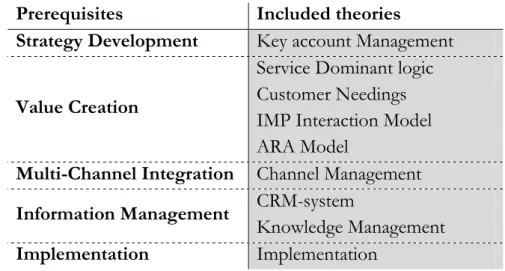
Chapter 3 In this chapter, the frame of reference is presented. The reader is introduced to theories which will form the knowledge base of the thesis along with the prerequisites which outline the design of the analysis.
Chapter 4 In this chapter, the empirical study is presented and further analyzed in connection to the theories presented in chapter 3.
Chapter 5 In this chapter, recommendations to Volvo Penta along with a scientific contribution is presented. The chapter ends with a discussion of further studies.
4
Chapter 2 – Methodology
The selected methodology is presented in this chapter, along with why it is suitable for the problem of this thesis. The selection of interviewees, the gathering of data and the analyzing of the conducted information are also explained. The chapter is concluded with a discussion of the validity, reliability and precision of the methodology along with a justification for rejected methodological alternatives.
2.1 Scientific Approach
Since the analytical purpose of this thesis is to link theory on how business processes should be designed to strengthen customer relationships, with empirical data on what these processes presently look like and the empirical purpose is to formulate a CRM strategy for Volvo Penta, it is of importance to translate the data and understand the information in order to grasp the context of the problem. This can be correlated to what Andersson (1979), Eriksson and Wiedersheim-Paul (1999), Ekström (1992) and Thurén (2007) describe as an interpretational approach, where the author deepens, develops and revises the knowledge of the context gathered from the research through interpretations. In this thesis, it is of importance to capture and grasp the problem situation of the interviewees and make the problem clearer. When this is of importance, qualitative interviews are useful (Kvale 1996; Wallén 1996). However, when interviewing the customers, a combination of qualitative and quantitative questions is seen as most appropriate since the authors also would like to complement the ―stories‖ of the interviewees with more statistically driven outcomes. According to Jacobsen (2002) and Carlsson (1991) this combination is called methodology triangulation and can be highly effective since it captures both the qualitative and the quantitative advantages. To conclude; the interviews in this thesis will have a focus on qualitative interviews with an additional complementary triangulated part for each individual.
The frame of reference (chapter 3) consists of pre-collected information in the form of secondary data. Secondary data is data that has been collected and researched beforehand and not during the current research (Patzer 1995; Kumar 2008; Wegner 2010). Thereby the authors have some assumptions
2 Methodology
5
beforehand which will be tested for its validity. Further, the research area cannot possibly be covered solely on secondary data since the business situation of Volvo Penta and their relationships are unique. Therefore, the authors of this thesis will perform interviews which will form the basis of the primary data. Primary data is data collected for the first time (Kothari 2008) and is in this thesis composed through interviews.
2.2 Research Design and Data Collection
The qualitative interviews will be carried out through in-depth interviews. According to (Wallén 1996; Alvesson & Sköldberg 2008; Dubois & Gadde 2002; Pople 1973), in-depth interviews are useful to grasp the phenomenology which is how the interviewee acts and replies and also the interviewee‘s visualization and experiences. Carlsson (1991) and Jacobsen (2002) further express that in-depth interviews are valuable when the number of interviewees are few and when the single individual‘s story and interpretations are of importance, which is in accordance to the purpose of the interviews; to identify the current CRM situation and future needs of Volvo Penta. Further, according to Gubrium and Holstein (2002), through in-depth interviews, with help of the so called ‗probing technique‘, the interviewer can ask follow-up questions and reach even deeper meanings of an answer.
The quantitative interviews will be a complementary part of the qualitative design in the triangulation interviews, mentioned by Bell (1993), with a questionnaire of listed questions where the interviewee chooses a few of the alternatives. Further a quantitative study was conducted with the purpose of reaching a clearer view of the information gathering and sharing within Volvo Penta (survey can be seen in appendix 2).
Performing the Interviews
The authors started by affirming the use of the interviews and the information, which was to depict the current CRM situation of Volvo Penta. Before the interviews were held, the authors provided the interviewee with information about the project and the purpose of the thesis, which according to Dalland (1993) and Ejvegård (1996) is important. The interviews were held in the interviewees‘ natural environment to, as much as possible; minimize the ‗context effect‘. If the interviews are held in a synthetic or staged environment the answers tend to be somewhat staged as well (Jacobsen 2002). The questions were put together in what Bell (1993) describes as an ‗interview guide‘
2 Methodology
6
(appendix 1) with loosely structured question, to be able to make the interviewee speak as freely as possible (the questions derive from the frame of reference and are designed to fulfil the purpose of this thesis). The interview guide was thereby used to keep the interview on track so that the interviewee did not soar away in his/her story. According to Carlsson (1991), it is important that the interviewer steers the interview on the right track, act more as a conversation partner rather than an interviewer and really listens to what is being said, a technique that was actively used throughout the gathering of the data.
2.3 The Interviewees
Since the purpose partly is to form a CRM strategy for Volvo Penta, it is important to grasp the current business situation and the future needs. The authors thereby, in accordance with Volvo Penta, agreed on interviewing a few representatives from each business area, which are industrial, marine leisure, business support, dealer business management and market support. The interviewees further represent different hierarchical levels in the organization. The reason for interviewing people in many business areas and hierarchical levels is that a CRM-system should not be solely implemented for the managers or front personnel but rather represent the needs of each and every employee within the organization. Volvo Penta is a large organization and according to Mr. Bjuve, the CRM-system should be applicable for the whole organization spreading all across Europe. Therefore, the authors additionally interviewed representatives from Italy to further grasp the business situation.
2.4 Analysis
The qualitative in-depth interviews engendered in a large quantity of information and the authors thereby started with summarizing the different interviews to more graspable data, i.e. the interviews were recreated into written text. Jacobsen (2002) recommend this as a starting point when doing the analysis of the data. Next, the authors focused on finding connections between the interviewees‘ answers. This was done by categorizing these according to the prerequisites (presented in chapter 3). According to Bell (1993) and Ejvegård (1996), creating categories can make the analysis of the data more lucid. However the scholars argue that the categories need to be reliable, valid, exhaustive and mutually exclusive. The authors have through the frame of references critically presented theories with standpoints from several scholars. Thereby, along with common sense, the categorization is considered to fulfil
2 Methodology
7
the critical factors. Further, categorization through the prerequisites was used to show the connection between the different parts in the thesis and provide a thorough thread.
The authors will use citation throughout the analytical process to further grasp the individual‘s thoughts and how the interviewees describe the phenomenon in his/her own words. According to Jacobsen (2002) citation helps the reader to connect further to the real-life situation and even the small details of the interviews. The citation has been translated from spoken language to written language which may cause some minor changes (Trost 2002).
2.5 Validity, Reliability and Precision
The customer relationship management strategy is complex to investigate and needs to cover basically the whole organization. Therefore, it is difficult to create an interview guide that is not directing the interviewees in any way. The authors started with a fairly large interview guide consisting of approximately 20 questions regarding most of the processes. However, after a few interviews, it was discovered that the interviewees had difficulties in answering many of the questions, for example regarding value creation and customer loyalty. The authors thereby chose to adapt the interview guide (with the help of theories) to the current situation and integrated most of the questions into the CRM part of the interview guide which further enabled the interviewee to speak freely. Since the strategy of CRM is complex, the authors are of the opinion that quantitative interviews would not provide a thorough picture of the problem and thus believe that the chosen in-depth interviews are most suitable for the purpose. According to Jacobsen (2002), there is no perfect research, but if the pre-collected information is used correctly, a more accurate one can be accomplished.
The question is now if the content of the interviews are valid and reliable. The validity and reliability of a qualitative interview are difficult to verify (Berger & Patchner 1988). However, the interviews have shown a saturation which indicates that the questions aim is fulfilled, i.e. the interviews have measured what was supposed to be measured and thus indicate a reliable result (Carlsson 1991; Bell 1993; Berger & Patchner 1988). The interview guide was supported by experts, which further indicates the validity of the outcome since the answers, according to the authors, were collected successfully. The authors have in a previous study (Fredriksson & Johansson 2009) successfully collected
2 Methodology
8
reliable qualitative results within a similar field by applying a technique presented by Gordon (1970):
1. It is easier to acquire reliable information if the interviewee is aware of the purpose of the interview.
2. It is easier to acquire reliable information if you succeed in creating a bond with the interviewee that is based on trust and without anxiety. 3. The reliability of the information in general will increase if the
interviewee gets to answer the questions independently and spontaneously.
Gordon (1970) further adds that factors that may affect the interviewee‘s answers need to be considered. In this case, the authors found that it might be difficult for the interviewees to explain the desired way of shaping a CRM strategy. This is mostly because the way they work now may be the only way they know how to work and they might not be aware of neither their own needs nor the possibilities with a CRM-system. It should be added that the authors not only described the purpose of the thesis but also the functions of a CRM-system. Due to the previously mentioned technique and downsides of the questions, the authors are positive to the reliability of the outcome in this research.
According to Wallén (1996) it is difficult to generate a precise result when using a qualitative interview. The authors of this thesis are not educated in the interviewing techniques but have only some previous experience which may have engendered in a precision of the research which is not completely perfect. However, due to the resources available, the authors are of the belief that it is as precise as it could be. Further, the authors have focused on collecting precise information by connecting the previous interviews when interviewing (Regnéll 1982) and also by using tools to register the answers as accurate as possible (Trost & Hultåker 2007).
2.6 Limitations and Criticism toward the Methodology
Criticism can be aimed towards the chosen research method of qualitative interviews because of the low precision and fairly low validity and reliability which were mentioned previously. However, it was not possible to perform a pure qualitative research due to the limited amount of information beforehand. The authors therefore chose to use the triangulation to increase the validity,
2 Methodology
9
reliability and precision of the research which in this case seems to be the best alternative. Then another question arises of the chosen qualitative research method of in-depth interviews. There are a number of different complementary ways of carrying out qualitative interviews e.g. focus groups. However, as mentioned before, the authors are not trained in interviewing methods and when using focus groups it is even more difficult to generate a reliable and valid result. A focus group needs to have a moderator which steers the whole discussion in the right direction and none of the interviewers have that knowledge. Further, it is of importance to grasp the current and future situation of the individuals within Volvo Penta and get their ‗story‘ which would not have been possible with a focus group (Jacobsen 2002).
There are many ways to analyse the collected information. Another way of analysing, apart from the chosen one, is to follow three steps; premises, deduction and conclusion (Bengtsson & Bengtsson 2003). However, the authors found it necessary to keep a thorough thread of the thesis which is enabled through categorizing the information. This step is not mentioned as a part of the method mentioned by Bengtsson and Bengtsson (2003) which is why it was rejected.
Another limitation is the number of interviewees and which ones that were interviewed. When performing qualitative in-depth interviews, there is a lot of information generated and it is important to be able to handle it all. The authors therefore chose not to interview more than 20 persons which are seen as an adequate number by Jacobsen (2002). The selection of the interviewees has been agreed upon by the contact person at Volvo Penta, Mr. Bjuve.
10
Chapter 3 – Frame of Reference
In the beginning of this chapter, a brief motivation of the chosen theories is given. The theories that are presented will give the reader a general description of the actual phenomenon. It includes theories on e.g. key account management, relationship marketing and CRM-systems. The chapter ends with the use of the dimensions and a review of the prerequisites that are conducted through the theories.
The content of the frame of reference is considered suitable for fulfilling the analytical purpose; to link theory on how business processes should be designed to strengthen customer relationships, with empirical data on what these processes presently look like and the empirical purpose; to formulate a CRM strategy for Volvo Penta. This will be done by analyzing how the current processes of the company are designed and what limitations and possibilities the company and market characteristics offer. The design of the frame of reference is built upon a CRM strategy framework presented by Payne and Frow (2005). Within each of the processes in this framework, further and deepened theories are added.
Payne and Frow (2005) have constructed a framework for adapting processes to become compatible with a CRM-approach. They emphasize that the processes need to be cross-functional and have chosen and defined them with this specifically in mind. Further, the scholars claim that there are few such frameworks that have a cross-functional approach. Since supported by several other scholars who recognize the importance and even necessity of cross-functionality in a CRM strategy (Lipka 2006; Finnegan & Currie 2010; Kaplan & Norton 2002) the authors of this thesis concur with this approach. Moreover, Payne and Frow (2005) suggest that the framework should be used as a guideline when formulating a CRM strategy. They make this clear in the following way:
―Synthesis of the diverse concepts in the literature on CRM and relationship marketing into a single, process-based framework should provide practical insights to help companies achieve greater success with CRM strategy development and implementation.‖ (Payne and Frow 2005, p. 169)
3 Frame of Reference
11
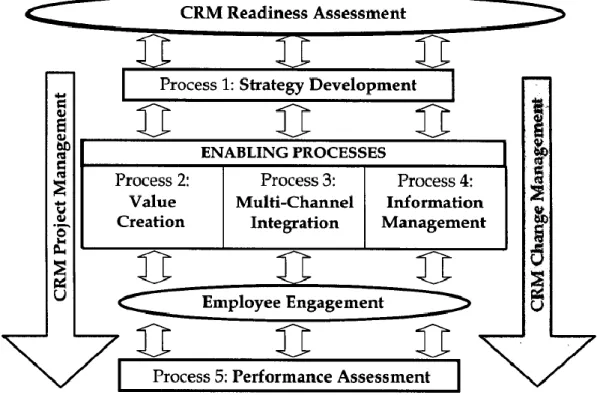
Consequently, the framework of Payne and Frow (2005) will be adopted and used as a platform in this thesis to develop a CRM-strategy for Volvo Penta. Theories from other sources will all be sorted under each of the processes and later linked to Volvo Penta‘s particular situation in order to define a CRM-strategy for the company. The five processes that Payne and Frow have identified are: strategy development process, value creation process, multichannel integration process, information management process and performance assessment process.
Figure 3.1 – Payne and Frow (2006) p. 143
Process 1 – The strategy development process is divided into business strategy and customer strategy. The business strategy is about how to compete in the future based on the company- and markets characteristics. The business strategy is then used to formulate a customer strategy. Within this process, theories on key account management are presented since this form the basis of the strategy development of Volvo Penta.
Process 2 – The value creation process is all about enabling co-creation and co-production of value between the company and its customers. This process is backed up by theories of service dominant logic and customer needings. These theories give the reader underlying facts to how the value creation process
3 Frame of Reference
12
works. Further, the IMP-model and the ARA-model are also presented since they explain what factors enable relationships and value creation between two interacting parties.
Process 3 – The multi channel integration process is about selecting the appropriate combination of channels of interaction with each customer. It is also about showing one face no matter which channel is used.
Process 4 – The information process is about how to collect information about customers from all interaction points, making it available to anyone and then analyzing it in order to be able to provide better value to the customers and thereby strengthening the relationship to them. Theory on CRM-systems backs up and illustrates the use and circulation of the information within an organization. The theory of knowledge management illustrates how the information is processed and handed over between people and departments in an organization.
Process 5 – The performance assessment process involves how to evaluate the
performance of the company and use that data to improve the performance further. This process will not be covered further in the thesis and will thereby only be presented briefly.
To validate the choice of these processes further and how they are exhaustive in forming a CRM strategy, a more recent framework conducted by Lambert (2009) should be mentioned. This framework consists of the very same processes except for the multi channel integration process. However, the scholar criticizes Payne and Frow‘s (2004) view of cross-functionality and claims that it is too limited. He argues that the processes must involve all functions within a company and that these should be represented both in top management and on so called key account and segment teams that interact with the customers‘ respective teams.
Lambert‘s (2009) framework consists of a strategic and an implementational dimension much like Payne and Frow‘s (2005). However, Lambert‘s (2009) are divided into sub-processes. Some of these sub-processes have been borrowed and placed under Payne and Frow‘s (2004) processes to further detail the description of the processes. No respect has been paid to whether the sub
3 Frame of Reference
13
process is strategic or implementational. The sub processes that were selected were sorted in the following way.
Strategy formulation process: review corporate and marketing strategy, segment and identify criteria for segmenting.
Value creation process: Provide guidelines for the degree of differentiation in the product and service agreements, internally review accounts and identify opportunities with the accounts.
3.1 Relationship Marketing
According to Hutt and Speh (2010, p. 92), relationship marketing centres on ―…all activities directed toward establishing, developing, and maintaining successful exchanges with customers and other constituents”. The importance of strong relationships has grown within industrial companies during the past decades due to their various advantages (Theron & Terblanche 2010). One advantage is that the deepened relationships work as a shield to prevent competitors to steal the customers. Another advantage is that loyal customers are far more profitable than ordinary ones (Theron & Terblanche 2010; Hutt & Speh 2010; Söderlund 2000).
The industrial relationship marketing is widely shaped through e.g. the industrial marketing and purchase interaction model and the ARA-model (explained further later on) (Buttle 1996). Many scholars (Håkansson & IMP Project Group 1982; Theron & Terblanche 2010; Hutt & Speh 2010; Buttle 1996; Håkansson et al. 1976) point out the importance of building a deep and interdependent relationship with the customers in which the important factors mainly consist of trust, commitment, satisfaction and communication. Reichheld (2001, p. 76) on the other hand argue that loyalty is not a matter of having a widespread database, measurement systems or reward programs but the outstanding loyalty is rather “…a direct result of the words and deeds – the decisions and practices – of committed top executives who have personal integrity”. In other words, the important factors are not the use of excellent technology or strategy but rather in the dedication of top management.
According to Möller and Halinen (2000) and Theron and Terblanche (2010), the information technology has created a large opportunity for relationship marketing where customer data can be assembled and manipulated, which
3 Frame of Reference
14
enables customer relationship management (explained more later on). According to Payne and Frow (2005) and Ryalds and Payne (2001) relationship marketing and customer relationship management (CRM) is interdependent and CRM is sometimes called ‗information-enabled relationship marketing‘.
3.2 CRM Definition
CRM (Customer Relationship Management) has been and is defined in many different ways by different sources (Payne & Frow 2005). Wilson et al. (2007) observe how some scholars see it as a synonym to Relationship Marketing (Hobby 1999) while others define it as using IT in implementing relationship marketing strategies (Ryals & Payne 2001). Several scholars describe how company executives commonly view CRM as a pure technology initiative and mention this as a major reason to why CRM so often fails (Payne & Frow 2005; Kvale 1996; Finnegan & Currie 2010; Foss et al. 2008; Reinartz et al. 2004). According to Pitt et al. (1995) and Ewusi-Mensah and Przasnyski (1991), it is reported that at least 70 % of the implementations of CRM-systems fail to some extent.
Payne and Frow (2005) emphasize the importance of having one consistently used definition of CRM since it ―significantly affects the way an entire organization accepts and practices CRM‖. Therefore, they have, through interviews with company managers and by reviewing literature on CRM, identified and sorted different definitions into three main perspectives. The perspectives are: narrowly and tactically as a particular technology solution, wide-ranging technology and customer centric. While the first two, focus on technical implications to different extents, the latter, customer centric perspective has a more strategic and broad approach that views CRM as a way of strengthening relationships to customers in order to increase shareholder value. The scholars argue that any organization should adopt the customer centric perspective, since it will enable them to realize all that needs to be considered in order to have a successful CRM implementation. Consequently, the scholars define CRM in the following way:
“CRM is a strategic approach that is concerned with creating improved shareholder value through the development of appropriate relationships with
key customers and customer segments. CRM unites the potential of relationship marketing strategies and IT to create profitable, long-term relationships with customers and other key stakeholders. CRM provides
3 Frame of Reference
15 enhanced opportunities to use data and information to both understand
customers and co-create value with them. This requires a cross-functional integration of processes, people, operations, and marketing capabilities that is enabled through information, technology, and applications” (Payne and
Frow 205 p. 168).
The authors of this thesis concur with Payne and Frow´s (2005) definition and will use it throughout the thesis.
3.3 Strategy development process
The strategy development process is divided into business strategy and customer strategy. The business strategy is about how to compete in the future based on the company- and markets characteristics. The business strategy is then used to formulate a customer strategy. The customer strategy states how to segment and target customers. In terms of CRM it is much about identifying what kind of relationship is appropriate with what customers.
3.3.1 Key Account Management
―The term key account management refers to the process of categorizing the company’s VIP clients (those who can really affect the strategy of the company) and serving such clients in a special and tailored manner”
(Jansen 2008, p. 1).
People in general may refer to key account management as identifying and targeting the most profitable customers in terms of turnover or pure income. However, the field covers a large area of profitability and it is up to each specific company to establish what profitability is for them. According to Cheverton (2004), when a company has decided on what a profitable customer is, they then automatically will address them that way. The scholar gives an example shown in figure 3.2 below.
3 Frame of Reference
16
The big ones What about tomorrow‘s oak trees?
Do you always let the sales statistics make your decisions for you?
The ones you mustn‘t lose You‘ll do anything to keep them
happy, even if it kills you...
The ones that offer future profit And where does today‘s profit come
from?
The ones your staff focus on So, do they ignore the rest?
The ones where extra effort brings extra return
Not bad, nut now define return – and how many can you do this for?
The ones demanding more Every industry has its loud mouths;
does that make them important? The ones that will take your
business where you want it to go
Perhaps the best, but are you that certain? Do you know? The future is never clear...
Figure 3.2 – Key account management, (Cheverton 2004, p. 6)
As shown in the figure, the aim of profitability addresses the customers and the view of customers in different ways. The scholar further mentions that it is important not to get stuck in current profitable customers but have a future vision of which customers may have a significance importance in the coming years. Pareto‘s 80/20 rule is agreed upon by many scholars (Baclawski 2008; Nugus 2006; Parmenter 2007) which describes that, in general, the top 20% of the customers stand for 80% of the profits. This aims the focus on the already existing high profitable ones. Cheverton (2004) does not contradict this principle, however he adds the importance of predicting future customers who further can increase the profits.
In an empirical study, Cheverton (2004) discovered that it is not always obvious who are the key customers or even what a key customer is in a company. The scholar thereby argue that it is of great importance that a company has the same view of what a key customer is and who those customers are to be able to have a thorough aim towards the most profitable ones.
The key account management theory is applicable to the environment in which Volvo Penta is interacting. Further, the key account management is a large part in the CRM strategy development where the selection of VIP customers is of importance.
3 Frame of Reference
17 3.4 Value Creation Process
This process is all about enabling co-creation and co-production of value between the company and its customers, as explained by Vargo and Lusch (2004). The theories presented under the value creation process are also used to design the other four processes since all processes need to be designed to create value. However, they are presented in this part for structural as well as logical purposes.
3.4.1 Service-Dominant Logic
The concept of service-dominant logic (SDL) is to see tangible goods as the value that they provide i.e. as services (Vargo & Lusch 2004). By this, the scholars mean that products do not generate value until they are used by the customer (even include organizations). The customer is thereby a part of the value creation process since he/she is co-creating the value (Vargo & Lusch 2006). This concept was coined by Vargo and Lusch in their article Evolving to a New Dominant Logic for Marketing in 2004, but the concept of co-creating value and seeing even tangible products as services has been researched for decades ((Normann & Ramírez 1993; Prahalad & Ramaswamy 2004; Schlesinger & Heskett 1991)). Grönroos (2000) explains that the supplier is a co-producer of value rather than only making value propositions. This means that value is generated by the customer in the usage of the products which can make every offer unique (Anderson et al. 2008). According to Vargo and Lusch (2004) SDL is a way to strengthen and understand the relationships with the customers which has become more important during the last years.
The service-dominant logic theory is used to identify the value creation process of Volvo Penta. The authors have applied the theory to the situation of Volvo Penta and thus adopt the view that the products of Volvo Penta do not provide values in themselves but rather when used.
3.4.2 Customer Needings
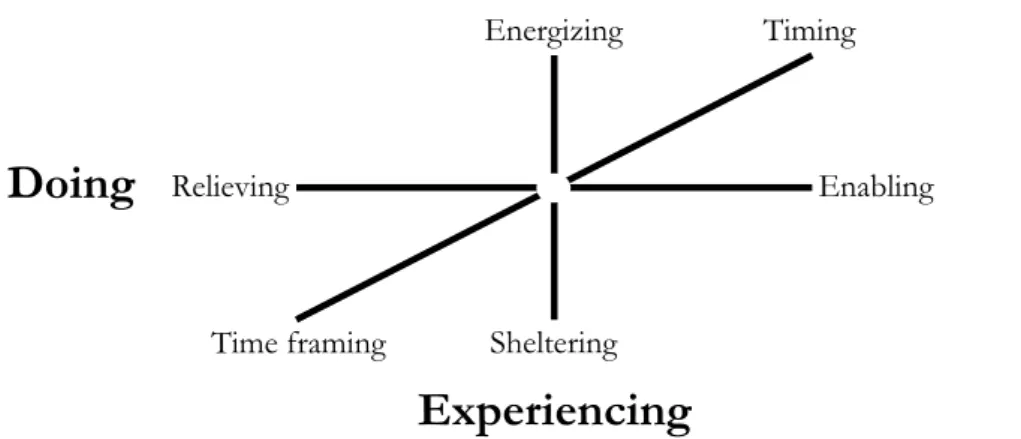
In a study conducted by Strandvik et al. (2008), the scholars found that oftentimes the offer of a supplier is not really what the customer wants. A customer needing is what a customer really needs as opposed to a compromised solution supplied by an offering. Customer needings is based on three dimensions; the doing dimension, the experiencing dimension and the scheduling dimension. These dimensions have further two functions which in
3 Frame of Reference
18
the case of doing and experiencing is mutually exclusive. The model of customer needings can be seen in figure 3.3 below.
Figure 3.3 – Figure from Strandvik et al. (2008) p. 29
The doing dimension has got the functions; relieving and enabling. The relieving function concern if a customer wants to be relieved of a certain activity. This means that the customer wants the supplier to deliver a more complete package of products and services. The enabling function refers to when a customer wants to be provided with tools that enable them to do the activities themselves.
The experiencing dimension has got the functions; sheltering and energizing. The sheltering function coheres with a customer that wants the supplier to minimize their risk i.e. to deliver good quality products on time. The energizing function is if the customer wants the supplier to be a part of the development of their value creation process.
The use of the experiencing dimension in this thesis
The experiencing dimension concerns the relational and more emotional aspects of the relationship. It involves the actors and their expectations on the relationship and willingness to develop it. It has the dimensions sheltering and energizing. Sheltering is about minimizing risks. Energizing is about co-creation of value. Fredriksson and Johansson (2009) found that these dimensions are not necessarily mutually exclusive. However, energizing comes at a price. It requires the buyer to become interdependent of the supplier by adapting processes and organization in order to link resources, tie activities and create
Time framing Energizing Timing Sheltering Relieving Enabling
Doing
Experiencing
Scheduling
3 Frame of Reference
19
bonds between actors, as mentioned by Håkansson and Snehota (1995) in the ARA-model. The functions can be related to a transactional respectively a committed relationship. Information regarding needings within this dimension is harder to get by and to quantify. It is usually picked up by actors who interact with their counterparts in the customer organization. It is likely that the needings are of a sheltering nature at the initial stage of the relationship but this needing has potential to evolve gradually given that the relationship is nurtured. Therefore, it is very important to pick up clues of the experiencing dimensions present location i.e. at what stage of a relationship the customer and the supplier are.
Shanks et al. (2009) divide the stages into acquisition, retention and strategic customer care and argues that the service level needs to be adapted to each level. Hollyoake (2009) agrees but uses the levels core, differentiated and bonded. Finally, Mcdonald (2000) identifies different levels of key account management and what the approach towards the customer should be at each. The IMP-model by Håkansson and IMP Project Group (1982) can also be used to identify different kinds of relationships. Especially, the environment factor can give clues on the expectations and limitations on the relationship, an evaluation of the atmosphere can describe the current state along with signs of institutionalization of the interaction process.
The scheduling dimension has got the functions; time framing and timing. The time framing function describes how long the supplier sees the duration of the relationship. The timing function describes how well the supplier can detect changes in the customer‘s needs over time. Even though the theory of customer needings is fairly new and somewhat unexplored, the authors found it vital to include it in the CRM strategy development. The theory brings up important processes in the value creation and thus, as the service dominant logic, helps mapping the process of how a company creates and helps to create value.
3.4.3 The IMP Interaction Model
The IMP interaction model was made by Håkansson and IMP Project Group (1982) for the purpose of depicting an interaction between two parties in an industrial relationship. According to Ford (2006) the business process is based on interactions rather than single isolated transactions. Håkansson and IMP
3 Frame of Reference
20
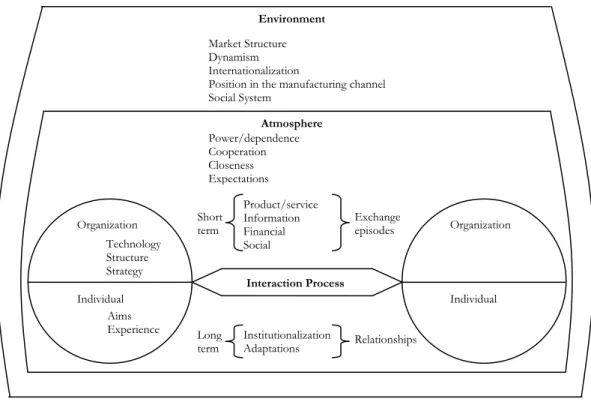
Project Group (1982) describe the model in four elements; the interaction process, the participants in the interaction process, the environment within which interaction takes place and the atmosphere affecting and affected by the interaction. Figure 3.4 below illustrates the connection between the four elements.
The Interaction Process
The interaction process separates the individual episodes and the relationship. The episodes refer to the actual exchange between two parties i.e. exchanges of products and services, information exchange, financial- or money exchange and social exchange (often characterized by adapting and dealing with cultural differences). The relationship is generated in the use or interaction of the episodes, especially the social exchange. According to Ford (2006) a relationship is built up when the episodes are institutionalized which means that the parties do the exchange without questioning it. Buttle (1996) argues that it is not the exchanges mentioned previously that form the relationship and the institutionalization of these but rather the way IT is forming the business nowadays. IT enables companies to preplan the interactions and exchanges and thus relationships do not grow because of the many exchanges.
The Interacting Parties
As mentioned above, the relationship is integration between two interacting parties. There are a number of factors that affect their relation and Håkansson and IMP Project Group (1982) mention the following factors. Two companies can have different technological standards which will affect the way that the two will do business. One party might use technically advanced communication tools and production tools while the other party uses traditional and non-technically advanced tools and thus make the episode exchanges complicated. The structure and size of the organizations will also affect the relationship. A large company with high bargaining power may be seen as the dominant party and thereby the decision power between the parties is uneven. Organizations’ experiences will also affect the relationship where the parties can be differently committed due to previous practices. Finally, Håkansson and IMP Project Group (1982) mention the individuals in the interaction between the parties. The individuals have a more complex way to reach a committed and trustful relationship than the other factors due to cultural differences, individuals‘ history, experiences etc.
3 Frame of Reference
21 The Interaction Environment
According to Håkansson and IMP Project Group (1982) a relationship cannot be seen as isolated but has to be seen in context to other surrounding factors. One factor is the market structure which is affected by the environment of the business where the relationship is acting, for example if the market is domestic or international (in an international context, the factor of internationalization is of meaning). Dynamism is another factor that describes the parties‘ commitment to the relationship. The position in the supply chain should be identified by the two companies since their actions and interactions will affect further relationships closer to the consumer. The scholars finally add the social systems as a factor that needs to be considered when evaluating and looking at the interaction environment. The social systems exist of e.g. product/service regulations, local purchasing laws and language restrictions.
Figure 3.4 – Figure from Håkansson and IMP Project Group (1982) p. 32
The Atmosphere
The atmosphere between the interacting parties explains their closeness to each other. According to Håkansson and IMP Project Group (1982), having closeness between two parties brings advantages to both but the interdependence to other companies has to be balanced. The benefit that the parties can receive from a close and committed relationship is that the
Market Structure Dynamism Internationalization
Position in the manufacturing channel Social System Power/dependence Cooperation Closeness Expectations Short term Product/service Information Financial Social Exchange episodes Technology Structure Strategy Long
term Institutionalization Adaptations
Environment Atmosphere Interaction Process Relationships Aims Experience Organization Individual Organization Individual
3 Frame of Reference
22
transactional cost and the production cost can be reduced due to the opportunity to optimize the production process between the parties. Further, as mentioned in the relationship marketing part, a close relationship often engenders higher revenues (Theron & Terblanche 2010; Hutt & Speh 2010; Söderlund 2001). The mutual control between and within the companies can further increase the prediction of future needs and changes and forecasting the environmental situation.
3.4.4 The ARA Model
The activities, resources and actors (ARA) model explains how to deepen and further link the involved parties in a supply chain and enables an interdependent thinking rather than individually solving problems (Bals & Hartmann 2008). The model was developed by Håkansson and Johanson (1992) and is further explained in the book Developing Relationships in Business Networks by Håkansson and Snehota (1995). As the name intends, the model describes the relationships between the activity links, the resource ties and the actor bonds which originally was aimed towards industrial relationships.
There are a number of activities performed between two parties in a relationship. The activities need to be linked between the parties and thus enable effectiveness and cost reductions. The activities, for example, regard technical, administrative and commercial aspects. When linking the activities, the parties become more interdependent which makes it more complex to replace a party for another i.e. the relationship is strengthening every time activities are linked.
The resources in a relationship can be tied to the involved actors and further tie the activities between the firms. The resource ties, for example, are manpower, equipment, knowledge and image. The interface of the resources between the parties can over time grow and become broad and deep which further creates strong ties between the involved parties.
When two companies interact and develop some sort of relationship, it is always individuals who perform the interactions which makes them an important aspect in each and every relationship. In a successful relationship, the actors create bonds between each other and thus generate an interpersonal relationship as well as a resource and activity based relationship. When bonds are shaped, the parties become mutually committed to the relationship which is
3 Frame of Reference
23
shown in the way of trust and commitment. A relationship does not have to be building on all three layers but also of a single or combination of two layers. Håkansson and Snehota (1995) further explain that the more the companies are focusing on the layers, the more integrated and deepened the relationship will get. Figure 3.5 below illustrate the connection between the three layers.
Figure 3.5 – Figure of ARA from Håkansson and Snehota (1995) p. 35
Both the IMP interaction model and the ARA model describe what activities enable a successful relationship. The authors have used these theories to find similarities and dissimilarities in the relationships that Volvo Penta has to their customers and also their internal processes of enabling strong relationships to the customers.
3.5 Multi-channel integration process
This process is about selecting the appropriate combination of channels of interaction with each customer. It is also about showing one face no matter which channel is used. In other words the channels a customer interact with need to be coherent, co-ordinated and designed to maximize the customers‘ value (Payne and Frow, 2004)
In the strategy development process the company constantly assesses the business environment in order to manage the business and customer strategy. The strategy determines how the company considers customer value and how to create it. However, it is not enough to know how to create it. It must also be
Activity links Resource ties Actor bonds
3 Frame of Reference
24
realized in practice. This is where the channels enter the picture. The channels are the touch points with the customers where all their interactions with the company happen. Payne and Frow (2004) have identified the following six groups of channels: sales force, outlets, telephony, direct marketing, e-commerce and m-e-commerce. In order to provide value, the right channels and channel combinations must be chosen for each customer or customer segment, it must be ascertained that the channels really do provide the value stated in the value creation process and the channels must be integrated so that they provide a consistent and coherent experience for customers who use multiple channels (Payne & Frow 2004). Mcdonald and Dunbar (2005) stress the importance of viewing channel selection and strategy as an ongoing process and that companies need to understand the dynamics of channels.
Selecting the right channels to interact with certain customers
The choice of channel or channels used to interact with certain customers must be based on the criteria that it should enable the value creation for that certain customer (Lanning 1998). In other words, the selected channel should be able to provide exactly that, which was found to maximize the customer‘s value in the value creation process (Payne & Frow 2004). Some customers might have lower expectations or needs due to their own resources and capabilities and would therefore not need the most expensive way of interaction. This is in line with the ARA-model which states that the distribution of activities between companies in a value chain depend on their resources (Håkansson & Snehota 1995).
Further, as part of CRM is to focus on the most profitable customers this also has to dictate the channel choice. For example, those customers who are considered potentially profitable might be interacted with by face-to-face while those that are less profitable might have to do with a call center (Payne & Frow 2004).
Finally, the choice needs to be based on what information the company needs from the customer. Even if a channel is the right one to make the sale then it should still not be used if the information needed to support the CRM-strategy cannot be reached through it. This information can be used to detect needs both when it comes to how to create value and what channels are preferred and needed presently and will be needed in the future (Storbacka 2001)
3 Frame of Reference
25 Making sure the experience within the channel is good
Payne and Frow (2004) highlight the importance of designing the channel interaction so that it meets or exceeds the customer‘s expectations. This might mean that you have to customize within the same channel to differentiate the interaction between different segments or customers. Yet again, the success of this depends on the amount of information you have about customers. To further emphasize the importance of a perfect interaction experience, a study by Jones and Sasser (1996) can be mentioned. They found that only customers who were highly delighted could be considered truly loyal. The customers who were only satisfied were only slightly more loyal than those who were thoroughly dissatisfied.
Offering a consistent and coherent experience across channels
Madaleno et al. (2007) have found that in a B2B context, customer satisfaction is strongly related to multichannel consistency. Storbacka (2001) concurs by claiming that a company needs to have consistency across the channels if it wants to form a particular perception of itself in the customer‘s mind. Further, the scholar warns that any inconsistency might confuse the customer, diminish his view of the company and lead to negative word of mouth. However, according to Payne and Frow (2004) multichannel integration is not only about providing a consistent experience. Sharing information about customers across the channels and knowing about other channels‘ interactions with the customer can also enable the supplier to participate in their value creation process in the best possible way.
3.6 Information management process
This process is about how to collect information of customers from all interaction points, making it available to anyone and then analyzing it in order to be able to provide better value to the customers and thereby strengthening the relationship to them. Payne and Frow (2004) underline the importance of creating a purposefully designed system consisting of different kinds of technology that can make this possible.
3.6.1 CRM-system
The authors previously described the CRM-systems as IT-based relationship marketing where the focus, as the name intends, is to strengthen the relationship to the customer regardless if it is the end-customer or industrial
3 Frame of Reference
26
customer (further agreed upon by Bygstad (2003)). According to Ryals and Payne (Ryals & Payne 2001), a CRM-system is used to enable the relationship marketing strategy. Also mentioned earlier, CRM-systems usually are unsuccessfully implemented and about 70 % fail to adapt a CRM-system (Tafti 2002). According to Schwartz et al. (2002) this is because companies most often view a CRM-system as purely technical and thereby only takes that into considerations. Though the technical aspect is one affecting variable, equally important is organizational change, different views of the customer and business change. Further Argyris and Schön (1997) argue that the managerial implications from articles often form the basis for the implementation of a CRM-system where the actual business is not regarded and is not optimally applied to the current situation. It is easy for the companies to skip some important steps in frameworks such as the one conducted by Payne and Frow (2005), which further indicates the high failure rate.
Bygstad (2003) mentions that a CRM-system is most often implemented to collect and store information about the customers and the way to communicate with them. Ciborra and Failla (2000) describe CRM as an information infrastructure with three main factors; processes, people and technology which intends that the CRM-system is not an isolated tool to communicate with customers but rather a tool that needs to be integrated in all transactions of the business lifecycle. According to Bygstad (2003) the CRM-system has three main promises to the business; (i) help each worker to manage the personal contacts, activities and documents, (ii) works as a tool for dialogue marketing in the form of individually aimed marketing (expressed as an important factor for CRM-system by several scholars (Deighton 1996; Peppers & Rogers 1997)), and (iii)
use the information from customers to analyze future product and service potentials. Figure 3.6 below shows an example of the CRM-system solution offered by Microsoft. This shows how some features are correlated in the CRM-system and further which parts of the company that are affected. Though, it should be added that this is just a reference from Microsoft and not representatives for all CRM-systems since they can vary in both complexity and width of usage.
3 Frame of Reference
27
Figure 3.6 – Microsoft CRM-system by Brown and Gravely (2003) P. 44
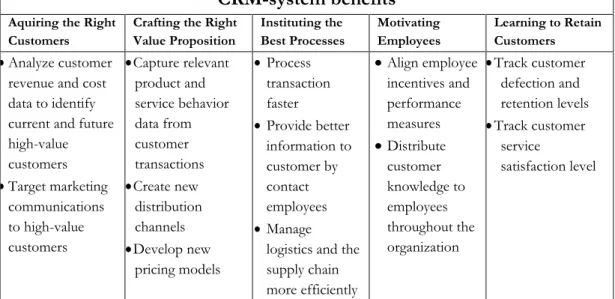
Hutt and Speh (2010) mention five main CRM priority areas; (i) acquiring the right customers, (ii) crafting the right value proposition, (iii) instituting the best processes, (iv) motivating employees, and (v) learning to retain customers. Companies can choose either to have the CRM-system to cover all or just some of the priority areas depending on what the need might be. Within these areas, Hutt and Speh (2010) further show how a CRM-system technology can help a business. This is illustrated in figure 3.7 below (modified by the author from a table presented by Hutt and Speh (2010) p. 105).
Customer Trading Partner
Supplier
Portal - provides access control
Business Process Hub - a secure networked platform Sourcing Best Practices ‖Day Ahead‖ Planning Personal- ization Knowing Customers ID Best Customers Analyze Market Know Compe- tition Customer Behavior Optimize Revenue Optimize Business Performance Resource Utilization Employe e Loosely coupled Application components XML Web services Open up New Revenue Streams Legacy Data Enterprise Enterprise APPS: ”Best of Breed” Integration
3 Frame of Reference
28
CRM-system benefits Aquiring the Right
Customers
Crafting the Right Value Proposition Instituting the Best Processes Motivating Employees Learning to Retain Customers Analyze customer
revenue and cost data to identify current and future high-value customers Target marketing communications to high-value customers Capture relevant product and service behavior data from customer transactions Create new distribution channels Develop new pricing models Process transaction faster Provide better information to customer by contact employees Manage logistics and the supply chain more efficiently Align employee incentives and performance measures Distribute customer knowledge to employees throughout the organization Track customer defection and retention levels Track customer service satisfaction level
Figure 3.7 – CRM-system benefits
3.6.2 Knowledge Management
A company needs to distribute different people‘s experiences throughout processes in the organization to enable the best customer value. Experience management focuses on managing the knowledge in a company and thus requires the knowledge to be; captured, modelled, stored, retrieved, adapted, evaluated, and maintained. According to Bergmann (2002) and Siebert (2005), this knowledge should, to make it effective, be combined with the Information Technology such as CRM-systems or other information intranets. According to Kerschberg and Jeong (2005) it is important for the decision makers in a company to easily access knowledge which is generated from other employees. The scholars call this just-in-time knowledge management. Though, there is now a need to figure out what is the right information and who the recipient of the information is. The answer lies within the company which has to decide on standards for the knowledge management. One large reason for focusing on experiences and knowledge management is that through CRM, the company needs to adopt a customer-centric approach through a single communication point and thus needs to act unified without hazarding multi-message answers (Bergmann 2002).
3.7 Performance Assessment Process
This process involves how to evaluate the performance of the company and use that data to improve the performance further. It needs to be decided which metrics should be used for this assessment. Probably measurements like
3 Frame of Reference
29
customer lifetime value are more appropriate when having a CRM-focused strategy. It is also important to have cross-functional metrics so that finance does not have some and marketing others.
3.8 Implementation
Payne and Frow (2006) have developed a framework for the implementation prerequisites of CRM. They have identified the elements of CRM readiness assessment, change management, project management and employee engagement to be vital when it comes to the implementation stage. However, even if these elements are vital to the success of CRM the authors of this thesis must limit themselves to the strategic part consisting of CRM-processes due to time restrictions and complexity. Therefore, the implementation elements will only be described briefly.
According to Payne and Frow (2006) a CRM readiness assessment aids in showing to what degree a company is ready to progress with CRM implementation and what first needs to be done as far as strategy processes are concerned. The scholars suggest the use of an overview audit if an organization is in the early stages of CRM development. The purpose of this audit should be to underline the relative priority of each of the five key CRM processes and what degree and what kind of change work needs to be applied within each process. Further, the scholars emphasize the importance of having an effective change management program. Companies that adopt CRM usually need to undergo major organizational and cultural changes, something which is not often realized by company executives. Payne and Frow (2006) identify three recurrent change management issues. Firstly, a visible sponsor for CRM from the highest level is vital for avoiding employee resistance and instead making employees understand and become committed to the CRM initiative. Secondly, a clear CRM vision is needed to create shared values and a customer focus. Finally, cultural clashes between departments within a company can prevent the possibility of working in a cross functional manner. These need to be made visible and resolved. The scholars have found that a common recipe for success in CRM implementation is the establishment of cross-functional teams (Payne and Frow 2006).
The project when implementing CRM can be either in the form of specialists working with a deadline or an internal cross functional team. Issues of main importance are that the project goal must support the CRM- and business