training lEaflEt for HElicoptEr pilotS and inStructorS
Risk
ManageMent
in tRaining
Introduction
�����������������������������
5
1.0 Training accident statistics
������������
6
1.1 Statistics of helicopter training related accidents in Europe1.2 Contributing factors identified for accidents
1.3 Top 6 training and instructional Intervention Recommendations (IRs)
2.0 Tools and Methods to Improve
Safety in Training
��������������������
12
2.1 Operational Evaluation Board (OEB) reports2.2 Risk analysis
2.3 Risk analysis and mitigation
2.4 Threat and Error Management (TEM) 2.5 ICAO SHELL Model
3.0 Engine Off Landings (EOL) /
Autorotations
�����������������������
22
3.1 General
3.2 Operational Evaluation Board recommendations 3.3 Risk analysis
3.4 Threat and Error Management (TEM) considerations
4.0 Acronyms, Bibliography & Definitions
��
30
4.1 Acronyms4.2 Bibliography 4.3 Definitions
Final RepoRt
eHeSt analySiS oF 2000 – 2005
For a download simply scan the QR-Code or visit
http://easa.europa.eu/essi/ ehest/wp-content/uploads/2010/ 10/EHEST-Brochure.pdf
This leaflet forms part of a series of EHEST
safety leaflets and publications aimed at
improving safety by sharing good practises.
These leaflets are accompanied by
web-based training materials, including videos.
All these materials are freely available to
pilots, instructors, training schools, authorities,
manufacturers, operators and associations.
This aim is to contribute to enhance flight
safety by addressing recognised safety issues.
Data from the accident analysis1 confirm that a significant number of helicopteraccidents occur during flight training. In this leaflet flight training includes initial training, recurrent, type rating and refresher training.
The aim of this leaflet is to improve the safety of helicopter training by:
• Increasing the awareness in the training community about helicopter accidents in general and training related accident in particular (cHaptEr 1),
• Increasing the awareness in the training community about training related Intervention Recommendations developed by EhEST (cHaptEr 1.3), • Providing the training community with a selection of tools and methods
(cHaptEr 2),
• Providing a practical example of risk assessment in training,
• Assisting the instructors and improving the safety education of trainees in a training context.
1. tRaining accident
StatiSticS
1.1 Statistics of helicopter training related
accidents in Europe
figurE 1 indicates that single engine piston helicopters are a large contributor to the numbers of accidents in training, particularly during PPL(H), CPL or ATPL training, however it does not take into account fleet, hours flown, usage, crew experience or other aspects. Single engine piston helicopters are widely used for training because of their relatively low operating costs. These helicopters often have a low inertia rotor system and with 2 crew normally operate close to their MTOM.
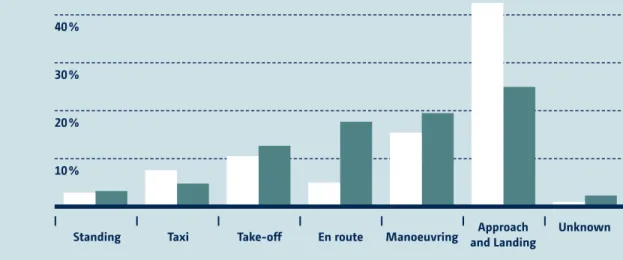
figurE 2 indicates that whilst the approach and landing phases generally represent 25 % of accidents; in training accidents the approach and landing represent 44 % of accidents (5 occurrences were during the approach phase and 16 during the landing phase). It should be noted that during training, more approaches and landings are performed than during normal operations. The main causes of accidents during the approach and landing phases were identified as dynamic roll over and autorotations.
When reviewing accident data from
helicopter accidents in Europe over the years
2007 to 2011, it appears that 18 %
of these
accidents occurred during flight training.
This figure is commensurate with the figures
provided by the Canadian JHSAT CY2000
report (19 %) and the US JHSAT CY2000 report
(18.8 %) for training accidents.
FiguRe 2 diStRibution oF accidentS by FligHt pHaSe
european helicopter accident data, flight training operations (2007 – 2011)
Standing taxi take-off En route manoeuvring and landingapproach unknown 20 % 30 % 10 % 40 % 50 % Training Accident Accidents
1.2 Contributing factors identified for accidents
In the EhEST Analysis of 2000 – 2005 European helicopter Accidents, of the 311 accidents in Commercial Air Transport and General Aviation (including Aerial Work), 48 were considered as training accidents, which represents 15.4 % of all the accidents. The accident analysis performed by EhEST was aimed at identifying all factors, causal or contributory, that played a role in the accident. Factors are coded using two taxonomies: Standard problem Statements (SPS) and Human factors analysis and classification System (HFACS) codes.
The top issues identified for accidents during General Aviation & Commercial Air Transport training are:
The use of the HFACS taxonomy by the EHSAT provided a complementary perspective on human factors.
top iSSuES HfacS
Risk assessment – during operation Overconfidence
Overcontrol/undercontrol Procedural error
Necessary action – delayed Cognitive task over saturation
top iSSuES Standard problEm StatEmEntS
Inadequate and untimely Flight Instructor (FI) action to correct student action Pilot decision making
Student Pilot
Perceptual judgment errors FI preparation and planning Training program management
Inadequate consideration of weather/wind Inadequate autorotation – Practice Selection of an inappropriate landing site Pilot control/handling deficiencies Inadequate flight crew briefing
Inadequate consideration of the aircraft performance Inadequate autorotation – Actual
1.3 Top 6 Training and Instructional
Intervention Recommendations (IRs)
having identified the main factors contributing to the accidents, the EhEST Team developed Intervention Recommendation (IR). IRs have been organised in several categories. The table below list the top 6 Training & Instructional Intervention Recommendations (IRs).
top 6 training & inStructional intErvEntion rEcommEndationS (irS)
1. ab-initio training Syllabi The flying training syllabus for ab-initio helicopter pilots should be expanded to give more time for:
a
›› Mission planning
b
›› Demonstration (and recovery) of vortex ring and loss of
tail rotor effectiveness
c
›› Flight into deteriorating weather
d›› Static & dynamic rollover
E›› Quick stops
f
›› Rapid power variation
g›› Low rotor RPM management
H
›› Awareness of the height and velocity diagram
2. mission preparation and Execution
a
›› Produce guidance material and check-lists for mission
preparation and execution (to include weight & balance).
b
›› Propose recurrent training including theoretical and
practical test for airmanship.
c
›› Ensure that passengers/crewmembers receive thorough
pre-flight and in-flight briefing.
d
›› Assess means to make people read and follow the
produced guidance materials.
3. recurrent training Expand recurrent training to include additional emphasis on:
a
›› Recovery from unusual attitudes/loss of airspeed when
flying by sole reference to instruments
b
›› Vortex ring
c
›› Loss of Tail Rotor Effectiveness
d
›› Conduct of High Risk missions (mountain flying, HEMS etc.)
E›› Autorotation by making the best use of Flight Synthetic
top 6 training & inStructional intErvEntion rEcommEndationS (irS)
4. flying Skills The training must emphasize that the pilot is responsible for the aircraft’s safety in both normal and emergency conditions and that they understand their responsibility for maintaining proficiency.
Consider developing and introducing objective criteria to assess flying and aircraft management skills for ab-initio, recurrent training and proficiency checks.
5. External Environment awareness
Pilots should be made aware of the need to familiarize themselves with both the area in which they intend to operate (terrain, obstacles, hazards etc.) and any local meteorological phenomena that may occur, including whiteout.
6. crm – training Syllabi Consider developing and introducing minimum standards for training syllabi. Ensure that these minimum standards include all issues reviewed by the EhSAT accident analysis. CRM training should be extended to all flying operations and aircraft types.
2. toolS and MetHodS
to iMpRoVe SaFety in tRaining
2.1 Operational Evaluation Board (OEB) reports
The OEB reports are provided by the European Aviation Safety Agency (EASA). The reports are based on the Original Equipment Manufacturer (OEM) Pilot Training syllabi either approved by the National Aviation Authority or, for new aircraft, on the Pilot Training course under construction by the OEM. The operational evaluation team provides a report following either a catch up process or, for new aircraft, a full evaluation. The reports make recommendations on the minimum training syllabi including, ground training, simulator, and flight training requirements. They also include Training Areas of Specific Emphasis (TASE). The OEB will be superseded by a new process which will generate Operational Suitability Data (OSD) material as part of the certification of new types and for all aircraft still in production. Existing OEB reports will automatically become OSD material when the new regulations come into force.
The minimum training syllabus and TASE will be mandatory for pilot training. The forecast implementation date is due to be April 2014.
The OEB report includes a general description of the helicopter, updates the Type Rating List and Licence Endorsement including all the variants and makes recommendations for the minimum training syllabi for:
• Initial type rating • Additional type rating • Differences training • Familiarisation training
• Specifications for particular emphasis during training
(e.g. autorotation, tail rotor control failure, hydraulic failure, etc.)
oEb reports provide a valuable source of information and are available on the EaSa website:
2.2 Risk Analysis
Identification of Hazards and risks is are the core concepts of risk management, and is one of the pillars of a Safety Management System (SMS). Risk analysis should consider the likelihood and severity of an event to determine the level of risk. Even taking these factors into account will not give an exact result as the level of risk can be mitigated by the experience of the pilot concerned.
A thorough risk assessment allows assessing risk in a realistic manner. It is essential that the risk be realistically assessed by the pilot, the crew, and the instructor so to avoid under-estimation and risk taking. This section summarises how the basic risk assessment instruments are developed in the frame of SMS.
2.3 Risk Analysis and Mitigation
Hazards are conditions, objects, activities or events with the potential of causing injuries to personnel, damage to equipment or structures, loss of material, or reduction of the ability to perform a prescribed function (different types of consequences, events or occurrences).
the risk is the combination of occurrence likelihood and severity.
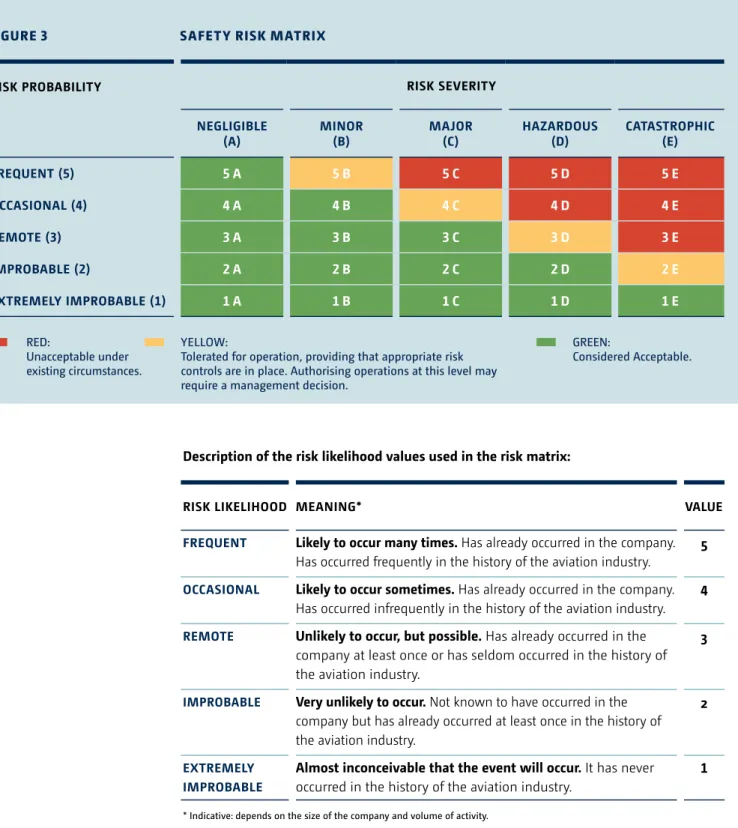
Once the hazards have been identified, a risk analysis is performed to assess whether the safety risk is ‘acceptable’ (green cells in the risk matrix), ‘tolerable’ (yellow) or ‘unacceptable’ (red). Mitigating actions, also called risk controls, need to be considered and implemen ted to lower the level of risk and bring it back to an acceptable level.
FiguRe 3 SaFety RiSk MatRix
riSK probability riSK SEvErity
nEgligiblE
(a) minor(b) maJor(c) HaZardouS(d) cataStropHic(E)
frEQuEnt (5) 5 a 5 b 5 c 5 d 5 E occaSional (4) 4 a 4 b 4 c 4 d 4 E rEmotE (3) 3 a 3 b 3 c 3 d 3 E improbablE (2) 2 a 2 b 2 c 2 d 2 E EXtrEmEly improbablE (1) 1 a 1 b 1 c 1 d 1 E RED: Unacceptable under existing circumstances. YELLOW:
Tolerated for operation, providing that appropriate risk controls are in place. Authorising operations at this level may require a management decision.
GREEN:
Considered Acceptable.
description of the risk likelihood values used in the risk matrix:
riSK liKEliHood mEaning* valuE
frEQuEnt likely to occur many times. has already occurred in the company. has occurred frequently in the history of the aviation industry.
5
occaSional likely to occur sometimes. has already occurred in the company. has occurred infrequently in the history of the aviation industry.
4
rEmotE unlikely to occur, but possible. has already occurred in the company at least once or has seldom occurred in the history of the aviation industry.
3
improbablE very unlikely to occur. Not known to have occurred in the company but has already occurred at least once in the history of the aviation industry.
2
EXtrEmEly improbablE
almost inconceivable that the event will occur. It has never occurred in the history of the aviation industry.
1
description of the risk severity values used in the risk matrix:
SEvErity of occurrEncE
mEaning* valuE
pErSonnEl EnvironmEnt financial loSS imagE cataStropHic Multiple fatalities Massive effects (pollution, destruction, etc.) Catastrophic financial loss International impact E
HaZardouS Fatality Effects difficult to repair Long term effects National impact d
maJor Serious injuries Noteworthy local effects Substantial effects Considerable impact c
minor Slight injuries Little impact Little impact Limited impact b
nEgligiblE Superficial or no injuries Negligible or no effects Negligible Light or no impact a
* Indicative: depends on the size of the company and volume of business.
2 ICAO has adopted the TEM model in its Human Factors Training Manual (ICAO Document 9683, 2002) 3 See http://www.skybrary.aero/index.php/Threat_and_Error_Management_(TEM)
4 An introduction to Threat and Error Management. Ashleigh Merritt, Ph.D. & James Klinect, Ph.D.
2.4 Threat and Error Management (TEM)
2 The TEM framework3, 4 is a conceptual model that assists in understanding, from an operational perspective, the inter-relationship between safety and human performance in dynamic and challenging operational contexts. The TEM approach stresses the importance of anticipation, recognition and recovery to maximise safety margins. TEM makes use of three basic concepts: Threats, Errors, and Undesirable Aircraft States. The flight crew has the important role to Transfer, Eliminate, Accept or Mitigate (TEAM) risks at crew level.threats are generally defined as events or errors that occur beyond the influence of the pilots (for instance weather-related), that increase operational complexity, and which must be managed to maintain the margins of safety.
Errors are generally defined as actions or inactions by the line personnel that lead to deviations from organisational or operational intentions or expectations.
Unmanaged and/or mis-managed errors may lead to Undesired Aircraft States (UAS). Errors in the operational context thus tend to reduce the margins of safety and increase the likelihood of an undesirable event.
undesirable Event (uE): Also called forerunner event, an UE identifies any deviation from what is expected and may cause personal injury or material damage. This event can be defined as a loss of control on the situation, i.e., any event which may give rise to an accidental sequence if no efficient recovery action is taken. Analysis of UE’s should be used to gain an understanding of the causes and pre-cursors of the event and therefore help prevent a recurrence.
undesired aircraft State (uaS) are generally defined as operational conditions (position, speed, attitude, or configuration of an aircraft) where an unintended situation results in a reduction in margins of safety. A UAS that results from ineffective threat and/or error management may lead to compromised situations and reduce safety margins. They are often considered the last stage before an incident or accident.
tHrEat & Error managEmEnt (tEm), is well illustrated by the Safety Bowl model5 used in the EhEST SMM, shown in figurE 4. The Safety Bowl model is an intuitive illustration of accidents seen as ‘loss of control’ of the situation. The bowl represents the
5 Not developed within the TEM framework, this model well illustrates the role of Undesirable Events, a concept used in TEM.
PREVENTION RECOVERY
ACCIDENT
UE
MITIGATION
MITIGATION
FiguRe 4 tHe SaFety bowl SaFety RiSk contRol Model
SaFety Model:
The accident is considered as a
loss of control on the situation
Ue (Undesirable Events) :
are identified as point of loss of control on the situation
3 typeS oF RiSk contRolS:
• Prevention • Recovery • Mitigation
safe envelope within which operations should be kept, while the position of the UEs represent the departure into either accident or incident scenarios. The model also illustrates the importance of monitoring and managing the risk controls in place and the need to introduce or adapt risk controls when necessary.
Under normal operations there are variations which are tolerable within certain limits as indicated by the ball having some freedom to move within the bowl. The edges represent measures that are put in place to keep normal operations within safe limits. Small excursions are corrected by the lip of the bowl.
Larger excursions from normal safe operations, i.e. the ball escaping from the bowl, can lead to an Undesirable Event and possibly an incident or an accident. When this occurs we rely on recovery factors to avoid the accident and on mitigating factors to limit the accident damage.
Threats and errors must be managed by the crew. For example: the hazard
“cumulonimbus” can become a threat if the crew has to face this hazard. In this case the crew then has to manage the threat. The crew can develop proactive controls (for instance changing route during pre-flight preparation) or reactive controls (for instance diverting off the route in flight). At a company level, crew proactive and reactive controls are normally part of procedures and operational practices documented in the SMS. They are generally detailed in the Flight Operation Manual and crew must be trained to apply them.
The use of risk assessment methodologies, check-lists, pre-flight logs, and risk management handbooks6 help improve TEM. In addition, training programs such as
crew resource management (crm) & Single pilot resource management (Srm) also contribute to improve TEM in the cockpit.
The SHELL model presented in cHaptEr 2.5 introduces a more systemic approach to safety risk management. As we will see, this model is particularly useful for the identification and categorisation of hazards.
2.5 ICAO SHELL Model
hazards are hard to identify and evaluate. The SHEll modEl can help us to understand the nature of hazards and is useful when trying to identify them.
The acronym SHEll is made of the first letter of its components Software, hardware, Environment and Liveware.
The SHELL model uses blocks to represent the different components with whom human operators interact. But the SHELL building block diagram does not address the interfaces between the non-human components, for instance between hardware and hardware, hardware and environment, and hardware and software, and is only intended as a basic aid to understand human Factors.
The SHELL model (SEE figurE 5) illustrates the different system components (the Hardware, the Software, the Environment, and the Liveware), with which human
operators (the Liveware) interact. All interfaces between the different elements HavE to be taken into account to gain an understanding of all possible types of interactions. In training activities, the Liveware-Liveware interface is mainly composed of instructor-trainee interactions, in which the instructor has to manage the instructor-trainee’s errors. From this perspective it is notable, that for the instructor, the white (outer) squares could represent the potential hazards which interact with the instructor and the blue (centre) square represents the instructor’s own errors.
the various SHEll components are illustrated as follows:
SoftWarE
››
The rules, procedures, written documents etc., which are part of the standard operating procedures. Also includes norms, conventions, “ways to do things here”, which aren’t necessarily approved.HardWarE
››
The helicopter, its controls, seats, displays and functional systems. EnvironmEnt››
The situation in which the L-H-S system must function, the socialand economic climate as well as the natural environment, both external and internal, for instance heat, vibrations, ergonomics, etc.
LIVEWARE Human being ATC, Trainee, Passenger LIVEWARE Front line actor: the instructor ENVIRONMENT Physical Organization Weather SOFTWARE SOP Manual Rules etc.
In this model the match or mismatch of the blocks (interface) is just as important as the characteristics of the blocks themselves. A mismatch can be a source of human error.
livEWarE
››
white square
The human beings within the system – trainee flight crew member, air traffic controllers, engineers and maintenance personnel, management and administration people, etc. livEWarE
››
blue square
The most critical as well as the most flexible component in the system. The edges of the Liveware block represent the
interaction between elements, they are not simple and straight, and the other components of the system have to be carefully designed to avoid system breakdown.
Of all the model components, the Liveware is the least predictable and the most susceptible to the effects of internal (hunger, fatigue, motivation, etc.) and external changes (temperature, light, noise, workload, etc.).
human error is often seen as the negative consequence of the Liveware in this interactive system, as people make errors.
the various SHEll interfaces are illustrated as follows: livEWarE <-> livEWarE
(the interface between people and other people)
This is the interface between people. Concerns aspects such as leadership, co-operation, teamwork and personality interactions and is addressed in training programs like Crew Resource Management (CRM), Multi Crew Co-ordination (MCC) and Line Oriented Flight Training (LOFT), etc.
livEWarE <-> SoftWarE
(the interface between people and software)
Software is the collective term which refers to laws, rules, regulations, orders, standard operating procedures, flight manuals, checklists, customs, conventions, norms and practices (‘the way things are done here’). Software also refers to the computer-based programs used to operate the automated systems.
For the interaction between liveware and software to be effective, it is important that the software be easy to implement for example the use of standard phraseology.
livEWarE <-> HardWarE
(the interface between people and hardware)
This Liveware-Hardware interface is the one most commonly considered when speaking of human-machine systems: design of seats to fit the sitting characteristics of the human body, design of displays to match the sensory and information processing characteristics of the user, design of controls with proper movement, coding and location, etc. In the helicopter, hardware refers for example to the flight controls, displays and switches in the cockpit. The Press-to-Talk switch is an example of a hardware component which
interfaces with the Liveware. livEWarE <-> EnvironmEnt
(the interface between people and the environment)
The Liveware-Environment interface refers to those interactions usually out of the direct control of humans, namely with the physical environment – (temperature, weather, turbulences, obstacles etc.) within which the aircraft operates. Much of the human factor developments in this area have been concerned with designing ways by which people (and equipment) can be protected: developing protective systems for lights, noise, radiation, etc..
3. woRked exaMple
engine oFF landingS (eol) / autoRotationS
3.1 General
An Engine Off Landing (EOL) or autorotation in a single engine helicopter are descending and landing manoeuvres in which the engine is ‘disengaged’ from the main rotor system. The EOL is a mandatory training manoeuvre in helicopter PPL, CPL, ATPL, Type Ratings courses and is often practiced in recurrent training.
Accident figures mentioned at the beginning of this leaflet indicate that the EOL is a contributor to training accidents. In the US, based on the CY2001 JHSAT Report7, accident analysis reveals that in 46 % of the autorotation accidents, the autorotation was the ‘initiating event’ (i.e. training in autorotation). The remaining 54 % of autorotation accidents were a result of an emergency EOL. An analysis by a manufacturer of its worldwide helicopter fleet identifies that of EOLs following a system malfunction or failure, that approximately:
• 40 % of EOLs are fully successful,
• 40 % lead to helicopter damages and light injuries, • 20 % lead to fatalities or severe injuries.
The EOL example will be used to illustrate how the various risk mitigation concepts and strategies presented in this leaflet can be employed to reduce EOL training accidents.
3.2 Operational Evaluation Board
recommendations
In the case of EOL training the OEB may be extremely useful as it states the manufacturer-standard operating procedures, for example Eurocopter Ecureuil/single Engine Family8 reads: Section 8.9.1 Pilots training methodology: Autorotation / Engine off landing Autorotation training shall be performed with a trainee and an instructor only. Autorotation training as mentioned in the RFM shall be conducted within gliding distance of a suitable area for a running landing. The engine reduction to idle position shall be completed when the helicopter is in autorotative descent and established on the glide path for the appropriate suitable area:
7 U.S. Joint Helicopter Safety Analysis Team Calendar Year 2001 Report 8 Version 2 dated 21/07/2011
• Perform first attempt Power on (Fuel Flow Control Lever or twist grip on flight position), execute the flare and go around then,
• Perform the autorotation training / Engine off landing (FFCL at 67/70 % Ng
or twist grip on idle position).
• Check engine rating.
Pay attention to the following:
• Use sufficient anti-torque pedal travel when power is reduced,
• Do not lower the nose too abruptly when power is reduced, to avoid a dive,
• Maintain proper NR during the descent,
• Wait to apply the-collective pitch at a correct height to avoid hard landing, loss
of heading control, and possible damage to the tail rotor and to the main rotor blade stops,
• Use sufficient anti-torque pedal travel when power is reduced, especially on
EC130B4 with Fenestron.
• Keep in mind that all Up Weight increase risks of NR over-speed and hard landing.
3.3 Risk Analysis
We proceed with the example of EOL in training to illustrate and apply the hazard identification, and risk assessment and mitigation processes.
Hazard identification
The SHELL model is quite useful for identifying and categorising hazards:
livEWarE – SoftWarE in the training environment is primarily dealing with the interaction of the instructor / student and briefing material / Rotorcraft Flight Manual (RFM) / checklists. Hazards that can be attributed to this interaction whilst undertaking engine off landing training would include, but not be limited to:
• Lack of familiarity with the specific helicopter limits / normal and abnormal procedures.
livEWarE – HardWarE in the training environment is primarily the interaction of the instructor / student and the controls / displays of the helicopter. hazards that can be attributed to this interaction whilst undertaking engine off landing training would include, but are not be limited to:
• Speed / Rotor RPM deviations, • Over controlling,
• Wrong control of the anti-torque pedals, • Flaring too high and too soon,
livEWarE – EnvironmEnt in the training environment is primarily dealing with the interaction of the instructor / student and the environment both within the cockpit and externally. Hazards that can be attributed to this interaction whilst undertaking engine off landing training would include, but not be limited to:
• Cockpit temperature,
• W.A.T. (Wind, Altitude and Temperature), • Landing site,
• Glare from the Sun.
livEWarE – livEWarE in the training environment is primarily dealing with the interaction of the instructor and the student. hazards that can be attributed to this interaction would include, but are not be limited to:
• Inadequate or no briefing,
• Student misunderstanding the instructor’s request,
• Late or inappropriate instructor intervention. Too much trust in trainee competencies.
• Student not willing to declare that he or she can’t cope with a situation (not to fail a test or lose face).
HaZardS livEWarE – SoftWarE pErSonS at riSK initial riSK lEvEl mitigation rESulting riSK lEvEl9 instructor & Student
unfamiliar with briefing material / RFM / checklists
Student / Instructor
3a Flight Crew Training Manual – Lists or contains the current briefing material and checklists. 2a discrepancies between briefing material / rfm / checklists Student / Instructor
3a Flight Crew Training Manual – Lists procedures to ensure briefing material / RFM / checklists are in agreement.
2a
9 Also called residual risk
HaZardS livEWarE – HardWarE pErSonS at riSK initial riSK lEvEl mitigation rESulting riSK lEvEl Speed/rotor rpm deviations Student / Instructor
3b Flight Crew Training Manual – Lists procedures to ensure helicopter is operated within appropriate limits for autorotational training and particularly engine off landings.
2b
overcontrolling Student /
Instructor
4c Flight Crew Training Manual – States the competence / experience of student and instructor for various phases of autorotational training.
2c
Helicopter configuration,
i.e. high / low skid gear; minimum / maximum mass
Student / Instructor
4a Training Organisation – Only operates one type and variant of helicopter. Flight Crew Training Manual – States the different techniques required for variations in helicopter configuration.
2a
control characteristics,
i.e. low / high inertia rotor system; clockwise / anti-clockwise
Student / Instructor
4a Training Organisation – Only operates one type and variant of helicopter. Flight Crew Training Manual – States the different techniques / procedures required for different helicopter types.
HaZardS livEWarE – EnvironmEnt pErSonS at riSK initial riSK lEvEl mitigation rESulting riSK lEvEl
cockpit temperature Student / Instructor
4c Use of heater, fresh air vents or removal of doors
2c
W.a.t. Student /
Instructor
3a Flight Crew Training Manual – Lists procedures to ensure helicopter is operated within appropriate limits for engine off landings.
1a
landing site Student /
Instructor
3a Flight Crew Training Manual – Lists those landing sites approved for engine off landings.
1a
glare from sun Student /
Instructor
3a Flight Crew Training Manual – States engine off landings shall not be performed into the sun when glare, particularly from a low sun, endangers the outcome of the landing.
2a HaZardS livEWarE – livEWarE pErSonS at riSK initial riSK lEvEl mitigation rESulting riSK lEvEl omitted briefing
engine off landing techniques
Student / Instructor
3d Flight Crew Training Manual10 (FCTM) - Define mandatory detailed briefing contents in particular for critical training manoeuvres like engine off landing, simulated regulation failure, simulated One Engine Inoperative (OEI), simulated hydraulic failure, simulated Tail rotor control failure.
2d
omitted briefing
conditions of transferring the controls from the trainee to the instructor handover
Student / Instructor
3d 2d
omitted briefing
task sharing in case of actual emergency
Student / Instructor
3d 2d
10 Or any other formal or informal standardized training documentation; these documents are generally composed
of pre-flight briefing contents, Tips for instructors and trainees common errors.
11 When the instructor takestake over controls from the trainee
12 A golden gate can be defined as a point at which conditions must be gathered before going further in the training manoeuvre
HaZardS livEWarE – livEWarE pErSonS at riSK initial riSK lEvEl mitigation rESulting riSK lEvEl demonstration – Intentional Speed or Rotor RPM deviation during demonstration
Student / Instructor
3b Flight Crew Training Manual – Define conditions and limits for demonstrations.
2b
taking over controls11
Failure to execute engine power recovery when necessary
Student / Instructor
4a Define golden gates12 in the Flight Crew Training Manual
2a
performances
Excessive fatigue
Student / Instructor
3c Define working hours and flight time limitations in the Flight Operation Manual (FOM), develop a crew self-awareness spirit in the organisation
1c performances Intellectual abilities alteration Student / Instructor
3d Define a policy in the Flight Operation Manual (FOM), develop a crew spirit in the organisation 2d demonstration Unintentional speed or Rotor RPM deviation during demonstration Student / Instructor
4a Limit the number of type ratings for instructors in the Flight Operation Manual Define currency and Recurrent training policy in the Flight Operation Manual
2a
demonstration
unintentional Missed runway during demonstration
Student / Instructor
4a 2a
taking over controls
Excessive action on controls
Student / Instructor
4c Flight Crew Training Manual – Define conditions and limits for demonstrations.
2c
crew miscommunication Student / Instructor
3c human Factors & Crew Resources Management training
Crew Resources Management course or policy for Instructor
2c non-essential conversation at inappropriate times Student / Instructor 3d 2d
3.4 Threat and Error Management (TEM)
considerations
A simple TEM strategy for the ‘entry’ element of training EOL is proposed, which suggests the use of HaSEl13 checks prior to the entry into the autorotation:
tHrEat Error undESirablE
aircraft StatE
accidEnt tEam
Air temperature, aircraft weight, density altitude and wind velocity. (which can adversely affect the rate of descent and distance covered)
Commencing the EOL with insufficient height to safely complete the EOL (i.e. too low).
aircraft Handling
Continued landing after unstable approach
Aircraft damaged due to striking the ground prematurely.
Height:
Use prescribed height for weight, speeds, air temperature and density altitude for EOLs stated in SOP, AFM, FCTM etc. Landing area unsuitable for an EOL. Conducting EOL to a landing
area unsuitable for an EOL.
aircraft Handling
Continued landing to an unsuitable landing site.
Aircraft damaged on landing.
area:
Only use suitable
training areas approved by the SOP, FCTM etc.
Loose articles from within cockpit could get jammed in controls during rapid attitude changes. Loose articles could strike crew members.
Not securing loose articles prior to autorotation.
aircraft Handling
Aircraft Control
Restricted control movement during critical stages of EOL resulting in possible aircraft damage & crew injury.
Security:
Prior to entry ensure all loose articles in cockpit secured. Combination of low temperature/
power setting and relative humidity could lead to carburettor icing in a piston engine powered helicopter. Undetected aircraft/engine underperformance or malfunction.
Not conducting a check of aircraft T & Ps and not applying carburettor heat prior to entry in autorotation.
aircraft Handling
Aircraft Control
Engine stoppage, Crew distraction. Inability to recover engine power sufficiently for a ‘go around’ if required and resulting in Aircraft damage.
Engine t&ps: Check aircraft/engine instrumentation and apply carburettor heat before lowering collective lever to enter autorotation. Other aircraft or obstacles in the
intended flight path.
Insufficient or inappropriate ‘lookout’ in the direction of the intended flight path.
aircraft Handling Unauthorized landing site penetration
Mid-air collision or collision with obstacles resulting in fatalities, crew injuries or aircraft damage.
lookout:
Enhanced lookout prior to and during entry in auto-rotation, including ‘blind spots’ of behind and below the aircraft.
tHrEat Error undESirablE aircraft StatE
accidEnt tEam
Air temperature, aircraft weight, density altitude and wind velocity. (which can adversely affect the rate of descent and distance covered)
Commencing the EOL with insufficient height to safely complete the EOL (i.e. too low).
aircraft Handling
Continued landing after unstable approach
Aircraft damaged due to striking the ground prematurely.
Height:
Use prescribed height for weight, speeds, air temperature and density altitude for EOLs stated in SOP, AFM, FCTM etc. Landing area unsuitable for an EOL. Conducting EOL to a landing
area unsuitable for an EOL.
aircraft Handling
Continued landing to an unsuitable landing site.
Aircraft damaged on landing.
area:
Only use suitable
training areas approved by the SOP, FCTM etc.
Loose articles from within cockpit could get jammed in controls during rapid attitude changes. Loose articles could strike crew members.
Not securing loose articles prior to autorotation.
aircraft Handling
Aircraft Control
Restricted control movement during critical stages of EOL resulting in possible aircraft damage & crew injury.
Security:
Prior to entry ensure all loose articles in cockpit secured. Combination of low temperature/
power setting and relative humidity could lead to carburettor icing in a piston engine powered helicopter. Undetected aircraft/engine underperformance or malfunction.
Not conducting a check of aircraft T & Ps and not applying carburettor heat prior to entry in autorotation.
aircraft Handling
Aircraft Control
Engine stoppage, Crew distraction. Inability to recover engine power sufficiently for a ‘go around’ if required and resulting in Aircraft damage.
Engine t&ps: Check aircraft/engine instrumentation and apply carburettor heat before lowering collective lever to enter autorotation. Other aircraft or obstacles in the
intended flight path.
Insufficient or inappropriate ‘lookout’ in the direction of the intended flight path.
aircraft Handling Unauthorized landing site penetration
Mid-air collision or collision with obstacles resulting in fatalities, crew injuries or aircraft damage.
lookout:
Enhanced lookout prior to and during entry in auto-rotation, including ‘blind spots’ of behind and below the aircraft.
4. acRonyMS, bibliogRapHy
& deFinitionS
4.1 Acronyms
afm Aircraft Flight Manual
amc Acceptable Means of Compliance
atpl Air Transport Pilot Licence cpl Commercial Pilot Licence
crm Crew Resource Management EaSa European Aviation Safety Agency
Eol Engine Off Landing
Eu European Union
EHESt European helicopter Safety Team fctm Flight Crew Training Manual
fStd Flight Simulation Training Device
fto Flight Training Organisation
gm Guidance Materials
JHSat Joint Helicopter Safety Analysis Team (an IHST team)
HaSEl Height, Area, Security, Engine T&P and Lookout HfacS human Factors Analysis and Classification System
iHSt International helicopter Safety Team
irs Intervention Recommendations
mtom Maximum Take-Off Mass
oEb Operational Evaluation Board
oEm Original Equipment Manufacturer
ppl Private Pilot Licence
ra Risk Assessment
rm Risk Management
SEp Single Engine Piston
SpS Standard Problem Statements
Sop Standard Operating Procedure
SHEll Software-Hardware-Environment-Liveware-Liveware
SmS Safety Management System
Srm Single (Pilot) Resource Management
tEam Transfer, Eliminate, Accept or Mitigate
tEm Threat and Error Management
uaS Undesirable Aircraft State
4.2 Bibliography
EaSa commission regulation (Eu) no 1178/2011 laying down technical requirements and administrative procedures related to civil aviation aircrew
acceptable means of compliance (amc) and guidance material (gm) to part-fcl
caa uK cap 712 Safety management System for commercial air transport operations
EHESt EHESt analysis of 2000 – 2005 European Helicopter accidents, final report (ISBN 92-9210-095-7)
EHESt Safety management toolkit (2012)
faa advisory circular 120-92, introduction to Safety Management System for air operators
risk management handbook, FAA-H-8083-2, from FAA flight standards, 2009
aviation news may/June 2005 on Practical Risk Management in Flight Training by Susan Parson
icao icao doc 9859 Safety management manual, 2nd Edition ICAO
icao doc 9422 accident prevention manual icao doc 9683 Human factors training manual
iHSt Canadian Joint Helicopter Safety Analysis Team (JHSAT)
calendar year 2000 report
US Joint Helicopter Safety Analysis Team Calendar Year (JHSAT)
2000 report
SKybrary www.skybrary.aero/index.php/Threat_and_Error_Management_(TEM)
Ashleigh Merritt & James Klinect, (2006)
otHErS defensive flying for pilots: an introduction to threat and Error management, The University of Texas Human Factors Research Project, (Dec. 12 2006)
4.3 Definitions
adm Aeronautical Decision Making is a systematic approach to the
mental processes used by pilots to determine the best course of action in response to a given set of circumstances.
Short, precise markers describing in behavioural terms non-technical skills or competencies
biaSES Biases are particular tendencies or inclinations that prevent
unprejudiced consideration of a situation and may lead to incorrect, “biased” decisions.
crm Crew Resource Management – The effective use of all resources available to the crew, including human (flight crew, ATC, cabin crew when
applicable, etc.), technical resources such as automated systems, and other resources such as time, procedures, information, communication, etc. Good CRM allows making good decisions as a crew.
dvE Degraded Visual Environment.
Error Erroneous intention (mistake) or unintended deviation from a correct inten tion (slip, lapse) that may result in an unsafe condition and contri-bute to an incident or an accident. Deviations that are intentional (for instance deliberate non-compliance with an SOP) are called violations.
Knowing what is going on around us and being able to predict what could happen next.
SlipS/lapSES Failures in the execution of the intended action. A particular form of error.
Srm Single-Pilot Resource Management: the capability for a single pilot to manage all the resources (on-board the aircraft and from outside sources) available to him or her (prior to & during flight) to ensure a safe flight. SRM is a form of CRM for single pilot.
tEm Threat and Error Management: The process of detecting and responding
to threats and errors to ensure that the outcome is safe.
tHrEatS Events or errors that occur beyond (or within) the influence of the flight crew, increase operational complexity, and which must be managed to maintain safety margins.
violation Intentional deviation from rules, regulations, operating procedures or standards.
Situation aWarEnESS
bEHavioural marKErS
iMpRint
disclaimer:
The views expressed in this leaflet are the exclusive responsibility of EHEST. All infor-mation provided is of a general nature only and is not intended to address the specific circumstances of any particular individual or entity. Its only purpose is to provide guidance without affecting in any way the status of officially adopted legislative and regulatory provisions, including Acceptable Means of Compliance or Guidance Materials. It is not intended and should not be relied upon, as any form of warranty, representation, undertaking, contractual, or other commitment binding in law upon EHEST its parti-cipants or affiliate organisations. The adoption of such recommendations is subject to voluntary commitment and engages only the responsibility of those who endorse these actions.
Consequently, EHEST and its participants or affiliate organisations do not express or imply any warranty or assume any liability or responsibility for the accuracy, comple-teness or usefulness of any information or recommendation included in this leaflet. To the extent permitted by Law, EHEST and its participants or affiliate organisations shall not be liable for any kind of damages or other claims or demands arising out of or in connection with the use, copying, or display of this leaflet.
picture credits:
Cover: Fotolia © Giuseppe Marinelli / Page 4: INAER / Page 11: Vasco Morao / Page 21: DFS Deutsche Flugsicherung GmbH / Page 28: AgustaWestland / Page 33: Eurocopter
contact details for enquiries:
European helicopter Safety Team
E-mail: [email protected], www.easa.europa.eu/essi/ehest
download the previous leaflets:
EHESt HE 1 training leaflet – Safety considerations
http://easa.europa.eu/essi/ehest/wp-content/uploads/2012/04/ HE1_Leaflet_safety_considerations_Training-DE.pdf
EHESt HE 2 training leaflet – Helicopter airmanship
http://easa.europa.eu/essi/ehest/wp-content/uploads/2011/12/ HE2_leaflet_helicopter_airmanship_v1.pdf
EHESt HE 3 training leaflet – off airfield landing site operations
http://easa.europa.eu/essi/ehest/wp-content/uploads/2012/01/ HE3_Off-Airfield-Landing-Site-Operations-v10.pdf
EHESt HE 4 training leaflet – decision making
http://easa.europa.eu/essi/ehest/wp-content/uploads/2012/06/ HE4_Single-Pilot-Decision-Making-v1.pdf
EuropEan HElicop tEr SafEt y tEam (EHESt)
Component of ESSI
European aviation Safety agency (EaSa)
Safety Analysis and Research Department Ottoplatz 1, 50679 Köln, Germany mail [email protected] Web www.easa.europa.eu/essi/ehest M A R Ch 2 01 3