525 Chapter 25 is devoted to verbal behavior, a distinguishing feature of the human
behavioral repertoire. Verbal behavior is at once the phenomenon that makes humans particularly interesting and the vehicle with which we express that inter-est. Verbal behavior makes progress possible from one generation to the next and enhances the development of sciences, technologies, and the arts. Building on Skinner’s (1957) conceptual analysis, Mark Sundberg presents verbal behavior in the context of typical human development, with an emphasis on language as-sessment and intervention programs for children with autism or other develop-mental disabilities.
P A R T 1 0
526
C H A P T E R 2 5
Verbal Behavior*
Key Terms
audience autoclitic automatic punishment automatic reinforcement convergent multiple control copying a textdivergent multiple control echoic
formal similarity
generic (tact) extensions impure tact
intraverbal listener mand
metaphorical (tact) extension metonymical (tact) extension multiple control
point-to-point correspondence
private events
solistic (tact) extension speaker tact textual transcription verbal behavior verbal operant
Behavior Analyst Certification Board® BCBA® & BCABA®
Behavior Analyst Task List,
©Third Edition
Content Area 3: Principles, Processes and Concepts.
3-15 Define and provide examples of echoics and imitation. 3-16 Define and provide examples of mands.
3-17 Define and provide examples of tacts. 3-18 Define and provide examples of intraverbals.
Content Area 9: Behavior Change Procedures
9-25 Use language acquisition programs that employ Skinner’s analysis of verbal behavior (i.e., echoics, mands, tacts, intraverbals).
9-26 Use language acquisition and communication training procedures.
© 2006 The Behavior Analyst Certification Board, Inc.,®(BACB®) all rights reserved. A current version of this
document may be found at www.bacb.com. Requests to reprint, copy, or distribute this document and ques-tions about this document must be submitted directly to the BACB.
Chapter 25 Verbal Behavior 527
Why should applied behavior analysts be con-cerned with verbal behavior? A review of the de-finition of applied behavior analysis as presented in Chapter 1 can provide an answer to this question.
Applied behavior analysis is the science in which tactics derived from the principles of behavior are applied to improve socially significant behavior and experimenta-tion is used to identify the variables responsible for be-havior change (p. 20).
Note the point to improve socially significant behavior. The most socially significant aspects of human behavior involve verbal behavior. Language acquisition, social in-teraction, academics, intelligence, understanding, think-ing, problem solvthink-ing, knowledge, perception, history, science, politics, and religion are all directly relevant to verbal behavior. In addition, many human problems, such as autism, learning disabilities, illiteracy, antisocial be-havior, marital conflicts, aggression, and wars, involve verbal behavior. In short, verbal behavior plays a central role in most of the major aspects of a person’s life, and in the laws, conventions, archives, and activities of a so-ciety. These topics are the main subject topics of most introductory psychology textbooks. These are the socially significant behaviors that applied behavior analysts to address. However, the verbal analysis of these topics has just begun, and a substantial amount of work has yet to be accomplished.
Verbal Behavior and
Properties of Language
Form and Function of Language
It is important in the study of language to distinguish be-tween the formal and functional properties of language (Skinner, 1957). The formal properties involve the topog-raphy (i.e., form, structure) of the verbal response, whereas the functional properties involve the causes of the response. A complete account of language must con-sider both of these elements.
The field of structural linguistics specializes in the formal description of language. The topography of what is said can be measured by (a) phonemes: the individual speech sounds that comprise a word; (b) morphemes: the units with an individual piece of meaning; (c) lexicon: the total collection of words that make up a given lan-guage; (d) syntax: the organization of words, phrases, or clauses in sentences; (e) grammar: the adherence to es-tablished conventions of a given language; and (f) se-mantics: what words mean (Barry, 1998; Owens, 2001). The formal description of a language can be accom-plished also by classifying words as nouns, verbs,
prepo-sitions, adjectives, adverbs, pronouns, conjunctions, and 1For more detail see Mabry (1994, 1995) and Novak (1994).
articles. Other aspects of a formal description of language include prepositional phrases, clauses, modifiers, gerunds, tense markers, particles, and predicates. Sentences then are made up of the syntactical arrangement of the lexical categories of speech with adherence to the grammatical conventions of a given verbal community. The formal properties of language also include articulation, prosody, intonation, pitch, and emphasis (Barry, 1998).
Language can be formally classified without the pres-ence of a speaker or any knowledge about why the speaker said what he did. Sentences can be analyzed as grammatical or ungrammatical from a text or from a tape recorder. For example, incorrect use of word tense can be identified easily from a recording of a child saying, “Juice all goned.”
A common misconception about Skinner’s analysis of verbal behavior is that he rejected the formal classi-fications of language. However, he did not find fault with classifications or descriptions of the response, but rather with the failure to account for the “causes” or functions of the classifications. The analysis of how and why one says words is typically relegated to the field of psychology combined with linguistics; hence the field of psycholinguistics.
Theories of Language
A wide variety of theories of language attempt to identify the causes of language. These theories can be classified into three separate, but often overlapping, views: biolog-ical, cognitive, and environmental. The basic orientation of the biological theory is that language is a function of physiological processes and functions. Chomsky (1965), for example, maintained that language is innate to hu-mans.1That is, a human’s language abilities are inher-ited and present at birth.
Perhaps the most widely accepted views of the causes of language are those derived from cognitive psy-chology (e.g., Bloom, 1970; Piaget, 1952). Proponents of the cognitive approach to language propose that lan-guage is controlled by internal processing systems that ac-cept, classify, code, encode, and store verbal information. Spoken and written language is considered to be the struc-ture of thought. Distinguishing between the biological and cognitive views is often difficult; many are mixed (e.g., Pinker, 1994) and invoke cognitive metaphors such as storage and processing as explanations of language behaviors, or interchange the words brain and mind (e.g., Chomsky, 1965).
Development
of Verbal Behavior
Skinner began working on a behavioral analysis of lan-guage in 1934 as a result of a challenge from Alfred North Whitehead,2which Whitehead made when he was seated next to Skinner at a dinner at the Harvard Society of Fel-lows. Skinner (1957) described the interaction as follows: We dropped into a discussion of behaviorism which was then still very much an “ism” and of which I was a zeal-ous devotee. Here was an opportunity which I could not overlook to strike a blow for the cause . . . . White-head . . . agreed that science might be successful in accounting for human behavior provided one made an exception of verbal behavior. Here, he insisted some-thing else must be at work. He brought the discussion to a close with a friendly challenge: “Let me see you,” he said, “account for my behavior as I sit here saying ‘No black scorpion is falling upon this table.’” The next morning I drew up the outline of the present study. (p. 457)
It took Skinner 23 years to fill in the details of his outline, which he published in his book Verbal Behavior (1957). The end result was so significant to Skinner (1978) that he believed Verbal Behavior would prove to be his most important work. However, Skinner’s use of the phrase prove to be 20 years after the book was pub-lished indicated that his analysis of verbal behavior had not yet had the impact that he thought it would.
There are several reasons for the slow appreciation of Verbal Behavior. Soon after the book was published, it was met with immediate challenges from the field of lin-guistics and the emerging field of psycholinlin-guistics. Most notably was a review by Noam Chomsky (1959), a young linguist from MIT who had published his own account of language (Chomsky, 1957) the same year Verbal Behav-ior was published. Chomsky maintained that Skinner’s analysis was void of any value. Chomsky criticized every aspect of the analysis, but more so, he criticized the phi-losophy of behaviorism in general. However, a reading of Chomsky’s review will reveal to those who comprehend Verbal Behavior that Chomsky, like many scholars, gravely misunderstood Skinner’s radical behaviorism, which provided the philosophical and epistemological foundations for Verbal Behavior (Catania, 1972; Mac-Corqoudale, 1970).
Skinner never responded to Chomsky’s review, and many felt this lack of response was responsible for the
2Whitehead was perhaps the most prominent philosopher of the time, known best for his landmark three-volume set coauthored with Bertrand Russell titled Principia Mathematica (1910, 1912, 1913).
widely held conclusion that Chomsky’s review was unan-swerable and that Chomsky made valid criticisms. MacCorquodale (1970) pointed out that the reason no one challenged Chomsky’s review was the condescend-ing tone of the review, in addition to the clear misunder-standings of Skinner’s behaviorism.
Skinner was not at all surprised by this reaction from linguists because of their emphasis on the structure of language rather than its function. More recently however, a favorable review of Skinner’s book from within the field of linguistics was published, recognizing that Skinner has changed the history of linguistics (Andresen, 1991). Although Skinner anticipated criticism from outside the field of behavior analysis, he probably did not expect the general disinterest and often outspoken negative re-action to Verbal Behavior from within the field. A num-ber of behaviorists have examined this issue and have collectively provided a list of reasons behavior analysts did not immediately embrace Verbal Behavior (e.g., Esh-leman, 1991; Michael, 1984; E. Vargas, 1986). Perhaps most troublesome to the behavior analysts of the time was that Verbal Behavior was speculative and did not contain experimental data (Salzinger, 1978).
The lack of research on verbal behavior continued to concern behavior analysts well into the 1980s (e.g., McPherson, Bonem, Green, & Osborne, 1984). However, this situation now appears to be changing, and a number of advances in research and applications directly relate to Verbal Behavior (Eshleman, 2004; Sundberg, 1991, 1998). Many of these advances are published in the jour-nal, The Analysis of Verbal Behavior.
Defining Verbal Behavior
Skinner (1957) proposed that language is learned behav-ior, and that it is acquired, extended, and maintained by the same types of environmental variables and principles that control nonlanguage behavior (e.g., stimulus con-trol, motivating operations, reinforcement, extinction). He defined verbal behavior as behavior that is reinforced through the mediation of another person’s behavior. For example, the verbal response “Open the door” can pro-duce the reinforcer of an open door mediated through the behavior of a listener. This reinforcer is indirectly ob-tained, but is the same reinforcer that could be obtained nonverbally by opening the door.
Skinner defined verbal behavior by the function of the response, rather than by its form. Thus, any response form can become verbal based on Skinner’s functional definition. For example, the early differential crying of a 2-month-old infant may be verbal, as would other re-sponses such as pointing, clapping for attention, gestures
Chapter 25 Verbal Behavior 529
such as waving one’s arm for attention, writing, or typ-ing. In other words, verbal behavior involves a social in-teraction between a speaker and a listener.
Speaker and Listener
The definition of verbal behavior makes a clear distinc-tion between the behavior of the speaker and that of the listener. Verbal behavior involves social interactions be-tween speakers and listeners, whereby speakers gain ac-cess to reinforcement and control their environment through the behavior of listeners. In contrast with most approaches to language, Skinner’s verbal behavior is pri-marily concerned with the behavior of the speaker. He avoided terms such as expressive language and receptive language because of the implication that these are merely different manifestations of the same underlying cogni-tive processes.
The listener must learn how to reinforce the speaker’s verbal behavior, meaning that listeners are taught to re-spond to words and interact with speakers. It is important to teach a child to react appropriately to the verbal stim-uli provided by speakers, and to behave verbally as a speaker. These are different functions, however. In some cases learning one type of behavior (i.e., speaker or lis-tener) facilitates learning another, but this must also be understood in terms of motivating operations, antecedent stimuli, responses, and consequences rather than in terms of learning the meanings of words as a listener and then using the words in various ways as a speaker.
Verbal Behavior: A Technical Term
In searching for what to call the subject matter of his analysis of language, Skinner wanted a term that (a) em-phasized the individual speaker, (b) referred to behavior that was selected and maintained by consequences; and (c) was relatively unfamiliar in the professions of speech and language. He selected the term verbal behavior. How-ever, in recent years verbal behavior has acquired a new meaning, independent from Skinner’s usage. In the field of
speech pathology, verbal behavior has become synony-mous with vocal behavior. Also, in psychology, the term nonverbal communication, which became popular in the 1970s, was contrasted with the term verbal behavior, im-plying that verbal behavior was vocal communication and nonverbal behavior was nonvocal communication. The term verbal has also been contrasted with quantitative as in GRE and SAT tests for college admissions. This dis-tinction suggests that mathematical behavior is not verbal. However, according to Skinner’s definition, much of math-ematical behavior is verbal behavior. Noting that verbal behavior includes vocal-verbal behavior and nonvocal-verbal behavior is sometimes confusing for those learn-ing to use Skinner’s analysis.
Unit of Analysis
The unit of analysis of verbal behavior is the functional relation between a type of responding and the same in-dependent variables that control nonverbal behavior, namely (a) motivating variables, (b) discriminative stim-uli, and (c) consequences. Skinner (1957) referred to this unit as a verbal operant, with operant implying a type or class of behavior as distinct from a particular response instance; and he referred to a set of such units of a par-ticular person as a verbal repertoire. The verbal reper-toire can be contrasted with the units in linguistics that consists of words, phrases, sentences, and the mean length of utterances.
Elementary Verbal
Operants
Skinner (1957) identified six elementary verbal oper-ants: mand, tact, echoic, intraverbal, textual, and tran-scription. He also included audience relation and copying a text as separate relations, but in this discussion the au-dience (or the listener) will be treated independently and copying a text will be considered a type of echoic be-havior. Table 25.1 presents plain English descriptions of
Table 25.1 Plain English Definitions of Skinner’s Six Elementary Verbal Operants
Mand Asking for reinforcers that you want. Saying shoe because you want a shoe.
Tact Naming or identifying objects, actions, events, etc. Saying shoe because you see a shoe. Echoic Repeating what is heard. Saying shoe after someone else says shoe.
Intraverbal Answering questions or having conversations in which your words are controlled by other words. Saying shoe when someone else says, What do you wear on your feet?
Textual Reading written words. Saying shoe because you see the written word shoe.
these terms. Technical definitions and examples of each elementary verbal operant are provided in the following sections.
Mand
The mand is a type of verbal operant in which a speaker asks for (or states, demands, implies, etc.) what he needs or wants. For example, the behavior of asking for direc-tions when lost is a mand. Skinner (1957) selected the term mand for this type of verbal relation because the term is conveniently brief and is similar to the plain Eng-lish words command, demand, and countermand. The mand is a verbal operant for which the form of the re-sponse is under the functional control of motivating op-erations (MOs) and specific reinforcement (see Table 25.2). For example, food deprivation will (a) make food effective as reinforcement and (b) evoke behavior such as the mand “cookie” if this behavior has produced cookies in the past.
The specific reinforcement that strengthens a mand is directly related to the relevant MO. For example, if there is an MO for physical contact with one’s mother, the specific reinforcement that is established is physical con-tact. The response form may occur in several topograph-ical variations such as crying, pushing a sibling, reaching up, and saying “hug.” All of these behaviors could be mands for physical contact if functional relations exist among the MO, the response, and the specific reinforce-ment history. However, the response form alone is insuf-ficient for the classification of a mand, or any other verbal operant. For example, crying could also be a respondent behavior if it were elicited by a conditioned or uncondi-tioned stimulus.
Mands are very important for the early develop-ment of language and for the day-to-day verbal inter-actions of children and adults. Mands are the first verbal operant acquired by a human child (Bijou & Baer, 1965; Novak, 1996). These early mands usually occur in the form of differential crying when a child is hungry, tired, in pain, cold, or afraid; or wants toys, at-tention, help, movement of objects and people, direc-tions, or the removal of aversive stimuli. Typically developing children soon learn to replace crying with words and signs or other standard forms of communi-cation. Manding not only lets children control the de-livery of reinforcers, but it begins to establish the speaker and listener roles that are essential for further verbal development.
Skinner (1957) pointed out that the mand is the only type of verbal behavior that directly benefits the speaker, meaning that the mand gets the speaker reinforcers such as edibles, toys, attention, or the removal of aversive
stim-uli. As a result, mands often become strong forms of ver-bal behavior because of specific reinforcement, and this reinforcement often satisfies an immediate deprivation condition or removes some aversive stimulus. For exam-ple, young children often engage in a very high rate of manding because of its effects on listeners. In addition, much of the problem behaviors of children who have weak, delayed, or defective verbal repertoires may be mands (e.g., Carr & Durand, 1985). Eventually, a child learns to mand for verbal information with who, what, and where questions, and the acquisition of new verbal behavior accelerates rapidly (Brown, Cazden, & Bellugi, 1969). Ultimately, mands become quite complex and play a critical role in social interaction, conversation, academic behavior, employment, and virtually every aspect of human behavior.
Tact
The tact is a type of verbal operant in which a speaker names things and actions that the speaker has direct contact with through any of the sense modes. For ex-ample, a child saying “car” because he sees a car is a tact. Skinner (1957) selected the term tact because it suggests making contact with the physical environment. The tact is a verbal operant under the functional con-trol of a nonverbal discriminative stimulus, and it pro-duces generalized conditioned reinforcement (see Table 25.2). A nonverbal stimulus becomes a discriminative stimulus (SD) with the process of discrimination train-ing. For example, a shoe may not function as an SDfor the verbal response “shoe” until after saying “shoe” in the presence of a shoe produces differential reinforce-ment.
A wide variety of nonverbal stimuli evoke tact re-lations. For example, a cake produces nonverbal visual, tactile, olfactory, and gustatory stimuli, any or all of which can become SDs for the tact “cake.” Nonverbal stimuli can be, for example, static (nouns), transitory (verbs), relations between objects (prepositions), prop-erties of objects (adjectives), or propprop-erties of actions (adverbs); that is, nonverbal stimuli can be as simple as a shoe, or as complex as a cancerous cell. A stimulus configuration may have multiple nonverbal properties, and a response may be under the control of those mul-tiple properties, as in the tact “The red truck is on the little table.” Nonverbal stimuli may be observable or unobservable (e.g., pain), subtle or salient (e.g., neon lights), relational to other nonverbal stimuli (e.g., size), and so on. Given the variation and ubiquity of nonver-bal stimuli, it is no surprise that the tact is a primary topic in the study of language.
Chapter 25 Verbal Behavior 531
Echoic
The echoic is a type of verbal operant that occurs when a speaker repeats the verbal behavior of another speaker. For example, a child saying “cookie” after hearing the word spoken by her mother is echoic. Repeating the words, phrases, and vocal behavior of others, which is common in day-to-day discourse, is echoic also. The echoic operant is controlled by a verbal discriminative stimulus that has point-to-point correspondence and for-mal similarity with the response (Michael, 1982) (see Table 25.2).
Point-to-point correspondence between the stim-ulus and the response or response product occurs when the beginning, middle, and end of the verbal stimulus matches the beginning, middle, and end of the response. Formal similarity occurs when the controlling an-tecedent stimulus and the response or response product (a) share the same sense mode (e.g., both stimulus and response are visual, auditory, or tactile) and (b) physi-cally resemble each other (Michael, 1982). In the echoic relation the stimulus is auditory and the response pro-duces an auditory product (echoing what one hears), and the stimulus and the response physically resemble each other.
Echoic behavior produces generalized conditioned reinforcement such as praise and attention. The ability to echo the phonemes and words of others is essential for learning to identify objects and actions. A parent might say, “That’s a bear, can you say bear?” If the child can re-spond “bear,” then the parent says “Right!” Eventually, the child learns to name a bear without the echoic prompt. This often occurs in a few trials. For example, if a child can say “bear” (or a reasonable approximation) after a parent says “bear,” then it becomes possible to teach the child to say “bear” in the presence of a picture of a bear or a bear at the zoo. The echoic repertoire is very impor-tant for teaching language to children with language de-lays, and it serves a critical role in the process of teaching more complex verbal skills (e.g., Lovaas, 1977; Sund-berg & Partington, 1998).
Motor imitations can have the same verbal prop-erties as echoic behavior as demonstrated by their role in the acquisition of sign language by children who are deaf. For example, a child may learn to imitate the sign for cookie first, and then mand for cookie without an imitative prompt. Imitation is also critical for teaching sign language to hearing children who are nonvocal. For the many children who do not have an adequate echoic repertoire for vocal language instruction, time is spent teaching echoic behavior rather than more useful types of verbal behavior. A strong imitative repertoire permits a teacher to use sign language immediately to
instruct more advanced forms of language (e.g., mands, tacts, and intraverbals). This allows a child to learn quickly to communicate with others without using in-appropriate behavior (e.g., a tantrum) to get what he wants.
Skinner also presented copying a text as a type of verbal behavior in which a written verbal stimulus has point-to-point correspondence and formal similarity with a written verbal response. Because this relation has the same defining features as echoic and imitation as it relates to sign language, the three will be treated as one cate-gory, echoic.
Intraverbal
The intraverbal is a type of verbal operant in which a speaker differentially responds to the verbal behavior of others. For example, saying “the Buckeyes” as a result of hearing someone else say “Who won the game Satur-day?” is intraverbal behavior. Typically developing chil-dren emit a high frequency of intraverbal responses in the form of singing songs, telling stories, describing ac-tivities, and explaining problems. Intraverbal responses are also important components of many normal intellec-tual repertoires, such as saying “Sacramento” as a result of hearing “What is the capital of California?”; saying “sixty-four” as a result of hearing “eight times eight”; or saying “antecedent, behavior, and consequence” when asked, “What is the three-term contingency?” The in-traverbal repertoires of typical adult speakers include hundreds of thousands of such relations.
The intraverbal operant occurs when a verbal dis-criminative stimulus evokes a verbal response that does not have point-to-point correspondence with the verbal stimulus (Skinner, 1957). That is, the verbal stimulus and the verbal response do not match each other, as they do in the echoic and textual relations. Like all verbal oper-ants except the mand, the intraverbal produces general-ized conditioned reinforcement. For example, in the educational context, the reinforcement for correct an-swers usually involves some form of generalized condi-tioned reinforcement such as “Right!” or points, or the opportunity to move to the next problem or item (see Table 25.2).
An intraverbal repertoire facilitates the acquisition of other verbal and nonverbal behavior. Intraverbal be-havior prepares a speaker to respond rapidly and accu-rately with respect to further stimulation, and plays an important role in continuing a conversation. For exam-ple, a child hears an adult speaker say “farm” in some context. If the stimulus farm evokes several relevant in-traverbal responses, such as “barn,” “cow,” “rooster,” or “horse,” then a child is better able to react to other parts
of an adult’s verbal behavior that may be related to a re-cent trip to a farm. One might say that the child is now thinking about farms and now has relevant verbal re-sponses at strength for further rere-sponses to the adult’s verbal behavior. An intraverbal stimulus probes the lis-tener’s repertoire and gets it ready for further stimulation. Collectively, mands, tacts, and intraverbals contribute to a conversation in the following ways: (a) A mand toire allows a speaker to ask questions, (b) a tact reper-toire permits verbal behavior about an object or event that is actually present, and (c) an intraverbal repertoire allows a speaker to answer questions and to talk about (and think about) objects and events that are not physi-cally present.
Textual
Textual behavior (Skinner, 1957) is reading, without any implications that the reader understands what is being read. Understanding what is read usually involves other verbal and nonverbal operants such as intraverbal behav-ior and receptive language (e.g., following instructions, compliance). For example, saying “shoe” upon seeing the written word shoe is textual behavior. Understanding that shoes go on a person’s feet is not textual. Understanding is typically identified as reading comprehension. Skinner chose the term textual because the term reading refers to many processes at the same time.
The textual operant has point-to-point correspon-dence, but not formal similarity, between the stimulus and the response product. For example, (a) the verbal stimuli are visual or tactual (i.e., in one modality) and the response is auditory (i.e., another modality) and (b) the auditory response matches the visual or tactual stimuli. Table 25.2 presents a diagram of the textual relation.
Textuals and echoics are similar in three respects: (a) They both produce generalized conditioned rein-forcement, (b) both are controlled by antecedent verbal stimuli, and (c) there is point-to-point correspondence between the antecedent stimulus and the response. The important difference between textuals and echoics is that the response product of textual behavior (e.g., the spoken word) is not similar to its controlling stimulus (e.g., the written word evokes a spoken response or au-ditory response product). The textual operant does not have formal similarity, meaning that the SDs are not in the same sense mode and do not physically resemble the textual response. Words are visual and comprised of individual letters, whereas the reading response pro-duces an auditory response product (which often is covert) comprising phonemes. The echoic response product, however, does have formal similarity with its controlling verbal stimulus.
Transcription
Transcription consists of writing and spelling words that are spoken (Skinner, 1957). Skinner also referred to this behavior as taking dictation, with the key repertoires in-volving not only the manual production of letters, but also accurate spelling of the spoken word. In technical terms, transcription is a type of verbal behavior in which a spoken verbal stimulus controls a written, typed, or finger-spelled response. Like the textual operant, there is point-to-point correspondence between the stimulus and the response product, but no formal similarity (see Table 25.2). For example, when asked to spell the spoken word “hat,” a response h-a-t is a transcription. The stimulus and the response product have point-to-point correspon-dence, but they are not in the same sense mode or do not physically resemble each other. Spelling English words
Table 25.2 Antecedent and Consequent Controlling Variables for Six Elementary Verbal Operants
Antecedent Variables Response Consequence
Motivating operations (4 hours without water) Mand (“water, please”) Specific reinforcement (glass of water)
Nonverbal stimulus (see toy truck) Tact (“truck”) Generalized conditioned reinforcement
(GCSR) (praise and approval) Verbal stimulus with point-to-point correspondence Echoic (say “book”) GCSR
and formal similarity (hear “book”)
Verbal stimulus without point-to point correspon- Intraverbal (say “dogs”) GCSR dence or formal similarity (hear “cats and . . .”)
Verbal stimulus with point-to-point correspondence, Textual (say “apple”) GCSR without formal similarity (see apple written)
Verbal stimulus with point-to-point correspondence, Transcription (write apple) GCSR without formal similarity (hear “apple”)
Chapter 25 Verbal Behavior 533
is a difficult repertoire to acquire. Because many words in the English language are not spelled the way they sound, shaping an appropriate discriminative repertoire is often difficult.
Role of the Listener
Skinner’s analysis of verbal behavior focuses on the speaker, whereas most linguists and psycholinguistic ac-counts of language emphasize the listener. Skinner sug-gested that the listener’s role is less significant than typically assumed because much of what is often de-scribed as listener behavior (e.g., thinking, understanding) is more correctly classified as speaker behavior. It is just that often the speaker and listener reside within the same skin (as we will see in the following discussion).
What role does the listener then play in Skinner’s account of language? In his analysis of listener behav-ior, Skinner pointed out that a verbal episode requires a speaker and a listener. The listener not only plays a critical role as a mediator of reinforcement for the speaker’s behavior, but also becomes a discriminative stimulus for the speaker’s behavior. In functioning as a discriminative stimulus, the listener is an audience for verbal behavior. “An audience, then, is a discrimina-tive stimulus in the presence of which verbal behavior is characteristically reinforced and in the presence of which, therefore, it is characteristically strong” (Skin-ner, 1957, p. 172). When Skinner (1978) wrote “very little of the behavior of the listener is worth distin-guishing as verbal” (p. 122), he was referring to when the listener serves as a discriminative stimulus in the role of an audience.
A listener functions in additional roles, other than as a mediator of reinforcement and a discriminative stim-ulus. For example, verbal behavior functions as dis-criminative stimuli (i.e., stimulus control) when a speaker talks to a listener. The question is, What are the effects of verbal behavior on listener behavior? A verbal discriminative stimulus may evoke echoic, textual, tran-scription, or intraverbal operants of a listener. The lis-tener becomes a speaker when this occurs. This is Skinner’s point: The speaker and listener can and often do reside within the same skin, meaning that a listener behaves simultaneously as a speaker. The most signifi-cant and complex responses to verbal stimuli occur when they evoke covert intraverbal behavior from a listener who becomes a speaker and functions as her own audi-ence. For example, a speaker’s verbal discriminative stimuli related to Pavlov’s work on respondent condi-tioning, such as, “What was Pavlov’s technique?” may evoke a listener’s covert intraverbal behavior such as
3In three of his books, Skinner devoted a full chapter to the topic of think-ing: Science and Human Behavior (1953, Chapter 16), Verbal Behavior (1957, Chapter 19), and About Behaviorism (1974, Chapter 7) with several sections dedicated to the topic of understanding (e.g., Verbal Behavior, pp. 277–280; About Behaviorism, pp. 141–142). A behavior analysis of thinking and understanding involves, in large part, situations in which both listener and speaker reside within the same skin.
thinking, “He paired the sound of a metronome with meat powder.”3
Verbal stimulus control may also evoke a listener’s nonverbal behavior. For example, when someone says “Shut the door,” the behavior of shutting a door is non-verbal, but shutting the door is evoked by verbal stim-uli. Skinner (1957) identified this type of listener behavior as understanding. “The listener can be said to understand a speaker if he simply behaves in an appro-priate fashion” (p. 277).
Verbal stimuli can become quite complex because separating the verbal and nonverbal behaviors of the lis-tener is difficult (Parrott, 1984; Schoneberger, 1990, 1991). For example, in following a directive to buy a cer-tain type and style of pipe fitting at the hardware store, success will involve both nonverbal behavior such as dis-criminating among pipe fittings and verbal behavior such as self-echoic prompts (e.g., “I need a three-quarter-inch fitting, three-quarter-inch”), tacts of the fittings (e.g., “This looks like three-quarter-inch”), and mands for in-formation (e.g., “Can you tell me if this will fit a three-quarter-inch pipe?”).
Identifying Verbal Operants
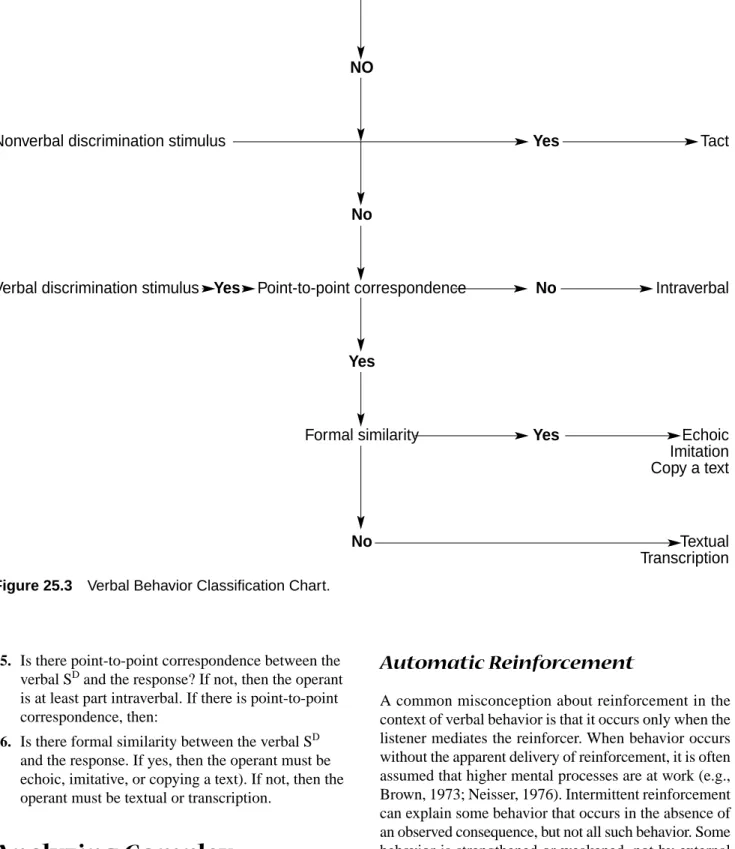
The same word (i.e., topography or form of the behavior) can appear in the definitions of all of the elementary ver-bal operants because controlling variables define verver-bal operants, not the form of the verbal stimuli. Verbal be-havior is not classified or defined by its topography or form (i.e., by the words themselves). The classification of verbal operants can be accomplished by asking a series of questions regarding the relevant controlling variables that evoke a specific response form (see Figure 25.1). A sample of verbal behavior classification exercise is pre-sented in Table 25.3
1. Does an MO control the response form? If yes, then the operant is at least part mand.
2. Does an SDcontrol the response form? If yes, then: 3. Is the SDnonverbal? If yes, then the operant is at
least part tact.
5. Is there point-to-point correspondence between the verbal SDand the response? If not, then the operant is at least part intraverbal. If there is point-to-point correspondence, then:
6. Is there formal similarity between the verbal SD and the response. If yes, then the operant must be echoic, imitative, or copying a text). If not, then the operant must be textual or transcription.
Analyzing Complex
Verbal Behavior
Analysis of more complex verbal behavior includes au-tomatic reinforcement, tact extensions (generalization), and private events. These topics are presented in the fol-lowing sections.
Automatic Reinforcement
A common misconception about reinforcement in the context of verbal behavior is that it occurs only when the listener mediates the reinforcer. When behavior occurs without the apparent delivery of reinforcement, it is often assumed that higher mental processes are at work (e.g., Brown, 1973; Neisser, 1976). Intermittent reinforcement can explain some behavior that occurs in the absence of an observed consequence, but not all such behavior. Some behavior is strengthened or weakened, not by external consequences, but by its response products, which have reinforcing or punishing effects. Skinner used the terms automatic reinforcement and automatic punishment in a number of his writings simply to indicate that an ef-fective consequence can occur without someone provid-ing it (cf., Vaughan & Michael, 1982).
Figure 25.3 Verbal Behavior Classification Chart.
Antecedent variables Verbal relation
UMO/CMO Yes Mand
NO
Nonverbal discrimination stimulus Yes Tact
No
Verbal discrimination stimulus Yes Point-to-point correspondence No Intraverbal
Yes
Formal similarity Yes Echoic Imitation Copy a text
No Textual
Table 25.3 Verbal Behavior Classification Exercises
As a result of . . . One has a tendency to . . . This is a(n) . . .
1. seeing a dog say “dog” __________
2. hearing an airplane say “airplane” __________
3. wanting a drink say “water” __________
4. hearing “How are you?” say “I’m fine” __________ 5. smelling cookies baking say “cookies” __________
6. tasting soup say “pass the salt” __________
7. hearing “book” write book __________
8. hearing “book” sign “book” __________
9. hearing “book” say “book” __________
10. hearing “book” say “read” __________
11. hearing “book” sign “read” __________
12. hearing “book” finger-spell “book” __________
13. seeing a book write book __________
14. wanting a book write book __________
15. signing “book” write book __________
16. hearing “color” say “red” __________
17. seeing a dog on the table say “get off” __________ 18. seeing stop written hit the brakes __________ 19. hearing “Skinner” write behavior __________
20. smelling smoke say “fire” __________
21. being hungry go to a store __________
22. seeing apple written sign “apple” __________
23. seeing 5 say “five” __________
24. wanting things say “thanks” __________
25. hearing “write your name” write your name __________ 26. hearing “run” finger-spell “run” __________ 27. seeing “home” signed sign “Battle Creek” __________ 28. hearing a phone ring say “phone” __________
29. smelling a skunk say “skunk” __________
30. hearing “table” say “mesa” __________
31. being happy smile __________
32. hoping a pilot sees it writing SOS __________
33. wanting blue say “blue” __________
34. hearing “Red, white, and” say “blue” __________
35. tasting candy say “mmmm” __________
Provide examples of verbal behavior.
36. Give an example of a mand involving an adjective. 37. Give an example of a tact of a smell.
38. Give an example of a response that is part mand and part tact. 39. Give an example of a response that is part tact and part intraverbal. 40. Give an example of a tact involving multiple responses.
41. Give an example of an intraverbal using writing.
42. Give an example of receptive language using sign language.
Answers to verbal behavior classification exercises in Table 25.3:
1. T; 2. T; 3. M; 4. IV; 5. T/M; 6. M; 7. TX; 8. IV; 9. E; 10. IV; 11. IV; 12. TR; 13. T; 14. M; 15. IV; 16. IV/T; 17. M; 18. NV; 19. IV; 20. T/M; 21. NV; 22. IV; 23. IV; 24. M; 25. IV; 26. TX; 27. IV; 28. T/M; 29. T; 30. IV; 31. NV; 32. M; 33. M; 34. IV; 35. T; 36. “I want the red one.”; 37. “Someone is smoking.”; 38. “My throat is dry.”; 39. “Macy’s.” When asked “Where did you buy that?”; 40. “That’s a big burger!”; 41. A response to an e-mail; 42. Stopping when someone signs “stop.”
Verbal behavior can produce automatic reinforce-ment, which has a significant role in the acquisition and maintenance of verbal behavior. For example, automatic reinforcement may explain why a typically developing infant engages in extensive babbling without the appar-ent delivery of reinforcemappar-ent. Skinner (1957) pointed out that the exploratory vocal behavior of young children could produce automatic reinforcement when those ex-ploratory sounds match the speech sounds of parents, caregivers, and others.
Skinner (1957) described a two-stage conditioning history in establishing vocal responses as automatic re-inforcers. First, a neutral verbal stimulus is paired with an existing form of conditioned or unconditioned rein-forcement. For example, a mother’s voice is paired with conditions such as presenting food and warmth and re-moving aversive stimuli (e.g., medication on a diaper rash). As a result, the mother’s voice, a previously neu-tral stimulus, becomes a conditioned reinforcer. The mother’s voice will now strengthen whatever behavior precedes it. Second, a child’s vocal response as either random muscle movement of the vocal cords or reflexive behavior produces an auditory response that on occasion may sound somewhat like the mother’s words, intona-tions, and vocal pitches. Thus, a vocal response can func-tion as reinforcement by automatically increasing the frequency of a child’s vocal behavior.4
Automatic reinforcement also plays an important role in the development of more complex aspects of verbal behavior, such as the acquisition of syntax and gram-matical conventions. For example, Donahoe and Palmer (1994) and Palmer (1996, 1998) suggested that a child’s use of grammar produces automatic reinforcement when it sounds like the grammar used by others in the envi-ronment, but is automatically punished when it sounds odd or unusual. Palmer (1996) referred to this as achieving parity.
The stimulus conditions that evoke automatically re-inforced behavior may be encountered everywhere be-cause each time a response is automatically reinforced it may alter the evocative effect of any stimulus condition that might be present. For example, a person may persist in singing or humming a theme song from a movie while driving home from the movie because of the two-stage conditioning process described previously. However, the song may be periodically evoked several hours, or even days, after the movie because each time the song is re-4Miller and Dollard (1941) were perhaps the first to suggest that a process like automatic reinforcement might be partially responsible for an infant’s high rate of babbling. Since then, many others have discussed and re-searched the role of automatic reinforcement in language acquisition (e.g., Bijou & Baer, 1965; Braine, 1963; Miguel, Carr, & Michael, 2002; Mowrer, 1950; Novak, 1996; Osgood, 1953; Smith, Michael, & Sundberg, 1996; Spradlin, 1966; Staats & Staats, 1963; Sundberg, Michael, Partington, & Sundberg, 1996; Vaughan & Michael, 1982; Yoon & Bennett, 2000).
peated, a new stimulus such as a traffic light, a street cor-ner, or a neon sign might acquire some degree of stimu-lus control. The next time the person comes in contact with, say, a red light, there could be some tendency to sing or hum the song. This effect might explain what is often termed delayed echolalia observed with children who have autism (Sundberg & Partington, 1998). At pre-sent, however, there have been no empirical investiga-tions of the stimulus control involved in automatic consequences, although it certainly seems like an inter-esting and important area of study.
Tact Extensions
Contingencies that establish stimulus and response classes and generalization allow a variety of novel and different discriminative stimuli to evoke verbal behavior. Skinner (1957) said it this way:
[A] verbal repertoire is not like a passenger list on a ship or plane, in which one name corresponds to one person with no one omitted or named twice. Stimulus control is by no means so precise. If a response is reinforced upon a given occasion or class of occasions, any feature of that occasion or common to that class appears to gain some measure of control. A novel stimulus possessing one such feature may evoke a response. There are sev-eral ways in which a novel stimulus may resemble a stimulus previously present when a response was rein-forced, and hence there are several types of what we may call “extended tacts” (p. 91).
Skinner (1957) distinguished four types of extended tacts: generic, metaphorical, metonymical, and solistic. The distinction is based on the degree to which a novel stimulus shares the relevant or irrelevant features of the original stimulus.
Generic Extension
In generic extension, the novel stimulus shares all of the relevant or defining features of the original stimulus. For example, a speaker who learns to tact “car” in the pres-ence of a white Pontiac Grand Am emits the tact “car” in the presence of a novel blue Mazda RX-7. A generic tact extension is evoked by simple stimulus generalization.
Metaphorical Extension
In metaphorical extension, the novel stimulus shares some but not all of the relevant features associated with the original stimulus. For example, Romeo was experi-encing a beautiful, sunny, warm day, and the exceptional weather elicited respondent behaviors (e.g., good feel-ings). When Romeo saw Juliet, whose presence elicited
Chapter 25 Verbal Behavior 537
similar respondent behaviors like the sunny day, he said, “Juliet is like the sun.” The sun and Juliet evoked a sim-ilar effect on Romeo, controlling the metaphorical tact extension “Juliet is like the sun.”
Metonymical Extension
Metonymical extensions are verbal responses to novel stimuli that share none of the relevant features of the orig-inal stimulus configuration, but some irrelevant but re-lated feature has acquired stimulus control. Simply, one word substitutes for another in metonymical tact exten-sions, meaning that a part is used for a whole. As exam-ples: Saying “car” when shown a picture of a garage, or saying “the White House requested” in place of “Presi-dent Lincoln requested.”
Solistic Extension
Solistic extensions occur when a stimulus property that is only indirectly related to the tact relation evokes sub-standard verbal behavior such as malaprops. For instance, using the solistic tact extension, a person may say “You read good” instead of “You read well.” Saying “car” when referring to the driver of the car is a solistic tact extension.
Private Events
In 1945 Skinner first described radical behaviorism, his philosophy. At the core of radical behaviorism is the analysis of private stimuli (see also Skinner, 1953, 1974). Verbal behavior under the control of private stimuli has been a main topic of theoretical and philosophical analy-ses of behavior ever since. In 1957 Skinner stated, “A small but important part of the universe is enclosed within the skin of each individual. . . . It does not follow that . . . it is any way unlike the world outside the skin or inside another’s skin” (p. 130).
A significant amount of day-to-day verbal behavior is controlled in part by private events. What is commonly referred to as thinking involves overt stimulus control and private events (e.g., covert stimulus control). The analysis of private stimulation and how it acquires stim-ulus control is complex because of two problems: (a) The participant can directly observe the private stimuli, but the applied behavior analyst cannot (a limiting factor in the prediction and control of behavior), and (b) private stimulus control of verbal episodes in the natural envi-ronment will likely remain private, no matter how sensi-tive instruments will become in detecting private stimuli and behaviors. Skinner (1957) identified four ways that caregivers teach young persons to tact their private
stim-ulation: Public accompaniment, collateral responses, common properties, and response reduction.
Public Accompaniment
Public accompaniment occurs when an observable stim-ulus accompanies a private stimstim-ulus. For example, a fa-ther may observe a child bump his head on a table while chasing a ball. The public stimuli are available to the fa-ther, but not the private and more salient painful stimuli experienced by the child. The father can assume that the child is experiencing pain because of his own history of bumping objects, and may say “Ouch,” or “You hurt your-self.” In this way, the father is using the bump (observable stimulus) as an opportunity to develop verbal behavior under the stimulus control of a private stimulus. This may occur with an echoic to the private event; later, the stim-ulus control transfers to the private stimuli. Specifically, the child may echo the father’s “ouch” while the painful stimuli are present, and quickly (depending on the child’s history of echoic to tact transfer) the painful stimuli alone evokes the tact “ouch.”
Collateral Responses
Caregivers also teach young persons to tact their private stimuli by using collateral responses (i.e., observable be-havior) that reliably occur with private stimuli. For ex-ample, the father may not observe the child bump his head, but may see the child holding his head and crying. These collateral behaviors inform the father that a painful stimulus is present. The same training procedures with public accompaniment can be used with collateral re-sponses. Because the painful private stimuli are salient, only one trial may be needed for the private stimuli to acquire stimulus control of the tact relation.
Parents should use public accompaniment and col-lateral responses during the beginning stages of tact train-ing. However, even after developing a repertoire of tacting private events, a parent or listener will have difficulty confirming the actual presence of the private event as in “My stomach hurts,” or “I have a headache now.”
Also, learning to tact private behaviors is acquired probably with public accompaniment and collateral re-sponses; for example, private stimuli that evoke private emotions (behaviors) that we tact with words such as happiness, sadness, fear, and being upset. Learning to tact such private events is difficult if the private stimula-tion is not present during training. For example, proce-dures that use pictures of people smiling and frowning (i.e., public stimuli) for teaching children to tact emo-tions will be less effective than procedures that use vari-ables to evoke pleasure or displeasure (i.e., private stimuli) during training.
Common Properties
The two procedures described earlier use public stimuli to establish tacting of private events. Common proper-ties also involve public stimuli, but in a different way. A speaker may learn to tact temporal, geometrical, or de-scriptive properties of objects and then generalize those tact relations to private stimuli. As Skinner (1957) noted, “[M]ost of the vocabulary of emotion is metaphorical in nature. When we describe internal states as ‘agitated,’ ‘depressed,’ or ‘ebullient,’ certain geometrical, temporal, and intensive properties have produced a metaphorical extension of responses” (p. 132). Much of our verbal be-havior regarding emotional events is acquired through this type of stimulus generalization.
Response Reduction
Most speakers learn to tact features of their own bodies such as movements and positions. The kinesthetic stim-uli arising from the movement and positions can acquire control over the verbal responses. When movements shrink in size (become covert), the kinesthetic stimuli may remain sufficiently similar to those resulting from the overt movements that the learner’s tact occurs as an instance of stimulus generalization. For example, a child can report imagining swimming, or can report self-talk about a planned conversation with someone, or can report thinking of asking for a new toy (Michael & Sundberg, 2003). Responses produced by private covert verbal be-havior can evoke other verbal bebe-havior and will be dis-cussed later in further detail.
Multiple Control
All verbal behavior contains multiple functional relations among antecedents, behavior, and consequences. “[A]ny sample of verbal behavior will be a function of many variables operating at the same time” (Skinner, 1957, p. 228). The functional units of mands, tacts, echoics, in-traverbals, and textual relations form the foundation of a verbal behavior analysis. A working knowledge of these functional units is essential for understanding the analy-sis of multiple control and complex verbal behavior.
Convergent Multiple Control
Michael (2003) used the term convergent multiple con-trol to identify when the occurrence of a single verbal response is a function of more than one variable. The task of an applied behavior analyst is to identify the relevant sources that control an instance of verbal behavior. For example, saying “Why did the United States enter World War II?” may be evoked by (a) MOs (making it part
mand), (b) verbal discriminative stimuli (making it part echoic, intraverbal, or textual), (c) nonverbal stimuli (making it part tact), or the presence of a specific audi-ence. For example, it’s possible that an audience with contempt for war (i.e., the MO) evoked a mand, “Why did the United States enter World War II?” The question may be more a function of this variable than an intraverbal re-lated to the ongoing conversation or the nonverbal or tex-tual stimuli that may be present in the room. On the other hand, the speaker may have no strong MO for the an-swer, but asks the question because of its relation to MOs for social reinforcement related to political involvement.
Divergent Multiple Control
Multiple control also occurs when a single antecedent variable affects the strength of many responses. For ex-ample, a single word (e.g., football) will evoke a variety of intraverbal responses from different people, and from the same person at different times. Michael (2003) used the term divergent multiple control to identify this type of control. Divergent multiple control can occur also with mand and tact relations. A single MO may strengthen a variety of responses, such as food deprivation strength-ening the response “I’m hungry,” or “Let’s go to a restau-rant.” A single nonverbal stimulus can also strengthen several response forms, as when a picture of a car strengthens the responses “car,” “automobile,” or “Ford.”
Thematic and Formal
Verbal Operants
Skinner (1957) identified thematic and formal verbal op-erants that function as sources of multiple control. The thematic verbal operants are mands, tacts, and intraver-bals and involve different response topographies con-trolled by a common variable. For an intraverbal example, the SD“blue” can evoke verbal responses such as “lake,” “ocean,” and “sky.” The formal verbal oper-ants are echoic (imitation, copying a text) and textual (and transcription) and are controlled by a common vari-able, with point-to-point correspondence. For example, the SD“ring” can evoke verbal responses such as “sing,” “wing,” and “spring.”
Multiple Audiences
The role of the audience raises the issue of multiple au-diences. Different audiences may evoke different re-sponse forms. For example, two applied behavior analysts talking (i.e., a technical speaker and a technical audience) will likely use different response forms than will a behavior analyst speaking with a parent (i.e., a
Chapter 25 Verbal Behavior 539
technical speaker and a nontechnical audience). A positive audience has special effects, especially a large positive audience (e.g., as in a rally for a certain cause), as does a negative audience. When the two audiences are combined, the effects of the negative audience are most obvious: “[When a] seditious soapbox orator sees a po-liceman approaching from a distance, his behavior de-creases in strength as the negative audience becomes more important” (Skinner, 1957, p. 231).
Elaborating Multiple Control
Convergent multiple control occurs in most instances of verbal behavior. An audience is always a source of stim-ulus control related to verbal behavior, even when a speaker serves as his own audience. In addition, it is also the case that more than one of the controlling variables re-lated to the different verbal operants may be relevant to a specific instance of verbal behavior. Convergent control often occurs with MOs and nonverbal stimuli, resulting in a response that is part mand and part tact. For exam-ple, saying “You look great” may be partly controlled by the nonverbal stimuli in front of a speaker (a tact), but also by MOs related to wanting to leave soon or wanting to avoid potential aversive events (a mand). Skinner (1957) identified this particular blend of controlling vari-ables as evoking impure tacts (i.e., impure because an MO affects the tact relation).
Verbal and nonverbal stimuli can also share control over a particular response. For example, a tendency to say “green car” may be evoked by the verbal stimulus “What color is the car?” and the nonverbal stimulus of the color green.
Multiple sources of control can be any combination of thematic or formal sources, even multiple sources from within a single verbal operant, such as multiple tacts or multiple intraverbals. Skinner pointed out that because these separate sources may be additive, the “multiple cau-sation produces many interesting verbal effects, includ-ing those of verbal play, wit, style, the devices of poetry, formal distortions, slips, and many techniques of verbal thinking” (pp. 228–229). Additional sources of control often reveal themselves—for example, when a speaker in the presence of an obese friend who is wearing a new hat emits the “Freudian slip,” “I like that fat on you.” Multiple sources of control often provide the basis for verbal humor and listener enjoyment.
Autoclitic Relation
This chapter has emphasized that a speaker can, and often does, function as her own listener. The analysis of how and why a speaker becomes a listener of her own verbal behavior and then manipulates her verbal behavior with
additional verbal behavior addresses the topic of the clitic relation. Skinner (1957) introduced the term auto-clitic to identify when a speaker’s own verbal behavior functions as an SDor an MO for additional speaker ver-bal behavior. In other words, the autoclitic is verver-bal be-havior about a speaker’s own verbal bebe-havior. The consequences for this behavior involve differential rein-forcement from the ultimate listener, meaning that the listener discriminates whether to serve or not serve as a mediator of reinforcement for those verbal stimuli. A speaker becomes a listener, and observer, of his own ver-bal behavior and its controlling variables, and then in turn becomes a speaker again. This effect can be very rapid and typically occurs in the emission of a single sentence composed of the two levels of responses.
Primary and Secondary
Verbal Operants
Michael (1991, 1992) suggested that applied behavior analysts classify verbal behavior about a speaker’s own verbal behavior as primary (Level 1) and secondary (Level 2) verbal operants. In Level 1, MOs and/or SDs are present and affect the primary verbal operant. The speaker has something to say. In Level 2, the speaker ob-serves the primary controlling variables of her own ver-bal behavior and her disposition to emit the primary verbal behavior. The speaker discriminates these con-trolling variables and describes them to the listener. A secondary verbal operant enables the listener’s behavior as a mediator of reinforcement. For example, an MO or SDevokes the response, “She is in Columbus, Ohio.” It is important for listeners as reinforcement mediators to discriminate the primary variables controlling the speaker’s behavior. The verbal operant “She is in Colum-bus, Ohio,” does not inform the listener as to why the speaker said it. “I read in the Columbus Dispatch that she is in Columbus, Ohio,” informs the listener of the pri-mary controlling variable. The first level is “She is in Columbus, Ohio” (the primary verbal operant), and the second level is “I read in the Columbus Dispatch” (the autoclitic).
Autoclitic Tact Relations
Some autoclitics inform the listener of the type of pri-mary verbal operant the autoclitic accompanies (Peter-son, 1978). The autoclitic tact informs the listener of some nonverbal aspect of the primary verbal operant and is therefore controlled by nonverbal stimuli. For example, a child’s statement, “I see Mommy” may contain an au-toclitic tact. The primary verbal operant (i.e., the tact) is the nonverbal SDof (a) the child’s mother; (b) the re-sponse, “Mommy”; and (c) the associated reinforcement
history. The secondary verbal operant (i.e., the autoclitic tact) is the speaker’s tact informing that a nonverbal SD evoked the primary verbal operant. In this case, the non-verbal SDwas the visual stimulus of the child’s mother, and the response “I see” informs the listener of the source of control that evoked the primary tact. If the child heard his mother, but did not see his mother, the autoclitic tact “I hear” would be appropriate.
The listener may challenge the existence and nature of the autoclitic tact—for example, “How do you know it’s mommy?” The challenge is one way that effective autoclitic behavior is shaped and brought under appro-priate stimulus control.
Autoclitic tacts also inform the listener of the strength of the primary operant. In the examples of the verbal stim-uli, “I think it is Mommy” and “I know it is Mommy,” “I think” informs the listener that the source of control for the primary tact “Mommy” is weak; “I know” is strong.
Autoclitic Mand Relations
Speakers use autoclitic mands frequently to help the lis-tener present effective reinforcers (Peterson, 1978). A specific MO controls the autoclitic mand, and its role is to mand the listener to react in some specific way to the primary verbal operant. “I know it is Mommy” may con-tain an autoclitic mand. For example, if “I know” is not a tact of response strength, it may be an MO in the same sense as “Hurry up.”
Autoclitic mands occur everywhere, but listeners have difficulty recognizing the MO controlling the auto-clitic mand because the sources of control are private. For example, hidden agendas as autoclitic mands often revel themselves only to the careful observer. For exam-ple, a primary intraverbal such as an answer to a question about the sale of a product may contain autoclitic mands, as in “I’m sure you will be pleased with the sale,” in which “I’m sure you will be pleased” is controlled by the same MO that might control the response “Don’t ask me for any details about the sale.”
Developing Autoclitic Relations
Speakers develop autoclitic relations in several ways. For example, a father is wrapping a gift for his child’s mother, and the child nearby says, “Mommy.” The father may ask the child to identify the primary variables controlling the response by asking, “Did you see her?” The father may differentially respond to “I see” indicating that clearly “Mommy” is a tact and hide the gift; rather than a mand for “Mommy,” in which case, he keeps wrapping the gift. The source of control for the response “Mommy” could be the gift, as in, “That is for Mommy.” “That is for” (i.e., the autoclitic) informs the father that the gift is a
nonver-bal stimulus controlling the primary tact, “Mommy,” and the father continues wrapping the gift. As Skinner (1957) pointed out, “[A]n autoclitic affects the listener by indi-cating either a property of the speaker’s behavior or the circumstances responsible for that property” (p. 329).
Early language learners seldom emit autoclitic re-sponses. Skinner was clear on this point: “In the absence of any other verbal behavior whatsoever autoclitics can-not occur. . . . It is only when [the elementary] verbal op-erants have been established in strength that the speaker finds himself subject to the additional contingencies which establish autoclitic behavior” (p. 330). Thus, early language intervention program should not include auto-clitic training.
Applications
of Verbal Behavior
Skinner’s analysis of verbal behavior provides a concep-tual framework of language that can be quite beneficial for applied behavior analysts. Viewing language as learned behavior involving a social interaction between speakers and listeners, with the verbal operants as the basic units, changes how clinicians and researchers ap-proach and ameliorate problems related to language. Skinner’s theory of language has been successfully ap-plied to an increasing number of human areas. For ex-ample, the analysis has been used for typical language and child development (e.g., Bijou & Baer, 1965), ele-mentary and high school education (e.g., Johnson & Layng, 1994), college education (e.g., Chase, Johnson, & Sulzar-Azaroff, 1985), literacy (e.g., Moxley, 1990), composition (e.g., J. Vargas, 1978), memory (e.g., Palmer, 1991), second language acquisition (e.g., Shimamune & Jitsumori, 1999), clinical interventions (e.g., Layng & Andronis, 1984), behavior problems (e.g., McGill, 1999), traumatic brain injury (e.g., Sundberg, San Juan, Dawdy, & Arguelles, 1990), artificial intelligence (e.g., Stephens & Hutchison, 1992), ape language acquisition (e.g., Sav-age-Rumbaugh, 1984), and behavioral pharmacology (e.g., Critchfield, 1993). The most prolific application of Skinner’s analysis of verbal behavior has been to lan-guage assessment and intervention programs for children with autism or other developmental disabilities. This area of application will be presented in more detail in the fol-lowing sections.
Language Assessment
Most standardized language assessments designed for children with language delays seek to obtain an age equivalent score by testing a child’s receptive and expressive language abilities (e.g., Peabody Picture