When to use splay trees
Eric K. Lee
∗,†and Charles U. Martel
Department of Computer Science, University of California at Davis, Davis, CA 95618, U.S.A.
SUMMARY
In this paper we present new empirical results for splay trees. These results provide a better understanding of how cache performance affects query execution time. Our results show that splay trees can have faster lookup times compared with randomly built binary search trees (BST) under certain settings. In contrast, previous experiments have shown that because of the instruction overhead involved in splaying, splay trees are less efficient in answering queries than randomly built BSTs—even when the data sets are heavily skewed (a favorable setting for splay trees). We show that at large tree sizes the difference in cache performancebetween the two types of trees is significant. This difference means that splay trees are faster than BSTs for this setting—despite still having a higher instruction count. Based on these results we offer guidelines in terms of tree size, access pattern, and cache size as to when splay trees will likely be more efficient. We also present a new splaying heuristic aimed at reducing instruction count and show that it can improve on standard splaying by 10–27%. Copyright c2007 John Wiley & Sons, Ltd.
Received 8 June 2005; Revised 20 November 2006; Accepted 22 November 2006 KEY WORDS: splay tree; cache performance; empirical; heuristic
1. INTRODUCTION
A critical task in designing an application is selecting the correct data structures. This requires an understanding of which data structures will yield the best performance. An asymptotic analysis of the candidate data structures suggests which one will perform best as the input gets large. However, for data structures with similar asymptotic complexity, it is often difficult to predict which will actually perform better in practice.
A further complication is that the reliability of predicting performance based on an analysis under the random-access-machine (RAM) model has lessened in the past 20 years owing to changes in computer architectures. In particular, there now exists an extremely large difference between the performance of the central processor and main memory—some access times for data are hundreds of times longer
∗Correspondence to: Eric K. Lee, Department of Computer Science, University of California at Davis, Davis, CA 95618, U.S.A. †E-mail: [email protected]
than others. How a data structure minimizes this difference by utilizing the hardware cache can have a significant impact on its execution time.
The binary search tree (BST), and its self-adjusting cousin, the splay tree‡, are two data structures
where the cache plays an important role in performance, so asymptotic analysis is not always a good predictor for these data structures. A randomly built BST is often a good choice for an application that requires fast insertion, deletion, and lookup of items, as well as fast ‘ordered’ operations such as
traversals or range queries§. However, if the lookup distribution is heavily skewed, a splay tree might be
a better choice. In heavily skewed distributions there is a small set of items that are accessed frequently,
forming a ‘working set’. Sleator and Tarjan [1] have proved that splay tree access times to the items in
a working set are fast. This is true even if the working set changes over time.
Experimental results by Bell and Gupta [2], and more recently by Williamset al. [3], have shown
that even when the access pattern is heavily skewed, the instruction overhead involved with the splay
operation outweighs the instruction savings of having shorter access paths. Bell and Gupta [2] showed
that a randomly built BST answered queries faster than a splay, even though a splay tree performs best in a skewed setting. In contrast with these previous results, our results offer a more complete picture of splay tree performance. In particular, we found that owing to superior cache performance there are settings when a splay is faster than the BST, despite a higher instruction count.
Our major contributions in this paper are new empirical results regarding the instruction count, cache performance, and execution time of BSTs and splay trees under skewed lookup patterns. In particular, we show that splay trees have fewer cache misses compared with BSTs, and that the difference in their cache performance increases as the tree grows. The improved cache performance of the splay tree at large tree sizes more than compensates for the higher instruction cost involved in splaying, making them faster than BSTs in this setting. Furthermore, as the cost of a cache miss increases in the future, we expect that the speedup due to splaying will increase. Based on these results we offer guidelines in terms of tree size, access pattern, and cache size as to when a splay tree will likely be more efficient than its static counterpart (BST). We also present a new splaying heuristic aimed at reducing instruction count and show that it can improve upon standard splaying by 10–27%.
Since splay trees are potentially better than BSTs only when the access pattern is skewed, we focus on this setting in this paper. Intuitively, splaying when the access pattern is near uniform is not productive. In a uniform setting there is no payoff for the investment of bringing items to the root since the probability that the same item will be accessed again soon is small. We work under the assumption
that a splay tree is desirable because either the exact access distribution is unknowna priori, or that
the set of frequently accessed items changes over time. If the access pattern is known and fixed, it is trivial to build a tree that is optimal (or near optimal) for the access pattern. Finally, we note that there are many settings when access patterns are heavily skewed but the specific access probabilities are unknown or are dynamic. A simple example is storing movie information in a tree, keyed by title. Certain movies are much more popular than others, but the specific set of popular movies may change over time.
‡A splay tree moves accessed items to the root, see Section2.
2. BACKGROUND
2.1. Splaying
A splay tree is a self-adjusting BST that improves on the asymptotic bounds in theamortizedsense, and
requires no additional space (in contrast to, say, an Adelson-Velsky–Landis (AVL) tree). Splaying was
developed by Sleator and Tarjan [1], and consists of a sequence of operations that moves the queried
node to the root of the tree. By performing this move-to-root operation in a particular manner, any
sequence ofm > n lookups on a nnode tree takes only O(mlogn)time. This is an improvement
over theO(mn)worst case of a standard BST. Furthermore, when the access pattern is skewed, the
frequently accessed nodes will cluster near the root making future access to them faster.
Two main methods for splaying exist, top-down and bottom-up. In our experiments [4], we have
found thatsimpletop-down splaying, a top-down variant, performs best. Thus, all the results we present
involve this variant. In contrast with bottom-up splaying, in top-down splaying only a single pass is necessary to find the item of interest and move it to the root. Details of this method are provided in
AppendixA.
2.2. Faster splay trees via heuristics
There are a number of existing heuristics aimed toward improving the performance of splay trees. Most focus on decreasing the overhead involved in splaying by reducing rotations. Williams
et al. [3] discuss (and evaluate) several heuristics in the context of large text collections [3] (see also
experimental results from Bolster [5]). One particular heuristic, randomized splaying, has been shown
to perform well in practice. The heuristic was proposed by Albers and Karpinski [6] (a similar method
was suggested by Furer [7]). Randomized splaying is based on a simple concept: with probabilityp
a node is splayed, and with probability 1−pa standard BST lookup is performed (and the node keeps
its place in the tree).
We consider a deterministic version of randomized splaying—splaying every k lookups and
performing a standard BST lookup otherwise. The deterministic variant removes potentially expensive
random number generation, which improves performance in practice [6]. We note that the choice ofkis
somewhat arbitrary, but Albers and Karpinski suggest thatk=2 (i.e. alternating splaying and standard
BST searching) should provide an improvement over standard splaying in almost all cases. We will
refer to this deterministic version of randomized splaying ask-splaying.
We propose a heuristic based on a ‘sliding window’. A sliding window is a queue of fixed size used
to keep track of information regarding the lastwevents. At a high level, our heuristic works as follows.
Assume we divide a splay tree creating ‘upper’ and ‘lower’ portions. Now, if most lookups are to the upper portion of the tree then we assume that the frequently accessed items are near the root, so no splaying is necessary. On the other hand, if there are many accesses to the lower portion, splaying is performed under the assumption that the tree could be readjusted to perform better. The sliding window
is used to record the upper and lower accesses for the pastwaccesses.
2.3. Caches
As the disparity between processor and memory speed continues to grow, computer architects have introduced new levels into the memory hierarchy to help bridge the gap. The memory hierarchy exploits the principle of locality—a recently accessed item is likely to be accessed again in the near future.
Therefore it is desirable to keep such an item at a place were it can be quickly accessed. The first level of the hierarchy is closest to the processor and has the fastest access time, but also has the smallest capacity. Since there is a trade-off between the capacity and access time, each successive level is
larger but slower. The level(s) between the main memory and the processor are known as caches.
Typically, the cache closest to the processor is referred to as the L1 cache and for each successively
cachen= {2,3, . . .}is the Lncache. In our results we quantify a data structure’s cache performance
in terms of cache hits and misses.
Assuming that we have only a single cache between the CPU and main memory, cache hits and misses occur as follows. When the CPU makes a request for a data item the cache is checked; if that
item is in the cache the result is acache hit. If the requested item is not in the cache then the item is
copied from its location in main memory into the appropriate cache set. This is known as acache miss.
The associated cost of bringing the item in from memory is known as thememory latencyand can be
100 times more expensive than a cache hit [8]. The process of checking successively lower levels of
the memory hierarchy has a straightforward generalization to handle cases when there are many cache levels. In our analysis we will focus on capacity and conflict misses. Capacity misses occur when the cache is too small to contain all the blocks needed during the execution of a program. In contrast, conflict misses occur when two or more data items in the memory map to the same cache set. This can
occur regardless of the cache size. See Hennessy and Patterson [9] for further details regarding these
types of cache misses.
2.4. Related work
Shortly after their creation, splay trees were shown to perform better than some standard heaps in a
priority queue study by Jones [10]. This is the result of the fact that no comparisons are needed to find
the minimum in a tree (simply follow the left branch) and that the self-adjusting behavior of the tree allowed for shorter paths to the items. Furthermore, in Jones’s implementation splay rotations were reduced and specialized for enqueue and dequeue.
Bell and Gupta [2] performed an empirical study where the central focus was a comparison of the
performance of splay trees to randomly built BSTs and AVL trees. Trees consisting of 4095 integers were tested with Zipf-like access patterns. A representative result of their findings concerns the case where 100 000 total operations were performed—20 000 updates and 80 000 searches. In this setting the randomly built BST outperformed the splay tree in terms of execution time for all cases except at the highest skew level, which had 90% of all accesses going to 1% of the nodes. In this extremely skewed distribution, splaying had an execution time 6% faster than the BST. The major difference between Bell and Gupta’s results and our own is the execution time influence of the cache. In particular, the trees in their experiments were small enough to fit entirely into the cache, thus cache effects had little performance impact.
More recently, Williamset al. [3] studied the performance of self-adjusting data structures on the
specific task of storing words found in a large text collection. The experiment selected each word in sequence from a 1 GB text file and then performed a lookup for the word in the tree. If the word existed in the tree then some statistical information was updated, and if it did not a new node was created to
store the word. The text file was Zipf distributed (see Section3)—it contained 2.0 million distinct
words among 171.4 million total words.
Williams et al. [3] reported that BSTs were faster than the various splaying techniques in their
ours because their experimental setting was significantly different. The primary difference is that our
trees were randomly built and their trees were not. Williamset al. noted that many of the most common
words were likely to appear early in the text collection. Since the words were processed from the start of the collection, the resulting BST has short access paths to these common words. Thus, readjusting a tree constructed in this manner via splaying is likely to offer little benefit. We note that, in a setting like this, sampling the text to find the most common words and inserting these first may be a better alternative to using splay trees.
Iancuet al. [11] evaluated splay trees and B-trees with respect to cache performance. Their results
show that B-trees were faster than splay trees in answering queries for a variety of access patterns. The exception was for a heavily skewed pattern with high locality, in which the splay was faster. Our results differ because our measurements allow us to determine how much each factor contributes
to the performance of the trees. In particular, for the skewed access pattern tested by Iancuet al.,
the splay outperformed the B-tree, but in addition to having better cache performance the splay also executed only one-third of the B-tree’s instructions. Thus, one cannot conclude how much of an effect the superior cache performance of the splay had on the execution time. Furthermore, our results allow us to offer recommendations in terms of tree size and cache size as to when the improved cache performance of the splay outweighs its instruction count overhead relative to BSTs.
3. COMPARISON METHODOLOGY
3.1. Access patterns and tree sizes
Non-uniform distributions are all around us; for example, the distribution of people in U.S. cities, or the distribution of grades for an exam. We focus on one common skewed distribution, Zipf’s, named
after Harvard linguist George Zipf [12]. Furthermore, this is the distribution previous studies have used
to compare splay trees with other data structures [2,3]. We will now briefly describe Zipf’s distribution.
Consider a distribution over a set ofnobjects where theith most frequently occurring object will
appear 1/itimes the frequency of the most frequently occurring object. In Zipf’s distribution the most
frequently occurring object appears with probability 1
n
i=11/i = 1
Hn
and thus the probability of itemioccurring is
pi= 1 i · 1 Hn
whereHnis thenth harmonic number. In essence, Zipf’s distribution means that a small portion of the
items (e.g. 10%) occur extremely frequently (e.g. 90%). Zipf’s law applies to a wide range of data sets.
Two examples are the word frequencies in the English language [12], and the frequency of Web page
accesses¶[13].
¶Breslauet al. [13] state ‘the distribution of page requests generally follows a Zipf-like distribution where the relative probability of a request for theith most popular page is proportional to 1/iα, withαtypically taking on some value less than unity’.
We present results involving two types of access patterns, each consisting of 1 million Zipf
distributed queries. Thestatic Zipf access pattern was constructed as follows.
(1) For allnkeys, select keyiuniformly at random among the keys that have not been assigned an
access probability. Assign it the access probabilitypi=(1/i)·1/Hn.
(2) For all 1 million queries the probability queryj is to keyiispi.
The second type of access pattern, dynamic Zipf, is constructed similarly except that it reassigns
probabilities periodically. The difference from the static case is that every 50 000queries the access
probabilities to the tree keys were reassigned using the above process.
Our experiments involved trees ranging in size from 16 384 (214) nodes up to 1 048 576 (220) nodes
in powers of 2. These sizes were chosen so that the smaller splay trees would fit entirely in the cache, and the larger splay trees would only partially reside in the cache. For instance, the largest tree tested was 24 times larger than the L2 cache.
3.2. Implementation
All implementations were written in C, and compiled using GCC 3.2.2 without optimization. The splay
results we present are for the simple top-down splaying variant (see AppendixAfor details) since it
was the fastest among the variants we tested [4]. The implementation was taken from Weiss’s data
structures text [14]. The BST implementation was also from Weiss [14]; however, the non-recursive
versions of the relevant operations (insertandfind) were used.
The driver program first constructed a binary tree containing n unique integer keys inserted
uniformly at random∗∗. We used the same construction routine for building both the splay and BST.
This meant that no splaying was performed during the construction of the splay tree. The benefit of constructing the trees in this manner was that the execution times of the two data structures were identical modulo the time to answer queries. Furthermore, splaying during construction is unproductive since the keys were inserted in random order. We note that using the same construction routine for both
trees is consistent with the approach used by Bell and Gupta [2].
After the tree was built, the entire query set (static or dynamic Zipf) was read into a large queue (an array of 1 million cells). This step aimed to reduce file I/O during the experiment, which would likely skew the timing results. Despite the queue’s size, both the queue and the tree fit entirely in main memory. Furthermore, the queue had a negligible effect on the cache performance of the tree because each cell was only accessed once, and only in a localized fashion. Thus, the queue only utilized a small portion of the cache at any given time during the experiment. Finally, once the tree was constructed, and the queries were stored in memory, the driver processed each query using the tree’s search routine.
This quantity was chosen because in limited experimentation we determined that 50 000 was approximately the limit where splay trees begin to lose their effectiveness. Decreasing the quantity further meant the splay trees would perform worse than BSTs for all tree sizes.
∗∗Timing skew introduced by random number generation was avoided by producing a file offline that contained the integers to be inserted.
3.3. Test system
All timing measurements were performed on a 1 GHz Pentium III machine, running Red Hat Linux 9.0. The test system had 512 MB of main memory, and a 512 KB eight-way set associative L2 cache. In addition, it had two L1 caches (instruction and data) both 16 KB in size with eight-way
associativity. The latency of main memory was measured (using RightMark memory analyzer [15])
to be approximately 100 ns, and 8 ns for the L2 cache. The L1 caches had a 2 ns latency on a cache hit,
but as a result of pipelining the L1 cache could be accessed without delay††.
Throughout our analysis we will assume that the test system executes 870 million instructions per
second. The SPEC integer benchmarks in Hennessy and Patterson’s text [8] provide an average cycle
per instruction (CPI) of 1.15 for the P6 micro-architecture (base architecture for the Pentium pro, Pentium II and Pentium III). Using this CPI and a clock rate of 1 GHz gives an execution rate of approximately 870 million instructions per second.
3.4. Trials and metrics
Cache and instruction counts were performed using thesim-cachesimulator, one of the tools that
make up the SimpleScalar tool set [17]. SimpleScalar is an execution-driven simulator that executes
a compiled version of the target program. This allows for a very detailed analysis of the candidate program since every machine level instruction and data access can be tracked. Another benefit is that the candidate program need not be instrumented with profiling code that could bias the results.
We modified the simulator to measure only the cache misses and instruction counts of the trees during the queries (the only part of the simulation where their performance could differ). More accurate simulation results were obtained by first performing 500 000 ‘warm up’ queries followed by 1 million queries during which the performance was measured. The warm up phase allowed us to measure the steady state performance of the trees.
In addition to simulated results, real time measurements were collected. The timing experiments were run immediately following system boot, with the system running a light load (CPU usage was consistently between 98 and 100% over the lifetime of a run). The time was measured using the Linux
timeutility, which gives the end-to-end execution time of the program. We collected data for three
trials of identical query sequences for every tree size and access pattern combination. The minimum time among the three trials is what we report, as this time reflects the least CPU and cache interference from other OS functions. However, the variance among the three trials was negligible. Experiments using different random number seeds were also tested, but there was no significant variance among those either.
The times we report include the time to read in the query file, build the tree, and perform the queries. The following procedure was used to obtain sufficiently long execution times and assure the majority of time was due to the queries: a total of 10 million queries were performed by repeating the 1 million queries in the query file from start to end 10 times. By reusing the same set of queries we were better able to note the differences in the execution time in two ways. First, the longer execution times (typically greater than 7 s) reduced the variance, and produced more accurate results.
6 7 8 9 10 11 12 13 14 15 16 17 18 16384 32768 65536 131072 262144 524288 1.04858e+06 Real Time (seconds)
Tree Size (number of nodes) TD Simple Splay Standard BST (a) 5 6 7 8 9 10 11 12 13 14 15 16 17 18 19 1.04858e+06 524288 262144 131072 65536 32768 16384 Real Time (seconds)
Tree Size (number of nodes) TD Simple Splay
Standard BST
(b)
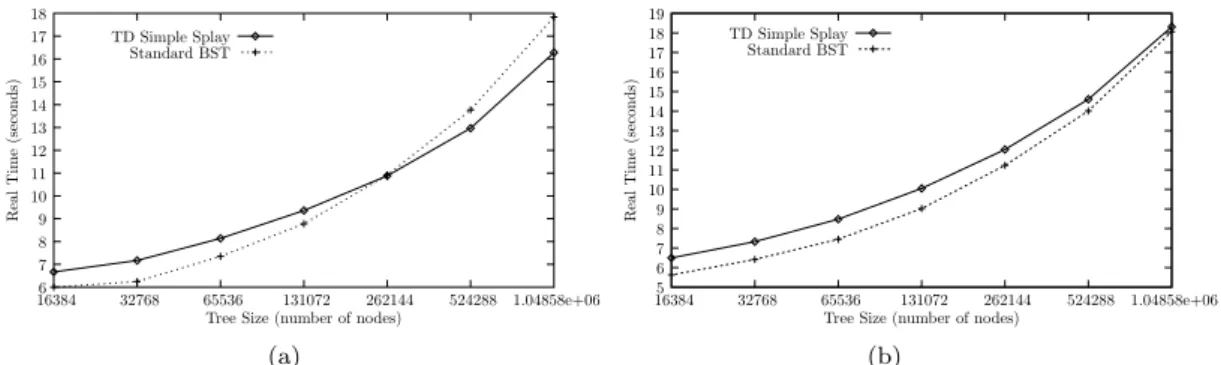
Figure 1. Times include reading the data file, building the tree, and performing the queries: (a) the static timing results for 10 million queries with the access pattern held constant; (b) the dynamic timing results when the lookup
probabilities were reassigned every 50 000 queries.
Second, repeating the same queries made the proportion of time spent on reading in and storing the queries smaller. For all tree size and access pattern combinations, more than 75% of the total end-to-end time was from the lookups.
4. RESULTS
4.1. BST versus splay—instruction counts and execution times
We first tested how much better the structure of a splay tree was in terms of average search depth, when the lookups are Zipf distributed. We found that for the static Zipf access pattern the splay tree visited approximately 40% fewer nodes per search compared with the BST. In particular, for the largest tree
size (220nodes) the splay performed 10 fewer compares and 10 fewer pointer assignments per search.
Despite the superior structure of the splay tree, Figures1(a)and1(b) show that the execution time
of the splay tree is as much as 14% worse than that of the standard BST for both access patterns.
Figure1(a)shows the timing results for the static Zipf distribution. Interestingly, at the largest tree size
the splay tree outperforms the standard BST by about 8%. Figure1(b)gives the timing results for the
dynamic Zipf queries. For the dynamic access pattern the splay tree was slower than the BST for all tree sizes. However, as in the static case, the gap decreased as the tree size increased. At the largest tree size the execution times were nearly identical.
One known reason why splay trees are slower than BSTs is that the number of comparisons and
pointer assignments during splaying outweigh the savings in search depth [2,3]. To confirm this, we
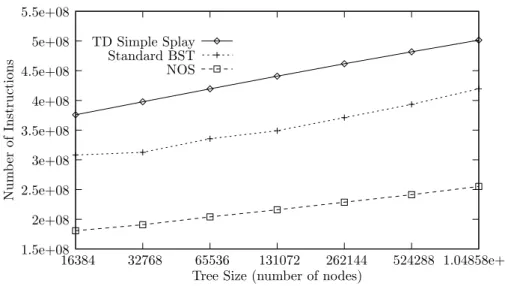
obtained machine level instruction counts using SimpleScalar. Figure2shows that the BST performs
16–18% fewer instructions acrossalltree sizes. Furthermore, by projecting using the slopes of the
curves from Figure2it is evident that, even for a tree with more than 10 million nodes, the splay will
still perform more instructions than the BST. Even though the instruction counts are consistently higher for the splay tree, the timing results indicate that in the static case the splay is faster at large tree sizes.
1.5e+08 2e+08 2.5e+08 3e+08 3.5e+08 4e+08 4.5e+08 5e+08 5.5e+08 1.04858e+06 524288 262144 131072 65536 32768 16384 Num b er of Instructions
Tree Size (number of nodes) TD Simple Splay
Standard BST NOS
Figure 2. Instruction counts from SimpleScalar for the splay and BST on the static Zipf access pattern. The instruction counts were for the 1 million queries (excluding construction),
measured after 500 000 ‘warm up’ queries.
Thus, instruction overhead cannot completely account for the difference in execution time of the two trees.
In addition to the instruction counts for the BST and splay, we also tested a third data structure: the ‘near optimal splay’ (NOS) tree. The NOS was designed to provide a hypothetical upper bound to splay tree performance. In particular, if there was no overhead in splaying, the splay tree would perform similarly to the NOS tree. The NOS performs lookups exactly as a standard BST. However, prior to the lookups, a one-time restructuring is performed so that the most frequently accessed nodes are at the top of the tree. This is accomplished by splaying the most frequently accessed nodes to the
root inreverseorder of their access probabilities. Thus, for the static Zipf access pattern the NOS keeps
the most frequently accessed items close to the root without further splaying.
The instruction counts for the NOS tree on the static Zipf access pattern in Figure2are particularly
interesting. In terms of absolute savings, it performs about 1.6×10⁸ fewer instructions than the
standard BST for the largest tree size. By using the assumption of 870 million instructions per second
for our test machine, a saving of 1.6×10⁸ instructions over a million queries translates to about
1.83 s over 10 million queries. Examining the differences in execution times for the largest tree size in
Figure1(a)reveals that the standard splay tree has about a 1.8 s speedup over the BST. That is, although
the NOS executes significantly less instructions than the BST, and the standard splay tree significantly more, they both exhibit a similar speedup advantage over the BST. This implies that the splay tree’s execution time is determined by other factors besides instruction counts.
2e+06 4e+06 6e+06 8e+06 1e+07 1.2e+07 1.4e+07 1.04858e+06 524288 262144 131072 65536 32768 16384 T o tal N um b er o f M isses
Tree Size (number of nodes) p p y TD Simple Splay Standard BST NOS (a) 0 500000 1e+06 1.5e+06 2e+06 2.5e+06 3e+06 3.5e+06 4e+06 4.5e+06 5e+06 1.04858e+06 524288 262144 131072 65536 32768 16384 T o tal N um b er o f M isses
Tree Size (number of nodes) p p y
TD Simple Splay Standard BST NOS
(b)
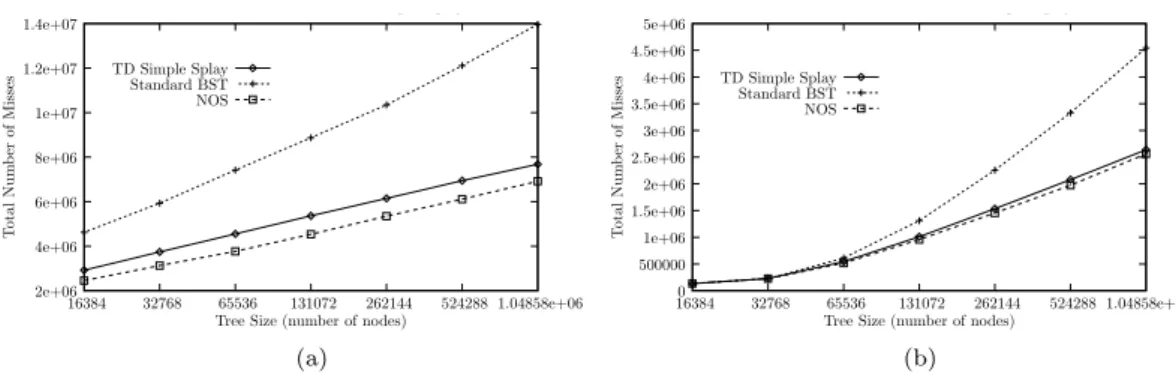
Figure 3. (a) L1 and (b) L2 cache performance of splay and BST on the static Zipf data set. The miss counts were for 1 million queries (excluding construction), measured after 500 000 ‘warm up’ queries. The simulation
parameters matched that of the test system.
4.2. BST versus splay—cache performance
In our experiments the BSTs and splay trees were constructed in an identical manner. Thus the relative locations of the nodes in memory were the same, and furthermore, they had an identical mapping to the cache. Since conflict misses are dependent on the mapping of the tree nodes to cache blocks, these types of misses should be similar for both trees. Thus, conflict misses could not result in a significant difference in cache performance. However, by examining the difference in the locations of the frequently accessed nodes in the two trees as the queries progress, we can conclude that a splay
will have fewercapacitymisses.
For both the BST and splay, the highly accessed nodes are initially randomly dispersed throughout the tree. Since the bulk of the nodes are in the bottom few levels of the trees immediately following construction, most of the frequently accessed nodes are far from the root. For the static BST these nodes never move, so each such frequently accessed node creates a long ‘chain’ of additional frequently accessed nodes from the root to itself (the access probability of an internal node is the sum of the access frequencies of its children). In contrast, the splay tree brings the frequently accessed items to the root of the tree. Thus, the chains are shorter in the splay. From these observations we can conclude that the BST accesses more distinct nodes than the splay tree. Given that the cache is limited in size, the likely consequence of accessing more distinct nodes is more capacity misses.
To test the hypothesis that splay trees have better cache performance than BSTs, we measured the number of L1 and L2 cache misses for the two trees using SimpleScalar. The cache parameters used in these two simulations are identical to the test system used in the timing experiments. The results of
these simulations for the static Zipf access pattern are shown in Figures3(a)and 3(b).
Figure3(a)shows that as tree size increases, the splay tree has significantly fewer L1 cache misses
than the BST. At the smallest tree size the splay has 37% fewer L1 misses than the BST, and
at the largest tree size the difference increases to 45%. Figure 3(b) shows a similar trend for the
but at 131 072 nodes the splay performs 23% fewer L2 cache misses. As with the L1 cache this difference increases, and at the largest tree size the splay tree has approximately 42% fewer L2 cache misses.
Using the latency values of our test machine, and the number of cache misses given in Figures3(a)
and3(b), we can approximate the savings in execution time for the splay tree due to improved cache
performance. For instance, for the largest tree the splay has approximately 6.4 million fewer L1 cache misses. At an 8 ns penalty per miss, this results in approximately a 0.05 s saving. For the L2 cache, the splay has approximately 1.9 million fewer misses than the BST, which translates to approximately a 0.19 s advantage. Summing these two times gives a 0.24 s total cache improvement for the splay at the largest tree size. Since the measured miss totals were for 1 million queries, for over 10 million queries (the number of queries used in the timing measurements) we expect around 10 times the difference, or 2.4 s.
With the cache performance speedup in hand, we can approximate thenet speedup for the splay
tree by including the instruction counts given in Figure2. Given that the splay tree performs about
8.2×10⁷more instructions than the BST at the largest tree size, and using the assumed execution rate
of the test system, we have approximately 0.09 s worth of additional instructions performed by the splay tree. Scaling this difference up to 10 million queries gives a 0.9 s difference. Thus, the projected
net speedup by the splay tree is 2.4−0.9=1.6 s. We can check this calculation with the measured
time difference between the splay and BST for the largest tree in Figure1(b). This measured difference
is 1.56 s; thus, this breakdown of cache/instruction contribution is probably accurate.
Recall from Figure1(b)that, for the dynamic case, the splay was not faster than the BST at any
tree size. Again, cache performance is a major reason for these results. Our simulations showed that
the splay tree had a much smaller advantage in cache performance in the dynamic setting [4]. Since the
frequently accessed nodes are constantly changing, the splay tree visits more distinct nodes than in the static case. The result is similar to the BST—not all of these nodes can be kept in cache at the same time.
In addition to a smaller benefit from the cache, the splay also suffered from an even larger instruction
overhead in the dynamic case [4]. Since the frequently accessed nodes are changing, the splay tree never
stays in a steady state for very long (if at all). Thus, longer paths are splayed on each lookup compared with the static case. This translates to more pointer assignments and a higher overall instruction count. In contrast, for the BST, the instruction counts are similar for both the static and dynamic lookups. For the dynamic access pattern, each reassignment of lookup probabilities is random. This implies that the average search path length, which determines the instruction count, has little variance.
4.3. Evaluating the sliding window heuristic
The previous section shows that moving the frequently accessed nodes to the root results in better cache performance. Unfortunately, a splay tree performs a large number of instructions to accomplish this. We can reduce this instruction overhead by noticing that once the frequently accessed items are near the top of the tree, further splaying is largely unproductive—it is a waste to bring a frequently accessed
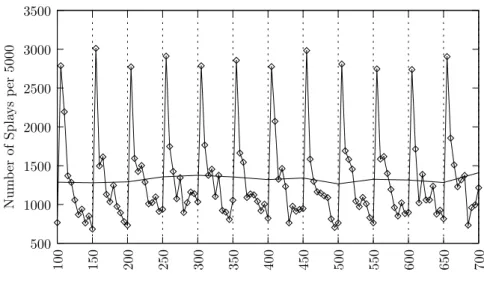
node to the root if it replaces another frequent item. Figure4 illustrates the results of the sliding
window heuristic (SW-splay) based on this observation. The results are for the dynamic Zipf access pattern. Notice that every 50 000 queries, the SW-splay detects the changes in the access pattern and adjusts the splaying activity accordingly. Immediately following a change in the access pattern
500 1000 1500 2000 2500 3000 3500 100 150 200 250 300 350 400 450 500 550 600 650 700 Num b er of Spla ys p er 5000
Number of Lookups in Thousands
Figure 4. Number of splay operations per 5000 lookups on a 220node SW-splay tree. The lookups were from the dynamic Zipf access pattern, vertical dotted lines show the changing points. The depthdwas 20, and the threshold
twas 16, withw=32. The solid line (nearly constant at 1250 splays per 5000) represents the average number of splays per 5000 lookups in a 50 000 query span.
the splaying activity peaks. However, once these nodes are splayed to the root, the frequency of splaying quickly falls off.
More specifically, asliding window splay tree(SW-splay) works as follows.
• We first choose two parameters, d and t. The parameter d is thedepth of the tree used to
differentiate an upper and lower access. For every lookup that traverses at most d nodes, the
lookup is counted as an upper access. Otherwise, the lookup is a lower access. The parametertis
thethresholddetermining the required number of upper accesses in the sliding window. That is,
if the number of upper accesses in the pastwlookups is less thant, splaying is performed on the
next lookup. Otherwise, the next lookup will be a static BST search (no rotations).
• On each lookup update the sliding window by dequeuing the result (upper or lower) of the oldest
lookup and enqueuing the result of the current lookup. Since it is only necessary to keep track of upper or lower on each access, the sliding window can be implemented efficiently as a bit queue.
We compared the SW-splay against three other trees: a standard BST, k-splaying for four values
ofk, and a standard splay tree. For all the SW-splay results the depth cutoff,d, was log2nwherenis
the number of nodes in the tree. The value of the threshold,t, was 16, half the sliding window size.
The parameterd was chosen to be the height of a perfectly balanced tree andtwas chosen so that on
average at least 50% of the accesses were as fast as in a perfect balanced tree. We note that changing
Table I. Comparison of execution times (in seconds) for various tree sizes for BST, a standard Splay tree,k-splaying, and the SW-splay when the lookups were Zipf distributed and the lookup
probabilities were held constant.
n(nodes) BST k=64 k=16 k=4 k=2 Splay SW,d=logn,t=16
16 384 5.89 4.48 4.59 5.03 5.45 6.36 4.62 32 768 6.13 5.19 5.25 5.66 6.12 7.11 5.35 65 536 7.22 6.13 6.14 6.48 7.06 8.03 6.28 131 072 8.69 7.49 7.37 7.68 8.24 9.29 7.46 262 144 10.87 9.28 9.01 9.13 9.70 10.78 9.00 524 288 13.73 11.86 11.40 11.32 11.81 12.91 11.18 1 048 576 18.09 15.81 15.18 14.89 15.30 16.31 14.75
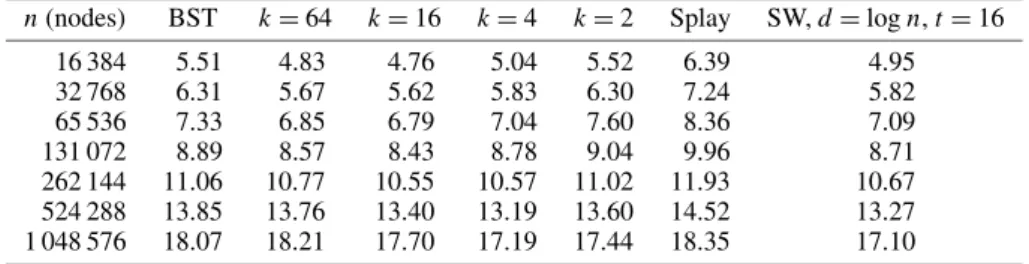
Table II. Comparison of execution times (in seconds) for various tree sizes for BST, a standard Splay tree,k-splaying, and the SW-splay when the lookups were Zipf distributed, and the
lookup probabilities were changed every 50 000 lookups.
n(nodes) BST k=64 k=16 k=4 k=2 Splay SW,d=logn,t=16
16 384 5.51 4.83 4.76 5.04 5.52 6.39 4.95 32 768 6.31 5.67 5.62 5.83 6.30 7.24 5.82 65 536 7.33 6.85 6.79 7.04 7.60 8.36 7.09 131 072 8.89 8.57 8.43 8.78 9.04 9.96 8.71 262 144 11.06 10.77 10.55 10.57 11.02 11.93 10.67 524 288 13.85 13.76 13.40 13.19 13.60 14.52 13.27 1 048 576 18.07 18.21 17.70 17.19 17.44 18.35 17.10
worked better at the large trees and others worked better at the smaller trees. Also the value ofd is
related to the choice oft; if a smallerdvalue is used, a smallertvalue will work better.
Table I shows the timing results of these methods for the static Zipf access pattern (10 million
queries). The first noteworthy trend is that bothk-splaying (for all values of k) and the SW-splay
performed better than both a standard BST and splay tree across all tree sizes. In fact, at the largest tree sizes, 4-splaying and the SW-splay outperformed the BST by 18%. A second interesting result
is that no value ofk is optimal across tree sizes. For 64-splaying, the reduction in instruction count
greatly aids the smaller trees. However, since cache performance is a critical factor at the larger tree sizes, a welcome trade-off is to perform more splaying, which results in more instructions but better
cache performance. Thus, the smaller values ofkdid better at the larger tree sizes. Finally, although
the SW-splay offers substantial improvement over the standard splay tree (27% at the smallest tree size and 10% at the largest tree size), the improvement over 4-splaying is small, just 8% at the smallest tree size and a marginal 1% at the largest tree size.
TableIIprovides the results for the dynamic Zipf access pattern. The same trends as in the static
standard BST at the larger tree sizes. This indicates that while the heuristics are effective at reducing the instruction count overhead in splaying, none improve on the cache performance of the splay trees. Furthermore, it is likely that if the lookups were even more dynamic, for example changing every 10 000 queries, a standard BST would outperform all the heuristics presented here. This is because there would be small (if any) cache benefit from splaying in a highly dynamic case, and any reduction
in instruction count from the SW-splay ork-splaying (with smallk) would be minimal because of the
constant readjusting.
5. CONCLUSION
In this paper we have compared the performance of standard BSTs to splay trees under skewed access patterns. In particular, we have focused on the cache performance of the two trees. Our results demonstrate that splay trees have superior cache performance over BSTs when the lookups are skewed, and that this improvement can result in better overall performance.
We have also proposed a new heuristic for splaying, the SW-splay, that reduces the instruction overhead involved in constant splaying. Our results indicate that the heuristic can be a significant
improvement on standard splaying. However, if the a good choice of k can be easily determined,
k-splaying is likely to be preferable because it offers a similar level of improvement and has the added
benefit of being extremely simple to implement. The SW-splay may be a good choice whenkcannot
be determineda priori. Since the SW-splay keeps a history of lookup results, it has the ability to adjust
its parameters online. We have performed limited experimentation in this paper; additional testing and developing methods for adjusting parameters is an area for future work.
Based on our findings we offer some guidelines as to when splay trees are likely to outperform BSTs. A splay tree is likely to have faster lookups than a randomly built BST when both of the following are true.
• The lookup pattern is highly skewed (e.g. Zipf).
• The set of frequently accessed nodes remains constant for a significant number of queries
(in our experiments around 200 000), and the tree is not constructed based on the access pattern
(as in the text collection experiment by Williamset al. [3]).
Furthermore, at least one of the following must also be true.
• The trees are much too large to fit in the cache—either in terms of number of nodes or node size
(e.g. large keys such as strings). (In our experiments for the static Zipf case 10 times the L2 cache size was approximately the point where savings in memory latency outweighed the instruction overhead.)
• The system has high memory latency. The current trends in architecture design indicate that
memory latency will continue to increase relative to processor performance [8]. Thus, although
in our experiments the splay had only an 8% speedup over the BST in the best case, in the future we expect that this speedup relative to BSTs will increase. However, we note that new architectures with better prefetching support may reduce the actual penalty for cache misses. Additional experiments on newer architectures can help to clarify this.
A B C D L R x y z (a) L R z y B C D A x (b)
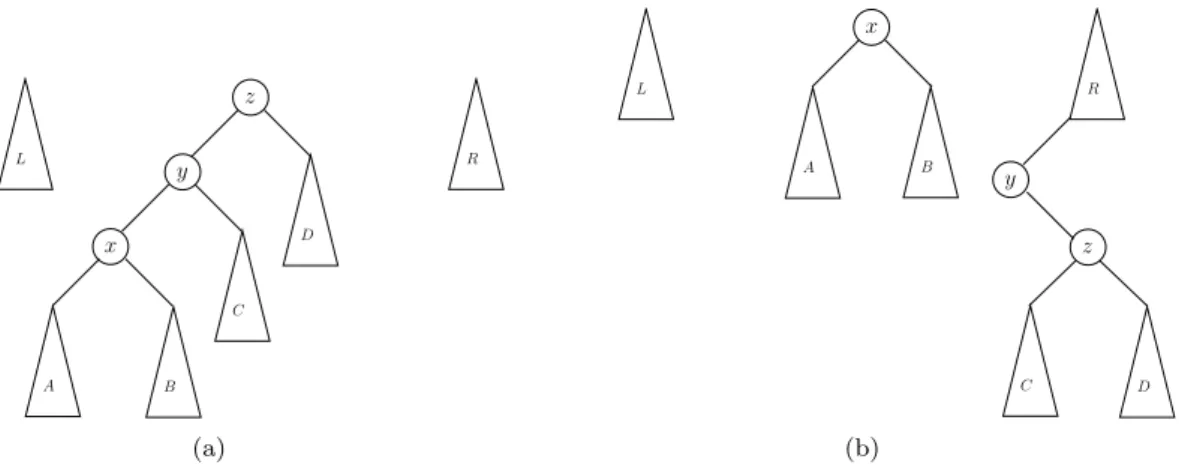
Figure A1. Simple top-down rotation for a zig-zig case: (a) the nodexis the item to be promoted; (b) the nodesy
andzare rotated and then added to the minimum of the right subtree.
Our experiments involved synthetic data sets with independent though non-uniform accesses. More realistic settings may have a temporal locality of reference or may access keys of similar value more frequently within a time window. Each of these would be favorable for splay trees, but might also improve the cache performance of the BST. Thus, it would be helpful to continue this work on a range of realistic data sets
APPENDIX A. TOP-DOWN SPLAYING
We provide the details of simple top-down splaying. An implementation of this splaying variant can
be found in Weiss’s text [14]. The tree is first split into three parts: left, right, and middle. In the left
subtree are the items known to be smaller than the accessed item, and in the right are the items known to be larger. In the middle are items that are not yet determined to belong to either of the previous trees. Initially the left and right subtrees are empty and the middle tree is the entire tree. The search proceeds two nodes at a time starting with the root node.
If the next two nodes on the search path are both left (right) children (see FigureA1) we have a
zig-zig (zag-zag) pattern. If a zig-zig-zig-zig pattern is found, a rotation is done between the parent and grandparent nodes. After performing this rotation, both nodes and their subtrees are added to the minimum of the right tree. If the next two nodes on the path are a left child followed by a right child, we have a zig-zag
pattern (see FigureA2). In this case the grandparent is appended to the right (left) tree. The parent
node stays in the middle tree. Both the zig-zig and zig-zag have symmetric equivalents and are handled accordingly.
There is the special case when zig-zig and zig-zag rotations do not exactly end at the node searched
for, x. In this case the parent of x is added to the minimum of the right tree if it is larger than
A B C D y x z L R (a) x A L y R z D B C (b)
Figure A2. The zig-zag rotation for simple down splaying. This case is the only difference from standard top-down splaying: (a) nodeyis the item to be promoted; (b) only nodezis appended to the minimum of the right
subtree, and no rotation is performed.
L R x A B (a) zig-zig x L R A B (b) result
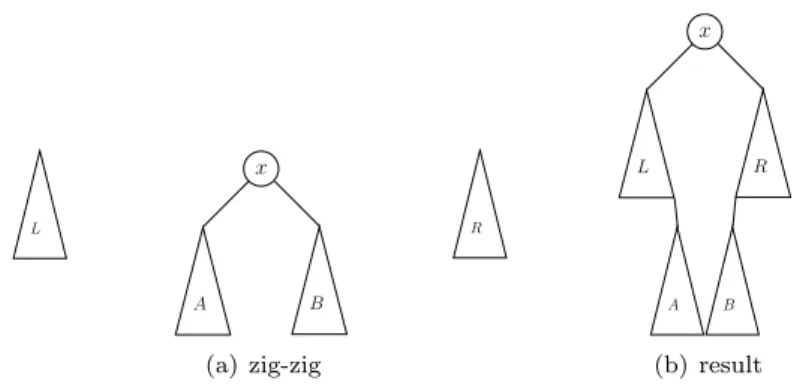
Figure A3. The final step in top-down splaying: (a) zig-zig pattern; (b) the left and right trees are reassembled with
x(the splayed item) as the new root.
when reachingx; the left, right, and middle trees are reassembled. The searched item,x, now becomes
the root of the entire tree with the left and right trees becoming the left and right subtrees of the new
final tree. FigureA3shows the reassembling of the three trees.
ACKNOWLEDGEMENTS
We wish to thank the anonymous referee for several helpful comments which improved this paper. We would also like to thank Professor Matt Farrens for useful suggestions and technical advice.
REFERENCES
1. Sleator DD, Tarjan RE. Self-adjusting binary search trees.Journal of the ACM1985;32(3):652–686.
2. Bell J, Gupta GK. An evaluation of self-adjusting binary search tree techniques.Software—Practice and Experience1993; 23(4):369–382. Available at: http://www.cs.ubc.ca/local/reading/proceedings/spe91-95/spe/vol23/issue4/spe819.pdf. 3. Williams HE, Zobel J, Heinz S. Self-adjusting trees in practice for large text collections. Software—Practice and
Experience2001;31(10):925–939. Available at: http://www.cs.rmit.edu.au/∼jz/fulltext/spe01.pdf.
4. Lee EK. Cache performance of binary search trees and analyzing victim caches.M.S. Thesis, Department of Computer Science, University of California at Davis 2005. Available at: http://www.cs.ucdavis.edu/∼leeer/research/ms thesis.pdf. 5. Bolster A. Experiments in self adjusting data structures.BIT Honors Thesis, School of Information Technology, Bond
University, 2003. Available at: http://www.it.bond.edu.au/publications/02THESIS/THESIS02-05.pdf.
6. Albers S, Karpinski M. Randomized splay trees: Theoretical and experimental results.Information Processing Letters
2002;81(4):213–221. Available at: http://citeseer.nj.nec.com/507513.html.
7. Furer M. Randomized splay trees.Proceedings of the ACM–SIAM Symposium on Discrete Algorithms, January 1999. SIAM: Philadelphia, PA, 1999.
8. Hennessy JL, Patterson DA.Computer Architecture: A Quantitative Approach(3rd edn). Morgan Kaufmann: San Mateo, CA, 2003.
9. Hennessy JL, Patterson DA.Computer Organization & Design: The Hardware/Software Interface (2nd edn). Morgan Kaufmann: San Mateo, CA, 1997.
10. Jones DW. An empirical comparison of priority-queue and event-set implementations.Communications of the ACM1986; 29(4):300–311.
11. Iancu C, Acharya A, Ibel M, Schmitt M. An evaluation of search tree techniques in the presence of caches.Technical Report UCSB TRCS01-08, UCSB, 2001. Available at: http://citeseer.ist.psu.edu/iancu01evaluation.html.
12. Zipf GK.Human Behavior and the Principle of Least Effort: An Introduction to Human Ecology. Addison-Wesley: Cambridge, MA, 1949.
13. Breslau L, Cao P, Fan L, Phillips G, Shenker S. Web caching and Zipf-like distributions: Evidence and implications.
Proceedings of the 18th Conference on Computer Communications (INFOCOM ’99). IEEE Computer Society Press: Los Alamitos, CA, 1999; 126–134. Available at: http://citeseer.ist.psu.edu/559400.html.
14. Weiss MA.Data Structures and Algorithm Analysis in C(2nd edn). Addison-Wesley: Reading, MA, 1997. 15. RightMark. RightMark Memory Analyzer, 2004. http://cpu.rightmark.org/ [27 January 2007].
16. Intel. Intel Architecture Optimization Reference Manual, 1999.
ftp://download.intel.com/design/PentiumII/manuals/24512701.pdf [27 January 2007]. 17. SimpleScalar LLC. Corporation Website. http://www.simplescalar.com [27 January 2007].