Explaining Reputation Assessments
Ingrid Nunes, Phillip Taylor, Lina Barakat, Nathan Griffiths,
Simon Miles
PII:
S1071-5819(18)30642-6
DOI:
https://doi.org/10.1016/j.ijhcs.2018.10.007
Reference:
YIJHC 2259
To appear in:
International Journal of Human-Computer Studies
Received date:
26 July 2017
Revised date:
3 July 2018
Accepted date:
31 October 2018
Please cite this article as: Ingrid Nunes, Phillip Taylor, Lina Barakat, Nathan Griffiths, Simon Miles,
Explaining Reputation Assessments,
International Journal of Human-Computer Studies
(2018), doi:
https://doi.org/10.1016/j.ijhcs.2018.10.007
This is a PDF file of an unedited manuscript that has been accepted for publication. As a service
to our customers we are providing this early version of the manuscript. The manuscript will undergo
copyediting, typesetting, and review of the resulting proof before it is published in its final form. Please
note that during the production process errors may be discovered which could affect the content, and
all legal disclaimers that apply to the journal pertain.
ACCEPTED MANUSCRIPT
Explaining Reputation Assessments
Ingrid Nunesa,b,∗, Phillip Taylorc, Lina Barakatd, Nathan Griffithsc, Simon Milese
aUniversidade Federal do Rio Grande do Sul (UFRGS), Porto Alegre, Brazil
bTU Dortmund, Dortmund, Germany
cUniversity of Warwick, Coventry, United Kingdom
dUniversity of Essex, Colchester, United Kingdom
eKing’s College London, London, United Kingdom
Abstract
Reputation is crucial to enabling human or software agents to select among al-ternative providers. Although several effective reputation assessment methods exist, they typically distil reputation into a numerical representation, with no accompanying explanation of the rationale behind the assessment. Such expla-nations would allow users or clients to make a richer assessment of providers, and tailor selection according to their preferences and current context. In this paper, we propose an approach to explain the rationale behind assessments from quantitative reputation models, by generating arguments that are combined to form explanations. Our approach adapts, extends and combines existing ap-proaches for explaining decisions made using multi-attribute decision models in the context of reputation. We present example argument templates, and describe how to select their parameters using explanation algorithms. Our pro-posal was evaluated by means of a user study, which followed an existing proto-col. Our results give evidence that although explanations present a subset of the information of trust scores, they are sufficient to equally evaluate providers rec-ommended based on their trust score. Moreover, when explanation arguments reveal implicit model information, they are less persuasive than scores.
∗Corresponding author.
Email addresses: [email protected](Ingrid Nunes),
[email protected](Phillip Taylor),[email protected](Lina
Barakat),[email protected](Nathan Griffiths),[email protected]
ACCEPTED MANUSCRIPT
Keywords: Reputation, Trust, Explanation, Arguments, User study
1. Introduction
In environments where many parties offer comparable services or products, customers need to be able to choose between the options available. Automated support for this has been studied extensively in the areas of recommender sys-tems [1] and reputation assessment [2]. In particular, reputation assessment al-5
lows the calculation of reputation scores so that the past performance of service providers can be compared. These scores can then be used to determine which provider to select, as they characterise providers according to the factors of in-terest to the client. Various reputation models [3, 4, 5, 6, 7] have been shown to be effective through empirical evaluation, but do not provide the transparency 10
needed to understand why one provider has a better reputation than another. As the complexity of reputation models increases, this understanding is becom-ing harder to achieve. Access to the reasons that underlie reputation assessment would allow users to judge whether the resulting reputation scores reflect their actual interests in the current context, and allow providers to identify the as-15
pects they must improve. Explanations have been exploited to improve user system acceptance in expert systems and recommender systems [8], but have not been explored in the context where automated interactions occur, such as in multi-agent systems, or instantiated for reputation assessment methods.
Our goal is to improve, from the user perspective, thetransparency of repu-20
tation models, which are in general purely quantitative. Reputation scores are helpful to assess and rank providers but, with explanations of such scores, users would be able to evaluate whether they agree with them. As a consequence, users can make moreeffectivechoices when taking reputation into account. We propose an approach to explain the rationale behind the scores generated by 25
reputation assessment models. These are abstracted into a generic reputation model, which we refer to as themulti-term reputation model (MTRM). This is not a new reputation model, but rather is a generalised model in which we can
ACCEPTED MANUSCRIPT
express existing reputation assessment methods, upon which explanations can be built. Our approach generates arguments about the reasons behind repu-30
tation scores by leveraging explanation approaches proposed in the context of multi-attribute utility theory [9, 10], and combines the arguments into expla-nations. Explanations are produced based on information that can be obtained from an instance of MTRM. Moreover, this generic reputation model can be customised, leading to an instantiation of a specific underlying existing reputa-35
tion model, and model-specific arguments can then be generated. In order to illustrate this process, we show customisations for the FIRE [4] and TRAVOS [5] reputation models.
Despite the fact that users have generally been taken out of the loop in evaluations of work on trust and reputation for multi-agent systems, a study 40
involving real people is essential for validating our approach. Therefore, in or-der to evaluate our generated explanations, we conducted a user study, which provides evidence of their usefulness. The study involve 30 participants and fol-lowed the protocol proposed by Bilgic and Mooney [11]. As result, we observed that, in order to assess providers, our explanations is as efficient as having de-45
tailed information about trust scores of providers, that is, with less information (and possibly more confidentially) participants were able to assess providers. Furthermore, our explanation arguments are less persuasive than scores when they reveal implicit model information. In our study, arguments were presented to participants in a textual form, generated using example templates of how 50
to transform our explanation arguments into a user-understandable form. This choice caused participants, however, to prefer trust scores, which were presented in a table, over textual explanations.
In summary, our key contribution is an approach to explain quantitative reputation models, focusing on FIRE and TRAVOS as illustrative reputation 55
models. Specifically, we (i) propose a method to generate explanations of assess-ments from quantitative reputation models, (ii) show how to leverage existing approaches for explaining decisions made using multi-attribute decision models in the context of reputation, and (iii) evaluate such explanations through a user
ACCEPTED MANUSCRIPT
study. 60
We describe background research and related work in Section 2. The multi-term reputation model (MTRM) is introduced in Section 3, followed by a de-scription of our explanation approach in Section 4. The user study performed to evaluate our approach is presented in Section 5. Finally, we present our conclusions in Section 6.
65
2. Background and Related Work
Two main research areas are associated with our work, namely, explana-tions for recommender and decision support systems, and trust and reputation assessment methods. There is much work that has been done in the former, but not addressing our particular context. We give an overview of explanation 70
approaches and introduce those that are adopted in our work in Section 2.1. Trust and reputation have also been widely investigated and, as a result, many reputation models have been proposed. Our approach aims to be generic, in the sense that it can be used with any reputation model. We instantiate it for il-lustration using two existing reputation models, FIRE [4] and TRAVOS [5, 12], 75
as described in Section 2.2.
2.1. Explanation Generation
Over recent years, there has been an increasing interest in explanations for recommender and decision support systems [8, 13, 14]. Explanations in such systems have been investigated, as was the case with expert systems [15], be-80
cause explanations can promote many benefits, including increased user trust and more effective decisions [8], which are fundamental to user acceptance of these systems.
Different studies have been performed in the context of explanations. Many types of explanations given for recommender systems were compared in user 85
studies [13, 16]. Herlocker et al. [13] concluded that showing rates from neigh-bours in the context of collaborative filtering (using histograms) contributes
ACCEPTED MANUSCRIPT
to the acceptance of the recommendation. However, Bilgic and Mooney [11] observed that this kind of explanation persuades users to accept recommenda-tions rather than helping them to make better choices. Indeed, explanarecommenda-tions 90
can be given with different purposes [8]. As Bilgic and Mooney argue, persua-sion explanations cause users to overestimate the quality of an option and make inaccurate choices and, consequently, their confidence in the system rapidly de-teriorates. Our interest is thus in effective explanations [8], which assist users to make better decisions by helping them to evaluate the quality of options ac-95
cording to their own preferences. There are some studies with people that give foundation to this kind of explanation [17, 18], with the proposal of patterns and guidelines, which state that attributes presented in explanations must be tailored to the user, as has been confirmed by a previous user study [19].
There are three main approaches that propose algorithms that select at-100
tributes to be part of effective explanations [20, 9, 10]. Such approaches use multi-attribute decision models as input, which makes them inadequate to be used as is with reputation models. However, they can be used in a complemen-tary way in our work, by being adapted to be used in our context.
The oldest approach, proposed by Klein and Shortliffe [20], is empirically 105
motivated but lacks proper evaluation, while Labreuche’s approach [9] addresses a limitation of this method—a formal justification of the selected arguments. Labreuche [9] proposed an approach for selecting and generating arguments for the family of multi-attribute decision models parameterised by weights assigned to the criteria, such as the expected utility model and the weighted majority 110
model. The explanations generated are of four different types, generated using different kinds of argumentation reasoning, calledanchors (all,not on average,
invert andremaining case). Anchors identify changes in a weight vectorvthat yields an inversion of the prescription made by the decision model, leading to why one option is preferred to another. Two strategies for the modification of 115
the weights are considered: (i) the replacement ofv by some reference weights wF, indicating that an option is preferred to another because it is better for the
ACCEPTED MANUSCRIPT
weightsv among the criteria (associated with a branch-and-bound algorithm), indicating that the preferred option is better for the most important attributes 120
and worse for the least important attributes. A trivial anchor addresses the case of domination (the case where an option has at least one advantage with respect to another, and no disadvantage), and another last anchor covers the remaining cases.
An explanation generation technique was proposed by Nunes et al. [10], 125
which is founded on a study of how people justify choices [18]. The technique is composed of a set of algorithms that select attributes to be used as part of explanations that follow different explanation patterns, such as critical at-tribute,cut-off value,decisive criteriaandtrade-off resolution. While Klein and Shortliffe’s approach selects outlier attributes and Labreuche analyses weight 130
changes, Nunes et al. consider a set of attributes as decisive when they are the minimum set of attributes (in the sense of⊂) needed to make an option worse than another. If this set consists of all cons of an option, then a second set of attributes is selected: the minimum set of attributes that are pros that must not be taken into account to enable the existence of a decisive criteria.
135
We have used adapted parts of these two introduced approaches [9, 10] in the work described in this paper, and further details of these parts are provided when we describe our explanation approach.
Argumentation frameworks have also been adopted for the purpose of em-powering quantitative decision tools with inference mechanisms and respec-140
tive explanation capabilities—e.g. argumentation-enriched recommender sys-tems have been proposed for recommending music [21], movies [22, 23], web content [24], and learning objects [25]. In many such approaches, Defeasi-ble Logic Programming (DeLP) [26] is employed either instead, or on top of an existing quantitative technique in order to provide a qualitative perspec-145
tive, where conclusions/suggestions are reasoned in terms of arguments for and against them. In particular, DeLP models (potentially inconsistent and contra-dictory) knowledge about the domain, in terms of facts and a set of strict and defeasible inference rules. An argument for a particular conclusion/suggestion
ACCEPTED MANUSCRIPT
is then derived by applying backward chaining on these facts and rules. Ar-150
guments can be attacked by other arguments (e.g. those proposing opposite conclusions), and the attacks among arguments can be resolved via associating arguments with probabilities/preferences.
The knowledge (facts and rules) upon which the reasoning of such argumen-tation frameworks is based is typically pre-determined, and is derived directly 155
from user preference declarations, and added on top of the (sub-)results of the quantitative measure. Our explanation approach focuses on providing a finer-grained analysis of the reasoning behind the quantitative measure (rather than substituting it or building on top of it), and can be seen as a dynamic generator of knowledge to then be used by such argumentation frameworks.
160
2.2. Reputation Models
Trust and reputation enable agents to minimise the inherent uncertainty when self-interested individuals or organisations interact [27]. Trust can be viewed as an assessment of the likelihood that an individual or organisation will fulfil its commitments [28]. Reputation complements trust, and can be seen as 165
a public perception of trustworthiness [29]. Several computational models of trust and reputation exist, which can be broadly categorised into those that are based on credentials and those based on experience and observation of past behaviour—see [27, 29, 2, 30] for comprehensive reviews. Credential-based ap-proaches use policies to express when, for what, and how to determine trust 170
based on certificates, keys, or digital signatures, etc. Although such methods are effective for managing access rights and permissions, they do not support more general reasoning about interactions, and therefore in this paper we focus instead on experience based approaches.
Several experience based approaches use a combination of direct and indirect 175
experience to derive a numerical or probabilistic assessment of reputation [31]. ReGreT [32, 3] assesses reputation on three aspects: (i) an individual dimen-sion from direct experience, (ii) a social dimendimen-sion using knowledge of others’ experiences and the social structure, and (iii) an ontological dimension that
ACCEPTED MANUSCRIPT
accounts for the different aspects that inform reputation (e.g. delivery, price, 180
and quality). FIRE [4] builds on ReGreT through the addition of role-based trust, and certified reputation based on third-party references [4]. TRAVOS [5] takes a probabilistic approach to assessing trust, estimating the expected value of success of future interactions using a beta probability distribution.
The use of a binary variable (success or failure) to model outcomes is a 185
limitation of TRAVOS and alternative approaches have been proposed. For example, BLADE [6] models agents and advisor evaluation functions as dynamic random variables using Dirichlet distributions, enabling progressive learning of probabilistic models through Bayesian techniques. To cope with noisy advisors, HABIT [7] creates a Bayesian network to support reasoning about reputation. 190
However, HABIT assumes that the distribution of an agent’s behaviour is static, an assumption not made by other approaches. Other reputation systems apply machine learning in assessing reputation, typically in assessing stereotypical reputation [33, 34].
Although these methods rely on different aggregations/distributions, they 195
have been used for the same purpose of estimating the reputation of agents with which an agent wants to interact, relying on evaluations made based on previous interactions (either by direct experience or with peers) over time. In this paper, we adopt FIRE and TRAVOS as examples to illustrate our approach, and describe their operation in more detail below. We focus on FIRE and 200
TRAVOS due to their simplicity and low computational overheads, compared to approaches such as BLADE and HABIT, because the focus of this paper is on explanation generation providing a rationale for reputation assessment, rather than on any particular reputation assessment method itself. We selected two methods to demonstrate the generality of our approach and the value of 205
customisations made to particular methods.
2.3. The FIRE Reputation Model
FIRE combines four types of reputation and trust: interaction trust from di-rect experience (I), witness reputation from third party reports (W), role-based
ACCEPTED MANUSCRIPT
trust (R), and certified reputation based on third-party references (Cr) [4]. Rep-210
utation is assessed in FIRE from ratingtuples, (a, b, t, i, v), whereaand b are agents that participated in interaction i such that a gave b a rating value of v ∈ [−1,+1] for the term t (e.g. reliability, quality, timeliness). A rating of +1 is absolutely positive,−1 is absolutely negative, and 0 is neutral. In FIRE, each agent has a history of sizeH and stores the lastH ratings it has given in 215
its local database. FIRE gives more weight to recent interactions using arating weight function,ωK, for each trust or reputation componentK∈ {I, W, R, Cr}.
The component trust or reputation a has in b for term t is the weighted mean of ratings, TK(a, b, t) = P ri∈RK(a,b,t)ωK(ri)·vi P ri∈RK(a,b,t)ωK(ri) (1) where RK(a, b, t) is the set of ratings stored by aregarding b for component
K with respect to term t, and vi is the value of rating ri. Interaction trust, TI(a, b, t) is calculated from the interaction records that the assessing agent a
has in their database,RI(a, b, t). Specifically, the ratings of records matching
(a, b, t, , ) are aggregated using Equation 1, wherebis the agent being assessed, tis the term of interest, and “ ” matches any value, and:
ωI(ri) =e−
∆τ(ri)
λ (2)
Here, ωI(ri) is the weight for rating ri and ∆τ(ri) is the time since ratingri
was recorded.
Witness and certified reputation are similarly calculated, using this aggre-220
gation over different sets of interaction ratings. For witness reputation the assessing agent, a, uses a acquaintances to provide their ratings ofb for term t, i.e. ratings of the form (, b, t, , ). If the acquaintance has no relevant ex-perience, they will pass on the request to their own acquaintances. To assess certified reputation, the assessed agent, b, provides a set of ratings that they 225
have previously been given by other agents. The weighting used in calculating witness and certified reputation isωW(ri) =ωCr(ri) =ωI(ri).
ACCEPTED MANUSCRIPT
Role-based trust uses ratings assigned to rules describing agent relationships, e.g. if they are part of the same organisation, or there is a provider consumer relationship. Rules have the form (rolea, roleb, t, e, v), representing if two agents 230
aandbtake rolesroleaandroleb, thenbis expected with a likelihood ofe∈[0,1]
to have performance ofvfor termtin an interaction witha. To calculate role-based trust, rules in the assessing agent’s database that matchRR(a, b, t) are
aggregated using Equation 1, withωR(ri) =ei.
The composite term trust,T(a, b, t), in an agent with respect to a given term tis calculated as a weighted mean of the component sources:
T(a, b, t) = P
K∈{I,W,R,Cr}ωK· TK(a, b, t) P
K∈{I,W,R,Cr}ωK (3)
where ωI, ωW, ωR and ωCr are parameters that determine the importance of 235
each component,ωK=ωK·ρK(a, b, t), and the reliability of the reputation value
for component K is ρK(a, b, t). The reliability of a reputation value is
deter-mined by a combination of the rating reliability and rating deviation reliability (details of the calculations can be found in [4]).
2.4. The TRAVOS Reputation System
240
TRAVOS is based on the Beta Reputation System [35] and extends it to ignore reputation assessments from unreliable witnesses [5, 36, 12]. TRAVOS uses interaction trust and witness reputation, computed using rating tuples similar to those used in FIRE. Whereas in FIRE the rating value is a real number, ratings in TRAVOS are binary,v∈ {0,1}, where 0 is a negative rating and 1 is positive. The component trust value agentahas in agentbwith respect to termt, is the expected value of a beta probability density function,
TK(a, b, t) =
αK(a, b, t)
αK(a, b, t) +βK(a, b, t)
, (4)
whereαK(a, b, t) is 1 plus the number of relevant positive ratings andβK(a, b, t)
is 1 plus the number of relevant negative ratings,
αK(a, b, t) = 1 +|{ri∈ RK(a, b, t)|vi= 1}|,
βK(a, b, t) = 1 +|{ri∈ RK(a, b, t)|vi= 0}|.
ACCEPTED MANUSCRIPT
The beta probability density function can also be used to compute a confi-dence in the trust value, defined by the proportion of the distribution that lies in a range centred around the expected value,
ρK(a, b, t) = RTK(a,b,t)+ TK(a,b,t)− X αK(a,b,t)−1(1−X)βK(a,b,t)−1dX R1 0 UαK(a,b,t)−1(1−U)βK(a,b,t)−1dU , (6)
whereis a user defined parameter to define the range considered.
As with FIRE, an assessing agent computes interaction trust from the set of ratings,RI(a, b, t), in its database that match (a, b, t, , ). The interaction trust
is thenTI(a, b, t), which has an associated confidence,ρI(a, b, t). IfρI(a, b, t) is
below a threshold set by the user, witnesses are asked for ratings of agentbfor 245
termt, which are used to compute the witness reputation.
Witnesses, w ∈ W, provide opinions in the form of the number of posi-tive,αW(w, b, t) and the number of negative ratings,βW(w, b, t), that they have
given b. Before the overall reputation is calculated, the witness opinions are discounted based on their perceived accuracy to limit their effect on the com-250
posite reputation score. TRAVOS stores previous ratings provided by witnesses inobservationtuples, (a, w, b, t, i, o, v), where,wis a witness that provided eval-uatorawith a set of ratings about providerb, which formed a beta probability density distribution whose expected value determined the raw opinion value of o. After processing this witness opinion and selectingbto interact with,agave 255
ba rating value ofv in interactioni.
On receipt of a new opinion from a witness, w, an evaluator, a, queries their observation database for records where the opinion,o, provided byw for termtwas similar. Two opinions are said to be similar if their expected values are close (i.e. they both lie in the same discrete interval). The coherence of the opinion provided,o, and the rating for the subsequent interaction,v, then determines the reliability of the new opinion provided by the witness. Given this reliability, the opinion is discounted and combined along with the interaction
ACCEPTED MANUSCRIPT
trust by summing theαand βparameters, α(a, b, t) =αI(a, b, t) + X w∈W ¯ αW(w, b, t) β(a, b, t) =βI(a, b, t) + X w∈W ¯ βW(w, b, t), (7)
where ¯αW(w, b, t) and ¯βW(w, b, t) are the discounted opinion parameters
pro-vided by witness w regarding agent bfor termt. The composite term trust in agentbfor termtis then,
T(a, b, t) = α(a, b, t)
α(a, b, t) +β(a, b, t). (8) For full details on the calculation behind discounting see [12].
3. Multi-Term Reputation Model
In the previous section, we gave an overview of two different reputation models, namely FIRE and TRAVOS. In order to provide a model-independent 260
explanation approach, we must first specify a common model specification that generalises different reputation models. This generalised model, which we refer to asmulti-term reputation model (MTRM), can be specialised by the addition of the specific components of a particular reputation model. Note this MTRM is not a new reputation model, but a model that captures concepts present in 265
any reputation model. Therefore, explanations provided based on this model are applicable to any reputation model. Concepts that are usual, e.g. recency, but not used in all reputation models can be added in MTRM extensions. We next introduce the MTRM concepts.
All reputation models consider a way for an agent to assess how an inter-action with another agent occurred. In FIRE, for example, agents associate a rating with those they interact with in [−1,+1], while in TRAVOS agents only record success or failure, i.e. ratings are in {0,1}. These ratings are then communicated to others who require additional information to inform their de-cisions. In our model, we consider that an agent is associated with a set of trust
ACCEPTED MANUSCRIPT
ratings
ri=ha, b, t, K, vi (9)
where a is a source agent, b is target agent, t is a term, K is a reputation 270
type, andvis a rating value. A particular reputation model may add additional parameters, e.g. interaction as in FIRE. Trust ratings are associated with rep-utation types, or components, according to the component of the model that generates them. Each model incorporates a particular set of reputation types, KSet. TRAVOS only includes interaction (I) and witness (W) reputation types, 275
while FIRE supplements those with role-based (R) and certified (Cr) reputation. The set of ratings associated with a particular reputation type isRK(a, b, t).
These ratings are used to calculate a trust valueTK(a, b, t), which combines
trust ratings in a single real value. In case of FIRE, as introduced in Section 2.3, the trust value is a weighted mean of ratings, considering a recency function 280
ωλ(ri), while TRAVOS uses a probabilistic model. If a trust value is associated
with a reputation typeK, it means that it is derived from ratings only associated withK.
Trust values associated with different reputation types must be combined to form a single value. In MTRM, as its name indicates, we consider that agents 285
can assess others with respect to different terms t ∈ T, such as cost, quality and timeliness. The component trust values can be combined to form the term trust T(a, b, t). We do not assume that the term trust is calculated using a specific method such as a weighted mean or sum, but rather we assume that the term trust can be decomposed into weightsωK and trust valuesTK(a, b, t), 290
associated with different reputation types. This is straightforward in FIRE, given that FIRE calculates trust as a weighted mean of weighted means. How-ever, TRAVOS does not calculate a composite trust value from interaction and witness trusts in this way, instead combining ratings from witnesses, after ad-justment for reliability and relevance, to act as parameters of a beta probability 295
distribution whose expected value determines the composite trust value. Con-sequently, we use the TRAVOS model to compute the term trust from ratings,
ACCEPTED MANUSCRIPT
and then decompose this term trust into two trust values, one associated with direct interaction trust, and another with witness trust.
TRAVOS computes an overall trust value, which in our case is the term trust, by combining the direct interaction trust and witness opinions, after adjusting them for perceived accuracy. The combination proceeds by summing theαand β parameters of the beta probability density functions, as in Equation 7. In FIRE, the trust component weights are determined by user preferences, while in TRAVOS, we define them as the proportion of the final beta probability density function that the component parameters account for. For instance, the interaction trust weight is,
ωI(a, b, t) = αI(a, b, t) +βI(a, b, t)
αI(a, b, t) +βI(a, b, t) +Pw∈Wα¯W(w, b, t) + ¯βW(w, b, t)
(10) and witness reputation weight isωW(a, b, t) = 1−ωI(a, b, t).
300
Finally, existing reputation models either do not consider terms (e.g. TRAVOS) or often do not specify how to combine values for different terms into a single trust score (as is the case with FIRE). Therefore, inspired by multi-attribute utility theory [37], we consider weights that establish a trade-off relationship among terms, and view term trust as a utility value. The overall trust score is then a weighted mean of term trusts, where the weights are agents’ preferences for terms. T(a, b) = P t∈Tωt· T(a, b, t) P t∈Tωt (11) where the parameters ωt correspond to a’s preferences regarding the relative
importance of terms, andT is the set of all terms.
Note that in order for reputation models to be abstracted to our MTRM, they should either use a weighted sum approach, like FIRE, or be decomposable into such an approach, like TRAVOS.
305
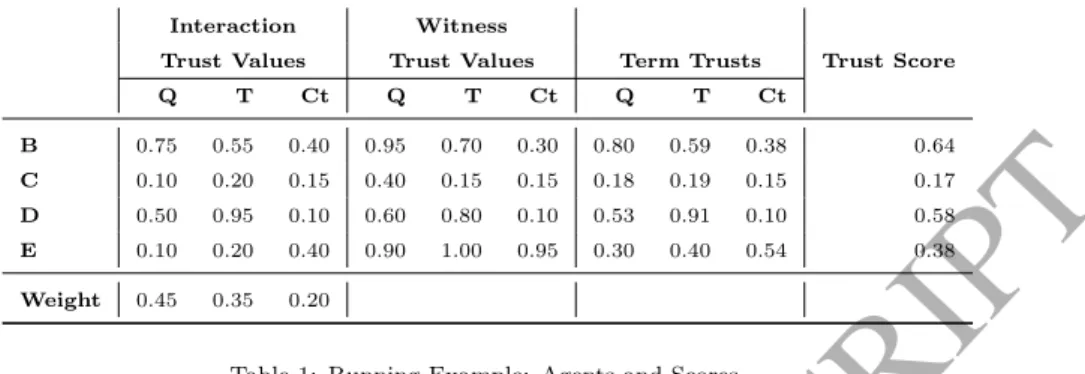
As result, our MTRM is able to capture data such as that presented in Ta-ble 1. In this taTa-ble, we show a set of illustrative trust values from the perspective of an agentAwith respect to four other agents (B, C,D and E), considering three different terms—Quality (Q), Timeliness (T) and Cost (Ct). For exam-ple,TI(A, D, T) = 0.95. These trust values are combinations of ratings by, for 310
ACCEPTED MANUSCRIPT
Interaction Witness
Trust Values Trust Values Term Trusts Trust Score
Q T Ct Q T Ct Q T Ct B 0.75 0.55 0.40 0.95 0.70 0.30 0.80 0.59 0.38 0.64 C 0.10 0.20 0.15 0.40 0.15 0.15 0.18 0.19 0.15 0.17 D 0.50 0.95 0.10 0.60 0.80 0.10 0.53 0.91 0.10 0.58 E 0.10 0.20 0.40 0.90 1.00 0.95 0.30 0.40 0.54 0.38 Weight 0.45 0.35 0.20
Table 1: Running Example: Agents and Scores.
example, a recency function. Similarly, there are trust values that come from witnesses, which are shown in the columns labelled with “Witness Trust Values” in Table 1, for instanceTW(A, C, Q) = 0.40.
The term trust, in this case, combines interaction and witness trust values. Assume that agent Auses the following weights: (i) interaction weight: ωI = 315
0.75; and (ii) witness weight: ωW = 0.25. As result, for example, we have the
quality trust with respect toBwould beT(A, B, Q) = 0.75×0.75+0.25×0.95 = 0.80.
Similarly, term trusts are combined using weights, which are shown in the last row of Table 1, for terms resulting in the overall trust score, shown in the last 320
column in Table 1—for instance,T(A, C) = 0.17. Based on these calculations, it can be seen that the agent with the best trust score is agentB. Although there is a mathematical explanation that leads to this, it is hard to extract intuitive arguments that justify whyBis the most trustworthy agent for agentA. This is done by our explanation approach, which is presented in the following section. 325
4. Explaining Reputation Assessments
Now that we have a common reputation model, we can specify a method for producing explanations. An explanation justifies why a particular agent (e.g. a service provider) has a better reputation, i.e. the overall trust score, than another from the perspective of a given agent (e.g. a client). Our explanations 330
ACCEPTED MANUSCRIPT
that distinguish the two agents being compared, being all arguments needed to understand which agent is better. Arguments are instantiated with parameters selected using specified algorithms. We first present arguments that can be part of an explanation, and then show how to use these arguments to produce an 335
explanation.
Our method not only produces arguments for our common trust model, MTRM, but also considers the specific details of different reputation models. Therefore we have generic arguments, generated based on MTRM, which are supplemented with model-specific arguments. We show as examples of the latter 340
specific arguments for both FIRE and TRAVOS, which are used as illustrative reputation assessment models in this paper.
4.1. Explanation Arguments
We first look at the possible classes of reasons why a provider may have a better reputation than another. Such classes are associated with the different 345
components that are part of MTRM. Each class has a corresponding argument type that can be used as part of an explanation. The generation of arguments here is similar to the identification of decisive criteria to explain choices made using multi-attribute decision models. We select, adapt and combine the algo-rithms of Labreuche [9] and Nunes et al. [10] to produce our arguments. As 350
described earlier, an agent’s overall trust score is a weighted mean of term trust values, and each of these can be decomposed into trust values for different rep-utation types. Correspondingly, our argument types are split into three groups, namely decisive terms, decisive reputation types, and reputation model-specific arguments, as described below. For simplicity, but without loss of generality, 355
we assume that ratings are in [0,1], given that the approaches we leverage use this range. FIRE and TRAVOS ratings can be easily mapped to this range.
4.1.1. Argument: Decisive Terms
The reputation of a provider for a client is a balance among trust values for terms, corresponding to aspects of an interaction or service such as quality or 360
ACCEPTED MANUSCRIPT
timeliness. Some terms may be irrelevant with respect to why one provider is more trusted than another, either because they have low weight for the client or because the differences between term trust values for providers are small. To explain why providerb has a better overall trust score than provider b0 for an
agenta, we must identify thedecisivetermsD(a, b, b0) =hP, Cithat lead to this 365
conclusion, whereP andC are sets of terms that are the decisiveprosandcons
of b with respect to b0, respectively. For example, if P = {quality, cost} and
C = {timeliness}, we can derive an argument of the form “b is more trusted thanb0because it has higher trust for quality and cost, even thoughb0has higher trust for timeliness”.
370
A trivial case is that ofdomination, when bhas advantages compared tob0
with respect to some terms and no disadvantages with respect to the remaining terms. According to Labreuche, important terms are those that have weights higher than the reference weight, which is defined as the weight that makes all terms equality important (used in thenot on average anchor, ΨN OA). That is,
if there arenterms, the reference weight isωA= 1/n. We need to adapt this to
take into account the trust values for terms. Considering the difference between term trust for a termt for providersband b0, ∆
t=|T(a, b, t)− T(a, b0, t)|, we
can say that the reference value difference is ∆A = Pt∈T∆t
|T| , where T is the
set of terms. Thus, ∆A is the average of the differences between trust values for all terms. Given the reference weight and reference value difference, the reference weighted value difference is ωA·∆A. Decisive terms in the case of
domination are consequently those whose weighted value difference is higher than the reference weighted value difference, i.e.
DDom(a, b, b0) =h{t∈T|ωt·∆t> ωA·∆A},∅i (12)
Informally, decisive pros are terms that have: (i) above average weight and value, (ii) very high weight, or (iii) very high value. In this context “very high” means that even though ∆t <∆A,ωt is high enough to causeωt·∆t> ωA·∆A,
and the same reasoning is applied to ∆t. As providerbdominatesb0, there are
no cons in this case. 375
ACCEPTED MANUSCRIPT
In order to illustrate the domination case, we use the example introduced in the previous section, considering the values presented in Table 1. By analysing the term trusts of agentsB and C, it is possible to see thatB dominatesC, becauseBhas higher trust values for all terms. In order to identify the decisive terms, we first calculate the reference value difference, which is
∆A= |0.80−0.18|+|0.59−0.19|+|0.38−0.15|
3 =
0.63 + 0.40 + 0.23
3 = 0.42
AsωA= 0.33,ωA·∆A= 0.14. Calculating the weighted differences for quality, timeliness and costs, we obtain 0.28, 0.14 and 0.05, respectively. As only the first two are above the reference weighted value difference1, they are the decisive terms. An explanation argument, in this case, would be as follows.
Example 1: Bhas a better reputation thanC, because it is better in all aspects that you consider in your preferences, mainly with respect to timeliness, and quality.
When dominance is not the case, we could apply either Labreuche’s an-chors [9] or the patterns of Nunes et al. [10] to select decisive criteria. As the number of terms|T|may be high and Labreuche’s approach may have perfor-mance issues [10], we use the latter, which is briefly explained as follows. We first define T+ ={t∈ T|T(a, b, t)> T(a, b0, t)} and T− = {t ∈T|T(a, b, t)< T(a, b0, t)}, which are the sets of all pros and cons of b with respect to b0, re-spectively. Using these patterns, the decisive criteria isDDC(a, b, b0) =hT+∗, T−∗i,
such thatT∗ +⊆T+,T−∗ ⊆T−, and X t∈T∗ + ωt·∆t> X t∈T−/T−∗ ωt·∆t (13) T∗
+and T−∗ are both minimal in the sense of⊆. WhenT−∗ =∅, it is a decisive 380
criteria pattern, otherwise it is a trade-off resolution pattern.
In order to better understand the selection of decisive terms when there is no dominance, we use our running example. Consider agents B and D.
ACCEPTED MANUSCRIPT
According to the trust value, the former has two pros, namely quality (weighted difference is 0.12) and cost (weighted difference is 0.06), while the latter has 385
only timeliness (weighted difference is 0.11) as pros. In order to justify whyD is less trustworthy thanB, considering only quality would be enough, because its weighted difference is already higher than the weighted difference of timeliness (its con). Therefore, quality is B’s decisive criteria with respect to D. This is illustrated in the argument below.
390
Example 2: Bhas a better reputation thanD, mainly due to quality.
4.1.2. Argument: Decisive Reputation Types
The key argument produced to explain why providerbis more trusted than providerb0 is the set of terms that are the decisive pros ofbwith respect tob0,
and occasionally the decisive cons ofb0. Term trusts are derived from ratings of different kinds of sources, referred to as reputation types,K, being a composition 395
of trust values considering different sources. Therefore, we can again leverage algorithms used for multi-attribute decision models, to refine the explanation.
When b dominates b0 for a term t, i.e. there exists K in the set of
repu-tation types such that TK(a, b, t) > TK(a, b0, t) and there is no K0 such that TK0(a, b, t) < TK0(a, b0, t), then stating that t is a decisive term is sufficient, 400
and no additional argument is needed. In other cases, it is relevant to add new arguments to the explanation. For example, assume that b has a higher trust score thanb0 considering a component I (for interaction trust), b0 has a
higher trust score thanbconsideringW (for witness trust), andωIωW (I is
more important thanW). In this case, it is helpful to state the argument “even
405
thoughb0 has higher ratings from third party reports,b has higher ratings from direct experience, which is more important.”
Our pairwise analysis of weights and values is done with Labreuche’sinvert
anchor, ΨIV T. Although this anchor had performance issues in a previously
performed experiment with human participants [10], this occurred where there 410
ACCEPTED MANUSCRIPT
types. We assume there is a small number of reputation types (e.g. there are four in FIRE and two in TRAVOS) and so performance is not an issue here. The argument given for explaining trust values considering reputation types is a permutation π(a, b, b0, t) = {(K, K0) ∈ S2}, where S ⊆ K
Set, such that 415
T(a, b, t) <π(a,b,b0,t) T(a, b0, t). The operator <π(a,b,b0,t) compares two term trusts applying the permutationπ(a, b, b0, t) to reputation type weights.
Conse-quently,π(a, b, b0, t) gives a set of pairwise changes in weights, which causes the
term trust ofb0 to be higher than that ofb. Labreuche provides a branch-and-bound algorithm for the determination of this kind of explanation [9], which for 420
brevity is not reproduced here. Given that there are limited possible permuta-tions in our case, algorithmic efficiency is not critical.
Considering our running example, we have a case of decisive reputation types considering agentsBandEwith respect to the timeliness term. The trust value of agentBis better considering interaction ratings (0.55>0.20), while the trust 425
value of agent E is better considering witnesses ratings (1.00> 0.70). If the weights given to the interaction and witnesses ratings were inverted, E would have a higher term trust than B—timeliness trust would be 0.66 for B and 0.80 for E, instead of 0.59 and 0.40, respectively. We present below a textual argument that gives this explanation.
430
Example 3: Considering timeliness, even though E has higher reputation with respect to witness reputation, which is less important,Bhas has higher reputation with respect to own interaction, which is more important.
4.1.3. Reputation Model-specific Arguments
The way that trust and reputation values are derived from ratings is different for each reputation model. As a consequence, it is possible to provide further arguments other than our generic arguments if we take model particularities into account. In this case, model-specific arguments can be generated and used 435
to supplement the generic arguments. In addition, arguments can be added not only to explain trust scores, but to give further details about trust values
ACCEPTED MANUSCRIPT
and term trusts. Here, to illustrate these possibilities, we present two model-specific arguments: a FIRE-model-specific argument associated with trust values and a TRAVOS-specific argument to further explain term trusts.
440
FIRE-specific Argument: Recency. The trust value for a particular reputation type in FIRE is calculated through a weighted mean of available ratings vi.
Weights can be used to assign more importance to particular ratings, specifically more recent ratings have a higher weight. The ratings are thus scaled using a rating recency factor λ, as introduced before. The recency factor may play a key role both in the overall trust score and in the trust value for particulartand K. The overall trust score of a provider usesωλ(ri) to combine available ratings RK(a, b, t), associated with a particular a, b and t. In this case, we can also
consider a reference rating weight function ωλAK, which is the average weight,
i.e.
ωAλK =
1 |RK(a, b, t)|
(14) Given this reference function, two situations might occur. First, the order derived from the overall trust score of providers b and b0, calculated taking
into account recency, conflicts with the order derived from the overall trust score calculated usingωλAK. That is, we haveT(a, b)>T(a, b
0) andTA(a, b)< TA(a, b0), whereTA(a, b) is the overall trust calculated usingωA
λK. Second, even
445
though this situation may not occur, there may still be cases whereTK(a, b, t)> TK(a, b0, t) and TKA(a, b, t)< TKA(a, b0, t), for a particularK andt. In the first
scenario, we add an argument F(a, b, b0) to the explanation explaining that
“although on average b0 has higher ratings thanb, recentlyb has been receiving
higher ratings than b0, which are more valuable”. In the second case, we must 450
add a finer-grained argument F(a, b, b0, t, K), for specific K and t: “although on averageb0 has higher ratings for t thanb, considering K, recentlybhas been
receiving higher ratings thanb0, which are more valuable”.
TRAVOS-specific Argument: Low Confidence. FIRE uses weights of reputa-tion types to express their importance for a particular assessor agent, and they 455
ACCEPTED MANUSCRIPT
remain fixed unless an assessor explicitly changes them. Therefore, a set of in-teraction and witness ratings does not influence the weights of reputation types to calculate a trust score. TRAVOS, on the other hand, evaluates how useful interaction ratings are, before taking witness ratings into account. If an asses-sor does not have enough confidence into its own ratings, i.e. the confidence is 460
below a given threshold, then witness ratings are used, otherwise it will rely on its own ratings.
Therefore, it is important to know whether the trust score is based solely on interaction ratings or on both interaction and witness ratings. If ρI(a, b, t)
(interaction confidence) is below a threshold set by the assessor, for any of the 465
providers being assessed, it means that witness ratings are being taken into account to consider b better than b0, i.e.T
W(a, b, t)> TW(a, b0, t). When this
is the case, we add an argument C(a, b, b0, t) to the explanation, which can
be written in natural language in the following form: “although you have had limited previous interactions with eitherb orb0 with respect tot, the former is
470
considered better than the latter by witnesses”.
4.2. Explanation Generation
Above, we introduced the different arguments that can be used to form an explanation to justify why a providerbhas a higher trust score than a providerb0.
In this section, we show how to generate such an explanation. We first identify 475
our coarse-grained argument to justify trust scores. This argument is composed of decisive terms, which has the formD(a, b, b0) and gives the decisive pros and cons justifying the overall trust scores. Whenb dominatesb0, i.e. existst∈T
such that T(a, b, t)> T(a, b0, t) and there is no t0 ∈T such that T(a, b, t0)< T(a, b0, t0), the decisive criteria are given byD
Dom(a, b, b0), otherwise they are 480
given byDDC(a, b, b0).
Once we know the decisive criteria that justify trust scores, we can provide fine-grained arguments that provide further understanding, considering decisive termst∈P. First, we search for those that have a trust score associated with decisive reputation types. This is given byπ(a, b, b0, t), which is a permutation 485
ACCEPTED MANUSCRIPT
Algorithm 1:Expl(a, b, b0)
Input:a: an agent;b, b0: service providers Output:φ: explanation with a set of arguments
1 ifdominates(b,b’)then 2 φ← {DDom(a, b, b0)}; 3 else 4 φ← {DDC(a, b, b0)}; 5 addSpecificArguments(φ); 6 foreacht∈P do
7 if∃π(a, b, b0, t)such thatT(a, b, t)<πT(a, b0, t)then
8 φ←φ∪ {π(a, b, b0, t)};
9 addSpecificTermTrustArguments(φ, t,T(a, b, t),T(a, b, t0));
10 foreachK∈KSetdo
11 addSpecificTrustValueArguments(φ, t, K,TK(a, b, t),TK(a, b, t0));
12 returnφ;
of weights given for the different reputation types, indicating that the weights involved in that permutation are decisive, because if they were assigned in a different way, we would have T(a, b, t) < T(a, b0, t). Second, we add model-specific arguments. For example, in the case of FIRE, the argumentsF(a, b, b0) and F(a, b, b0, t, K) are added when the selected recency weight function is the 490
cause for making the trust value ofbhigher than that ofb0, i.e. if equal weights
were given to all ratings, this would not have been the case. While in the case of TRAVOS, the argument C(a, b, b0, t) is added when interaction ratings are
limited, and thus the opinions of witnesses are taken into account.
This method is presented in Algorithm 1, which generates an explanation 495
Expl(a, b, b0) to justify why providerbhas a higher trust score than providerb0,
for agenta. An explanation is thus a set of arguments of the types introduced above. Note that in Algorithm 1, fine-grained arguments are generated only for terms that are decisive pros. However, arguments may be also generated for decisive cons, if one wants to provide further details about the trust score. 500
No fine-grained arguments are generated for the remaining terms, since they are not decisive. In addition, Algorithm 1 calls functions that add additional arguments to the explanations. These functions must be specified for specific trust models. For example, in the case of FIRE we can add recency arguments
ACCEPTED MANUSCRIPT
Algorithm 2:FIRE: addSpecificArguments Input:φ: explanation
Output:φ: explanation with added arguments
1 ifT(a, b)>T(a, b0)andTA(a, b)<TA(a, b0)then 2 φ←φ∪ {F(a, b, b0)};
3 returnφ;
Algorithm 3:FIRE: addSpecificTrustValueArguments
Input:φ: explanation;t: term;K: reputation typeTK(a, b, t),TK(a, b0, t): trust values
Output:φ: explanation with added arguments
1 ifTK(a, b, t)>TK(a, b0, t)andTKA(a, b, t)<TKA(a, b0, t)then
2 φ←φ∪ {F(a, b, b0, t, K)};
3 returnφ;
Algorithm 4:TRAVOS: addSpecificTermTrustArguments
Input:φ: explanation;t: term;ρI(a, b, t),ρI(a, b0, t): confidence;TW(a, b, t),TW(a, b0, t):
trust values
Output:φ: explanation with added arguments
1 if(ρI(a, b, t)< orρI(a, b0, t)< ) andTW(a, b, t)>TW(a, b0, t).then
2 φ←φ∪ {C(a, b, b0, t)};
3 returnφ;
to explain the trust score as a whole and particular trust values, as shown in 505
Algorithms 2 and 3. Similarly, for TRAVOS we can add arguments to explain term trust, as shown in Algorithm 4.
Finally, we now show how an explanation Expl(a, b, b0), which is a set of arguments, can be translated to human-readable form. For illustration, we adopt a textual form. Parts shown in brackets are optional, and thus may not 510
appear in all explanations. Note that two of the optional arguments are FIRE-specific and one is TRAVOS-FIRE-specific. In addition, optional arguments may be added more than once, depending on the number of arguments that are part of the explanation.
ACCEPTED MANUSCRIPT
due to list of pros inP [, even though Providerb0 provides better
list of cons inC ]C6=∅.
[In addition, Providerb0 has, on average, higher ratings than Providerb , but
Providerb has been recently receiving higher ratings than Providerb0 , which are
more valuable.]F(a,b,b0)
[Considering Termt , even though Providerb0 has a higher trust value
consid-ering Reputation TypeK , which is less important, Providerb has a higher trust
value considering Reputation TypeK0 , which is more important.]∀(K,K0)∈π(a,b,b0,t)
[Moreover, although you have had limited previous interactions with either
Providerb or Providerb0 with respect to Termt , the former is considered
better than the latter by witnesses.]∀C(a,b,b0,t)
[Moreover, Providerb0 has, on average, higher ratings for Termt than b,
considering Reputation TypeK , but Providerb has been recently receiving higher
ratings than Providerb0 , which are more valuable.]
∀F(a,b,b0,t,K)
5. User Study 515
In this section, we therefore present a user study conducted to evaluate our proposed explanation approach.
5.1. Goal and Research Questions
Reputation assessment models are often used in multiagent systems to allow autonomous agents (which can be humans) to identify in which agents they can 520
trust to interact with. Our explanations can be used as a means for agents to exchange information regarding the reputation of other agents, without the need for exposing the reputation model details or detailed scores. However, as our explanations reveal less information than components of trust scores, we must evaluate if they are helpful for agents or users to better choose another 525
agent (which can be, e.g. a service provider) to interact with. More specifically, we aim to answer the following research questions.
1. Are our explanations more effective in helping users to understand reputation-based recommendations than quantitative scores alone?
2. How do users perceive the usefulness of our explanations? 530
ACCEPTED MANUSCRIPT
In order to answer these questions, we present our explanations to users using our example explanation templates. Our hypothesis is that users are better able to understand the rationale behind recommendations when they receive explanations instead of only quantitative information (i.e. reputation scores). Our first research question is aligned with this hypothesis. However, given that 535
the effectiveness of such explanations may be different to how users perceive their usefulness, the second research question aims to explore this relationship.
5.2. Procedure
Our user study followed an adaptation of the protocol previously adopted to conduct user studies that involve the evaluation of explanations in recommender 540
systems [11, 16]. The steps of this protocol are the following [11]: (1) get sample ratings from the user; (2) compute a recommendationr; (3) for each explanation system, present rto the user with e’s explanation and ask the user to rate r; and (4) ask the user to tryr and then rate it again. In the remainder of this section we present the steps we followed to conduct the user study.
545
Construction of Provider Model. Our study involves participants rating and receiving recommendations of service providers based on reputation models. In order to have a set of providers to be part of the study, we create a set of simulated providers. Providers are described with a model that specifies the probabilities of transaction outcomes, e.g. considering a provider of delivery 550
services, an outcome is the number of days taken to deliver a package. Outcomes are associated with terms, e.g. the outcome of delivering a package is associated with the term timeliness.
Participant Data and Preference Elicitation. Participants initiate the study by providing data about themselves and preferences for different terms. Addition-555
ally, they provide preferences for reputation types, required by the FIRE model.
Collection of Sample Ratings. From each participant, we collect 15 sample rat-ings in the following way: (i) randomly select a provider, (ii) simulate an inter-action by generating outcomes based on the provider model, and (iii) present
ACCEPTED MANUSCRIPT
the result of the interaction to the participant and ask them to rate the provider 560
with respect to each term. We present an example of an interaction outcome in Figure 1a. Note that providers may be selected more than once, and likely have different outcomes in each interaction. Each set of ratings is associated with a round, which is interpreted as a timestamp for FIRE and a round for TRAVOS. These sample ratings are used to build both the FIRE and TRAVOS models for 565
each participant. Participants provide ratings with a value between 0 and 1 (or not applicable). For FIRE, this value is used as is, and for TRAVOS we used a threshold of 0.5 to distinguish between successful and unsuccessful interactions. Moreover, TRAVOS requires a confidence threshold, which was set to 0.2. We selected a low threshold given that participants have few repeated experiences 570
with the same provider, causing confidence to be usually low. In this way, we balance situations where witness opinions are used or not.
Explanation Evaluation. We randomly select three providers from the set of providers and rank them using their computed reputation scores (step 2 of the protocol), which are based on the reputation model, ratings (from the partic-575
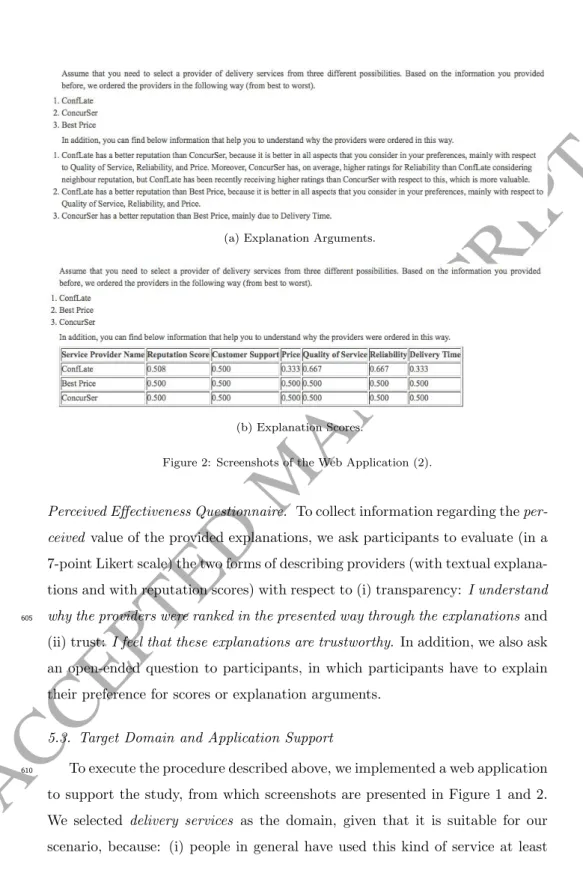
ipant and peers) and preferences. We randomly select the model to be used and which explanatory information is provided to users: (i) FIRE with scores alone, (ii) FIRE with explanation arguments alone, (iii) TRAVOS with scores alone, or (iv) TRAVOS with explanation arguments alone. Examples of expla-nation arguments and scores are shown in Figures 2a and 2b, respectively. Note 580
that participants are not aware that there are two underlying reputation mod-els driving the recommendations. Then, we show to participants the provider ranking, together with the selected explanatory information (step 3 of the pro-tocol), and ask them to answer in a 7-point Likert scale whether they agree with the statement: Considering the information provided above, I would order
585
the presented providers in the same way that they were ordered, according to my preferences. Next, we show participants the same ranking together with the full provider model (i.e. the probabilities of the outcomes), such as presented in Figure 1b, so that they know all possible details about this provider, and ask
ACCEPTED MANUSCRIPT
(a) Sample Ratings: Generated Outcome.
(b) Full Provider Information.
Figure 1: Screenshots of the Web Application (1).
them again the same question (step 4 of the protocol). Based on these answers 590
we measure how the scores given for the first question (scores or explanation arguments) differ from the scores given for the provider model. With full in-formation of providers’ probabilities, participants know exactly what to expect by interacting with providers; however, this complete information is usually un-known. Therefore, the participant score with respect to full information is used 595
as a baseline: the closer the participant score for explanation arguments or rep-utation scores, the better. This is therefore the metric we collect to evaluate the effectiveness of explanatory information, in the form of absolute difference between the two answers, referred to as score difference. This step is repeated 10 times for each participant.
ACCEPTED MANUSCRIPT
(a) Explanation Arguments.
(b) Explanation Scores.
Figure 2: Screenshots of the Web Application (2).
Perceived Effectiveness Questionnaire. To collect information regarding the per-ceived value of the provided explanations, we ask participants to evaluate (in a 7-point Likert scale) the two forms of describing providers (with textual explana-tions and with reputation scores) with respect to (i) transparency: I understand why the providers were ranked in the presented way through the explanationsand 605
(ii) trust: I feel that these explanations are trustworthy. In addition, we also ask an open-ended question to participants, in which participants have to explain their preference for scores or explanation arguments.
5.3. Target Domain and Application Support
To execute the procedure described above, we implemented a web application 610
to support the study, from which screenshots are presented in Figure 1 and 2. We selected delivery services as the domain, given that it is suitable for our scenario, because: (i) people in general have used this kind of service at least
ACCEPTED MANUSCRIPT
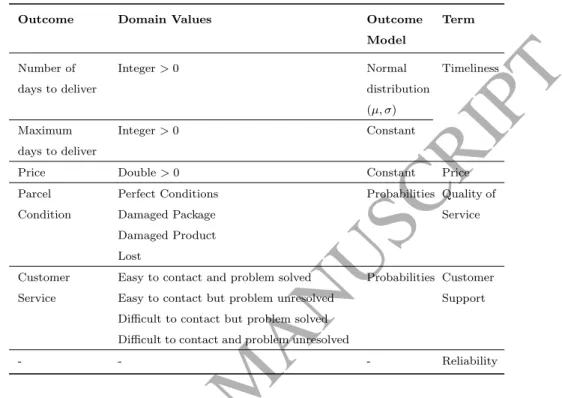
Table 2: Provider Model and Terms.
Outcome Domain Values Outcome Term
Model Number of days to deliver Integer>0 Normal distribution (µ, σ) Timeliness Maximum days to deliver Integer>0 Constant
Price Double>0 Constant Price
Parcel Condition Perfect Conditions Damaged Package Damaged Product Lost Probabilities Quality of Service Customer Service
Easy to contact and problem solved Easy to contact but problem unresolved Difficult to contact but problem solved Difficult to contact and problem unresolved
Probabilities Customer Support
- - - Reliability
once and, if not, they are aware of how it works and its possible outcomes, and (ii) participants do not need toconcretely experience such services to be able 615
to evaluate them, i.e. the domain can be simulated.
Service providers are modelled with probabilities associated with different outcomes, which are listed in Table 2. For example, providers are associated with a constant value that indicates the maximum days they take to deliver a package. They are also associated with a variable representing the average 620
number of days that it takes to deliver packages and the standard deviation. Therefore, to simulate the number of days taken we used randomisation with a normal distribution defined by these parameters.
Participants evaluate providers with respect to each term presented in the rightmost column of Table 2. These terms are associated with the outcome that 625
we believe that the participant would take into account to rate a term. Note that reliability is not associated with any outcome, since we assume that this is
ACCEPTED MANUSCRIPT
Table 3: Characteristics of Participants (N = 30).
Age 16–25 years 26–35 years
23 (77%) 7 (23%)
Gender Male Female
29 (97%) 1 (3%)
Course Undergraduate Graduate
Level 23 (77%) 7 (23%)
related to repeated experiences that the participant has with the same provider. We modelled 10 providers, each being associated with two sets of model parameters. We use the first set of parameters to collect the first half of the 630
set of sample ratings, and the second set of parameters to collect the remaining samples. In this way, we simulate change in the providers’ behaviour, and allow for the fact that the ratings provided can change over time.
5.4. Participants and Preferences
Our study participants were selected using convenience sampling. Gradu-635
ate and undergraduate students of a Brazilian Computer Science program were invited to participate as volunteers. Data was collected in two separate time slots, and participants that participated within the same time slot were consid-ered peers, in order to compute witness trust. In total, our study involved 30 participants, such that 9 participated in the first time slot and 21 participated 640
in the second. We detail characteristics of the participants in Table 3.
In addition to collecting participant characteristics, we also asked them to provide their preferences with respect to reputation types and terms. Descrip-tive information was provided to allow them to understand the required infor-mation. In Table 4, we present the preferences provided by participants. Note 645
ACCEPTED MANUSCRIPT
Table 4: Participant Preferences for Reputation Types and Terms.
Reputation Type/Term M SD Interaction 0.635 0.11 Witness 0.365 0.11 Customer Support 0.138 0.08 Price 0.202 0.09 Quality of Service 0.237 0.05 Reliability 0.242 0.07 Timeliness 0.181 0.07
5.5. Results and Analysis
We now present our study results, analysing first objective effectiveness and then perceived effectiveness. Hereafter explanation arguments and trust scores are referred to asarguments andscores, respectively.
650
5.5.1. Objective Effectiveness
The metric used to analyse objective effectiveness is the score difference between that given to explanatory and full information. Our aim is to evaluate collected scores in a single group but, because we had two separate participant groups (in order to obtain witness ratings), we first investigated whether results 655
obtained are similar for both groups. We ran a Mann-Whitney’s U test to compare group responses and, as expected, their is no significant difference between the scores provided by the two groups (U = 9436, p-value = 0.98).
Considering participant scores, we obtained the results presented in the sec-ond (mean, M) and third (standard deviation, SD) columns of Table 5. Results 660
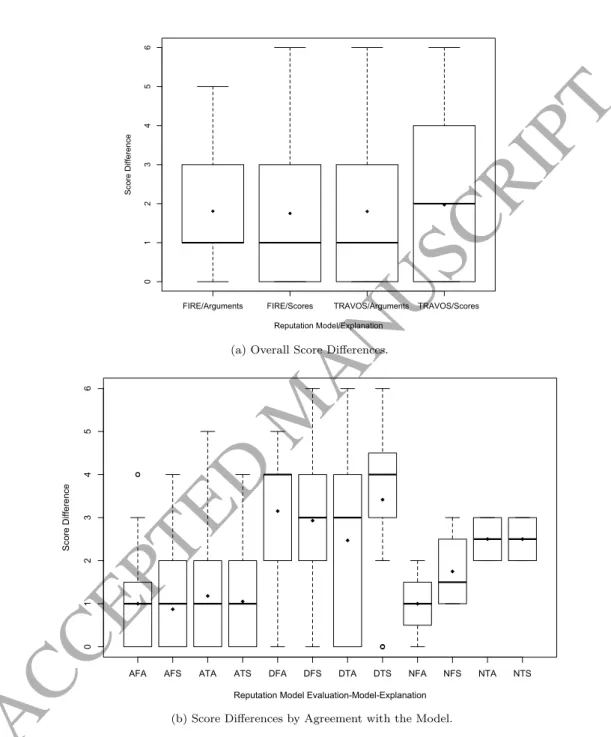
are split into four groups (rows), according to the reputation model used (FIRE or TRAVOS) and the provided explanatory information (arguments or scores). Score differences for the four groups are also shown in Figure 3a, in a box plot, which presents the mean, median and variance of values. As can be seen, results diverge between FIRE and TRAVOS: while scores performed better considering 665
ACCEPTED MANUSCRIPT
FIRE, arguments outperformed scores considering TRAVOS. Despite these dif-ferences, a Kruskal-Wallis test revealed that the differences are not significant (χ2= 13.7, p = 0.94). Although arguments and scores achieved similar results, this is already evidence of the effectiveness of our arguments. Arguments refer to a small portion of the information revealed by scores (it selects only decisive 670
criteria, and provides further information only with respect to them). Therefore, we state our first finding as follows.
Finding 1: Information that is not present in arguments can indeed be discarded, because it is not helpful to better evaluate providers, as otherwise using scores would have had a better performance.
Note that scores and arguments were presented separately in our study in order to understand the effectiveness of arguments in isolation, but we are not suggesting that this should be the case in real applications. We assume that 675
they can be presented together, so that they can complement each other. This initial analysis of our results showed that the differences among the four groups are not statistically significant. However, a deeper analysis allowed us to reveal interesting findings, which explain the contradicting results between FIRE and TRAVOS. First, we analysed whether the difference between the values 680
obtained for FIRE and TRAVOS was due to the model quality, i.e., one model produces rankings that better match users opinions. Model quality is evaluated by checking whether the ranking produced by the reputation model matches the ranking that the users would produce, when they are aware of the full provider information. Consequently, in order to evaluate model quality, we used only 685
the scores given by participants considering the full provider information. As shown in Table 6, rankings using trust scores calculated by FIRE and TRAVOS received similar ratings. Moreover, roughly, the same amount of participants agreed with the rankings produced by models. Indeed, Mann-Whitneys U test indicates that the difference between the scores obtained with full information 690
ACCEPTED MANUSCRIPT
T able 5: Summary of Score Differences. Reputation Mo del/ Ov erall Mo del-sp ecific Argumen ts Agreemen t with the Mo del Explanatory With Without Agree Disagree Neutral Information M SD M SD M SD M SD M SD M SD FIRE/Argumen ts 1.81 1.53 1.76 1.52 1.88 1.57 1.00 1.00 3.15 1.33 1.00 0.82 FIRE/Scores 1.75 1.58 -0.87 1.03 2.93 1.51 1.75 0.96 TRA V OS/Argumen ts 1.80 1.67 1.83 1.82 1.75 1.40 1.18 1.10 2.47 1.97 2.50 0.71 TRA V OS/Scores 1.97 1.79 -1.05 1.07 3.42 1.82 2.50 0.71ACCEPTED MANUSCRIPT
FIRE/Arguments FIRE/Scores TRAVOS/Arguments TRAVOS/Scores
0 1 2 3 4 5 6 Reputation Model/Explanation Score Difference
(a) Overall Score Differences.
AFA AFS ATA ATS DFA DFS DTA DTS NFA NFS NTA NTS
0 1 2 3 4 5 6
Reputation Model Evaluation-Model-Explanation
Sco re D iff ere nce
(b) Score Differences by Agreement with the Model. Figure 3: Overview of Scores Differences.
ACCEPTED MANUSCRIPT
Table 6: Quality of Reputation Assessment Models.
Reputation Model M SD Agree Disagree Neutral
FIRE 4.48 2.00 56.25% 38.75% 5.00%
TRAVOS 4.37 2.17 55.71% 41.43% 2.86%
Second, we investigated whether the model-specific arguments played a key role in our results. However, this was also not the case. In our results 61.96% of the provided explanations contained model-specific arguments (61.36% for FIRE, and 62.67% for TRAVOS). In columns 6–7 of Table 5, we detail the 695
score differences between explanations provided with and without model-specific argument. We ran a Kruskal-Wallis test that showed that the differences are not significant (χ2= 0.22, p = 0.97).
We then analysed whether the agreement with model influenced the results. Scores were split into three groups: (i) agree: when participants provided a 700
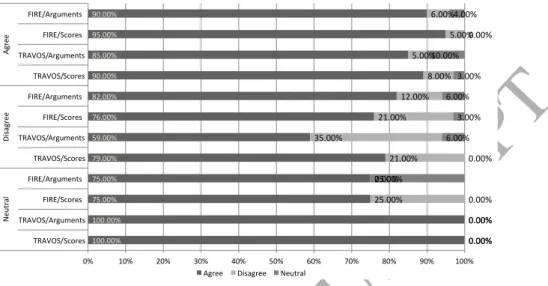
score greater than 4 considering the full provider information, (ii) disagree: when participants provided a score lower than 4, and (iii)neutral: when partic-ipants provided a score equals to 4. Results are detailed in the last six columns of Table 5. They are also shown in Figure 3b, where the x-axis has labels with three letters: the first stands forAgree,Disagree, orNeutral, the second stands 705
forFIRE orTRAVOS, and the third stands forArguments orScores. We ob-served that participants, in general, tend to agree with the ranking based on explanatory information, because this is only the information they have, which is in accordance with the ranking (the ranking is derived from scores). Conse-quently, changes occur more often from agree to disagree than from disagree to 710
agree, i.e., participants more often agree with the ranking considering explana-tory information, and then change their opinion to disagree when they learn the full provider information. A Kruskal Wallis test revealed a significant difference among the groups (χ2= 97.7, p<0.01). A post-hoc test using Mann-Whitney tests with Bonferroni correction showed significant differences between the agree 715
ACCEPTED MANUSCRIPT
groups AFA, AFS and all disagree groups, and the agree groups AT