Distributed Highly Available Search Trees
∗ Konrad Schlude† Eljas Soisalon-Soininen‡ Peter Widmayer†Abstract
We propose a distributed dictionary that tolerates arbitrary single server crashes. The distinctive feature of our model is that the crash of a server cannot be detected. This is in contrast to all other proposals of distributed fault tolerant search structures presented thus far. It reflects the real situation in the internet more accurately, and is in general more suitable to complex overall conditions. This makes our solution fundamentally different from all previous ones, but also more complicated. We present in detail the algorithms for searching, insertion, and graceful recovery of crashed servers.
1
Introduction
The amount of digital information grows at a breathtaking pace, and better and better net-working makes distributed computing power readily available. Modern databases make use of today’s technology and develop into increasingly global information systems, to the advantage of the economy and society as a whole. The efficient storage and retrieval of data becomes a criti-cal issue, and as a consequence, distributed indexing schemes have gained considerable attention [1, 5, 6, 8, 9, 11, 12, 13]. Without these distributed data structures, efficient search for the desired data is next to impossible.
It has been shown to what extent classical concepts carry over to the distributed setting: [9] presents a distributed hash file, whereas [5] proposes a scalable data structure based on random binary leaf search trees. For many data warehousing and multidimensional database applications, the important access primitives include a variety of similarity search operations, such as nearest neighbor queries or the enumeration of the data in a close neighborhood of the query. Since these operations cannot be supported with hashing, this leaves distributed search trees as the only viable alternative.
In their seminal paper [9], Litwin et al. coined the term Scalable Distributed Data Structure
(SDDS)for structures that satisfy the following requirements: a file expands to new servers grace-fully; there is no master site that must be accessed for virtually each operation; the file access and maintenance primitives never require atomic updates to multiple workstations.
1.1 Fault Tolerance
A distributed system offers the chance to remain operational even if an individual computer fails. For a large distributed system, such a failure must indeed be expected from time to time. Therefore, distributed data structures have been proposed that tolerate limited hardware failures and still
support access to all data at all times — they are calledhighly available data structures [7, 8, 10].
This failure resilience is achieved by means of data replication [8], or by applying the technique of parity records and buckets [7, 10]. In these proposals an essential feature is that a server can ∗ Part of this work was done while the second author was visiting the Department of Computer Science, Swiss
Federal Institute of Technology, Zurich.
†Institut f¨ur Theoretische Informatik, ETH Zentrum, CH-8092 Z¨urich, Switzerland. E-mail: {last
name}@inf.ethz.ch
‡Laboratory of Information Processing Science, Helsinki University of Technology, Otakaari 1 A, FIN-02150 Espoo,
detect rapidly whether some other server is operational or crashed. This is certainly a reasonable assumption for local networks, but it is unrealistic for globally distributed databases.
The distinguishing feature of our approach is that high availability can be achieved even if no server can ever detect whether some other server is operational or has crashed. This takes asyn-chronicity seriously, but makes the design of a data structure quite complicated and fundamentally different from the situation where a server crash can be detected [6, 7, 8, 10]. For instance, locks are not allowed to synchronize servers, since the server that has to unlock another server could have a crash failure, thereby letting the other wait — clearly an unacceptable situation.
In this paper, we propose a scalable, distributed dictionary supporting insert and a variety of
search operations for keys from a linearly ordered universe, say integers, in a challenging environ-ment. It works in a totally asynchronous setting, where faulty servers cannot be detected, and it tolerates crashes: A single server crash is guaranteed to do no harm at all, and simultaneous crashes of more than one server are also often harmless, but with no guarantee. More specifically: First, the dictionary remains fully operational in the presence of a single failure, i.e., all search and insert operations work correctly and efficiently. Second, it enables efficient recovery, i.e., a server that has suffered a crash failure can reinvolve itself into the data structure, and after the recov-ery is complete, a client cannot distinguish whether a crash occurred. In addition, the dictionary supports its operations with a very small overhead (number of messages, memory) to achieve fault tolerance.
1.2 The Model
Let us now be more precise about the distributed system and its availability. Let the set of computers be connected by a network. Computers communicate by sending and receiving messages. Every computer is identified uniquely by its address. We do not focus on message size, assuming that large buffers for incoming messages are available. We express this by assuming that messages can be arbitrarily large, but we will not exploit this in any extreme way. Message transmission is asynchronous in the following sense. First, no computer has access to a global clock. Second, every sent message will be delivered eventually, but message transmission times are unpredictable and not bounded. Third, messages can pass each other on different paths. For instance, if a computer
C sends a messagem1 and then a messagem2 to a computerC0, then it is possible thatC0 receives
m2 beforem1.
We distinguish client computers that initiate insert or search operations on the data set from
servers that store data. Starting with one server S0, more and more servers become involved as needed to keep the individual server load small; we consider the set of potential servers to be arbitrarily large for this purpose. The SDDS conditions can be satisfied with the following basic strategy. An SDDS is distributed among servers and is manipulated by requests from client sites which always have their own image of the structure. However, the image of the client can be outdated, because the SDDS may have, for example, split some of its buckets and distributed them between old and new servers. The structure is designed so that with an outdated image the client can find the correct bucket but cannot send the query directly to the new server. After this, a new updated image will be sent to the client so that it cannot make the same error twice. In this way the most important property of an SDDS is achieved: no bottlenecks are created because clients with updated information can usually send their queries directly to correct servers.
In our model, communication is reliable, but a server can break down. Therefore, we distinguish
operational and crashed servers. An operational server is fully functional, while a crashed server can neither receive nor send messages nor perform a computation. An operational server can crash. A crashed server loses all its data, except for some small piece of data in a secure memory. The reason is that on one hand, a server cannot recover without any information at all about its role in the data structure, and on the other hand, it is not economically feasible to protect all its data against loss. For simplicity of the discussion, we assume that the first crash of a server can only
happen after the server has been involved into the data structure. This assumption is not a serious restriction, as we will show in Section 5.1. Since a failure cannot be detected, we have to use a
technique that can be classified as Hot Standby [4]; i.e., data is duplicated in a way where every
key is stored on two different servers, and without failure both copies are equally well available. A
crashed server can recover; this will change its state to operational, and the server will reinvolve
itself into the data structure in a way that we will propose in detail.
Server S0 has an exceptional role and does not crash. This may appear like a strong and
unrealistic assumption, but it is neither. It is realistic, because securing a single machine in a network is easy and is routinely done in practice; it is not stronger than the minimum needed, since the impossibility of distributed consensus [3] suggests that without this assumption, the desired behavior cannot be achieved. Furthermore, to obtain the required properties, we will see that our
data structure also needs a secure and central entity, the so calledsplit manager. Although this is
not desired in a distributed system, its existence is not a serious drawback. In fact, all distributed data structures in the literature need some central entity to do a small but important piece of work. For instance, in [5] such an entity finds the next server that can be involved into the data structure, and [9] needs a central entity as split coordinator. For convenience, we propose to implement
the split manager within S0, but other implementations are possible. We avoid the discussion of
operational details that are local in a server, and assume that receiving and processing a message and sending messages as a consequence is one atomic step.
Section 2 reviews the distributed binary search trees, and Section 3 presents our proposal for
a fault tolerant distributed dictionary based on distributed binary trees. Section 4 proves its
properties. Section 5 discusses modifications, and Section 6 concludes the paper.
2
Distributed Binary Search Trees
We present a solution to the fault tolerant distributed dictionary problem with distributed binary leaf search trees [5], in which the keys (and data) are stored in leaves that are similar to B-tree leaves and the internal nodes are binary routers. The tree structure not only supports the access of single records but also allows a variety of efficient similarity queries. We limit ourselves to the explicit discussion of the former, since it will become clear how to perform the latter. The nodes of the tree are stored in servers, and the edges are communication links. In this section we shortly review the binary tree structure, for more details we refer to [5].
With every node u, we associate a nonemptyresponsibility interval Iu ⊂ZZ, represented by a
pairlu, ru∈ZZ∪ {−∞,∞}. Nodeu isresponsible for a key k, ifk∈Iu. Each internal nodeu with
left childv1 and right childv2 has asplit value σu ∈Iusuch thatIv1 = [lu, σu] andIv2 = [σu+1, ru].
For every key k∈ ZZ there is exactly one leaf v that is responsible for k. Leaves store keys, with
leaf vstoring a set Kv ⊆Iv of keys.
In our model, each server can hold a constant number of leaves. Internal nodes contain routing information only, and there is no a-priori bound on the number of internal nodes a server can contain.
In a state in which no insert operations are under way, each client has a picture of that part of the binary tree structure above all leaves it has accessed. All searches by clients will be directly sent to leaves and servers in the known part of the tree. If queries are evenly distributed, so is the load of servers; even if the distribution of queries and insertions is skewed, the load of servers can be leveled out nicely with a concept proposed in [13].
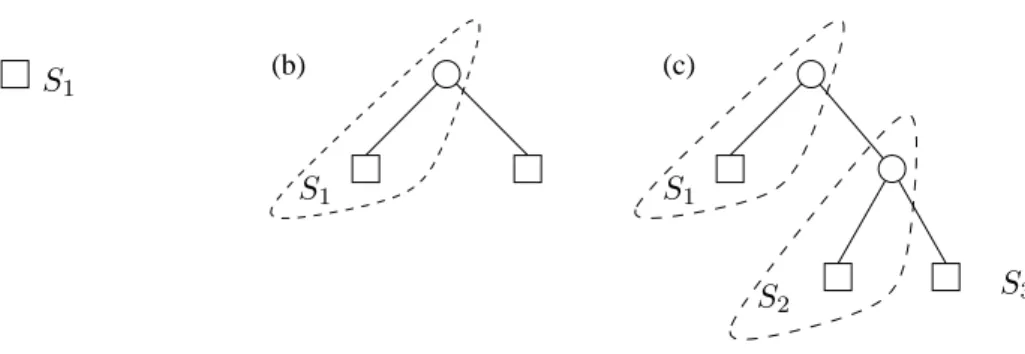
Initially, the structure contains one leaf only, and whenever, due to insertions, a split occurs a new server is taken to store one half of the records the split node was responsible for. A split also means that a new internal node must be created; this will be stored in the old server that held the split node, cf. Figure 1. Consider then the situation depicted in Figure 1, and assume that a client has an out-of-date picture of the structure telling that there is only one leaf even though the true
(a) (b) (c)
S2 S3
S1
S1
S1
Figure 1: The distributed tree grows from one leaf in server S1 (a) to two leaves and servers (b),
and further to three leaves and servers (c).
picture is as given in Figure 1(c).
Assume further that the client searches for a key which has been moved to serverS3. Using its
out-of-date picture the client sends the query to serverS1, and seeing that the required key is not
in its own leaf, S1 sends according to the tree structure the query toS2. Similarly, S2 sends the
query to S3 whose leaf is responsible for the key of the query.
After the query has been performed and the client has obtained the corresponding information, the search path used is also sent to the client. Then, for all keys the nodes in this path are responsible for, this path is first used in the client before accessing the global structure.
3
Highly Available Trees
Roughly speaking, the Highly Available Tree (HAT) that we now propose duplicates data and
stores copies in two different distributed binary leaf search trees. Both trees are kept as similar as possible, but failures and different execution speeds may create differences between the trees that
will be repaired as operations progress. Every node u in one tree has an associated node u0 in the
other tree, itsbuddy. Every request is performed on both trees simultaneously.
In more detail, a HATH consists of a pair of rooted binary trees Tl and Tr with roots rl, rr.
Initially, each of the treesT• consists of its root r• only. The trees grow by splitting a leaf into an
internal node with two children.
We define the buddy operator, denoted by a prime symbol 0, as follows. If rl is the root of Tl
and rr the root ofTr, then rl0 := rr and rr0 := rl. If u is an internal node and v is its left (right)
child, thenv0 is defined as the left (right) child ofu0. For any other pair of nodesw1, w2,w016=w2
and w02 6=w1 hold. Observe that for any node u, we have u00 = (u0)0 =u. The parent of a node u
is denoted by p(u), the sibling of u is denoted by s(u), see Figure 2. If u0 =v for two nodes u, v,
thenv is the buddy ofu and u is the buddy of v.
s(u) u p(u) s(u0) u0 p(u0)
Figure 2: Pair of two isomorphic trees
It follows that a node has at most one buddy; a node can send a message to its buddy’s address anytime, even though this buddy need not be part of the dictionary at the moment at which the
message is sent. A node u knows the addresses of its sibling and its parent (ifu is not a root). If
u is an internal node, it knows the addresses of its children.
InH, two treesTl, Trare linked in the following way. Every nodeuis restricted to have the same
responsibility interval as its buddy u0, i.e., Iu =Iu0, and u knows the address of u0. Furthermore
u knows the address of its buddy’s parent p(u0) and sibling s(u0). If u0 is an internal node with
childrenv10 andv20, thenuknows the addresses ofv01 andv20 or will know these addresses eventually.
A nodeu can send messages to node v, if u knows the address ofv.
To simplify notation, we do not distinguish between an object and its address, i.e.,u denotes a
node or the address of this node,cdenotes a client or the address of this client. If a nodeureceives
a messagem, thenu is also informed about the address of the sender ofm; in particular,u knows
whether mwas sent from its parent p(u), its buddy u0, or a client c.
3.1 Mapping Nodes to Servers
The described structure has to be mapped to the set of servers, i.e., every node u is stored on a
server S(u). The set of all potential servers is enumerated {S0, S1, S2, . . .}, but this enumeration
and the corresponding addresses of the servers need to be known only to S0. On the other hand,
the addresses of S0, S1, and S2 are known to every computer. Server S0 maintains a counternew
for the relative number of the server to be involved next. Since we start with two root servers,
initiallynew= 3. A serverSis calledinvolved, if there is a nodeuwithS =S(u). For the resilience
against 1–server failures it is important that a node and its buddy are not on the same server, i.e.,
S(u) 6= S(u0) for every node u. In order to ensure scalability, no server is allowed to store more
than a constant number of leaves. Since internal nodes contain routing information only, we do not impose an a–priori bound on the number of internal nodes on a server.
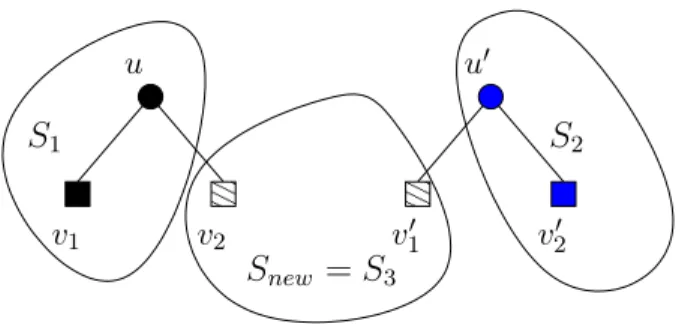
The allocation rule maps the nodes as follows (Figure 3):
0 0 1 1 0 0 1 1 u v1 v2 u0 v0 1 v20 S2 Snew =S3 S1
Figure 3: Mapping trees to servers
1. The root ofTl is stored onS1, the root of Tr is stored on S2.
2. Letu∈Tlbe a leaf that performs a split and becomes an internal node with left childv1 and
right childv2. Then
(a) The left childv1 is stored on S(u), i.e.,S(v1) =S(u).
(b) The right childv02 is stored onS(u0), i.e., S(v20) =S(u0).
(c) The nodes v2, v10 are stored on a new serverSnew, i.e.,S(v2) =S(v10) =Snew.
The construction immediately implies:
Lemma 3.1 The allocation rule of mapping HAT nodes to servers has the following properties: 1. Buddies are on different servers. More formally, for every node u, S(u)6=S(u0) holds. 2. No server stores more than two leaves.
Note that a message from a nodeuto a nodevhas to be sent from the serverS(u) to the server
act (instead of servers only) and therefore say that this message goes directly fromu tov even if
S(u) =S(v).
It is possible that a node u is stored on a crashed server S(u). To simplify notation, we call
u crashed, if the server S(u) is crashed or has not performed its recovery. Otherwise u is called
operational.
3.2 Dictionary Operations
This section shows how the described structure can be used to implement the dictionary operations search and insert.
3.2.1 Initialization
A HAT H is initialized as empty. The empty structure H consists only of the roots rl of Tl and
rr of Tr. Let rl be stored on S1,rr on S2. For the responsibility intervals, we get Irl =Irr = ZZ.
The two nodes do not contain keys, i.e., Krl =Krr =∅. The address ofrl is stored in the secure
memory ofS2, and the address ofrr is stored in the secure memory ofS1.
3.2.2 Search
A search request of a client c for a key k is performed simultaneously in both trees of H, since c
cannot decide whether there is a failure in a tree. To perform an operation,c sends two messages
to the roots rl, rr, from which the messages are forwarded to the responsible children, until the
messages reach the responsible leaves. If a leaf receives a search request message, it sends its
response aboutktoc, telling whetherkhas been inserted or not. Since in this naive approach the
roots become bottlenecks, we apply the ideas proposed in [5] of informing clients about the tree structure in a lazy fashion so that they can start future searches further down in the tree. This will be discussed in Section 5.2.
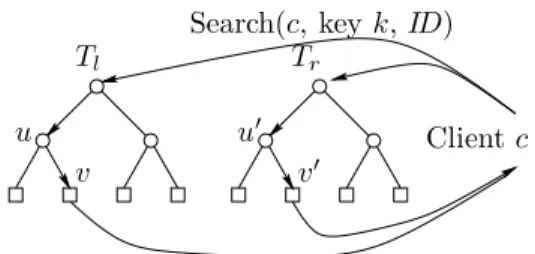
Whereas in an ordinary leaf search tree the search request leads to a search path from the root to the responsible leaf, in a HAT such a request defines a pair of search paths, see Figure 4.
u u0
Search(c, keyk,ID)
Clientc
v v0
Tl Tr
Figure 4: Simultaneous search in a HAT
But, as a consequence of the weakness of our assumptions about the distributed system, such
a pair of independent search paths is not enough: If in Figure 4 the nodesrl=p(u) andu0 crash,
then the search request from clientccannot reach the responsible leaves. In order to safely bypass
crashed nodes without loss of information, we connect the search paths in the following way. If a
node u sends a messagem to a childv, then u sends m to also v0. If there is no crash failure, v
receives two copies of the same message, one from u, the other from u0. Theorem 4.6 proves that
in this way, crashed nodes can be bypassed.
This, however, causes the next problem: If a node sends two messages for every message it receives, the number of messages doubles at every node on the search path. Since this exponential growth is totally unacceptable, we control it by keeping track of what happened as follows. If a
the number of inserts and searcheschas requested so far. Thencsends the messageSearch(c, k, ID)
to the roots of H. If a node receives a message, this node keeps track with a message tag for the
pair c, ID of receiving this message, and it forwards the message to its corresponding child v and
to v0. If a second copy of this message is received later, the node recognizes from the tag that it
has forwarded the message before and hence does not forward the message again.
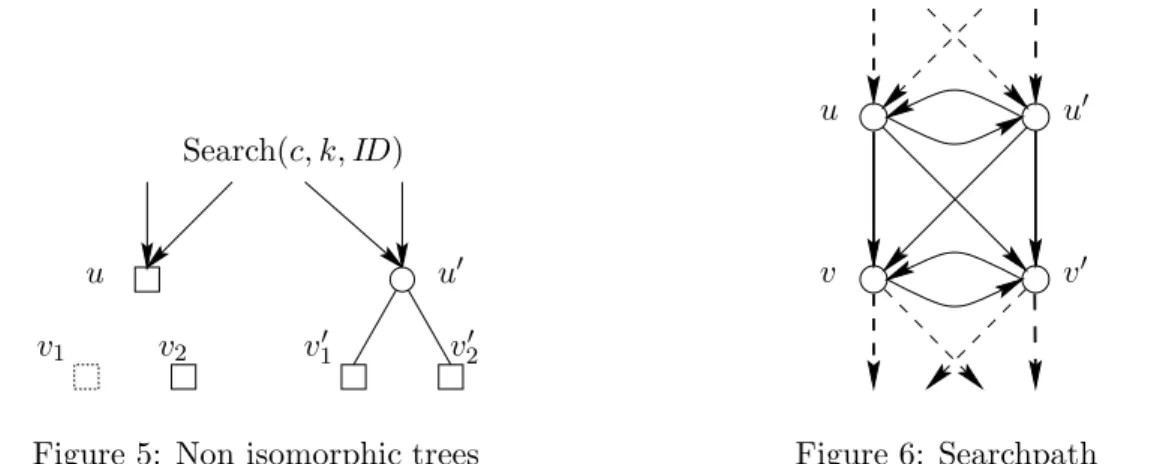
Now, a (smaller) problem is that a tag has to be stored in memory. To save memory, a tag should be deleted after a while. One option is to delete the tag after the node has received the second copy of the message (if the node is a root, then no tags are needed). But now we run into a further problem: It is possible that a tag is never deleted. In the example of Figure 5, a search
message is sent to buddies u and u0. Both, u and u0, are about to split. Now, assume that node
u0 has already performed its split, whileu has not. Sinceu is a leaf, it responds to the client. But
since u0 is an internal node, it forwards the search request to the responsible child v20 and to v2.
The corresponding tags inu andu0 will be deleted. But the childrenv2, v20 receive only one copy of
the message, and therefore, their tags will never be deleted. Although tags may seem like a rather small problem, their number might increase with every search operation, and on the long run, this is clearly undesirable. We therefore choose to avoid the possible unbounded growth of the number of tags with the following concept.
Search(c, k, ID)
u
v1 v2 v10 v20
u0
Figure 5: Non isomorphic trees
u
v v0
u0
Figure 6: Searchpath
Ifu forwards the search message to children v and v0, or responds to a client c, then u sends
the message together with the addresses of v and v0 or cto its buddy u0, called a cross message1.
Lemma 4.1 shows that cross messages suffice to achieve the desired properties. We call the pair of
connected search paths, including cross messages, asearch path in a HAT, see Figure 6.
In more detail, the tags work as follows. If a node u receives the c, ID pair in a message
Search(c, k, ID) for the first time, then u creates atag. Such a tag consists of 3 entries:
• Message: The message identifierc, ID.
• Received from: The addresses of the nodes or the client c from which u has received the
message in the past. Initially, this entry is empty. After having received the message
Search(c, k, ID) from a sender, u adds the address of this sender to the entry.
• Sent to: The addresses of the nodes or the clientcto which the message is sent. Ifuis a leaf,
then it sends messages toc and to u0. If u is an internal node, messages are sent to children
v and v0 and tou0.
If u is the responsible leaf for key k, then u sends a response message to client c. If u is an
internal node, then u forwards the message Search(c, k, ID) to its child v and its buddy’s childv0
withk∈Iv =Iv0. In both cases a message is sent to u0, too.
Ifu receives a message from a client, then it expects to receive the message twice, once from
the client and once from its buddy u0. If u receives a message from a parent node p(u) or p(u0),
then u expects to receive this message three times: Fromp(u), p(u0), and u0. The message tag is
deleted afteru has received the messages from all the expected senders.
This mechanism lets u forward a message only once, although u receives that same message
up to three times. But unfortunately, it also introduces an extra complication in the following
situation: Leaf u has performed a split, while u0 has not. If u has sent the message to children v
and v0 whileu0 has sent an answer to the client c, then the following happens. By receiving the
message from u, u0 recognizes that its buddy has links to their children while itself has not. To
remedy the situation, now u0 sends the message Search(c, k, ID) to v and v0 and changes its tag
entry ”Sent to” from (c, u) to (v, v0, u). After that u0 will perform asplit, see Section 3.3. Hence,
the search along connected paths in this way correctly manages the tags, provided that no crash failures occur.
3.2.3 Insert
To insert keyk into the HAT, client csends the messageInsert(c, k, ID) to the rootsrl, rr. In the
same way as a search message, this insert message is forwarded through the HAT. Each internal
node u that receives Insert(c, k, ID) forwards the message to the buddy u0 and to children v and
v0 withk∈I
v. A tag for this message is created.
Eventually the message will reach a leaf. If k is in the responsible leaf u, i.e., k ∈Ku, then u
sends the messageNotInserted(k, ID) to c; otherwisekis inserted intou, i.e.,Ku 7→Ku∪ {k}, and
u sends the messageInserted(k, ID) to c.
Insertions into a leafu could lead to a split of u, see section 3.3.
3.3 Split
A split of a leafu is necessary if the set of stored keysKu and therefore the workload becomes too
big. During a split, the leafu becomes an internal node with left childv1 and right childv2.
Because a node and its buddy must have the same responsibility interval,u and u0 must have
the same split value σu =σu0. Since the split should be adaptive, the split value has to be chosen
according to the key setsKu, Ku0, for instance as their median key (a merely space dependent split
value such aslu+bru−lu
2 c is not sufficiently adaptive). But, since insertions can be made in uand
u0 in different order, K
uand Ku0 can differ greatly in size. Therefore, no node alone can choose the
split value, we need a consensus betweenuandu0. In [3] it was shown that such a consensus between
two or more nodes is impossible in our model; there is no protocol that guarantees consensus in the presence of failures.
We arrive at a split value decision by circumventing the impossibility of consensus: The split
value is chosen by a central entity, thesplit manager. The split manager is stored on the fail–safe
server S0, and hence every node knows its address.
As a suggestion for the split value σu, u computes the median ˜σu of its key set Ku. Then u
sends the messageSplitRequest(u, u0,˜σu) to the split manager. After having received the first split
request fromuor its buddy u0, the split manager selects 4 new nodes v1, v2, v10, v20 (according to the
scheme described in Section 3.1), decides the split value σu (picking either ˜σu or ˜σu0), and sends
the messageSplitGrant(u, u0, v1, v2, v10, v20, σu) tou.
The split manager responds withSplitGrant(u0, u, v01, v02, v1, v2, σu), if it receives a split request
from u0. This implies that the split manager keeps track of that split, using a split tag. If the
split manager receives another split request from u0 oru, it uses the split tag to reconstruct the
SplitGrant message sent before and to reuse the previously chosen split value. As before, to save memory, the split tags should be deleted as soon as they have become useless.
Again, this requirement introduces an extra difficulty. Because a leaf can perform many splits, it is not enough that a tag is deleted after each of both corresponding nodes has performed a split.
has not performed a split. Ifusends a recover request tou0, thenuis recovered as a leaf. Therefore,
u can split again, and it can repeat this over and over.
We solve this problem by keeping track of the split event history in the split tags. A split tag
t(u, u0) consists of 5 parts:
• Nodes to split: The addresses of the nodesu, u0.
• Split value: The split valueσu that the split manager selected.
• New nodes: The addresses of the 4 children v1, v2, v10, v20.
• Split Performed: Two flags indicating whether the split manager has received the forwarded
messages about performed splits fromu, u0. The flags are initialized as ”no”.
After having received the split grant,u uses the split valueσu to compute new intervals I1 :=
[lu, σu],I2 := [σu+ 1, ru] and key setsK1:=Ku∩I1,K2:=Ku∩I2. Thenu sends the message
Ini-tialize(u, u0, vi, vi0, s(vi), s(vi0), Ii, Ki) to vi and the message Initialize(u0, u, vi0, vi, s(v0i), s(vi), Ii, Ki)
tov0i. Thenustores the addresses ofv1, v2as its children and the addresses ofv10, v20 as its buddy’s
children and deletes its key set Ku. Furthermore, u sends the message SplitPerformed(u) to its
buddyu0. Thenu is an internal node.
Eventuallyu0 receives the message SplitPerformed(u). If u0 is already an internal node, then
u0 forwards the message FwSplitPerformed(u) to the split manager. If u0 is still a leaf,
SplitPer-formed(u) forcesu0 to begin its own split. After becoming an internal node, u0 sends the message
FwSplitPerformed(u) to the split manager.
TheInitialize(u, u0, vi, vi0, s(vi), s(vi0), Ii, Ki) message reaches the serverS(vi) eventually. If node
vi has not been initialized already by a message fromu0, thenS(vi) initializesvi with responsibility
intervalIvi :=Ii and key setKvi :=Ki. The addressesu, u0, v0i, s(vi), s(vi0) are the addresses of the
parents, the buddy, the sibling and its buddy’s sibling. The buddy addressvi0 is stored in the secure
memory ofS(vi). If a second messageInitialize(u0, u, vi, vi0, s(vi), s(v0i), Ii, Ki0) is received, thenKi0
is inserted in Kvi, i.e.,Kvi :=Kvi∪Ki0.
If the split manager receives a message FwSplitPerformed(u), then it sets the corresponding
entry in the split tag t(u, u0) to ”yes”. If both entries are set to ”yes”, then t(u, u0) is deleted.
As a detail on the side that illustrates the intricacy of our mechanism, note that since every
node v knows the address of its buddy v0, it could happen thatv sends a message to v0, although
the server S(v0) does not know of v0 yet. However, the server S(v0) stores the message in a large
enough queue for future service. After v0 has been initialized, it works on the messages that have
been received before byS(v0). Therefore, we can safely assume that every node has a buddy at all
times.
3.4 Recovery
Let S be a server after a crash, whose state changes from crashed to operational. Then S starts
the following recovery protocol. According to the model, S knows the address of the buddy of
at least one of its nodes from the secure memory. Let u0 be one of these addresses, indicating
that there was a node u on S before the crash. Every such node u on the server now sends the
message RecoverRequest()to its buddy u0. If u0 is an internal node, it answers with the message
Recover(Iu, v1, v2, v10, v02, σu, p(u), p(u0), s(u), s(u0)), where Iu is the responsibility interval of u and
u0;v1, v2, v0
1, v02 are the addresses of the children and their buddies;σu is the split value;p(u), p(u0)
are the addresses of the parents;s(u), s(u0) are the addresses of the siblings. Ifu0 is a leaf, then the
answer isRecover(Iu, p(u), p(u0), s(u), s(u0), Ku0), whereKu0 is the set of keys ofu0, and the rest is
as before. After having received and processed this recover message, serverS checks whether there
is a childvi, a parent p(u0) or a buddy’s siblings(u0) that should be on S and that has no address
of its buddy in the secure memory. If so, S initializes this node and sends the recover request to
After every node on the server has received and processed the recover message from its buddy, the recovery protocol is finished.
Observe that it is enough for a server in the recovery process to know one node’s buddy, even
if many nodes were stored on that server before the crash. To see this, letu, vbe two nodes on the
same server, i.e., S(u) = S(v). If both nodes are in the same tree, w.l.o.g. u, v ∈ Tl, then these
nodes are on a path from the root to a leaf, i.e., one node is the descendant of the other. Ifu∈Tl
and v∈Tr, then there are nodeswl∈Tl and wr∈Tr with the properties:
• u is descendant ofwl.
• v is descendant ofwr.
• wl is the sibling of the buddy ofwr, i.e.,wl=s(w0r).
Therefore, the recovery protocol can recover every node on a server, if the address of only one buddy is available and none of these buddies is crashed.
4
Properties
Let us now argue that the mechanism described in Section 3 indeed leads to the desired behavior.
Let H be a HAT with subtrees Tl, Tr. In its history, H starts out as empty data structure with
two roots rl, rr. Then a finite sequence of insert and search operations O = {o1, o2, . . ., on} is
performed on H, and there are no other operations on H. During this phase, servers are allowed
to have crash failures. Eventually,H reaches a state in which no messages are sent or received any
more; measured in global time, we call this moment τ0. Let us now observe H from an external
point of view. We look at the set S of involved servers and the setF ⊂ S of servers that have had
crash failures before τ0. For this situation, we get the following results.
Theorem 4.1 (Overhead) If no crash failure occurred, i.e.,F =∅, then every tag (message tag or split tag) has been deleted. Furthermore, the number of messages sent to performO onH is less than 7 times the number of messages in each one of the underlying treesTl orTr.
Proof: We prove the theorem by counting the messages that are sent to perform the operations
O. A message can be sent (1) from a node to another node, or (2) from a node to the split manager,
or (3) from the split manager to a node, or (4) from a leaf to a client. Let MH(O) be the set
of these messages, and let MH(O) :=|MH(O)|. This number will be compared to the number of
messages in the tree Tl. A messagem ∈ MH(O) is called an internal message of Tl, if m is sent
(1) from a node u ∈Tl to a node v ∈ Tl, or (2) from a node u ∈Tl to the split manager, or (3)
from the split manager to a node u∈Tl, or (4) from a leaf of Tl to a client. To perform O on Tl,
these internal messages have to be sent. In order to compareMH(O), let Ml(O) be the number of
internal messages of Tl.
Lemma 4.2 If no crash failure occurs, then MH(O)<7Ml(O) holds.
Proof: We regard every possible case and compute the factor that bounds the number of messages in this case.
Case 1: Ifu, u0 are internal nodes that receive a message, e.g., aSearch(c, k, ID) message, for
the first time, then due to their routing scheme u and u0 send 6 messages. One of them is an
internal message ofTl.
Case 2: If two leaves u, u0 receive a message, then each sends 2 messages, one to the clientc
and one to the buddy. One of these 4 messages is counted inMl(O).
Case 3: It is possible that a node u has performed its split while u0 has not. In this case at
most 7 messages are sent. u sends messages to two nodes v, v0 and to u0; u0 sends messages to u
and to the clientc; by receiving the message fromu,u0 recognizes that it has to send the message
also to v and v0. One of these 7 messages is an internal message. The same result holds for the
Case 4: If two leavesu, u0 perform their splits 12 messages have to be sent. For each leaf there
are the SplitRequest, SplitGrant, SplitPerformed, FwSplitPerformed and two Initialize messages.
Only 3 of these 12 messages are internal messages of Tl.
Case 3 leads to the inequalityMH(O) ≤ 7Ml(O), but, since for every operationo ∈O case 2
occurs once, the inequality becomes MH(O)<7Ml(O). 2
Lemma 4.3 If no server has had a crash failure, i.e., F = ∅, then at τ0 the HAT H is in the following situation:
1. The trees Tl, Tr are isomorphic.
2. For every pair of nodes u, u0, Iu =Iu0 holds. 3. For every pair of leaves u, u0, Ku=Ku0 holds. 4. All tags have been deleted.
Proof: Every insert operation is performed on both trees. Therefore, if one of the two roots has performed a split, the other has done it too. Furthermore, the splits have been done with the same split value. Induction shows the first three properties.
Let u, u0 be a pair of leaves. The split of one node forces the other to split, too. The nodes
u, u0 perform their splits and send the messages SplitPerformed to its buddy, and they forward
these messages to the split manager. The split manager has created the split tagt(u, u0), and after
having received theseSplitPerformed messages,t(u, u0) is deleted.
Let c be a client that sends an insert or search message to a pair of nodes u, u0. Both nodes
create message tags, but these tags will be deleted after having received the second message from
the buddy. If both nodes are leaves, then they send messages only back tocand no other tags are
created. If both nodes have performed splits, thenu, u0 forward the messages to nodes v, v0. Each
of these two nodes will receive messages from u, u0 and one from its buddy. Therefore, the tags
in v, v0 will be deleted. If u has performed a split while u0 has not, then u sends the message to
nodes v, v0 and u0 sends a message back to c. The cross message (Search(c, k, ID), v, v0) forces u0
to send the message tov, v0 too. Therefore, each of the nodes v, v0 receives 3 messages and deletes
the corresponding tag after that. 2
The combination of both lemmas completes the proof of the theorem. 2
It is obvious thatH works well if no crash failure occurs: Every insertion and every search will
be carried through, the trees tend to be isomorphic and every tag will be deleted. Deletion of the tags cannot be guaranteed, if failures can occur. But it has to be guaranteed that a split tag is not deleted too early. Otherwise it could happen that the unique split value gets lost in a sequence of
splits, crash failures and recoveries, i.e., u uses a split value different from that of u0. This would
imply that the buddy condition is violated, and recovery is not possible.
Lemma 4.4 Letu, u0be two nodes, where one of them has sent a split request to the split manager. After the corresponding split tag t(u, u0) is deleted, neither u nor u0 will send a split request.
Proof: Assume that the tagt(u, u0) is deleted. Each node must have forwarded the split performed
message from its buddy. At the moment at whichuhas sent the messageFwSplitPerformed(u0), it
has been an internal node already. If u0 sends a recover request to u, then u0 will be recovered as
an internal node. Therefore, no node will send a split request. 2
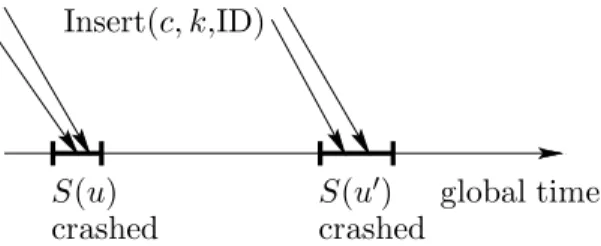
Definition 4.5 (Recoverable crashes) Let us call the set of crashed servers F recoverable, if for every node u, S(u)∈/ F or S(u0)∈/F hold.
Note that in this very strict definition, we do not pay attention to the possibility that a crashed server could have performed its recovery before a second server crashes, without any loss of data or messages. But on the other hand, in contrast to what one might think at first glance, the restriction
S(u) crashed Insert(c, k,ID) S(u0) crashed global time
Figure 7: Unrecoverable situation
that two buddies u, u0 are not crashed at the same time, is not strict enough. This is shown in
the example in Figure 7. Messages are sent to a node u and its buddy u0. The messages get lost
although the nodes u, u0 are not crashed at the same time, because the messages reach crashed
serversS(u), S(u0).
Let us only state the properties of the HAT under extreme circumstances; situations in between will lead to behaviour in between.
Theorem 4.6 (Correct operation) If F is recoverable, then all of the following hold at τ0: 1. Every search request has been answered.
2. Every insert request has been processed by at least one responsible leaf.
3. Letk be a key that has been inserted. If no more crash failure happens after τ0 and a single client c starts a search for k, then c will be informed that k has been found.
Proof: We can assume that there is no recovery, i.e., crashed servers remain crashed. Let u, u0
be the addressees of a Search(c, k, ID) message. SinceF is recoverable at least one of these nodes
is operational and acts on the message: If it is a leaf, it sends a message to c, if it is an internal
node it forwards Search(c, k, ID) to the children v, v0. Since O is finite, the number of nodes in
H is bounded and the message will reach a leaf eventually. This leaf sends a message back to the
clientc. The same holds for anInsert(c, k, ID) message.
For every inserted key k there is a nodeu, withk has been inserted in u and S(u) ∈/ F. The
Search(c, k, ID) message will reachu eventually. Ifu is still a leaf, thenu sends a response toc. If
u has performed a split, then u forwardsSearch(c, k, ID) to a child v. Eventually Search(c, k, ID)
reaches a leafw. Sincechas sent theSearch(c, k, ID) afterτ0, the keykis inw, i.e.,k∈Kw. Then
w sends a response toc. 2
Theorem 4.7 (Trees are identical copies) If F is recoverable and no more crash failure hap-pens after τ0, then H will eventually reach a state in which all of the following hold:
1. The trees Tl, Tr are isomorphic.
2. Both nodes in a pair of nodes u, u0 has the same responsibility interval, i.e., Iu =Iu0. 3. Both nodes in a pair of leaves u, u0 has the same data, i.e., Ku=Ku0.
Proof: Let S be a server with S ∈ F. Due to the assumption that a server can have a crash
failure only after the initialization of the first node, Shad stored at least one node before the crash
failure happened. Let u be such a node. Since F is recoverable, the server S(u0) had no crash
failure. Therefore,ucan determine its parent, children and sibling. This is enough information for
S to reconstruct every nodev withS=S(v). Therefore, the trees become isomorphic.
Let u, u0 be two nodes. If S(u) ∈/ F and S(u0) ∈/ F, then Iu = Iu0 due to construction. If
one of these nodes is on a crashed server, e.g., S(u) ∈ F, then this node is recovered with the
responsibility interval of its buddy. Therefore, the equalityIu =Iu0 holds in both cases.
Let w be a node with S(w) ∈/ F. If k ∈ Kw, every request Insert(c, k, ID) has reached w or
w has been initialized with k∈Kw. A leaf splits when its key set becomes too big. Therefore, if
Ku =Ku0 for a pair of leaves withS(u) ∈/ F and S(u0) ∈/F. If S(u)∈F and S(u0) ∈/ F, then the
key sets are equal, since Ku is a copy ofKu0. 2
Let us summarize: A HAT works well, if not too many servers are crashed at the same time and recovery is performed fast enough. And of course, if crashes are too frequent and recovery is too slow, no data structure whatsoever can offer a reliable service.
5
Improvements and Modifications
So far, we described the HAT with a few assumptions and in its most simple form. Let us now discuss the flexibility of the basic HAT concept.
5.1 Secure Memory and Early Crashes
We have assumed that every server has a small secure memory. This is done to enable a server’s
recovery after a crash. But the server can obtain the information in a different way, too. Let S
be a server that after having a crash failure wants to recover. If S receives a message from a node
u, then S knows that there should be a node v ∈ S which is in some relation to u. Therefore
S can send a message to u, asking for the information. Hence, an extra message exchange can
replace the secure memory. The same technique can be applied to get rid of the assumption that no server crashes before it is involved in the data structure: If it instead does crash first, but later gets a message from some other server, it will know that it is involved, and it will get the necessary information with a message exchange.
5.2 Lazy Update
We described in Section 2 how clients with more activity tend to have better knowledge of the tree.
Let us now explain the (fairly obvious) extension of thelazy update concept presented in [5] to the
HAT. If a node u sends a messagem to another node or to a client,u attaches its address and its
responsibility interval tom. Every search or insert operation a clientcinitializes, gives information
about the HAT’s structure toc. Ifcknows the addresses of two nodesu, u0 and their responsibility
intervalIu,ccan send every search for a keyk∈Iu tou, u0 directly.
5.3 Hidden Data
In a distributed data structure, it is not always clear what the correct answer for a search request
is. If one client searches for a key k and a second client wants to insert k into the structure, the
answer to the search depends on factors such as the transmission time of the messages. This is a somewhat undesirable, but unavoidable property. Therefore in a HAT, a client can get two different answers for a search. From one positive answer already, the client knows that the key is present.
But a HAT has another strange property. It is possible that a keykis not found, althoughkhas
been inserted into a leaf earlier. This can happen if a leafuhas performed a split (and deleted its
key setKu), while the child has not received theInitialize message fromu, i.e., the data is hidden
in an unreachable message. In the following we describe a protocol that avoids this undesired and strange behaviour.
If a node u performs a split and sends Initialize messages to children vi, vi0, then u does not
delete its key set Ku =K1∪K2. Every following message Search(c, k, ID) is forwarded according
to the described routing scheme, but additionally u sends an answer to c. Also, every following
message Insert(c, k, ID) is forwarded according to the routing scheme, and k is inserted in Ku.
If a node v receives an Initialize message, then it sends a message InitializationOK() back to
the sender. If nodeu receives the message InitializationOK()from a nodevi orvi0, then it deletes
Ki, i.e. Ku 7→Ku\Ki. IfKu =∅, thenu stops its schizophrenic behavior.
It can be easily seen that if a key k has been inserted in a leaf u, then all following search
requests will find at least one copy ofk.
6
Conclusions
We have proposed a distributed dictionary that tolerates arbitrary single server crashes. The
distinctive feature of our model is that the crash of a server cannot be detected. This is in contrast to all other proposals of distributed fault tolerant search structures presented thus far. It reflects the real situation in a global data base more accurately, and is in general more suitable to complex overall conditions. This makes our solution fundamentally different from all previous ones, but also more complicated. We have presented in detail the algorithms for searching, insertion, and graceful recovery of crashed servers.
On the basis of our proposal, we are designing an experimental setup to verify the HAT prop-erties in a real situation. This in itself is a major effort, since we need to appropriately intertwine a wealth of parameters, ranging from patterns for data, for queries, to timing and distribution of crash failures. We will report on this experimental study in a separate paper.
We are working on the application of our scheme on a pair of B-trees (cf. [2]). We aim at a structure that is balanced and therefore guarantees logarithmic search path length. On the other hand, we expect disadvantages also: For instance, it may be impossible to delete message tags, because there can be more than one path from a root to a leaf.
We find it interesting to further study fault tolerant data structures such as heaps or queues with extremely weak assumptions about the environment, and to extend our scheme to higher dimensional data structures that support neighbourhood queries.
References
[1] Y. Breitbart, S. Das, N. Santoro, P. Widmayer (eds): Distributed Data and Structures 2,
DIMACS Workshop, Princeton, 1999, Proceedings in Informatics 6. Carleton Scientific, 1999.
[2] Y. Breitbart, R. Vingralek: Distributed and scalable B+-tree data structures. In: [12], 98–117.
[3] M. Fischer, N. Lynch, M. Paterson: Impossibility of distributed consensus with one faulty
process. JACM, 32(2), 374–382, 1985.
[4] J. Gray, A. Reuter: Transaction Processing: Concepts and Techniques. Morgan Kaufmann Publishers, San Francisco, California, 1993.
[5] B. Kr¨oll, P. Widmayer: Distributing a search tree among a growing number of processors.
Proc. ACM SIGMOD Conference on the Management of Data), 265–276, 1994.
[6] B.W. Lampson: How to build a highly available system using consensus. Workshop on
Dis-tributed Algorithms (WDAG), 1–17, 1996.
[7] W. Litwin, J. Menon, T. Risch, Th. Schwarz: Design issues for scalable availability LH∗
schemes with record grouping. In: [1], 38–55.
[8] W. Litwin, M.-A. Neimat: High-availability LH∗ schemes with mirroring.First Int. Conf. on
Cooperating Information Systems (CoopIS), 196–205, 1996.
[9] W. Litwin, M.-A. Neimat, D.A. Schneider: LH∗—A scalable, distributed data structure.ACM
Trans. on Database Systems (TODS), 21(4), 480–525, 1996. A preliminary version appeared
as: LH∗—Linear hashing for distributed files. Proc. ACM SIGMOD Conference on the
[10] W. Litwin, Th. Schwarz: LH∗RS: A high-availability scalable distributed data structure using
Reed Solomon codes.Proc. ACM SIGMOD Conference on the Management of Data, 237–248,
2000.
[11] D. Lomet: Replicated indexes for distributed data.Fourth International Conference on Parallel
and Distributed Information Systems (PDIS), 108–119, 1996.
[12] N. Santoro, P. Widmayer (eds): Distributed Data and Structures 1, IPPS Workshop, Orlando,
Florida, 1998, Proceedings in Informatics 2. Carleton Scientific, 1999.
[13] R. Vingralek, Y. Breitbart, G. Weikum: Snowball: Scalable storage on networks of