Abstract—Sustainability of cloud data center is to be addressed in terms of environmental and economic effects. Cloud computing is a new opportunities to deploy sustainable solutions and advance their services upon that platform. Energy efficiency deals with performing the same tasks as before while consuming less energy, resulting in lower costs. Energy efficiency helps reduce the world carbon emissions, a key factor to attain a greener environment. The environmental impact of data centers is very significant in green environment because of their enormus amount of power consumption and carbon dioxide emissions. Energy efficiency approaches, such as dynamic power management (DPM), become a critical issue in sustainable data center environment while it is important to ensure to meet service level agreement (SLA).
The aim of this paper is to discover the energy efficient power management approach for cloud data center. Sustainable data centre framework (SDC) is proposed as a sustanable sloution for next generation data center. In proposed frame work, machine learning based resource prediction is prerformed for handling dynamic workload nature. As a consequence, future power demand and CO2
emission is estimated to provide dynamic power management process. And then we explore the energy efficient dynamic power management approach for proposed SDC. On the other hand, SLA violation is considered as the one of sustainable factors. Finally we developed a simulation environment and evaluated the proposed approach to prove how does our proposed DPM effective on SDC framework.
Keywords— Carbon dioxide Emission, Energy Efficient Cloud Data Centers, Service Level Agreement, Sustainability.
I. INTRODUCTION
USTAINABILITY science seeks real world solutions to sustainability issues and aims to break down artificial and outdated disciplinary gaps between the natural and social sciences through the creation of new knowledge and its practical application to technology transfer and decision making(Clark & Dickson, 2003; Palmer et al. 2005; Weinstein et al. 2007). Public concern about environmental sustainability has grown steadily rapidly in recent years. Nowadays IT farms become a main focus area of sustainability. Especially modern data center consumes enormous amount of power consumption. As a consequence, Gartner estimation [4] found that IT is responsible for about 2% of global greenhouse gas emissions in 2007, about as much as the aviation industry, the
San Hlaing Myint, University of Computer Studies, Yangon. (e-mail: [email protected]).
Thandar Thein, University of Computer Studies, Yangon. (e-mail: [email protected])..
energy and CO2 impacts of data centers are expected to more
than double by 2020.This concern, coupled with increasing government interest in regulating data center resource consumption, is resulting in a new approach to management of data centers.
Some technologies and means in data centre infrastructures are investigated to aid cloud computing to save more energy and having less impact on the environment. Dynamic power management (DPM), dynamic voltage management (DVFS) and virtualization are popular energy efficiency approach and state of the art challenges for sustainable data center environment.
However, there are many opportunities for greater efficiency through integrated design and management of data center components. This paper focuses on many aspects of sustainability of modern data centers which include environmental impact, economic effect, minimizing energy consumption, reducing CO2 emission, and efficient processing
and utilization of computing infrastructure. On the other hand, satisfaction of QoS requirements specified by users via Service Level Agreements (SLA) is an important consideration factors. Proposed sustainable data center design is an effective solution for minimizing SLA violation, energy consumption and carbon emission. The core idea of three server pools design (Active, Sleep, Shutdown) can achieve server consolidation strategy and efficient dynamic power management solution while mediating the SLA violation effectively. Dynamic power management is the main concern of energy efficient cloud data centers. Finally we evaluate SLA violation and energy consumption by comparing traditional and cloud data centers to figure out which one is more recommended to e deployed.
II. PROBLEM STATEMENTS
The core idea of this paper is to solve power wasting overprovision problem which is happened because an idle server burns almost as much as power as a busy server. The comparison of idle and busy state power consumption of Intel Xeon server and CPU is shown in Table 1 and 2. As compare with 350.6 watt Intel Xeon x5570 server, an idle server can consume 153.8 watt. While a 100% utilization CPU (Intel Core i5-2300) consume 51.1 watt, it consumes 4.5 watt at idle state [2, 5].
A Framework of Dynamic Power Management
for Sustainable Data Center
San Hlaing Myint, and Thandar Thein
TABLE I
INTEL XEON SERVER POWER CONSUMPTION
Intel Xeon Server Server Power Consumption
Idle Busy
X5570, Dual-Core 153.8 W 351.1 W
X5670, Quart-Core 157.7 W 358.6 W
E5520, 2 Quart-Core 197.5 W 322.3 W TABLE II
INTEL CORE I5PROCESSOR POWER CONSUMPTION
Intel Xeon Server CPU Power Consumption
Idle 100% utilization
Core i5-2300 4.5 W 51.1 W
Core i5-2400 4.6 W 55.3 W
Core i5-2500 4.8 W 62.2 W
In such scenarios, in order to save power idle servers are needed to turn off. Most existing research considered two policies (On/Off). In this case, turning servers off have a setup cost to later turn them back on. This is the main problem for SLA which guarantee for waiting delay time. In order to meet delay guarantee, two policies are not enough. We need to setup new policy to mediate this problem. Sleep mode state, with shorter setup time and lower power requirement, is a good solution to overcome this problem. It is not only to solve overprovision problem but also mediate SLA violation. On the other hand, it can save cost of wasted power consumption and degrade environmental impacts of carbon dioxide emission.
III. ENERGY EFFICIENT TECHNIQUES
Energy efficiency becomes the main concern for data center design consideration in green environment. Without much overhead, many energy efficiency techniques can be applied at the data centers. These include the Dynamic Power Management (DPM) or device reduction, Dynamic Voltage Frequency Scale (DVFS), Virtualization and the improvement of port, server, storage, cooling, and electricity supply efficiency [9].Among them, DPM, DVFS and virtualization are The state of the art energy efficiency techniques. Some authors classify DVFS under DPM techniques [15]. In this work, DPM is emphasized to provide capacity management of cloud data center.
A.Dynamic Power Management
The basic concept of all the energy efficiency techniques is that service providers built data centers with redundant resources to meet QoS requirements and performance guarantee which causes overprovision problem. DPM is a set of techniques in which server equipments are dynamically power off according to the current load. The number of active server components is restricted to a minimum while conforming to the required performance and QoS criteria.
Typically, the server components experience non-uniform workloads during the course of their operation. Future workload of server components can be predicted, with some degree of uncertainty, using probabilistic techniques on the basis of the recent workload history. The characteristics of efficient power management techniques are as follow :
It can be implemented in software, hardware, firmware or VM.
It is limited to a component, server, cluster or data center.
It is based on a local or global optimization metric.
It has local or global resource distribution management.
Dynamic Power Manager or Autonomic Power Manager (APM) is a framework that dynamically powers on/off electronic devices after predicting the future workloads [8, 10, 12]. Backend of the dynamic power management. Virtualization is implemented in both the server and switch domain but with different objectives. Server virtualization usually achieves energy efficiency by sharing limited resources among different applications. However, sharing the same physical resources that previously would have been dedicated to one physical machine comes at a cost. Virtualization is the one of the most effective ways toward energy efficiency. Virtualization is the most adopted power management and resource allocation technique used by the data center operators [1]. This work is not focused on virtualization technology.
IV. FRAMEWORK OF DYNAMIC POWER MANAGEMENT FOR SUSTAINABLE DATA CENTER
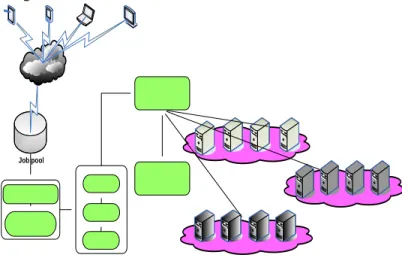
Dynamic power management for sustainable data center is presented in Figure 1. It consists of infrastructure design and management environment. Job pool ? ? ? ? Z Z Z Z ZZ Power Manager ML Predictors Resource Prediction Model CPU usage Z Z Service Lavel Agreement Evaluater Active Pool Sleep Pool Shutdown Pool CO2 Model Power Model Number of Host CO2 Emission Estomator
Fig. 1 Dynamic Power Management for Sustainable Data Center Architecture
In the infrastructure design, physical servers are group into three server pools (Active pool, Sleep pool and Shutdown pool) which have three different states such as running state, sleeping state and power off state respectively. The data center
is composed of high performance heterogeneous physical servers which supported virtualization technology and serve cloud services to cloud users. This system architecture covers energy consumption problem, carbon dioxide emission problem and SLA violation problem due to resource over provisioning in the data center to keep high performance guarantee.
In management environment, it includes resource demand predictor, carbon dioxide emission estimator and power manager, resource manager and SLA evaluator.
A. Resource Demand Prediction
Resource usage demand of future workloads is predicted by using machine learning (ML) techniques. We focus on CPU resource usage demand in this work. The processing steps are: data standardization, feature selection, model generation and model evaluation process. Data standardization process consists of subtraction the value from its average value and divides the result by its standard deviation. Feature selection is conducted as a preprocessing step in machine learning based prediction process and is effective in reducing dimensionality, removing irrelevant data, increasing learning accuracy, and improving result comprehensibility. Model generation process is performed to develop a set of models and choose the best one according to different parameters selecting the more accurate result.
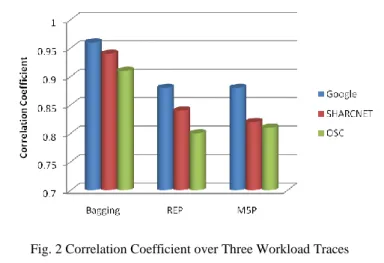
Finally model evaluation process is conducted by comparing different Machine Learning algorithms in order to choose the (approximately) best one. Power machine learning algorithms such as Bagging, M5P and REP Tree are used for mdel evaluation process. In order to evaluate the prediction quality of experiment machine learning algorithms, two metrics: correlation coefficient and mean absolute error (MAE) are calculated. We conducted this evaluation process on three workload traces: Parallel Workload Archives (SHARCNET & OSC) and Google Cluster Workloads. The prediction accuracy of ML algorithms are shown in Figure 2 and 3. Weka 3.6 toolkit is used for model evaluation process [6].
Correlation Coefficient: This metrics is based on the standard correlation coefficient and measures the extent of linear relationship between predicted
J*
and actual
Jvalues. It is a dimension less index that ranges from -1 to 1 with 1 corresponding to ideal correlation. The correlation coefficient C is given by:
p a J JC
*
cov
(1)Where
cov
J,
J*
the covariance between the predictedand the actual values is, while
a and
p are their respectivestandard deviations.
Fig. 2 Correlation Coefficient over Three Workload Traces
Mean Absolute Error: MAE, is the average of the difference between predicted and actual value in all test cases; it is the average prediction error. MAE can be calculated as follow:
N
MAE
J
J
J*
(2)
Assuming that the
J is actual CPU usage observed by Jobj and*
J
would be expected CPU usage of Jobj.Fig. 3 Mean Absolute Error (MAE) over Three Workload Traces
According to Figure 2, we can clearly see that correlation coefficient scores of Bagging algorithm are 0.94, 0.894 and 0.9033 respectively over three workload traces. In Figure 3, Bagging algorithm has least MAE error compared with other two algorithms over different workload traces. We found that Bagging provides highest prediction accuracy compared with other algorithms over different workload traces. Prediction accuracy of Bagging have 92% and above, and it’s MAE nearly zero over all workload traces.
B. Carbon Dioxide Emission Estimation
To facilitate energy efficient computing, the information about the CO2 emission rate is needed to provide. The power
consumption of a physical machine can be estimated by a linear relationship between power consumption and CPU
utilization. And also the CO2 emission rate is directly
proportional with power consumption respectively. CO2
emission of a server is calculated base on estimated power consumption. The power consumption and CO2 emission of a
server is calculated by using the following equations.
(3)
Where is the power consumption of a server at u% CPU utilization of given workload. is the power consumption of u% CPU utilization of given workload, and are power consumption of maximum CPU utilization and idle, respectively.
(4) Where is CO2 emissionrate. CO2 emission of a server at
u% CPU utilization . is the CO2 emission of a server
at u% CPU utilization of given workload.
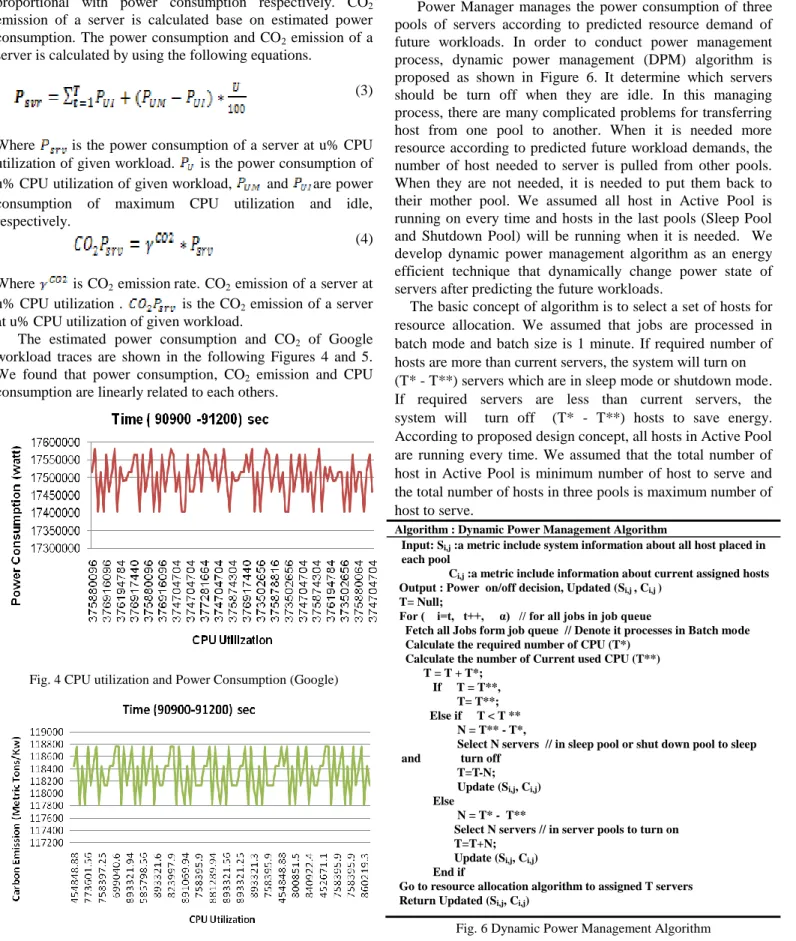
The estimated power consumption and CO2 of Google
workload traces are shown in the following Figures 4 and 5. We found that power consumption, CO2 emission and CPU
consumption are linearly related to each others.
Fig. 4 CPU utilization and Power Consumption (Google)
Fig. 5 CPU Utilization and CO2 Emission (Google)
C. Power Manager
Power Manager manages the power consumption of three pools of servers according to predicted resource demand of future workloads. In order to conduct power management process, dynamic power management (DPM) algorithm is proposed as shown in Figure 6. It determine which servers should be turn off when they are idle. In this managing process, there are many complicated problems for transferring host from one pool to another. When it is needed more resource according to predicted future workload demands, the number of host needed to server is pulled from other pools. When they are not needed, it is needed to put them back to their mother pool. We assumed all host in Active Pool is running on every time and hosts in the last pools (Sleep Pool and Shutdown Pool) will be running when it is needed. We develop dynamic power management algorithm as an energy efficient technique that dynamically change power state of servers after predicting the future workloads.
The basic concept of algorithm is to select a set of hosts for resource allocation. We assumed that jobs are processed in batch mode and batch size is 1 minute. If required number of hosts are more than current servers, the system will turn on (T* - T**) servers which are in sleep mode or shutdown mode. If required servers are less than current servers, the system will turn off (T* - T**) hosts to save energy. According to proposed design concept, all hosts in Active Pool are running every time. We assumed that the total number of host in Active Pool is minimum number of host to serve and the total number of hosts in three pools is maximum number of host to serve.
Algorithm : Dynamic Power Management Algorithm
Input: Si,j :a metric include system information about all host placed in
each pool
Ci,j :a metric include information about current assigned hosts
Output : Power on/off decision, Updated (Si,j , Ci,j )
T= Null;
For ( i=t, t++, α) // for all jobs in job queue
Fetch all Jobs form job queue // Denote it processes in Batch mode Calculate the required number of CPU (T*)
Calculate the number of Current used CPU (T**) T = T + T*;
If T = T**, T= T**; Else if T < T ** N = T** - T*,
Select N servers // in sleep pool or shut down pool to sleep and turn off
T=T-N; Update (Si,j, Ci,j)
Else
N = T* - T**
Select N servers // in server pools to turn on T=T+N;
Update (Si,j, Ci,j)
End if
Go to resource allocation algorithm to assigned T servers
Return Updated (Si,j, Ci,j)
D. SLA Evaluator
SLA evaluator checks SLA violation with energy consumption reduction while maintaining QoS requirement and performance guarantee. In this work, our goal is to guarantee that setup time for restarting host is fewer than 70% and CO2 emission is fewer than 60% of normal data center.
According to power saving aspects, more turning off server leads to increase in waiting time for jobs. This problem is mediated by the existence of sleep mode, with shorter setup time. We define SLA violation risk of waiting time as follow;
VSAL = (5)
Where α is the waiting factor, and Td denotes Average
Duration Time. Toff and Tsleep are average power off server
setup time and average sleep server setup time respectively. Td
is calculated based on Equation4.
Td= (6)
Where di is the duration required bu request i. N is the
number of request waiting in queue and ni is the number of
resources. Toff and Tsleep are calculated as follow;
Toff= (7)
Tsleep= (8)
Where SToff and STsleep are denoted as setup time of a server.
V. RELATED WORKS
Nowadays in the modern data center environment, service provider and user much more about reaching a sustainable strategy for their operations. The researchers proposed a sustainable data center that replaces conventional resource delivery models with a framework centered around the supply and demand side management of all data center resources including IT, power and cooling [13].
Most of data centers are suffering from energy wastage of underutilized or idle resources. Many researchers explored energy efficient techniques for saving energy consumption. Dynamic Power Management (DPM) is an energy efficiency technique for reducing power dissipation in systems by slowing or shutting-down components when they are idle or underutilized[15].
In [6], researchers introduced two main power states: active (DVFS) and inactive (Idle/sleep) of power interface (ACPI) which is applied in data center and devices for energy efficiency. In active mode, the device adjusts its power due to its performance whereas the operation is ceased due to power demand in inactive mode. Khargharia et al. [8] have proposed a theoretical framework for optimizing the per watt performance of a data center at each level of hierarchy— cluster level, server level and device level. The Autonomic Manager (AM) works in four phases, viz. monitoring, analysis, planning, and execution wherein each phase is dependent on
the previous workload history. Gong et al. [3] have studied the issue of energy-aware server provisioning and load dispatching for connection-intensive applications. They have used real trace data from a data center hosting Windows Live Messenger application. Three server provisioning algorithms are described: hysteresis-based provision, forecast-based provision and short-term load forecasting. The server load provisioning algorithms are tested on a testbed of 60 connection servers and a load dispatcher with real data center traces.
In this work, we try to prove that proposed sustainable data center design has better energy efficiency than traditional data center. The core idea of sustainable data center design is the major concern of this research. DPM and Optimal resource allocation algorithms are developed by extending these concerns. DPM algorithm is proposed as a sustainability aspect of modern data center.
VI. SIMULATION ENVIRONMENT TABLE III
INTEL XEON SERVER SYSTEM SPECIFICATION
Model speed Number of CPU
Xeon L5506 2.23 GHz 4 Xeon LC3528 1.73 GHz 2 Xeon EC3539 2.13 GHz 4 Xeon E5506 2.13 GHz 2 Xeon E5507 2.13 GHz 2 Xeon L5520 2.27 GHz 4 Xeon L5530 2.4 GHz 4 Xeon E5502 1.87 GHz 2 Xeon E5503 2 GHz 2
In this work, we developed a java simulation platform for managing three server pools and batch jobs in a data center. Three server pools are built as Active pool, Sleep pool and Off Pool. Each pool consists of a hundred heterogeneous Intel Xeon Servers. System specification of heterogeneous servers is described in the following table 3. All servers supported virtualization technology. We use batch mod processing for inputting jobs. Each batch job contains about 150 jobs with different CPU resource utilization which is assumed about 1 minute time interval for batch size.
VII.EVALUATION ON SIMULATION ENVIRONMENT In this experimentation, we compare power consumption and CO2 emission of sleep mode and active mode on
heterogeneous servers as shown in Figure 7 and Figure 8. Experimental results show sleep mode power consumption is very close to zero power while active mode uses their maximum power consumption .It can effectively reduce power consumption of idle servers and also in carbon dioxide emission. On the other hand, sleep mode reduce the setup time
of server to avoid SLA violation as shown in Figure 9.
Fig.7 Power Consumption Comparison in Busy and Sleep Mode
Fig.8 CO2 emission Comparison in Busy and Sleep Mode
Fig.9 SLA violation of sleep mode and power off evaluated on setup time
VIII.CONCLUSION AND FUTURE WORK
In this paper, we investigated the sustainable data center design for reducing power consumption and carbon dioxide emission. Dynamic power management algorithm is proposed sustainable data center as a way to management three server pools and a sustainability aspect of modern datacenter. We presented the accuracy of selected powerful machine learning algorithms and the estimated power consumption and CO2
emission. Experimental results reveal that the core idea proposed sustainable data center design reduces power consumption and carbon dioxide emission significantly. Sleep mode can reduce SLA violation effectively. This research is ongoing research. Therefore, we focus dynamic power management for three server pool in this paper.
We have planned to present resource allocation algorithm and the effectiveness of proposed algorithm on data center by experimenting on java simulation program in the near future. And then we will evaluate effectiveness of proposed algorithm and to investigate the effectiveness of resource allocation policies on sustainability of data center.
REFERENCES
[1] David Chernicoff, The shortcut guide to data center energy efficiency. NewYork, Realtime Publisher, 2010..
[2] Energy Star Power and Performance Data Sheet, SPECpower_ssj2008, DL360 G7; 579239-001, 2008..
[3] Gong Chen et al. “Energy-aware server provisioning and load dispatching for connection-intensive internet services.” In: Proceedings of the 5th USENIX symposium on networked systems design and implementation, NSDI’08, 2008, Berkeley, pp 337–350.
[4] Gartner, “Gartner Estimates ICT Industry Accounts for 2 Percent of Global CO2 Emissions,” http://www.gartner.com/it/page.jsp?id=503867,
Apr, 2007.
[5] HP Z600 workstation, Quick Spaces, Overview, DA–13277, Version 51, North America, November 21, 2013.
[6] H. Yuan, Kuo, C.-C.J, Ishfaq Ahmad, "Energy Efficiency in Data Centers and Cloud-Based Multimedia Services: An Overview and Future Directions," In Proc. Green Computing Conference, 2010 International, IEEE, Chicago, IL, 2010, pp 375-382.
[7] I. H. Witten, E. Frank, L. Trigg, M. Hall, G. Holmes and S. J. Cunningham, “Weka: Practical Machine Leraning Tools and Techniques with Java Implementations,” Technical Report , University of Waikato, Department of Computer Science, No.: 99/11, New Zealand, 1999.
[8] Khargharia B, Hariri S, Szidarovszky F, Houri M, El-Rewini H, Khan S, Ahmad I, Yousif M “Autonomic power performance management for large-scale data centers,” In Proc. Parallel and Distributed Processing Symposium, 2007. IPDPS 2007. IEEE International, Long Beach, CA, 26-30 March 2007, pp 1–8.
[9] MasanetE,BrownR, ShehabiA,Koomey J,NordmanB “Estimating the energy use and efficiency potential of U.S. data centers. Proceedings of the IEEE,” vol.99 , Issue: 8, 30 June 2011.pp 1440–1453.
[10] Mastroleon L, Bambos N, Kozyrakis C, Economou D, “Automatic power management schemes for internet servers and data centers,” In Proc. Global Telecommunications Conference, 2005. GLOBECOM '05. IEEE, vol.2, 28 Nov.-2 Dec. 2005, pp 5.
[11] N. Anderson, “Epa: Power usage in data centers could double by 2011,” http://arstechnica.com/old/content/2007/08/epa-power-usage-in-data-centers-could-double-by-2011, August 2007.
[12] Raghavendra R, Ranganathan P, Talwar V, Wang Z, Zhu X “No power struggles: coordinated multi-level power management for the data center,” ASPLOS XIII In Proc. of the 13th international conference on Architectural support for programming languages and operating systems, 2008, New York, USA, Pages 48-59.
[13] P. Banerjee, C. D. Patel, C. Bash, P. Ranganathan, “Sustainable Data Centers: Enabled by Supply and Demand Side Management.” DAC’09, San Franciso, California, USA, July 26-31, 2009, pp 884 - 887. [14] The Climate Group, SMART 2020: A report by The Climate Group on
behalf of the Global eSustainability Initiative (GeSI) ,Enabling the low carbon economy in the information age,2008.
[15]Valentini GL, Lassonde W, Khan SU, Min-Allah N, Madani SA, Li J, Zhang L, Wang L, Ghani N, Kolodziej J et al. “An overview of energy efficiency techniques in cluster computing systems,” Cluster Computing, March 2013, Vol. 16, Issue 1, pp 3-15.