IT 11 052
Examensarbete 30 hp
September 2011
Calculating the Availability
of Nodes in a Peer-to-Peer Backup
System
Teknisk- naturvetenskaplig fakultet UTH-enheten Besöksadress: Ångströmlaboratoriet Lägerhyddsvägen 1 Hus 4, Plan 0 Postadress: Box 536 751 21 Uppsala Telefon: 018 – 471 30 03 Telefax: 018 – 471 30 00 Hemsida: http://www.teknat.uu.se/student
Abstract
Calculating the Availability of Nodes in a Peer-to-Peer
Backup System
Amir-Hossein Monshi
Dynamic nature of peer-to-peer networks makes implementation of highly reliable backup solutions challenging. Nevertheless, this thesis believes that information about availability of nodes can assist the reliability of peer-topeer backup solutions.
Particularly, data replicas can be placed on subsets of nodes with the highest availabilities to reduce the risk of temporary or permanent data loss. Therefore, the goal here was to investigate an efficient and effective method to predict availabilities of nodes by observing their past behavior.
To reduce communication complexity and other costs, the proposed availability calculation mechanism designated nodes themselves to report the status of their peers through monitoring their ordinary pariwise interactions. However, not all the nodes were constantly communicating and/or were honest in their opinions about their partner nodes. To compensate for this, availability of a node was calculated by aggregating opinions of all of its partners, where each opinion was weighted according to the reputation (i.e. trustworthiness) of the partner. To this end, ideas from some of the most famous reputation systems were studied and adopted to devise and implement an efficient novel reputation calculation mechanism which respected dynamics and connectivity of networks. Simulations were conducted by incorporating the elitist strategy to select nodes with the highest availabilities for replication. The results indicated great success in discerning such nodes. Finally, the algorithm was integrated into an under-development commercial hybrid peer-to-peer backup service.
Ämnesgranskare: Arnold Pears Handledare: Carl Hasselskog
Acknowledgments
I would like to thank my supervisor Carl Hasselskog for his guidance and help throughout the course of this thesis, without his help this thesis would not be a reality. I would like to appreciate Dr. Arnold N. Pears for his priceless comments.
Table of Contents
Acknowledgments iii
Table of Contents v
List of Figures vii
Chapter 1: Introduction 1
1.1 The Problem . . . 3
1.1.1 Previous Solutions . . . 5
1.1.2 Peer Availability Approach . . . 6
1.2 Organization of the thesis . . . 8
Chapter 2: Background and Methodology 9 2.1 Denition of terms . . . 9
2.1.1 Peer-to-peer . . . 9
2.1.2 Peer-to-peer Backup . . . 10
2.1.3 Availability . . . 11
2.2 Objective and Obstacles . . . 13
Chapter 3: Solution 17 3.1 Reputation Management Systems . . . 18
3.1.1 Trust Transitivity . . . 20
3.1.2 More on Trust and Reputation . . . 21
3.1.2.1 Trust Representation . . . 25
3.2 Availability Calculation . . . 29
3.2.1 The Basic Availability Calculation Algorithm . . . 33
3.2.2 A More Ecient Availability Calculation Algorithm . . 34
Chapter 4: Conclusion 41
4.1 Evaluation of the Algorithms . . . 41
4.1.1 Behaviors of the Nodes in Simulations . . . 41
4.1.2 Partner Selection . . . 42
4.1.3 Evaluation Metric . . . 43
4.1.4 Experiments . . . 43
4.1.4.1 First Experiment: In The Presence of Mali-cious Providers . . . 44
4.1.4.2 Second Experiment: In The Presence of Purely Malicious Nodes . . . 46
4.1.4.3 Third Experiment: In The Presence of Feed-back Skewing nodes and Malicious providers . 49 4.1.4.4 Forth Experiment: In The Presence of Feed-back Skewing nodes and Purely Malicious Nodes 49 4.2 Implementation Notes . . . 53
4.3 Summary . . . 54
4.4 Future Work . . . 55
List of Figures
3.1 Indirect trust paths from peerito peerkthrough intermediary
peers. . . 21 3.2 Indirect functional trust (adapted from [14]) . . . 23 3.3 Beta PDF instances (taken from [12]) . . . 28 3.4 A beta PDF is a dened on a probability variable (taken from
[14]) . . . 29 3.5 Parallel paths of trust between two nodes . . . 30 3.6 Matrix representation of trust network in EigenTrust . . . 32 4.1 Performance of the algorithms in presence of malicious content
providers . . . 47 4.2 Performance of the algorithms in presence of purely malicious
nodes . . . 48 4.3 Performance of the algorithms in presence of feedback skewing
nodes and malicious content providers nodes . . . 50 4.4 Performance of the algorithms in presence of feedback skewing
Chapter I
Introduction
Chaos is a name for any order that produces confusion in our minds.
George Santayana
PC backup technologies have come a long way since the days of 5.25 and 3.5 oppy disks. Today we are living in the era of remote backup services which not only supply subscribers with gigabytes of storage space but also are globally accessible, convenient, and highly reliable as opposed to the traditional on-site solutions. Nonetheless, still a great percentage of PC users surprisingly do not back up their data, at least not regularly, according to the surveys conducted by service providers themselves[15, 2].
Among a variety of factors which can impede users from picking up the good backup habits, one could point out the yet relatively high price-capacity ratio. For example, at the time of this writing, Dropbox charges the monthly price of $19.99 for 100GB of storage space. An average home PC user, who is unaware of the importance of frequent o-site backup, might consider this to be a signicant cost for such an inessential task! Unfortunately, signicant fractions of prices oered by backup service providers are unavoidable and inicted not only by the actual storage media costs, but also other inevitable expenses: infrastructure, development, set-up, maintenance, administration, etc.
The aforementioned costs are magnied in backup systems compared to other services due to high-reliability requirements. For instance, a backup service provider might want to launch several backup server clusters at mul-tiple geographic zones to guarantee high availability in the face of technical disruptions or natural catastrophes. Furthermore, service providers who try
to keep up with the demands of their ever-growing number of clients, should expect such capital expenditures to scale as well.
From an architectural perspective, the scalability seems to be an inher-ent problem of the cliinher-ent-server model in general. This model stems from the conventional notion that strictly designates a set of agents i.e., server machines, to provide a particular service to others who are mere consumers i.e., client machines. In these types of systems, a shift from an equilibrium of supply and demand towards higher rates of demand preludes to bottle-necks at provider's end, and in this situation, an increase in their number or performance seems to be the inevitable remedy.
On the other hand, in the peer-to-peer model, each peer appears both as a service provider and a consumer to the other peers. In other words, each participant in this model dedicates a part of its resources, hardware in particular, to serve other participants directly. Consequently, a network of demand and supply amongst peers is formed over which they ideally col-laborate to achieve desirable levels of service quality. As opposed to the traditional server-based model, when the number of peers grow, the capa-bility of a peer-to-peer network in service provision also scales, moreover it becomes more robust to failures.
These features lead to signicant reduction in complexity, service set-up, and maintenance costs. As a result, very popular (and in some cases contro-versial) peer-to-peer networks have been formed to serve dierent goals such as le sharing, streaming media, cloud computing, etc. Numerous Internet users have interest to take part in their favorite peer-to-peer networks to share and receive the services they desire.
With the advantages of the to-peer model, the idea of building peer-to-peer backup services becomes attractive. Especially when users have lots of unused sharable spaces lying around on their hard disks. A large-scale study by Douceur and Bolosky, shows that the average space usage of per-sonal computers in a commercial environment is only %53 and this includes virtual memory and le system overheads[9]. An extension of their study over the course of ve years has shown that this value has decreased even more to around 40%[42].This amount of unused storage space can potentially constitute an enormous virtual disk for backup purposes of peers.
Another outcome of the latter study suggests that the amount of locally created and modied contents are decreasing and users tend to copy les more and more from each other. Besides that, signicant portions of le systems contain core contents, such as OS, and ubiquitous applications, which users already have in common. As a result of this natural redundancy, many data blocks are identical among groups of nodes. Thus, peer-to-peer backup solutions can detect and coalesce these identical blocks to save the unused storage for replication of dissimilar data blocks if need be. Other distributed le and peer-to-peer backup systems have taken advantage of this feature[6, 43, 44].
Other storage optimizations are also possible. For instance, using era-sure coding signicantly reduces the number of data blocks required for a successful data restore operation compared to the ordinary replication. Con-sequently, erasure code replication requires less storage space to provide the same degree of data availability that is achievable by the strict replication[45]. Data compression is another eective method to boost the storage eciency furthermore.
All in all, it seems that the necessities for building ecient, cost-friendly, and manageable peer-to-peer backup services are satisable. However, sev-eral attempts to build such a service have been made[6, 3, 18, 17, 22], and none of them have been successful on the Internet like other popular peer-to-peer systems!
While identifying the reasons of their failures and constructing adequate solutions demand thorough analysis of all intrinsic aspects of the those works, but still it is apparent that they lack an important ingredient which can re-duce their risk of failure signicantly. That is constantly monitoring, learn-ing, and exploiting the dynamics of a network of peers. The next section elaborates on this issue and a dierent approach to devising peer-to-peer backup solutions.
1.1 The Problem
Server-based architectures usually oer great degrees of reliability, thanks to their centralized control and infrastructure that is hard to achieve in highly
dynamic and decentralized public to-peer systems. Structure of a peer-to-peer network in the Internet is constantly changing and peers which are present in the network at one moment, might be absent later and vice versa. As if this is not enough, open nature of the public peer-to-peer networks welcomes various types of malicious peers which employ dierent strategies to burden the performance of the system. For instance, they might try to propagate spurious and/or malicious contents1. Such degree of uncertainty
in the behavior of a system, puts serious challenges in the path of nding solutions that demands extreme reliability such as backup.
It might be possible to approximate high availability of data by increasing the number of replicas by an order of magnitude. This approach alongside proper cryptographic hashing techniques would allow us to eventually spot and verify authentic contents. Obviously, this soon becomes impractical as the number of nodes grow. Because, it is wasteful of nodes' disk capacities and results in the congestion of the network due to heavy messaging over-heads. The problem is intensied in peer-to-peer backup systems compared to other similar services such as peer-to-peer le sharing. Since in the latter, usually great number of peers in the network share same les and therefore there is a high degree of availability regarding shared data blocks. On the other hand, in a backup network, peers naturally bring in distinct les. In the naïve approach to achieving the same availability level of a le sharing network, all data blocks should be replicated with the same degree. While a backup system, by denition, is expected to be more reliable and available than a le sharing system and therefore even higher degrees of replication might be necessary. Thus, the naïve approach if replication is obviously impractical due to the strains that it puts on a network.
1Therefore, in the context of this thesis, a node's availability refers to the probability
of a successful data restore from that node at any point in time. This obviously requires the node to be available in the network when requested and capable of providing correct and uncorrupted data.
1.1.1 Previous Solutions
The reviewed works in peer-to-peer backup[6, 3, 18, 17, 22] each use a dif-ferent approach for tackling this problem2. However, generally their actions
could be considered to be either protective or corrective in nature. The protective type of actions involves a peer, wishing to make a backup, to nd a set of partners or buddies and exchange quotas with them and repli-cate chunks of its backup data to them. Should any partner fail to respond with the original un-tampered data to a request or challenge from the origi-nal peer, due to unavailability or malice, the data may be recovered from the other partners. In other words, a peer protects itself from the possibility of failure in retrieving the backed up data by replication to a number of peers. The method and criteria of partner selection dier in previous studies and are customized for their specic algorithms3. One question that needs to
be asked, however, is whether it is possible to estimate the number of part-ners/replicas required for high probabilities of successful restore operations, without knowing the availability measure of the partners.
When some partners fail, the rst obvious corrective action is an attempt to retrieve the data from other partners. This might be followed by other corrective actions. For instance, by strict punishment of failed partners e.g., by discarding some of their exchanged data to discourage their malicious behavior[17], or by replacing the unavailable and/or malicious partners with new plausible ones. Although these corrective strategies have been shown to be eective to some extent, they have not escaped situations where there is more uncertainty than expected. For instance the aforementioned punish-ment mechanism easily results in the loss of an honest partner's data that has been punished for being chronically unavailable due to reasons other than malice. The partner replacement strategy can result in high levels of data migration from other partners and/or the original peer to the newly elected
2Stefansson and Thodis have dedicated a chapter of their M.Sc thesis to reviewing some
of the more signicant works in peer-to-peer backup. Since this thesis tries to focus only on a very specic aspect of peer-to-peer backup systems, namely availability of peers, the interested reader is encouraged to refer to [22]for a more general survey.
3These criteria are sometimes too restrictive and might remove some useful network
plausible alternatives. With such high volumes of stored data nowadays, one can easily imagine the amount of trac generated as a result of sev-eral unsuccessful attempts in nding honest/available partners. Needless to say, none of the corrective mechanisms can guard against the scenario that restoring the data is impossible or deferred unboundedly because partners have become unavailable for a long time or permanently.
These types of problems are in general very dicult to deal with and corrective solutions are not bullet-proof in that regard. Consequently peer-to-peer backup systems may suer from high trac rates, high disk consump-tion, long waiting times due to unavailability of nodes, unreliability issues, and other peculiarities of this sort that may seem daunting to the end user who demands the reliability that a server-based solution can oer.
However, this thesis is optimistic that monitoring dynamicity and non-determinism of peer-to-peer networks yields valuable information about the network and their nodes which can greatly benet various strategies that deal with this problem. In particular, useful information about the availability of nodes is attainable which can guide various strategies in their resource investments on peers in a network. All the studies reviewed so far suer from the fact that they fail to take availability of peers into account, al-though extensive research in peer-to-peer networks has been carried out on this subject.
1.1.2 Peer Availability Approach
The root of all evil is in the fact that a node in a public peer-to-peer network is generally less consistent in its behavior than a dedicated backup server. That is because there is no centralized control over the peers and thus they are not committed to continuous high quality service provision. The user that controls the peer can shut down the backup application at any mo-ment or uninstall it permanently. In a worse case scenario, the peer might (un)intentionally deliver corrupted or malicious data. Thus, a reasonable solution to deal with these problems is replication of data to more than one partner peer. Although, this approach has been used in previous works, un-fortunately, the availability histories of candidate partners were not taken
into account as a selection criterion. This information can help estimate the probability of a successful future restore operation from partner peers. An analogy would be how a seller's reputation on eBay could estimate the probability of a satisfactory transaction with them4.
By knowing the availability measures of candidate partners, a peer can select the ones with the highest availability. As it will be explained later, an availability measure can be represented in dierent ways and based on that, it can provide dierent levels of information. For example, availability measure of a peer might only have ordinal quality and serve no more than ranking the peer among the peers in terms of its availability; on the other hand, it can represent the actual availability probability of a peer rather than being a mere ranking. While the former provides a comparative approach to partner selection which allows a strategy to select the highly available partners, the latter additionally allows a strategy to compute the probability of a successful restore operation from a set of candidate partners.
Having availability measures with probabilistic interpretations helps in eectively ne-tuning the set of partners for a successful restore operation. For instance, imagine that a strategy requires that the probability of at least one partner being available all the time to be higher than a certain threshold which the current set of candidate partners falls below. By having availability probabilities of peers, the strategy can replace some of the candidate partners with better ones or maybe add more partners to the set until the probability becomes higher than the threshold.
This opens possibility for designing more resilient strategies that can be eective in more realistic scenarios. For instance, a strategy might prefer replication to a greater number of partners with lower availabilities rather than a few of them having high availabilities. This could be due to some other restrictive factors such as disk and/or bandwidth limitations of highly
4Probability of a satisfactory transaction assigned by a buyer based on the reputation
of a seller is a Bayesian probability which is the buyer's degree of belief in this event. On the other hand, classical probability is bound to physical properties such as that of a fair coin. Bayesian probability encodes uncertainty in probabilities and thus more eectively models the behavior of real world entities such as peers, eBay sellers, etc[12]. Concept of Bayesian probability is a fundamental to computing availabilities of peers in this thesis.
available peers, or for other purposes such as load-balancing, latency reduc-tion,etc. One might consider this as an optimization problem where the objective is to maximize the benets and minimize the loss with respect to the aforementioned facets of the system. A considerable amount of literature has been published on this problem in distributed and peer-to-peer systems. However, since the scope of this thesis is limited to the calculating the avail-ability of peers, the interested reader is referred to [10, 8, 19, 5, 7, 4] for some instances of research in this eld.
1.2 Organization of the thesis
The rest of the thesis is organized as follows. Chapter 2 elaborates on the background and fundamental concepts, requirements and objectives. Chap-ter 3 illustrates the main solution proposed in this thesis and its variations and enhancements. Chapter 4 explains about experiments and analyzes the results, describes some technical consideration in the integration of the algo-rithm into the commercial product that this thesis is a part of, and nally summarizes the thesis by giving some hints about unsolved problems and future work.
Chapter II
Background and Methodology
Speak English! I don't know the meaning of half those long words,
and I don't believe you do either! Eaglet, Alice in Wonderland
Before moving on to the main solution proposed for the problem of calculating availability of nodes in a peer-to-peer backup system, it seems essential to spend some eort in establishing the conceptual foundations for a better understanding of design decisions made throughout the thesis. To this end, an introduction to the fundamental concepts, objectives and requirements of the thesis appears to be inevitable. Thus, this chapter is written to serve the very same purpose by starting to explain some of the basic terminology in section 2.1. Then, section 2.2 elaborates on the objectives and requirements of this work.
2.1 Denition of terms 2.1.1 Peer-to-peer
According to Schollmeier[20], peer-to-peer networks are a subclass of dis-tributed network architectures in which the participants act both as providers and requesters of a particular service. In other words, each participant ded-icates a part of its hardware resources to serve other participants directly. He further divides a peer-to-peer network denition into two types, namely, pure and hybrid. The former refers to a type of network in which there is no central entity e.g., central server, among the peers whereas in the latter type
such entities do exist. This very important architectural dierence can have a major eect in design decisions regarding the algorithms and strategies mainly in terms of security and/or distribution.
For instance, in order to select partners for replica placement, a peer can usually trust availability measures which are calculated and published by central authorized servers. However, in the absence of such central au-thorities, peers must calculate the availability measures of their candidate partners themselves. For candidates partners that a peer has null informa-tion about, it might want to rely on opinions of those peers who have had a history with them. To this end, the peer should be able to eectively deal with dishonest information that it might receive from malicious peers regarding the candidate partners[16].
2.1.2 Peer-to-peer Backup
Peer-to-peer backup is a type of distributed system by which a user can copy their data onto other users' machines in a way that they can be restored later. Landers et al.[17] neatly describe steps involved in a generic peer-to-peer backup process, which are recited here:
• The process starts by a user's request for a data backup
• Then the system replicates the data to other peers i.e., partners. • Each node shares some of its storage space with other peers.
The word system used subtly to indicate that an originating peer itself may not be the only element that is responsible for the replication of its backup data to its partners. In particular, in a hybrid peer-to-peer backup system, a central server might rst receive the backup request of a peer and it might perform some other actions before, during, and after the peer is replicating its data. For instance, it might perform one or more of the following: au-thentication, authorization, and accounting(AAA [1]); determining the best set of partners for the peer's backup request; monitoring the replication and data transfer; recording success or failure of replica placements; etc.
2.1.3 Availability
The Glossary of Telecommunication Terms[23] denes availability as follows: 1. The degree to which a system, subsystem, or equipment is operable and in a committable state at the start of a mission, when the mission is called for at an unknown, i.e., a random, time.
Note 1: The conditions determining operability and committability must be specied. Note 2: Expressed mathematically, availability is 1 minus the unavailability.
2. The ratio of (a) the total time a functional unit is capable of being used during a given interval to (b) the length of the interval.
Note 1: An example of availability is 100/168 if the unit is capable of being used for 100 hours in a week. Note 2: Typical availability objectives are specied in decimal fractions, such as 0.9998.
This is a concrete denition but also a very generic one, and applying it to a peer-to-peer backup system requires removing two ambiguities:
• What is the subject of availability?
• Which of the two denitions should be used?
In order to answer the rst question, it should be claried which part of the system the availability calculation process takes place for. Distributed systems in general and peer-to-peer systems in particular are usually complex systems with various facets and properties. It is therefore desirable to rene the denition of availability by restricting it to specic properties, parts, or granularities of such systems. This approach have been suggested also by others[25, 27]. In [27], On et al. give a ne-grained hierarchical denition of availability of a service which relies on the availability of data and system both. Availability of the system is determined by availability of nodes and links. A node is considered to be available when it is online and can allocate resources to provide the request. Service providers can specify to consumers the availabilities of the aforementioned components of the service, in a way that enables consumer to seek a ne-grained customized quality of service. This approach to dening availability is superior to the traditional method
which is merely based on uptime/downtime of the nodes, since it captures the dierent aspects of functionality of a service.
The quest of the thesis, as its title indicates, is conned to availability calculation of nodes in a peer-to-peer backup system. In other words, the subject of the availability here, is the service that individual nodes in a peer-to-peer backup system can provide. To this end, the eort has been made to have a ne-grained view of the components that contribute the overall service availability of a node (as in [27]). Consequently, a time-specic ser-vice availability function has been dened to be the Boolean conjunction of some criteria which determine whether or not a node is providing the correct service at a specic time e.g. at the time when it is requested by another node. These criteria are the online status of the node in the network; con-sistency and correctness of data requested from the node; and its success in replying with a correct response to a request based on the networks propri-etary communication protocol. To put it simply, imagine node A making a service request to node B. Upon receiving a response from B or detecting its failure to deliver one, A evaluates the service availability function i.e, the above availability criteria, to a Boolean value. This determines the failure or success of B in presenting itself as a functional node to A at the time of the request.
Challenging a node and evaluating its availability i.e., sampling, with high frequency over an interval of time should result in an estimation of the aver-age availability that is equivalent to the part two of the standard denition above, hence, addressing the second ambiguity regarding this denition. It should be noted that to the best of author's understanding, applying the rst availability denition above seems absurd when the functionality of a service is being represented by a Boolean value, such as here. On the other hand, if time-specic availability can be indicated with values between zero and one i.e., degree, then the rst part of the denition is preferred. Examples of this type can be the storage capacity of a node or bandwidth of a link at an instance of time. The average of those values can represent availability of the system which is meant by the rst denition above.
At this point, it should be mentioned that there are major diculties in gathering large and reliable sets of time-specic availability values for
calculation of the average availability of a node in a public and dynamic peer-to-peer network. They will be discussed in the next section.
2.2 Objective and Obstacles
This section proceeds with elaboration on thesis objectives and obstacles in the path of achieving them. In this regard, rst a brief description of the development platform is presented. Then the problem of availability calculation is redened according to the current platform and its intrinsic boundaries. Consequently, considerations and decisions which are made to approach the problem are justied.
This work attempts to extend an under development proprietary peer-to-peer backup system1 with an eective peer availability calculation
mech-anism. The goal of the product is to enable a node to share a part of their storage space in exchange for access to a massive storage space of a virtual disk that is comprised of shared spaces of all nodes in the network.
When a user makes a backup request, system replicates their data among other nodes in the network. Similarly, upon a request for retrieval of their backed up data, system queries the nodes which are available and hold the data. For this purpose, the system is assisted by the nodes availability esti-mations in replica placement and resource management (ref section 1.1.2).
The back up system is designed to follow the hybrid peer-to-peer network architecture. In other words, there are central servers that are responsible for management of the network. Critical tasks such as authentication, autho-rization, and accounting (AAA) regarding users/nodes; calculation of nodes availabilities; nding replica placement congurations with low risk of failure; and directing nodes accordingly in their replications; are all done by central servers to maximize the reliability of backup service.
Designating central servers to calculate the availability of nodes, they re-quire viable sample sets of time-specic availabilities of nodes. Traditionally in distributed systems, servers acquire this data by frequently probing the nodes. However, if this were a feasible choice here, the problem of availability
1This system is a continuation of CollabBackup which was developed by Carl Hasselskog
calculation would become trivial. Probing nodes by the server is not possible due to some inherent design considerations.
The system follows Representational State Transfer (REST) architec-ture [26]2 for its well-known benets (mainly scalability) and thus embeds a
stateless request-response protocol (e.g. HTTP) for communication between nodes and servers. As a result of this protocol, servers can not actively probe the availability of nodes due to inability in initiating requests. Even if nodes probation by servers were possible e.g., by having them constantly reporting to the servers, still it would be practically impossible to track their availabil-ities completely. Recall from the previous section that the availability of a node at request-time depends on delivering correct response to the request of another node. For a server to conrm availability of a node, it should be able to verify the correct delivery of node's responses to requests made by others. This involves verifying that those responses do not contain corrupted data. Should this be feasible, it puts a lot of strain on servers and also on the network due to extra probation trac overheads.
A method used mostly in some empirical research in order to gather data regarding availability of the nodes at dierent times is to designate some special nodes i.e., crawlers/probers, to probe others frequently for their availabilities[29, 28, 30]. In order for this method to be eective in capturing all of the dynamics of a large network in a timely fashion, it requires a great number of active crawlers, which indeed impose a lot of trac overhead on the network. Existence of these and other issues are conrmed by [31]and [32].
While relying on central servers and crawlers to probe nodes in a network for their availabilities seems cumbersome, using nodes themselves to monitor each other sounds promising. Simply put, a node can assess the availability of its partners based on the correctness of their responses. Assessment of results from various nodes regarding their partners then can be aggregated to estimate average availabilities of partners. Having nodes sampling avail-abilities of one another, comes with much less overhead as opposed to the previous techniques. Because, no redundant probing is necessary when nodes
2This architecture is best explained by its most famous conforming implementation that
can monitor each others' availabilities by checking only the correctness and consistency of their normal interactions. Unfortunately, however, nodes can not often be considered to be reliable samplers.
The unreliability can arise at sampling and reporting stages. A node needs to frequently probe its partner in order to acquire a statistical sample that is sucient for a close availability estimation. Obviously, in a peer-to-peer network, nodes are not to be delegated with such a task. Because, not only frequent sampling causes trac overheads, but also it is naïve to assume that a node is constantly present and sampling. Even if some nodes constantly probe each other, they are not always reliable in reporting these data. Misbehavior of this kind could be unintentional e.g., corruption of data, or with malice aforethought. The latter case is quite possible due to open and decentralized nature of peer-to-peer networks.
In general, therefore, it seems that the measurements done by nodes in a peer-to-peer network come with a degree of uncertainty. This is while reliability-critical peer-to-peer backup strategies surely can benet from cer-tainty in nodes availability data which helps them in making perceptive deci-sions in replica placement and resource management. Therefore, it is advan-tageous to be able to reduce the degree of uncertainty as much as possible and furthermore to be able to somehow estimate it so that system can cautiously deal with it. This thesis also aims at these very improvements.
In summary this work tries to fulll the following criteria in devising a method for peer availability calculation:
• Using nodes themselves to monitor each others' availabilities through
their ordinary interactions in order to be resourceful.
• Enduring the existence of malicious nodes which pass dishonest
judg-ments on other nodes.
• Estimation of uncertainty in data regarding the availability on nodes.
The following chapter introduces a novel approach for calculating the avail-ability of nodes by respecting the above criteria. The method is extensively based upon studies on another very popular area of research particularly in
peer-to-peer systems, namely, Reputation Management Systems. Then, in the chapter 4 eectiveness of this method is tested by simulations.
Chapter III
Solution
So far as the laws of mathematics refer to reality, they are not certain. And so far as they are certain,
they do not refer to reality. Albert Einstein This chapter explains a new approach1 for nodes availability calculation in
a peer-to-peer backup system. Recall from section2.2 that there is a weak notion of centralized control in the target peer-to-peer system. Therefore we are left to the opinions of nodes on each other in order to estimate their availabilities. In other words, degree of availability of a node should somehow be calculated using the opinions of other nodes about that node based on success in their past transactions with the node.
This approach is prone to errors as nodes opinions are not completely reliable due to inconsistent sampling or malice. The situation becomes even more complex when malicious peers build collectives of high degrees of com-plexity to subvert the system. Identifying these collectives and analyzing their eects and perhaps nullifying them are all extremely dicult goals to achieve in a decentralized peer-to-peer system where normally no peer can be trusted.
1Although this work is heavily based on previous work in the eld of Reputation
Man-agement Systems, to the best of the author's knowledge, the approach that is taken in this thesis has not been used before directly toward availability calculation in peer-to-peer networks. However, since a large and growing body of literature has investigated this very problem which is impossible to thoroughly cover in the limited scope of this thesis, the author apologizes in advance for unintentional omission of any overlapping previous research.
To reduce the impact of these anomalies, techniques from area of Repu-tation Management (RM) have been utilized extensively to devise a feasible availability calculation method. Therefore, in section 3.1 a brief review of some of the most inuential work in RM is provided. Then section 3.2 delves into the details regarding the basic form of our availability calculation method and considerations that were inspired by studies in RM systems. The chapter that follows, conducts a series of simulations that shows the eectiveness of the method proposed here.
3.1 Reputation Management Systems
Many societies are formed around the notion of reputation. A familiar exam-ple is eBay where users usually prefer to trade with highly reputed merchants. In these types of systems, the trust that users put in each other is usually in direct relation with their reputation2. Therefore, if a trader is to make their
business ourish, they should strive to gain a high reputation in their respec-tive society. When users rst join the system they have no reputation but as they trade with other users, they gain or lose reputation based on the qual-ity of the service they oer and consequently the feedbacks that they receive from their business partners3. eBay manages the reputation of users by
col-lecting and publishing the feedbacks that they receive from other users. This way for example when someone wants to purchase a merchandise, she can assess the kind of service that she can expect from the candidate merchants by knowing their reputations.
A network of peers is not unlike the eBay society in terms anonymity of joining peers and their freedom in providing various degrees of quality of service (QoS). Therefore, a reputation management system can also benet peer-to-peer networks (although the absence centralized control e.g., eBay servers, might make this task more of a challenge particularly in pure peer-to-peer architectures). An eective reputation management system can con-tribute signicantly to the information about the expected QoS from peers.
2In fact trust and reputation are used sometimes interchangeably in the literature. 3Obviously, dishonest partners might give false negative/positive feedbacks due to
Not surprisingly, a large and growing body of literature has investigated the role of reputation management systems in peer-to-peer networks. In fact, the generalisability of such large volume of published research on this matter is problematic. This thesis, exploits ideas from some of the most inuen-tial work in this eld in order to approach the peer availability calculation problem4.
Interactions between peers helps them form opinions about QoS of each other. However, if there is no mechanism to make these opinions global, ob-viously peers stay conned only to their own local opinions which might be incomplete due to infrequent sampling, unreliability. . . and thus insucient for decision making. Moreover, a peer often might want to nd a partner from a set of candidates which it have had no interactions with and thus have no local opinions about. In this situation, it is impossible for the peer to discern the best partner from the others unless it can learn their global reputation.
A reputation management system helps reducing the risk of such abom-inable experience in a network of peers where interacting members antici-pate quality service from their counterparts, but simultaneously are allowed to provide arbitrary levels of QoS. In such systems, a reputation manage-ment system usually computes members' reputations by aggregation of other members' opinions about them. However, aggregation of peers' opinions is not as trivial as it appears at the rst sight. This is because peers' opinions about each other are not always totally reliable, and since there is no single central authority in the system that can condently conrm (un)reliability of such opinions, therefore trust of peers on each others' opinions also should be taken into account as a determinant factor. As a result, a network of trust [13] is formed over the actual network of peers. Existing reputation manage-ment mechanisms generally exploit the information that is scattered over a network of trust in order to arrive at a consensus on opinions of everyone and thereby estimate reputations.
The trust relationship among peers is transitive, a property that the most eective reputation management systems respect in their analysis of trust
4Interested reader is encouraged to refer to [33, 34] for surveys on reputation/trust
networks. Next parts proceed from elaborations on trust transitivity[14] and the denition of trust itself to the actual techniques of reputation estimation.
3.1.1 Trust Transitivity
Transitivity of trust is usually best explained by tangible examples from our trust-based relationships as humans. For instance, imagine Alice is an employer who wants to hire Charlie, whose performance she has no opinion about. However, Alice knows Bob who has worked directly with Charlie and can inform her of Charlie's performance at work. In this scenario, Alice can form a level trust on how Charlie might perform at work indirectly, by trusting Bob's words. Obviously the level of trust that Alice has in Bob aects her nal trust in Charlie's performance.
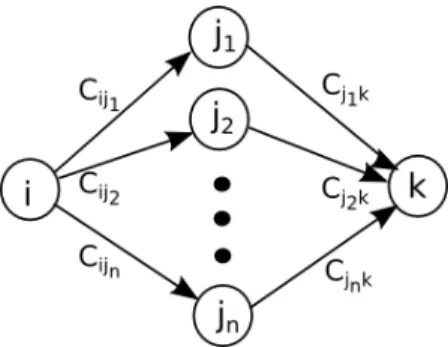
This notion is used in trust and reputation management of particularly peer-to-peer systems to calculate indirect trust between peers. For instance, in EigenTrust, a competent reputation management system, proposed by Kamvar et al. [16], indirect trust of a peer i in peer k is:
tik =
X
j∈J
cij×cjk
wherecij is the direct trust of peer iin peerj and similarly cjk is the opinion
of peer j in peer k, where 0 ≤ cij, cjk ≤ 1. In other words, peer i makes a
weighted average of opinions of other peers about peer k where weights are
the trust that peerihas in them as a result of direct interactions. Each
mul-tiplication term in the above summation indicates an indirect trust relation between peers i and k through peer j as it is shown in gure 3.1.
The above formula contains one level of indirection which is sometimes not enough to establish trust between two peers because in a trust network there might be multiple intermediary peers between subject and object of the trust relation. For instance, Alice knows Bob who knows Carol who has an opinion about the performance of a candidate employee called David. Obviously, the length of trust paths can be arbitrary.
Indirect trust is useful when sucient or reliable direct experience with a party is lacking. In peer-to-peer systems because generally a peer is neither
Figure 3.1: Indirect trust paths from peer i to peer k through intermediary
peers.
assumed to be consistent in its sampling nor always completely reliable in reporting its true opinions. Therefore, generally direct opinions of no single peer can be considered as sucient and reliable, rather this information is scattered in the network. Thereby, reputation management systems usually traverse indirect trust paths which are formed amongst peers, and aggregate their local trusts into global trust values regarding peers i.e. their reputa-tions. As it will be illustrated later in section3.2, one of the more signicant factors of trust and reputation management systems is their approach in taking indirect trust paths into analysis.
3.1.2 More on Trust and Reputation
Before proceeding to analysis of a network of trust , it is essential to elaborate more on trust and reputation and their dierences to prevent confusion5.
Trust and reputation are closely related notions, however Jøsang et al. in [33] point out a subtle distinction between trust and reputation (in the senses that they are used in this thesis and many reputation systems). Simply put, reputation can be considered as an objective global measure that is formed by aggregation of opinions of all peers, but (direct) trust is subjective and local to peers themselves.
For instance, when an entityAstarts interacting withBfor the rst time, 5Please note that the following concepts do not have xed and standard denitions in
literature. Therefore those denitions have been adopted which can help meet the goals of this thesis to the best of author's knowledge
she does not have a personal sense of trust in him due to lack of previous direct experience. However, she might want to put her trust in B based
on its reputation that can be considered as an objective measure of trust in B which is estimated by reputation system. Later when A gains enough
experience regarding B and forms a level of trust in him, this trust might
be close to B's global reputation or very dierent based on A0s individual
experience of B, or a special relationship between them.
Jøsang et al. in [14] bring up the concept of scope of trust which is infor-mally equivalent to the quality, service. . . that trust is based on. For instance when Alice trusts in Bob's recommendation regarding Charlie's work ethics, the scope of trust is work ethics. Authors also have made an interesting dis-tinction between two variants of trust regarding a scope, namely functional trust and referral trust:
Functional trust is a type of trust that is result of a trusting party's eval-uation of a trusted party regarding the scope of trust e.g. Bob's trust in Charlie regarding his work ethics is functional trust, since its the outcome of Bob working directly with Charlie.
Referral trust is the trust a party has in the ability of a trusted party to precisely reect the trustworthiness of a third party regarding the scope of trust e.g. Alice's trust in Bob's ability to correctly recommend Charlie as a good worker is Alice's referral trust in Bob.
It should be noted that direct functional trust regarding a scope can be extended to indirect functional trust as a result of trust transitivity6. For
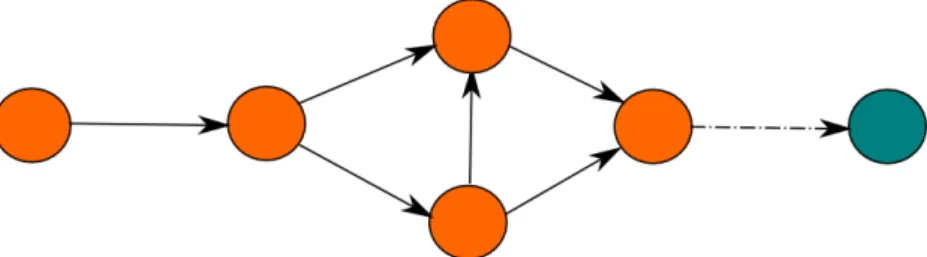
instance Alice will have an indirect functional trust in Charlie by considering Bob's recommendation about him. The indirect functional trust that Alice has in Charlie might be weaker than Bob's direct trust in him due to Alice's partial trust in Bob's recommendation. As it is illustrated in gure 3.2, an indirect trust path can be of arbitrary length but it is necessary that every path ends with a direct functional trust which guarantees the functional nature of the indirect functional trust.
6Trust transitivity is possible for a trust scope when both direct functional and referral
Figure 3.2: Indirect functional trust (adapted from [14])
In a reputation system that takes indirect trust paths into calculation, reputation of a peer then can be considered as global indirect functional trust of the reputation calculating entity e.g., a central server, another peer. . . , in that peer. Therefore, if the direct functional trust of peers in each other is dened to be based on the scope of availability, then the reputation of peers is the global measure of their availability i.e. the availability that is aggregated from various sources taking into consideration the trustworthiness of sources. The distinction between functional trust and referral trust is important because it allows mounting special functionalities on top of already existing reputation systems. For instance, EigenTrust is a reputation algorithm that does not distinguish between referral trust and functional trust, perhaps be-cause both referral trust and functional trust have the same denition in this system which is based on the reliability of node in data provision. That might be ne as long as the purpose of the reputation algorithm is to rank peers based on their reliability. However, if the denition of a reputation should indicate another aspect of the system e.g., availability, then the denition of functional trust should be changed accordingly so that peers could also reect on that aspect.
Thereby, before modifying the actual reputation algorithm to calculate peer availability, the elemental components, being the referral and functional trusts, should rst be redened accordingly. Since the availability calculation algorithm proposed relies on subjective logic[35], we follow the same notation.
Referral trust: The referral trust of peer A in peer B is shown by ωA B, as
A's degree of belief inB's honesty, and is estimated by A based on its
data toA.
Functional trust: The functional trust of peer A in peer B is shown by ωA
xB, as A's degree of belief in B's ability to respond correctly to its
requests. Obviously, this requiresB not only to provide authentic data,
in the sense dened above, but also be available and behave correctly regarding the communication protocol between the two. Functional trust is obtained by A based on its observance of B's past behavior.
The role of referral trust, as previously mentioned, is to provide the trusting party with an estimation of the reliability of the trusted party's opinions regarding third parties. To this end, a peer's capability to correctly return the data blocks, which it has been assigned to, can be considered as a measure of it's reliability and consequently trustworthiness in giving correct feedbacks. This assumption for instance has been incorporated in EigenTrust[16].
However, the above denition of referral trust might be subject to crit-icism as its does not include the correctness of the feedbacks of a trusted party about other nodes. In fact, some malicious peers might provide au-thentic data to gain high levels of referral trust but when requested for feed-back, they return false information to discredit honest peers or glorify other malicious peers.
Dealing with this type of malicious behavior is non-trivial in this system (and many other reputation systems). Because, peers do not directly query other peers for highly trusted peers. If this were the case, then the referral trust of a trusted peer could have been directly penalized upon a bad recom-mendation. Rather, here, a peer asks the central reputation managers e.g., central servers, which in turn rely on peers feedbacks to calculate reputations and in this regard they run a complicated aggregation algorithm that makes average values out of the feedbacks from all the peers. In this situation it is very dicult to trace back the source of incorrect feedback. But still based on an assumption that most of the peers in the network are honest in their feedbacks, the system should survive by outnumbering the malicious peers.7
7Please recall that although the central servers are not responsible for actively probing
A point worth mentioning about the denition of functional trust is that it can be changed independently of the reputation algorithm that is presented later in this chapter. At this point the roots of unavailability which fulll the requirements of the application are included in the above denition. However, if need be, this denition can be modied without requiring any modication in the main reputation algorithm. This is a positive side-eect of discerning between trust variants.
Also note that the above denition of functional trust is based on combi-nation of dierent metrics. Merging dierent metrics into one has also been suggested in other reputation systems such as FuzzyTrust[21]. In the next part, the trust representation is explained according to subjective logic and Bayesian statistics.
3.1.2.1 Trust Representation
Trust can be represented in various forms the simplest of which is by Boolean values i.e. an entity is either trusted or not. Another way is the discrete representation where a trust value is chosen from a nite set of ordinal dis-crete values[36]. However, often reputation systems use more sophisticated continuous representations which are capable of conveying higher levels of information which at least allow a more ne-grained comparison between rankings. For instance, EigenTrust uses normalized local trust values which are calculated as is shown below:
cij is the normalized local trust of peer i in peer j and is equal to
max(sij,0) P
kmax(sik,0) where sij =sat(i, j)−unsat(i, j)also sat(i, j)and unsat(i, j)
are respectively the number of past successes and failures of peeri in
having satisfactory transactions with peer j.Each peer can keep track of the
number of its satisfactory and unsatisfactory transactions with other peers and therefore calculate the normalized local trust values as mentioned. These local trust values are then converged into global trust values by EigenTrust algorithm which are also positive real numbers in[0,1].
query them to nd their (possibly new highly available) partners. In other words, reputation algorithm is executed on those servers.
The global and local trust values are eective in ranking the peers (globally and locally) based on their trustworthiness. However, as the authors of EigenTrust also conrm[16], these values do not have any absolute probabilistic interpretation and are only useful for relative comparison of peers with each other in terms of trustworthiness. Recall from section 2.2 that, the objective of this thesis is to estimate the availability of peers in a probabilistic form that captures and expresses the uncertainty existing in availability values. Obviously, the representation of trust that is proposed in EigenTrust does not fulll this requirement. Two dierent methods of expressing uncertainty, namely, fuzzy logic and subjective logic, have been already exploited in trust managements systems.
FuzzyTrust[21] is an eective reputation system that is based on fuzzy logic. It calculates reputation by aggregating local scores which are derived from the result of a set of fuzzy inference rules. For instance, availability might be dened by the following rules
• If a partner's rate of communication failures is low and the rate of
inauthentic content download is high, then the availability is very low.
• If a partner's rate of communication failures is medium and the rate of
inauthentic content download is medium, then the availability is low. The results of these rules are superimposed i.e., aggregated, and defuzzied by each peer, to produce the local trust score values. A set of fuzzy member-ship functions are used to map the actual observation numbers into a set of predened fuzzy levels e.g. very low, low, medium, etc. by which, the fuzzy inference rules are denable.
An advantage of fuzzy inference rules is that they are easily human-understandable and thus provide the means for designers to dene or extend the rule sets based on application requirements. Also, being dened as fuzzy propositions, these rules deal with uncertainty. However, the precision is sac-riced in the process of mapping values to fuzzy levels; rule-based inference; and aggregation i.e., superimposition, of the results of rules. For instance, the degree of uncertainty directly depends on the number of fuzzy levels and
the shape of membership functions which are dened by the designer. In other words, uncertainty is articially embedded in membership curves to approximate the real uncertainty in data[38]. This is while in our system it is essential to estimate the real uncertainty that is inherent in the sampled data so that replica placement subsystem can take it into calculations.
Subjective logic is another approach for expressing uncertainty explic-itly in trust values[13]. Trust in subjective logic is shown in the form of an opinion tuple which is of the form hb, d, u, ai whereb stands for belief, d for
disbelief,ufor uncertainty, anda is atomicity which is a xed a priori degree
of belief i.e., a way to embed the foreknown success probability of a trusted party into an opinion. Also, the equation b+d+u = 1 always holds. As it
is obvious from the equation, as the degree of belief or disbelief grows, the uncertainty level shrinks. Intuitively, as a trusting party gains more positive and/or negative experience regarding a trusted party, her belief and/or dis-belief in that party's trustworthiness becomes stronger and consequently the uncertainty in her opinion about him is reduced. This relationship is shown in the the following denitions between r and s, which are the number of
successful and unsuccessful experiences regarding the trusted party, andb, d,
and u: b= r+rs+2 d= r+ss+2 u= r+2s+2 ⇐⇒ ( r = 2b/u s= 2d/u (3.1)
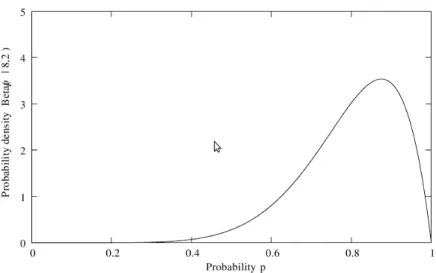
In [13], Jøsang justies a bijection between opinion tuples and beta prob-ability distribution functions (PDF) which are also a way to represent a posteriori probabilities of binary events in Bayesian statistics[12]. A beta distribution can be denoted by Beta(α, β) whereα and β are shape
param-eters of the distribution. Figure 3.3 shows some of the instances of beta distribution. As it can be observed, for the greater α and β, the certainty
around a particular probability value also increases. αandβ are in direct
re-lationship with number of successful and unsuccessful experiments i.e.r and s, and hence a mapping between them and opinion tuples exists which is
Figure 3.3: Beta PDF instances (taken from [12]) b= r+rs+2 d= r+ss+2 u= r+2s+2 a=atomicity ⇐⇒ ( r = 2b/u s= 2d/u ⇐⇒ α=r+ 2a β =s+ 2(1−a) a =atomicity (3.2)
Informally, a beta PDF approximates the uncertain probability of future successful experiments by combining prior knowledge with evidence that is acquired from past observations. It has been reminded in [14] that a beta PDF is dened on a probability variable (as it is depicted in Fig. 3.4). Therefore, a beta PDF is a second order probability. For instance, if we assume that the variable p in gure 3.4 shows the probability of a successful interaction with a node in future, then the beta PDF indicates that 0.8 is
about the average probable value for this probability (p).
Since we have adopted opinion tuples to be the representative form of trust values, therefore both functional trust and referral trust have corre-sponding beta PDFs. This facilitates the replica placement decision subsys-tem with probabilistic analysis capability. For instance, Rp2
p1 beta(α, β) can
show the likelihood that a node responds correctly with probability that falls in[p1, p2]. As a result, this representation helps achieve an important goal of
this thesis which is to provide replica placement subsystem with a represen-tation for a node's availability that not only have probabilistic interprerepresen-tation but also quantify uncertainty explicitly in a way that in can be taken into
Figure 3.4: A beta PDF is a dened on a probability variable (taken from [14])
calculations by replica placement subsystem.
Subjective logic includes a set of operators to manipulate the opinions for trust network analysis. Fortunately, since there is a mapping between opinion tuples and beta PDFs, the subjective logic operators provide the means to implicitly modify the parameters of beta curves consistently. Next section uses a related subset of subjective logic operators to approach the trust network analysis and availability calculation problems.
3.2 Availability Calculation
Recall from the previous section that trust transitivity allows calculation of indirect trust of one node in another along arbitrarily long trust paths. However, usually trust networks consist of parallel paths as it is shown in Fig. 3.5and therefore a rather comprehensive mechanism should include the information from all of these paths in trust analysis and possibly aggregate them into one trust value between two nodes. In this regard, two famous methods are compared here and one that seems more suited to meet the requirements is chosen to inspire the approach to trust network analysis in the thesis.
Figure 3.5: Parallel paths of trust between two nodes
one node in another according to the paths from the source to the destination in order to oer a precise trust network analysis based on subjective logic opinion tuples and operators. To this end, rst all the paths between the source and the target are discovered. Then these paths are combined to construct simplied graphs, called directed series-parallel graphs (DSPG), which are resulted from removing the cycles and dependencies. A DSPG then can be traversed to calculate the trust value of the source in the target. However, there are2n−1possible DSPGs construct-able forndierent paths,
of which the one resulting in the least amount of uncertainty in the nal trust value is desirable. Although there are algorithms for recognition of DSPGs in linear time[37, 39] which can be used for nding such DSPGs (and thereby for estimation of trust values), however still there are prohibitive computational burdens in using this technique for large networks.
As the system ages the number of edges increase in a trust network, and thereby number of paths grow exponentially. In this situation, even a linearly complex DSPG recognition algorithm is hindered by the great number of paths[24]. Note that this is only for recognition of a DSPG between two nodes. When global reputation is to be calculated, the opinion of each node on any directly/indirectly connected node must be taken into account which results in DSPG recognition algorithm to be called O(n2) which obviously
increases the computational costs even more.
Therefore, the more ecient trust network analysis technique of Eigen-Trust [16] is adopted here, in order to combine it with subjective logic opinion tuples and operators to exploit both the eciency of EigenTrust algorithm and features of subjective logic opinion tuples.
Algorithm 3.1 The basic centralized version of EigenTrust algorithm 1 ~t(0) =c~ i 2 repeat 3 ~t(m+1) ←CT~t(m) 4 δ← ||~t(m+1)−~t(m)|| 5 untilδ <
C (illustrated in Fig. 3.6a) where element cij is the local trust of node i in
nodej. The trust values represented by elements of the matrix are the
nor-malized local trust values (ref 3.1.2.1). Letti=CTci whereciis the normalized
local trust vector of peer i in other peers. If looked closely each element of tik of vector ti is calculated according to the formula tik = Pj∈Jcij ×cjk.
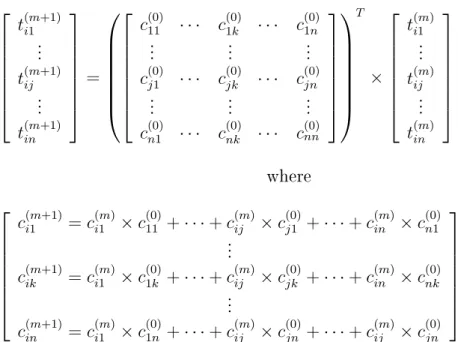
This is the same formula that was mentioned in section 3.1.1, and recall that it calculates one level of indirect trust by aggregating opinions of other peers regarding peeri. If the above denition oftiis now extended to ti=(CT)mci,
where m is a positive integer, then the eect will be that paths of trust of
length m among nodes are taken into calculation i.e., m level of indirection
will be included. The expressionti=(CT)mci can be reformulated as a
recur-sive expression of the form t(im+1)=CTt(im), an illustration of which is shown
in gure 3.6b.
The very basic centralized version of EigenTrust algorithm that uses
t(im+1)=CTt(m)
i is shown in algorithm 3.1. For a big enough value of m,
ti converges to the left principal eigenvector of C and therefore algorithm
terminates. Theti vector will contain the indirect trust of node iin all other
nodes, resulted from aggregating multiple paths of indirect trust until con-vergence. Results show that this technique is very eective in calculation of nodes reputations. It is also more ecient than the previous technique of trust network analysis as the algorithm converges fast according to[16].
Therefore we rely on EigenTrust trust calculation model to compute the reputation of the nodes. However, instead of using normalized local trust values, local opinions tuples of peers are incorporated. Moreover, instead of using multiplication and addition of elements in matrix/vector products,
C= c11 c12 · · · c1n ... ... ... cn1 cn2 · · · cnn
(a) Trust network matrix represen-tation t(im1 +1) ... t(ijm+1) ... t(inm+1) = c(0)11 · · · c(0)1k · · · c(0)1n ... ... ... c(0)j1 · · · c(0)jk · · · c(0)jn ... ... ... c(0)n1 · · · c(0)nk · · · c(0)nn T × t(i1m) ... t(ijm) ... t(inm) where ci(1m+1) =ci(1m)×c(0)11 +· · ·+cij(m)×c(0)j1 +· · ·+c(inm)×c(0)n1 ... c(ikm+1) =ci(1m)×c(0)1k +· · ·+c(ijm)×c(0)jk +· · ·+c(inm)×c(0)nk ... c(inm+1) =ci(1m)×c(0)1n +· · ·+c(ijm)×c(0)jn +· · ·+c(ijm)×c(0)jn
(b) Recursive expression of global trust calculation based on matrix of normalized local trust values.
Algorithm 3.2 Simple availability calculation algorithm.
1 Let~ci be a vector where cij is the direct referral trust of iin node j.
2 LetC be a metrix where element cij =the direct referral trust of node iin j.
3 LetF be a matrix where element fij =the direct functional trust of node i
inj. 4 ~t(0) =~c i 5 fori←0 to N 6 do 7 ~t(i+1) ←CT×˙~t(i)
where ×˙ is an overload of matrix product where
multiplication is replaced by subjective logic discount operator ⊗ and addition
is replaced by average fusion operator ⊕
8
9 fork ←1to # of nodes
10 do
11 aik ←t1⊗f1k⊕t2⊗f2k...tn⊗fnk
~ai now contains indirect functional trust i.e. availabilities of all nodes
from point of view of node i.
two subjective logic operators are used, which will be explained in the next subsection.
3.2.1 The Basic Availability Calculation Algorithm
The simple version of the availability calculation mechanism is shown in the algorithm 3.2. From line 1 to 6, the algorithm calculates the indirect referral trust of node i in all others. Then from line 7 to 10, the availability of a
peer k is calculated as the weighted average of functional trusts of all other
nodes in k. The weights are the trust values in peers that judge k which
were calculated in previous lines. In other words, trustworthiness of the judging nodes weighs the inuence of their judgments regarding other nodes' availabilities.
Note that using opinion tuples instead of normalized local trust values, entails usage of subjective logic operators as mentioned earlier. To this end,
two operators from subjective logic are used to replace multiplication and addition operators in matrix product. Namely, discount operator(⊗)[13] for
multiplication and average fusion operator (⊕) [40]for addition. The discount
operator is used when moving along a trust path to compute the eect of trust transitivity similar to multiplication in EigenTrust(Ref. 3.1.1 ), while the average fusion operator is used to combine parallel paths of trust in order come to a consensus of opinions regarding the scope of trust.
More specically, average fusion operator is applicable when dependent opinions regarding a single object are to be combined e.g. availability of a node at a relatively short period of time, when observed by other nodes, can yield several dependent opinions regarding the node which can be combined using averaging fusion operator8.
Eventually, lines 7 to 10 calculate the availability by rst discounting and then averaging the opinions, in order to compute the weighted average of the opinions of all nodes regarding a node's availability. Note that opinions of nodes are weighted based on their trustworthiness which is intuitive since opinions of the more trustworthy nodes should be of more eect.
An important matter to note is that the convergence detection condition in line 5 of algorithm 3.1 has been replaced with a bound checking condition in the for-loop of line 3 in algorithm 3.2. This is because here we can not expect the algorithm to converge due to not normalizing trust values as it is done in EigenTrust[24]. However, still the matrix multiplication scheme can be exploited as an ecient mechanism to calculate trust along chains of nodes. Eectiveness of this method is demonstrated empirically in the next chapter.
3.2.2 A More Ecient Availability Calculation Algorithm
The algorithm proposed in the previous subsection can be enhanced in terms of eciency in some aspects. Algorithm 3.3 presented here takes into account the concepts of isolated sub-graphs, and intervals to provide a more ecient
8There is another fusion operator called cumulative fusion operator (⊕) which is
ap-plicable to independent events such as observations of a node's availability in dierent time periods. We will be assisted by this operator to concoct a more ecient version of the algorithm in the next subsection.
![Figure 3.2: Indirect functional trust (adapted from [14])](https://thumb-us.123doks.com/thumbv2/123dok_us/664407.2580127/35.892.265.661.174.312/figure-indirect-functional-trust-adapted-from.webp)
![Figure 3.3: Beta PDF instances (taken from [12]) b = r+s+2rd = r+s+2su = r+s+22 a = atomicity ⇐⇒ ( r = 2b/u s = 2d/u ⇐⇒ α = r + 2a β = s + 2(1 − a)a = atomicity (3.2)](https://thumb-us.123doks.com/thumbv2/123dok_us/664407.2580127/40.892.273.599.216.380/figure-beta-pdf-instances-taken-rd-atomicity-atomicity.webp)