EXCELSIOR GOLD LIMITED
ABN 38 123 629 863
30 June 2015 Annual Report
CORPORATE DIRECTORY
Directors
Peter John Bird (Chairman)
David Alan Hamlyn (Managing Director) David Sidney Potter (Technical Director)
Chen Chik (Nicholas) Ong (Commercial Director)
Company Secretary
Chen Chik (Nicholas) Ong
Registered Office
Unit 2
124 Stirling Highway North Fremantle WA 6159 Telephone: +61 8 9335 7770 Facsimile: +61 8 9335 6231 Email: [email protected] Website: www.excelsiorgold.com.au Auditors
BDO Audit (WA) Pty Ltd
38 Station Street, Subiaco WA 6008
Share Registry
Security Transfer Registrars 770 Canning Highway Applecross WA 6153
Telephone: (08) 9315 2333 Facsimile: (08) 9315 2233
Stock Exchange Listing
The Company is listed on the Australian Securities Exchange Ltd (ASX) Home Exchange: Perth, Western Australia
ASX Code: EXG
Company Profile 4
Managing Director’s Review 5
2014/2015 Development Milestones 8
Directors’ Report 11
Review of Operations 12
Auditor’s Independence Declaration 46
Consolidated Statement of Profit or Loss and Other Comprehensive Income 47
Consolidated Statement of Financial Position 48
Consolidated Statement of Changes in Equity 49
Consolidated Statement of Cash Flows 50
Notes to the Consolidated Financial Statements 51
Declaration by Directors 92
Independent Auditor’s Report 93
Additional ASX Information 95
Company Profile
Excelsior Gold Limited (“Excelsior Gold” or “the Company”) (ASX: EXG) is an emerging Australian mineral exploration and development company with a core focus on developing its 100% owned Kalgoorlie North Gold Project (“Project”) located 30 to 55 kilometres north of Kalgoorlie in Western Australia’s highly prospective Eastern Goldfields.
The Project covers 134 square kilometres of tenements over 25 kilometres of strike of the Bardoc Tectonic Zone greenstone belt.
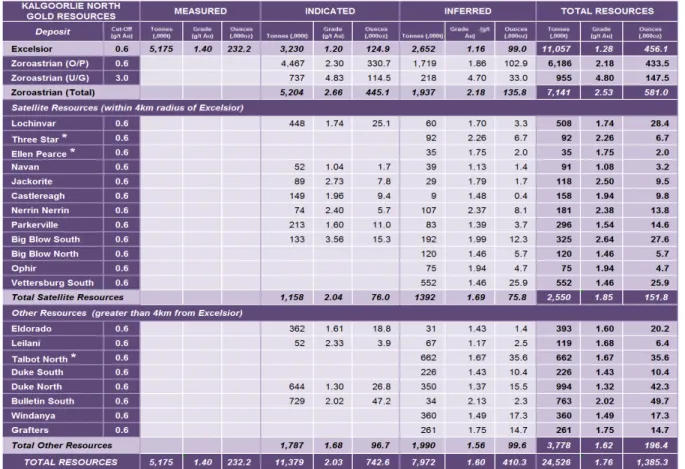
Mineral resources delineated to date total 24.53 million tonnes at 1.76g/t Au for 1,385,100 ounces of contained gold (at 0.6g/t and 3.0g/t Au cut-‐off grades).
The close proximity of the Company’s deposits to Norton Gold Fields Limited’s (“Norton”) Paddington treatment plant (“Paddington Mill”) has enabled Excelsior Gold to progress the development of the Project through cooperative milling agreements with Norton.
Two processing agreements are in place which will provide access to the Paddington Mill for the treatment of KNGP ores. The Bardoc South Ore Treatment Agreement (ASX announcement 18 February 2015) covering the processing of a series of smaller satellite deposits within the Bardoc South tenements and the longer term Capital Contribution and Ore Treatment Agreement (ASX announcement 20 October 2014) commencing in 2016.
Excelsior is proposing to mine three small open pits in the Bardoc South area in late calendar 2015 followed by the development of the larger Zoroastrian Central open pit to provide ore to the Paddington Mill in 2016 and 2017 and the Bulletin South open pit in 2018.
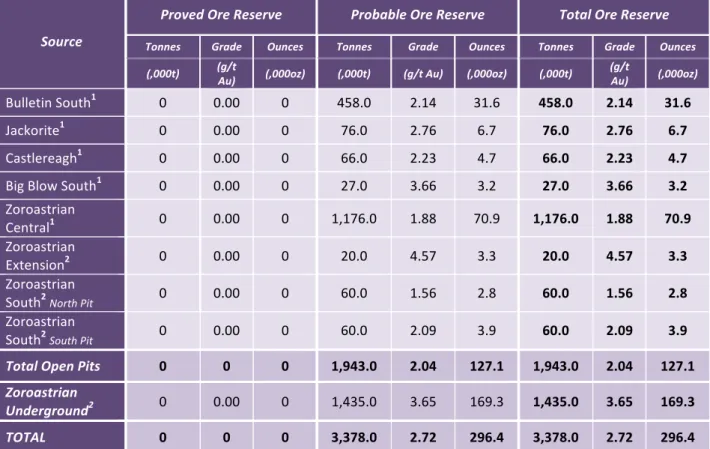
The current mining schedule is centred on the proposed development of only five of the most advanced deposits within the Project’s 22 resource areas. Probable Ore Reserves for the initial open pit development phase of the Project are 1.94 million tonnes grading 2.04g/t Au for 127,100 ounces of gold.
Pre-‐feasibility level studies have also established underground mine Ore Reserves at the Zoroastrian deposit which total 1.43 million tonnes at 3.65g/t Au for 169,300 ounces of gold. The potential underground mine plan will be updated as new information on the mineralisation at Zoroastrian becomes available from the mining of the open pit and can be utilised to target further drilling to confirm and expand the underground ore reserves.
The Project exhibits extensive widespread gold mineralisation outside the currently defined resources and reserves and the Company is targeting further resource expansion at both the existing deposits and in new resource areas.
Cash flow generated from future gold production will be directed towards further exploration drilling aimed at realising the large potential of the gold mineralisation within the Project hence further generating value to shareholders.
Managing Director’s Review
The Company’s focus for the year has been on mine development at the Kalgoorlie North Gold Project on the back of the Capital Contribution and Ore Treatment Agreement with Norton Gold Fields executed in October 2014. This agreement secured a minimum 500,000 tonnes per annum (“tpa”) of mill capacity at the Paddington Mill for an initial allocation of 2.5 million tonnes of ore with processing scheduled to commence in January 2016. Excelsior Gold was committed to contribute part of the cost of upgrading the Paddington plant, capped at A$12.5 million, in return for the mill allocation and attractive open book treatment costs.
An additional treatment agreement with Norton, the Bardoc South Ore Treatment Agreement, was executed in February 2015 which brought the promise of earlier mine production prior to January 2016 from the Bardoc South deposits in the southern part of the tenement area.
The take-‐over of Norton by its major shareholder, Zijin Mining Group Co. Ltd (“Zijin”), in June 2015 resulted in delays to the proposed mill upgrade as Zijin assessed the scope of the mill expansion. This delay in the upgrade did not impact on Excelsior Gold’s rights to treat ore at the Paddington Mill however did affect the timing and magnitude of funding of the Company’s portion of the capital required to upgrade the Paddington Mill.
In a difficult year for the resource sector, Excelsior Gold has successfully steered a path to gold production and sustaining cash flow which will underpin the Company’s future. With the focus on production, activities during the year have been directed primarily towards extensive mining feasibility studies including open pit and underground mine designs and infill drilling programs in proposed open pit areas.
In terms of contained gold, Mineral Resources remained relatively unchanged however resource confidence improved with conversion of Inferred resources to Indicated classification. Current Measured, Indicated and Inferred Mineral Resources for the Project total 24.52 million tonnes @ 1.76g/t Au for 1,385,100 ounces at 0.6 and 3.0g/t Au lower cut-‐offs.
Reverse circulation and diamond drilling campaigns were directed at the initial proposed production areas at Zoroastrian, the Bardoc South satellite pit areas and Bulletin South to drill out proposed open pit areas and to provide geotechnical information and metallurgical samples. The emerging Bulletin South area continued to demonstrate potential for resource growth and larger mine development with a 33% increase in resource ounces and robust drill intercepts outside the current open pit design on extensions to the known mineralisation (ASX announcements 28 October 2014 and 10 April 2015).
The Base Case open pit Ore Reserve of 1.94 million tonnes grading 2.04g/t Au for 127,100 ounces provides an initial four year mine life under the minimum treatment provisions (500,000tpa) of the agreement with Norton and provides time and cash flow to finesse the underground mine studies at Zoroastrian and bring additional open pit ore reserves into the mining sequence. The current underground Probable Ore Reserves at Zoroastrian total 1.44 million tonnes grading 3.65g/t Au for 169,300 ounces of gold.
The Company has mining approvals in place for the initial open pit mine plan and at the time of this report was in the process of finalising funding. The Company accepted a credit approved $15 million loan and hedging program from Macquarie Bank Limited (“Macquarie”) in July 2015 to provide funding for Excelsior Gold’s share of the capital contribution to the Paddington Mill upgrade is further endorsement of the merits of the Project. Discussions with Macquarie are ongoing on the finalisation of the project funding documentation.
The Company’s Kalgoorlie experienced mining team is in place with grade control drilling at the initial Bardoc South open pits completed and haul road construction initiated. Mining is scheduled to commence in November 2015.
The activities of the past financial year and the subsequent developments have paved the way for Excelsior Gold to transition to gold production in a cost effective and streamlined manner. The treatment pathway has largely de-‐risked the development of the Project and protected the exploration and resources growth upside.
The milling arrangements with Norton aligns Excelsior Gold with a financially strong partner who has demonstrated a willingness to invest capital and pursue acquisitions to underpin the security of its operations. These arrangements also expose the Company to the potential for higher milling allocations at the Paddington Mill. At its own election, the Company has the ability to continue to evaluate the feasibility of a new stand alone processing plant for the Project or additional processing opportunities with other processing companies in the district.
On behalf of all Shareholders, I thank the Company’s staff and contractors for the diligent work carried out over the year. The small geological field crew consisting of Meaghan Walley and led by Technical Director, David Potter and Exploration Manager, Bradley Toms, have continued to successfully grow resources and transform them to ore reserves during the year. The team is well supported by our North Fremantle Office staff, Database Manager, Amanda Lennon and Corporate Assistant, Grace Tan. The Company’s Commercial Director, Nicholas Ong has been pivotal in the successful contract negotiations with Norton and the financing arrangements with Macquarie. I thank them all for their commitment to the success of the Company’s programs.
I also welcome the Company’s new Kalgoorlie based mining team led by Mine Manager Randell Ford and Geological Superintendent, Hayden Parry. Both are highly experienced operators in the Kalgoorlie region who bring additional local mining and geological knowledge to the Company and who will be instrumental in the success of the mining operations.
I extend my thanks to our contractors who have provided valuable assistance to the Company throughout the year.
• Duncan Coutts from DC Consulting, Operations Manager for the Company since September
2014 and has provided leadership and guidance in feasibility studies, advice on mine design, mine scheduling and overall planning for operations readiness. Duncan’s input has been invaluable in the progressing of the approval process and the development of the mining program.
• Alexander Holm from Alexander Holm and Associates, the Company’s Environmental
Coordinator for environmental monitoring and management, preparation of mining proposals and facilitation of the approval processes.
• Auralia Mining Consulting for open pit optimization studies and mine design work on the
majority of the open pits in the initial mining program. The Auralia team, led by Daniel Tuffin, has had a long association with the Project and their early stage optimisation studies have help guide the Company’s drilling programs which have delivered low resource and ore reserve discovery costs.
Mining Plus Pty Ltd for underground mining studies and design work on the Zoroastrian
• Daniel Schwann Consulting and Scott Barry for metallurgical work and contribution to the
refinement of procedures under the ore processing agreements with Paddington Gold.
• Excelsior Gold’s Land Manager, Graham Williamson from Central Tenement Services for
tenement management.
• Mineral Administration Services for accounting and payroll services and implementation of
mine production accounting procedures.
• Kings Park Corporate Lawyers for legal advice.
• KPMG Corporate Finance for corporate advice and financial modeling. • Drilling contractors, Redmond Drilling and Westralian Diamond Drillers. • Toucan Resources and Mt Vetters Pastoral Company for field support.
The 2014/2015 financial year has been a transformational year for Excelsior Gold. No longer a junior explorer, the Company is now poised for production with processing agreements, mining approvals and a well experienced mining team in place to execute the initial mining plan for the Kalgoorlie North Gold Project.
David Hamlyn Managing Director
2014/2015 Development Milestones July 2014
s Execution of Macquarie convertible loan facility documentation and draw down of the first $2 million tranche (ASX announcement 22 July 2014).
s Commencement of a multi-‐stage development and exploration drilling program focussed on Zoroastrian, Bulletin South and new exploration areas (ASX announcement 30 July 2014).
August 2014
s Highly targeted reverse circulation drilling programs test extensions to the Zoroastrian mineralisation and infill Inferred mineral resource areas contained within and adjacent to preliminary open pit designs.
s Drilling enhances exploration and development potential at Bulletin South including result 19m @ 5.94g/t Au (ASX announcement 27 August 2014).
September 2014
s Further drilling success at Bulletin South indicates potential to extend preliminary open pit designs (ASX announcement 10 September 2014).
s Drilling at Parkerville extends mineralisation including 10m @ 3.99g/t Au (ASX announcement 17 September 2014).
s Definitive mine submissions from a number of mining contractors operations based on preliminary open pit mine designs identifies substantial cost reductions for the Project (ASX announcement 19 September 2014).
s Placement of 33.33 million shares at $0.06 each raising $2 million before costs (ASX announcement 29 September 2014).
October 2014
s Further resource drilling success at Parkerville, 11m @ 4.35g/t Au, and exploration drilling at Botswana West intersects wide zones of near surface gold mineralisation, 9m @ 1.32g/t Au from 1m depth (ASX announcement 7 October 2014).
s Execution of Capital Contribution and Ore Treatment Agreement with Norton (ASX announcement 20 October 2014).
s Bulletin South Mineral Resources increased by 25% to 729,700t @1,98g/t Au for 46,500ozs (ASX announcement 28 October 2014).
November 2014
s Infill resource drilling and geotechnical core drilling conducted at Zoroastrian to facilitate open pit and underground mine design (ASX announcement 12 November 2014).
s Parkerville Mineral Resources upgraded with 76% increase in contained ounces to 296,000t @ 1.54g/t Au for 14,600ozs (ASX announcement 26 November 2014).
December 2014
s Resource development drilling at Zoroastrian continues to confirm resource interpretations and drilling at Navan laterite resource indicates low cost mine potential with gold
s Resource development drilling at Bulletin South defines extensions to gold mineralisation including 13m @ 5.06g/t Au, demonstrating potential for expansion of conceptual open pit design (ASX announcement 18 December 2014).
February 2015
s A second ore treatment agreement, the Bardoc South Ore Treatment Agreement, executed with Norton provides earlier pathway to production by mining and processing of Bardoc South deposits prior to end December 2015 (ASX announcement 18 February 2015).
March 2015
s Open pit mine design and feasibility works completed on four Bardoc South deposits (Castlereagh, Jackorite, Big Blow South and Nerrin Nerrin) establish Ore Reserves of 205,000t @ 2.75g/t Au for 18,100ozs (ASX announcement 18 March 2015).
s Mining Proposal lodged with Department of Mines and Petroleum on 12 March 2015 for development of Bardoc South and Bulletin South open pits.
s Placement of 24.22 million shares at $0.09 each raising $2.33 million before costs (ASX announcement 30 March 2015).
April 2015
s Bulletin South Mineral Resource upgraded to 762,900t @ 2.02g/t Au for 49,500ozs and Ore reserves of 458,000t @ 2.14g/t Au for 31,600ozs established from mine design studies (ASX announcement 10 April 2015).
s Drilling at Bulletin South intersects strong gold mineralisation beneath Ore Reserve open pit design including 20m @ 4.44g/t Au (ASX announcement 14 April 2015) and 25m @ 3.71g/t Au (ASX announcement 22 April 2015).
May 2015
s Close spaced infill drilling initiated on Bardoc South deposits as precursor to grade control drilling.
s Mining Proposal for the development of the Zoroastrian Central and Extended open pits was lodged with Department of Mines and Petroleum on 29 May 2015.
June 2015
s Infill drilling at Big Blow South confirms high grade gold mineralisation including 3m @ 13.3g/t Au from 51m depth and 2m @145g/t Au from 60m (ASX announcement 4 June 2015).
s Castlereagh infill drilling confirms and extends open pit mine potential with intersections outside Ore Reserve pit design including 8m @ 3.81g/t Au (ASX announcement 24 June 2015).
Subsequent Events July 2015
s Zoroastrian Mineral Resources updated and Ore Reserves of 2.63mt @ 2.84g/t Au for 239,900ozs established from open pit and underground mine design and feasibility studies (ASX announcement 6 July 2015).
s Bardoc South and Bulletin South Mining Proposal approved for development the Castlereagh, Jackorite, Big Blow South, Nerrin Nerrin and Bulletin South open pits with combined Ore Reserves of 690,000t @ 2.32g/t Au for 49,700ozs (ASX announcement 9 July 2015).
s Grade control drilling from surface commenced at Castlereagh, Jackorite and Big Blow South open pit areas.
s A credit approved $15 million loan and hedging facility with Macquarie accepted consisting of $12 million loan facility and $3 million call grant facility, subject to conditions precedent including an equity of subordinate debt raising of $7 million by the Company (ASX announcement 13 July 2015).
s Zoroastrian Mining Proposal approved covering the development of the Zoroastrian Central and Zoroastrian Extended open pits with combined Ore Reserves of 1.196mt @ 1.92g/t au for 74,200ozs (ASX announcement 28 July 2015).
s Ore Reserves approved for mining at Bardoc South, Bulletin South and Zoroastrian total 1.886mt @ 2.07g/t Au for 123,900ozs.
DIRECTORS’ REPORT
Your Directors present their report on the consolidated entity of Excelsior Gold Ltd (“the Group”) and the entities it controlled at the end of, or during, the year ended 30 June 2015 and the state of affairs at that date.
DIRECTORS
The following persons were directors of the Group during the whole of the financial period (or as disclosed) and up to the date of this report:
Mr David Hamlyn Mr David Potter
Mr Chen Chik Ong Mr Peter Bird
PRINCIPAL ACTIVITIES
The principal activity of the Company is gold exploration and mine development at its Kalgoorlie North Gold Project.
FINANCIAL RESULTS
The loss of the Group after providing for income tax for the financial year was $3,101,694 (2014: $1,884,980).
DIVIDENDS
No dividends have been paid or declared and no dividends have been recommended by the Directors.
REVIEW OF OPERATIONS
KALGOORLIE NORTH GOLD PROJECT
The Project is located 30 to 55 kilometres north of Kalgoorlie in Western Australia and covers 134 square kilometres of granted mining leases and prospecting licences over 25 kilometres of strike of the Bardoc Tectonic Zone greenstone belt (refer Figure 1).
Historic gold production from the Bardoc Mining Centre in the central part of the tenements occurred from the underground Zoroastrian Mine in the late 1890s to early 1900s and from the Zoroastrian and Excelsior open pits mined by Aberfoyle Gold Pty Limited between 1987 and 1991. Open pit production totalled 2,220,000 tonnes at 1.6g/t Au for 113,000 ounces of gold.
The Project is located at the convergence of two major gold mineralising structural systems, the Bardoc Tectonic Zone and the Black Flag Fault.
The Bardoc Tectonic Zone represents the northern extensions of the Boulder Lefroy Fault system which hosts extensive gold mineralisation and world class gold deposits including the St Ives camp in the south and the Golden Mile at Kalgoorlie-‐Boulder.
The Black Flag Fault is interpreted to be a mineralised link structure between the Zuleika Shear to the west and the Bardoc Tectonic Zone and influences major deposits at Kundana and Mount Pleasant to the west.
The convergence of these structural systems within the Project area creates an intensely mineralised area with a multitude of gold occurrences related to the interaction of the north-‐north-‐west trending Bardoc Tectonic Zone and the north-‐east trending Black Flag Fault structures.
Exploration to date has delineated priority areas within the extensive mineralisation including:
Ø 22 defined resource areas to date totalling 1,385,100 ounces Au (at 0.6 to 3.0g/t Au cut-‐offs) including
o 2 large gold resources at the Zoroastrian and Excelsior deposits which host current Measured, Indicated and Inferred resources of 1,037,100 ounces of gold
o an expanding resource at Bulletin South which currently totals 49,500 ounces of Indicated and Inferred resources
o 19 satellite resource areas containing Indicated and Inferred resources totalling 298,600 ounces Au;
Ø 18 advanced prospects where additional drilling and resource modelling is warranted to quantify mineral resources;
Ø 51 zones with significant drill intercepts which present further resource expansion opportunities; and
Ø Numerous additional untested structural, geochemical and hyperspectral targets.
Total current Measured, Indicated and Inferred Mineral Resources for the Project, at 0.6 and 3.0g/t Au cut-‐off grades, are:
24.52 million tonnes @ 1.76g/t Au for 1,385,100 ounces
* This information was prepared and first disclosed under the JORC Code 2004. It has not been updated since to comply with the JORC Code 2012 on the basis that the information has not materially changed since it was last reported.
Rounding errors may occur.
Table 1: Kalgoorlie North Gold Project Resource Inventory
(July 2015 – refer ASX announcement 9 July 2015)
Figure 1. Kalgoorlie North Gold Project Prospect Location Plan, Geology, Tenements,
Resource Targets and Neighbouring Significant Gold Deposits showing gold resource ounces @ 0.6g/t and 3.0g/t Au lower cut-‐offs
ZOROASTRIAN
The Zoroastrian gold mineralisation is hosted in quartz veins and stockwork zones within the differentiated Zoroastrian Dolerite. The quartz veining has been defined over a strike length of 1.4 kilometres and to a maximum vertical depth of 380 metres. The system remains open along strike and at depth and the high grade gold content of the stockwork and the narrower vein style mineralisation demonstrate both open pit and underground mine potential.
Drilling programs conducted in December 2014, were designed to infill previous drilling which had delineated Indicated and Inferred Mineral Resources totalling 6.69 million tonnes grading 2.70g/t Au for 581,200 ounces of gold (ASX announcement 12 November 2013).
The 2014 drilling targeted Inferred Mineral Resource material and unclassified mineralisation within and adjacent to the initial Pre-‐Feasibility Study (“PFS”) Zoroastrian open pit and conceptual underground mine designs (ASX announcement 4 March 2014) to increase resource classification confidence rather than expand the mineral resources. A total of 5,023 metres of reverse circulation drilling was completed in 71 holes to take the drill spacing in the proposed open pit areas to nominal 20m x 20m spacing.
The gold mineralisation in the Zoroastrian area is associated with an array of multiple dimensional and variable orientated quartz veins and stock works. Three dimensional geological interpretation has identified 80 gold bearing lodes of varying dimensions and orientations within the system of which 78 lodes were used in the mineral resource calculation. The mineral resource estimate was completed using a combination of Ordinary Kriging and Inverse weighted methodologies as appropriate to the different lodes.
Indicated and Inferred Mineral Resources totalling 7.14 million tonnes grading 2.53g/t Au for 581,000 ounces of gold (ASX announcement 9 July 2015).
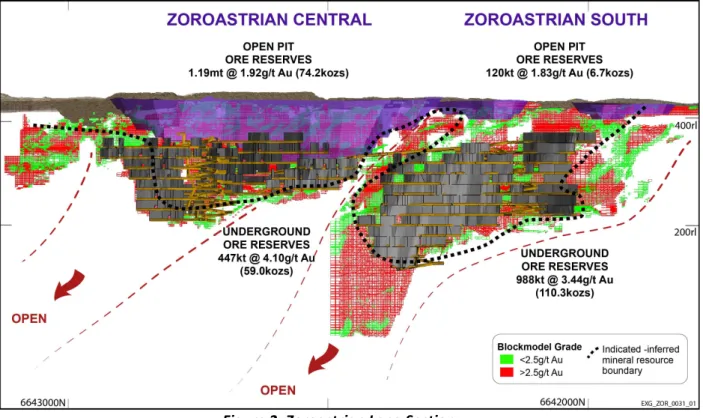
The quartz vein and stock-‐work style gold mineralisation is localised by north-‐east cross cutting fault structures and is interpreted to be concentrated in two north plunging zones of gold mineralisation within the granophyric units within the Dolerite (refer Figure 2).
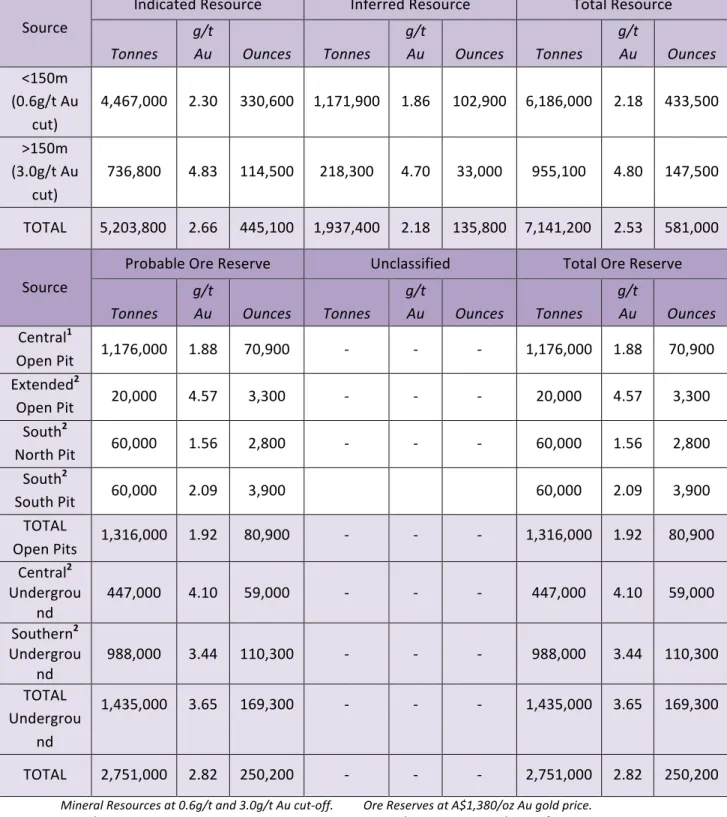
The Zoroastrian Mineral Resource is subdivided into shallower zones of mineralisation, less than 150 metres vertical depth, which are potentially amenable to open pit mining and deeper, greater than 150 metres vertical depth mineralisation which presents underground mining opportunities. The shallow resource is modelled and estimated at a low grade cut of 0.6g/t Au and using a high grade top-‐cut of 50g/t Au. The deeper mineralisation was modelled at a cut-‐off grade of greater than 1.0g/t Au and is quoted at a 3.0g/t Au cut-‐off to reflect underground mining economic cut-‐off grades (refer Table 2).
As a result of this drilling overall Mineral Resources at Zoroastrian remained static but resource confidence was improved with a 10% increase in Indicated Mineral Resources predominately in the deeper portion (>150m vertical depth) of the resource.
Using the new Mineral Resource estimate, a new Zoroastrian Ore Reserve was derived following Feasibility mine design works completed as part of the Mining Proposal for the development of the Zoroastrian deposit. This Mining Proposal was lodged with the Department of Mines and Petroleum (“DMP”) on 29 May 2015 and approved for development on 24 July 2015.
Mine design for the Zoroastrian Central open pit was completed by Auralia Mining Consulting Pty Ltd (“Auralia”). Mining Plus Pty Ltd (“Mining Plus”) completed design work on the Zoroastrian Extended open pit, Zoroastrian South open pits and the Zoroastrian underground.
An Australian dollar gold price of A$1,380 per ounce was used in all the mining design studies and ore treatment costs are derived from the cost structure associated with the long term cooperative Capital Contribution and Ore Treatment Agreement with Paddington Gold (ASX announcements 18 June 2014 and 20 October 2014).
Total Zoroastrian Probable Ore Reserves were estimated in July 2015 as 2.63 million tonnes @ 2.84g/t Au for 239,900 ounces of gold (ASX announcement 9 July 2015).
Re-‐design work by Mining Plus on the Central Underground mine design was subsequently carried out to refine portal, crown pillar and rib pillar locations and incorporated updated underground mining costs submitted by mining contractors based on the initial designs. Re-‐design of the larger Southern Underground was no undertaken at this time although revised decline access from the base of the Zoroastrian Central open pit to the southern stope designs was incorporated in the study.
Figure 2: Zoroastrian Long Section
showing Mineral Resource block model, Ore Reserves and proposed open pits and underground mine designs
The open pit designs and Probable Ore Reserves remain unchanged from those reported on 9 July 2015 (1.32 million tonnes @ 1.92g/t Au for 80,900 ounces) but underground Ore Reserves increased by 10,300 ounces to 1.43 million tonnes @ 3.65g/t Au for 169,300ozs as a result of the refinements to the Central Underground design (ASX announcement 4 September 2015).
Total Zoroastrian Probable Ore Reserves increased to: -‐
2.75 million tonnes @ 2.82g/t Au for 250,200 ounces of gold
Details of Mineral Resource modelling parameters for the Zoroastrian deposit are presented in JORC Code, 2012 Edition – Table 1 in the 9 July 2015 ASX announcement and Ore Reserve parameters in ASX announcement 4 September 2015.
Source
Indicated Resource Inferred Resource Total Resource
Tonnes g/t Au Ounces Tonnes g/t Au Ounces Tonnes g/t Au Ounces <150m (0.6g/t Au cut) 4,467,000 2.30 330,600 1,171,900 1.86 102,900 6,186,000 2.18 433,500 >150m (3.0g/t Au cut) 736,800 4.83 114,500 218,300 4.70 33,000 955,100 4.80 147,500 TOTAL 5,203,800 2.66 445,100 1,937,400 2.18 135,800 7,141,200 2.53 581,000 Source
Probable Ore Reserve Unclassified Total Ore Reserve
Tonnes g/t Au Ounces Tonnes g/t Au Ounces Tonnes g/t Au Ounces Central1 Open Pit 1,176,000 1.88 70,900 -‐ -‐ -‐ 1,176,000 1.88 70,900 Extended2 Open Pit 20,000 4.57 3,300 -‐ -‐ -‐ 20,000 4.57 3,300 South2 North Pit 60,000 1.56 2,800 -‐ -‐ -‐ 60,000 1.56 2,800 South2 South Pit 60,000 2.09 3,900 60,000 2.09 3,900 TOTAL Open Pits 1,316,000 1.92 80,900 -‐ -‐ -‐ 1,316,000 1.92 80,900 Central2 Undergrou nd 447,000 4.10 59,000 -‐ -‐ -‐ 447,000 4.10 59,000 Southern2 Undergrou nd 988,000 3.44 110,300 -‐ -‐ -‐ 988,000 3.44 110,300 TOTAL Undergrou nd 1,435,000 3.65 169,300 -‐ -‐ -‐ 1,435,000 3.65 169,300 TOTAL 2,751,000 2.82 250,200 -‐ -‐ -‐ 2,751,000 2.82 250,200
Mineral Resources at 0.6g/t and 3.0g/t Au cut-‐off. Ore Reserves at A$1,380/oz Au gold price. Rounding errors may occur. Mineral Resources are inclusive of Ore Reserves 1Auralia Mining Consulting Pty Ltd 2Mining Plus Pty Ltd
Table 2: Zoroastrian Mineral Resources and Ore Reserves – September 2015
The Zoroastrian Ore Reserves are derived from total Indicated Mineral Resources of 5.20 million tonnes @ 2.66g/t Au, containing 445,100ozs of gold. Due to the use of some historical drilling data in the resource estimates, Excelsior Gold does not quote Measured Mineral Resources or Proved Ore Reserves classifications although data quality, drill density, geological continuity and Mineral Resource confidence are high. Any material classified as an Inferred Mineral Resource was not included in the mining studies.
The underground mine design study utilised Minable Shape Optimiser® (MSO), a Datamine Studio3® tool, to determine the preliminary mining extents or stope shapes. The MSO data provides a means of assessing a mining envelope by considering the deposit in terms of tonnes, grade, mining width, level spacing and cut-‐off grade. A cut-‐off grade of 2.0g/t, a level spacing of 20 metres and a minimum mining width of 1.5 metres were selected to further analyse from the MSO results.
The underground mine design is based on Sublevel Open Stoping as the single mining method as it provides higher production rates and generally lower operating costs, however further studies may show that more than one mining method may be used to extract additional ore from selected areas on the deposit.
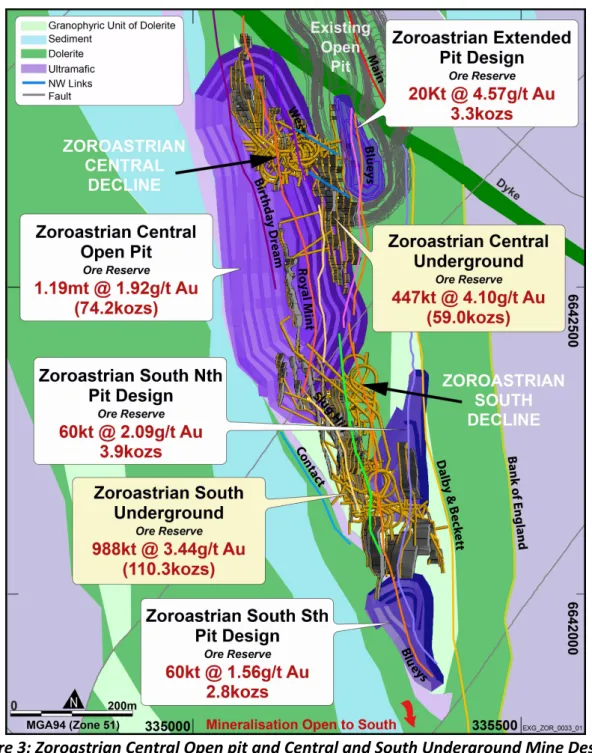
The Zoroastrian underground mine plan incorporates two underground mines with decline design commencement points for the Zoroastrian Central and the South ore bodies from portal positions within the Zoroastrian Central open pit (refer Figure 3).
Where appropriate, modifying factors have been applied to the Feasibility Study level works on the open pits as part of the Ore Reserve estimation. These modifying factors have been calculated based on data resulting from independently tendered mining operating costs, vendor-‐sourced capital cost estimates, independent mining and geotechnical studies, and metallurgical and environmental studies. The modifying factors have been applied at varying points as required during Whittle optimisation, pit design, scheduling and reporting of the Ore Reserves.
In the case of the Zoroastrian Central open pit a 15% mine dilution factor and a 95% mining recovery was applied during the Ore Reserve works. At Zoroastrian South and Extended pits the mine dilution was 9% at zero grade and recovery was 84%. In the underground studies stoping dilution was factored onto the stoping blocks at 15% and a minimum mining width of 1.5 metres was set for the stoping blocks.
Any material classified as an Inferred Mineral Resource was not included for consideration as an economic driver during any of the optimisation processes and does not influence the final Ore Reserves calculations.
The underground Ore Reserves are estimated to a pre-‐feasibility study level. The preliminary underground design is economically viable and therefore qualifies as an Ore Reserve but it is limited by drilling information at depth and further drilling and design refinement is planned. The mining of the Zoroastrian Central open pit will provide extensive geological information which will enhance deeper drill targeting and the design of the underground mine.
Figure 3: Zoroastrian Central Open pit and Central and South Underground Mine Designs
showing geology, Ore Reserves, proposed open pit designs, portal locations and Central and South underground mine designs
Ore Reserves are quoted on a ‘delivered to mill’ basis, which excludes metallurgical recovery factors. The planned treatment of Zoroastrian ore is at the Paddington processing facility which is a conventional 3.5mtpa CIL plant suitable for the treatment of Zoroastrian type ores.
Metallurgical test work predicts an average mill recovery of 93% at a grind size of 80% passing 106 microns and 24 hour leach residence time is applicable to the Zoroastrian Central Open Pit and a process recovery of 91.7% was applied to oxide and transitional material in the Zoroastrian South open pits and 91.7% for the fresh Zoroastrian underground mineralisation.
BARDOC SOUTH
The Bardoc South Tenements which form part of the southern portion of the Project, were previously a divestment from the Paddington Operations (refer Figure 4). Norton retains the first right to treat ore mined from within the Bardoc South Tenement area.
Figure 4: Bardoc South Tenements Area
(shaded)and Satellite Resources
showing proposed open pit designs with Ore Reserves, prospect Mineral Resources and proposed haul roadThe Bardoc South tenements comprise approximately 40% of the total Kalgoorlie North Gold Project area and contain 11 of the current 22 mineral resources within the Project and numerous exploration and resource targets. Total Indicated and Inferred Mineral Resources at Bardoc South are 3.59 million tonnes @ 1.70g/t Au for 195,800 ounces which account for only 14% of the Project resource ounces to date.
The most advanced prospects are concentrated in a highly mineralised area centred approximately 2.5 kilometres south of the Zoroastrian deposit. The intensity of the Black Flag Fault cross cutting structures in this area result in the development of smaller, higher grade gold deposits on different prospective units and shears within the Bardoc Tectonic Zone – Nerrin Nerrin in the Zoroastrian Dolerite, Castlereagh and Parkerville on the southern extensions of the Excelsior Shear and Big Blow
Figure 5: Bardoc South Satellite Mining Area
showing geology, Ore Reserves, proposed open pit designs, waste dump and haul road layout and prospects with significant drilling intercepts
Under the terms of the Bardoc South Ore Treatment Agreement, Norton agreed to process ore from the Bardoc South deposits over a period up to end December 2015. By subsequent agreement with Norton the timing constraints on the processing of Bardoc South ores have been removed to facilitate the potential treatment of Bardoc South ore at the Paddington Mill into 2016. Excelsior Gold will be responsible for all of the mining operations whilst Norton will be responsible for haulage and milling of the ore.
The current mining schedule covers the development of three of the Bardoc South resources. The Jackorite, Castlereagh and Big Blow South open pits are scheduled for development in late 2015 and the first quarter of 2016.
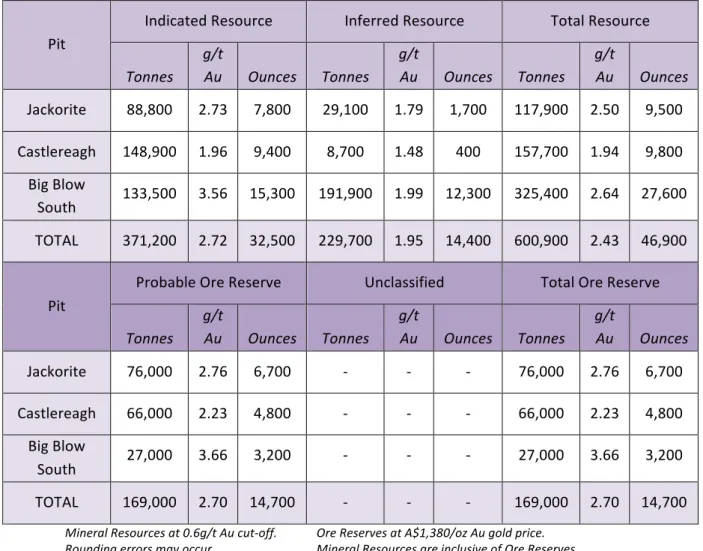
Ore Reserves for the scheduled Bardoc South open pits are 169,000 tonnes @ 2.70g/t Au for 14,700ozs of gold
(ASX announcement 18 March 2015)
.
Pit
Indicated Resource Inferred Resource Total Resource
Tonnes g/t Au Ounces Tonnes g/t Au Ounces Tonnes g/t Au Ounces Jackorite 88,800 2.73 7,800 29,100 1.79 1,700 117,900 2.50 9,500 Castlereagh 148,900 1.96 9,400 8,700 1.48 400 157,700 1.94 9,800 Big Blow South 133,500 3.56 15,300 191,900 1.99 12,300 325,400 2.64 27,600 TOTAL 371,200 2.72 32,500 229,700 1.95 14,400 600,900 2.43 46,900 Pit
Probable Ore Reserve Unclassified Total Ore Reserve
Tonnes g/t Au Ounces Tonnes g/t Au Ounces Tonnes g/t Au Ounces Jackorite 76,000 2.76 6,700 -‐ -‐ -‐ 76,000 2.76 6,700 Castlereagh 66,000 2.23 4,800 -‐ -‐ -‐ 66,000 2.23 4,800 Big Blow South 27,000 3.66 3,200 -‐ -‐ -‐ 27,000 3.66 3,200 TOTAL 169,000 2.70 14,700 -‐ -‐ -‐ 169,000 2.70 14,700
Mineral Resources at 0.6g/t Au cut-‐off. Ore Reserves at A$1,380/oz Au gold price. Rounding errors may occur. Mineral Resources are inclusive of Ore Reserves
Table 3: Bardoc South Mine Schedule – Mineral Resource and Ore Reserve Summary
Resource definition drilling was initiated on the three open pit areas during the June Quarter and subsequent to the grant of the Mining Approval in July 2015, addition infill drilling to grade control spacing (7.5m x 5.0m) was conducted. The small size of the proposed open pits and the rapid rate of mining, dictates the need for grade control drilling to be completed from surface prior to the commencement of mining.
A total of 12,439 metres of reverse circulation drilling has been completed in 359 holes on the Bardoc South open pit areas. Some of the more significant results included: -‐
Big Blow South (3,968 metres drilled in 111 holes)
Ø 12 metres @ 4.05g/t Au from 43 metres including 3 metres @ 13.3g/t Au from 51 metres
(BBSGC0001)
Ø 2 metres @ 145g/t Au from 60 metres
(BBSGC0002)
Ø 11 metres @ 6.51g/t Au from 18 metres including 4 metres @ 16.4g/t Au from 24 metres
(BBSGC0014)
Ø 7 metres @ 6.30g/t Au from 20 metres including 1 metre @ 36.2g/t Au from 20 metres
(BBSGC0028)
Castlereagh (5,503 metres drilled in 154 holes) Ø 9 metres @ 3.69g/t Au from 22 metres (CASGC0040)
Ø 11 metres @ 3.88g/t Au from 29 metres including 1 metres @ 23.4g/t Au from 39 metres (CASGC0041)
Ø 13 metres @ 3.18g/t Au from 25 metres including 5 metres @ 5.97g/t Au from 30 metres (CASGC0053)
Ø 14 metres @ 4.06g/t Au from 16 metres (CASGC0107)
Jackorite (2,968 metres drilled in 94 holes) refer Figure 5
Ø 13 metres @ 6.86g/t Au from 15 metres including 2 metres @ 35.5g/t Au from 23 metres (JACGC0014)
Ø 8 metres @ 6.94g/t Au from 4 metres including 4 metres @ 10.4g/t Au from 7 metres (JACGC0025)
Ø 17 metres @ 14.5g/t Au from 23 metres including 2 metres @ 69.9g/t Au from 36 metres (JACGC0029)
Ø 14 metres @ 7.00g/t Au from 3 metres (JACGC0084) Ø 13 metres @ 9.46g/t Au from29 metres (JACGC0101)
The results from the closed spaced grade control drilling programs are being incorporated into revised ore reserve estimates based on refined open pit designs. Mining is scheduled to commence in October 2015.
Figure 6: Grade Control Drilling at Jackorite (July 2015)
BULLETIN SOUTH
The Bulletin South area is located in the south western portion of the Project tenements and is centred around the historical Bulletin South open pit which was mined in 1994 and reportedly produced 66,592 tonnes @ 2.76g/t Au for 5,900 recovered ounces of gold. The existing pit is approximately 170 metres long, 100 metres wide and was mined to a maximum depth of 55 metres. Gold mineralisation at Bulletin South is associated with stock-‐work zones within a porphyry unit proximal to the regionally significant Black Flag Fault structure which is interpreted to be close to the southern end of the historical open pit. Primary gold mineralisation in the quartz stockwork system within the felsic porphyry may represent mineralisation along splay structures emanating from the Black Flag Fault. The stockwork mineralisation in the porphyry averages 15 metres true width.
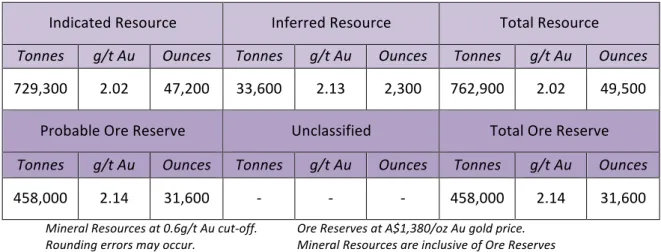
Drilling campaigns in the later part of 2014 demonstrated depth and strike extensions to the mineralisation and increased mineral resource ounces by 33% and improved resource confidence with a 153% increase in Indicated resource ounces. The total Indicated and Inferred resources at a 0.6g/t Au lower cut-‐off are
(ASX announcements 28 October 2014 and 10 April 2015)
762,900 tonnes @ 2.02g/t Au for 49,500 ounces of gold
The resource extends over 250 metres of strike down to 150 metres below surface and remains open down dip and down plunge to the south.
Updated Ore Reserves for the Bulletin South deposit were also reported in the March Quarter
(ASX announcement 10 April 2015)
.
Indicated Resource Inferred Resource Total Resource
Tonnes g/t Au Ounces Tonnes g/t Au Ounces Tonnes g/t Au Ounces 729,300 2.02 47,200 33,600 2.13 2,300 762,900 2.02 49,500
Probable Ore Reserve Unclassified Total Ore Reserve
Tonnes g/t Au Ounces Tonnes g/t Au Ounces Tonnes g/t Au Ounces 458,000 2.14 31,600 -‐ -‐ -‐ 458,000 2.14 31,600
Mineral Resources at 0.6g/t Au cut-‐off. Ore Reserves at A$1,380/oz Au gold price. Rounding errors may occur. Mineral Resources are inclusive of Ore Reserves
Table 4: Bulletin South – Mineral Resource and Ore Reserve Summary
The Ore Reserve was established from Feasibility mine design works completed as part of the Mining Proposal for the development of the Bardoc South and Bulletin South open pits which was approved for development on 7 July 2015
(ASX announcements 18 March and 8 July 2015)
.
The Ore Reserve pit design is an interim design which contains 76% of the Indicated Resource ounces and was designed to a maximum depth of approximately 125 metres. Gold mineralisation extends at depth and along strike from the current pit design which bottoms out on the lower limits of the Indicated Resource.
A drill program was completed in April 2015 to test for extensions to the gold mineralisation and to investigate possible new lode positions in the immediate vicinity of the proposed open pit
(ASX announcements 14 April and 22 April 2015)
.
The drilling demonstrated strong potential to expand thecurrent proposed open pit. Results included: -‐
Ø 20 metres @ 4.44g/t Au from 126 metres including 5 metres @ 14.2g/t Au from 126 metres
(KNC150006)
Ø 25 metres @ 3.71g/t Au from 93 metres including 2 metres @ 36.6g/t Au from 111 metres
(KNC150007)
Ø 25 metres @ 1.74g/t Au from 89 metres including 4 metres @ 7.05g/t Au from 110 metres
(KNC150009)
The gold mineralisation still remains open along strike and down dip/plunge both to the north and to the south (refer Figure 7). Further drilling is planned to scope out the extent of the gold mineralisation ahead of new Mineral Resource estimates and mine feasibility studies aimed at increasing the extent of the open pit design and the Ore Reserve.
Future drilling programs will focus on the definition of shallower mineralisation to the north to reduce high waste stripping and to establish potential links to the high grade Botswana Locker mineralisation 120 metres to the north (refer Figure 7).
Figure 7: Bulletin South Drilling Results – Long Section
showing current pit design, existing pit, interpreted gold mineralisation gram x metre contours, historical drilling results and new drilling results in red.
The area around the Bulletin South deposit (refer Figure 8) contains significant gold mineralisation, both within current gold resources and in historical drilling and is a priority exploration area. Due to fragmented tenement ownership in the past, the area has not been systematically explored and historical drilling is generally shallow and sporadic. Consolidation of tenements by Excelsior Gold in 2014 has paved the way for a more comprehensive evaluation of the gold mineralised systems. Mineralising trends related to the Black Flag Fault have been defined with the aid of fluid flow modelling of the structures as part of the Company’s collaborative research program with CSIRO and by hyperspectral mapping which highlights alteration patterns associated with the gold mineralisation.
The largest deposit developed to date in this immediate area is the Wendy Gully mine site owned by Norton, located approximately two kilometres south of Bulletin South. Wendy Gully produced in excess of 200,000 ounces of gold from open pit and underground sources and demonstrates the potential of the area to host substantial deposits with gold mineralisation continuous at depth and of sufficient grade to support underground mining.
Figure 8. Greater Bulletin Area – Air Photo Location Plan
showing existing open pits, gold mineralised structural trends, recent and historical drilling results and current gold resources
EXCELSIOR
The Excelsior deposit located to the north east of Zoroastrian is hosted within a sequence of tightly folded and sheared ultramafic/sedimentary schists within the Excelsior Shear Zone. Gold mineralisation occurs in a broad 20 to 50 metres wide zone of intense altered quartz-‐sericite-‐ carbonate schists.
The Excelsior Shear is a major north-‐north-‐west trending structure up to 80 metres wide and extending for over six kilometres to the north and potentially 15 kilometres to the south of the Excelsior deposit within the Kalgoorlie North Project tenements. Satellite resources at Lochinvar, Three Star and Ellen Pearce to the north and at Castlereagh and Parkerville to the south demonstrate the potential for gold resources along the structure.
The current Measured, Indicated and Inferred resources at Excelsior, based on gold mineralisation interpreted and wire-‐framed at a nominal 0.6g/t Au lower cut-‐off with high grade cut to 40.0g/t Au total
11.10 million tonnes @ 1.28g/t Au for 456,100 ounces
Conceptual mining studies have confirmed that the broad zones of gold mineralisation host potential for large, low strip ratio open pit mine development.
Open pit mining of the Excelsior resource would necessitate the relocation of the Kalgoorlie to Leonora rail line and the Goldfields Highway which cut across the mineralised Excelsior Shear to the north of the historical open pit mined by Aberfoyle Gold in the late 1980s. An initial design and cost estimate for the 2.9 kilometre relocation of the infrastructure is approximately $16.06 million which would accommodate an open pit designed to a vertical depth of 230 metres.
The Excelsior Deposit is a significant base load deposit for ore supply to a potential standalone mill development option for the Project as examined in the Company’s Pre-‐Feasibility Study completed in March 2014
(
ASX announcement 4 March 2014)
which established Ore Reserves of 3.85 million tonnes at 1.34g/t Au for 165,800 ounces of gold. The low strip ratio open pit design is amenable to low cost bulk mining and could potentially be mined at a rate of two million tonnes per annum. The upfront capital requirements to relocate infrastructure and the modest mined grade of the deposit, coupled with the