500
Visual Functions
General
Roadside visual functions are those roadside features that are primarily perceived or experienced through sight. Primary visual functions include:
• Driver guidance and navigation • Distraction and glare screening • Corridor continuity
• Reinforcing community character • Scenic preservation
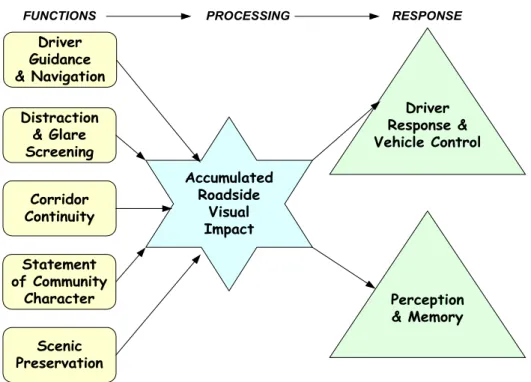
The driver uses visual information from the roadside environment to assist in controlling, guiding, and navigating the vehicle as shown in
Figure 500.1. The driver and passengers also form impressions and memories from what is seen along the roadside, thus roadsides are important in establishing community and state identity.
Driver Guidance & Navigation Corridor Continuity Distraction & Glare Screening Scenic Preservation Driver Response & Vehicle Control Perception & Memory Accumulated Roadside Visual Impact
FUNCTIONS PROCESSING RESPONSE
Statement of Community
Character
Figure 500.1 Input & Output Model for Roadside Visual Functions The driver can only absorb and process a limited amount of visual information at a time. Excessive visual stimulation and complexity
can distract the driver and decrease driver control. Conversely, monotony from lack of visual interest can decrease driver attention and thus diminish control.1 Difficulties with perception, attention, and
distraction are a primary cause in over forty percent of traffic accidents.2
Visual stimuli are translated into driver responses. The sequence of visual events leading to an appropriate decision must be organized to meet this objective. Highway alignment, roadway geometrics,
landform configurations, vegetation, and structures all contribute to driver guidance.
Visual functions are inseparable from other roadside functions. Operational functions such as sight distance, headlight screening, signing, and sunlight glare mitigation can also be considered visual functions. The retention of native vegetation and habitat, an
environmental function, also has a visual impact on motorists.
Resources
The region’s Landscape Architects
Maintenance & Operations Programs Landscape Architect
HQ Scenic Byway Coordinator within Highways & Local Programs HQ Design Office Roadside and Site Development Unit
References
Roadside Classification Plan(M 25-31), WSDOT
G. J. Alexander and H. Lunenfeld, Positive Guidance In Traffic Control, FHWA, Washington, D. C., April 1975.
G. J. Alexander and H. Lunenfeld, Driver Expectancy In Highway Design and Traffic Operations, USDOT Final Report FHWA-TO-86-1, FHWA, Washington, D. C., 1986.
Peter L. Hornbeck and Garland A. Okerlund, Jr., Visual Values for the Highway User, FHWA, Washington, D. C. (undated).
T. J. Post, G. J. Alexander, and H. Lunenfeld, A User’s Guide To Positive Guidance (2nd edition), Report FHWA-TO-81, FHWA, Washington, D. C., 1981.
Sally Schauman, et al., Visual Perception of the Roadway and Roadside Elements by the Observer in Motion, Washington State
1 A. Wertheim, 1978, “Explaining Highway Hypnosis.” Accident Analysis and Prevention, 10:111-129.
G.W. Williams, 1963, “Highway Hypnosis,” International Journal of Clinical and Experimental Hypnosis,
103: 143-151.
Transportation Center, WA-RD 283-1, TRAC/WSDOT, Seattle, Washington, December 1992.
Transportation Research Board (TRB), Human Factors Research In Highway Safety, National Research Council, Circular 414,
Washington, D. C., September 1993.
Definitions
aesthetics Evaluations and considerations with the sensory quality of resources (sight, sound, smell, taste, and touch) and especially with respect to judgment about their pleasurable qualities.3
cognition The mental process or function by which knowledge is acquired.
coherence Quality of state of being united in principles and relationships or to be logically and aesthetically connected.
complexity The multiple qualities in a landscape that provide visual interest such as the combination of form, color, and texture.
control The driver’s ability to safely drive the vehicle.
corridor continuity The overall coordination and sequence of visual features as experienced by the roadway user.
expectancy The driver’s readiness to respond to events, situations, or the presentation of information. It is primarily a function of the driver’s experience.
feature A visually distinct or outstanding part, quality, or characteristic of a landscape.
form The mass or shape of an object. Usually considered to be three dimensional. In the figure below, the forms of the mountain, hills and valley are shown.
Figure 500.2 Forms in the Landscape
landscape An area composed of interacting ecosystems that are repeated because of geology, land form, soils, climate, biota, and
3 U. S. Department of the Interior, Bureau of Land Management. BLM Manual: visual resource
human influences throughout the area. Landscapes are generally of a size, shape, and pattern that is determined by interacting ecosystems.4 navigation Trip planning and execution.
view Something that is looked toward or kept in sight, especially a broad landscape or panorama. Act of looking toward an object or scene. The figure below shows views from the roadway toward the forest along the roadside.
vista A confined view, especially one seen through a long passage, as between rows of trees or down a canyon. A vista often focuses upon a specific feature in the landscape.
Policy
23 USC 1310A “Control of Outdoor Advertising”
The Congress hereby finds and declares that the erection and maintenance of outdoor advertising signs, displays, and devices in areas adjacent to the Interstate System and the primary system should be controlled in order to protect the public investment in such
highways, to promote the safety and recreational value of public travel, and to preserve natural beauty
23 CFR 750 “Highway Beautification Act” of 1965 and all amendments.
This federal policy prohibits the clearing of vegetation along Interstate highways for viewing of commercial establishments.
RCW 47.32.130 Gives WSDOT the authority to remove objects and structures on, or in proximity to the right of way that pose an
immediate threat to roadway safety.
RCW 47.38Roadside Areas -- Safety Rest Areas
RCW 47.39and amendments. Scenic and Recreational Highway Act of 1967.
RCW 47.42 “Highway Advertising Control and Scenic Vistas Act” Controls advertising signs along state highways.
Roadside Classification PlanM 25-31, WSDOT
Planning
Fulfill the visual functions in accordance with the Roadside
Classification Planfor achieving corridor continuity, blending, and buffering with adjacent land uses. The following measures will aid in achieving this goal.
• Provide adequate right of way to meet the requirements of the
Roadside Classification Plan including acquisition of additional land for the following purposes:
• Blending • Buffering • Screening
• Environmental obligations
• Allow for generous medians and wide right of way buffer widths when acquiring land for state highways and state highway projects.
• Increase normal right of way widths to protect desirable views and vistas or to provide for visual screening.
• Consult the Corridor Plans along Scenic Byways or Heritage Tour Routes that reflect community preferences for treatment of the roadside and provide guidance for visual quality along roadway segments.
• Coordinate with the Heritage Corridors Program Office and the regional Planning Office to obtain current Corridor Plans on designated routes.
• Work with local communities to enhance community character. • Consider partnership agreements with adjacent property owners
to reduce maintenance impacts while ensuring adherence with the
Roadside Classification Plan.
Public Involvement
Public involvement in WSDOT roadside activities is conducted in a manner that is consistent with the process established for roadways in general. (See WSDOT Design Manual chapter on “Public
Involvement and Hearings.”) It is the department’s goal that decisions be made in the best overall public interest and that other agencies and the public be involved early enough to influence project decisions.
WSDOT also conducts public meetings to get public responses to proposed transportation projects using visual simulations. In addition, WSDOT (partnering with universities) conducts visual preference research to assess drivers’ and community’s values and perceptions for roadside view alternatives.5
Design
Physical Features
Expectancy and Driver Response
Driver expectations are an important basis for the design of safe roadways. Roadside features can create patterns that can provide the driver with clues to what lies ahead. The visual environment can be enhanced to reinforce accurate expectations about what driving responses are necessary.
An effective highway design is based on predictability and coherence in the visual environment (corridor continuity). It anticipates driver expectations and surprise factors, and gives the driver sufficient visual information to accurately predict upcoming roadway
conditions. This information forewarns drivers and helps them avoid accidents. Land use, sight distance, terrain, corridor continuity, screening distractions, and reinforcing visual features give the driver clues about the road ahead.
“Positive Guidance” is a process that uses engineering tools to optimize the highway system in order to improve traffic operations and safety at hazardous locations. When this procedure is applied, the roadside features are an integral part of a Positive Guidance design of a highway information system.
Distraction
Drivers might have difficulty seeing and selecting relevant visual information within complex visual scenes. When there is too much visual information (“clutter”), drivers can be distracted and safety can be impaired.
Drivers can make poor decisions when they are distracted. All
aspects of the visible environment contribute to information overload and distraction. Special attention is required to keep highway
directional signs to a minimum, and to locate them in such a way as to avoid distracting the driver.
Research on advertising signs within view of the roadway suggests that novel, sensuous, or moving displays are likely to distract the driver’s attention. Minimize these distractions through roadside screening or negotiations with responsible parties. When this fails, WSDOT has the authority to remove object and structures outside the right of way that pose an immediate threat to motorists and roadway safety (RCW 47.32.130). Such action may especially be warranted where accident data verifies that such object or structure does indeed pose a safety hazard.
Recommendations
Design in such a way as to: • Send a clear message. • Minimize visual distractions.
• Design roadsides so they are sustainable, given expected service level and funding.
• Define the roadway through appropriate roadside treatments (landform, vegetation, wall treatment, and so forth) to enhance guidance characteristics.
• Provide for screening of distractions with berms and vegetation. • Avoid unnecessary tree removal next to commercial and
industrially zoned areas.
• When designing for roadside treatment, consider the existing treatment or character of the adjacent road segment to provide for corridor continuity.
Roadsides and Memory
Perceptual or cognitive factors influence the memories or
impressions of a place. It is the roadside and the view from the road that the driver or visitor remembers long after having driven along the road.
Roadsides are more than a buffer for the roadway; they are often the transition into a community. Drivers associate and derive impressions about communities by what they see along the roadside. The roadside
can be a community amenity. The preservation of visual quality strongly supports the economic interests of the state through the tourism industry. WSDOT will endeavor to support a community’s effort to enhance their entrance as outlined in the Roadside
Classification Plan.
The presence of natural features and the perception of a clean, healthy natural environment have often been linked with positive visual preference.6 Among scenic roadway users, natural features
(lakes, rivers, mountains, hills, natural vegetation, long distance views) are most highly valued.7 Structures and activities having a
negative impact on the natural quality of the landscape are regarded with suspicion, and commercial establishments, signs, and
multifamily housing are generally viewed as detractors to visual quality. Research on the extent of agreement among observers of
6 Kaplan and Kaplan, 1982, 1989 and Kaplan, 1995.
environmental attractiveness found that natural and rural
environments are preferred over urban and semiurban environments.8
However, the public, generally values visual features that fit the locality and contribute to a sense of place. Cultural landscapes are generally most valued by the people who live nearby.9
Directed Attention Fatigue
People use directed attention to work in distracting surroundings and make decisions in complex situations, such as driving on heavily traveled roads. The visual environment can aggravate or alleviate directed attention fatigue. Extended, unrelieved periods of directed attention can diminish the capacity to analyze, plan, and make
decisions resulting in irritability and taking unnecessary risks. Visual access to natural environments is one of the key elements in
counteracting directed attention fatigue through restorative
experiences.10 There is increasing evidence11 to suggest that natural
and naturalized roadsides might diminish or alleviate directed
attention fatigue in the roadway user. Therefore, careful planning and design of corridor views for scenic vistas and aesthetically pleasing roadside treatment can be important for improving roadway safety. Recommendations
• Consider viewer perceptions when designing and maintaining roadside areas.
• Provide for opening up desirable views by planting or encouraging low growing vegetation.
• Consider berms and vegetation to screen undesirable views where right of way widths and corridor continuity allow.
• Consider working with community partners to provide
community gateways that enhance roadside character in keeping with the Roadside Classification Plan.
Maintenance
Maintenance activities affect roadside visual quality. When there are extensive visual impacts from a maintenance activity, such as
removal of significant vegetation, public involvement is recommended. The Corridor Plan can be used for guidance.
8 Coughlin and Goldstein, 1970. and Ulrich, 1981, 1986. 9 Melnick, 1983.
10 Kaplan, 1995. 11 Parsons, et al., 1998.
• Identify opportunities to partner with adjacent land owners to preserve or reveal desirable views and roadside segments that enhance or maintain corridor continuity. (It is not WSDOT policy to remove vegetation to open up views toward commercial
properties.) Balance desirable visual functions with the needs of roadway users and adjacent landowners.
• Coordinate with the regional Landscape Architect, or the HQ Design Office Landscape Architect in regions without a Landscape Architect.
• On Scenic Byways coordinate with the Heritage Corridors Program Office.
• Enhance or retain vegetation to screen undesirable views and to meet the requirements of the Roadside Classification Plan
(corridor continuity, blending with, and buffering adjacent land uses).
• Maintain low growing vegetation or limb up trees to retain desirable views.
• Carefully consider actions before removing vegetation to open up views. Consider whether development adjacent to the highway is likely to eliminate the view after removing vegetation. Analyze the angle of view from the driver’s perspective and minimize removal of vegetation to meet the view objective. Consider selective removal of tree limbs or removal of only the limbs on the lower one third of the tree to reveal desirable views.
• Consider the Corridor Plan as a basis for determining the
Maintenance Plan and funding service levels for a given highway corridor.
Additional Sources of Information
Robert E. Coughlin and Karen A. Goldstein, The Extent Of Agreement Among Observers On Environmental Attractiveness, Regional Science Research Institute discussion paper #37, Philadelphia, PA, February 1970.
C.W. Hamilton, R. Bell, D. Giblin, K. Wolf, and K. Ewing, Planting for Sustainable Roadsides: Empirical and Experimental Studies and
Recommendations for Western Washington. Technical Research Report WA-RD 439.1. Olympia, Washington: Washington State Department of Transportation, 1998. Chapter Four: Landscape Perception and Roadside Design Guidelines.
R. Kaplan and S. Kaplan, The Experience Of Nature: A Psychological Perspective, Cambridge University Press, Cambridge and New York, 1989.
R. Kaplan and S. Kaplan, Cognition And Environment: Functioning In An Uncertain World, Praeger Publishers, New York, 1982.
Stephen Kaplan, “The Urban Forest As A Source Of Psychological Well-Being,” Urban Forest Landscape, Gordon A. Bradley, ed., University of Washington Press, Seattle and London, 1995, pp. 100108.
Richard L. Kent, “Attributes, Features, And Reasons For Enjoyment Of Scenic Routes: A Comparison Of Experts, Residents, And Citizens,”
Landscape Research 18(2) 1993 92-102, 1993.
Frances E. Kuo and William C. Sullivan. “Aggression and Violence in the Inner City: Effects of Environment via Mental Fatigue.”
Environment and Behavior. Vol.33No.4, July 2001 543-571. http://www.herl.uiuc.edu/IMAGES/scientific_article_VV.pdf
R. Z. Melnick, “Protecting Rural Cultural Landscapes: Finding Value In The Countryside,” Landscape Journal 2:85-96, 1983.
P. A. Miller, “Scenic Value In The Urbanizing Landscape,” Urban Forest Landscape, Gordon A. Bradley, ed., University of Washington Press, Seattle and London, 1995, pp. 111-127.
R. Parsons, Tassinary, L. G., Ulrich, R. S., Hebl, M. R., and M. M. Grossman, “The View From The Road: Implications For Stress Recovery And Immunization,” Journal of Environmental Psychology, November 1998.
Carla B. Rabinowitz and Robert E. Coughlin, “Analysis Of Landscape Characteristics Relevant To Preference,” Regional Science Research Institute discussion paper # 38, Philadelphia, PA, March 1970.
Andrea Faber Taylor, Frances E. Kuo, and William C. Sullivan. “Views of Nature and Self-Discipline: Evidence From Inner City Children.”
Journal of Environmental Psychology. 2001 21.
http://www.herl.uiuc.edu/IMAGES/scientific_article_GG.pdf Robert Ulrich, “Human Responses to Vegetation and Landscapes,” Landscape and Urban Planning 13, 1986 pp. 29-44.
--- “Natural Versus Urban Scenes: Some Psychophysiological Effects,”
Environment and Behavior, 13.5, 1981, pp. 523-56.
--- “Scenery in the Travel Route,” in Experience of Nature, Rachel and Steven Kaplan, eds., 1974.
K. Wolf, The View From the Road, Seattle, WA, 1998.