A dissertation submitted to the Department of Computer Science, Faculty of Science at the University of Cape Town
in fulfilment of the requirements for the degree of
DOCTOR OFPHILOSOPHY
in
Computer Science
— Alapan Arnab —
Supervisor
Adjunct Professor Andrew Hutchison
Digital rights management (DRM) can be defined as a technology that enables persistent access control. The common understanding of DRM is that of a technology that enables means to thwart piracy of digital multimedia through limiting how the media is used by the consumer. It can be observed that many of these restrictions can be applied to any type of data. Therefore, it should be possible to create a two part DRM system – a common DRM system that enforces the basic access controls (such as read, write and execute) and an application specific DRM system that enforces the application specific access controls (such as print and play). The aim of this dissertation is to create such a framework for distribution independent DRM systems.
Most vendors promote DRM as a copyright protection mechanism, and thus consumers expect a number of rights that are allowed by copyright legislation, but which are not available for the DRM protected media. However, DRM is not an enforcement of copyright law, but rather an enforcement of a licensing regime. Thus, there is incorrect (and possibly false) marketing of DRM enabled media from the vendors of DRM enabled media, leading to dissatisfied con-sumers. We think that one of the main reasons for the current situation, is that there is no defined legal framework governing the operation of DRM systems. In this dissertation, we address this gap, by developing a legal framework for DRM systems as one of the components of our DRM framework.
Negotiation can be defined as the process which leads to the conclusion of a contract. Since DRM is the enforcement of licensing agreements, there is a need to cater for negotiation proto-cols in DRM systems. Negotiations provide the consumer with the power to request different rights packages, especially when consumers have a legitimate need for rights not granted nor-mally to other consumers (for example, disabled consumers have needs that may not be met with standard rights set). Negotiations also allow the possibility for the licensors to extract the maximum value from the consumers. For this reason, the inclusion of negotiation
cols in DRM systems can become a powerful tool, and in this dissertation we present the first negotiation protocols for DRM systems.
Even though the definition of DRM as an access control model has existed since at least 2002, there has been no formal description of DRM as an access control model. Thus, there are no formal models for any of the rights expression languages which express DRM access control policies, and various authors have commented on ambiguities present in interpretation and en-forcement of licenses expressed in these languages – a result of a lack of formal definition of these languages. In this dissertation, we develop a formal model for a Licensing Rights Expression Language (LiREL), which is designed to provide a mechanism to express access control policies which are also sound legal license documents. Our formal model also discusses the enforcement of the access control policies, and is thus the first formal model for DRM as a mechanism for access control.
Access control is a two part process: authenticationof the parties involved andauthorisation of the parties to access the resources. Authorisation in DRM provides some unique challenges: there is a need to support multiple platforms, without guaranteed network connectivity and min-imal trust between the parties involved. For this reason, the associated authentication framework becomes more complex.
While many access control models define user management as part of their model, we have taken a different approach, and removed user management from the core DRM system. Instead, our authorisation process requires a trusted verification of the user’s credentials and then decides on the access control request. For this reason, our user authentication framework is ticket based, and shares similarities to Kerberos tickets.
DRM also requires a strong data identity management. However, all the current identity systems for data do not provide verification service for data identity. For this reason, we developed VerifiableDigitalObjectIdentity (VDOI) System, to address this gap.
These components are combined towards a general framework for digital rights management that advances the understanding, organisation and implementation of DRM compared to ap-proaches or solutions which are currently available.
Prof. Andrew Hutchison for his guidance, supervision and patience during the course of my degree. He is an incredible supervisor, and I have enjoyed working with him.
Prof. Julien Hofman, who has been my unofficial, secondary supervisor. His insight of elec-tronic law, and his guidance in exploring the legal position of DRM gave a new dimension to the direction of my research.
Mr. Marlon Paulse and Mr. Duncan Bennett, who took the challenge of implementing a DRM controller (and still follow my design) for the GNU-Linux kernel, and succeeded.
Ms. Mary Faragher for proof reading and editing the draft of this dissertation. All mistakes that remain, are off course all mine.
Ms. Vicky Weissman, Dr. Sussanne Guth, Dr. Renato Iannella and the rest of the ODRL v2 working group, for our discussions, and their comments.
Mr. Martin Springer and DMP for our discussions and their comments.
Prof. Pieter S Kritzinger and the rest of the DNA Research group for their continued support and suggestions. It has been a great experience!
Mr. Nicholas Hall for drawing the faces of Alice, Bob, Charlie and their friends. To my family and friends that have supported me during this journey.
And last, but not least, a thank you to the financial support from National Research Foundation (NRF) of South Africa, and the University of Cape Town (UCT) Postgraduate Funding Office. Their support made this journey easier.
Abstract i
Acknowledgements iii
Contents iv
List of Figures xiv
List of Tables xvii
1 Introduction 1
1.1 Users of a DRM System . . . 3
1.2 Scope . . . 4
1.3 Layout . . . 4
I
Requirements and Related Work
7
2 Requirements for a General Framework for DRM 9 2.1 Sources for Requirements . . . 92.2 Core Requirements . . . 10
2.3 Usability Requirements . . . 13
2.4 Legal and Social Requirements . . . 16
2.5 Summary . . . 17
3 A Discussion of Existing DRM Systems 19 3.1 Apple iTunes Music Store . . . 20
3.1.1 Brief Overview . . . 20 v
3.1.2 Core Requirement Analysis . . . 21
3.1.3 Usability Requirements Analysis . . . 21
3.1.4 Legal and Social Usability Analysis . . . 23
3.2 Microsoft Windows Media (WM) . . . 24
3.2.1 Brief Overview . . . 24
3.2.2 Core Requirement Analysis . . . 25
3.2.3 Usability Requirement Analysis . . . 26
3.2.4 Legal and Social Requirement Analysis . . . 26
3.3 Helix DRM . . . 27
3.3.1 Brief Overview . . . 27
3.3.2 Core Requirement Analysis . . . 28
3.3.3 Usability Requirement Analysis . . . 28
3.3.4 Legal and Social Requirement Analysis . . . 29
3.4 Open Mobile Alliance (OMA) DRM . . . 30
3.4.1 Brief Overview . . . 30
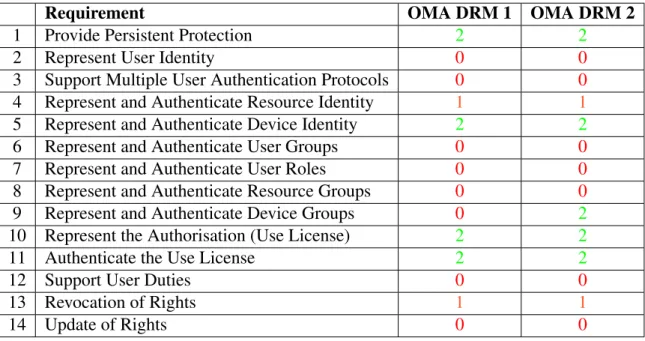
3.4.2 Core Requirement Analysis . . . 31
3.4.3 Usability Requirement Analysis . . . 32
3.4.4 Legal and Social Requirement Analysis . . . 33
3.5 Adobe Document Security . . . 33
3.5.1 Brief Overview . . . 34
3.5.2 Core Requirement Analysis . . . 34
3.5.3 Usability Requirement Analysis . . . 34
3.5.4 Legal and Social Requirement Analysis . . . 35
3.6 Authentica’s Active Rights Management Platform (ARM) . . . 36
3.6.1 Brief Overview . . . 36
3.6.2 Core Requirement Analysis . . . 37
3.6.3 Usability Requirement Analysis . . . 37
3.6.4 Legal and Social Requirements Analysis . . . 38
3.7 Microsoft Rights Management Services (RMS) . . . 39
3.7.1 Brief Overview . . . 39
3.7.2 Core Requirements Analysis . . . 40
3.7.3 Usability Requirement Analysis . . . 41
3.7.4 Legal and Social Requirements Analysis . . . 42
3.9 Summary . . . 43
4 Theoretical Foundations for DRM Systems 47 4.1 Role Players in a DRM System . . . 47
4.1.1 Discussion . . . 47
4.1.2 Analysis of Role Players in Existing DRM Systems . . . 48
4.2 Security Taxonomy . . . 49
4.2.1 Discussion . . . 49
4.2.2 Characteristics of the Security Architectures . . . 51
4.2.3 Categorisation of Existing Systems . . . 51
4.3 Rights Expression Languages (RELs) . . . 51
4.4 The DRM Reference Model . . . 54
4.5 A Layered Approach to DRM . . . 55
4.5.1 Discussion . . . 55
4.5.2 Analysis of Existing Systems . . . 57
4.6 Interoperability in DRM . . . 57
4.6.1 Types of DRM Interoperability . . . 60
4.6.2 REL Interoperability . . . 61
4.6.3 Interoperability through Intermediaries . . . 61
4.7 Protocol and System Modelling . . . 62
4.8 Summary . . . 63
II
Framework
65
5 An overview of our General Framework for DRM 67 6 Legal Framework For DRM 69 6.1 Copyright & DRM: A Background . . . 706.2 Copyright & DRM: Licensing . . . 72
6.2.1 Reproduction and Distribution in the Digital Arena . . . 73
6.2.2 Abuse: Protecting what should not be protected . . . 75
6.2.3 Camp and Copyright Management . . . 75
6.2.4 “Personal Use” . . . 76
6.2.5 The Focus on Use and the Licensing Paradigm . . . 76
6.3.1 Requirements for Contracts . . . 77
6.3.2 Licensing and the Problems With Current DRM Systems . . . 78
6.3.3 Form and Content of Licensing Contracts . . . 80
6.3.4 Privatisation of Copyright – Buying vs Licensing . . . 83
6.3.5 Copyright Tribunal and License Arbitration . . . 84
6.4 Fairer Use . . . 85
6.4.1 Fairer Use through Negotiations . . . 85
6.4.2 Fairer Use through the use of Credentials . . . 87
6.5 Other Legal Issues . . . 88
6.5.1 Globalisation Effect of the Internet . . . 89
6.5.2 Trade Practices . . . 90
6.5.3 Privacy . . . 90
6.5.4 Electronic Transactions Act . . . 91
6.6 Summary: Towards a Legal DRM System . . . 92
7 A Negotiations Framework for DRM 93 7.1 A note on terminology . . . 94
7.2 Related Work in Electronic Negotiations . . . 94
7.3 Types of Negotiations . . . 95
7.4 Requirement for Negotiation for DRM . . . 96
7.4.1 Factors affecting Negotiation in DRM . . . 97
7.4.2 DMP requirement for negotiations . . . 98
7.5 Bidding . . . 98 7.5.1 Process . . . 99 7.5.2 Protocol . . . 99 7.5.3 Modelling . . . 101 7.6 Bargaining . . . 101 7.6.1 Process . . . 103 7.6.2 Protocol . . . 103 7.6.3 Modelling . . . 107
7.7 RELs and the Expression of Negotiations . . . 107
7.8 Negotiation Requirement Analysis . . . 108
7.8.1 Raiffa’s Factors Affecting Negotiation . . . 108
7.9 Example . . . 110
7.10 Summary . . . 110
8 A Formal Model for DRM 113 8.1 Existing Access Control Mechanisms . . . 114
8.1.1 DAC, MAC and RBAC . . . 114
8.1.2 Differences between DRM and Existing Access Control Models . . . . 115
8.1.3 XACML and RELs . . . 116
8.2 Additional Requirements for RELs . . . 117
8.3 A Licensing REL: LiREL . . . 120
8.4 A Formal Description for LiREL . . . 120
8.4.1 Language Semantics and Syntax vs Language Vocabulary . . . 121
8.4.2 Obligations . . . 121
8.4.3 Constraints . . . 122
8.4.4 The Licensors . . . 122
8.4.5 The Licensees . . . 123
8.4.6 The Third Parties . . . 124
8.4.7 The Resources . . . 125
8.4.8 The Agreement . . . 125
8.4.9 Catering for Negotiations . . . 128
8.4.10 Visual Model . . . 130
8.4.11 Comparison to Current RELs . . . 130
8.4.12 XML Schema . . . 133
8.5 Analysis of Access Control Enforcement . . . 133
8.5.1 Validity of Use Licenses . . . 134
8.5.2 Enforceability of Use Licenses . . . 134
8.5.3 Conflict Resolution . . . 135
8.5.4 Deciding a Request . . . 135
8.5.5 Determining Cardinality . . . 136
8.6 Summary . . . 136
9 An Authorisation Framework for DRM 139 9.1 The Authorisation Process . . . 139
9.1.1 The DRM Controller . . . 140
9.1.3 Multiple Use Licenses and Authorisation . . . 142
9.1.4 The Process . . . 143
9.1.5 Verification of the correctness of DRM Controllers . . . 145
9.2 Motivation for Decoupling Authentication and Authorisation . . . 145
9.3 Management Console . . . 146
9.4 Modelling The Authorisation Process . . . 148
9.5 Summary . . . 150
10 An Authentication Framework for DRM 151 10.1 Related work on Authentication . . . 152
10.1.1 Ticket based User Authentication . . . 152
10.1.2 Resource Authentication . . . 153
10.1.3 Device Authentication . . . 157
10.2 User Authentication through Time Limited Tickets . . . 157
10.2.1 General Overview . . . 158
10.2.2 Ticket Design . . . 159
10.2.3 Security Considerations . . . 160
10.3 Other Forms of User Credentials . . . 161
10.4 Verifiable Digital Object Identity System . . . 163
10.4.1 Basic Setup . . . 163 10.4.2 Identifier Resolution . . . 163 10.4.3 Identifier Format . . . 164 10.4.4 Identifier Verification . . . 165 10.4.5 Management of Identifiers . . . 166 10.4.6 Security Considerations . . . 168 10.5 Summary . . . 169
11 Creating Protected Works 171 11.1 The Packaging Service . . . 171
11.1.1 The Packaging Workflow . . . 172
11.1.2 Encryption Keys . . . 174
11.1.3 Regulation of the Packaging Service . . . 174
11.2 A Layered Approach to DRM Packages . . . 174
11.2.1 The Data Layer . . . 176
11.2.3 The Packaging Layer . . . 177
11.2.4 Unpacking the Protected Package . . . 177
11.2.5 Comparison to other Packaging Formats . . . 178
11.3 Summary . . . 178
12 Web of Trust & Key Distribution in DRM 181 12.1 Web of Trust for DRM . . . 182
12.1.1 The DRM Controller . . . 182
12.1.2 An Independent Verification Authority . . . 182
12.1.3 License Server . . . 183
12.1.4 Authentication and Credentials Service . . . 184
12.1.5 Packaging Service . . . 184
12.2 Key Distribution in DRM . . . 185
12.2.1 Public Keys for Signature Verification . . . 185
12.2.2 Decryption Keys for Protected Data . . . 188
12.3 Comparison to the to OMA DRM Approach . . . 189
12.4 Summary . . . 190
III
Implementation, Analysis and Conclusions
191
13 Experiences in Implementing a Kernel-Level DRM Controller 193 13.1 Related Work . . . 19413.2 System Design . . . 195
13.2.1 DRM Controller – Management Daemon Interaction . . . 195
13.2.2 File Format . . . 196
13.2.3 Rights Expression Language (REL) . . . 197
13.3 Implementation Details . . . 197
13.3.1 Setup . . . 197
13.3.2 Permissions and Constraints Implemented . . . 198
13.3.3 The Enforcement Engine: The Operating System Kernel Module . . . . 199
13.3.4 Motivation for our approach . . . 202
13.4 Experimental Evaluation . . . 203
13.4.1 Experiment Setup . . . 203
13.4.3 Results . . . 204
13.4.4 Analysis . . . 204
13.5 Analysis of our Approach . . . 207
13.5.1 Application Level Transparency . . . 207
13.5.2 Wide range of rights . . . 207
13.5.3 Performance . . . 207
13.5.4 Comprehensive Protection . . . 208
13.5.5 Modification of Protected Files . . . 208
13.5.6 Correct Identification of Accesses . . . 208
13.5.7 Stream Encryption . . . 209
13.5.8 Compensating for Application Behaviour . . . 209
13.5.9 Implications for hardware based DRM systems . . . 209
13.6 Summary . . . 209
14 Conclusions and Future Work 211 14.1 Requirement Analysis of our General Framework for DRM . . . 213
14.1.1 Core Requirements . . . 213
14.1.2 Usability Requirements . . . 215
14.1.3 Legal and Social Requirements . . . 216
14.2 Future Work . . . 217
14.3 Conclusions . . . 217
IV
Appendices
219
A Abbreviations 221 B XML Schemas: LiREL 223 C XML Schemas: A Sample Permission Set for LiREL 229 D Negotiation using LiREL 233 D.1 The Initial Enquiry . . . 233D.2 The First Offer . . . 234
D.3 The Counter Offer . . . 236
D.3.1 Rejection of the Offer . . . 236
D.4 The Counter-Counter Offer (Another Offer) . . . 240
D.4.1 Rejection of the Counter-Offer . . . 240
D.4.2 The Offer . . . 242
D.5 The Acceptance of Offer . . . 244
D.6 The Concluding of an Agreement . . . 246
1.1 The DMP DRM Value Chain [63] . . . 4
1.2 Categorisation of DRM Systems [149] . . . 5
3.1 Overview of the Helix Platform [101] . . . 27
3.2 DRM Types in OMA 1.0 [146] . . . 30
3.3 Overview of OMA DRM 2 Architecture [147] . . . 31
3.4 Overview of Authentica Active Rights Management Platform [44] . . . 36
3.5 Deploying a RMS system . . . 39
4.1 Categorisation of DRM Systems [149] . . . 50
4.2 The DRM Reference Model [168] . . . 54
4.3 Proposed DRM Layers . . . 56
5.1 A General Framework for DRM . . . 67
6.1 Simple Negotiations Protocol . . . 86
7.1 The DMP DRM Value Chain [63] . . . 97
7.2 Bidding Process . . . 99
7.3 Bidding Petri Net . . . 101
7.4 Flowchart for a bargaining protocol . . . 102
7.5 Bargaining Petri Net . . . 106
8.1 Comparing RELs functionalities [90] . . . 120
8.2 UML model ofL . . . 131
8.3 Simple XrML Model [142] . . . 132
8.4 ODRL 2 Model (Draft) [105] . . . 133 xv
9.1 DRM Controller Decision Flowchart . . . 144
9.2 Management Console interfacing with a number of different DRM Controllers . 146 9.3 Petri Net of the Authorisation Process . . . 149
10.1 A layered view of DRM Packages . . . 156
10.2 Authentication Ticketing System . . . 159
10.3 Proposed ticket format . . . 160
10.4 XML schema diagrams for a customer receipt as discussed in [38] . . . 162
10.5 XML schema each step of the identifier registration protocol for VDOI system. 167 11.1 DRM Packaging Service Workflow . . . 172
11.2 XML schema of a signed receipt from the service producer . . . 173
11.3 XML schema of a signed request to create a DRM package . . . 173
11.4 A layered view of DRM Packages . . . 175
12.1 Web of Trust with only the DRM Controller . . . 183
12.2 Web of Trust with the DRM Controller and an Independent Verification Authority184 12.3 Web of Trust with the DRM Controller, an Independent Verification Authority and a License Server . . . 185
12.4 Web of Trust with the DRM Controller, an Independent Verification Authority, a License Server and Authentication & Credentials Service Providers . . . 186
12.5 Web of Trust with the DRM Controller, an Independent Verification Authority, a License Server, Authentication & Credentials Service Providers and a Pack-aging Service . . . 187
13.1 The DRM Controller Architecture and Communications . . . 195
13.2 Layered approach to DRM file formats (left) and the implemented file format (right) . . . 196
13.3 The BNF grammer for our simplified REL . . . 197
13.4 The interaction of the various components within the kernel module . . . 199
3.1 Core Requirement Analysis for iTunes FairPlay . . . 22
3.2 Usability Requirement Analysis for iTunes FairPlay . . . 23
3.3 Legal and Social Requirement Analysis for iTunes FairPlay . . . 23
3.4 Core Requirement Analysis for Windows Media . . . 25
3.5 Usability Requirement Analysis for Windows Media . . . 26
3.6 Legal and Social Requirement Analysis for Windows Media . . . 27
3.7 Core Requirement Analysis for Helix DRM . . . 29
3.8 Usability Requirement Analysis for Helix DRM . . . 29
3.9 Legal and Social Requirement Analysis for Helix DRM . . . 30
3.10 Core Requirement Analysis for OMA DRM 1 and OMA DRM 2 . . . 32
3.11 Usability Requirement Analysis for OMA DRM 1 and OMA DRM 2 . . . 33
3.12 Legal and Social Requirement Analysis for OMA DRM 1 and OMA DRM 2 . . 33
3.13 Core Requirement Analysis for Adobe Document Security . . . 35
3.14 Usability Requirement Analysis for Adobe Document Security . . . 35
3.15 Legal and Social Requirement Analysis for Adobe Document Security . . . 36
3.16 Core Requirement Analysis for Authentica ARM . . . 38
3.17 Usability Requirement Analysis for Authentica ARM . . . 38
3.18 Legal and Social Requirement Analysis for Authentica ARM . . . 39
3.19 Core Requirement Analysis for RMS . . . 41
3.20 Usability Requirement Analysis for RMS . . . 41
3.21 Legal and Social Requirement Analysis for RMS . . . 42
3.22 Summary of our requirement ratings for the various DRM systems which we discussed in this chapter. . . 45
4.1 Identifiable Role Players in Current Systems . . . 49 xvii
4.2 Characteristics of DRM Architectures [149] . . . 52 4.3 Categorisation of Existing Systems . . . 52 4.4 Analysis of Media DRM Systems against the Layered Architecture . . . 58 4.5 Analysis of Enterprise DRM Systems against the Layered Architecture . . . 59 8.1 Illocutions for a logic-based negotiation language as discussed by Wooldridge
and Parsons . . . 129 8.2 Illocutions for negotiation in DRM . . . 129 9.1 Classification of Level 1 and Level 2 Rights . . . 142 13.1 The types and sizes of the files used during the performance evaluation
experi-ment. . . 204 13.2 Comparing the duration of the read() system call when handling DRM protected
and non-DRM protected data on a DRM-enabled and DRM-free system. . . 205 13.3 Comparing the duration of the rename() system call when handling DRM
I
NTRODUCTION
Protection of confidential data has been a problem since the ancient times. Protection of data has always hinged on two important factors: keeping the data a secret and trusting the people who have access to the secret. Since the time of Julius Caesar, secrecy has been achieved through various encryption schemes, which over time have become better and better, to the extent that current computing power will not be able to break a strongly encrypted message in usable time. However the issue of trust has not been resolved, and intentionally or unintentionally, holders of secret information can do what they want to do with the secret information.
Protection and control of information dissemination is not limited to the military (as in the case of Caesar). For example, in December 2004, Apple Computer Inc.1 took three online publica-tions, Powerpage, Apple Insider and Think Secret, to court for publishing detailed information on new unannounced products [86]. The aim was to force the publishers to reveal their sources on who leaked the information (and thus violated Apple’s non-disclosure agreements). This situation arose because Apple could not protect their trade secrets from being distributed freely to unauthorised persons. Apple is not the only company with this problem and there have been a number of estimates on the cost to enterprises through intellectual property loss. Furthermore, there is a number of new legislations promoting data privacy and protections, such as the Health and Financial sectors such as HIPAA in the USA [189], which require technical and business processes that can control the flow of protected and sensitive data.
Data does not necessarily have to be sensitive to require control. Reproduction of digital data is an inherently simple task; and with the growth of the Internet and wider access to broadband Internet access, distribution of digital data is becoming cheaper, faster and easier. For this reason, control of copyrighted digital works that are currently not in the public domain, is of great interest to copyright holders. Even when copyrighted works are not sensitive in nature;
1http://www.apple.com/. Apple Computer Inc. is now known as Apple Inc. 1
there are many rights holders who feel that they need to control the access to their works, primarily because of the ease in distributing digital data.
Enterprises are not the only entities that wish to control access to their data. Ordinary users also have a need to maintain private communications, and control data they consider sensitive. It is not just a need to control access to their health and financial data; but other data not necessarily considered generally sensitive. Private data, like home videos, holiday photos and journals may require limited distribution to close friends and family but not necessarily to far flung relatives or distribution over the Internet.
Digital rights management (DRM) refers to a set of technologies that can be used to define, manage and track rights associated with a digital object [170]. Another definition, by the Dig-ital Media Project (DMP), is that DRM is a system that provides “controlled communication between two or more Users” [20]. This latter definition is closer to our preferred definition, also defined by Rosenblatt and Dykstra in [170], as a set of technologies that provide “persistent access control”. Thus, DRM aims to provide access control to digital resources regardless of where the data is located. In our opinion, this is the only definition that covers the scenarios we previously discussed. This definition also encompasses the functions desired in a DRM system – provide control over the use of data and provide a secure association of usage rules with the data – as discussed by Koenen et al. in [118].
DRM is an often maligned term on the Internet [8] giving rise to an Anti-DRM Day [152], while the executive editor of one of the largest technology news websites, CNet.com, labelled DRM as “a load of C.R.A.P” [53]. Even Microsoft chairman Bill Gates (whose company has produced a number of different DRM systems) has commented on the problems associated with current DRM systems [21]. Most of these criticisms are associated with DRM systems designed to protect copyrighted media on the Internet (referred to as media DRM systemsfrom now on) while criticisms for DRM systems focused for the enterprise are hardly publicised. Further-more, as discussed by Bott in [58], detractors of DRM do not acknowledge that limited content protection mechanisms have been in existence for a long time, including satellite videos or pay per view content on cable TV networks. These systems have shown that there are successful business models which are based on the limited distribution of content.
In [87], Gaudet outlines the differences between media DRM and Enterprise Rights Manage-ment (ERM) systems. The two differences the author outlines are:
1. DRM focuses on protection of static content, while ERM often needs to protect dynamic content, tied to business processes.
2. DRM aims to maximise economic returns for content, while ERM tries more to control content life cycle.
Gaudet seems to be favouring a separation of DRM systems, depending on the application. However, this scenario is not practical in the long run. With separate systems, users will need different DRM systems for their work, entertainment and personal data. Also, if the current scenario persists, there is the potential that different DRM systems will arise depending on the device or platform and according to the application scenarios. This means that consumers will need to utilise different applications and platforms for different protected works, causing inconvenience and thus, ultimately, unusable. For this reason, we believe that such a scenario is intractable and a common, generalised approach is required for DRM.
Furthermore, many proposals for media DRM systems aim to protect works through their entire lifecycle [63], particularly, as discussed by Byers et al. in [60], illegal versions of copyrighted works are not necessarily created and distributed by users. This means that media DRM systems will need to have many more of the features of enterprise DRM systems; thus it does not make much sense to separate the two.
Access control is a two part process: authentication of the parties involved and authorisation of the parties to access the resources. In this thesis, we discuss a framework to provide the means for persistent access control that can offer the core functionalities required by any type of DRM, but which is also flexible enough to accommodate specific use cases as required.
1.1
U
SERS OF ADRM S
YSTEMAs identified by Bartolini et al. [46] and also by the DMP [63], there are a number of parties involved in the DRM value chain. While the value chain as discussed by the DMP, as shown in figure 1.1, can be considered largely linear, DRM value chains should also be able to handle more complex tree-like access control hierarchies, such as the ones discussed by Sandhu et al. with regards to RBAC models in [174].
Regardless of the length or the shape of the DRM value chain, users in the value chain can be categorised into one or both of producerorconsumer. As a producer, the user is involved in creating or modifying the protected work. As a consumer, the user is involved in using the protected work in its current form. Thus, users such as a content provider or a service provider can be considered as consumers in the value chain, while an instantiator is both a producer and a consumer.
Figure 1.1: The DMP DRM Value Chain [63]
stark difference between enterprise and media DRM systems emerge. Enterprise DRM systems will, in general, consist of a lot more users who would be considered as both producers and consumers; while the majority of the users in a media DRM system will be consumers only. However, even in media DRM systems, a user can be considered a consumer of one resource but a producer of another; thus there is no reason to consider the different systems in isolation. 1.2
S
COPEIn [149], Park et al. categorised secure content distribution, as shown in figure 1.2. One such category depended on the distribution mechanism. In this dissertation, we discuss distribution agnostic DRM systems – i.e. DRM systems that do not depend on the type of distribution as part of the access control mechanism. For this reason, we do not discuss DRM with respect to streaming or broadcast media. And although we do discuss some details of CD and DVD protection mechanisms, we do not discuss systems that aim to protect such media (CDs, DVDs, Blu-Ray discs etc), since such systems are dependent on the distribution medium.
Furthermore, we discuss DRM from the view of digital data only. Since data is usually rendered in an analogue form, it is inevitable that digital data can be reproduced in some sort of analogue form. DRM provides access control of data while in its digital form, and we do not discuss access control for the data once it can be represented in analogue form.
1.3
L
AYOUTThis dissertation is divided into four parts. In Part 1, comprising of chapters 2 to 4, we present what could be considered related and background work. We first detail requirements of DRM systems, extracted from a number of different sources in chapter 2. Following this, we discuss a number of existing DRM systems in chapter 3, and evaluate how well they satisfy the require-ments. In chapter 4, we examine a number of key contributions to the foundations to DRM systems such as rights expression languages and the DRM reference model.
Figure 1.2: Categorisation of DRM Systems [149]
The second part of this dissertation, is our framework itself, and we introduce the framework in chapter 5, and the detailed layout of the chapters involved. The framework is covered between chapters 6 and 12.
In the third part of the dissertation, we present a discussion of our prototype implementation of some of the key parts of our framework, followed by the conclusion, where we also conduct an evaluation of our framework using the requirements we outlined.
Part 4 is the appendices, which include a XML schema for LiREL in appendix B together with a sample data dictionary in C. Appendix D, details a complete bargaining transaction using LiREL and the sample data dictionary.
Requirements and Related Work
R
EQUIREMENTS FOR A
G
ENERAL
F
RAMEWORK FOR
DRM
Due to the number of interested parties in DRM systems, there have been a number of publica-tions regarding the requirements for DRM. However, there have been two major influences in the drafting of these requirements:
1. DRM systems have been developed according to the intended functions, and thus require-ments have been geared specifically for the systems; and may not apply in the general case.
2. The different parties drafting these requirements have different agendas and this results in often conflicting globals set of requirements.
In this chapter, we discuss the requirements for a general framework for DRM, which we have categorised into three categories: core requirements for access control, usability requirements and legal and social requirements. We have drawn these requirements from a number of sources, which we discuss in section 2.1.
2.1
S
OURCES FORR
EQUIREMENTSWe have examined a number of different sources to draw up the requirements discussed in this chapter. In [46], Bartolini et al. were one of the first to discuss requirements for content protection systems, and they were also one of the first to discus the parties involved in a DRM value chain. In [149], Park et al. discuss different taxonomies for content protection systems and a few technical requirements for DRM.
There are a number of different organisations that have released comprehensive technical re-9
quirements for DRM. The requirements by Networked Audiovisual Systems and Home Plat-forms (NAVSHP) [16], the Digital Media Project (DMP) [19] and the TIRAMISU project [124] are quite comprehensive, but all focus specifically on media DRM systems. The requirements documents, especially from the DMP have gone through many iterations and refinements, and differ drastically from their initial versions [177].
Unfortunately, technical requirements rarely acknowledge legal or social requirements for DRM systems; and when they do specify such requirements, they are often vague and even contra-dictory. For example, conflicting needs specified by the TIRAMISU project are the need for detailed tracking and monitoring of content usage information and the need for user privacy. We have drawn our requirements for social and legal requirements from two main sources: Mulli-gan et al.’s evaluation of media DRM systems on the infringement of “personal use” in [143] and the Center for Democracy & Technology’s criteria for evaluating media DRM in [22]. In 2005, we conducted an online survey which aimed to investigate the respondents’ usage patterns for physical media, their habits and attitudes concerning digital piracy as well as their attitude to DRM and other content protection mechanisms. There have been other surveys that investigated respondents attitude towards DRM such as the INDICARE survey [78], but we believe that our survey was the first to include existing physical media usage patterns. We published some of our important results in [33], and we have drawn up some of the requirements based on the results of our survey and the INDICARE survey.
An additional source for requirements can be found in feature descriptions of enterprise DRM systems, particularly when they describe certain use cases. In most cases, these features are already covered in the other sources mentioned above, but the use cases often bring a unique perspective on the requirements. These documents include systems from Adobe [17], Authen-tica [44] and Microsoft [137].
2.2
C
ORER
EQUIREMENTSFor any protected resource, access should only be granted if the consumer fulfils all the require-ments. Should the resource be moved to a device which cannot interpret and enforce the access control policies, no access should be given.
Requirement 1: Provide Persistent Protection: Access to the resource should only be granted when the consumer fulfils all the requirements set out by the access control policies. Fur-thermore, the resource should not be accessible if the device cannot interpret or enforce the access control policies.
Access control is inherently a two part process – there is an authentication process, and once the parties have been authenticated, there is an authorisation process – i.e. is the person who they claim to be, and is that person allowed access to that resource. The user in a DRM system is not necessarily the end user, but includes any person (natural or legal) involved in a DRM system, such as the rights holder or a third party processing payment.
Requirement 2: Represent User Identity: Before a user can be authenticated, the user must be identified. The user identity has to be globally unique, since DRM protection has to be applied globally. User identity is often closely associated with authentication protocols, and thus;
Requirement 3: Support multiple User Authentication Protocols: Authentication proves the validity of a claimed identity. Since there are already a number of existing secure au-thentication protocols, it is easier to accommodate these protocols than to create new authentication protocols.
The user is not the only party in a DRM transaction. Because DRM aims to control the use of content, there is a need to identify and authenticate data content as well as the devices which wish to render the content.
Requirement 4: Represent and Authenticate Resource Identity: To control access to a re-source, the resource first needs to be identified in a globally unique scheme. Once a resource can be identified, there is also a need to verify the correctness of the association between the resource and its identity.
Requirement 5: Represent and Authenticate Device Identity: To confine access to a resource to a particular device, there needs to be a mechanism to define the identity of the device. Once a device has been identified, there is a need to verify the correctness of the associa-tion between the device and its identity.
While access control can be defined for an individual user, resource and device, it is also useful to control access through defined groups of users, resources and devices. For example, it could be useful to define location domain, such as a department in an enterprise, where data can be accessed. Furthermore, access control can also be defined though the function of the user in an organisation [85](or society) and this functionality should also be catered for in DRM.
Requirement 6: Represent and Authenticate User Groups: There is a need to control ac-cess to data to a defined group of users, and there should be a mechanism to define and authenticate such a grouping.
Requirement 7: Represent and Authenticate User Roles: There is a need to control access to data through a definition of the functionality/role played by the user in an organisa-tion.There should be a mechanism to define and authenticate that the user belongs to the defined role.
Requirement 8: Represent and Authenticate Resource Groups: There is a need to control access to data to a defined group of resources, and there should be a mechanism to define and authenticate such a grouping.
Requirement 9: Represent and Authenticate Device Groups: There is a need to control ac-cess to data to a defined group of devices, and there should be a mechanism to define and authenticate such a grouping.
The above requirements are all involved in authenticating the parties involved in a DRM trans-action. Once the parties are authenticated, authorisation for the parties is required.
Requirement 10: Represent the Authorisation (Use License): There is a need to define the authorisation for an individual person, group or role to access one or more resources on one or a group of devices. The data unit that provides such an authorisation is hereby referred to as ause license
Requirement 11: Authenticate the Use License: There is also a need to ensure that the au-thorisation is created by the appropriate party (the rights holders or one of their represen-tative), as well as the integrity and correctness of the use license.
Requirement 12: Support User Duties: Consumers may be required to perform certain ac-tions before they are authorised access. For example, in a media DRM setting; the re-source may have a limited free evaluation stage (e.g. shareware) and then the consumer is required to pay for further usage. Thus, the consumer would need to show proof of payment before getting authorisation for use. This scenario is not restricted to the media DRM scenario, and may also be required in an enterprise scenario; for example, a con-sumer may only be granted access to an application, once (s)he has passed the training for that application.
Requirement 13: Revocation of Rights: Access control rights may need to be revoked for a number of reasons such as the consumer violating the terms of the agreement or the consumer getting a different use license for the same work. Thus, there needs to be an efficient mechanism to revoke access control rights; but at the same time revocation has to be controlled in a fair manner.
Requirement 14: Update of Rights: Access control rights may need to be changed for a num-ber of reasons such as the consumer acquiring an extension of the agreement beyond the stated period. Thus, there needs to be an efficient mechanism to update access control rights; but at the same time updates have to be controlled in a fair manner.
We contend that the requirements discussed above constitute the core requirements for any DRM system, and define the minimum requirements for persistent access control. However, there are other requirements for a general DRM systems which we are going to discuss in the remainder of this section.
2.3
U
SABILITYR
EQUIREMENTSThere are a group of requirements that, though not strictly required to provide access control, are very desirable for a DRM system. These requirements, such as portability, are demanded from the users (producers and consumers) of the system and can be termed essential features required for a DRM system, and systems that have these features are likely to have more success and attract less criticism.
Chief amongst this group of requirements is portability, and the lack of support for portability in DRM systems has attracted the most criticism in DRM systems in academia [143], consumer groups [22, 78], public comment [8] and the media [53, 21]. Mulligan et al. defined portability as:
the ability to use acquired content on any suitable device, regardless of ownership in the device or its physical surroundings. Portability also refers to the ability to shift the format of a copy. [143]
We believe that portability can be distinguished into four different categories, and each category can be seen as an individual requirement for any DRM system; although the importance of the requirements can vary between different applications of DRM.
Requirement 15: Time Shifting: Time shifting refers to the ability of the DRM systems to regulate when the consumer accesses a protected work. In the media DRM space, time shifting could be used to rent works to consumers for limited time periods (similar to a movie rental or library). In the enterprise, access of corporate infrastructure at “odd hours” is already used in intrusion detection and other security infrastructure and time shifting restrictions in DRM could be used in a similar vein.
Requirement 16: Format Shifting: Format shifting refers to the ability of the DRM systems to regulate the consumer’s ability to change the format of the data file (without affecting the access control rules), and Mulligan et al. argued that it is an important portability issue in media DRM systems [143]. Format shifting could be important in an enterprise for similar reasons – for example, the enterprise could keep internal data stored in a certain format and in a different format when released to other companies or even to the public (in the case of financial statements for example). Format shifting should also allow for easier integration between different applications across different platforms.
Requirement 17: Space Shifting: Space shifting refers to the ability of the DRM systems to regulate which devices the consumer can use to access the protected resource. Space shifting operates within the same type of device and operating system.
Requirement 18: Platform Shifting: Platform shifting refers to the availability of a DRM sys-tem across multiple devices and operating syssys-tems. In a world with multiple types of convergent devices, users can expect to access protected resources on mobile phones, portable computers, desktop computers and hand-held computers to name a few. Each of these devices also support a number of different operating systems, sometimes from the same vendor. Thus, platform shifting refers to the DRM systems ability to support multiple operating systems and devices.
For portability, DRM systems need to be able to support the regulation of time shifting, for-mat shifting and space shifting while implementations of DRM systems need to support the implementation of platform shifting. There are requirements other than portability which can be grouped under usability requirements, and we discuss them next.
Requirement 19: Integration with Existing Applications: Current DRM systems introduce their own applications in order to enforce the access control policies. This strategy is however not feasible in the long term: in the media DRM space, consumers want the
choice for which applications they want to use, because of familiarity or features pro-vided by these applications. Similarly, enterprises often use software developed for their specific needs and resources that need to be protected are not necessarily generated by applications supplied by current vendors of DRM systems.
Requirement 20: Delegation of Rights: At least one user has to have the right to delegate rights to other users (e.g. an author has to be able to delegate the right to view to a reader); but there is a need to control delegation of rights. We are however interested in delegation of rights after the initial delegation, and if possible, all aspects of delegation must be possible. Delegation of rights could also include the transfer of rights (either temporary or permanent) between consumers of a work. A permanent transfer of rights can effectively be seen as a revocation followed by a granting of rights, without the rights holder exerting additional payment (or other duties).
Requirement 21: Fine Grained and Flexible Access Control Specification: The use cases for DRM systems in general demand fine grained access control – not just control on the traditional read, write and execute but also application specific controls. Furthermore, restrictions on specific controls would also be preferred. Because of the variety of use cases for DRM, there is also a need to create flexible access control specification, with the definition of the controls differing according to the use cases.
Requirement 22: Tracking and Monitoring: Although not a feature of DRM itself, monitor-ing the access and usage patterns of users (both consumers and producers) can be easily achieved. In an enterprise, monitoring the usage of confidential data is crucial, and should compromises to security take place, access logs and usage patterns would be very useful in tracking down the source of the compromise.
However, with the ability to track and monitor usage, privacy does become a concern. Monitoring employee activity in the workplace is already a contentious issue, while mon-itoring consumers in media DRM systems could be illegal in some countries, and already attract criticism in academia [143] and the public [8]. Thus, the ability to track and mon-itor usage is only desired in certain applications of DRM, and care needs to be taken to stay within the boundaries of appropriate monitoring.
Requirement 23: Offline Usage: Communication networks are not perfect, and there are many situations where consumers (or even producers) may not have access to the Internet (for
example on an aeroplane), or may need to access resources on devices which have no con-nectivity (such as the current generation of Apple iPods). Thus offline usage is desirable; but does have its drawbacks – offline usage reduces monitoring and tracking capabilities; and may also limit the control desired. For example in an enterprise, if an employee is fired and the employee has protected data that can be accessed offline, the employee could still retain access to the protected data. Generally, online usage could be required periodically but not necessarily all the time for operation
2.4
L
EGAL ANDS
OCIALR
EQUIREMENTSUltimately, transactions regulated in a DRM system are governed by applicable laws. When disputes do occur, the only fair solution to the disputes can be found through arbitration or the courts. However, current DRM systems (and arguably most computer systems) do not consider the legal implications of the services they provide; nor do they have clearly identifiable legal frameworks under which they operate.
Requirement 24: A Legal Framework for DRM: There is a need to identify and position DRM systems, and the transactions in a DRM system, in a comprehensive legal frame-work. The legal framework should address concerns relating to copyright law and fair use and personal uses such as portability and archiving.
Consumer organisations have also commented on some of the requirements for media DRM systems with respect to features consumers expect from DRM systems. Some of these require-ments can be addressed as part of a legal framework, while other requirerequire-ments do not necessarily have any legal backing. These requirements also apply (although at times, to a lesser degree) to enterprise DRM systems.
Requirement 25: Transparency: DRM systems should clearly disclose the restrictions im-posed. The restrictions should be available to the user before the resource is acquired, and the user should also have the means to view the restrictions during use. Furthermore, the restrictions should be clearly stated and documented, and not hidden away in complex agreements and user agreements.
Requirement 26: Privacy and Anonymity: The requirement for privacy and anonymity, goes against a previously stated requirement for monitoring and tracking. While both can co-exist in the same system, a system that provides tracking and monitoring cannot claim to
provide complete user privacy and vice versa. However, some parts of both are required for generalised DRM systems, and the range of the features implemented will depend on the exact application.
If monitoring and tracking are implemented, the user must be informed of what data is being collected, how the collected data is going to be used, who will have access to the collected data and how long the collected data will be stored.
Requirement 27: Do Not Alter Platform Functionality and Performance: Implementation of a DRM system should not drastically alter the functionality or performance of the whole system for non-protected works. This includes the introduction of security loopholes through the DRM system, or the need for additional software or hardware to regain func-tionality or performance.
2.5
S
UMMARYIn this chapter we have discussed 27 requirements for a generalised DRM systems, which we have drawn from a broad number of different sources. These requirements are categorised into three categories: the core requirements for access control, usability requirements and the legal and social requirements. We have discussed each requirement in detail, together with our motivations regarding their importance in DRM systems. As the categories imply, not all of the requirements are necessary to achieve persistent access control, but, these additional requirements provide a greater usability of the DRM system for all the parties involved.
A D
ISCUSSION OF
E
XISTING
DRM
S
YSTEMS
Before creating a comprehensive framework for DRM, there is a need to identify the successes and problems present in existing solutions. In particular, there is a need to identify the various areas which hinder the evolution of existing systems to become a general DRM system.
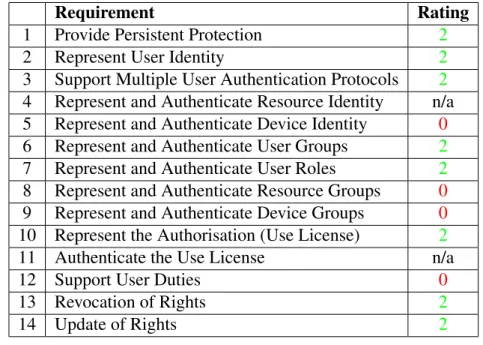
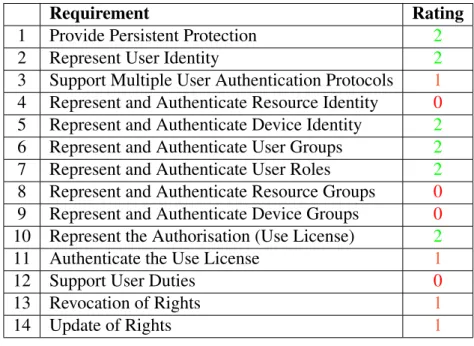
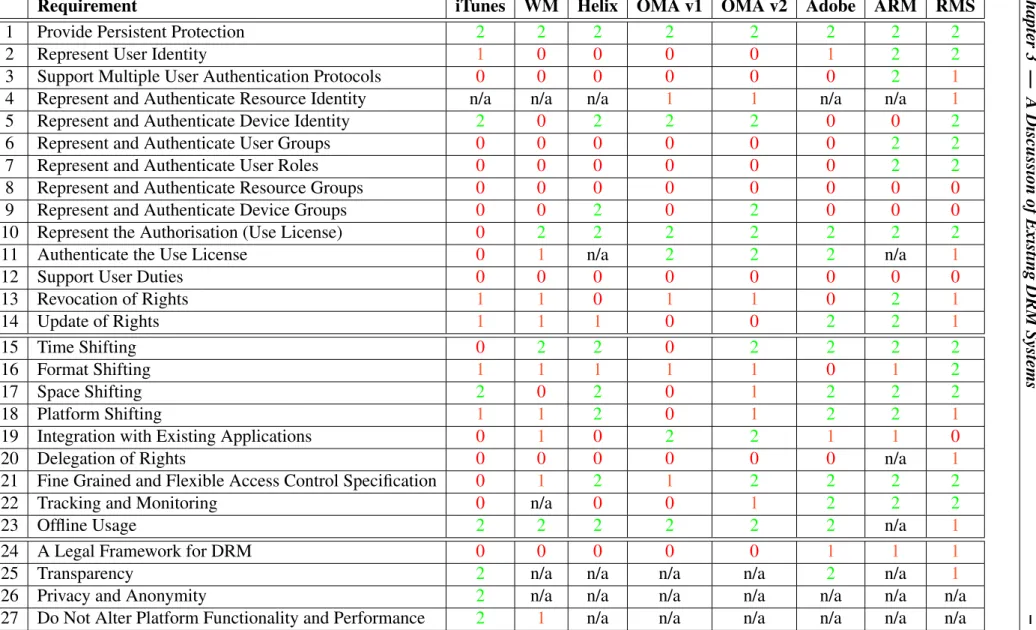
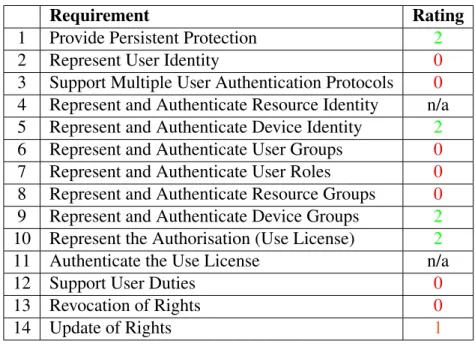
In this chapter, we discuss a number of different DRM systems, both media and enterprise. For each system, we give an overview of the players involved in the system, how protected files are assembled and how access controls are enforced. We also conduct a requirement analysis of the systems using the requirements we have already discussed in chapter 2. For the requirement analysis, we use a simple 3 point rating system for each requirement, defined below. The ratings are then used to compare different systems, and identify which requirements are least satisfied by current DRM systems.
0 : The requirement is not supported at all. 1 : There is limited support for the requirement. 2 : The requirement is supported in full.
The requirement analysis is done with respect to the DRM system itself and what is possi-ble with the DRM system, and not what is expected by consumers or consumer organisations. Certain requirements could be considered fully met in design but have no support in implemen-tations. In these cases, we often score the systems as limited support, especially if the decisions behind non-implementation are driven by the vendor’s business model and practices; and not because of adequate market demand.
3.1
A
PPLE IT
UNESM
USICS
TOREIn March 2003, Apple Computers debuted the Apple iTunes Music Store1which allowed
cus-tomers to download individual music tracks for 99 US cents, and whole albums for US $9.99. Within one year, iTunes Music Store had become the dominant online music store, selling over 50 million songs [66] and it currently commands the majority of legal online music down-loads [91]. With over 2 Billion downloaded songs, 50 million TV episodes and 1.3 Million movie downloads, it can be considered to be the most successful DRM system [28].
Apple’s iTunes Music Service is a proprietary system, and the details we present below are com-piled from the user documentation provided by Apple [26], and from some well known compro-mises of the system – Playfair (subsequently renamed Hymn) [1, 11, 12] and PyMusique [193, 166] and its successor SharpMusique [111].
3.1.1 Brief Overview
iTunes DRM system can be considered as a set of two services. Initially, iTunes started as a music player system for Apple Macintosh, and later became the interface between the Apple Macintosh and their portable music player, the iPod. iTunes (the software) has evolved to become a comprehensive media player, and is available on Microsoft Windows and Apple Mac OS operating systems. The second part of the system is the iTunes Music store, which sells music, audio books, movies and TV episodes. All media sold on the music store is protected by the Apple DRM system known as FairPlay, which is the focus of our discussion.
When a user first registers in the iTunes Music Store, a digital certificate, including a key, is generated for that machine. We believe that this certificate is signed by the iTunes Music Store. Currently, the user can register five machines in total, which would all carry the same digital certificate. It is possible to deregister the machine (thereby removing the key from the key store), but it is not possible to register beyond the maximum – even if those machines are no longer registered.
When protected data (currently music and video) is transfered to a portable device (currently only the Apple iPod is supported), the digital certificate associated with the data is also trans-fered. It is therefore possible to utilise data from different users on the portable device.
There are no other keys or digital certificates involved in the iTunes Music Service, and thus Apple manages to keep a very tight control over the chain of trust. However, the short chain (only two types of keys) introduces its own problems, primarily with regards to portability.
Using the primary key (on the iTunes service) provides no user authentication; and thus any data that is protected with the key is accessible to every registered user. Thus, the iTunes service utilises the user key to protect content, requiring user authentication to access data. This means that portability between different users is not possible; a limitation which will affect every user who reaches their maximum limit on registered computers.
A flaw in the system, uncovered by PyMusique, is that the protection of content does not occur on the iTunes server; presumably because it would require the iTunes service to keep track of all the keys. Instead, the protection is only applied once the data is downloaded to the registered computer. PyMusique and SharpMusique took advantage of this flaw, and interacted with the iTunes music server directly, but did not protect the data once it was downloaded. In late 2006, the protocol used by iTunes to interact with iTunes Music Store changed, and SharpMusique no longer works [111].
Hymn (also known as PlayFair) is a more direct attack on the service, where the user’s key is recovered from the portable device and used to decrypt the protected content. Once the data is decrypted, the user can do what they wish with the content.
3.1.2 Core Requirement Analysis
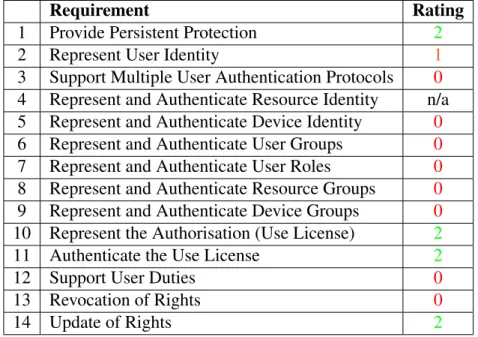
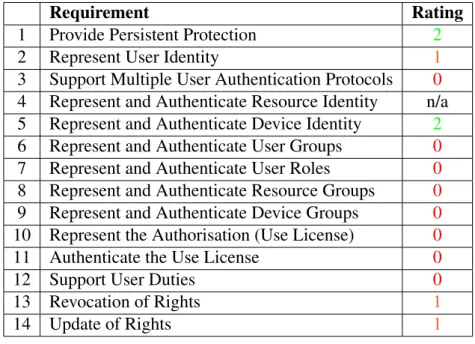
FairPlay cannot be considered a complete DRM system. Its primary protection relies on secure distribution, which has already been compromised. Furthermore, the user identity system is basic, and two different users cannot be accommodated on the same iTunes system directly (it is possible to cater for two different users if they use different user profiles on the consuming computer’s operating system). Furthermore, even though Apple is introducing iTunes enabled media into other areas of the home through products such as Apple TV2, mechanisms to man-age device or user groups do not exist. And even though music is sold as albums, songs are effectively treated as individual and not as a group of resources. This could be due to the fact that the system does not make use of any licensing structure. Revocation of rights is also poorly supported, and only allows the complete revocation of user’s rights and not selective revoca-tion. The rights profile can be updated (and have changed since the inception of the store), but requires an update to the iTunes software, and users who do not update their software do not get the updated rights profile. Table 3.1 provides a summary of our core ratings.
3.1.3 Usability Requirements Analysis
Portability is often seen as a major consumer problem with DRM and FairPlay scores interesting ratings with respects to portability. FairPlay currently does not have any time shifting
Requirement Rating 1 Provide Persistent Protection 2
2 Represent User Identity 1
3 Support Multiple User Authentication Protocols 0
4 Represent and Authenticate Resource Identity n/a 5 Represent and Authenticate Device Identity 2
6 Represent and Authenticate User Groups 0
7 Represent and Authenticate User Roles 0
8 Represent and Authenticate Resource Groups 0
9 Represent and Authenticate Device Groups 0
10 Represent the Authorisation (Use License) 0
11 Authenticate the Use License 0
12 Support User Duties 0
13 Revocation of Rights 1
14 Update of Rights 1
Table 3.1: Core Requirement Analysis for iTunes FairPlay
tions imposed on the user – once the user downloads a song or video clip, they can render it however often they wish. The subscription model, which requires time shifting is not supported in FairPlay, although rumours of such as a service have been reported by the media [59, 117]. Since we do not have access to any internal documentation on FairPlay, we assume that Time Shifting is simply not supported, and future support will require an update of the iTunes service. FairPlay is openly acknowledged as a DRM wrapper, thus there is no reason why multiple format types cannot be accommodated, or why format conversion cannot be performed between these different formats. However, only two formats are currently implemented: AAC for audio and Quicktime Video for video. Likewise, limited platform portability is supported through the evidence of support for different operating systems and the iPod, but the support remains tightly controlled. Space shifting however is well supported.
Apart from Offline Usage, where FairPlay does not require any Internet connection other than for initial acquisition of media, other usability requirements are not catered for by FairPlay. iTunes does not support delegation of rights, and the lack of licensing structure means that there are no fine grained access controls. With the tight integration of iTunes software, other applications are ignored and the iTunes music store claims that it does not track or monitor usage of protected works.
Requirement Rating
15 Time Shifting 0
16 Format Shifting 1
17 Space Shifting 2
18 Platform Shifting 1
19 Integration with Existing Applications 0
20 Delegation of Rights 0
21 Fine Grained and Flexible Access Control Specification 0
22 Tracking and Monitoring 0
23 Offline Usage 2
Table 3.2: Usability Requirement Analysis for iTunes FairPlay
3.1.4 Legal and Social Usability Analysis
While it is well known that the iTunes Music store sells media to the general public, the exact legal position of the store is, at best unknown, and has attracted legal attacks in some countries like Norway [159], which would like to force portability of FairPlay beyond the iPod. If iTunes sells media under copyright law, then a number of functions allowed under copyright are not permitted and that means it can be considered as illegal. If it is under a licensing system, then do they fulfil the requirements necessary for concluding valid contracts? Thus, with an unclear and unknown legal position, it scores a 0 rating for the legal framework rating.
iTunes Music store is very transparent in identifying all the restrictions placed by iTunes, but does not provide much detail on how much personal data is collected (sales records etc) or if data is correlated to keep track of general trends. Apple does have a comprehensive privacy policy, and is easily available to all users [27], and thus our higher score. Finally, studies have shown that battery life of portable media players diminishes faster when playing DRM enabled media when compared to non DRM enabled media [116], but that is understandable considering the extra CPU operations required to render the media. Apple iPod had one of the lowest reported degradation in performance, and hence the full rating. Our ratings are summarised in table 3.3.
Requirement Rating
24 A Legal Framework for DRM 0
25 Transparency 2
26 Privacy and Anonymity 2
27 Do Not Alter Platform Functionality and Performance 2
3.2
M
ICROSOFTW
INDOWSM
EDIA(WM)
Recent versions of Microsoft’s Windows Media (WM) Audio and Windows Media Video were designed to compete with iTunes Music Store and thus feature DRM protection. Unlike Apple, Microsoft’s initial strategy was to support multiple online music stores and multiple portable media players. But, even though the formats are supported by one vendor; different versions support different features and are often incompatible. Microsoft’s first release, Windows Me-dia 9, did not support automatic time shifting expiry and was confined to online connectivity only [127]. This was solved in a subsequent release, “Play For Sure”. This is possibly the most widely used version, and is supported by many device manufacturers and online music stores. More recently, Microsoft released yet another specification, which is incompatible with “Play For Sure”, and geared towards its own portable device player, Zune [3, 181]. With this strategy, it seems that Microsoft is trying to emulate Apple’s tight integration strategy.
In this section, we primarily discuss “Play For Sure”, although all three versions use a similar architecture. Like iTunes, Windows Media is a proprietary solution, although there is a lot more documentation available on its operation than iTunes’ operation. We use documentation released by Microsoft [136, 140, 133, 134, 156, 135, 155] and reports on the breaking of the protection (through a tool FairUse4WM) in [57] and the original details posted in [76] and an earlier attack using a tool DrmDbg [75].
3.2.1 Brief Overview
Unlike Apple, Microsoft has chosen not to control the distribution and licensing components of the DRM system. Furthermore, because the playback libraries can be licensed, theoretically, playback is possible in a wide range of platforms and devices.
One of the key features of the Microsoft approach is the default support for super distribution – it does not matter how the consumer acquires the media, but to access the media, the consumer will require a license. However, the licenses are non transferable, and usually tied to the device. This approach severely limits portability, as consumers cannot use multiple devices even if the consumer owns these devices.
Unlike iTunes, DRM protected media files are encrypted before distribution. The key to access these files are distributed through the use license. Licenses also carry a revocation list of con-suming devices that should be refused access to the protected media. Because the licenses are locked to the consuming device, there is no need for user authentication. Unfortunately, neither the public documentation nor the break indicate conclusively whether the use license itself is encrypted.
The documentation does confirm that the use licenses are signed by the licensors. The licen-sors’ root certificates in turn have to be signed by Microsoft directly. This means, that while, Microsoft may not control the entire DRM value chain, they still control the chain of trust. This also means that Microsoft ultimately can decide which licensors to trust, and can refuse licensors a signed certificate, thereby refusing them access to utilise the Windows Media DRM system.
Like Hymn, FairUse4WM (based on an earlier attack DrmDbg) is a direct attack, extracting the key(s) from the licenses and then extracting the content from the protected package.
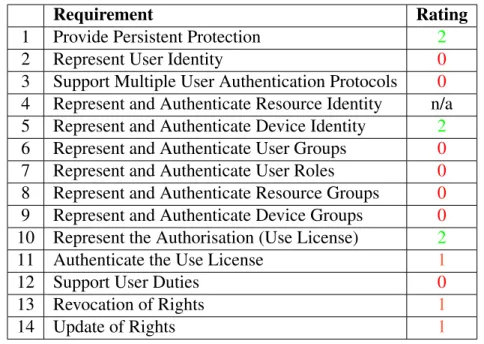
3.2.2 Core Requirement Analysis
Requirement Rating
1 Provide Persistent Protection 2
2 Represent User Identity 0
3 Support Multiple User Authentication Protocols 0
4 Represent and Authenticate Resource Identity n/a 5 Represent and Authenticate Device Identity 2
6 Represent and Authenticate User Groups 0
7 Represent and Authenticate User Roles 0
8 Represent and Authenticate Resource Groups 0
9 Represent and Authenticate Device Groups 0
10 Represent the Authorisation (Use License) 2
11 Authenticate the Use License 1
12 Support User Duties 0
13 Revocation of Rights 1
14 Update of Rights 1
Table 3.4: Core Requirement Analysis for Windows Media
Since protection offered by WM is not distribution dependent, it offers a more persistent access control protection. However, like iTunes FairPlay, there is no provision for individual user identity, and instead user identity is replaced by device identity. Also, like iTunes FairPlay, there is no provision to identify groups of devices, resources or users; and revocation of rights is tied to the device, and not individual rights or resources. Unlike iTunes FairPlay, WM does make use of use licenses and these use licenses are authenticated through the digital signature of the issuer. However, there does not seem to be any mechanism to verify the authenticity of the issuer (whether it is still trusted for example) or whether the license issuer can differ from the actual packager of the media (i.e. can an artist package the media him(her)self and then use music stores to market and sell licenses?). Rights can be updated through the issuing of a new license, but we are not aware of any media store that supports such a practice. Since current revocations are based on device rather than license, we are not sure if license revocation
is possible. Our core requirement analysis ratings are summarised in table 3.4. 3.2.3 Usability Requirement Analysis
Initially, WM was used exclusive in subscription business models, and thus time shifting was a key feature, although this initially required online connectivity. Like iTunes FairPlay, WM uses a wrapper and thus it potentially can support other media formats. However, no other im-plementations exist, and thus cannot be verified any further. Unlike Apple, Microsoft has been more liberal in allowing WM to be incorporated into other devices and platforms. However, the recent change with Zune, and because of the fact that Microsoft can still refuse to license to any vendor they wish, we have lowered the platform shifting scores. Since WM is based on a set of libraries, it is possible to render media on compatible software that makes use of the libraries, although not all applications may work. Because media licenses are device specific, space shifting is not possible under most schemes.
Even though WM does feature a licensing mechanism, the lack of individual users make fine grained access control difficult, and this difficulty is compounded by a relatively small set of access control primitives. Without user identification, delegation is also not possible. WM does support tracking and monitoring support, but the extent is not documented; and both “Play For Sure” and Zune versions support offline usage. Our usability requirement analysis ratings are summarised in table 3.5. Requirement Rating 15 Time Shifting 2 16 Format Shifting 1 17 Space Shifting 0 18 Platform Shifting 1
19 Integration with Existing Applications 1
20 Delegation of Rights 0
21 Fine Grained and Flexible Access Control Specification 1
22 Tracking and Monitoring n/a
23 Offline Usage 2
Table 3.5: Usability Requirement Analysis for Windows Media 3.2.4 Legal and Social Requirement Analysis
As with Apple iTunes FairPlay, there is no legal certainty to the legal position of online media stores using WM. Furthermore, because individual media stores set their own privacy policies, and their own disclosure rules, we cannot rate these factors. With regard to performance and battery life, the reviews mentioned earlier found that WM enabled devices fared the worst, losing battery life up to 25% faster [116]. This is significantly higher than the iPod and thus our
Requirement Rating
24 A Legal Framework for DRM 0
25 Transparency n/a
26 Privacy and Anonymity n/a
27 Do Not Alter Platform Functionality and Performance 1
Table 3.6: Legal and Social Requirement Analysis for Windows Media
lower rating. Our legal and social requirement analysis ratings are summarised in table 3.6. 3.3
H
ELIXDRM
Real Network’s Helix DRM is built on the Helix platform, a multi-format, multi-platform, me-dia platform; co-developed with the Helix Community, an open source initiative. Large parts of the Helix platform are available as open source, but the DRM component, while integrat-ing with the larger Helix platform, remains proprietary. Helix DRM does cater support for both Windows Media and iTunes fair play [163], but has been largely unsuccessful. The in-formation we present in this section is summarised from documentation released by Real Net-works3[145, 162], Michiels et al.’s brief discussion in [132] and some of the Helix Community
documentation including [101, 102, 100, 99]. 3.3.1 Brief Overview
Figure 3.1: Overview of the Helix Platform [101]
As illustrated in figure 3.1, the Helix Platform consists of three players: a producer to create encoded content, a server to distribute content and clients that render the content. Helix DRM
![Figure 1.2: Categorisation of DRM Systems [149]](https://thumb-us.123doks.com/thumbv2/123dok_us/970774.2627307/27.892.273.613.134.444/figure-categorisation-of-drm-systems.webp)
![Figure 3.3: Overview of OMA DRM 2 Architecture [147]](https://thumb-us.123doks.com/thumbv2/123dok_us/970774.2627307/53.892.154.741.150.456/figure-overview-oma-drm-architecture.webp)