Leveraging Linux to reduce
software development costs
By Marc Brown, Reid Gerson and Rachael Rusting
IBM Software Group
Introduction
Today, organizations are leveraging Linux® technology to lower their IT
infrastructure costs and streamline their business operations. Linux offers customers a choice for new workloads through open computing, avoiding lock-in to proprietary hardware or software vendors or architecture. Part of this move to Linux is because companies are realizing the value that automating and integrating the software development environment provides. This white paper
discusses how the IBM® Rational Software Development Platform an open,
flexible, solution that integrates proven best practices and products for governing developmentenables, helps clients to achieve business driven development.
Why Linux for software development?
The Linux operating system was developed within the open source community. The open source community develops, debugs, maintains and enhances Linux source code, resulting in high quality and high performance. The Linux operating system offers superior security, reliability and overall uptime on par with other UNIX-like operating systems.
As the Linux operating system has become more popular and its stability and scalability are proven, organizations have turned to it to address the increasingly expensive costs of maintaining multiple proprietary operating systems across multiple hardware platforms—expenses that include the operating system price, operating system maintenance costs, hardware costs, hardware upgrade costs and administration costs.
2 Introduction
2 Why Linux for software development?
3 Linux and IBM Rational software: A foundation for building
business value
3 The IBM Rational Software Development Platform
5 Rational tools for developing on and for Linux
7 Change and configuration management
8 Process and project management 9 Requirements and analysis 10 Design and construction 12 Software quality
15 Services
15 Linux and IBM Rational software— creating value for your
organization
16 For more information
Linux and IBM Rational software: A foundation for building business value
Today, you can run Linux on platforms ranging from mainframes to pervasive computing devices. And organizations are also creating more Linux technology– based applications. The resulting value to the enterprise is multiplied when the Linux operating system is used to both develop and deploy Linux technology– based applications.
Many organizations face the challenge of integrating a combination of operating systems, server platforms and mainframe technology. How can you realize the benefits of the Linux operating system in your software development environment when you have to support a diverse set of applications and platforms?
The IBM Rational Software Development Platform
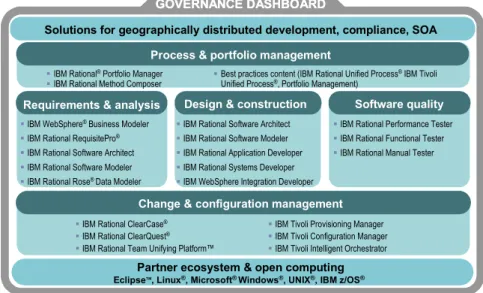
To answer this challenge, you need an integrated software development lifecycle solution that enables you to leverage the Linux environment without disrupting your development teams. The IBM Rational Software Development Platform, a cross-brand IBM Software Group solution based on Eclipse™, enables your development teams by defining, automating and integrating the business process of software development. Organizations that embrace software development as strategic to their business can deliver software and software-based systems with the power to transform, create new revenue sources and drive business results (see Figure 1).
The IBM Rational Software Development Platform is:
• Proven. It consists of tools and best practices that are the choice of thousands of high-performance software teams.
• Complete. It drives business value throughout your software lifecycle by supporting every member of your development team, as well as your business and operations stakeholders.
• Open. You can leverage existing assets and choose from a wide array of development languages, deployment platforms and partner technologies—including Microsoft .NET, BEA and Oracle solutions.
• Modular. Choose the exact tools and adoption path that best fit your needs. Use your existing tools with components of the IBM Rational Software Development Platform—no need to “rip and replace” what you already have.
The IBM Rational Software Development Platform provides companies with the right tools, services and best practices needed to focus on software development as a strategic business process. By doing this, organizations are able to automate and integrate their people, customers, software and systems to improve operational efficiency and capture valuable intellectual property.
Rational tools for developing on and for Linux
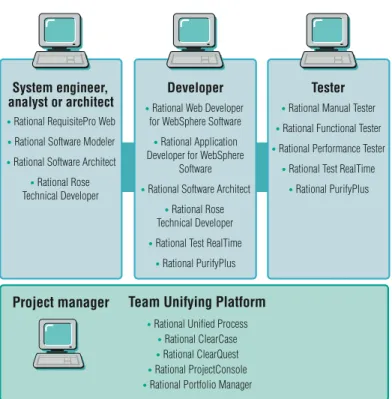
Rational software offers a comprehensive solution that lets you leverage the Linux operating system to build, integrate, expand, modernize and deploy software and software-based systems. With broad support for all roles and activities in the software lifecycle, the IBM Rational Software Development Platform supports development on and for Linux (see Figure 2).
Rational support for Linux focuses on two areas: facilitating the development of Linux applications through comprehensive IDE support and reducing total cost of ownership (TCO) for software development infrastructures by providing Linux technology–based platform support for software asset management.
Figure 1: IBM Rational Software Development Platform Business Driven Development
The IBM Rational capabilities include:
• Requirements and analysis: Reduce project risk with requirements management and business, use case and data modeling.
• Design and construction: Improve productivity in code-centric, model-driven and rapid application development.
• Software quality: Improve software functionality, reliability, performance and scalability throughout the development project.
• Change and configuration management: Manage lifecycle assets with process automation, change control, reporting and traceability.
• Process and portfolio management: Plan, manage and measure development projects with proven processes and team unifying tools.
������ ������������������������ ���������������������������� ����������������������������� ������������������������ ��������������������� ��������� ������������������������� ���������������������� ���������������������� ����������������������� �������� ����������������������������� ���������������� ������������������� ������������������������ ��������������������� ���������������� �������������������� � � � � � ��������������� ���������������������� �������������������������� �������������������� ��������������������� ������������������������� ���������������������������� �������������������������� �������������������������� ���������������������������� ��������������� �������������������
Figure 2: Rational tools allow you to develop on Linux and develop for Linux.
Change and configuration management
IBM Change and Configuration Management offerings helps ensure that individuals and development teams work productively. IBM Rational
ClearCase® software configuration management products help you to
effectively manage and control software assets through version control, automated workspace management, parallel development support, and build
and release management. IBM Rational ClearQuest® change management
products help manage the software lifecycle through process automation, defect and change tracking, reporting and traceability.
Rational ClearCase and Rational ClearQuest work together to allow you to define and manage changes to software assets as activities. Through the Unified Change Management (UCM) capability, specific files in Rational ClearCase are associated with activities in Rational ClearQuest. Developers can then perform operations directly on the activities rather than on the collections of files associated with them.
This activity-based approach to change and configuration management helps developers ensure they are working on the right versions of the right files. It helps build engineers ascertain that the right files are incorporated into the build. Testers can easily confirm that the right functionality and builds are tested. QA engineers can quickly see and validate what has changed between builds. And project managers can more easily track and asses project status.
Rational change and configuration management products provide options for easy access from the environments and locations in which your team works. From desktop clients, to remote and Web clients, to integrated IDE access, Rational change and configuration management products enable development teams to securely manage software assets and changes from virtually anywhere. You can easily manage your development assets on Linux, which can help reduce development costs, while development teams have the flexibility to use their preferred development environment.
Process and project management
Project failures often can be traced to a lack of a shared understanding of terminology, processes and goals. Whether you are developing large systems, integrating legacy applications or developing new software, a consistent process provides a common vocabulary and clear definition of responsibilities.
Rational Method Composer, that includes the IBM Rational Unified Process®,
or RUP®, can help address these software development issues. RUP, a
software-development process based on proven best practices, can be tailored and configured to meet the needs of your specific project. RUP is the “common playbook” that helps all members of your team understand what they need to do to perform their tasks more effectively, and also understand how they can more effectively interact with other team members. Because of the resulting reduction in confusion and rework, your teams will create business applications more quickly and cost-effectively. Comprehensive IBM Rational Summit Ascendant™ planning and estimation tools, that are also included in Rational
Method Composer, complement the proven RUP guidance for developing quality software.
During project lifecycles, continuous improvement and repeatable successes are possible only with tools that automate the development processes. IBM
Rational Team Unifying Platform™ tools are designed to equip your teams with
the development infrastructure they need to work together more effectively while providing managers and stakeholders with access to up-to-date project status information. A core part of the IBM Rational Suite, Rational Team Unifying Platform tools provide your team with common access to development assets, communication alerts and workflow processes, as well as visual
modeling, code-generation and run-time analysis capabilities.
Requirements and analysis
Whether you are a project manager, analyst, developer or tester, requirements and analysis affect your work. IBM Requirements and Analysis offerings help you define the right solution by understanding your problem space, capturing and managing evolving requirements, modeling user interactions, defining your database architecture and incorporating stakeholder feedback throughout your project lifecycle. Good requirements and analysis practices help reduce project risk and keep your project running smoothly until the final product is successfully delivered to your customer.
IBM WebSphere Business Modeler software provides business analysts with comprehensive business process modeling and collaboration capabilities to graphically design processes across people, partners and applications. It is an easy-to-use process modeling tool that lets you simulate and validate business processes and deliver a fast start for deployment.
IBM Rational RequisitePro® is a powerful, easy-to-use and integrated product for
requirements and use-case management that promotes better communication, enhances teamwork and reduces project risk. The IBM Rational RequisitePro
Web client1 and IBM Rational Software Modeler can help you understand and
define your business problem, capture and manage evolving requirements, model business or system requirements, define your database architecture and incorporate stakeholder feedback throughout your project lifecycle.
IBM Rational Software Modeler and IBM Rational Software Architect enable architects and designers to practice model-driven development with the Unified Modeling Language (UML). Users can produce platform-independent models of software architecture, business needs, reusable assets and management-level communication.
Design and construction
IBM provides a range of Design and Construction offerings to make
development faster and easier; to maximize quality, robustness and reusability; to maximize the value of both code and models; and to allow development teams to choose the development paradigms that fit them best. These solutions include tools for traditional coding, code visualization and visual editing, modeling and round-trip engineering, legacy integration, rapid application development and model execution.
BA-CA Leasing: Steering the course with proven practices
Combine the cost-effectiveness of Linux with tools that allow you to adapt quickly to changing business needs, and you can realize significant reductions in your organization’s TCO.
When Vienna-based Bank Austria Creditanstalt (BA-CA) Leasing was ready to automate its vehicle leasing process, it chose tools based on IBM technology. BA-CA Leasing created a highly responsive
technology platform and online solution that allows up to 1,000 concurrent users to complete transactions in real time. The bank’s IT team designed, developed and implemented its online calculator application in about six months. They selected IBM WebSphere software for an open-standards, Java technology– based solution. The application resides on a hardware foundation of three IBM ® iSeries™ systems and three IBM xSeries® systems running Red Hat Linux.
“We have in-house expertise with Linux. And, given the fact that Linux has proven to be very reliable and inexpensive, we wanted to try it out for our online vehicle-leasing application,” says Georg Nechvatal, software engineer and analyst. “Linux on the xSeries system works perfectly for us, enabling us to be responsive to our customers’ need for a convenient leasing process while reducing our total cost of ownership.”
The BA-CA Leasing and IBM team used IBM WebSphere Studio Application Developer to create the Java servlets that provide the business logic. By using the RUP development platform, the team was able to adapt quickly to changing business needs by delivering code in smaller, more concise iterations. “As the project progressed, the developers were able to mitigate risk, reduce complexity in the design phase and ultimately increase productivity while reaching key project milestones,” says Nechvatal.
1 Some Microsoft components are required for use with Rational RequisitePro from a team perspective; it is not a stand-alone Linux-supported application. However, it can be used in heterogeneous environments where projects have both Microsoft Windows and Linux clients.
IBM uses the award-winning Eclipse platform as a basis for an entire family of end-to-end IBM application development tools. These products benefit from integrated quality-assurance testing as well as IBM product support and use the same interfaces and build upon the technology shared with the Eclipse platform. In April 2004, IBM WebSphere Studio won the Best Linux Developer Tool award from the Linux User & Developer Awards 2004.2
Software developers typically need an integrated development environment. The IBM Rational and IBM WebSphere families of products provide several capabilities for organizations that want to develop software in Java, COBOL, PL/I and other languages. If your organization is developing Java and J2EE applications, you can leverage IBM Rational Web Developer for WebSphere Software and IBM Rational Application Developer (RAD) for WebSphere Software. IBM Rational Web Developer for WebSphere Software offers an easy-to-use integrated development environment with high-productivity RAD tools for building and maintaining dynamic Web applications, Web services and Java applications. Rational Application Developer for WebSphere Software adds to Rational Web Developer for WebSphere Software comprehensive tools for building and maintaining portals and J2EE applications as well as UML visual editing and entry-level version control and team support. Rational Software Architect builds on Rational Application Developer for WebSphere Software to offer software architects and senior developers a rich set of model-driven development capabilities for unifying all aspects of software architecture. If you are developing applications for pervasive computing devices, you can leverage IBM WebSphere Studio Device Developer. And if you maintain or develop new COBOL or PL/l applications, you can leverage IBM WebSphere Developer for z/Series.
2 For more information, see www.linuxuser.co.uk/expo/index.php?option=content&task= blogsection&id=8&Itemid=87.
For software organizations constructing software systems, the IBM Rational family of products supports both code and model-centric C, C++ or Java J2ME development. IBM Rational Software Architect provides a comprehensive IDE, based on Eclipse, which provides UML 2 modeling support, patterns and transformations, code visualization and language support. Leveraging Rational Software Architect, organizations can build component-based architectures and designs, then by utilizing model transformations, they can transform these designs to code or visualize existing legacy code. IBM Rational Rose RealTime software supports users who want to execute on a particular universal modeling language (UML) and move to a full model-driven development approach. Rational Rose RealTime supports modeling for device-level and system-level development. Both approaches are fully supported on Linux—on both the host and the target side. With model-driven development, your development organization can improve its effectiveness and productivity by leveraging code generation and automated testing facilities of Rational Rose RealTime.
Software quality
The goal of any software development effort is to create high-quality applications. But what exactly does “quality” mean? Quality is an experience—the sum total of end-user impressions about how well a tool addresses their needs. It is a combination of perceptions about an application’s functionality, usability, reliability, performance, scalability and a host of other characteristics. To fulfill this tall order, development organizations must commit to building quality into their applications from the beginning; otherwise, time works against project success.
Building quality into an application requires the deep commitment and collaboration of every person on the project team. It involves an iterative process and a set of tools to help team members automate error-prone aspects of their work, freeing them to focus on creativity and value. And for the testing team, it involves a change in mindset. They are not responsible for building in quality, but for finding the failures that slip past the rest of the project team, such as functionality and usability errors.
Rational Test RealTime offers run-time analysis, as well as unit integration and system-level testing. It allows you to test and debug software on both real-time embedded platforms as well as on full-featured host platforms, and then to coordinate the two environments. When your hardware is unavailable, you can simulate at the host and test for generic bugs. When the target is available, you can execute the same test directly on the operational platform.
IBM Rational PurifyPlus™ provides run-time analysis capabilities for use by
developers during their debugging efforts and by testers looking to gain a better understanding about why the application under test is failing. It is comprised of a suite of utilities for exposing memory leaks, performance bottlenecks and code coverage statistics down to individual lines of code. Available across a host of operating systems including Linux, PurifyPlus significantly increases the speed at which reliability errors can be exposed and eliminated before application release.
IBM Rational Manual Tester helps teams overcome the disorganization and unintended errors that can prohibit effective manual testing. Using a full-featured Windows- and Linux-based test editor, testers can create well-documented scripts supplemented with images, files and custom data. A drag-and-drop reuse library vastly simplifies test maintenance in the face of application changes; updates to any one instance of test step blocks shared across multiple scripts and all other instances update automatically. Usage of Rational Manual Tester is intended for business analysts and professional testers working without test automation or with highly variable application interfaces and business processes.
IBM Rational Functional Tester enables functional test automation-the classic QA technique proven to increase the speed, breadth and depth of the testing efforts. This tool enables the execution of automated test on both Windows and Linux platforms, which provides for hands-free interaction with graphical user interfaces and underlying APIs, probing for both functional and
non-functional errors.
IBM Rational Performance Tester is designed to help teams ensure the scalability of complex Web-based applications before deployment. Rational Performance Tester generates large, concurrent, multi-user loads based on easily generated tests, and then collates and graphically displays system response times. With this information, performance testers can expose system-level bottlenecks, ensuring that poor performing but high-priority business processes are optimized before deployment.
Testing teams in many organizations still use many manual processes. As a result, organizations need to allocate large chunks of their budgets—both time and money—to testing. With all of these software quality products from IBM Rational, development teams can now automate many time-consuming and tedious activities, allowing them to do more testing in less time.
Services
Choosing software from IBM means you have access to the vast resources available through the global team at IBM Software Services and a network of qualified IBM Business Partners—all ready to help you quickly maximize software capabilities and help speed return on your IBM software investments. Through expert consultation, in-depth understanding of IBM software technologies, custom application development, real-world experience and knowledge transfer, IBM can help you turn your IT investments into quantifiable business value.
IBM Software Services can provide support as your organization makes the transition—incrementally or all at once—to the Linux environment. Besides services, IBM offers a variety of Linux Porting Centers and Linux Technology Centers worldwide that can help your business port its applications and migrate from UNIX or Windows to the Linux operating system. These leading-edge services and solutions are available whenever and wherever you need them.
Linux and IBM Rational software—creating value for your organization
The IBM Rational Software Development Platform, powered by Rational software, can help teams like yours maximize output with fewer resources; develop high-quality software that meets the needs of end users; and meet these goals within a predictable schedule and budget. From analysis and requirements gathering to testing and deployment, Rational software supports all aspects of the software development lifecycle on Linux while creating real business value.
Contact IBM Rational at 1-877-426-3774 or visit http://www-306.ibm.com/
software/rational/linux/ and learn how you can leverage the power and cost effectiveness of Linux and Rational to help lower your organization’s TCO.
trademarks or registered trademarks of International Business Machines Corporation in the United States, other countries or both.
Microsoft and Windows are trademarks of Microsoft Corporation in the United States, other countries or both.
Eclipse is a trademark or registered trademark of Eclipse Foundation Inc. in the United States, other countries or both.
Java and all Java-based trademarks are trademarks of Sun Microsystems, Inc., in the United States, other countries or both.
UNIX is a registered trademark of The Open Group in the United States and other countries.
Linux is a trademark of Linus Torvalds in the United States, other countries or both.
Other company, product and service names may be trademarks or service marks of others.
References in this publication to IBM products or services do not imply that IBM intends to make them available in all countries in which IBM operates. All statements regarding IBM future direction or intent are subject to change or withdrawal without notice and represent goals and objectives only. ALL INFORMATION IS PROVIDED ON AN “AS-IS” BASIS, WITHOUT ANY WARRANTY OF ANY KIND. This publication contains non-IBM Internet addresses. IBM is not responsible for information contained on these Web sites.
The IBM home page on the Internet can be found at
ibm.com
G507-1031-02 To learn more about IBM Rational products and services, visit:
ibm.com/rational
To learn more about Linux application development and system administration, visit:
ibm.com/developerworks/linux
To learn more about the IBM Rational Software Development Platform, visit:
ibm.com/software/info/developer
To learn more about the flexible ways to purchase IBM software, visit:
ibm.com/software/rational/howtobuy
Ready to build and deploy on demand applications and Web services for Linux? Then you need the latest IBM trial code for Linux—all on a no-charge DVD. Visit: