NBER WORKING PAPER SERIES
THE EFFECTS OF QUANTITATIVE EASING ON INTEREST RATES: CHANNELS AND IMPLICATIONS FOR POLICY
Arvind Krishnamurthy Annette Vissing-Jorgensen
Working Paper 17555
http://www.nber.org/papers/w17555
NATIONAL BUREAU OF ECONOMIC RESEARCH 1050 Massachusetts Avenue
Cambridge, MA 02138 October 2011
We thank Jack Bao, Olivier Blanchard, Greg Duffee, Charlie Evans, Ester Faia, Simon Gilchrist, Robin Greenwood, Monika Piazzesi, David Romer, Thomas Philippon, Tsutomu Watanabe, Justin Wolfers, and participants at seminars and conferences at Brookings, Chicago Fed, Board of Governors of the Federal Reserve, ECB, San Francisco Fed, Princeton University, Northwestern University, CEMFI, University of Pennsylvania (Wharton), Society for Economic Dynamics, NBER Summer Institute, the NAPA Conference on Financial Markets Research, and the European Finance Association for their suggestions. We thank Kevin Crotty and Juan Mendez for research assistance. This paper was prepared for the Brookings Papers on Economic Activity Fall 2011 issue. We have received an honorarium for the presentation of the paper at Brookings. The views expressed herein are those of the authors and do not necessarily reflect the views of the National Bureau of Economic Research.
At least one co-author has disclosed a financial relationship of potential relevance for this research. Further information is available online at http://www.nber.org/papers/w17555.ack
NBER working papers are circulated for discussion and comment purposes. They have not been peer-reviewed or been subject to the review by the NBER Board of Directors that accompanies official NBER publications.
© 2011 by Arvind Krishnamurthy and Annette Vissing-Jorgensen. All rights reserved. Short sections of text, not to exceed two paragraphs, may be quoted without explicit permission provided that full credit, including © notice, is given to the source.
The Effects of Quantitative Easing on Interest Rates: Channels and Implications for Policy Arvind Krishnamurthy and Annette Vissing-Jorgensen
NBER Working Paper No. 17555 October 2011
JEL No. E4,E5,G01,G14,G18
ABSTRACT
We evaluate the effect of the Federal Reserve’s purchase of long-term Treasuries and other long-term bonds ("QE1" in 2008-2009 and "QE2" in 2010-2011) on interest rates. Using an event-study methodology we reach two main conclusions. First, it is inappropriate to focus only on Treasury rates as a policy target because QE works through several channels that affect particular assets differently. We find evidence for a signaling channel, a unique demand for long-term safe assets, and an inflation channel for both QE1 and QE2, and an MBS pre-payment channel and a corporate bond default risk channel for QE1. Second, effects on particular assets depend critically on which assets are purchased. The event-study suggests that (a) mortgage-backed securities purchases in QE1 were crucial for lowering mortgage-backed security yields as well as corporate credit risk and thus corporate yields for QE1, and (b) Treasuries-only purchases in QE2 had a disproportionate effect on Treasuries and Agencies relative to mortgage-backed securities and corporates, with yields on the latter falling primarily through the market’s anticipation of lower future federal funds rates.
Arvind Krishnamurthy
Kellogg School of Management Northwestern University 2001 Sheridan Road Evanston, IL 60208 and NBER [email protected] Annette Vissing-Jorgensen Finance Department
Kellogg School of Management Northwestern University
2001 Sheridan Road Evanston, IL 60208-2001 and NBER
2 1. Introduction
The Federal Reserve has recently pursued the unconventional policy of purchasing large quantities of long-term securities, including Treasuries, Agency bonds, and Agency Mortgage Backed Securities (quantitative easing, or “QE”). The stated objective of quantitative easing is to reduce long-term interest rates in order to spur economic activity.3 There is significant evidence that QE policies can alter long-term interest rates. For example, Gagnon, Raskin, Remache, and Sack (2010) present an event-study of QE1 that documents large reductions in interest rates on dates associated with positive QE announcements. Swanson (2011) presents confirming event-study evidence from the 1961 Operation Twist, where the Fed/Treasury purchased a substantial quantity of long-term Treasuries. Apart from the event-study evidence, there are papers that look at lower frequency variation in the supply of long-term Treasuries and documents causal effects from supply to interest rates (see, for example, Krishnamurthy and Vissing-Jorgensen (2010)).4
While it is clear from this body of work that QE lowers medium and long-term interest rates, the channels through which this reduction occurs are less clear. The main objective of this paper is to evaluate these channels and their implications for policy. We review the principal theoretical channels through which QE may operate. We then examine the event-study evidence with an eye towards distinguishing among these channels, studying a range of interest rates and drawing in additional facts from various derivatives prices to help separate the channels. We furthermore supplement previous work by adding evidence from QE2 and evidence based on intra-day data. Studying intra-day data allows us to document price reactions and trading volume in the minutes after the main announcements, thus increasing confidence that any effects documented in daily data are causal.
It is necessary to understand the channels of operation in order to evaluate whether a given QE policy was successful. Here is an illustration of this point: Using annual data back to 1919, Krishnamurthy and Vissing-Jorgensen (2010) present evidence for a channel whereby changes in term Treasury supply drives the safety premia on near zero default risk long-term assets. Their findings suggest that QE policy that purchases very safe assets such as Treasuries or Agency bonds should work particularly to lower the yields of bonds which are
3 http://www.newyorkfed.org/newsevents/speeches/2010/dud101001.html
4 Other papers in the literature that have examined Treasury supply and bond yields include Bernanke, Reinhart and Sack (2004), Greenwood and Vayanos (2010), D’Amico and King (2010), Hamilton and Wu (2010), and Wright (2011).
3
extremely safe, such as Treasuries, Agency bonds and high-grade corporate bonds. But, even if a policy affects Treasury interest rates, such rates may not be the most policy relevant ones. A lot of economic activity is funded by debt that is not as free of credit risk as Treasuries or Aaas. For example, about 40 percent of corporate bonds are rated Baa or lower (for which our earlier work suggests that the demand for assets with near zero default risk does not apply). Similarly, mortgage-backed securities issued to fund household mortgages are less safe than Treasuries due to the substantial pre-payment risk involved in such securities. Whether yields on these less safe assets fall as much as those on very safe assets depends on whether QE succeeds in lowering default risk/default risk premia (for corporate bonds), and pre-payment risk premia (for mortgage-backed securities).
One of the principal findings of this paper is that the large reductions in mortgage rates due to QE1 appear to be driven partly by the fact that QE1 involved large purchases of agency MBS (thus reducing the price of mortgage-specific risk). In contrast, for QE2 which involved only Treasury purchases, we find a substantial impact on Treasury and Agency bond rates, but smaller effects on MBS rates and corporate rates. Furthermore, we find a substantial reduction in the default risk/default risk premium for corporate bonds only for QE1, suggesting that the QE1 MBS purchases may also have helped drive down corporate credit risk and thus corporate yields (possibly via the resulting mortgage refinancing boom and its impact on the housing market and consumer spending). The main effect on corporate bonds and MBS in QE2 appears to be through a signaling channel, whereby financial markets interpreted QE as signaling lower federal funds rates going forward. This finding for QE2 raises the question of whether the main impact of a Treasuries-only QE may have been achievable with a Fed statement committing to lower federal funds rates, i.e. without the Fed putting its balance sheet at risk in order to signal lower future rates.
The next section of the paper lays out the channels through which QE may be expected to operate. We then present event studies of QE1 and QE2 in Section 3 and 4 to evaluate the channels. We document that QE worked through several channels. First, a signaling channel (reflecting the market inferring information from QE announcement about future Federal funds rates) significantly lowered yields on all bonds, with effects depending on bond maturity. Second, the impact of quantitative easing on mortgage-based security (MBS) rates was large when QE involves MBS purchases, but not when it involves only Treasury purchases, indicating
4
that another main channel for QE1 was to affect the equilibrium price of mortgage-specific risk. Third, default risk/default risk premia for corporate bonds fell for QE1 but not QE2, contributing to lower corporate rates. Fourth, yields on medium and long maturity safe bonds fell because of a unique clientele for safe nominal assets, and Fed purchases reduce the supply of such assets and hence increase the equilibrium safety-premium. Fifth, evidence from inflation swap rates and TIPS show that expected inflation increased due to both QE1 and QE2, implying larger reductions in real than nominal rates. Section 5 presents regression analysis building on our previous work in Krishnamurthy and Vissing-Jorgensen (2010) to provide estimates of the expected effects of QE on interest rates via the safety channel. Section 6 concludes.
2. Channels
a. Signaling Channel
Eggertson and Woodford (2003) argue that non-traditional monetary policy can have a beneficial effect in lowering long-term bond yields only if such policy serves as a credible commitment by the central bank to keep interest rates low even after the economy recovers (i.e., lower than what a Taylor rule may call for). Clouse, et. al. (2000) argue that such a commitment can be achieved when the central bank purchases a large quantity of long duration assets in QE. If the central bank raises rates, it takes a loss on these assets. To the extent that the central bank weighs such losses in its objective function, purchasing long-term assets in QE serves as a credible commitment to keep interest rates low. Furthermore, some of the Federal Reserve announcements regarding QE explicitly contain discussion of the Federal Reserve’s policy on future federal funds rates. Markets may also infer that the Fed’s willingness to undertake an unconventional policy like QE indicates that it will be willing to hold its policy rate low for an extended period.
The signaling channel affects all bond market interest rates (with effects depending on bond maturity) since lower future federal funds rates, via the expectations hypothesis, can be expected to affect all interest rates. We examine this channel by measuring changes in the prices of the federal funds futures contract, as a guide to market expectations of future federal funds rates.5 The signaling channel should have a larger impact in lowering intermediate maturity rates
5
Piazzesi and Swanson (2008) show that these futures prices reflect a risk premium, in addition to such
5
rather than long maturity rates, since the commitment to keep rates low only lasts until the economy recovers and the Fed can sell the accumulated assets.
b. Duration Risk Channel
Vayanos and Vila (2009) offer a theoretical model for a duration risk channel. Their one-factor model produces a risk premium on a bond of maturity t that is approximately the product of the duration of a maturity t bond and the price of duration risk, which in turn is a function of the amount of duration risk borne by the marginal bond market investor and this investor’s risk aversion. By purchasing long-term Treasuries, Agency debt, or Agency MBS, policy can reduce the duration risk in the hands of investors and thereby alter the yield curve, particularly reducing long-maturity bond yields relative to short-maturity yields. To deliver these results the model departs from a frictionless asset pricing model. The principal departures that generate the duration risk premium result are the assumptions that there is a subset of investors who have preferences for bonds of specific maturities (``preferred habitat demand’’) and another subset of investors who are arbitrageurs and who become the marginal investors for pricing duration risk.
An important but subtle issue in using the model to think about QE is to ask whether the preferred habitat demand applies narrowly to a particular asset class (e.g., only the Treasury market) or whether it applies broadly to all fixed income instruments. For example, if some investors had a special demand for 10 year Treasuries, but not 10 year corporate bonds (or mortgages or bank loans), then the Fed’s purchase of 10 year Treasuries can be expected to affect Treasury yields more than corporate bond yields. Vayanos and Vila (2009) do not take a stand on this issue. Greenwood and Vayanos (2010) offer evidence for how a change in the relative supply of long-term versus short-term Treasuries affects the spread between long-term and short-term Treasury bonds. This evidence also does not settle the issue, because it only focuses on Treasury data.
Recent studies on QE have interpreted the model as being about the broad fixed income market (see Gagnon, Raskin, Remache, and Sack, 2010), and that is how we proceed. Under this interpretation, the duration risk channel has two principal predictions:
extent that this risk premium is reduced by QE, our estimates of the signaling effect are too large. It is difficult to assess whether changes in short rates or employment growth due to QE have the same effect as non-policy related change in these variables so we do not attempt to quantify any such bias.
6
i. QE decreases the yield on all long-term nominal assets, including Treasuries, Agency bonds, corporate bonds, and MBS.
ii. The effects are larger effects for longer duration assets.
c. Liquidity Channel
The QE strategy involves purchasing long-term securities and paying by increasing reserve balances. Reserve balances are a more liquid asset than long-term securities. Thus, QE increases the liquidity in the hands of investors and thereby decreases the liquidity premium on the most liquid bonds
It is important to emphasize that this channel implies an increase in Treasury yields. That is, it is commonly thought that Treasury bonds carry a liquidity price premium, and that this premium has been high during particularly severe periods of the crisis. An expansion in liquidity can be expected to reduce such a liquidity premium and increase yields. This channel thus predicts that:
i. QE raises yields on the most liquid asset such as Treasuries, relative to other less liquid assets.
d. Safety Premium Channel
Krishnamurthy and Vissing-Jorgensen (2010) offer evidence that there are significant clienteles for long-term safe (i.e., near zero-default-risk) assets that lower the yields on such assets. The evidence comes from relating the spread between Baa bonds and Aaa bonds (or Agency bonds) to variation in the supply of long-term Treasuries, over a period from 1925 to 2008. They report that when there are less long-term Treasuries, so that there are less long-term safe assets to meet clientele demands, the spread between Baa and Aaa bonds rises. The safety channel can be thought of as describing a preferred habitat of investors, but only applying to the space of safe assets.
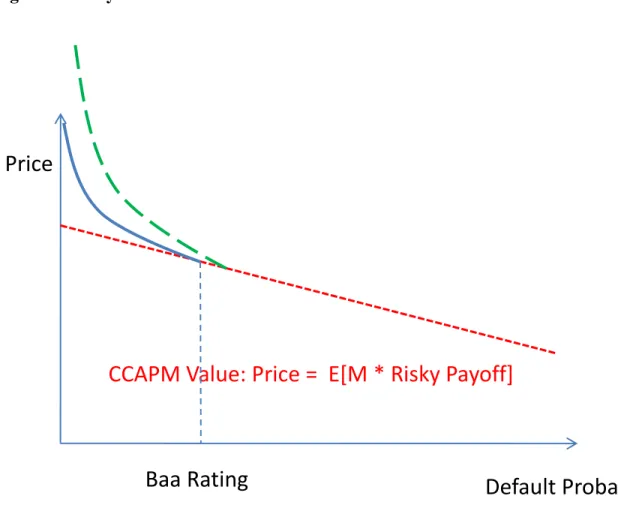
The safety channel is not the same as the risk premium of a standard asset pricing model; it reflects a deviation due to clientele demand. A simply way to think about investor willingness to pay extra for assets with very low default risk is to plot an asset’s price against its expected default rate. Krishnamurthy and Vissing-Jorgensen (2010) argue that this curve is very steep for low default rates, with a slope that flattens as the supply of Treasuries increases. Figure 1
7
illustrates the distinction. The bottom line is the C-CAPM value of a risky bond. As default risk rises, the price of the bond falls. The distance from this line up to the middle (solid) line illustrates the safety premium; for bonds that have very low default, the bond price rises as a function of the safety of the bond. The figure also illustrates the dependence of the safety premium on the supply of long-term Treasuries. The distance from the bottom line to the top line is the safety premium for a smaller supply of safe assets. The clientele demand shifts the premium up due to a higher marginal willingness to pay for safety when supply is lower. This dependence on the premium on the supply of long-term Treasuries is how Krishnamurthy and Vissing-Jorgensen (2010) distinguish a standard risk premium explanation of defaultable bond pricing with the clientele-driven safety demand.
This same effect may be expected to play out in QE. However, there is a subtle issue in thinking about different asset classes in QE: Treasury and Agency bonds are clearly safe in the sense of offering an almost sure nominal payment (note that the government ``takeover’’ of Fannie Mae and Fredidie Mac was announced on 9/7/2008 prior to QE1 and QE2, making agency bonds particularly safe during the period of QE1 and QE2); however Agency MBS has significant prepayment risk which means that it may not meet clientele safety demands. The safety channel thus predicts that:
i. QE involving Treasuries and Agencies lowers the yields on very safe assets such as Treasuries, Agencies, and possible high-grade corporate bonds, relative to less safe assets such as lower-grade corporate bonds or bonds with prepayment risk such as MBS.
We expect Baa bonds to be the relevant cutoff for these safety effects. First, such bonds are the boundary between investment grade and non-investment grade securities, so that if driven by safety clientele demands, the Baa bond forms a natural threshold. More rigorously, Longstaff, Mithal and Neis (2006) use credit default swap data from December 2000 to October 2001 to show that the component of yields that is hard to explain by purely default risk information is about 50 bps for Aaa and Aa rated bonds, and about 70 bps for lower-rated bonds, suggesting that the cutoff for bonds whose yields are not affected by safety premia is somewhere around the A/Baa rating.
8
e. Prepayment Risk Premium Channel
QE1 involved the purchase of $1.25tn of Agency MBS. Gabaix, Krishnamurthy, and Vigneron (2007) present theory and evidence that mortgage prepayment risk carries a positive risk premium, and that this premium depends on the quantity of prepayment risk borne by mortgage investors. The theory requires that the MBS market is segmented and that a class of arbitrageurs who operate predominantly in the MBS market are the relevant investors in determining the pricing of prepayment risk. This theory is similar to the Vayanos and Vila (2009) explanation of the duration risk premium, and more broadly fits into theories of intermediary asset pricing (see He and Krishnamurthy, 2010).
This channel is particularly about QE1 and its effects on MBS yields, which reflect a prepayment risk premium:
i. MBS purchases in QE1 lowers MBS yields relative to other bond market yields. ii. No such effect should be present in QE2.
f. Default Risk Channel
Lower grade bonds such as Baa bonds carry higher default risk than Treasury bonds. QE may affect the quantity of such default risk as well as the price (i.e. risk premium) of the default risk. If QE succeeds in stimulating the economy, we can expect that the default risk of corporations will fall, and hence Baa rates will fall. Moreover, standard asset pricing models predict that investor risk aversion will fall as the economy recovers, implying a lower default risk premium. Finally, extensions of the intermediary pricing arguments we have offered above for pricing prepayment risk can imply that increasing health/capital in the intermediary sector can further lower the risk premium on default risk.
We use credit-default swap (CDS) rates to evaluate the importance of a default risk channel. A credit default swap is a financial derivative used to hedge against default by a firm. The “credit default swap rate” measures the percentage of face-value that must be paid as an annual insurance premium to insure against default on the bonds of a given firm. The 5-year CDS refers to an insurance contract that expires in 5 years, while the 10-year CDS refers to the same expiring in 10 years. We use these CDS to infer default risk at different maturities.
9 g. Inflation Channel
To the extent that QE is expansionary it increases inflation expectations, and this can be expected to have an effect on interest rates. In addition, some commentators have argued that QE may increase tail risks surrounding inflation.6 That is, in an environment where investors are unsure about the effects of policy on inflation, policy actions may lead to greater uncertainty over inflation outcomes. Others have argued that aggressive policy decreases uncertainty in the sense that it effectively combats the possibility of a deflationary spiral. Ultimately, this is an issue that can only be sorted out by data. We propose looking at the implied volatility on interest rate options, since a rise in inflation uncertainty will plausibly also lead to a rise in interest rate uncertainty and implied volatility. The inflation channel thus predicts:
i. QE increases the rate on inflation swaps as well inflation expectations as measured by the difference between nominal bond yields and TIPS.
ii. QE may increase or decrease interest rate uncertainty as measured by the implied volatility on swaptions.
Two explanations are in order on the measurements in (i) and (ii): First, a (zero-coupon) inflation swap is a financial instrument used to hedge against a rise in inflation. The swap is a contract between a “fixed rate payor” and a “floating rate payor” that specifies a one-time exchange of cash at the maturity of the contract. The floating rate payor pays the realized cumulative inflation over the life of the swap as measured using the CPI index. The fixed rate payor makes a fixed payment, contracted at the initation of the swap agreement. In an efficient market, the fixed rate payment thus measures the expected inflation rate over the life of the swap. Second, a swaption is a financial derivative on interest rates. The buyer of a call swaption earns a profit when the interest rate rises relative to the strike on the swaption. As with any option, following on the Black-Scholes model, the expected volatility of interest rates enters as an important input for pricing the swaption. The implied volatility is the expected volatility of interest rates as implied from current market prices of swaptions.
h. Summary
6
10
The channels we have discussed and our empirical approach can be summarized with a few equations. Suppose that we are interested in the real yield on a T-year long-term, risky, and illiquid asset such as a corporate bond or a mortgage backed security. Denote this yield by Also, denote the expected average interest rate over the next T years on short-term safe and liquid nominal bonds as [ ], and the expected inflation rate over the same period as Then we can decompose the long-term rate as:
[ ] .
Each line in this equation reflects a channel we have discussed. The first line is the expectations hypothesis terms. The long-term rate reflects the expected average future real interest rate. The signaling channel for QE may affect through the first line. Expected inflation can also be expected to affect long-term real rates. The second term reflects a duration risk premium that is a function of duration and the price of duration risk, as explained above. This decomposition is analogous to the textbook treatment of the CAPM, where the return on a given asset is decomposed as the asset’s β multiplied by the market risk premium. The third term is the illiquidity premium we have discussed, which is likewise related to an asset’s liquidity multiplied by the market price of liquidity. The next terms reflect the safety premium (the extra yield on the non-safe bond because it doesn’t have the extreme safety of a Treasury bond), a premium on default risk, and for the case of MBS, a premium on prepayment risk.
The equation makes clear that a given interest rate can be affected by QE through a variety of channels. It is not possible to examine the change in say the Treasury rate to conclude how much QE affects interest rates more broadly because different interest rates are affected by QE in different ways.
11
Our main empirical methodology to examining the various channels can be thought of as difference-in-difference approach supplemented with information from derivatives. For example, in asking whether there is a liquidity channel that may affect interest rates, we consider the yield spread between a long-term Agency bond and a long-term Treasury bond and measure how this yield spread changes over the relevant QE event. The yield decomposition from Eq. 1 for each of these bonds is identical, except for the term involving liquidity. That is, these bonds have the same duration, safety, default risk, etc., but the Treasury bond is more liquid than the Agency bond. Thus the difference in yield changes between these bonds isolates a liquidity channel. We examine how this yield spread changes over the QE event dates. We take this difference-in-difference approach in evaluating the liquidity, safety, duration risk premium, and prepayment risk channels. In addition to the difference-in-difference approach, in some cases we use derivatives prices, which are affected by only a single channel, to separate out the effect of a particular channel. This is how we use the federal funds futures contracts, the CDS swap rates, the inflation swap rates, and the implied volatility on interest rate options.
3. Evidence from QE1 a. Event Study
Gagnon, et. al., (2010) provide an event study of QE1 based on the announcements of long-term asset purchases by the Federal Reserve in the late-2008 to 2009 period (“QE1”). QE1 included purchase of mortgage-backed securities, Treasury securities and Agency securities. Gagnon, et. al., (2010) identify eight event dates beginning with the 11/25/08 announcement of the Fed’s intent to purchase $500bn of Agency MBS and $100bn of Agency debt, and running into the summer of 2009. We focus on the first five of these event dates (11/25/2008, 12/1/2008, 12/16/2008, 1/28/2009, and 3/18/2009), leaving out three later event dates on which only small yield changes occurred.
There was considerable turmoil in financial markets in the period from the fall of 2008 to the spring of 2009, which makes inference from an event-study somewhat tricky. Some of the assets we consider, such as corporate bonds and CDS, are less liquid than Treasuries. During a period of low liquidity, the prices of such assets may react slowly in response to an announcement. We deal with this issue by presenting two-day changes for all assets (from the day prior to the day after the announcement). In the data, for high liquidity assets like Treasuries,
12
two-day changes are almost the same as one-day changes. For low liquidity assets, the two-day changes are almost always higher than one-day changes.
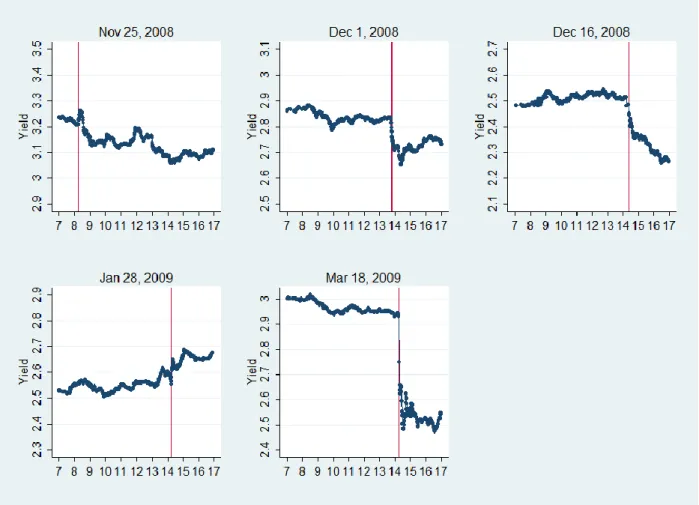
The second issue that arises is that we cannot be sure that the identified events are in fact important events, or the dominant events for the identified event day. That is, other significant economic news arrives through this period and potentially creates measurement error problems for the event-study. To increase our confidence that QE1 announcements were the dominant news on the five event dates we study, Figure 2 presents graphs of intraday movements in Treasury yields and trading volume for each of the QE1 event dates. The figure is based on data from BG Cantor and the data graphed is for the on-the-run 10 year Treasury bond at each date. Yields graphed are averages by the minute and trading volume graphed is total volume by minute. The vertical lines indicate the minute of the announcement, defined as the minute of the first article covering the announcement in Factiva. These graphs show that the events identify significant movements in Treasury yields and Treasury trading volume and that the announcements do appear to be the main piece of news coming out on the event days, especially on 12/1/2008, 12/16/2008 and 3/18/2009. For 11/25/2008 and 1/28/2009, the trading volume graphs also suggest that the announcements are the main events, with more mixed evidence from the yield graphs for those days.
While it is likely that these five dates are most relevant event dates, it is possible that there are other “true” event dates that we have omitted. How does focusing on too limited a set of event dates affect inference? For the objective of analyzing through which channels QE operates, omitting true event dates reduces the power of our tests by increasing the noise in the sample, but does not lead to any biases.7 For estimating the overall effect of QE, omitting potentially relevant dates could lead to an upward or downward bias depending on how the omitted dates affected the market’s perception of the probability or magnitude of QE.
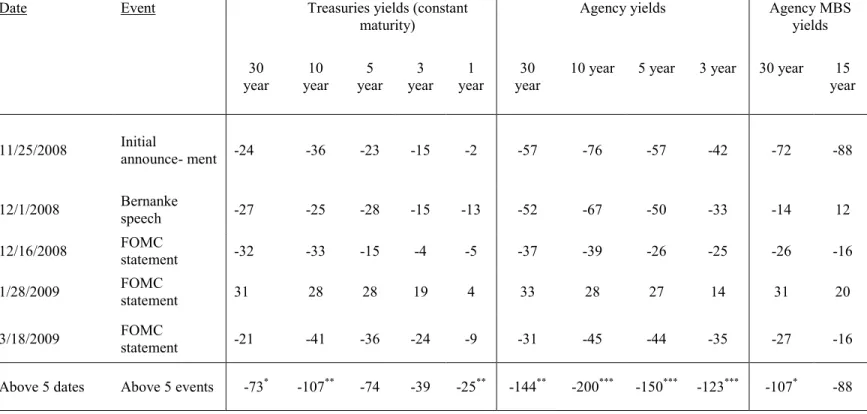
Table 1 presents data on two-day changes in Treasury, (non-callable) Agency, and Agency MBS yields around the main event-study dates, spanning a period from 11/25/08 (the two-day change from 11/24/08 to 11/26/08) to 3/18/09 (the two-day change from 3/17/09 to 3/19/09). Over this period it became evident from Fed announcements that the government intended to purchase a large quantity of long-term securities. Across the five event dates, interest
7
13
rates fell across the board on long-term bonds, consistent with a contraction of supply effect. Now consider the channels through which the supply effect may have worked.
In all tables we provide tests of the statistical significance of the rate changes or changes in derivatives documented, focusing on the total change shown in the last row of each table (for QE1 and QE2 separately). Specifically, we test whether changes on QE announcement days differ from changes on other days. To do this, we regress the daily changes for the variable in focus on 6 dummies: A dummy for whether there was a QE1 announcement on this day, a dummy for whether there was a QE1 announcement on the previous day, a dummy for whether there was a QE2 announcement on this day, a dummy for whether there was a QE2 announcement on the previous day, a dummy for whether there was a QE3 announcement on this day, a dummy for whether there was a QE3 announcement on the previous day. By ``QE3’’ we refer to the Fed announcement in its FOMC statement on 9/21/2011 (this event happened after the Brookings panel took place but we analyze it briefly below). This regression is estimated on daily data from the start of 2008 to the end of the third quarter of 2011, using OLS but with robust standard errors to account for heteroscedasticity. F-tests for the QE dummy coefficients being zero are then used to assess statistical significance. When testing for statistical significance of 2-day changes, the F-test is a test of whether the sum of the coefficient on the QE dummy (QE1 or QE2) and the coefficient on the dummy for a QE announcement (QE1 or QE2) on the previous day, is equal to zero. When testing statistical significance of two-day changes in CDS rates we follow a slightly different approach described below due to the way our CDS rates changes are constructed.
b. Signaling Channel
Figure 3 graphs the yields on the monthly federal funds futures contract, for contract maturities from March 2009 to October 2010. The pre-announcement average yield curves are computed on the day before each of the five QE1 events and then averaged across these dates. The post-announcement average yield curve is computed likewise based on the five days after the QE1 event dates. Dividing the downward shift from the initial to the post-announcement average yield curve by the slope of the initial average yield curve, and multiplying by the number of event dates tells us how much the policy shifted the rate cycle forward in time. The graph shows that, on average, each QE announcement “shifts” an anticipated rate hike cycle by the Fed later
14
by a little over one month. Evaluating the forward shift at the point and slope of the March 2010 contract, the total effect of the five QE announcements is to shift anticipated rate increases later by 6.3 months. This effect is consistent with the signaling channel whereby the Fed’s portfolio purchases (as well as direct indications of the stance of policy in the relevant Fed announcements) signals a commitment to keep the federal funds rate low.
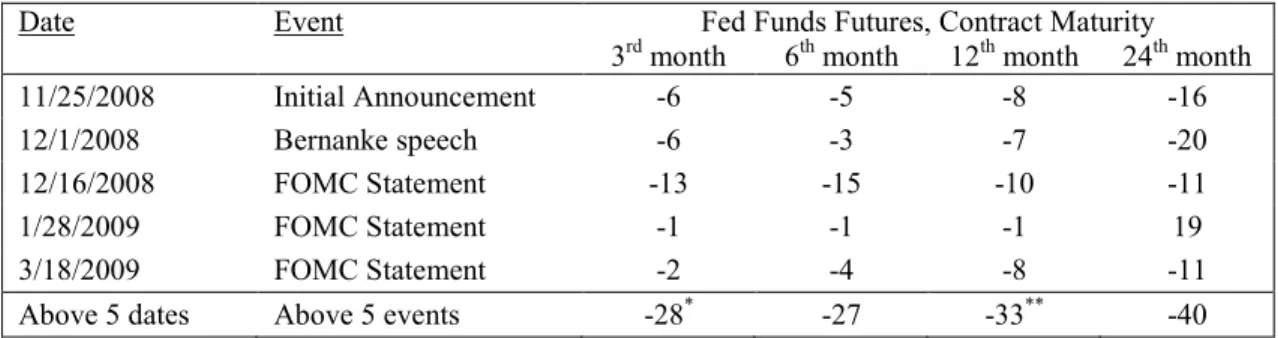
Table 4 reports the one and two-day change in the yields of the 3rd month, 6th month, 12th month, and 24th month futures contracts, across the five event dates. We aggregate by, for example, the 3rd month rather than a given contract-month (e.g., March), because it is more natural to think of the information in each QE announcement as concerning how long from today rates will be held low (on the other hand, for plotting a yield curve it is more natural to hold the contract-month fixed, as we did above in Figure 3). For two of the four Fed funds futures contracts two-day changes for QE1 announcement dates are significantly more negative than on other days. The two-day decrease in the 24th month contract is 40 basis points.
How much effect can the signaling channel have on longer term rates? The difficulty in assessing the effects on longer rates is that we cannot precisely measure changes in the expected future federal funds rates for horizons over 2 years due to the lack of federal funds futures contracts. An upper bound on the signaling effect can be found by extrapolating the 40 bps fall in the 24th month contract to all horizons. This is an upper bound because it is clear that at longer horizons, market expectations should reflect a normalization of the accommodative current Fed policy so that signaling should not have any effect on rates at that horizon. Nevertheless, with the 40bp number, equation 1 predicts that rates at all horizons fall by 40bps. A second approach to estimating the signaling effect is to build on the observation that QE shifted the path of anticipated rate hikes by about 6 months. Signaling affects long term rates by changing the expectations term in equation 1, [ ] Consider the expectations term for a T-year bond:
[ ] ∫
where, is the expected federal funds rate t years from today. Let us use to denote the path described by the federal funds rate as expected by the market prior to QE announcements. Suppose that QE policy signals that the rate is going to be held at for the next X months,
15
and thereafter follow the path indicated by (such that the rate at time t with the policy in place is what the rate would have been X months earlier absent the policy). That is, QE simply shifts an anticipated rate hike cycle later by X months. Then, the decrease in the expectations term for a T-year bond is,
[ ] ∫
The first point to note from this equation is that it indicates that the signaling effect is decreasing in maturity (i.e. T). Here is a rough check on how large the signaling effect can be. Suppose that is 0%, which is as low as the federal funds rate traded over this period. Consider the term next. The 2-year federal funds futures contract, which is the longest contract traded, indicated a yield as high as 1.5% over the period from 11/08 to 3/09. But expected federal funds rates out to say 10 years are likely to be much higher than that. Over the QE1 period the yield curve between 10 and 30 years was relatively flat, with levels of Treasury rates at 10 and 30 years as high as almost 4%. Thus, consider a value of of 4% to get an upper bound on this signaling effect. Then, for a 10 year bond, the change is 20bps, while for a 30 year bond, the change is about 7bps. At the 5-year horizon, given the slope of the yield curve, is lower than 4%. We use 3.5%, which is based on computing forward rates between year 4 and 7 using the 3, 5 and 7 year Treasury yields, implying a signaling effect of 35bps for the 5-year horizon. Our two ways of computing the signaling effect indicates moves in the range of 20 to 40 bps out to 10 years. This effect potentially explains the moves in the CDS-adjusted Baa rates of 41bps (long) and 25bps (intermediate). It also can help explain the fall in the 1-year Treasury yield of 25 bps.
On the other hand, longer term rates move much more substantially than shorter term rates. Longer term Treasuries and Agencies fall 73 to 200 bps, and much more than the 1- year bond yield. For the corporate bonds of Table 2, however, there is no apparent maturity effect (for a given ratings category). Thus, to understand the more substantial movements of long-term rates we need to look to other channels and, in particular, the safety and prepayment risk channels.
16 c. Duration Risk Channel
Consistent with the duration risk hypothesis, the yields of many longer term bonds in Table 1 fall more than the yields of shorter maturity bonds. The exceptions here are the 30 year Treasury and Agency bonds, where the yields falls less than the 10 year bond. Note that given that mortgages amortize and carry prepayment risk, the duration on the 30 year MBS is around 7 years and thus more comparable to a 10 year bond than a 30 year bond.
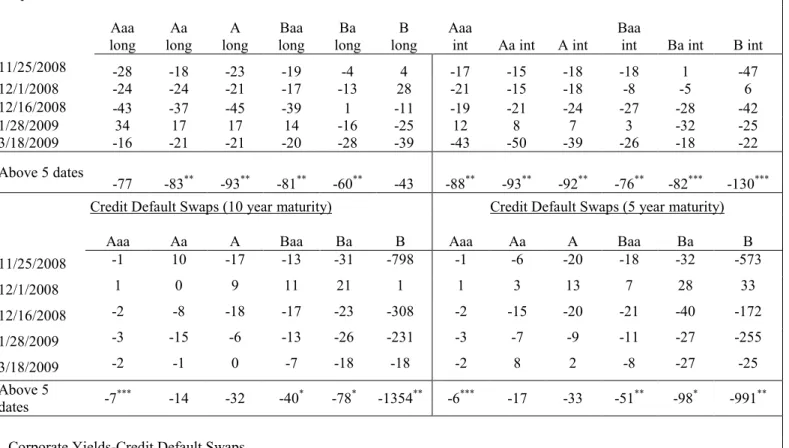
There is other evidence that the duration risk channel cannot explain. There are dramatic differences in the yield changes across the different asset classes. Agency bonds, for example, experience the largest fall in yields. The duration risk channel cannot speak to these effects as it only prescribes effects that depend on bond maturity. The corporate bond data also cannot be explained by the duration risk channel. Table 2 presents data on corporate bond yields of intermediate duration (around 4 year duration) or long duration (around 10 year duration), as well as these same yields with the impact of changes in CDS rates taken out. We adjust the yield changes using CDS changes to remove any effects due to a changing default risk premium and thereby isolate duration risk premium effects. We construct CDS rate changes by rating category as follows. We obtain company-level CDS rates from Credit Market Analysis via Datastream. We classify companies into ratings categories based on the value-weighted average rating of the company’s senior debt with remaining maturity above 1 year, using bond information from the Fixed Investment Securities Database (FISD) and the Trade Reporting and Compliance Engine (TRACE). For each QE date we then calculate the company level CDS rate change and the value-weighted average of these changes by ratings category, with weights based on the company’s senior debt with remaining maturity above 1 year (and with weights calculated based on market values on the day prior to the event day). 8 The reason for calculating company level CDS changes and then averaging across companies (call this ``method 1’’), as opposed to calculating average CDS rates across companies and then the change over time in the averages (call this ``method 2’’) is that we only have CDS data for a subset of companies, between 362
8
We drop CDS rates for AIG. According to our calculations, this firm is the largest in ratings category Baa by market value of bonds outstanding and has a very large CDS rate increase on our last QE1 date. With AIG included, the two-day CDS changes for category Baa (summed across the 5 QE1 dates) are 32 rather than 40 at the 10-year horizon and 37 rather than 51 at the 5-year horizon. We are not sure whether AIG is still included in the Barclays bond indices during this period, given the government intervention for this firm.
17
and 378 for each QE1 date (and around 338 for the two main QE2 dates we study below). This is likely much fewer than the number of companies for which bond yields are included in the corporate bond indices from Barclays that we use. Therefore, if we used method 2, the CDS calculations for a given ratings category would be fairly sensitive to whether a particular company is down- or up-graded on a given day (and more so than the bond yield indices). We avoid this problem by using method 1 since a given time change is then calculated using CDS rates for a fixed set of companies. A side effect of using method 1 is that the sum of two daily CDS changes for a given ratings category (each averages of one-day changes across companies) will not equal the two-day CDS change for this category (calculated by averaging two-changes across companies). Therefore, to assess the statistical significance of two-day CDS changes for a given ratings category we estimate a regression where the dependent variable is the two-day CDS change (from date t-1 to t+1) and the independent variables are a dummy for whether day t is a QE1 announcement day and a dummy for whether day t is a QE2 announcement day. To keep statistical inference simple, we only use data for every second day (as opposed to using overlapping two-day changes). We make sure that all QE announcement dates are included (if a given QE date falls on a date that would otherwise not be used, we include the QE date and drop the day prior and the day after the QE date). We have CDS data only up to the end the third quarter of 2010, so we estimate the regression using data from the start of 2008 to the end of 2010:Q3. We use the same regression for two-day changes when assessing the statistical significance of two-day yield changes adjusted for CDS-changes.
The CDS adjustment makes a substantial difference in interpreting the corporate bond evidence in terms of the duration risk channel. In particular, there is a large fall in CDS rates for lower grade bonds on the event dates, suggesting that default risk/risk premia fell substantially with QE, consistent with the default risk channel (we discuss this further below). Given the CDS adjustment, the change in the yield of the Baa bond can be fully accounted for by the signaling channel. Moreover, there is no apparent pattern across long and intermediate maturities in the changes in CDS-adjusted corporate bond yields. These observations suggest that we need to look to other channels to understand the effects of QE.
18 d. Liquidity Channel
The most liquid assets in Table 1 are the Treasury bonds. The liquidity channel predicts that these yields should increase with QE, relative to the yields on less liquid bonds. Consistent with this, Treasury yields fall much less than the yields on Agency bonds which are less liquid. That is, the Agency-Treasury spread falls with QE. For example, the 10 year spread falls by 200-107=93 basis points. This is a relevant comparison because 10 year Agencies and Treasuries have similar default risk (especially since the government placed FNMA and FHLMC into conservatorship in September 2008), and are duration matched. Thus this spread isolates a liquidity premium. Consistent with the liquidity channel, we see that the equilibrium price premium (yield discount) for liquidity falls substantially in economic terms. To test whether agency yield changes are statistically significantly larger than Treasury yield changes on the QE1 dates we use the difference between agency yield changes and Treasury yield changes as dependent variable in the regression laid out in section 3.a and find that this is the case for all maturities shown (3, 5, 10, and 30 years) at the 5 percent level.
e. Safety Channel
The non-callable Agency bonds will be particularly sensitive to the safety effect. These bonds are not as liquid as the Treasury bonds, but do have almost the same safety as Treasuries. Of the channels we have laid out, agency bond yields are mainly affected via the signaling channel, the duration risk premium channel, and the safety channel. We have argued that the duration risk premium channel is not substantial, and that the signaling channel accounts for at most a 40 bps decline in yields on QE1 dates. The fall in 10 year Agency yields is 200 bps, which is the largest effect in the table. This suggests that the safety channel impact on Agency and Treasury yields is one of the dominant channels for QE1, at least 160 bps for the 10-year bonds.9 To test whether agency yield changes are statistically significantly larger on the QE1 dates than the signaling
9When inferring the size of the safety channel from comparing agency yield changes and changes in
federal funds futures, we implicitly are assuming that neither is affected by changes in the overall supply of liquidity in QE1. This is plausible if (a) agencies are not (to a substantial extent) valued for their liquidity and do not change price in response to a change in the supply of liquidity, (b) the federal funds futures we use are sufficiently far out in the future to not be affected by the high price of liquidity in the fall of 2008, and (c) the market expects any QE1 injected liquidity to be withdrawn by the time of the federal funds futures contract used. In terms of (b) and (c), these assumptions are plausible given that we focus on the 24th month federal funds futures.
19
channel predicts we use the difference between agency yield changes and change in the 24-month Fed funds futures contract yield as dependent variable in the regression laid out in section 3.a and find that this is the case for all maturities shown (3, 5, 10, and 30 years) at the 5 percent level.
As we have just noted, Treasuries fall less than the Agencies because the liquidity effect runs against the safety effect but the safety effect itself should affect Treasuries and Agencies about equally.
The corporate bond evidence is also consistent with a safety effect. The CDS-adjusted yields on Aaa bonds, which are close to default free, fall much more than the CDS-adjusted Baa or B bonds. The Aa and A bond are also affected by the safety effect, by a smaller amount as the safety channel predicts. There is close to no effect on the non-investment grade bonds.10 Finally, since Agencies are safer than Aaa corporate bonds, the safety channel prediction that the former bond yields fall more than the latter is also confirmed in the data.
f. Prepayment Risk Channel
Agency MBS yields fall by 107 bps for 30-year bonds and 88 bps for 15-year bonds. There are two ways to interpret this evidence. It is possible that this is due to a safety effect – the government guarantee behind these MBS may be worth a lot to investors so that these securities carry a safety premium. The safety premium then rises, as with the Agency bonds, decreasing Agency MBS yields. On the other hand, the Agency MBS carry significant prepayment risk and are unlikely to be viewed as safe in the same way as Agency bonds or Treasuries (where safety connotes the almost complete certainty of nominal repayment at known dates). We think that a more likely explanation is market segmentation effects as in Gabaix, Krishnamurthy and Vigneron (2007). The government purchase of MBS reduces the prepayment risk in the hands of investors, and thereby reduces MBS yields. The effect is higher for the 30 year than the 15 year because the longer bonds carry more prepayment risk.
10
The anomalously large moves in the CDS rates for the B category appear to be partly driven by Ford, perhaps related to news about the auto bailouts. If we drop Ford from the tabulation, the 5-year CDS and 10-year CDS fall by 435 bps and 496 bps, respectively.
20
Importantly, Fuster and Willen (2010) show that the large reductions on agency MBS rates around 11/25/2008 were quickly followed by reductions in mortgage rates offered by mortgage lenders to households.
g. Default Risk Channel
We have noted earlier from Table 2 that QE appears to reduce default risk or default risk premia, which particularly affects the interest rates on lower grade corporate bonds. The table shows that CDS rates of the Aaa firms do not change appreciably with QE. There is a clear pattern across the ratings, going from Aaa to B, whereby higher credit risk firms experience the largest fall in CDS rates. In terms of statistical significance, two-day changes in CDS rates are significantly more negative for QE1 announcement days than on other days for 4 of 6 ratings categories. This evidence suggests that QE had a significant effect on yields through default risk and default risk premia.
h. Inflation Channel
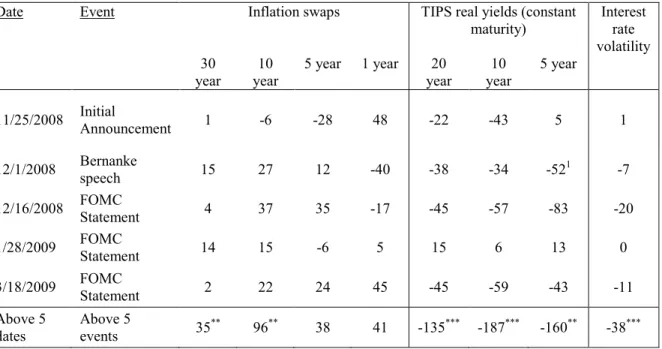
The above analysis focuses on nominal rates (in particular, the effects on various nominal rates relative to the nominal signaling channel benchmark). To assess effects on real rates, one further needs information about the impact of QE1 on inflation expectations. Table 3 presents the relevant data.
The first columns in the table are for inflation swaps. The 10-year inflation swap is the fixed rate in the 10-year zero coupon inflation swap, and thus a market-based measure of expected inflation over the next 10 years (see Fleckenstein, Longstaff and Lustig (2010) for information on the inflation swap market). This data suggests that inflation expectations increased by between 35 and 96 basis points, depending on maturity.
The second set of columns present data on TIPS yields. We compare these yield changes to those from nominal bonds to evaluate the change in inflation expectations. Based on the evidence of the existence of significant liquidity premia on Treasuries, it is inappropriate to compare TIPS to nominal Treasuries. If investors’ safety demand did not apply to real safe bonds such as TIPS, then the appropriate nominal benchmark is the CDS-adjusted Baa bond. On the other hand, if long-term safety demand also encompassed TIPS, then it is more appropriate to use the CDS-adjusted Aaa bond as benchmark. We are unaware of definitive evidence that
21
settles the issue. From Table 1, the CDS-adjusted long maturity Aaa (Baa) bond falls in yield by 70 (41) bps, while the intermediate maturity bond falls in yield by 82 (25) bps. Matching the 70 (41) bps change to the 187 bps change in the 10 year TIPS, we find that inflation expectations increased by 117 (146) bps at the 10 year horizon (both significant at the 1 percent level, using the same regression to test significance as used for two-day CDS-changes). At the 5 year horizon, based on the 82 (25) bps change in CDS-adjusted intermediate maturity Aaa (Baa) bond and 160 bps change in TIPS, we find that inflation expectations increased by 78 (135) bps (the first not significant and the second significant at the 5 percent level). Benchmarking to the Aaa bond produces results more similar to those from the inflation swaps.
Together these two sets of data suggest that the impact of Fed purchases of long-term assets on expected inflation was large and positive.
We also evaluate the inflation uncertainty channel. The last column in Table 3 reports data on implied volatilities from interest rate swaptions (i.e., the option to enter into an interest rate swap). The data is the Barclays implied volatility index. The underlying maturity for the swap ranges from 1 year to 30 year, involving options that expire from 3 months to 20 years. The index is based on the weighted average of implied volatilities across the different swaptions.
The average volatility measure over the QE1 time period is 104 bps, so the fall of 38 bps is substantial. Thus, it appears that QE1 reduced rather than increased inflation uncertainty.
The other explanation for this fall in volatility is segmented markets effects. MBS have an embedded interest rate option that is often hedged by investors in the swaption market. Since QE1 involved the purchase of MBS, investors have a smaller demand for swaptions and hence implied volatility on swaptions fall. This latter explanation is often the one given by practitioners for changes in swaption implied volatilities. Notice, however, that volatility is essentially unchanged on the first QE1 event date, which is the event that drives the largest changes in MBS yields. This could indicate that the segmented markets effects are not important, with volatility instead driven by the inflation uncertainty channel.
i. Summary
QE1 significantly reduced yields on intermediate and long-maturity bonds. There is evidence that QE1 decreased the yields on bonds, particularly intermediate maturity bonds, via the
22
signaling channel, with effects on 5 to 10 year bonds ranging from 20 to 40 bps. A preferred habitat for long-term safe assets, including Treasuries, Agencies and highly-rated corporate bonds appears to have generated a large impact of QE1 on the yields on these bonds, with effects as high as 160 bps for 10-year agency and Treasury bonds. For riskier bonds such as lower grade corporate bonds and MBS, QE1 had effects through a reduction in default risk/default risk premia and a reduced prepayment risk premium. 10-year CDS rates on Baa corporate bonds fall by 40 on the QE1 dates. These effects on CDS rates and MBS pricing could be due to reductions in risk borne by the financial sector, consistent with limited intermediary capital models, or due to impacts via a mortgage refinancing boom and its impact on the housing market and consumer spending. As for the duration risk premium channel, we find little evidence for this. Finally, there is evidence that QE substantially increased inflation expectations, but reduced inflation uncertainty. The increase in expected inflation was large, with 10-year expected inflation up between 96 and 146 bps depending on the estimation approach used, implying that real rates fell dramatically for a wide variety of borrowers.
Finally, note that these effects are all sizable and probably much more than we should expect in general. This is because the November 2008 to March 2009 period is an unusual financial-crisis period in which the demand for safe assets was heightened, segmented market effects were apparent across many markets, and intermediaries suffered from serious financing problems. In such an environment, supply changes should be expected to have a large effect on interest rates.
4. Evidence from QE2 a. Event Study
We perform an event study of QE2 similar to that of QE1. There are two relevant sets of events in QE2. First, in the 8/10/2010 FOMC statement, the committee announces:
“the Committee will keep constant the Federal Reserve's holdings of securities at their current level by reinvesting principal payments from agency debt and agency mortgage-backed securities in longer-term Treasury securities.”
23
Prior to this announcement, market expectations were that the Fed would let its MBS portfolio runoff,11 thereby reducing reserve balances in the system and allowing the Fed to exit from its non-traditional monetary policies. Thus, the announcement of the Fed’s intent to continue QE revised market expectations. Moreover, the announcement indicated that QE would shift towards longer-term Treasuries, and not Agencies or Agency MBS as in QE1. As a back-of-the-envelope computation, suppose that the prepayment rate for the next year on $1.1tn of MBS was 20%.12 Then the announcement indicated that the Fed intended to purchase $220bn of Treasuries over the next one year, and $176bn over the subsequent year, etc. It is unclear from the announcement how long the Fed expected to keep the re-investment strategy in place.
The 9/21/10 FOMC announcement reiterates this message:
“The Committee also will maintain its existing policy of reinvesting principal payments from its securities holdings.”
The second type of information for QE2 pertains to the Fed’s intent to expand its purchases of long-term Treasury securities. In the 9/21/10 FOMC statement, the fourth paragraph states:
“The Committee will continue to monitor the economic outlook and financial developments and is prepared to provide additional accommodation if needed to support the economic recovery […]” (emphasis added)
This paragraph includes new language relative to the corresponding paragraph in the 8/10/2010 FOMC statement which read: “The Committee will continue to monitor the economic outlook and financial developments and will employ its policy tools as necessary to promote economic recovery and price stability.” The new language in the 9/21/2010 statement follows the third paragraph of that statement in which the FOMC reiterates its intention to maintain its target for the federal funds rate and reiterates its policy of reinvesting principal payments from its securities holdings. The new language was read by many market participants as indicating new stimulus by the Fed, and particularly an expansion of its purchases of long-term Treasuries. For example, Goldman Sachs economists in their market commentary on 9/21/2010 refer to this language and conclude that the Fed intends to purchase up to $1 trillion of Treasuries
11
See Fed Chairman Bernanke’s Monetary Policy Report to Congress on July 21, 2010, discussing the "normalization” of monetary policy. The issue is also highlighted in Bernanke’s testimony on March 25, 2010 on the Federal Reserve’s exit strategy.
12
The Fed’s holdings of MBS on August 4, 2010 was $1,118bn, while it was $914bn on June 22, 2011 (source: H4 report of the Federal Reserve). That is an annualized decline of 20.6%.
24
(see “FOMC Rate Decision - Fed Signals Willingness to Ease Further if Growth or Inflation Continue to Disappoint,” 9/21/2010, Hatzius, McKelvey, Tilton and Stehn).
The following announcement from the 11/3/2010 FOMC statement makes such an intention explicit:
“The Committee will maintain its existing policy of reinvesting principal payments from its securities holdings. In addition, the Committee intends to purchase a further $600 billion of longer-term Treasury securities by the end of the second quarter of 2011.”
The 11/3 announcement was widely anticipated. According to the Wall Street Journal, a WSJ survey of private sector economists in early October of 2010 found that the Fed was expected to purchase about $750 billion in QE2.13 We have noted above the expectation, as of 9/21/2010, by Goldman Sachs’ economists of $1 trillion of purchases. Based on this, one would expect the 11/3/2010 announcement to have little effect (estimates in the press varied widely, but the actual number of $600 bn was in the range of numbers commonly mentioned).
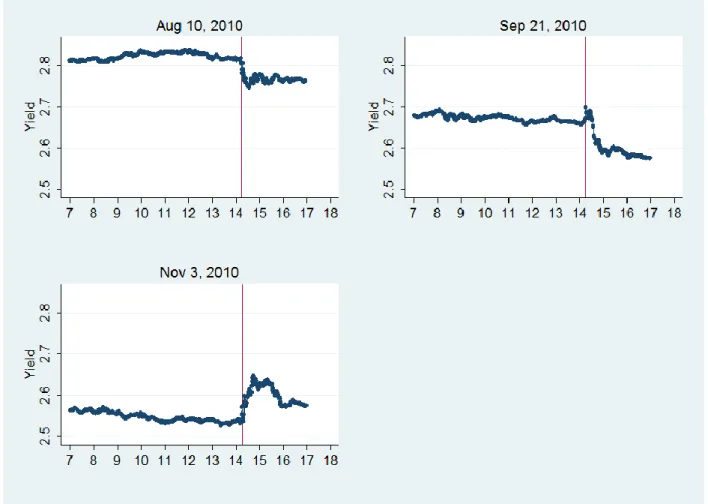
Figure 4 presents intraday data on the 10-year Treasury bond yield around the announcements times of the FOMC statements. The 8/10 announcement appears to be significant news for the Treasury market, reducing the yield in a manner that suggest that market expectations over QE were revised up. The 9/21 announcement is qualitatively similar. At the 11/3 announcement, Treasury yields increased but then fell some. The reaction suggests that markets may have priced in more than a $600bn QE announcement.
In our event study, we aggregate across the 8/10 and 9/21 events, which seem clearly to be driven by upward revisions in QE expectations. We do not add in the change from the 11/3 announcement as it is unclear whether only the increase in yields after than announcement or also the subsequent decrease was due to QE2 (furthermore, the large two-day reaction to the 11/3 announcement may not be due to QE2 since a lot of it happened the morning of 11/4 around the time new numbers were released for jobless claims and productivity). As noted in Section 3a, given our objective of understanding the channels of QE, it is important to focus on events that we can be sure are QE relevant.
13
25
Additionally, we present information for both 1-day changes and 2-day changes, but focus on the 1-day change in our discussion. This is because market liquidity had normalized by the fall of 2010, and looking at the 2-day changes would therefore likely add noise to the data.
b. Analysis
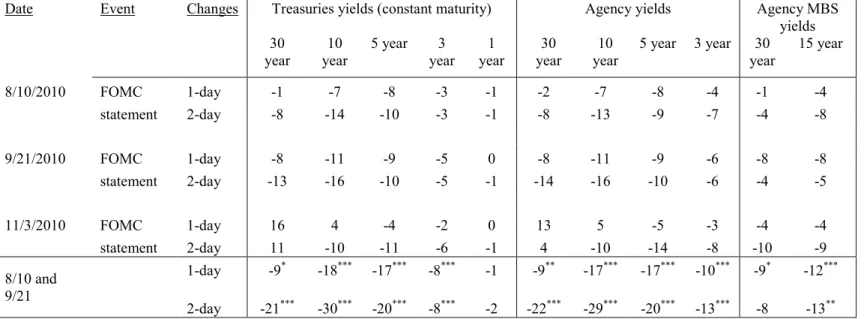
Table 5 provides data on the changes in Treasury, Agency and Agency MBS yields over the event dates. Table 6 provides data on changes in corporate bond yields, CDS, and CDS-adjusted corporate yields.
Effects of QE2 on yields are consistently much smaller than the effects found for QE1. This could be partially due to omissions of relevant additional event dates for QE2. We considered various additional events (e.g. speeches by Fed officials) but, using intra-day Treasury yield data, did not find any days with dramatic Treasury yield declines right around the events. This does not mean that considering only a few QE2 event dates captures all of the impact of QE2, only that the market may have updated its QE2 perceptions not only on Fed announcement dates but also on dates of bad economic news. Decomposing the yield impact of, for example, a GDP announcement into its ``standard effects’’ and its indirect effect due to its impact on the likelihood of QE is difficult and we do not pursue it.
The fact that the effects of QE2 are fairly small makes it more difficult to discern all of the various channels in QE2 than in QE1. That said, here are some conclusions regarding the channels:
There is significant evidence of the signaling channel. The 12th month federal funds futures contract from Table 4 falls by 4 bps. The 24th month contract falls by 11 bps. Extrapolating out from this 24th month contract suggests that we can explain moves in longer term rates of up to 11 bps following our first approach outlined in our discussion of signaling for QE1. Turning to our second approach, Figure 5 plots the average pre- and post- QE2 yield curves from the federal funds futures contracts. The graph suggests a shift later of the anticipated rate hike cycle. We can again estimate how large this shift is. Because the slope of the futures curve from Figure 5 is not constant, the computation is sensitive to exactly which point you use to evaluate the time shift. Using the slope and vertical shift at July 2012, we estimate the time shift is 3.2 months, while using the slope
26
and vertical shift at July 2011, we estimate the time shift at 2.1 months. The 2.1 month number implies a fall in 5 year rates of 12 bps, a fall in 10 year rates of 8 bps, and a fall in 30 year rates of 2 bps. The 3.2 month number implies a fall in 5 year rates of 18 bps, a fall in 10 year rates of 12 bps and a fall in 30 year rates of 4 bps. The fall of 18 bps in the 5 year rate from this computation is too large relative to the 11 bps upper bound from our first approach, suggesting that the 2.1 month computation is more plausible.
These numbers appear in line with the CDS adjusted corporate bond yield changes as well as the Agency MBS yield changes. Note also that the intermediate corporate rates (about 4 year duration) in Table 6 fall more than the long rates (10 year duration) and the 15 year Agency MBS yields (3 year duration) from Table 5 fall more than the 30 year (7 year duration). The durations for the corporate series are obtained from Datastream. The MBS durations are calculated based on the coupon rates of the MBS series and the fact that the MBS amortize. Both moves are consistent with the signaling channel. Thus, the signaling channel can plausibly explain all of the movements in the corporate bond rates and the Agency MBS yields. The only exception is for the Ba long and B longcategories where the CDS appear to rise sharply with no corresponding effects on bond yields. We are unsure of what is driving the CDS-bond basis for these categories.
Given that MBS yield changes are fully accounted for by the signaling channel, there is no evidence of a pre-payment risk channel for QE2. This is as would be expected given that QE2 did not involve MBS purchases. Similarly, there does not appear to be a substantial duration risk premium channel. Given that the size of the signaling channel is roughly the same as the decline in the CDS-adjusted corporate rates, there is no additional yield decline to be explained by a duration risk premium reduction.
There is also evidence for a safety channel. 10-year Agency yields and Treasury yields, which are both near zero default-risk fall in yield more than the CDS-adjusted corporate bond yields. With a signaling effect for 10-year bonds of between 8 and 12 bps, and a fall in 10-year Treasury and agency bond yields of 17 to 18 bps, the safety effect is between 5 and 10 bps for the 10-year agency bonds and Treasuries
27
There does not appear to be a liquidity channel. Treasury and Agency yields fall by nearly the same amounts, so that their spread, which can measure liquidity, appears unchanged. This result is plausible because liquidity premia in markets were quite low in late 2010, as market liquidity conditions had normalized. Consider the following data (on 08/10/2010):
Treasury Bill Tier 1 Non-Financial CP
1 week 13bps 20bps
1 month 15 19
3 month 15 27
The premium on the more liquid 1 week bill relative to the 3 month bill is only 2 basis points. The premium on the more liquid 3 month bill relative to 3 month CP is only 12 basis points. The latter premium also reflects some credit risk and tax effects. Part of the reason why liquidity premia are so low is that government policy had already provided a large supply of liquid assets to the private sector. Consider that the Fed had already increased bank reserves substantially. At the end of the third quarter of 2008, reserve balances totaled $222bn. At the end of the second quarter of 2010, reserve balances totaled $973bn (Flow of Funds, Table L.109). Furthermore, the government had increased the supply of Treasury bills from $1,484bn to $1,777bn over this same period (U.S. Treasury, Monthly Statement of the Public Debt of the United States). These arguments suggest that the effects on liquidity premia should be negligible via the liquidity channel.
There is no evidence for a credit risk channel as the CDS rates rise, especially for lower-grade bonds. This may indicate that QE2 (unlike QE1) did not have a substantial stimulating effect on the economy. It is also possible that the increase in CDS rates (as opposed to simply unchanged CDS rates) is due to the market inferring from the Fed’s decisions to pursue QE2 that the economy was in worse shape than previously thought.
28
Table 7 provides data on inflation swaps and TIPS yields for the event dates to analyze effects on inflation expectations. Inflation expectations rise with QE2. The 10 year inflation swap rises by 5 bps, while the 30 year inflation swap rises by 11 bps. The 10 year TIPS falls by 25 bps. Comparing this number to the CDS-adjusted fall in the Aaa (Baa) long bond, implies that inflation expectations rise by 14 bps (16 bps) at the 10-year horizon. The implied volatility on swaptions falls by 3 bps, indicating a slight decrease in inflation uncertainty.
c. Summary and Discussion
The QE2 data suggest three primary channels for this Treasuries-only policy. The signaling channel lowered yields on 5-year bonds by 11 to 18 bps and on 10-year bonds by 11 to 12 bps depending on estimation method used.. The safety channel lowered yields on low-default risk 10-year bonds by an additional 5 to 10 bps. Furthermore, there is significant evidence for an increase in inflation expectations (5 to 16 bps over the 10-year horizon), suggesting that real rates fell for all borrowers. The main effect on the nominal rates that are most relevant for households and many corporations -- mortgage rates and rated on lower-grade corporate bonds -- was thus through the signaling and inflation channels, as opposed to resulting from a portfolio balance effect via the QE2 Treasury purchases.
Our finding that signaling plays a primary role in QE2 is consistent with the market’s reaction to the August 9, 2011 FOMC statement which stated that: “The Committee currently anticipates that economic conditions--including low rates of resource utilization and a subdued outlook for inflation over the medium run--are likely to warrant exceptionally low levels for the federal funds rate at least through mid-2013.” From August 8 to 9, Treasury rates declined by 12, 20, 20, and 12 bps at the 3, 5, 10, and 30 year maturities, respectively. An important question is thus whether the Fed could have achieved the signaling and inflation impact on yields seen in the Treasuries-only policy of QE2 from a commitment as in the August 9, 2011 statement, and thus without taking on additional balance sheet risk.