BROADCASTERS´
MANUAL
2013/14
Contents
Use of the Manual... 4
1. Objectives ... 5
1.1 Role of Television... 5
1.2 Principle points of contact and Division of Obligations ... 7
1.3 Broadcast Planning Survey ... 10
1.4 Documentation Required Pre-Survey ... 15
1.5 Documentation Following Survey ... 15
1.6 Media Agent Liaison with HB and Media Rights Holders ... 16
2. Television Production ... 17
2.1 General ... 17
2.2 High Definition Technical Specification ... 17
2.3 Audio Specification ... 17
2.4 Satellite Uplink Specification and Distribution ... 17
2.5 Power supply ... 17
3. Multilateral TV Production Considerations ... 18
3.1 Production Standards ... 18
3.2 Technical Infrastructure ... 19
3.3 Cabling ... 19
3.4 TV Compound... 20
3.5 Lighting Installation ... 20
3.6 Transition Replay Animation ... 20
3.7 Use of Specialty Cameras and Handhelds ... 21
3.8 Record and Replay Devices ... 21
3.9 Photo Finish ... 21
3.10 Audio Considerations ... 21
4.6 Studio and In-vision Positions ... 26
4.7 ENG Crews ... 26
5. Accreditation and Supplementary Access Devices ... 26
5.1 Accreditation ... 26
5.2 Camera Stickers ... 27
5.3 Operator Bibs ... 28
5.4 Vehicle Access Passes ... 29
6. Venue Logistics ... 29
6.1 Logistics ... 29
6.2 Starting Time... 29
6.3 Venue/Region Information ... 30
7. Event Operations ... 30
7.1 Definition of Roles and Contributors ... 30
7.2 Contingency ... 33
7.3 Competition Communication ... 33
7.4 Public Address System ... 33
8. Event Phase ... 33
8.1 Run up to the first TX commitment ... 33
8.2 Camera Production Test and Rehearsal ... 34
8.3 Daily Call Sheets ... 35
9. Advertising Considerations ... 36
9.1 Advertising Considerations ... 36
9.2 FIS Advertising Rules ... 36
9.3 FIS Marketing Guide ... 36
9.4 Advertising Check ... 37
9.5 Placement of Advertising Banners in the Competition Area ... 37
10. Graphics Data and Timing ... 37
10.1 FIS Graphics, Data and Timing Partner ... 37
11. TV Ratings... 39
Use of the Manual
As the international organisation responsible for the promotion and development of skiing, FIS is constantly looking to find new ways of increasing interest in all of the FIS disciplines.
The starting point in this endeavour is to ensure that the events in the FIS calendar are organised to the highest level by granting the responsibility to Organising Committees which understand the sport and are willing to invest in creating the best environment for athletes, officials, media, sponsors and spectators. The guarantee of high quality events involving the best athletes competing in the most attractive environment is an essential platform for coverage through the electronic media, which is the means to reach and attract the largest number of people.
This manual offers carefully prepared guidelines for both Organising Committees and Host Broadcasters to ensure the delivery of exceptional and consistent standards of television production throughout the calendar season. The manual is intended to provide the parties with the best possible platform to launch the necessary planning and final delivery of first class skiing events for the international television audience.
In the preparation and planning of events in the different disciplines there are a large number of common elements. For this reason, the manual has been designed with a number of sections. In the first section of the manual general information and explanations affecting all disciplines are provided, elaborating the vital planning phases of any given event, while outlining the division of responsibilities between all contributing parties. Where possible photo examples, drawings and illustrations have been added to complement the text and many examples have been included that broadcasters are advised to follow.
This core text is supplemented by appendices relating to the individual FIS disciplines. These include the competitions and their formats, coverage philosophy, production planning, television running orders, on-screen graphics with timing and data presentation, examples of venue layouts, camera plans and broadcast installations.
This manual is intended to be a portable and quick reference publication that accompanies skiing production of the different disciplines both in the development stages and during the competition phase of the event.
It is recognised that the world of sport and electronic media is constantly changing, and regular updates and modifications to this document can be expected, as required by the individual discipline and technological developments
This Broadcast Manual was produced jointly by FIS and Infront.
1. Objectives
1.1 Role of Television
Television is an essential publicity tool for competitive sports competition and is a vital component of the marketing concept. The Host Broadcaster (HB) is responsible for the delivery of a high quality international television broadcast in close partnership with the Organising Committee (OC) and the International Ski Federation (FIS). The appointed FIS TV Supervisor will aid and assist the planning process and support the delivery of the production plan.
FIS Broadcast partners who have purchased the TV and/or media rights to FIS events are identified in this manual as Rights Holding Broadcasters (RHB’s).
As a general rule, FIS aims to present a clear and concise division of responsibility with regard to the successful broadcast of a FIS World Cup or World Championship competition. The OC or the National Ski Association (NSA) of the host country will deliver the competition, including providing much of the physical infrastructure that will benefit both the HB and attending RHB’s.
Perhaps the single most important objective for all HB’s is to deliver a consistent and high level standard of production across all competitions throughout all participating host nations during the calendar season. The FIS presents simple guidelines for Host Broadcasters to follow which can be summarised as follows:
Deliver a live complete and continuous High Definition international world feed to attending and non-attending RHB’s, with opening titles, a complete graphics service (provided by FIS data and timing partner), international stereo sound and closing animation. A written and prepared format will be followed for pre and post-race programming including specific procedures for the podium ceremony and post-race formalities. The running order will include information on the venue and the sporting arena, be it an alpine, cross country, freestyle or snowboard course, or the profile of a jumping hill. The final phase of the running order will include an animation that informs the viewer of the next competition venue on the FIS World Cup calendar for the discipline
The HB will produce the events in an unbiased and professional manner
Offer the television audience exceptional coverage of the action that is likely to appeal to existing fans and stimulate growth in emerging markets
Follow the drama inherent in the competition by using a variety of camera techniques, including appropriate use of replays together with an exciting audio experience
Offer modern and innovative enhancements and speciality camera devices that will complement the overall viewing experience
Include post-race formalities as a high priority in the coverage plan including athletes reactions, the flower ceremony and athlete interviews featured in the multilateral feed
RHB’s are encouraged to customise their programming by attending the event and sharing the space and infrastructure in the TV Compound. The appointed Host Broadcasters are expected to liaise and support the needs of visiting broadcasters
The importance of ‘insightful, informed and editorially credible storytelling through
appropriate shot selection and replay options’ remain a key priority for all host broadcasters. HB’s must follow the examples of the multilateral running order for the different competitions provided in the relevant annex to this manual.
The preparation and delivery of the production plan must be regarded as the most
demanding of challenges, but equally the HB must also consider the likelihood of providing support services to unilateral broadcasters, TV Compound logistics, cabling, broadcast management and technical assistance.
Facilities may include the supply and installation of the commentary booth equipment, tailboard connection to unilateral broadcasters’facilities and perhaps the supply of broadcast facilities to an attending rights holder.
The OC will be responsible for the supply and installation of the necessary cables to interface with FIS' data and timing service partner, although typically the Host Broadcaster will assist with this task, providing that the distances are reasonable and within the confines of the TV compound. The site survey will seek a suitable and convenient position for the Data and Timing Partner’s technical facilities.
HB’s and RHB’s are invited to develop suitable production ideas that best illustrate the competition dynamic, capture the athletes’ experience and offer performance comparisons in a way that will inform and appeal to both fanatics and new audiences.
The designated TV Compound should be designed and prepared well in advance of the competition with respect to occupation by both the host broadcast operation and unilateral broadcasters. These obligations may vary on a case-by-case basis and specific guidelines for each race venue will be made available to the respective HB and the OC.
Host Broadcasters are expected to design a suitable time frame in advance of each competition to fully prepare their broadcast installation. The schedule should consider the possibility of conducting a full technical and production rehearsal (with timing and a podium presentation) at least one day before the actual competition. The organisation of the technical and production rehearsal will be carefully planned with the Organising Committee.
1.2 Principle points of contact and Division of Obligations
In order to successfully host and deliver a FIS World Cup Skiing event, the FIS works closely with the local Organising Committee and the National Skiing Association (NSA) who will introduce key members of their planning and event delivery team months in advance of each competition. In summary FIS contact with the key members of the Organising Committee, NSA and the appointed host broadcaster can be presented as follows:
Organising Committee / NSA FIS Representatives President Organising Committee and General Secretary FIS Race Director OC Appointed Host Broadcaster FIS Event Coordinator OC Principal HB Contact FIS Media and PR Coordinator Chief of Stadium/Track FIS TV Supervisor
Chief of Ceremony Appointed Media Agent – TV and Media Rights Manager (TVM)
Press Manager/Media Centre Appointed Data and Timing Services Provider Logistics Contacts (accreditation, transport and
accommodation)
DIVISION OF OBLIGATIONS TABLE
FIS FIS TV Supervisor National Skiing Association (NSA)
Local Organising Committee (OC)
Host Broadcaster (HB) NSA / LOC Commercial Partner
Def
initio
n
The federation is the main international organisation of ski sports and has a membership of 115 National Ski Associations. It is responsible for organising the calendar for competitions in all disciplines including the different FIS World Ski Championships every two years. The FIS also controls competitive ski racing by enforcing a set of rules which prevents any skier from having an advantage over another.
The FIS TV Supervisor (TVS) is responsible for monitoring the standard of TV Production and consistency from all participating venues throughout the calendar season.
The TVS will assist host broadcasters with the necessary planning, development and documentation of their event and be associated to the project from the planning stage through to the final transmission days.
Is the national governing body for all skiing disciplines, providing direction and leadership for athletes from member clubs. The NSA is responsible for all aspects of competitive skiing from grassroots programmes through to the training and selection of the national team.
Each NSA is responsible for planning and delivering competitive ski races as part of the annual commitment to the seasonal FIS calendar.
Each NSA will appoint a local organising committee to plan, build and manage the infrastructure required to deliver a major international skiing competition. The OC is expected to nominate a suitable contact for the benefit of the Host Broadcaster. This contact will aid and assist the HB’s planning and installation of broadcast equipment at the competition venue
Is the appointed local or national broadcasting organisation that is responsible for the television production of the event. This may also be an independent television production company.
The host broadcaster’s coverage is produced and formatted in a way that accommodates the international broadcast rights holder, i.e. the video signal does not feature any in vision presentation and the audio signal is available as a clean effects mix only.
For selected events in the FIS calendar, the commercial partner represents the NSA and/or LOC by managing the domestic and international media and marketing rights. A designated TV and Media Rights Manager will attend each event (TVM) T V P lan n ing S u rve y
The FIS Chief race director is the most senior official at any FIS event and will attend the venue planning surveys.
The TVS will make a vital contribution to the panning survey, providing advice and guidelines regarding camera positioning, timing and
measurement locations and the overall broadcast infrastructure.
A representative of the LOC should attend the TV planning surveys and note the necessary transport infrastructure required to support the rigging and installation process.
Working closely with the HB and the FIS Race director, all aspects of the competition site are determined including the position of the start and finish areas, timing and measurement points, commentary tribune, timing room, mixed zone, TV compound, and all associated offices.
The TV producer, director and senior crew representatives, together with the FIS Staff, FIS TV Supervisor and a representative(s) from the OC will conduct a TV planning survey. The HB will produce a report documenting the results of the survey and submit to all attending parties.
Designated camera positions and scaffold towers will require the approval of the FIS Race director.
The TVM will ensure that the documentation that is produced following the survey accommodates the needs of attending commentary teams and rights holding broadcasters. S a fe ty
The FIS Race director will examine all relevant safety requirements including camera towers and positions around the course.
The TVS will assist the FIS Staff by ensuring all broadcast devices, facilities, apparatus and cable installations meet the necessary health and safety standards as defined by each host nation.
The OC must deliver a competition site that respects the safety of athletes, staff and spectators.
The HB is expected to deliver a production plan which meets relevant FIS Safety guidelines, as well as their own safety procedures on the competition venue and within the TV compound. In certain nations the HB must be prepared to submit their risk assessment report.
The appointed commercial partner responsible for course advertising sales must respect the safety guidelines regarding advertising stands and inflatables. st In st a lla tio n
The TVS will ensure that the relevant
documentation has been produced and distributed in order to coordinate and implement the broadcast installation according to an agreed timeframe.
Provides the necessary access to the camera and microphone positions including the use of snowmobiles, as well as supplying a safe and reliable technical power supply for the host broadcaster and attending RHB’s. The OC must be responsible for the supply and installation of cable bridges, conduits,
The host broadcaster supplies as part of its agreement protective winter clothing for all crew and personnel including skis, boots and gloves.
The host broadcaster will be responsible for the safe and discreet installation of cables within the confines of the TV compound including the use of
The position of advertising banners and stands corresponds to the intended camera plan.
FIS FIS TV Supervisor National Skiing Association (NSA)
Local Organising Committee (LOC)
Host Broadcaster (HB) NSA / LOC Commercial Partner M ixed zo n e
The FIS nominates a TV liaison coordinator to manage the mixed zone. In some cases this will involve a number of staff.
The TVS will assist host broadcasters with the planning, coordination and management of the mixed zone
Supplies and installs the action area, mixed zone podium position and necessary daylight colour temperature lighting. Also provides all of the necessary supplementary access devices to operate within the Mixed Zone.
The HB provides a bookable cabled camera unit with operator as part of its installation in the mixed zone for use by attending rights holders.
Depending on the contractual situation, the commercial partner administers the booking requests for pre-and post-unilateral services. L o g istics/sp a ce
. The TVS will assist the
host broadcaster in establishing the specific requirements for RHB's, including Commentary Booths. The FIS Production Guidelines indicate the minimum physical requirements and the data and timing service provider will supply a data feed monitor free of charge to each commentary booth.
Provides the necessary space for the TV compound operation mixed zone, commentary tribune, timing room and TV studios including security during the competitions phase of the event. The LOC shall also provide the necessary number of furnished and heated commentary booths for unilateral broadcasters to rent. In some cases both the physical booths and facilities within them may be supplied by the commercial partner.
The HB must provide accurate drawings of the TV compound space with relevant dimensions of each vehicle (including expanding sides).
Regarding commentary booths the HB or commercial partner will be invited to supply the necessary number of equipped or partially equipped commentary booths with a duty technician available during the competitions phase of the event.
The HB or commercial partner will be invited to supply the necessary number of equipped or partially equipped commentary booths with a duty technician available during the competition phase of the event. Dat a a n d t im ing
The FIS will appoint a data and timing service provider to supply the FIS TV graphics presentation in the English language for the international feed.
The TVS will provide relevant information to the HB
The LOC will provide a data and timing room for use by service provider including necessary lighting, furniture and protected power supply.
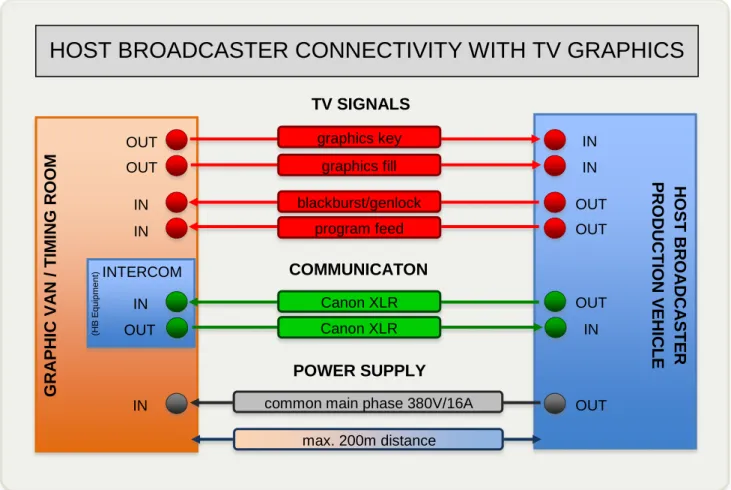
The HB will install the necessary cables, sync reference and programme monitor to the service provider according to a documented request. B ro a d ca st S ign a l Uplink
The FIS shall update the host broadcaster and the commercial partner regarding any likely changes to the competition schedule due to poor weather or unexpected delay.
The TVS will assist the HB in establishing the final timings and satellite requirements including those for pre-and post unilaterals.
The LOC shall ensure a suitable position is available for uplink facilities, identified at the site survey.
The host broadcaster shall supply and install the necessary cabling to connect the international programme output to the uplink facilities.
The commercial partner is responsible for the supply and management of the International signal distribution, including all updates.
NB: The FIS TV Supervisor works under the guidance and authority of the Race Director
1.3 Broadcast Planning Survey
For host locations that are established and existing competition venues, a planning meeting must be conducted in good time in advance of the event, with the FIS staff together with the assigned FIS TV Supervisor, the responsible TV Director and TV Producer of the HB (and members of their production team) and a representative of the marketing partner as appropriate. Representatives of the OC are expected to host the survey and may invite an advertising agent who has been appointed to sell available advertising space.
Each person contributing to the survey should not underestimate the time required to inspect the venue and assess the range of television requirements. Depending on the discipline, the survey will also identify the crucial points along the course and at the venue that will
influence the television production.
For cross country, ski cross and snowboard cross competitions the actual design and selection of the course may be influenced by the television director, and certainly this is the case for new course designs so they can be best arranged for the aesthetic and logistical demands of the television coverage plan.
Each event may include a programme of competitions scheduled to take place over a number of days. The planning survey must consider any possible reset times between course lengths and race disciplines. In some cases, camera re- positioning may need to take place during the race itself and the additional cable paths and access logistics must be considered during the planning survey.
In summary FIS recognises the role of both TV Producer/Editor and Director to be defined as follows:
TV PRODUCER/PROGRAMME EDITOR JOB DESCRIPTION
Overall operational responsibility for the Host Broadcaster’s Multilateral Feed, in particular observing the ‘story telling’ requirements for any given race
First and principal point of contact for all activities relating to the host broadcaster, including accommodating the needs of unilateral broadcasters, and facility requests
Senior Operational Partner of the FIS Race Director/OC/Marketing Agencies
Content handling of timing data and graphics
TV Operational Consultant for all departmental supervisors TV DIRECTOR JOB DESCRIPTION
Delivering a programme that faithfully represents the producer’s editorial decisions
Positioning, handling and directing all broadcast devices on the course
In some cases, the TV Producer and Director may choose to attend an initial survey alone (say the day before the main survey with a member of the OC) to fully establish his/her initial production plan without the opinions of a large survey team.
A key principle for the TV Director and FIS Race Director is to remember they are providing multilateral feed coverage and this should be unbiased in order to satisfy the international viewing audience. Coverage should be impartial, with equal emphasis on all participants, including replays of their reactions. Live action should always be a priority, and quite often the best approach is to ‘keep things simple’. At the same time, one of the most important assets of the designated TV Director and TV Producer will normally be considerable
knowledge of the sport. This knowledge will significantly contribute to how the excitement of the competition can be captured, showing all the important parts of the venue and the development of the competition.
The HB Producer and Director are expected to study the form and performance of the
athletes participating in the competition. Familiarity not only with the subject, but also with the season performance is imperative to fully understand and exploit the strengths and
weaknesses of athletes in the coverage plan. This type of research may include recent recovery from injury, a change in tactical approach or the rising form of a new athlete whose style is eye catching and entertaining. This knowledge will aid the necessary preparation for the members of the production team who can be given specific instructions to identify particular athletes.
The technical purpose of the survey is to develop the camera plan, microphone positions and cable path routing. The survey also presents the best opportunity to identify the TV
Compound layout, space to meet the unilateral facility requirements of RHB’s, accreditation and access. The race dynamics can be discussed in terms of the competition venue layout as well as the position and operation of the Mixed Zone, podium, lighting considerations, commentary booths, data and timing service provider and all associated logistics such as power supply, parking, catering and security.
In summary and as a minimum requirement the HB is expected to nominate the following individuals to attend the survey:
TV Producer/Senior Project Manager
TV Director
Chief Technical Manager/Technical Producer
Depending on the venue and the event to be produced the following specialists may also attend the survey:
Senior Cameraman (also cable rig supervisor)
Production Manager
Audio Supervisor
RF Engineer
It is essential that each member of the survey team can make confident and clear decisions that will affect the planning and execution of the broadcast product. Things may and will change but at least the survey report is detailed, factual and concise.
Another important purpose of the TV planning survey is to establish the position of the Mixed Zone and podium position beside the Finish Area. FIS will provide a Media and PR Manager and with the appointed TVM will manage the Mixed Zone and follow the guidelines and schedule determined for pre and post-race procedures.
The FIS Race Director and Event Coordinator must be invited to the official planning survey or at the very least receive the site survey report documentation following the inspection. For new venues a FIS appointed Homologation Inspector will attend in order to approve the strict standards required to host a FIS Skiing competition.
Following each survey the HB is expected to distribute a detailed camera plan (indicating how each camera will be used) and a schedule detailing the activities during the final days of preparation before the event. The OC will distribute plans of the competition site including the competition offices, TV Compound, mixed zone, podium position, commentary positions and all the logistical considerations such as parking, catering and team facilities.
TV planning surveys for new competition venue locations will require a more detailed and strategic planning approach in order to examine carefully the physical attributes of the venue and identify any special construction needs, safety considerations, access and consideration of the likely TV production plan. An experienced TV Producer/Director can provide a vital contribution to the design and layout of all new competition venues.
An example of the site survey considerations are summarised below:
Description Action Required
Venue(s) Infrastructure with the OC, FIS Staff and HB TV Producer
Camera Positions carefully considered with respect to the way the story of the competition is to be told
Air fences and protection of camera platforms to be provided by LOC
Flash Interview position with backdrop and lighting
Scaffold towers or Platforms
The likely position and height of towers or platforms with respect to the competition and expected weather conditions
The OC will initially provide the venue drawings and prepare a profile which may be included in the camera plans
Following the survey the HB will distribute the camera plan drawings of the competition venue to include microphone positions and all timing points.
HB to identify locations and determine level of protection required
To be agreed with the HB
To be agreed with the HB
Strategic Features
Define the locations of any specific features to be included in the coverage
As discussed with FIS Staff, FIS TV Supervisor and the HB to ensure suitable coverage is provided at strategic parts of the competition venue.
Finish Area
Define the finish line position and identify the relevant zones around the finish line, including the mixed zone and podium position
Venue Public Address System The PA system should not interfere with the international programme audio and the reporting/broadcasting activities taking place in the mixed zone or in the commentary booths.
The OC to distribute a map of the mixed zone area showing all of the different areas related to sporting and media activity depending on the discipline.
The placing of loudspeakers to be coordinated with the HB
Race Leader’s Position/Throne Where used, identify the space for the leader position and/or the throne
HB to include a hand held camera in coverage plan for this feature
TV Compound Location
Establish a suitable space (as close as possible to the stadium area) and identify the most suitable position for satellite uplink vehicles
Particular attention to the arrivals and parking schedule must be noted
HB to design and distribute a TV Compound layout including the positions of any unilateral rights holders, tender trucks and uplink vehicles
Description Action Required Cable Paths
Around competition venue and within the TV Compound
The HB will study the likely cable path runs around the competition venue and the delivery of cables in and out of the TV compound. A cable bridge may be necessary. In some cases the HB will submit a cable schedule so all known cable runs are identified. The HB must be informed in advance of the likely competition training times to avoid any scheduling conflict with the broadcast installation
Power Supply Requirements
Both technical and backup power supply requirements will need to be identified
HB to formally request a technical power supply specification for the OB and the domestic production vehicles, while the TVM will manage and co-ordinate requests for attending RHB’s
Commentary Booth Positions
If permanent commentary booths are not available, FIS’s appointed media agent may supply according to a specific agreement with the OC and demand from RHB’s
OC to identify expected positions for commentary booths and the survey should check the sight lines as well as the supply of power, furniture, heating, telecommunications and suitable weather protection
Parking, Medical Services and Transport Practical and Physical considerations
The survey should identify parking availability and the provision for medical services, public conveniences and media transport facilities
1.4 Documentation Required Pre-Survey
The appointed host broadcaster expects to receive the venue and competition site drawings not later than two weeks in advance of the survey.
1.5 Documentation Following Survey
it is essential that there is a smooth and timely distribution of information between all contributing parties and each will make sure the following documents are delivered according to the timeframe specified below between the OC, FIS, TVM and the Host Broadcaster:
Host Broadcaster
Master camera plan of the competition venue including scaffold towers and platforms, together with microphone positions to be delivered not more than 4 weeks after the survey
Provisional TV compound layout may follow up to 10 days before the competition with the inclusion of attending RHB’s and satellite uplink vehicles. The final version may be updated shortly before the competition itself
Cable Schedule as required
Daily Schedule for HB in terms of tender vehicle arrival, park and power, cable installation, skidoo availability, camera platform build, installation of all timing points, full rig and technical rehearsal. Note the training schedule should be provided to the Host Broadcaster as soon as it becomes available in order to coordinate the cable installation
Organising Committee/TVM
Commentary booth plan with broadcaster divisions
Start Area, Finish Area, Mixed Zone, including the divisions within the Mixed Zone
1.6 Media Agent Liaison with HB and Media Rights Holders
The media agent (TVM) shall act as the principal point of contact for all international TV and media rights requests associated with the competition. The TVM represents the International media rights for the event and is the only authority that may approve accreditation and other supplementary access requests from attending rights holders.
In particular, the TVM will handle all requests by RHB’s who may wish to attend the competition including their logistical and practical needs such as accreditation, parking, security, local labour, accommodation and technical facilities. The TVM will coordinate specific requests for access and the use of ENG or unilateral cameras that may require operator bibs and authorisation stickers.
The TVM will also be the principal point of contact for non-attending RHB’s in terms of signal delivery, coordination of feeds, pre and post unilaterals and the distribution of the daily running orders. In advance of each event the TVM will distribute the satellite coordinates to all international rights holders together with the necessary RAS or BISS codes and timing schedules, including line up periods.
Requests which specifically require action or co-ordination by the host broadcaster are communicated accordingly and the relevant documentation will be shared with the broadcast partner concerned. The host broadcaster will identify a suitable technical contact (as well as the producer or production manager) for the co-ordination and delivery of all HB related matters and facilities requests.
2. Television Production
2.1 General
TV agreements with a broadcasting organisation or Production Company must ensure that this Broadcast Manual is applied to ensure the production quality and TV transmission of FIS Skiing World Cup events included in the FIS calendar.
2.2 High Definition Technical Specification
All FIS events must be produced in High Definition in the technical standard of the country in which the event takes place.
2.3 Audio Specification
Audio line-up signals are defined as -18dbfs and must be produced as a stereo international pair. An international signal does not and will not include voice over or commentary in any language. Host Broadcasters may choose to produce an event using 5.1 Surround Sound providing a stereo international pair is available from the tailboard.
2.4 Satellite Uplink Specification and Distribution
The satellite uplink facilities provider is obliged to provide the necessary cabling from their SNG unit to the host broadcaster’s tailboard. Typically the distance will be short and
convenient, although approximate distances and parking positions will be defined during the site survey.
The specification is as follows:
Two HD video cables with embedded international stereo FX, (A primary path and a backup)
Specific instructions regarding the transmission modulation and schedule will be documented in good time in advance of the event.
2.5 Power supply
The LOC will be responsible for the installation of the necessary power supply, including UPS as agreed with HB, to ensure the production of the multilateral signal and meet the needs of UB's. The cost of electric power actually used and/or the fuel consumed for generators will be paid for by the HB and/or UB's.
3. Multilateral TV Production Considerations
3.1 Production Standards
FIS expects Host Broadcasters to offer exceptional standards of production for all winter sports events and aims to establish an excellent professional relationship with the appointed TV Producer /Project Manager.
TV coverage of FIS Skiing events should aim to capture the athletes’ determination and competitiveness, the venue atmosphere, drama and human aspects of the event including the finish/win sequence and podium presentation. The overall graphics presentation for any Skiing event is crucial to aid the understanding of real time race activity and must not be underestimated. The following items are key values which FIS associates with high standards of production:
A continuous live international broadcast formatted in a way that can be easily scheduled in a programming slot with opening titles, appropriate and relevant production before the competition start (according to a documented running order), the competition itself, results summary, flash interview, podium presentation and closing animation). The multilateral broadcast must not show any presenter in vision, or include inserts or commercial elements associated with the domestic broadcast
As a rule, the international television feed should be self-explanatory as a viewing experience and not be dependent upon listening to a commentary
The production will provide an uncompromisingly fair and impartial coverage of each competitor (with respect to the storytelling process and the format of the competition)
Through appropriate shot selection and replay options, the viewer will be given an insightful, informed and credible account of the whole competition
By sensible positioning and use of fixed, mobile and specialty cameras units the action and dynamic of the competition will be captured taking into account the limitations of the budget and available facilities
Better understanding of the competition will be provided through a clear and informative graphics presentation giving accurate information in real-time
Through the sophisticated use of experts working with a carefully prepared communication systems the story telling process for all disciplines will be assured
Thoughtful and consistent coverage of podium ceremonies will be produced
Adequate consideration will be given to the presence of advertising and event sponsors while respecting the course dynamics and natural landscape
The live transmissions must include all FIS graphics related to each discipline, particularly the official FIS logo and replay wipe, start lists and competition results as well as the overall event and World Cup standings
The television viewing experience is greatly enhanced by correct and strategic positioning of microphones and it is important to select the appropriate positioning of directional
microphones with windshield and woolly sock protection. In some cases, follow microphones might be required to capture the athlete’s movement. Capturing sound from key points, depending on the discipline, such as the start and finish areas, the hill climbs, pit stops, coaching zones and spectator tribunes is an essential component of the television production.
3.2 Technical Infrastructure
The representatives of the HB are expected to arrive at the competition venue sufficiently in advance of the first transmission to ensure the technical set up for the event. During this time and according to a documented timetable, all relevant cable paths must be installed as well as camera platforms and any speciality camera systems including RF devices. The director will also confirm with the timing and data partner the exact placing of all timing and
measurement positions so that the camera positioning is accurate around these points.
All safety requirements will be checked, including ‘hidden’ cables beneath the snow, the overall snow conditions and any possible course changes. Camera platforms and speciality camera units will be examined for their safety and view of the course. The FIS Race Director will provide a final safety approval for camera platforms on the race course and in the competition area. The HB is expected to follow their own risk management procedures following documented guidelines in their individual event production manuals.
3.3 Cabling
Cabling is the responsibility of the HB and attending unilateral broadcasters, although the OC will prepare the necessary cable paths, conduits, ducts, tubes, bridges and safety elements for the cable installation in and around the competition venue itself. FIS insists the following guidelines are adhered to:
Cables should not cause any obstruction or safety hazard to athletes, course officials, volunteers or spectators and must comply with local safety and security regulations
Cables should not be laid over the advertising boards
Every attempt must be made to ensure cables are installed discreetly and as unobtrusively as possible, particularly in the sensitive areas shown by the television cameras
As and where necessary, cable bridges, cable ties, cable mats, yellow jackets and dressing should be used to make cables safe and secure
The HB must provide assistance to visiting broadcasters to ensure their cabling needs are met
The OC is responsible for installing the cables between the host broadcaster’s production vehicle and the FIS data and timing service provider
3.4 TV Compound
Occupying a location identified during the site survey the TV Compound must be carefully managed by the HB, particularly with regard to parking and power supplies for all attending parties. The TV Compound should include adequate space for multilateral and unilateral SNG vehicles, tender trucks, a protected power supply, production offices, storage space and any temporary catering facilities.
HB’s are responsible for producing a detailed parking plan of the TV Compound and should have a technical representative with decision making authority available when vehicles arrive, including those of attending unilateral broadcasters.
An uninterrupted power supply (UPS) must be provided to the HB and attending RHB’s by the OC.
3.5 Lighting Installation
For events scheduled for evening/night races the complete competition area as well as the areas significant for the TV transmission must be lit with a minimum of 1000 lux measured at any point of the competition area in the direction of the main television cameras. In general, the competition area must be evenly lit with a constant colour temperature.
The course lighting must be supplied and installed by the OC under the supervision of the television production lighting supervisor. This matter can be discussed in further detail during the site survey.
3.6 Transition Replay Animation
The 25 frame FIS transition replay animation (wipe) will introduce slow-motion or super-slow-motion replays into the broadcast. The slow super-slow-motion package should start and finish with a moving picture, not a freeze-frame. Within the package, the transmission from one slow motion to another should be a dissolve of 25 frames. Each replay sequence must be introduced by the FIS transition replay animation and relate only to the FIS Logo and the name ‘FIS World Cup’. Any other branded replay elements are not allowed unless permission has been granted by the FIS. The same animation will carry these views off-screen to signal the return to live coverage. The animation will be accompanied by a 25 frame audio effect.
The transition replay animation will be supplied in advance by the TVM as a sequence of targa files or as a fill and matte animation supplied on videotape.
In the United States and Japan, the transition replay animation will run for 30 frames, according to the 525 line/60Hz system.
3.7 Use of Specialty Cameras and Handhelds
Typically handheld cabled or RF camera units, RF units on ski-doos, Jimmy Jibs, polecams, helicams, rail cameras and other speciality cameras will appear on the camera plan
produced by the HB. The number and type of these speciality cameras will depend on the discipline and the production philosophy of the HB. A hand held RF camera may be the best choice to conduct the post-race flash interview featured in the multilateral feed.
Note that host broadcasters using rail cameras must supply to the Data and Timing Supervisor the frequency and power supply used to avoid any conflicts with timing equipment.
3.8 Record and Replay Devices
Host Broadcasting Organisations are expected to incorporate at least 2 X EVS video record and replay servers as part of their overall facilities inventory, one of which may be a Super Slow Motion server (SSM). Typically each competition can be followed by a short replay sequence of the highlights. The HB is also expected to make 2 x safety copies of the programme to Digital Videotape including a separate recording of any pre and post
unilaterals. 3 x DVD copies of the programme are also required and will be coordinated with the attending TVM.
3.9 Photo Finish
The FIS Data and Timing service provider will supply and install photo finish camera
technology across the finish line as specifically required by certain disciplines. This still image is available to the host broadcaster via the existing connectivity for the
graphics service. The installation of the photo finish cameras should be carefully coordinated with the host broadcaster as the photo finish cameras must have priority in terms of
positioning and installation. The Jury will decide if a photo finish image is required to determine the final positions and
evidence of the photo finish will be revealed in the results tables.
3.10 Audio Considerations
In general directional microphones protected with windshields and woolly socks are
positioned with both fixed and mobile camera units sending the audio signal back by triax (or via the RF transmitter) to the camera CCU.
Some stadium venues may benefit from spectator effects microphones positioned towards the main tribune or grandstand. Effects microphones are also required to capture the
indications to the athletes at the start of the competition. Although the public address announcer does not need to be directly available as a source,
the PA Audio source may be included for the benefit of the National Anthems.
For the benefit of the flash interview (and any scheduled pre or post-race unilaterals) a hand held dynamic microphone should be available beside the mixed zone and close to the exit gate.
3.11 Use of music
FIS will supply a selection of music to the Host Broadcaster employing a theme used for all FIS Skiing events without the need for any specific music use reporting mechanism.
3.12 Podium Presentation
Towards the end of the live TV transmission, as soon as possible after the result is known the presentation of the first three athletes shall take place in the designated area.
The original site survey will help determine the exact position of this presentation and the camera positioning should be included in the coverage plan of the HB.
Athletes must attend the Winner’s Award Ceremony with their competition suits, gear and clearly visible race bibs. TV interviews may take place following the podium presentation only in the designated Mixed Zone positions.
4. Unilateral TV Requests
Unilateral broadcasters are widely encouraged to attend the competition venue, both for customisation of their programming needs and to conduct interviews with participating athletes. FIS seeks to establish partnerships with broadcasting organisations that can provide:
Extensive publicity
Widest possible transmission activity and broadcasters with large audiences
Guaranteed terrestrial broadcasts in the host nation
RHB’s must approach the Marketing Agency to order broadcast services and facilities if they wish to the present at the event.
Depending on specific TV rights agreements, domestic unilateral broadcasters may approach the OC directly.
4.1 Unilateral Broadcaster Request Booking Details
Unilateral Broadcasters must present a detailed facilities summary to the TVM who will respond to and share the relevant information accordingly.
Item Description (Example)
TV Compound Space OB Van with operational dimensions Edit Vehicle with operational dimensions Tender Vehicle with operational dimensions Power Supply OB Van: Current (amps), phase and connector types
Edit Vehicle: Current, phase and connector types Mixed Zone Position: Current, phase and connector types Commentary Position
Mixed Zone Space required for an in-vision position subject to availability Summary of facilities to be installed in the mixed zone including lighting
Commentary Position Partially or fully equipped with CIS Monitor, International Feed(s), Furniture & Heating
Production Container If required and with approximate position Furniture
Heating
CIS Data Monitors Location and number to be provided
Unilateral Camera Positions Brief Description of how many and their locations Use of RF units and wireless microphones Host Broadcaster Signals Example:
1 x World Feed Dirty HD + INT stereo audio 1 x World Feed Clean HD + INT stereo audio And any isolated camera feeds
Camera Stickers Example:
Camera stickers for fixed cameras in the mixed zone, in the competition venue and for ENG crew
Bibs Example:
For course inspection and mixed zone VAPPS Parking Example:
OB Van, Edit Vehicle and Tender Vehicle in TV Compound Crew Cars
Security 24 hours from dd/mm/yy Local Labour Example
3 X helpers from 10:00 – 18:00 on dd/mm/yy 3 x helpers from 16:00 on dd/mm/yy Telephone Lines Arranged through local PTT as follows:
1 x ADSL OB Van 1 x IDD OB van
1 x ADSL Production trailer 2 x IDD Production Trailer 1 x ISDN commentary booth Accreditation List Names of people to be accredited:
Schedule Brief description of schedule include arrival, rig, live TX and de-rig schedule
4.2 Commentary Booths
The host broadcaster is generally not responsible for the supply and installation of
commentary booths, although each event is considered on a case by case basis depending on contractual agreements between the NSA, the TVM and the HB.
However, the commentary booths themselves must meet the following specification:
Positioned in such a way that the Competition Site (e.g. Finish/landing area and the last part of the course) are visible preferably with a profile view
Sufficiently noise protected and separated from other positions and the public
Adequate space for commentator, co-commentator and an interview partner or guest
A feed of the international audio signal
Table for documents and workspace and 8 power sockets
Heated with 2-3 coat hooks
The option of renting a partially or fully equipped commentary booth, programme monitor and stats/data feed monitor (CIS) should be offered. The data feed monitor is provided free of charge to the commentary booths by the FIS data timing service provider. Additionally free of charge WiFi or LAN shall be provided by LOC.
FIS recognises that programme monitoring in commentary booths will reflect the aspect ratio of the multilateral signal and be available on 17’’ or 19’’ monitors.
Visiting broadcasters wishing to commentate at the venue must arrange their own commentary circuit bookings via their local national telecoms provider.
4.3 Mixed Zone and Flash Interviews
A dedicated Mixed Zone shall be provided next to the Finish Area, so that attending RHB’s and other members of the media may conduct short informal interviews with the competitors. The Mixed Zone shall be set-up by the OC in consultation with the TVM and the HB. The OC will provide the necessary supplementary access devices to the Mixed Zone, while the FIS Media and PR Coordinator will manage the mixed zone activities with the support of the OC.
The appointed TVM will coordinate pre- and post-unilateral requests and work closely with the FIS Media and PR coordinator to include the post-race flash interview.
There will be an established order in the Mixed Zone for RHB’s, with the first position being offered to the rights holder of the host nation.
The OC will establish the best possible layout for the Finish Area depending on the available space and their drawings will include a number of specific media zones that can be defined as follows:
Partitioned TV Boxes or live Announce Positions where attending RHB’s will conduct their presentations with their own on-site production facilities. Typically they integrate their own cameras with the feed from the HB to customise their show and provide their viewers with a strong venue presence. The TV boxes are positioned at the beginning of the Mixed Zone, so the athletes may pass in front of them as they make their way down the corridor.
The HB is obliged to provide the necessary facilities to conduct pre and post unilateral requests for the specific use by RHB’s. Booking arrangements must be confirmed between the TVM and the attending RHB’s according to a documented rate card agreement.
Interviews may be conducted using the multilateral signal path at agreed times outside the main programme window.
The next part of the mixed zone is allocated to those who do not have live commitments, is adjacent to the athletes’ exit and is allocated to ENG positions. Live radio crews and the written press may share this zone, although an order of priorities is to be established and observed.
There is a written and formal procedure for post-race interviews, although some variations apply depending on the event and host nation. As a general guideline, the following procedure applies for FIS World Cup events:
Between the end of the race and the podium presentation, only the HB and the attending TV networks with live unilateral facilities are allowed to conduct short
interviews with the top three athletes. This will enable the podium presentation to take place as part of the multilateral feed without delay
The broadcaster from the winner's home country will be the first to interview the athlete. Should the top three athletes belong to the same nation, the attending live broadcaster must decide the sequence of their interviews with the help of the FIS Media and PR Coordinator
Typically the flash interview (conducted in English via the multilateral feed) will take place directly before the podium presentation and in any case in the position as indicated in the running order.
4.4 Pre and Post Unilateral Transmissions
Bookable pre and post unilateral transmissions will be available at each competition venue. The facilities, provided by the HB will be available as a live source and carried via the multilateral signal. Pre and post unilateral facilities will include a microphone, camera with lighting and operator as required. An interview may be conducted and recorded to videotape or videodisk with playback via satellite at a time to be arranged in advance. The pre and post unilateral transmissions will be co-coordinated via radio communication with the host
broadcast facilities via the attending TVM.
4.5 TV Interviews during the Live Transmission of the Event
Interviews may be conducted at any time during the competition schedule from a dedicated live camera position. These interviews shall be part of the unilateral coverage of an RHB and will not be included in the multilateral signal.
4.6 Studio and In-vision Positions
Unilateral broadcasters wishing to use indoor or covered facilities with a view over the finish area are invited to submit their requests to either the OC (domestic broadcasters) or the TVM (international broadcasters).
In both cases RHB’s are invited to attend a site survey to discuss their intentions and identify a suitable studio/in-vision position. Unilateral RHB’s are responsible for building their own position including all broadcast facilities, furniture, lighting and security.
4.7 ENG Crews
RHB’s may send ENG crews to FIS events, and may request a suitable shooting position in the finish area or beside the course. ENG positions will be available depending on the course length, dynamics and accessibility.
Broadcasters wishing to have ENG positions must send their precise requests well in advance of the event, and must choose from the options made available by the OC and which do not directly conflict with the HB’s coverage plans.
5.
Accreditation and Supplementary Access Devices
5.1 Accreditation
As a general rule, although there are variations to the procedure depending on the specific agreements between FIS, the NSA’s and the OC’s, foreign broadcasters may approach the
In some cases, where foreign media accreditation requests are made directly to the OC the information is immediately shared with the Marketing Agency so the management of the foreign media requests is handled by the same organisation.
Example Accreditation
In turn, the OC is advised to have a representative ‘TV Contact’ at the press office dealing with TV personnel, taking care of their accreditation, providing them with the necessary information and updates. This person will hand out accreditation only to the representatives of the HB and other RHB representatives.
The requests coming from domestic media are typically dealt with directly by the NSA/OC when they are responsible for domestic media rights in the host nation.
When the Marketing Agency also holds the domestic rights, he is the one managing all the accreditations, even those for domestic broadcasters. This also applies to supplementary access devices and to unilateral broadcasters.
5.2 Camera Stickers
Besides the personal accreditation to be given to the media personnel, each authorised TV camera should be identified with an ‘accreditation’ sticker. As implemented in previous years, RHB’s with season long contracts will be offered one and the same sticker to identify their TV cameras throughout the season. It will be delivered to the RHB by the Marketing Agency before the beginning of the season.
In some cases, where RHB’s may have an interest only in a single event, the Marketing Agency will prepare camera stickers that are valid for that event only.
Cameras belonging to the HB with fixed and permanent positions do not need stickers, but it is imperative that those working at the Finish Area display the authorised camera stickers at all times, to conform to the security access procedures.
The OC will inform the Security Manager that only TV cameras with the relevant sticker may access the Finish Area (and, more generally, any competition area) and FIS expects the full co-operation of the OC regarding restricted access to sensitive parts of the competition site.
5.3 Operator Bibs
A further access device will be required by all personnel who need to work in the competition area and the OC is required to supply:
A unique bib to identify the HB personnel (and supplied by the HB) working in the competition area and in the Finish Area. It is important that the bib is very visible so that the personnel can be identified easily in the competition area and/or in the Finish Area as members of the host broadcasting crew. A clear colour distinction will support the strength of the course security operation, as well as the protection of TV rights to eligible broadcast partners
A different bib or an armband is used to identify the rights holding cameramen and production teams, including TV commentators, allowed in the competition area prior to and during the competition. It is understood that television presenters appearing in vision do not need to wear their bibs or armbands when “on air” in vision. For the Mixed Zone Area, the Marketing Agency provides each unilateral RHB with a
laminated cardboard directly on-site, a so-called “LIVE TV BOX CARD”. This card is customised for each venue with the total number of such LIVE TV BOX cards depending on FIS approval
Another bib or armband, of a different kind or colour, (or simply a laminated thin cardboard) for the TV personnel who are admitted to the inspection only, (depending on FIS approval)
5.4 Vehicle Access Passes
Due to limited availability, vehicles wishing to enter the TV Compound or surrounding parking areas need to submit their requests including Vehicle Licence Plates (where possible) to the TVM (for international broadcasters) and to the OC (for domestic and host broadcasters).
RHB’s should specify if their vehicle requires TV Compound parking or parking in the nearest available parking area. Information regarding commercial vehicles will need to include the operational dimensions (including expanding sides when parked and tailboard access).
Attached Is an examples of a vehicle access pass:
6. Venue Logistics
6.1 Logistics
The OC together with the HB and FIS Race Director or Event Coordinator must select suitable locations for camera positions and platforms, the commentary tribune, mixed zone, podium position, TV Compound and associated production and timing offices. Provision must also be allowed for an uninterrupted power supply, parking facilities, bathroom facilities and catering.
The OC must also be responsible for the security of and safe access to all operational areas, including the preparation, management and distribution of accreditation. The TVM will be responsible for the management and distribution of accreditation from international members of the media.
6.2 Starting Time
All FIS events will start at the published scheduled start time including qualification and preliminary heats. Any changes to the schedule due to unforeseen weather conditions or other circumstances will be decided collectively between the FIS Race Director, FIS Event Coordinator and the OC.
6.3 Venue/Region Information
The HB is required to include at the beginning of the pre-race multilateral running order a one-minute video sequence showing the natural beauty/ items of interest/profile of the host city or region.
7. Event Operations
7.1 Definition of Roles and Contributors
FIS RACE DIRECTOR
Is the most senior officiating member of the competition management and his/her duties include the health and safety aspects of the competition venue and the surrounding environment. The race director has a key role to play in all matters affecting the sporting activity and the running of the competition. The race director is also responsible for the timing of the event as well as making decisions regarding the weather and other conditions.
FIS EVENT COORDINATOR
In addition to various other functions is the link between the Host Broadcaster and FIS, the Marketing Agency as well as the jury.
FIS TV SUPERVISOR
As described in the division of obligations table, the FIS TV Supervisor, working under the guidance and authority of the FIS Race Director, will be appointed to a specific number of events and will attend the initial planning survey, following the planning and progress until the final delivery. In particular the FIS TV Supervisor will contribute to the decisions made
regarding the competition venue infrastructure and TV compound logistics and act as a point of contact to ensure all the deliverables are provided as agreed during the site survey.
TV AND MEDIA RIGHTS MANAGER (TVM)
International TV and Media rights are carefully coordinated by the appointed Media partner who will attend each and every event during the calendar season. The TV and Media Rights Manager (TVM) represents the interests of the international broadcast partners and will ensure a strong and effective planning relationship between the NSA, OC and host broadcaster, as well as attending and non-attending rights holders.
The TVM is the principal point of contact for all broadcast partners, particularly for those choosing to attend the event and which require access to the programme feed, isolated camera requests, power, commentary facilities, parking, accreditation, accommodation,
The TVM will also check the TV Compound layout in terms of space for the international uplink and any attending RHB’s who may arrive with their own facilities to customise their programme from the competition venue.
The TVM will work closely with the OC, HB and FIS TV Supervisor to ensure the planning process runs to time and according to any written deadlines.
During the event phase, the TVM will produce and distribute an approved multilateral running order for each competition and will need to be sure that the running order is followed
according to the published format. The TVM will ensure the international world feed is delivered to the standard required and coordinate any pre and post unilateral requests on a daily basis.
HOST BROADCASTER PRODUCER/PRODUCTION MANAGER
The principal point of contact representing the host broadcaster, will be available to handle all requests regarding the host broadcaster’s responsibilities and is the likely interface with attending rights holders. The production manager will attend the initial venue survey and distribute the relevant documentation as follow up to the planning survey. The production manager will manage the activities within the TV compound designing a schedule for the park and power process and making sure all the cabling requirements are met according to specific requests and deadlines. The production manager will also work closely with the OC regarding practical considerations such as power supply, security, parking and course access.
FIS MEDIA AND PR COORDINATOR
The FIS Media and PR coordinator acts as an interface between the media and the athletes and typically arrives two days before the first competition.
Among other responsibilities, the Media and PR coordinator checks the facilities, structure and flow of the mixed zone and finish area ensuring that members of the media are given opportunities to speak with athletes after their race.
The Media and PR coordinator will manage the appropriate leader presentation which allows the TV audience and local spectators to see who is the current leader. The athlete may change several times during the course of the competition.
The Media and PR coordinator will also conduct the post-race interview for the multilateral feed and will work closely with the TVM and HB to co-ordinate exactly when that will take place.
CHIEF DATA AND TIMING SUPERVISOR (WHERE APPLICABLE)
The role and expertise of the Chief Data and Timing Supervisor may be summarised as follows:
Communicating and coordinating with all attending parties (FIS, TV/HB and the OC) Managing all operational aspects of the timing and data service
Supervising the installation and setup of the timing and in venue results technology (timing, scoring, data handling, results, scoreboards, TV etc.)
Having considerable knowledge of the sport and competition rules Attending the initial venue survey (as required)
Ensuring the planning, deadlines and required quality and quantity of deliverables are respected
Representing the interests of the timing and data service at venue meetings, operations and official events
CHIEF OF STADIUM (CS)
Reports to the Chief of Competition and is responsible for all activities in the stadium area. This includes the flow of competitors to the starting area, equipment marking, commercial markings, equipment control in the finish area, the flow of athletes from the finish area and providing support for anti-doping controllers.
The CS also supervises the installation of fencing, course markings and signs in the stadium area as well as coordinating the placement of the start and finish lines with the data and timing supervisor.
The CS is responsible for the security aspects of the stadium area including access and control for competitors, coaches, service personnel and the media including the preparation of the mixed zone.
The CS must make sure there is sufficient lighting to provide adequate working conditions
CEREMONY CHIEF (CC)
Reports to the Chief of Competition and the OC Chief and is responsible for the entire Winner Presentation and Prize Giving ceremony. The CC will coordinate with the FIS PR & Media Coordinator, the speaker, TVM and the Host Broadcaster regarding the exact position and timing of the ceremony. The CC will ensure that everything is prepared immediately after the race and the designated representatives are in position. Overall the CC will ensure a well presented winner ceremony according to the FIS Guidelines.
7.2 Contingency
In the event of adverse weather conditions or other circumstances threatening to postpone or cancel a scheduled event, the TVM will discuss the options with the FIS Race director, FIS Event Coordinator and OC. If an event is rescheduled the information is quickly distributed to domestic and international broadcast partners via the TVM. Even if the competition is
postponed or cancelled the host broadcaster should come on air at the scheduled time with live weather conditions and an explanation of the problem and the reason any decision was taken.
7.3 Competition Communication
Although the host broadcaster is not expected to maintain permanent radio communication with the FIS Race Director, relevant issues will certainly be discussed before and perhaps during a competition via the FIS Event Coordinator
.
7.4 Public Address System
The speaker and/or moderator, when present, must be informed in detail of the way the competition will be used by broadcasters, so they do not spoil the event via the loudspeaker for a broadcaster which may shuffle the order, create highlights or broadcast strategic phases of the competition. This is particularly valid for broadcasters who have in-vision or studio positions at the venue and whose announcers are recording suitable links for their final programme.
The volume and content of the public address sound throughout the venue must be co-ordinated between the HB and the OC.
8. Event Phase
The Cross Country experts have prepared information regarding the preparation immediately prior to the competition. This is reproduced in this section 8 as it provides information which could assist for the final on-site preparations for all disciplines.
8.1 Run up to the first TX commitment
As soon as a FIS Cross-Country Skiing competition reaches the final planning week a number of scheduled activities must take place to fully prepare the venue, course and broadcasting arrangements in a relatively short amount of time. The following table provides an example for a combined format race (i.e. a sprint with a middle or long distance format).
Days before TX Description
– 5 Days Tender and support vehicles travel and park
– 4 Days Assemble all camera platforms as well as initial cabling for both race formats.
– 3 Days Cabling continues
– 2 Days Director and Timing Supervisor agree and identify pre and intermediate timing points as per the survey details
HB Outside Broadcast vehicles arrive as well as any mobile production facilities for attending rights holders
TV Compound park and power
Complete cabling, position and install cameras and microphones
– 1 Day Initial meeting and inspection of the finish area/TV position w