Open Access Dissertations Theses and Dissertations
Fall 2014
Engineering faculty views of teaching quality,
accreditation, and institutional climate and how
they influence teaching practices
Jacqueline C. McNeil Purdue University
Follow this and additional works at:https://docs.lib.purdue.edu/open_access_dissertations Part of theHigher Education Commons, and theTeacher Education and Professional Development Commons
This document has been made available through Purdue e-Pubs, a service of the Purdue University Libraries. Please contact [email protected] for additional information.
Recommended Citation
McNeil, Jacqueline C., "Engineering faculty views of teaching quality, accreditation, and institutional climate and how they influence teaching practices" (2014).Open Access Dissertations. 332.
PURDUE UNIVERSITY
GRADUATE SCHOOL
Thesis/Dissertation Acceptance
7KLVLVWRFHUWLI\WKDWWKHWKHVLVGLVVHUWDWLRQSUHSDUHG %\ (QWLWOHG )RUWKHGHJUHHRI ,VDSSURYHGE\WKHILQDOH[DPLQLQJFRPPLWWHH $SSURYHGE\0DMRU3URIHVVRUVBBBBBBBBBBBBBBBBBBBBBBBBBBBBBBBBBBBB BBBBBBBBBBBBBBBBBBBBBBBBBBBBBBBBBBBB $SSURYHGE\+HDGRIWKH'HSDUWPHQW*UDGXDWH3URJUDP 'DWH
To the best of my knowledge and as understood by the student in the Thesis/Dissertation Agreement, Publication Delay, and Certification/Disclaimer (Graduate School Form 32), this thesis/dissertation adheres to the provisions of Purdue University’s “Policy on Integrity in Research” and the use of copyrighted material.
Jacqueline McNeil
Engineering Faculty View of Teaching Quality, Accreditation, and Institutional Climate and How They Influence Teaching Practices
Doctor of Philosophy Matthew Ohland Joyce Main Karl Smith Matthew Ohland Stuart Kellogg Ruth Streveler 11/21/2014
ENGINEERING FACULTY VIEWS OF TEACHING QUALITY, ACCREDITATION, AND INSTITUTIONAL CLIMATE AND HOW THEY INFLUENCE TEACHING
PRACTICES
A Dissertation Submitted to the Faculty
of
Purdue University by
Jacqueline C. McNeil
In Partial Fulfillment of the Requirements for the Degree
of
Doctor of Philosophy
December 2014 Purdue University West Lafayette, Indiana
ACKNOWLEDGEMENTS
Dr. Ohland, Dr. Kellogg, Dr. Main, and Dr. Smith in their insights and help in the creation of this dissertation. All the faculty and staff in the department of Engineering Education at Purdue University. All the faculty in Industrial Engineering and Mining Engineering at South Dakota School of Mines and Technology.
TABLE OF CONTENTS Page ABSTRACT ... v CHAPTER 1. INTRODUCTION ... 1 1.1 Introduction ... 1 1.2 Scope ... 5 1.3 Significance ... 5 1.4 Definitions ... 7 1.5 Research Questions ... 8 1.6 Assumptions ... 9
1.7 Limitations and Delimitations ... 10
CHAPTER 2. ENGINEERING FACULTY PERSPECTIVES ON THE NATURE OF QUALITY TEACHING ... 12
2.1 Introduction ... 12
2.2 Literature Review ... 14
2.3 Methods ... 21
2.4 Results and Discussion ... 25
2.5 Conclusions ... 37
CHAPTER 3. THE INFLUENCE OF ABET ACCREDITATION PRACTICES ON FACULTY APPROACHES TO TEACHING ... 40
3.1 Introduction ... 40
3.2 Literature Review ... 41
3.3 Methods ... 40
3.4 Finding and Discussion ... 54
Page CHAPTER 4. FACULTY PERSPECTIVES AND INSTITUTIONAL CLIMATE
FOR TEACHING QUALITY IN ENGINEERING ... 66
4.1 Introduction ... 66
4.2 Literature Review ... 68
4.3 Methods and Data ... 75
4.4 Results and Discussion ... 81
4.5 Conclusions ... 98
CHAPTER 5. CONCLUSIONS ... 101
5.1 What We Learned From Each of the Research Studies ... 101
5.2 What We Learned From All the Studies Taken Together ... 103
5.3 What Seems Likely After Having Completed All Three Studies ... 105
REFERENCES ... 107
ABSTRACT
McNeil, Jacqueline C. Ph.D., Purdue University, December 2014. Engineering Faculty Views of Teaching Quality, Accreditation, and Institutional Climate and How They Influence Teaching Practices. Major Professor: Matthew Ohland.
There is wide agreement that teaching quality matters in higher education, but faculty have varied ideas about the definition of quality. This dissertation examined data from a survey administered in 1997, 1999, and 2002 at institutions of the Southeastern
University and College Coalition for Engineering Education (SUCCEED) supplemented by a survey administered more recently to a subset of those institutions and two
additional institutions. All participating institutions are large public universities. The data collected included faculty teaching practices and three influences on those practices—the faculty member’s definition of quality teaching, their perspective on ABET accreditation processes, and the climate for teaching at their institution, resulting in a dissertation in a three-paper format.
“Engineering Faculty Perspectives on the Nature of Quality Teaching” examines definitions of quality teaching. Using thematic analysis, these were coded according to a framework for quality in higher education by Harvey and Greene. Multinomial logistic regression showed that views on quality teaching were associated with faculty teaching practices. The most common definition of teaching quality (held by 49 percent of
participants) is associated with elitism and restricted access—the best way to improve education is to admit better students. These faculty focus on education as “knowledge transfer” and “learning content.” Another 38 percent of faculty had a transformational perspective, more focused on process than content, valuing “empowering students,” “developing students,” and “creating an environment for learning.” These faculty refer pedagogies of engagement such as active learning. The only other prevalent definition of quality (30 percent of faculty) focused on “fitness for purpose,” characterized by terms such as “ability to meet specific legitimate learning objectives” and “mastery of learning outcomes.” This work provides guidance to faculty development efforts.
“The Influence of ABET Accreditation Practices on Faculty Approaches to
Teaching” explores the effect of ABET accreditation on quality teaching as described in faculty comments from 2014 using thematic analysis. Multinomial logistic regression related faculty perspectives on accreditation terminology and processes to faculty teaching practices. Faculty had overwhelmingly negative views regarding accreditation, believing that it adds to their workload, stifles their creativity, and distracts them from other important objectives including teaching. Faculty who express various negative views of either the goals or the practice of accreditation are less likely to engage in certain student-centered teaching practices. More positively, our findings show that faculty who tend agree with the student-outcomes focus of the ABET criteria engage in richer educational experiences—they give students more writing assignments and allow students to learn collaboratively.
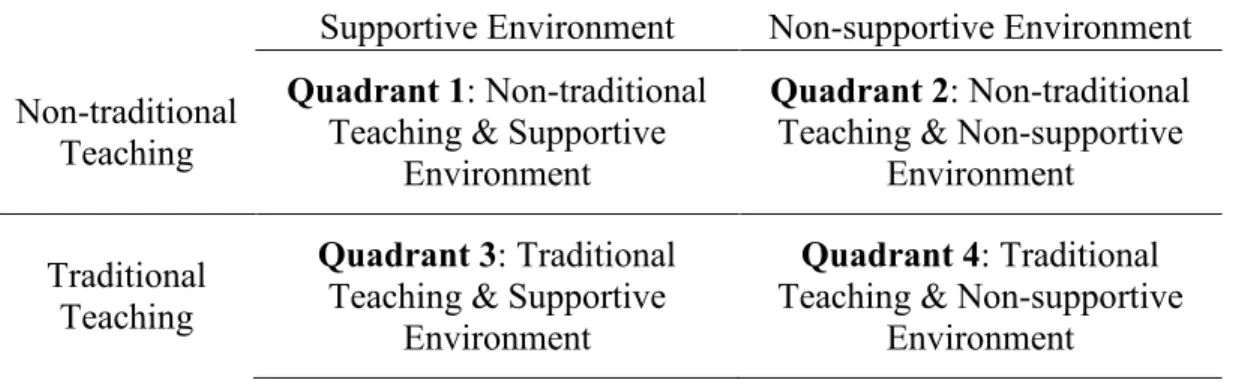
“Faculty Perspectives and Institutional Climate for Teaching Quality in Engineering” analyzes faculty comments from the earlier surveys using thematic analysis. Comments from the 2014 survey were classified by teaching practices (traditional vs. non-traditional) and institutional climate (traditional vs. non-traditional), creating four cases. These
comments were then analyzed using a collective case study approach. The study of the two collections of open-ended comments was supplemented by multinomial logistic regression of survey items from the 2014 administration relating faculty teaching
practices and the institutional climate for teaching. In the historical data, faculty views of student evaluations evolved from seeing it as a negative burden to describing is as
positive evidence of student learning. Faculty comments included many references to administrators who only “pay lip service” to the importance of teaching, although some faculty spoke positively about their campus’ commitment to quality teaching. Faculty awareness of and pressure to use student-centered methods increased with time. The collective case study identified faculty in all four conditions, although they were not equally prevalent, and illustrates the experience in each condition using faculty comments.
CHAPTER 1. INTRODUCTION 1.1 Introduction
This dissertation presents three distinct ways that faculty perceptions of the nature of quality can affect their teaching. This dissertation focuses on the intrinsic barriers to quality teaching in engineering classrooms—why faculty make the decisions they make about teaching.
There is a national call for change. America has been concerned about how we teach engineering students and are calling for more student-centered teaching in our
classrooms: From Analysis to Action (NRC, 1996), Shaping the Future (NSF, 1996), and Transforming Undergraduate Education in Science, Mathematics, Engineering, and Technology (NRC, 1999).
Research has shown that student-centered pedagogies have advantages. Actively engaging students in learning helps them enjoy the classes, which, consecutively, keeps the students in the degree program, these pedagogies have been shown to retain
minorities and women at a higher rate, and to learn the material at a deeper level (Astin, 1993; Cabrera, Nora, Bernal, Terenzini, & Pascarella, 1998; Cooper, 1990, Gamson, 1994; Goodsell, 1992; Johnson, Johnson, & Smith, 1991; Kulik, Kulik, & Cohen, 1979;
Levine & Levine, 1991; McKeachie, 1986; McKeachie, 1990; Murray, 1998; Pascarella & Terenzini, 1991; Prince, 2004).
Many engineering faculty have been slow to change to student-centered pedagogy, and as such, there are many research efforts on getting faculty to change to student-centered pedagogy (Felder, 1995; Felder & Brent, 1994; Prince, 2004; Riley, 2003; Smith, Douglas, Cox, 2009; Smith, Sheppard, Johnson, & Johnson, 2005; Wankat & Oreovicz, 1993). Recent research surveyed U.S. engineering department heads and found that many faculty are aware of student-centered teaching methods but are not using them (Borrego, Froyd, Henderson, Cutler, Prince, 2013). This research adds to that understanding by exploring three important influences on the decisions faculty make about teaching methods: faculty perceptions of quality teaching, faculty views of the accreditation process, and the department climate for teaching.
The original research design was to extend previous work in the Southeastern University and College Coalition for Engineering Education (SUCCEED) to study faculty
pedagogical choices in 1997, 1999, 2002, and 2014 and to describe the influences on those pedagogical choices. From 1992 to 2002, SUCCEED was funded as an NSF-sponsored coalition of eight colleges of engineering to promote a reform movement within engineering education. The coalition consisted of: Clemson University, Florida A&M University—Florida State University (joint College of Engineering), Georgia Institute of Technology, North Carolina State University, North Carolina A&T State University, University of Florida, University of North Carolina at Charlotte, and Virginia
Polytechnic Institute and State University. The SUCCEED coalition had included efforts to improve faculty preparedness to use and change faculty perspectives on student-centered pedagogies.
The original research project was to analyze the reconfigured survey responses from 2014 and explore any changes at the original SUCCEED institutions in the past 12 years— changes in the teaching methods used, changes to the climate in which faculty teach, or thematic changes in open-ended comments. Additional questions were added to probe faculty definitions of quality teaching and the effect of the accreditation process on their teaching quality. Additional institutions were invited to participate to further generalize the findings, even though these new institutions did not participate in the administrations in 1997, 1999, or 2002.
Some of the original SUCCEED institutions did not participate in the 2014 administration because they were concerned about an interference with local efforts to assess faculty teaching practices and assessments relating to accreditation. This is a symptom of growing concern over assessment fatigue, particularly survey fatigue. Some universities have begun to centralize the approval of survey assessments administered to the academic community. A Survey Advisory Committee (SAC) at North Carolina State University was formed to “provide recommendations on policies and practices to govern surveys of members of the NC State campus community” (OIRP, 2014). This committee was formed to help protect the time and resources of the university’s faculty, staff, students, and administrators.
Standard practices were used to improve survey response rates. The survey was emailed from someone within each of the institution’s administration for it to be from a source that was credible (Dillman, 2007) and there were reminder emails sent out to faculty a couple weeks after the initial launch (Dillman, 2007; Kaplowitz, Hadlock, & Levine, 2004; Deutskens, et al., 2004). The survey was built to put similar items into groupings which decreased the overall amount of survey time (Couper, Traugott, & Lamias, 2001; Deutskens, et al., 2004) and there was a progress bar showing how much of the survey was left to help motivate participants to finish (Couper, et al., 2001; Dillman, et al., 1999). Despite all these efforts, there was a low response rate of about 10 percent because the survey was distributed through participant’s work email addresses (Dillman, 2007; Klapowitz, et al., 2004; Deutskens, et al., 2004) nor was there any reward or lottery offered (Bosnjak & Tuten, 2003; Church, 1993; Deutskens, et al., 2004). In spite of these efforts, the compounding circumstances of a low survey response rate and
non-participating institutions, the data collected were not well-suited to the original research questions. Nevertheless, the data collected, particularly the qualitative data collected from open-ended comments on the survey, made it possible to address questions of importance.
The remainder of this chapter describes the scope of the research, the significance of doing this study, and the statement of purpose. The research questions will show the clarity of purpose. The assumptions, limitations, delimitations, and definitions of key terms are also addressed.
1.2 Scope
This research proposal focuses on how faculty define quality teaching, the teaching methods they report using in the classroom, their views on accreditation and its effect on their teaching quality, and how institutional climate affects their teaching quality. The survey is a self-report by what faculty perceive in response to Likert-type questions and open-ended responses to prompts on surveys distributed electronically. This research does not include any observational component.
1.3 Significance
The significance of this study is new insight to the research community about the
perceptions of faculty of teaching methods being used in the engineering classrooms, the perceptions of quality pedagogies from engineering faculty, and whether there has been any affect from the accreditation process or institutional climate for individual faculty’s teaching quality.
There have been multiple calls for change in engineering education (American Society for Engineering Education, 2009; King, 2008; National Academy of Engineering, 2004; National Research Council, 2012; Shavelson & Towne, 2002; Streveler, Smith, & Miller, 2005; Streveler & Smith, 2006). There have been multiple multimillion dollar coalitions made across the United States to help this movement of changing the way we educate engineering students from the National Science Foundation (NSF) including SUCCEED, ECSEL, Gateway, and Foundation (Borrego, 2007). ABET is an accreditation board for applied science, computing, engineering, and engineering technology degree programs in
the United States (ABET, 2013). ABET changed the criteria for accrediting engineering degree programs between 1996 and 2004 to help stimulate and move engineering
programs to adopt more of a student outcomes focus (Prados, Peterson, & Lattuca, 2005). The significance of this work is in exploring three significant influences on how faculty choose teaching methods—their definition of quality teaching, the teaching climate at their institution, and their views on accreditation and its effect on teaching quality.
Recalling that many faculty are aware of student-centered teaching methods but are not using them (Borrego, Froyd, Henderson, Cutler, Prince, 2013), it would be easy to think that those faculty members simply do not care about teaching. This research provides evidence that many faculty value teaching quality—but that their definition of quality leads them to focus on teacher-centered methods such as lecture. Recognizing the
different perspectives of faculty can affect how administrators and department heads talk to their faculty about teaching quality. The findings of this research regarding faculty perspectives on ABET accreditation processes provide critical feedback both to ABET and to accreditation coordinators at the institution and program level—many faculty believe that the accreditation process as currently implemented is stifling. This research also describes the different language and experience characteristic of faculty members based on their teaching methods and the institutional climate for teaching quality. Identifying these patterns may help faculty understand their experience and may help institutions improve.
1.4 Definitions
The historical data from surveys administered in the SUCCEED Coalition in 1997, 1999, and 2002 used the term “quality teaching”. Noting the potential ambiguity of this term, this research both collects faculty definitions of this term and subsequently provides a definition of that term to ask faculty to report on what influences quality teaching. Questions about ABET accreditation processes were added to the survey both because it was a significant potential source of changing influence in the time span studied and because the goal of ABET assurance of quality, and ABET’s vision statement and goals mention “quality teaching”. By adding questions about ABET, this research could explore the relationship between accreditation and quality teaching for faculty.
To explore faculty views on what influences quality teaching, it was necessary to provide a definition of quality teaching—after faculty had already provided their own definition. The definition of quality teaching in this research starts from student outcomes. The outcomes from active learning pedagogies range from deeper student learning to better retention because students enjoy the courses (Prince, 2004). The use of active (or, more generally, student-centered) pedagogies help retain all students, particularly women and minorities (Berry, 1991; Frederickson, 1998). Improving retention of women and
minorities is a national imperative because it addresses workforce concerns, social justice issues, and has the potential to improve the profession by applying more diverse
perspectives in the design process. Thus, the definition of quality teaching used in this research is based on the use of student-centered teaching methods.
The research questions that evolve to address the issues described above are below. Studying faculty definitions of quality teaching, their perspective on ABET accreditation processes, and the climate for teaching at their institution resulted in a dissertation in a three-paper format. Each paper includes a description of its research questions and the literature that shaped those research questions. The full set of research questions is presented here as an outline of the work.
1.5 Research Questions
Chapter 2: Engineering faculty perspectives on the nature of quality teaching
a. How do engineering faculty define quality teaching? b. What influences faculty’s definition of quality teaching?
c. How are a faculty member’s influencers of quality teaching related to his/her pedagogical choices?
Chapter 3: The influence of ABET accreditation practices on faculty approaches to teaching
a. How do faculty describe the influence of the ABET accreditation process on quality teaching?
b. How do faculty definitions of quality teaching influence their views of the ABET accreditation process?
c. How are faculty perceptions of the ABET accreditation process related to faculty teaching practices
Chapter 4: Faculty perspectives and institutional climate for teaching quality in engineering
a. How did faculty describe the quality and importance of teaching on their campus? b. How did those descriptions change over time?
c. How do faculty describe the effect of the teaching climate?
d. How does institutional climate effect faculty approaches to teaching?
1.6 Assumptions
One of the basic assumptions in this study is that faculty were honest and accurate, to the best of their ability, when answering survey questions. In particular, faculty must be accurate enough in their reporting to ensure a consistent and positive correlation between what faculty report and what is actually happening in the classroom. The magnitude of this correlation is less important. It is assumed that when faculty are asked in the survey about their definition of quality teaching, that they are writing about their beliefs about quality teaching and are not providing some sort of “expected” response. For this reason, the open-ended definition of quality teaching is the first question on the survey. To the extent that this research uses a survey with modest changes from a survey that has been published previously, some steps normally taken in survey development and validation have been omitted. The validity of the instrument relies on its prior peer review and publication. There is an assumption that the faculty will have enough awareness of teaching methods that the instrument has face validity. This study assumes that the faculty who have taught undergraduates in the past three years will be able to recall how they taught the students. The study focuses on undergraduate teaching, but acknowledges
that faculty may take a sabbatical, may not teach undergraduates every semester, or may have other reasons that keep them from teaching undergraduates in the terms studied. There is an assumption that faculty are familiar with the ABET criteria and can reflect on how this has impacted their teaching.
1.7 Limitations and Delimitations
The results are engineering faculty’s perceptions of what is happening in the classroom, and not necessarily what is actually happening. Faculty may not be able to deconstruct how different influences (institutional, ABET, learning about new teaching practices, etc.) have affected their teaching practices. The survey response rate was around 10 percent. The institutions used in this study were all large, public, four year institutions. The views expressed in the open-ended responses could be the faculty with the extreme views that felt compelled to answer, and there may be missing data from faculty that do not have strong feelings about the topics covered in this survey.
As is typically the case, the design of the study and the data collected result in various delimitations or bounds on the scope of the work and its interpretation. The quantitative components of this work do not represent a cross-section of all engineering faculty in the United States. The results represent those faculty at the colleges in the study. Further, this study cannot identify individuals longitudinally. This research does not disaggregate results according to the use of specific student-centered teaching methods. Specific active learning strategies such as collaborative and cooperative learning have been studied previously, but are not differentiated in this study.
Where this study relies on qualitative methods, generalization is not the goal—rather, the goal is to understand and interpret the influences on teaching practices from the
viewpoint of faculty. While the qualitative data source includes rich and often extensive comments, the comments as qualitative data do not represent a dialogue between the participant and the researcher—the communication is one-way. There was no way to contact the faculty that responded to the survey because the researchers assured
anonymity to the participants and to the Institutional Review Board (IRB) of all survey participants, thus the survey did not collect specific identifiable information. This made the comments in the open-ended questions a statement with no way to follow-up or ask faculty to clarify their meaning.
CHAPTER 2. ENGINEERING FACULTY PERSPECTIVES ON THE NATURE OF QUALITY TEACHING
2.1 Introduction
There have been multiple calls for change in higher education, these changes are calling for more student-centered teaching practices: From Analysis to Action (NRC, 1996), Shaping the Future (NSF, 1996), and Transforming Undergraduate Education in Science, Mathematics, Engineering, and Technology (NRC, 1999). Research has shown student-centered (nontraditional) teaching has advantages of higher retention, deeper learning, and student enjoyment (Astin, 1993; Cabrera, Nora, Bernal, Terenzini, & Pascarella, 1998; Cooper, 1990, Gamson, 1994; Goodsell, Maher, & Tinto, 1992; Kulik, Kulik, & Cohen, 1979; Levine & Levine, 1991; McKeachie, 1986; McKeachie, 1990; Murray, 1998; Pascarella & Terenzini, 1991; Prince, 2004). There have been multiple studies showing that engineering faculty have not adopted student-centered teaching methods, the intrinsic and extrinsic barriers that preclude them from adopting student-centered teaching methods (Borrego, Froyd, Henderson, Culter, Prince, 2013; Prince, 2004; Riley, 2003; Smith, Douglas, Cox, 2009; Smith, Sheppard, Johnson, & Johnson, 2005; Wankat & Oreovicz, 1993). A recent report showed that engineering faculty were the third lowest in higher education, at 45.5 percent, to ask the students to think critically about the deeper meaning or significance of what they were learning (Eagan, Stolzenberg, Berdan Lozano, Aragon, Suchard, & Hurtado, 2014). This research wanted to understand the intrinsic
barriers to adopting student-centered (nontraditional) teaching methods. One way to find out what was going on inside faculty’s heads was to ask them to define quality teaching. This is what this research did, asked faculty to define quality teaching, and through this study, the nature of quality teaching was discovered. This research was able to get to the essence of what engineering faculty thought about quality teaching.
The purpose of this study was to discover the nature of quality teaching within
engineering faculty at a number of universities within the United States. A wide variety of stakeholders would likely agree that quality matters in higher education—but what does that mean? The definition of “quality” is likely to vary from person to person and even for the same person as the context changes. Measuring the quality of an automobile is different from measuring the quality of drinking water. The purpose of this research was to explore the different definitions of quality teaching in engineering education from the perspective of faculty. To the extent that engineering faculty are typical of other faculty in higher education, in that they receive minimal, if any, formal training in teaching (Kenny, et al., 2001), the findings here should have relevance to other disciplines.
This research will help faculty, faculty developers, administrators, students, and industry leaders understand the language used to describe quality teaching and the criteria faculty are using to define it. Thus, this papers leads to a deeper understanding of quality
This research is important for another reason. If there is diversity in how faculty define quality teaching, but the evaluation of teaching does not acknowledge that diversity, the result is that the success of some faculty who are striving for quality teaching will be measured against the wrong yardstick. As we strive for more diversity in engineering among students and faculty, and in the profession more generally (NAE, 2002), we must be transparent in how we measure success and we must measure success in different forms.
2.2 Literature Review
This research is about the nature of quality in teaching engineering. The nature of quality digs deeper than finding specific criteria for a quality management tool. Nature, by definition is the “inherent character or basic constitution of a person or thing: essence” as this research has gotten to the essence of quality teaching according to engineering faculty (Merriam-Webster, 2014). The nature of quality looks at the different perspectives of quality and what these perspectives are looking for when they seek quality.
Research on quality management in higher education. There is a substantial research base on quality and quality management in industry. Those methods have been applied toward designing a quality management system for higher education as well, with a variety of papers on different topics within the umbrella term of “quality” (Srikanthan & Dalrymple, 2003). Owlia and Aspinwall (1996) created a framework for dimensions of quality specifically for colleges and universities by comparing nine different models of
service quality dimensions. Each of the nine different models that were compared showed how different perspectives can change the models quality dimensions. Owlia and
Aspinwall (1996) compiled all these different service quality dimensions into one they developed for higher education: tangibles, competence, attitude, content, delivery, and reliability; and the authors mapped each dimension to the customers, which students were in each one, staff were added in tangibles, competence, content, and reliability, and employers were added into the quality dimensions of content and reliability. Even in these papers, there is debate of how to assess the teacher-student interactions because envisioning a student as a metaphorical “output” of a manufacturing process is unpalatable. Another approach to measuring quality in higher education is based on methods of measuring quality in a service business, because this avoids the need to
compare students to products being developed and made in a factory (Owlia & Aspinwall, 1996).
Research looking at quality from five perspectives. The work of Garvin (1988) move in a useful direction for our work, because he provides a five-faceted definition of quality: transcendent, product-based, user-based, manufacturing-based, and value-based. By encompassing a diversity of meanings of quality, we begin to be able to account for the different ways faculty achieve it. Transcendent interpretations of quality are
individualistic, personal, and associated with ideas like love. Product-based
interpretations are based on measurable standards. User-based interpretations address customer satisfaction criteria, which may vary considerably among stakeholder groups.
Manufacturing-based interpretations are those that emphasize zero-defects based on manufacturer specifications. Value-based interpretations focus on economic benefit. Harvey and Green (1993) adapted Garvin’s definitions of quality in higher education resulting in five similar categories: exceptionality (in the sense of excellence), perfection and consistency, fitness for purpose, value for money, and transforming. These
definitions, described below, of the nature of quality fit the data from how engineering faculty described quality teaching.
Higher education quality as exceptional. Exceptionality is accepted universally in higher education because it is so elite and rare (Pfeffer & Coote, 1991). This definition is pervasive in higher education because it is viewed as distinctive, special, or high class (Astin, 1993; Harvey & Green, 1993). Astin (1993) described the typical values behind excellence in education as reputation and resources, whereas he argued for “talent development”, focused more directly on the basic purpose of higher education. In resources, Astin included money, high-quality faculty, and high-quality students. Astin described reputation as a pyramid with a few well-known universities on top and two-year community colleges and most smaller four-two-year universities on the bottom with no systematic research justifying an institution’s position in the pyramid.
By defining quality as exceptionality, it becomes conflated with exclusivity,
inaccessibility, and privilege. Higher education in general is thus granted a measure of quality simply because not all people participate. Universities in particular establish quality by being exceptional in certain ways among institutions of higher education.
Thus, Astin (1993) describes an American folklore of reputation in higher education. Ball (1985) defined excellence as having high, almost unattainable, standards. Meeting such standards requires excellent inputs and outputs (Moodie, 1986), which would make access to higher education even more limited. Ironically this focus on attracting
exceptional students reduces the need for quality teaching—as Harvey and Green note, “It does not matter that teaching may be unexceptional—the knowledge is there, it can be assimilated.” (1993, p. 12, italics added for emphasis). This view of quality has been described in universities in Britain, Germany, and the United States (Astin & Solomon, 1981; Frackmann, 1991; Moodie, 1988; Miller, 1990).
Perfection and consistency as quality in higher education. Harvey and Green’s (1993) description of perfection and consistency as quality is an educational implementation of “zero defects” and “getting things right the first time”. This form of quality is more inclusive because it is possible for all institutions to achieve rather than being marked by exclusivity. An institution can demonstrate quality by meeting predefined measurable standards. The focus is on the process and conformance to specifications, but this definition of quality embodies a philosophy of prevention in which all educators are responsible for quality rather than stressing inspection as a means to quality (Peters & Waterman, 1982). This echoes Deming’s principle, “Cease dependence on inspection to achieve quality” (Deming, 1986) and more recently, ABET’s policy that “It is not
necessary to assess the level of attainment of an outcome for every graduate. Similarly, it is not necessary to assess the level of attainment for an outcome every year. Appropriate
statistical sampling procedures may be used in the assessment of outcomes and objectives.” (ABET, 2014).
Higher education’s fitness for purpose. Fitness for purpose provides another approach to defining quality, which resonates with both our desire to recognize a diversity of goals faculty might work toward and with the diversity of institutional missions. While Harvey and Green (1993) define fitness for purpose as how well the service meets the
expectations of the customer, there is no clear agreement on who the customers are in the case of higher education. Some customers that have been associated with higher
education are students, parents, industry, and taxpayers (Jauch & Orwig, 1997; Mazelan, 1991). While students may be considered consumers of education because they enter the institution and are educated. Employers also consume that education by hiring the graduates and purchasing research services (Collins, Cockburn, & MacRobert, 1990; Harvey & Green, 1993). In the case of higher education, there is also concern that customers are not in the best position to know what the specifications should be, particularly if the students are viewed as the customers (Marchese, 1991; Roberts & Higgins, 1992). If we consider the institutional mission as fitness for purpose, the
institution can be judged by how effectively and efficiently it achieves its mission, based on the quality assurance mechanism the university has in place (Harvey & Green, 1993). Since the mission and its quality assurance mechanism may not align with consumers and their view of quality, customer satisfaction should be considered. Nevertheless, students satisfaction may not align with other measures of quality (Sallis & Hingley, 1991).
Value for money in higher education. Harvey and Green’s fourth definition is “value for money”. This interpretation assumes that quality can be defined in economic terms. This approach levels the playing field of exceptionality by considering what an institution achieves with the students it attracts and the resources it consumes. In higher education within the United States, research expenditures are one of the primary measures of quality (Jennings, 1989; Cross, Wiggins, & Hutchings, 1990; Hutchings & Marchese, 1990; Millard, 1991). Measures of efficiency may not be good measures of effectiveness (Yorke, 1991). Sensicle (1991) points out that there may be a tendency to rely solely on performance indicators to measure quality, and writes, “important qualitative aspects of performance and progress in higher education might be missed or submerged” (p. 16). Harvey and Green (1993) have suggested customer charters as a way to establish a set of standards of what a customer should expect for the money they pay, thus establishing a measure of quality. While such charters are intended to create a competitive market for higher quality, they have more commonly been used to set a standard practice for maintaining quality.
Transformation as quality in higher education. The final category for quality is transformation. Transformation is a change of form, which can be documented
qualitatively (Harvey & Green, 1993). Harvey and Green give an example of ice being transformed into water, where the temperature can be documented quantitatively, but the form change from solid to liquid can be documented qualitatively. In regards to education, the transformation process can be applied as doing something to the consumer,
rather than doing something for the consumer (Elton, 1992). This transformational idea of higher education even applies to the construction of new knowledge, because we are not just adding to the research, but are intertwined within the research we study (Kuhn, 2012; Price, 1963; Lakatos & Musgrave, 1970; Mullins, 1973; Holten, 1988). There are two different perspectives of looking at transformation within education, enhancing and empowering the consumer. Enhancing the consumer or the consumer’s value added is hard to measure because what, exactly, is being measured? This can be related back to the inputs and outputs from the previous quality categories because with a value added, the conclusion would be to find a way to measure the value added, and perhaps miss the qualitative nature of quality added. Muller and Funnell (1992) argue for transformation in value added by explaining that learners should be participants in their own learning and evaluating processes. This is closely aligned with empowering the consumer, which involves giving power over to the consumer to transform (Harvey & Burrows, 1992). Empowering the student in higher education will give them a chance to make decisions on their own learning (Wiggins, 1990). This self-empowerment can lead to student evaluations, student charters, self-selecting classes and their critical thinking ability (Harvey & Green, 1993). The critical thinking cannot be learned through traditional lecture style teaching: “This requires an approach to teaching and learning that goes beyond requiring students to learn a body of knowledge and be able to apply it
analytically. Critical thinking is about encouraging students to challenge preconceptions; their own, their peers and their teachers.” (Harvey & Green, 1993, p. 26). Quality in terms of transformation of students is seen as “the extent to which the education system
transforms the conceptual ability and self-awareness of the student.” (Harvey & Green, 1993, p. 26).
These definitions the nature of quality in higher education were a natural fit to use as a context for the definitions of quality teaching given by engineering faculty because it fills a gap of what faculty are self-reporting what they are doing in the classroom and what they actually believe is quality teaching. The research was set as a survey of self-reported teaching methods being used in the classroom, which may not tell the whole story of the faculty’s attitude about quality teaching, unless we asked them about their attitude toward teaching. When the researchers asked faculty to give a definition of quality teaching, this gave better insight as to the nature of faculty’s beliefs about teaching and what their underlying assumptions are about different teaching methods, like traditional and nontraditional teaching. By classifying engineering faculty based on their definitions of quality teaching, the researchers were able to get to deeper assumptions about teaching that engineering faculty have. There have not been any other studies that address the nature of quality teaching in engineering that the researchers have been able to uncover.
2.3 Methods
This work builds on a survey administered to faculty at institutions in the SUCCEED Coalition in 1997, 1999, and 2002 (Brent, Felder, Brawner, Miller, & Allen, 1998; Brawner, Felder, Brent, Miller, & Allen, 1999; Brawner, Felder, Allen, & Brent, 2001; Brawner, Felder, Allen, & Brent, 2001; Brawner, Felder, Allen, & Brent, 2002; Brawner, Felder, Brent, & Allen, 2004). Just as the 1999 and 2002 surveys included minor updates
based on changes in educational technology since prior survey administrations, changes were made to update the 2014 survey to reflect current technology. The original study design was to use successive independent samples to explore changes at those institutions in the past 12 years—changes in teaching methods, changes in the value of teaching, and changes in the influence of various other stakeholders on faculty teaching practice. Additional questions were added to specifically probe faculty perspectives on quality teaching and on the effect of the accreditation process on teaching practice. In an effort to further generalize the findings from this study as well as some of the findings from the earlier survey administrations, additional institutions were invited to participate in the survey, even though those new institutions would not have comparison data from earlier administrations.
Some institutions that had administered the faculty teaching practices surveys in 1997, 1999, and 2002 did not participate in the 2014 administration. The most common reason was concern for an escalation of survey administration, particularly in cases where it was believed that administering the survey would interfere with local efforts—in two cases, assessments related to accreditation, and in another case, an independent effort to assess faculty teaching practices.
The culture of engineering education has an emphasis on assessment and continuous improvement – more generally because the profession is self-managing, and particularly because of the accreditation processes itself. Nevertheless, concerns for assessment fatigue—survey fatigue in particular—are growing. North Carolina State University has
charged a Survey Advisory Committee (SAC) “to provide recommendations on policies and practices to govern surveys of members of the NC State campus community” (OIRP, 2014). While this committee was formed in part to protect the time and resources of the NC State community (students, faculty, staff, administrators, and alumni), it also arises out of concern that survey fatigue is leading to declining response rates and, ultimately, less robust data collection.
The choice of multiple institutions in our target population to decline participation (which was not expected) was compounded by a low survey response rate. We made efforts to improve the response rate, such as having the survey invitation come from a credible source (Dillman, 2007), sending reminder messages non-respondents (Dillman, 2007; Kaplowitz, Hadlock, & Levine, 2004; Deutskens, et al., 2004), grouping like items together to decrease survey time (Couper, Traugott, & Lamias, 2001; Deutskens, et al., 2004), and motivating participants to continue by branching to reduce overall survey length and displaying a progress indicator (Couper, et al., 2001; Dillman, et al., 1999). In spite of these measures, a low response rate was anticipated because the survey was distributed electronically (Dillman, 2007; Klapowitz, et al., 2004; Deutskens, et al., 2004), because we could not offer an incentive (Bosnjak & Tuten, 2003; Church, 1993;
Deutskens, et al., 2004), and for the reasons cited given above (OIRP, 2014). The low participation by target institutions and faculty within the institutions that did distribute the survey resulted in a shift in the research design and a concomitant increase in the
This work focuses on findings from an open-ended question, “How do you define quality teaching?” and five follow-up questions that measure the influence on quality teaching of (a) the ABET accreditation process, (b) colleagues, (c) department climate, (d) the
promotion and tenure process, and (e) personal commitment to students. These follow-up questions were measured on a Likert-type scale from 1 (extremely negatively) to 7 (extremely positively). The other notable addition to the survey was an open-ended question and multiple follow-up questions related to the influence of accreditation. The results from those questions are beyond the scope of this paper.
The open-ended responses defining quality teaching provided the basis for a collective case study (Stake, 1998) of how faculty define quality and what influences that definition. Among 91 survey respondents, 82 provided definitions of quality teaching. The
definitions were read multiple times and each definition was associated with a particular definition of quality described by Harvey and Green (1993). While some responses included a combination of phrases that might be associated with multiple definitions, it was possible to associate all responses with a dominant definition.
Logistic regression was used to explore the extent to which the various influences determine a faculty member’s definition of quality, and the Duncan-Waller test for multiple comparisons was used to examine the relative importance of the five influences. Correlations of the five influencing factors are also discussed.
Considering the quality of the qualitative data (Walther, et.al., 2013), the theoretical validation of this data, while limited by including participants only from large, public, research institutions, other modes of variation are present. The perspective of those of different ranks and positions is included, consistent with an average engineering department. The average amount of time teaching was 16 years, which would indicate that we are not measuring novelty effects. Procedural validation was shown through the use of qualitative and quantitative data to triangulate the results. Further, the constant comparative method was used to make sure that the researchers were staying consistent with coding the definitions of quality teaching (Walther, et. al., 2013). Communicative validation was not present because this data used an open-ended survey, thus there was only one way communication, but this enhanced process reliability through the use of a consistent survey message given to all the universities with the exact same survey (Walther, et. al, 2013).
2.4 Results and Discussion
Survey response rates. The response rate for each university separated by faculty type is shown in Table 2.1. The response rates fluctuate some, but do not raise concerns that the results will be particularly biased toward one institution or faculty type. It does impose limitations on our ability to disaggregate by both variables simultaneously in our findings, but such an analysis is precluded by our low sample size in any event.
Table 2.1: Response rates by participating institution and faculty type Tenure/tenure track Non-tenure track
School % reported % reported
A 8% 6%
B 11% 12%
C 9% 6%
D 3% 8%
TOTAL: 8% 10%
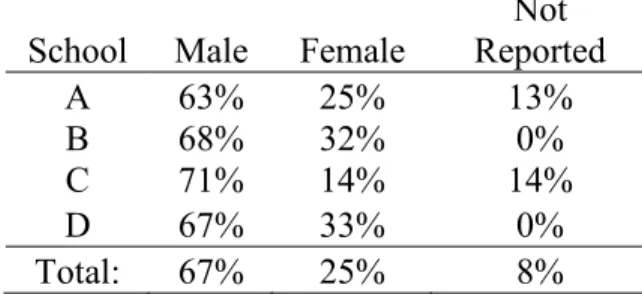
The gender distribution of responses from each institution is shown in Table 2.2. Compared to the representation of women among engineering faculty, this represents a higher response rate for women, which is not uncommon (Smith, 2008). Studies of survey response rates show that gender is the single greatest predictor of survey
completion (Sax, Gilmartain, & Bryant, 2003). This overrepresentation of women faculty is a limitation in the limited modeling included in the current study, but oversampling women faculty, though unintentional, is an asset to the collective case study.
Table 2.2: Gender distribution of response rates by participating institution School Male Female Reported Not
A 63% 25% 13%
B 68% 32% 0%
C 71% 14% 14%
D 67% 33% 0%
Total: 67% 25% 8%
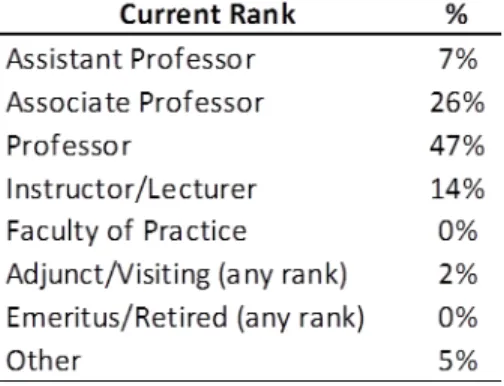
Responses spanned a range of faculty ranks, as shown in Table 2.3. The first question on the survey was if faculty have taught undergraduates in the past three years, and there were 97 responses to this question, where 5 faculty said they had not taught
undergraduates in the past three years. The faculty that reported teaching undergraduates in the past three years were asked to answer all the questions of the survey, faculty that had not taught in the past three years were taken to the end of the survey without being asked any other questions. Respondents averaged 16 years as a faculty member, 13 of which were at their present institution. Respondents were affiliated with various
disciplines, with the larger disciplines of Mechanical Engineering, Electrical Engineering, and Civil Engineering most represented. Disaggregation by discipline is not possible with the data collected.
Table 2.3: Distribution of responses by faculty rank.
Quality teaching as exceptionality. Harvey and Green’s definition of quality as exceptionality was the most common. Some of the typical expressions in definitions classified in this category referred to “knowledge transfer” and “knowing content
knowledge”. These represent a view of teaching in which students are vessels into which the professor’s knowledge is poured. The student is a passive participant in the classroom (Harvey &Green, 1993). Harvey and Green describe this approach: “It does not matter that teaching may be unexceptional—the knowledge is there, it can be assimilated.” (1993, p. 12). Faculty adopting this definition articulated the passive role of students in various ways—most delineating the measure of quality teaching from the instructor’s perspective rather than the student’s as “the effectiveness by which the material taught is
conveyed from instructor to student” (#39) and “the ability to convey information to non-experts” (#40). A more extreme expression of this instructor-centered paradigm overtly disregards the student experience as important: “class does not have to be ‘fun’ or even interesting…” (#36). Nearly half (43 percent) of faculty had a definition of quality teaching that fit this category.
Quality teaching as transformation. Faculty whose definition of quality teaching focuses on the transformation of students use much more developmental language, describing the changes students experience as enhancing and empowering them to transform (Harvey & Green, 1993). This was the second most prevalent definition of quality teaching, with 28 percent of faculty definitions fitting this category. Such faculty discourse also tended to be more focused on process than content, describing the
importance of “empowering students,” “developing students,” and “creating an environment for learning”, and referring to pedagogies of engagement such as “active learning.” One faculty described this process focus as, “effectively engaging students in the work of the course and empowering them to take responsibility for their learning and the learning of their peers.” (#71) This shift in responsibility for learning to students and their peers can also represent a loss of control for the faculty. Harvey and Burrows (1992, p. 3) write, “it embodies not just a loss of control over the structural organization or academic content of higher education; it is a loss of control over the intellectual
processes.” The tension involved in adopting a transformational definition was articulated by a faculty member who struggled “…to find a balance between two conflicting roles:
that of a coach, and that of a judge/gatekeeper… to identify and emphasize conceptual material that is non-intuitive.” (#33).
Wiggins argues that “we have a moral obligation to disturb students intellectually. It is too easy nowadays, I think, to come to college and leave one’s prejudices and deeper habits of mind and assumptions unexamined—and be left with the impression that assessment is merely another form of jumping through hoops or licensure in a technical trade” (1990, p. 20). Engineers need to know technical knowledge and be able to question deeper assumptions. Yet even among engineering faculty who adopted this definition, some expressed concerns that engineering has technical knowledge
requirements and that giving up control of student learning may leave students without all the tools they need to be a successful engineer. Other faculty were committed to student transformation without reservation, contrasting their views with the dominant
“exceptionality” approach: “A course should ideally develop in the student a new way of thinking or a new perspective/lens into the world. Just exposure to new information or even a new skillset is not indicative of a high quality course.” (#38).
Quality teaching as fitness for purpose. This definition was characterized by terms such as “ability to meet specific legitimate learning objectives” and “mastery of learning outcomes.” This category was nearly as prevalent as transformation, with 24 percent of faculty definitions coded as being in this category. Many faculty in this category used the term learning objectives and outcomes more generally, such as, “establish clear learning outcomes for the course and providing meaningful learning opportunities that foster
mastery of the outcomes” (#84) and “students attain learning outcomes en masse...” (#90). In those cases, it is unclear if those learning outcomes are chosen by individual faculty or the department, college, or university. Similarly, these general descriptions are unclear as to what those learning objectives are and whether certain outcomes are more important than others to the faculty member.
Although faculty did not generally name the specific learning objectives or outcomes tied to a course, some were more specific about the “purpose” of the learning outcomes. Some faculty identified the “purpose” as application to practice, such as “How well the students can retain knowledge in the future and how well students are able to apply what they’ve learned in the future” (#42) and “teaching the topics which are important to the students’ future success…” (#66). Faculty that define quality teaching in consideration of the student’s future attempt to frame quality from the perspective of the student. This aspect of “fitness of purpose” is called “quality in perception” (Harvey & Green, 1993, p.20; Sallis & Hingley, 1991).
The definitions of quality teaching that fit in the “fitness for purpose” category are vague and varied because there is uncertainty and variation in defining the “purpose” of higher education in general and engineering in particular. There are many stakeholders in engineering education with diverse perspectives.
Quality teaching as perfection and consistency. The definitions of quality teaching received in this study did not resonate with this “zero defects” category. One respondent
stressed “clarity and consistency in grading procedures” (#89), and was coded as having this definition. Srikanthan and Dalrymple (2003) focused on the stakeholders in higher education and expected that employees such as faculty and administrators would view quality in this category, but we do not find this to be the case in our sample.
Quality teaching as value for money. No respondents specifically addressed financial value, return on investment, specific performance indicators, or student/teacher charters on criteria for teaching—all characteristics that would be coded in this category based on Harvey and Green’s description. One respondent’s definition was classified in this category who cited ABET as an external authority. Turning to an entity outside the university to set standards of quality is also characteristic of this definition. This
respondent’s definition of quality teaching included “facilitating student learning of the specific technical and non-technical (includes ABET a-k) information and skills that apply to the course in question” (#13).
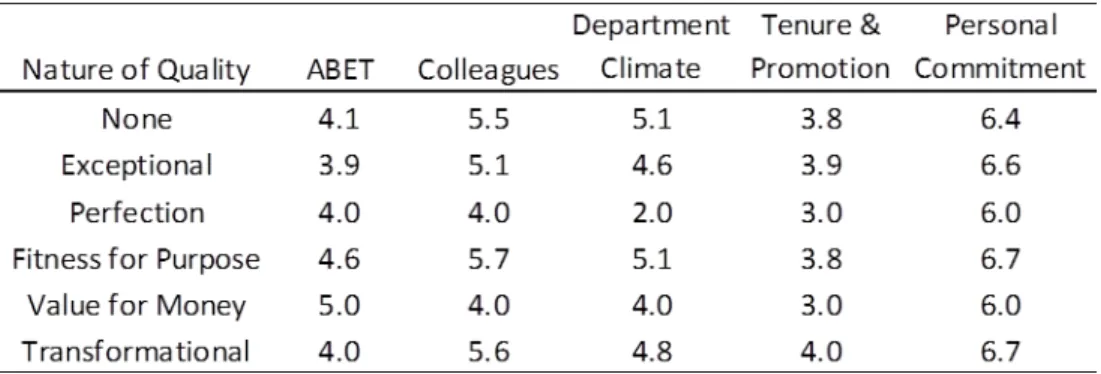
Influences on quality teaching. The relationship of the five influences to a respondent’s definition of quality was studied using logistic regression, with the definition of quality teaching as a categorical outcome variable and the five influences as independent
variables. Neither gender nor faculty rank was found to play a role in a faculty member’s definition of quality teaching or the nature or extent of influences on teaching quality, so those were removed from the model and are not discussed further.
Table 2.4: Means of each of the influences by quality.
Table 2.5: Means of each of the influences by gender.
Table 2.6: Means of each of the influences by university.
Only one influence was found to have a significant (p=0.05) relationship to a
respondent’s definition of quality. With an odds ratio of 1.745, an increase of one unit on the reported influence of ABET accreditation is associated with a respondent being 1.745 times more likely to define quality teaching as “fitness for purpose.” Because engineering accreditation provides a standard set of outcomes for engineering graduates (a common purpose), but provides flexibility in how those outcomes are achieved, this relationship can be explained. The greater challenge is explaining why no other relationships were observed between a respondent’s definition of quality teaching and the various influences. Whereas a faculty member’s definition of quality teaching was generally independent of their reported influence of the five factors studied, a pattern was observed among
respondent’s reported influences—there appeared to be a consistent ranking of the
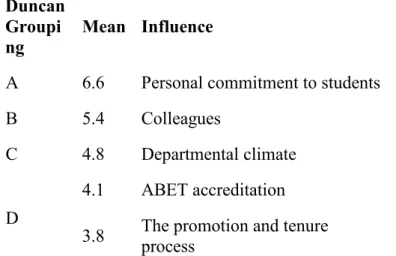
influences. To control for the effect of comparing multiple means, the Duncan-Waller test for multiple comparisons was used, and the results are shown in Table 2.8.
Table 2.8: Duncan-Waller test for multiple comparisons of influences on teaching quality
Duncan Groupi
ng Mean Influence
A 6.6 Personal commitment to students
B 5.4 Colleagues
C 4.8 Departmental climate D
4.1 ABET accreditation 3.8 The promotion and tenure process
Note: means with the same letter are not significantly different (p=0.05), N=90 or 91.
Personal commitment to students has significantly more reported influence than
colleagues, who have significantly more reported influence than the departmental climate, which in turn has significantly more reported influence than ABET accreditation and the promotion and tenure process. The promotion and tenure process is a ritual that
formalizes some aspects of the department climate, but respondents draw a distinction between the two. In other words, colleagues and the department can communicate values and practices related to quality teaching that are not embodied in the promotion and tenure process—policies are slower to change than people.
It is discouraging to note that the average influence of the promotion and tenure process is negative—the promotion and tenure process—its focus on research grants and
publications at these universities based on the open-ended responses of faculty—has a negative effect on faculty’s teaching quality. Another survey, from COACHE, had
specific data for Purdue University that showed faculty are unsatisfied with the lack of clarity in the tenure process (McClure, 2012).
The ranking of the five influences studied was robust—the ranking was the same regardless of gender, faculty rank, and university. This has implications for faculty development practices. The strong influence of colleagues may at first appear to be a barrier to change—because even if a department has expectations regarding quality teaching (such as by requiring faculty to attend teaching workshops), a junior faculty member may reduce her or his commitment to quality teaching based on conversations with colleagues. Yet this influence represents an opportunity as well—this underscores the potential for positive influence through mentoring by colleagues—particularly where a teaching mentor is identified independently from a research mentor. Furthermore, the influence of colleagues suggests strategies for faculty development professionals; pairing senior and junior colleagues as they engage in faculty development related to teaching may be effective.
One university had a notably higher rating for the influence of the promotion and tenure process, so there is hope that a university’s policies on promotion and tenure can have a positive effect on faculty’s teaching quality. Respondents at that university also indicated a higher influence from colleagues (p=0.05, odds ratio = 0.37), so all other things being equal, respondents at that university rate the influence of colleagues 0.37 higher on average than at other universities in the sample.
Based on the consistency of the rank-order of the five influences, it is not surprising that responses for some of the influences are significantly correlated. Specifically, there is a relationship between the influence of colleagues and department climate (r=0.67, p<0.0001), department climate and the promotion and tenure process (r=0.33, p<0.01), and colleagues and personal commitment to students (r=0.28, p<0.05). These correlations neither provide additional insight nor diminish the meaningfulness of the earlier results.
Faculty’s reported influencers are related to their teaching practices. As a measure of how the influencers are related to faculty approaches to undergraduate teaching, faculty were asked to describe the influence of the ABET accreditation process, their colleagues, the department climate, the promotion and tenure process, and their personal commitment to students on their teaching quality.
Responses to “ABET accreditation process” as an influence in teaching quality are unrelated to gender, total years as a professor, and institution. Using “Extremely
negatively” (1) as the referent, faculty who responded more positively were less likely to “give students the option of working in teams (2 or more) to complete homework” [b = -0.41, χ2 (1, N = 89) = 6.24, p < 0.05 (odds ratio = 0.665)]. This is an interesting finding, since ABET accreditation wants students to be able to work in teams as an outcome. This research has shown that faculty with a nature of quality of fitness for purpose are more likely to see the benefit of ABET accreditation standards, perhaps these faculty are focused on fitness for purpose, and do not see the purpose in giving students the option of working in teams.
Responses to “Colleagues” as an influence in teaching quality are unrelated to gender, total years as a professor, and institution. Using “Somewhat negative” (2) as the referent group because none of the participants marked colleagues as a one, faculty who
responded more positively were more likely to “REQUIRE students to work in teams (2 or more) to complete homework” [b = 0.36, χ2 (1, N = 89) = 4.26, p < 0.05 (odds ratio = 1.429)].
“Department climate” responses as an influence in teaching quality are unrelated to gender, total years as a professor, and institution. Using “Extremely negatively” (1) as the referent group , faculty who responded more positively were more likely to “REQUIRE students to work in teams (2 or more) to complete homework” [b = 0.40, χ2 (1, N = 88) = 5.42, p < 0.05 (odds ratio = 1.488)].
The influencers of “promotion and tenure process” and “personal commitment to students” did not have any teaching methods that were statistically significant.
2.5 Conclusions
Engineering faculty do not have a common view of quality teaching. In this study, only three of five definitions of quality identified by Harvey and Green (1993) are prevalent. It is important for faculty developers and department chairs to recognize that faculty have different views of the nature of quality teaching because this will affect the goals they are trying to achieve and the extent to which various approaches to faculty development will resonate with those goals. It may help department chairs to know that certain faculty have
a definition of quality teaching that resonates with accreditation, because those faculty may be useful both in explaining the accreditation process to colleagues and in sharing the accomplishments of other colleagues with accrediting bodies. This is especially important in that faculty who view quality as exceptionality are likely to view accreditation processes as a waste of time and money. Department chairs and upper administration may also be interested in faculty that view the nature of quality as
transformational because those faculty are more likely to see the benefit student-centered teaching techniques, which help institutions with recruitment and retention (Astin, 1993; Cabrera, Nora, Bernal, Terenzini, & Pascarella, 1998; Cooper, 1990, Gamson, 1994; Goodsell, 1992; Johnson, Johnson, & Smith, 1991; Kulik, Kulik, & Cohen, 1979; Levine & Levine, 1991; McKeachie, 1986; McKeachie, 1990; Murray, 1998; Pascarella & Terenzini, 1991; Prince, 2004). These faculty with a transformational definition of quality teaching may be best suited to “master teacher” roles to help other faculty see the value of this definition.
Faculty developers could use this research to help faculty identify with one of the perceptions of the nature of quality, which may help faculty understand the different perceptions and come to understand diverse perspectives of quality and better understand their colleagues. The two perceptions of the nature of quality that were not represented in this research was another finding, perfection and consistency and value for money. The researchers thought that some engineering faculty would see teaching engineering principles as perfection and consistency because of the exact nature of engineering work (seeing things as right and wrong) or value for money because the cost of education is a
topic of national discussion. Some recommendations for faculty developers is to use this information to address the specific needs of faculty with exceptionality value of quality teaching by explaining the research on how students learn and the best teaching practices from that research. Faculty with the transformative value of quality teaching could use more focused training on specific teaching methods. The fitness for purpose faculty could use a combination of an explanation of the research, which would show the purpose of specific teaching methods, and then a how-to workshop on student-centered teaching methods.
Future research should look at the link of faculty teaching practices and faculty’s
perception of the nature of quality. Departmental climate may also influence or be related to faculty’s perception of the nature of quality, which was outside the scope of this work. The data used for this research was a small sample because of the low rate of
participation from four universities. The two natures of quality definitions that were not popular in this sample (Perfection and Consistency and Value for Money). These
perspectives might be represented in a larger sample, either from adding more institutions or getting more faculty to participate.
CHAPTER 3. THE INFLUENCE OF ABET ACCREDITATION PRACTICES ON FACULTY APPROACHES TO TEACHING
3.1 Introduction
Engineering programs in the United States are accredited by the Engineering
Accreditation Commission of ABET (ABET, 2013a). ABET also accredits engineering programs in other countries upon request (ABET, 2013b). ABET’s Criteria for
Accrediting Engineering Programs (ABET, 2013c) were revised in the 1990s because engineering educators perceived the criteria standards limited innovation in engineering degree programs (Daniels, Wood, & Kemnitzer, 2011). This research project explores the effect ABET has on faculty teaching practices. Faculty were surveyed about their views on ABET’s focus on student outcomes and about their approach to teaching, and
relationships between the two have been identified.
The “Engage to Excel” report (Olson & Riordan, 2012) claims that the United States needs one million more college graduates in science, technology, engineering, and mathematics. One way to get more college graduates in STEM is to teach differently, because it has been shown that STEM (traditional) teaching is one of the major reasons that students leave these degree programs (Seymour, 2002). Quality teaching is even more important because it can keep the students that enrolled in STEM degrees and could attract more diverse students into these degrees.