Open Research Online
The Open University’s repository of research publications
and other research outputs
Patterns of Learning in the Accountancy Profession:
the Roles of Continuing Professional Development and
Lifelong Learning
Thesis
How to cite:Lindsay, Hilary Frances (2013). Patterns of Learning in the Accountancy Profession: the Roles of Continuing Professional Development and Lifelong Learning. EdD thesis The Open University.
For guidance on citations see FAQs.
c
2013 The Author Version: Version of Record
Copyright and Moral Rights for the articles on this site are retained by the individual authors and/or other copyright owners. For more information on Open Research Online’s data policy on reuse of materials please consult the policies page.
Patterns of Learning in the Accountancy
Profession: the Roles of Continuing
Professional Development and
Lifelong Learning
Hilary Frances Lindsay
MEd, MScIFM, MBA, BSc (Hons)
Thesis submitted for the award of Doctor of Education (EdD)
Centre for Research in Education and Educational Technology
(CREET)
The Open University
June, 2013
ABSTRACT
This thesis explores the roles of CPD and lifelong learning for accountants today. Accountants are experiencing more career transitions and learning is an increasingly vital element in the ever changing environment. The research findings will be used to help accountants learn more effectively throughout their careers.
Since 2005, member bodies of the International Federation of Accountants (IFAC) have been required to implement mandatory continuing professional development (CPD) schemes and to ‘foster a commitment to lifelong learning’ (IFAC, 2004a, p.1). In this new context this research with members of the Institute of Chartered Accountants in England and Wales (ICAEW) explores the roles of CPD and lifelong learning, so contributing to both the CPD and lifelong learning research agendas.
The research looks at how accountants perceive and describe their learning activities and experiences using a mixed methods approach involving an initial large-scale survey, exploring learning in one context, followed by in-depth interviews which look at learning across a career.
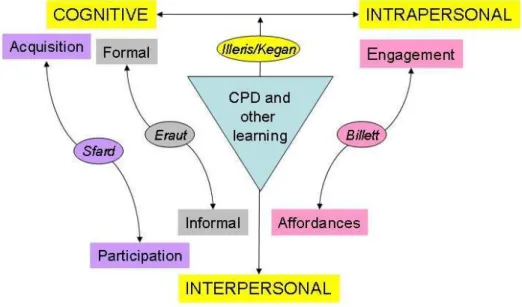
Two conceptual frameworks, developed during the literature review, underpin the research. These are based on a model developed by Illeris (2009) and incorporate the cognitive, interpersonal and intrapersonal
dimensions of learning. Other key concepts referred to throughout the research include identity, agency, engagement, affordance and the metaphors of learning as acquisition, learning as participation and learning as becoming.
The patterns of learning varied according to the roles, sectors, career stages and gender of accountants. The need for career adaptability (Bimrose et al., 2011) emerged from the research and was added to professional competence to produce a new learning model, the professional learning iceberg. It is proposed that ‘learning relating to professional competence’ and ‘learning relating to career adaptability’ are more meaningful concepts than ‘CPD’ and ‘lifelong learning’ to describe the learning needed to succeed in the accountancy profession in the twenty-first century.
CONTENTS
Acknowledgements ... 7
Figures ... 9
Tables ... 11
Abbreviations ... 13
CHAPTER ONE - WHY FOCUS ON CONTINUING PROFESSIONAL DEVELOPMENT AND LIFELONG LEARNING? ... 15
Introduction and structure of the thesis ... 15
Learning in the accountancy profession ... 17
Lifelong learning and CPD in practice ... 24
How does this research add value? ... 29
My stance as a researcher ... 31
CHAPTER TWO - SHAPING THE RESEARCH ... 33
The two dimensions to the research ... 33
The detailed research questions ... 38
CHAPTER THREE - A REVIEW OF THE LITERATURE ... 45
CPD and lifelong learning ... 46
The evolution of continuing professional development ... 46
The wider aspects of lifelong learning ... 55
Capturing a snapshot of learning activities ... 59
Learning in the workplace ... 59
A conceptual framework to capture a snapshot of learning activities 65 Learning across a career ... 68
Evolving theories of learning ... 70
A conceptual framework for learning across a career ... 72
CHAPTER FOUR - THE LARGE-SCALE SURVEY ... 91
Designing the survey ... 91
Selecting the sample ... 91
Constructing the questionnaire ... 95
Ethical considerations ... 99
Analysis of the data ... 100
Data management ... 100
Undertaking the analysis ... 101
Findings from the survey ... 107
How relevant are each of the learning activities? ... 107
How likely are accountants to describe learning activities as CPD? .. 110
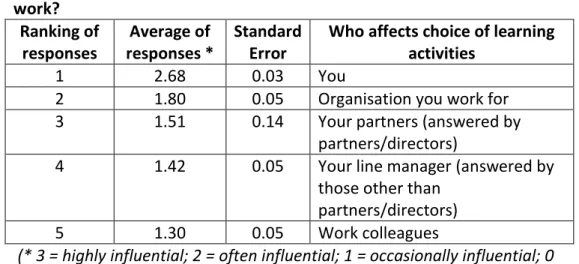
Who influences the choice of learning activities? ... 111
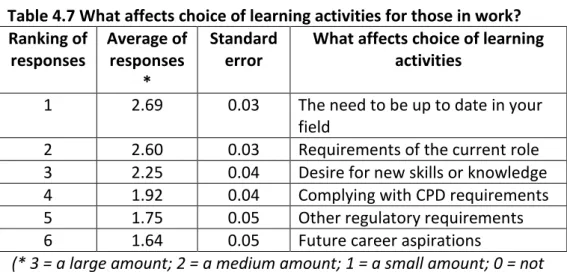
What affects the choice of learning activities? ... 112
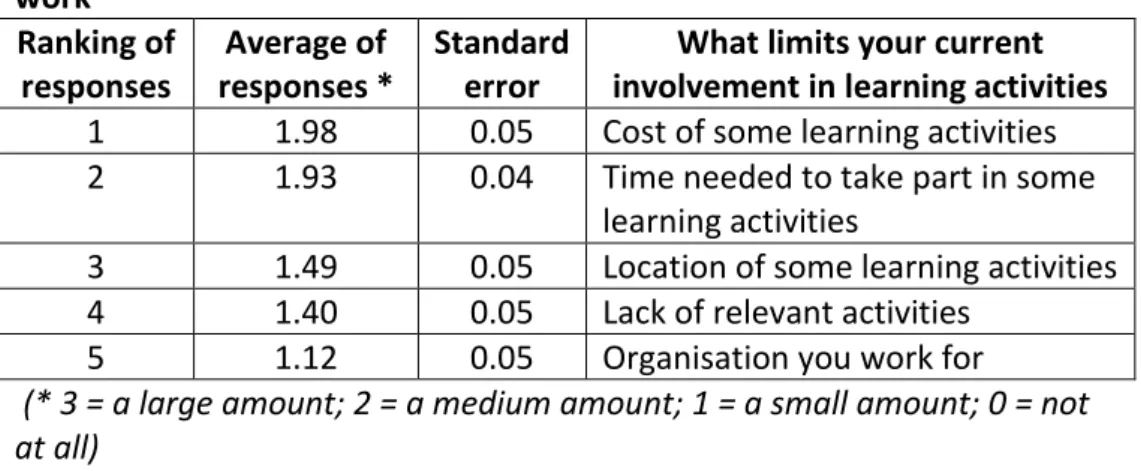
What limits involvement in learning activities? ... 114
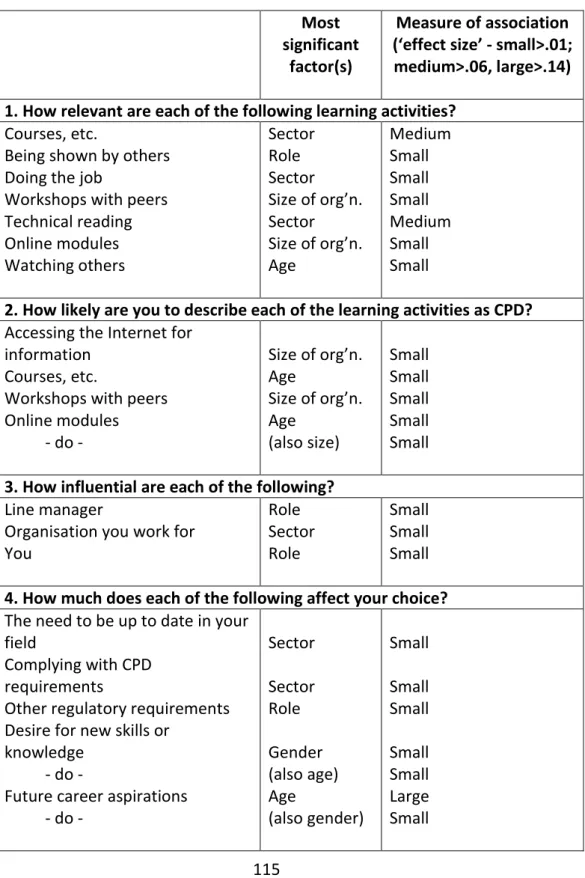
Differences in patterns of learning ... 114
Moving on to the in-depth interviews ... 120
CHAPTER FIVE - THE IN-DEPTH INTERVIEWS ... 129
Undertaking the in-depth interviews ... 129
Thematising ... 130 Designing ... 130 Interviewing... 134 Transcribing ... 136 Interpreting ... 137 Verifying ... 141
Findings from the in-depth interviews ... 142
Learning associated with career transitions ... 142
Learning relating to the concept of agency ... 151
Learning linked to the concept of identity ... 156
CHAPTER SIX - THE OVERALL FINDINGS FROM THE RESEARCH ... 165
Relating the findings to the research questions ... 165
Research question 1 (a snapshot of learning activities) ... 166
Research question 2 (learning across a career) ... 169
Research question 3 (patterns of learning) ... 176
Revisiting the roles of CPD and lifelong learning ... 188
Developing a new model for professional learning ... 192
CHPTER SEVEN - CONCLUDING THE RESEARCH AND LOOKING AHEAD .... 201
Conclusions ... 201
Recommendations ... 204
Recommendations for ICAEW members ... 205
Recommendations for ICAEW ... 205
Further research opportunities ... 207
Limitations identified within the research ... 209
Main achievements of the research ... 211
REFERENCES ... 213
APPENDICES ... 225
Appendix 1 - Requirements of the International Federation of Accountants (IFAC) ... 225
Appendix 2 - ICAEW CPD Process ... 227
Appendix 3 - ICAEW statistics in the POB report ... 229
Appendix 4 – Questionnaire ... 231
Appendix 5 - Sources of questions in questionnaire ... 235
Appendix 6 - Covering letter ... 239
Appendix 7 – Crosstab summary of respondents ... 241
Appendix 8 – Background to one-way and two-way analyses of variance (ANOVAs) ... 247
Appendix 9 – Analysis of questions 1-5 for those in work ... 251
Appendix 10– Analysis of questions 1-5 for those not in work ... 257
Appendix 11 – Survey results relating to gender ... 259
Appendix 12 – Summary by age and gender of current areas of work ... 261
Appendix 13 – In-depth interview framework ... 263
Appendix 14 – Mailing to potential interviewees ... 267
Appendix 15 – Codes used and number of contributions ... 271
Appendix 16 – Extract from a coded transcript ... 273
Appendix 17 – Career transitions made by interviewees ... 281
Acknowledgements
Academic research is a roller coaster and this thesis has been no exception. I am very grateful to my respondents and interviewees and to everyone else who has supported me in what, for me, has been an exhilarating ride. My special thanks go to
my husband Colin, himself an OU graduate and enthusiast, for his endless encouragement, listening and proof-reading;
my supervisor, Dr. Dorothy Harris, present throughout the whole journey, and my co-supervisor Professor John Richardson who was involved later in the process. Both have been the critical friends I needed;
the members of the British Accounting and Finance Association (BAFA) Education Special Interest Group who encouraged me to produce my first academic publication;
colleagues from The Open University Business School who have welcomed me into the Centre for Accounting and Finance Research Support Forum;
and last, but by no means least, the colleagues at ICAEW and CABA who are now working with me to make my findings of practical
Figures
Figure 2.1 A complementary combination of approaches 37 Figure 3.1 The three dimensions of learning and competence 66
development
Figure 3.2 Conceptual framework to capture a snapshot of 68 learning activities
Figure 3.3 Components of a social theory of learning: an initial 76 inventory
Figure 3.4 Conceptual framework relating to learning across 78 a career
Figure 5.1 Conceptual framework relating to learning across 130 a career (repeat of figure 3.4)
Figure 6.1 A new conceptualisation of an accountant’s learning 196 Figure 6.2 The professional learning iceberg 197 Figure 7.1 Possible elements of career adaptability 207
Tables
Table 4.1 Sample size and distribution 92 Table 4.2 Analysis of respondents who indicated their sector 95 Table 4.3 Responses from sub-groups explored in the analysis 102 Table 4.4 Relevance of learning activities for those in work 108 Table 4.5 Likelihood of describing learning activities as CPD for 110
those in work
Table 4.6 Who influences the choice of learning activities for 111 those in work?
Table 4.7 What affects choice of learning activities for those 112 in work?
Table 4.8 Factors limiting involvement in learning activities for 114 those in work
Table 4.9 Most significant demographic factors for each question 115 Table 5.1 Details of the thirteen interviewees 133 Table 5.2 Career outlines of the thirteen interviewees 138
Abbreviations
ANOVA Analysis of Variance
CABA Chartered Accountants’ Benevolent Association CPD Continuing Professional Development
CPE Continuing Professional Education EU European Union
IAESB International Accounting Education Standards Board ICAEW Institute of Chartered Accountants in England and Wales IES International Education Standard
IFAC International Federation of Accountants ILM Institute of Leadership and Management LAWS Learning at Work Survey
MBA Master of Business Administration MM Mixed Methods
PARN Professional Associations Research Network POB Professional Oversight Board
CHAPTER 1
WHY FOCUS ON CONTINUING PROFESSIONAL
DEVELOPMENT AND LIFELONG LEARNING?
Introduction and structure of the thesis
The shape of careers in the accountancy profession continues to change. Serial careers, career breaks and portfolio careers are now commonplace. Many accountants will also want to, or need to, work past the traditional retirement age. The economic situation continues to affect how, when and where individuals can pursue their professional careers with work-life balance remaining a perennial issue.
I have been a member of the Institute of Chartered Accountants in England and Wales for over thirty years. During that time I have pursued a very varied and successful career across several sectors. My own experiences already reflect the future career pattern outlined above. Learning and development have been pivotal to my success. I was therefore very interested when the International Federation of Accountants (IFAC, 2004a, p.1) gave CPD and lifelong learning prominence by introducing a requirement that all accountancy bodies ‘foster a commitment to lifelong learning among professional accountants’ and put in place mandatory CPD schemes, with the onus being on individual accountants to comply. This thesis explores how, in today’s climate and with the existence of a mandatory CPD scheme, learning can be of most benefit to accountants
the accountancy profession and the roles of continuing professional development (CPD) and lifelong learning, in particular looking at how the learning experiences of accountants can be used to benefit each other.
Against the background of the new IFAC standard, the aim of the research is to use the literature on CPD, lifelong learning and work-related learning to frame research into the learning activities and experiences of accountants which will lead to a new understanding of what learning means, in practice, for accountants today. The findings will be used to facilitate discussions with accountants and their professional bodies and, from that, to develop initiatives to help accountants learn more effectively throughout their careers. This research into a real-life issue has the potential to make a significant contribution to professional knowledge and practice within the accountancy profession, thus meeting the aims of a professional doctorate.
The initial chapter provides the background to the research by looking first at the introduction of the mandatory CPD scheme and then at how CPD and lifelong learning manifest themselves in practice. The potential for this research to add value and the stance of the researcher are then considered. Chapter 2 sets out some more detailed research questions and describes how the shape of the research developed to encompass a large-scale survey, providing a snapshot of current learning activities, followed by in-depth interviews to explore learning across a career. Chapter 3 reviews the literature, first by looking in more detail at CPD and lifelong
learning and then considering in turn a snapshot of current learning activities and learning across a career. Two conceptual frameworks are developed from the literature and later used to frame the survey and inform the interviews. All aspects of the survey are covered in Chapter 4 and the in-depth interviews are considered in Chapter 5. In Chapter 6 the findings are related to the more detailed research questions. This results in the development of a new conceptual framework designed to pull together all aspects of a professional accountant’s learning. Finally Chapter 7 addresses the conclusions, recommendations, further research opportunities, limitations and main achievements of the research.
Learning in the accountancy profession
In 2004 the learning landscape for accountants changed when IFAC, the worldwide body representing all the professional bodies, issued International Educational Standard 7 (IES 7) (IFAC, 2004a, p.1), entitled
‘Continuing Professional Development: A Program of Lifelong Learning and Continuing Development of Professional Competence’. This required IFAC’s 155 member bodies to ‘foster a commitment to lifelong learning among professional accountants’ and to put in place mandatory CPD schemes for all accountants, with the onus on individual accountants to comply (Appendix 1). CPD and lifelong learning both feature in the title of IES 7. This thesis considers the respective roles of CPD and lifelong learning by exploring how patterns of learning vary amongst members of the
with around 110,000 based in the UK. Its members work across all sectors and in many varied roles in public practice (working as partners or employees for firms of chartered accountants), in business and in the public and not-for-profit sectors.
IES 7 (IFAC, 2004a, p.1) requires member bodies to help their individual members to develop and maintain ‘the professional competence necessary to protect the public interest’. IFAC (2004b) provides definitions for the key terms used in the standard and relevant ones are repeated here. ‘Learning’ is defined as ‘a broad range of processes whereby an individual acquires capabilities’ (ibid p.19) where ‘capabilities’ are defined as ‘the professional knowledge; professional skills; and professional values, ethics and attitudes required to demonstrate competence’ (ibid, p.15). ‘Competence’ is defined as ‘being able to perform a work role to a defined standard, with reference to real working environments’ (ibid, p.16) and finally ‘CPD’ is defined as ‘learning activities for developing and maintaining the capabilities of professional accountants to perform competently within their professional environments’ (ibid, p.16). The emphasis is very much on current competence, with little reference to any lifelong dimension. No formal definition of lifelong learning is provided but below the heading ‘Promotion of Lifelong Learning’ the standard states, ‘Member bodies should promote the importance of continuous improvement of competence and a commitment to lifelong learning for all professional accountants’ (2004a, p.3). The IFAC definitions of learning and CPD and its description of lifelong learning form the initial definitions used in this thesis. However the three
terms have many different interpretations and nuances and all are considered in greater detail in this and later chapters to inform the direction and, ultimately, the findings of this research.
Although the IFAC standard apparently introduces something new there has always been an expectation that members of professions would keep their skills up to date (Houle, 1980; Young, 1998; Friedman et al., 2001). The accountancy profession has been no exception, although members have not often been formally required to demonstrate this. In the UK the landscape changed in the 1980s when some areas of accountancy-related work became regulated by bodies outside the accountancy profession. From that time, accountants working in audit, financial services and insolvency had to demonstrate their compliance with stated CPD requirements. The members of ICAEW working in those areas were required to attain a certain number of CPD points each year. Attendance at formal events contributed one point for each hour of activity, with involvement in less structured activities such as technical reading contributing one point for three hours’ activity and limited to no more than one-third of the total points.
Under IES 7, the new IFAC standard, accountancy bodies could choose to introduce a mandatory CPD scheme that was either input-based, output-based or some combination of the two. ICAEW was one of the first bodies to introduce a mandatory output-based CPD scheme for all its members
its core a reflect-act-impact cycle (Appendix 2) and replaced the previous hours-based input scheme described above. Under the new output-based scheme members were asked individually to reflect on their learning needs, act in response to those needs, assess the impact of their learning and then pursue learning activities to meet the needs each had identified. First on the list of suggested learning activities was ‘learning at work’. The output-based CPD scheme provided a real opportunity for informal learning, a subject considered further in Chapter 3, to increase its profile. Across all professions Continuing Professional Education (CPE) had been metamorphosing into CPD which had been recognised as now ‘embracing and recognising informal learning that can be achieved in practice’ (Friedman and Phillips, 2004, p.371). The ICAEW output-based scheme provides a valuable opportunity to explore informal learning in practice.
In introducing its CPD scheme, ICAEW had defined CPD as ‘having the knowledge and expertise to fulfil your role and responsibilities’ (ICAEW, 2005) but made no reference in its documentation to ‘lifelong learning’. IFAC had also neglected ‘lifelong learning’ within its standard, despite it featuring in the title of IES 7. There was no formal definition and little further mention of it compared to the multiple references to CPD. IFAC appears to have given the phrase the nominal prominence then common in policy documents (Field, 2002). The very low profile accorded to lifelong learning by both IFAC and by ICAEW was the driver behind my desire to explore the respective roles of CPD and lifelong learning.
The omission of lifelong learning in the ICAEW guidance conflicted with the opportunity this innovative output-based scheme provided for informal learning to have a higher profile. I had already explored informal learning’s possible new role in an unpublished Masters Degree dissertation (Lindsay, 2007). In this earlier research with ICAEW members I had found that:
‘CPD’ was felt primarily to refer to courses done by members in practice;
In the CPD context informal learning was utilised, under-valued and under-recorded;
Employers and any appraisal process were very influential in determining what CPD was undertaken.
The limitations suggested by the first two findings echo existing research into CPD in the professions, an area considered in more detail in Chapter 3. CPD has been referred to as an ‘ambiguous and contested concept’ (Friedman & Phillips, 2004, p.370) and Madden and Mitchell (1993) had previously demonstrated this ambiguity by identifying two CPD models, a sanctions model and a benefits model, providing conflicting reasons why CPD might be undertaken. Was CPD there to protect the interests of stakeholders such as regulatory bodies, accountancy bodies and, ultimately, the public? Or was it there to help accountants develop throughout their professional careers? IFAC’s concern with ‘developing and maintaining the professional competence necessary to protect the public interest’ (2004a, p.1) suggest it has introduced an inherently
development afforded by a possible output-based approach correspond more with a benefits model.
Meanwhile the far more extensive literature on lifelong learning also demonstrated a diversity of views. Whilst some refer to a straightforward description of learning ‘which occurs over the span of one’s life’ (Pillay et al., 2006, p.18) others acknowledge that lifelong learning is a ‘complex and ambiguous term’ (Sutherland and Crowther, 2006, p.xv). The relationship between lifelong learning and CPD has emerged during this research as a further example of complexity.
IFAC (2004a, p.1) initially required professional bodies of accountants to ‘foster a commitment to lifelong learning’. As mentioned above, under the heading ‘Promotion of Lifelong Learning’ the initial version of IES 7 stated:
Member bodies should promote the importance of continuous improvement of competence and a commitment to lifelong learning for all professional accountants.
(IFAC, 2004a, p.3)
In 2011 a proposed redraft of IES 7 instead stated under the heading ‘Promotion of Lifelong Learning’:
IFAC Member bodies shall promote the importance of, and a commitment to, continuing development and maintenance of professional competence.
The proposed redraft appeared to be restricting lifelong learning to the issue of professional competence.
However the story did not end there. Following consultation the final version of the redrafted IES7 standard (IFAC, 2012, p.4), which is to be implemented by 2014, has changed the emphasis yet again. Although the requirement to ‘foster a commitment to lifelong learning’ remains, the revised standard is simply called ‘Continuing Professional Development’ with the reference to lifelong learning removed from the title. The heading for the quotation included above is now ‘Promotion of CPD’ (IFAC, 2012, p.5) rather than ‘Promotion of Lifelong Learning’. However for the first time lifelong learning is clearly defined. In explaining the scope of the standard the redrafted IES7 states:
Lifelong learning represents all learning and development activity, formal or informal, undertaken with the aim of enhancing knowledge, skills, values, ethics and attitudes from personal, civic, social and employment-related perspectives.
(IFAC, 2012, p.7)
This definition appears to be based on that adopted by the European Union (EU) which states that lifelong learning
includes learning for personal, civic, social and employment-related purposes and can take place inside or outside the formal education and training systems.
It will be of great interest to see how professional bodies, ICAEW included, react to the introduction of such a broad definition, particularly when they are required to ‘foster a commitment’ to lifelong learning.
In their research across many professional associations, Friedman & Phillips (2004, p.362) comment that some associations define CPD as ‘lifelong learning for professionals’. However this begs the question of the extent to which CPD and lifelong learning can be the same thing. In the accountancy context should lifelong learning relate solely to professional competence, as IFAC had proposed in 2011? Or is the much wider description they have now introduced more appropriate? For whose benefit is CPD and how does this compare with lifelong learning? Questions such as these added to my initial desire to explore the roles of CPD and lifelong learning in the accountancy profession.
Lifelong learning and CPD in practice
There remained the question of what might be the nature of lifelong learning in the accountancy profession and in particular what learning might there be that is above and beyond that required for professional competence. My own learning experiences and my early doctoral research are considered below and provide some initial responses to this question.
Accountants are now making career choices which are more and more likely to involve serial careers, career breaks and portfolio careers. These
p.398). Unusually for someone of my generation my career has reflected much of this diversity. I have experienced seven distinct careers as a chartered accountant. I have been a tax specialist, a partner in a firm of chartered accountants, a management consultant, a finance director and a director at a professional accountancy body and, at present, have a portfolio career which includes working as an academic and acting as a trustee in the voluntary sector. In each role I have developed my professional skills to take advantage of the opportunity afforded to me.
The apparent anomaly between CPD and lifelong learning referred to above led me to consider my own learning. Over the years how and what I have learnt has depended on the various roles I have undertaken. For example, when I was a director with ICAEW in the 1990s, there was a formal review process where my training needs were identified and the employer then sourced appropriate courses which I attended. However, in parallel, I chose to pursue the Master of Business Administration (MBA) qualification to give my career fresh impetus. As a novice Open University lecturer I later sought opportunities to increase my skills and gradually took on mentoring, monitoring and moderating roles to develop my own expertise. I was concerned that I lacked qualifications and therefore demonstrable credibility in the higher education arena and pursued a fast track route to membership of the Institute for Learning and Teaching in Higher Education, ultimately becoming a fellow of the Higher Education Academy. More recently, as a new board member for a housing
association, I attended national conferences where I was able to absorb the culture and understand the current issues facing the sector.
However my learning has involved far more than participating in discrete activities, such as the ones mentioned above. Over the years I have learnt to play to my strengths, to understand where my skills can make the most difference, to communicate effectively in a range of contexts and to manage the demands on my time. My own lifelong learning story has evolved as a response to my ever-changing environment. I have learnt in many ways, in a continuous response to the context in which I have been working, and my learning has also helped shape career opportunities. It was this process of learning throughout a multifaceted career that I wished to research; to look at how accountants ‘engage and re-engage continually’ in learning (Sutherland and Crowther, 2006, p.3). This area of ongoing personal and career development was absent in the CPD discourse originally described by IFAC where the focus was on being competent to perform a role with little reference to lifelong learning, although the personal aspect of lifelong learning does now feature fleetingly in the description of lifelong learning in the redrafted standard (IFAC, 2012).
From 2005 all non-retired ICAEW members have had to comply with the new output-based CPD scheme. When asked to complete my annual CPD declaration I have been required to review my reflect-act-impact learning cycle. To do this I note down the formal learning events I have attended in the previous year and look ahead to any further skills or knowledge I need
to acquire. I now realise that in doing this I am epitomising the ‘current zeitgeist of ubiquitous audit’ where workplace learning is seen as the ‘controlled acquisition of predetermined skills’ (Hodkinson et al., 2004, p.22). However this CPD process in no way reflects all my learning and, as already illustrated, there is undoubtedly a disconnect between the annual CPD requirement and the totality of my learning. I realised there would be some similarities, but many differences, among the lifelong learning stories and CPD experiences of other ICAEW members. I have always been a passionate believer in personal development. Reflecting on my own learning led me to wonder whether what and how I had learnt could in some way be of benefit to other accountants and, more generally, whether accountants could learn from each other.
An initial study undertaken at the end of the first year of my doctoral studies provided valuable feedback from the three ICAEW members I interviewed about their CPD and other learning experiences. The first member saw CPD as a necessary demonstration of technical competence following his comparatively recent return to work in an accountancy practice. For the second member CPD was a regulatory requirement overseen by his employer because he worked in a regulated area. Meanwhile the third member was confident she could produce adequate CPD records if called upon to do so but found no value in the CPD process in her current non-financial role. Overall the respondents viewed ‘CPD’ as a necessity if they were in a role where they had to demonstrate
developments. However the majority of their learning activities concerned learning from experience, often by taking on new challenges. Several common themes emerged from this initial study. The learning stories all encompassed personal values, preferences, work-life balance and career prospects. The interviews not only highlighted the importance of the informal as well as the formal aspects of CPD but also provided examples of the more elusive concept of lifelong learning. It also suggested there could be patterns to how accountants learnt in various contexts; patterns from which others could learn and benefit.
ICAEW is the largest chartered accountancy body in the UK and its membership is the most diverse. Its members work in public practice (in firms of chartered accountants), in industry and commerce and in the public and not-for-profit sectors. They work in both regulated and non-regulated areas of work. Members are at differing levels of seniority with some being employers while others are employees. Some are working full-time and others part-full-time. Some, like me, have portfolio careers where they are pursuing more than one employment or self-employment opportunity, each usually on a part-time basis. In all these contexts both CPD, relating to professional competence, and the wider aspects of lifelong learning have a valuable contribution to make to an accountant’s learning.
My own experiences and the initial study I conducted helped clarify the overarching focus I wished to explore in the research, namely ‘Patterns of learning in the accountancy profession: the roles of continuing professional
development and lifelong learning’. I needed to encompass both CPD and lifelong learning and ICAEW, as an early adopter of output-based CPD and with such a diverse membership, provided an excellent setting for my research.
How does this research add value?
CPD in the accountancy profession has been an under-researched area (Friedman and Phillips, 2004; Paisey et al., 2007; Wessels, 2007). What research there had been had focused on input-based CPD schemes and had usually been undertaken to inform the CPD policies of professional accountancy bodies (Paisey et al., 2007; Wessels, 2007; IFAC, 2008; De Lange et al., 2010). IFAC (2008, p.96) identified a lack of interest in research into CPD among accounting academics and highlighted the trend for ‘bottom up’ research commissioned by professional bodies. By contrast my research is set in the context of one of the comparatively few output-based CPD schemes. Unusually, my research is from the perspective of individual accountants, with no input from either professional bodies or employers. In addition I found no previous research that had looked at both CPD and lifelong learning in the accountancy profession. My research would therefore not only contribute to both the CPD and the lifelong learning research agendas but would also include a new combined perspective. The research is even more timely following the recent change in how IFAC (2012) describes lifelong learning.
Four recent developments serve to emphasise the changing environment in the UK and how important it is to understand better how learning can benefit accountants throughout what are increasingly likely to be spliced careers. The first is the ongoing impact of the economic recession that started in October 2008 which has affected how, when and where people may be able to pursue their careers. The next two developments relate to retirement. The government announced plans to increase the state pension age to 66 for both men and women by 2020 (HM Government, 2009). Alongside this the default retirement age was removed so employers could no longer issue retirement notices to their employees (HM Government, 2011). These changes mean careers will be expected to last longer, and for financial reasons may have to do so.
The final development relates to gender, and emerged while this research was in progress. In February 2011 Lord Davies of Abersoch published his independent report ‘Women on Boards’ (Davies, 2011) in which he lamented the fact that only 12.5% of FTSE 100 company board members were women. He referred to the leaking female executive pipeline, an issue present in accountancy as much as in other fields and, citing Ioannidis and Walther (2010), wrote;
This leaking pipeline may be partially explained by the level of female attrition from the UK workforce. Male and female graduate entry into the workforce is relatively equal. This equality is maintained at junior management positions but then suffers a marked drop at senior
management levels. The reasons for this drop are complex, and relate to factors such as lack of access to flexible working arrangements, difficulties in achieving work-life balance or disillusionment at a lack of career progression.
(Davies, 2011, p.14)
The four issues identified above together provide compelling reasons why this research can add value by exploring how CPD and lifelong learning can help accountants respond to the challenges outlined. The findings will have relevance not only for accountants but also for professional bodies for accountants. The issues outlined above are by no means unique to the accountancy profession and aspects of the research will also be of interest to other professions.
My stance as a researcher
As described above I have always been a passionate believer in personal development in its widest sense. For several years I have been an elected member of the ICAEW Council and sit on its Learning and Professional Development Board, seeing these as ways of giving something back to the accountancy profession. This research has provided a further opportunity to do so. I started with no preconceptions of what my findings and conclusions might be but felt that whatever I discovered would increase
be of equal interest and value. The use of ‘I’ in this report demonstrates that I am an insider to this research. However throughout the research I have adopted a reflexive approach and have been ‘striving for objectivity and neutrality’ (Ritchie and Lewis, 2003, p.20).
This initial chapter has set the scene and considered issues relating to the two topics at the heart of this research; continuing professional development and lifelong learning. It has also indicated why this area of research is not only of interest to me but also of relevance and potential value to others.
CHAPTER 2
SHAPING THE RESEARCH
The second chapter explores two dimensions which are beginning to emerge in the research, namely a snapshot of learning activities at one point in time, relating to the current career stage, role and sector, and learning across a career. It explains how the research was designed in order to explore these aspects and why a mixed methods approach was adopted. The wording of the detailed research questions is discussed and the implicit and explicit assumptions adopted in the research are considered.
The two dimensions to the research
As outlined in Chapter 1 the CPD discourse of IFAC, the global body for accountants, is very much focused on maintaining and developing competence within a role. To examine learning activities in connection with accountants’ current roles this research needed to capture a snapshot of current learning activities across the accountancy profession. ICAEW’s introduction of an output-based scheme had given increased emphasis to informal learning within CPD and the impact of this change needed to be investigated. This has been done by building on research carried out by Felstead et al. (2005) who surveyed formal and informal learning activities by using the metaphors of ‘learning as acquisition’ and ‘learning as
been employed in this research. This literature is considered further in Chapter 3 and the methodology in Chapter 4.
In contrast it was not possible to explore the phenomenon of lifelong learning by looking at a snapshot of learning activities. This instead needed to be explored by talking in-depth to individual accountants about their learning experiences. IFAC (2004a) initially referred to lifelong learning in connection with the continuous maintenance and development of professional competence. My personal experiences and earlier research described in Chapter 1 identified wider facets to lifelong learning. In order to explore these wider aspects as well as looking at learning activities in connection with current roles I concluded that in the research I needed to be asking questions in two very different ways. The first involved a highly structured large-scale survey to capture a snapshot of learning activities and generating mainly numerical data. The second involved a smaller number of much less structured in-depth interviews to explore learning experiences across a career which would generate narrative data. Teddlie and Tashakkori (2009, p.35) refer to such an approach as ‘a classic MM [mixed methods] combination’.
Despite the reference to ‘classic’, mixed methods research is still comparatively new. By the late 1980s qualitative research, underpinned by an interpretivist paradigm, had been recognised as a valuable alternative in the field of educational research to the traditional quantitative approaches with their positivist paradigms. However there were many at that time who
felt quantitative and qualitative methods could not be integrated because the two underpinning paradigms were incompatible (Howe, 1988). Mixed methods research has evolved considerably over the last twenty years with initial supporters still contributing to its evolution. In the early days of mixed methods research Hammersley (1992) suggested that quantitative and qualitative research paradigms were not dichotomies or dualisms but instead formed a continuum: twenty years later he proposed that researchers should not be choosing to adopt a particular research method but instead should be considering what is appropriate at each phase of the research process (Hammersley, 2012). Early in the development of MM research Bryman (1988, p.154) noted that researchers’ skills often limited ‘their ability and inclination to flirt with other approaches’, and that this reluctance was probably helping to prolong the paradigm wars, whereby positivism and interpretivism were seen as intrinsically incompatible. However much more recently Bryman (2006, p.111) refers to the ‘paradigm peace’, commenting that ‘to a very large extent, the paradigm wars can be considered over and peace can be regarded as having broken out’ (ibid, p.113) and that researchers are now using mixed-methods when the area of research suits this. The peace is not yet accepted by all. When Gage (1989, p.4) predicted life after the paradigm wars, he commented that the term ‘‘social science’ is at its root an oxymoron’, suggesting there would be ongoing tension around the use of scientific methods to explore social phenomena. Over twenty years later Plowright (2011, p.179) refers to an ongoing ‘raging debate’ over this issue.
Whilst being mindful of the above tensions, the approach chosen for this research is the one that best enables the overall focus of the research to be explored and the detailed research questions outlined below to be answered. The approach is discussed further below and the collection and analysis of the data are considered later in Chapter 4.
A common theme in the mixed methods literature is that the world is multi-dimensional and research needs to reflect this. Miles and Huberman (1994, p. 40, original emphasis) comment that ‘numbers and words are
both needed if we are to understand the world’ and Mason (2006, p.10) suggests that ‘understandings are impoverished and may be inadequate if we view…phenomena only along a single dimension’. She refers to the macro and micro scales in which lives are simultaneously lived, seeing these two facets as underpinning the justification for mixing methods in research. Greene adds to this theme with her advice to
redirect attention away from fundamentally incommensurable attitudes of paradigms – including objectivism-subjectivism and realism-idealism - and toward different and distinctive but not inherently incompatible attributes, such as distance-closeness, outsider-insider view, figure-ground, generality-particularity….
(Greene, 2007, p.53)
Both Greene’s approach and the macro and micro elements referred to by Mason (2006) very much resonate with the intention in this research to
explore accountants’ learning experiences from the two perspectives mentioned above – a snapshot at one point in time and across a career.
A further potential benefit of using mixed methods emerged. In reviewing the approach adopted for her doctoral thesis Woolley (2009, p. 7) commented that her aim was for the qualitative and quantitative components ‘to be mutually illuminating, thereby producing findings that are greater than the sum of the parts’. To illustrate this she referred to a model developed by Gorard and Taylor (2004) which is reproduced at Figure 2.1. Gorard and Taylor (ibid, p. 47, original emphasis) commented that ‘Using the results in A, B and C as all valuable increases the amount and range of evidence available to us’.
Figure 2.1: A complementary combination of approaches Source: Gorard and Taylor, 2004, p.47
As will become apparent later, the approach adopted in this research has not only resulted in insightful findings in sectors A and B, but the triple-intersect area C has led to the development of a new and unanticipated
methods can enhance our capacity for theorizing beyond the macro and micro’ and this has been the outcome of this research.
The detailed research questions
The overarching aim of this research is to explore patterns of learning in the accountancy profession and the roles of CPD and lifelong learning. Each accountant has a pattern of learning activities in their current role which includes, but is by no means limited to, what they perceive and record as CPD. Each accountant is also part-way through his or her accountancy career and will have been involved in learning as their career has unfolded. CPD and lifelong learning are not two discrete phenomena. CPD does not just relate to competence in the current role but continues throughout an accountants’ career whilst any snapshot of learning at one point in time is part of an accountants’ overall lifelong learning. The two concepts are not separate but inextricably inter-related. Each is a part of the other. The research therefore has sought to capture this complementarity through the wording of three specific research questions:
1. What do accountants learn in their current role?:
a. What learning activities do accountants feel are most relevant? b. Which learning activities do accountants describe as CPD? c. What motivates accountants to learn?
2. How do accountants perceive and describe their experiences of learning throughout their careers?
The answers to the three questions not only provide individual insight but also enable the overarching focus of the research, the roles of CPD and lifelong learning, to be addressed. The first research question, which relates to a snapshot of learning activities at one point in time, has been addressed by collecting data from a large-scale survey. The second question relating to learning across a career involved in-depth interviews. All the data have been used to cast light on the third question; whether, and if so how, patterns of learning vary across the profession.
The wording of the research questions was critical if the inherent complementarity of the concepts of CPD and lifelong learning was to be captured. The second question was based on one formulated by LaCourse (cited by Moustakas, 1994, p. 106), namely ‘How do people perceive and describe their experience of time?’ The word ‘perceive’ acknowledges that people view time differently while the words ‘describe’ and ‘experience’ indicate that research participants will be asked to talk about the subject in some depth. The use of equivalent wording would allow everyone to talk about their own learning experiences and so the second research question became, ‘How do accountants perceive and describe their experiences of learning throughout their careers?’ In order to preserve the sought-for complementarity an element of perception was also included in the first research question. As a result this asked accountants which activities they
felt were most relevant and which activities they would describe as CPD. Unlike previous researchers into CPD in the accountancy profession (Paisey
activities or their outcomes. Throughout the research it was individuals’ perceptions of their learning experiences that were explored, so avoiding potential dichotomies caused by opposing paradigms and instead ensuring the two facets of the research were complementary.
In his much cited work on phenomenological research methods Moustakas (1994, p. 52) comments that in phenomenology ‘perception is regarded as the primary source of knowledge, the source that cannot be doubted’. In this research the world is being described as seen by subjects with the important reality being what people perceive it to be (Kvale, 1996). The approach adopted therefore has similarities with a phenomenological approach as evidenced by the choice of research questions, both for the large-scale survey and the in-depth interviews, where phenomenology has its natural home.
In carrying out the research I have accommodated the idea of strangeness, a further aspect of the phenomenological approach first articulated by Schuetz (1944, p.499). I needed to ‘place in question what seemed unquestionable’ to me, as a member of the accountancy profession. The phenomenological approach required me to ‘bracket’ my own background knowledge (Denzin, 1989, p.55). Denzin suggested that in so doing a phenomenon needed to be taken apart and dissected so that ‘it is not
interpreted in terms of the standard meanings given to it by the existing literature’ (original emphasis). Whilst Chapter 1 included the IFAC definitions of CPD and learning and its description of lifelong learning, this
research explores alternative ways of describing some of these concepts.
However the accountancy context of this research corresponds with realism in that there is ‘an external reality which exists independently of people’s belief and understanding about it’ (Ritchie and Lewis, 2003, p.11). As Ritchie and Lewis did, this research also acknowledges the critical importance of how respondents have interpreted a situation and how they understood things from their own perspective. The ontological position would therefore seem to reflect the ‘subtle realism’ (ibid, p.19) they ascribe to Hammersley. Hammersley (1992, p.51, original emphasis) describes its key elements as:
Knowledge can not be defined with certainty but should be defined as ‘beliefs about which we are reasonably confident’;
Making a claim does not change relevant aspects of reality;
‘The aim of social research is to represent reality, not to reproduce
it’.
Although written from an ethnographic perspective, the above description of reality resonates with the aims and approach adopted in this mixed methods research.
As described earlier in this chapter, the research had been shaped to answer the research questions before the assumptions underpinning it were discussed. This follows the advice of Hammersley (1992, p.51) that the approach chosen should ‘depend on the purposes and circumstances of
philosophical commitments’. However more recently he warns against ‘excessive pragmatism’ when mixing research methods. ‘We cannot avoid making epistemological and ontological assumptions, at least for working purposes’ (2012, slides 11 and 12). Although recognising that the validity of such assumptions can not be directly tested, Hammersley contends this does not preclude the need to make and state the assumptions that underpin any research, as has been done in this chapter.
In carrying out the mixed methods research an ‘explanatory sequential design’ has been adopted (Creswell and Plano Clark, 2007, p.72). The interview phase follows the survey with the interview data helping to explain or develop the survey results. There are two variants of this design. The first is the ‘follow-up explanations model’ (ibid, p.75) where the quantitative research is dominant and the qualitative phase explores some of the quantitative results further. Using Morse’s taxonomy (1991, cited in Morgan, 1998) this research is described as QUAN → qual. The second variant is the ‘participant selection model’ (Creswell and Plano Clark, 2007, p.75) where, as the name suggests, the quantitative phase is used to identify potential interviewees for the qualitative phase. This can be described as quan → QUAL. Morgan (1998) advises that the weighting of the two phases should reflect what is best suited to address the research goals. At the start of this research the two phases were given equal weighting as they appeared to have equal potential to provide value and this has subsequently proved to be the case. As the main research was preceded by an initial qualitative study comprising three interviews, the
complete structure of the research is qual → QUAN → QUAL.
The method adopted provides the opportunity for ‘multiple ways of knowing’ (Greene, 2007, p.17). As discussed above, the research encompasses issues such as distance-closeness and generality-particularity instead of identifying dichotomies such as objectivism and subjectivism. This reflects a ‘complementary strengths’ stance to the question of paradigms (Greene, 2007, p.76; Teddlie and Tashakorri, 2009, p.98), whereby the integrity of the different methodologies is maintained but the two approaches are used to provide different dimensions to the research. The purpose of the research is what Greene describes as complementarity, where the quantitative and qualitative phases explore ‘different facets or dimensions of the same complex phenomenon’ (ibid, p.101, original emphasis). There are also some elements of expansion, where ‘different methods are used to assess different phenomena’ (ibid, p.110, original emphasis). The survey and the interviews have been linked by inviting survey respondents to participate in the interviews and using the interviews to explore further some of the survey findings.
Johnson and Onwuegbuzie (2004, p.14) refer to mixed methods as ‘a research paradigm whose time has come’, commenting that a tenet of mixed methods research is ‘that researchers should mindfully create designs that effectively answer their research questions’ (ibid, p.20). This chapter has set out the two dimensions to this research, a snapshot of
explained why a mixed methods approach has been adopted. The assumptions underpinning the research have been discussed, in particular by looking at the wording chosen for the detailed research questions. A review of the literature follows in Chapter 3 before Chapters 4 and 5 consider, in turn, the large-scale survey and the in-depth interviews.
CHAPTER 3
A REVIEW OF THE LITERATURE
The purpose of this literature review is to develop a theoretical underpinning for my research into the learning activities and experiences of accountants. The review covers a wide range of topics, such as lifelong learning, work-based learning, identity and agency, any one of which in different circumstances could have been reviewed in depth. However in my research context the aim of the literature review is instead to identify theories and concepts which accord with my knowledge and experience of learning in the accountancy profession. The theories and concepts have then been used to develop conceptual frameworks to help focus the research into a snapshot of learning activities at one point in time and into learning across a career.
The review begins by considering the history, inherent tensions and current implementation of continuing professional development schemes before exploring literature around lifelong learning. To capture a snapshot of learning activities the review draws on literature relating to professional, situated, informal and workplace learning. From this a conceptual framework is developed, based on the model of the three dimensions of learning and competence (Illeris, 2009). The review then moves on to consider learning across a career by drawing on literature relating to
framework. Finally literature relating to the impact of changing career patterns on learning is explored.
CPD and lifelong learning
The evolution of continuing professional development
Houle (1980), an eminent writer in the field of professional development called his book ‘Continuing learning in the professions’. He consciously chose the word ‘learning’ rather than the then-prevalent ‘education’ because he wished the emphasis to be on individuals and groups achieving their potential. He felt this distinction was ‘essential when learners are professionals, people who, above all others, should have a sophisticated ability to guide their own careers’ (ibid, p.xi). Houle felt that for the highest standards of character and competence, every practising professional needed to ‘engage in lifelong study’ (ibid, p.7). He also proposed that continuing education was not merely about keeping up to date but ‘must also be designed to facilitate changes in life patterns or career lines’ (ibid, p.13). An alternative view was that, as professions existed primarily in the public interest, the purpose of continuing professional education (CPE) activities should be to reassure the public (Lifvendahl, 1998). From his twenty year review of CPE, Young (1998, p.135) concluded that ‘Governmental bodies, professional associations and employers have used mandatory continuing professional education as a method to quell public concern about professional incompetence’.
However practitioners themselves were not finding CPE of great value. After the first three year cycle of Mandatory CPE for US accountants, Coffee and Beegle (1994) found the 200 accountants they surveyed ‘mildly agreed’ that Mandatory CPE, with its required participation in an agreed programme of courses, enhanced the public image of their profession and enhanced the quality of professional work. Despite this lukewarm reception the scheme continued to grow to the extent that only a few years later Young (1998, p.138) concluded that ‘the dinosaur, the multimillion dollar mandatory continuing professional education enterprise, is alive and well and increasing in importance, sophistication and power’. A further motivational force had also become apparent; the financial benefit accruing to US accountancy bodies who enjoyed near monopolistic positions in the field of CPE provision. However accountants themselves continued to be lukewarm about CPE. Over 10,000 North Carolina accountants, each required to do 40 hours accredited CPE each year, were surveyed (Wessels, 2007). On a five-point Likert scale, with 3 being neutral, the 2,000 respondents averaged 3.45 in their view of whether the Mandatory CPE programme was effective - not an overwhelming endorsement. The research did not consider what other ways there might be to help practitioners to meet their learning needs. The recommendations were addressed to the providers of CPE and focused on how to make CPE programs even more successful by improving the location and content of courses.
Meanwhile, in the UK, CPE had metamorphosed into continuing professional development (CPD) which was seen as differing from CPE because it also involved ‘embracing and recognising informal learning that can be achieved in practice’ (Friedman and Phillips, 2004, p.371). However, as in the US, professionals themselves were not strong advocates of mandatory CPD. Although 70% of human resources professionals did support accreditation certificates for course attendance, 85% did not favour mandatory CPD (Jones and Fear, 1994). Despite this apathy subsequent research within the HR profession found that, as with CPE in the US, ‘CPD is fast attaining an as yet unchallenged status as orthodoxy’ (Sadler-Smith and Badger, 1998, p.66). Professor Andrew Friedman, Managing Director of the Professional Associations Research Network (PARN) and a long-time observer and researcher of the CPD scene across professional bodies has suggested:
CPD may be thought of as an ‘institutional wrapper’ provided by professional bodies around what most professionals had ‘just done’ in the past to keep themselves up-to-date and to develop themselves as professionals.
(Friedman, 2012, p.32)
This comment captures very well how ‘CPD’ has become a new shorthand description for the professional learning agenda. Friedman not only describes CPD as ‘a creation of professional bodies’ (ibid, p.39) but he also concludes that the professional bodies were exerting enormous influence over the whole CPD agenda:
They still almost exclusively define what CPD is. They decide what counts as legitimate or valid CPD and provide support for the CPD cycle.
(Friedman, 2012, p.39)
In research with accounting professionals working outside public practice, Rothwell and Herbert (2007) discovered that attendees at a branch event associated CPD most with courses, reading and, unsurprisingly, attending branch events provided by their professional body. Rothwell and Herbert’s well-argued conclusion was that ‘future CPD provision needed to be less supply-led and more demand-driven’ (ibid, p.136). This corresponds with the earlier recommendation of Young (1998) that CPE delivery needs to be learner-centred rather than teacher–centred. However if CPD is to be learner-centred, for whose benefit should that learning be? Friedman et al. (2001) found in their research that employers saw CPD not in terms of how it benefited the individual, but in terms of how an individual with that learning could benefit their organisation, with the employers’ requirement focused on professional rather than personal development. In an unpublished Masters Degree dissertation (Lindsay, 2007), I too found that the influence of the employer in the choice of learning activities was significant, a factor explored further in this research. From the above, it would seem that professional associations, employers and professionals each have different expectations from CPD, with the professionals’ voice potentially the least influential.
Two underlying tensions and dichotomies have emerged around CPD. As outlined in Chapter 1, early researchers into CPD in the UK identified two contrasting CPD models. Madden and Mitchell (1993, p.26) found well-established and highly visible professional bodies operated a ‘sanctions model’ where members were required to fulfil a requisite number of hours of study each year. Meanwhile a ‘benefits model’ was used by those bodies aspiring to chartered status, as a way of encouraging the competence of their members through a voluntary CPD scheme. Mandatory CPD schemes are now widespread but these two conflicting purposes still remain a source of tension. Allied to these are the possible limitations of CPD. Friedman et al. (2001, p.1) describe CPD as an ‘ambiguous and contested concept’. As an example of this they found in their research with practitioners that ‘respondents were overwhelmingly sceptical about linking CPD to competency’ (ibid, p.87). The practitioners felt that CPD should be about learning and that the ‘examination of capability and competence … should be undertaken by other means’ (ibid, p.176).
There are also concerns about the impact a mandatory CPD scheme can have on professionalism. In a review of professional learning, Harrison (2003, p.35) posed the question, ‘If practitioners are increasingly subject to measurement against externally imposed standards of performance, in what ways can they be said to be a profession and able to act on the basis of autonomous judgement?’ He suggests that professional autonomy and reflective practice would instead manifest themselves in how professionals managed the development of their own careers, where the development is
‘never complete with no closure on the need for further learning’ (ibid, p.29). In a review of the CPD landscape, Boud and Hager (2012, p.17) comment on the irony that the formalising of CPD has resulted in ‘a move from the outcome of CPD – the development – to the input – the activity’. Wenger (2009, slide 2) also expresses similar concerns, referring to the ‘colonisation’ of the learning landscape through ‘codification and regulation’ and ‘institutionalized accountability’. He describes this colonisation as creating a ‘tension for meaningful learning’ which stunts the development of personal identity. Mandatory CPD schemes are potentially part of this institutional regulation with the resultant CPD not necessarily facilitating the ‘changes in life patterns or career lines’ which Houle (1980, p.7) had advocated over thirty years ago.
Against this backdrop the global body for accountants, IFAC (2004a) introduced its requirement for mandatory CPD and ICAEW (2005), one of the UK-based accountancy bodies, responded by introducing an output-based scheme. This innovative approach gave more prominence to informal learning and had the potential to allow a more holistic and learner-centred approach to professional learning than had prevailed with traditional input-based CPD schemes. In an attempt to promote and facilitate output-based CPD, IFAC (2008) subsequently commissioned research from the Professional Associations Research Network (PARN) into approaches to CPD measurement, an area of potential difficulty for output-based schemes. The research involved contacting those at professional
unlike this research, no views were sought from accountants themselves. The IFAC research report acknowledges several limitations inherent in input-based schemes, including the fundamental issue that time spent attending CPD activities ‘is not a good proxy for learning’ (IFAC, 2008, p.101). An output-based scheme is seen as a clearer signal to stakeholders that ‘the profession takes maintenance and development of competencies seriously’ (ibid, p.88). The research also refers to some abuse of input-based schemes: for example, attendees signing attendance forms for absent colleagues. In addition there is recognition that, as professional bodies under input-based schemes accredit CPD activities, they are in a position to determine ‘what could ‘count’ as legitimate CPD’ (ibid, p.101). This runs counter to the requirement that ‘it is the responsibility of the individual professional accountant to develop and maintain professional competence’ (IFAC, 2004a, p.1). Research amongst accountants in the Asia Pacific Region, where CPD schemes are predominantly input-based, has highlighted similar anomalies (De Lange et al., 2010) with the result that the final recommendation from that research is that:
Member bodies of IFAC need to work towards shifting the focus of professional accountants from a compliance mentality in relation to CPD to more fully embracing the ethos of lifelong learning and professional development approach to CPD.