Thank
7KH50
RXWSXWV
50,75
Citatio
See th
Version
Copyri
Link to
you for do
0,75HVHDUF
VRI50,78
5HVHDUFK5H
on:
is record i
n:
ght Statem
o Published
wnloading
FK5HSRVLWR
QLYHUVLW\UHV
HSRVLWRU\KWWSUHVHDUFKEDQNUPLWHGXDX
in the RMI
ment: ©
d Version:
this docum
RU\LVDQRSH
VHDUFKHUV
IT Researc
ment from
HQDFFHVVG
ch Reposit
the RMIT R
GDWDEDVHVK
ory at:
Research R
KRZFDVLQJW
Repository
WKHUHVHDUF
FK
PLEASE DO NOT REMOVE THIS PAGE
Bennett, G, Scholer, F and Uitdenbogerd, A 2008, 'A comparative study of probabilistic and
language models for information retrieval', in Database Technologies 2008: Proceedings of
the Nineteenth Australasian Database Conference (ADC 2008), Wollongong, Australia, 3-4
December 2007, pp. 65-74.
https://researchbank.rmit.edu.au/view/rmit:2473
Published Version
2008 Australian Computer Society, Inc. Reproduction for academic, not-for-profit purposes permitted provided this text is included.
A Comparative Study of Probabilistic and Language Models for
Information Retrieval
Graham Bennett
Falk Scholer
Alexandra Uitdenbogerd
School of Computer Science and Information TechnologyRMIT University, GPO Box 2476V, Melbourne 301, Australia Email:{gbennett,fscholer,alu}@cs.rmit.edu.au
Abstract
Language models for information retrieval have re-ceived much attention in recent years, with many claims being made about their performance. How-ever, previous studies evaluating the language mod-elling approach for information retrieval used different query sets and heterogeneous collections, which make reported results difficult to compare. This research is a broad-based study that evaluates language mod-els against a variety of search tasks — topic finding, named-page finding and topic distillation. The stan-dard Text REtrieval Conference (TREC) methodol-ogy is used to compare language models to the prob-abilistic Okapi BM25 system. Using consistent pa-rameter choices, we compare results of different lan-guage models on three different search tasks, multi-ple query sets and three different text collections. For
ad hocretrieval, the Dirichlet smoothing method was found to be significantly better than Okapi BM25, but for named-page finding Okapi BM25 was more effec-tive than the language modelling methods. Optimal smoothing parameters for each method were found to be dependent on the collection and the query set. For longer queries, the language modelling approaches required more aggressive smoothing but they were found to be more effective than with shorter queries. The choice of smoothing method was also found to have a significant effect on the performance of lan-guage models for information retrieval.
Keywords: Information retrieval, language models, probabilistic models, smoothing.
1 Introduction
Searching for documents via textual queries has, thanks to the Internet boom, become a common prac-tice for a large proportion of society. However, not all searches have the same goals. In some cases, the user wants to find out about a topic (topic-finding or ad hocretrieval); in others they have a specific web page or document in mind (named-page finding). These different types of task are likely to require different retrieval techniques in order to produce the best an-swers for the user.
Search engines are a type of information retrieval (IR) system. To retrieve a ranked, or sorted, list of documents in response to the user’s search request, an IR system must use evidence of similarity between the query and each document. A range of different
Copyright c2008, Australian Computer Society, Inc. This pa-per appeared at the Nineteenth Australasian Database Confer-ence (ADC2008), Wollongong, Australia, January 2008. Con-ferences in Research and Practice in Information Technology (CRPIT), Vol. 75, Alan Fekete and Xuemin Lin, Ed. Reduction for academic, not-for profit purposes permitted pro-vided this text is included.
models have been proposed for text retrieval. The most widely used include vector-space models [Salton, 1971], probabilistic models [Sparck Jones et al., 2000], and more recently language models [Ponte and Croft, 1998].
Since language models became popular for use in information retrieval in the late 90s, many variant models have been proposed. However, reported eval-uations of the language modelling approach for ad hoc search tasks use different query sets and collec-tions. Thus, even when standard collections such as those from the TREC conferences are used, the re-ported results are difficult to compare. In particular, it is not clear whether language models can offer con-sistent performance gains over other state-of-the-art retrieval approaches, across a range of queries, collec-tions, and search tasks.
Our research investigates whether language mod-elling can offer significant performance improvements over a strong probabilistic baseline method across a range of search tasks. We investigate the following research questions:
1. Are differences in retrieval performance between language models and probabilistic models re-peatable for different topic sets and document collections?
2. Does the choice of smoothing method have a sig-nificant effect on the performance of language models forad hoc retrieval?
3. Does the type of search task (topic finding, named-page finding, and topic distillation) influ-ence the relative performance of language mod-elling approaches compared to other models? 4. Does query length influence the relative
perfor-mance between different types of retrieval mod-els?
The remainder of this paper is structured as fol-lows: in Section 2 we present background material on information retrieval systems, and provide details of the probabilistic and language modelling approaches that we evaluate in this work. Our experimental framework, including topics, collections, and search tasks, is described in Section 3. The results from our experiments are presented in Section 4, and conclu-sions are discussed in Section 5.
2 Text Information Retrieval Models
A range of different models have been proposed in the information retrieval literature, based upon dif-ferent notions of what it means for a document to be relevant to a query. While some models, such as the Boolean model, have been important histor-ically, the most common form ofad hoc information retrieval today is ranked retrieval. In this scenario,
used for example in Web search, a query is treated as an unordered set of keywords (also known as a “bag of words” query). Using statistics about how terms are distributed in documents and across the collec-tion as a whole, the IR system calculates a similarity measure between the query and each document, and returns a list of documents ordered by decreasing sim-ilarity score to the user. Different models calculate the similarity between queries and documents in dif-ferent ways. In this work we constrain our attention to two highly popular and successful families of mod-els: probabilistic and language models.
2.1 Probabilistic Models
Probabilistic models of information retrieval aim to evaluate, for each query-document pair, the probabil-ity that the document is relevant to the query. While a range of alternative probabilistic models have been proposed for information retrieval, we focus our at-tention on the highly successful Okapi similarity func-tion. This model is based on a binary independence model developed by Sparck Jones and Robertson [1976], with extensions based on a 2-Poisson model to capture term frequencies [Robertson and Walker, 1994]. Due to space constraints we omit a full deriva-tion of the Okapi model; the reader is referred to Sparck Jones et al. [2000] for a thorough presenta-tion. The Okapi BM25 similarity function is:
BM25 =X t∈Q log(N−nt) nt · (k1+ 1)fd,t K+fd,t · (k3+ 1)fq,t k3+fq,t (1) where: Q is a query; N is the number of documents in the collection;ntis the total number of documents that contain termt;fd,tis the number of occurrences of term tin documentd(that is, the term frequency of term t in the current document);fq,t is the num-ber of occurrences of term tin the query Q (i.e. the query term frequency);K=k1· (1−b) +b·dldavl
;dld is the number of terms in document d;avl is the av-erage document length; and k1, k3, and b are
tun-ing parameters. Broadly speaktun-ing, the first term of the BM25 function captures the inverse document fre-quency, while the second and third terms capture the within-document and within-query term frequencies, respectively.
Although it is possible to set the tuning param-eters to values that give optimum performance on particular collections, we use a consistent set of val-ues in our experiments. We use valval-ues recommended by Robertson and Walker [1999], which have been found to be effective in many different retrieval envi-ronments: k1= 1.2;b= 0.75;k3= 1000.
2.2 Language Models
Statistical language models estimate the distribution of words in an input language. In the context of infor-mation retrieval, a document is generally viewed as a sample from an underlying language model. That is, the document is only one possible version of the infor-mation that is being conveyed by the author; terms in the collection are generated with specific probabil-ities. Documents are ranked by the likelihood that each document language model could have generated the user’s query terms.
Many variations on the language modelling ap-proach to information retrieval have been proposed in the literature, including multiple Bernoulli mod-els [Ponte and Croft, 1998], multinomial modmod-els [Song and Croft, 1999, Hiemstra and Kraaij, 1998], and rel-evance models [Lavrenko and Croft, 2001]. Despite
differences in the model implementations, the under-lying process can be broadly viewed as consisting of three main steps: first, a language model is estimated for each document in the collection; second, the sys-tem calculates the probability that we would observe the sequence of query terms if we sampled terms at random from each document language model; and, finally, the documents are ranked in order of these probabilities.
Under the query-likelihood approach, language models for IR try to estimate for each document the probability that the queryQwas generated by the un-derlying language model, MD. If it is assumed that terms occur independently, then the probability be-comes the product of the individual query terms given the document model:
P(Q|MD) = Y t∈Q
P(t|MD) (2)
In information retrieval, it is common to use uni-gram models, where terms do not depend on their context. (While more sophisticated models could be expected to improve performance, work using higher order models has not been able to demonstrate con-sistent gains for IR, while such models are much more complex to estimate [Lavrenko, 2003].)
It therefore remains to estimate the probability of individual query terms. The document under con-sideration, D, is a sample from the language model, MD. The maximum likelihood estimate of an indi-vidual query term is therefore given by:
ˆ
P(t|MD) = fd,t
|D| (3)
wherefd,t is the within-document frequency of term tin documentd, and|D|is the total number of terms in the document.
We note here that if a query term does not occur in the document, then the maximum likelihood estimate for that term is zero, giving an overall similarity score of zero for the query and the document. However, it is not sensible to rule out a document just because a single query term is missing. Therefore language models make use ofsmoothingto balance probability mass between occurrences of terms in documents, and those terms not found in the documents. We discuss the key approaches for smoothing language models in in Section 2.3.
An alternative approach to ranking documents in the language modelling framework ismodel com-parison. Here, both the query and each document are modelled using a multinomial unigram language model, as above. The documents in the collection are then ranked according to divergence of the two probability distributions, measured by the Kullback-Leibler divergence of the query language modelMQ and the document language modelMD[Zhai and Laf-ferty, 2001b]:
H(MQ||MD) =X t∈Q
P(t|MQ) log P(t|MQ) P(t|MD) (4) We use model comparison in our experiments below.
2.3 Smoothing
Smoothing is an important feature of language mod-els: it balances term probabilities by discounting the probability of terms seen in the document, and ad-justing low or zero probabilities upwards for other
terms. This circumvents the zero frequency problem, where query terms that do not occur in a document would otherwise lead to an overall query likelihood of zero. Typically, smoothing approaches combine docu-ment term frequencies with the frequency of the term in the collection as a whole. To investigate the relative performance of language models, we compare retrieval results under four major smoothing approaches.
Jelinek-Mercer
Jelinek-Mercer smoothing [Jelinek and Mercer, 1980] combines the relative frequency of a query term in the document D with the relative frequency of the term in the collection as a whole. The maximum like-lihood estimate is moved uniformly toward the collec-tion model probabilityP(t|MC):
P(t|MD) = (1−λ)fd,t
|D| +λP(t|MC) (5) The value of λ is query- and collection- dependent. A value of λ≈0.1 is suitable for short queries, and larger values (e.g. λ = 0.7) are more suitable for longer queries [Zhai, 2006].
Dirichlet (Bayesian) Smoothing
Dirichlet smoothing makes smoothing dependent on the document size; because longer documents allow us to estimate the language model more accurately, they are more likely to require less smoothing. If we use the multinomial distribution to represent a language model, the conjugate prior of this distribution is the Dirichlet distribution [Zhai, 2002]. This gives:
P(t|MD) = fd,t+µP(t|MC)
|D|+µ (6)
As µ gets smaller, the contribution from the collec-tion model becomes smaller also, and more emphasis is given to the relative term weighting. According to Zhai [2002], the optimal prior value forµis around 2,000.
Absolute Discounting
Ney et al. [1994] describe a smoothing method where all non-zero counts are discounted by subtracting a constantδ from the counts of each term. The prob-ability mass acquired from the present terms is dis-tributed over unseen events uniformly. Zhai [2006] formulates absolute discounting in information re-trieval as:
P(t|MD) = max(fd,t−δ,0) +δ|D|up(t|MC)
|D| (7)
where|D|uis the number of unique words in the doc-ument D, and 0< δ <1.
Two-Stage Smoothing
A further type of smoothing that has been proposed for information retrieval using language models is a two-stage strategy Zhai [2002]. First, the system smoothes the document language model using the Dirichlet prior; secondly, the system mixes the doc-ument language model with a ‘query background’ model using Jelinek-Mercer smoothing. In this ap-proach it is assumed that, in the absence of data to estimate the query background model, P(t|MC) is a
reasonable approximation. The smoothing function is therefore:
P(t|MD) = (1−λ)fd,t+µP(t|MC)
|D|+µ +λP(t|MC) (8) whereµis the Dirichlet prior parameter, andλis the Jelinek-Mercer parameter. Zhai and Lafferty [2004] indicate that the parametersµandλcan be estimated automatically in the two-stage smoothing approach.
3 Experimental Setting
In this section, we describe our experiments to inves-tigate the effectiveness of the probabilistic and lan-guage modelling approaches toad hoctext retrieval.
3.1 Search Tasks
Users of information retrieval systems aim to fulfill an information need. While such needs can vary widely, they can be broadly categorised according to the user’s objective and the nature of the search task [Broder, 2002].Informational searches are those where the user searches the collection for documents that are topically relevant. The user endeavours to learn ‘about’ something — such tasks are also called
topic finding. Named-page finding is a navigational search task, where the user’s objective is to find a specific named resource. Topic distillation represents the user’s requirement to view a short list of key site entry-pages, such as those that might form a Web browser bookmark file on a topic.
These types of search tasks have different objec-tives, and require different resources in response to a query. To investigate the relative advantages and disadvantages of retrieval models, we therefore inves-tigate performance for each of these types of search tasks. Further details of search tasks are discussed in Section 4.
3.2 Retrieval Models
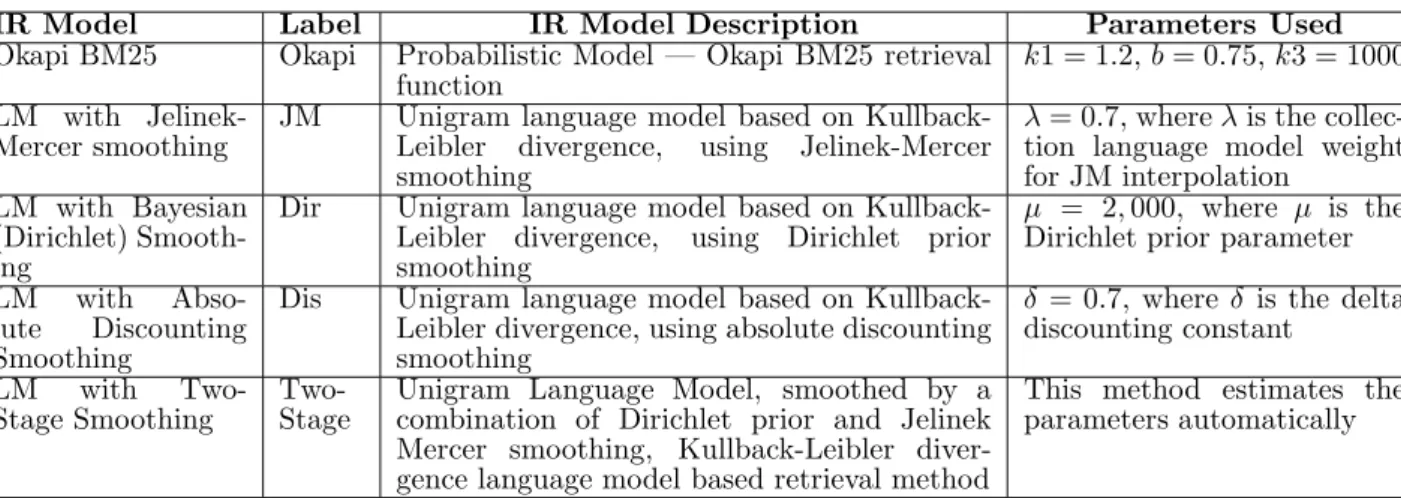
In our experiments we investigate the performance of a range of IR models: Okapi BM25, Jelinek-Mercer smoothing, Dirichlet smoothing, Absolute Discount-ing smoothDiscount-ing, and Two-Stage smoothDiscount-ing. The models, and associated parameter settings, are sum-marised in Table 1.
For our retrieval experiments we used Lemur, a publicly available information retrieval system de-veloped jointly by the University of Massachusetts Amherst and Carnegie Mellon University (http:// www.lemurproject.org). The software can index large collections of documents, and the toolkit imple-ments a wide variety of information retrieval models. The toolkit supports the construction of unigram lan-guage models for documents and queries, and imple-ments retrieval systems based on Okapi BM25 term weighting, the vector space model, and simple lan-guage model approaches. We used version 4.3.2 of the Lemur software.
3.3 Parameter Choices
All of the retrieval models considered in our work re-quire the setting of parameters. In this section we discuss the parameter choices.
Okapi BM25: The Okapi BM25 similarity measure includes three tuning parameters: k1, b and k3. k1 and b are usually set to 1.2 and 0.75 respectively, al-though smaller values for b may work effectively for
Table 1: IR Models used in experiments.
IR Model Label IR Model Description Parameters Used
Okapi BM25 Okapi Probabilistic Model — Okapi BM25 retrieval function
k1 = 1.2,b= 0.75,k3 = 1000 LM with
Jelinek-Mercer smoothing JM Unigram language model based on Kullback-Leibler divergence, using Jelinek-Mercer smoothing
λ= 0.7, whereλis the collec-tion language model weight for JM interpolation
LM with Bayesian (Dirichlet) Smooth-ing
Dir Unigram language model based on Kullback-Leibler divergence, using Dirichlet prior smoothing
µ = 2,000, where µ is the Dirichlet prior parameter LM with
Abso-lute Discounting Smoothing
Dis Unigram language model based on Kullback-Leibler divergence, using absolute discounting smoothing
δ = 0.7, where δ is the delta discounting constant
LM with
Two-Stage Smoothing Two-Stage Unigram Language Model, smoothed by acombination of Dirichlet prior and Jelinek Mercer smoothing, Kullback-Leibler diver-gence language model based retrieval method
This method estimates the parameters automatically
some queries [Robertson and Walker, 1999]. For pa-rameter k3, Robertson and Walker [1999] state: “...in long queries k3 is often set to 7 or 1000 (effectively infinite.)” They do not describe a different setting for shorter queries.
We note that these parameters are query- and collection-dependent. That is, if relevance informa-tion was available in advance, it would be possible to tune the Okapi BM25 function to further increase MAP or other information retrieval metrics. How-ever, this is not possible in real retrieval scenarios. We therefore restrict our investigation to the recom-mended parameter settings.
Language Modelling Smoothing Parameters:
Retrieval performance is very sensitive to choice of smoothing parameters [Zhai and Lafferty, 2001a]. Smoothing is the most critical component of the lan-guage modelling approach, because the IR system must accurately estimate document and query model parameters for effective retrieval performance.
Jelinek-Mercer smoothing relies on a parameterλ to interpolate the maximum likelihood probabilities with the expected term frequency in the collection. Whenλis small, less smoothing is applied and there is more emphasis on relative term weights. Such a small value of λ represents a conjunctive interpretation of the query terms [Zhai and Lafferty, 2004]. In our experiments we consistently used a value of λ= 0.7, and conducted separate sensitivity tests to confirm that this value is reasonable.
For Dirichlet smoothing, previous work shows that µ = 2000 gives good performance in nearly all cases [Zhai and Lafferty, 2004]. It has also been demonstrated that, for absolute discounting of term probabilities, smoothing using a constant δ = 0.7 is near best for both long and short queries, and across various test collections.
We remark that these parameter values give good performance across a range of collections and user re-quests, but that no parameter setting is guaranteed to be optimal for all queries and collections. Both Okapi BM25 and the language modelling approaches rely on parameters which are determined empirically. We did not attempt to optimise parameter choices using methods such as Expectation-Maximisation, leave-one-out or cross-validation using a training corpus.
We use the same set of smoothing parameters — using values recommended in the IR literature, as ex-plained above — for each language modelling method. This enables comparison across collections and tasks.
3.4 Test Collections
In our experiments, we use a range of TREC test collections, topics and relevance judgements. The collections represent different types of data, such as newswire and Web data.
Newswire Data: We use the newswire collection used at TREC-8 for the ad hoc retrieval task. The data consists of newswire text from Financial Times Limited, the Los Angeles Times, the Foreign Broad-cast Information Service, and the Federal Register. A set of 50 search topics (numbers 401–450) are used in our experiments for topic finding searches on newswire data.
Web Data (WT10g): The WT10g collection is a 10 gigabyte snapshot of a 1997 Web crawl. It is a sub-set of the larger VLC2 collection [Bailey et al., 2003]. This engineered subset contained many features rep-resentative of real Web data, including inter-server links.
The topic finding queries used with the collection were sampled from actual Web search engine logs, and formed the ‘title’ part of the TREC topic. The description and narrative were added later.
To study the effectiveness of language modelling techniques for different types of search requests, we also use named-page queries in our experiments. Such searches are not typical for collections consisting of newswire text, but are common on the Web. We aim to investigate how the type of task influences the rel-ative performance of language modelling approaches as compared with Okapi BM25.
The topic sets we use for this collection are: • TREC-9 (2000) Web queries 451–500, taken from
search engine query logs (including word mis-spellings)
• TREC-10 (2001) Web queries 501–550, taken from search engine query logs (no word mis-spellings)
• TREC-10 (2001) Named-Page queries NP1–145, to evaluate the task of homepage finding
Web Data (.GOV): The .GOV TREC test collec-tion [Craswell and Hawking, 2002] is a set of 1.25 mil-lion Web documents from the .gov (U.S. government Internet) domain in early 2002. As well as HTML, the collection includes the extracted text from Adobe
<num> Number: 403 <title> osteoporosis <desc> Description:
Find information on the effects of the dietary intakes of potassium, magnesium and fruits and vegetables as determinants of bone mineral density in elderly men and women thus preventing osteoporosis (bone decay). <narr> Narrative:
A relevant document may include one or more of the dietary intakes in the prevention of osteoporosis. Any discussion of the disturbance of nutrition and mineral metabolism that results in a decrease in bone mass is also relevant.
Figure 1: A sample topic from TREC 9. Acrobat, Microsoft Word, Postscript and plain text files.
As with the WT10g collection, we have a set of named-page finding requests for the .GOV collection. We also use a set of requests that aim to retrieve documents that ‘distill’ or capture a list of key re-sources about a particular topic. The target docu-ments would be like a user’s bookmark file that cap-tures key Web entry-pages on a topic. These requests are called ‘topic distillation’ requests.
The topic sets we use with the .GOV collection are: • TREC-2002 Named-Page queries NP1–150 • TREC-2002 Topic Distillation queries 551–600
3.5 Query Length
TREC topic statements forad hocsearch consist of an identifier, title, description, and narrative describing the user’s information need. The title is a very short description of the information need, usually consisting of a few keywords. The description and narrative add progressive levels of detail about the topic, specifying conditions that might contribute to or detract from the relevance of a page. A sample TREC topic is shown in Figure 1.
Title only searches are representative of Web searches, because the title field in the TREC topic is only several keywords in length. The more verbose ‘title + description + narrative’ form of query rep-resentation assumes that the user is willing to give greater detail about their information need.
To study the effects on retrieval performance using both short and long queries, we combine parts of the topic statement as follows: title only; title + description; and, title + description + narrative. Where we combine topic fields, we simply form a bag of words with the words from each part of the topic. We weight the contribution of each component of the query identically.
3.6 Pre-Processing
We stem both queries and collections using the Porter stemmer [Porter, 1980], and eliminate terms from queries and collections that are in the SMART system stop list [Salton, 1971, 1999].
We note that there are many different stemming algorithms and lists of stop words. We choose to use the Porter stemmer and SMART retrieval system stop list because these are widely used in information re-trieval experiments and at TREC.
We index the full text (natural language textual content) of the documents in the test collections. Evaluations ofad hoc retrieval at the Text Retrieval Conferences have found that anchor text, document structure and link structure (i.e. in-links and out-links) can be useful sources of evidence for the rele-vance of documents, and there are many successful ex-periments using these additional features. However,
as we are interested in conducting a comparative anal-ysis of retrieval models, we do not make use of such additional features to avoid the introduction of ad-ditional confounding factors into the analysis. Using only the core retrieval model should not favour any individual IR modelling approach.
3.7 IR System Evaluation
The field of information retrieval has a strong history of experimental evaluation. The relative performance of systems is generally compared by measuring how many relevant answers the search has identified, and how early in the ranked list these answers occur. A variety of metrics have been proposed, emphasising different aspects of system performance, and differ-ent search tasks. For our topic finding and topic dis-tillation experiments, we use three different ways of measuring precision of the ranked list that an IR sys-tem produces:
• the mean of the precision scores obtained af-ter the system retrieves each relevant document (mean average precision or MAP)
• precision at R documents retrieved, where R is the number of known relevant documents in the collection (R-precision)
• the number of relevant documents in the top ten documents retrieved (Precision@10).
Buckley and Voorhees [2005] report that mean aver-age precision (MAP), the averaver-age of precision scores at each relevant document retrieved, is the single mea-sure most often used in IR research to represent the overall effectiveness performance of a system.
For named-page finding, it is generally assumed that the user is interested in retrieving a single specific resource. The above precision measures are therefore not appropriate for the named-page finding task. In-stead, the mean reciprocal rank (MRR) is used; this is the inverse of the rank position at which the rel-evant resource was returned, averaged over a set of queries.
To investigate whether a true effect has occurred, and that variations in results are not due to chance alone, statistical significance testing is often employed to attach a level of confidence to observed outcomes. Sanderson and Zobel [2005] have demonstrated that the pairedt-test is a suitable instrument for investi-gating differences in information retrieval system per-formance; we use this test for significance testing in our experiments.
4 Results
We structure our findings by type of task: topic find-ing, named-page findfind-ing, and topic distillation. For each task, we also identify the type of collection used (newswire and Web data).
To investigate the effects of query length, we work with different combinations of fields in each TREC topic to form the query that is submitted to Lemur. Title-only queries are only several words long. The description adds more definition to the few words in the title. The narrative contains a concise description of what aspects of the topic make the document rel-evant. To represent a combination of topic fields, we use the following codes:
• ‘T’ = title only
• ‘TD’ = title + description
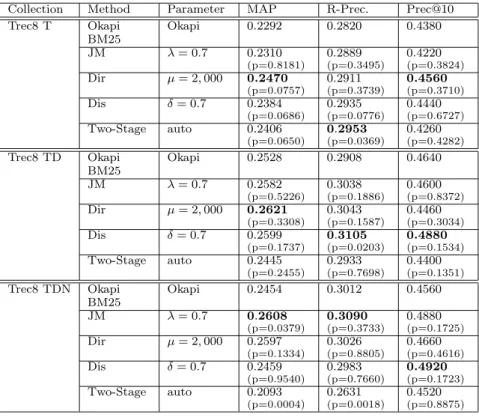
Table 2: Topic Finding Task, Queries 401–450, TREC-8 Newswire. The highest score for each collec-tion/measurement pair is shown in bold.
Collection Method Parameter MAP R-Prec. Prec@10
Trec8 T Okapi BM25 Okapi 0.2292 0.2820 0.4380 JM λ= 0.7 0.2310 (p=0.8181) 0.2889 (p=0.3495) 0.4220 (p=0.3824) Dir µ= 2,000 0.2470 (p=0.0757) 0.2911 (p=0.3739) 0.4560 (p=0.3710) Dis δ= 0.7 0.2384 (p=0.0686) 0.2935 (p=0.0776) 0.4440 (p=0.6727) Two-Stage auto 0.2406 (p=0.0650) 0.2953 (p=0.0369) 0.4260 (p=0.4282) Trec8 TD Okapi BM25 Okapi 0.2528 0.2908 0.4640 JM λ= 0.7 0.2582 (p=0.5226) 0.3038 (p=0.1886) 0.4600 (p=0.8372) Dir µ= 2,000 0.2621 (p=0.3308) 0.3043 (p=0.1587) 0.4460 (p=0.3034) Dis δ= 0.7 0.2599 (p=0.1737) 0.3105 (p=0.0203) 0.4880 (p=0.1534) Two-Stage auto 0.2445 (p=0.2455) 0.2933 (p=0.7698) 0.4400 (p=0.1351) Trec8 TDN Okapi BM25 Okapi 0.2454 0.3012 0.4560 JM λ= 0.7 0.2608 (p=0.0379) 0.3090 (p=0.3733) 0.4880 (p=0.1725) Dir µ= 2,000 0.2597 (p=0.1334) 0.3026 (p=0.8805) 0.4660 (p=0.4616) Dis δ= 0.7 0.2459 (p=0.9540) 0.2983 (p=0.7660) 0.4920 (p=0.1723) Two-Stage auto 0.2093 (p=0.0004) 0.2631 (p=0.0018) 0.4520 (p=0.8875)
In our result tables, the highest scores for each collection/measurement pair are shown in bold font. Thep-values for a pairedt-test are shown beneath the Mean Average Precision, R-Precision, Precision@10 and Mean Reciprocal Rank scores in the tables. In the discussion of results, where a p-value is less than 0.05, we take this as an indication of statistical sig-nificance. However, reporting actual p-values allows for the adjustment of the significance threshold.
4.1 Topic Finding
Topic finding is the classicad hoc search task. In re-sponse to the user’s query, the IR system searches a collection of indexed documents, and returns an or-dered list of answer resources. The more effective the IR system’s search algorithm is, the better the quality of the ranked list of retrieved results.
Newswire Data: Table 2 shows the results for queries 401–450 on the TREC-8 newswire data. For the newswire collection, language models perform well. However, there is variation between the smooth-ing approaches: each scores highest on at least one of the three metrics for a variant of the topic.
Based on MAP scores, the ordering of methods for the newswire collection is as follows:
• T (title-only): Dirichlet > T wo− Stage > AbsDiscounting > Okapi > J elinek−M ercer • TDN (all topic fields): J elinek−M ercer >
Dirichlet > AbsDiscounting=Okapi > T wo− Stage
The mean average precision score for Jelinek-Mercer using longer versions of queries is significantly better than Okapi BM25 (paired t-test,p <0.05).
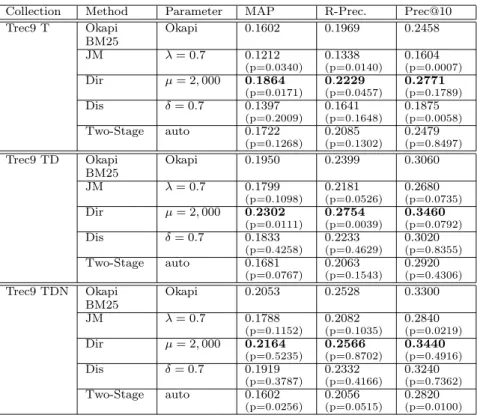
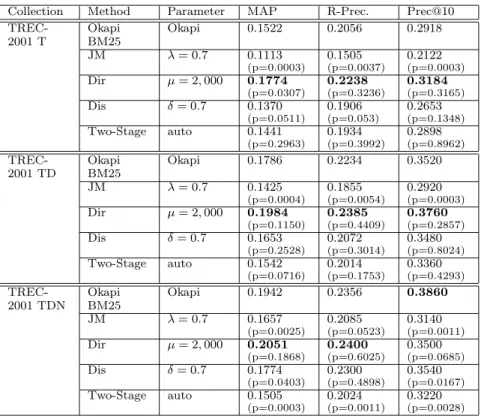
Web Data (WT10g): Table 3 shows the results for queries 451–500 for the TREC-9 ad hoc search on the WT10g Web data. The results on the same collection using TREC-10 (2001) queries 501–550 are given in Table 4.
Only Dirichlet consistently outperforms the Okapi BM25 baseline on the Web data. The difference between mean average precision scores for Dirichlet and Okapi BM25 is statistically significant for title-only queries (paired t-test, p < 0.05), and Dirichlet smoothing is numerically superior for longer queries. Using MAP scores, an ordering of methods for the Web data collections and queries is:
• T (title-only): Dirichlet > Okapi = T wo− Stage > AbsDiscounting > J elinek−M ercer • TDN (all topic fields): Dirichlet > Okapi >
AbsDiscounting > J elinek−M ercer > T wo− Stage
Overall, for the topic finding task, we find that Dirichlet smoothing consistently performs better than Okapi BM25 on both newswire and Web data. While Jelinek-Mercer performs well on the smaller newswire collection, particularly for longer queries for which our parameter choice is close to optimal, this finding does not hold for the Web data. Two-stage smooth-ing performs well for title-only queries, but its perfor-mance deteriorates as the query becomes more ver-bose.
Regarding query length, both Okapi BM25 and the language model approaches performed better with the longer, verbose versions of the topics than with the title field only.
Because Jelinek-Mercer smoothing does not per-form as well as expected for longer queries on the Web data, and since the optimal value of λ for Jelinek-Mercer smoothing is dependent on the collection and query set, we conducted separate sensitivity tests us-ing the TREC-9 Web data. However, the results of these (not reported here for space reasons) suggest
Table 3: Topic Finding Task, Queries 451–500, TREC-9 Web data.
Collection Method Parameter MAP R-Prec. Prec@10
Trec9 T Okapi BM25 Okapi 0.1602 0.1969 0.2458 JM λ= 0.7 0.1212 (p=0.0340) 0.1338 (p=0.0140) 0.1604 (p=0.0007) Dir µ= 2,000 0.1864 (p=0.0171) 0.2229 (p=0.0457) 0.2771 (p=0.1789) Dis δ= 0.7 0.1397 (p=0.2009) 0.1641 (p=0.1648) 0.1875 (p=0.0058) Two-Stage auto 0.1722 (p=0.1268) 0.2085 (p=0.1302) 0.2479 (p=0.8497) Trec9 TD Okapi BM25 Okapi 0.1950 0.2399 0.3060 JM λ= 0.7 0.1799 (p=0.1098) 0.2181 (p=0.0526) 0.2680 (p=0.0735) Dir µ= 2,000 0.2302 (p=0.0111) 0.2754 (p=0.0039) 0.3460 (p=0.0792) Dis δ= 0.7 0.1833 (p=0.4258) 0.2233 (p=0.4629) 0.3020 (p=0.8355) Two-Stage auto 0.1681 (p=0.0767) 0.2063 (p=0.1543) 0.2920 (p=0.4306) Trec9 TDN Okapi BM25 Okapi 0.2053 0.2528 0.3300 JM λ= 0.7 0.1788 (p=0.1152) 0.2082 (p=0.1035) 0.2840 (p=0.0219) Dir µ= 2,000 0.2164 (p=0.5235) 0.2566 (p=0.8702) 0.3440 (p=0.4916) Dis δ= 0.7 0.1919 (p=0.3787) 0.2332 (p=0.4166) 0.3240 (p=0.7362) Two-Stage auto 0.1602 (p=0.0256) 0.2056 (p=0.0515) 0.2820 (p=0.0100)
that even tuning this parameter does not lift abso-lute Jelinek-Mercer MAP scores above Okapi BM25.
4.2 Named-Page Finding Task
For the named-page finding task, the system should return one document — the specific named resource. The task reflects the desire of the searcher to find a resource that is known or suspected to exist; it is as-sumed that only this resource (or a duplicate of it) is relevant to the request. The resource is a single sig-nificant document, and may not be a site-entry page. A named-page topic in the TREC framework is spec-ified by a short number of keywords only, without a description or narrative section. Two sample named-page finding topics from TREC-2001 are ‘Hotel Grand, Thailand’ and ‘Quicken Support’.
Table 5 shows the results of our evaluation for the named-page finding task using WT10g Web data and topics NP1–145. Results of the named-page finding task using .GOV domain Web data and topics NP1– 150 are given in Table 6.
With a total of nearly 300 named-page queries, and using two distinct Web data collections, we found that Okapi BM25 achieved best performance for the named-page finding task. The most success-ful method for ad hoc search, Dirichlet smoothing, came last in our comparisons, performing significantly worse than Okapi. Two-stage smoothing showed sim-ilar performance to Okapi, and the difference in mean reciprocal rank scores is not significant (p >0.05).
Ranking by MRR score, the ordering of methods for named-page finding is:
• Okapi > T wo−Stage > AbsDiscounting > J elinek−M ercer > Dirichlet
One reason for the success of Okapi BM25 at this task may be that it behaves like coordination level ranking [Hiemstra, 2001]. Coordination level ranking partially ranks documents with nquery terms above
documents withn−1 terms, and this property is es-pecially useful for very short queries. The language modelling approaches do not benefit from adjusting term probabilities using the frequency of terms in the collection, or assigning probability mass to unseen terms. In fact, the more aggressive the smoothing, the smaller the level of coordination between query terms [Kraaij, 2004]. A simpler query term match-ing strategy like Okapi BM25 gives strong results for short queries.
To perform a truly effective search for named Web resources, an IR system should consider the page’s po-sition in a site hierarchy and the page’s importance, rather than only the page’s text. Employing evidence such as hyperlink measures, anchor text, and URL structure is very useful for the named-page finding task. By using content terms only, the mean recip-rocal rank scores, and other metrics given in our Re-sults section, may not reflect the best possible perfor-mance for each language modelling approach. How-ever, our focus is on a comparative analysis between approaches. We therefore restrict our attention to content-only evidence for all retrieval models that we consider.
4.3 Topic Distillation Task
Topic distillation requests are similar to named-page finding requests; the objective is to return high-level, authoritative Web pages that ‘facilitate navigation into a site’ [Hersh, 2004]. The best system approaches for such requests use a combination of Web page fea-tures. These include anchor text for links between and on HTML Web pages (link text is likely to de-scribe what the target page is about), URL length, and measures of page importance.
For example, for a request ‘obesity in the U.S.’, there are many United States government Web pages that mention these keywords in their con-tent. The correct answer for the topic distillation task is http://www.surgeongeneral.gov/topics/
Table 4: Topic Finding Task, Queries 501–550, TREC-2001 Web data.
Collection Method Parameter MAP R-Prec. Prec@10
TREC-2001 T Okapi BM25 Okapi 0.1522 0.2056 0.2918 JM λ= 0.7 0.1113 (p=0.0003) 0.1505 (p=0.0037) 0.2122 (p=0.0003) Dir µ= 2,000 0.1774 (p=0.0307) 0.2238 (p=0.3236) 0.3184 (p=0.3165) Dis δ= 0.7 0.1370 (p=0.0511) 0.1906 (p=0.053) 0.2653 (p=0.1348) Two-Stage auto 0.1441 (p=0.2963) 0.1934 (p=0.3992) 0.2898 (p=0.8962) TREC-2001 TD Okapi BM25 Okapi 0.1786 0.2234 0.3520 JM λ= 0.7 0.1425 (p=0.0004) 0.1855 (p=0.0054) 0.2920 (p=0.0003) Dir µ= 2,000 0.1984 (p=0.1150) 0.2385 (p=0.4409) 0.3760 (p=0.2857) Dis δ= 0.7 0.1653 (p=0.2528) 0.2072 (p=0.3014) 0.3480 (p=0.8024) Two-Stage auto 0.1542 (p=0.0716) 0.2014 (p=0.1753) 0.3360 (p=0.4293) TREC-2001 TDN Okapi BM25 Okapi 0.1942 0.2356 0.3860 JM λ= 0.7 0.1657 (p=0.0025) 0.2085 (p=0.0523) 0.3140 (p=0.0011) Dir µ= 2,000 0.2051 (p=0.1868) 0.2400 (p=0.6025) 0.3500 (p=0.0685) Dis δ= 0.7 0.1774 (p=0.0403) 0.2300 (p=0.4898) 0.3540 (p=0.0167) Two-Stage auto 0.1505 (p=0.0003) 0.2024 (p=0.0011) 0.3220 (p=0.0028)
Table 5: Named-Page Finding Task, Queries NP1–145, TREC 2001 Data.
Collection Method Parameter Mean Recipro-cal Rank Success@10 WT10G Okapi BM25 Okapi 0.2947 0.517 JM λ= 0.7 0.2237 (p=0.0025) 0.400 Dir µ= 2,000 0.1642 (p<0.0001) 0.297 Dis δ= 0.7 0.2808 (p=0.4689) 0.476 Two-Stage auto 0.2734 (p=0.0912) 0.503
obesity/, which is an authoritative page on the topic. The page is judged the correct answer as it introduces the topic and links to other useful and relevant re-sources. The page above is also an entry page at the most appropriate level in the Surgeon General web-site’s hierarchy.
Topic distillation as a search task is different to
ad hoc topical searches. For ad hoc search, the user wants the most topically relevant documents returned to them. For topic distillation, the system should return to the user a Web page that is an entry page to other high-quality resources on the topic.
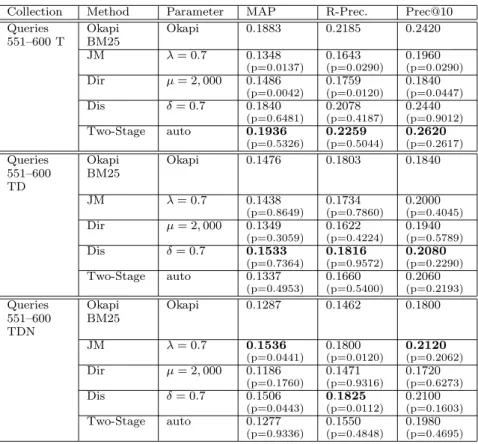
We show results for queries 551–600, which were part of the TREC-2002 Topic Distillation task, in Ta-ble 7. It can be seen that Jelinek-Mercer and ab-solute discounting smoothing approaches work well for longer versions of the topics. For queries formed from joining the ‘title’ and ‘description’ fields of each topic, absolute discounting produces the best results, but the difference is not statistically significant (p > 0.05). For title-only queries, two-stage smoothing performs best, but not significantly better than Okapi BM25 (p >0.05).
Using MAP, which Craswell and Hawking [2004] indicate as an appropriate measure for the topic tillation task, the ordering of methods for topic dis-tillation is:
• T (title-only): T wo − Stage = Okapi > AbsDiscounting > Dirichlet > J elinek − M ercer
• TDN (all topic fields): J elinek− M ercer = AbsDiscounting > Okapi > T wo−Stage > Dirichlet
Our results indicate that absolute discounting and Jelinek-Mercer smoothing (with optimal parameters) can outperform the strong Okapi BM25 baseline for longer queries. Jelinek-Mercer smoothing performs poorly for short queries; using a smaller value for λ improves retrieval accuracy, but the revised ap-proach does not improve significantly on Okapi BM25. Dirichlet smoothing, which was the strongest overall performer for topic finding search, performed badly at named-page finding and topic distillation tasks.
An overall trend is that the Okapi BM25 function performs best with shorter queries for topic distilla-tion requests. This finding is not repeated in our re-sults for topic finding search, however.
It may be possible that the longer topic descrip-tions contain a lot of ‘noise’ words, the presence of which degrade precision for Okapi BM25. The lan-guage modelling approaches appear to handle the verbosity of the queries more effectively than Okapi-BM25 as the form of request gets longer. This is one
Table 6: Named-Page Task, Queries NP1–150, TREC 2002 Data.
Collection Method Parameter Mean Recipro-cal Rank
Success@10
.GOV Okapi BM25 Okapi 0.5993 0.760
JM λ= 0.7 0.4833 (p<0.0001) 0.693 Dir µ= 2,000 0.4459 (p<0.0001) 0.647 Dis δ= 0.7 0.5366 (p=0.0004) 0.733 Two-Stage auto 0.5790 (p=0.2178) 0.773
Table 7: Topic Distillation Task, Queries 551–600, TREC 2001 Data.
Collection Method Parameter MAP R-Prec. Prec@10
Queries 551–600 T Okapi BM25 Okapi 0.1883 0.2185 0.2420 JM λ= 0.7 0.1348 (p=0.0137) 0.1643 (p=0.0290) 0.1960 (p=0.0290) Dir µ= 2,000 0.1486 (p=0.0042) 0.1759 (p=0.0120) 0.1840 (p=0.0447) Dis δ= 0.7 0.1840 (p=0.6481) 0.2078 (p=0.4187) 0.2440 (p=0.9012) Two-Stage auto 0.1936 (p=0.5326) 0.2259 (p=0.5044) 0.2620 (p=0.2617) Queries 551–600 TD Okapi BM25 Okapi 0.1476 0.1803 0.1840 JM λ= 0.7 0.1438 (p=0.8649) 0.1734 (p=0.7860) 0.2000 (p=0.4045) Dir µ= 2,000 0.1349 (p=0.3059) 0.1622 (p=0.4224) 0.1940 (p=0.5789) Dis δ= 0.7 0.1533 (p=0.7364) 0.1816 (p=0.9572) 0.2080 (p=0.2290) Two-Stage auto 0.1337 (p=0.4953) 0.1660 (p=0.5400) 0.2060 (p=0.2193) Queries 551–600 TDN Okapi BM25 Okapi 0.1287 0.1462 0.1800 JM λ= 0.7 0.1536 (p=0.0441) 0.1800 (p=0.0120) 0.2120 (p=0.2062) Dir µ= 2,000 0.1186 (p=0.1760) 0.1471 (p=0.9316) 0.1720 (p=0.6273) Dis δ= 0.7 0.1506 (p=0.0443) 0.1825 (p=0.0112) 0.2100 (p=0.1603) Two-Stage auto 0.1277 (p=0.9336) 0.1550 (p=0.4848) 0.1980 (p=0.4695)
function of the role of smoothing, i.e. that of ‘explain-ing’ common words in the query [Zhai and Lafferty, 2004].
5 Conclusion and Future Work
The aim of this study was to investigate the rela-tive performance of the probabilistic and language model approaches to information retrieval. To our knowledge, it is the first large-scale study that has examined the performance of these core retrieval technologies, using consistent settings, across a range of scenarios including different types of data, different search tasks, and different query lengths. Our results indicate that there is no single retrieval approach that can offer optimal performance under all conditions, but that each can offer different advantages in different situations.
For the topic finding task using short key-word queries, Dirichlet prior smoothing signifi-cantly outperformed the probabilistic Okapi BM25 method (two-tailed t-test, p < 0.05). Two-stage smoothing was the next best language mod-elling method for title-only queries. For longer
queries, Dirichlet smoothing also out-performed all other methods. We did not find that the other smoothing methods (absolute discounting, Jelinek-Mercer and two-stage smoothing) could outper-form Okapi BM25 over the two collections we used.
The named-page task is very different to topic find-ing; an exact match on query terms frequently is not sufficient to find the specific named resource. How-ever, Okapi BM25 performed well. As the named-page queries are short descriptions, Okapi BM25 behaved like coordination level ranking, a ranking strategy which is appropriate for very short queries. Dirichlet smoothing, which performed well at topic finding tasks, gave less emphasis to the relative weights of the query terms, and was the worst per-former at named-page finding.
For the topic distillation task, absolute discount-ing and Jelinek-Mercer worked well with the longer versions of the TREC topics, and significantly out-performed Okapi BM25 (two-tailed t-test,p <0.05). Okapi BM25 performed better with shorter queries for this task; we suspect that the presence of ‘noise’ words in the longer queries degraded precision for Okapi BM25. The language modelling approaches
are able to ‘explain’ such non-informative words in the query more effectively.
All language modelling approaches required smoothing parameters which must be determined em-pirically for optimal performance. Sensitivity analy-sis showed little change to the relative ordering of language model smoothing methods when we chose different values for parameters.
The research undertaken here provided informa-tion about the types of task and forms of query for which language models are best suited. In IR, perfor-mance is dependent to a degree on the type of collec-tion and the set of queries. In our study, we restricted our attention to representing the content of a docu-ment only, not its link structure, anchor text or other markup — features that are important for retrieval on web data. A wider study with multiple sources of evidence like link structure would broaden the appli-cability of these findings. Stemming and stopping are generally applied in most IR experiments; however it is not clear that they bring benefits to the retrieval tasks used here. The interaction between combina-tions of stemming, stopping, and query length would be worthwhile to study more closely. Our broad-based study was able to provide useful insight into the relative performance of core retrieval models. Fu-ture work investigating the impact of these other fac-tors would further enhance the understanding of the relative performance of retrieval techniques.
References
P. Bailey, N. Craswell, and D. Hawking. Engineering a multi-purpose test collection for Web retrieval experiments. Infor-mation Processing and Management, 39(6):853–871, 2003. A. Broder. A taxonomy of web search. SIGIR Forum, 36(2):
3–10, 2002.
C. Buckley and E. M. Voorhees.TREC: Experiment and Eval-uation in Information Retrieval, chapter 3, pages 53–75. The MIT Press, 2005.
N. Craswell and D. Hawking. Overview of the TREC-2002 Web Track. InProceedings of the Eleventh Text REtrieval Conference (TREC-2002), Gaithersburg, Maryland USA, November 2002. NIST Special Publication.
N. Craswell and D. Hawking. Overview of the TREC-2004 Web Track. In Proceedings of the Thirteenth Text RE-trieval Conference (TREC-2004), Gaithersburg, Maryland USA, November 2004. NIST Special Publication.
W. Hersh. Information Retrieval: A Health & Biomed-ical Perspective (Second Edition) - Update - Chapter 8, 2004. http://medir.ohsu.edu/~hersh/irbook/updates/ update8.html(accessed 30 September 2006).
D. Hiemstra.Using language models for information retrieval. PhD thesis, Centre for Telematics and Information Technol-ogy, University of Twente, 2001.
D. Hiemstra and W. Kraaij. Twenty-One at TREC 7: Ad-hoc and Cross-Language Track. InProceedings of the Seventh Text REtrieval Conference (TREC-7), pages 174–185. NIST Special Publication, 1998.
F. Jelinek and R. Mercer. Interpolated estimation of markov source parameters from sparse data. InWorkshop on Pat-tern Recognition in Practice, 1980.
W. Kraaij. Variations on Language Modeling for Information Retrieval. PhD thesis, University of Twente, June 2004. V. Lavrenko. SIGIR 2003 Tutorial: Language Modeling in
Information Retrieval, 2003. http://ciir.cs.umass.edu/ ~lavrenko/SIGIR2003-Tutorial.pdf (accessed 30 Septem-ber 2006).
V. Lavrenko and W. B. Croft. Relevance-based language mod-els. InProceedings of the ACM SIGIR International Con-ference on Research and Development in Information Re-trieval, pages 120–127, New Orleans, LA, 2001.
H. Ney, U. Essen, and R. Kneser. On structuring probabilistic dependences in stochastic language modelling. Computer Speech and Language, 8:1–38, 1994.
J. M. Ponte and W. B. Croft. A language modeling approach to information retrieval. InProceedings of the ACM SIGIR ternational Conference on Research and Development in In-formation Retrieval, pages 275–281, Melbourne, Australia, 1998.
M. Porter. An algorithm for suffix stripping. Program, 14: 130–137, 1980.
S. E. Robertson and S. Walker. Okapi/Keenbow at TREC-8. InProceedings of the Fourteenth Text REtrieval Conference (TREC-8). NIST Special Publication, 1999.
S. E. Robertson and S. Walker. Some simple effective approx-imations to the 2-poisson model for probabilistic weighted retrieval. InProceedings of the ACM SIGIR International Conference on Research and Development in Information Retrieval, pages 232–241, Dublin, Ireland, 1994.
G. Salton. The SMART Retrieval System - Experiments in Automatic Document Processing. Prentice-Hall, 1971. G. Salton. SMART Version 11.0 Stop word list, 1999. ftp:
//ftp.cs.cornell.edu/pub/smart/english.stop (accessed 30 September 2006).
M. Sanderson and J. Zobel. Information retrieval system eval-uation: effort, sensitivity, and reliability. InProceedings of the ACM SIGIR International Conference on Research and Development in Information Retrieval, pages 162–169, Sal-vador, Brazil, Aug. 2005.
F. Song and W. B. Croft. A general language model for infor-mation retrieval. InCIKM ’99: Proceedings of the Eighth International Conference on Information and Knowledge Management, pages 316–321, New York, NY, USA, 1999. K. Sparck Jones and S. E. Robertson. Relevance weighting of
search terms.Journal of the American Society for Informa-tion Science, 27(3):129–146, 1976.
K. Sparck Jones, S. Walker, and S. E. Robertson. A prob-abilistic model of information retrieval: development and comparative experiments - Part 1. Information Processing and Management, 36(6):779–808, 2000.
C. Zhai. Statistical language models for informa-tion retrieval, 2006. http://sifaka.cs.uiuc.edu/lmir/ sigir06-tutorial-lmir.pdf(accessed 30 September 2006). C. Zhai. Risk Minimization and Language Modeling in Text
Retrieval. PhD thesis, Carnegie Mellon University, 2002. C. Zhai and J. Lafferty. A study of smoothing methods for
language models applied to ad hoc information retrieval. In
Proceedings of the ACM SIGIR International Conference on Research and Development in Information Retrieval, pages 334–342, New Orleans, Louisiana, United States, 2001a. ACM Press.
C. Zhai and J. Lafferty. A study of smoothing methods for lan-guage models applied to information retrieval.ACM Trans-actions On Information Systems, 22(2):179–214, 2004. C. Zhai and J. D. Lafferty. Model-based feedback in the
lan-guage modeling approach to information retrieval. InCIKM ’01: Proceedings of the Tenth International Conference on Information and Knowledge Management, pages 403–410, 2001b.