Calhoun: The NPS Institutional Archive
Theses and Dissertations Thesis Collection
2015-06
Survivability as a tool for evaluating open source software
Cummings, David J.
Monterey, California: Naval Postgraduate School
NAVAL
POSTGRADUATE
SCHOOL
MONTEREY, CALIFORNIA
THESIS
SURVIVABILITY AS A TOOL FOR EVALUATING OPEN SOURCE SOFTWARE
by
David J. Cummings June 2015
Thesis Advisor: Timothy H. Chung
Second Reader: Rama D. Gehris
REPORT DOCUMENTATION PAGE Form Approved OMB No. 07040188
Public reporting burden for this collection of information is estimated to average 1 hour per response, including the time for reviewing instruction, searching existing data sources, gathering and maintaining the data needed, and completing and reviewing the collection of information. Send comments regarding this burden estimate or any other aspect of this collection of information, including suggestions for reducing this burden to Washington headquarters Services, Directorate for Information Operations and Reports, 1215 Jeerson Davis Highway, Suite 1204, Arlington, VA 222024302, and to the Oce of Management and Budget, Paperwork Reduction Project (0704-0188) Washington DC 20503.
1. AGENCY USE ONLY (Leave Blank) 2. REPORT DATE
06-19-2015
3. REPORT TYPE AND DATES COVERED
Master’s Thesis 09-01-2014 to 06-19-2015
4. TITLE AND SUBTITLE
SURVIVABILITY AS A TOOL FOR EVALUATING OPEN SOURCE SOFTWARE
5. FUNDING NUMBERS
6. AUTHOR(S)
David J. Cummings
7. PERFORMING ORGANIZATION NAME(S) AND ADDRESS(ES)
Naval Postgraduate School Monterey, CA 93943
8. PERFORMING ORGANIZATION REPORT NUMBER
9. SPONSORING / MONITORING AGENCY NAME(S) AND ADDRESS(ES)
N/A
10. SPONSORING / MONITORING AGENCY REPORT NUMBER 11. SUPPLEMENTARY NOTES
The views expressed in this document are those of the author and do not reflect the official policy or position of the Department of Defense or the U.S. Government.
12a. DISTRIBUTION / AVAILABILITY STATEMENT
Approved for public release; distribution is unlimited
12b. DISTRIBUTION CODE
13. ABSTRACT (maximum 200 words)
This thesis explores the application of traditional survivability analysis to the open source software (OSS) development process. It postulates that combat systems face potential threats from cyber warfare professionals aiming to manipulate software embedded in the systems. The research highlights current Department of Defense (DOD) interest in OSS, and explains a method for evaluating the capability of OSS programs to withstand cyber warfare attacks. Survivability concepts are demonstrated in a scenario involving an adversary inserting malicious code into the source repository of FlightGear, an open source flight simulator. Analysis is conducted on five open source programs to illustrate commonality in the evaluation process. It is determined that survivability analysis is a feasible method for OSS software evaluation, and could be used as a tool to compare OSS alternatives.
14. SUBJECT TERMS
software, survivability, open source software, unmanned aerial vehicle
15. NUMBER OF PAGES 109 16. PRICE CODE 17. SECURITY CLASSIFICATION OF REPORT Unclassified 18. SECURITY CLASSIFICATION OF THIS PAGE Unclassified 19. SECURITY CLASSIFICATION OF ABSTRACT Unclassified 20. LIMITATION OF ABSTRACT UU
NSN 7540-01-280-5500 Standard Form 298 (Rev. 289)
Approved for public release; distribution is unlimited
SURVIVABILITY AS A TOOL FOR EVALUATING OPEN SOURCE SOFTWARE
David J. Cummings Lieutenant, United States Navy
B.S., California Polytechnic University, San Luis Obispo, 2006
Submitted in partial fulfillment of the requirements for the degree of
MASTER OF SCIENCE IN SYSTEMS ENGINEERING
from the
NAVAL POSTGRADUATE SCHOOL June 2015
Author: David J. Cummings
Approved by: Timothy H. Chung Thesis Advisor Rama D. Gehris Second Reader Clifford Whitcomb
ABSTRACT
This thesis explores the application of traditional survivability analysis to the open source software (OSS) development process. It postulates that combat systems face potential threats from cyber warfare professionals aiming to manipulate software embedded in the systems. The research highlights current Department of Defense (DOD) interest in OSS, and explains a method for evaluating the capability of OSS programs to withstand cyber warfare attacks. Survivability concepts are demonstrated in a scenario involving an adver-sary inserting malicious code into the source repository of FlightGear, an open source flight simulator. Analysis is conducted on five open source programs to illustrate commonality in the evaluation process. It is determined that survivability analysis is a feasible method for OSS software evaluation, and could be used as a tool to compare OSS alternatives.
Table of Contents
1 Introduction 1 1.1 Background . . . 1 1.2 Scope . . . 2 1.3 Benefits of Study . . . 4 1.4 Research Questions . . . 4 1.5 Methodology . . . 5 1.6 Thesis Outline . . . 6 2 Literature Review 9 2.1 Introduction . . . 9 2.2 Software. . . 92.3 Open Source Software . . . 11
2.4 Unmanned Aerial Vehicles . . . 22
3 Survivability Analysis 27 3.1 Introduction . . . 27
3.2 Need for Survivability Analysis . . . 27
3.3 Threats . . . 28 3.4 Scenario . . . 31 3.5 Analysis . . . 33 3.6 Conclusion . . . 48 4 Data Analysis 49 4.1 Introduction . . . 49
4.2 Software Program Development . . . 50
4.3 Example Analyses . . . 53
4.4 Collective Analysis . . . 57
5 Conclusion and Future Work 61
5.1 Conclusion . . . 61 5.2 Future Work . . . 63 5.3 Summary . . . 71
Appendix: Program Code 73
A.1 githubIssuesAalysis.py . . . 73 A.2 analyzeGithubData.py . . . 77
List of References 79
List of Figures
Figure 2.1 Number of open source projects over time since 2007. . . 13
Figure 2.2 Global aerial drone market through year 2024. . . 23
Figure 3.1 Ariane 5 rocket destruction after launch . . . 29
Figure 3.2 Number of issues opened and closed over time for FlightGear. . . 36
Figure 3.3 Trend lines representing the number of issues opened and closed over time for FlightGear. . . 37
Figure 3.4 Cumulative issues, or backlog of issues, for FlightGear over time 38 Figure 3.5 Number of developers who were working on FlightGear as com-pared to the number of issues generated for FlightGear over time 38 Figure 3.6 Number of developers who were working on FlightGear as com-pared to the number of commits provided by developers over time 40 Figure 4.1 General organization of the Github application program interface (API) . . . 51
Figure 4.2 Ardupilot issue open and close dates over time . . . 53
Figure 4.3 ArduPilot issue open and close dates with trend lines . . . 54
Figure 4.4 Total ArduPilot issues that remained open over time . . . 55
Figure 4.5 MAVLink issue open and close dates over time . . . 56
Figure 4.6 MAVLink issues open and close dates with trend lines . . . 56
Figure 4.7 Total MAVLink issues that remained open over time . . . 57
Figure 4.8 Number of issues opened and closed over time for six open source software (OSS) programs . . . 58
List of Tables
Table 2.1 Comparison of titles used for developers on the open source Apache Project and representative proprietary software projects . . . 15 Table 2.2 Open source programs used by the Aerial Combat Swarms project 25 Table 3.1 Essential events and elements for the open source software
develop-ment process . . . 35 Table 4.1 Issues analysis results for several open source projects related to
List of Acronyms and Abbreviations
ARSENL Advanced Robotic Systems Engineering Laboratory
ACS Aerial Combat Swarms
AAA anti-aircraft artillery
API application program interface
CIO Chief Information Officer
CSV comma-separated values
CAC Common Access Card
CVE Computer Vulnerabilities and Exposures
CRUSER Consortium for Robotics and Unmanned Systems Education and Research
C2 Command and Control
COTS commercial-off-the-shelf
DARPA Defense Advanced Projects Research Agency
DOD Department of Defense
E3A Essential Events and Elements Analysis
GUI graphical user interface
GCS ground control station
HTTP Hyper Text Transfer Protocol
IT information technology
IEEE Institute of Electrical and Electronics Engineers
IOC initial operating capability
IADS integrated air defense system
JSF Joint Strike Fighter
LFTE Live-Fire Test and Evaluation
MCWL Marine Corps Warfighting Laboratory
MIT Massachusetts Institute of Technology
MASINT measurement and signature intelligence
NPS Naval Postgraduate School
ONR Office of Naval Research
OPNAV Office of the Chief of Naval Operations
OpenBSD Open Berkeley Software Distribution
OSI Open Source Initiative
OSS open source software
PACFLT Pacific Fleet
SLOC source lines of code
SEA South East Asia
SRWBR short range wide band radio
SAM surface-to-air missile
TCP transmission control protocol
URL uniform resource locator
USCG United States Coast Guard
USG United States government
UAS unmanned aerial system
UAV unmanned aerial vehicles
UDP user datagram protocol
Executive Summary
The Department of Defense (DOD) relies on software to execute important strategic mis-sion requirements. Combat systems employed by the DOD are becoming progressively more dependent on software to be effective, as evidenced by some aircraft whose engines cannot be started without a software card relaying mission information to onboard comput-ers. The DOD has many uses for software, so it is important for the organization to make informed decisions when choosing between software alternatives. A poor choice of soft-ware could have significant implications on the budget, the readiness, and the capability of the armed services.
One category of software receiving special attention is open source software. In 2009, the DOD Chief Information Officer (CIO) reiterated that OSS should be evaluated along with proprietary software when choosing alternatives for DOD applications. Open source soft-ware is highly suitable for rapid prototyping and experimentation, and low upfront cost and availability of source code make OSS ideal for DOD research and development. The idea of OSS being embedded in operational combat systems is troubling to some because public access of open source code allows anyone, including enemies, to gain insight to system capabilities, but proprietary software may not be as secure as one might think, and OSS not as vulnerable. This thesis aims to evaluate the ability of the OSS development process to guard against attackers by determining the suitability of individual OSS programs for DOD missions.
The scope of the thesis is narrowed by studying DOD OSS programs embedded in hard-ware systems, specifically softhard-ware utilized by small UAVs. At the Naval Postgraduate School (NPS), Advanced Robotic Systems Engineering Laboratory (ARSENL) supports ongoing research involving UAVs and UAV swarm operations, and OSS is an essential part of their operating scheme. Several OSS programs used by the lab are taken as a sam-ple and analyzed to evaluate their survivability. Initial data gathering from one program, FlightGear, provides information to demonstrate how survivability applies to the OSS de-velopment process. Data from several other programs is retrieved using a separate software program developed for the research.
Survivability analysis is demonstrated by designing a scenario in which an adversary inserts malicious software to an OSS program by gaining access to the community of software de-velopers building the code. Nine steps outline events allowing the adversary to successfully compromise UAV autopilot software, represented by FlightGear, and kill an aircraft. The goal of the survivability analysis is to identify the likelihood of events in the scenario oc-curring, and subsequently, the combined probability that aircraft is killed. In the case of the FlightGear scenario, event probabilities are determined by analyzing characteristics of FlightGear’s open source project, including activity level of the development community as judged by issue reports and commit logs. This data represents one indicator of the general health of FlightGear and its resistance to attack.
One underlying theory of the thesis is that data associated with open source projects re-flects their resilience against cyberattacks, and by this premise, the first step in evaluating an OSS program is to gather information about it. Many open source software programs are hosted by websites such as GitHub, GitLab, BitBucket, and SourceForge, which act as cloud-based repositories, storing the project’s source code online and allowing simultane-ous collaboration by developers in separate geographic locations. The websites track and archive activities related to development of programs and report information such as the number of people working on the code, the number of inputs each programmer provides, the unresolved bugs in the program, and the programming languages used for development. Obtaining this information manually by scrolling through websites and clicking on links is not efficient, so a software program is developed to automatically access project data and store it for analysis. The program is written in the Python programming language, and uses several tools to gather data from GitHub, where most of the applications used by ARSENL are kept. Time constraints for the thesis limited the program development, so it is only able to process project issues (bugs or feature requests), which is an important metric for OSS programs, but should not be the only data included in OSS analysis. Plans are laid out for development of a more thorough program in Section 5.2.
Collected data is graphically analyzed using the Microsoft Excel spreadsheet program. Specific indications of project health come from trends in data, such as the number of issues opened over the time period analyzed. An increasing trend in opened issues means there is high project activity and many developers working on the project. This is a healthy
sign, showing interest in the project and support from the community. A malicious code insertion will have a difficult time surviving inspection by many programmers working on the project, therefore, an increasing trend in issues being opened suggests better resilience to attack. This logic is applied to the survivability analysis by reducing event probabilities, which increases the likelihood that such a program would survive a malicious insertion attempt. In this way, survivability analysis successfully demonstrates its usefulness for evaluating OSS programs.
Upon completing the thesis, it was apparent there are many avenues for further research. While survivability analysis is demonstrated to work for a small sample of OSS programs, it needs to be validated by expanding its scope through application to other program types. The outcomes of the survivability analysis also need to be verified by cross-checking results with those produced by known OSS validation techniques. In addition, the program devel-oped for the thesis needs to be expanded to capture more data. It could also be improved to perform data analysis instead of just data collection. It would be helpful for people choos-ing between OSS alternatives to see immediate results about an OSS program’s suitability for a specific application by inputting a project name and receiving immediate results from the data analysis program. In its current state, collected data requires manual analysis us-ing a different spreadsheet program. These topics could all supply opportunities for further research to provide better understanding of the potential role of survivability analysis in OSS software development and selection.
Acknowledgments
I thank my thesis advisor, Tim Chung, for providing major support throughout my research. He was consistently available to answer questions and determined to provide the tools necessary for me to succeed. Professor Chung was especially helpful in the development of a software program that was crucial to the completion of my thesis. Thanks to my second reader, Rama Gehris, who provided insight about software topics and offered excellent advice for the flow and structure of the document. Thanks to Naval Postgraduate School (NPS) staff working in the Advanced Robotic Systems Engineering Laboratory (ARSENL) lab, including Michael Day and Michael Clement, who provided information about open source software (OSS), and to students in the thesis working group, who made the daily grind of thesis work—especially toward the end—enjoyable and entertaining.
Thanks to the professors and faculty of the Systems Engineering Department and Mechani-cal Engineering Department at NPS, especially Chris Adams, Matt Boensel, Ron Giachetti, and Mark Stevens, who provided the academic background and analytic tools necessary to progress through my research. Special thanks to Barbara Berlitz for her instruction about the thesis process at NPS and her detailed review of my finished product.
HUGE thanks to my beautiful wife, Chelsea, and our two daughters, Lyla and Emmy, for empathizing with me, for remaining supportive when I could not be home, and for providing constant encouragement as I proceeded through the research process. Thank you!
CHAPTER 1:
Introduction
1.1
Background
Software had its origin in the middle of the 20th century, and since then software develop-ment has expanded rapidly. The Departdevelop-ment of Defense (DOD) uses software extensively and relies on software-based systems for most of its critical capabilities. In order for United States (U.S.) military services to maintain a tactical advantage, they must stay at the leading edge of essential technology areas, including software development. One form of software that has received increasing attention in the last decade is open source software (OSS). As an example, about three-quarters of the world’s large companies planned to add Linux-based servers to their information technology systems over the past 10 years [1]. The OSS software community has the support of commercial companies interested in utilizing open source approaches to develop new technology. For example, one illustrative open source project whose organizational structure is governed by the Linux Foundation, “Dronecode,” aims to standardize unmanned aerial vehicles (UAV) software and promote cooperation among developers for consumer and commercial UAV applications [2].
Due to advances in OSS development and backing from major commercial companies, the government should expand its interest in OSS programs and OSS methodology. Although open source software is currently used in the DOD, apprehension sometimes blocks its implementation in sensitive areas such as combat system development. OSS programs need to be analyzed to support DOD understanding and awareness of their potential to improve technology used by U.S. military forces.
Like consumer software, military software technology has expanded rapidly in recent years, largely due to the advancing complexity of military systems. The F-22 Raptor, which demonstrated initial operating capability (IOC) in 2005, employs around two million lines of code to operate its avionics system [3]. In contrast, the F-35 Joint Strike Fighter (JSF), with an anticipated IOC date before December 2016, already has 24 million lines of code in its software system [4]. Software required to support the advanced capability of the newer
fighter is constantly forced to keep pace as hardware technology improves. Over 10 years’ time, the demand for software grew by 10 times the original amount, and this trend will likely continue for future aircraft designs. Such developments highlight the DOD need for acquiring new software and understanding how it will continue to impact combat systems in the future.
While OSS may seem unconventional or even out of place in the traditional military ac-quisition landscape, it may be more suitable than proprietary software for certain DOD applications. In fact, in a memorandum published by the chief information officer of the DOD, OSS is designated as “commercial computer software that shall be given appropri-ate statutory preference” when considering software for any DOD function [5]. As such, this research aims to highlight characteristics of the OSS development process and evaluate OSS projects based on data gathered from their open source repositories.
1.2
Scope
The scope of this thesis involves military hardware systems that incorporate software in their designs. Generally, the systems in question are heavily dependent on software and would not be useful without their software-based elements. Examples are modern mili-tary aircraft, air defense systems, ships, radar systems, unmanned underwater systems and unmanned aerial vehicles. The advent of OSS in these classes of assets or systems is rare, which motivates this thesis to explore its potential capability and viability within this scope. The primary system of focus for this thesis is the unmanned aerial vehicles. In addition to the surge in commercial development and military use in the past decade, significant work has been conducted by software developers and hobbyists alike who generate, implement, and deploy code used by small civilian UAVs and drones. This technology could poten-tially be very useful for military initiatives working on developing aligned systems for the military. One goal of the thesis is to assess whether OSS is feasible for use in military systems such as UAVs. The same methods used here are anticipated to be applicable to other OSS software under consideration for use by the military. Ideally, these insights may provide an analytic framework to generate guidance for decision makers that may support the inclusion of OSS to more programs of interest within the DOD.
This research does not, however, seek to directly compare proprietary software and open source software in depth. While general aspects are discussed, no formal evaluation is performed to promote or devalue one development method over another. There is potential for a comparative study; however, it is not the focus of this report, as such assessments are largely dictated by the specific requirements on the software system and/or operational context. Chapter 5 discusses options for further exploration into these topics.
The thesis is intended to apply to a broad range of software systems used by the military and Department of Defense. Despite the focus on UAVs, the presented methodology is designed so that parallels can be drawn and ideally applied to a wide range of software systems with varying objectives. As discussed, the primary context of the system analysis in this study is the unmanned aerial system context. This operational environment nominally involves one or more UAVs being controlled autonomously or via human-in-the-loop constructs, with communication and/or data links possibly providing information to external (typically ground-based) command stations. As these UAV systems rapidly continue to advance with the emergence of new technologies, the role of software and its integration becomes ever increasingly important for achieving successful system-of-systems operation.
Such holistic perspectives may further facilitate future concepts employing these UAV capabilities. One example of this type of system-of-systems is a UAV swarm cooperat-ing to achieve an objective. Research is currently becooperat-ing conducted at Naval Postgrad-uate School (NPS) involving swarm concepts, which are of particular interest to opera-tional stakeholders such as Pacific Fleet (PACFLT), Office of the Chief of Naval Oper-ations (OPNAV), Office of Naval Research (ONR), United States Coast Guard (USCG), Defense Advanced Projects Research Agency (DARPA), and Marine Corps Warfighting Laboratory (MCWL). As such, this thesis is conducted in support of the Secretary of the Navy initiative for the Consortium for Robotics and Unmanned Systems Education and Research (CRUSER) and projects being conducted in the Advanced Robotic Systems En-gineering Laboratory (ARSENL), which utilizes OSS extensively to demonstrate swarm capabilities.
1.3
Benefits of Study
This thesis highlights the potential ability of OSS to be embedded in DOD hardware sys-tems by analyzing a case study of OSS programs used in UAV swarms. The analysis provides a methodology for the evaluation of OSS programs under consideration as alter-natives to proprietary software, and provides tools to streamline data gathering from OSS repositories.
The thesis also bridges the gap between DOD software development community and the rapidly-growing OSS community by discussing recent trends in software development, in-cluding the influence of open source developers on robotics software and unmanned system software. It calls attention to these issues to help widen the field of view of DOD personnel as they consider future methods for development of software dependent systems. More specifically, the thesis benefits unmanned systems development in the Department of De-fense by dispelling rumors of OSS inadequacy, and discussing real world examples of OSS programs successfully implemented in DOD mission environments.
Finally, the thesis is expected to also benefit the open source software development commu-nity by providing an additional tool for use in evaluating projects and potentially guiding their development in a manner that aligns with operational and/or acquisition requirements. For example, the idea of survivability is not discussed significantly in OSS literature, but it provides a context within which military programs may be evaluated. The process for survivability analysis discussed in the thesis provides an initial blueprint for evaluating software projects based on data generated from their source code repositories. The meth-ods for defining individual event probabilities for attacks on open source projects could allow project managers to refine their efforts to build quality software and to strengthen their software development communities.
1.4
Research Questions
This thesis addresses several specific research questions. The questions are designed to provide some direction and scope for the research without overly constraining the analysis or limiting the resulting findings. The primary goals of this thesis are captured in the following research questions.
1. How can the concepts of traditional aircraft combat survivability be used to evaluate the capability of OSS to withstand an attack from an adversary?
2. What attributes of an OSS software program make it more capable to withstand an attack from an adversary?
3. How can OSS project data be retrieved in a repeatable manner in order to feed OSS survivability analyses?
4. How could an adversary destroy a system or force a mission failure by manipulating software embedded in the system?
5. What is the best way to retrieve publicly-available data from websites that host OSS project repositories?
6. How can OSS project data be analyzed and presented to provide decision makers guidance for selecting suitable OSS programs?
1.5
Methodology
This section discusses the methodology used to address the research questions proposed in Section 1.4. Tools used to answer the research questions include a literature review, data gathering, programming of software scripts for analysis support, and a survivability analysis. The information obtained throughout the research is combined and evaluated to provide results conclusions, and areas for future work, as discussed in Chapter 5.
1.5.1
Literature Review
A thorough review of literature related to OSS and DOD system software is conducted, including news articles, websites, books, journal articles, research papers, conference pro-ceedings and working papers. The materials are surveyed and organized, such that the body of information and sources can be easily accessed as the research progresses. The initial review enables a foundation for relevant OSS topics and supports subsequent methodology development regarding OSS capabilities.
1.5.2
Data Gathering
In order to compare and contrast OSS projects, data is required to help analyze their quali-ties. Due to the open nature of OSS, most projects are hosted on websites that provide
de-scriptive information about, for example, the people who work on the software, the amount of work completed on a monthly basis, and the overall size of the software project (as mea-sured by source lines of code (SLOC)). While readily available, such data must be retrieved and organized in a fashion that facilitates analysis of interest. Investigation and develop-ment of supporting software scripts helps with data collection and aggregation processes in support of efficient and reproducible results.
1.5.3
Analyses
The primary method for analysis of OSS programs is borrowed from traditional aircraft combat survivability. Methods for survivability analysis are adapted to fit the OSS develop-ment paradigm, including the identification of events that could allow an enemy to exploit the OSS development process by introducing vulnerabilities into software embedded in an autonomous UAV. A good survivability analysis is based on a thorough understanding of the events that lead to a kill and a good definition of the event probabilities. Several existing OSS programs are examined to determine values for individual event probabilities in the sequence an attacker might use manipulate a program.
Probability definitions are based on data obtained from projects’ source code repositories. Most OSS is stored on web-based repositories that provide access to community members who work on the projects from different geographic locations, and due to the open nature of the projects, the data is often accessible by the general public. GitHub, a popular website that hosts many of the software programs used by ARSENL, provides most of the data in-corporated in this thesis, and a software program is written to help fetch data from GitHub. Analysis of several OSS programs provides an indication of the programs’ suitability for use in DOD systems.
1.6
Thesis Outline
The thesis is organized by chapters. There are a total of five chapters, beginning with an introduction and ending with results and conclusions. This section discusses what the reader can expect in each section.
infor-mation and outlines the scope and research questions to be addressed. It substantiates the subject matter and gives the reader an overview of what to expect from the analysis. Chapter 2 provides a review of the literature related to the thesis topic. It discusses findings from journal articles and reports on OSS development and use. The chapter gives the reader sufficient background knowledge to comprehend analyses discussed in following chapters. Chapter 3 discusses the survivability analysis that is performed. It gives an introduction to traditional survivability techniques and discusses the way they are adapted for use in this analysis. It provides a scenario for the open source development process to define how an adversary might attack a specific project. Data for several projects are examined to provide a means for quantifying their performance and capability of defense.
Chapter 4 details methods used to gather data about OSS projects used in the analysis. It discusses a software program that is developed to help retrieve data from GitHub, and presents the data that is gathered.
Chapter 5 discusses conclusions and results of the thesis. It provides recommendations for the use of open source software in DOD systems. Finally, it discusses possibilities for future work and topics that need to be examined further.
CHAPTER 2:
Literature Review
2.1
Introduction
Chapter 2 introduces topics related to the analysis covered by the thesis, including the ware development process, open source software, DOD software, UAVs, and UAV soft-ware. Content in this chapter provides background information that supports subsequent discussion, and also acts as a reference guide for later chapters. Most of the material dis-cussed in Chapter 2 is derived from various outside sources, which are provided at the end of the thesis in the reference list.
2.2
Software
Software is known as “the entire set of programs, procedures and routines associated with the operation of a computer system” [6]. It contrasts hardware, which is the physical com-ponents of a computer or system that are controlled by software. Software engineering was born when computers began to have a significant role in technology in the 1950s, but it was not until the late 1970s when software was available for development by hobbyists due to increased accessibility of personal computers. In its short lifespan, software has taken on many unique forms, its capability has grown immensely, and its presence in everyday life has become ubiquitous.
In the context of this study, the word “software” is used to describe the programs that cooperate with hardware to control or operate physical systems. There is some discussion of software as it exists on a desktop computer or network server, but the primary focus for software investigated in this thesis is in the context of military combat systems. An example of such software is that which is used to, e.g., manipulate the control surfaces on an autonomous UAV. This software can, for example, accept inputs such as stick positions or waypoint locations from a ground-based pilot (human or computer), and deliver output to hardware components such as motors or servos onboard the aircraft, which adjust their states based on the commands received.
This type of software is already used extensively in every branch of the military, and is often significantly large and complex, requiring substantial resources for its design, development, maintenance, testing, and deployment. Even more pressing, the necessity of such software is increasingly critical in DOD systems, further requiring matched growth in the ability to educate, train, and manage associated personnel.
2.2.1
Trends and Importance
Software has been a major part of technology development in the last 50 years, although its development and use has grown most substantially since the end of the 20th century and into the 21st century. The spectrum of its utility continues to expand in new and inno-vative directions. A measure of the extent of this expansion is to look at the demand for software engineers and developers. From 2007 to 2012, the number of software jobs in the U.S. grew by 31 percent, which reflects a rate that is three times faster than the overall job rate growth in the U.S. [7]. The increase inavailable job positions for programmers also indicates the demand signal for software is getting stronger. For example, U.S. au-tomaker Ford Motor Company reports that their most essential positions involve software and systems engineering [8]. An examination of the modern automobile immediately high-lights why Ford requires so many technically, and specifically software, oriented jobs, due to the significant integration of software into many automotive sub-systems. For example, computers are no longer limited to mechanical sensors and timing control, but are ma-jor elements used in environment control, entertainment systems, electronic components, engine performance monitoring, directional control, and enhanced braking. All of these computer-controlled components require software to run properly, and increasingly, major automakers must employ a team of software engineers who can design, build, integrate, and maintain this software.
This trend in software usage is paralleled in the DOD with increasingly complex and inte-grated combat systems. In order for the U.S. to remain relevant among world competitors, it must match and exceed other countries’ military technology development. Just as in com-mercial products ranging from smart phones to home appliances to automobiles, software continues to play a substantial role in the upgrade and/or creation of nearly all combat sys-tem capabilities. Due to software’s importance, the DOD has a strong interest in the way
it is procured, developed, secured, used, deployed, stored and maintained. New combat system programs are extremely dependent on advanced software to complete their mission requirements. The F-35 Joint Strike Fighter is one example of a sizable program that is burdened by rising software costs due to its high complexity. As recently as 2014, major testing has been delayed due to software development problems resulting from uncertainty in software requirements and software version control [9].
2.3
Open Source Software
Software produced today can be placed in one of two broad categories based on the way it is licensed, proprietary software and open source software. Proprietary software is written with the intent of maintaining control over the source code that lies behind the various pro-grams, and companies that create proprietary software treat their work as if it is patented. They prevent users from understanding exactly how the programs work in an effort to maintain an edge over competitors. These types of programs typically come with sizable licensing fees that customers pay up front, and these fees can present a substantial cost, especially if multiple copies of the software are required.
The term “open source software” is used primarily to describe a software product that allows the user to access the source code behind it. The Chief Information Officer (CIO) for the DOD defines open source software as “software for which the human-readable source code is available for use, study, reuse, modification, enhancement, and redistribution by the users of that software. In other words, OSS is software for which the source code is ‘open.”’ [5]. This type of software is controlled by special open source licenses, and there are several unique licenses which differentiate OSS projects by governing how source code can be manipulated and redistributed (see Section 2.3.2). The philosophy of open source software promotes sharing of ideas instead of protecting them, and it aims to achieve a higher level of technology by using cooperative techniques. It has been tremendously successful in certain applications such as the Mozilla Firefox web browser and the Apache web server [10].
Open source software is often mistaken to mean “free” software. It may be true in some instances that open source software is offered free-of-charge, but there are other instances when it is not. It is important to understand that using OSS will not always be cheaper
than using a proprietary equivalent. Often times the initial acquisition cost of open source software is small or nonexistent, but there may be costs tied to the software for things like training, software upgrades, and maintenance [11]. Cost is always a big driver of software selection, and it should be considered even when using OSS acquired free of charge.
2.3.1
Open Source Software in the DOD
Though perhaps not immediately apparent, the DOD, in fact, uses OSS in many ways. Ac-cording to an assessment of various programs in the DOD conducted over a decade ago, the DOD was already using at least 115 open source software programs [12]. In 2003, the software was used in applications such as infrastructure support, software development, security, and research, and in recent years, the role of OSS has expanded to computing infrastructure, graphics, geospatial imaging, database management, and modeling and sim-ulation [13].
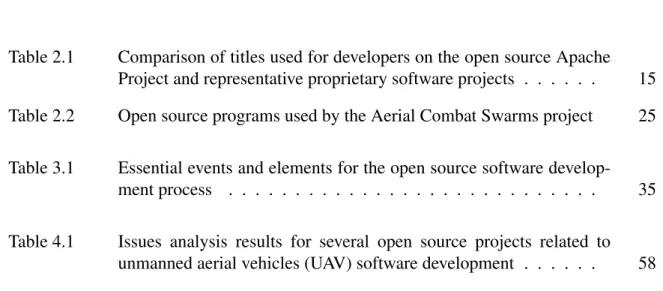
Furthermore, the trend of increased OSS usage does not show signs of slowing. Figure 2.1 shows the estimated number of open source projects by year since 2007. The rising trend of the data in Figure 2.1 indicates increasing popularity of OSS, and when combined with DOD policy preferentially adopting open source solutions [5], such growth in OSS is likely to become more prevalent in years to come. As such, going forward, it is increasingly imperative to understand how to evaluate OSS in order to select well-suited projects, if available.
2.3.2
Open Source Software Licenses
The role of intellectual property is of significant relevance in any discussion on OSS, and copyright law provides protection for developers who write software code. Generally, source code cannot be adjusted, reused, or redistributed without the specific approval from the author. If developers want to allow users access to the code that they write, approval is facilitated through a software license bound to the code. Most proprietary software restricts users from seeing the source code and prohibits any adjustment or redistribution. Such re-strictions are the primary distinctions in which OSS differs from proprietary software. Licenses can be written to include essentially anything that the code’s author desires.
Pro-Figure 2.1: Number of open source projects over time since 2007. Adapted from [14]
grams under the umbrella of OSS typically share some general characteristics. Arguably, the most important quality of OSS is that it is termed “free.” The word “free” is not used in the economic sense, but in the sense of liberty, as in the freedom to do what one wants with the product. Open source licenses aim to guard this freedom and protect the programmers who build open source code.
Developers have created “free” programs since the beginning of software to maximize cre-ative development and to learn from one another. It was not until 1998 when a formalized definition of OSS was created. At this time, the Open Source Initiative (OSI) was estab-lished to provide governance over open source license definitions. OSI is a non-profit, community-recognized body for reviewing and approving licenses that conform to their definition of open source [15]. The following requirements must be included in an OSS license for OSI approval.
1. Must allow redistribution of the software
2. Must make the source code available with the program 3. Must allow modifications and derived works
5. Must not discriminate against persons or groups 6. Must not discriminate against fields of endeavor 7. Must apply to all to whom the program is distributed 8. Must not be specific to a product
9. Must not restrict other software 10. Must be technology-neutral
The software community claims these attributes are essential for a program to be consid-ered OSS. While there are several types of OSS licenses in existence, they all share these baseline characteristics.
The vast majority of operational open source software is governed by a relatively small number of licenses. These include the Apache License (2.0), the Massachusetts Institute of Technology (MIT) License, the GNU General Public License, and the Mozilla Public License 1.1. It is good to have a general understanding of the primary licenses that are used because 90 percent of all OSS software uses just the top 10 license types [16].
Awareness of the details of the governing license is essential for any software development initiative, whether open or otherwise, to avoid infringing on copyright law. For example, the GNU General Public License requires that modified code be redistributed under the same license. For a government project, such a requirement may preclude the use of software for certain use cases or applications, as, for example, the DOD may not want developed software to be redistributed to the public for security and/or classification reasons.
Perhaps even more relevant in the open source community, OSS licenses are an impor-tant part of software development, as they protect both the authors and the users of OSS programs, and additionally, give developers freedom to define how their code must be used.
2.3.3
Open Source Software Development Process
The development process for OSS differs depending on the project. Many software devel-opers enjoy these types of projects due to the inherent freedom they provide. Although OSS development does not follow one single set of guidelines, most successful projects employ some sort of structure that mimics one or more of those used by companies developing pro-prietary software. One example is the Apache web server project, which is a widely used
open source software program designed for server computers for hosting websites. Now a large project that has been under development since early 1995 [17], the vast majority of websites use this software, and Apache is considered very secure and robust [18]. A pre-vious study analyzed several aspects of this and other open source software programs [10]. In the case of Apache, it was noted that among the community of developers contributing to the project, there exists a well-defined structure and hierarchy for different types of de-velopers. The developers who contribute the most and are active the longest typically have higher levels of responsibility and access to the primary source code.
Many projects’ organizational structures are similar to Apache’s, where often, developers can be grouped based on their level of involvement. Some examples of unofficial titles of people submitting code to the project include “release manager,” “senior core group members,” “core group members,” and “standard developers.” For example, Table 2.1 lists the developer titles used in the Apache program and their proprietary counterparts [10]. Despite the difference in the openness of the software, these positions within an OSS project hierarchy often reflect similar software engineering positions that a commercial software firm, such as Microsoft, would employ for a given software project.
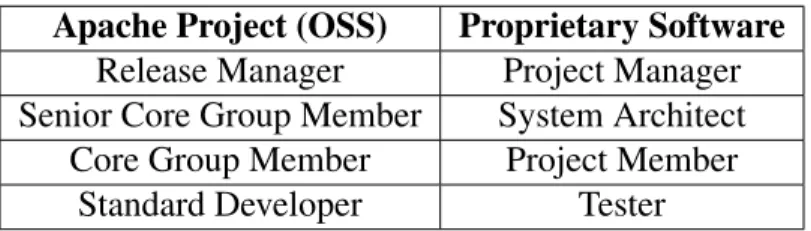
Apache Project (OSS) Proprietary Software
Release Manager Project Manager Senior Core Group Member System Architect Core Group Member Project Member
Standard Developer Tester
Table 2.1: Comparison of titles used for developers on the open source Apache Project and representative proprietary software projects
No matter how loosely structured a development process for OSS, successful programs can be seen to follow common development management schemes. Open source software is most often created by “massive parallel development” [19], in which, typically, a single lead developer (or group of “core” developers for a large project) organizes the project and guides its direction. Secondary developers write code, test the software, and can often make recommendations for the project.
In a study looking at several sources describing the OSS development process, Acuna notes that Institute of Electrical and Electronics Engineers (IEEE) standard practices are used for
many OSS projects [20]. IEEE defines five categories of design which encompass 28 total activities. Of the 28, 15 areas are specifically mentioned in the studies examining different open source software projects. Despite the popular theory that OSS development varies drastically from proprietary software, in reality, there are more parallels and similarities than there are differences.
Largely in response to potential misconceptions surrounding OSS, the DOD chief informa-tion officer published answers to several frequently asked quesinforma-tions regarding OSS [21]. The paper addressing the FAQs discusses how code progresses from primary developers to the finished product. The project is first created and the source code is placed into a trusted repository on the internet, where only certain developers (i.e., “trusted developers”) have access. The trusted developers are typically those who either started the project itself or those members of the software development community hand-selected by the founding developers. Once the project is online, general users and developers typically have access to the source code and can download, manipulate, and distribute it as they wish. As they continue to use this software, these developers can often directly provide feedback in the form of bug reports and modification requests. Although some users can change the ex-isting code in order to make improvements or address a bug they have found, these users cannot simply change the source code that exists in the trusted repository because they are intentionally not granted access. For a general developer to incorporate his changes into the original source code, the trusted developers first evaluate the potential contribu-tion for quality and adherence to compatibility and coding convencontribu-tions, and then allow the change if they approve said changes or additions. In this way, OSS can progress from a small project to a large repository of code that is potentially actively used, maintained, and updated by a large group of software developers.
One notable stark contrast to proprietary software development is the common lack of face-to-face meetings that occur among OSS software developers, and as such, OSS projects are usually characterized by large numbers of involved individuals who are not usually co-located (nor need they be). Such teams of OSS developers leverage remote communication and collaboration tools, such as online repositories and software management systems, real-time chat and discussion forums, email distribution lists, as well as conventional web-sites to maintain connectivity. The source code usually resides on a server typically readily
accessible via the internet. Using these techniques, developers remain aware of the ongo-ing progress of the project and the contributions of community members. Although this visibility and transparency is often touted as a strength of OSS, as will be seen in the anal-ysis presented in this thesis, such access via online portals provides a potential avenue for anonymity among people working on the project, in that members can often join an open source repository and provide inputs without supplying their true name or other identifying information.
Developer Incentive for Contributing to OSS
At first glance, one might think it counter-intuitive that a software developer would want to share work freely after spending time and effort in the software’s implementation. In other words, not immediately evident is how such a system could continue to exist, with developers producing code and distributing it without payment or exchange of goods in return. However, as detailed below, numerous motivating factors continue to inspire open source programmers and allow these types of projects to progress, let alone exist.
A possible reason an individual may be motivated to engage an open source software project is his or her interest in learning about how a particular program or function works. By joining an open source project, the developer gains access to a wealth of information provided by a diverse team of programmers of varying skills and backgrounds. One study highlights that “learning is one of the driving forces that motivate developers to get involved with OSS projects because it provides the intrinsic satisfaction for OSS developers” [22]. These learning opportunities hold value that cannot necessarily be measured in quantifiable dollars, but is measurable in education and increased technical abilities [23].
Other OSS contributors may be paid employees of commercial corporations assigned to work on open source projects, as it is in the interest of commercial software companies such as Google or Microsoft to provide inputs to open source projects. With OSS popu-larity increasing, large projects are beginning to have significant influence in the software community as a whole. These companies want to ensure that they remain aware of tech-nology progression and provide direction at times. One of the ways they do this is by maintaining a paid staff dedicated to being involved with open source projects. One ex-ample is the Dronecode [24], which is an open source project structured under the Linux
Foundation. The project was founded and is still supported by commercial entities such as 3D Robotics, Baidu, Laser Navigation, and Walkera [25], which employ software develop-ers to actively participate, guide, and/or lead development efforts.
Programmers can also use open source collaboration for résumé building. If a developer provides a significant impact to an open project, such investment in time and training has often been rewarded with additional employment opportunities or advancement. In addition to potential job offers arising from demonstrated software development skill sets, a current employee might also use open source work as a measure of professional development and value to negotiate a pay raise. Despite the general notion that programmers build OSS without selfish interest in mind, there are many ways to profit from such efforts [26]. Although monetary motives are plausible and often likely, some people enjoy writing code simply for the satisfaction gained by helping others. This altruistic mindset can have a lasting impact on the software community, as mentors teach apprentices and knowledge is passed freely among collaborators, as evidenced by the success of various online discus-sion boards providing such help forums, including those focused on computation and/or programming questions such as StackOverflow [27]. Many software developers share a common desire to help each other progress in their field [28], ultimately leading to not only progress of the software project, but also the cultivation of an increasing population of software developers that can contribute to that and other software projects.
2.3.4
Advantages and Disadvantages
Regardless of motivation, OSS continues to gain popularity across diverse swaths of ap-plication areas, research domains, and consumer sectors. In providing a perspective or philosophy that may be different from traditional software development methods, various benefits or penalties exist to the use of open source software.
The advantages of open source software are often debated due to the number of people and companies on either side of the argument, however, there is research that shows some undeniable benefits of existing open source software programs and their impact on the DOD. The benefits are technically oriented, such as higher security and higher reliability, and business oriented, such as lower cost and higher business functionality. Many of the
highlights presented here summarize a study on the benefits and drawbacks of OSS [29], in which the study team interviewed 13 software and information technology (IT) firms to draw from their experience with OSS.
Competition
Competition among vendors is generally accepted as being healthy for the software engi-neering market. Open source software allows people with similar interests and goals to come together and work toward a common cause. These people are often motivated by personal interest and often work on open source projects during their free time, and may build software because the commercial-off-the-shelf (COTS) software already in existence does not offer a solution that satisfies their needs. As these OSS initiatives develop and offer new software alternatives, commercial suppliers are forced to honor the upgrades and advances in features and functionality. Ultimately, the extra competition leads to better software technology. Even if OSS is not used directly, the existence of these options such as OpenOffice [30] and LibreOffice [31] forces commercial programs like Microsoft Word to stay current and keep up with competing programs. The competition also affects the cost of commercial products. Without open source products on the market, proprietary software would likely demand a higher value which would translate to higher cost for the consumer.
Security
There are some open source products designed specifically with security in mind. One such product used by the DOD is Open Berkeley Software Distribution (OpenBSD), an operating system that touts its security and reliability as one of its strongest features. Critics of open source software claim that due the accessibility of OSS, any foreign entity could infiltrate a critical program with malicious software [32]. Proponents defend open source software, saying that malicious software would have to pass under the watchful eye of every developer working on the project, which could number in the hundreds or thousands of programmers for large projects. Morgan and Finnegan’s study highlights that the majority of firms interviewed thought OSS provided higher security due to “the availability of source code, the reduced threat of viruses, and the extra awareness of security in the design phase of projects.” [29]
When considering the security of software, it is important to note that regardless of whether a piece of software is open source or not, there is potential for it to have security flaws. As such, numerous researchers have studied and generated statistics comparing the security flaws of proprietary software to open source versions (such as Internet Explorer compared to Mozilla Firefox), which typically conclude that vulnerabilities are, in fact, much more prevalent in commercial versions [33]. However, the implicit benefit leveraging a larger number of people working with OSS to improve prevention of bugs from being introduced or residing in the code base relies heavily on the skills and initiative of the specific user and developer community for that software project. For example, some open source projects are highly active and are likely to better exhibit the aforementioned advantage, whereas other projects are less actively managed or developed. In the latter case, if software users do not search for issues, the issues have a higher probability of remaining in the code [34]. Even though these studies find in favor of OSS in many cases, OSS under consideration for use or inclusion should be carefully assessed to include evaluation of the vibrancy of the given project as a potential indicator of its level of security.
Creativity
One measure of creativity is the speed at which functions are developed for a software project. This “growth rate” projects experience serves as an indicator of the level of inno-vation that a project possesses. Paulson et al. gathered empirical data showing creativity to be higher in open source projects when compared to proprietary projects [35]. Typically growth is highest at the start of projects and decreases over time. The study compared the growth rate of proprietary and open source projects by analyzing the number of functions created over the lifetime of the projects. The results consistently showed that the number of functions created, as measured by growth rate over their lifespan, was higher for open source projects.
There could be several reasons for higher creativity in OSS, including the intrinsic moti-vation for OSS programmers to help their fellow community members [28]. Also, good developers in open source communities are recognized and typically highlighted quickly, while commercial employees often cannot receive broad recognition (outside of the com-pany) by releasing their code. Open source developers can select which software they develop, and tailor their work to applications that interest them most.
Further, usually people who write code for open source projects are users of the products. This vested interest spurs motivation to design high-quality code that meets their current and future needs. OSS also encourages users to view and be familiar with projects that are similar to the ones they are working on, which has the additional benefit of enhancing the community’s understanding of the technology involved and allows developers to uti-lize portions that have already been accomplished. As such, availability of existing open source projects avoids having to reinvent sections or sub-routines or entire libraries. In this way, open source software can potentially support a faster development process and enable advancing the software technology quickly.
Progression
The fact that OSS is used by a growing number of people is a good indicator that it has significant advantages over proprietary software. Over 60 percent of corporations cur-rently use OSS and consider OSS options before looking into proprietary programs. Over 50 percent of these companies also say that at least half of their engineers participate in open source projects [14]. Companies are clearly seeing good results from open source programs, as evidenced by their willingness to fund OSS projects and their adoption of OSS applications for their own use. Perhaps the biggest indicator that OSS is becoming more embedded in the software community is that companies are paying to be involved by allowing their employees to make open source contributions without receiving specific compensation.
Disadvantages
In the previously cited study, Morgan and Finnegan also highlight several disadvantages that companies have experienced using OSS [29]. One of the most common is lack of ex-pertise, which often prevents people from considering open source options. Often, project managers fear that their employees have too little experience with the OSS to facilitate a smooth transition. The apprehension can often be attributed to unfamiliarity, which could potentially be overcome by introducing open source concepts and including such OSS op-tions when considering types of software to use, purchase, or integrate.
consis-tently a larger problem for OSS than for commercial projects. The root of this problem for certain OSS projects may be due to the given open source process being less formalized than in proprietary companies, or due to other reasons such as the absence of self-regulation or governance over development procedures for open source, or simply less time devoted to proper documentation. Another issue is that the primary users of OSS are often the de-velopers themselves, and do not need as much documentation as an end user who did not participate in building the code. As a result, novice-friendly documentation may be harder to generate. In contrast, the end user of commercial products is not only unfamiliar with the development, but cannot view the source code, so the documentation must necessarily be focused on clarity and simplicity.
On the business end, users of OSS may often find it difficult to adopt the software be-cause there is a lack of support. Despite acquiring an application free of charge, support often comes at a premium and can sometimes be inadequate or slow. Another problem for businesses is often the lack of accountability in some open source programs, and compa-nies may have liability concerns when using OSS. OSS licenses almost always contain a clause indicating the authors are not responsible for anything the user does with the code. In contrast, proprietary companies can have reliability or security guarantees written into contracts to protect the customers.
2.4
Unmanned Aerial Vehicles
As the prevalence of UAVs increases, so to does the software enabling automated or even autonomous capabilities in these systems, as the commands performed by a pilot in a con-ventional aircraft are replaced by software-generated commands in an UAV. To highlight this point, the U.S. Air Force began developing unmanned aircraft in 1960 after concerns over pilot attrition during the Cold War [37]. Since then, the drone market has expanded in the military and in civilian sectors substantially. In 2010, 41 percent of aircraft in the DOD were unmanned [38]. Figure 2.2 shows the expected increase in market capitalization for drones in civilian and military sectors [39].
Two types of UAVs exist. These are remotely piloted aircraft and autonomous aircraft. Most UAVs used in current combat are remotely piloted, meaning a person makes nearly all decisions related to basic flight and mission. Other aircraft are autonomously controlled,
Figure 2.2: Global aerial drone market through year 2024. From [39]
meaning an aircraft operates without the intervention of a pilot [40]. A relatively new advent in unmanned flight is the use of multiple UAVs cooperating toward a common goal, also known as a swarm of UAVs.
2.4.1
Swarm Concept
Many of the OSS programs studied in this analysis are used by ARSENL as a part of the Aerial Combat Swarms (ACS) project. A group of aircraft is considered a UAV swarm if they can communicate with each other and perform cooperative tasks as a group [41]. Swarms can be advantageous due to the low cost of individual aircraft, and in the case of warfighting effectiveness, a group of several or many aircraft may have the ability to overwhelm advanced defensive systems that could otherwise easily handle one larger plane. Live-fly (i.e., outdoor) swarm UAV research and development is currently limited due to civilian regulations prohibiting operations of two or more drones (another term for UAV) at once [42]. Some exceptions exist, leveraging access to military resources and venues, allowing for efforts in UAV swarms at various institutions such as NPS. For example, NPS
researchers have a goal to conduct experiments involving up to 100 UAVs in simultaneous flight operations [43] in the ACS project. Due to the numbers of aircraft involved in the operation, human interaction with individual aircraft is necessarily limited, and instead, success of the swarm will be dependent on software-derived capabilities via advanced au-tonomous software.
2.4.2
Software Components in the Swarm Environment
ARSENL uses software in several capacities during UAV swarm operations. On the indi-vidual aircraft, software is used in flight control systems, in payload management systems, in communications systems, in sensor processing, and in Command and Control (C2) sys-tems. There is often a command station which utilizes software to provide individual and/or group instructions to various aircraft in the swarm. Depending on the size of the swarm, multiple stations can be used.
The State of Open Source Software for UAVs
OSS for UAVs has been in production since at least 2003 [44], as there are many projects designed specifically for drones including APM/Ardupilot, OpenPilot, and PaparazziUAV. The community is made up of primarily hobbyists who build software and hardware for small aircraft on their free time. OSS for UAV has recently drawn interest from large or-ganizations such as the Linux Foundation, which, in 2014, enabled the Dronecode Project, which aims to unite software developers, hobbyists, and commercial companies in the com-mon goal of creating a standard for drone OSS development. The project has already drawn 1200 programmers who provide over 150 daily code commits (submissions of written code) on some projects [25]. This support and popularity showcases the growing potential of open source solutions for drone software.
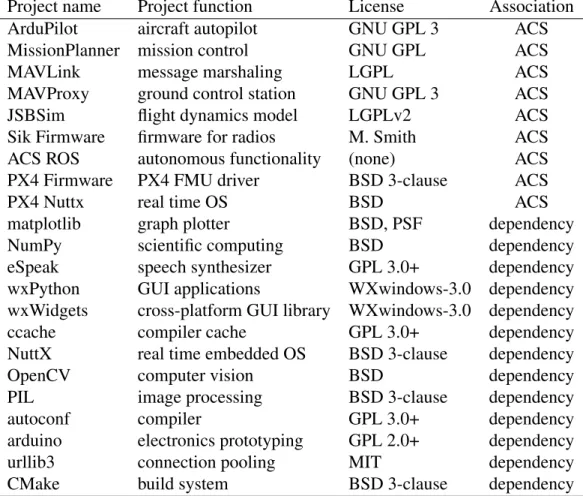
A partial list of software used by ARSENL at NPS in their software design and develop-ment in support of UAV swarm research is shown in Table 2.2. Licenses used by each program are shown for general reference, and more information regarding the differences between each license can be found online [45]. The association column indicates whether the OSS program is used directly for ACS development, or indirectly as a dependency for another part of the ACS development process. Many of the programs are related to one
Project name Project function License Association
ArduPilot aircraft autopilot GNU GPL 3 ACS
MissionPlanner mission control GNU GPL ACS
MAVLink message marshaling LGPL ACS
MAVProxy ground control station GNU GPL 3 ACS
JSBSim flight dynamics model LGPLv2 ACS
Sik Firmware firmware for radios M. Smith ACS
ACS ROS autonomous functionality (none) ACS
PX4 Firmware PX4 FMU driver BSD 3-clause ACS
PX4 Nuttx real time OS BSD ACS
matplotlib graph plotter BSD, PSF dependency
NumPy scientific computing BSD dependency
eSpeak speech synthesizer GPL 3.0+ dependency
wxPython GUI applications WXwindows-3.0 dependency wxWidgets cross-platform GUI library WXwindows-3.0 dependency
ccache compiler cache GPL 3.0+ dependency
NuttX real time embedded OS BSD 3-clause dependency
OpenCV computer vision BSD dependency
PIL image processing BSD 3-clause dependency
autoconf compiler GPL 3.0+ dependency
arduino electronics prototyping GPL 2.0+ dependency
urllib3 connection pooling MIT dependency
CMake build system BSD 3-clause dependency
Table 2.2: Open source programs used by the Aerial Combat Swarms project
another and they have several uses, including software development, aircraft control, air-craft communication, ground control operation, sensor processing, and data management. The majority of software used by the lab for ACS is open source. ACS is one example that showcases the potential of OSS. The programs that ARSENL use continue to provide advanced capabilities for conducting experiments with large groups of unmanned aircraft.
CHAPTER 3:
Survivability Analysis
3.1
Introduction
This chapter introduces the concept of survivability, explores its utility in the context of UAVs, and uses it to analyze the ability of the open source development process to defend against attack. The methodology for completing a survivability analysis is shown using data gathered from one OSS program, and conclusions are drawn regarding the program’s resilience against such an attack.
3.2
Need for Survivability Analysis
Since the early 1970s, one of the most important fields of study for the development of U.S. military aircraft has been aircraft combat survivability. During the conflict in South East Asia, the U.S. experienced significant aircraft losses as a result of enemy integrated air defense systems, and in 11 years of conflict, approximately 5000 helicopters and fixed-wing aircraft were downed by the North Vietnamese [46]. By 1965, enemy air defenses were significantly developed since previous major conflicts including World War II (WWII) and the Korean War. The North Vietnamese’s integrated air defense system (IADS) was more advanced, incorporating surface-to-air missiles (SAMs) acquired from Russia that were capable of reaching altitudes higher than the operational ceiling of most fixed-wing aircraft in the U.S. inventory. This forced aircraft into low-altitude attack profiles which were well inside the engagement envelope of anti-aircraft artillery (AAA) systems. Aircraft designers did not anticipate this kind of resistance and consequently, the aircraft were not well-equipped to avoid or sustain hits from SAM and AAA systems.
The tactics and combat systems employed by the U.S. were also inadequate to carry out the missions required during the conflict. The first laser-guided bomb was not fully developed until midway through the war in 1968, and up until this time, aircraft were using primarily unguided munitions (dumb-bombs) to destroy targets [47]. Between 1965 and 1968, Op-eration Rolling Thunder pitted the vast might of America’s military power against supply
![Figure 2.1: Number of open source projects over time since 2007. Adapted from [14]](https://thumb-us.123doks.com/thumbv2/123dok_us/1501771.2701146/38.918.168.752.152.494/figure-number-open-source-projects-time-adapted.webp)
![Figure 2.2: Global aerial drone market through year 2024. From [39]](https://thumb-us.123doks.com/thumbv2/123dok_us/1501771.2701146/48.918.197.722.152.544/figure-global-aerial-drone-market-year.webp)