Procedia Engineering 15 (2011) 5279 – 5283 1877-7058 © 2011 Published by Elsevier Ltd. doi:10.1016/j.proeng.2011.08.978
Procedia
Engineering
Procedia Engineering 00 (2011) 000–000 www.elsevier.com/locate/procediaAdvanced in Control Engineering and Information Science
Rotor Fault Analysis of Classification Accuracy Optimition
Base on Kernel Principal Component Analysis and SVM
Xiangyang JIN
a, Lin LIN, Shisheng ZHONG, Gang DING,a*
School of Mechatronics Engineering, Harbin Institute of Technology, Harbin 150001, China
Abstract
Directing at the problems that it is hard to determine fault type if the vibration of aero-engine’s rotor system is over standard during the maintenance testing, a fault diagnosis approach based on kernel principal component analysis (KPCA) feature extraction and multi-class support vector machines (SVM) is proposed. This method first takes the use of nonlinear feature extraction of KPCA to extract the feature of testing cell standard fault samples. By computing the inner product kernel functions of rotor vibration signal’s original feature space, the nonlinear map of rotor vibration signal transformed from low dimensional feature space to high dimensional feature space is achieved. The nonlinear principal components of original feature are obtained by performing PCA on the high dimensional feature data. Then, the nonlinear principal components are taken as eigenvectors of multi-class SVM to perform training and test. During the training period, optimize the relatively parameter by adopting cross optimization algorithm to find out the best penalty parameter and kernel function parameter. A high classification accuracy of training set and test set is sustained, overfitting and underfitting are avoided. Experiment results indicated that this method had good performance in distinguishing different fault modes for high-speed rotor, and was suitable for machinery’s state recognition.
© 2011 Published by Elsevier Ltd. Selection and/or peer-review under responsibility of [CEIS 2011]
Keywords:Test Cell; KPCA; Feature Extraction; Muti-SVM; Fault Classification; 1. Main text
Monitoring technology can provide effective warning information in the initial stage of fault to reduce the losses[1]. The monitoring process needs to measure many variables, there is a correlation between
* Corresponding author. Tel.: 13304513005; fax: 0451-57355791. E-mail address: [email protected] .
Open access under CC BY-NC-ND license.
different variables, if several correlative variables can be reduced to a few independent variables, removing the redundant information obtained in the monitoring process[2], and then we can find the root
cause of fault from the remaining independent variables.
Now the most frequently used variable dimension-reduction methods are Principal Component Analysis (PCA), Canonical Variate Analysis (CVA), Independent Component Analysis (ICA) and Fisher Discriminant Analysis (FDA)[3], these methods are all linear dimension-reduction methods, assuming that
there is a linear correlation between variables in each process, and then adopt dimensionality reduction and extraction of independent variables to achieve the process monitoring and diagnosis.
Kernel Principal Component Analysis feature extraction is more suitable for extracting data’s nonlinear features in nonlinear fault feature extraction[4,5]. Support Vector Machine can achieve good classification
results in the case of very few training samples[6-7], it has a strong generalization and anti-interference
ability.
2. Kernel Principal Component Analysis (KPCA) Feature Extraction
In this method, a pre-selected set of nonlinear mapping can map the input data to a high dimensional feature space to make the input data have a better separability, by choosing different kernel functions can get different nonlinear features. KPCA can achieve the transformation from input space to feature space through the nonlinear mapping
Φ
,and then perform linear PCA on the mapped data, so it is of a strongnonlinear processing ability.
For the M samples in input space
x k
k(
=
1,2, ,
L
M
)
,x
k∈
R
N , assuming ,then its covariance matrix is 10
M k kx
==
∑
11
M T j jx x
jM
==
∑
C
.For general PCA method, we can obtain the eigenvalue with large contribution rate and its corresponding eigenvector by solving the characteristic equationλν
=
C
ν
.Nonlinear mapping function
Φ
is introduced to change the sample pointsx x
1, , ,
2L
x
Min the input space into sample pointsΦ
( , ( ), , ( )
x
1)
Φ
x
2L
Φ
x
M in the feature space, and assume that1
( ) 0
M k kx
=Φ
=
∑
(1) Thus the covariance matrix in the feature space F is1
1
M( ) ( )
T j j jC
x
M
==
∑
Φ
Φ
x
(2) Therefore, the PCA in feature space is to solve the eigenvalueλ
and the eigenvectorV F
∈
\ 0
{ }
in equationλν
=
C
ν
, therefore there is( ( ) )
x
k( )
x C
k(
k
1,2, , )
M
λ
Φ
ν
= Φ
ν
=
L
We can notice that
ν
in the above formula can be expressed byΦ
( )( 1,2, , )
x i
i=
L
M
in the way of linear, that is 1( )
M i i ix
ν
α
==
∑
Φ
(4) It is available from the above formula (2) - (4) that1 1 1
1
( ( ) ( ))
( ( )
( ))( ( ) ( ))
M M M i k i i k j j i i i jx
x
x
x
x
x
(
k
=
1, 2, ,
L
M
M
λ α
α
= = =Φ
Φ
=
Φ
Φ
Φ
Φ
∑
∑
∑
)
, (5)Define the
M
×M
matrixK
:( ) ( )
ij i j
K
= Φ
x
Φ
x
2
Formula (4) can be simplified as
M K
λ α
=
K
α
(6)M
λα
=
K
α
(7) which obvious satisfiesSo it absolutely satisfies formula (6). By solving the formula (7), we can obtain the required eigenvalues and eigenvectors. The projection of test samples on vector
V
kof space F is1
(
k( ))
M k( ( ) ( ))
i i iV
x
α
x
x
=Φ
=
∑
Φ
Φ
(8) All above are derived under the premise of the mapping data mean is zero, that is to say formula (1) is feasible, if not feasible in some cases, k in formula (7) can be replaced by
K
.
2 1 1 , 11
M1
1
M1
1
M1
ij ij im mj in nj im mn nj m n m nK
K
K
K
K
M
=M
=M
==
−
∑
−
∑
+
∑
1
1
In this formula,
1
ij=
(it is feasible for alli
i andj
)3. Simulation Application Research
The specific implementation steps of vibration fault classification approach for aeroengine based on Kernel Principal Component Analysis mode and Support Vector Machines (SVM) proposed in this paper are shown in figure 1[8-10] . Data is collected from certain type of engine of engine repair shop in Air
China Beijing Aircraft Maintenance Engineering Co., Ltd (Ameco), data is collected when engine test cells simulating different faults.
Fig.1 Aeroengine vibration fault classification flow chart
In order to establish fault classification mode based on KPCA and multi-classification SVM, we conduct process monitoring on three kinds of common faults. First, respectively collect the vibration data of normal state, fault of pedestal looseness, vibration and crack of oil tube, turbine blade damage, for each type of work state, select 6 sensors data of system for feature extraction, which respectively are: exhaust gas temperature EGT, fuel flow FF, lubricating oil consumption WF, engine pressure ratio EPR, and
low-pressure rotor N1, low-low-pressure vibration V1. Each working state performs 120 times of samplings at a certain sampling frequency, a total of 480 sampling data is obtained.
Perform normalization on 3 kinds of faults, 6 types of data collected from the sensors in the interval [0,1]. Select 20 samples for 3 kinds of faults, choose EGT and FF, V1 and N1 as the projection direction, thus the projection drawing is shown in Figure 2[11,12].
EGT
FF
0 1
1
Pedestal looseness vibration and crack of oil tube turbine blade damage
Fig.2 Two dimensional projection of three faults sample data
The figure shows that the situation of sample data of three kinds of faults mixed together is linearly inseparable.
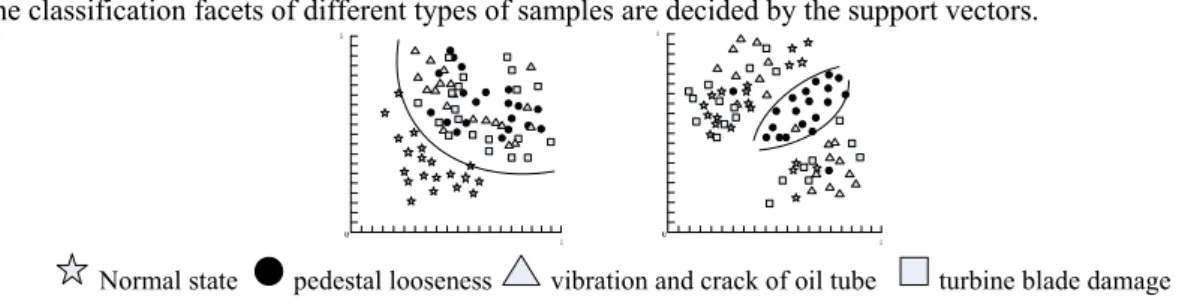
Figure 3 is the classification results of some samples after KPCA feature extraction on 3 kinds of fault data by the using of radial basis function, Least Squares Support Vector Machine classification method. The classification facets of different types of samples are decided by the support vectors.
Normal state pedestal looseness vibration and crack of oil tube turbine blade damage
Fig.3 SVM classification facet of three faults model
It can be seen from the figure that after the KPCA feature extraction, different faults can achieve a clearer classification by SVM.
The following table 1 is to select KPCA-SVM method, PCA-SVM, neural network, SVM method based on fault feature sample, it is a contrast based on the data classification of fault modes of normal state, pedestal looseness, vibration and crack of oil tube, turbine blade damage (120 groups for each mode). It can be seen from that the KPCA classification method selected based on the features of fault samples can improve the classification accuracy in the condition of guaranteeing the arithmetic speed, which has a better performance than other classification methods.
Table 1 Testing Performance Contrast of RBF and SVM Classification
Network type Average training time (s) Classification accuracy(%)
Normal Pedestal looseness Crack of oil tube Turbine blade
RBF 8.78 95 90.73 93.45 88.74
SVM 7.56 96.25 89.62 92.48 90.33
KPCA-SVM 6.56 100 97.34 98.23 96.47 4. Conclusions
(1) Integrate the Kernel Principal Component Analysis extraction technology and Support Vector Machine and then applied in the classification of machinery fault diagnosis mode, its performance is superior to many existing methods. For small samples, the diagnostic accuracy is higher. For high-dimensional samples, the diagnosis speed is faster.
(2) The parameters in the testing modes of Support Vector Machine have a larger influence on the detecting accuracy, such as the penalty parameter c and kernel function can affect the classification performance of Support Vector Machine, although it can be decided by a large number of man-made tests and be found by the using of cross-examination, there is no practical universal programs and lacks of theoretical guidance, so how to set these parameters to allow for better performance of SVM is a worthy research direction.
Acknowledgements
This work was supported by the Key Program of National Natural Science Foundation of China(No.60939003,50805032),and the National High Technology Research and Development Key Program of China(No.2009AA043404) ,and Scientific Research Fund of Heilongjiang Provincial Education Department(No.12511124).
References
[1]Chen Guo. Introduction to Aircraft Detection and Diagnosis [M].Beijing: Civil Aviation of China Publishing House, 2007. [2] Li Hongkun, Ma Xiaojiang.Pattern Recognition of diesel engine by using kernel principle component analysis and support vector machine [J].Journal of Vibration, Measurement & Diagnosis, 2009, 29(1):42-45.
[3] Zhang Xi,Yan Weiwu,Liu Zhenya,et al. Process monitoring and fault diagnosis of condenser using KPCA and PSVM[J] .Proceedings of the CSEE,2007,27(14):56-61.
[4]Wen Bangchun, Wu Xinhua, Ding Qian, et al.Nonlinear dynamics of rotating machinery fault theory and experiment [M].Beijing: Science Press, 2004.
[5] Zhu Ning, Feng Zhigang, Wang Qi.Fault diagnosis of rocket engine ground testing bed based on KPCA and SVM [J].Journal of Harbin Institute of Technology, 2009, 41(3):81-84.
[6]Yuan Shengfa,Chu Fulei.Support vector machines and its applications in machine fault diagnosis[J] .Journal of Vibration and Shock.2007,26(11):29-35.
[7]Zhang Xuegong.Introduction to Statistical learning theory and support vector machines[J].Acta Automatica Sinica,2000,26(1):32-42.
[8]Xiao Jianhua.Intelligent mode recognition method [M].Guangzhou: South China University Press, 2006. [9]Fang Ruiming.Support vector machine theory and application [M].Beijing: China Electric Power Press, 2007.
[10]Yu Dejie,Chen Miaofeng,Cheng Junsheng,et a1.Fault diagnosis approach for rotor systems based on AR model and support vector machine[J].Systems Engineering Theory Practice,2007,27(05):152-157.
[11]Li Weihua,Shi Tielin,Yang Shuzi.Rotor fault diagnosis method based on kernel function approximation[J].Chinese Journal of Mechanical Engineering,2006,42(9):76-82.
[12]MATLAB Chinese forum.MATLAB neural network analysis of 30 cases [M] .Beijing: Beijing University of aeronautics and astronautics press, 2010.