T
HE
UNIVERSITY OF
SYDNEY
D
OCTORAL
T
HESIS
Power system stability scanning
and security assessment using
machine learning
Author:
Ruidong L
IUSupervisor:
Dr. Gregor Verbiˇc
A thesis submitted in fulfillment of the requirements
for the degree of Doctor of Philosophy
in the
The Centre for Future Energy Networks
Electrical & Information Engineering
iii
Declaration of Authorship
I, Ruidong LIU, declare that this thesis titled, “Power system stability scan-ning and security assessment using machine learscan-ning” and the work pre-sented in it are my own. I confirm that:
• This work was done wholly or mainly while in candidature for a re-search degree at this University.
• Where any part of this thesis has previously been submitted for a de-gree or any other qualification at this University or any other institu-tion, this has been clearly stated.
• Where I have consulted the published work of others, this is always clearly attributed.
• Where I have quoted from the work of others, the source is always given. With the exception of such quotations, this thesis is entirely my own work.
• I have acknowledged all main sources of help.
• Where the thesis is based on work done by myself jointly with others, I have made clear exactly what was done by others and what I have contributed myself.
Signed: Date:
v
The University of Sydney
Abstract
Engineering & Information Technologies Electrical & Information Engineering
Doctor of Philosophy
Power system stability scanning and security assessment using machine learning
Power systems are undergoing a major transformation driven by the in-creasing uptake of renewable energy sources, DC power transmission, and the decentralization of electric power supply, like rooftop PV, energy stor-age, home energy management systems, and electric vehicles. How future grids will look like, however, is still uncertain as the evolution depends not only on technological development but also on the regulatory environment.
Future grids planning thus requires a major departure from conventional power system planning, where only a handful of the most critical scenar-ios is analyzed. To account for a wide range of possible future evolutions, scenario analysis has been proposed in many industries. As opposed to the conventional power system planning, where the aim is to find an optimal transmission and/or generation expansion plan for an existing grid, the aim in future grids scenario analysis is to analyze possible evolution pathways to inform power system planning and policy making. Therefore, future grids’ planning may involve large amount of scenarios and the existing planning tools may no longer suitable.
Other than the raised future grids’ planning issues, operation of future grids using conventional tools is also challenged by the new features of fu-ture grids such as intermittent generation, demand response and fast re-sponding power electronic plants which lead to much more diverse oper-ation conditions compared to the existing networks. Among all operoper-ation issues, monitoring stability as well as security of a power system and action with deliberated preventive or remedial adjustment is of vital important. On-line Dynamic Security Assessment (DSA) can evaluate security of a power system almost instantly when current or imminent operation conditions are supplied. DSA is proved to be more efficient than traditional extensive off-line security studies and is widely utilized by utilities in power systems oper-ation. However, given the new features of future grids, the existing dynamic security assessment tools also need to be examined and refurbished to suit future grids.
The focus of this dissertation are, for future grid planning, to develop a framework using Machine Learning (ML) to effectively assess the security of future grids by analyzing a large amount of the scenarios; for future grids op-eration, to propose approaches to address technique issues brought by future grids’ diverse operation conditions using ML techniques.Unsupervised learn-ing, supervised learning andsemi-supervised learningtechniques are utilized in a set of proposed planning and operation security assessment tools.
vii Research Organisationa (CSIRO) project during my candidature and my con-tribution in this project is given in the first chapter of the dissertation. To the best of our knowledge, the Future Grid Research Program funded by the CSIRO, is the first to propose a comprehensive modeling framework for future grid scenario analysis. The project aims to provide a modeling framework for the future Australian electricity grid out to 2050 and also analyze power flow, stability, security and resilience to changing technolo-gies beyond energy balancing. Diverse scenarios for levels and placement of renewable generation, different transmission and topologies, different load management strategies and storage technologies are considered. The second chapter includes scenarios design for future grids and transient stability as-sessment using time-domain simulation method based on power flow study of the scenarios. The study work carried out in the project showed very high computational burden of the conventional time-domain method and which leads to the research focus on machine learning methods to overcome the disadvantages of the existing methods in future grids planning.
One of the main contributions of the dissertation is a framework for fast stability scanning using ML for future power system planning. The ML tech-niques used in the third chapter (unsupervised learning) have been used in the past in many other power engineering applications [1, 2, 3, 4]. Imple-menting them directly to the problem of fast stability scanning, however, is infeasible because the number of operating conditions and the number of features required to describe an operating condition are much larger than in the existing applications. Unsupervised clustering technique is the first machine learning approach utilized in this dissertation to deal with future power system planning stability assessment.
DSA provides power system operators with security information of power systems for current or imminent operating conditions considering various system topologies and contingencies. The security information is basis for preventive or emergency control to prevent systems0insecurity.
Transient Stability Assessment (TSA) is one of the most important tasks in DSA. To account for the diverse operation topologies of future grids, in the fourth chapter a reliable and high accuracy TSA model (supervised learn-ing) is proposed considering various system topologies. The innovation of this model are three-fold: (i) first, from feature selection algorithm aspect, a hybrid filter-wrapper feature selection method is proposed; (ii) then, from In-telligent System (IS) training algorithm aspect, a boosting learning algorithm
is used during IS training process; (iii) last, from stability decision-making al-gorithm aspect, an Extreme Learning Machine (ELM)1-based ensemble with
a new decision making rule based on weighted outputs of ELMs is proposed to achieve 100% predictive accuracy.
The core of a TSA is called classifier which is able to give out straight away transient stability of a power system once an operating condition is fed. A key feature of a classifier is its generalization ability, which refers to the ability of the classifier to give reliable and accurate predictions using previously unseen operating conditions. The generalization ability depends on the classifier’s structure, the learning algorithm used, the training set size and its quality [9]. In supervised learning, a training set consists of a group of operating conditions and the corresponding stability labels (security indexes in DSA). The labels are normally obtained using computationally expensive time-domain simulations.
To accommodate fast changing future grids’ operation conditions, DSA classifier must be updated regularly to ensure its robustness, which requires generating new training samples and retraining. Clearly, evaluating a large amount of operating conditions in order to cover a wide range of diverse operating conditions in a training set quickly becomes computationally pro-hibitive. Reducing the number of samples in the training set is also not an option as this would reduce the classifier’s generalization ability [9].
As presented in the fifth chapter, an alternative is to use semi-supervised learning[10], which uses both labeled and unlabeled operating conditions. In this dissertation, the last contribution is a new DSA framework based on a combination of semi-supervised learning and data editing. To improve the generalization ability of a classifier, a large number of unlabeled operating conditions are used, which can be computed efficiently by power flow study. As a result, the proposed DSA framework requires significantly less labeled operating conditions to achieve a high generalization ability which satisfies future grids’ operation needs.
1The ELM used in [5,6,7] is essentially a randomized neural network with omission of
ix
Acknowledgements
I would like to express my deepest thanks to my supervisor, Dr. Gregor Ver-biˇc, for his tremendous academic guidance and encouragement throughout this research work. Thanks also go to Dr. Jin Ma for his help on publications and valuable academic suggestions.
I am also grateful to Professor David Hill for his guidance and support during my candidature in the Centre for Future Energy Networks. Special thanks go to the members of the Centre and Dr. Archie Chapman for their valuable suggestions and comments.
Finally, I wish to express my utmost gratitude to my parents, my dear wife and our kids for their care, support and love.. . .
xi
Publications
Publications during my candidature and my contribution to each publication in percentage are given below.
R. Liu, G. Verbiˇc and J. Ma, "A machine learning approach for fast future grid small-signal stability scanning," 2016 IEEE International Conference on Power System Technology (POWERCON), Wollongong, NSW, 2016, pp. 1-6.
Contributor Modeling Results Analysis Paper writing
Ruidong Liu 90% 90% 80%
Others 10% 10% 20%
R. Liu, G. Verbiˇc and Y. Xu, "A new reliability-driven intelligent system for power system dynamic security assessment," 2017 Australasian Universities Power Engineering Conference (AUPEC), Melbourne, VIC, 2017, pp. 1-6.
Contributor Modeling Results Analysis Paper writing
Ruidong Liu 90% 90% 80%
Others 10% 10% 20%
R. Liu, G. Verbiˇc, J. Ma and D. J. Hill, "Fast Stability Scanning for Future Grid Scenario Analysis," in IEEE Transactions on Power Systems, vol. 33, no. 1, pp. 514-524, Jan. 2018.
Contributor Modeling Results Analysis Paper writing
Ruidong Liu 90% 90% 80%
Others 10% 10% 20%
R. Liu, G. Verbiˇc and J. Ma, "A New Dynamic Security Assessment Frame-work Based on Semi-supervised Learning and Data Editing," Submitted to journal of Electric Power Systems Research, May 2018.
Contributor Modeling Results Analysis Paper writing
Ruidong Liu 90% 90% 80%
H. Marzooghi, M. Gramroodi, A.S. Ahmadyar, R. Liu, G. Verbiˇc, D. J. Hill "Scenario and Sensitivity Based Stability Analysis of the Australian Future Grid," Submitted to IEEE Transactions on Power Systems, 2018.
Contributor Modeling Results Analysis Paper writing
Ruidong Liu 25% 25% 20%
xiii
Contents
Declaration of Authorship iii
Abstract vi Acknowledgements ix Publications xi 1 Introduction 1 1.1 Background . . . 1 1.1.1 History of Electricity . . . 1
1.1.2 Electricity Networks Around the World . . . 1
1.1.3 Electricity in Our Life . . . 2
1.1.4 Reliable Electricity Supply. . . 2
1.2 Security Assessment in Planning and Operation. . . 3
1.2.1 Concepts of Security Assessment . . . 3
1.2.2 Existing Techniques and Methods . . . 5
1.2.2.1 Time-domain Simulation . . . 5
1.2.2.2 Deterministic Techniques . . . 6
1.2.2.3 Probabilistic Techniques . . . 10
1.2.2.4 Intelligent System Techniques . . . 11
1.3 Challenges in Future Grids Planing and Operation . . . 16
1.4 Recent Studies on Modeling of Future Grids . . . 17
1.5 Focus of the Presented Work . . . 19
1.6 Structure of the Thesis . . . 20
1.7 Methodology . . . 21
2 The CSIRO Future Grid Study Project 25 2.1 Introduction . . . 25
2.2 Project Background . . . 25
2.2.1 Existing Future Grid Studies . . . 26
2.2.2 Limitations of Existing Studies . . . 27
2.3.1 Test System . . . 28
2.3.2 Simulation Preparation and Procedures . . . 28
2.3.3 Assumptions and Scenarios Description . . . 31
2.4 Future Grid Transient Stability Study. . . 35
2.5 Transient Stability and Stability Indices . . . 36
2.6 Extended Equal-Area Criterion Brief . . . 37
2.7 Simulation Results . . . 37
2.8 Security Assessment Simulation Burden . . . 40
3 Un-supervised machine Learning Method for Fast Stability Scan-ning 41 3.1 Introduction . . . 41
3.2 Background . . . 41
3.2.1 Existing Studies . . . 42
3.2.2 Motivation Behind the Study . . . 43
3.3 Contribution of This Study. . . 44
3.4 Simulation Platform . . . 44
3.4.1 Test System . . . 46
3.4.2 Scenario Description (Line 1 in Algorithm 1) . . . 46
3.4.3 Time-series Analysis (Lines 2-5 in Algorithm 1) . . . . 46
3.4.3.1 Market Model (Line 3 in Algorithm 1) . . . . 46
3.4.3.2 Load-flow Analysis (Line 4 in Algorithm 1) . 47 3.4.4 Stability Analysis (Lines 6-8 in Algorithm 1) . . . 47
3.4.4.1 Modal Analysis . . . 47
3.4.4.2 Steady-state Voltage Stability. . . 48
3.5 Clustering and Feature Selection . . . 48
3.5.1 Clustering . . . 49
3.5.1.1 k-means Algorithm . . . 49
3.5.1.2 Particle Swarm Optimization (PSO) . . . 50
3.5.2 Feature Selection . . . 51
3.5.2.1 Relief Algorithm . . . 51
3.6 A Novel Fast Stability Scanning Framework. . . 53
3.6.1 Feature Selection for Weighted Clustering (Lines 1-5 in Algorithm 3). . . 54
3.6.2 Self-adaptive PSO-k-means Clustering (Line 6 in Algo-rithm 3) . . . 55
3.6.3 Stability Scanning (Lines 7-11 in Algorithm 3) . . . 56
xv
3.7.1 Feature Selection . . . 57
3.7.2 Clustering . . . 58
3.7.3 Small-signal Stability . . . 59
3.7.4 Voltage Stability . . . 60
3.7.5 Worst Case Operating Point Shift . . . 62
3.7.6 Simulation Burden of Stability Scanning . . . 64
3.8 Conclusion . . . 64
4 Supervised machine Learning Method for TSA 65 4.1 Introduction . . . 65
4.2 Background . . . 65
4.2.1 Existing Studies . . . 66
4.2.2 Motivation Behind the Study . . . 66
4.3 Contribution of the Study . . . 67
4.4 Extreme Learning Machine Ensemble Learning and Feature Selection . . . 67
4.4.1 Extreme Learning Machine Theory . . . 67
4.4.2 Feature Selection for IS . . . 68
4.4.2.1 Filter and Wrapper Feature Selection . . . 69
4.4.2.2 Hybrid Filter-Wrapper Feature Selection . . . 69
4.4.3 Ensemble Learning and Rule for Classification . . . 71
4.5 Simulation Platform and Stability Database . . . 73
4.5.1 The 39-bus Test System . . . 73
4.5.2 Stability Database. . . 73
4.6 Results and Analysis . . . 74
4.6.1 Results of Feature Selection . . . 74
4.6.2 Evaluation with Different System Topologies and Con-tingencies . . . 76
4.6.3 Evaluation with Hybrid Feature Selection and Boosting Algorithm . . . 77
4.6.4 Decision-making for 100% Predictive Accuracy . . . . 78
4.7 Conclusion . . . 80
5 Semi-supervised machine Learning Method for TSA 83 5.1 Introduction . . . 83
5.2 Background . . . 83
5.2.1 Existing Studies . . . 84
5.2.2 Motivation Behind the Study . . . 84
5.4 Review of Pertinent Machine Learning Techniques . . . 86
5.4.1 Training Set Size and Generalization performance . . . 86
5.4.2 Supervised, Unsupervised and Semi-supervised Learn-ing . . . 86
5.4.3 Tri-training . . . 88
5.4.4 Data Noise and Data Editing . . . 90
5.5 A New Dynamic Security Assessment Framework . . . 91
5.5.1 Training Set Generation . . . 91
5.5.2 Extreme Learning Machine Classifier . . . 92
5.5.3 Feature Selection . . . 93
5.5.4 Combined Tri-training and Data Editing Algorithm . . 93
5.5.4.1 Initialization (lines 1-4 in Algorithm 8) . . . . 93
5.5.4.2 Accuracy Evaluation (line 9 in Algorithm 8) . 94 5.5.4.3 Pseudo Labeling and Data Editing (lines 11-22 in Algorithm 8) . . . 94
5.5.4.4 Tri-training Criteria (lines 23-33 in Algorithm 8) 95 5.5.4.5 Classifier Update (lines 36-41 in Algorithm 8) 95 5.6 Simulation Platform and Stability Database . . . 95
5.6.1 The 39-bus Test System . . . 95
5.6.2 Training Set . . . 95
5.7 Case Study Results and Analysis . . . 98
5.7.1 Results of the Feature Selection . . . 98
5.7.2 Impact of the Training Set Size . . . 99
5.7.3 Impact of the Increased Penetration of Renewables . . 100
5.7.4 Semi-supervised Learning Improves Online TSA Per-formance by Using Unlabeled Samples . . . 101
5.7.5 Data Editing . . . 101
5.7.6 Comparison of TSA Classifiers . . . 102
5.8 Conclusion . . . 103
6 Conclusion 105 6.1 Conclusion of the Presented Works . . . 105
6.2 Suggestion for Future Work . . . 106
xvii
List of Figures
1.1 Stability Classification. . . 6
2.1 Simplified 14-generator model. . . 29
2.2 NEM 16-zones by AEMO. . . 30
2.3 Hourly transient stability indices of all studied scenarios. . . . 38
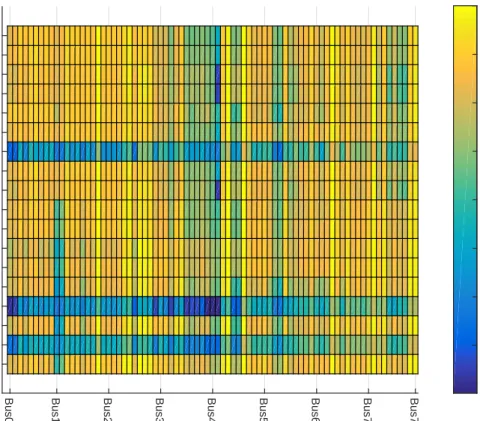
2.4 Projection of transient stability indices on all buses of all stud-ied scenarios. . . 39
3.1 14-generator test system. . . 45
3.2 Comparison of the clustering results: conventional k-means vs. the proposed self-adaptive PSO-k-means. . . 59
3.3 SSA critical damping ratio fast scanning results: (a) time series, (b) error distribution using PSO-k-means and k-means. . . 60
3.4 Convergence of feature selection: (a) SSS, (b) VS. . . 61
3.5 VSA loading margin fast scanning results: (a) time series, (b) error distribution using PSO-k-means and k-means. . . 62
3.6 SSA: Critical mode damping ratio vs. demand. . . 63
3.7 VSA: Loading margin vs. demand. . . 63
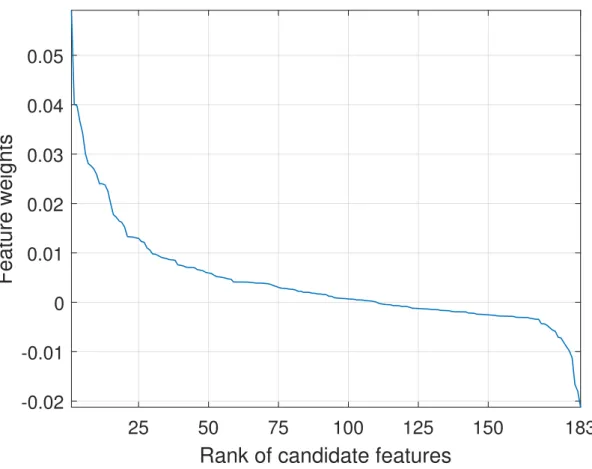
4.1 Ranked weights of candidate features as result of the RRelief-F feature selection. . . 75
4.2 Classification accuracy improvement during the SFFS process. 76 4.3 Classification accuracy affected by topology change. . . 77
4.4 Classification accuracy improved by SFFS and boosting learning. 78 4.5 Prediction results of all misclassified OCs for faults on the buses. 79 4.6 Ensemble classification using weighted outputs improves class separation. . . 80
5.1 Block diagram of the proposed DSA framework. . . 92
5.2 IEEE New-England 39 Bus System. . . 97
5.3 Top100features as a result of feature selection. . . 99
5.5 Bus voltage phase angle variance for the conventional and the renewable scenario. . . 101
5.6 Comparison of the classification results for the conventional and the renewable scenarios. . . 102
5.7 Comparison of the number of noisy samples per iteration in tri-training with and without data editing.. . . 103
5.8 Compare prediction results of supervised, semi-supervised and semi-supervised with active learning algorithms.. . . 104
xix
List of Tables
1.1 Notable Power Outages . . . 3
2.1 Abbreviations Used in Study Scenarios Description . . . 35
2.2 Comparison of Generation Portfolio . . . 35
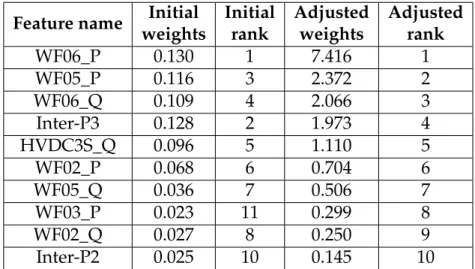
3.1 Features and weights for SSS . . . 57
3.2 Features and weights for VS . . . 58
4.1 Test System Topologies . . . 73
xxi
List of Abbreviations
CSIRO Commonwealth Scientific Industrial and Research Organisation DSA Dynamic Security Assessment
ML Machine Learning
TSA Transient Stability Assessment IS Intelligent System
AUPEC Australasian Universities Power Engineering Conference DAE Differential Algebraic Equations
DG Distributed Generation
PDF Probabilistic Density Function ELM Extreme Learning Machine ANN Artificial Neural Network SVM Support Vector Machines DT Decision Tree
PMUs Phasor Measurement Units VMV Voltage Magnitude Violation TV Thermal Limit Violation VS Voltage Stability
TS Transient Stability OCs Operating Conditions TEF Transient Energy Function CVM Core Vector Machine NEM National Electricity Market RES Renewable Energy Source
FACTS Flexible Alternating Current Transmission System CST Concentrating Solar Thermal
SH Snowy Hydro NSW New South Wales VIC Victoria
QLD Queensland SA South Australia
AEMO Australian Energy Market Operator AVR Automatic Voltage Regulation
PSS Power System Stabiliser UC Unit Commitment
PSAT Powerflow and Short-Circut Analysis Tool DSATools Dynamic Security Assessment Software SSS Small Signal Stability
EEAC Extended Equal Area Criteria TSAT Transient Security Assessment Tool TSI TS Index
VSAT Voltage Security Analysis Tool FS Frequency Stability
RoCoF Rate of Change of Frequency
NTNDP National Transmission Network Development Plan FiTs Feed in Tariffs
BS Battery System
IPBS Integrated PV-battery Systems SoC State of Charge
WF Wind Farms
PSO Particle Swarm Optimization SMSE Sum of the Mean Squared Error SDB Stability Database
BP Back-Propagation
SLFN Feedforward Neural Network
SFFS Sequential Floating Forward Selection LRS Plus-L and Minus-R Selection
PAC Probably Approximately Correct learning KNN K-Nearest Neighbor
xxiii
1
Chapter 1
Introduction
1.1
Background
1.1.1
History of Electricity
Electricity has been in use for a very long time - electric fish and eels were using it a long time before it was ever harnessed by humans. In the 18th century, Benjamin Franklin conducted an extensive famous research in elec-tricity in which he flew a kite with a dampened string and attached a metal key to the string in order to route electricity from a thunderstorm. Michael Faraday made the generation of electricity a practical possibility. Michael Faraday, in 1831, created the world’s first generator by moving copper coils through a magnetic field. The conceptual generator model was further re-fined by Thomas Edison years later. Edison’s generator is the first in mankind history to power electric streetlights in New York City in 1881. The work of Edison, Tesla, Westinghouse and many other inventors and engineers in elec-trical engineering in the 20th century helped set the foundations for today, shaping electricity as an essential tool of modern life and a driving force for human societies development.
1.1.2
Electricity Networks Around the World
Nowadays, electricity networks on different continents cover vast areas and are normally interconnected to achieve reliability and economic opera-tion.
The mainland North American electricity network consists with the East-ern Interconnection, the WestEast-ern Interconnection, the Texas Interconnection, the Quebec Interconnection, and the Alaska Interconnection. The regions are
not directly connected or synchronized to each other, but there are HVDC in-terconnections connect all the regional networks. This immense North Amer-ican network of power lines, generation facilities, and related communica-tions systems is often referred to as "the world’s largest machine" and supply electricity continuously to one of the world’s most developed regions.
The interconnected network of Continental Europe is the largest synchronous electricity network in the world. the network is run by 43 electricity trans-mission system operators; supplies over 500 million customers in 36 coun-tries, including most of the European Union. In 2016, 1136 GW of production capacity was connected to the grid in which 506 GW is contributed by re-newable generation including hydro [11]. As the largest developing country, China’s power industry is characterized by fast growth and an enormous installed base. In 2014, it had the largest installed electricity generation ca-pacity in the world with 1505 GW and generated 5583 TWh [12, 13]. China also has the largest thermal power capacity, the largest hydropower capacity, the largest wind power capacity and the largest solar capacity in the world. Despite an expected rapid increase in installed capacity scheduled in 2014 for both wind and solar, and expected increase to 60 GW in nuclear by 2020, coal will still account between 65% and 75% of capacity in 2020 [14].
1.1.3
Electricity in Our Life
One hallmark of our modern societies is electricity usage and electricity is an essential element contributed to our economic development. Not to men-tion the developed countries, in recent years, people in many developing countries from India, China to many African countries have experienced ris-ing livris-ing standards, as more people are able to access electricity to keep their home appliance working. Many devices facilitating our life and impacting a big portion of our living standard are powered by electricity. Computers, TVs, mobile phones, white goods such as washing machine, dishwashing machine which free us from daily work require electricity. Electricity is now a basic element of our life.
1.1.4
Reliable Electricity Supply
Our societies are heavily relying on the electricity and our day to day life and economy can be greatly affected if we cannot have a reliable electricity supply.
1.2. Security Assessment in Planning and Operation. 3 During a power blackout, traffic lights go off, creating chaos on the af-fected roads. Airports and railways cannot be properly operated. Commu-nication system covering almost every corner of our societies are no longer functioning. People cannot find out what is happening around since many are relying on heavily internet to gain information. Factories and offices are shut down. One can imagine the vast impact of a large scale blackout on our life and the economy. The power outage during USA California’s capacity crisis in 2000 affected 1.5 million people, had effects on California’s GDP (it was cut by 0.7-1.5%) and are thought to have cost around $40 billion [15]. Ac-cording to the Royal Academy of Engineers, the cost of an electricity shortfall in the UK would run into billions of pounds. In South Africa, power shortage has had devastating economic consequences too. Table1.1lists some notable wide-scale power outages around the world [16].
TABLE1.1: Notable Power Outages
Events People Affected Location Date
1 620 million India 30/07/2012 31/07/2012 2 230 million India 2/01/2001
3 150 million Bangladesh 1/11/2014 4 140 million Pakistan 26/01/2015 5 100 million Indonesia 18/08/2005
1.2
Security Assessment in Planning and
Opera-tion.
To design and maintain a reliable power system is of important since our societies and economy are heavily relying on a continuous power supply. Power system reliability is therefore the overall objective in power system planning and operation.
1.2.1
Concepts of Security Assessment
The conceptual definition and relationship of reliability, security and sta-bility are given below [17]:
Reliability of a power system refers to the probability of its satisfactory operation over the long run. It denotes the ability to supply adequate electric service on a nearly continuous basis, with few interruptions over an extended time period.
Security of a power system refers to the degree of risk in its ability to survive imminent disturbances (contingencies) without interruption of cus-tomer service. It relates to robustness of the system to imminent disturbances and, hence, depends on the system operating condition as well as the contin-gent probability of disturbances.
Stability of a power system, refers to the continuance of intact operation following a disturbance. It depends on the operating condition and the na-ture of the physical disturbance.
The essential differences among the three aspects of power system per-formance are also given in [17]:
• Reliability is the overall objective in power system design and opera-tion. To be reliable, the power system must be secure most of the time. To be secure, the system must be stable but must also be secure against other contingencies that would not be classified as stability problems e.g., damage to equipment such as an explosive failure of a cable, fall of transmission towers due to ice loading or sabotage. As well, a system may be stable following a contingency, yet insecure due to post-fault system conditions resulting in equipment overloads or voltage viola-tions.
• System security may be further distinguished from stability in terms of the resulting consequences. For example, two systems may both be sta-ble with equal stability margins, but one may be relatively more secure because the consequences of instability are less severe.
• Security and stability are time-varying attributes which can be judged by studying the performance of the power system under a particular set of conditions. Reliability, on the other hand, is a function of the time-average performance of the power system; it can only be judged by consideration of the system’s behavior over an appreciable period of time.
Reliability of a power system depends on proper system planning, oper-ation and management and is the overall target. Security and stability as-sessment are required in power system planning and operation in order to achieve a higher reliability performance.
Security assessment includes two important components: static security analysis involves steady-state analysis of post-disturbance system conditions
1.2. Security Assessment in Planning and Operation. 5 to verify that no equipment ratings and voltage constraints are violated; dy-namic security analysis involves examining different categories of system stability performances such as angle stability, voltage stability and frequency stability. Stability of a power system refers to the continuance of intact oper-ation following a disturbance and is thus the most important integral com-ponent of system security assessment. Security assessment of power systems is crucial for both systems planning and systems operation.
1.2.2
Existing Techniques and Methods
Security analytical techniques are well developed for conventional power systems in the past decades; some typical studies are revisited including de-terministic, probabilistic techniques and intelligent system techniques. 1.2.2.1 Time-domain Simulation
Time-domain simulation solves a large amount of Differential Algebraic Equations (DAE) representing the system under study by using integration methods in a step-by-step process for a transient time frame (usually up to 10 seconds after the disturbance). Simulation softwares check interested sta-bility indexes in the integration process and signal when the indexes excess a certain limit, such as generators’ angle difference in a network for transient stability study. Conventionally, in power systems planning and operation security assessment, only limited number of scenarios and contingencies are investigated to ensure expansion of the system or a particular operation con-dition does not jeopardize the system security. Thus, time-domain simula-tion is widely used as an offline applicasimula-tion since long simulasimula-tion time is not yet an issue.
In order to assess power systems security in a fast manner, many other methods including deterministic and probabilistic techniques have been well studied and implemented in power system’s planning and operation in the past decades. Compared to the time-domain simulation, these techniques are much faster and therefore can be used in power systems operation for on-line security assessment. This section revisits some of the major techniques which have been published.
1.2.2.2 Deterministic Techniques
Stability analysis is one of the cores involved in power system security assessment, the area covers steady-state and dynamic stabilities. Voltage sta-bility is widely accepted as both steady-state and dynamic phenomenon. The angle stability is studied under small disturbances or large disturbances, cor-respond to damping/oscillation study and transient study. Frequency stabil-ity is another aspect of the power system stabilstabil-ity issue which might draw more attention due to much less inertia in the future grid. Traditionally and has been widely used approach in stability studies is so called deterministic method, which requires a specific power system configuration, fixed param-eter sets and predefined disturbances.
In 2004, a definition and classification of power system stability report is published by IEEE/CIGRE Joint Task Force on Stability Terms and Defini-tions [17]. This report addresses the issue of stability definition and classifica-tion in power systems from a fundamental viewpoint and closely examines the practical ramifications. Fig. 1.1 gives the overall picture of the power system stability problem, identifying its categories and subcategories.
FIGURE1.1: Stability Classification. Voltage Stability Analysis
1.2. Security Assessment in Planning and Operation. 7 Voltage stability refers to the ability of a power system to maintain steady voltages at all buses in the system after being subjected to a disturbance from a given initial operating condition [17].
Voltage stability concerns are not new and in the past decades, researchers have developed different approaches to investigate if a system is near or close to voltage instability, these approaches can be classified into dynamic and steady state analysis.
Among those voltage steady-state stability analysis methods, there is one so called voltage collapse proximity indicator method. Based on the power flow Jacobian and measures of singularity, different indices in terms of power flow solutions have been developed. The singular value method is based on calculating the reduced Jacobian matrix minimum singular value, which gives indices to voltage stability proximity. The singular value method is re-garded by some researchers to reflect Jacobian singularity of the power sys-tem better [18,19].
In [18], the authors presented a fast method to compute the minimum sin-gular value of a power flow Jacobian matrix, together with the correspond-ing right and left scorrespond-ingular vectors. The method presented is based on con-sideration of amplification in direction defined by the singular vectors. The performed case studies results show that the minimum singular value of the power flow Jacobian and its sub-matrix are good indicator s of the proxim-ity to the static voltage stabilproxim-ity limit. The right singular vector corresponds to sensitive voltages (angles) and the left singular vector indicates the most sensitive directions for changes of active and reactive power injections [18].
Another method is linear sensitivity analysis, which is based on load-flow linear first-order sensitivities. By using them, it is straightforward to determine what changes in parameters (control variables) would be most ef-fective to produce desired changes in dependent variables (state variables) of the power system [20].
Simulation approach is another important tool to analyse steady-state voltage stability issue. Conventional methods used for voltage stability as-sessment are the PV and QV curves and the modal analysis technique [21]. The V-Q curves analysis was developed from the difficulties of convergence of power flow program for cases stressed near the maximum power trans-fer on a path [22]. Other than the aforementioned methods, so-called direct methods for finding voltage collapse points in the power system have been developed and can be used as an alternative for the singular value method.
Voltage stability assessment in power system also uses Decision Tree Tech-nique [23] and Artificial Intelligence techniques like Fuzzy networks [24] and Artificial Neural Networks [25].
Computational efficiency (speed) is the key element for online stability monitoring. This can be achieved through increasing the power of computa-tional devices or by using different stability indices to reduce computacomputa-tional complexity.
Damping Analysis
Small-disturbance (or small-signal) rotor angle stability is concerned with the ability of the power system to maintain synchronism under small distur-bances. The disturbances are considered to be sufficiently small that lineari-sation of system equations is permissible for purposes of analysis [17].
Conventionally time domain simulation and eigenvalue analysis of lin-earised system models are widely used to evaluate the small signal stability of power systems[26]. These methods have been used for decades. Other than the numerical simulation and eigenvalues analysis approach, there are small signal stability region method [27], non-linear analysis method [28] and probabilistic approach [29]. The eigenvalue method is based on Lyapunov’s first method, and includes QR methods [30] and partial eigenvalue method [31].
Although the traditional eigenvalue analysis of the state matrix A which is derived from linearisation around an operating point of the differential al-gebraic equations had been widely performed on power systems since the 1960’s, application of bifurcation theory to power system stability analysis was started in the 1990’s [32]. From the point of view of bifurcation theory, local bifurcations and hence system stability are studied through the determi-nation of a series of system eigenvalues associated with the gradual evolution of certain system parameters (e.g., demand changes) [33]. Local bifurcations having a significant effect on the stability of the system and most studied in the literature are the saddle-node (one of the eigenvalues becomes zero) and the Hopf bifurcations (a pair of complex eigenvalues cross the imaginary axes of the complex plane).
Probabilistic analysis method has also been studied which is discussed later in this proposal.
Frequency Stability Analysis
Frequency stability refers to the ability of a power system to maintain steady frequency following a severe system upset resulting in a significant
1.2. Security Assessment in Planning and Operation. 9 imbalance between generation and load [17]. Frequency stability issue is not involved in this research work.
Transient Stability Analysis
Large-disturbance rotor angle stability or transient stability, as it is com-monly referred to, is concerned with the ability of the power system to main-tain synchronism when subjected to a severe disturbance, such as a short circuit on a transmission line. [17].
Transient stability analysis conducted by power system planning and op-eration engineers to evaluate the response of the system to various severe disturbances. It has been in practice to investigate transient stability by nu-merical simulation in utility planning. But the nunu-merical integration method requires intensive and time-consuming computational effort and tradition-ally precluded from online security analysis. This necessitated the devel-opment of fast simulation and direct methods of transient stability analysis which is mostly based on Lyapunov second method [26].
Direct methods was likely first proposed by Magnusson [34] in the late 1940’s, and pursued in the 1950’s by Aylett [35], and in the 1960’s by El-Abiad and Nagappan [36]. In contrast to the time-domain approach, direct methods determine system stability directly based on energy functions. These meth-ods determine whether or not the system will remain stable once the fault is cleared by comparing the system energy (when the fault is cleared) to a critical energy value.
Although direct stability methods have been in use since 1960’s, methods featuring energy functions have been the more preferred ones. However, direct methods must overcome several challenges (modeling, function and reliability) and limitations (scenario, condition and accuracy) before they can become a widely accepted practical tool [37].
In [38], the authors offered a systematic procedure of constructing energy functions for both network-reduction and network-preserving power system models. An advanced method, called the BCU method, of computing the controlling unstable equilibrium point is presented along with its theoret-ical foundation. Numertheoret-ical solution algorithms capable of supporting on-line applications of direct methods are provided. Practical demonstrations of using direct methods and the BCU method for online transient stability assessments on two power systems are described. Another important direct method called Extended Equal Area Criterion is widely used in commercial power system study software [39].
1.2.2.3 Probabilistic Techniques
In contrast to those above revisited deterministic analysis approaches which are widely used by researchers and power engineers in planning and opera-tion security assessment work, probabilistic approaches provide an alterna-tive to study varies stability issues in power system. Deterministic methods, which require a specific power system configuration, fixed parameter sets and predefined disturbances. However the configuration of the network af-ter contingencies is unpredictable, the system parameaf-ters are not constant but vary around rated values slightly, the intermittent output of RES gener-ators and the contingencies themselves are also unpredictable, etc. To inves-tigate the security level of a power system thoroughly, one needs to consider all possible scenarios, which are the combination of the aforementioned un-certainties. Even with different direct analytical methods, it’s still quite dif-ficult or impossible to investigate the massive scenarios, not even mention the much more time consuming but more accurate and reliable simulation method.
The subject of planning and reliability measures is moving away from de-terministic criteria toward hybrid dede-terministic-probabilistic planning meth-ods to provide a quantified risk assessment using performance indices which are sensitive to factors that affect reliability [40].
In [41], the authors applied Two Point Estimate Method in static volt-age probabilistic stability analysis, utilized power margin to calculate the stability probability without construction of complex relationship between the variables and the stability index. This avoids model reduction approach which is used in analytical studies. Much less simulation work is required to find the statistical stability profile of the voltage. The research only focused on the uncertainties of generation and demand.
In [42], the authors performed large amount of time-domain simulation to investigate the impact of possible installed Distributed Generation (DG) in distribution network on the voltage profiles of the system. The simulation is based on a model which allocated the DGs in a probabilistic fashion to account for the uncertainties of future installations. In this paper, the Gibbs sampler algorithm is used to generate three key parameters for the allocation of the non-deterministic DGs: type, size, and location. The Gibbs sampler algorithm is one of the Markov Chain Monte Carlo methods.
In [29], the authors proposed an analytical method of probabilistic analy-sis to investigate the impact of stochastic uncertainty of grid-connected wind generation on power system small-signal stability. The method can directly
1.2. Security Assessment in Planning and Operation. 11 calculate the Probabilistic Density Function (PDF) of critical eigenvalues of a large-scale power system from the PDF of wind power generation. It is shown that the stochastic variation of grid-connected wind generation can cause the system to lose stability even though the system is stable determin-istically.
In [43], the authors discussed the impact of uncertain power injections in the grid on the load margin. Two common analysis of voltage stability: closest saddle node bifurcation and prefixed direction of load and production increase are covered in the paper. The loading margin is interpreted as a stochastic variable itself, this allows to interpret load margins at different levels of probability of voltage collapse with or without corrective actions undertaken. The probabilistic margin is assessed with a minimum number of samples by use of a stochastic response surface method implementation.
Above mentioned studies justified the advantages of probabilistic analy-sis in the future grid security studies. Both indirect (simulation) and direct (analytical) methods are proved to be successful in voltage and small signal stability assessment. The advantage of calculation speed of direct methods and accuracy of indirect methods can be combined to achieve the target of online security assessment for the future grid.
1.2.2.4 Intelligent System Techniques
Other than the above mentioned techniques, intelligent systems are also used in power system security assessment to overcome disadvantages of the conventional techniques, such as time-domain simulation method. Time-domain simulation is an accurate, flexible, and reliable security assessment method. However, since the early ’90s, the power industry has drastically changed. Open power markets, renewable energy, and the current shift to-wards Smart-Grids significantly complicate the planning and operating sys-tems. In power systems operation, conventional practice based on offline studies is inadequate and costly.
In power systems operation, as summarized in [44], reasons to shift from offline to on-line security assessment are as follows:
• Offline methods tend to be conservative when determining the avail-able power-transfer ability, and this results in added cost.
• Electricity load growth outpaces the growth of the infrastructure, push-ing the system to operate closer to its stability boundary.
• Market activity drives the system into an unpredictable, erratic power transfer pattern.
• The offline method can’t capture the realistic operating conditions of renewable energy (particularly wind and solar power), and the system becomes unreliable.
An alternative to achieve fast and reliable power system security assess-ment is the intelligent system. As summarized in [45],There are significant op-portunities for the introduction of intelligent systems for use in on-line DSA. Many on-line DSA systems in use today may be referred to as deterministic systems since they rely largely on enumerated analytical solutions.
An intelligent system is a computer-based system that can represent, rea-son about, and interpret data. In doing so it can learn about the structure of the data, analyze the data to extract patterns and meaning, derive new in-formation, and identify strategies and behaviors to act on the results of its analysis. Intelligent systems come in many forms and have many applica-tions, from processing huge data sets to controlling robots and drones. Ma-chine learning is one of many application of IS based around the idea that a machine - computer based - can learn from large amount of data to extract desired information by itself.
Contrast to deterministic or probabilistic techniques which aim to con-struct a mathematical relationship between a given power system condition (with interested disturbance applied) and the system security status, an IS can be used to map the same condition to the security status straightaway when it is properly trained before hand.
Intelligent systems are seen to have four features which can bring benefits to the real-time environment,
• Intelligent systems can be very fast. Although distributed computation is now commonplace, full simulation methods require minutes of time to reach a conclusion. For large power systems in which many con-tingencies must be assessed, even with multiple-CPU computing, this time may be of concern and for on-line analysis, time is critical; partic-ularly if a system is entering an insecure state and decisions must be made quickly.
• Intelligent systems are learning systems. Deterministic systems will conduct the same computations every cycle even if some of the calcula-tions could be deemed inconsequential or if condicalcula-tions arise rendering
1.2. Security Assessment in Planning and Operation. 13 the computations less accurate. IS systems have the ability to establish if a system condition has been seen previously and predict the solution accordingly.
• Intelligent system can provide a high degree of discovery. Discovery refers to the ability to uncover salient, but previously unknown, char-acteristics of, or relationships in, a system.
• Intelligent systems have the ability to synthesize large volumes of data into manageable and meaningful information. Considering the poten-tially massive volume of data provided from system measurements and simulation results, the ability to sift through such data and “collate” the useful results is critical for DSA systems.
Many works have been published using IS for on-line power system se-curity assessment.
In [46], the authors provided a broad overview of online power system security analysis, with the intent of identifying areas needing additional re-search and development. Major components which are involved in the secu-rity analysis are identified, including data preparation (measurements, filter-ing, state estimation), online load flow study, contingency selection and secu-rity evaluation. Within the paper, data estimation and contingency analysis are discussed in detail, also optimization of preventive and corrective actions are covered. The procedure and approaches to carry out dynamic stability as-sessment is provided. The study indicated that artificial intelligence or expert systems have proven to be appropriate solutions to other power system op-erations problems and speculated that these technologies will play a major role in dynamic stability assessment. The paper also briefly discussed pat-tern recognition methods and probabilistic methods likelihood application in dynamic security assessment in the areas of contingency screening and in quantifying the probability of the next state of the system. The study gives clear scope related to online security assessment, the key issues need to be tackled and procedures traditionally been used.
In [44], the authors provided an overview of possibility and advantages of application of IS in online stability assessment. The key factors involved in implementation and a typical structure of an intelligent stability assessment system is proposed. The procedure starts from data preparation, selection of input and output, significant features and learning algorithm are also dis-cussed. Considering high uncertainty of parameters involved in future grids
security assessment, Monte Carlo simulation approach is also used by the authors.
In [47], the authors developed an intelligent framework for real-time DSA of power systems with large penetration of wind power. The framework con-sists four major components, a DSA engine whose role is to perform real-time DSA of the power system, a wind power and load demand forecasting en-gine for offline and online predicting wind power generation and electricity load demand, a database generation engine for generating instances to train the DSA engine, and a model updating engine for online updating the DSA engine. In the paper, the authors used an algorithm called extreme learning machine to overcome inadequacy of other soft computing approaches such as Artificial Neural Network (ANN), Support Vector Machines (SVM), Deci-sion Tree (DT), Fuzzy rule and data mining.
Decision tree is one of the most popular ISs used for TSA [48,49].
Authors in [48] proposed an online dynamic security assessment scheme for large-scale interconnected power systems using phasor measurements and decision trees. The scheme builds and periodically updates decision trees offline to decide critical attributes as security indicators. The scheme uses a new classification method involving each whole path of a decision tree instead of only classification results at terminal nodes to provide more reliable security assessment results for changes in system conditions.
In [49], authors used Phasor Measurement Units (PMUs) and decision trees to develop a real-time security assessment tool to assess four impor-tant post-contingency security issues, including Voltage Magnitude Violation (VMV), Thermal Limit Violation (TV), Voltage Stability (VS) and Transient Stability (TS). The proposed scheme is tested on a real power system rep-resented by a series of Operating Conditions (OCs) during a representative day. Robustness tests for the offline trained DTs are performed on a group of changed OCs that were not included for training the DTs and the idea of tuning critical system attributes for preventive controls is also presented to improve system security.
Support Vector Machine (SVM) is another popular tool used by researchers [50,51]. In [50], authors present a novel approach to enable frequent compu-tational cycles in online dynamic security assessment by using the terms of the Transient Energy Function (TEF) as input features to a machine learn-ing algorithm (support vector machine is used). The aim is to train a slearn-ingle classifier that is capable of classifying stable and unstable operating points independent of the contingency. The network is trained based on the current
1.2. Security Assessment in Planning and Operation. 15 system topology and the loading conditions. It is shown that the classifier can be trained using a small set of data when the terms of the TEF are used as input features.
In [51], online power system TSA problem is mapped as a two-class clas-sification problem - offline training and online application - and a novel data mining algorithm using the Core Vector Machine (CVM) is proposed to solve the problem based on PMU big data. Compared with other Support Vector Machines, the proposed CVM based assessment algorithm has higher preci-sion and the least time consumption and space complexity.
Authors in [5, 6, 7] used the ELM algorithm for pre-fault and post-fault online TSA.
DSA application of the ELM algorithm proposed in [5] has shown to have faster learning speed compared to other ISs. In the paper, a new transient stability assessment model using the increasingly prevalent extreme learn-ing machine theory is developed. It has significantly improved the learnlearn-ing speed and can enable effective on-line updating. The proposed model is com-pared with some state-of-the-art methods in terms of computation time and prediction accuracy. The simulation results show that the proposed model possesses significant superior computation speed and competitively high ac-curacy.
A TSA model using an ELM-based ensemble in [6] is proposed by au-thors. The model is developed for real-time dynamic security assessment of power systems. The IS structures a series of extreme learning machines and generalizes the randomness of single ELMs during the training. The proposed model learns and works very fast and can estimate the credibility of its DSA results, allowing an accurate and reliable pre-fault DSA mecha-nism: credible results can be directly adopted while incredible results are de-cided by alternative tools such as time-domain simulation. This makes the IS promising for practical application since the potential unreliable results can be eliminated for use. Case studies considering classification and prediction are, respectively, conducted on an IEEE 50-machine system and a dynamic equivalent system of a real-world large power grid.
In study of post-fault TSA, authors in [7] used an ELM-based ensemble and proposed a new decision-making rule. The case study demonstrated feasibility of the ELM application for post-fault TSA, which requires faster learning speed than pre-fault TSA applications. This paper develops a novel IS to balance the post-fault TSA response speed and accuracy requirements. A set of classifiers are sequentially organised, each is an ensemble of extreme
learning machines. A self-adaptive TSA decision-making mechanism is de-signed to progressively adjust the response time.
1.3
Challenges in Future Grids Planing and
Oper-ation
Power systems are undergoing a major transformation driven by the in-creasing uptake of renewable energy sources, DC power transmission, and the decentralization of electric power supply, like rooftop PV, energy storage, home energy management systems, and electric vehicles. Renewable gen-erators and smart grid associated techniques are shaping the big networks around the globe.
We interpret future grids to be any grid type structures with the above-mentioned transformational changes which are significantly different to the existing power systems.
Our power system planning and operation engineers are challenged by technical issues they haven’t seen. The new features of our power system brought by distributed generation, electric vehicles, utility scale storage, a large amount of power electronics application and participation of end users in system operation should be addressed to ensure a sustainable and reliable future power system.
How future grids will look like, however, is still uncertain as the evolution depends not only on technological development but also on the regulatory environment. The future grid planning aim is to find an optimal transmission and/or generation expansion plan for an existing grid, the aim in future grids scenario analysis is to analyze possible evolution pathways to inform power system planning and policy making. Therefore, future grids’ planning may involve large amount of scenarios and the existing planning tools may no longer suitable.
Other than the raised future grids’ planning issues, operation of future grids using conventional tools is also challenged by the new features of fu-ture grids such as intermittent generation, demand response and fast re-sponding power electronic plants which lead to much more diverse oper-ation conditions compared to the existing networks. Among all operoper-ation issues, monitoring stability as well as security of a power system and action
1.4. Recent Studies on Modeling of Future Grids 17 with deliberated preventive or remedial adjustment is of vital important. On-line dynamic security assessment can evaluate security of a power system al-most instantly when current or imminent operation conditions are supplied. DSA is proved to be more efficient than traditional extensive off-line secu-rity studies and is widely utilized by utilities in power systems operation. However, given the new features of future grids, the existing dynamic secu-rity assessment tools also need to be examined and refurbished to suit future grids.
1.4
Recent Studies on Modeling of Future Grids
So far, power system planners and operators have, in general, well man-aged security issues of the existing power systems. However, our power systems are undergoing a revolution as a result of emerging renewable en-ergy sources, more flexible networks and new load profiles. How to handle the new challenges of our future grids in planning and operation security assessment is a key to have reliable future grids.
A proper mathematical model of a power system which is closest to its physical network is vital when analyzing the real world system by using the model. As discussed previously, many new features which are not part of our existing power systems will be playing important roles in future grids and capture these new features in a power system model for planning or operation security assessment is the first important step. Many studies have been carried out recently on future grids modeling and some are given in the following subsection.
The future grid test bed for this research is of fundamental and the first task to be completed. Though the results of this research work is not case specified, but can apply to any future grids, a test bed is required to carry out necessary simulation works. In [37], the authors concluded that there is no international research so far has developed a standardized comprehensive modeling framework for future grids which closes to the modeling frame-work for classical systems: a suite of definitions, equations and software for power flow, stability analysis, dispatch, security and reliability. Also even some well-known modern power system study software have included new features to cover renewables, however, deficiencies remain in the capability to represent completely the features of future grids in the long-term.
A few published future grid models analysed by the authors [52, 53, 54,
55], the conclusion is that those models all have pros and cons as explained in the next a few paragraphs.
The first model proposed in [52] - Australian Energy Market Operator (AEMO)’s 100 percent renewables study, four scenarios are considered dis-tinguished by the development of renewable generation technologies and the demand projection. The focuses are again on economic analysis and bal-ance. In [53] is called Future Zero-carbon Electrical Grid of Australia (ZCA) in 2020. In this model renewable generation, fixed distributed storage and mobile storage (Electric Vehicles) are considered. However the study focused only on economic aspects and selection of the wind and solar sites with the highest probability of wind speed and solar radiation. Moreover the study didn’t cover the grid performance, stability and security assessment.
In [54], the authors produced simulations of scenarios with 100 per cent RE considering a copper plate model for the National Electricity Market (NEM). This model study ignored the core of the future grid – network, but only concentrated on generation–demand balance. In [55], the researchers tried to determine the least cost mix of wind, solar, geothermal, gas and hydro gen-erations for California in 2050. The generation mix includes dis-patchable hydro, pumped hydro, natural gas, geothermal, and centralized solar ther-mal with storage. The research conclusion is based on balancing and hourly-time domain simulations. Again stability is not considered. Regarding the role played by the storage in future grid, the authors of reference [56,57,58] have tried different ways to evaluate the cost, performance of the grid with different scale of storage systems are embedded.
From the above studies, the researchers mostly focused on to evaluate the feasibility of RES generation to balance the future projected demand. The overall performances of the grid were not addressed. Most of the studies are based on a final stage of the evolution of the grid, thus the performances of the grid during transition are not studied. However it’s obvious that the transition from the classical to so called future grid will take at least decades depending on policy, economical condition and technical development. An-other major concern is that all of the above studies have used conventional load models and neglected DR. In the long-term it can be expected that DR will play a major role alongside storage and so affect the result of power sys-tem studies significantly [37].
1.5. Focus of the Presented Work 19
1.5
Focus of the Presented Work
In this research work, a set of comprehensive new future grid security assessment tools are proposed from security assessment in future grids plan-ning and operation point of view.
As mentioned in the previous sections, time-domain simulation is widely used for power system planning since only limited number of critical sce-narios and contingencies need to be investigated. And if those scesce-narios and contingencies are secure then the system under study is regarded as secure. However, the greater complexity of future grids goes way beyond just di-mensional scale. This will require new tools such as for scanning large num-bers of network scenarios.
On the other hand, the new features of future grids impose more diverse and fast changing operating conditions on existing online security assess-ment tools, such as the widely used Online Dynamic Security Assessassess-ment systems. Investigation is needed to evaluate performance of conventional existing online security assessment tools and new tools need to be developed for future grids operation.
The focus of this dissertation are, for future grid planning, to develop a framework using machine learning to effectively assess the security of future grids by fast analyzing a large amount of the scenarios; for future grids oper-ation, to propose new ML based DSA approaches to address technique issues brought by future grids’ diverse and fast changing operation conditions. Un-supervised learning,supervised learningandsemi-supervised learningtechniques are utilized in a set of proposed planning and operation security assessment tools.
One of the major research aims is to propose a framework to assess the security of future grids for planning purpose by analyzing large amount of the scenarios, considering the new features which are not part of the present system. The inherent intermittent production of Renewable Energy Source (RES), inertia less, fast transition of system structure and diverse load flow pattern, inverter dominated and new employed control schemes will greatly affect the way to analyze security of the future grid. Another major aim is to develop new IS based DSA tools, therefore to give the future grid operators awareness of potential stability issues in a faster and more accurate way. The aims of this research work are listed below:
• Conduct transient stability study of the designed scenarios using time-domain simulation method and analysis transient stability of the grid affected by different new features.
• Propose an IS (unsupervised learning) based framework to perform fast scanning of a large amount of scenarios for future grid planning. (Mar-ket model is included in the framework.)
• Conduct fast scanning of small signal stability and voltage stability margin using the proposed method.
• Propose an IS (supervised learning) based DSA tool to tackle reliability and accuracy issues caused by topology change and renewable genera-tion penetragenera-tion in future grids.
• Propose an IS (semi-supervised learning) based DSA tool to tackle se-curity assessment speed and accuracy issues caused by renewable gen-eration penetration in future grids.
1.6
Structure of the Thesis
Other than the introduction chapter, the thesis has another 5 chapters. During the period of candidature, works are carried out on power system security assessment by conventional and state-of-the-art techniques. Innova-tive approaches are proposed in chapters 3 to 5 and papers based on these innovation are published.
In the second chapter, a CSIRO project focused on developing a future grid model and scenarios for the security assessment of the future grid is given. Scenario development will be discussed. Time-domain simulation method is applied in the project evaluating transient stability performance. The simulation considered 18 scenarios and hourly operating conditions are evaluated over typical months.
A large number of scenarios are evaluated using time-domain simulation in future grids planning and simulation burden is unmanageable even for offline application. The third chapter presents a novel unsupervised learning algorithm based fast scanning tool. Small signal stability and voltage stability margin are evaluated for a future grid model based on the IEEE 14-generator benchmark network system.
New features of future grids such as intermittent renewable generation, demand response, utility scale storage, etc. challenges the existing IS based
1.7. Methodology 21 DSA tools. The fourth chapter evaluate the performance of a conventional IS based DSA tool and propose novel techniques to overcome the reliability and accuracy issues if traditional supervised learning algorithm is used in a DSA tool.
To achieve fast security assessment and high accuracy in future grids op-eration, a novel semi-supervised learning algorithm based DSA model is pro-posed in the fifth chapter. Semi-supervised learning algorithm uses both la-beled and unlala-beled operating conditions in the IS training process and sig-nificantly reduced time-domain simulation required to prepare training data for the DSA.
The last chapter concludes the thesis by revisiting key achievements pre-sented in previous chapters and identify possible future works in developing tools for future grids security assessment in both planning and operation.
1.7
Methodology
Conventional time-domain simulation method is used in the CSIRO fu-ture grid project security assessment work. A large amount of scenarios need to be assessed and which leads to heavy computational burden. To overcome the issue, the first research target is to develop a framework for fast scanning of future grids security, thus to have an overview of a future grid security performance from the planning point of view. A novel ML based security scanning tool for future grids planning is proposed. Further, future grids op-eration conditions are more diverse than existing networks and which jeop-ardizes reliability and accuracy of conventional IS based DSA tools. The sec-ond research target is to propose novel ML based DSA tools for future grids on-line security assessment. The methodologies are adopted to carry out the research work are provided:
There are different ways to define the types of machine learning algo-rithms but commonly the algoalgo-rithms can be divided into categories accord-ing to their purpose. The main categories are unsupervised Learnaccord-ing, super-vised learning, semi-supersuper-vised Learning and reinforcement Learning.
• To achieve fast scanning of security performance of the future grid sce-narios, unsupervised machine learning algorithm is considered. The algorithm is mainly used in pattern detection and descriptive model-ing. However, there are no output categories or labels here based on which the algorithm can try to model relationships. Clustering algo-rithm will be used to categories large number of operating conditions
and only ’typical’ operating conditions are evaluated by time-domain simulation. Feature selection is required to pick best features for oper-ating condition clustering.
• For future grids on-line security assessment, supervised machine learn-ing algorithm is considered since the algorithm is more accurate than the unsupervised algorithm when evaluate imminent operating condi-tions. Supervised learning algorithms try to model relationships and dependencies between the target prediction output and the input fea-tures such that we can predict the output values for new data based on those relationships which it learned from the previous data sets. Novel feature selection method will be discussed, other advanced ma-chine learning methods such as ensemble learning will be considered to achieve a more reliable and accurate DSA tool for future grids. • In the previous two algorithms, either there are no labels for all the
observation in the data set or labels are present for all the observa-tions. Semi-supervised learning falls in between these two. Supervised learning algorithms require large number of training samples which are normally from time-domain simulation. For future grids on-line secu-rity assessment, the requirement of time-domain simulation for train-ing samples can be relaxed by semi-supervised learntrain-ing algorithm. A novel DSA model using semi-supervised learning algorithm will be discussed. Data editing method will be used to overcome the disad-vantage of the semi-super