of E-mail for Computer Forensics
Olivier de Vel1, Malcolm Corney2, Alison Anderson2, and George Mohay2 1
Defence Science and Technology Organisation, P.O. Box 1500, Edinburgh SA 5111, Australia
2 Faculty of Information Technology,
Queensland University of Technology, Brisbane Q4001, Australia
Abstract. We describe an investigation of authorship gender and lan-guage background cohort attribution mining from e-mail text documents. We used an extended set of predominantly topic content-free e-mail document features such as style markers, structural characteristics and gender-preferential language features together with a Support Vector Machine learning algorithm. Experiments using a corpus of e-mail doc-uments generated by a large number of authors of both genders gave promising results for both author gender and language background co-hort categorisation.
1
Introduction
Computer forensics investigations have to increasingly deal with e-mail as this is becoming an important form of communication for many computer users, for both legitimate and illegitimate activities. E-mail is used in many legitimate activities such as message and document exchange. Unfortunately, it can also be misused, for example, in the distribution of unsolicited junk mail, unautho-rised conveyancing of sensitive information, mailing of offensive or threatening material. E-mail evidence can be central in cases of sexual harassment or racial vilification, threats, bullying and so on.
Some researchers have stated that e-mail is much like spoken communication. However, there are some important differences. For example, e-mail is more rar-efied than normal spoken communication. With e-mail, participants cannot see each other’s faces, hear each other’s voices, or identify gestures or other vi-sual cues. The information content in an e-mail can include simple text as well as mark-up text to convey additional information. Some senders of e-mail use only natural language text to formulate the content of the transmitted infor-mation, other users have developed an electronic “para-language” to mark-up their message and convey affective and socio-emotional information. Such infor-mal language codes, called “emotext,” include intentional misspelling (e.g., “u r ssoooo kooool”), lexical surrogates for vocalisations (e.g., “hmm”), grammatical markers (e.g., excessive use of upper-case letters, repeated question marks), and visual arrangements of text characters into “emoticons” (short combinations of normal and rotated characters to resemble facial expressions of joy, sadness etc.).
In this paper we are particularly interested in determining two characteristics of the author of an e-mail, viz. the gender and language background of the author. Gender characteristics are based on the gender-preferential (or gender-specific) language used by the author. Language background characteristics are based on the author’s expression of language (for example, English as a first language, EFL, or as a second language, ESL). The paper is organised as follows. Firstly, we outline the current status of work in the area of author attribution in Section 2. We then focus our discussion on gender-preferential and language background-specific e-mail mediated communication in Section 3. Sections 4 and 5 briefly outline the Support Vector Machine learning algorithm used in our experiments, describe the e-mail corpus used, and present the methodology employed in the experiments. Validation of the method is then undertaken by presenting results of gender- and language-specific e-mail categorisation performance in Section 6. Finally, we conclude with some general observations and present future directions for the work in Section 7.
2
Background to Author Cohort Attribution
The principal objectives of author cohort (here, gender and language background cohorts) attribution are to classify an ensemble of e-mails as belonging to a par-ticular author cohort and, if possible, obtain a set of characteristics or features that remain relatively constant for a large number of e-mails written by that par-ticular cohort of authors. The question then arises; can characteristics such as language, structure, layout etc. of an e-mail be used, with a high degree of confi-dence, as a kind of author cohort phrenology and thus link the e-mail document with its author cohort? Also, can we expect the writing characteristics or style of an author cohort to evolve in time and change in different contexts? For ex-ample, the composition of formal e-mails will differ from informal ones (changes in vocabulary etc.). Even in the context of informal e-mails there could be sev-eral composition styles (e.g., one style for personal relations and one for work relations). However, humans are creatures of habit and have certain personal traits which tend to persist. All humans have unique (or near-unique) patterns of behaviour, biometric attributes, and so on. We therefore conjecture that cer-tain characteristics percer-taining to language, composition and writing, such as particular syntactic and structural layout traits, patterns of vocabulary usage, unusual language usage (e.g., converting the letter “f” to “ph”, or the excessive use of digits and/or upper-case letters), stylistic and sub-stylistic features will re-main relatively constant. The identification and learning of these characteristics with a sufficiently high accuracy are the principal challenges in author cohort categorisation.
Related, but separate, areas of author cohort attribution are text categorisa-tion and authorship attribucategorisa-tion. The former attempts to categorise a set of text documents based on its contents or topic whilst the latter attempts to identify the author of the e-mail. Many methods have been proposed for text categorisa-tion. Most of these techniques employ the “bag–of–words” or word vector space
feature representation and use a learning algorithm such as decision trees [1], Bayesian probabilistic approaches [2], or support vector machines [3] to classify the text document. Work in e-mail text classification has also been undertaken by some researchers in the context of automated e-mail document filtering and filing (see, for example. [4]). Authorship attribution studies are also extensive and often controversial (for example, the authorship of the Federalist papers [5] and Shakespeare’s works [6]). Almost all of these studies employ stylometric features (“style markers”) for discriminating authors and all use large, formal texts as the source of documents. Over 1,000 stylometric features have been proposed [7], including word- or character-based stylometric features, function words, profanities, punctuation etc. Also, there exists a number of different tech-niques for performing the discrimination. These include statistical approaches (e.g., cusum [8], neural networks [9] and so on. Unfortunately, there does not exist a consensus on the existence of a set of uniquely discriminatory stylometric features, nor on a correct methodology as many of the mentioned techniques suffer from problems such as questionable analysis, inconsistencies for the same set of authors, failed replication etc.
A small number of studies in e-mail authorship attribution have been under-taken. Corneyet al[10] used a set of stylometric and e-mail structural features and also studied the effect of text size and the number of e-mail documents per author on the author categorisation performance. They observed a relatively constant categorisation performance for text chunk sizes greater than approxi-mately 100 words with, however, a significant drop-off for text sizes less than this. Also, they observed that as few as 20 documents may be sufficient for sat-isfactory categorisation performance. de Vel et al achieved satisfactory results with multi-topic and multi-author categorisation using a set of predominantly content-free e-mail document features such as structural characteristics and lin-guistic patterns [11].
3
Gender- and Language Background-Preferential E-mail
Mediated Communication
Although computer-mediated communication (CMC) does inhibit some cues such as personal identity or individuating details (e.g., dress, location, demeanour, expressiveness), there is no evidence to suggest that all other cues are also in-hibited. With e-mail mediated communication, some information about social categories or social identity, such as gender, or educational or second language (ESL) background cues are likely to be inferred in the relative absence of inter-personal context cues [12].
In the case of gender-based communications, men and women use language and converse differently even though they technically speak the same language. Empirical evidence suggests that there exist gender differences in written com-munication, face-to-face interaction and in computer-mediated communication. It is thought that gender-preferential language is conveyed in all of these forms of communication due, in part, to the use of intersecting or generalised
gender-preferential language attributes. Many studies have been undertaken on the issue of gender and language use (for example, see the bibliography at [13]). It has been suggested by various researchers that women’s language makes more frequent use of emotionally intensive adverbs and adjectives such as “so”, “terribly”, “aw-fully”, “dreadful” and “quite” and that their language is more punctuated with attenuated assertions, apologies, questions, personal orientation and support”. On the other hand, male conversational patterns express “independence” and as-sertions of vertically hierarchical power. Men are more “proactive” by directing speech at solving problems while women are more “reactive” to the contribu-tions of others, agreeing, understanding and supporting. Some features of men’s language are “strong assertions, aggressive, self-promotion, rhetorical questions, authoritative orientation, challenges and humor”. In brief, men’s on-line conver-sation resemble “report talk”, rather than “rapport talk” which women tend to favour.
Many gender-preferential CMC studies have been undertaken in recent years. However, very few studies in the area of e-mail CMC have been performed (for example, Thomsonet al[12]) and no studies, to the authors’ knowledge, in auto-mated e-mail gender-preferential author cohort attribution have been undertaken to date.
In the case of communications based on language background differences, people with ESL and EFL generally communicate differently. For example, it is often difficult to translate slang, colloquial, or idiomatic expressions from one language to another. Authors with a poor command of their second language will often translate phrases or sentences literally, make spelling mistakes and grammatical errors, and generate incorrect text. For the case of an idiomatic ex-pression, the unusual syntactic pattern that conveys the semantics of the expres-sion is generally different than the sum of its parts. For example, the idiomatic expression “No me tome el pelo” in Spanish is correctly (semantically) trans-lated into English as “Don’t pull my leg” or more precisely “Don’t tease me”, but is translated literally as “Don’t pull my hair”. Authors with ESL or EFL language backgrounds will often have a different mix of vocabulary and function words. We hypothesise that these authors will have different stylometric profiles and should therefore be able to be discriminated based on a set of stylometric attributes.
In our study we use a combination of stylometric, structural and gender-preferential features, together with a Support Vector Machine classifier as the learning algorithm for cohort analysis.
4
Support Vector Machine Classifier
The Support Vector Machine’s (SVM) concept is based on the idea of structural risk minimisation which minimises the generalisation error (i.e. true error on unseen examples). This true error is bounded by the sum of the training set error and a term which depends on the Vapnik-Chervonenkis (VC) dimension of the classifier and on the number of training examples. SVMs belong to the class of the
more general basis expansion and regularisation problem to which methods such as smoothing splines, multidimensional splines (eg, MARS, wavelet smoothing) belong. One advantage of SVMs is that they do not require a reduction in the number of features in order to avoid the problem of over-fitting, which is useful when dealing with large dimensions as encountered in the area of text mining. See [14] for more background information on SVMs.
Some researchers have applied SVMs to the problem of text document cat-egorisation and author attribution concluding that, in most cases, SVMs out-perform conventional classifiers (see, for example, [3]). SVMs have been used for automatic filing of e-mails as well as for classifying e-mail text as spam or non-spam [15][16].
5
E-mail Corpus and Methodology
We describe the process of generating the e-mail corpus and the selection of at-tributes for both the gender- and language-specific author categorisation exper-iments. We also briefly describe the sampling methodology used and calculation of the categorisation performance.
5.1 E-mail Corpus Generation
The generation of a suitable corpus of e-mails for the study was complicated by various factors. Firstly, the process of generating any e-mail corpus is constrained by privacy issues and ethical considerations. It is not possible to use e-mails from other people’s inboxes without their consent. Unfortunately, obtaining a person’s consent is an almost impossible exercise. Secondly, even though it is possible to use publicly available e-mail corpuses such as newsgroups, mailing lists etc., it is not always easy to validate the gender of the sender of each e-mail in the corpus. For example, it is not sufficient to use the sender’s name as this could be an alias, indeterminate, spoofed etc.. Thirdly, it is generally difficult to obtain a sufficiently large and “clean” (i.e., void of cross-postings, off-the-topic spam, empty bodied e-mails with attachments etc.) corpus of e-mails. Finally, it is important not to generate an e-mail corpus that is biased towards, for example, a different cohort type or e-mail topic as these may affect the categorisation results of the author cohort attribution experiment. A judicious, and time-consuming, selection of e-mails for model building is therefore paramount.
The corpus of e-mail documents used in the experimental evaluation of the gender author categorisation study was sourced from two inboxes (Pine and Netscape e-mail clients) of a member of a large (greater than 15,000 users) academic organisation1. The senders of the e-mail messages were selected based on the fact that they belonged to the organisation and their gender and, to a lesser extent, language background checked. All other senders (external) were 1 In order to preserve anonymity, all third parties (such as any member of the DSTO)
that were involved in the experiment were only presented with the summary statistics of the experiment and not with the contents of the e-mails in the corpus.
not considered as it was not possible to confirm their gender and/or language background reliably. Any cross-postings, re-quoted spammed e-mails (e.g., jokes, stories), general notification or broadcast e-mails relating to the organisation etc. were purged from the corpus. An initial total of 8820 e-mail documents sourced from 342 authors (approx. equally distributed between the two genders) were selected. The gender (M/F) and language background (EFL/ESL) of each author was confirmed for all e-mail documents. This document set was subsequently pared down to two subsets (not mutually exclusive), one for each cohort type, namely 4369 e-mail messages (for 325 authors) and 4932 e-mail messages (for 522 authors) for the gender and language background cohorts, respectively, to ensure only email messages with a minimum number of words equal to 50 are used (see [10] for suggested guidelines on the choice of e-mail document size). The body of each e-mail document was then parsed using an e-mail grammar, and the relevant e-mail body features were extracted. The body was pre-processed to remove (if present) any salutations, reply text and signatures. However, the existence, position within the e-mail body and type of some of these were retained as inputs to the categoriser (see below). Attachments were excluded, though the e-mail body itself was used.
In order to study the impact of the number of words in an e-mail on the categorisation performance (see later), the e-mail corpus was further divided into multiple subsets. The subsets were generated by first creating a root-level subset with a minimum number of 50 words per e-mail, and then recursively generating lower-level subsets from their parent subsets with a minimum of 100, 150, 200 etc. words per e-mail. A summary of the e-mail document corpus statistics measured in terms of the number of authors in each gender and language background cohort and the number of e-mails as a function of the minimum number of words per e-mail, is shown in Tables 1 and 2.
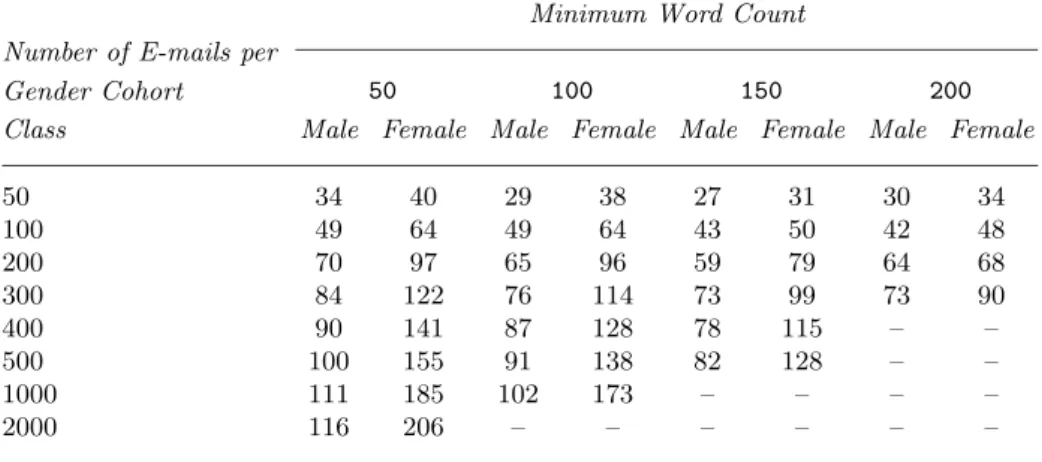
The e-mails in the e-mail database were also sampled in sets of 50, 100, 200, 300 etc. e-mails per author cohort type, for different minimum word counts in each cohort (as shown in Tables 1 and 2). The resulting sampling gave rise to the author count for each gender and language background cohort, as shown in Tables 3 and 4, respectively.
5.2 Attribute Selection
The attributes/features selected for the experiment were members of two sets namely, a baseline stylometric- and structural-specific set, and a gender-specific set. The total number of attributes used in the experiment was 222.
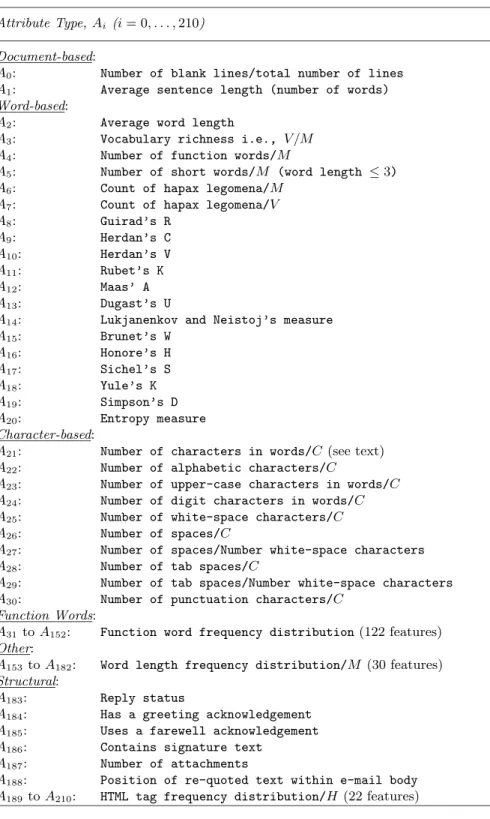
The baseline stylometric set of attributes/features chosen was selected from the set identified in previous authorship attribution experiments (see [10][17][11]) for e-mail authorship discrimination. These attributes, which included both a mix of character- and word-based style markers as well as structural features, were extracted from each e-mail body document. A total of 211 baseline at-tributes, comprising 183 style marker attributes and 28 structural atat-tributes, were employed in the experiment (see Table 5). Note that M = total number of tokens (i.e., words), V = total number of types (i.e., distinct words), C =
Table 1.Summary statistics of the e-mail corpus used in the experiment for the gender ([M|F]) author cohort.
Minimum Number Male Author Cohort Female Author Cohort Total Number of Words (Number of Authors) (Number of Authors) of Authors
50 117 208 325
100 104 176 280
150 91 135 226
200 83 99 182
Minimum Number Male Author Cohort Female Author Cohort Total Number of Words (Number of E-mails) (Number of E-mails) of E-mails
50 2071 2298 4369
100 1257 1072 2329
150 842 585 1427
200 564 384 948
Table 2. Summary statistics of the e-mail corpus used in the experiment for the language background ([EFL|ESL]) author cohort.
Minimum Number EFL Author Cohort ESL Author Cohort Total Number of Words (Number of Authors) (Number of Authors) of Authors
50 296 226 522
100 256 136 392
150 205 92 297
200 169 62 231
Minimum Number EFL Author Cohort ESL Author Cohort Total Number of Words (Number of E-mails) (Number of E-mails) of E-mails
50 3926 706 4932
100 2128 357 2485
150 1311 231 1542
Table 3.Summary statistics of the author count for e-mails with different numbers of e-mail per gender cohort class and minimum word count per e-mail. Values indicated by “–” correspond to insufficient e-mail document size/word count population.
Number of E-mails per
Minimum Word Count
Gender Cohort 50 100 150 200
Class Male Female Male Female Male Female Male Female
50 34 40 29 38 27 31 30 34 100 49 64 49 64 43 50 42 48 200 70 97 65 96 59 79 64 68 300 84 122 76 114 73 99 73 90 400 90 141 87 128 78 115 – – 500 100 155 91 138 82 128 – – 1000 111 185 102 173 – – – – 2000 116 206 – – – – – –
Table 4.Summary statistics of the author count for e-mails with different numbers of e-mail per language background cohort class and minimum word count per e-mail. Values indicated by “–” correspond to insufficient e-mail document size/word count population.
Number of E-mails per
Minimum Word Count
Language Cohort 50 100 150 200
Class EFL ESL EFL ESL EFL ESL EFL ESL
50 40 39 38 38 32 29 37 35 100 69 66 67 60 65 51 60 48 200 113 109 100 95 92 86 – – 300 145 140 131 122 – – – – 400 171 171 – – – – – – 500 187 191 – – – – – – 600 202 206 – – – – – – 700 214 224 – – – – – –
total number of characters, andH = total number of HTML tags in the e-mail body. Also, attributeA21 is the total number of characters in words, including apostrophes and hyphens, divided by C. The hapax legomenacount is defined as the number of types that occur only once in the e-mail text. AttributesA8 to A20 are defined in Tweedieet al[7]. For example, Rubet’s K value is computed as log(V)/log(M).
We briefly clarify how we derive some of the attributes shown in Table 5. Firstly, the set of short words in each e-mail document consists of all words of length less than or equal to 3 characters (e.g., “all”, “at”, “his” etc.). Only the total count of short words is used as a feature. The short word frequency distri-bution may be biased towards e-mail content and was therefore not used in our experiments. Secondly, the set of all-purpose function words (“a”, “about”, “af-ter”, “all”, “also”, . . . , “yet”, “you”, “your”, “yours”) and its frequency distribu-tion is obtained and also used as a sub-vector attribute. The number of funcdistribu-tion words used is 122. Finally, a word length frequency distribution consisting of 30 features (up to a maximum word length of 30 characters) is employed.
The re-quoted text position refers to the reply status of e-mail. A reply text can generally be placed in any position in the e-mail document and each line is usually prefixed with a special character (e.g., “>”). In our experiment, the position of re-quoted text allowed for 6 different possibilities (e-mail body text interspersed with the re-quoted text, e-mail body text preceded by re-quoted text etc.). Due to some e-mailers using HTML formatting, we include the set of HTML tags as a structural metric. The frequency distribution of HTML tags was included as one of the 28 structural attributes.
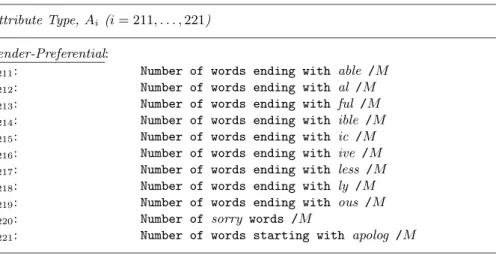
The set of basic gender-specific language attributes were selected from the literature presented in Section 3. These are listed in Table 6 (attributes A211 to A221). The selected attributes attempt to measure the frequency of use of adjectives, adverbs (mainly through the presence of suffixes) and apologies. This attribute set is a small subset of possible gender-preferential language attributes listed in the literature. Note that these attributes are not unique in the ability to discriminate between genders. Indeed some of the attributes listed in Table 5 are also capable of contributing to effective gender discrimination, though which ones is an open problem at this stage.
Though our choice of attributes is specifically biased towards features that have been shown to be able to effectively discriminate between authors and, hopefully, between author gender and language background, rather than dis-criminating between topics, some of the style marker attributes may have a combination of author and content bias as, for example,hapax legomenaas de-fined in attributesA6andA7in Table 5 (see [18]). Attributes, such asN-graphs, have not been included due to their strong topic bias, even though they may be useful as language background-specific attributes (N-graphs are contiguous se-quences of characters, including whitespaces, punctuation etc. . . ).
Each attributeAi is also scaled as follows:
Table 5.E-mail document body style marker and structural attributes.
Attribute Type,Ai(i= 0, . . . ,210)
Document-based:
A0: Number of blank lines/total number of lines A1: Average sentence length (number of words) Word-based:
A2: Average word length
A3: Vocabulary richness i.e., V /M A4: Number of function words/M
A5: Number of short words/M (word length ≤3) A6: Count of hapax legomena/M
A7: Count of hapax legomena/V
A8: Guirad’s R A9: Herdan’s C A10: Herdan’s V A11: Rubet’s K A12: Maas’ A A13: Dugast’s U
A14: Lukjanenkov and Neistoj’s measure
A15: Brunet’s W A16: Honore’s H A17: Sichel’s S A18: Yule’s K A19: Simpson’s D A20: Entropy measure Character-based:
A21: Number of characters in words/C(see text) A22: Number of alphabetic characters/C
A23: Number of upper-case characters in words/C A24: Number of digit characters in words/C A25: Number of white-space characters/C A26: Number of spaces/C
A27: Number of spaces/Number white-space characters A28: Number of tab spaces/C
A29: Number of tab spaces/Number white-space characters A30: Number of punctuation characters/C
Function Words:
A31toA152: Function word frequency distribution(122 features) Other:
A153toA182: Word length frequency distribution/M (30 features) Structural:
A183: Reply status
A184: Has a greeting acknowledgement A185: Uses a farewell acknowledgement A186: Contains signature text
A187: Number of attachments
A188: Position of re-quoted text within e-mail body A189toA210: HTML tag frequency distribution/H (22 features)
Table 6.E-mail document gender-preferential language attributes.
Attribute Type,Ai(i= 211, . . . ,221)
Gender-Preferential:
A211: Number of words ending with able /M A212: Number of words ending with al /M A213: Number of words ending with ful /M A214: Number of words ending with ible /M A215: Number of words ending with ic /M A216: Number of words ending with ive /M A217: Number of words ending with less /M A218: Number of words ending with ly /M A219: Number of words ending with ous /M
A220: Number of sorry words /M
A221: Number of words starting with apolog /M
so as to ensure all attributes are treated equally in the classification process. The scaling factor,SFAi, is computed as:
SFAi=
U BAi−LBAi Ai,max−Ai,min
withAi,minandAi,maxbeing the minimum and maximum values of the attribute Ai, respectively. Also,LBAi andU BAi are the defined lower and upper bounds of the scaled attribute, respectively (we have usedLBAi= 0.0 andU BAi = 1.0). 5.3 Performance Evaluation Methodology
The SVMlightSupport Vector Machine classifier developed by T. Joachims from the University of Dortmund [19] was used in the experiments. SVMlightis an im-plementation of Vapnik’s Support Vector Machine [14], as described in Section 4 . It (SVMlight) scales well to a large number of sparse instance vectors as well as efficiently handling a large number of support vectors. In our experiments we explored a number of different kernel functions for the SVM classifier namely, the linear, polynomial, radial basis and sigmoid tanh functions. We obtained maximalF1classification results (see below for the definition ofF1) on our data set with a polynomial kernel of degree 3. The “LOQO” optimiser was used for maximising the margin.
The Support Vector Machine computes two-way categorisation. Therefore, in our experiments on author gender categorisation, only a single two-way clas-sification model with a two-way confusion matrix needed to be generated. The training-testing sampling methodology used was a 10-fold cross-validation of the entire e-mail document set.
To evaluate the categorisation performance on the e-mail document corpus, we calculate the accuracy, recall (R), precision (P) and combinedF1performance
measures commonly employed in the information retrieval and text mining lit-erature (for a discussion of these measures see, for example, [20]), where:
F1= 2RP (R+P)
6
Results and Discussion
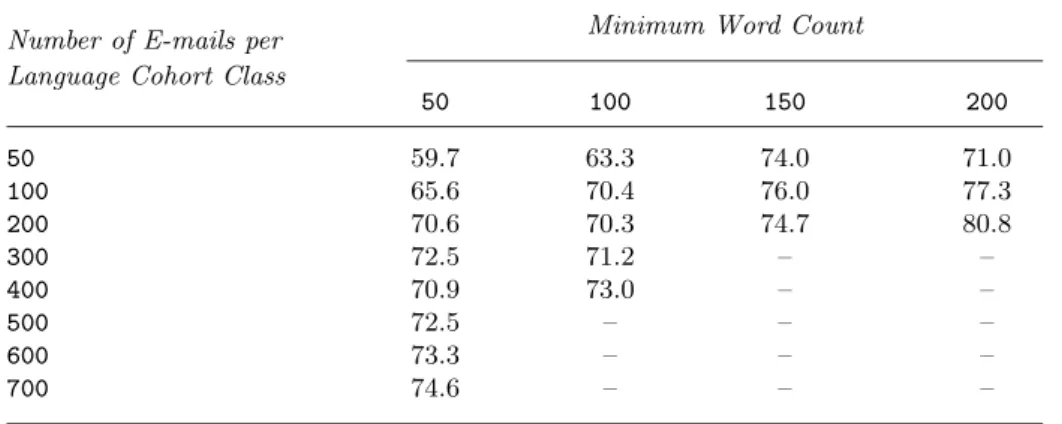
We present both our author gender-preferential cohort and language background-specific cohort attribution results and report theF1statistic using the Support Vector Machine (SVM) classifier. The results are given for different e-mail doc-ument sizes (measured as the minimum word count) and for different e-mail author cohort sizes (number of e-mail documents per female and male author cohort for the gender cohort, and number of e-mail documents per EFL and ESL author cohort for the language background cohort). The attribution perfor-mance results for the two experiments i) gender author cohort, and ii) language background author cohort are shown in Tables 7 and 8, respectively.
Table 7. Gender-specific cohort F1 categorisation performance results (in %) for
different e-mail document sizes and for different e-mail cohort sizes. Combined at-tribute/feature set used (Tables 5 and 6). See text for explanation. Values indicated by “-” correspond to insufficient e-mail document size/word count population.
Number of E-mails per Minimum Word Count
Gender Cohort Class
50 100 150 200 50 64.4 62.2 57.1 59.8 100 68.4 64.0 56.8 65.0 200 64.8 61.5 62.2 63.8 300 66.4 67.6 66.6 67.3 400 67.5 68.7 70.2 – 1000 69.4 71.1 – –
As observed in Table 7, the gender-specific cohortF1 categorisation perfor-mance results indicate that, in general, the SVM classifier combined with the style markers, structural attributes, and gender-preferential language attributes is able to satisfactorily discriminate between the author gender cohorts. As ex-pected, there is a general improvement, though not dramatic, in performance as the the number of e-mails in each gender cohort class increases. However, the improvement in performance as a function of the minimum word count is not as consistent as the e-mail count performance results. A noticeable improvement is only achieved when the number of e-mails in each gender cohort class is not too small (>300). An increased minimum word count does not seem to have a large
impact on the performance results. These results indicate that a small number of e-mails per author cohort class is generally sufficient for satisfactory gender classification. This result compares favourably with similar observations made in authorship attribution studies [10].
Table 8.Language background-specific cohort F1 categorisation performance results
(in %) for different e-mail document sizes and for different e-mail cohort sizes. Com-bined attribute/feature set used (see Tables 5 and 6). See text for explanation. Values indicated by “-” correspond to insufficient e-mail document size/word count popula-tion.
Number of E-mails per Minimum Word Count
Language Cohort Class
50 100 150 200 50 59.7 63.3 74.0 71.0 100 65.6 70.4 76.0 77.3 200 70.6 70.3 74.7 80.8 300 72.5 71.2 – – 400 70.9 73.0 – – 500 72.5 – – – 600 73.3 – – – 700 74.6 – – –
Table 8 present slightly better F1 categorisation performance results for the case of the language background-specific cohort compared with the gender-specific cohort results. Again, there is a general improvement, though not dra-matic, in performance as the the number of e-mails in each language cohort class increases. The improvement in performance as a function of the minimum word count is, however, more significant than for the case of the gender-specific au-thor cohort. A noticeable improvement is achieved when the number of e-mails in each language cohort class is >100 and when, in most cases, the minimum word count increases.
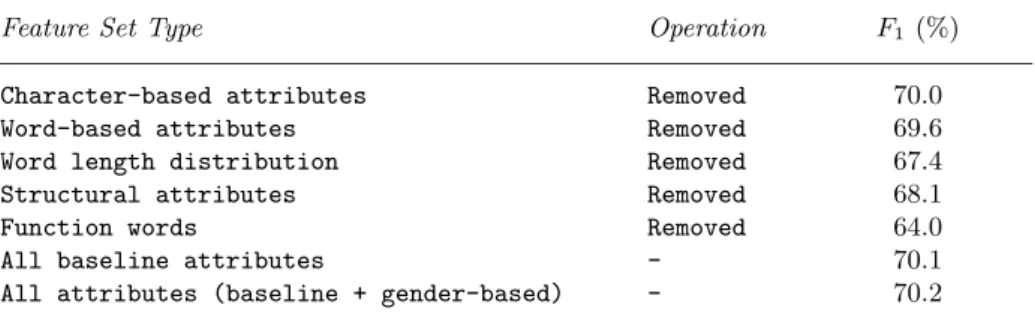
Some preliminary analysis of the impact of the different types of attributes (stylistic, structural, gender-preferential) on the author gender cohort categori-sation performance was also undertaken. Each type of attribute set was removed from the feature set and the performance results calculated. These are shown in Table 9.
Though preliminary at this stage, the results in Table 9 show that the full combination of attributes gives the best author gender categorisation. Removal of any of the attributes gives rise to a reduced performance value, though some more importantly than others. In particular, the set of function words (attributes A31 toA152) are seen to be an important gender discriminator. This is as ex-pected since function words has been shown to be a good author discrimina-tor [11] as well as containing words that could belong to gender-preferential
Table 9.Effect of the attribute type on theF1 categorisation performance results.
Feature Set Type Operation F1 (%)
Character-based attributes Removed 70.0
Word-based attributes Removed 69.6
Word length distribution Removed 67.4
Structural attributes Removed 68.1
Function words Removed 64.0
All baseline attributes - 70.1
All attributes (baseline + gender-based) - 70.2
language (such as “so”, “very” etc.). However, we also note that the gender-preferential attributes used in the experiment only give a marginal improvement in the categorisation performance. This indicates that the current set of gender-based attributes are insufficient and a more selective and/or more extensive set of gender-preferential attributes will need to be used to achieve better categori-sation performance.
7
Conclusions
In this paper, we have investigated the learning of the author gender and lan-guage background cohort categories from e-mail documents. We used an ex-tended set of predominantly content-free e-mail document features such as style markers, structural characteristics and gender-preferential language features to-gether with a Support Vector Machine learning algorithm. Experiments on a number of e-mail documents generated by over 800 authors of both genders (M/F) and language background (EFL/ESL) gave promising results for both author gender and language background cohort categorisation. Author language background cohort categorisation results were observed to be better than the author gender cohort results. We observed an improvement in categorisation performance with increasing number of e-mails and minimum word count in both gender and language background cohorts.
The current approach has several limitations. Firstly, as mentioned in Sec-tion 6, a larger set of gender-preferential language attributes needs to be used to improve the gender cohort categorisation performance results further. Secondly, more studies on the usefulness of specific style markers for author gender and language background cohort identification should be investigated as it is conjec-tured that, for example, certain bi-graphs incorporating punctuation could be effective discriminators [21]. Thirdly, experiments to determine the best subset of attributes need to be undertaken (e.g., forward feature selection). Finally, the diversity in author characteristics in the author cohort e-mail database is currently quite small owing to the type of organisation where the e-mails were sourced. Though it is not easy to obtain a sufficiently large set of e-mails from
authors with varying cohort characteristics (educational level, language back-ground etc.), we hope to be able to build up a suitable forensic database and further test our approach.
References
1. Apte, C., Damerau, F., Weiss, S.: Text mining with decision rules and decision trees. Workshop on Learning from text and the Web, Conference on Automated Learning and Discovery (1998)
2. Yang, Y., Liu, X.: A re-examination of text categorisation methods. Proc. 22nd Int. ACM SIGIR Conf. on Research and Development in Information Retrieval (SIGIR99) (1999) 67–73
3. Joachims, T.: Text categorization with support vector machines: Learning with many relevant features. Proc. European Conf. Machine Learning (ECML’98) (1998) 137–142
4. Sahami, M., Dumais, S., Heckerman, D., Horvitz, E.: A Bayesian approach to filter-ing junk e-mail. Learnfilter-ing for Text Categorization Workshop: 15th National Conf. on AI. AAAI Technical Report (WS-98-05) (1998) 55–62
5. Mosteller, F., Wallace, D.: Inference and Disputed Authorship: The Federalist. Addison-Wesley, Reading, Mass. (1964)
6. Elliot, E., Valenza, R.: Was the Earl of Oxford the true Shakespeare? Notes and Queries,38(1991) 501–506
7. Tweedie, F., Baayen, R.: How variable may a constant be? Measure of lexical rich-ness in perspective. Computers and the Humanities,32(1998) 323–352
8. Farringdon, J.: Analysing for Authorship: A Guide to the Cusum Technique. Uni-versity of Wales Press, Cardiff (1996)
9. Tweedie, F., Singh, S., Holmes, D.: Neural network applications in stylometry: The Federalist papers. Computers and the Humanities (1996) 1–10
10. Corney, M., Anderson, A., Mohay, G., de Vel, O.: Identifying the Authors of Sus-pect E-mail. Computers and Security (submitted) (2001)
11. de Vel, O., Anderson, A., Corney, M., Mohay, G.: E-mail Authorship Attribution for Computer Forensics. Data Mining for Security Applications, Kluwer Publishers (2002)
12. Thomson, R., Murachver, T.: Predicting gender from electronic discourse. British Journal of Social Psychology40(2001) 193–208
13. Schiffman, H.: Bibliography of gender and language. http://ccat.sas.upenn.edu/ haroldfs/popcult/bibliogs/gender/genbib.htm (2002) 14. Vapnik, V.: The Nature of Statistical Learning Theory. Springer-Verlag, New York
(1995)
15. Druker, H., Wu, D., Vapnik, V.: Support vector machines for spam categorisation. IEEE Trans. on Neural Networks,10(1999) 1048–1054
16. Diederich, J. Kindermann, J., Leopold, E., Paass, G.: Authorship attribution with Support Vector Machines. Applied Intelligence (2000) (submitted)
17. de Vel, O.: Mining e-mail authorship. Proc. Workshop on Text Mining, ACM Inter-national Conference on Knowledge Discovery and Data Mining (KDD’2000) (2000) 18. Chaski, C.: A Daubert-inspired assessment of current techniques for language-based author identification. US National Institute of Justice (1998) http://www.ncjrs.org
19. Support Vector Machine, SVMLight: University of Dortmund (2001) http://www-ai.cs.uni-dortmund.de/FORSCHUNG/VERFAHREN/SVM LIGHT/svm light.eng.html 20. Witten, I., Frank, E.: Data Mining: Practical Machine Learning Tools and
Tech-niques with Java Implementations. Morgan Kaufmann, San Francisco (2000) 21. Chaski, C.: Empirical evaluations of language-based author identification
![Table 1. Summary statistics of the e-mail corpus used in the experiment for the gender ([M |F]) author cohort.](https://thumb-us.123doks.com/thumbv2/123dok_us/794450.2600446/7.892.199.725.277.553/table-summary-statistics-corpus-experiment-gender-author-cohort.webp)