Children’s language and behavioural, social and
emotional difficulties and prosocial behaviour
during the toddler years and at school entry
bjsp_50783..91Dimitra Hartas
The ability of young children to manage their emo-tions and behaviours is an important prerequisite for social adjustment and school readiness. With an increase in early-onset behavioural difficulties in children, understanding changes in child behaviour during the preschool years and the factors that influence it is a priority for policy and practice. Despite much evidence on the association between language and behavioural difficulties in children, few studies have examined longitudinally language and problem/prosocial behaviour in early years. Using a UK community-based sample, Dimitra Hartas, from the University of Warwick, examines the association between language, gender and behavioural, social and emotional difficulties and prosocial behaviour during the toddler years and at school entry. The findings showed a moderate decline in behavioural and social difficulties during preschool, and stability in emotional difficulties. Moderate associations were found between vocabu-lary and problem behaviour but not prosocial behaviour, with literacy-based language emerging as a substantive predictor of teacher-rated behav-iour. These findings have important implications for early years provision.
Key words: prosocial behaviour, language, beha-vioural difficulties, early years.
Introduction
Social competence and emotional well-being in young chil-dren have received much attention in recent years as they link to language development and early school adjustment and learning (Miller-Lewis, Baghurst, Sawyer, Prior, Clark, Arney & Carbone, 2006; Phillips & Lonigan, 2010; Pike, Iervolino, Eley, Price & Plomin, 2006). The ability of young children to manage their emotions and behaviours and to make meaningful interpersonal relationships is an important prerequisite for school readiness and academic success. Increasingly, teachers express concerns that children, espe-cially those living in poverty, enter primary school with limited social and emotional competencies, which are likely to compromise their successful transition into a formal learn-ing environment (Rimm-Kaufman, Pianta & Cox, 2000). Prosocial behaviour, defined as helpful, kind, considerate and
co-operative behaviour, and the capacity to regulate behav-iour have been found to relate strongly to school readiness and success, that is, higher early numeracy and literacy skills at school entry (McClelland, Morrison & Holmes, 2000), whereas limited social competence is a strong predictor of academic failure (Webster-Stratton, Reid & Stoolmiller, 2008). Understanding the factors, such as language, that influence behaviour and social and emotional development in young children is therefore an important research challenge and has implications for early years provision. Although many factors influence young children’s behav-iour, there are strong theoretical and empirical grounds for the association between language and behavioural, social and emotional difficulties (Beitchman, Wilson, Johnson, Atkinson, Young, Adlaf, Escobar & Douglas, 2001; Bena-sich, Curtiss & Tallal, 1993) with the co-occurrence rate of language and behavioural difficulties in young children having been estimated to 50–70% (Redmond & Rice, 1998). The link between language and behavioural difficulties has been established by two large bodies of research. The first has examined the prevalence of emotional and behavioural difficulties among children selected as having speech and language difficulties (for example, Fujiki, Brinton & Clarke, 2002), whereas the other has examined the prevalence of language difficulties among children with behavioural and social difficulties (such as Cohen, Barwick, Horodezky, Val-lance & Im, 1998). The relationship between behavioural and language difficulties has been found to persist over time. An age pattern of behavioural difficulties in children with language difficulties remains marked through early years (Benasich et al., 1993), primary years (Lindsay, Dockrell & Strand, 2007), later childhood and adolescence (Conti-Ramsden & Botting, 2004) and into adulthood (Beitchman et al., 2001).
Behavioural difficulties have been found to differentiate between boys and girls, with boys being three to four times more likely than girls to display disruptive behaviour (ONS, 1999). However, the nature of the relationship between gender and behaviour remains unclear, especially for pre-school children (Huaqing Qi & Kaiser, 2003). In a study examining the developmental trajectories of behavioural dif-ficulties in preschool boys and girls, boys were found to exhibit higher levels of disruptive behaviour than did girls (Spieker, Larson, Lewis, Keller & Gilchrist, 1999), whereas
girls from low-income backgrounds were reported by their parents to exhibit more problem behaviours than boys (Eiden, 1999). Furthermore, in other studies, preschool boys and girls have been reported to be similar in their display of problem behaviour (Lavigne, Gibbons, Christoffel, Arend, Rosenbaum, Binns, Dawson, Sobel & Isaacs, 1996). Despite much research on the association between language and behavioural, social and emotional difficulties (for example, Beitchman et al., 2001; Benasich et al., 1993), an inconsistent pattern emerges regarding language and social competence in young children (Hart, Fujiki, Brinton & Hart, 2004; Fujiki, Morgan, Brinton & Hart, 1999). In a study by Fujiki et al. (1999), although children with language diffi-culties were less socially competent compared to their typi-cally developing peers, no consistent pattern of association was found between language and social behaviour. More-over, in a community-based sample of children aged between 18 and 35 months, behavioural and language diffi-culties were generally not correlated (Rescorla & Achen-bach, 2002). This variation may be explained by considering the complexity inherent in children’s social competence and its underpinning behavioural, social and emotional dimen-sions, and the lack of specificity in assessing child behaviour by using behaviour scales that offer generalisations in the characteristics examined. Also, differences in sample char-acteristics (community-based vs. clinical samples) are likely to explain variation in that clinical samples often find stronger associations between language and behaviour in children, but these associations can be inflated by their over-representation of extremes and comorbidity (Plomin, Price, Eley, Dale & Stevenson, 2002). Finally, the link between language and behaviour may manifest differently across dif-ferent developmental trajectories, but also it may be less directly mediated by other factors.
Most research on factors, including language, that affect children’s behavioural, social and emotional development has focused on ‘at risk’ groups and fewer on non-clinical, community-based samples (Pike et al., 2006). Also, few studies have used longitudinal designs to examine repeated measures on predictor variables (such as vocabulary at ages three and five) to capture the temporal quality of the effects of children’s cognitive and linguistic skills on behaviour in preschool children (Miller-Lewis et al., 2006), and even fewer have included ratings of prosocial behaviour as a counterpoint to negative behaviours (Phillips & Lonigan, 2010). Increasingly, studies have included teacher and parent ratings to examine the contextual parameters that influence child behaviour. The use of multiple sources of information (such as parents and teachers) influences behav-iour ratings, especially when informants are not in agree-ment (for example, Achenbach, McConaughy & Howell, 1987; Lindsay et al., 2007). Parents and teachers differ in their perceptions of children’s behaviour. A review of cross-informant correlations of child behaviour by Achenbach et al. (1987) reported a mean correlation of 0.27 between parent and teacher ratings. The low levels of parent–teacher agreement may be explained by considering the context specificity of children’s behaviour which fluctuates
depend-ing on the academic, emotional and social demands placed on children at home and school.
Using a large community-based sample, the purpose of this study was to examine the relationship between gender, lan-guage (that is, vocabulary, literacy-based lanlan-guage) and behavioural, emotional and social difficulties and prosocial behaviour in young children longitudinally. Also, the predic-tive power of cognipredic-tive, vocabulary and literacy-based lan-guage skills regarding parent and teacher ratings of behaviour was examined. Despite an increase in the numbers of young children with an early onset of behavioural diffi-culties (Hughes & Ensor, 2009), little is known about their association with gender and expressive vocabulary and literacy-based language during the toddler years and at school entry.
Method
Sample
The data for this study came from the second and third surveys of the Millennium Cohort Study (MCS), a national longitudinal birth cohort study, which offers large-scale information about the ‘New Century’s Children’ and their families. The surveys were carried out when the cohort children reached the ages of three and five respectively, achieving a response rate of 78% and 79% of the original target sample. The working sample derived from the surveys
was 14,961 singleton cohort children (N = 8,671 for
England only). Information about the sampling strategy and response rates for the survey are available in Plewis and Ketende (2006). Full details about the origins and objectives of the Millennium Cohort Study can be obtained from the UK Data Archive at Essex University. Ethical approval for the MCS was gained and parents gave informed consent before interviews took place and written consent for the cognitive assessments.
Measures
There are three sets of measures, namely behaviour, cogni-tive and language obtained at ages three and five.
Behaviour: The Strengths and Difficulties Questionnaire (SDQ) (Goodman, Meltzer & Bailey, 1998) consists of five scales with five items each. The scales are: Emotional Symp-toms, Conduct Problems, Hyperactivity, Peer Problems and Prosocial. In each subscale scores for each of the five items were summed, giving a range of 0–10, and the total difficul-ties score, which is the sum of all problem SDQ domains, had a range of 0–40. The SDQ has a good test-retest reli-ability of 0.85 (Goodman et al., 1998).
Teacher-rated measures of children’s behaviour were obtained from the Personal, Social and Emotional (PSE) development scale of the Foundation Stage Profile (FSP). The PSE contains Dispositions and Attitudes; Social Devel-opment; and Emotional Development. Each of these assess-ment scales has nine points, with scores ranging between 3 and 27 (M=20.79, SD=4.42, N=8,671). The FSP assess-ment framework provides teacher ratings of child social and
academic progress based on continued observation during the first year of compulsory education (between ages four and five) in England. Compared to standardised tests, FSP is thought to provide a more developmentally appropriate picture of school functioning for children of all abilities and for children whose English is an additional language (QCA, 2000).
Cognitive skills: Picture Similarities (verbal reasoning) and Pattern Construction (spatial skills) subscales of the British Ability Scale-II (BAS-II) were administered at age five; and the Bracken School Readiness Assessment (BSRA) at age three. The BSRA was made up of six sub-tests that assess the child’s ability to identify colours, letters, numbers and shapes and to describe and compare objects, for example, by size.
Language: The Naming Vocabulary subscale of the British Ability Scale-II (BAS-II), which assesses expressive lan-guage and knowledge of names in English, was adminis-tered at three years (M=49.64, SD=11.39; N=12,975) and five years (M=53.81, SD=11.25; N=14,961). For com-parison purposes, two vocabulary groups were formed, namely above average vocabulary, which was defined as containing scores of at least one standard deviation above the mean (T=50), and the below average group, defined as at least one standard deviation below the mean. Language skills in the context of literacy were obtained via the Com-munication, Language and Literacy (CLL) from the FSP. The CLL contains Language for Communication and Think-ing; Linking Sounds and Letters; ReadThink-ing; and Writing. Each of these assessment scales has nine points, with scores
ranging between 4 and 36 (M = 24.71, SD = 7.16,
N=8,671).
Data analytic plan
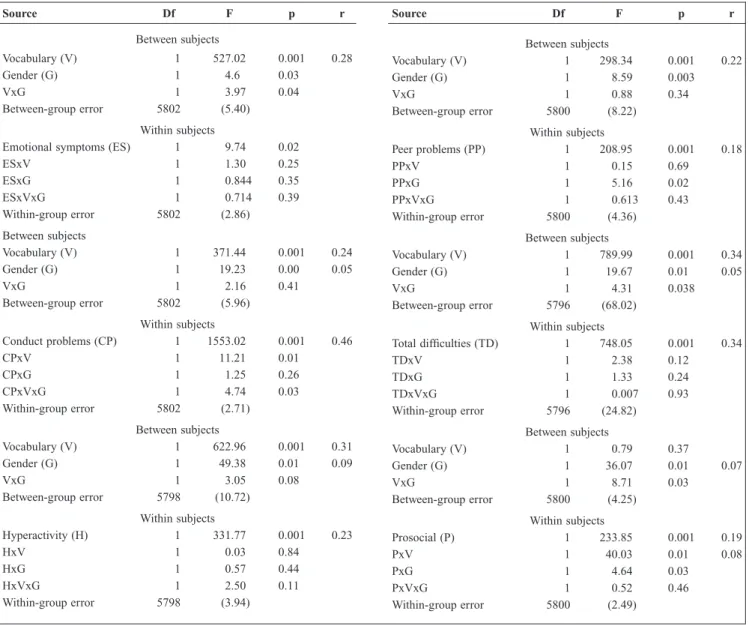
A repeated-measures ANOVA was conducted to examine the relationship between vocabulary groups, gender and SDQ domains longitudinally. Analyses of within- and between-subject factors were deemed appropriate for group compari-sons and for the examination of longitudinal patterns and possible interaction effects between the variables. The within-subject design examined longitudinal differences in the ratings of SDQ domains (that is, emotional symptoms, conduct problems, hyperactivity, total difficulties and prosocial behaviour) at ages three and five, and the between-group design examined two independent variables, namely vocabulary (that is, above/below average vocabulary groups) and gender (that is, male/female). The interactions examined were: SDQ domains x vocabulary; SDQ domains x gender; vocabulary x gender; and SDQ domains x vocabu-lary x gender (see Table 2). The effect sizes were calculated by applying the formulae r= √F(1, dfR) / F(1, dfR)+dfR,
which uses the F-ratio and the residual degrees of freedom (dfR). Effect size values of 0–0.2 are deemed small, 0.2–0.5
medium and 0.5+ large (Field, 2009). Also, a univariate analysis of variance was conducted to examine the relation-ship between PSE, vocabulary groups and gender (partial eta squared was used for the effect size). Finally, a series of hierarchical regressions were conducted to assess the
pre-diction of parents’ and teachers’ ratings of behaviour (i) from children’s cognitive skills, that is, BSRA, Picture Simi-larity and Pattern Construction, and expressive vocabulary, that is, Naming Vocabulary, at ages three and five, and (ii) from literacy-based language, that is, CLL, at age five.
Results
The repeated measures ANOVA yielded significant results for both within- and between-subject designs for most SDQ domains. (Table 1 presents the descriptive statistics for gender, vocabulary and SDQ domains for ages three and five.
SDQ, PSE and vocabulary
Significant longitudinal differences of a medium effect for SDQ problem domains (with the exception of emotional symptoms) and of a small effect for prosocial behaviour were found, indicating that, between the ages of three and five, significant downward changes in SDQ ratings, problem domains in particular, occurred (Table 2). Non-significant differences were found in parents’ ratings for emotional symptoms, indicating less variability in emotional difficul-ties over the two-year period. Significant vocabulary main effects were found for SDQ problem domains but not for prosocial behaviour. Specifically, medium-size differences between vocabulary groups were found for emotional symp-toms, conduct problems, hyperactivity, peer problems and total difficulties. These results indicated that, compared to children with above average vocabulary, children with below average vocabulary were rated significantly higher in problem behaviour but received roughly equal ratings for prosocial behaviour. Finally, significant gender effects that were small in size were found for SDQ domains, with the exception of emotional symptoms, indicating that parent-rated problem and prosocial behaviours did not differ sub-stantially between males and females.
The repeated ANOVA yielded non-significant interactions Table 2). Specifically, the SDQ domains x vocabulary inter-action was non-significant, indicating that differences in SDQ ratings over the two-year period were independent of vocabulary group (above/below average). The SDQ domains x gender and the vocabulary x gender interactions were non-significant, indicating that SDQ ratings and vocabulary did not differ in males and females. Finally, the SDQ domains x gender x vocabulary interaction was non-significant, indicating that the decline in behavioural and social difficulties over the two-year period was not moder-ated by vocabulary and gender, in that a roughly equal drop in problem behaviour occurred for boys and girls across vocabulary groups.
Finally, the relationship between PSE, gender and vocabu-lary groups was examined. Vocabuvocabu-lary had a significant main effect on PSE,F(1, 4175)=868.09, p<0.000,hp2=
0.17, whereas gender had a significant yet weak effect,F(1, 4175)=81.29, p<0.000,hp2=
0.02. There was no signifi-cant interaction between vocabulary and gender, indicating that teacher ratings of behaviour were roughly the same
across groupings, that is, boys and girls in above/below average vocabulary groups.
Prediction of parent and teacher ratings of behaviour
To assess their relative contribution to parent and teacher ratings of behaviour (that is, SDQ total difficulties, SDQ prosocial and PSE), vocabulary and cognitive skills at age three were entered first (model 1) followed by cognitive skills and vocabulary at age five (model 2 for prosocial behaviour and total difficulties) as well as literacy-based language skills at age five (model 2 for PSE only) (see Table 3). For predicting parent-rated prosocial behaviour at age five, cognitive and vocabulary skills at age three accounted for a statistically significant but very small portion of variance,Adj. R2=0.005. The addition of
cogni-tive and vocabulary skills at age five slightly improved the model fitDR2=0.002, indicating that these skills were not
good predictors of prosocial behaviour. In predicting parent-rated total difficulties at age five, cognitive skills and vocabulary at age three accounted for a portion of variance,
Adj. R2 =0.101. The addition of cognitive and vocabulary
skills at age five slightly improved the model fitDR2=0.014,
with cognitive (b=–0.152, p<0.000) and vocabulary skills at age three (b =–0.109, p< .000) emerging as relatively good predictors. In predicting teacher-rated PSE, cognitive and vocabulary skills in step 1 made a significant contribu-tion, especially BSRA (b = 0.265, p < 0.000), Adj. R2 =
0.119. In step 2, the addition of cognitive and vocabulary skills at age five and especially literacy-based language (CLL) improved the model fit substantially, DR2 =
0.439, with CLL emerging as a very strong predictor (b=0.760, p
< 0.000) for teacher-rated behaviour even when child cognitive/vocabulary skills were accounted for. Overall, cognitive and vocabulary skills at age three made a sig-nificant but relatively small contribution to parent-rated
problem behaviour and PSE, whereas CLL made a substan-tive contribution to teacher-rated behaviour.
Discussion
The purpose of this study was to examine associations between language, gender and parent- and teacher-rated behaviour in young children during the toddler years and at school entry. Moderate associations between vocabulary and parent-rated behavioural, social and emotional difficulties were found, whereas no significant links emerged between vocabulary and prosocial behaviour. Also, a moderate asso-ciation was found between PSE and vocabulary. Longitudi-nal aLongitudi-nalyses showed a decline in parent-rated behavioural and social difficulties between the ages of three and five, which was independent of vocabulary groups. In contrast, emotional difficulties were less varied. Finally, although vocabulary did not emerge as a strong predictor of parent-rated behaviour, language in the context of literacy (for example, communication and thinking in the classroom and phonological awareness) was found to be a substantive pre-dictor of teacher-rated child behaviour. Cognitive skills at age three were good predictors of both parent- and teacher-rated behaviour, suggesting that behaviour regulation also has a cognitive dimension.
Changes in child behaviour during preschool
Young children’s behavioural and social difficulties showed, on average, a moderate drop, whereas emotional symptoms did not vary. These findings are comparable to those of previous studies in which it was found that approximately half of preschool children with significant externalising dif-ficulties no longer manifested these behaviours after their transition to school (Campbell, Shaw & Gilliom, 2000; Keenan & Wakschlag, 2000; Lavigne et al., 1996). A peak of socially problematic behaviours, aggression in particular,
Table 1: Descriptive statistics
Below average vocabulary Above average vocabulary
Age
Male Female Male Female
M (SD) M (SD) M (SD) M (SD) Emotional symptoms 3 2.57 (3.05) 2.80 (3.34) 1.42 (1.85) 1.36 (1.66) 5 2.40 (2.76) 2.63 (2.87) 1.28 (1.65) 1.35 (1.64) Conduct problems 3 3.98 (2.92) 3.94 (2.99) 2.91 (2.30) 2.54 (2.10) 5 2.46 (2.52) 2.16 (2.31) 1.49 (1.61) 1.19 (1.41) Hyperactivity 3 6.01 (3.45) 5.49 (3.38) 4.16 (2.72) 3.53 (2.55) 5 5.06 (3.33) 4.77 (3.44) 3.35 (2.47) 2.64 (2.23) Peer problems 3 3.46 (3.33) 3.17 (3.35) 2.30 (2.72) 1.97 (2.43) 5 2.58 (2.93) 2.60 (2.88) 1.54 (2.11) 1.36 (1.94) Total Difficulties 3 16.02 (10.01) 15.43 (10.41) 10.82 (6.90) 9.42 (6.11) 5 12.52 (9.11) 12.19 (8.80) 7.67 (5.50) 6.56 (4.97) Prosocial 3 8.04 (2.54) 8.08 (2.39) 7.59 (2.01) 7.97 (1.81) 5 8.26 (1.92) 8.52 (1.79) 8.34 (1.65) 8.82 (1.40) PSE 5 17.52 (4.84) 19.04 (4.70) 21.82 (3.77) 22.7 (3.43)
Notes:Nage3=3721 (N=1859 below average vocabulary; N=1862 above average vocabulary).
Nage5=6551 (N=1510 below average; N=5041 above average).
has been shown in three-years-olds (Egger & Angold, 2006), followed by a decline in oppositional/defiant difficulties between the ages of three and five (Lavigne et al., 1996). In contrast, emotional difficulties, such as anxiety, have been
shown to remain stable during the preschool years. Emo-tional difficulties in three-year-olds were reported to be highly stable across 12 months, 0.75 and 0.74 based on maternal and paternal reports respectively (Edwards, Rapee
Table 2: Repeated ANOVA for SDQ domains, vocabulary and gender
Source Df F p r Between subjects Vocabulary (V) 1 527.02 0.001 0.28 Gender (G) 1 4.6 0.03 VxG 1 3.97 0.04 Between-group error 5802 (5.40) Within subjects
Emotional symptoms (ES) 1 9.74 0.02
ESxV 1 1.30 0.25 ESxG 1 0.844 0.35 ESxVxG 1 0.714 0.39 Within-group error 5802 (2.86) Between subjects Vocabulary (V) 1 371.44 0.001 0.24 Gender (G) 1 19.23 0.00 0.05 VxG 1 2.16 0.41 Between-group error 5802 (5.96) Within subjects Conduct problems (CP) 1 1553.02 0.001 0.46 CPxV 1 11.21 0.01 CPxG 1 1.25 0.26 CPxVxG 1 4.74 0.03 Within-group error 5802 (2.71) Between subjects Vocabulary (V) 1 622.96 0.001 0.31 Gender (G) 1 49.38 0.01 0.09 VxG 1 3.05 0.08 Between-group error 5798 (10.72) Within subjects Hyperactivity (H) 1 331.77 0.001 0.23 HxV 1 0.03 0.84 HxG 1 0.57 0.44 HxVxG 1 2.50 0.11 Within-group error 5798 (3.94) Source Df F p r Between subjects Vocabulary (V) 1 298.34 0.001 0.22 Gender (G) 1 8.59 0.003 VxG 1 0.88 0.34 Between-group error 5800 (8.22) Within subjects Peer problems (PP) 1 208.95 0.001 0.18 PPxV 1 0.15 0.69 PPxG 1 5.16 0.02 PPxVxG 1 0.613 0.43 Within-group error 5800 (4.36) Between subjects Vocabulary (V) 1 789.99 0.001 0.34 Gender (G) 1 19.67 0.01 0.05 VxG 1 4.31 0.038 Between-group error 5796 (68.02) Within subjects Total difficulties (TD) 1 748.05 0.001 0.34 TDxV 1 2.38 0.12 TDxG 1 1.33 0.24 TDxVxG 1 0.007 0.93 Within-group error 5796 (24.82) Between subjects Vocabulary (V) 1 0.79 0.37 Gender (G) 1 36.07 0.01 0.07 VxG 1 8.71 0.03 Between-group error 5800 (4.25) Within subjects Prosocial (P) 1 233.85 0.001 0.19 PxV 1 40.03 0.01 0.08 PxG 1 4.64 0.03 PxVxG 1 0.52 0.46 Within-group error 5800 (2.49)
Note:Values enclosed in parentheses represent mean square errors.
Table 3: Standardised regression coefficients for SDQ total difficulties, SDQ Prosocial and PSE at age five
Prosocial Total difficulties PSE
Model 1 Model 2 Model 1 Model 2 Model 1 Model 2
BSRA (3) 0.057*** 0.046ns -0.203*** -0.152*** 0.263*** -0.052** NV (3) 0.024ns 0.024ns -0.152*** -0.109** 0.113*** 0.010ns PC (5) 0.035ns -0.079*** 0.004ns NV (5) -0.014ns -0.077*** 0.012ns PS (5) 0.028ns -0.042*** 0.009ns CLL (5) 0.760*** Adj. R2 0.005 0.007 0.101 0.115 0.119 0.558 F 18.67*** 10.44** 375.78*** 174.93*** 459.82***** 1433.56***
Notes:N=6675–6795. *** p<.001; ** p<.01. BSRA; Bracken School Readiness Assessment. NV; Naming Vocabulary. PS; Picture Similarity. PC; Pattern Construction. CLL; Communication Language Literacy.
& Kennedy, 2009), and stable only between ages four and five (Rose, Rose & Feldman, 1989).
In considering changes in young children’s behaviour, it is important to note that the nature of behavioural, emotional and social difficulties exhibited by three-year-olds is quali-tatively different from that of older children. For most three-year-olds, parent-reported elevated behavioural difficulties tend to be a transient developmental phase within which they test boundaries and develop a sense of autonomy, whereas for some children, behavioural difficulties persist after their transition to school.
Problem and prosocial behaviour, vocabulary and gender
As with previous studies using community samples (Plomin et al., 2002), in this study, medium-size relation-ships were found between young children’s vocabulary and parent ratings of problem behaviour at ages three and five. Compared to children with high average vocabulary skills, those with below average vocabulary were more likely to be rated by their parents as having behavioural difficulties. A novel aspect was that although a moderate association was found between expressive vocabulary and parent ratings of behavioural, emotional and social difficulties in young children, the decline in problem behaviour ratings during the preschool years did not differ across vocabulary groups. Children between the ages of three and six years are developing language and social and emotional skills at a rapid pace and the cognitive and affective processes involved are receptive to the socialisation practices that surround their lives (Webster-Stratton et al., 2008). Social cognition supports the understanding of emotions and social situations and is likely to influence children’s social experiences in their interactions with parents, ultimately influencing parents’ ratings of problem and prosocial behaviour. Children’s capacity to identify and predict others’ emotions and their responses to emotional situa-tions is crucial for regulating emositua-tions and their
behav-ioural expression and, ultimately, reducing problem
behaviour (Egger & Angold, 2006). This is particularly important considering that, among preschool children, inappropriate behaviour often reflects difficulties with emotion understanding rather than language or other cognitive skills (Hughes & Ensor, 2009).
In this study, vocabulary skills were found to differentiate between problem and prosocial behaviour with the latter showing stable parent ratings between vocabulary groups. This is comparable with previous research in which primary school children with language impairment did not differ from same-age typically developing peers on parent ratings of prosocial behaviour (Farmer, 2000). At first glance, these findings are counterintuitive in that for children to exhibit prosocial behaviours good expressive and receptive lan-guage skills are required (Hart et al., 2004). Although social
competence involves both emotional and cognitive
responses to social situations, it is important to differentiate between these responses (Dunn, 1995), considering that prosocial behaviour relies primarily on the capacity to engage emotionally with others, as well as on the existence
of cognitive skills that are typically required to discriminate, encode or retrieve information that allows for linguistic
and socio-cognitive representations to be developed
(Bishop, 1997).
In discussing the relationship between language and problem and prosocial behaviour, three explanations have been offered. Firstly, the link between behaviour and lan-guage difficulties may not be directly due to the presence of other factors such as emotional regulation, which may mediate the relationship. For example, in a study by Fujiki et al. (2002), children with language difficulties were rated lower in emotional regulation. Secondly, patterns of associa-tion between language and prosocial behaviour may be influenced by the severity of language difficulty, as in a study by Hart et al. (2004) where severe expressive language difficulties had a significant impact on prosocial behaviour. Thirdly, the conceptual dimensions that underpin social competence, which is typically defined as prosocial behav-iour and likeability, may relate to language differently. For example, prosocial behaviour has been found to link to severe language difficulties, whereas likeability is linked to poor receptive language skills (Hart et al., 2004).
Finally, and consistently with previous studies, the gender effects on problem and prosocial behaviours were small in size and thus not substantive (Lindsay et al., 2007; Hughes & Ensor, 2009). The relationship between gender and behavioural difficulties in young children is ambiguous in that although gender effects have been found to differen-tiate between externalising and internalising difficulties with the former being more prevalent in boys (ONS, 1999), this differentiation was not evidenced in the present study.
Predicting child behaviour from language
As with previous research (Benasich et al., 1993; Dockrell, Lindsay, Palikara & Cullen, 2007; Lindsay et al., 2007; Pike et al., 2006), children’s expressive vocabulary during pre-school and at pre-school entry did not substantially predict parent ratings of behavioural, emotional and social difficul-ties and prosocial behaviour at age five. In a study by Bena-sich et al. (1993), language difficulties at age four did not predict either concurrent or behavioural difficulties at age eight. However, language in the context of literacy (for example, communication and thinking in classroom and phonological awareness) was found to be a strong predictor of teacher-rated child behaviour, suggesting that teachers’ views about children’s language in the classroom are likely to influence their perception of children’s behaviour. Con-versely, teachers tend to score higher on behavioural prob-lems that interfere with aspects of children’s learning with their reports of behaviour being influenced by their percep-tion of children’s academic performance (Miller-Lewis et al., 2006; Lindsay et al., 2007). Considering evidence that receptive language difficulties are better predictors of chil-dren’s behaviour (Beitchman et al., 2001), it can be argued that an effective use of children’s language in the classroom relies heavily on their receptive language skills. Finally, the differences in the extent to which children’s language
influences parent and teacher ratings of behaviour can be explained by considering that teachers have a normative view of what constitutes appropriate behaviour, whereas parents’ views of behaviour are likely to be influenced by children’s capacity for emotion understanding and overall communication (rather than vocabulary skills alone) whose meaning is constructed within the social and cultural milieu of a family.
Strengths and limitations
There are strengths and limitations to this study. Using a large, community-based sample has enabled replication of other studies with fairly small samples to examine the lon-gitudinal patterns of child behaviour as well as its associa-tion with expressive vocabulary and gender, a relatively under-researched area in early years. This study involved multiple behaviour aspects (for example, problem and prosocial behaviour), various measures of language (such as vocabulary and literacy-based language) and multiple infor-mants (that is, parents and teachers). Finally, it explored the predictive power of child’s vocabulary at ages three and five and language as it was used in the context of literacy regard-ing parent- and teacher-rated behaviour in a large, non-clinical sample of young children.
As this study shows, vocabulary was not associated with prosocial behaviour but was moderately associated with behavioural, social and emotional difficulties, suggesting a vocabulary specificity effect on parent ratings of child behaviour. Further research is needed to delineate the types and severity of language difficulties or language delay that are more likely to associate with problem and prosocial behaviour in preschool children, and explore the contribu-tion of emocontribu-tion understanding and social problem-solving skills to child behaviour. Finally, to truly consider the dynamic processes of child behaviour development, an examination of reciprocal effects is required in terms of collecting data across three different points in time, for example, language measures at time 1, affecting ratings of child behaviour (both problem and prosocial) at time 2, which then affects language at time 3.
Conclusions and implications
Young children who lack self-regulatory skills and social competence find it difficult to learn and relate socially to others in early years settings and after their transition to school. For most young children, behavioural difficulties is a transient phase, but for children who enter formal education without the required social/emotional competencies and lan-guage skills, school-based support needs to be three-fold in terms of targeting language, behaviour and learning. To ensure that early years settings and schools are geared to meeting children’s language and social and emotional needs, the development of contextually relevant intervention strategies, situated within the curriculum, should be consid-ered intentionally to foster the development of language and critical social-emotional skills (Fantuzzo, Bulotsky-Shearer, McDermott, McWayne, Frye & Perlman, 2007). Early years
intervention programmes should take an ecological
approach in terms of focusing on children as well as their immediate environments (such as home or school), and rec-ognise the context specificity of young children’s behaviour as well as the interlinked nature of children’s, parents’ and teachers’ adaptive or maladaptive behaviour. Most crucially, family- and school-based interventions should approach children as active participants in the construction of their behaviour, who, as they grow, develop skills to regulate behaviour and engage socially with others. As this study shows, how well children fared with regard to classroom-based language made a significant contribution to teachers’ perceptions of their behaviour, whereas in the home, chil-dren’s vocabulary did not exert a strong influence on paren-tal views of behaviour. The relationship between language and behaviour, especially in early years, is not monotonic in that other attributes such as cognition and emotion regula-tion are important in influencing views about child behav-iour. Considering children’s behaviour specificity and the multitude of social competencies that young children bring into their interactions with others at home and in the school, the provision of effective early years intervention is a bal-ancing act between supporting toddler-age children’s needs for autonomy and independence and tackling elevated problem behaviours that are likely to pose obstacles to learn-ing with and from others.
References
Achenbach, T. M., McConaughy, S. H. & Howell, C. T. (1987) ‘Child/adolescent behavioural and emotional problems: Implications of cross-informant correlations for situational specificity’,Psychological Bulletin, 101, 213–232.
Beitchman, J. H., Wilson, B., Johnson, C. J., Atkinson, L., Young, A., Adlaf, E., Escobar, M. & Douglas, L. (2001) ‘Fourteen-year follow-up of speech/language impaired children and control children: psychiatric outcome’,Journal of the American Academy of Child and Adolescent Psychiatry, 40 (1), 75–82.
Benasich, A. A., Curtiss, S. & Tallal, P. (1993) ‘Language, learning, and behavioral disturbances in childhood: a
longitudinal perspective’,Journal of the American Academy of Child & Adolescent Psychiatry, 32 (3), 585–594.
Bishop, D. (1997)Uncommon Understanding.Hove:
Psychology Press.
Campbell, S., Shaw, D. & Gilliom, M. (2000) ‘Early externalising behaviour problems: toddlers and preschoolers at risk for later maladjustment’,
Development and Psychopathology, 12, 467– 488.
Cohen, N., Barwick, M., Horodezky, N., Vallance, D. & Im, N. (1998) ‘Language, achievement, and cognitive processing in psychiatrically disturbed children with previously identified and unsuspected language
impairments’,Journal of Child Psychology and Psychiatry, 39, 865–877.
Conti-Ramsden, G. & Botting, N. (2004) ‘Social
difficulties and victimization in children with SLI at 11 years of age’,Journal of Speech, Language and Hearing Research, 47, 145–161.
Dockrell, J. E., Lindsay, G., Palikara, O. & Cullen, M. A. (2007)Raising the Achievements of Children and Young People with Specific Speech and Language Difficulties and Other Special Educational Needs through School, to Work and College. Research Report 837.
Nottingham: DfES.
Dunn, J. (1995) ‘Children as psychologists: the later correlates of individual differences in understanding of emotions and other minds’,Cognition and Emotion, 9, 187–201.
Edwards, S., Rapee, R. & Kennedy, S. (2009) ‘Prediction of anxiety symptoms in preschool-aged children: examination of maternal and paternal perspectives’,
Journal of Child Psychology and Psychiatry, 51 (3), 313–321.
Egger, H. & Angold, A. (2006) ‘Common emotional and behavioral disorders in preschool children: presentation, nosology, and epidemiology’,Journal of Child
Psychology and Psychiatry, 47 (3/4), 313–337. Eiden, R. (1999) ‘Exposure to violence and behavior
problems during early childhood’,Journal of Interpersonal Violence, 14 (12), 1299–1313. Fantuzzo, J., Bulotsky-Shearer, R., McDermott, P.,
McWayne, C., Frye, D. & Perlman, S. (2007) ‘Investigation of dimensions of social-emotional classroom behavior and school readiness for low-income urban preschool children’,School Psychology Review, 36, 44–62.
Farmer, M. (2000) ‘Language and social cognition in children with Specific Language Impairment’,
Journal of Child Psychology and Psychiatry, 41 (5), 627–636.
Field, A. (2009)Discovering Statistics Using SPSS(3rd edition). London: Sage.
Fujiki, M., Brinton, B. & Clarke, D. (2002) ‘Emotion regulation in children with Specific Language
Impairment’,Language, Speech, and Hearing Services in Schools, 33, 102–111.
Fujiki, M., Morgan, B., Brinton, M. & Hart, C. (1999) ‘Withdrawn and sociable behavior of children with language impairment’,Language, Speech, and Hearing Services in Schools, 30, 183–195.
Goodman, R., Meltzer, H. & Bailey, V. (1998) ‘The Strengths and Difficulties Questionnaire: a pilot study on the validity of the self-report version’,European Child & Adolescent Psychiatry, 7, 125–130.
Hart, K. I., Fujiki, M., Brinton, B. & Hart, C. H. (2004) ‘The relationship between social behavior and severity of language impairment’,Journal of Speech, Language, and Hearing Research, 47, 647–662.
Huaqing Qi, C. & Kaiser, A. (2003) ‘Behavior problems of preschool children from low-income families’,
Topics in Early Childhood Special Education, 23 (4), 188–216.
Hughes, C. & Ensor, R. (2009) ‘Independence and interplay between maternal and child risk factors for preschool children behaviour’,International Journal of Behavioral Development, 33 (4), 312–322.
Keenan, K. & Wakschlag, L. S. (2000) ‘More than the terrible twos: the nature and severity of behaviour problems in clinic-referred preschool children’,Journal of Abnormal Child Psychology, 28, 33–46.
Lavigne, J., Gibbons, R., Christoffel, K., Arend, R., Rosenbaum, D., Binns, H., Dawson, N., Sobel, H. & Isaacs, C. (1996) ‘Prevalence rates and correlates of psychiatric disorders among preschool children’,
Journal of the American Academy of Child & Adolescent Psychiatry, 35 (2), 204–214. Lindsay, G., Dockrell, J. & Strand, S. (2007)
‘Longitudinal patterns of behaviour problems in children with specific speech and language difficulties: child and contextual factors’,British Journal of Educational Psychology, 77, 811–828.
McClelland, M. M., Morrison, F. J. & Holmes, D. L. (2000) ‘Children at risk for early academic meta-analytic review’,Review of Educational Research, 70, 443–484.
Miller-Lewis, L., Baghurst, P., Sawyer, M., Prior, M., Clark, J., Arney, F. & Carbone, J. (2006) ‘Early childhood externalising behaviour problems: child, parenting, and family-related predictors over time’,Journal of Abnormal Child Psychology, 34, 891–906.
ONS (Office for National Statistics) (1999)The Mental Health of Children and Adolescents in Great Britain. Summary report. London: ONS.
Phillips, B. & Lonigan, C. (2010) ‘Child and informant influences on behavioural ratings of preschool children’,Psychology in the Schools, 47 (4), 374–390.
Pike, A., Iervolino, A., Eley, T., Price, T. & Plomin, R. (2006) ‘Environmental risk and young children’s cognitive and behavioral development’,International Journal of Behavioral Development, 30 (1), 55–66. Plewis, I. & Ketende, S. (2006)Millennium Cohort Study:
technical report on response. London: Institute of Education, University of London.
Plomin, R., Price, T., Eley, T., Dale, P. & Stevenson, J. (2002) ‘Associations between behaviour problems and verbal and nonverbal cognitive abilities and disabilities in early childhood’,Journal of Child Psychology and Psychiatry, 43 (5), 619–633.
QCA (Qualifications and Curriculum Authority) (2000)
Curriculum Guidance for the Foundation Stage. London: QCA.
Redmond, S. & Rice, M. (1998) ‘The socioemotional behaviors of children with SLI: social adaptation or social deviance?’Journal of Speech, Language and Hearing Research, 41, 688–700.
Rescorla, L. & Achenbach, T. M. (2002) ‘Use of the Language Development Survey (LDS) in a national probability sample of children 18 to 35 months old’,
Journal of Speech, Language, and Hearing Research, 45, 733–743.
Rimm-Kaufman, S. E., Pianta, R. C. & Cox, M. J. (2000) ‘Teachers’ judgments of problems in the transition to kindergarten’,Early Childhood Research Quarterly, 15, 147–166.
Rose, S. L., Rose, S. A. & Feldman, J. F. (1989) ‘Stability of behaviour problems in very young children’,
Development and Psychopathology, 1, 5–19. Spieker, S., Larson, N., Lewis, S., Keller, T. &
Gilchrist, L. (1999) ‘Developmental trajectories of disruptive behavior problems in preschool children of adolescent mothers’,Child Development, 70 (2), 443–458.
Webster-Stratton, C., Reid, J. & Stoolmiller, M. (2008) ‘Preventing conduct problems and improving school readiness: evaluation of the Incredible Years Teacher
and Child Training Programs in high-risk schools’,
Journal of Child Psychology and Psychiatry, 49 (5), 471–488.
Address for correspondence:
Dr Dimitra Hartas Institute of Education University of Warwick Coventry CV4 7AL
Email: [email protected]
Article submitted: January 2011 Accepted for publication: May 2011