Institute for International Trade Negotiations – www.iconebrasil.org.br Página 42
Benchmark of cane-derived renewable jet fuel
against major sustainability standards
Report
Coordinator André M. Nassar Authors Paula Moura Gabriel Granço Leila Harfuch Sponsors: July 20th, 2012Institute for International Trade Negotiations – www.iconebrasil.org.br Página 2 About ICONE
The Institute for International Trade Negotiations (ICONE) is an independent non-profit organization established in 2003. Through its technical and applied research work ICONE supports the private sector, international organizations, society, and governments with information and strategic studies contributing to the international debate on agriculture and development.
ICONE has been recognized domestically and internationally for excellence in its applied research. The institute has developed expertise in trade policy and international negotiations, emerging economies and agriculture trade, modeling agriculture and land-use change, agricultural-based biofuels and sustainability.
ICONE has been engaged in several projects and research initiatives related to biofuels, land-use change and green-holand-use gases emissions, especially through the land-use of BLUM (Brazilian Land Use Model), the economic model for Brazilian agriculture. The BLUM encompasses a comprehensive database of economic and satellite imagery data of the main agricultural products produced in Brazil.
Institute for International Trade Negotiations – www.iconebrasil.org.br Página 3
Table of Contents
About ICONE ...2
1. Executive Summary ...4
2. Introduction ...6
3. Presentation of analyzed initiatives ...8
4. Methodology ...9
4.1. Definition of comparison criteria and framework for benchmark of Production standards .... 10
4.2. Definition of comparison criteria and framework for benchmark of Chain of custody Standards 14 4.3. Definition of comparison criteria and framework for benchmark of governance, transparency and public disclosure of information ... 15
4.4. Definition of comparison criteria and framework for benchmark of system operations ... 15
4.5. Compilation of results and notes on presentation of results ... 16
5. Benchmark results ... 16
5.1. Production Standards: Environmental, Land Use and GHG Emissions ... 16
5.2. Production Standards: Socio-Economic and Food Security ... 31
5.3. Chain of Custody Standards ... 42
5.4. Governance, transparency and public disclosure of information... 47
5.5. System Operations ... 53
5.6. Assessment of the IDB Scorecard ... 57
6. Gap Analysis ... 60
7. Conclusions and recommendations ... 65
8. Support Information ... 66
Institute for International Trade Negotiations – www.iconebrasil.org.br Página 4 1. Executive Summary
This study was developed in order to understand the differences in the requirements of major sustainability standards for the production of biofuels and to understand the main challenges in the implementation of these standards in Brazil. Such study is a demand of the aviation industry, which is increasingly interested in adopting renewable energy sources, more particularly in the form of biojet fuels.
The analyzed initiatives are Bonsucro, the Roundtable on Sustainable Biofuels (RSB), the International Sustainability and Carbon Certification (ISCC) and the Inter-American Development Bank Biofuels Sustainability Scorecard (IDB Scorecard), although the latter is a self-assessment tool rather than a certification. The principles and criteria in the analyzed standards are mainly focused on environmental issues, such as GHG emissions, land use change and biodiversity conservation; and social issues, such as labor and worker health and safety. Some standards also have principles and criteria related to economic issues, such as production and processing efficiency. Throughout the process of developing this study, representatives from these initiatives were invited to provide feedback and suggestions on the analysis and methodology used.
The benchmark was carried out for the production and chain of custody standards, as well as for governance and system operations (including conformity and risk assessments) of the initiatives. The main differences were found to be in the way that each standard requires proof of compliance (evidence) with criteria, as well as in the governance structures, scope of the standards and system operations. The differences among governance structures are important, since they are related to the standard setting process and transparency protocol adopted by the standards and, therefore, to their legitimacy. Bonsucro and RSB are part of the ISEAL Alliance and follow the ISEAL code of good standard setting processes, which should ensure that the standard setting process is transparent and involves multiple and relevant stakeholders. ISCC is not an ISEAL member and there are no public records of the standard setting process adopted. Although it was initiated by the German government, it is now managed by a multi-stakeholder process.
The criteria in the standards are generally similar. There are differences, however, in additional criteria included in RSB - related to GMOs, food security and ILUC - and in ISCC – related to food security. There are also important differences in the criteria and definitions related to high conservation value areas (HCVA) in the standards.
The gap analysis was carried out for Bonsucro, RSB and ISCC. Interviewed groups included sugarcane mills already certified or in the process of becoming certified by one of these initiatives, intermediary companies and certifying companies. Both production and chain of custody standards were assessed to identify the existing gaps between the standards and current practices adopted along the supply chain, as well as the challenges in implementing these standards in Brazil.
The gap analysis revealed that the main bottlenecks for certification are related to its expansion. The implementation of sugarcane biofuel certification in Brazil has taken place so far only in producer-owned/managed areas and in companies/mills with established management programs, which facilitated the process. The expansion of certification to smaller producers and
Institute for International Trade Negotiations – www.iconebrasil.org.br Página 5
third party supplier areas will be a much greater challenge. Although the gaps vary among the standards, there is a very important gap that is common to all related to compliance with some points of the Brazilian legislation, especially environmental (Forest Code), labor (overtime, shifts and breaks) and worker health and safety (NR-31). This problem is common to the entire agricultural sector in Brazil. Many producers are in the process of becoming compliant with the law, which is an important first step that is generally accepted by the certifications. Another important gap identified, also related to compliance with the law, is that of necessary structural adaptations, especially in mills with older plant configuration.
There are other gaps that go beyond the law, especially related to the interpretation and implementation of certain criteria, such as HCVA, ILUC and food security. The requirements of these criteria are not clear and there is uncertainty regarding how they will be implemented in Brazil. Other gaps, such as formal communication with stakeholders are less complicated and more a matter of organization.
The main difference among the standards is that the Bonsucro production standard has already been implemented in Brazil for sugarcane based biofuels, while RSB and ISCC have not. Therefore, while Bonsucro’s gap is for the expansion of certification, the others are for the implementation of the certifications.
In addition to identifying gaps between the contents of a standard, it is critical to choose a standard based on good governance. Not all standards are governed or audited in an equal fashion. A quality standard is created through a transparent, multi-stakeholder process representing the full value chain and civil society. After such a credible standard setting process, the auditing process must be rigorous and capable of demonstrating thorough analyses of the relevant processes and data as well as thorough interviews with relevant stakeholders, such as field laborers. Currently, not all standards in the marketplace fulfill the credibility criteria of multi-stakeholder development processes and robust auditing. ISEAL is a good reference point to determine such credibility.
Institute for International Trade Negotiations – www.iconebrasil.org.br Página 6 2. Introduction1
The global concern with climate change, combined to the world dependence on fossil fuels, higher price volatility and the increasing uncertainties on oil supply have motivated a growing interest for renewable energy sources, particularly in the form of biofuels. This can be extended to the aviation sector, which has few alternatives to the conventional fuel due to its dependence on liquid fuels with high energy density. According to IPCC (2007), estimates of CO2
emissions from global aviation increased by a factor of about 1.5, from 330 MtCO2/yr in 1990 to
480 MtCO2/yr in 2000, and accounted for about 2% of total anthropogenic CO2 emissions. Since
aviation CO2 emissions are projected to continue to grow strongly, the use of biofuels has been
encouraged, among other options, as a way to reduce the impacts on the climate.
Considering this, the aviation industry became concerned in assessing two central sustainability aspects related to biojet fuels: GHG reduction potential and the capacity of the supply chain to comply with sustainability standards. Biofuel producers are also strongly interested in both issues.
Sugarcane, which is one of the most widely used agricultural feedstock in the fuel market in Brazil, is probably the most efficient plant currently available in scale production capable of converting solar energy into biofuels. It is also the most fast paced agricultural-based feedstock in adopting sustainability requirements and with the highest GHG emissions reduction compared to fossil fuels.
However, the agricultural sector in general and biofuel production, specifically, have been widely criticized and accused of non-sustainable practices related to social and environmental issues. There is increasing pressure, especially from the European market, for the adoption of more sustainable practices in biofuel operations.
Due to this, private sustainability standards and certifications, developed by initiatives such as Bonsucro, the Rountable on Sustainable Biofuels (RSB) and the International Sustainability and Carbon Certification (ISCC) became common over the past years, as a way of improving the sustainability of products.
These sustainability certifications are focused especially on GHG emissions reductions, other environmental impacts, and minimization of socio-economic impacts. The standards and certifications processes are complex and require adaptations of the sector. While they may generate benefits for producers and processors, they may also generate additional costs and hurdles. Furthermore, the legitimacy of such initiatives is closely associated to the processes they follow to develop standards and provide sustainability certificates.
In 2011, the European Union Renewable Energy Directive recognized seven biofuel sustainability certifications as proof of compliance with the directive. Among these initiatives are Bonsucro, RSB and ISCC, although Bonsucro did not receive full recognition. This has increased even more the importance of assessing the complexities of these standards and the viability of their implementation. For this reason, we developed this analysis to capture the requirements of each standard for production and chain of custody, as well as a governance assessment of the initiatives. The three certifications were selected due to their scope (products
1 The authors are grateful for the ideas and comments provided by Edegar O. Rosa (WWF Brazil), Kevin Ogorzalek
(WWF US), Laszlo Mathe (WWF), Nicolas Viart (Bonsucro), Matthew Rudolf (RSB), Sébastien Haye (RSB), Norbert Schmitz (ISCC) and Lydia Pforte (ISCC).
Institute for International Trade Negotiations – www.iconebrasil.org.br Página 7
and feedstocks) and also since they are global initiatives that have been implemented or had pilot projects in Brazil. The Inter-American Development Bank (IDB) scorecard was included because it is based on the RSB standard and is a useful self-assessment tool that outlines the general criteria for sustainable biofuel production.
The present document details the findings of the benchmark phase of the project. This phase includes the following analysis:
a) Benchmarking protocol: assessment of the principles, criteria and indicators for Bonsucro, ISCC, and RSB, as well as a separate assessment of the IDB scorecard, which is a self-assessment tool based on the RSB standard. Such analysis will result in the generation of an independent checklist for cross referencing between certification programs, as well as a list of specific information required from the standard setting bodies. This was developed in cooperation with Bonsucro, ISCC, RSB and IDB staff personnel to ensure appropriate coverage of critical aspects of each standard.
b) Qualitative assessment of existing gaps between the standards and current production practices along the chain of custody in a selected group of Brazilian cane producers (mill and feedstock grower activities) and identification of barriers preventing the adoption of the standards proposed by the certification schemes.
c) Analysis to compare Bonsucro, ISCC, and RSB certification processes that will result in a comparison of the challenges of standard assessment, the comprehensiveness of the audit requirements, and the consistency of the audit activities relative to the Standards and Principles. This will include an analysis of the conformity assessment procedures and of the audit process through conversations with companies/producers that are seeking to obtain the sustainability certifications, companies that carry out the audits (certifiers), organizations that have developed the standards and through the project teams’ knowledge regarding Brazilian legislation requirements and the different standards requirements and audit guidance processes.
This report describes and compares the general characteristics, sustainability criteria (production and chain of custody), governance structures and system operations of the analyzed initiatives and standards and also presents the results of the interviews with producers and other supply chain actors and certifiers. The comparison of governance structures and system operations was included after conversations with standard representatives, whom pointed out that it was important to go beyond the comparison of production and chain of custody standards. The criteria were also benchmarked against the Brazilian legislation to assess which aspects in the standards are covered and which are not by the law. This allows an understanding of the degree to which compliance with the law is or is not enough to ensure compliance with the analyzed certifications. It is important to note, however, that we only considered major federal laws and other relevant laws in terms of the scope of the project.
The document is divided as following: Section 2 presents the analyzed initiatives and its general characteristics; Section 3 explains the methodological aspects for this qualitative assessment of the sustainability standards; Section 4 presents the benchmark results for the
Institute for International Trade Negotiations – www.iconebrasil.org.br Página 8
standards analyzed; Section 5 summarizes the findings and recommendations; and Section 6 has some support information about the aggregation of the criteria.
3. Presentation of analyzed initiatives
As previously mentioned, the initiatives analyzed in this study are: Bonsucro, the Roundtable on Sustainable Biofuels (RSB), International Sustainability and Carbon Certification (ISCC) and the Inter-American Development Bank Biofuels Sustainability Scorecard (IDB Scorecard). It is important to mention that each initiative has specific certification criteria for the European Union (EU), in order to comply with the European Renewable Energy Directive standards for biofuel use (besides the IDB scorecard, which is a self-assessment tool and not a certification).
Bonsucro is a global multi-stakeholder association, initiated by farmers, industrials and end-user partners, to reduce the environmental and social impacts of sugarcane production. The Bonsucro headquarters are located in London, UK. The certification system was launched in 2011 and has already issued 17 certificates in Brazil for sugar and ethanol produced from sugarcane. Also in 2011, Bonsucro-EU certification was accepted as proof of sustainability for the EU Renewable Energy Directive, although without including the concept of highly biodiverse grassland, as it is awaiting the final EU definition, while it has incorporated the other EU specific criteria. It is only MSI focused solely on sustainability of the sugarcane sector.
Since 2007, the RSB is also a global multi-stakeholder initiative – coordinated by the Energy Center at the “École Polytechnique Fédérale de Lausane” (EPFL) in Lausanne, Switzerland – concerned with ensuring the sustainability of biofuels production and processing. The RSB has more than 100 members in more than 30 countries, representing a wide range of stakeholders, including industry leaders and important NGOs. RSB is a member of the ISEAL Alliance and complies with ISEAL codes of conduct for standard setting. The RSB certification system was launched in 2011 and since then has issued one certificate to an Australian group for bioethanol produced from wastewater. There is one producer in Brazil currently in the process of obtaining RSB certification. The RSB-EU standard was also recognized under the EU Renewable Energy Directive as proof of sustainability.
ISCC is a global initiative, based in Germany. It has been supported by the German Federal Ministry of Food, Agriculture and Consumer Protection. The certification system has been operational since the beginning of 2010 and has issued more than 1,300 certificates for biomass in sixty countries, including Brazil. The ISCC-EU standard was fully recognized by the EU Commission as proof for the Energy Directive. ISCC currently runs two schemes for the biofuels sector, ISCC-DE and ISCC-EU and another scheme – ISCC PLUS – for all other applications (feed, food, chemicals, solid biomass, etc.).
The IDB Biofuels Sustainability Scorecard was created by the Sustainable Energy and Climate Initiative (SECCI) and the Structured and Corporate Finance Department (SFC) of the IDB based on the sustainability criteria of the RSB. The objective of the Scorecard is to serve as a
Institute for International Trade Negotiations – www.iconebrasil.org.br Página 9
self-assessment tool to guide the development of biofuel projects towards a more sustainable path. Also, its results serve as a base for the IDB to determine eligibility for financing of projects.
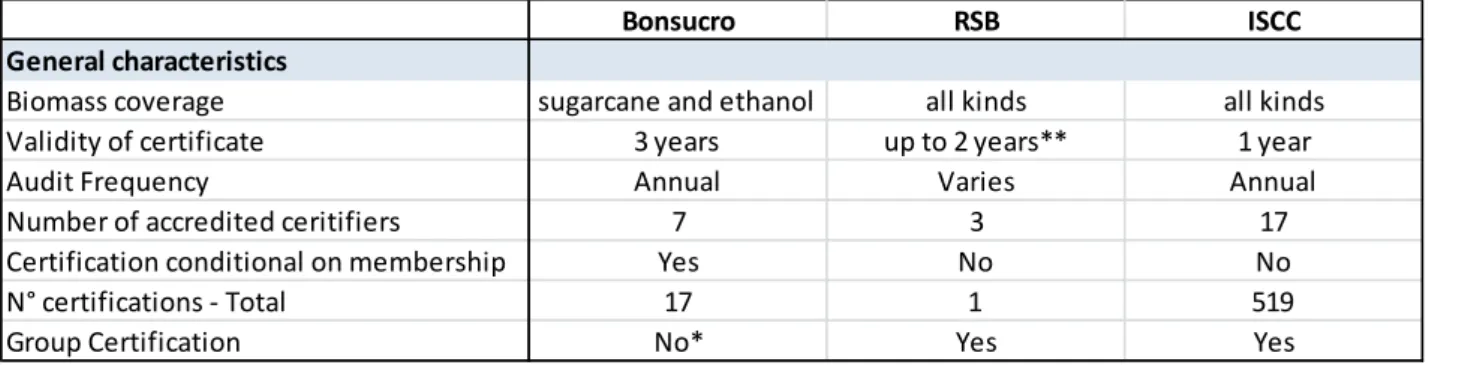
Table 1 below summarizes other general characteristics of the initiatives, except the IDB scorecard since it is not a certification system. The validity of the certificates varies between the standards. The Bonsucro certificate is valid for three years, the ISCC certificate is valid for one year and the RSB certificate for up to two years, depending on the risk class attributed to the certified operations (discussed in more detail in the systems operation benchmark). Bonsucro surveillance audits are carried out annually after the initial certification audit. For ISCC, audits are also annual since the certificate is only valid for one year. For RSB, audit frequency depends on the risk class attributed to the certified operations. The risk class determines the interval between audits, audit type (i.e., desk, office, field) and the audit team.
The certification of all three initiatives works through an accreditation system of approved certification bodies. ISCC has 19 recognized certification bodies, Bonsucro has seven and RSB has three. An important difference between the standards is that only Bonsucro requires all certified parties to become members of the organization. In RSB and ISCC, this is not a requirement. Certified parties may become members if they wish to take part in decision making and standard discussions, but are not obligated to do so if they only wish to become certified.
Table 1. General characteristics of initiatives
*Group certification is only allowed for chain of custody certification. **Depends on risk class attributed to operations.
4. Methodology
The benchmarking of the production and chain of custody principles, criteria and indicators, governance models, as well as other system operations characteristics was performed for Bonsucro, the International Sustainability and Carbon Certification – ISCC, and the Roundtable on Sustainable Biofuels – RSB. A separate assessment was carried out of the IDB scorecard.
There is not one well known and widely used methodology for benchmarking sustainability standards. Many comparisons have been done, however, using different methodologies and approaches. Therefore, to carry out the benchmark of the standards in this study, we used previously established frameworks and methods, as well as our own methods based on the objectives of the study.
Bonsucro RSB ISCC
General characteristics
Biomass coverage sugarcane and ethanol all kinds all kinds
Validity of certificate 3 years up to 2 years** 1 year
Audit Frequency Annual Varies Annual
Number of accredited ceritifiers 7 3 17
Certification conditional on membership Yes No No
N° certifications - Total 17 1 519
Institute for International Trade Negotiations – www.iconebrasil.org.br Página 10
Throughout the process of carrying out this benchmark, standard representatives and other experts in the sector were consulted in order to validate the methodology and the results and to guarantee that the assessment of the standards was accurate. Both the preliminary report and the final report were sent to representatives from Bonsucro, RSB and ISCC, whom provided valuable feedback. Their comments were incorporated in the report. In cases where there were significant disagreement points, footnotes were added to include the viewpoint of the standard representatives. The report, however, reflects ICONE´s assessment of the standards and gaps in Brazil.
It is important to mention that Bonsucro is the only sustainability standard that considers sugar and ethanol, while all others focus on biofuels in general2. For the analysis proposed, we intend to focus on sugarcane-based biofuels, more specifically cane-derived biojet fuels.
4.1. Definition of comparison criteria and framework for benchmark of Production standards
The benchmark of the production standards was carried out using a framework based on previously published studies to review and analyze sustainability standards and initiatives. The first reference was an analysis done by the Food and Agriculture Organization of the United Nations under the Bioenergy and Food Security Criteria and Indicators (FAO/BEFSCI) study about “Sustainability Aspects/Issues addressed under the Initiatives reviewed” (Ismail et al., 2011). The initiatives reviewed by the FAO included regulatory frameworks (such as the EU Renewable Energy Directive), as well as voluntary standards and certification schemes (such as Bonsucro, the International Sustainability and Carbon Certification - ISCC, the Roundtable on Responsible Soy - RTRS and the Roundtable on Sustainable Biofuels - RSB) and scorecards (such as the IDB scorecard). This served as a good base since all the standards included for the purpose of this study were also benchmarked in the FAO analysis (i.e., ISCC, RSB and Bonsucro and the IDB scorecard). In the FAO benchmark, four main categories were used to classify the criteria: environmental, socio-economic, governance and food security.
Based on the FAO benchmark and considering the specific objectives of the present study, the main benchmark categories were established as: environmental aspects, land use aspects, GHG emissions aspects, socio-economic aspects and food security aspects. We separated the land use and GHG emissions issues due to their importance for the life-cycle analysis phase of this project. The categories were chosen based on the most important topics in terms of biofuels produced from an agricultural feedstock and also considering the objective of the aviation industry with the adoption of biojet fuels. The categories above include the production/processing standards of the initiatives.
2
Institute for International Trade Negotiations – www.iconebrasil.org.br Página 11
The FAO analysis divides the main topics into sub-topics, which were also used as a reference for the present benchmark, with some adaptations based on the objectives of the present study (as will be shown below).
Next, we reviewed “The state of sustainability initiatives review 2010: sustainability and transparency” produced by the International Institute for Sustainable Development (IISD) and the International Institute for Environment and Development (IIED), which is an overview of the system characteristics and market trends regarding ten of the most mature voluntary sustainability initiatives in the forestry, coffee, tea, cocoa and banana sectors. Despite the fact that this report is not related to biofuel criteria, it served as a reference for the benchmark framework and organization, as well as for the systems operations benchmark (Potts, Meer and Daitchman, 2010).
Also, we consulted the paper “Recent developments of biofuels/bioenergy sustainability certification: a global overview” by Scarlat and Dallemand (2011). This paper provides a detailed review of the main certification initiatives and approaches for biofuels and/or bioenergy, including schemes for crops used as feedstocks for biofuels. The analysis includes Bonsucro, ISCC and RSB, as well as the Roundtable for Responsible Soy and the Roundtable on Sustainable Palm Oil. However, it also includes regulatory frameworks, such as the Renewable Transport Fuels Obligation, the US Renewable Fuel Standard and the California Low Carbon Fuel Standard. The approach in the paper is different from the one used in the present study in the sense that it is more like a general overview of these initiatives and not a benchmark per se.
In Scarlat and Dallemand (2011) the main topics analyzed were: general requirements, environmental aspects, GHG emissions calculations, socio-economic aspects, and monitoring and reporting requirements. The authors created subdivisions within the topics and defined criteria to analyze within these topics. We referenced the subdivisions and criteria created by the authors for the environmental aspects, GHG emissions and socio-economic aspects for this study.
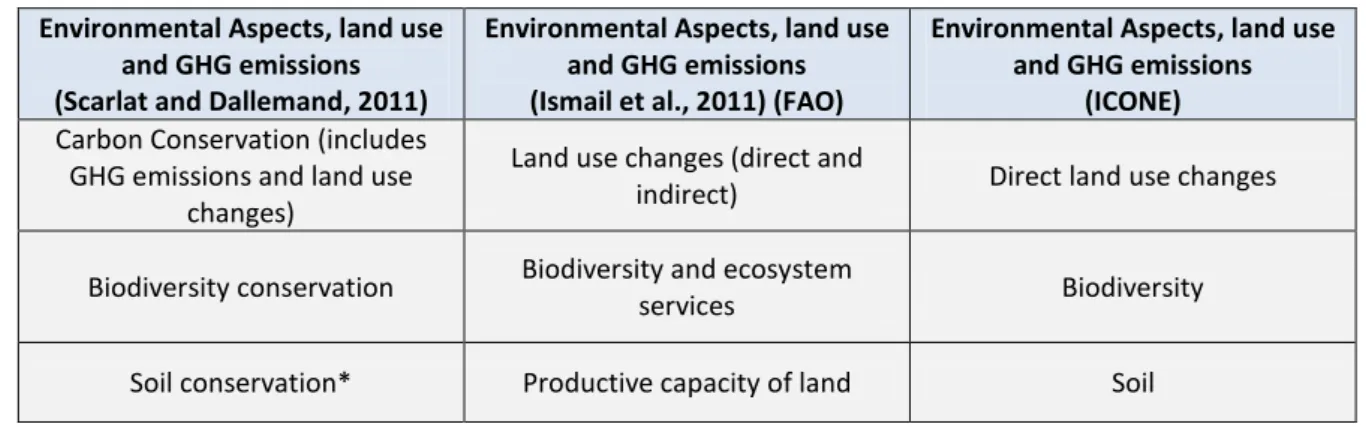
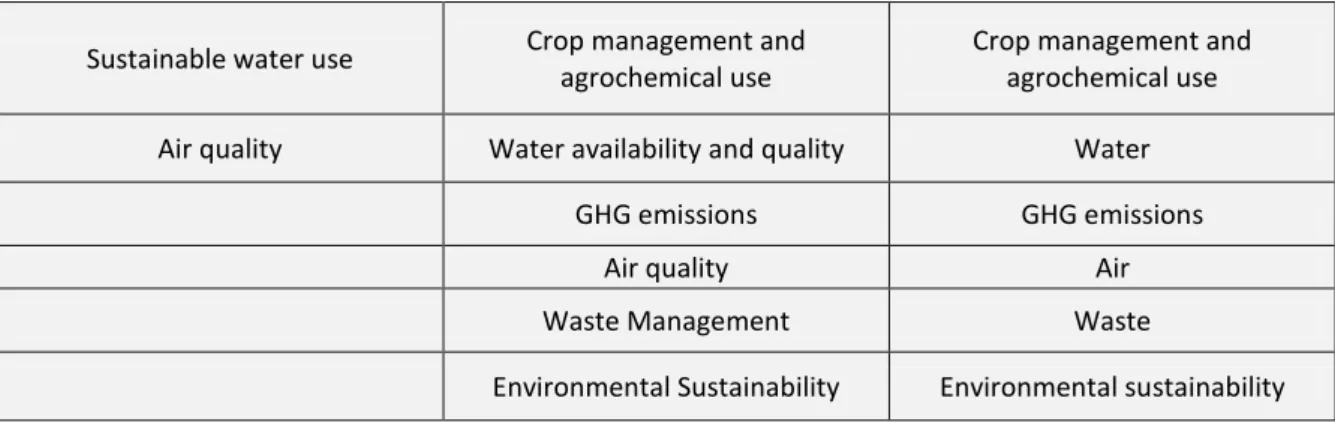
Based on the FAO study and on the Scarlat and Dallemand (2011) paper, 16 sub-topics were defined for the benchmark. They are very similar to the FAO analysis, as can be seen in tables 2 and 3 below.
Table 2. Environmental aspects, land use and GHG emissions (sub-topics) Environmental Aspects, land use
and GHG emissions (Scarlat and Dallemand, 2011)
Environmental Aspects, land use and GHG emissions (Ismail et al., 2011) (FAO)
Environmental Aspects, land use and GHG emissions
(ICONE) Carbon Conservation (includes
GHG emissions and land use changes)
Land use changes (direct and
indirect) Direct land use changes
Biodiversity conservation Biodiversity and ecosystem
services Biodiversity
Institute for International Trade Negotiations – www.iconebrasil.org.br Página 12 Sustainable water use Crop management and
agrochemical use
Crop management and agrochemical use
Air quality Water availability and quality Water
GHG emissions GHG emissions
Air quality Air
Waste Management Waste
Environmental Sustainability Environmental sustainability * The authors include waste management and agrochemical use in the soil conservation sub-topic.
Table 3. Socio-Economic and Food security (sub-topics) Socio-Economic and Food
security aspects (Scarlat and Dallemand, 2011)
Socio-Economic and Food security aspects (Ismail et al., 2011) (FAO)
Socio-Economic and Food security aspects
(ICONE) Economic development Land tenure/access and
displacement Land, water and resources Social aspects Rural and social development Rural and social development Labor conditions Access to water and other natural
resources Human rights and labor rights Employment, wages and labor
conditions
Employment, wages and labor conditions
Human health and safety Human health and safety Energy security and access Economic development Good management practices and
continuous improvement Food security Social sustainability
Food security
The 16 subtopics were further divided into 36 comparison criteria. To define the criteria we referenced Scarlat and Dallemand (2011), but we changed some of the aggregations, based on what we considered plausible and most relevant for the purpose of the present study. Also, the previous definition of the sub-topic guided the definition of the comparison criteria, as well as the standards themselves.
To summarize, the 16 topics (underlined) and 36 sub-topics (numbered) are listed below and described in detail in Section 6:
Under Environmental, Land use and GHG emissions:
Biodiversity: 1) biodiversity and 2) genetically modified organisms. Soil: 3) productive capacity of the soil and 4) use of by-products.
Crop Management and Agrochemical Use: 5) fertilizer, 6) integrated plant management, 7) agrochemical use.
Water: 8) quality of surface and groundwater and 9) quantity of surface and groundwater/Irrigation.
Institute for International Trade Negotiations – www.iconebrasil.org.br Página 13
Air: 10) air pollution and 11) open air burning.
Waste: 12) reduce waste/waste management/disposal
Environmental Sustainability: 13) energy, 14) efficiency and 15) incorporation of sustainability into new projects.
Direct land use changes: 16) restriction/baseline for LUC.
GHG emissions: 17) emission reduction and 18) GHG calculations. Under Socio-Economic and Food Security:
Laws and International Conventions: 19) compliance with relevant applicable laws. Land, Water and Resources: 20) land rights and land use rights, 21) water rights.3 Human Rights and Labor Rights: 22) labor conditions and 23) contractor and
suppliers.
Employment, Wages and Labor Conditions: 24) wages/per unit wages, 25) work hours/breaks/overtime, 26) contracts and 27) communication/complaints/mediation mechanisms.
Human Health and Safety: 28) conditions of occupational health and safety for workers, 29) social impact assessment.
Rural and Social Development: 30) social development and 31) women, youth, children and indigenous communities.
Economic Development: 32) production and processing efficiency, 33) economic viability, 34) good management practices and 36) engagement and communication with stakeholders.
Food Security: 36) assess food security impacts.
Lastly, to validate the comparisons and the defined criteria, we consulted the “standards map” tool, developed by the International Trade Centre (ITC, 2011), which includes all three of the analyzed standards. This is a benchmark tool that allows users to compare different criteria within standards.
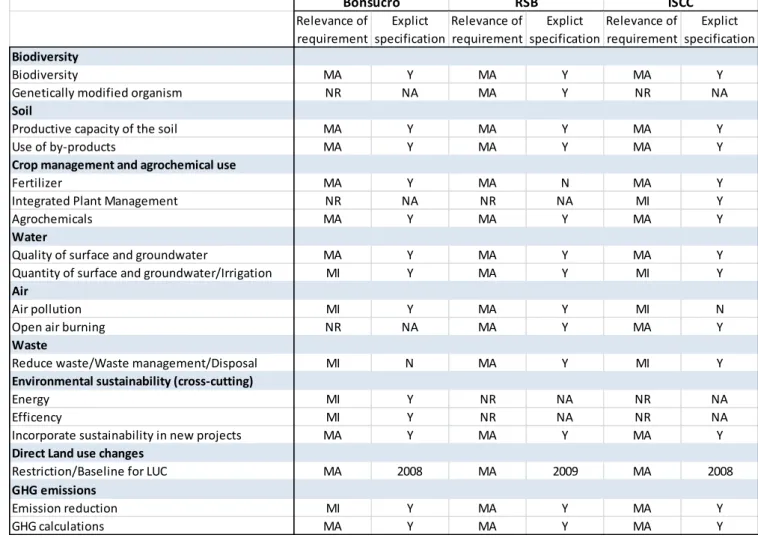
After the definition of the criteria, we compared the production standards based on two indicators: a) relevance of requirement4 and b) as having explicit or not explicit specifications. a) Relevance of requirement: classify standards as having major requirements, minor requirements or no requirements in each category in order to highlight the relevance of issues in each standard.
3
In the first edition of the report, there was a 3rd sub-topic within this category named “access to resources”. It was excluded because after consultation with standard representatives, it was concluded that it was redundant since there are individual categories for the issues included in this topic (i.e., water rights, land rights and food rights/access).
4
This indicator was previously named “timing of requirement” and standards were classified as having “immediate requirements”, “not immediate requirements” and “not required”. After consultation with standard representatives, this was changed since they expressed a concern that the previous terminology would create confusion regarding the requirements for certification.
Institute for International Trade Negotiations – www.iconebrasil.org.br Página 14
• For Bonsucro: major requirements were considered to be the five core criteria required for certification: applicable laws, International Labor Organization - ILO labor conventions, minimum wage, assess impacts of sugarcane enterprises on biodiversity and ecosystem services, and greenfield expansion. Minor requirements were considered to be all the others. However, for certification the producer needs to comply with the core criteria along with 80% of the total indicators, besides from 100% of chain of custody requirements and additional 100% of Bonsucro EU criteria (when intended for EU market).
• For RSB: major requirements were considered to be all minimum requirements, which must all be met necessarily for certification, along with chain of custody requirements. Minor requirements were considered to be all progress requirements.
• For ISCC: major requirements were considered to be all criteria classified as “major musts” in the standard, which must all be met necessarily for certification, in addition to 60% of minor musts and chain of custody requirements. Minor requirements were considered to be all the “minor musts” defined in the standard.
• For IDB: this was not applied to IDB, as it is a scorecard (self-assessment tool) and not a standard like the others.
b) Explicit specification: classify criteria as being an explicit specification or not.
• The criteria was classified as being an explicit specification in two cases: 1) if there was a quantitative measure or indicator to verify compliance with the criteria; 2) if there was a qualitative, but detailed description of how to verify compliance with the criteria.
• The criteria were classified as not being an explicit specification if it did not present a detailed description or way to verify compliance with the criteria.
• The ‘not applicable´ classification was used in cases where the issue is not a requirement in the standard.
Lastly, the requirements of the standards were compared to Brazilian legislation based on the question: Is the criteria covered by Brazilian legislation? (Yes or No).
4.2. Definition of comparison criteria and framework for benchmark of Chain of custody Standards
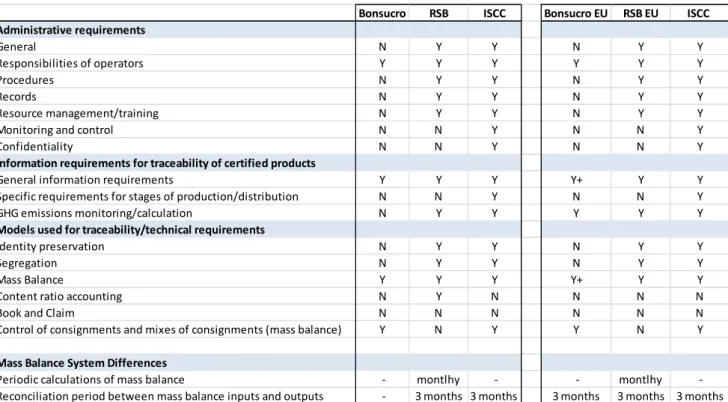
The chain of custody criteria for comparison of standards were defined mainly based on the “standards map” tool (ITC, 2011) and also based on the standards themselves. Scarlat and Dallemand (2011) briefly touch on this topic and classify chain of custody requirements as administrative and technical. In the “standards map” analysis, the criteria used are very broad. In the present study, we tried to disaggregate the broad categories to provide a more detailed comparison. The requirements were divided into three broad categories: 1) Administrative requirements for tracking certified products; 2) Information requirements for tracking certified products; 3) Models used for traceability/technical requirements. We also included a category to compare the mass balance methodologies of the standards, since it is the most commonly used for traceability of certified products along the supply chain.
Institute for International Trade Negotiations – www.iconebrasil.org.br Página 15
After the criteria were defined, we assessed which standards required each criterion on a yes/no basis. For the EU market specific standards, additional criteria were also identified. A qualitative assessment of the differences was also carried out following the result presentation in tables.
4.3. Definition of comparison criteria and framework for benchmark of governance, transparency and public disclosure of information
The governance models of the analyzed initiatives were described and compared based on organizational structure, standard-setting and certification processes. Also, as a way of assessing transparency in the initiatives, we carried out a benchmark of public disclosure of information of the standards based on the model presented in Potts, Meer and Daitchman (2010) and also on the “standards map” tool, developed by the International Trade Centre (ITC, 2011). The criteria for comparison were divided in three broad categories: 1) information related to decision makers; 2) information related to decisions and; 3) information related to documents of meetings and processes. The first category includes the availability of documents with information on who are board, committee and technical group members. The second category includes the availability of information regarding decisions, such as compliant enterprises, complaints, appeals and resolutions, and certification decisions. The last category includes the availability of documents related to records and processes. These categories were further divided into more detailed sub-categories.
After the criteria were defined, we assessed the standards availability of information in each category on a yes/no basis (presented in a table), and also carried out a qualitative assessment of the comparison.
4.4. Definition of comparison criteria and framework for benchmark of system operations
Within this category, system operation characteristics were compared and analyzed, including conformity assessment and risk assessment. The comparison criteria for the conformity assessment benchmark were defined based on the previously mentioned publications, especially Potts, Meer and Daitchman (2010), the “standards map” tool, and also a benchmark carried out by a consulting firm for the UK Department of Transport (Ecofys, 2011). These two publications served as a good starting point to define comparison criteria for conformity assessment. For risk assessment, we defined three comparison criteria based on the standards themselves, since none of the publications we consulted treat this issue in detail. We defined three criteria to be compared on a yes/no basis: 1) whether the standard has specific guidelines/standard for risk assessment; 2) whether the standard requires a self-risk assessment and; 3) whether the risk level affects the audits. We also carried out a qualitative analysis of this issue and differences between the standards.
Institute for International Trade Negotiations – www.iconebrasil.org.br Página 16 4.5. Compilation of results and notes on presentation of results
The results were compiled and are presented in tables, followed by a qualitative analysis of the comparisons. It is important to highlight that the initiatives have different standards for certification of products to be in compliance with the European Union Renewable Energy Directive (RED). Production standards differ in EU requirements only regarding environmental, land use and GHG emissions criteria and, therefore, only these sections will make this distinction.
The differences between the “original” standards and EU directed standards are summarized below:
RSB-EU: criteria 3a and 7a are different from RSB.
Bonsucro-EU: Principle 6 is a principle supplements the original Bonsucro standard. ISCC-EU: Criteria 1.3, 1.4, 2.3, are different from ISCC-DE. ISCC-EU Criteria 2.4.5, 2.5.3,
2.5.4, and 2.5.5 are new. ISCC requested that only the ISCC-EU standard be included in the analysis because they intend to maintain only this standard in the near future. Therefore, the ISCC-EU standard will be referred to as only ISCC from now on for the purpose of this study. In the benchmark results, the only standard considered is ISCC-EU.
It is also important to note that the IDB Scorecard is not per se a standard and, therefore, receives special treatment in the benchmarking. This means that it was not compared to the certification systems and that a qualitative assessment of the categories included was carried out in a separate section of the report.
5. Benchmark results
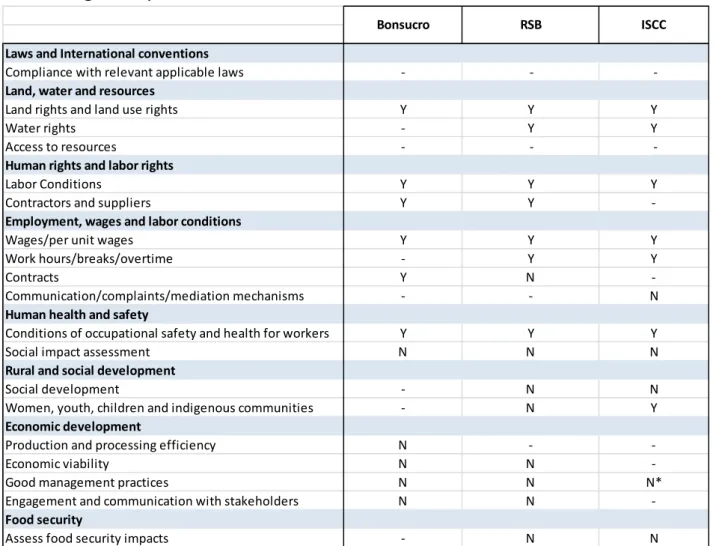
The results of the comparisons are summarized in tables 1 through 8. The results are divided in benchmark of environmental, land use and GHG emissions requirements followed by environmental, land use and GHG emissions requirements benchmark against Brazilian legislation. Next, the same is presented for socio-economic and food security requirements; for chain of custody standards; governance, transparency and public disclosure of information; and system operations. The last sub-section is dedicated to the assessment of the IDB scorecard.
5.1. Production Standards: Environmental, Land Use and GHG Emissions
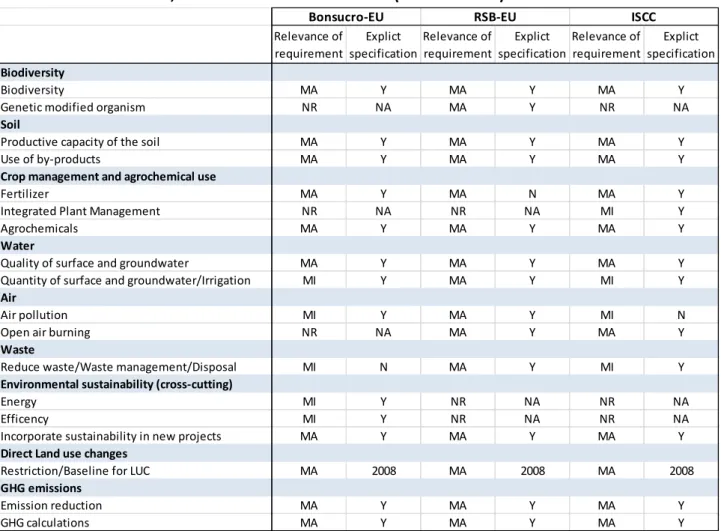
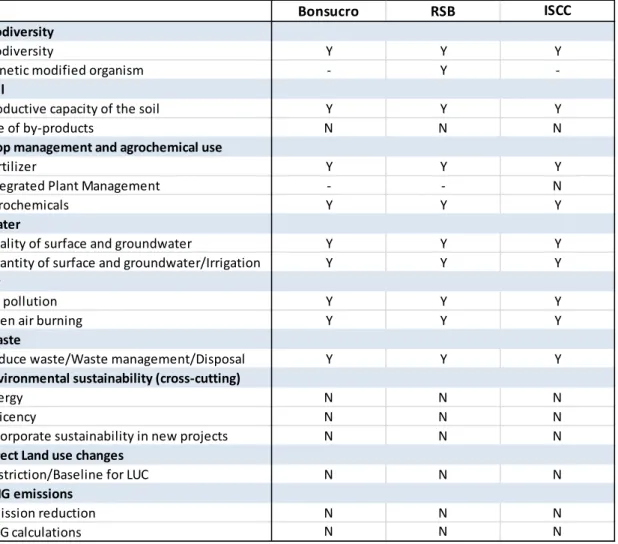
For the production standards the following topics were analyzed separately: biodiversity, genetically modified organisms, productive capacity of the soil, use of by-products, fertilizer, integrated plant management, agrochemicals, quality of surface and groundwater, quality of surface and groundwater/irrigation, air pollution, open air burning, reduce waste/waste management/disposal, energy, incorporate sustainability in new projects, restriction/baseline for Land Use Change – LUC, emissions reductions and GHG calculations. The qualitative assessment for the different standards is summarized in Table 4 (original standards) and Table 5 (EU standards). Table 6 compares if the principles and criteria are covered by the Brazilian legislation.
Institute for International Trade Negotiations – www.iconebrasil.org.br Página 17 Biodiversity
This category includes biodiversity, ecosystem services and invasive species. Biodiversity includes plants, animals, other organisms and ecosystem. Ecosystem services are the goods and services that biodiversity provides. Invasive species can pose a threat to biodiversity if it is not well handled. All the standards treat biodiversity as a major requirement and present explicit specifications. All standards have detailed criteria about land with High Conservation Value (HCV), land with high biodiversity value or high carbon stock. These criteria fulfill a requirement from the EU Directive 28/09/EC.
Bonsucro and Bonsucro-EU have a general approach in their criteria. The efforts related to biodiversity are concentrated in the criterion about land with HCV and the criterion about the need to have and implement an environmental management plan (EMP). The EMP stipulates the protection of riparian areas along with other issues. ISCC also has a general approach and all concepts related to biodiversity are treated in the criteria about use of the land with high biodiversity value or high carbon stock and protection of HCV areas. An important point is that ISCC requires that all other production areas of the farm/ plantation comply with these criteria. RSB and RSB-EU have more detailed criteria. They divided the subject into different criterion, this methodology allows for more detailed requirements, for instance on preserving ecosystem services and functions. Special attention is paid to the concept of buffer zone inside the production site to intercept pollutants and manage other environmental concerns. The other standards do not have this concept.
The Brazilian legislation related to these issues are Decree Nº 4.339/2002 (National Policy for Biodiversity), Law Nº 4.771/1965 (Forest Code) and Decree Nº 6.514/2008. The Brazilian legislation protects land with high biodiversity value, but it does not prohibit the conversion of such lands. There is legislation in place that allows the conversion of specific areas. The legislation is not specific regarding the conservation of land with highly biodiverse grassland, land with high carbon stock and peat land. To comply with the requirements of EU directive 28/2009 no conversion of land with high biodiversity value, land with highly biodiverse grassland, land with high carbon stock and peat land no conversion is allowed. Brazil does not have a specific legislation about buffer zone (as considered by RSB and RSB-EU) within the production site. However, some requirements in the Brazilian Forest Code can be considered similar to it, such as Permanent Protected Areas with riparian natural vegetation, and the Legal Reserve (a percentage of the farm which needs to be preserved with natural vegetation). Ecosystem services are recognized in the Brazilian legislation.
The Decree Nº 6.514/2008 considers as crime infractions against the fauna and flora, infractions that promote pollution and other environment infractions. It can be considered more restrictive than the standards requirements.
Institute for International Trade Negotiations – www.iconebrasil.org.br Página 18 Genetically modified organisms
This category includes all criteria related to genetically modified organisms (GMO). The use of GMOs is allowed, but actions shall be taken to minimize the risk of damages to the environment and people, and to improve environmental and/or social performance over the long term. Brazil is a signatory of the Cartagena Protocol on Biosafety and uses the Biosafety Clearinghouse. Only the RSB and RSB-EU standards have major requirements for GMOs, which shall demonstrate positive environmental and/or social benefits, with appropriate measures of containment and monitoring. However they are not prohibited by the RSB. The certification scheme had a GMO Expert Group that worked to improve RSB guidelines for risk mitigation regarding GMOs. Brazil does not use GMO crops for sugarcane. But Amyris’ industrial process to obtain biojet fuel does use GMOs.
Aside from being a signatory of the Cartagena Protocol on Biosafety, Brazil has a legislation that goes beyond the required to fulfill the RSB and RSB-EU criteria about GMOs. The law 11.105/2005, Decree 5.591/2005 establishes norms of security, inspection, disposition and release in the environment. There are severe penalties, including one to four years reclusion for illegal disposal or release of GMOs into the environment.
Productive capacity of the soil
This category includes all criteria related to soil as a factor for feedstock production and the environment. For this reason, the soil quality (physical, chemical and biological) must be improved and/or maintained. Soil erosion and soil structure are analyzed within this topic as well. All the standards have explicit specifications regarding this issue, although they adopt different criteria to analyze it.
Bonsucro and Bonsucro-EU have measurable values for soil ph, soil carbon content and to minimize the opportunity of erosion to occur. Additionally, Bonsucro addresses the percent of soil tilled and covered to conserve soil health and reduce erosion.
ISCC has detailed criteria to minimize soil erosion, to manage vulnerable soil, to assess the balance of organic soils, and techniques to maintain the soil structure. The standard has a restriction on burning as part of the productive process and do not allow burning as part of the land clearing process. ISCC has a specific criterion for soil management planning.
RSB and RSB-EU have specific procedures for this subject. Requirements are to minimize soil erosion, adopt practices to maintain or enhance soil organic matter and to conduct a screening of soil conditions. If necessary, after the screening, a Soil Impact Assessment should be conducted in accordance with the guidance.
The Program of Hydrographic Basin and Conservation of Soil concentrate the actions for soil conservation in Brazil. Conama Resolution Nº 420/2009, and Decree N° 94076/1987. The individual states can have their own legislation for soil use and conservation.
These standards also have a restriction on burning as part of the productive process, but do not prohibit the burning. The issue of burning is discussed in more detail in the “Open air burning” section.
Institute for International Trade Negotiations – www.iconebrasil.org.br Página 19 Use of by-products
This category includes all criteria related to the use of agricultural by-products. This is an explicit criterion for all standards and a major requirement as well. These criteria address the consequence for the soil of the use of agricultural by-products from the feedstock production. In addition, the RSB is developing a specific certification regime for biofuel producers using agricultural, forestry or industrial by-products.
Fertilizer
This category concentrates all aspects of fertilizer utilization, including storage, handling and disposal. Only ISCC fully describes the good practices for fertilizer use, including the use of machinery. But it is a major requirement for all the standards. Bonsucro and Bonsucro-EU have detailed criteria for the application rates of fertilizers, which pay special attention to the potential effects on eutrophication caused by the use of nitrogen and phosphorus fertilizer, as well as greenhouse gas impacts. RSB and RSB-EU treat fertilizers as a chemical and has a list of prohibited substances (Principle 11).
Brazil does not have a legislation that controls the use of fertilizers, but has legislation about handling these products. It covers the production, importation, commercialization and inspection. The normative instruction specifies the norms for registry, packaging and labeling of fertilizers. Decree Nº 4954/2004, MAPA/SDA Normative Instruction nº 27 /2006; MAPA Normative Instruction nº 5 /2007; MAPA/SDA Normative Instruction nº 25 /2009.
Integrated Plant Management (IPM)
IPM is a potentially more sustainable way to manage invasive plants and pests through prevention, observation and monitoring, and intervention. In the intervention phase, non-chemical approaches must be considered. Only ISCC has criteria related to this subject, but they are not impeditive (not major requirements) for certification.
Agrochemicals
This category concentrates all aspects of agrochemicals utilization, including storage, handling and disposal. This subject is a major requirement for all the standards and all of them have explicit specifications for it. ISCC has more detailed criteria for use, handling, storage and disposal, than the other standards. RSB, RSB-EU, Bonsucro and Bonsucro-EU do not allow the use of chemicals recorded in the World Health Organization (WHO)’s 1a and 1b lists. For Bonsucro and Bosucro-EU, the only exception is when the use of these chemicals can be proven to be in compliance with local and international legal requirements. RSB and RSB-EU establish a phase-out program for the use of chemicals recorded in Annex III of the Rotterdam Convention and in the Stockholm Convention on Persistent Organic Pollutants (POPs). Bonsucro, Bonsucro-EU, and ISCC have criteria that state that only locally approved agrochemicals should be used. Bonsucro, however, limits the amount of pesticide active ingredients to 5kg/ha. Bonsucro and Bonsucro-EU criterion require producers to follow the Stockholm Convention on POPs. Brazil is a
Institute for International Trade Negotiations – www.iconebrasil.org.br Página 20
signatory of both the Rotterdam Convention and the Stockholm Convention, as a member of the WHO. However, being a signatory or member does not mean that Brazil does not allow the use of the chemicals listed in the RSB and RSB-EU standards.
The legislation includes research, experiments, production, packaging, labeling, transportation, storage, commercialization, marketing, utilization, importation, export, final destination of residues and packages, register, classification, control, and inspection of agrochemicals. Brazilian legislation covers the points established by the standards in their criteria. Brazil is a member of the WHO and a signatory of Rotterdam Convention and the Stockholm Convention. However, being a signatory to these conventions does not mean that the agrochemicals listed in WHO’s 1a and 1b lists are not used in Brazil. The relevant national laws are Law nº 7802/1989, Decree Nº 4074/2002, and IBAMA Normative N° 84, de 15 of October 1996.
Quality of surface and groundwater
This subject is related to all criteria that treat water as an important factor for production and the environment. For this reason, water quality (physical, chemical and biological) must be improved and/or maintained during all or part of the biofuel productive process. This is a major requirement and all standards have explicit specifications for it. Bonsucro and Bonsucro-EU include water for industrial use and for agricultural use. Bonsucro also addresses water quality from the farm level through the nutrient input and EMP indicators. ISCC focuses only on agriculture usage of water. RSB and RSB-EU include the usage of water both at the agricultural and industrial stages of the supply chain. ISCC has criteria for maintaining or re-establishing the natural vegetation near water bodies, as does Bonsucro and Bonsucro-EU. The RSB and RSB-EU require establishing buffer zones where needed in order to avoid degradation of water bodies. RSB and RSB-EU have a Water Assessment if the screening exercise indicated the need for it.
The relevant national laws regarding this issue are CONAMA Resolution Nº 420/2009; CNRH Resolution No 92/2008; Law Nº 9433/1997; Decree Nº 6514/2008. Law Nº 9433/1997 states that the Federal Executive may delegate to the States and the Federal District the authority to grant license or right of use of water resources under federal domain. The Hydrographic Basin Committee is responsible for the management of hydric resources. It can be federal-level, if the river crosses a State border, or state-level if the river flows within the State. The States can have their own legislation for water, especially for rivers that only flow within the state.
Law Nº 4771/1965 (Forest Code) establishes that the riparian vegetation has to be maintained or re-established. Brazilian legislation treats as an environmental crime water pollution. It can be considered more restrictive than the standards requirements.
Institute for International Trade Negotiations – www.iconebrasil.org.br Página 21 Quantity of surface and groundwater/irrigation
This category complements the previous one. The quantity of surface and groundwater can be affected by unsustainable use. All standards have explicit specifications about this topic, but only RSB and RSB-EU treat it as a major requirement. RSB and RSB-EU have specific Water Assessment guidelines related to depletion and contamination of water resources, including the water used for irrigation. Bonsucro and Bonsucro-EU have criteria to reduce water consumption, specifically for irrigation. ISCC has a specific criterion to justify irrigation considering water conservation. Also, ISCC requires a water management plan aimed at efficient water usage.
The relevant national laws regarding this issue are CONAMA Resolution nº 396 /2008; CNRH Resolution Nº 5/2000; DECREE Nº 89.496/1984; Decree Nº 2.178/1997; and Decree Nº 6.514/2008. The Federal Law governs the irrigation, but states can have their own legislation for irrigation. The Hydrographic Basin Committee is also involved with this subject. The pollution of groundwater is treated by the CONAMA Resolution nº 396 /2008 considering the prevention and control of pollution. The Brazilian legislation is more detailed and restrictive than the standards requirements.
Air pollution
Only RSB and RSB-EU have major requirements related to air pollution. They require the implementation of an air management plan, which identifies major air pollutants and indicates strategies to mitigate air pollutants. Bonsucro and Bonsucro-EU have a threshold for atmospheric acidification and air and air pollution is an issue that should be addressed in the Environmental Management Plan. ISCC only mentions explicit air conservation in the main title of Principle 2 and in the criterion related to open air burning, which will be discussed below.
The relevant national laws regarding this issue are CONAMA Resolution Nº 005/1989; and Decree Nº 6514/2008. Brazilian legislation treats as an environmental crime air pollution. The legislation fulfills the requirements from the standards, but Brazilian legislation does not require farmers to have an air management plan. The States can have their own legislation for air pollution.
Open air burning
This category includes all criteria related to open air burning as part of the production cycle. Only Bonsucro and Bonsucro-EU do not have criteria for it, however, they call for a burning plan through the EMP. Additionally, both standards account for GHG emissions, soil organic matter, and ground cover in different aspects of the standard. As Bonsucro is metric based it does not prescribe management practices. All the other standards treat this subject as a major requirement. ISCC has a restriction on burning as part of the productive process and does not allow burning as part of the land clearing process. This restriction allows the use of burning only when this use is authorized by environmental license. RSB and RSB-EU require that burning of sugarcane for harvest be minimized, but do not prohibit the burning under specific
Institute for International Trade Negotiations – www.iconebrasil.org.br Página 22
conditions, e.g. when workers health and safety is at stake or when no viable alternative is available.
The restriction on burning is an important issue for Brazilian sugarcane producers because burning is an optional procedure for sugarcane harvesting. Even in this scenario, Brazilian legislation already covers this issue, and São Paulo state (the most important for sugarcane production) has specific legislation that establishes the extinction of burning in 2031, but the Agricultural-Environmental Protocol for the Sugar/Energy Sector firmed between the State of São Paulo and the sector, anticipated the extinction of burning to 2017. In addition, many municipalities have their own legislation that prohibits burning for harvesting.
The relevant national laws regarding this issue are Decree Nº 2661/1998; Decree Nº 6.514/2008. Brazilian legislation treats as an environmental crime burning of solid residues and burning for clearing areas. States and municipalities have their own legislation that can be more restrictive than the federal legislation. Also, the Decree Nº 6961/2009 establishing the Agro-Ecological Zoning imposes that sugarcane burning will be forbidden nationally in 2017. The Brazilian legislation is more restrictive than the standards requirements.
Reduce waste/waste management/disposal
This topic is related to reduction/treatment/disposal of waste in order to avoid environmental contamination. It is a major requirement only for RSB and RSB-EU, but ISCC, RSB and RSB-EU have explicit specifications regarding this issue. ISCC has a farm waste management plan. The RSB and RSB-EU have criteria to manage the waste, minimize waste and avoid contamination of the environment. Bonsucro and Bonsucro-EU have criteria to reduce emissions and effluents, but do not address the issue of waste disposal or waste management.
The relevant national laws regarding this issue are CONAMA Resolution N° 430/2011; Law Nº 12305, /2010; and Decree Nº 6514/2008. Brazilian legislation treats as an environmental crime pollution promoted incorrect disposal of waste, also the incorrect disposal of waste. Brazilian legislation does not require farmers to have a waste management plan. The federal legislation says that states must have a state law for solid residues. The state legislation can be more rigorous than the federal legislation.
Energy
The use of energy can have impacts on environmental sustainability, for that reason it is taken into consideration when planning the use of energy for the biofuel project. Bonsucro and Bonsucro-EU have criteria that require reduction of energy consumption through the entire chain of production.
Efficiency
Like energy, efficiency can have impacts on environmental sustainability. Only Bonsucro and Bonsucro-EU have explicit requirements related to this, but they are not major requirements. The efficiency criteria are related to total raw materials used per kg of product,
Institute for International Trade Negotiations – www.iconebrasil.org.br Página 23
sugarcane yield, working hours lost/working hour and others related to mill and industrial performance.
Incorporate sustainability in new projects
All the standards have explicit specifications for this issue, and it is a major requirement as well. The environmental sustainability is considered in all aspects of the project, and all objectives consider the impact they have on the environment.
Brazilian legislation has the instrument EIA/RIMA (study of environmental impact/report of environmental impact) implemented by CONAMA Resolution Nº 001/1986, to be submitted by the biofuel project to the environmental organ responsible (states and/or federal). The EIA/RIMA is more detailed than the standards and as restrictive as the standards, because if a project doesn’t have the EIA/RIMA, it is not authorized to be implemented.
Restriction/Baseline for Land Use Change - LUC
RSB-EU and ISCC have a restriction on conversion of land that fulfills the EU directive 28/2009. The original standards have restrictions on conversion but that do not necessarily meet the EU directive 28/2009. Bonsucro-EU does not meet the sustainability requirement of Article 17(3)(c) on highly biodiverse grassland of the Directive. The Bonsucro-EU standard states that HCVA should be defined nationally and that in the absence of such definition producers should prove that no HCVAs have been converted after 2008. The GHG emissions due to land use change must be added to the carbon footprint for all the standards. Bonsucro and Bonsucro-EU consider direct land use change as a change from the original state of the land to use for sugarcane production. Bonsucro also focuses on RAMSAR and UNESCO Heritage Sites through indicator 1.1. RSB, RSB-EU, ISCC consider the direct land use change for production of any feedstock for biofuel/bioliquid. RSB has a concept of “no-go areas” for areas that should not be used for feedstock production. There is also a restriction to conversion of areas that contain identified conservation values of global, regional or local importance. RSB-EU is more detailed defining the “no-go areas” and adding the definitions of UNESCO’s World Heritage Site, Ramsar Site and Alliance for Zero Extinction areas. More than that, the standard has a concept of “no-conversion areas” that fulfills the EU directive 28/2009 and includes HCV Areas, Key Biodiversity Areas, Natura 2000 Sites, etc. While “no-go” areas cannot be used for any biofuel operation, “no-conversion” areas can be used for biofuel operations as long as their conservation status is maintained and that none of their conservation values is lost due to biofuel operations. RSB and RSB-EU calculate the emissions by subtracting the carbon content of the implemented biofuel system from the carbon content of the land use at the baseline date. RSB has a baseline date of 01/01/2009, and a baseline date of 01/01/2008 for RSB-EU. RSB and RSB-EU use IPCC land categories: forest land; cropland; grassland; wetlands; settlements; other land.
ISCC has definitions for land with high biodiversity value or high carbon stock. The principles are in accordance with the EU directive. ISCC uses several definitions such as: UNESCO world heritage site, Ramsar site, Alliance for Zero Extinction, Harmonized world soil database,
Institute for International Trade Negotiations – www.iconebrasil.org.br Página 24
WDBA, IBAT, and national documents. The ISCC states that no national law and regulation can violate any requirements of ISCC and the EU Directive 28/2009. ISCC considers the IPCC categories of land use plus a seventh category for perennial crops. If after 01/01/2008 (the baseline) a change occurs from one category to another, then there is a need to calculate the emissions from carbon stock changes. Only when Principle 1 is not violated, a land use change can take place and then carbon stock change has to be calculated. Bonsucro definitions of high conservation value areas state that National definitions of HCVA shall take precedence over international when both exist. Bonsucro-EU adds the definitions from the EU directive 28/2009 and establishes that the definitions from the EU directive are proprietary, although Bonsucro-EU does not meet the sustainability requirement of Article 17(3)(c) on highly biodiverse grassland of the Directive. Bonsucro and Bonsucro-EU state that the table of IPCC default land use change values for selected countries published in the PAS 2050 is used in the footprint calculation. Bonsucro considers the date 01/01/2008 as baseline.
Brazil has an Agricultural-Environmental Zoning for sugarcane (ZAE – CANA - Figure 1), implemented by Decree Nº 6961/2009. The ZAE – CANA guides the expansion of sugarcane through a combination of public policies and access to credit. The Zoning considers: vulnerability of land, climate risk, potential for sustainable agricultural production and the present environmental legislation. More than that, the Zoning excludes from possible sugarcane expansion: 1. land with a slope superior to 12%, considering the premise of mechanical harvest, without burning for the expansion areas; 2. areas with native vegetation; 3. the Amazon and Pantanal biomes and Alto Pantanal watershed; 4. areas of environmental protection; 5. Indigenous land; 6. dunes; 7. mangrove; 8. cliffs and rocks outcrops; 9. reforestation areas; 10. urban areas and mining areas. For the Center-South states (GO,MG, MT, MS, PR and SP), areas that already had sugarcane plantation in the crop year 2007/2008 were excluded. The areas appointed for the expansion of sugarcane production under the Agricultural-Environmental Zoning are those areas that are already under intensive agricultural production, semi-intensive agricultural production, special crop production (perennials, annuals) and grassland. This areas were classified into three groups according to their potential (high, medium and low) further discriminated by current type of use (Ag – Agriculture/Livestock, Ac – Agriculture and Ap – Grassland) based on the map for remaining forest in 2002, published by Probio-MMA.
Institute for International Trade Negotiations – www.iconebrasil.org.br Página 25
Figure 1- Agricultural-Environmental Zoning for sugarcane – suitable areas in Brazil
Source: Embrapa (2009)
Emissions reduction
The EU directive 28/2009 requires an immediate minimum reduction of 35% of lifecycle greenhouse gas emissions relative to the fossil fuel baseline. The EU has progressive requirements for emissions reductions, up to 60% in January 2018. This requirement also applies to bio jet fuel. The fossil fuel equivalent product has an emission value of 83.8 gCO2eq/MJ.
RSB and RSB-EU require a 50% reduction at the blending stage, which can be obtained by blending biofuels with different GHG performances (e.g. blending equal volumes of a biofuel achieving 60% GHG savings and a biofuel achieving 40% GHG savings), while ISCC requires a 35% reduction initially, which progressively rises to 60% within certain time. Bonsucro requires the emissions from ethanol production to be less than 24 gCO2eq/MJ, while Bonsucro-EU has to be less than 50 gCO2eq/MJ. The difference of values is due to the fact that the EU RED has a default value for sugarcane ethanol of 24 gCO2eq/MJ plus the value of direct land use change, and for this default value the threshold of 50 gCO2eq/MJ is equal to a reduction of 40%.