der Technischen Universität Darmstadt genehmigte
Dissertation
zur Erlangung des akademischen Grades Dr. rer. nat.
vorgelegt von
Silvana Hartmann, Dipl. Ling. geboren in Darmstadt
Tag der Einreichung: 3. August 2016 Tag der Disputation: 30. September 2016
Referenten: Prof. Dr. Iryna Gurevych, Darmstadt Prof. Martha Palmer, Ph.D., Boulder
Prof. Dr. Simone Paolo Ponzetto, Mannheim Darmstädter Dissertationen 2017
URL:http://tuprints.ulb.tu-darmstadt.de/id/eprint/6770
This document is provided by tuprints, E-Publishing-Service of the TU Darmstadt http://tuprints.ulb.tu-darmstadt.de [email protected]
This work is published under the following Creative Commons license: Attribution – Non Commercial – No Derivative Works 4.0 International https://creativecommons.org/licenses/by-nc-nd/4.0/
Automatic SRL systems are typically based on a predefined model of semantic predi-cate argument structure incorporated in lexical knowledge bases like PropBank or Frame-Net. They are trained using supervised or semi-supervised machine learning methods using training data labeled with predicate (word sense) and role labels. Even state-of-the-art sys-tems based on deep learning still rely on a labeled training set. However, despite the success in an experimental setting, the real-world application of SRL methods is still prohibited by severe coverage problems (lexicon coverage problem) and lack of domain-relevant training data for training supervised systems (domain adaptation problem). These issues apply to English, but are even more severe for other languages, for which only small resources exist. The goal of this thesis is to develop knowledge-based methods to improve lexicon cov-erage and training data covcov-erage for SRL. We use linked lexical knowledge bases to extend the lexicon coverage and as a basis for automatic training data generation across languages and domains. Links between lexical resources have already been previously used to address this problem, but the linkings have not been explored and applied at a large scale and the resulting generated training data only contained predicate (word sense) labels, but no role labels. To create predicate and role labels, corpus-based methods have been used. These rely on the existence of labeled training data as sources for label transfer to unlabeled cor-pora. For certain languages, like German or Spanish, several lexical knowledge bases, but only small amounts of labeled training data exist. For such languages, knowledge-based methods promise greater improvements.
In our experiments, we target FrameNet, a lexical-semantic resource with a strong focus on semantic abstraction and generalization, but the methods developed in this thesis can be extended to other models of predicate argument structure, like VerbNet and PropBank. This
• First, we lay the foundations for the improvement of FrameNet coverage through the development of standardized models of interoperability for semantic knowledge bases like FrameNet, specifically modeling FrameNet in the standard-compliant lex-icon model UBY-LMF, and through modeling links between lexical knowledge bases on the level of predicate argument structure, i.e., the level of frames and roles. • Second, we develop a novel method for creating a FrameNet in any language based
on the automatic alignment of FrameNet and Wiktionary. The method is evaluated on the example of German, effectively building a larger FrameNet knowledge base to improve FrameNet semantic role labeling for English and German.
• Third, we present the application of DistantSRL, a novel knowledge-based distant supervision method for the creation of frame- and role-labeled training data, which we evaluate for English and German. We find that the resulting training data are of high quality and complementary to the manually labeled data, i.e., the FrameNet fulltext corpus and SALSA.
• Fourth, we assess the domain generalization capabilities of open-source FrameNet SRL and analyze how DistantSRL can contribute to the adaptation of FrameNet se-mantic role labeling to new domains, including the domain of user-generated dis-course. Therefore, we create a new, substantially-sized test dataset based on English texts from the community question-and-answer forumYahoo! Answers. We find that domain adaptation is required for the predicate labeling step of FrameNet SRL. Our experiments include a comparison of DistantSRL to alternative methods for training data generation for English, e.g., paraphrasing and monolingual annotation projec-tion. We find that our automatically generated training data contribute to best results on a range of out-of-domain test sets.
Finally, we summarize the main findings of our work and discuss open research ques-tions that result from our work. Results show that our method creates high-quality training data that complement the available FrameNet data for English and German. However, our automatically generated data is noisy and may require methods for training SRL systems that better deal with the large and noisy generated training data, for instance by using additional domain adaptation methods.
We point out possible directions and recommendations for future work, e.g., the au-tomatic linking of semantic knowledge bases on the level of predicate argument structure to improve the coverage of our automatically labeled data, and the further integration of FrameNet-like resources with large semantic knowledge bases like Wikidata with the goal to extend the ontology coverage of FrameNet.
gesetzt werden kann um verschiedene Anwendungen, die semantische Informationen vor-aussetzen, zu verbessern. Beispiele sind das automatische Beantworten von Fragen ( Ques-tion answering), die Informationsextraktion (Information extraction) oder die automatische Textzusammenfassung (Summarization).
Systeme für die automatische Rollen-Annotation nutzen üblicherweise ein theoreti-sches Modell semantischer Prädikat-Argument-Struktur, das in lexikalischen Wissensba-sen wie PropBank oder FrameNet implementiert ist. Diese Modelle weiWissensba-sen semantischen Prädikaten, zumeist Verben, eine Lesartenannotation (Word Sense) zu, und annotieren (oft abhängig von der Lesart) syntaktische Argumente der Prädikate mit semantischen Rollen. Überwachte oder teilüberwachte Verfahren des Maschinellen Lernens werden auf ent-sprechend annotierten Trainingsdaten angewendet, um automatische Systeme zur Anno-tation der Prädikat-Argument-Strukturen zu trainieren. Auch Systeme, die dem neuesten Stand der Forschung entsprechend Deep Learning einsetzen, benötigen annotierte Trai-ningsdaten. Diese üblicherweise von Experten manuell annotierten Datensätze zu produ-zieren ist sehr aufwändig. Die mangelnde Abdeckung der Vielfalt natürlicher Sprache durch die Trainingskorpora (mangelnde Lexikonabdeckung) ist ein Grund dafür, dass Systeme für die automatische Annotation semantischer Rollen zwar in Laborexperimenten erfolgreich sind, in praktischen Anwendungen jedoch noch nicht umfassend eingesetzt werden kön-nen. Ein weiterer Grund ist der Mangel an Trainingsdaten für verschiedene Textarten oder Genres, auch Domänen genannt, denn trainierte Systeme müssen auf neue Genres, für die sie eingesetzt werden sollen, angepasst werden (Domänenadaption). Diese beiden Proble-me bestehen für das Englische, sind jedoch noch stärker ausgeprägt für andere Sprachen,
Das Forschungsziel dieser Arbeit ist die Entwicklung wissensbasierter Methoden, mit denen die Lexikonabdeckung und Abdeckung mit Trainingsdaten für die automatische An-notation semantischer Rollen verbessert werden kann, sowohl für neue Sprachen als auch für neue Genres. Die Verlinkung lexikalischer Wissensbasen auf der Ebene vonWord Sen-seund semantischer Prädikat-Argument-Struktur dient als Grundlage für die automatische Generierung von Trainingsdaten mit Lesarten und semantischen Rollen für verschiedene Sprachen und Genres. Verlinkte lexikalische Wissensbasen wurden bereits in früheren Ar-beiten mit dem Ziel eingesetzt, die Lexikonabdeckung zu erhöhen. Diese ArAr-beiten nutzen jedoch nicht die umfassende Verlinkungmehrerer Wissensbasen. Zudem erstellen sie zwar neue Lesartenannotationen, nicht jedoch vollständige Prädikat-Argument-Strukturen, die eine schwierigere Aufgabe darstellen. In dieser Arbeit stellen wir die erste Methode vor, die wissensbasiert Trainingsdaten mit vollständigen Prädikat-Argument-Strukturen annotiert. Eine Alternative zu wissensbasierten Methoden sind korpusbasierte Methoden. Diese übertragen Annotationen von vorhandenen annotierten Trainingsdaten auf noch unanno-tierte Korpora und setzen daher die Existenz announanno-tierter Korpora mit guter Abdeckung bereits voraus. Für einige Sprachen, wie Deutsch oder Spanisch, stehen zwar umfangrei-che lexikalisumfangrei-che Wissensbasen zur Verfügung, jedoch kaum annotierte Korpora. Für solumfangrei-che Sprachen bieten wissensbasierte Methoden daher essentielle Vorteile.
Im Zentrum dieser Arbeit steht die Wissensbasis FrameNet und ihr Modell der Prädikat-Argument-Struktur. FrameNet implementiert ein feinkörniges semantisches Modell mit ei-nem hohen Grad semantischer Abstraktion, das es für Anwendungen im Bereich Sprachver-stehen interessant macht. Die Methoden, die in dieser Arbeit vorgestellt werden, können jedoch auch auf weitere Modelle semantischer Prädikat-Argument-Struktur angewendet werden, beispielsweise VerbNet oder PropBank. Die wichtigsten Forschungsbeiträge die-ser Arbeit sind:
1. Erstellung der notwendigen Voraussetzungen für die Verbesserung der Lexikonab-deckung: Wir präsentieren ein standardkonformes Modell lexikalischer Interopera-bilität für Wissensbasen, die wie FrameNet semantische Prädikat-Argument-Struktur modellieren. Konkret wird ein Modell von FrameNet in UBY-LMF entwickelt. Zudem ergänzen wir das UBY-LMF Modell um eine Modellierung von Links zwischen Wis-sensbasen auf der Ebene der Prädikat-Argument-Struktur.
2. FrameNet für neue Sprachen: Wir präsentieren eine neue Methode für die Überset-zung von FrameNet in beliebige Sprachen aus Wiktionary. Die Methode basiert auf einer automatischen Verlinkung von FrameNet und Wiktionary und nutzt Wiktiona-ry als Interlingua. Wir wenden die Methode exemplarisch für das Deutsche an und erstellen eine neue Wissensbasis mit FrameNet-Informationen für das Deutsche.
Grund entwickeln wir einen neuen Testdatensatz basierend auf nutzergenerierten Texten aus dem Frage-und-Antwort ForumYahoo! Answers. Anhand dieses Daten-satzes, sowie weiterer Datensätze, stellen wir fest, dass das Problem der Domänen-adaption auf der Ebene der Lesartenannotation auftritt, die der Rollen-Annotation vorangeht. Wir vergleichen in unseren Experimenten DistantSRL mit korpusbasier-ten Methoden zur Trainingsdakorpusbasier-tengenerierung und deren Einfluss auf die Domänen-Generalisierung. Im Vergleich mit korpusbasierten Methoden zur Annotationspro-jektion und Methoden, die Paraphrasen verwenden, erzielt DistantSRL die besten Er-gebnisse auf domänenfremden Testdatensätzen der englischen Sprache.
Die Ergebnisse unserer Experimente zeigen, dass unsere Methode der wissensbasier-ten Trainingsdawissensbasier-tengenerierung zur Entwicklung von SRL Systemen für neue Sprachen und neue Domänen beitragen kann. Weitere Forschungsarbeit ist jedoch erforderlich, um die vorhandenen Trainingsmethoden besser auf bestimmte Eigenschaften der wissensbasiert generierten Daten anzupassen, d.h. das Training auf großen Datenmengen automatisch er-stellter Annotationen zu verbessern.
Die Arbeit schließt mit einer Zusammenfassung der Ergebnisse und einem Ausblick auf offene Fragen und weitere Forschungsideen, die sich aus unserer Arbeit ergeben, beispiels-weise die automatische Verlinkung auf der Ebene der Prädikat-Argument-Struktur, sowie weitere Integration von FrameNet mit großen semantischen Wissensbasen wie Wikidata mit dem Ziel, die Abdeckung von Weltwissen in FrameNet weiter zu vergrößern.
work. I would also like to thank my committee members, Martha Palmer and Simone Paolo Ponzetto, for finding the time to review my dissertation. This work has been funded by the German Research Foundation (DFG) through the projects QAEL (grant № GU 798/3-1), InCoRe (grant № GU 798/9-1), and AIPHES (grant № GRK 1994/1).
I would like to thank the co-authors of my publications for the fruitful collaboration and discussions, in particular those with Judith Eckle-Kohler and Ilia Kuznetsov on semantic role labeling, and with Christian Meyer and the UBY team on lexical resources. I am also grateful to Martha Palmer for her helpful feedback and encouragement, and for being my host when I visited CU Boulder on a research grant by the Fulbright Commission.
I am glad to have been part of a vibrant research lab, and I am grateful to all my col-leagues for inspiring discussions and moral support during lunch and coffee breaks, espe-cially Torsten Zesch, György Szarvas, Emily Jamison, Nicolai Erbs, and Richard Eckhart de Castilho. I wholeheartedly thank Christian Meyer, Emily Jamison, Ilia Kuznetsov, Judith Eckle-Kohler, Lisa Beinborn, and Tristan Miller for their thoughtful reviews of my thesis. I also thank Orin Hargraves for sharing his experience on annotation studies, Anette Frank for insights on SALSA, and the student assistants and annotators who contributed to my work. Moreover, I would like to thank the scientific community that has shared datasets and software, and answered many questions, including, but not limited to Collin Baker, Hagen Fürstenau, Mihai Surdeanu, Meghana Kshirsagar, Nancy Ide, and Nathan Schneider. I am grateful to my parents who encouraged me to follow my interests and pursue an academic career, and to my friends and family for providing support and much-needed distraction on the journey leading to this thesis. My deepest gratitude goes to Dorian. Thank you for accompanying me on this ride, I couldn’t have done it without you.
1.4 Domain Adaptation of Semantic Role Labeling . . . 9
1.5 Research Questions . . . 11
1.6 Approach . . . 12
1.7 Contributions and Findings . . . 13
1.8 Publication Record . . . 15
1.9 Thesis Outline . . . 16
1.10 List of Abbreviations . . . 18
2 Integrating Semantic Knowledge Bases 19 2.1 Motivation: Extending FrameNet . . . 20
2.1.1 FrameNet . . . 21
2.1.2 English Coverage . . . 24
2.1.3 FrameNet for Languages other than English . . . 26
2.2 Lexical-semantic Knowledge Bases . . . 28
2.2.1 VerbNet . . . 28 2.2.2 PropBank . . . 32 2.2.3 SALSA . . . 34 2.2.4 WordNet . . . 36 2.2.5 GermaNet . . . 38 2.2.6 Wiktionary . . . 39
2.3 Linking Semantic Knowledge Bases . . . 42
2.3.1 Sense-level Alignments . . . 44
2.3.2 Predicate Argument Structure Alignments . . . 47
2.5 Creating the FrameNet – Wiktionary Alignment . . . 55
2.5.1 Automatic FrameNet – Wiktionary Alignment . . . 55
2.5.2 Resulting Resource FNWKxx . . . 60
2.6 Translating FrameNet to German via Wiktionary . . . 64
2.6.1 Disambiguating German Lexical Entries . . . 65
2.6.2 Resulting Lexical Knowledge Base FNWKde . . . 66
2.6.3 Discussion: a Multilingual FrameNet based on FNWKxx . . . 68
2.7 Standardizing Semantic Knowledge Bases . . . 71
2.7.1 Modeling Semantic Knowledge Bases in UBY-LMF . . . 73
2.7.2 Modeling Resource Links . . . 78
2.8 A Linked Lexical Knowledge Base for FrameNet . . . 80
2.9 Summary of Chapter 2 . . . 84
3 Knowledge-based Supervision for Semantic Role Labeling 87 3.1 Knowledge-based Training Data Generation with DistantSRL . . . 88
3.1.1 Formalization . . . 90
3.1.2 Knowledge-based Sense Labeling . . . 91
3.1.3 Knowledge-based Role Labeling . . . 95
3.1.4 Distant Supervision . . . 99
3.2 Semantic Role Labeling using Knowledge Bases . . . 101
3.2.1 Knowledge-based Semantic Role Labeling . . . 102
3.2.2 Semantic Role Labeling using Linked Lexical Knowledge Bases . . . 103
3.3 Generating Training Data for Semantic Role Labeling . . . 107
3.3.1 Generating Training Data for Word Sense Disambiguation . . . 107
3.3.2 Generating Training Data for Semantic Role Labeling . . . 108
3.4 Application of DistantSRL to English . . . 115
3.4.1 Unlabeled Corpora and Gold Standard Data . . . 115
3.4.2 Frame Labeling: Corpus Creation and Experiments . . . 118
3.4.3 Role Labeling: Corpus Creation and Experiments . . . 125
3.5 Application of DistantSRL to German . . . 131
3.5.1 Automatically Generated Training Data and Test Data . . . 131
3.5.2 Frame Labeling Experiments . . . 132
3.5.3 Role Labeling Experiments . . . 133
3.6 Full Semantic Role Labeling with DistantSRL . . . 135
3.6.1 Experiments with SEMAFOR . . . 135
3.6.2 Discussion in Relation to State-of-the-art FrameNet SRL . . . 140
4.2.6 Gold Standard . . . 160
4.2.7 Comparison to Other Test Datasets . . . 160
4.3 Assessing the Domain Generalization of FrameNet SRL . . . 166
4.3.1 Experimental Setup . . . 166
4.3.2 Experiment Results . . . 167
4.4 Experiments on Training Data Generation for Domain Adaptation . . . 173
4.4.1 Methods of Training Data Generation . . . 173
4.4.2 Experimental Setup . . . 177 4.4.3 Experiment Results . . . 178 4.4.4 Error Analysis . . . 184 4.5 Discussion . . . 188 4.6 Summary of Chapter 4 . . . 192 5 Conclusion 195 5.1 Summary and Contributions . . . 196
5.2 Open Issues and Outlook . . . 198
5.2.1 Directions for Further Work . . . 198
5.2.2 Outlook: FrameNet Model Coverage . . . 202
5.3 Closing Remarks . . . 203
A Appendix A: List of Resources 205
B Appendix B: Annotation Guidelines of FrameNet Annotation Study 209
List of Tables 221
List of Figures 223
Semantic role labeling (SRL) is a kind of semantic analysis that builds upon sentence-level syntactic analysis to answer the questions“Who did what to whom, when, where, how, and why?” (Palmer et al., 2009), replacing syntactic labels with semantic role labels that abstract from the surface realization of a text to the semantic function of an argument of the sentence, for instance labeling the syntacticsubject with the roleAgent.
SRL is increasingly requested for real-life applications and has been successfully eval-uated for various applications from question answering (Narayanan and Harabagiu,2004; Shen and Lapata,2007) to reading comprehension (Berant et al.,2014) and identifying rea-son in on-line debates (Hasan and Ng,2014).
Contemporary semantic role labeling systems are supervised or semi-supervised ma-chine learning systems. Even state-of-the-art systems that use deep learning still rely on a labeled training set.1
Two problems related to the generalization abilities of the supervised systems impact their use in downstream applications. The first one concerns the coverage of the available training data, e.g., can a system deal with previously unseen training data? The second problem concerns domain adaptation, i.e., how well does a supervised semantic role labeling system generalize to other domains and text types? Both problems extend to and are more severe for languages other than English which often lack the required labeled corpora.
This thesis presents a knowledge-based attempt to answer these questions. It investi-gates knowledge-based training data generation and its potential to enhance semantic role labeling and domain adaptation for semantic role labeling. This introductory chapter
pro-1Fully unsupervised approaches receive increasing attention in research, but have not yet progressed to a
vides the motivation for our work on knowledge-based supervision for domain-adaptive semantic role labeling with a particular focus on FrameNet semantic role labeling that is the main subject of study in this thesis.
1.1 Semantic Role Labeling
Semantic role labeling identifies predicates and semantic arguments in text and assigns role labels to the semantic arguments, thus modeling the semantic predicate argument structure on the sentence level. It builds upon the syntactic analysis of sentences: the semantic ar-guments in semantic role labeling are typically based on syntactic arar-guments and adjuncts of the predicate – typically a verb or an event noun. Syntactic labels mark the grammati-cal function, e.g., thesubject or thedirect andindirect object of a sentence. Semantic role labeling adds a layer of abstraction to syntactic analysis by marking the semantic func-tion of an argument, for instance whether it performs the role of theAgent, the Patient, or theBeneficiary of an event. This level of abstraction is important for natural language understanding. It however poses a difficult task for automatic analysis, because it solves a complex problem: there is no default mapping between syntactic and semantic functions, not even for the same predicate. TheAgent role, for example, is not always associated with the grammaticalsubject of a sentence. It could also be represented by adirect object, or by aprepositional object.
Most automatic semantic role labeling systems are based on a predefined inventory of semantic roles. The most popular and well-known role inventories are FrameNet (Baker et al., 1998), PropBank (Palmer et al., 2005), and VerbNet (Kipper-Schuler, 2005). They are distinguished by the different size and granularity of the role inventories, ranging from a large inventory of fine-grained, predicate specific roles with descriptive labels for FrameNet, over the more compact set of thematic roles for VerbNet, to a set of abstract role labels for PropBank. The degree to which they relate to the syntactic structure of a sentence also varies, with PropBank roles strongly associated with syntactic arguments, and FrameNet abstracting more strongly. FrameNet also puts a stronger focus on predicate labels: it provides a hierarchy of predicate labels calledframes that group predicates with different lemmas, leading to a setup where role labels are frame-specific, but not predicate-specific. Role labels in VerbNet and PropBank are predicate-predicate-specific. As a result, FrameNet provides a more detailed modeling of semantic knowledge than the other semantic role resources and abstracts stronger from the surface text, creating a semantic representation paraphrasing the sentence. Figure1.1shows an example sentence from FrameNet for the predicatebuythat evokes theCommerce_buyframe. The arguments ofbuyare labeled with the frame-specific semantic rolesBuyer,Seller,Goods, andMoney. This has advantages for applications relying on detecting paraphrases, for instance when trying to find potential answers for questions in automated question answering: the event described by the
sen-tence in Figure1.1can also be paraphrased as “Thorn EM bought Richard Branson’s music businesses”. Frame-semantic analysis of the latter sentence also associates the predicate bought with the frame Commerce_buy, and it labels the participants Thorn EM, Richard Branson, and music businesses with the same roles as shown in the figure. Based on the frame-semantic analysis, the two sentences can be identified as descriptions of the same event.
An additional advantage of FrameNet is that it is largely language-independent. There-fore, lexicology projects in many languages have adopted FrameNet as their preferred model for lexical-semantic representation, and efforts to automatically translate FrameNet to other languages emerged.
The higher granularity of FrameNet roles increases the coverage problems of FrameNet. Therefore, it is likely to benefit from comprehensive resource integration, which motivates the focus on FrameNet in this work.
FrameNet semantic role labeling. SinceGildea and Jurafsky(2002) introduced automatic semantic role labeling, FrameNet semantic role labeling has developed significantly, also fostered by a series of SemEval shared tasks (Baker et al.,2007;Ruppenhofer et al.,2010b). FrameNet semantic role labeling generally follows a two-step approach: first, the predicates are labeled with a frame (word sense) label, then the arguments are identified and labeled with a predicate-specific role label. PropBank semantic role labeling in contrasts is focused on the identification and labeling of arguments. This is possible because the inventory of role labels is a small set of predicate-independent labels.
Increasingly, global optimization and semi-supervised methods are used to create sys-tems that generalize well to unseen data, or can easily be adapted to new languages. For several years, different instances of the SEMAFOR frame-semantic parser showed state-of-the-art performance (Das et al., 2010, 2014). They were recently superseded by systems based on deep learning strategies (FitzGerald et al.,2015;Täckström et al.,2015).
Formalization. In this work, we formalize the task of FrameNet semantic role labeling as follows: semantic role labeling consists of two subsequent analysis steps. The second step relies on the first step. The first step is calledframe identification – orFrameId:
FrameId(s,ti) =fi (1.1) It receives a predicate targetti and the surrounding sentences as input and returns the frame labelfi for the predicate targetti. There can bei=1…npredicate targetsti per sen-tences. Some definitions of FrameNet semantic role labeling also include the identification of the predicate target as a preliminary step, but we follow recent work that uses predefined targets for evaluation (Das et al.,2014).
The second step is called role labeling, or RoleId. It can be split into two subtasks, argument identification (ArgId) androle classification (RoleC), that are often solved jointly. If formalized separately,ArgId receives the output of theFrameId step fi as input together with the predicate targetti and the sentences. It returns a set of argument spans{ai0,...,aik} fork = 0…m arguments per sentences. Eachaij correspond to a list of tokens associated with the argument span:
ArgId(s,ti,fi) = {ai0,…,aik} (1.2)
These argument spans are the input for the subtask of role classification, which optionally assigns a role labelrij to eachaij, resulting in a list of pairs of argument span and role label: RoleC(s,ti,fi,{ai0,…,aik}) = {(ai0,ri0),…,(aik,rik)} (1.3)
If these two steps are performed in a joint fashion, a set of pairs {(ai0,ri0),...,(aik,rik)} is returned which pairs the argument spans with their role labels:
RoleId(s,ti,fi) = {(ai0,ri0),…,(aik,rik)} (1.4) whereaij is thejthargument span associated withti, andrij is the role label associated with aij, and(aij,rij)is a pair of argument span and role label associated withti.
Full frame-semantic role labeling combines these two steps:
SRL(s,ti) =RoleId(s,ti,FrameId(s,ti)) (1.5) To illustrate this formalization, we refer to the example sentence in Figure 1.1. The verb sold in the sentence corresponds to the predicatet1. The frame labelf1associated with this predicate isCommerce_buy. The example containsk = 4semantic arguments{a11,…,a14}. The argument spans are marked by boxes in Figure 1.1. Counting the arguments in the sentence from left to right, the argument spana12, associated with the phrase“millionaire Richard Branson”, receives the role labelr12=Seller.
been significantly extended by additional verb classes and revised during the continued de-velopment of VerbNet. The motivating theory of FrameNet is frame semantics (Fillmore, 1976), which aims to describe common situations and their participants, modeled by frames and roles respectively. All of these resources have in common that they incorporate some notion of word sense. VerbNet and FrameNet moreover group word senses, VerbNet in verb classes that gather syntactically and semantically related verbs; FrameNet groups word senses, calledlexical units, by frames: a frame gathers words of various parts-of-speech that are associated with (orevoke) the frame. FrameNet additionally spans a hierarchy of relations between frames, for instance inheritance or temporal relations. Like PropBank, FrameNet distinguishes between the lexical knowledge base and a corpus of annotated sen-tences that is used for the training of SRL systems, the FrameNet fulltext corpus.
Coverage problems. Also in common are the coverage problems of the lexical knowledge bases. They do apply to a different degree for the different resources, e.g., there is a larger set of labeled data available for PropBank than for VerbNet and FrameNet.
The coverage problems are caused on the one hand by insufficient amounts of training data for the given labeling problem, and on the other hand by insufficient coverage of the lexical knowledge base. For FrameNet, for example,Palmer and Sporleder(2010) analyzed the coverage problems in detail. They identified three types of coverage problems: example coverage, when a certain frame or role has not been seen in the training data,lexicon cover-age, when a certain word sense is not included in FrameNet, andontology coverage, when certain real-world concepts are missing from FrameNet.Ontology coverage is also referred to asmodel coverage.
Despite these issues, lexical-semantic knowledge bases incorporate a lot of valuable knowledge and theory compiled by expert linguists. In order to use these valuable knowl-edge sources efficiently, methods to enhance them have been proposed. These include standardization of lexical knowledge bases to improve access to the various types of in-formation contained in different lexical resources, and interlinking them to increase their coverage and combine the complementary information types contained. These approaches address the problems oflexicon coverage and example coverage. Linkings between lexical
knowledge bases have been proposed on the sense and role level. They link, for instance, a FrameNet sense to the corresponding sense in WordNet, or a FrameNet role to the corre-sponding VerbNet role. Such linkings between two or more lexical knowledge bases result in a linked lexical knowledge base, short LLKB.
Linking lexical knowledge bases. Early work in semantic role labeling already used semi-automatically created links between FrameNet, VerbNet, and WordNet to assuage coverage problems and improve a rule-based semantic role labeling system (Shi and Mihalcea,2005); others used word sense disambiguation to create linkings to WordNet (Burchardt et al., 2005), or used implicit linkings to WordNet and exploited the FrameNet frame hierarchy (Johansson and Nugues,2007b). SemLink (Palmer,2009; Bonial et al.,2013) is an ongoing effort that provides a manually curated linking between FrameNet, VerbNet and PropBank on the sense and role level. Recent work also attempts to improve semantic role labeling using available external resources, typically in the form of corpora, e.g., by adding infor-mation from PropBank (Kshirsagar et al.,2015;FitzGerald et al.,2015), but does not exploit the linked knowledge bases.
Knowledge-based methods in natural language processing (NLP) received additional leverage in the recent years when a) collaboratively created knowledge bases such as Wiki-pedia and Wiktionary emerged as resources for NLP, and b) advanced methods to automat-ically link lexical knowledge bases on the word sense level were developed (Ruiz-Casado et al.,2005;Navigli and Ponzetto,2010). The latter are also called methods forsense align-ment. Previous work in linking resources typically focused on specific combinations of knowledge bases, e.g., linking FrameNet to WordNet or Wikipedia (Laparra and Rigau,2009; Tonelli and Giuliano,2009), mostly used for translating FrameNet to other languages via multilingual wordnets. As a larger linking effort,Gurevych et al. (2012a) created UBY as a lexical database that links the major expert-built and collaboratively created knowledge bases. There has been no comprehensive evaluation that exploits linkings of several knowl-edge bases in parallel for FrameNet semantic role labeling.
Standardizing lexical knowledge bases. Linking lexical knowledge bases on the sense or role level does not suffice for an efficient use of the various information types contained therein. The lexical information needs to be accessible in an efficient manner. To solve this problem,Eckle-Kohler et al.(2012) developed the lexicon model UBY-LMF as a standardized format for modeling the major lexical knowledge bases and the information types provided by them.Gurevych et al.(2012a) provided the methods to convert the major lexical knowl-edge bases to this standardized format, representing them in a single large MySQL database, and created a Java API to access them programmatically. The present author’s contributions to the standardized model of FrameNet in UBY-LMF, which include the modeling of
seman-notated corpora are lacking and often cannot be created manually at a large scale because of prohibitive cost.
Similar to the previous work in linking lexical knowledge bases introduced above, some efforts at training data generation aim at extending the FrameNet lexicon and creating la-beled training data at the same time. Other approaches only focus on creating Frame-Net-labeled training data for predicates already present in the FrameNet lexicon. In this work, we distinguish betweenknowledge-based approaches to training data generation and corpus-based approaches.
Knowledge-based training data generation. Knowledge-based approaches to training data generation have been used for the generation of frame labels via linked lexical knowl-edge bases, in particular for languages other than English (Tonelli and Pianta,2009a; La-parra and Rigau,2009). They only rely on information provided by the linked knowledge base and do not use labeled corpus information. Since the knowledge bases are linked on the sense level, but not on the level of predicate argument structures or roles, they typically focus on frame labels and do not provide role-labeled training data.
Corpus-based training data generation. Corpus-based approaches have been popular for the generation of both frame and role labels on previously unlabeled texts. They rely on existing annotated corpora as a basis for the transfer of labels to unlabeled text in the same language or in a different target language, and do not use semantic information from linked lexical knowledge bases. There are two types of corpus-based approaches: approaches to annotation projection, which have been explored in monolingual and cross-lingual vari-eties, and monolingual approaches based on paraphrasing the annotated sentences in ex-isting role-labeled corpora.
Annotation projection. Annotation projection uses alignments of labeled sentences to unlabeled candidate sentences on the token level or on the level of syntactic
dependen-2FitzGerald et al.(2015), for example, report that the performance of their state-of-the-art system on FrameNet
cies. For monolingual projection, the candidate sentences are identified on the basis of a matching predicate lemma. If the candidate sentences can be aligned successfully, the role labels are transferred to the aligned target constituents (Fürstenau and Lapata,2012). For cross-lingual projection, parallel corpora are automatically labeled with an existing seman-tic role labeling tool, typically for English. Then, the created role labels are transferred to the aligned tokens (Padó and Lapata,2009).
Fürstenau and Lapata (2012) also explore a variant of monolingual annotation projec-tion that attempts to expand the FrameNet lexicon by projecting to lemmas not yet in the FrameNet lexicon. This opens up a prohibitively large search space. To make the method viable, they use a method for frame acquisition based on lexical similarities to filter the set of potential frames for a new lemma.
Exner et al.(2015) explore a variant of cross-lingual projection that borrows from distant supervision methods (Mintz et al.,2009) in relying on named-entity matching to establish the alignment: they use loosely parallel texts – Wikipedia articles in English and Swedish – and align sentences based on matching named-entities in the source and target language. The source language is labeled automatically with PropBank roles and redundancy is used to filter noisy labels. They evaluate this approach for PropBank labels.
Paraphrasing-based approaches to training data generation. Monolingual projection approaches have in common that they build on a low-resource scenario, starting out with very few labeled seed sentences. Paraphrasing-based approaches rely on a larger corpus. They attempt to variegate existing labeled sentences with the goal to create a broader range of phenomena in the training corpus. Woodsend and Lapata(2014) use synchronous gram-mars derived from comparable corpora based on Wikipedia and bitext from the Paraphrase Database – a large database of paraphrases generated from bilingual parallel texts ( Gan-itkevitch et al.,2013) – to extract paraphrase rules for PropBank-labeled data. Using these rules, they multiply the number of training instances in PropBank by 24 and improve on the state of the art for PropBank semantic role labeling.
Pavlick et al.(2015a) use the Paraphrase Database to extend the FrameNet lexicon. They replace predicates (lexical units) in the FrameNet fulltext corpus with previously unseen predicates suggested by the rewrite rules extracted from the Paraphrase Database and rely on manual postprocessing via crowdsourcing to filter out the noise. The number of predi-cates in the resulting resource, FrameNet+, is three times as high as the number in the orig-inal FrameNet lexicon. The coverage extension, however, does not extend to role labels: FrameNet+ only provides additional frame-labeled training data based on the FrameNet fulltext corpus.
Each of the aforementioned approaches to training data generation has advantages and disadvantages. Corpus-based approaches do not use the wealth of information encoded in linked lexical knowledge bases. Monolingual annotation projection approaches create
Supervised machine learning systems perform worse on data with different underlying la-bel distributions, e.g., different domains. This has also been confirmed for semantic role labeling systems (Pradhan et al.,2007b). In order to avoid the expensive labeling of large amounts of target domain data, methods for domain adaptation of supervised machine learning systems have been developed that aim to create systems that generalize to a spe-cific target domain, or to variable domains. They range from supervised domain adapta-tion, which combines labeled source domain and target domain training data, via semi-supervised domain adaptation (labeled source-domain data, labeled and unlabeled target domain data), to unsupervised domain adaptation (labeled source domain, unlabeled tar-get domain data), and finally to blind domain adaptation that attempts to create domain independent – also called open-domain – systems.
Domain adaptation for semantic role labeling has been mostly evaluated for PropBank-style semantic role labeling. The CoNLL shared tasks on semantic role labeling (Carreras and Màrquez,2005;Surdeanu et al.,2008;Hajič et al.,2009) provide the appropriate test bed: typically, newspaper text from the Wall Street Journal Corpus is contrasted to the target do-main of fiction texts from the Brown Corpus. Conventional SRL systems do not focus on the aspect of domain generalization and therefore show a large drop in performance when applied to the out-of-domain test sets. Recently,Yang et al.(2015b) used unsupervised do-main adaptation based on deep belief networks to create a PropBank semantic role labeling system with improved out-of-domain performance.
For FrameNet, due to its comparatively smaller training dataset, but larger set of frame and role labels, similar, if not stronger, domain adaptation problems are expected. Both subtasks of FrameNet semantic role labeling, frame identification and role labeling, may require domain adaptation.
However, domain adaptation for FrameNet semantic role labeling has so far only been evaluated sparsely. Johansson and Nugues(2008b) evaluated the impact of different parsers on FrameNet semantic role labeling, using the Nuclear Threats Initiative (NTI) data as an out-of-domain training set, observing low domain generalization abilities of their super-vised system. Croce et al. (2010) aim to create an open-domain FrameNet semantic role labeling system by integrating a distributional model into their semantic role labeling
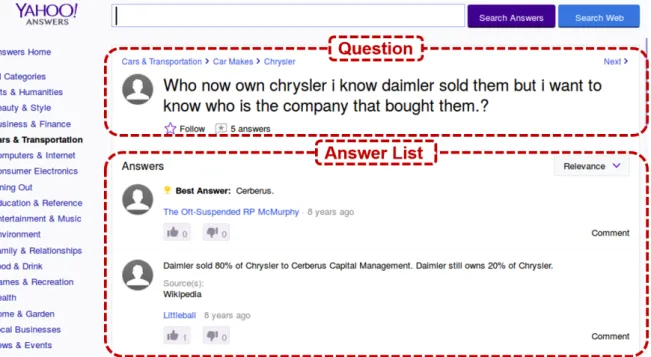
sys-Figure 1.2: Example of user-generated text: question and answers from Yahoo! Answers.
tem that generalizes lexicalized features for argument classification to previously unseen arguments and thus contributes to a system with similar performance on test data from the source domain and the target domain NTI.
Distributional methods that may help to generalize to unseen data have also been adopt-ed by state-of-the-art systems, including dense word representations obtainadopt-ed via deep learning (Hermann et al.,2014;FitzGerald et al.,2015). These systems, however, have not been evaluated on out-of-domain test data. Nowadays, standard FrameNet semantic role la-beling evaluation makes use of an in-domain test set, more specifically a split of the Frame-Net 1.5 fulltext corpus that is randomly sampled and contains texts from the same sources in the training, development, and test portions. Out-of-domain evaluation is lacking, as are appropriate datasets that enable this kind of evaluation.
Discourse type adaptation of semantic role labeling. Domain adaptation is typically fo-cused on different domains of professionally edited text, e.g., newspaper text versus fic-tion, or newspaper text versus biomedical texts (Biber and Conrad, 2009). A subtype of domain adaptation concerns the difference between discourse types, for instance between edited texts and unedited, colloquial texts, that can be found in large quantities on the web, called user-generated discourse. The most popular variants of user-generated discourse are Twitter tweets and forum posts.
2011). There is, however, almost no related work that evaluates semantic role labeling for user-generated discourse. Liu et al. (2010) developed a PropBank semantic role labeling system for Twitter data in the news domain, and Søgaard et al.(2015) recently created a small FrameNet-labeled dataset based on Twitter tweets in the context of their experiments in knowledge extraction. They, however, do not present a detailed evaluation of the domain generalization capabilities of FrameNet semantic role labeling.
We present such an evaluation in Chapter4and discuss the potential of various meth-ods of training data generation to the domain adaptation of FrameNet. Therefore, we cre-ate a new, substantial test dataset based on user-genercre-ated questions and answers from the community question-and-answer forum Yahoo! Answers, complementing the available Twitter dataset. Surdeanu et al. (2011) showed that PropBank semantic role labeling can benefit automated community question answering, and we expect that FrameNet semantic role labeling, with its higher level of semantic abstraction, could further benefit automated question answering once sufficient semantic role labeling performance can be reached on this domain.
1.5 Research Questions
In the previous sections, we introduced the coverage problems of FrameNet semantic role labeling that hamper its use in real-life applications for English and other languages, and we also addressed the lack of research on domain adaptation of FrameNet SRL.
The goal of this thesis is to develop methods that deal with problems of lexicon coverage and domain adaptation for semantic role labeling from a knowledge-based perspective. It aims to assuage coverage issues by integrating existing lexical knowledge bases comprehen-sively into a linked lexical knowledge base – in previous work, only small-scale integration
efforts of selective resources have been reported. On this background, the main research question of this thesis is:
• Can the comprehensive integration of lexical knowledge bases benefit semantic role labeling in the context of domain adaptation and adaptation to other lan-guages?
This question raises several secondary research questions that are addressed in the course of this thesis:
1. How can the semantic information in lexical-semantic knowledge bases like FrameNet be standardized such that their integration can be modeled effectively?
2. Can the comprehensive integration of expert-built and user-generated lexical knowl-edge bases alleviate FrameNet coverage issues for English and other languages? 3. How can linked lexical knowledge bases contribute to enhance semantic role labeling
systems, for instance via automatic training data generation?
4. What are the domain generalization capabilities of open-source FrameNet semantic role labeling, and what are the needs and requirements for domain adaptation? 5. How can linked lexical knowledge bases support domain adaptation for semantic role
labeling?
The long-term objective of this research is making semantic role labeling viable for real-world applications on user-generated web data, for instance automatic question answering. The result is an evaluation of knowledge-based supervision for domain-adaptive semantic role labeling as outlined in the next section.
1.6 Approach
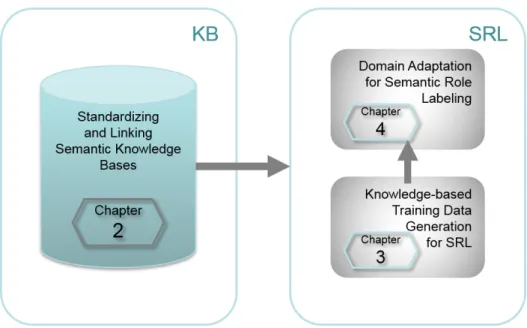
Figure1.3summarizes the approach to the research questions that was taken in this thesis. It can be roughly segmented into two parts. The first part, on the left-hand side of the figure, describes work on enhancing lexical knowledge bases by their standardization and integration into a linked lexical knowledge base, answering research questions 1 and 2.
The second part, on the right-hand side of the figure, focuses on the use of the integrated knowledge base for semantic role labeling. We explore a novel distant supervision approach for the automatic generation of large-scale role-labeled training data in various domains that is inspired by related work in relation extraction (Mintz et al.,2009). The lower box on the right-hand side represents the analysis of the proposed method in an in-domain semantic role labeling setup for English and German, answering research question 3. It
Figure 1.3: Thesis overview diagram.
provides a detailed evaluation for the tasks of frame identification and role classification. Additionally, training an open-source semantic role labeling system with the English data leads to a semi-supervised semantic role labeling system for English. The upper box on the right-hand side represents the application of the distant supervision approach to domain adaptation, which is evaluated for English. This includes a comparison to other approaches of training data generation, answering research questions 4 and 5.
1.7 Contributions and Findings
In the course of this thesis, we show that the large-scale integration of lexical knowledge bases on the sense and semantic role level can benefit semantic role labeling for English and other languages. The main contributions and findings of this thesis can be summarized as follows:
1. The development of standardized models of interoperability of semantic knowledge bases like FrameNet, specifically modeling FrameNet in UBY-LMF and modeling links on the frame and role level (see Chapter2).
2. A novel method for creating a FrameNet in any language based on the automatic alignment of FrameNet and Wiktionary. The method is evaluated on the example of German, effectively building a larger FrameNet knowledge base to improve FrameNet semantic role labeling for English and German (see Chapter2).
3. The study of the knowledge-based distant supervision method DistantSRL for the cre-ation of frame- and role-labeled training data for English and German. The resulting training data are of high quality and complementary to the manually labeled data, i.e., the FrameNet fulltext corpus and SALSA (see Chapter3).
4. A detailed analysis of the domain generalization capabilities of contemporary open-source FrameNet semantic role labeling for English; it shows that domain adaptation is required for the task of frame identification (see chapter Chapter4).
5. The application of the introduced knowledge-based methods for training data gener-ation in the context of adapting FrameNet SRL to the domain of user-generated dis-course in community question answering and their comparison to alternative meth-ods for training data generation for English, e.g., FrameNet+ and monolingual an-notation projection (see Chapter4). We find that our automatically generated train-ing datasets have the potential to improve the domain generalization capabilities of FrameNet semantic role labeling, but that the training of semantic role labeling sys-tems needs to be adapted to better deal with large and noisily labeled training data. Along with the methodological contributions and studies listed above, a number of lex-ical resources were created and published for research purposes:
• UBYFN, a lexical knowledge base in UBY-LMF format containing WordNet, FrameNet, VerbNet, PropBank, the English Wiktionary, the German Wiktionary, GermaNet, and SALSA, and links between them from SemLink.
• FNWKde, a lexical knowledge base in UBY format containing FrameNet, the En-glish and German Wiktionary, and automatically created sense-level links between FrameNet and the English and German Wiktionary.
• several large-scale corpora automatically labeled with FrameNet frames and roles using DistantSRL and monolingual annotation projection.
• a manually annotated gold standard dataset of 2,789 matching and non-matching pairs of word senses between FrameNet and the English Wiktionary, with annotation guidelines.
• YAGS, a large manually annotated gold standard dataset of 3,091 FrameNet frame and 6,081 role annotations on the user-generated texts from the Yahoo! Answers Manners dataset, with annotation guidelines.
The software developed for the thesis was partially integrated into and contributed to the DKPro UBY and DKPro Core open-source software repositories. A detailed list of re-sources and download links are contained in AppendixA.
Linked Lexical Resources (Hartmann et al.,2016). This article was published by the Transactions of the Association for Computational Linguistics. It describes joint work with Dr. Judith Eckle-Kohler who provided the methods for the knowledge-based role label transfer on sense-labeled data. The improved approach to sense labeling and the experimental evaluation of the method presented in this paper are contributions of the author. The content of this paper is described in Chapter3.
• Out-of-domain FrameNet Semantic Role Labeling (Hartmann et al.,2017a). This pa-per describes joint work with Ilia Kuznetsov and Teresa Botschen (née Martin) and was presented at EACL 2017 in Valencia, Spain. The creation of YAGS, the FrameNet-labeled gold standard based on user-generated question-and-answer data, and the out-of-domain evaluation of SEMAFOR in this paper are contributions of the present author and reported in this thesis. They are described in detail in Chapter4.
The author’s contributions to the following publications are also reported in this thesis: • UBY – A Large-Scale Unified Lexical-Semantic Resource Based on LMF (Gurevych
et al.,2013). This paper was presented at EACL 2012 in Avignon, France.
• UBY-LMF – A Uniform Model for Standardizing Heterogeneous Lexical-Semantic Re-sources in ISO-LMF (Eckle-Kohler et al., 2012). This paper was presented at LREC 2012, Istanbul, Turkey.
• UBY-LMF - Exploring the Boundaries of Language-Independent Lexicon Models ( Eckle-Kohler et al.,2013). This publication is a chapter in the book “LMF Lexical Markup Framework” published by ISTE–HERMES–Wiley in 2013. It contains a detailed de-scription of the model of FrameNet in UBY-LMF.
The main contributions of the present author to these three papers are the model of FrameNet in UBY-LMF and the corresponding conversion routines. They are presented in Chapter2.
During the work on the thesis, the author also contributed to a number of publications that are not reported in this thesis, but are placed in related research areas, namely the ac-quisition of multiwords for lexical knowledge bases and ontologies (Hartmann et al.,2012; Hartmann and Gurevych,2013a), which provides another example on how the lexicon cov-erage of FrameNet could be improved. Other publications present further work on integrat-ing lexical knowledge bases in UBY and makintegrat-ing them accessible to researchers in lintegrat-inguistics and natural language processing (Gurevych et al.,2012b,2013;Chiarcos et al.,2012a,b). An-other publication (Mújdricza-Maydt et al.,2016) provides the basis for a better integration of SALSA, the frame-semantic resource for German, with other lexical resources in the fu-ture: it presents the reannotation of parts of the SALSA corpus with GermaNet senses and VerbNet-style roles to facilitate the comparative evaluation of semantic role resources and their linking on the sense and role level for German. It also provides the foundations for the work reported inHartmann et al.(2017b). In this study, we create a small German corpus with parallel FrameNet-style, VerbNet-style, and PropBank-style annotations and use it as a benchmarking dataset for the experiment-based comparison of the three semantic role labeling frameworks.
1.9 Thesis Outline
The main part of this thesis follows the order of the research contributions that build upon another as visualized in Figure1.3.
Chapter2 introduces work on enhancing linked lexical knowledge bases by standard-izing and linking them; it builds the foundation for the following chapters. We study two aspects of how standardization and integration of lexical knowledge bases can improve coverage issues associated with expert-built semantic knowledge bases. The first aspect is the extension of lexical knowledge bases by standardizing their format and linking them on the sense and role levels. The second aspect is the translation of lexical knowledge bases to other languages based on their linking to multilingual resources. The chapter presents a novel approach using Wiktionary as an interlingual index for the creation of FrameNet re-sources in any language and its application to German. It results in UBYFN, a linked lexical knowledge base for English and German centered around FrameNet.
Chapter 3 describes a new method for knowledge-based training data generation for FrameNet frame identification and semantic role labeling. The method uses knowledge-based distant supervision from UBYFN, the LLKB created in Chapter 2, for the automatic labeling of large corpora with FrameNet word senses, i.e., frames, and roles. The method requires large corpora, because it labels the input data only sparsely.
Experiments on the tasks of frame identification and role classification on diverse test sets show that the method creates large-scale training data of high quality that complement the FrameNet fulltext corpus, indicating that they can be used to support domain
gener-ous chapter and the resulting semi-supervised semantic role labeling system for English in the context of domain adaptation to user-generated discourse. To this end, we intro-duce a new manually labeled test dataset of FrameNet role labels based on user-generated data from the Yahoo! Answers question-and-answer forum. We use this dataset to assess the domain generalization capabilities of an open-source FrameNet semantic role labeling system, finding that the main bottleneck for domain adaptation of FrameNet semantic role labeling is the frame identification step. We therefore study the potential of our automati-cally generated training data to support domain adaptation of frame identification. In these experiments, the knowledge-based approach to training data generation is also compared to other approaches for training data generation, e.g., monolingual annotation projection and FrameNet+. The results further confirm our results from Chapter3: the automatically generated training set has the potential to improve frame identification across domains, but systems making full use of its potential need to be equipped to deal with large amounts of training data and may need to use additional domain adaptation methods.
The thesis concludes in Chapter5with a summary of the work presented and a detailed discussion of open issues, for instance how to efficiently use the large amounts of auto-matically labeled training data for FrameNet semantic role labeling, and future work, for instance improving FrameNet coverage not only for the lexicon and training data, but also improving the model coverage.
1.10 List of Abbreviations
In this section, we introduce a number of abbreviations that we use in the course of this work.
• SRLabbreviatessemantic role labeling as introduced in Section1.1.
• LKBabbreviateslexical knowledge base, a term referring to lexical resources such as FrameNet, WordNet, Wikipedia, and Wiktionary.
• LLKBabbreviateslinked lexical knowledge base and refers to LKBs linked on the level word senses and/or semantic roles.
• WSD abbreviates word sense disambiguation, the assignment of a word sense label according to a sense inventory like WordNet or FrameNet to a given target word in context.
• VSDabbreviatesverb sense disambiguation, word sense disambiguation for verbs. • POSabbreviates the term part-of-speech.
• UGDabbreviates the term user-generated discourse.
• Accstands for accuracy, an evaluation metric that reports how many system predic-tions are correct with respect to a gold standard annotation.
• Pstands for precision, an evaluation metric that reports how many of the instances labeled by the systems are correctly labeled with respect to a gold standard annota-tion.
• Rstands for recall, an evaluation metric that reports how many of the available test instances are labeled correctly by the system.
The work presented in this chapter is motivated by the deficiencies of existing semantic knowledge bases like FrameNet: as a lexical resource created manually by experts, Frame-Net is not complete. Even for English, gaps in the lexicon coverage and a lack of training data are detrimental to the quality of automatic semantic role labeling. For other languages, semantic role resources are even smaller than FrameNet, or non-existent.
Links between lexical resources have already been previously used to address this prob-lem, but they have not been explored and applied at a large scale, for instance by exploiting links on the sense level and on the level of semantic predicate argument structure, and by exploiting links to several resources at the same time. To perform such an exploration, we embed FrameNet in a network of linked lexical knowledge bases, first by integrating existing linkings that were created either manually or automatically, and second by auto-matically creating new links to further lexical knowledge bases.
We address two of the research questions outlined in Chapter1. The first research ques-tion is: can the lexicon coverage of semantic knowledge bases like FrameNet be improved for English and other languages by linking them comprehensively on the sense level and on the semantic role level? To answer this question, we integrate existing sense and pred-icate argument structure linkings into a large linked lexical knowledge base, create a new automatic sense alignment of FrameNet to Wiktionary, and analyze the resulting linked lexical knowledge base in detail. Automatic sense alignment is an intricate task, due to the different sense granularity in the different lexical knowledge bases, and due to the different representational models they provide for the same, or similar, semantic information types. We also address the aspect of FrameNet coverage for other languages, namely the trans-fer of lexical knowledge bases for English to other languages lacking such resources. This
task is even more difficult than coverage extension for English, because it requires auto-matic methods to provide a connection across languages, for instance cross-lingual sim-ilarity; automatic methods may encounter different conceptualizations of word senses in different languages.
In this work, we propose a new answer to the question on how to extend the coverage increase to other languages, i.e., can we induce semantic role resources by linking lexical knowledge bases cross-lingually? The solution suggested in this chapter is a simple, but powerful approach to construct a FrameNet lexicon in other languages using Wiktionary as an interlingual representation. The approach is applied to and evaluated on the German language, resulting in a German FrameNet lexicon. We present a detailed evaluation of the induced German FrameNet and a discussion of Wiktionary as an interlingual connection for the cross-language transfer of lexical-semantic resources to various languages.
The second research question we address concerns the efficient access to the various information types contained in the linked lexical knowledge bases. To efficiently use the various types of information encoded in the linked lexical knowledge bases, they need to be represented in a standardized format and provided with a common API. To achieve this goal, the different linguistic information types, and the different terminology used to repre-sent these types in the various lexical knowledge bases need to be unified, which requires diligent analysis of the structure of the considered lexical knowledge bases and their infor-mation types. We aim to provide a comprehensive model that conforms to the metamodel implemented in the ISO standard LMF (Francopoulo et al.,2006), and represents all informa-tion types in the major lexical knowledge bases; we specifically present our contribuinforma-tions to creating such a model for a) semantic lexicons like FrameNet, and b) for links on the level of semantic predicate argument structure.
In this chapter, we first introduce FrameNet and motivate our work in enhancing and translating FrameNet via resource linking. We then introduce relevant lexical knowledge bases, discuss earlier efforts in linking them, and finally present our own work on automati-cally aligning FrameNet to Wiktionary on the sense level, and using the resulting alignment to create a German FrameNet lexicon. We then describe our contributions to standardiza-tion and modeling of linked semantic knowledge bases, which is a prerequisite for their efficient use in NLP. The chapter closes with a detailed description of the resulting linked lexical knowledge base UBYFN.
2.1 Motivation: Extending FrameNet
In this section, we motivate the work on linking and integrating lexical-semantic knowl-edge bases presented in this chapter. The main driving factors are the coverage gaps of FrameNet and the lack of FrameNet-style resources in other languages. Therefore, this
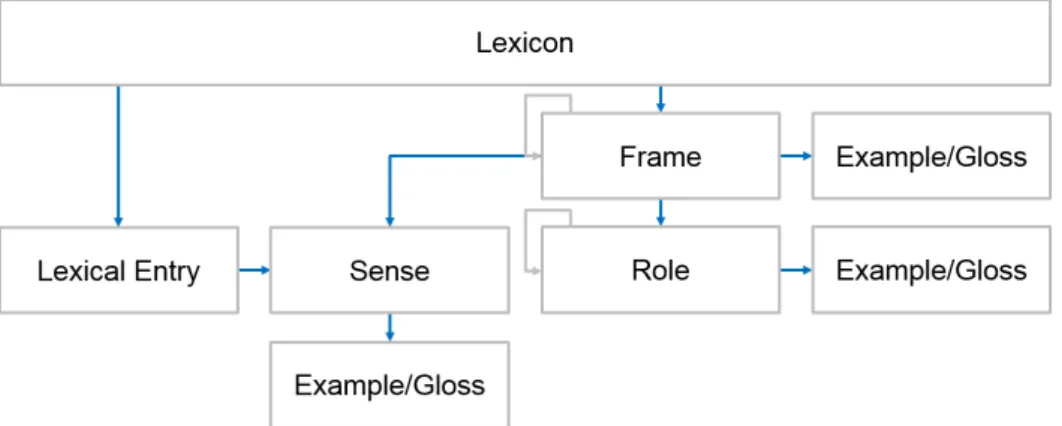
sec-Figure 2.1:FrameNet lexicon structure.
tion first introduces FrameNet in detail, and then discusses coverage gaps and problems associated with the creation of FrameNet-like resources in other languages.
2.1.1 FrameNet
FrameNet(Baker et al.,1998;Fillmore and Baker,2010) is an expert-built lexical-semantic resource incorporating the theory of frame semantics (Fillmore, 1976). It groups word senses in frames that represent particular prototypical situations, including predicates for both events and states: the verb complete and the noun completion belong to the frame Activity_finish.
The participants of these situations, typically realized as syntactic arguments, fill the semantic roles of the frame calledframe elements in FrameNet, for instance the role of the Agent performing an activity, or the role of the Activity itself. Roles are frame-specific, leading to a large inventory of roles. FrameNet distinguishes between obligatory roles that are crucial for the understanding of the frame and optional roles, that are often realized as adjuncts in example sentences. These are calledcore roles andnon-core roles respectively. Examples for core roles of the frameActivityareAgent andActivity, examples for non-core roles arePlace,Duration, andManner.
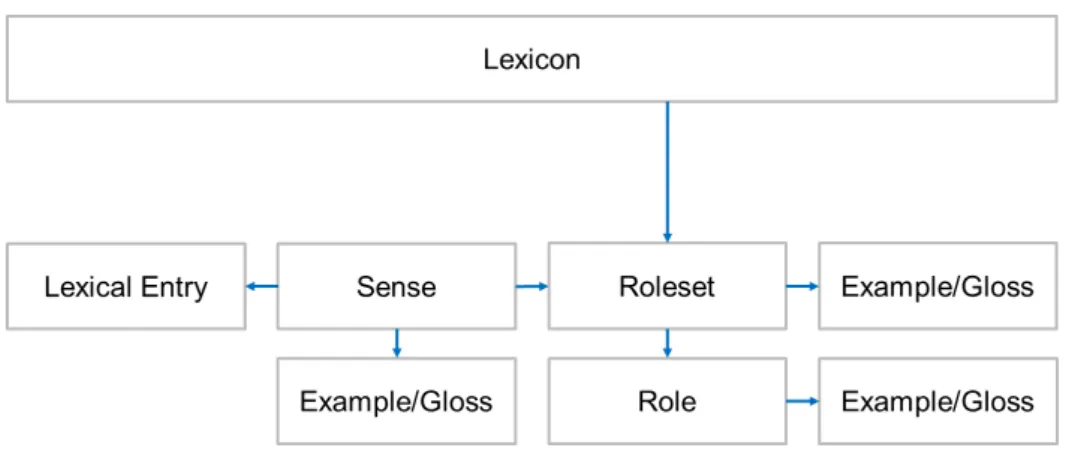
FrameNet lexicon structure. Figure2.1shows the schematic structure of the FrameNet lexicon. As shown by the two blue arrows leaving theLexicon box in Figure2.1, there are two entry points to the FrameNet lexicon. One is the lexical entry that is defined by lemma and part-of-speech, represented by the box labeled Lexical Entry, the other is the list of frames in FrameNet, represented by the box labeledFrame. A lexical entry can have one or several word senses, calledlexical units in FrameNet, that are represented by the box labeled Sense in the figure. These are defined by lemma, part-of-speech, and frame label, which is why they are linked to the Frame box. Each frame provides a set of roles, called frame
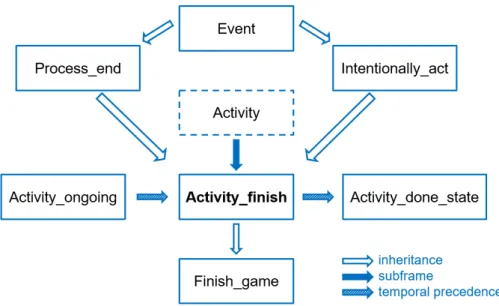
Figure 2.2:Example: FrameNet frame hierarchy aroundActivity_finish.
elements in FrameNet that are represented by the box labeledRole.4 Senses, frames, and roles are equipped with a definition gloss and example sentences in the FrameNet lexicon, as shown by the box labeledExample/Gloss. To simplify the lexicon schema, there is only a single box for examples and/or definition glosses. FrameNet also defines relations between frames and roles that are represented by the grey arrows in Figure2.1and will be introduced in the next paragraph.
Frame relations. FrameNet frames are connected by a hierarchy of frame relations, the frame Activity_finish, for instance, is a subframe of the abstract frame Activity, inherits from the frames Intentionally_act and Process_end, temporally precedes the frame Activ-ity_done_state and is preceded by the frame Activity_ongoing. These relations are visu-alized in Figure 2.2. The inheritance relation describes the is-a relation present in many ontologies. A frame that inherits from another frame, just asActivity_finish inherits from Process_end, inherits its semantic properties, for instance its set of roles. The subframe re-lation is used to segment events into smaller parts, anActivity contains several subframes that describe the beginning, running, and the end of theActivity. Some of these subframes are shown in Figure2.2:Activity_ongoing,Activity_finish, andActivity_done_stateare sub-frames ofActivity. The subframes follow a temporal order, therefore they are linked by a temporal precedence relation. The dotted lines in Figure2.2mark Activity as anabstract
4Note that we use similar diagrams to characterize the structure of other lexical knowledge bases later in
this chapter and contrast them to FrameNet. To ensure comparable terminology between different lexical knowledge bases, we diverge from FrameNet terminology when describing certain aspects of the lexicon structure, for instance usingsenseinstead oflexical unitorroleinstead offrame element.
Figure 2.3:Example: FrameNet lexicon entry for the verbcomplete.
frame that, unlike other frames, is not directly associated with word senses in FrameNet, but provides a set of roles that derived frames inherit. Activity_finishfor instance inherits the rolesAgent andActivity from the abstract frameActivity.
Examples for relations between roles areexcludes and requires. TheDamaging frame has two core roles, Agent andCause, that exclude each other: either the Damaging is performed by an Agent, typically a person, or brought about by aCause, for instance a thunderstorm. Therequires relation occurs for the roles that describe the participants of a conversation in theDiscussion frame, Interlocutor_1 andInterlocutor_2. In the example sentence “She discussed the menu with the chef”, “She” is labeled with the role Interlocu-tor_1and“with the chef” is labeled with the roleInterlocutor_2. TheInterlocutor_2 cannot be omitted. An alternative phrasing would be to group the several participants of a dis-cussion as in the sentence“They discussed the menu”. In this example,“They” receives the Interlocutors role that excludes bothInterlocutor_1andInterlocutor_2.
FrameNet lexical entry. To further illustrate the FrameNet lexicon, Figure2.3shows some of the information associated with the verbcomplete in FrameNet. The verbcomplete has a single word sense in FrameNet that is characterized by the frame Activity_finish and receives the unique sense id label11352. Figure2.3also shows the frame definition of the frameActivity_finish and an abbreviated list its roles. The frame Activity_finish has two core roles and twelve optional non-core roles. The FrameNet lexical entry for the example
sense also contains 24 example sentences annotated with frame and role labels. Three of them are shown in Figure2.3.
FrameNet release 1.5. The creation of FrameNet is a major lexicographic effort: corpus evidence was collected for the most frequent verbs in the British National Corpus and ag-gregated by syntactic behavior and word sense to identify the concepts modeled as frames. The FrameNet release 1.5 (Ruppenhofer et al., 2010a) contains 1,019 frames, 9,633 frame-specific roles, and 11,942 word senses defined as a combination of lemma, part-of-speech, and frame, also calledlexical unit in FrameNet. Many of those word senses are equipped with role-annotated sense examples that are based on corpus evidence from the British National Corpus, leading to overall 154,485 example sentences like the sentences shown in Figure 2.3. Additionally, running text has been annotated with FrameNet frames and roles and is available as the FrameNet fulltext annotations corpus containing 5,946 sen-tences and 23,944 annotated frames.5 The corpus texts annotated with FrameNet frames and roles have been used to train automatic semantic role labeling systems, for instance the SEMAFOR system (Das et al.,2014).
2.1.2 English Coverage
As an expert-built resource, FrameNet is growing slowly. As a result, there are coverage gaps on the ontology level, the lexicon level, and also on the level of annotated corpus in-stances (Palmer and Sporleder,2010). On the ontology level, certain frames may be missing from the frame hierarchy. FrameNet, for instance, contains a frame for Intentional_decep-tion, but does not contain a more specialized frame to describe a doping scenario in sports competitions. Additionally, the frame hierarchy may be more fine-grained for certain topic areas than for others.
On the lexicon level, certain word senses – or lexical units – are missing in FrameNet, even though there is a frame that represents their meaning. The word senses associated with the frameCause_to_make_progressinclude the verbimprove, as in“We improve Frame-Net”, but they do not contain the synonymous verbenhance.
To get an estimate on the coverage of the FrameNet lexicon, we analyze how many unique words defined by their lemma and POS (types) and instances of these words (tokens) the FrameNet lexicon covers in various corpora. We use the word frequency lists from the British National Corpus (BNC)6and the written part of the American National Corpus (ANC),7and the web-based corpus ukWAC (Baroni et al.,2009). Table2.1shows the results 5Earlier versions of FrameNet do not distinguish between example sentences and fulltext annotations. In
September 2015, FrameNet release 1.6 has been published. Since we used FrameNet 1.5 in the present work, all reported details concern FrameNet release 1.5.
6We use Adam Kilgariff’s BNC frequency lists:https://www.kilgarriff.co.uk/bnc-readme.html. 7http://www.anc.org/data/anc-second-release/frequency-data/
adjective, noun, verb 98.99 99.48 17.45 61.70 2.56 56.01 adjective 97.33 98.93 13.60 84.43 4.03 83.94
noun 99.33 99.58 16.48 20.54 2.06 46.41
verb 99.61 99.55 70.88 79.58 9.07 86.82
Table 2.1: FrameNet lexicon coverage of several corpora in percent.
of this analysis and provides numbers for WordNet for comparison. In total, the FrameNet lexicon covers 55.4% of the open-class words, e.g., nouns, verbs, adjectives, in the BNC, accounting for 80.58% of the corpus instances. The coverage of the BNC is high, very high for verbs, since the BNC was used as a basis for the development of FrameNet. For other corpora, the picture changes: the FrameNet lexicon only covers 3.41% of the open-class types and 36.41% of the open-class tokens of the ANC. For the web-based corpus ukWAC (Baroni et al.,2009), the FrameNet lexicon only covers 0.31% of the open-class words and 29.56% of the corpus instances for open-class words. The type and token coverage is higher for verbs in all corpora. In the web-based ukWAC corpus, the token coverage is high, even despite the low type coverage. The low noun coverage in ukWAC is caused to a large degree by the automatic preprocessing