Ann Hematol (2006) 85: 275–280 DOI 10.1007/s00277-005-0045-5
O R I G I N A L A RT I C L E
Lotte Abildgaard . Eva Ellebæk .
Göran Gustafsson . Jonas Abrahamsson . Liisa Hovi . Gudmundur Jonmundsson . Bernward Zeller . Henrik Hasle
Optimal treatment intensity in children with Down syndrome
and myeloid leukaemia: data from 56 children treated
on NOPHO-AML protocols and a review of the literature
Received: 1 August 2005 / Accepted: 3 November 2005 / Published online: 4 March 2006#Springer-Verlag 2006
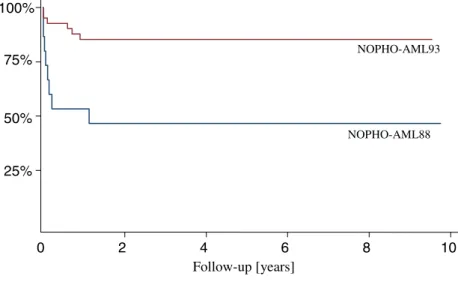
Abstract Children with Down syndrome (DS) and my-eloid leukaemia have a significantly higher survival rate than other children, but they also experience considerable treatment-related toxicity. We analysed data on 56 children with DS who were treated on the Nordic Society for Pae-diatric Haematology and Oncology-acute myeloid leukae-mia (NOPHO-AML)88 and NOPHO-AML93 protocols and reviewed the literature. In the dose-intensive NOPHO-AML88 protocol, 8 out of 15 patients (53%) experienced an event. In the less dose-intensive NOPHO-AML93 pro-tocol, 7 out of 41 patients (17%) had an event. Therapy was reduced in 29 patients (52%) with in average 75% and 67% of the scheduled dose of anthracycline and cytarabine, respectively. Treatment-related death occurred in seven who all received full treatment. Relapse and resistant dis-ease occurred at a similar rate in those receiving full and reduced treatment. Review of major series of myeloid
leukaemia of DS showed no clear relationship between dose and survival; however, it appears that both a reduction in treatment dose and a less intensively timed treatment regimen improved the outcome. Further studies are needed to define the optimal regimen for treating myeloid leukaemia of DS.
Keywords Down syndrome . AML . Therapy . Children
Introduction
Children with Down syndrome (DS) have a significantly increased risk of developing myeloid leukaemia described as myelodysplastic syndrome (MDS) and acute myeloid leukaemia (AML). Due to the unique features of MDS and AML in DS children, including the presence of GATA1 mutation in vast majority [1], the unifying term myeloid leukaemia of DS (ML-DS) has been used for this disorder [2]. Recent years have seen a number of studies with AML therapy producing event-free survival (EFS) of more than 75% [3–5] in ML-DS compared with EFS of around 50% in AML children without DS [6–8]. The favourable outcome in ML-DS has been explained by the increased sensitivity to cytarabine and daunorubicin [9–11] as well as a higher susceptibility of DS cells to apoptosis [4,12].
ML-DS typically occurs at 1–2 years of age, and in contrast to the transient leukaemia seen in some newborns with DS, it is the universal experience that without anti-leukaemic treatment, all patients with ML-DS die from progressive disease [13, 14]. Very intensive therapy is associated with a significantly higher mortality in ML-DS [15], and chemotherapy doses are often reduced in DS patients. The optimal balance between dose intensity and the risk of treatment-related toxicity has not yet been de-fined. We studied the association between treatment inten-sity and outcome in children with ML-DS by reviewing the literature and analysing data on patients treated on the Nordic Society for Paediatric Haematology and Oncology (NOPHO)-AML protocols.
L. Abildgaard . E. Ellebæk . H. Hasle (*) Department of Paediatrics, Skejby Hospital, 8200 Aarhus N, Denmark
e-mail: [email protected] G. Gustafsson
Barncancerforskningsenheten, Astrid Lindgrens Barnsjukhus, Stockholm, Sweden
J. Abrahamsson
Department of Paediatrics, Queen Silvia Children's Hospital, Gothenburg, Sweden
L. Hovi
Department of Paediatrics, University of Helsinki, Helsinki, Finland
G. Jonmundsson
Department of Paediatrics, Landspitalinn, Reykjavik, Iceland
B. Zeller
Department of Paediatrics, University Hospital, Rikshospitalet, Oslo, Norway
Patients and methods
Design
All children with leukaemia in the Nordic countries are treated according to common Nordic protocols [16]. Data are registered in the NOPHO database at Barncancerfors-kningsenheten, Astrid Lindgrens Barnsjukhus in Stockholm. We reviewed data on patients with DS who had been diagnosed as having myeloid leukaemia in the period from 1988 to 2002 and treated according to the NOPHO-AML88 or NOPHO-AML93. We included two Danish patients diagnosed as having MDS, treated as AML, but not reported to the AML database. Two children reported to the NOPHO-AML88 received no treatment and were excluded from this study.
We identified 56 DS children (13%) treated according to the NOPHO-AML88 (n=15) and the NOPHO-AML93 (n=41) protocols.
The treatment has been described previously [6]. The flow charts of the NOPHO-AML88 and NOPHO-AML93 are shown in Fig. 1. In short, the treatment courses con-sisted of ATEDox: cytarabine 200 mg/m2 continuous infusion days 1–4, 6-thioguanine 100 mg/m2 b.i.d. orally days 1–4, etoposide 100 mg/m2 continuous infusion days 1–4, doxorubicin 75 mg/m2 day 5; AM: cytarabine 100 mg/m2 continuous infusion days 1–5, mitoxantrone 10 mg/m2days 1–3; HA1M: cytarabine 1 g/m22-h infusion b.i.d. days 1–3, mitoxantrone 10 mg/m2days 3–5; HA2E: cytarabine 2 g/m22-h infusion b.i.d. days 1–3, etoposide 100 mg/m2days 2–5; HA3: cytarabine 3 g/m22-h infusion b.i.d. days 1–3. For children less than 2 years of age, chemotherapy was calculated per bodyweight.
No special treatment recommendations for DS patients were given in the protocol; however, no haematopoietic stem cell transplantations were performed in the DS children. Data were retrieved from the NOPHO-database, and when necessary, treatment details were requested from the treating clinics.
Statistics
The Kaplan–Meier plot was applied to estimate the EFS from the day of diagnosis. Events were defined as resistant disease, relapse or death of any reason. Patients with re-sistant disease were considered failures at time zero. EFS was compared using log-rank test and Cox regression analysis. Univariate analysis was conducted by Wilcoxon rank-sum test for quantitative variables and Fisher's Exact Test for qualitative variables. Computations were per-formed using Intercooled Stata 8.2. Outcome data were analysed as of January 1, 2004.
Results
Patients' characteristics
The epidemiological and clinical characteristics of the Nordic DS patients were published recently [16]. The me-dian age in the present cohort was 2.0 years, with only one patient more than 4 years of age at the time of diagnosis. There were no statistically significant differences in the distribution of gender, age and white blood cell between patients on protocols AML88 and NOPHO-AML93 or between patients receiving reduced or full-treatment dose (data not shown). The majority of patients were diagnosed as having AML M7, the proportion of M7 increased with time due to improved diagnostics.
Treatment modifications
Twenty-nine patients (52%) were given reduced therapy, receiving in average 75% of the anthracycline and 67% of the cytarabine dose compared with the doses scheduled in the protocol. Eighteen children received all scheduled courses but with dose reduction (one relapse and one resistant disease); six patients received a reduced number
= Death
NOPHO-AML88
ATEDox AM ATEDox HA1M HA2E HA3 HA2E
NOPHO-AML93
ATEDox ATEDox HA1M HA2E HA3 HA2E
Fig. 1 Flow chart of NOPHO-AML88 and NOPHO-AML93 with temporal occurrence of the TRDs. For abbreviations, please see text
of courses (one resistant disease); five were reduced both in doses and number of courses (one resistant disease).
Four of the 18 patients who received all courses but with dose reduction were reduced during induction only, 2 during consolidation only, and 12 were reduced during both induction and consolidation.
Outcome
Eight of the 15 patients (53%) treated on the NOPHO-AML88 experienced an event; 5 died from treatment-re-lated deaths (TRDs), 2 had resistant disease and 1 relapsed. Seven of the 41 patients (17%) treated on the NOPHO-AML93 had an event; 2 died from TRD, 2 had resistant disease and 3 suffered from relapse.
All seven patients who died from TRD received full-treatment dose. Of the eight patients who had a relapse or resistant disease, four received full dose and four reduced dose therapy (Table1).
Figure1illustrates the temporal occurrence of TRDs. All seven cases of TRD were caused by infections. No deaths were due to cardiac toxicity, and no patients developed late cardiac failure (median follow-up 8 years). Six patients died during therapy; five were treated on the NOPHO-AML88 and one on the NOPHO-AML93. All patients ex-cept one died in relation to the induction courses. One patient died from pneumonia 2 months from the last con-solidation course after recovering from cytopenia.
Many patients experienced respiratory distress following induction chemotherapy. Five children required treatment
at an intensive care unit because of the respiratory prob-lems. These adverse effects all occurred in relation to the first course of induction.
The EFS increased from 47% in the NOPHO-AML88 to 85% for children treated on the NOPHO-AML93 (hazard ratio=4.7,p=0.005). The Kaplan–Meier plot illustrates that almost all events occurred within the first 12 months since diagnosis (Fig.2).
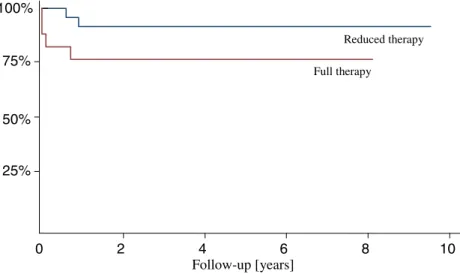
On the NOPHO-AML93, 17 patients received full-treatment dose, and 24 patients received reduced full-treatment. Figure3shows the EFS of the two groups. Those receiving reduced treatment had an EFS of 92% compared with an EFS of 76% in the group receiving full treatment (hazard ratio=3.2, p=0.17). The data indicated no difference in outcome for patients who received reduced treatment dose compared with those who received reduced number of courses. Nine of ten patients who received less than the recommended four consolidation courses were alive in continuous complete remission.
The NOPHO-AML88 was intended to have an interval of only 16 days from the start of the first induction course to the beginning of the second. But the condition of the patients made it impossible to enforce this in most cases. The interval between the first two courses in DS patients was in average 28 days. The interval was 14, 19 and 29 days in the three patients who died after the second induction course. In the NOPHO-AML93, the second course should not be given until bone marrow (BM) recovery was achieved, which lasted in average 43 days for the DS patients. No patients died from TRD following the second induction course in the NOPHO-AML93.
Review of the literature
Major series of ML-DS from North America, Japan, Germany and United Kingdom were reviewed.
Comparing the studies, anthracycline dose was con-verted into daunorubicin equivalents using a conversion factor of 1 for doxorubicin and 5 for idarubicin and mito-xantrone. The cumulative doses of anthracyclines and Table 1 Outcome with reduced and full therapy among 56 DS
children treated on the NOPHO-AML88 and NOPHO-AML93 Full therapy Reduced therapy
Patient number 27 29 Treatment-related death 7 (26%) 0 (0%) Relapse/Resistant 4 (15%) 4 (14%) Surviving in CR1 16 (59%) 25 (86%) 25% 50% 75% 100% 0 2 4 6 8 10 NOPHO-AML93 NOPHO-AML88 Follow-up [years] Fig. 2 EFS in NOPHO-AML88
cytarabine in relation to survival are illustrated in Table2. The survival rates are not directly comparable because of different types of survival analyses and follow-up. When available, we used EFS, but two studies only reported overall survival [13, 14]. The time of follow-up varied in the different studies from 4 to 8 years, but no events oc-curred after 4 years of follow-up, and therefore, the var-iation in follow-up is of minor importance.
The Pediatric Oncology Group (POG) published in 1992 [17] the results of AML Study 8498 including 12 DS children treated with standard AML induction therapy fol-lowed by post-remission therapy with high-dose cytarabine (HdA) with or without L-asparaginase. The therapy was relatively well tolerated without any toxic deaths resulting in a remarkable 4-year EFS of 100%.
The Children's Cancer Group studies 2861 and 2891 [3, 15] included 118 children with ML-DS. The children were randomised to either an intensively timed or standard-timed induction therapy. Outcome data were available for 110 patients.
The treatment consisted of two induction cycles with a five-drug, dexamethasone, cytarabine, 6-thioguanine, eto-poside and daunorubicin (DCTER), regimen and consol-idation courses based on HdA.
The children with DS on Children Cancer Group (CCG)-2861 and CCG-2891 had an EFS of 68%. The intensively timed therapy was associated with unacceptably high mor-tality and no significant reduction in relapse rate in children with DS. In contrast to non-DS children, standard-timed therapy significantly improved the EFS in DS to 74% compared with 52% on intensively timed therapy [15].
A Japanese study [18] used a treatment regimen specif-ically designed for children with DS. Each chemotherapy course consisted of low-dose daunorubicin, cytarabine and etoposide and was used for both induction and consolida-tion. The number of courses varied between two and eight. The protocol included no HdA.
The 8-year EFS for the 33 children was 80%. Three children relapsed, three children died of TRD, two children with congenital heart anomalies developed congestive heart 25% 50% 75% 100% 0 2 4 6 8 10 Follow-up [years] Reduced therapy Full therapy
Fig. 3 EFS in NOPHO-AML93 according to reduced or full-dose therapy
Table 2 Studies of AML in DS
Study N Dauno (mg/m2) AraC (g/m2) TRD (%) RD (%) Relapse (%) EFS (%)
AML-BFM-98 [5] 66 220–240 23–29 5 0 6 89
AML-BFM-87/93 [13] 21 220–400 23–43 33 0 14 48a
POG 8498 [17] 12 230 40.7 0 0 0 100
Japan [18] 33 300 4.2 9 0 9 80
NOPHO-AML93 [present study] 41 300 49.6 5 5 7 85
CCG-2861/2891 [15]
Standard timing 85 320 15.2 2 2 ND 74
Intensive timing 25 320 15.2 32 4 ND 52
NOPHO-AML88 [present study] 15 450 50.1 33 13 7 47
MRC AML 10 [14]
Less intensive 13 ND ND 8 8 38 46a
AML 10 like 32 650 10.6 34 0 8 59a
The studies are ranked by increasing daunorubicin dose
Nnumber of patients,Daunocumulated dose of daunorubicin equivalents [19],AraCcumulated dose of cytarabine,TRDtreatment-related death,RDresistant disease,EFSevent-free survival,NDno data
a
failure and died, and one child died due to septic shock in complete remission (CR). Although the treatment regimen of the induction and the consolidation therapy were exactly the same, the frequency of fever and infections was higher during the induction compared with the last consolidation. The protocol used no prophylactic central nervous system (CNS) therapy and observed no CNS relapses.
The German AML-BFM-87 and AML-BFM-93 studies [13] included induction with cytarabine, daunorubicin and etoposide, consolidation with cytarabine, doxorubicin, vin-cristine, 6-thioguanine, cyclophosphamide and prednisone, intensification with HdA and etoposide, and 1 year of maintenance treatment (6-thioguanine and cytarabine). Only 21 of the 40 patients were treated according to the protocol, and only 14 received full therapy. Among the 21 patients, the 5-year survival was 48%.
The AML-BFM-98 study used the same therapy as the BFM93 protocol but with recommendations for dose re-duction and supportive care. The compliance with the pro-tocol increased and resulted in a significant improvement in EFS to 89% [5].
The British Medical Research Council (MRC) AML 10 trial [14] compared the outcome of patients treated on the MRC 10 protocol (n=24) with other intensive protocols (n=8) or on individualised less intensive protocols (n=13). The MRC 10 included cumulative doses of anthracyclines and cytarabine of 650 mg/m2and 10.6 g/m2, respectively. There were some modifications made to the protocol (two patients did not receive all courses) mostly because of ex-cessive toxicity. The 5-year survival rate for the 32 children treated on the intensive protocol was 59%.
There was no difference in the remission and survival rates between the group that received full-treatment dose and the group with individualised treatment. However, deaths among the patients receiving full-treatment dose were mostly due to toxicity, whereas deaths in patients treated on individualised protocols mostly were the result of relapse or resistant disease.
Discussion
The NOPHO database is considered to be population based [16]. When reviewing the DS data, we noticed two patients diagnosed as having MDS not reported to the database. There has been no consensus on whether children with DS and MDS should be included in the NOPHO-AML data-base. Therefore, there may be a few more patients with DS diagnosed as having MDS and not reported to the AML database. Today, there is an international agreement con-sidering MDS and AML in DS as one disease [2].
Out of 15 patients treated on the NOPHO-AML88, 8 experienced an event (53%). This is much higher than for patients on the NOPHO-AML93, where only 7 out of 41 patients had an event (17%). The main difference between the two protocols was that the second course of induction on the NOPHO-AML93 was not given until BM recovery
was achieved. This resulted in a longer period between the first and the second induction courses (43 days in average on the NOPHO-AML93 compared with 28 days on the NOPHO-AML88) and thereby a less intensively timed induction regimen. The decreased time intensity arm of the CCG study also showed a reduction in TRD without worsening remission rates or number of relapse [15].
Twenty-nine patients received a reduced treatment in our study. Among them three patients had resistant disease and one relapsed. The low number of patients does not allow further analyses of the extent of reduction and the risk of relapse and resistant disease.
Six out of seven TRD and the most severe side-effects occurred in relation to the induction courses where the highest dose of anthracyclines is given. Furthermore, the long-term irreversible side-effects in the form of cardio-myopathy favour a reduction in anthracyclines. Several studies recommend a reduction in the use of anthracylines with cumulative doses not exceeding 250 mg/m2[13,18]. Consolidation in the NOPHO protocol is based on four courses of HdA. No TRD occurred in relation to the con-solidation, and we did not observe any major CNS toxicity. In addition, the CCG used HdA-based post-remission ther-apy without excessive toxicity in DS patients [15].
Intrathecal chemotherapy varied between the protocols from zero to eight injections. The Japanese protocol included no prophylactic CNS therapy and no HdA and experienced no CNS relapses [18]. None of the other studies reported any CNS relapses. CNS involvement at diagnosis is relatively rare in DS [3], suggesting that CNS-directed therapy may be reduced or even omitted without increased risk of relapse.
Etoposide was included in the BFM, NOPHO, MRC and Japanese studies but not in the CCG and POG protocols. It is difficult to evaluate the role of etoposide in the complex treatment regiments, but it may not be essential considering the favourable outcome reported by POG and the standard timing arm of CCG [15].
No apparent association is seen between survival and the cumulative doses of anthracycline and cytarabine (Table2). The differences in the type of survival analyses and follow-up cannot explain the lack of correlation between dose and outcome. The poorest outcome was found among patients not treated according to protocol [13, 14] or patients re-ceiving very time-intensive therapy as in CCG [15] and the present study (NOPHO 88). TRD was also high among those receiving the highest anthracycline doses [14]. The frequency of relapse showed no clear correlation with cumulated doses except a high relapse rate in those treated with non-intensive schedules [14]. There are good evi-dence for new treatment protocols to be less intensive re-garding both timing and dose intensity [3,13,15,18].
Only older age has been associated with an increased relapse rate [3]. DS children above 3 or 4 years of age may need more intensive therapy. Further studies are needed to identify those DS patients with a poor outcome on the reduced therapy schedules.
Conclusion
A reduction in treatment dose as well as a less intensively timed treatment compared with standard AML regimens seems to improve the outcome for patients with DS and myeloid leukaemia. However, without intensive therapy, the relapse rate increases, and the optimal regimen for treating ML-DS is still not known. An international co-operative study including guidelines for supportive care may help define the best therapy for ML-DS.
References
1. Gurbuxani S, Vyas P, Crispino JD (2004) Recent insights into the mechanisms of myeloid leukemogenesis in Down syn-drome. Blood 103:399–406
2. Hasle H, Niemeyer CM, Chessells JM, Baumann I, Bennett JM, Kerndrup G, Head DR (2003) A pediatric approach to the WHO classification of myelodysplastic and myeloproliferative diseases. Leukemia 17:277–282
3. Gamis AS, Woods WG, Alonzo TA, Buxton A, Lange B, Barnard DR, Gold S, Smith FO (2003) Increased age at diagnosis has a significantly negative effect on outcome in children with Down syndrome and acute myeloid leukemia: a report from the children's cancer group study 2891. J Clin Oncol 21:3415–3422
4. Ravindranath Y (2003) Down syndrome and acute myeloid leukemia: the paradox of increased risk for leukemia and heightened sensitivity to chemotherapy. J Clin Oncol 21:3385– 3387
5. Creutzig U, Reinhardt D, Diekamp S, Dworzak M, Stary J, Zimmermann M (2005) AML patients with Down syndrome have a high cure rate with AML-BFM therapy with reduced dose intensity. Leukemia 19:1355–1360
6. Lie SO, Abrahamsson J, Clausen N, Forestier E, Hasle H, Hovi L, Jonmundsson G, Mellander L, Gustafsson G (2003) Treatment stratification based on initial in vivo response in acute myeloid leukaemia in children without Down syndrome. Results of NOPHO-AML trials. Br J Haematol 122:217–225 7. Creutzig U, Ritter J, Zimmermann M, Hermann J, Gadner H,
Sawatzki DB, Niemeyer CM, Schwabe D, Selle B, Boos J, Kuhl J, Feldges A (2001) Idarubicin improves blast cell clearance during induction therapy in children with AML: results of study AML-BFM 93. AML-BFM Study Group. Leukemia 15:348–354
8. Webb DK, Harrison G, Stevens RF, Gibson BG, Hann IM, Wheatley K (2001) Relationships between age at diagnosis, clinical features, and outcome of therapy in children treated in the Medical Research Council AML 10 and 12 trials for acute myeloid leukemia. Blood 98:1714–1720
9. Taub JW, Huang X, Matherly LH, Stout ML, Buck SA, Massey GV, Becton DL, Chang MN, Weinstein HJ, Ravindranath Y (1999) Expression of chromosome 21-localized genes in acute myeloid leukemia: differences between Down syndrome and non-Down syndrome blast cells and relationship to in vitro sensitivity to cytosine arabinoside and daunorubicin. Blood 94:1393–1400
10. Frost BM, Gustafsson G, Larsson R, Nygren P, Lönnerholm G (2000) Cellular cytotoxic drug sensitivity in children with acute leukemia and Down's syndrome: an explanation to differences in clinical outcome? Leukemia 14:943–944
11. Zwaan CM, Kaspers GJ, Pieters R, Hahlen K, Janka-Schaub GE, Van Zantwijk CH, Huismans DR, de Vries E, Rots MG, Peters GJ, Jansen G, Creutzig U, Veerman AJ (2002) Different drug sensitivity profiles of acute myeloid and lymphoblastic leukemia and normal peripheral blood mononuclear cells in children with and without Down syndrome. Blood 99:245–251 12. Hasle H (2001) Pattern of malignant disorders in individuals
with Down’s syndrome. Lancet Oncol 62:429–436
13. Creutzig U, Ritter J, Vormoor J, Ludwig WD, Niemeyer C, Reinisch I, Stollmann Gibbels B, Zimmermann M, Harbott J (1996) Myelodysplasia and acute myelogenous leukemia in Down's syndrome. A report of 40 children of the AML-BFM Study Group. Leukemia 10:1677–1686
14. Craze JL, Harrison G, Wheatley K, Hann IM, Chessells JM (1999) Improved survival of acute myeloid leukaemia in Down's syndrome. Arch Dis Child 81:32–37
15. Lange BJ, Kobrinsky N, Barnard DR, Arthur DC, Buckley JD, Howells WB, Gold S, Sanders J, Neudorf S, Smith FO, Woods WG (1998) Distinctive demography, biology, and outcome of acute myeloid leukemia and myelodysplastic syndrome in children with Down syndrome: Children's Cancer Group studies 2861 and 2891. Blood 91:608–615
16. Zeller B, Gustafsson G, Forestier E, Abrahamsson J, Clausen N, Heldrup J, Hovi L, Jonmundsson G, Lie SO, Glomstein A, Hasle H (2005) Acute leukaemia in children with Down syndrome: a population-based Nordic study. Br J Haematol 128:797–804
17. Ravindranath Y, Abella E, Krischer JP, Wiley J, Inoue S, Harris M, Chauvenet A, Alvarado CS, Dubowy R, Ritchey AK, Land V, Steuber CP, Weinstein H (1992) Acute myeloid leukemia (AML) in Down's syndrome is highly responsive to chemo-therapy: experience on Pediatric Oncology Group AML Study 8498. Blood 80:2210–2214
18. Kojima S, Sako M, Kato K, Hosoi G, Sato T, Ohara A, Koike K, Okimoto Y, Nishimura S, Akiyama Y, Yoshikawa T, Ishii E, Okamura J, Yazaki M, Hayashi Y, Eguchi M, Tsukimoto I, Ueda K (2000) An effective chemotherapeutic regimen for acute myeloid leukemia and myelodysplastic syndrome in children with Down's syndrome. Leukemia 14:786–791 19. The AML Collaborative group (1998) A systematic
collabora-tive overview of randomized trials comparing idarubicin with daunorubicin (or other anthracyclines) as induction therapy for acute myeloid leukaemia. Br J Haematol 103:100–109