New solution approaches for scheduling problems in
production and logistics
At the faculty of
Rechts- und Wirtschaftswissenschaften
of the Technischen Universität Darmstadt
Submitted in fulfilment of the requirements for the
degree of Doctor rerum politicarum
(Dr. rer. pol.)
Doctoral Thesis
By Hamid Abedinnia
First assessor: Prof. Dr. Christoph Glock
Second assessor: Jun.-Prof. Dr. Simon Emde
Day of the viva vice: 09.11.2018
Published under CC BY-SA 4.0 International https://creativecommons.org/licenses/
Sämtliche aus fremden Quellen direkt oder indirekt übernommene Gedanken sind als solche kenntlich gemacht.
Die Dissertation wurde bisher keiner anderen Prüfungsbehörde vorgelegt.
Inhalt
List of Abbreviations ... X List of Figures... XIII List of Tables ... XV
Abstract ... 1
Zusammenfassung ... 2
Introduction ... 4
Part A Machine scheduling in production ...12
Paper 1 Machine scheduling problems in production: A tertiary study ...13
Paper 2 Machine scheduling in production: A content analysis ...39
Paper 3 New simple constructive heuristic algorithms for minimizing total flow-time in the permutation flowshop scheduling problem ...73
Part B Scheduling problems in logistics ...92
Paper 4 Scheduling electric vehicles making milk-runs for just-in-time delivery ...93
Paper 5 Scheduling personnel for the build-up of unit load devices at an air cargo terminal with limited space ... 118
Paper 6 An integrated model to improve ergonomic and economic performance in order picking by rotating pallets ... 140
List of Abbreviations ... X List of Figures... XIII List of Tables ... XV
Abstract ... 1
Zusammenfassung ... 2
Introduction ... 4
Part A Machine scheduling in production ...12
Paper 1 Machine scheduling problems in production: A tertiary study ...13
Abstract ...13
1 Introduction ...14
1.1. Machine scheduling problems in production ...14
1.2. Tertiary study ...15
1.3. Organization of the paper ...16
2 Review methodology ...16
2.1. Literature search strategy ...16
2.2. Selection criteria ...17
3 MSPP: a framework ...17
4 Tertiary analysis ...19
4.1. Methodology...19
4.2. Descriptive results ...21
4.2.1. Article count by year ...21
4.2.2. Article count by journal ...21
4.2.3. Article count by author ...22
4.3. Data evaluation ...22
4.3.1. Type of literature review ...23
4.3.2. Quantitative analysis ...23
5 Discussion ...30
6 Conclusion ...32
1 Introduction ...40
2 Methodology and results of the study ...41
2.1. Sampling ...42
2.1.1. Methodology of the literature search ...42
2.1.2. Descriptive analysis of the sample ...43
2.2. Recording and coding units ...45
2.3. Categorization ...45
2.3.1. Categories obtained through the deductive approach ...45
2.3.2. Categories obtained through the inductive approach ...46
2.4. Results of the CA...47
2.4.1. Type of problem ...48
2.4.2. Flow pattern ...49
2.4.3. Objectives ...51
2.4.4. Job and machine characteristics ...52
2.4.5. Solution approaches ...54
2.4.6. Scheduling in practice ...57
2.4.7. Pure theory ...57
3 Discussion ...58
3.1. Sensitivity analysis ...58
3.2. Limitations of the sample ...60
3.2.1. Lack of application in scheduling studies ...60
3.2.2. Missing metaheuristics ...61
3.3. Limitations of the CA ...61
4 Summary and future research ...62
Acknowledgment ...62
References...62
Further reading ...64
Appendix ...70
Paper 3 New simple constructive heuristic algorithms for minimizing total flow-time in the permutation flowshop scheduling problem ...73
Abstract ...73
3 Proposed heuristics...77
3.1. AGB (focuses on option 7 to improve LS): ...77
3.2. AGB/α/β (focuses on option 2 to improve AGB) ...78
3.3. AGB/α/β/γ (focuses on option 9 to improve AGB) ...79
4 Computational experiment...79
4.1. Comparing AGB and LS for the general case ...82
4.2. Evaluating the effect of the improvement options for field α on the NEH//A, LS and AGB heuristics ...83
4.3. Evaluating the effect of the improvement options for the field γ on the NEH//A, LS and AGB heuristics ...85
4.4. Statistical analysis ...88
5 Summary and conclusion...89
References...90
Part B Scheduling problems in logistics ...92
Paper 4 Scheduling electric vehicles making milk-runs for just-in-time delivery ...93
Abstract ...93 1 Introduction ...94 2 Literature review ...95 3 Problem description...97 3.1. Formal description ...98 4 Computational complexity...99 5 Algorithms ... 102 5.1. MIP model ... 102 5.2. Opening heuristic ... 104 5.3. Neighborhood search ... 104 6 Computational study ... 107 6.1. Instance generation... 107 6.2. Algorithmic performance ... 108 6.3. Fairness considerations ... 112
6.4. Effect of battery capacity... 114
7 Conclusion ... 115
Paper 5 Scheduling personnel for the build-up of unit load devices at an air cargo terminal
with limited space ... 118
Abstract ... 118
1. Introduction ... 119
2. Literature review ... 120
3. Problem description... 122
3.1. Mathematical formulation ... 123
3.2. Example of a ULDSP solution ... 124
4. Algorithm for the ULDSP ... 125
4.1. Reformulation of the problem ... 125
4.2. Selecting assignments heuristically ... 128
5. Computational study ... 129
5.1. Benchmark instances and computational environment... 129
5.2. Computational results ... 131
5.2.1. Algorithmic performance ... 131
5.3. Practical implications ... 134
6. Conclusion ... 137
References... 138
Paper 6 An integrated model to improve ergonomic and economic performance in order picking by rotating pallets ... 140
Abstract ... 140 1 Introduction ... 141 2 Literature review ... 142 3 Case Study ... 144 4 Problem description... 145 5 The Model... 148 5.1. Biomechanical modelling ... 148
5.2. The model of the order picking zone ... 151
5.3. Minimizing the total picking effort – model... 153
5.4. Minimizing the total picking effort – algorithm ... 159
6 Numerical experiments ... 160
ABS Absolute value
ACO Ant colony optimization
AGB The heuristic developed by Abedinnia, Glock and Brill AGV Automated guided vehicles
AI Artificial intelligence
AM Adaptive memory
AMP Adaptive memory programming ANN Artificial neural network
ARPD Average relative percentage deviation AS/RS Automated storage and retrieval system
AVE Average dependency
ave Average
CA Content analysis
cm Centimetre
CON Constant
cont. Continued
CPU Central processing unit e.g. Exempli gratia (for example) EA Evolutionary algorithm
Eq. Equation
EVMSP Electric vehicle milk-run scheduling problem FCFS First come first served
FF The heuristic developed by Fernandez-Viagas and Framinan FIFO First in first out
Fig Figure
FL The heuristic developed by Framinan and Laha FMS Flexible manufacturing systems
FSP Flowshop scheduling problem
FT Flowtime
GA Genetic algorithm
GB Gigabyte
GDP Gross domestic product
GHz Gigahertz
GLS Guided local search
GSP Generalized set partitioning
h. Heuristic
kg Kilogram
LB Lower bound
LP Linear programming
LS The heuristic developed by Laha and Sarin
max Maximum
MILP Mixed ingeger linear programming
min Minimum
MIP Mixed ingeger programming
MJTWPT Machine & Job-based Total Weighted Processing Time MSPP Machine scheduling problems in production
MTWPT Machine-based Total Weighted Processing Time
N Newton
n.R. No rotation
NEH The heuristic developed by Nawas, Enscor and Ham
No. Number
NP Non-deterministic polynomial-time OEM Original Equipment Manufacturer
OH Opening heuristic
opt Optimum
PC Personal computer
PFSP Permutation flowshop scheduling problem PSO Particle swarm optimization
RAM Random Access Memory
RCPSP Resource-constrained project scheduling problem rnd Uniformly distributed random integer
RPD Relative percentage deviation
SA Simulated annealing
sec. Second
SI Shortest imminent
SIG Slope Indices of Gupta SIP Slope Indices of Palmer SIR Slope Indices of Rajendran SJR SCImago Journal Rank
SNIP Source Normalized Impact per Paper SPT Shortest processing time
SS Scatter search
TFT Total flowtime
TS Tabu search
TSP Travelling salesman problem TWFT Total weighted flow-time TWK Total work-content
ULDSP The problem of scheduling the build-up of unit load devices at an air cargo terminal under space and per-sonnel constraints
US United states of America VNS Variable neighborhood search
Figure 1 Methodology of the tertiary study ...16
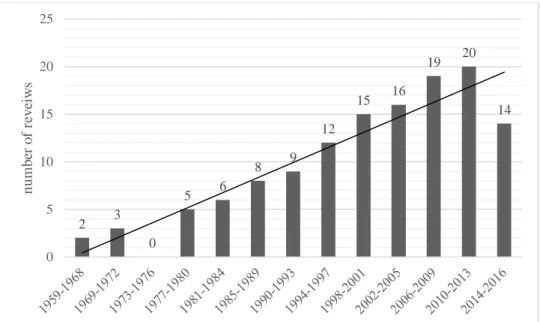
Figure 2 Number of surveys published on MSPP over time ...21
Figure 3 Number of published surveys on MSPP per journal ...22
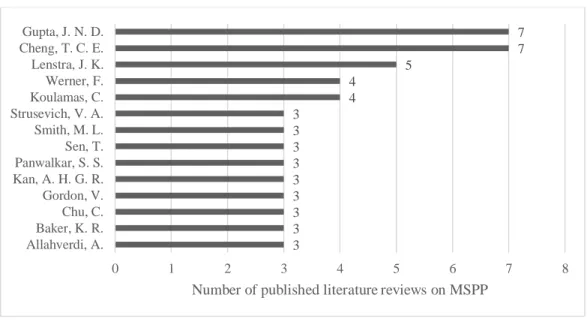
Figure 4 Authors that published at least three of the sampled literature reviews on MSPP ...22
Paper 2
Figure 1: Number of published surveys per year. ...44Figure 2: Number of published surveys per journal...44
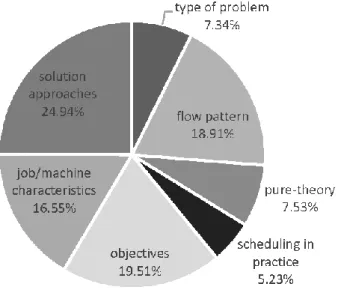
Figure 3: Shares of the keyword groups in the total keyword count of the sampled papers. ...47
Figure 4: Subgroups of the group “Type of problem” and their shares in the keyword count. ...49
Figure 5: Subgroups of the group “flow pattern” and their shares in the keyword count. ...50
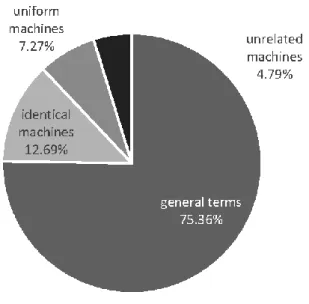
Figure 6: Different clusters of keywords for the subgroup “parallel machines” and their shares in the keyword count. ...51
Figure 7: Subgroups of the group “objectives” and their shares in the keyword count. ...52
Figure 8: Subgroups of the group “Job and machine characteristics” and their shares in the keyword count. ...53
Figure 9: Examples of interdependencies that may arise between job- and machine-related assumptions. ...54
Figure 10: Subgroups of the group “solution approaches” and their shares in the keyword count. ...54
Figure 11: Distribution of keyword counts of the subgroup “exact algorithms”. ...55
Figure 12: Share of specific simple heuristic algorithms in the keyword count of the subgroup “simple heuristics”. ...56
Figure 13: Share of specific metaheuristics in the keyword count of the subgroup “metaheuristics”. ..56
Figure 14: Distribution of the keyword count of the subgroup “scheduling in practice”...57
Paper 3
Paper 4
Figure 1: Part feeding with electric vehicles at our OEM partner. ...94Figure 2: Example graph for EVMSP-1. ... 102
Figure 3: Number of vehicles at the depot as a function of time for large instance no. 1 (n=150, r=5). ... 114
Paper 5
Figure 1: Flow of cargo through an airport. ... 120
Figure 2: Example data and solution. ... 125
Figure 3: All possible assignments 𝛺3 for job 𝑗 = 3 in the example ... 127
Paper 6
Figure 1: Order picking operations in the case warehouse ... 145Figure 2: U-shaped zone studied in this paper with n=8 and m=3 ... 147
Figure 3: Graphical illustration of the pallet rotation process ... 148
Figure 4: Mannequin from the biomechanical model illustrating example body postures during pick tasks ... 149
Figure 5: Example of a pallet with three buckets stored above each other (25 kg) ... 150
Figure 6: Inventory level of front and back part of the items for a given solution over time ... 158
Figure 7: Average time needed to process one pick list for different pallet rotation strategies ... 161
Figure 8: Average load on the order picker for different pallet rotation strategies and automated pallet rotation ... 162
Figure 9: Average time per picklist for different values of ∆𝑖... 163
Figure 10: Average load on the order picker for different pallet rotation strategies and manual pal-let rotation ... 163
Figure 11: Number of dangerous picks for different pallet rotation strategies ... 164
Figure 12: Load and time per picklist for the standard and the weight-based assignment ... 165
Figure 13: Load and time per picklist for the standard and the weight-based assignment for an ad-justed item demand structure ... 166
Figure 14: Average number of rotations for different items considering different rotation strategies and under different pallet rotation times ... 167
Figure 15: Average time needed to process one pick list for different pallet rotation strategies with the new problem setting ... 167
Figure 16: Average load on the order picker for different pallet rotation strategies and automated pallet rotation with the new problem setting ... 168
Table 1: Application of scheduling problems in different industries ... 5 Table 2: Overview of the papers included in this cumulative dissertation ... 7
Paper 1
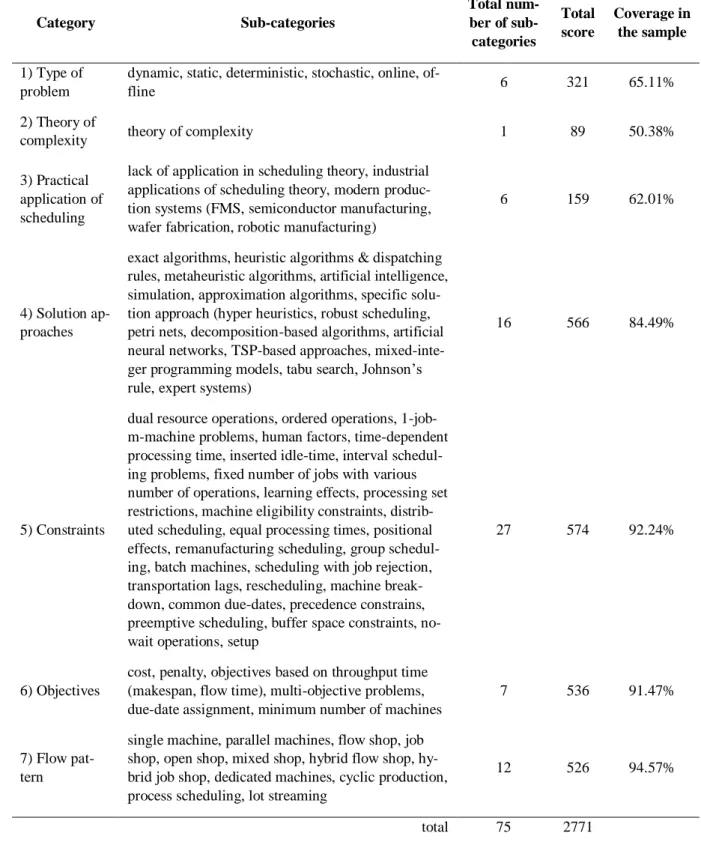
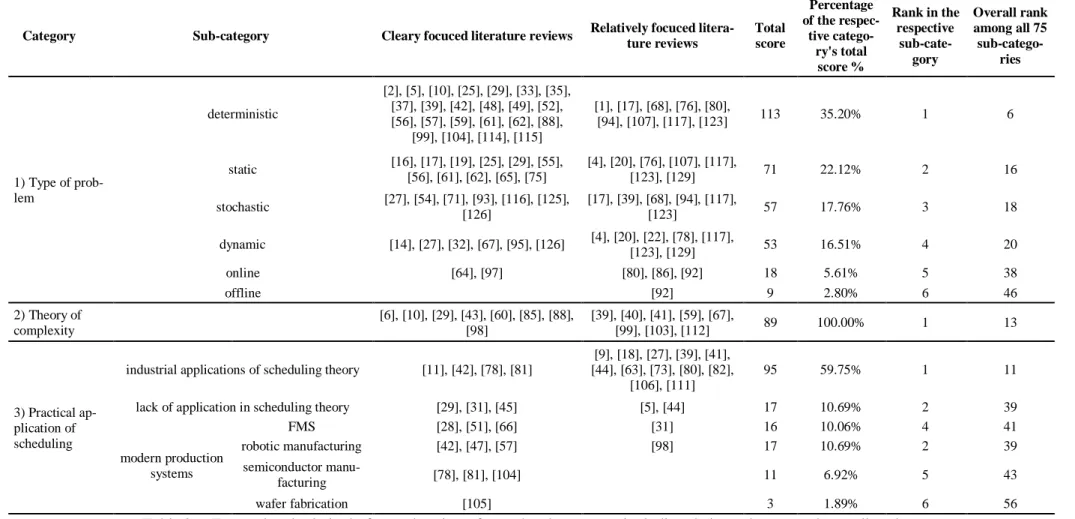
Table 1: Framework with categories, sub-categories, total score obtained and coverage ...24 Table 2 a: Focused and relatively focused reviews for each sub-category including their total score and overall rank ...25 Table 2 b: Focused and relatively focused reviews for each sub-category including their total score and overall rank ...26 Table 2 c: Focused and relatively focused reviews for each sub-category including their total score and overall rank ...27 Table 2 d: Focused and relatively focused reviews for each sub-category including their total score and overall rank ...28 Table 2 e: Focused and relatively focused reviews for each sub-category including their total score and overall rank ...29 Table 3: Results of the sensitivity evaluation ...31
Paper 2
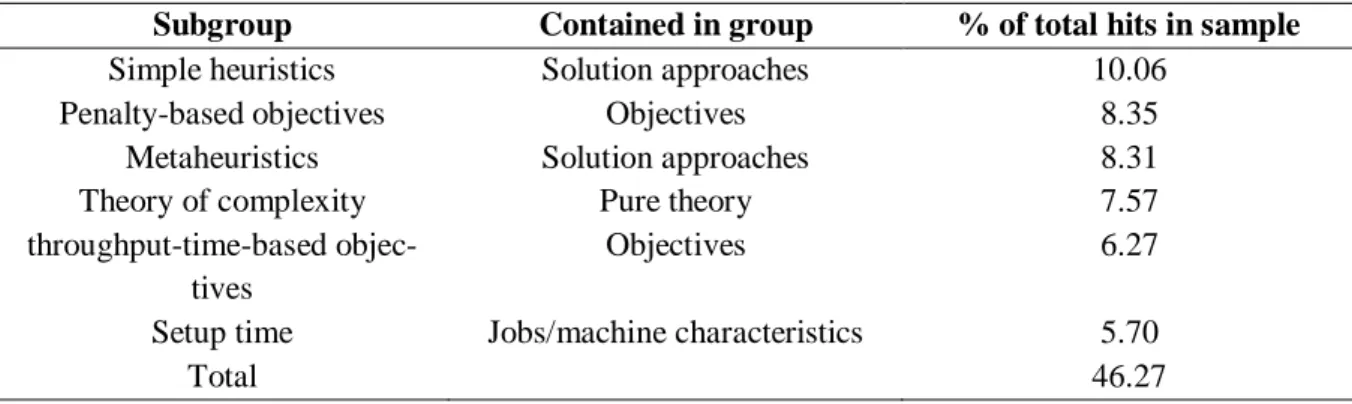
Table 1: Most discussed subgroups in the sampled papers and the groups they belong to. ...48 Table 2: Subgroups with more than five dedicated papers. ...59 Table 3: Ten subgroups with the highest percentage dependency on their dedicated papers. ...59 Table 4: Ten subgroups with the highest average percentage dependency on their dedicated papers. ..60
Paper 3
Table 1: Comparing AGB and LS for the general case: Summary of results for small-size problems ..83 Table 2: Comparing AGB and LS for the general case: Summary of results for large-size problems. .84 Table 3: Summary of results for different α- and γ-values for small-size problems. ...85 Table 4: Summary of results for different α- and γ-values for large-size problems. ...87 Table 5: Comparing LS and 𝐴𝐺𝐵/𝑀𝑇𝑊𝑃𝑇𝑖/𝐴/𝑇𝑊𝐹𝑇8: Summary of results for small-size problems. ...88 Table 6: Comparing LS and 𝐴𝐺𝐵/𝑀𝑇𝑊𝑃𝑇𝑖/𝐴/𝑇𝑊𝐹𝑇8: Summary of results for small-size problems. ...88 Table 7: Results of the statistical test. ...89
Paper 4
Table 1: An example problem. ...99
Table 2: Notation for the MIP model ... 103
Table 3: Results for the small instances with slow recharging (n = 15, r = 1). ... 109
Table 4: Results for the small instances with slow recharging (n = 25, r = 5). ... 110
Table 5: Results for the large instances with slow recharging (n=150, r=1). ... 111
Table 6: Results for the large instances with slow recharging (n=150, r=5). ... 112
Table 7: Comparison of fairness as obtained by tabu search and fairness as obtained by the first-come-first-to-operate rule (n=150)... 113
Paper 5
Table 1: Notation for the MILP model... 124Table 2: Additional notation for the generalized set partitioning model. ... 126
Table 3: Comparison of the assignment selection strategies (small instances). ... 131
Table 4: Comparison of solution methods (small instances). ... 132
Table 5: Comparison of solution methods given a 10 second time limit (large instances); a dash (-) denotes that no feasible solution was found within the time limit. ... 133
Table 6: Comparison of optimized schedules and a rule-of-thumb (large instances). ... 135
Table 7: Size of workforce required depending on the available space in the warehouse (large instances); dashes (-) denote that no feasible solution could be found. ... 136
Table 8: Violation of the space constraint if the number of ULD per flight is uncertain (large instances); γ denotes the percentage of flights affected, ζ is the maximum percentage by which ULD requirements can fluctuate. ... 137
Paper 6
Table 1: Item characteristics and biomechanical output for lower level pallets ... 150Table 2: Item characteristics and biomechanical output for upper level pallets ... 150
Table 3: Peak load on the order picker for rotating pallets with different types of items ... 151
Table 4: Sample item data used for the illustrative example ... 156
Table 5: Sample pick lists used for the illustrative example ... 156
Table 6: Results for 𝚺𝟏 and k=1 for the illustrative example ... 157
Table 7: Results for 𝚺𝟏 and k=2 for the illustrative example ... 157
Table 8: Results for 𝚺𝟐 for the illustrative example ... 157
Table 9: Parameters used for the computational experiment... 160
The focus of the thesis is to develop new solution approaches for scheduling problems encountering in manufacturing as well as in logistics. The thesis is divided into two parts: “machine scheduling in pro-duction” and “scheduling problems in logistics” each of them consisting three papers.
To have most comprehensive overview of the topic of machine scheduling, the first part of the thesis starts with two systematic review papers, which were conducted on tertiary level (i.e., reviewing litera-ture reviews). Both of these papers analyze a sample of around 130 literalitera-ture reviews on machine sched-uling problems. The first paper use a subjective quantitative approach to evaluate the sample, while the second papers uses content analysis which is an objective quantitative approach to extract meaningful information from massive data. Based on the analysis, main attributes of scheduling problems in pro-duction are identified and are classified into several categories. Although the focus of both these papers are set to review scheduling problems in manufacturing, the results are not restricted to machine sched-uling problem and the results can be extended to the second part of the thesis. General drawbacks of literature reviews are identified and several suggestions for future researches are also provided in both papers.
The third paper in the first part of the thesis presents the results of 105 new heuristic algorithms devel-oped to minimize total flow time of a set of jobs in a flowshop manufacturing environment. The com-putational experiments confirm that the best heuristic proposed in this paper improves the average error of best existing algorithm by around 25 percent.
The first paper in second part is focused on minimizing number of electric tow-trains responsible to deliver spare parts from warehouse to the production lines. Together with minimizing number of these electric vehicles the paper is also focused to maximize the work load balance among the drivers of the vehicles. For this problem, after analyzing the complexity of the problem, an opening heuristic, a mixed integer linear programing (MILP) model and a taboo-search neighborhood search approach are pro-posed. Several managerial insights, such as the effect of battery capacity on the number of required vehicles, are also discussed.
The second paper of the second part addresses the problem of preparing unit loaded devices (ULDs) at air cargos to be loaded latter on in planes. The objective of this problem is to minimize number of workers required in a way that all existing flight departure times are met and number of available places for building ULDs is not violated. For this problem, first, a MILP model is proposed and then it is boosted with a couple of heuristics which enabled the model to find near optimum solutions in a matter of 10 seconds. The paper also investigates the inherent tradeoff between labor and space utilization as well as the uncertainty about the volume of cargo to be processed.
The last paper of the second part proposes an integrated model to improve both ergonomic and economic performance of manual order picking process by rotating pallets in the warehouse. For the problem under consideration in this paper, we first present and MILP model and then propose a neighborhood
Zusammenfassung
Die vorliegende kumulative Doktorarbeit besteht aus sechs Artikeln, die in wissenschaftlichen Zeit-schriften veröffentlicht wurden. Der Schwerpunkt dieser Doktorarbeit liegt in der Entwicklung neuer Lösungsansätze für die Planungsprobleme, die in der Fertigung und in der Logistik auftreten. Die Arbeit gliedert sich in zwei Teile: „Maschinenplanung in der Produktion“ und „Planungsprobleme in der Lo-gistikplanung“, die jeweils aus drei Artikeln bestehen.
Um einen möglichst umfassenden Überblick über das Thema Maschinenplanung zu erhalten, beginnt der erste Teil der Arbeit mit zwei systematischen Literaturüberblickarbeiten, die im Tertiärstudie durch-geführt wurden (d.h. Überblick von Literaturüberblicke). In beiden diese arbeiten wird eine Stichprobe von rund 130 Literaturüberblicken zu Problemen in Bereich der Maschinenplanung analysiert. Der erste Artikel verwendet einen subjektiven quantitativen Ansatz zur Bewertung der Stichprobe, während der zweite Artikel die sogenannte Inhaltsanalyse (Content Analyse, CA) verwendet. Dies ist ein objektiver quantitativer Ansatz, um aussagekräftige Informationen aus massiven Daten zu extrahieren. Basierend auf der Analyse werden die Attribute von Planungsproblemen in der Produktion identifiziert und in verschiedene Kategorien klassifiziert. Obwohl liegt der Fokus dieser beiden Arbeiten auf der Überprü-fung von Planungsproblemen in der Fertigung, die Ergebnisse beschränken sich jedoch nicht auf das Maschinenplanungsproblem, und die Ergebnisse können auf den zweiten Teil der Doktorarbeit ausge-dehnt werden. Allgemeine Nachteile als auch Hindernisse von Literaturüberblickarbeiten werden iden-tifiziert, und in beiden Artikeln werden auch einige Vorschläge für zukünftige Forschungen gegeben. Der dritte Artikel im ersten Teil der Arbeit stellt die Ergebnisse von 105 neuen heuristischen Algorith-men vor, die entwickelt wurden, um die Gesamtauslaufzeit einer Reihe von Jobs in einer Fertigungsum-gebung eines Flowshops zu minimieren. Die rechnerischen Experimente bestätigen, dass die in diesem Artikel vorgeschlagene beste Heuristik den durchschnittlichen Fehler des besten vorhandenen Algorith-mus um etwa 25 Prozent verbessert.
Der erste Artikel im zweiten Teil konzentriert sich auf die Minimierung der Anzahl elektrischer Schlepp-züge, die für die Lieferung von Ersatzteilen vom Lager an die Produktionslinien verantwortlich sind. Zusammen mit der Minimierung der Anzahl dieser Elektrofahrzeuge ist das Papier auch darauf ausge-richtet, die Arbeitslast unter den Fahrern der Fahrzeuge abzugleichen. Für dieses Problem werden nach Analyse der Komplexität des Problems eine Öffnungsheuristik, ein MILP-Modell (Mixed Integer Linear Programing) und ein Nachbarschaftssuchansatz mit hilfe die so genante Tabu-Search meta-heuristik-vorgeschlagen. Darüber hinaus werden einige Erkenntnisse aus dem Management diskutiert, beispiels-weise der Einfluss der Batteriekapazität auf die Anzahl der benötigten Fahrzeuge.
Der zweite Artikel des zweiten Teils befasst sich mit dem Problem der Vorbereitung von Unit-Loaded Devices (ULDs) an Luftfrachtgütern, die in Ebenen geladen werden sollen. Das Ziel dieses Problems besteht darin, die Anzahl der erforderlichen Arbeitskräfte so zu minimieren, dass alle bestehenden Ab-flugzeiten eingehalten werden und die Anzahl der verfügbaren Plätze für die Ladung von ULDs nicht gestört wird. Für dieses Problem wird zunächst ein MILP-Modell vorgeschlagen und anschließend mit einigen Heuristiken verstärkt, wodurch das Modell innerhalb von 10 Sekunden nahezu optimale Lösun-gen finden konnte. Der Artikel untersucht auch den inhärenten Kompromiss zwischen Arbeits- und
Der letzte Artikel des zweiten Teils schlägt ein integriertes Modell vor, um die Ergonomie und die Wirt-schaftlichkeit des manuellen Kommissionierprozesses durch rotierende Paletten im Lager zu verbessern. Für das in dieser Arbeit behandelte Problem stellen wir zuerst ein MILP-Modell vor und schlagen dann eine Nachbarschaftssuche vor, die auf so genannte Simuliertem Anealing meta-heuristik basiert ist. Die Ergebnisse des numerischen Experiments zeigen, dass selektiv rotierende Paletten sowohl die Kommis-sionierzeit als auch die Belastung des Kommissionierers reduzieren können, was zu einem schnelleren und weniger riskanten Kommissionierprozess führt.
Introduction
Scheduling is a decision-making process to determine the allocation of restricted resources to accom-plish a set of tasks, and its goal is to optimize given (and sometime conflicting) objectives subject to the considered constraints (Pinedo, 2008). This definition of scheduling makes it relevant to almost all plan-ning activities, from planplan-ning personal daily activities to sophisticated production planplan-ning in the man-ufacturing of semiconductor circuits, for example. Depending on the area where the schedule needs to be prepared, resources, tasks, objectives and constraints can be of different forms. Table 1 illustrates some examples for these different forms in four different industrial disciplines in which scheduling is relevant: I) machine scheduling in production (which is covered in the first part of this thesis); II) sched-uling problems in logistics (which is the subject of the second part of this thesis); III) project schedsched-uling; and IV) scheduling in software development.
This broad applicability of scheduling made it popular among practitioners and simultaneously attractive for academics. The scientific literature on scheduling is extensive and, as Gorman (2016) stated, sched-uling is the second most frequently studied optimization problem in the Operations Research and Man-agement Science literature.
This cumulative dissertation consists of six papers either published in or submitted to different scientific journals (see Table 2 for more information). All six papers are concerned with scheduling problems. Due to differing foci of the papers, this dissertation is divided into two parts. Part A includes Papers 1 to 3 and contributes to a research stream that investigates scheduling problems in production, which are also known as machine scheduling problems. Part B features Papers 4 to 6 and investigates scheduling problems encountered in planning intra-plant logistics activities. Aside from the differing foci, the six papers also vary in the methodologies employed. The first two papers present systematic literature re-views on the state-of-research of machine scheduling problems in production. These literature rere-views are conducted on a tertiary level, which means they analyze a literature sample consisting exclusively of literature review papers. As the topic of machine scheduling is very general and not restricted to a specific industry, and as there are some similarities between scheduling problems in production and in logistics, these two literature reviews also cover some studies that focus on the application of scheduling in logistics (e.g., the scheduling of automated guided vehicles (AGVs) is discussed in both papers). The remaining four papers develop mathematical models for supporting production/logistics planning deci-sions. Papers 3 develops a set of constructive heuristic algorithms to minimize total throughput time in a basic production system. Papers 4 to 6 first present mixed-integer programing (MIP) models for the problems under consideration and then propose different heuristic and meta-heuristic algorithms, which are all able to obtain near-optimal solutions for their respective problems with reasonable runtime. The following provides an introduction to the research areas that the papers contribute to and explains the research gaps they are looking to fill.
A regular literature review (which is frequently also referred to as a secondary study) aims to analyze primary works published in a specific research area (Garousi & Mäntylä, 2016; Hochrein et al., 2015).
R eso u rc e( s) T a sk (s) Ob je ct ive (s) C on st r ain t( s) S am p le r e fe r e n c es m a c hi ne s, m a n p ow er , el ec tr ic it y pa rt s/ o rd er s to be m a n u -fa ct ur ed m ini m iz ing th ro u gh put t im e, m a x im iz ing m a -chi ne ut il iz a ti on m a c hi ne br ea k-dow n , con tr ol la bl e pr o c ess ing t im es S a n la v il le & S chm id t (1998) P a n w a lk a r et a l. ( 2013 ) H a ll & S ri sk a nd a ra ja h ( 1996 ) tr a n spo rt a ti on ve hi c le s, m a n p ow er pr o d uc ts to b e pa cke d /t ra n spo rt ed m ini m iz ing n u m -be r o f ve h ic le s in use , m a xi m iz ing just -in -t im e de li v -er ie s, e rgonom ic con st ra in ts B ehn a m ia n & F . G h om i (2014) C he n & Le e (2008) fi n a n c ia l re so ur c es, m a n -pow er , m a c h ine s P ro je ct pa rt s to be d one m ini m iz ing de la y , m a x im iz ing P re c ede n c e c on -st ra in ts, un exp ec te d h a za rd s H er roe le n e t a l. ( 1999) B ruc ke r et a l. ( 1999) pr o c ess o rs, ne tw o rk li nk s or e xpa n si on c a rd s, com put ing uni ts com put a ti on e le m ent s, so ft w a re se gm ent s, th re a d s m a x im iz ing l o a d ba la n ci ng , m ini -m iz ing r esp on se ti m e m ust -m ee t de a d-li ne s, d yn a m ic a rr i-v a l ti m es Y ua n & N a h rst ed t (2003) S ingh e t a l. ( 2010 ) Ta bl e 1 : A pp li ca ti on o f sc he dul ing pr o bl em s in di ff er en t ind ust ri es
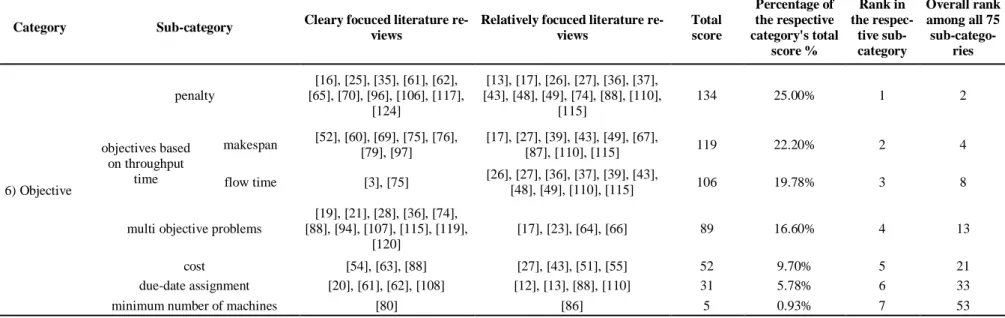
However, the massive body of literature in some research streams, such as machine scheduling, prohibits a regular secondary review that covers the entire available literature. Tertiary studies (i.e., reviews of literature reviews) may support structuring and synthesizing a particular research area in such cases (Kache & Seuring, 2014; Seuring & Gold, 2012). According to Paper 1, the contributions of a tertiary study is manifold: (I) giving an aggregated overview of a research domain; (II) analyzing research trends in the domain of interest; (III) evaluating the methodological rigor of literature reviews in the domain; and (IV) identifying research gaps (on the secondary and, if possible, also on the primary level). Papers 1 and 2 present the results of tertiary studies conducted on the domain of machine scheduling problems in production (MSPP). The comprehensive samples of both papers, containing around 130 literature reviews, have been generated in a systematic way to make the results reproducible and reliable. As describing the review methodology employed is necessary for making the generation of the sample reproducible and more reliable, Paper 1 first describes the review methodology used by outlining both the literature search strategy as well as inclusion/exclusion criteria employed. It then proposes a con-ceptual framework that considers the main attributes of MSPP in 7 categories and 75 sub-categories. After a descriptive analysis of the sampled papers that gives insight into publication patterns for MSPP, a quantitative analysis of the sampled review papers is carried out based on the proposed framework. A synthesis of research findings describes the state-of-knowledge and unveils general deficiencies of lit-erature reviews on MSPP. In addition, the paper provides a comprehensive overview of MSPP, which supports researchers in positioning their own work in the literature and in finding potential innovative research areas. Based on a discussion of the statistical findings, opportunities for future research on MSPP are proposed.
Paper 2 presents the results of a content analysis (CA) on a comprehensive sample generated in a similar way as in Paper 1. Paper 2 starts with a short description of the CA, which is an objective and quantitative approach to extract worthwhile information from massive data (Neuendorf, 2002). The objective of a CA is to make replicable and valid inferences from texts or other meaningful matters to the context of their use (Krippendorff, 2012). Among four different types of CAs that have been discussed in the liter-ature (i.e., descriptive, inferential, psychometric, and predictive CA), Paper 2 employs a descriptive approach, whose conclusions are limited to the content under study. As recording units, the paper selects words (e.g., “makespan”), abbreviations (e.g., “HFS”, which stands for “hybrid flow shop”) and symbols (e.g., “Cmax”, which stands for maximum completion time). The appearance frequency of the recording units in the sample are set as the objects of the analysis. At the end of the search phase of the CA, the recording units that are used more frequently in the sample are rated as more important. To ensure that the process of categorizing recording units is exclusive and exhaustive, both inductive and deductive categorization approaches are employed (more information on categorization approaches in the CA can be found in Neuendorf (2002) and Krippendorff (2012)), which results in an identification of a total of 179 main attributes of machine scheduling problems in production that can be allocated to 7 groups and 48 subgroups. The reliability of the results of the content analysis is then examined in a sensitivity analysis. Finally, a close analysis of the results unveils several research gaps in the literature and enables us to propose promising avenues for future research.
h e p a p e r A u th o rs T it le Jou r n al S ta tu s in P ro -a rt A ) H . A be di nni a C . H . G loc k E. H . G ro ss e M. S ch ne ide r Ma ch ine sc he d u li ng pr o b le m s in pr od uc ti o n: A t er ti a ry st ud y C om put er s & I nd ust ri a l En -gi ne er ing P ubl is he d H . A be dinni a C . H . G loc k M. S ch ne ide r Ma ch ine sc he d u li ng i n pr o d u ct ion: A c on te n t a n a ly si s A pp li ed Ma the m a ti ca l M od -el li ng P ubl is he d H . A be di nni a C . H . G loc k A . B ri ll N ew s im p le c o n st ruc ti ve he ur ist ic a lg o ri thm s fo r m ini m iz ing to ta l fl ow -t im e in t he p er m uta ti on f low s ho p sc he duli ng pr o b-le m C om put er s & O pe ra ti o n s R es ea rc h P ubl is he d in L o-rt B ) S . Em de H . A be di nni a C . H . G loc k S che d u li ng e le ct ri c ve hi c le s m a king m il k -r un s fo r just -in -t im e D el ive ry II E Tr a n sa ct io n s A c c ept ed S . Em de H . A be dinni a A . La n ge C . H . G loc k S che d u li ng p er sonne l fo r the bui ld -up of uni t lo a d de vi c es a t a n a ir c ar g o t er m in a l w it h l im it ed spa ce OR -S pe ct ru m U nde r re vie w C . H . G loc k E . H . G ro sse H . A be di nni a S . Em de A n i n te g ra te d m ode l to i m pr ove e rgon om ic a nd e c onom ic pe r-fo rm a nc e in o rde r pi c k ing by r o ta ti n g pa ll et s E ur o pe a n Jo ur n a l o f O p er a -ti on a l R es ea rc h U nde r re vi ew Ta bl e 2 : O ve rvi ew o f the pa p er s in c lu de d i n t hi s cu m u la ti ve di ss er ta ti on
Paper 3 develops a set of new simple constructive heuristic algorithms to minimize total flow-time, i.e., the summation of completion times of all jobs, for an n-jobs xm-machines permutation flowshop sched-uling problem. A flowshop production system is commonly defined as a production system in which a set of 𝑛 jobs undergoes a series of operations in the same order (Pinedo, 2008). Flowshop scheduling problems are in most cases proven to belong to the class of NP-hard problems. This is even the case for permutation flowshop scheduling problems, i.e. for flowshop scheduling problems with the same job order on all machines. The heuristic algorithms proposed in this paper are based on the popular simple heuristic presented by Nawaz et al. (1983), which is known as NEH in the literature. The NEH heuristic consists of two phases, namely (I) the sorting (prioritizing) phase and (II) the insertion phase. In the sorting phase, the jobs are sorted in descending order of their total processing time. This sorted list is then used in the insertion phase to determine the sequence in which jobs are added to an existing partial sequence. Based on a considered decision criterion, in each iteration, the best partial sequence will be selected for the next iteration. In Paper 3, we first propose a modification for the insertion phase of NEH (which is actually a smart neighborhood search) and then integrate new indicator variables for weighting jobs into this algorithm. We also propose new decision criteria to select the best partial sequence in each iteration of our algorithm. A comprehensive numerical experiment reveals that our modifications and extensions improve the effectiveness of the best existing simple heuristic without affecting its compu-tational efficiency by 24%.
In Paper 4, we modeled the problem of assigning a set of timetabled milk-run trips to a fleet of electric vehicles such that battery capacities are not exceeded, the fleet size is minimal, and fairness, which is measured by calculating the difference of workload on the most and least busy driver, is maximal. Bat-tery-operated electric vehicles are frequently used in in-plant logistics systems to feed parts from a cen-tral depot to work cells on the shop floor. These vehicles, often so-called tow trains, make many milk-run trips during a typical day, with the delivery timetable depending on the production schedule. To operate such a milk-run delivery system efficiently, not only do the timetabled trips need to be assigned to vehicles, it is also important to take the limited battery capacity into consideration. Moreover, since most tow trains in use today are still operated by human drivers, fairness aspects with respect to the division of the workload also need to be considered. In this context, we tackle the following problem that we encountered at a large manufacturer of engines for trucks and buses in Germany. Given a fixed schedule of milk-runs (round trips) to be performed during a planning horizon and a fleet of homogene-ous electric vehicles stationed at a depot, which vehicle should set out on which milk-run and when should recharging breaks be scheduled, such that all runs can be completed with the minimum number of vehicles and ensuring all vehicles are approximately equally busy? The computational complexity of this problem, as well as the complexity of some important sub-problems (such as the case in which battery restriction is relaxed), are investigated in Paper 4. A constructive heuristic algorithm has been proposed, which can solve the problem in pseudo-polynomial time. Although this heuristic is quite fast (it solves large instances in split seconds), the solution quality, especially with regard to fairness, is suboptimal. To overcome this issue, Paper 4 also suggests a solution approach based on taboo search, which is capable of solving realistic instances to near-optimality in less than two minutes. Comprehen-sive computational experiments conducted in this paper enabled us, first, to examine the effectiveness as well as the efficiency of the solution approaches proposed, and then, to offer some insight into how battery technology influences vehicle utilization.
Paper 5 investigates a problem we encountered at a terminal of a major German airfreight carrier and addresses the preparation of unit load devices (ULD), which later have to be loaded onto aircrafts. This process is difficult to plan for many airlines, which face the challenge of assigning a limited number of workers to a limited number of workspaces available for preparing the ULD, while respecting the re-quirements imposed by an existing flight schedule. While preparing ULD, the objectives are to comply with the flight schedule, not to exceed the available space at the terminal, and to minimize the maximum workforce employed over time. To support airlines in realizing efficient ULD preparation processes, this paper proposes a mixed-integer programming model as well as a generalized set partitioning refor-mulation of this problem. Based on the latter forrefor-mulation, we develop different heuristic strategies, some of which are shown to solve this NP-hard problem to near-optimality (using the right parameter settings for the proposed heuristic, our heuristic performs very well, delivering optimality gaps well below 1% on average) in a matter of merely 10 seconds. (Near-)optimal schedules as obtained by our heuristics are significantly better at avoiding large peak workloads than the simple rule of thumb we encountered in practice. On average, the required peak workforce could be more than halved. We also investigate the inherent tradeoff between labor and space utilization as well as the effect of uncertainty about the volume of the cargo to be shipped.
Paper 6 studies manual order picking activities in a U-shaped warehouse where items are stored on pallets in two rows one above the other, inspired by a situation observed in practice. Picking products directly from pallets renders order picking a high-risk environment for developing musculoskeletal dis-orders due to the required handling of heavy loads and continuous bending, stretching and lifting. The challenge that arises for warehouse managers in this case is to organize the order picking process as efficiently as possible, simultaneously keeping in mind health and safety issues. The first aspect can be addressed by planning short order picking routes and implementing storage assignment methods that allocate frequently required items close to the depot of the warehouse. Worker well-being, in turn, can be improved by searching for opportunities to reduce the load on the warehouse worker. Our observa-tions revealed that, in many cases, picking an item from the back side of a pallet led to excessive load on the order picker compared to picking the same item from the front side of the pallet. Therefore, Paper 6 investigated the case where the company has the opportunity to rotate pallets once their front part has been depleted, which helps to reduce the extent of bending and stretching required on the part of the order picker, and therefore the load on the worker’s spine. In this way, a biomechanical model was developed to measure the peak L4/L5 spinal compression that acts on the order picker during the picking of items as an ergonomic objective. In addition, as an economic objective, the total order picking time was considered. A mathematical model was also proposed for sequencing orders, routing the order picker through the warehouse, and scheduling pallet rotation tours. The developed model allows study-ing the impact of rotatstudy-ing pallets on two different measures: order pickstudy-ing time and peak spinal load on the order picker. The results of a numerical experiment indicate that selectively rotating pallets may both reduce order picking time as well as the load on the order picker, leading to a quicker and less risky order picking process. The model proposed in this paper supports the decision of which pallet to rotate (and which not to rotate) against the company’s cost objectives and its strive for worker well-being. Several managerial insights, limitations of our study, as well as several suggestions for further research are also discussed.
Overall, this thesis adds to the literature two systematic literature reviews on the state-of-research of machine scheduling problem in production (Paper 1 and Paper 2), one decision support model to se-quence jobs in a classic production system (Papers 3), and three effective algorithms to support decision making in scheduling problems encountered in planning intra-plant logistics activities (Paper 4 to 6). Despite the scientific character of the papers, the literature synthesis and the comprehensive computa-tional experiments conducted clearly underscore the practical applicability of the reviewed and devel-oped decision support models and hence their relevance for practitioners. Detailed managerial insights together with limitations of the chosen research approaches and future research opportunitiesm can be found in the final section of each paper.
References
Behnamian, J., F. Ghomi, S.M.T., 2014. A survey of multi-factory scheduling. Journal of Intelligent Manufacruring. 27, 1–19. Brucker, P., Drexl, A., Möhring, R., Neumann, K., Pesch, E., 1999. Resource-constrained project scheduling: Notation,
classification, models, and methods. European Journal of Operational Research. 112, 3–41.
Brucker, P., Sotskov, Y.N., Werner, F., 2007. Complexity of shop-scheduling problems with fixed number of jobs: a survey. Mathematical Methods of Operations Research. 65, 461–481.
Chen, B., Lee, C.Y., 2008. Logistics scheduling with batching and transportation. European Journal of Operational Research. 189, 871–876.
Garousi, V., Mäntylä, M. V., 2016. A systematic literature review of literature reviews in software testing. Information and Software Technology. 80, 195–216.
Gorman, M.F., 2016. A “Metasurvey” analysis in Operations Research and Management Science: A survey of literature reviews. Surveys in Operations Research and Management Science. 21, 18–28.
Hall, N.G., Sriskandarajah, C., 1996. A survey of machine scheduling problems with blocking and no-wait in process. Operations Research. 44, 510–525.
Herroelen, W., Demeulemeester, E., De Reyck, B., 1999. A classification scheme for project scheduling, in: International Series in Operations Research & Management Science, Vol 14. Springer, Boston, MA, Boston.
Hochrein, S., Glock, C.H., Bogaschewsky, R., Heider, M., 2015. Literature reviews in supply chain management: a tertiary study. Management Review Quarterly. 65, 239–280.
Kache, F., Seuring, S., 2014. Linking collaboration and integration to risk and performance in supply chains via a review of literature reviews. Supply Chain Management: An International Journal. 19, 664–682.
Krippendorff, K., 2012. Content Analysis: An Introduction to Its Methodology, third ed., SAGE Publications, Inc.
Lenstra, J.K., Kan, A.H.G.R., Brucker, P., 1977. Complexity of machine scheduling problems. Annals of Discrete Mathematics. 1, 343–362.
Levner, E., Kats, V., Alcaide López de Pablo, D., Cheng, T.C.E., 2010. Complexity of cyclic scheduling problems: A state-of-the-art survey. Computers & Industrial Engineering. 59, 352–361.
Nawaz, M., Enscore, Jr.E.E., Ham, I., 1983. A heuristic algorithm for the m-Machine, n-Job flow-shop sequencing problem. Omega. 11, 91–95.
Pinedo, M.L., 2008. Scheduling Theory, Algorithms, and Systems, Third. ed. Springer.
Sanlaville, E., Schmidt, G., 1998. Machine scheduling with availability constraints. Acta Informatica. 35, 795–811.
Seuring, S., Gold, S., 2012. Conducting content‐analysis based literature reviews in supply chain management. Supply Chain Management: An International Journal. 17, 544–555.
Singh, A., Goyal, P., Batra, S., 2010. An optimized round robin scheduling algorithm for CPU scheduling. International Journal on Computer Science and Engineering. 2, 2383–2385.
Yuan, W., Nahrstedt, K., 2003. Energy-efficient soft real-time CPU scheduling for mobile multimedia systems. ACM SIGOPS Operating Systems Review. 37, 149–163.
Authors:
Hamid Abedinnia, Christoph H. Glock, Michael Schneider, Eric H.
Grosse
Type of publication: Journal article
Publication details: Computers & Industrial Engineering, Volume 111, September 2017, Pages 403-416
Abstract
This paper presents the results of a comprehensive and systematic review of 129 litera-ture reviews on machine scheduling problems in production (MSPP). The paper first proposes a conceptual framework that considers the main attributes of MSPP in 7 cate-gories and 75 sub-catecate-gories. After a descriptive analysis of the sampled papers that give insights into publication patterns for MSPP, a quantitative analysis of the sampled review papers is carried out based on the proposed framework. A synthesis of research findings describes the state of knowledge and unveils general deficiencies of literature reviews on MSPP. In addition, the paper provides a comprehensive overview of MSPP, which supports researchers in positioning their own work in the literature and in finding potential innovative research areas. Based on a discussion upon the statistical findings, opportunities for future research on MSPP are proposed.
Keywords: systematic literature review, review of reviews, scheduling in production, machine schedul-ing
1
Introduction
1.1.Machine scheduling problems in production
Scheduling can generally be defined as the process of assigning restricted resources to a set of tasks that need to be accomplished. Scheduling is a relevant problem in many different areas, e.g. in project man-agement (Leyman & Vanhoucke, 2015; Nkasu & Leung, 1997), software optimization (Li, Singhoff, Rubini, & Bourdellès, 2016), and personnel management (Cochran, Chu, & Chu, 1997; Prot, Lapègue, & Bellenguez-Morineau, 2015). Among the most prominent and important research fields in scheduling are production systems (Pinedo, 2008), which is also the focus of the paper at hand. In many production systems, jobs (that represent tasks) need to be processed on machines (that represent resources). The aim of machine scheduling problems in production (MSPP) is to find a sequence of jobs to be processed on machines in a way that optimizes a set of objective(s) without violating any of the constraints (Graves, 1981; Sen & Gupta, 1984). Even in modern production systems, such as in semiconductor manufactur-ing plants, schedulmanufactur-ing techniques play an important role in reducmanufactur-ing idle times, speedmanufactur-ing up the produc-tion process and reducing cost by improving operaproduc-tional processes (Mönch, Fowler, Dauzère-Pé rès, Mason, & Rose, 2011).
As MSPP need to be solved in almost any production system to plan operational activities, related solu-tion approaches are broadly applicable in practice (Tuncel & Bayhan, 2007). Solving MSPP is challeng-ing in most cases, however, as modifychalleng-ing one simple assumption often leads to a new problem that requires new solution approaches. This fact renders MSPP not only a challenging problem for practi-tioners, but also a popular research topic for academia. It is thus not surprising that MSPP belong to the most frequently studied optimization problems in management and engineering. Simple database searches may illustrate the scope of this research stream: The keyword combination ‘‘scheduling” and ‘‘production”, for example, leads to about 1,750,000 hits in Google Scholar and 48,000 hits in Business Source Premier1, which gives an impression of the high number of publications in this area.
The continuous high publication output on MSPP makes it necessary to regularly synthesize and con-solidate research topics and findings to give researchers and practitioners an overview of the existing state-of-knowledge and to identify research gaps that could be addressed in future research efforts. This general understanding already inspired many researchers to review specific sub-domains of this research field (see, for example, the metasurvey of Gorman (2016) on literature reviews in operations research and management science). Specific MSPP literature reviews help researchers to gain insights into the topic covered by the review, but they may also contribute to a loss of overview of the research domain itself (here: MSPP), whose state-ofknowledge may be scattered over a large number of specific review papers. As the high number of published works on MSPP prohibitsa single review that covers the entire (primary) literature, one established way to synthesize research in this area is to conduct a tertiary study on a comprehensive sample of review papers (secondary works) on MSPP. The next section gives an overview of tertiary studies and their contribution to the literature and outlines the contribution of the present paper to the literature on MSPP. Section 1.3 then outlines the organization of this paper.
1.2.Tertiary study
Research streams that enjoyed a high publication output in the past often suffer from the fact that the high amount of published research makes it very difficult (if not impossible) to maintain an overview of the entire domain. For the same reason, reviewing the entire domain in a single literature review is often prohibitive. Tertiary studies (i.e., reviews of literature reviews) may support structuring and synthesizing a research area in this case, as their object of analysis are (fewer) literature reviews instead of a prohib-itively large number of primary research papers. The primary objective of tertiary studies is to investi-gate core themes that have been studied in a particular research area by reviewing and analyzing sec-ondary works (i.e., literature reviews). The aims of tertiary studies are to (I) give an aggregated overview of a research domain, to (II) analyze research trends in the domain of interest, to (III) evaluate the meth-odological rigor of literature reviews in the domain, and to (IV) identify research gaps (on the secondary and, if possible, also on the primary level). Tertiary studies usually apply a systematic literature review to a sample of literature reviews, and they are an established research methodology in many different areas including operations and production management (e.g., Bushuev, Guiffrida, Jaber, & Khan, 2015; Glock, Grosse, & Ries, 2014), supply chain management (e.g., Hochrein & Glock, 2012; Hochrein, Glock, Bogaschewsky, & Heider, 2015; Kache & Seuring, 2014; Seuring & Gold, 2012), or software engineering (e.g., Garousi & Mäntylä, 2016). Tertiary studies provide a compact and comprehensive overview of the state-of-knowledge in a specific research area, and unveil general deficiencies of pub-lished literature reviews on the subject under consideration. Tertiary studies are thus valuable sources for finding potential areas for future research.
In the area of MSPP, a prohibitively large number of primary works and a high as well as an increasing number of secondary research motivated the tertiary study at hand. The tertiary study enables us to analyze the entire domain of MSPP, which would not be possible in a regular literature review that analyzes primary works (Garousi & Mäntylä, 2016; Hochrein et al., 2015). The contribution of an easy-to-understand but comprehensive overview of the vast research field of MSPP provided by our tertiary study is manifold. First, our paper gives a broad overview of the research field of MSPP and synthesizes findings that were obtained in literature surveys covered in our sample. As a review of the MSPP on the primary level is not possible due to the massive number of papers that have been published on this topic, only a tertiary study is able to review this research stream in such a broad manner. To the best of our knowledge, our paper is the first and only work that applies a systematic tertiary analysis to MSPP, so it is the only paper that gives such a broad overview of research on MSPP. Secondly, we develop a content-related and technical classification framework for MSPP based on an in-depth analysis of the sampled review papers. This framework for classifying MSPP (Section 3) can be seen as a synthesis of the different classification schemes for MSPP applied or derived in the sampled literature reviews. Thirdly, the content-related analysis (Section 4.3.2) illustrates major topics and applications that were discussed in the sampled review papers, which helps readers in gaining insights into the topics that were emphasized by prior research (and, in return, into topics that did not receive much attention so far). This, in turn, assists readers in identifying possible avenues for future research or positioning their own work in the existing literature. For readers interested in conducting a secondary study on their own, this tertiary study helps to identify areas where a new or an initial literature review is required. The latter aspect is supported in detail in our content discussion that identifies topics where secondary studies are required in the future. Finally, this tertiary study could also serve as a guideline for the application of systematic
review techniques in the area of MSPP, which is an aspect that is of increasing relevance in the scientific literature.
1.3.Organization of the paper
To accomplish the objectives outlined in Section 1.2, this paper, first, generates a sample of literature reviews on MSPP in a systematic search of the literature (Section 2). Subsequently, the paper proposes a comprehensive conceptual framework that reflects the main characteristics of MSPP in seven catego-ries and 75 subcategocatego-ries (Section 3). The framework is used to evaluate literature reviews in this area. The methodology of the tertiary study is explained in detail in Section 4.1. After a descriptive analysis of the sample that gives insights into publication patterns (Section 4.2), a quantitative and content-re-lated analysis of the sampled review papers is carried out (Section 4.3). This step contains an evaluation of the review methodology as well as a content examination of the sampled review papers based on the proposed framework to identify the most popular streams of research on MSPP. Finally, the study iden-tifies methodological drawbacks of existing literature reviews on MSPP and highlights areas where fu-ture research might be promising (Section 5). Section 6 concludes the paper. Fig. 1 illustrates the steps of the tertiary study.
Figure 1 Methodology of the tertiary study
2
Review methodology
2.1.Literature search strategy
repro-strategy that was used to identify literature reviews on MSPP in detail. The literature search was con-ducted in November 2016. In a first step, keywords were defined that were later used to identify relevant works in the literature. The final keyword list was generated using three groups of keywords, where group A contained keywords related to scheduling (‘‘scheduling” and ‘‘sequencing”), group B keywords that limited the search to MSPP (‘‘machine”, ‘‘shop”, ‘‘manufacturing”, ‘‘production”, ‘‘process”, ‘‘flow shop”, ‘‘job shop”, and ‘‘open shop”), and group C keywords related to literature reviews (‘‘sur-vey”, ‘‘review”, ‘‘overview”, ‘‘taxonomy”, and ‘‘trends”). The keyword ‘‘shop” was included in group B to ensure that different spellings of shop-related production systems are covered (e.g., ‘‘flow shop” is often also referred to as ‘‘flowshop” or ‘‘flow-shop”). The final keyword list was generated by combin-ing all keywords from the three initial lists. The database Scopus was then searched for works that contain keywords from the final keyword list either in their title, abstract or list of keywords. In this step, 7253 papers were identified. The database search was complemented by a forward and backward snowball search, where the references of papers contained in the sample were checked, and where works that cited papers contained in the sample were evaluated for possible relevance (Hochrein & Glock, 2012). In this step of the literature search, 28 additional articles were added to the sample.
2.2.Selection criteria
After an initial sample had been generated based on the database and snowball searches, all pre-selected works were independently checked for relevance by three researchers. Works were included in the final sample based on the following requirements:
• The language was limited to English.
• Only works that appeared in peer-reviewed, high-quality journals were considered, and book chapters and conference papers were excluded from the analysis. To assess the quality and rep-utation of a journal, the SNIP and the SJR metrics were used, and only works published in journals with SNIP≥0.87 and SJR≥0.51 were considered relevant (see also González-Pereira, Guerrero-Bote, & Moya-Anegón, 2010; Moed, 2010). Two journals, for which the SNIP and SJR metrics were not available, were manually added to the list of relevant journals (i.e. Annals of Discrete Mathematics and Production and Inventory Management).
• Only works that review the literature on MSPP (secondary studies) were considered. Works that compare methods for a specific scheduling problem or that propose models or solution proce-dures (even if they contain a section on reviewing the literature) were excluded from the sample. • To keep the tertiary study focused on MSPP, we excluded works on project scheduling,
person-nel scheduling, timetabling, scheduling in agriculture, and computer scheduling.
Applying the defined inclusion and exclusion criteria to the initial sample based on an analysis of title and abstract reduced the size of the sample from 7281 to 230 articles. In a final step, all papers that remained in the sample were completely read to assess their relevance in light of the defined criteria. This step led to a final sample of 129 relevant review papers.
3
MSPP: a framework
This section proposes a conceptual framework to categorize the literature on MSPP. The framework can be seen as an extension of the 3-field notation of Graham, Lawler, Lenstra, and Kan (1979), which
carefully read to identify important characteristics of MSPP. Based on this analysis, a comprehensive framework containing 75 different attributes of MSPP (referred to as subcategories hereafter) divided into seven categories was developed. The proposed framework facilitates the analysis of literature re-views on MSPP and allows a structured and rigorous examination of this research field. In the following, we briefly introduce each category of the framework (see also Table 1 in Section 4.3.2, which contains a list of all categories and sub-categories).
Type of problem
To classify scheduling problems, Nagar, Haddock, and Heragu (1995) proposed the type of problem as a categorization criterion that summarizes structural properties of the problem at hand. We use the cat-egory type of problem to classify problems as stochastic or deterministic, static or dynamic, and offline or online. Note that prior research has often used the terms static/offline and dynamic/online inter-changeably; however, as some authors see a difference in this terminology (e.g., Lee, Leung, & Pinedo, 2010), our framework considers them separately.
Theory of complexity
The category theory of complexity is used to evaluate if reviewed papers explicitly report complexity results for the considered problem or not.
Practical application of scheduling
Many researchers pointed out a gap between the theory of scheduling and its application in practice (e.g., MacCarthy & Liu, 1993). As Sabuncuoglu (1998) noted, the ‘‘well established and rich body of scheduling theory has scarcely been used in practice”. Thus, our framework evaluates if the sampled papers focus on exploring and bridging the gap between scheduling in theory and in practice. In addition, we also examine the application of MSPP in modern manufacturing systems, such as flexible manufac-turing systems (FMS), robotic and semiconductor manufacmanufac-turing, and wafer fabrication.
Solution approaches
The category solution approaches summarizes the methods used to solve specific MSPP, and it is a classification criterion that has frequently been used in the past (e.g., Reza Hejazi & Saghafian, 2005). In the following, we distinguish between exact, approximation (i.e., worst-case ratios), heuristic and
metaheuristic algorithms as well as algorithms based on artificial intelligence (AI) and simulation. We note that some researchers categorize AI-algorithms (such as expert systems or artificial neural net-works) as metaheuristics (e.g., Reza Hejazi & Saghafian, 2005), while others distinguish between these two (e.g., Ouelhadj & Petrovic, 2009). To be compatible with both interpretations, our framework con-siders them separately.
Constraints
The constraints considered in MSPP influence the applicability and the complexity of the corresponding models, and they have frequently been used as classification criteria in surveys on MSPP (e.g., Dileepan
Objectives (performance criteria)
The objective of MSPP models is usually to find a sequence of jobs to be processed on machines that optimizes either a single or a set of performance criteria. In addition, the objective of some problems is to determine due dates for jobs, which are commonly referred to as due date assignment problems (see e.g., Gordon, Proth, & Chu, 2002). Performance criteria, which measure the quality of the solutions, can be cost-based (e.g., total setup cost, total inventory cost, total resource cost), penalty-based (e.g., total tardiness/earliness, number of tardy jobs, maximum lateness), or based on throughput time (Kiran & Smith, 1984). We split up the performance criterion throughput time into makespan (defined as com-pletion time of the last job) and flow time (defined as the difference between completion time and the release time of the jobs).
Machine configuration (flow pattern)
The machine configuration (or flow pattern) describes how jobs are routed through the production sys-tem as well as the configuration of the machines on the shop floor (Graham et al., 1979). This category evaluates if a single- or a multi-stage production system is considered and how many machines are available on each stage (single machine vs. parallel machine problems). For multi-stage problems, the
machine configuration distinguishes between several options for routing jobs through the system, namely (a) flow shops (routing is predetermined and identical for all jobs), (b) job shops (predetermined, but individual routings for each job), and (c) open shops (no limitation on routing; a job can be processed in any sequence). For more details on different machine configurations for MSPP, see for example Pinedo (2008). Early research on scheduling problems often used on a discrete-time formulation that divides the time horizon into a number of intervals of equal duration (Li & Ierapetritou, 2008). The category machine configuration therefore also captures if the continuous- or discrete-time formulation is used for the problem (process scheduling). It further determines if inventory-related costs are consid-ered in the problem (such problems are commonly referred to as lot-streaming problems), and if the problem under consideration contains a cyclic production system or not.
4
Tertiary analysis
4.1.Methodology
The methodology of our tertiary analysis consists of three steps. First, descriptive statistics of the sample including article count per year, per journal and per author are presented (Section 4.2). Secondly, the sample is evaluated with respect to type of literature review and the methodology employed (Section 4.3.1). Thirdly, a quantitative and content-related analysis is conducted to classify each sampled litera-ture review according to the developed framework (Section 4.3.2).
The literature generally differentiates between three types of literature reviews: (a) narrative reviews, (b) systematic reviews, and (c) meta-analyses (Cooper, 2010; Hochrein & Glock, 2012; Hochrein et al., 2015). Narrative reviews usually do not describe how the sample was developed and/or do not document the literature search process in a systematic way. The lack of transparency in the literature search and selection phase makes it difficult or even impossible to reproduce the findings of narrative literature reviews, and it also makes it difficult to assess if the results of the review hold for the research field per