C
ENTRE FORD
YNAMICM
ACROECONOMICA
NALYSISW
ORKINGP
APERS
ERIES* We thank MarcusMiller and seminar participants atWarwick, RES Conference 2005 and EEA Conference 2006 for their helpful comments. The second author would like to thank the ORS, the CSGR and Department of Economics, University of Warwick for their financial supports. This research was partially funded by the ESRC project No. R000219236 “Moral Hazard and Financial Institution”. This paper was previously circulated with the title ‘Bargaining, Moral Hazard and Sovereign Debt Crisis’.
† Correspondence: School of Economics and Finance, University of St Andrews, St Andrews, KY16 9AL. Tel: +44(0)1334 462424; Fax +44(0)1334 462444; e-mail: [email protected].
CASTLECLIFFE,SCHOOL OF ECONOMICS &FINANCE,UNIVERSITY OF ST ANDREWS,KY169AL
CDMA07/11
Does Strengthening Collective Action
Clauses (CACs) Help?
*Sayantan Ghosal
University of Warwick
Kannika Thampanishvong
†
University of St Andrews
J
UNE2007
U
PDATEDO
CTOBER2007
A
BSTRACTWe study the effect of strengthening CACs in a debt rollover model of a sovereign debt crisis. Conditional on default, there are multiple equilibria: the impact of strengthening CACs depends critically on the prevailing equilibrium. For a subset of equilibria, (i) given a fixed number of creditors, we derive an optimal CAC threshold and (ii) given a fixed CAC threshold, as the number of creditors becomes larger, we show a convergence to efficient information aggregation. Moreover, strengthening CACs may actually increase the ex ante probability of adverse shock. Our analysis makes the case for a formal sovereign bankruptcy procedure.
Keywords: Sovereign Debt, Bargaining, Coordination, Moral Hazard, Collective Action Clauses.
1 Introduction
Following Mexico’s debt moratorium in 1982, there was a large-scale write-down under the Brady Plan and the market’s response has been to switch from bank …nance to bond-…nance (Eichengreen and Portes, 1995). Typically, emerging markets issue New York bonds, which re-quire the unanimous consent of all creditors to change any …nancial terms1. This requirement makes these sovereign debt contracts di¢cult to restructure (Roubini and Setser, 2003) thus substantially reducing the perceived risk of restructuring (Cline, 1984; Buchheit, 1999). How-ever, a rash of emerging market liquidity crises during the 1990s, and the more recent Argentinian default, demonstrate that sovereign bonds, nevertheless, carry substantial default risk.
To reign back a seemingly unending series of bailouts2, two principal mechanisms were considered: (a) an o¢cial Sovereign Debt Restructur-ing Mechanism (SDRM), based on Chapter 11 of the US bankruptcy code (Krueger, 2001) and (b) the market-driven adoption of Collective Action Clauses (hereafter, CACs3) in debt contracts as in the nineteenth
cen-1The …nancial terms are narrowly de…ned as payment dates and principal of the
bond contract.
2The failure to bailout Russia in 1998 came as a shock to investors and sovereign
risk premium rose to double …gures.
3According to the current market practice, CACs consist of two main parts: the
acceleration clauses and the majority restructuring provision. “The acceleration clauses are designed to limit the ability of a minority of bondholders in disrupt-ing the restructurdisrupt-ing process. Accorddisrupt-ing to these clauses, a vote by 25 percent of outstanding principal is needed to accelerate the claims and a vote of more than 50 percent is required to de-accelerate these claims. The majority restructuring provi-sion allows a “quali…ed majority of bondholders of an issuance to bind all holders of that issuance to the …nancial terms of a restructuring, either before or after a default,” (IMF, 2002, p.2). The majority restructuring provision enables the “matu-rity date, the amount of interest and principal, and the currency of payment to be modi…ed by a vote of a quali…ed majority of bondholders,” (IMF, 2002, p.4).
tury London capital market (Buchheit, 1999; Ghosal and Miller, 2003). The former has proved unpopular4. So CACs have been strongly pro-moted as a viable, market-driven alternative (Taylor, 2002), with Mexico taking a lead in early 2003 by issuing a $1 billion bond containing CACs in New York. Subsequently, other countries, such as South Korea, South Africa and Brazil, also issued bonds with CACs in New York.
Kletzer (2004a) notes a potential drawback with strengthening CACs: interest rate premiums may actually rise with the inclusion of CACs in sovereign bond contract if creditors expect debtor moral hazard to dom-inate the bene…ts of easier, less costly restructuring. In addition, empiri-cal studies in this area provide a mixed results for the impact of CACs on interest rate premium. Eichengreen and Mody (2004) study the launch spreads on emerging market bonds – both bonds subject to UK govern-ing law and those subject to New York law – and …nd that CACs reduce the borrowing cost for more creditworthy issuers, while the less credit-worthy issuers need to pay higher spreads for issuing bonds that contain CACs. Eichengreen et al. (2003) include both primary and secondary market premiums in their study and also …nd that the credit rating of the issuer plays a crucial role. On the contrary, Becker et al. (2003) and Richards and Gugiatti (2003) …nd that, by considering the yields in the secondary markets, the inclusion of CACs in a bond issue did not increase the interest rate premium (and not change the bond prices) for that particular bond. Their results seem to support the ambiguous im-pact of CACs on cost of borrowing and bond prices. Weinschelbaum and
4One reason why is that a formal sovereign bankruptcy procedure requires
chang-ing the Articles of Agreement of the IMF, a possibility which has been resisted by large borrowers and the US.
Wynne (2005) challenge the conclusions from previous empirical results and argue that the results obtained by the previous empirical studies do not account for (endogenous) IMF intervention and compositional ef-fects in the markets for sovereign debt. They argue that CACs could be irrelevant in the sovereign debt markets and therefore, yield spreads with and without CACs are uninformative about moral hazard problems.
Kletzer (2003), in a formal model of bargaining, has shown that strengthening CACs away from unanimity leads to welfare gains in post-default scenarios. Pitchford and Wright (2007) argue that introducing CACs increases welfare in post-default scenarios and has a net positive impact on welfare even after issues relating to debtor moral hazard are taken into account.
In this paper, we study the e¤ect of strengthening CACs in an in-complete information debt rollover model of a sovereign debt crisis. In equilibrium scenarios where the actions of creditors do not depend on their privately observed signals, strengthening CACs away from unanim-ity eliminates the power of individual creditor holdouts. However, both situations where the debt rollover occurs with a probability zero or one are equilibria and strengthening CACs by itself does not determine which equilibrium creditors coordinate on. There is still a role for third parties (like the IMF or courts) or creditor coordination committees which are substitutes for CACs. Moreover, when the future net worth of the new one-period debt is low, the equilibrium where debt rollover occurs with a probability one is not necessarily interim e¢cient.
In equilibrium scenarios where individual creditor best responses are sensitive to her signals, coordination of actions across creditors depends
on payo¤ relevant uncertainty. In such equilibrium scenarios, where creditors use threshold strategies, strengthening CACs does reduce cri-sis risk. Given a …xed number of creditors, we derive an interim optimal CAC threshold. However, we also show that given a …xed CAC thresh-old, as the number of creditors becomes larger5, in equilibrium, there is a convergence to e¢cient information aggregation. For a …xed (and …nite) number of creditors, given the strategy of other creditors, each creditor’s decision to accept the debt rollover increases the probability of a suc-cessful debt rollover and therefore imposes an externality6 on all other creditors. When the debt contract involves a large number of creditors, each creditor becomes small (relative to the group of creditors taken as a whole) and her marginal impact on the continuation probability of a successful debt rollover becomes zero. In the limit, there is an e¢cient information aggregation.
Taken together our results, in contrast to existing work, caution against concluding that strengthening CACs necessarily improves wel-fare in post-default interactions between the debtor and creditors. Our results imply that strengthening CACs is most e¤ective in the scenarios with a small number of creditors but it is precisely in such scenarios that creditors will have access to other, perhaps more e¤ective explicit coordination mechanisms (like the creditor committees).
Withex ante debtor moral hazard, in general, achieving bothex ante e¢ciency and interim e¢ciency may not be possible. Further,
strength-5In order to ensure that we compare like-for-like, per capita creditor payo¤s are
kept constant throughout the limiting argument.
6Given the number of creditors, whether this externality is negative (respectively,
positive) depends on whether the …xed CAC threshold is above (respectively, below) the value of the interim optimal CAC threshold.
ening CACs may adversely impact the debtor’s ex ante incentives and actually increase the ex ante probability of adverse shock.
Finally, we study the policy implications of our formal analysis. The IMF has an informational advantage in verifying the precise nature of policy e¤ort undertaken by the debtor, and ensuring that bailouts help matters by sending out public signals so that creditors coordinate on the appropriate equilibrium in the debt rollover game. However, IMF bailouts could also have an adverse impact as the problem of creditor moral hazard might emerge.
An important element in our analysis is the con‡ict betweenex ante e¢ciency and interim e¢ciency due to ex ante debtor moral hazard. A limitation of CACs is that it cannot address ex ante issues. This raises the question of whether there is a role for an appropriately designed formal sovereign bankruptcy procedure that addresses bothex ante and ex post issues. We outline such a procedure.
The remainder of the paper is structured as follows. The next subsec-tion discusses related literature. In secsubsec-tion 2, we study the debt rollover in the debt rollover game with incomplete information. In section 3, we show how the probability of adverse shock can be endogenized by study-ing the ex ante debtor moral hazard. Section 4 is devoted to policy issues while section 5 concludes. Some of the more technical materials are reported in the appendix.
1.1 Related literature
Kletzer (2004b), building on the analysis of Kletzer and Wright (2000) (see also Bulow and Rogo¤, 1989), studies a model of debtor-creditor
bargaining where strengthening CACs eliminates the ine¢ciency of cred-itor holdout. Some of our results are very di¤erent. First, we show that the e¤ect of strengthening CACs depends critically on which equilibrium prevails in the debt rollover game. Second, when strengthening CACs has a positive impact, we derive an optimal CAC threshold. In Kletzer and Wright (2000), a higher probability of disagreement has a higher impact on the debtor willingness to pay. In a related work, Eichengreen et al. (2003) predict that CACs will be able to price ex ante debtor moral hazard by lowering the borrowing cost for a creditworthy issuer but increasing the borrowing cost for less creditworthy issuer. We show that a positive crisis risk is necessary for resolving the incentive issues related to ex ante debtor moral hazard and that in general, there is a con‡ict between ex ante and interim e¢ciency. While in Gai et al. (2004), Roubini and Setser (2004) and Tanaka (2006) the crisis cost is exogenous to the mechanism of debt write-down, in our model, the cri-sis cost is endogenous through the threat of having an endogenously generated interim crisis risk.
Weinschelbaum and Wynne (2005) study how CACs determine debtor country’ governments’ …scal incentives, bond yields and probability of default. Their empirical results have already been noted. In their theo-retical model, they show that CACs are useful in coordinating creditors within the same jurisdiction. Strengthening CACs lowers the cost of re-structuring debt. However, strengthening CACs can also have an impact on the debtor government’s incentive to run reckless …scal policies that increase the possibility of crisis.
for debt …nance, short maturities, and foreign currency denomination of liabilities by adopting a “dual-and-common agency” perspective. His formal analysis takes as exogenous both the probability of adverse shock and the probability of a debt crisis, conditional on default. In contrast, here while the maturity structure of debt is taken as given, both the probability of adverse shock and the probability of debt crisis, condi-tional on default, are endogenous.
Our results are consistent with the empirical studies, which support the ambiguous e¤ects of CACs. Eichengreen and Mody (2000, 2004) conduct empirical investigations basing on the primary market yields and conjecture that the credit rating of the issuer matter. This result is con…rmed by Eichengreen et al. (2003) who expand the data to include both primary and secondary market yields. Using data for both primary and secondary market yields, Becker et al. (2003), however, report that the use of CACs in a bond issue did not increase the cost of borrowing for that particular bond. Richards and Gugiatti (2003) …nd that CACs do not have a signi…cant impact on bond pricing in the secondary market. Our model predicts that strengthening CACs will reduce borrowing costs for issuer with high credit rating only when it lowers interim crisis risk. Our analysis of the e¢cacy of various policy interventions is related to Rodrik (1998) who suggests that, when …nancing development by issuing bonds exposes the country to excessive crises, the unrestricted use of such debt instruments should be limited.
Finally, in contrast to the unique equilibrium obtained in the litera-ture on global games which study coordination games with asymmetric information (Carlsson and van Damme, 1993; Morris and Shin, 1998),
here, conditional on default, we obtain multiple Bayesian equilibria. In our paper, the way payo¤s to creditors are indexed by the underlying fundamentals ensures that an extreme form of coordination failure be-tween creditors always exists for all values of the fundamentals. In the global games literature, in contrast, the way payo¤s to creditors are in-dexed by the underlying fundamentals ensures that there are always two extreme regions in the space of fundamentals with a strongly dominant action7.
2 Debt rollover with incomplete information
2.1 The model
There are three time periods, = 012. At = 0, a sovereign debtor
embarks on a project which is …nanced by bonds, each with a face value of, issued at= 0. The two-period bonds are sold toidentical private creditors. The promised return for each private creditor is at= 1and (1 +) at = 2. For future reference, note that all payo¤s are denoted
in = 1units.
We assume that the sovereign debtor’s capacity to service the existing debt at= 1is determined by the …scal resources not already committed elsewhere. Suppose, for the moment, that at= 1there is an exogenous and unanticipated (at = 0) shock8 so that the available …scal resources
7There are, of course, other technical di¤erences. We look at a model with a
…nite number of creditors (although we do study the limit of Bayesian equilibria as the number of creditors becomes large). In our model, the (privately observed) signalling has …nite support.
8An example of such adverse shock could be a devaluation when sovereign debt
is denominated in dollars. Later in this paper, we extend the model to endogenize the probability of adverse shock and allow creditors to anticipate such shock with a correct probability.
are less than the payment due to creditors,. This triggers a “technical default” at = 1.
Conditional on default at = 1, the debtor issues a new one-period
bond rolling over the outstanding interest and capital owed in the ex-isting two-period bond. Simultaneously, each private creditor decides whether or not to roll over, i.e. accepting the new one-period debt is-sued by the debtor. If the proportion of creditors who reject the debt rollover exceeds the critical CAC threshold, a “sovereign debt crisis” occurs9
Built into the existing two-period sovereign debt contract is a crit-ical threshold, 2 £1
1
¤
, where denotes the proportion of private
creditors that are needed to block a successful debt rollover at = 1 i.e. represents the critical CAC threshold10. In general, increasing is equivalent to strengthening CACs, which would make debt rollover easier. Moreover, since all the private creditors are ex ante symmetric, by invoking the doctrine of pari passu, we will assume that any o¤er made by the debtor treats each creditor symmetrically.
The new one-period bond has a face value ofand promises a return
of (1 +). Therefore, a successful debt rollover implies that, at = 2,
the amount falling due becomes (1 +) + (1 +)= (1 +)2 which at = 1 (using 1
(1+) as the discount factor) is worth (1 +). We …nd
9It is important to note the distinction between a technical default and a sovereign
debt crisis. Atechnical default occurs when the sovereign debtor is unable to pay the promised returns to the private creditors in the …rst period due to the occurrence of an adverse shock. Conditional on default, debt rollover game takes place and each creditor decides whether to accept the debt rollover. A sovereign debt crisis only occurs when a su¢ciently large number of creditors decide not to roll over the debts.
10Consider the case when= 1
. In this case, a decision of only one private
credi-tor not to roll over the short-term debts is su¢cient for the project to be terminated. This is, in fact, equivalent to requiring a unanimity in the debt rollover decision.
it convenient to work with normalized per capita creditor payo¤s, which are obtained by dividing the gross creditor payo¤s by(1 +). Thus, in
normalized per capita creditor payo¤s, the amount owed by the debtor to each creditor at = 2 is1.
Conditional on default at = 1, the normalized per capita creditor
payo¤s are determined by where 2 [01] is the actual worth of the new one-period bond issued by the debtor so that (1 +)2 is the amount actually paid out by the debtor at= 2. The (prior) probability overis given by some continuous probability density function()(with
()being the associated cumulative probability distribution).
Conditional on default at= 1, there is incomplete information: each
private creditorreceives a privately observed signal 2 f¡ +g
of the true value of where 0 but small. Speci…cally, ¹, ¹ 0 and¹ 1
for large but …nite 2. Conditional on, for each, is
i.i.d. over f¡ +gaccording to the distribution ©1 2
1 2
ª11
.
We label an individual private creditor by, where= 1 . Each
creditor privately observes a signal . Conditional on , each creditor
chooses an action () 2 fAccept (), Reject ()g. A strategy of
the creditor is a map that speci…es an action for each . Conditional
on ¾ = (1 ), let (¾) = (1(1) ()). For each , let
~
() = #f:() = g denote the number of private creditors who
choose to reject the debt rollover when the value of the signal is. Given
, let() = ~(¡)+ ~(+)denote the number of creditors who
reject the debt rollover. Conditional on , in order to determine each
11Of course, when = 0, = for all and when = 1, = 1¡for all .
Appropriate adjustments to all expressions involving signals need to be made at the boundary: these are not explicitly stated in the text.
creditor ’s payo¤s, there are two scenarios to be considered:
1. () ¸ . In this scenario, the private creditors successfully
reject the debt rollover, a debt crisis occurs and litigation ensues. If
() =, the normalized per capita creditor payo¤ is while if() =
, the normalized per capita payo¤ to creditor is, where 12.
2. () . In this scenario, the debt rollover is successful. If
() = , the normalized per capita creditor payo¤ is ¡, while if
() = , the normalized per capita payo¤ to creditor is , where
is the privately borne legal cost for the individual creditor who rejects the debt rollover but whose attempt is unsuccessful. We assume that
, i.e. the payo¤ to any individual creditor of being a second mover
in the asset grab race is higher than the privately borne legal cost from an unsuccessful attempt to stop the debt rollover.
Conditional on default, after observing her private signal, each cred-itor simultaneously decides whether or not to accept the debt rollover.
We study the Bayesian equilibria of this game. In most policy dis-cussions, and in our model, creditors have to decide whether or not to accept the debt rollover conditional on default but before all payo¤ rel-evant uncertainty has been fully revealed. Accordingly, we ask whether relative to a …rst-best benchmark13 the equilibrium crisis risk is interim e¢cient14.
12Let = ¡ 0
(1+), while = ¡
00
(1+), where (a) the parameters and
denote the liquidation payo¤s (expressed as a proportion of (1 +)) to creditors with0 1,0 1and and (b)0 and00 denote the privately borne legal cost of entering into the asset grab race. The assumption implies that and00 0 which we interpret as the …rst-mover advantage in the asset grab race which ensues when the debt rollover is rejected.
13The …rst-best benchmark corresponds to the case with complete information
about the future net worth of the new one-period debt.
2.2 Creditor coordination and CACs
We study two di¤erent equilibrium scenarios, one where the actions of creditors do not depend on their privately observed signals and the other where they do.
We begin by noting an extreme form of coordination failure between creditors: conditional on default, it is always an equilibrium for all cred-itors to choose not to roll over irrespective of their signals. As long as
¡1
, if ¡1creditors reject the debt rollover, then the remaining
creditor will also reject the debt rollover. Evidently, in such a scenario, strengthening CACs will have no e¤ect on the debt rollover.
At the other extreme, when 1, there is also always an
equilib-rium where the debt is rolled over with a probability one. Indeed, if all other creditors agree to a debt rollover (i.e. accept the new one-period bond issued by the sovereign debtor after a technical default occurs at
= 1), a deviation by an individual creditor cannot terminate the debt
rollover. Note that such an equilibrium persists even when the signal observed by an individual creditor, , is close to zero.
It follows that for each 2 [01] and privately observed signal ,
as long as 1
¡1
, both action pro…les, one where each creditor
agrees to a debt rollover and the other where each creditor rejects the debt rollover, are both Bayesian equilibria. Therefore, starting from a situation where= 1
, increasing(which is equivalent to
strengthen-ing CACs away from unanimity to remove the possibility of an individual
into account both states of the world where the debt is rolled over and states of the world where the debt is not rolled over. Unless explicitly stated otherwise, we assume that in the …rst-best ex ante scenario, the project will be funded.
creditor holdout) implies that a new equilibrium where debt rollover oc-curs with a probability one exists.
However, even here strengthening CACs by itself does not necessarily lead to the resolution of a sovereign debt crisis: there is still a role for third parties (like the IMF or courts) or creditor coordination committees to ensure that creditors coordinate on the equilibrium where the debt rollover occurs with a probability one.
Furthermore, there is no reason why, for low values of and hence,
, the equilibrium where debt rollover occurs with a probability one is
e¢cient.
Next, we show that there are other equilibria where creditors choose threshold strategies i.e. a creditor rejects the debt rollover as long as her privately observed signal is below a certain threshold. For such equilibria, creditor coordination depends on payo¤ relevant uncertainty. Suppose all creditors use a symmetric threshold strategy so that for some ¹ 2 [01], whenever ¸ ¹, creditor rolls over, but whenever ¹, creditor does not roll over. Let us denote such a strategy
con…guration by ¹. Conditional on observing , let ( ¹) denote
creditor ’s expected payo¤ from not agreeing to the debt rollover and
( ¹) denote creditor ’s expected payo¤ from agreeing to a debt
rollover. Note that when creditor is choosing a best response, (a) whenever
( ¹)¡( ¹) 0, creditor does not agree to the
debt rollover, (b) whenever
( ¹)¡( ¹)·0, creditoragrees
to the debt rollover15.
15In the main body of the paper, we have assumed, for simplicity, that a creditor
always agrees to the debt rollover if she is indi¤erent between agreeing and not agreeing to the debt rollover. The general case where each creditor rolls over
Given the strategies of other creditors, conditional on observing a sig-nal , from the perspective of any one creditor, in general, the number
of other creditors not agreeing to the debt rollover is a random variable. For any private creditor, given, if all other private creditors 6=are
following a symmetric threshold strategies ¹, and creditor observes a
signal = ¹, let ¹(¹)16 denote the probability that exactly other
creditors (from a population of¡1other creditors) do not agree to the debt rollover. Given a threshold strategy ¹, notice thatf¹(¹)g=0¡1 is
a symmetric binomial distribution and by computation, for two di¤er-ent threshold strategies ¹ and ¹0, ¹(¹) = ¹0(¹0) = ¡¡1¢ ¡12¢ = (), i.e. the distribution f¹(¹)g=0¡1 is identical to the distribution
f¹0(¹0)g=0¡1.
Next, we compute creditor’s expected payo¤s under two cases: (i)
when she agrees to the debt rollover and (ii) when she does not agree to the debt rollover. Let17 () = maxf0 ¡2g. For any private creditor , given , if all other private creditors 6= are following a
symmetric threshold strategies ¹, conditional on observing the signal
= ¹, creditor’s expected payo¤ from not agreeing to the debt rollover
is given by the expression
(¹ ¹) = ¡1 X =¡1 () + [¹¡] X() =0 (), while creditor ’s expected payo¤ from agreeing to the debt rollover is
given by the expression
(¹ ¹) = ¡1 X = () + ¹ X¡1 =0 (). Notice that both
(¹ ¹) and(¹ ¹) are increasing linear functions of ¹ the debt with probability and does not roll over with probability (1¡), where 0· ·1, is straightforward but is computationally tedious. All computations for the general case are reported in Appendix A.
16The exact expression for
¹
()¹ is contained in Appendix A.
and the slope of
(¹ ¹)is steeper than the slope of(¹ ¹). When
¹
is close to zero,
(¹ ¹) (¹ ¹)as long asis small enough. It
follows that there is a¹¤ 0such that
¡
¹
¤ ¹¤¢¡¡¹¤ ¹¤¢= 0
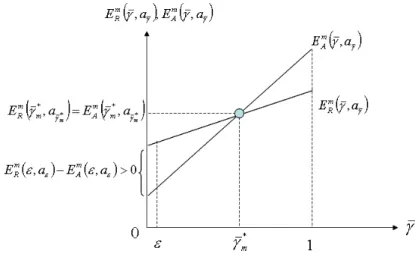
and whenever ¹¤ · 1, ¹¤ is a Bayesian equilibrium threshold; it is
interior when ¹¤ 1. A Bayesian interior equilibrium threshold is
depicted in …gure 1 below.
Figure 1: A Bayesian interior equilibrium threshold
For later reference, by computation, note that the expression for¹¤
is given by ¹ ¤ =+ (¡) ¡1 X = ()¡ X() =0 () (¡1) (1)
What is the impact of strengthening CACs? Strengthening CACs (equivalently, increasing) increases the proportion of private creditors
required to prevent a successful debt rollover. We …nd that the impact of strengthening CACs depends critically on the prevailing equilibrium
in the debt rollover game. For the Bayesian equilibria with extreme coordination failure, as previously discussed, strengthening CACs has no impact. However, when there is an interior Bayesian equilibrium threshold, ¹¤, it is possible to show that ¹¤ is decreasing in . Figure
2 below depicts how the graphs of
(¹ ¹) and (¹ ¹) change
with (again detailed derivations are contained in Appendix A). As
increases, the events where there is a successful debt rollover have a higher probability. By using the expressions for creditor payo¤s, it follows that, as increases, (a) below ,
(¹ ¹) decreases in value
while, above ,
(¹ ¹)increases in value, i.e. the graph of (¹ ¹)
becomes steeper (when increases) and (b) below +,
(¹ ¹)
increases in value while above+,
(¹ ¹)decreases in value i.e. the
graph of
(¹ ¹)becomes ‡atter (whenincreases). Thus, for higher
values of , the point of intersection between
(¹ ¹)and(¹ ¹)
now must be lower in value. It, therefore, follows that strengthening CACs reduces crisis risk. Figure 2 illustrates.
Next, we ask whether the interim crisis risk is ine¢ciently high or ine¢ciently low. Interim e¢ciency corresponds with the situation when there is a complete information about . Interim e¢ciency requires
that the private creditor should only not agree to the debt rollover if her payo¤ when debt rollover is successful (thus project continues to completion at = 2), given by , is less than or equal to the payo¤ she receives from being the …rst mover in the asset grab-race that ensues when debt rollover is unsuccessful (thus project is liquidated at = 1),
Figure 2: Impact of strengthening Collective Action Clauses
·.
With incomplete information about (which is the case we consider
here) and under our assumptions, a creditor’s expected payo¤ from a successful debt rollover is the expected value of conditional on her
pri-vately observed signal: this is simply equal to. In general, Bayesian
equilibria where the actions of creditors do not depend on their privately observed signals cannot be e¢cient. When creditors use threshold strate-gies, using the expression derived for ¹¤
, by computation, for a …xed,
our results show that when = 1,¹¤
, while when = 1,¹¤ .
Correcting for integer e¤ects, there exists a value of , called ^, for which ¹¤^ = . Thus, for a …xed , ^ is the interim optimal CAC threshold.
Next, for a …xed, we study what happen to the interior Bayesian
equilibrium threshold, ¹¤
, when becomes in…nitely large18. We show
18We assume that all the per capita payo¤ variables like,and are held …xed
that for all 0 1
2 (and symmetrically, for all 1
2 1), as ! 1, ¹¤
! . It follows that the larger the number of creditors,
the smaller is the ine¢ciency associated with a Bayesian equilibrium in threshold strategies and in the limit, the ine¢ciency vanishes.
The formal arguments underlying this result relies on a version of the central limit theorem and is quite technical. We, therefore, present these arguments in Appendix B. Here we point out that the e¢ciency is obtained in the limit due to e¢cient information aggregation. For a …xed , given the strategy of other creditors, each creditor’s decision to
accept the debt rollover increases the probability of a successful debt rollover and therefore imposes an externality on all other creditors. As already pointed out, given the number of creditors, whether this exter-nality is negative (respectively, positive) depends on whether the …xed CAC threshold is above (respectively, below) the value of the interim optimal CAC threshold, ^. As ! 1, each creditor becomes small (relative to the group of creditors taken as a whole) thus her marginal impact on the continuation probability of a successful debt rollover be-comes zero and there is an e¢cient information aggregation.
The following proposition summarizes the e¢ciency result obtained here.
Proposition 1 (E¢ciency) (i) Strengthening CACs (increasing , for
a …xed ) reduces crisis risk i.e. ¹¤ is decreasing in and we derive an interim optimal CAC threshold ^. (ii) For all 0 12 (and
symmetrically, for all 1
2 1), as! 1,¹¤ ! i.e. strengthening CACs works only whenis not too large as we …nd that, for a …xed value
of the CAC threshold of 0, 1, the larger the number of creditors (higher ), the smaller is the ine¢ciency associated with a Bayesian
equilibrium in threshold strategies and, in the limit (as ! 1), the ine¢ciency vanishes.
We interpret Proposition 1 as casting doubt on the e¢cacy of strength-ening CACs in resolving sovereign debt crisis. With a …xed number of creditors, when creditors use threshold strategies, CACs do improve in-terim e¢ciency of a debt rollover and it is possible to derive an optimal CAC threshold. However, for any …xed CAC threshold, as the number of creditors becomes larger, the ine¢ciency associated with an equilibrium in threshold strategies becomes smaller and vanishes in the limit. Propo-sition 1 suggests that CACs are most e¤ective in scenarios with a small number of creditors but it is precisely in such scenarios that creditors will have access to other, perhaps more e¤ective explicit coordination mechanisms (like creditor committees).
3 Ex ante debtor moral hazard
There are two main motivations for studying ex ante debtor moral haz-ard. First, we would like to endogenize the probability of adverse shock. Second, we want to rule out the possibility of long-term bullet debt con-tracts maturing at = 2. In principle, the presence of long-term bullet debt contracts maturing at = 2 could be welfare improving in that it would rule out interim ine¢cient creditor coordination. With ex ante debtor moral hazard, a positive crisis risk, conditional on default, is a necessary condition for resolving debtor’sex ante incentives. Therefore, long-term bullet debt contracts will not to be used with ex ante debtor
moral hazard.
We denote theex ante action of the debtor by0, where0 2 f g
and and denote good and bad ex ante e¤ort by the debtor,
re-spectively19. We assume that 0 2 © ª denote the cost of e¤ort,
measured in = 1 payo¤ units. We also assume that it is more costly for the debtor to exert good e¤ort than to choose bad e¤ort so .
Let 0 denote the ex ante probability of adverse shock when the ex ante action 0 2 f g is chosen by the debtor. We assume that the probability of adverse shock is higher if the debtor chooses bad e¤ort so . If there is no adverse shock or if there is a successful debt
rollover at = 1, the debtor obtains a non-contractible payo¤ 020; otherwise, the debtor obtains a payo¤ of zero. We also assume that, con-ditional on default, creditors have to decide whether or not to roll over the debt before observing the ex ante choice of action by the debtor21. We will also assume that theex anteoptimality requires that the debtor chooses 0 =
As a function of the equilibrium threshold¹¤
prevailing in the debt
19In this context, good e¤ort could correspond to a situation where money is
bor-rowed and used to promote R&D in the export sector and bad e¤ort could correspond to transferring borrowed money to local elites who are then free to put it in tax havens overseas. Refer to Ghosal and Miller (2003) for more examples on ex ante debtor moral hazard and for other relevant results.
20Following Eaton and Gersovitz (1981), we interpret this non-contractible payo¤
as the bene…t at = 1 of gain in national output at = 2 when a debt crisis is prevented at = 1. Another example of such non-contractible payo¤ can be described as follows. Suppose the funds borrowed by the sovereign are used to …nance a publicly operated infrastructure project. If the infrastructure project succeeds, the government enjoys the prospect of higher tax revenue as more domestic and foreign …rms invest and employment is generated. No private creditor can attach the future tax revenues generated by the infrastructure project.
21For instance, it takes time for the debtor’s action to be revealed and creditors
have to decide whether or not to agree to the debt rollover before the action of the debtor is revealed.
rollover game, let(¹¤
)denote the debtor’s expected payo¤ conditional
on default, measured in = 1 payo¤ units. The debtor’s payo¤ from choosing a good e¤ort is given by the expression(1¡)+(¹¤
)¡
, while the debtor’s payo¤ from choosing a bad e¤ort is given by
the expression (1¡) +(¹¤
)¡. The incentive compatibility
constraint, which ensures that the sovereign debtor chooses good e¤ort, is determined by the following expression
(1¡)+(¹¤)¡¸(1¡) +(¹¤)¡ (2)
This yields an upper bound on (¹¤
) namely
(¹¤)·+ (
¡)
(¡) (3)
Since we assume that and , h(¡)
(¡)
i
0. As (¹¤)¸
0, if+((¡¡)) 0, there is no solution to the debtor’sex anteincentive
problem. On the other hand, if ¡
¡, a solution is possible.
Suppose ¡¡ so that a solution to the debtor’s ex ante
in-centive problem is possible. Let ¹ denote the interim e¢cient
equi-librium threshold in the debt rollover game. If (¹ ) + (¡) (¡),
interim e¢ciency and ex ante e¢ciency are incompatible. By computa-tion, (¹ ) = (1¡(¹ +))+
£
(¹ +)¡(¹ ¡)¤[Pr
^
], wherePr^ is the probability of
a successful debt rollover at the interim e¢cient CAC threshold,^. Note that (1) = 0 (the debtor’s payo¤ from an unsuccessful debt rollover) and clearly, as long as 0, (¹ ) (1). More generally, by
computation, it is checked that (¹¤
) is decreasing in ¹¤. Therefore,
if (¹ ) + (¡)
(¡) 0, there will be an equilibrium threshold in
the debt rollover game that ensures ex ante e¢ciency but necessarily requires interim ine¢ciency. Clearly, strengthening CACs so that ¹¤
converges to¹ can actually increase the probability of adverse shock.
We summarize the above discussion with the following proposition:
Proposition 2 With ex ante debtor moral hazard, a positive interim
crisis risk, conditional on default, is necessary to solve the debtor’s ex ante incentives. In general, there is a con‡ict between interim and ex ante e¢ciency. Strengthening CACs may actually increase the ex ante probability of adverse shock.
4 Evaluating policy interventions
4.1 IMF intervention as a public signal
In the previous sections, we have shown that the ex post policy inter-vention, such as strengthening CACs, depends critically on which equi-librium prevails in the debt rollover game. Typically, the IMF has an informational advantage over private creditors because the IMF can ver-ify the precise nature of the policy e¤ort undertaken by the debtor. When there is a technical default, conditional on putting in place appro-priate structural adjustment e¤ort, the IMF usually provides loans22 to the debtor so that her debt servicing obligation can be met in the …rst period. Our model suggests that if, in addition, the IMF conditions its
22These loans are used by the debtor to pay o¤ its existing creditors. According
to Fischer (2001) and Miller and Zhang (2000), the IMF is e¤ectively gamed into providing bailouts in order to avoid the disorderly default by the sovereign debtor.
support on the outcome of the debt rollover game, any such intervention will have a bigger marginal impact on the incentives of the debtor to choose higher policy e¤ort.
Conditional on the technical default, any announcement by the IMF serves as a public signal to the creditors. Why should this help? In the debt rollover game, the creditors can use this public signal to coordinate on the appropriate equilibrium. However, it is important to note that IMF intervention might, at the same time, give rise to the problem of creditor moral hazard as, with bailout, each creditor is now e¤ectively insured against the possibility of default.
4.2 A sovereign bankruptcy procedure
In our model, we have assumed that the sovereign debtor obtains a payo¤ in the second period if the project continues to completion and such payo¤ is non-contractible23. An important element in our analysis is the con‡ict between ex ante e¢ciency and interim e¢ciency due to ex ante debtor moral hazard. A limitation of CACs is that it cannot address ex ante issues. This raises the question of whether there is a role for an appropriately designed formal sovereign bankruptcy procedure that addresses both ex ante and ex post issues. The key element of such procedure relies on the ability of the court in making the debtor’s non-contractible payo¤ becomes non-contractibleex ante24. With those elements
23Such payo¤ determines the debtor’s incentive to bargain with the private
credi-tors in the …rst period.
24It is, in practice, di¢cult to establish a formal sovereign bankruptcy procedure
if it requires the court to make the debtor’s non-contractible payo¤s realized at= 2 to become contractible as it is only the sovereign debtor who usually has a private information about the non-contractible payo¤ not the court nor the private creditors.
being embedded to it, such appropriately designed sovereign bankruptcy procedure is useful in solving the problem ofex ante debtor moral hazard and leading to more orderly sovereign debt restructuring. In fact, this view has also been shared by several authors, including Sachs (1995), Buchheit and Gulati (2002) and Krueger (2001, 2002).
In what follows, we outline a formal sovereign bankruptcy procedure similar to the SDRM outlined by Anne Krueger of the IMF (Krueger, 2001). First, such a formal sovereign bankruptcy procedure would re-quire establishing an international sovereign bankruptcy court. Second, such a court will need to ensure (and the sovereign debtor to credibly commit to) some ‘contractibility’ on sovereign debtor’s non-contractible payo¤s (realized at = 2) and that some foreign interest payments and
loans could be diverted in favor of creditors as part of the bargaining process. Third, following an adverse shock, when a technical default oc-curs, the bankruptcy court would order a ‘standstill’, which legitimizes the suspension of payments and protects the debtor from litigation (by ‘vultures’) that might inhibit debtor-creditor negotiations (Miller and Zhang, 2000). The standstill would provide a breathing space for a ‘dis-covery phase’, a period when the bankruptcy court tries to discover the future net worth, , of any restructured debt. Let ^ denote the pay-o¤ measured in period = 1 units which makes each private creditor indi¤erent between investing in the project and the risk-free security. Finally, during the resolution phase, the court would enforce a transfer ^
¡ to each creditor. When^¡ ·
, then using the debtor’s payo¤s,
both capacity to repay at = 1 and the future payo¤ realized at = 2,
sov-ereign debt. On the other hand, when^¡
, either the court would
have to order a debt restructuring or a debt write-down.
To summarize, …rst, note that any payments made in the resolution phase can be made conditional on the policy e¤ort undertaken by the debtor. Second, since this particular formal sovereign bankruptcy proce-dure makes some of the debtor’s non-contractible future payo¤ become contractible ex ante, it is useful in solving the ex ante debtor moral hazard.
5 Conclusion
We develop a model of sovereign debt crisis when lending takes place through the bond markets. We study the interaction between ine¢-ciencies in the debt rollover game and ex ante debtor moral hazard. Conditional on a technical default, there are multiple, interim ine¢cient equilibrium outcomes and the impact of strengthening CACs depends on the prevailing equilibrium. For a subset of equilibria, (i) given a …xed number of creditors, we derive an optimal CAC threshold and (ii) given a …xed CAC threshold, as the number of creditors becomes larger, we show that there is a convergence to e¢cient information aggregation.
Withex ante debtor moral hazard, a positive interim crisis risk, con-ditional on default, is necessary to solve the debtor’s ex ante incentives and in general, there is a con‡ict betweenex ante e¢ciency and interim e¢ciency. Our analysis makes the case for a formal sovereign bankruptcy procedure.
Extending the model to a dynamic setting to study the interaction between sovereign debt crisis and endogenous growth is an important
topic for future research.
Appendix
In this Appendix, we present the missing parts of our discussion in the main text. Appendix A and B are devoted for the detailed proofs of our arguments in the debt rollover game, given in section 2.2. In Appendix A, we derive Bayesian equilibria for the general case when a creditor agrees to the debt rollover with probability , 0 · · 1, if she is indi¤erent between accepting or rejecting the debt rollover. In Appendix B, we study the impact of increasing , for a …xed , on the
interior Bayesian equilibrium threshold. In other words, for a generic
0, 1, what happen to ¹¤ as ! 1? Appendix A
For any private creditor, givenand, if all other private creditors 6= are following a symmetric threshold strategies ¹, and creditor
observes a signal , let¹( ) denote the probability that exactly
other creditors do not agree to the debt rollover given that creditor
ob-serves a private signal . By computation, note that for given threshold
strategies ¹ and¹0, the expression for¹( ¹) is
·µ ¡1 ¶ µ 1 2 ¶¸ ¡1¡+ µ 1 2 ¶X¡1 =0 "µ ¡1 ¶ µ 1 2 ¶¡1# µ ¡1¡ ¡ ¶ (1¡)¡¡1¡ + µ 1 2 ¶ X¡1 =+1 "µ ¡1 ¶ µ 1 2 ¶¡1# µ ¶ (1¡)¡+ ·µ ¡1 ¶ µ 1 2 ¶¸ (1¡)
and therefore for two di¤erent thresholds ¹ and ¹0, the distribution f¹( ¹)g=0¡1 is identical to the distribution f¹0( ¹0)g=0¡1.
cases: when she agrees to the debt rollover and when she does not agree to the debt rollover. Let25 () = maxf0 ¡2g. For any private creditor , given and , if all other private creditors 6= are
fol-lowing a symmetric threshold strategies¹, conditional on observing the
signal = ¹, creditor ’s expected payo¤ from not agreeing to the debt
rollover is given by the expression (¹ ¹) =
¡1 X =¡1 ¹( ¹) + [¹¡] X() =0
¹( ¹), while creditor’s expected payo¤ from agreeing to
the debt rollover is given by the expression(¹ ¹) = ¡1 X = ¹( ¹)+ ¹ X¡1 =0
¹( ¹). Notice that both(¹ ¹)and(¹ ¹)are
lin-ear functions of ¹ and the slope of (¹ ¹)is steeper than the slope
of (¹ ¹) and when ¹ = , (¹ ¹) (¹ ¹). It follows
that there is a ¹¤ such that ¡ ¹ ¤ ¹¤ ¢ ¡¡¹¤ ¹¤ ¢ = 0 and whenever ¹¤ 2[01], ¹¤ is a Bayesian equilibrium threshold. For each
, where 2 [01], ¡¹¤ ¹¤ ¢ ¡¡¹¤ ¹¤ ¢ = 0 implies that ¹ ¤
satis…es the following equation:
¹ ¤= " (¡) ¹¤ ( ¡1¹¤ ) ¡1 X = ¹¤ ( ¹ ¤ ) # + (A1) ¡ 2 4 ¹¤ ( ¡1¹¤ ) X() =0 ¹¤ ( ¹ ¤ ) 3 5 If¹¤1
1, by continuity of ¹¤ in , there exists ¹ 1 such that for
all 2 (¹1], if ¹¤
satis…es expression (A1), then ¹¤ 2 (01). Thus,
interior Bayesian equilibrium threshold exists.
Next, to prove that multiple Bayesian equilibria exist, we need to begin by showing that multiple symmetric self-ful…lling Bayesian equi-librium thresholds exist. This can be done by proving that whenever¹¤
satis…es (A1),¹¤
is decreasing in. Speci…cally, note that for0 , the
probability distribution f¹(0 ¹)g=0¡1 …rst-order stochastically
dom-inates f¹( ¹)g=0¡1. For 0 , note that (a) when ¹ +, 0(¹ ¹) is less than (¹ ¹); when ¹ = + ,
0
(¹ ¹)
is equal to (¹ ¹) and …nally when ¹ + ,
0
(¹ ¹) is
greater than (¹ ¹) and (b) when ¹ ,
0
(¹ ¹) is greater
than (¹ ¹); when ¹ = ,
0
(¹ ¹) is equal to (¹ ¹) and
when ¹ , 0(¹ ¹) is less than (¹ ¹). For 0 , it follows
that ¹¤0
¹¤. Let¹¤= minf¹¤01g. Since¹¤ is decreasing in, the
set of symmetric self-ful…lling Bayesian equilibrium thresholds is given by £¹¤1
¹¤
¤
. Taking into account the existence of Bayesian equilib-ria with extreme coordination failure, it follows that multiple Bayesian equilibria exist and are given by £¹¤1
¹¤
¤
[ f1g.
Finally, for a …xed , we study the impact of strengthening CACs
for the general case when a creditor agrees to the debt rollover with probability , 0 · · 1, if she is indi¤erent between accepting or rejecting the debt rollover, and for a …xed . Speci…cally, we want to prove that, for a …xed , if ¹¤
satis…es (A1), then ¹¤ is decreasing
in . For some , let us consider ¹¤
. For 0 , note that (a)
when ¹ +, 0(¹ ¹) is greater than (¹ ¹); when ¹ =
+, 0(¹ ¹) is equal to (¹ ¹) and …nally when ¹ +,
0(¹ ¹) is less than(¹ ¹)and (b) when ¹ ,
0
(¹ ¹)is
less than (¹ ¹); when ¹ = ,
0
and when ¹ , 0(¹ ¹) is greater than (¹ ¹). For 0
and for a …xed , it follows that ¹¤
0 ¹¤. Therefore, for a …xed
and when the number of private creditors is not too large, strengthening CACs can help reduce the power of holdout creditor (who accelerate payments) and crisis risk.
Appendix B
In Appendix B, we study what happen when the number of private creditors become large (i.e. when ! 1) for a given . Note that, in order to ensure that we compare like-for-like, per capita creditor payo¤s are kept constant throughout the limiting argument. We assume that
= 1. Let ~() = ¡ 1 22 p 2 , and let ~() = 1 p 2 R ¡1¡ 1 22.
Let 12. For large, as ! 1 but !0, by Feller (1984, pp.
184 and 195), a version of the central limit theorem can be applied and therefore, Pr à · ¡ ¡21 p ¡1 2 ! »1¡~()
Moreover, as ! 1 by Feller (1984, pp. 175), 1¡~()» ~(). Now,
by computation, it follows that
¡ ¡21 p ¡1 2 = p ¡1 µ 2¡1¡ 1 ¶ and therefore, lim !1 ¡¡21 p ¡1 2 = lim !1 p ¡1 µ 2¡1¡ 1 ¶ =1
while lim !1 ¡ ¡1 2 p2¡1 = lim!1 ¡ 2¡1¡ 1 ¢ p ¡1 = 0 It follows that for a …xed and large ,
Pr (·) = Pr à ¡ ¡1 2 p ¡1 2 · ¡ ¡1 2 p ¡1 2 ! »1¡~ à ¡ ¡1 2 p ¡1 2 !
Consider, …rst, the case when 12. Then, by computation, for large , p ¡1 ¡ 2¡1¡ 1 ¢
» p(2¡1) and therefore, as ! 1, the expression lim!1p¡1¡2¡1¡ 1
¢
= lim!1p(2¡1) = 1. It
follows that for large , 1¡~ Ã ¡ ¡1 2 p ¡1 2 ! » ~( p (2¡1)) p (2¡1) Moreover, for large , again, by the central limit theorem,
µ ¡1 ¡1 ¶ µ 1 2 ¶ »~ Ã (¡1)¡ ¡1 2 p ¡1 2 ! and by computation,(¡p1)¡¡21 ¡1 2 = p ¡1 (2¡1) » p (2¡1) for largeand as! 1,lim!1p¡1(2¡1) = lim!1p(2¡1) = 1. Therefore, for large ,
~ Ã (¡1)¡ ¡1 2 p ¡1 2 ! »~¡p(2¡1)¢
and the ratio ¡1 X = h¡¡1 ¢ ¡1 2 ¢¡1i ¡¡1 ¡1 ¢ ¡1 2 ¢¡1 » ~ (p(2¡1)) p (2¡1) ~ (p(2¡1)) = 1 p (2¡1) and therefore, lim !1 ¡1 X = h¡¡1 ¢ ¡1 2 ¢¡1i ¡ ¡1 ¡1 ¢ ¡1 2 ¢¡1 = lim!1 1 p (2¡1) = 0
Using the fact that ~(¡) = ~() and~(¡) = 1¡~(), a
sym-metric argument establishes that when 12,
lim !1 ¡1 X = h¡¡1 ¢ ¡1 2 ¢¡1i ¡ ¡1 ¡1 ¢ ¡1 2 ¢¡1 = lim!1¡ 1 p (2¡1) = 0
Again, by a symmetric argument, as ! 1, it also follows that when
12, lim !1 X¡2 =0 h¡¡1 ¢ ¡1 2 ¢¡1i ¡ ¡1 ¡1 ¢ ¡1 2 ¢¡1 = lim!1¡ 1 p (2¡1) = 0 and when 12, lim !1 X¡2 =0 h¡¡1 ¢ ¡1 2 ¢¡1i ¡ ¡1 ¡1 ¢ ¡1 2 ¢¡1 = lim!1 1 p (2¡1) = 0
Note that, when = 1 2, lim!1 ¡¡1 2 p ¡1 2 = 0 and as ~(0) = 1 and ~
(0) = 12, by central limit theorem,
lim !1 X¡2 =0 h¡¡1 ¢ ¡1 2 ¢¡1i ¡ ¡1 ¡1 ¢ ¡1 2 ¢¡1 = 1 2 = lim!1 ¡1 X = h¡¡1 ¢ ¡1 2 ¢¡1i ¡ ¡1 ¡1 ¢ ¡1 2 ¢¡1
Therefore,¹¤ !+12(¡¡)as! 1. It follows that for6= 12,
2(01), as! 1, ¹¤
!.
Acknowledgments
We thank Marcus Miller and seminar participants at Warwick, RES Con-ference 2005 and EEA ConCon-ference 2006 for their helpful comments. The second author would like to thank the ORS, the CSGR and Department of Economics, University of Warwick for their …nancial supports. This research was partially funded by the ESRC project No. R000219236 “Moral Hazard and Financial Institution”.
References
[1] Becker, T., Richards, A., Thaicharoen, Y., 2003. Bond restructuring and moral hazard: are collective action clauses costly? Journal of International Economics 61, 127–161.
[2] Buchheit, L.C., 1999. A lawyer’s perspective on the new interna-tional …nancial architecture. Journal of Internainterna-tional Banking Law 14(7), 225–9.
col-lective will. Georgetown University Law Center Working Paper 34. [4] Bulow, J., Rogo¤, K., 1989. A constant recontracting model of
sov-ereign debt. Journal of Political Economy 97(1), 155–178.
[5] Carlsson, H., van Damme, E., 1993. Global Games and Equilibrium Selection. Econometrica 61, 989–1018.
[6] Cline, W., 1984. International Debt: Systemic Risk and Policy Re-sponses. MIT Press, Cambridge.
[7] Eaton, J., Gersovitz, M., 1981. Debt with Potential Repudiation: Theoretical and Empirical Analysis. The Review of Economic Stud-ies 48(2), 289–309.
[8] Eichengreen, B., Portes, R., 1995. Crisis? What Crisis? Orderly Workouts for Sovereign Debtors. CEPR, London.
[9] Eichengreen, B., Mody, A., 2000. Would Collective Action Clauses Raise Borrowing Costs? NBER Working Paper 7458.
[10] Eichengreen, B., Kletzer, K.M., Mody, A., 2003. Crisis Resolution: Next Steps. Paper presented at the Brookings Trade Forum. [11] Eichengreen, B., Mody, A., 2004. Do Collective Action Clauses
Raise Borrowing Costs? The Economic Journal 114(495), 247–264. [12] Feller, W., 1984. An introduction to probability theory and its
ap-plications, Vol.1. Wiley Eastern Ltd, New Delhi.
[13] Fischer, S., 2001. The International Financial System: Crises and Reform. Paper presented at the Lionel Robbins Lecture, London School of Economics.
[14] Gai, P., Hayes, S., Shin, H.S., 2004. Crisis costs and debtor disci-pline: the e¢cacy of public policy in sovereign debt crises. Journal of International Economics 62(2), 245–262.
[15] Ghosal, S., Miller, M., 2003. Co-ordination failure, moral hazard and sovereign bankruptcy procedures. The Economic Journal 113, 276–304.
[16] International Monetary Fund, 2002. Collective Action Clauses in Sovereign Bond Contracts - Encouraging Greater Use. Paper pre-pared by the Policy Development and Review, International Capi-tal Markets and Legal Department, International Monetary Fund. https://www.imf.org/external/np/psi/2002/eng/060602a.pdf [17] Kletzer, K.M., Wright, B.D., 2000. Sovereign debt as international
barter. American Economic Review 90(3), 621–639.
[18] Kletzer, K.M., 2003. Sovereign Bond Restructuring: Collective Ac-tion Clauses and O¢cial Crisis IntervenAc-tion. IMF Working Paper 03/134.
[19] Kletzer, K.M., 2004a. Resolving Sovereign Debt Crises with Collec-tive Action Clauses. Federal Reserve Bank of San Francisco Eco-nomic Letter Number 2004-06.
[20] Kletzer, K.M., 2004b. Sovereign bond restructuring: collective ac-tion clauses and o¢cial crisis intervenac-tion, in: Haldane, A. (Ed.), Fixing Financial Crises in the 21Century. Routledge, pp. 230–253.
[21] Krueger, A., 2001. International …nancial architecture for 2002: a new approach to sovereign debt restruc-turing. International Monetary Fund, Washington D.C. http://www.imf.org/external/np/speeches/2001/112601.htm [22] Krueger, A., 2002. A New Approach to Sovereign Debt
Re-structuring. International Monetary Fund, Washington D.C. http://www.imf.org/external/pubs/ft/exrp/sdrm/eng/index.htm
[23] Miller, M., Zhang, L., 2000. Sovereign liquidity crises: the strategic case for a payment standstill. The Economic Journal 110(460), 335– 362.
[24] Morris, S., Shin, H.S., 1998. Unique equilibrium in a model of self-ful…lling currency attacks. American Economic Review 88(3), 587– 597.
[25] Pitchford, R. and Wright, M.L.J., 2007. Restructuring the Sov-ereign Debt Restructuring Mechanism. Federal Reserve Bank of Minneapolis, Research Department Sta¤ Report.
[26] Richards, A., Gugiatti, M., 2003. Do Collective Action Clauses In-‡uence Bond Yields? New Evidence from Emerging Markets. Inter-national Finance 6(3), 415–447.
[27] Rodrik, D., 1998. Who needs capital account convertibility?, in: Ke-nen et al. (Eds.), Should the IMF pursue capital account convert-ibility?, Essays in International Finance 201. Princeton University. [28] Roubini, N., Setser, B., 2003. Improving the Sovereign Debt Re-structuring Process: Problems in ReRe-structuring, Proposed Solutions and a Roadmap for Reform. Institute for International Economics, Washington D.C.
[29] Roubini, N., Setser, B., 2004. The reform of the sovereign debt restructuring process: problems, proposed solutions, and the Ar-gentine episode. Journal of Restructuring Finance 1(1), 1–12. [30] Sachs, J., 1995. Do we need an international lender of last resort.
http://www.cid.harvard.edu/archive/hiid/papers/intllr.pdf
[31] Tanaka, M., 2006. Bank loans versus bond …nance: Implications for sovereign debtors. The Economic Journal 116(510), C149–C171.
[32] Taylor, J.B., 2002. Sovereign debt restructuring: a US perspective. Department of Treasury PO-2056. Paper presented at the Confer-ence on Sovereign debt workouts: hopes and hazards? Institute for International Economics, Washington D.C.
[33] Tirole, J., 2003. Ine¢cient Foreign Borrowing: A Dual- and Common-Agency Perspective. American Economic Review 93(5), 1678–1702.
[34] Weinschelbaum, F., Wynne, J., 2005. Renegotiation, collective ac-tion clauses and sovereign debt markets. Journal of Internaac-tional Economics 67, 47–72.