Understanding Google: Search Engines and the
Changing Nature of Access, Thought and
Knowledge within a Global Context
Submitted by Richard Graham to the University of Exeter as a thesis for the degree of
Doctor of Philosophy in English In December 2017
This thesis is available for Library use on the understanding that it is copyright material and that no quotation from the thesis may be published without proper
acknowledgement.
I certify that all material in this thesis which is not my own work has been identified and that no material has previously been submitted and approved for the award of a
degree by this or any other University.
Abstract
This thesis explores the impact of Google’s search engine within contemporary digital culture. Search engines have been studied in various disciplines, for example information retrieval, computer science, law, and new media, yet much of this work remains fixed within disciplinary boundaries. The approach of this thesis is to draw on work from a number of areas in order to link a technical understanding of how search engines function with a wider cultural and philosophical context. In particular, this thesis draws on critical theory in order to attend to the convergence of language, programming, and culture on a global scale.
The chapter outline is as follows. Chapter one compares search engine queries to traditional questions. The chapter draws from information retrieval research to provide a technical framework that is brought into contact with
philosophy and critical theory, including Plato and Hans-Georg Gadamer. Chapter two investigates search engines as memory aids, deploying a history of memory and exploring practices within oral cultures and mnemonic techniques such as the Ars Memoria. This places search engines within a longer historical context, while drawing on contemporary insights from the philosophy and science of cognition. Chapter three addresses Google’s Autocomplete functionality and chapter four explores the contextual nature of results in order to highlight how different
characteristics of users are used to personalise access to the web. These chapters address Google’s role within a global context and the implications for identity and community online. Finally, chapter five explores how Google’s method of generating revenue, through advertising, has a social impact on the web as a whole, particularly when considered through the lens of contemporary Post-Fordist accounts of
capitalism. Throughout, this thesis develops a framework for attending to algorithmic cultures and outlines the specific influence that Google has had on the web and continues to have at a global scale.
Table of Contents
Acknowledgements ... 6 Introduction ... 7 1.0 Google’s Dominance ... 9 2.0 Literature Review... 13 2.1 Computer Science ... 132.2 Search Engine Optimisation (SEO) ... 14
2.3 Business ... 15
2.4 Legal and Political ... 15
2.5 Edited Collections ... 16
2.6 Interdisciplinary Studies ... 17
3.0 Chapter Outline ... 18
4.0 Challenges... 21
5.0 Notes on Notation and Examples Used ... 23
Chapter One: From Questions to Queries: The Changing Role of Questioning Through Search Engines ... 24
Introduction ... 24
1.0 The Three Steps of Search Engines... 27
1.1 Step One: Crawling and Scraping ... 27
1.2 Step Two: Indexing and Ranking ... 31
1.3 Step Three: Query and Results... 39
2.0 Google: Words Beyond Grammar ... 48
3.0 A Brief History of Search Engine Interface ... 53
4.0 Transaction Log Analysis ... 57
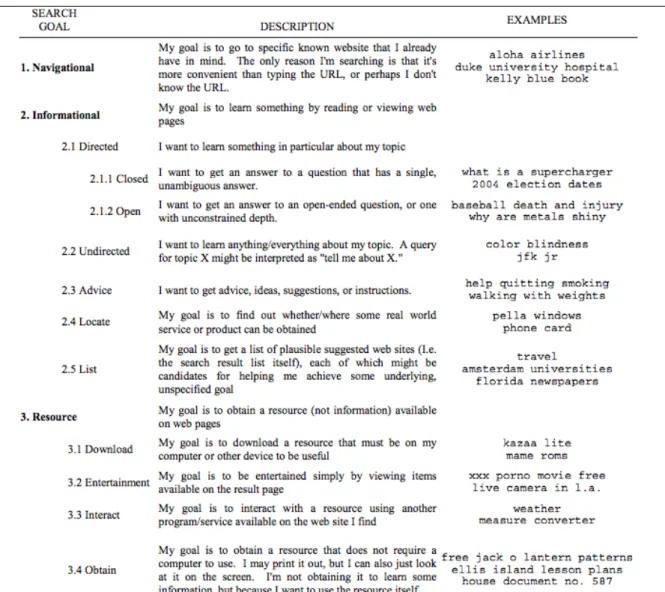
4.1 Goals, Functions and Intentions... 58
4.2 Length of Queries ... 67
4.3 Search “Success” and How Deep Searchers Dig ... 71
4.4 Correlations ... 75
4.5 Content of Search Queries ... 76
5.0 Asking Questions About the World ... 86
5.1 Meno’s Paradox ... 86
5.1.1 Gadamer’s Hermeneutics ... 88
5.2 Algorithms in the Context of Questions and Queries... 91
Chapter Two: A History of Technosocial Memory Practices ... 96
Introduction ... 96
1.0 Google at Our Fingertips ... 98
1.1 Can Google Really Provide Transactive Memory?... 103
2.0 The Phenomenology of a Search ... 107
3.0 Is the Shift from Oral Culture to Literacy a Useful Historical Precedent? ... 120
4.0 Ancient Modes of Memory ... 129
4.1 Literate Plato: “Phaedrus” ... 132
4.2 Aristotle’s Sensory Approach ... 134
5.0 The Ars Memoria ... 139
5.1 The Ars Memoria: Growth and Demise ... 142
5.2 The End of the Ars Memoria and the Beginning of Modern Science ... 150
Conclusion ... 159
Chapter Three: Autocomplete ... 162
Introduction ... 162
1.0 The Public Fascination with Autocomplete Suggestions ... 167
1.1 Autocomplete’s Lack of Academic Attention... 173
2.0 The Origins of Autocomplete ... 178
3.0 So How Does Autocomplete Operate? ... 181
3.1 Probability and Machine Learning ... 187
3.2 RankBrain ... 189
4.0 The Case of Tuuli Lappalainen ... 202
5.0 Speed ... 219
5.1 Speed and Judgment ... 220
6.0 Relevance for Autocomplete ... 231
Conclusion ... 236
Chapter Four: Search Engine Results and the Plurality of Googles ... 238
Introduction ... 238
1.0 Methodological Challenges ... 245
2.0 What Should Search Engine Results Be? ... 250
2.1 Group A: Search Is Democratic, Relevance Can Be Measured Objectively, and Answers Can Exist Independently of Bias ... 251
2.1.1 Relevance in Information Retrieval ...255
2.2 Group B: Search Is Undemocratic, Relevance Is a Measure of Personalisation, and All Answers Are Inherently Biased ... 263
4.0 Altering Variables to Change Search Results: An Experiment ... 276
4.1 Comparisons of Google’s Geographically Regional Domains ... 291
4.2 Comparisons of Language Differences ... 296
4.3 Mode of Discourse... 298
4.3.1 Word Choice and Phrasing ...302
4.3.2 Word Choice – Gay vs. Homosexual ...302
4.3.3 Word Choice - Phrasing as Positive or Negative ...309
5.0 Unimaginable Communities ... 314
6.0 Repeating the Experiment 24 Months Later ... 318
6.1 Comparisons of Language Differences 24 Months Later ... 319
6.1.1 Search Using the Official Language in Each Domain 24 Months Later ...326
6.2 Word Choice 24 Months Later ... 329
6.3 Phrasing 24 Months Later ... 332
Conclusion ... 336
Chapter Five: Google and Advertising: Digital Capitalism in the Context of Post-Fordism, the Reification of Language, and the Rise of Fake News ... 341
Introduction ... 341
1.0 The Economics of Google ... 343
2.0 The Context of Post-Fordism ... 348
3.0 AdWords: Organic vs. Sponsored Results ... 351
3.1 AdWords: The First Global, Real-time, and Multilingual Linguistic Market ... 353
3.1.1 Google’s Institutionalisation, Data-Collection, and Advertising ...360
3.2 AdWords in the Context of “The Magic System” ... 363
3.3 AdWords and the General Intellect ... 367
3.4 The Future of Languages in an Incentivised Online Environment ... 374
3.4.1 Google’s International Expansion ...378
4.0 AdSense and Post-Fordism ... 381
4.1 AdSense and Fake News ... 384
4.2 The Reciprocal Relationship Between AdSense and Facebook ... 392
Conclusion ... 400
Conclusion ... 402
1.0 Research Questions Addressed ... 403
2.0 Google’s Dominance and the Role of Search Engines ... 405
2.1 The Future of the Web ... 407
2.2 Ubiquity of Data ... 409
Acknowledgements
The research of this thesis was supported through funding by the Arts and Humanities Research Council’s Digital Humanities Doctoral Award (Reference 1099). I am grateful for the financial support that enabled my doctoral study. I am sincerely indebted to my supervision team, Regenia Gagnier and Laura Salisbury, for their expertise and encouragement throughout the thesis process. My deepest thanks go to the University of Exeter’s English faculty, not only for the many supportive conversations during the thesis but also for the inspirational teaching during my undergraduate and master’s degrees. I particularly owe my decision to follow academia to the rousing lectures and seminars of Matt Hayler and Paul Williams. I also wish to thank my students, particularly the first-year critical theory students of Approaches to Criticism. Their enthusiasm and often vocal bemusement is a continual reminder of the joys of academic study.
I would like to thank all of those whom I sailed with on Semester at Sea for the many enlightening conversations. I am indebted to Victor Luftig for the opportunity and am grateful for his wisdom and sincerity. My thanks also go to Alex Nalbach and Mark Brill for their infectious enthusiasm for teaching and research.
I have been exceptionally lucky for the friendships that have helped me through this period and in particular the patience, kindness and thoughtfulness of James Tyndall, Jack Griffiths and Ryan Sweet.
Finally, this thesis is dedicated to the following people:
Anne and Keith Graham, without your longstanding support and resilience I would
not be where I am now. You have enabled this journey in countless ways.
Matt Hayler, I could not wish for a better mentor and friend. The origins of this
research and interest in all things digital stem from our many conversations.
Regenia Gagnier, for as long as I write,your approval will always be my watermark
of quality. Your directness and encouragement have been invaluable and I will forever treasure the many pieces of advice you have given me over the years.
Zoe Bulaitis, you have been a significant part of every step of this journey. None of
Introduction
This thesis explores the impact of search engines within contemporary digital culture and, in particular, focuses on the social, cultural, and philosophical influence of Google. Search engines are deeply enmeshed with other recent developments in digital culture; therefore, in addressing their impact these intersections must be recognised, while highlighting the technological and social specificity of search engines. Also important is acknowledging the way that certain institutions, in
particular Google, have shaped the web and wider culture around a particular set of economic incentives that have far-reaching consequences for contemporary digital culture. This thesis argues that to understand search engines requires a recognition of its contemporary context, while also acknowledging that Google’s quest to
“organize the world's information and make it universally accessible and useful” is part of a much older and broader discourse. Balancing these two viewpoints is important; Google is shaping public discourse on a global scale with
unprecedentedly extensive consequences. However, many of the issues addressed by this thesis would remain centrally important even if Google declared bankruptcy or if search engines were abandoned for a different technology. Search engines are a specific technological response to a particular cultural environment; however, their social function and technical operation are embedded within a historical relationship to enquiry and inscription that stretches back to antiquity.
This thesis addresses the following broad research questions, while at each stage specifically addressing the role and influence of search engines: how do individuals interrogate and navigate the world around them? How do technologies and social institutions facilitate how we think and remember? How culturally situated
is knowledge; are there epistemological truths that transcend social environments? How does technological expansion fit within wider questions of globalisation? How do technological discourses shape the global flows of information and capital? These five questions map directly onto the five chapters of this thesis.
Much of the existing study of search engines has been focused on small-scale evaluation, which either addresses Google’s day-by-day algorithmic changes or poses relatively isolated disciplinary questions. Therefore, not only is the number of academics, technicians, and journalists attending to search engines relatively small, given the centrality of search engines to digital culture, but much of the knowledge that is produced becomes outdated with algorithmic changes or the shifting
strategies of companies. This thesis ties these focused concerns to wider issues, with a view to encourage and facilitate further enquiry.
1.0 Google’s Dominance
While this thesis does address search engines other than Google, directly in chapter one and indirectly throughout, a representative portrayal of the history of the search engine market must place Google at the centre of that picture, for a number of reasons. Google established the main standards central to today’s conception of what search engines represent and how they function. This has shaped the overall direction of search engines significantly; there have been many approaches to providing access to webpages, but Google’s model has set the standard, which now all other engines follow. Globally, across all platforms, Google have a search engine market share of 92.01% as of July 2017 (see “Search engine market share
Worldwide, July 2017”). To use an ecological metaphor, the narrative is a story of many web search engines, around 70 or more, all growing up towards the light and eventually being plunged into darkness by Google’s overwhelming canopy. The nature of Google’s monopoly is not an ancillary part of this history; this is because the greater number of individuals who use a particular search engine, the more informational and financial resources it has to shape its results. In addition, the hegemony of a particular company allows them to fix the cultural expectations for search engine results, which reinforces their position. Therefore, Google’s success has provided them significant resources which they have invested in ways that consolidate their dominance. For example, Google’s entry into the mobile industry, Android, as well as deals with other companies, enabled Google’s search engine to become the default on the vast majority of mobile devices. This means that as the main way to access the web shifts from desktop to mobile, Google’s dominance grows even further. For example, Google’s desktop market share in the United
States is 77.45%, whereas its mobile market share in the US is 96.2% (see “Mobile Search Engine Market Share in the United States of America, July 2017”). In 2015, Google announced that “more Google searches take place on mobile devices than on computers in 10 countries including the US and Japan” (Dischler) and in 2016, Search Engine Land’s Greg Sterling estimated that in the US overall mobile search, which includes both smartphones and tablets, had risen to “58 percent of overall search query volume” (“Report: Nearly 60 Percent”). During the last twenty years, Google’s voice has drowned out the sound of its competitors. If the market remains on its current trajectory, the search engine narrative of the next twenty years will be in the form of a soliloquy.
Simply establishing an infrastructure and building up an index of the web, a prerequisite for any kind of search engine, is hugely costly. The only index that covers a large enough portion of the web to be comparable to Google’s is
maintained by Microsoft. Unsuccessful public, as well as private, attempts have been made; in 2005, a joint German-French project (named Quaero) was established in order to build a European search engine. The venture failed before even managing to develop an alternative engine (see Winkler and European Commission), let alone maintain one that would provide enough of an incentive for users to switch from Google. The research and development costs, provided by the European
Commission, were €199 million for the French and €120 million for the German development teams. Without an independent index of the web, any attempts to provide alternative search engine rankings require building and maintaining an index from scratch. With every passing day, the associated costs of building up an index of the web rise as the web grows larger and the opportunity to challenge the status quo shrinks as Google’s profits increase. That in the search engine market, Microsoft are
the underdog, is a telling sign. Although establishing an online landscape of
transparency and accountability is overwhelmingly in the global public interest, after Quaero, another attempt at producing a publicly funded search engine is unlikely.
In almost every country, Google have a monopolistic share of the search engine market. There are some exceptions, such as Baidu in China, but these examples usually represent their own monopolies; the only exception is the fairly equal market share, between Yandex and Google, in Russia (although, for mobile share Google have pulled ahead to 65.51% (see “Mobile Search Engine Market Share in the Russian Federation, July 2017”)). However, in many countries, Google's share of the market sits between 90% and 100%. Because alternatives are the exception, rather than the rule, this thesis does not compare the results of different search engines. This could be a topic for further study, although if trends continue as they are, the real-world relevance diminishes daily. Another important point to note is that there are fewer alternatives to Google than might be assumed, as Dirk
Lewandowski argues,
many providers of what may appear to be a search engine are simply services that access the data of another search engine, representing nothing more than an alternative user interface to one of the more well-known engines, and in many cases, that turns out to be Google. (“Why We Need an Independent Index of the Web” 51)
For example, Yahoo! is powered by Microsoft’s Bing search engine and various meta-search engines DuckDuckGo and DogPile rely heavily on Google’s results. Even Bing does not necessarily represent an alternative to Google’s results; in 2011,
conclusive reports both conducted by Google and outside institutions found evidence that Bing was directly copying Google’s results wholesale, claiming them as their own, as will be discussed in more depth in chapter four. Whether or not the search engine market naturally tends toward a monopoly, as is discussed by Siva
Vaidhyanathan in The Googlization of Everything (And Why We Should Worry), is not discussed in this thesis, although the nature of that debate has wide ramifications for many areas of digital culture. There are specific technical innovations that led to Google’s early rise to power and these are discussed in chapter one, as well as later modifications, such as Google Autocomplete, discussed in chapter three. The social and economic impact of Google as a company, as well as its associations with other institutions, such as Facebook, are detailed in the context of digital capitalism in chapter five.
2.0 Literature Review
Search engines have been studied in various disciplines, for example, information retrieval, computer science, law, and new media, yet much of this work remains fixed within disciplinary boundaries. The approach of this thesis is to draw on work from a number of areas in order to link a technical understanding of how search engines function with a wider cultural and philosophical context. In particular, this thesis draws on critical theory in order to attend to the convergence of language, programming, and culture on a global scale.
The existing literature can be divided into a number of different areas, which bridge academic and non-academic study: academic computer science, Search Engine Optimisation (SEO) reports, business texts, legal and political approaches and broader interdisciplinary approaches. The current state of the field is outlined below.
2.1 Computer Science
The underlying technical processes of how search engines function are outlined in a number of texts. The original 1998 outline for Google, written by the founders Sergey Brin and Lawrence Page, “The Anatomy of a Large-Scale Hypertextual Web Search Engine” as well as the later 1999 paper co-authored with their Stanford professors, Rajeev Motwani and Terry Winograd (Page et al.), still provides a representative account of Google’s basic approach to search engine design. Further technical developments are outlined in Finding Out About: A Cognitive Perspective on Search Engine Technology and the WWW (Belew), Understanding Search Engines:
Mathematical Modeling and Text Retrieval (Berry and Browne), and Google's PageRank and Beyond: The Science of Search Engine Rankings (Langville and Meyer). These texts are highly technical and written for a computer science
audience; they provide a useful background but, as this thesis is focused on social and philosophical implications, I have chosen to limit the mathematical and
programming details.
2.2 Search Engine Optimisation (SEO)
SEO is a large and growing industry and field of study; practitioners are employed by businesses or individuals to improve webpage rankings and operate in a grey-area in regard to Google. Due to Google’s secrecy about their algorithms, at its worst SEO is digital con-artistry but at its best the industry provides a rigorous interrogation of the day-to-day changes to Google's products as well as overall trends regarding search engines. Danny Sullivan, who is cited throughout this thesis, first established the industry in 1996 with his blog A Webmaster's Guide To Search Engines and went on to found the websites Search Engine Watch and Search Engine Land. Although the field focuses on the particular changes and practical advice, their overall reports provide useful technical insight into the ways that search engines have changed from the late 1990s until the present.
2.3 Business
There are a large number of books that address Google from a purely business perspective, such as What Would Google Do? (Jarvis), I'm Feeling Lucky: The Confessions of Google Employee Number 59 (Edwards), and The Google Guys: Inside the Brilliant Minds of Google Founders Larry Page and Sergey Brin (Brandt), however, in the context of this thesis most of these texts can be ignored. Three books that balance the evolution of Google’s business practices with insightful
commentary on the changing context of search are John Battelle’s The Search: How Google and Its Rivals Rewrote the Rules of Business and Transformed Our Culture, which, published in 2005, can be considered the first full-length study of search engines outside of computer science, Ken Auletta’s Googled: The End of the World As We Know It (2009), and Steven Levy’s In The Plex: How Google Thinks, Works, and Shapes Our Lives (2011). These are cited throughout as they contain interviews with Google engineers and provide a context for historical changes within the search engine industry.
2.4 Legal and Political
Siva Vaidhyanathan’s The Googlization of Everything: (And Why We Should Worry), published in 2012, was the first academic book-length study written in English to address the legal repercussions and social implications of Google’s global dominance. The following year the Italian writers’ collective Ippolita published a revised English version of their 2007 text The Dark Side of Google, which represents a more speculative, political, and overtly critical stance than Vaidhyanathan.
Google’s CEO Eric Schmidt and Director of Ideas Jared Cohen’s The New Digital Age: Reshaping the Future of People, Nations and Business was also published in 2013 and is a sourcebook for the idealism and techno-deterministic attitudes
prevalent within the company. Julian Assange, one of the individuals interviewed for Schmidt and Cohen’s book, presents his version of events in When Google Met WikiLeaks. Google’s relationship with wider modes of capitalism is the focus of this thesis’ final chapter; however, the political implications and potential alliances with the United States’ government, including the National Security Agency’s Prism program, although important, are not directly addressed in this thesis.
2.5 Edited Collections
A small number of edited collections and journal special issues focused on search engines have been published in the last decade. The key texts are as follows, The Social, Political, Economic, and Cultural Dimensions of Search Engines (Hargittai ed.), Die Macht der Suchmaschinen / The Power of Search Engines (Machill and Beiler eds.), Deep Search: The Politics of Search beyond Google (Becker and Stalder eds.), Web Search: Multidisciplinary Perspectives (Spink and Zimmer eds.), Web Search Engine Research (Lewandowski ed.), and Society of the Query Reader: Reflections on Web Search (König and Rasch eds.). These collect together many of the useful articles on search engines, referred to throughout this thesis. A recurring shortcoming, however, is that many of the articles provide isolated approaches or use search engines to provide evidence for a different issue, rather than focusing on them directly.
2.6 Interdisciplinary Studies
There are two book-length interdisciplinary studies of search engines that provide models that this thesis follows: Alexander Halavais’ Search Engines Society (2008), provides a technologically focused study that places detailed analysis within a wider cultural and social background. Ken Hillis, Michael Petit, and Kylie Jarrett’s Google and the Culture of Search (2012) is wide-ranging in its theoretical and philosophical sources and provides the context for chapter two. Both texts draw from a range of critical theory, philosophy, new media theory and other areas; while both have arguments or analyses that I argue against, their attempts to pull back focus and view search engines in a broader context is something that this thesis aims to emulate throughout.
3.0 Chapter Outline
The following chapters are structured in a broadly chronological way around two scales: the historical and the step-by-step actions of using a search engine. Chapter one addresses the formulation of search engine queries while outlining the early years of search engine development, from 1995 onwards. Chapter two focuses on the use of search engines as memory aids and establishes a much longer pre-digital history that stretches back to antiquity. Chapter three attends to the Autocomplete function that directs users as they type their query, in doing so reflecting on the changes established by Google from 2004 onwards. Chapter four considers the content of Google’s search results and investigates the various criteria used to provide results by analysing the results for a set of queries searched in 2015.
Chapter five addresses the global influence of Google from an economic standpoint and highlights a range of its effects, including the rise of fake news during the 2016 US Presidential election. Further detail regarding the methodological approaches and content of the following chapters is provided below.
Chapter one compares search engine queries to traditional questions. The chapter draws from information retrieval and computer science research to provide a technical framework that is brought into contact with philosophy and critical theory, including the work of Plato and Hans-Georg Gadamer. The chapter also surveys research on translation log analysis, the findings of which have not been addressed outside of information retrieval, to provide an insight into the search patterns of users between 1997 and 2006.
Chapter two investigates search engines as memory aids, deploying a history of memory and exploring practices within oral cultures and mnemonic techniques
such as the ars memoria. This places search engines within a longer historical context while drawing on contemporary insights from the philosophy and science of cognition. In particular, this chapter surveys psychology studies regarding the
interdependence of memory on external aids, termed transactive memory, as a way of tying historical examples to current experimental findings that address the
possible consequences of ubiquitous access to search engines.
Chapter three focuses on Google’s Autocomplete functionality, which I argue represents a wider cultural shift for all search engines and other digital interfaces from 2004 onwards. Autocomplete is the most discussed search engine feature in popular media and the press, therefore, this chapter begins by addressing this widespread attention. However, I argue that, despite such interest, Autocomplete is widely misunderstood and by outlining the tool in detail this chapter shows that it produces some of the most complex issues within the study of search engines. In addition, Autocomplete has received almost no academic attention, therefore, this chapter opens up further questions for future research.
Chapter four addresses Google’s search engine results, outlining them from a technical perspective and exploring the social implications of tailoring results for different contexts. This chapter also addresses the notion of relevance, a term used frequently by Google and search engine technologists; although this term is
mentioned throughout the academic literature on search engines, no author has addressed its usage in detail. I explore two different readings of the term, which I argue are each employed with different epistemological foundations. The final part of this chapter presents an original study, carried out in 2015, that documents how different contextual signals, such as location, language, and phrasing of queries, change the kind of search results provided by Google. The same study was then
carried out in 2017, which provides an opportunity to analyse the changing nature of Google’s results. In doing so, this chapter addresses the methodological challenges of studying algorithmically generated results that affect a wide range of disciplinary approaches. This chapter also raises questions regarding the globalising impact of digital institutions, such as Google.
Finally, chapter five explores how Google’s method of generating revenue, through advertising, has a social impact on the web as a whole, particularly when considered through the lens of contemporary Post-Fordist accounts of capitalism. This chapter considers Google’s effects on diminishing linguistic diversity online as well as the way in which the incentives of digital advertising incentivised the rise of fake news during the 2016 US presidential election.
Throughout, this thesis develops a framework for attending to algorithmic cultures and outlines the specific influence that Google’s search engine has had on the web and continues to have on a global scale.
4.0 Challenges
There are a number of challenges regarding the study of search engines. Many of the objects of study, such as algorithms and datasets, are proprietary information, which companies do not release for various reasons, including fear of competitors adopting their methods or users gaming their ranking system. As discussed above, there is no independent index of the web; this means that researchers do not know the size of the web or what webpages are not returned by search engines or
relegated to the unknown through low rankings. Google, Bing and other search engines admit to a certain degree of censorship, in alignment with local and international law, but without an independent index there is no way of finding out whether their censorship goes further than they claim. Google makes around “500-600” (Hargittai, “The Social, Political…” 772) changes to their algorithms a year and do not offer an historical record of search results; in addition, search results differ between individuals and across various contexts depending on a large number of factors, many of which are also kept secret. As Eszter Hargittai argues, this “poses significant challenges for the replication of search results, which is a basic tenet of scientific investigation” (772). Google’s expanding use of machine learning also introduces situations in which various emergent technosocial arrangements are unintelligible even to the engineers responsible. These, and other issues, are addressed throughout this thesis and developed more fully in chapter four,
specifically in regard to analysing the results of search engines. These challenges can be frustrating, both for author and reader, but highlighting, rather than avoiding, them is central for an honest reflection of contemporary digital culture. This thesis
aims to draw together tactics used by other scholars, while also introducing new ways of engaging with algorithmic cultures.
5.0 Notes on Notation and Examples Used
Throughout, I have followed the standard practice, within search engine studies, of using [square brackets] to signify when a word or a phrase is being referred to as a search engine query. Note that [sic] applies to them throughout, as when using my own examples and those from other researchers, these reflect direct queries and therefore often lack capitalisation, contain slang, and are often grammatically incorrect.
There are times when screenshots of Google searches are used as evidence or examples. All of these searches were performed using a Virtual Private Network (VPN) in order to anonymise search behaviour, prevent results from being
personalised, and to control other kinds of information sent to Google regarding the search. At times, in particular in chapter four, the VPN is used to adopt an Internet Protocol (IP) address from a server in a different geographical location, in order to compare the searches from one country to another.
Chapter One:
From Questions to Queries: The Changing Role of
Questioning Through Search Engines
Introduction
This chapter’s focus is twofold: first, a technical description of how search engines function is outlined; second, this chapter places web search queries within a broader philosophical context regarding the nature of questions. The initial section explores the computational techniques that underpin how search engines function and demonstrates how even the most basic processes have deeply embedded social and cultural attitudes. Doing so establishes a major theme of this thesis that technology is never neutral or apolitical.
The technical aspects of how any web search engine functions can be split into three parts: crawling and scraping, indexing and ranking, and queries and results. In the course of outlining these three general processes Google’s particular innovations are highlighted, as their impact shaped industry norms. Google’s
methods set their search engine apart from their competitors and led to their large-scale influence, in terms of market share and technical changes implemented by other search engines in response. In doing so, this analysis demonstrates why Google is of primary focus throughout this thesis. Although this chapter provides insight into the early technical developments of search engines, it does not attempt
to provide a detailed history of the rise and fall of particular technology companies. Elizabeth Van Couvering’s article “The History of the Internet Search Engine: Navigational Media and the Traffic Commodity” provides the most thorough chronology of the search engine industry between 1994 and 2006. An alternative history is provided by John Battelle in The Search. In the chapter “Search Before Google” Battelle includes a slightly wider range of examples, such as the Archie tool implemented in 1990, although its designation as a web search engine is, like most firsts, widely debated.
The second key focus of this chapter is to explore how search engine queries are related to traditional modes of asking questions. The interface of search engines requires users to provide language in order to gain access to information, as is the case in other modes of enquiry; however, the technology behind how search engines function means that this process treats language in a radically different way
compared to the conventional discourse of asking questions. Although the technologies underlying how a search engine query is treated have become increasingly complex, the fundamental difference between questions and queries remains: queries are an automated search for the words and phrases submitted. Even if users frame their queries as questions, the way in which queries are
interpreted means that linguistic inputs establish the kinds of results provided, in that they mirror the user’s language. In order to ground such claims, this chapter draws on a range of studies from the discipline of information retrieval (IR) that analyse actual search queries of users, between 1997 and 2006. An overview of this
literature provides an empirical body of evidence that is used throughout the thesis. After establishing a technical outline of search engine queries, these insights are placed into a broader philosophical context, including Plato’s discussions
concerning questions and Hans-Georg Gadamer’s hermeneutical model of enquiry. The interdisciplinary nature of bringing together work from the social sciences, philosophy and critical theory is this chapter’s original contribution, as the statistical conclusions regarding search engines have not been widely cited or analysed outside of their original discipline. This chapter also establishes the foundation for chapter two, which addresses the longer history of various technosocial memory practices in the context of current debates regarding the effect of search engines on memory.
1.0 The Three Steps of Search Engines
1.1 Step One: Crawling and Scraping
Figure 1. A diagram outlining the first two steps: Crawling and scraping, and indexing and ranking. Taken from Curt Franklin “How Search Engines Work” How Stuff
Works.
At the most basic level, search engines function like an index in the back matter of a book, however, unlike an index’s usual subject specificity, search engines record every word they find on the web. When an individual uses a search engine they are not searching the web directly, instead, they are searching a particular index of the web. Each search engine builds its own index through an automated software application known variously as a “crawler, spider, web robot, or bot” (Halavais 14).
These spiders crawl the web by carrying out two simple tasks (see fig. 1). First, a webpage will be chosen at random and the spider records all the words that appear on that page (ignoring very common words such as ‘the’ and ‘and’). Next, the spider looks for any hyperlinks on that page and follows each of them in turn, repeating the process of recording the words used on each page. In doing so, the results for all spiders can be aggregated and an index of words and locations can be built up. A search engine index differs from that of a book in two ways; first, they cover every word the spiders find, due to the open-ended nature of the web; second, as search engines advanced, other kinds of information about the relationships between words and documents were stored in the index. The first basic search engines
(WebCrawler, Lycos, Infoseek, Open Text, Excite, AltaVista, Inktomi; see Van Couvering “The History” 183) worked as a blunt tool whereby a user’s query – their linguistic input to search engine – represented a request interpreted as “show me all the instances where this word can be found”. Because indexes are automated rather than constructed by a human editor, as they would be for a book, the nuance of contextual significance is lost.1 Although search engines have grown in complexity, this structure, whereby search queries represent language a user hopes to find within an online page, remains their foundational logic. Attending to the systems that support such a logic, demonstrate that although queries are part of a wider tradition of enquiry, their technological characteristics make them distinct from previous non-computational modes of discourse.
Whereas the processes of indexing and ranking have evolved considerably, their development shaping the successes and failures of various search engines, this initial step of crawling the web has not changed significantly. As Alexander Halavais
1 There were attempts at editorial search engines, indexed by teams of individuals, such as Magellan,
outlines, “the crawler is a relatively simple piece of technology [and] it has not
evolved as much as other parts of the search engine” (15). Although crawling itself is simple, other factors cause its implementation to be uneven and complex. If users do not want their page to be crawled and added to an index, webmasters may employ a Robots Exclusion Protocol, also known as robots.txt, which stops spiders from
cataloguing explicitly exempted pages. Consequently, although theoretically any organisation crawling the web with spiders should build up an identical index of the web, a robots.txt file can specify which particular spiders are denied and which can crawl their page. Statistical analysis by Yang Sun found that “popular search engines and information portals such as Google, Yahoo and MSN are generally favored by most of the websites we sampled” (83); in particular, “Google is always the most favored robot” (28). Therefore, although the technology deployed by different institutions is the same, Google captures more of the web. Therefore, a feedback loop regarding institutional trust emerges: Sun’s results demonstrate that smaller or lesser known institutions are subject to a larger number of robots.txt denials
compared to more established institutions leading to a bias whereby the “rich get richer” (29).
There are some specific consequences of the technology behind scraping remaining relatively unchanged. The main consequence is that it has led to the separation between the surface web (i.e. pages that can be scraped by spiders) and the deep web, which constitutes any pages that cannot be captured for various reasons. The deep web should not be confused with the dark web. The dark web is a subdomain of the deep web and is often used for criminal activity such as the Silk Road, however, the two are regularly conflated by media reports, which often gives way to a misunderstanding that pages not indexed by search engines are
objectionable or undesirable.2 There are many different kinds of pages that cannot be found using spiders, a large proportion of them are pages that do not have any direct incoming hyperlinks, such as databases or other sites that require different kinds of inputs to generate their pages. Because of this “information contained in these hundred thousands [sic] of repositories is […] hidden from users” (Shestakov and Salakoski 780). Therefore, any estimate of the size of the deep web represents little more than guesswork. There has been much research into ways to overcome this information gulf,3 however, the dominant way that pages from the deep web can become part of the surface web is through webmasters providing an XML file called a sitemap, developed and released by Google in 2005.4 Sitemaps allow webmasters to indicate the architecture of pages they wish to be indexed, including those lacking incoming hyperlinks. In a similar situation to the robot.txt exclusion bias detailed above, sitemaps are submitted to specific search engines so are likely to follow similar biases. Because of these challenges, which are mostly overcome through the actions of webmasters, the “index knows a lot about the information from the point of view of the providers who create the topology of the network” (Stalder and Mayer 98). Therefore, social attitudes, market dominance and economic incentives have a direct bearing on the most fundamental parts of how search engines function. As will be seen throughout this thesis, it is misleading to describe even the simplest
technologies as neutral, or to suppose that technologies can ever exist outside of their cultural context. The interplay between web-crawling spiders, robots.txt,
2 Andy Greenberg’s “Hacker Lexicon” provides more information about the distinction and a number of
examples where various established media institutions have reported wildly inaccurate stories due to conflating the two terms, which Greenberg implies may well be a wilful conflation.
3 One method uses a free software module called mod_oai that can expose the contents of databases
such as digital libraries. This module was built by Michael Nelson and documented in Nelson et al. “mod_oai: An Apache Module for Metadata Harvesting” and “Efficient, Automatic Web Resource Harvesting”.
4 See Danny Sullivan’s 2005 interview with Google’s engineering director Shiva Shivakumar for
sitemaps, web users, and webmasters exemplifies Bruno Latour’s statement, in his 1990 essay “Technology Is Society Made Durable”, that “we might call technology the moment when social assemblages gain stability by aligning actors and
observers. Society and technology are not two ontologically distinct entities but more like phases of the same essential action” (129). The technological interactions have attitudes embedded within them; this means that by treating a single search engine, Google for example, as the most reliable or effective, such an affirmation becomes a self-fulfilling prophecy. In addition, as particular cultural attitudes are stabilised they can become treated as neutral or apolitical. Evidence for Latour’s assertion
regarding the enmeshed nature of the technosocial is presented throughout this thesis, first in chapter two, which highlights the historical continuity of such a claim and then in chapter three, which presents the case that Google’s algorithms directly represent particular cultural values.
1.2 Step Two: Indexing and Ranking
Figure 2. A search for the query [ranking], which results in “About 552,000,000 results”.
The process of crawling the web with spiders results in a large and crude index of words that might become key terms in a future search engine query. The scale of the
web means that listing all pages that contain a search term in an arbitrary order, such as alphabetically, or ranking them based on sheer quantity of a word would not be considered practical (see fig. 2). In addition, web content has a lower barrier to entry than print publication, which leads to a broader range of both subject areas and quality. Therefore, the history of which search engines succeeded and which failed is largely based on the effectiveness of indexing and ranking pages. For example, fig. 3 compares two potential webpages that would be listed by any search engine in response to searching the query [Shakespeare].
Figure 3. Comparison between two webpage results for the query [Shakespeare]: a high-ranking BBC article written by Martin Wiggins (left), and a hypothetical low-quality webpage result (right).
The ranking of search results serves to prioritise high-quality results, such as the BBC article on the left, while deprioritising low quality or spam pages. At the heart of this process is an attempt to automate complex, hermeneutical human judgements. Different search engines have prioritised different criteria for automating such
B B C W E B PAG E
judgements, including measuring linguistic importance, interpreting design decisions, and aggregating widespread human sentiment. Building a program to make those kinds of judgements is difficult. So, instead of implementing a system that attempts to interpret each page from scratch, search engines were designed to measure the human sentiments latent in the language used, the kind of unavoidable design decisions implicit in the code, and the existing behaviour of users.
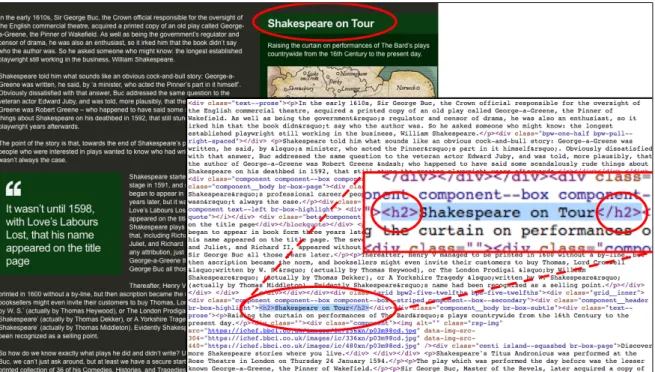
The overall history of the search engine market has been well-documented by Van Couvering and Battelle, therefore it is not necessary to repeat their work in detail; however, there are two examples within that wider narrative that shed light on particular technological perspectives that had a large impact on the evolution of the web and the wider online information ecology. One of the first search engines to become majorly successful was Alta Vista, launched in 1995, two years before Google. The focus of AltaVista’s ranking emphasised webpage design, in particular the hard-coded context of language, such as where and how words were displayed on a webpage and their proximity to other related words. This was accomplished by placing high importance on key elements of the computer code used to format webpages: Hypertext Markup Language (HTML) metawords. This used the existing format of pages to provide an indication of word importance. For example, if a word is coded as a title or header of a page, then this page would be ranked higher than another page that contained that search term in the body of the page. Fig. 3 provides an example of a header tag emphasising the word Shakespeare and how this might be used, in the context of fig. 2, to rank this page higher than others for the query [Shakespeare].
Figure 3. This image demonstrates how design decisions coded in HTML, such as including subheaders (<h2>), can be read by search engines and used to rank search engine results. Drawn by the author.
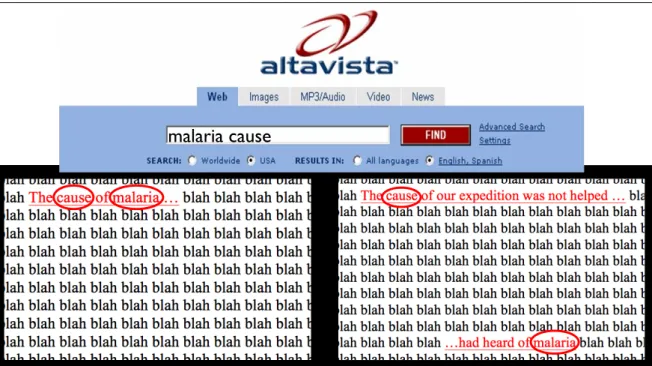
In addition, AltaVista prioritised the distance between various search terms. This allowed the recalling of information from the index to be based on the principle that, “pages where the query words occur near each other are more likely to be relevant than other pages where the query words are far apart” (MacCormick 18). John MacCormick provides an example of a search for [malaria cause] (18), which would cause a search engine to search its index for the two words separately: malaria and cause. When deciding the ranking of each result, MacCormick invents two possible results: one with the phrase “the cause of malaria…” (19), and the other which starts “the cause of our expedition was not helped when…” (20) and which mentions malaria on the same page but in a later section of the writing (see fig. 4).
Figure 4. An illustration (drawn by the author) to demonstrate MacCormick’s example of how word proximity can indicate probabilities of semantic relevance.
The metaword algorithm would, therefore, present the first result as more relevant than the second and would present another page with both malaria and cause in the title as more relevant still. This system of ranking worked better than AltaVista’s competitors when it was launched and is still one of the many metrics taken into account by contemporary search engines; however, it was not long before AltaVista was overtaken by Google, which pioneered a different way of prioritising and ranking pages. Google’s primary method is still in use and not only has it remained
dominant, but it has shaped the overall architecture of the web, which has reinforced its influence.
Although there are a number of different reasons why Google became the most dominant online search engine, there was a specific technological difference between its search engine and other competitors. The founders of Google, Sergey Brin and Lawrence Page proposed the idea of increasing the importance placed on
the hyperlinks between webpages and reducing the significance of the HTML layout of each page. 5 The evaluation of links would work in a way similar to how academic citation, in aggregate, conveys that importance of a source within a particular field or discipline. The more links to a page, the more important the community had deemed that page. However, as they describe, there are
significant differences between web pages and academic publications. Unlike academic papers which are scrupulously reviewed, web pages proliferate free of quality control or publishing costs. With a simple program, huge numbers of pages can be created easily, artificially inflating citation counts […]Further, academic papers are well defined units of work, roughly similar in quality and number of citations, as well as in their purpose – to extend the body of
knowledge. Web pages vary on a much wider scale than academic papers in quality, usage, citations, and length. A random archived message posting asking an obscure question about an IBM computer is very different from the IBM home page. (Page et al. 1-2)
Nonetheless the academic citation model would still be useful if the right measures were accounted for; in particular, the aspect that citations from more important or influential sources should be weighted to a higher degree than unimportant sources. Therefore, a calculation was required to factor flows of influence measured by an algorithm they named PageRank. Therefore, pages with a high number of incoming links or links from important sources would gain a score that would then be carried over to any pages subsequently linked to by this important page. Through this
5 Documented in Brin and Page “The Anatomy of a Large-Scale Hypertextual Web Search Engine”
method Brin and Page created maps of authority that they argued “allow rapid calculation of a Web page’s ‘PageRank’, an objective measure of its citation
importance that corresponds well with people’s subjective idea of importance” (109). Hyperlinks do not necessarily provide value judgements, for instance, when a
webpage author links to a page because it wants to flag it as bad, there is no
criterion which categorises links as negative or positive. In the words of MacCormick, however, “it turns out that, in practice, hyperlinks are more often recommendations than criticisms” (27).
Google’s PageRank algorithm functions by co-opting an aggregate of intention, as Jon Kleinberg argues: “hyperlinks encode a considerable amount of latent human judgment, and we claim that this type of judgment is precisely what is needed to formulate a notion of authority” (2). Each hyperlink has a different level of value; for example, an outgoing hyperlink from a page like whitehouse.gov carries more value than an outgoing hyperlink from the page of an amateur blogger. In turn, because these values are relational, the page that the whitehouse.gov hyperlinked to must also be given a high value. If the whitehouse.gov links directly to the amateur blogger’s page, then any outgoing hyperlinks from that page now carry an additional value derived from the previous hyperlink. Hyperlink judgements are all weighted in a way that is exclusively dependent on other nodes in the network. In order to prevent feedback loops the algorithm employs a Markov Chain, which is a method of
measuring these values as probabilities.6 However, because the values are reliant on each other, existing relationships of influence become reinforced. For example, even if pages from the deep web are indexed through mod_oai or sitemap files, these pages cannot be provided with a rank based on anything other than internal
6 For an in-depth mathematical explanation of the PageRank and its use of a Markov Chain, see
pages 84-88 of Berry and Brown Understanding Search Engines: Mathematical Modeling and Text Retrieval.
links. Therefore, PageRank’s logic prioritises existing hierarchies and thus trends towards a more static informational landscape.
Although there are many ways in which Google’s results have become mutable in a range of contexts, through localisation, personalisation, and time-dependent variables, which will be discussed in further chapters, Google’s original design was focused around reflecting an existing order. Page et al. in their 1998 paper describe their initial aim in the following way:
The importance of a Web page is an inherently subjective matter, which depends on the readers [sic] interests, knowledge and attitudes. But there is still much that can be said objectively about the relative importance of Web pages. [PageRank is] a method for rating Web pages objectively and
mechanically, effectively measuring the human interest and attention devoted to them. (1)
Unlike earlier uses of HTML metaword coding which measured the value of words, their proximity, and the formatting of pages independently of one another, the
emphasis of Google’s ranking algorithm placed the greatest importance on networks between pages. The coding and format of each page was still taken into account, but played a significantly lesser role in establishing the overall information ecology on the web. This codified outlook directed the landscape of the contemporary web to be dominated by large or well-known institutions by establishing what could and could not be discovered through a web search. Google’s influence, therefore, developed in concert with existing distributions of power and influence. Therefore, PageRank should be considered as a way of harnessing existing relationships, a type of
practice which, to borrow from Andrew Pickering’s concept of the mangle of practice, “should be seen as a process of modelling, of the creative extension of existing cultural elements” shaped by technological and social contingencies. (Pickering and Stephanides 140). Modelling is shaped by “resistances” (Pickering 23), which leads to “accommodations” (23) as new behaviour is set in place. In 1998, Google
established a logic that aligned quality with citation and provided a model for how the web ought to look in a way that became recursively influential. As will be developed throughout this thesis, Google’s original model has both established and adapted to, the changing nature of the web.
1.3 Step Three: Query and Results
The final stage of the search engine process is the front-end that users interact with. The search box, in particular Google’s minimal surrounding layout, has become a ubiquitous part of the web. The early web portals that predate search engines rearticulated an old media aesthetic of a newspaper front page or Teletext offering suggestions and directions to a user. Query formation by users will be addressed later in this chapter and in chapter three; search engine results are discussed in detail in chapter four. For the moment, they receive a brief explanation to complete the basic description of how search engines function.
The blank search box of a search engine can take any kind of query:
originally, Google allowed any combination of characters up to a maximum limit of thirty-two words, however, the evolution of search engines now enables searching through spoken word and even using pictures. The way in which search engines
interpret a query has changed significantly over the years; originally it would look for exact word matches in a document from its index responding to the HTML tags, as explained above, combined with its algorithm to judge citation value. Google also offered a selection of operators to narrow the search, the Boolean AND, OR and NOT as well as other characters that explicitly told the search engine to include synonyms (~ (tilde)), include wildcard terms (*), look only for exact phrasing (“ ”) etc. Although these operators have been gradually phased out and replaced by
automated systems outside of a user’s control, 7 the main underlying logic of
formulating a search engine query is entering words that the user hopes to find on a page. In a very literal sense, search queries embody Wittgenstein’s statement from his Tractatus Logico-Philosophicus that “The limits of my language mean the limits of my world” (68 emphasis in original). The linguistic nuances of each query, including variations of vocabulary, tone, grammar and phrasing, shape the kinds of webpages that are provided through search results. In addition, every time a query is searched the results are ranked sui generis according to a range of criteria, also referred to as signals, used to predict that specific user’s intentions and outlook. Google claim to use around 200 individual signals such as information about the user: their location, the time of day, and their browsing history; as well as information about the pages found (how long a site domain has been registered, the location of the server on which that page is stored, how long it will take to load).8 This means that search
7 Interface simplicity has always been a priority for Google, but there are other potential reasons for
minimising the range of search setting available to a user. For example, providing fewer option for users limits the variety of queries, thus enhancing Google’s purview over search results. For further commentary, see Barry Schwartz’s “Google Drops Another Search Operator: Tilde For Synonyms”, which also includes links to five other reports of search functionality dropped by Google.
8 The number of 200 has been used by Google (see Cutts) as well as the academic community (see
Levy In the Plex 49). See Brian Dean’s “Google’s 200” for a compilation of the existing evidence concerning the nature of these signals. Eric Schmidt, Executive Chairman of Alphabet, considers these factors to be “a business secret of Google” (see Sullivan “Schmidt”). The number may well be arbitrary, as in 2010 after Bing announced they use 1,000 signals, Google responded that their 200
engine results can be different between individuals depending on a number of factors. The criteria involved in these 200 signals are complex, therefore, chapter four directly explores the kinds of signals that influence which results are provided for different contexts and the ways in which search results for controversial topics can differ radically as a consequence.
There are many differences between questions and queries, but the way in which queries must mimic the language of their desired answer is of key importance. Even though Google Search employs synonyms by default, the extent to which alternative words and phrasing are used to supply results is highly variable.9 In Steven Baker’s official Google blog post, “Helping Computers Understand
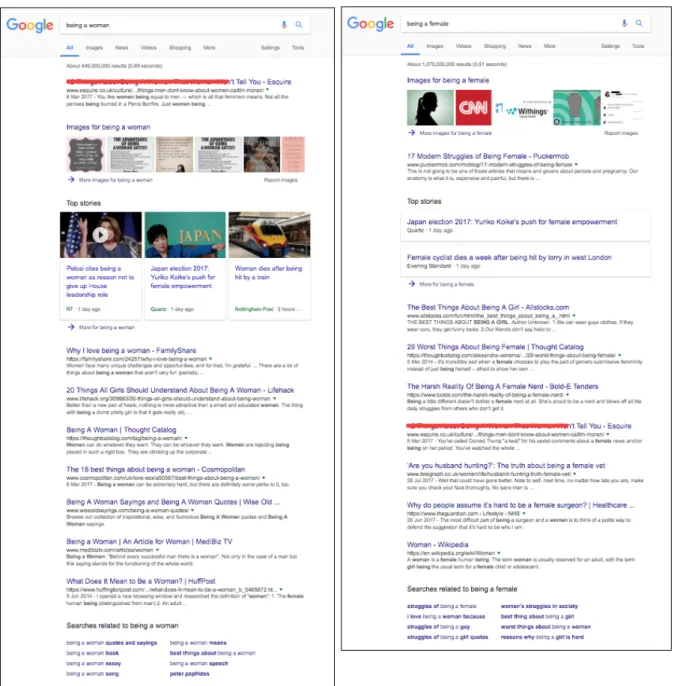
Language”, he uses the example of how, through using synonyms, a search for the query [pictures developed with coffee] is interpreted similarly to [photos developed with coffee] by drawing from results that contain the alternative wording. Fig. 5 shows the two searches, carried out in 2017 rather than 2010, with the shared results crossed out in red. There are some small differences but the linguistic replacement has not caused much variation in the results. This is in sharp contrast to, for example, words that have more complex associated uses. Fig. 6 compares the results for the queries [being a woman] and [being a female] in which only one result, “12 Things About Being a Woman That Women Won’t Tell You” written by Caitlin Moran for Esquire, is consistent in the first page of results. The differences shown in fig. 6 are ripe for a cultural critique, regarding the relationship between gendered experience, linguistic patterns, and modes of communication that is
signals are each made up of 50 sub-signals, thus raising their total to 10,000 (see Sullivan “Dear Bing”).
9 Google explicitly acknowledged that they use synonyms by default in an official blog post in 2010,
(see Steven Baker’s “Helping computers”), but the practice is most likely much older, given that it relies on a particular patent filed by Baker and John Lamping in 2005 (see Baker and Lamping “Determining query term synonyms within query context”).
beyond the scope of this chapter; chapter four addresses how similar linguistic shifts alter search results directly. Figs. 5 and 6 are included here in order to demonstrate that sometimes differences in vocabulary greatly influence search results and
sometimes they do not. Like much of Google Search’s interface, these variations are not explicitly communicated to users.
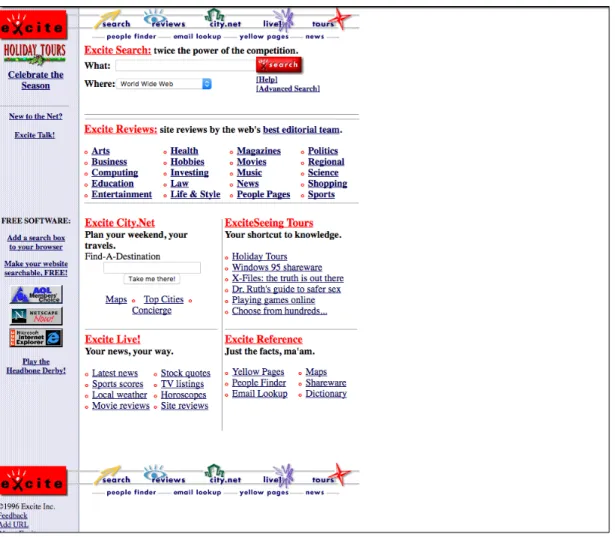
The explanation provided above outlined that queries are fundamentally different from questions. However, as shall be explored below, search engines facilitate a much wider range of online behaviours than even the broadest definitions of enquiry. What makes search engine interfaces somewhat unique is their lack of explicit framework. Web portals, in which the search bar is surrounded by curated information, dominated before the rise of Google and still exist today (see figs. 7-10). However, the search engine query bar at the centre of the pre-selected content still required the user to begin the process; even with the later implementation of
Autocomplete, which will be discussed fully in chapter three, the drop-down list of suggestions still only appears after the user has initiated the process.
Figure 5. Two searches with slight linguistic variation in the query, suggested as an example in Baker’s 2010 blog post: [pictures developed with coffee] (left), [photos developed with coffee] (right). Results that appear for both queries have been struck-through. Due to the use of synonyms the results are mostly the same. Search
Figure 6. Two searches with slight linguistic variation in the query that show a much larger variation in search results. [being a woman] (left), [being a female] (right). Results that appear for both queries have been struck-through. Even though synonyms for the queries have been used, the results are very different. Search performed 10/10/2017.
Fr om le ft to r ig ht. Fi gur e 7. Y ah oo ! W eb P or ta l, a s of 17 /1 0/1 9 96 , a cce ss ed v ia th e W ay B ack M ach in e Fi gu re 8. Ya ho o! W eb Po rta l, a cce sse d 15 /0 7/ 20 17 . Fi gu re 9. L yco s W eb P or ta l, a s of 10 /1 2/1 9 97 , a cce sse d vi a t he W ay B ack M ach in e. F ig ur e 1 0. Lyco s W eb P or ta l, a s of 15 /0 7/2 0 17 .
In this way, Google stands apart from much of the history of information
organisation. A survey of pre-digital information technologies – library categorisation systems, encyclopaedia, index cards – provides examples of infrastructure in which the information seeking behaviour might be prompted by a question, but which are organised according to pre-arranged, top-down hierarchies that do not incorporate question-asking behaviour into the system.10 Google’s interface makes no attempt to provide a detached perspective on the web. Most previous technologies allow
browsing without intent: a user of a library using the Dewey Decimal System can walk to the shelves containing the 800 class books and browse all the literature that that library has; the owner of an encyclopaedia can read every entry that starts with A, if they so choose. That every use of Google requires some informational input on the part of the user represents a radical shift for technologies used for enquiry. The cultural and philosophical implications of such a shift are an important part of
understanding Google Search, however, there is no existing literature that attends to the mandatory nature of queries in any real depth. Battelle coined the term
“database of intentions” (2) in 2005 to describe Google’s relationship to its users and the phrase has been taken up in subsequent studies (see Halavais 30, Duguid 16, Pariser 103, Hillis et al. 14, Jarrett “A Database of Intention?” 17, to name only a sample); this captures part of the interaction but has mainly been used in the context of privacy concerns. Hillis et al. put Google’s dialogic nature in a religious context (171) as well as invoking a Zizekian Big Other (179-185) that leads their analysis into conflating the technical differences between questions and queries. Halavais notes that Google is fulfilling the role of gatekeepers such as journalists and teachers (105) but does not make explicit the part of this interaction that would be built around a
10 See chapter two for a more in-depth assessment of the history of information technologies including
question and answer process. The only example of analysis that attends to the technological process of search engine queries, while relating this to a wider context of questioning is Boris Groys’ “Google: Words Beyond Grammar”. Groys’ piece is theoretically ambitious in relating queries to the implications of Derridean
Deconstruction. However, the piece is very short and, more significantly, presents some misunderstandings about the technical nature of Google’s search engine. Therefore, the following section will introduce Groys’ argument while providing some technical insights and a selection of quantitative studies that reinforce Groys’
theoretical arguments, as well as some evidence that quashes some of his claims. After this technical basis has been established, I will then extend Groys’
provocations by widening the historical narrative by introducing some of Plato’s concerns. After doing so I then take the distinction between questions and queries a step further by introducing the work of Hans-Georg Gadamer, which I argue provides a useful theoretical perspective that widens the philosophical scope of questioning while keeping the technical aspects of search engine queries intact.
2.0 Google: Words Beyond Grammar
Human life can be described as a prolonged dialogue with the world. Man interrogates the world and is interrogated by the world. This dialogue is
regulated by the way in which we define the legitimate questions that we may
address to the world or the world may address to us – and the way in which
we can identify the relevant answers to these questions. (Groys 147)
Groys’ piece opens with an emphasis on rules and the way that in order for
questions to be asked they must be expressed in a legitimate form that responds to a given context. Search engines, on the other hand, do not require inputs in the form of questions. The way in which Google responds to queries is by providing links to “all the accessible contexts in which this word [or combination of words] occurs (148). This enables queries to cover a greater remit than traditional questions; however, without the logical, rhetorical or dialectical structures that characterise traditional questions, queries act in a very different manner. Groys sees the way that Google queries attend to language as an extension of the non-normative claims of Ferdinand de Saussure and Jacques Derrida in which the meaning of words is dictated by context and endlessly shifting chains of signification. Groys goes on to argue that
Google, therefore, can be seen as an answer to deconstruction in at least two ways. On the one hand, Google is based on the same understanding of language as topological space, in which individual words follow their own trajectories - undermining any attempts to territorialize them in fixed,
![Figure 2. A search for the query [ranking], which results in “About 552,000,000 results”](https://thumb-us.123doks.com/thumbv2/123dok_us/10003287.2492849/31.892.106.800.787.925/figure-search-query-ranking-results-results.webp)
![Figure 5. Two searches with slight linguistic variation in the query, suggested as an example in Baker’s 2010 blog post: [pictures developed with coffee] (left), [photos developed with coffee] (right)](https://thumb-us.123doks.com/thumbv2/123dok_us/10003287.2492849/43.892.110.788.125.895/figure-searches-linguistic-variation-suggested-pictures-developed-developed.webp)