Megan M. Myers. Easy as FDL? Web Presence of Regional Federal Depositories. A Master‟s Paper for the M.S. in L.S degree. April, 2011. 48 pages. Advisor: Mike van Fossen.
Increased availability of electronic government publications has resulted in shifts in the Federal Depository Library Program (FDLP), and increased pressure on depository coordinators to justify continued participation. This study seeks to assess how regional Federal depository libraries promote documents collections and services via the library web page, taking into account visibility, clarity of purpose, resources provided, and interactivity. Analysis revealed that regional depositories are highly visible within their parent institution‟s library system and committed to communicating the purpose of the FDLP, but relatively unlikely to post circulation or collection usage policies online. Regional depositories were also discovered to be slow adopters of dynamic resources and Web 2.0 applications, but eager to promote traditional reference and information literacy services on their web page. Through increased interactivity, incorporation of Government Printing Office (GPO) marketing materials, and collaboration with other libraries,
regional Federal depositories can enhance their web presence and increase collection discovery.
Headings:
Depository libraries -- Evaluation
Depository libraries -- Reference services Government publications
Regional libraries -- Evaluation
by
Megan M. Myers
A Master‟s paper submitted to the faculty of the School of Information and Library Science of the University of North Carolina at Chapel Hill
in partial fulfillment of the requirements for the degree of Master of Science in
Library Science.
Chapel Hill, North Carolina April 2011
Approved by
Table of Contents
Literature Review……….5
Federal Depository Library Program: Past, Present and Future………..5
Obstacles to Participation in the FDLP………7
Electronic Government Information: Implications for Depositories………...9
Why Market Depository Libraries? ………..11
Assessing Library Websites as a Vehicle for Depository Promotion………14
Methodology………..17
Results………20
Visibility………20
Clarity of Purpose………..21
Resources Provided………22
Interactivity………22
Discussion………..23
Visibility………23
Clarity of Purpose………..25
Resources Provided………27
Interactivity………29
Limitations……….31
Conclusion……….31
Easy as FDL? Web Presence of Regional Federal Depositories
The Federal Depository Library Program (FDLP), codified in Title 44 of the U.S. Code, strives to provide the American public with no-fee, unrestricted access to Federal government information. Congress allocates funds to the Government Printing Office (GPO) to facilitate distribution of government information materials to designated depository libraries at no cost. While tangible information materials are provided at no cost to depositories, and copious amounts of government information is freely available on the web, government information is far from free; a multitude of costs are associated with depository status, including staff allocation for documents processing, cataloging, and collection maintenance, as well as providing assistance to the American public.
In the face of budget cuts, documents department coordinators are facing pressure from library administrators to cut staff and service hours, with many staffing and funding decisions being based on circulation, reference desk statistics, and web page and online catalog traffic. In order to justify sustainable levels of funding using these
one-dimensional indicators of library usage, libraries have to promote their services more than ever, connecting users with resources both in the physical library and through the library web page. This is especially true of libraries participating in the FDLP: Why do
methods of promoting depository libraries, in the hopes of identifying ways to maximize public access to government information while minimizing costs to the library.
One method of promotion depository libraries have at their disposal is the library website. Most depository libraries‟ parent institutions utilize a library website as a service to patrons, collocating information about the library, contact information, resources and the library‟s online catalog. With the website structure and design templates readily
available, depository libraries have the opportunity to tie their promotion efforts with their parent institution‟s library system, minimizing marketing costs to the documents
department. Selecting content and arranging material is far from a zero-cost endeavor, requiring the depository coordinator‟s time and effort both in the initial website creation
and periodic maintenance, but the promotion of depository libraries through a documents department web page is less costly and father reaching than traditional tangible
promotional materials, such as flyers, table tents or pens; it is difficult to reach
Literature Review
Federal Depository Library Program: Past, Present and Future
Congress established the FDLP in 1813 to ensure the American public has access to information of the U.S. Government (Federal Depository Library Program, n.d.). As a participant of the program, depository libraries receive Government information products at no cost, in exchange for providing no-fee access and professional assistance to their local community.
Authority of the FDLP, relevant definitions and legal obligations of depositories are codified in 44 U.S.C. §19. For the purposes of the FDLP, a government publication is defined as “informational matter which is published as an individual document at
Government expense, or as required by law,” (44 U.S.C. §1901). All informational materials that are deemed government publications based on this definition are to be made available through the facilities of the Superintendent of Documents to depository libraries (44 U.S.C. §1902), which are designated by law or Congressional representative (44 U.S.C. §1905). There are several legal obligations imposed on all depository
for selective depositories to replace a tangible government publication with an electronic version if they‟ve held the tangible for at least one year, and the electronic version is
official, complete and free to the public (Federal Depository Library Program, 2009). Regional depositories, up to two per state, are obligated to receive one copy of every new and revised government publication available for distribution to depositories, to retain one copy in print or microfiche of every government publication, to provide assistance for depositories in disposal of government publications, and to approve the disposal of government publications by selective depositories following successive offers of materials to (1) the regional, (2) other depositories within region, and (3) other libraries (Federal Depository Library Program, 2009).
In 1972 the Depository Library Council (DLC) was established to advise the Public Printer on policy concerns relating to the management and operation of the FDLP. The DLC is composed of fifteen members, each of which is appointed by the Public Printer. Each member serves a term of three years, with one-third of the council turning over each year; at least half of those appointed must come from depository libraries (Federal Depository Library Program, 2008). Through the members of the DLC, the FDLP takes into account the advice of individuals active in depository libraries when contemplating policy decisions, and encourages transparency in program administration.
GPO recognizes the challenges and changes facing the future of the FDLP, and has addressed many of these issues in the April 2009 draft of the Federal Depository Library Program Strategic Plan, 2009-2014: Creating an Informed Citizenry and Improving Quality of Life, available via the FDLP Desktop. The Strategic Plan
and states that, “the future of depository libraries depends on how well GPO and the
libraries can take advantage of new information technologies to connect their depository service to the information exchanged in a free press, open meetings, public assemblies, active petitions, and free speech,” (Library Services and Content Management,
Superintendent of Documents, U.S. Government Printing Office, 2009, p. 3). With 97% of government publications distributed through the FDLP having an electronic version available, depository librarians are “turning to the online environment for delivery of information and services at the user‟s point of need,” (p. 4). In light of this shift, it is
important to assess whether depository libraries are accomplishing this task effectively through analysis of web presence visibility within the parent institution‟s library system, and use of web tools and resources in promotion and access endeavors.
Obstacles to Participation in the FDLP
One of the biggest misconceptions about the FDLP, propagated by the slogan “Easy as FDL: Free Information, Dedicated Service, Limitless Possibilities,” is that Federal government information is „”free” to designated depositories. To the contrary,
depositories have to provide staff, equipment, and support resources to complete all of the activities related to depository status: processing documents, maintaining the
financial commitment, and the increasing availability of free government information on the web, depository libraries are being pressured to justify maintaining depository status.
Working against the depository, in tandem with the misconception that all government information is free, is the resource allocation process of the parent
institution, and subsequent repercussions for the functioning of a Federal depository. A flaw inherent to the structure of the FDLP is that the success of an individual depository is dependent on local resource allocation, rather than any characteristic that can be influenced at the program level (United States. Congress. Joint Committee on Printing, 1979, p. 45). Cook (1985) commented on the discrepancies in resource allocation to depositories in academic libraries, noting that resource allocation is not proportionate to overall library funding in academic institutions (p. 143). It is also noted that resource allocation becomes diluted the farther the depository coordinator lies from the budget process within the library‟s administrative hierarchy; in institutions where the documents department falls under the administration of the reference department, the coordinator will be removed from the budget process an additional level, compared to institutions where the depository constitutes a separate department, reporting directly to library administration (Cook, 1985, p. 146).
to maintain equipment that can read the increasing number of obsolete formats, especially in regional Federal depositories, which hold „legacy‟ collections of government
documents. Additionally, the increasing frequency with which federal agencies publish government information in a born-digital format, with no print equivalent, has forced designated depositories to provide dedicated FDLP public access computer workstations; this is a difficult battle for depository coordinators, as library administrators push to reduce the number of desktop computers maintained by the library for in-house use.
Electronic Government Information: Implications for Depositories
As increasing amounts of government information became available on the web, the FDLP began to shift its distribution methods, recognizing a need to accommodate the publication methods of federal agencies, and the need to preserve access to born-digital publications. Turock and Henderson (1996) point out that the push in 1995 for GPO to make electronic government databases available through GPO Access was “as much about budget reductions as it was about increasing access to information,” (p. 228), and stated that the “traditional role of librarians as providers of information…[is] expanding to also include that of intermediary as users require increasingly sophisticated guidance in navigating a complex information environment,” (p.233).
Given how poorly the original framework of the FDLP supports the fluidity of the digital environment, Jaeger, Bertot and Schuler (2010) state that depositories are going to have to find a means to exist in a future that:
(1) Increasingly chooses digital over print and paper;
(2) Offers multiple access points other than those traditional search tools offered by libraries;
(4) Creates new knowledge management tools that enables users direct and independent access to content;
(5) Fosters non-librarian organizations (that are often competitive with libraries) to create access points and dissemination mechanisms for government information; and
(6) Pushes user expectations to expect immediate access to information beyond the confines of a library‟s physical collection housed within a particular building (p. 474).
To assess how prepared depositories are to tackle the challenge of promoting online resources, and how documents librarians feel about the shift toward electronic distribution, Laskowski (2000) distributed a survey to the GOVDOCS-L listserv. In 2000, only 24.5% of respondents reported working with collections whose bibliographic
records were mostly integrated with the main collection, while the majority (38.3%) of respondents reported that bibliographic records were only partially integrated with the main collection in an online catalog (Laskowski, 2000, p. 177). Depositories were largely prepared to provide access to government information on the Internet, with 97% of respondents providing public access to Internet in their library (Laskowski, 2000, p. 178). The availability of government information online has also transformed reference
services, with a quarter of respondents reporting that most of their reference questions pertain to online material, and another 18% reporting that half of their questions pertain to online material; however, even with so many questions pertaining to online material, the majority (55.9%) reported their reference work still focuses on print materials (Laskowski, 2000, p. 178). Largely, documents specialists believe that patrons benefit from the availability of government information online, but 29.2% of respondents expressed some concerns, especially with regards to “the high cost of online access,
The increasing availability of government information online is also impacting user perceptions, especially with regards to the need for library professionals. In the same study, a paper survey was distributed to users of documents, and a strong preference for electronic sources of information on all topics was found among 58.9% of respondents, as well as for electronic sources of government information (60.7% of respondents) (Laskowski, 2000, p. 179). Among respondents to this survey, reliance on reference professionals or tutorials was minimal: only 19.6% were aware of online tutorials on topics pertinent to government information resources, and only half of those aware had utilized tutorials to learn about government information resources (Laskowski, 2000, p. 180).
Why Market Depository Libraries?
Norman (1995) summarizes marketing as a series of activities that help identify, address and re-evaluate the needs of the user:
Conducting research to discover needs; preparing a program around the marketing mix of product, price, place, and promotion; designing a strategic plan to set general goals, objectives, and strategies; preparing a marketing plan to determine marketing goals, objectives and strategies; and performing a marketing review and audit after a period of time, to evaluation the marketing program (p. 48). The idea of employing a „marketing mix‟ appears frequently in the literature, and can be thought of in terms of four P‟s: Product, Price, Place, and Promotion (McCarthy, 1981;
1995, p. 54). Librarians need to constantly evaluate the need for services and devise new services that meet ever-changing user needs. Price relates to what libraries may need to charge to recover costs, such as for printing and photocopying, overdue fines or
replacement fees (p. 55). Place refers to the library building and the physical reference desk, and efforts should be made to present the library as a welcoming, well-maintained space that encourages use (p. 55). Last, Promotion, the most self-explanatory of the four, can be achieved through a variety of avenues such as branding, direct mail,
bibliographies or handouts, and promotional items (p. 57).
The wide range of subjects covered by government documents, and diversity of publication formats, means that the potential group of users will always be larger than the actual user group, and the depository‟s primary focus should be increasing public
awareness of its existence (Singleton, 2004, p. 24). In a study of faculty use of government documents conducted by McCaghy and Purcell (1972) at Case Western Reserve University, the predominant reasons cited for infrequent use of documents included:
(1) Unaware of their existence (14%)
(2) Unfamiliar with their organization (24%)
(3) Use of government publications in other libraries (24%) (4) Obtain own copies (32%)
(5) Do not need government publications (46%) (6) Other (12%) (pp. 7-12)
To assess awareness of the depository library collection and reference services offered at the Mike Mansfield Library, Burroughs (2008) distributed a survey to students, staff and faculty of the University of Montana-Missoula. The survey revealed that
government information on at least a quarterly basis (p. 205). While there were many reasons cited for non-use of government information, the two categories most frequently selected were „Government publishes little or nothing of value in my field,‟ (35.5% of respondents) and „Unaware of the existence of such materials at the library, (23.7%) (p.
206); these findings are similar to those reported by McCaghy and Purcell (1972), and indicate that the depository would benefit from promoting their holdings, increasing awareness of the types of materials available. Of those individuals using government information, relatively few recognize the physical depository library as an access point for discovering government information: 77.4% reported seeking government
information via a general search engine (e.g., Google) and 41.8% use the Mansfield Library catalog, but only 19% find government information via a librarian, and a dismal 9.3% use GPO Access (p. 208). Brand recognition of the FDLP was also assessed, with disheartening results: only 20.36% had ever heard of the FDLP, and 21.36% were aware that the Mike Mansfield Library was a federal depository (p. 208).
Burroughs (2008) also assessed use of current services and interest in new services, in the interest of aligning depository services with user perceptions of what a library should provide. Online subject guides and printed handouts were deemed the most useful tools currently made available by the library (Burroughs, 2008, p. 210); this aligns with the library‟s perception that the government information subject guide page is used
virtual reference (12.09%), general instruction sessions on government information (11.07%), one-on-one consultations (9.43%), and a government documents blog (7.99%) (p. 210).
Assessing Library Websites as a Vehicle for Depository Promotion
Promotion of Federal depositories through interactive, accessible and usable websites is an essential topic of assessment in the wake of previously detailed shifts in both the FDLP and user preferences for seeking information, but the topic is absent from library literature. To develop a method for assessing depository websites, existing FDLP promotional materials and website usability guidelines were consulted, as well as several studies of website usability, quality and interactivity.
Federal depository libraries are encouraged to utilize library web sites or pages in Section 4.5 of the Federal Depository Library Manual: Marketing to Your Users. Web sites are identified as an “excellent way to publicize access to depository collections,”
and libraries are encouraged to collaborate with other depositories to provide useful content and links to external government information resources to potential users (Federal Depository Library Program, 2009, December 14). The FDL Manual
encourages use of the template formulated by the Government Documents Round Table (GODORT) of the American Library Association (ALA), available online at
FDLP promotional graphics (available from the FDLP Desktop at
http://www.fdlp.gov/outreach/promotionalresources/113). The FDLP Eagle is a
registered trademark of the FDLP, and serves to create the impression of the program as an identifiable brand. There are additional promotional materials available from the recent Easy as FDL promotional campaign, all available through the FDLP Desktop; libraries can incorporate the Easy as FDL logo, and embed informational videos
(http://www.fdlp.gov/outreach/promotionalresources/112-easyasfdlvideo), or „man on the street‟ footage (http://www.fdlp.gov/outreach/promotionalresources/381-taketostreet).
To determine aspects that should be present on every well designed website, guidelines set forth by the National Cancer Institute for government web designers were consulted. These guidelines attempt to facilitate creation of user-friendly, accessible websites, and are available online (http://www.usability.gov). Raju N and Harinarayana (2008) used these guidelines to assess 30 general library websites for usability,
accessibility, and the perception of library as brand. Of the websites analyzed, only 53.33% provided Frequently Asked Questions, but every library website analyzed included a news or events page (pp. 113-114); naming conventions of the news section differed, but the contents were similar from library to library. Another website feature assessed was the presence and placement of a logo; logos identify the website as credible to users, and contribute to the perception of the website representing a brand. Over two-thirds (70%) of websites analyzed used a logo to identify the library website, and the vast majority placed the logo in the upper-left corner of the page; interestingly, 30% of
Given the alignment of the purposes of the FDLP and government websites, namely to provide access to government information, the guidelines set forth by the National Cancer Institute represent a key tool to assess depository library websites, and form the primary basis of the methodology set forth in the present study in assessing the aspect of visibility.
Chua and Goh (2010) sought to assess the prevalence of Web 2.0 applications on library websites, and whether or not the presence of these applications serves to enhance the overall quality of the library website. The authors classified Web 2.0 applications in terms of how they support the functions of the library: information acquisition – blogs and wikis; information dissemination – RSS; information organization – social tagging; and information sharing – instant messaging and social networking (p. 205). The study found that libraries are readily adopting Web 2.0 applications, with academic libraries adopting applications slightly more frequently than public libraries (p. 209). To assess the quality of library websites, the authors came up with three aspects of quality, each of which was subdivided into four dimensions. The first, system quality was assessed in terms of usability, responsiveness, ease of access and privacy; information quality, the second aspect of quality, assessed the dimensions of soundness, dependability, usefulness and ease of use, and; the last, service quality, consisted of empathy, interactivity,
quality (210); while applications increase interactivity and are tied to the impression of receiving high-quality service, they are not linked to high-quality content. These findings reveal that libraries will have to walk a fine line, interacting with users while also
presenting content in a manner that conveys that it is sound and reliable.
Methodology
For the purposes of assessing depository websites, it is desirable to identify designated depository libraries of similar collection size and type of parent institution, making the population of forty-nine regional Federal depository libraries in the United States an ideal subset of the FDLP whole. Most libraries of „Regional‟ status are of „Large‟ library size, holding over 1,000,000 volumes, and all 49 regional depository libraries are of either „Academic General,‟ „State Library,‟ or „Public Library‟ library
type. Given these similarities, it is presumed that the forty-nine libraries represented in this population would have similar resources allocated to depository functions, and are supported by parent institutions that have similar characteristics to each of the other parent institutions in the population. While most states have one regional Federal depository designated, there can be up to two designated per state, as in Alabama, Louisiana, North Dakota, Oklahoma, Texas, and Wisconsin. At present the states of Alaska, Delaware, Rhode Island, South Dakota, Vermont and Wyoming do not have regional Federal depositories designated; instead, the regional Federal depository of a neighboring state serves these states.
means to identify depositories and a portal through which to gain access to a depositories website; in light of this, assessment of the depository website originated with the URL provided in each regional Federal depository‟s directory entry. One regional depository does not have a URL listed, and thus was omitted from analysis. A list of regional Federal depositories assessed and the URL provided by the FDLP Directory appears in Appendix A. Additional data pertaining to each regional depository was collected from the FDLP Directory, including depository library number, library name, parent
institution, library type, state, depository coordinator and phone number, and public services phone number.
Website assessment covers four aspects: Visibility, Clarity of Purpose, Resources Provided and Interactivity. Each aspect is subdivided into dimensions for assessment. For the purposes of this study, Visibility refers to how readily users can locate the
depository‟s web page, and the prevalence of FDLP identifiers. Determining whether the
URL provided in the FDLP Directory leads to the depository‟s webpage, or the
homepage for the parent institutions‟ library system, and counting the number of clicks to reach the depository‟s web page from the parent institution‟s library home page assesses
The aspect of Clarity of Purpose assesses whether the depository web page explains the purpose of having depository status. Criteria for assessment included the presence of „About‟ and/or Frequently Asked Questions (FAQs) sections (U.S.
Department of Health and Human Services, 2009, p. 146), the presence of a „Policies‟ section describing collection usage and/or circulation, and whether there are separate pages or section for the six headings suggested by the GODORT template for depository libraries: Federal Government; Legislative and Regulatory Information; State
Information; International and Foreign Information; Statistical Resources; and Additional Resources.
The aspect of Resources Provided is a measure of how the depository is promoting its collection and reference services through its website, either through
conveying information via a subject guide or other web-based resource, or promotion of a service provided by the depository, such as one-on-one consultations. The list of
resources assessed are those items appearing on the survey of student government information use and needs conducted by Burroughs (2008, p. 216), including:
government information subject guides, web-based government information tutorials, government information library instruction sessions, one-on-one research consultations, alerts and instant messaging. Several additional resources depositories are potentially providing were added to this list, including external links to GPO resources (e.g., Catalog of U.S. Government Publications, FDLP information web pages), and links to other depository libraries in their state.
interaction with an informational professional. The presence or absence of Web 2.0 applications was assessed using the list of applications utilized in Chua and Goh‟s 2010 assessment, including blogs, wikis, RSS, social tagging, instant messaging and social networking (p. 205). The ability of users to access reference assistance was broken into discrete avenues for seeking assistance, including the presence of contact information for the depository coordinator, cross-referenced for accuracy against the FDLP Directory entry, and the provision of contact information for other sources of reference service: phone number for general reference or depository department; email address for reference or depository department; web form for reference assistance; and virtual chat reference application or widget. The full text of the codebook is available in Appendix B.
Results
Analysis revealed that the Visibility, Clarity of Purpose, Resources Provided and Interactivity of regional Federal depository libraries vary significantly from institution to institution.
Visibility
The URL provided in the FDLP Directory maintained by GPO led directly to the documents department web page for thirty-five (72.9%) of the depositories. Five
depositories had documents department web pages that could not be accessed from the parent institution‟s library system home page without the use of the site search feature.
The FDLP Eagle logo is the only marketing materials frequently employed by depository coordinators as a visual cue, and is featured on thirty-seven (77.1%) of the depository web pages analyzed (see Figure 1). Other branding materials provided by GPO as part of the FDLP marketing plan are almost completely absent: one depository (2.1%) incorporated the GPO logo, and three depositories (6.3%) embedded the Easy as FDL promotional YouTube video.
Clarity of Purpose
Clarity of Purpose consisted of two parts, namely (1) how clearly the web page describes the intent and policies of the depository collection, and (2) the contents of collection, as evidenced by section headings suggested by the GODORT depository web page template.
Thirty-eight (79.2%) of the web pages analyzed included an explicit „About‟ section, describing the purpose of the FDLP and information pertaining to the individual library‟s participation in the program (i.e., date of designation). Fewer depositories
included FAQ sections (8.3%) or collection usage/circulation policies (33.3%).
Resources Provided
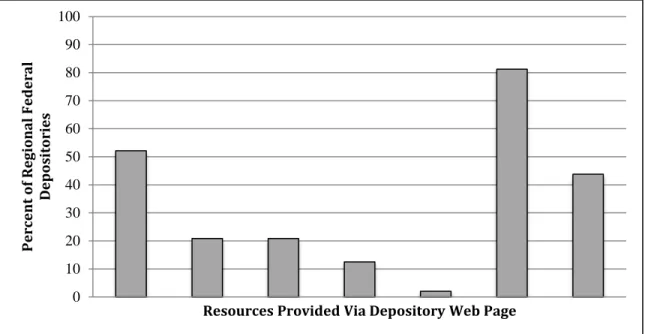
The most frequently provided resource was external links to GPO resources, which were found on thirty-nine (81.3%) of the regional Federal depository web pages (see Figure 3). The only other resource regularly provided were government information subject guides, available from twenty-five (52.1%) of the documents department web pages. In decreasing order of prevalence, other resources located on documents
department web pages include: External links to other depository libraries in the state (n = 21, 43.8%); web-based government information tutorials (n = 10, 20.1%); government information instruction sessions (n = 10, 20.1%); one-on-one research consultations (n = 6, 12.5%); and one instance of alerts service for new additions to the government
documents collection (2.1%).
Interactivity
Interactivity aimed to assess two dimensions: prevalence of Web 2.0 applications, and marketing of reference services. Assessment revealed that Web 2.0 applications are not common on the web pages of regional Federal depositories, and several of the applications included in the assessment did not appear on a single web page. As
illustrated in Figure 4, the most common Web 2.0 application utilized was a blog, found on seven web pages (14.6%). Three regional Federal depositories (6.3%) utilized RSS, one depository permitted social tagging (2.1%), and one depository had created a Facebook page for the documents department (2.1%). At present, no regional Federal depositories utilize a wiki, instant messaging or twitter to interact with users.
department is. Each portal of reference service analyzed had relatively equivalent prevalence, with half of all regional Federal depositories providing a phone number (50%), twenty-eight advertising email reference (58%), twenty-three offering a web form for submission of reference questions (48%), and twenty-one depositories offering chat reference (44%).
Discussion
The analysis of 48 regional Federal depository websites revealed trends in website organization, support provided by parent institutions of regional depositories, and what outreach tools and reference resources are currently adopted by the documents
community. Limitations of this analysis are also addressed.
Visibility
On the whole, the FDLP Directory maintains accurate information about regional Federal depositories, but 20% of directory listings included an inaccurate URL for the depository listed. Several of the inaccurate URLs automatically redirected to the current documents department web page, but two dumped to a 404 Page Not Found error message, with no guidance as to how to return to the parent institution‟s library system home page, or means to direct to the intended destination. By not ensuring information maintained in the FDLP directory is accurate, regional depositories are doing themselves a disservice, eliminating an important access point for users.
forty-three depositories had high visibility, allowing users to easily navigate to their web page, five depositories could not be located without using the search function on the library system‟s home page. By not having a visible presence and easy accessibility from the parent institution‟s library home page, these five depositories are preventing users
from discovering their collections; without indication otherwise, potential users of the depository may inaccurately draw the conclusion that neither government documents nor documents reference is available at the library.
In tough economic times, libraries are under increasing pressure to bring users into the library and demonstrate resulting collection use. An easy, cost-effective way to promote collections is to utilize existing marketing materials, and FDLP depositories have an assortment of logos, YouTube videos and other advertisement tools at their disposal thanks to the marketing and outreach department of GPO. Analysis of regional Federal depository web pages revealed that depositories are not featuring free marketing materials on their web pages, failing to align their depository with the FDLP brand. Over three quarters of depositories display the FDLP Eagle logo, the most recognizable icon of the program, but not a single regional depository features the logo from the recent Easy as FDL campaign. In recognition of changing expectations of users, GPO created
maintaining a current web page for the depository, discounting its ability to advertise their documents collection. Last, depository coordinators or their support staff may not be equipped with the skills required to update their web page, incorporate images or logos, or embed video.
Analysis revealed that the majority of regional depositories are successfully maintaining active URLs from the FDLP Directory and ensuring prominent placement on their parent institution‟s library home page to encourage web page discovery, but not all.
Those regional depositories that fail to maintain consistent, prominent access are hindering discovery. Additionally, while three quarters of depositories feature the standard FDLP Eagle logo, very few depositories are taking advantage of the new FDLP marketing campaign materials.
Clarity of Purpose
How clearly the depository web page conveys the purpose of the Federal
documents collection and associated reference staff is the essential link between chance discovery of the documents department web page by the user, and their subsequent use of the documents collection, either virtually or in-person. Explanation of the principles the FDLP is based on, legislative support for the program in 44 U.S.C. §19, and explicit policies as to who can use items held in the collection or receive assistance with documents serves to enhance user understanding of the FDLP, and may increase the likelihood that users will take advantage of the collection available to them, free of cost, with trained information professionals at their disposal.
Significantly fewer regional depositories see the benefit of formally stating policies regarding documents collection usage or circulation on their public web page, with only one third of depositories featuring this information. The omission of collection usage or circulation information may deter potential users from seeking materials or assistance locating materials, especially the general public who may be unfamiliar with the parent institution‟s library system, and general collection usage/circulation policies.
The second dimension of Clarity of Purpose assessed how plainly the regional depository web page conveyed the types of resources available via the documents department, either in tangible or electronic format. The section headings identified by GODORT‟s template for depository web pages as essential topics, namely Federal Government, Legislative & Regulatory Information, State Information, International & Foreign Resources, Statistical Information, and Additional Resources, proved to be less than essential in the eyes of the depositories. While it is understandable that libraries would not utilize the GODORT template in full, preferring to maintain continuity with the graphic and structural design of their parent institution‟s library website, the structure
(6.3%) opted to forego the heading „Federal Government‟ in favor of separate sections for Executive, Judicial and Legislative information; when combined with the count of libraries using the Federal Government heading, thirty-six depositories (75.1%) convey the idea of holding Federal government information materials. These findings lead us to believe that depositories are concerned with categorizing resources provided through their web page, but are not in agreement as to how to effectively achieve this goal.
Based on the web pages assessed, it is apparent that regional Federal depositories recognize the value in identifying the purpose of their collection through an „About‟
section, but do not see the need to elucidate the contents of their collection through partitioning of their online resources with section headings, as recommended by GODORT.
Resources Provided
By providing government information resources, such as subject guides or new document alerts, the documents department has the opportunity to serve users at their point of need, and users are interested in seeing these resources provided (Burroughs, 2008). Analysis of regional Federal depository web pages revealed that documents
departments are not early adopters of web-based information resource products, and some common information resources adopted by a variety of library types and services
nationwide have not been adopted by a single regional Federal depository.
assessed provide one or more subject guides, but the topic, organization and format of the subject guides differed significantly from depository to depository. For instance, some libraries limited their subject guide coverage to the subject of „Electronic Government Information,‟ while others divided subject guides by topic, such as „Agriculture,‟ „Commerce,‟ and „Transportation.‟
Surprisingly, less than half of the regional Federal depositories provide users with information about selective depositories in their state. Regional depositories that did provide this information typically included library name, address, phone number, and a URL, repeating content from the FDLP Directory, but collocating the information for depositories in the state and saving users from needing to exit the documents department webpage. Libraries that chose not to include this information presume users who have navigated to their page have done so purposefully, knowing that the regional depository is where they need to go to fulfill their government information need; unfortunately, this view does not take into account citizens who are unaware a selective depository can be found closer to home, which may be able to serve their information need more efficiently.
Ten depositories provided web-based tutorials, or advertised government information library instruction sessions. This finding was interesting in that equal numbers of depositories are adopting a new method of increasing information literacy, web-based tutorials, as are publicizing the traditional information literacy method of library instruction. Only six regional depositories advertised one-on-one research consultations as a service available to users, but it is unlikely that only six of the
one library providing this service. These findings demonstrate that documents
departments are slow adopters of new information literacy tools (web-based tutorials, blogs), and infrequent advertisers of common information literacy services (library instruction, one-on-one research consultations).
Interactivity
The first dimension used to assess the aspect of Interactivity, prevalence of Web 2.0 tools, further supports the finding that regional depositories are slow adopters of new outreach technology, replicating findings of the Resources Provided analysis. Blogs were the most commonly adopted Web 2.0 tool, with a mere seven regional depositories actively maintaining one. This is of note, as blogs are relatively time intensive compared to other Web 2.0 tools assessed; providing an RSS feed, social tagging or instant
messaging would require significantly less weekly maintenance, but only three regional depositories support RSS, one allows social tagging, and none of the regional
depositories assessed provides instant messaging. The only other Web 2.0 tool discovered was one regional Federal depository Facebook page. Many of the parent institution libraries feature Facebook pages, connecting with students and other technologically savvy users on the popular social networking platform, but documents departments are not presently capitalizing on this outreach opportunity. In order to keep pace with their parent institutions, regional depositories will have to adopt more Web 2.0 tools, providing more opportunities for potential users to discover government documents collections and services.
embedded within a library system that supports a multitude of reference services that are advertised uniformly on all library department/collection web pages. Each of the
reference service modes had equal prevalence, appearing on approximately half the regional depository web pages. Interestingly, a phone number for reference services was available from only half of the web pages analyzed; a public service phone number is provided for every regional depository from the FDLP Directory, demonstrating that GPO places significant weight on the provision of reference support via phone for any potential user of federal depositories. Email and web form-submitted reference assistance were significantly more prevalent, and if these modes of contacting reference service are combined, nearly every web page assessed provides some form of email-based reference assistance. Just under half of the regional depository web pages analyzed featured chat reference service, either specifically for government documents inquiries, or through a centralized chat reference service of the parent library. In some instances, the parent library offered chat reference, but it was not advertised or otherwise accessible from the documents department web page; if a user discovers the documents department web page via the FDLP Directory, they may not realize chat reference is available to them,
negatively impacting their likelihood of seeking assistance.
Analysis of the Interactivity of regional depository web pages revealed that Web 2.0 tools are being utilized by relatively few documents departments, with user
Limitations
The results of this assessment have several limitations. First, by limiting web page assessment to the population of regional Federal depositories in an effort to compare libraries of similar collection size and library type, findings of this study may not generalize to all depositories participating in the FDLP.
A second limitation of the present study was the reliance on the GODORT
Government Information Web Page Template to determine key section headings likely to appear on all government documents department web pages. The template was designed for small- or medium-sized libraries, and is provided in an effort to support depositories that have limited staff and resources to devote to web design and maintenance. Almost all of the regional Federal depository libraries are housed within a „large‟ library, and thus the contents of the GODORT template may not have been seen as applicable to regional Federal depository web pages. A second reason as to why headings featured in the GODORT template do not appear on regional Federal depository web pages is that these libraries may have more web design and maintenance staff at their disposal than their selective depository counterparts, and did not need to rely on preexisting templates in the creation of their documents department web page.
Conclusion
As the 200th anniversary of the FDLP approaches in 2013, the government documents community needs to reflect on how far the program has come, and where it‟s
headed in the future. As stated previously, government information is far from “free” to designated depositories, necessitating a discussion of how to justify the cost of
FDLP, providing the American public with no-fee, unrestricted access to government information. In the face of budget cuts, depository coordinators recognize how important it is to market their collections and services, maximizing documents collection usage and circulation.
The library web page provides a low-cost, adaptable tool to connect users with government information, as well as subject guides, tutorials, and reference assistance. The present study sought to assess whether Federal depositories are taking advantage of the library web page as a marketing tool by analyzing the aspects of Visibility, Clarity of Purpose, Resources Provided and Interactivity. Analysis revealed that regional
depositories have high Visibility, with an average of 1.837 clicks required to reach the documents department web page from the library system home page. However, several depositories have incorrect URLs listed in the FDLP Directory, which eliminates an important access point for these depositories. Web pages analyzed also revealed that regional depositories are relying on old GPO marketing materials, featuring the FDLP Eagle logo, rather than incorporating materials from the recent Easy as FDL marketing campaign.
Regional Federal depositories recognize the value of including an About page or section, but few depositories include collection usage or circulation policies, reducing Clarity of Purpose. Additionally, it is uncommon for regional Federal depositories to use the headings identified by the GODORT Government Information Web Page Template to organize resources available via the documents department web page.
Catalog of U.S. Government Publications and GPO Access. Half the regional Federal depositories also provide subject guides, but web-based tutorials and new document alert services are significantly less common. Similarly, depositories are not taking advantage of the library web page to advertise services provided, such as one-on-one research consultations or library instruction.
Regional Federal depositories are consistently using the library web page to advertise reference services, with many piggybacking on the advertisement efforts of the general reference department. While these efforts are strong, depositories are not using Web 2.0 tools to connect with users, decreasing the Interactivity of web pages analyzed.
While results of this analysis may not generalize to the larger documents
community, many opportunities for improvement are apparent. In the future, depository coordinators will hopefully take advantage of marketing resources provided free of cost by GPO. Additionally, coordinators would benefit from collaborating with other
References
Availability of government publications through Superintendent of Documents; lists of publications not ordered from Government Printing Office, 44 U.S.C. §1902 (2009). Brewerton, A. (2003). Inspired! Award-winning library marketing. New Library World,
104(7/8), 267-277. doi:10.1108/03074800310488040
Burroughs, J.M. (2009). What users want: Assessing government information preferences to drive information services. Government Information Quarterly, 26, 203-218. doi:10.1016/j.giq.2008.06.003
Chua, A.Y.K., & Goh, D.H. (2010). A study of Web 2.0 applications in library websites.
Library & Information Science Research, 32, 203-211. doi:10.1016/j.lisr.2010.01.002
Cook, K.L. (1985). Resource allocation to government documents departments in academic libraries, Government Information Quarterly,2(2), 143-155. doi:10.1016/0740-624X(85)90042-5
Definition of government publication, 44 U.S.C. §1901 (2009).
Distribution to depositories; designation of additional libraries; justification; authorization for certain designations, 44 U.S.C. §1905 (2009).
Federal Depository Library Program (FDLP). (n.d.). About the FDLP. Retrieved from http://www.fdlp.gov/home/about
Federal Depository Library Program (FDLP). (2008). Depository library council to the public printer. Retrieved from http://www.fdlp.gov/home/about/61-dlc?format=pdf Federal Depository Library Program (FDLP). (2009, December 14). FDL handbook. 4.5
Marketing to your users. Retrieved from
http://www.fdlp.gov/administration/handbook/116-chapter4?start=5 Federal Depository Library Program. (2009). Federal depository library legal
requirements. Retrieved from
http://www.fdlp.gov/component/docman/doc_download/830-federal-depository-library-legal-requirements
Government Documents Round Table. (n.d.). Government information model web page template. Retrieved from
http://www.ala.org/ala/mgrps/rts/godort/godortcommittees/gitco/govinfotemplate.cf m
Ford, S. (1997). Public access to electronic federal depository information in regional depository libraries. Government Information Quarterly, 14(1), 51-63.
doi:10.1016/S0740-624X(97)90051-4
Laskowski, M.S. (2000). The impact of electronic access to government information: What users and documents specialists think. Journal of Government Information, 27, 173-185. doi:10.1016/S1352-0237(00)00133-7
Library Services and Content Management, Superintendent of Documents, U.S.
plan, 2009-2014: Creating an informed citizenry and improving quality of life. Retrieved from http://www.fdlp.gov/component/docman/doc_download/37-fdlp-stratigic-plan-2009-2014-draft-3?ItemId=45
McCarthy, E.J. (1981). Basic marketing: A managerial approach. Homewood, Ill.: Richard D. Iriwn.
Norman, O.G. (1995). Marketing reference services. Reference Librarian, 23(49/50), 45-60. doi: 10.1300/J120v23n49_04
Singleton, P.R. (2004). Getting the word out: Promotion, marketing, and outreach for government information. Louisiana Libraries, 66(3), 24-7.
United States. Congress. Joint Committee on Printing. (1979). Federal Government Printing and Publishing: Policy Issues. Report of the Ad Hoc Advisory Committee
on Revision of Title 44 to the Joint Committee on Printing, United States
Congress. Washington : Government Printing Office.
Figures
Figure 1. Percent of regional Federal depository web pages featuring GPO-provided FDLP logos or promotional materials.
0 10 20 30 40 50 60 70 80 90 100
FDLP Eagle GPO Logo Easy as FDL
Logo Easy as FDLvideo Street" video"Man on the
Per
cent
of
Regio
na
l F
ed
er
al
D
ep
os
it
or
ies
Figure 2. Percent of regional Federal depository web pages featuring GODORT recommended section headings.
Federal Government
Legislative & Regulatory Information
State Information
International & Foreign Information
Statistical Resources
Additional Resources
Per
cent
of
Regio
na
l F
ed
er
al
D
ep
os
it
or
ies
Figure 3. Percent of regional Federal depository web pages featuring resources and reference tools for users.
0 10 20 30 40 50 60 70 80 90 100
Per
cent
of
Regio
na
l F
ed
er
al
D
ep
os
it
or
ies
Figure 4. Percent of regional Federal depository web pages featuring Web 2.0 applications.
0 10 20 30 40 50 60 70 80 90 100
Blog Wiki RSS Social
Tagging
Instant Messaging
Facebook Twitter
Per
cent
of
Regio
na
l F
ed
er
al
D
ep
os
it
or
ies
Figure 5. Percent of regional Federal depository web pages advertising reference services.
0 10 20 30 40 50 60 70 80 90 100
Phone Email Web Form Chat
Per
cent
of
Regio
na
l F
ed
er
al
D
ep
os
it
or
ies
Appendix A
List of Regional Federal Depository Web Pages Analyzed
Name of Library Parent Institution URL
Auburn University at Montgomery Library
Auburn University at Montgomery
http://aumnicat.aum.edu/go vtdocs/
Amelia Gayle Gorgas Library
University of Alabama http://www.lib.ua.edu/govin fo/
Law & Research Library Division
Arizona State Library, Archives & Public Records
http://www.lib.az.us/is/fedd ocs/index.cfm Arkansas State Library Government Publications Section
California State Library http://www.library.ca.gov Norlin Library University of Colorado,
Boulder
http://ucblibraries.colorado. edu/govpubs/index.htm Connecticut State
Library
Connecticut State Library http://www.cslib.org George A. Smathers
Libraries
University of Florida http://web.uflib.ufl.edu/docs /
Ilah Dunlap Little Memorial Library
University of Georgia http://www.libs.uga.edu/gov docs/index.html
Library University of Hawaii at Manoa http://library.manoa.hawaii. edu/departments/govdocs/in dex.html
Library University of Idaho http://www.lib.uidaho.edu/g ovdocs/
Illinois State Library Illinois State Library http://www.cyberdriveillinoi s.com/departments/library/w hat_we_do/depository_prog rams/home.html
Indiana State Library Indiana State Library http://www.library.in.gov University Libraries University of Iowa http://www.lib.uiowa.edu/g
ovpubs/
Anschutz Library University of Kansas http://www.lib.ku.edu/govti nfo/
William T. Young Library
University of Kentucky http://www.uky.edu/Librari es/libpage.php?lweb_id=14 8&llib_id=14
Troy H. Middleton Library
Louisiana State University, Baton Rouge
http://www.lib.lsu.edu/govd ocs/index.html
Prescott Memorial Library
Louisiana Tech University http://www.latech.edu/librar y/govdocs/
Raymond H. Fogler Library
College Park V/ Boston Public
Library
http://www.bpl.org/research /govdocs/index.htm
Library of Michigan Michigan Dept. of Education http://www.michigan.gov/li braryofmichigan
Government
Publications Library
University of Minnesota http://govpubs.lib.umn.edu/
J.D. Williams Library
University of Mississippi http://apollo.lib.olemiss.edu/ gov-docs/
Elmer Ellis Library University of Missouri, Columbia
http://mulibraries.missouri.e du/collections/Fdlp/default. htm
Mansfield Library University of Montana http://libguides.lib.umt.edu/ govinfo
Don L. Love Memorial Library
University of Nebraska, Lincoln
http://www.unl.edu/libr/gov docs/
UNR/KNOWLEDG E CTR/322
University of Nevada, Reno http://www.library.unr.edu/ depts/bgic/Default.htm Newark Public
Library
http://www.npl.org/Pages/C ollections/govdocs.html University Libraries University of New Mexico http://elibrary.unm.edu/govi
nfo/ Cultural Education
Center
New York State Library http://www.nysl.nysed.gov/f eddep.htm
Walter Davis Library
University of North Carolina at Chapel Hill
http://www.lib.unc.edu/refer ence/govinfo/index.html The Libraries North Dakota State University http://library.ndsu.edu/gover
nment-documents/
Chester Fritz Library University of North Dakota http://www.library.und.edu/ coll/government.htm Government
Information Services
State Library of Ohio http://www.library.ohio.gov /
U.S. Government Information Division
Oklahoma Department of Libraries
http://www.odl.state.ok.us/u sinfo/index.htm
Edmon Low Library Oklahoma State University http://www.library.okstate.e du/govdocs/
State Library Building
Oregon State Library http://www.oregon.gov/OS L/GRES/federalgovernment .shtml
State Library of Pennsylvania http://www.portal.state.pa.u s/portal/server.pt/communit y/bureau_of_state_library/8 811 Thomas Cooper Library
University of South Carolina, Columbia
vpub/ Texas State Library
& Archives Commission
http://www.tsl.state.tx.us/ref /fedinfo/index.html
Library Texas Tech University http://library.ttu.edu/ul/govd ocs/
Merrill Cazier Library
Utah State University http://library.usu.edu/govdo cs/index.php
Alderman Library University of Virginia http://www2.lib.virginia.edu /govtinfo/
Washington State Library
http://www.sos.wa.gov/libra ry/FederalDepositoryProgra m.aspx
Downtown Campus Library
West Virginia University http://www.libraries.wvu.ed u/government/index.htm Memorial Library University of Wisconsin,
Madison
http://www.library.wisc.edu /guides/govdocs/index.htm Milwaukee Public
Library
Appendix B Codebook
FDLP Directory Depository Information
Depository number: GPO assigned depository number.
Library name: Name of the library housing the regional Federal depository.
Parent institution: Depository‟s parent institution.
Library type: Type of library (i.e., Academic General, State Library, Public Library)
Depository coordinator: Listed coordinator of the regional Federal depository.
Contact information: Depository coordinator‟s phone number. Depository URL: URL for the regional Federal depository.
Visibility
Correct URL: Does the URL provided in the FDLP Directory lead directly to the document‟s department web page?
FDLP Eagle: Is the FDLP Eagle logo displayed on the documents department web page?
GPO logo: Is the GPO logo displayed on the documents department web page? Easy as FDL logo: Is the Easy as FDL logo displayed on the documents
department web page?
Easy as FDL informational video: Is the Easy as FDL information video embedded or linked to from the documents department web page?
‘Man on the street’ video: Is the Easy as FDL „Man on the Street‟ video embedded or linked to from the documents department web page?
Other promotional items: Other marketing or promotional logos, videos or information productsthat identify the FDLP as brand.
Clarity of Purpose
‘About’/General information: Information about the documents department and the FDLP.
FAQs: Answers to Frequently Asked Questions.
Policies: Information about collection usage and/or circulation policies of the depository.
GODORT template headings/sections: Presence of headings/sections suggested by the GODORT Government Information Web Page Template.
Federal Government
Legislative and Regulatory Information State Information
International and Foreign Information Statistical Resources
Additional Resources
Resources Provided
Government information subject guides: Compiled list of resources providing access to internal or external online resources, databases, and government websites.
Web-based government information tutorials: Tutorials that teach users how to conduct government information research; can be video (e.g., Captivate,
Camtasia) or interactive, static pages.
Government information library instruction sessions: Advertisement of availability of library instruction sessions on government information topics and/or ability to schedule.
One-on-one research consultations: Advertisement of availability of one-on-one research consultations and/or ability to schedule.
Alerts service: User notification of newly received government documents.
GPO resources: External links to GPO resources (e.g., Catalog of Government Publications, GPO Access, FDsys).
Depository libraries: External links to other depository libraries in the state.
Interactivity
Web 2.0 Applications: Presence of interactive, web 2.0 application or tool.
Blog Wiki RSS Social tagging Instant messaging Facebook Twitter
Other Web 2.0 applications: Other types of web 2.0 applications or tools used by the regional depository to interact with users.
Reference Services Contact Information: Presence of contact information for reference services directly from the regional depository web page, or linked to via „Ask a Librarian‟ or other indicative moniker.
Depository coordinator
Name: Name of depository coordinator.
Phone number: Phone number of depository coordinator.
Correct? Depository coordinator‟s contact information matches information provided in FDLP Directory
Reference department
Phone number: Phone number for reference department (dedicated government information reference department or merged with general reference).
Email: Email address for reference department.
Web form: Email reference submitted via a web form.