Clinical Correlates of Carotid Artery Atherosclerosis in
African
Americans: Ethnic and Geographic Disparities
By
Meisam Moghbelli
A Master’s Paper submitted to the faculty of the University of North Carolina at Chapel Hill
in partial fulfillment of the requirements for the degree of Master of Public Health in
the Public Health Leadership Program
Chapel Hill
Spring 2014
Date
Date
Abstract:
Objectives We evaluated whether carotid intima-media thickness (CIMT) and the presence or
absence of plaque improved coronary heart disease (CHD) risk prediction when added to
traditional risk factors.
Background Traditional cardiovascular disease (CVD) risk prediction schemes need further
improvement as the majority of the CVD events occur in the intermediate risk groups. On an
ultrasound scan, CIMT and presence of plaque are associated with CVD, and therefore could
potentially help improve CHD risk prediction.
Methods Risk prediction models (overall, and in men and women) considered included
traditional risk factors (TRF) only, TRF plus CIMT, TRF plus plaque, and TRF plus CIMT plus
plaque presence. Predictivity was established by calculating the area under the curve (AUC).
Cox proportional hazards models were used to estimate 10-year CHD risk for each risk model.
Observed events were compared with expected events, and, the net reclassification index (NRI)
was calculated.
Results Overall, the CIMT plus TRF plus plaque model provided the most improvement in AUC
in the overall sample. Similarly, the CIMT plus TRF plus plaque model had the best net
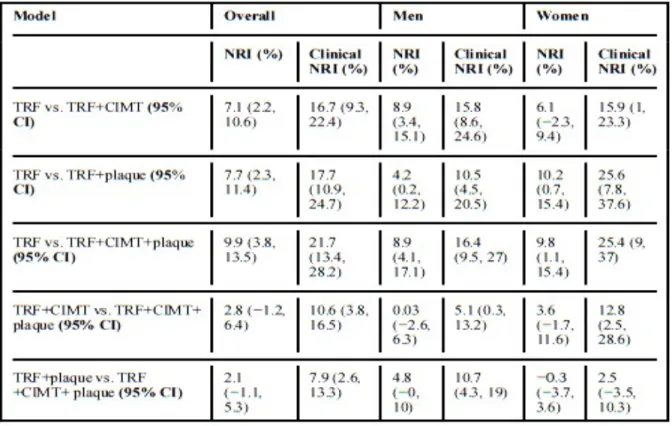
reclassification index of 9.9% in the overall population. However, comparison of TRF and CIMT
and plaque with TRF and CIMT or TRF and plaque only resulted in statistically non-significant
changes of the statistical test.
Conclusions Adding plaque and CIMT to TRF improve CHD risk prediction in the Jackson
Introduction
Cardiovascular disease (CVD) is a major cause of death and disability in developed countries, and increasingly in the developing world as well. Although CVD mortality rates have
declined over the past four decades in the United States, it remains responsible for about one third of all deaths in individuals over 35. (1,2) It has been estimated that one half of all middle aged men and one third of all middle aged women in the United States will develop some manifestation of CVD in their lifetime. (3)
The goal of our paper is to discuss cardiovascular disease prevalence, incidence, established environmental, biological, and demographic risk factors for the development of CVD, and to discuss an available imaging modality and appropriateness of using this modality for primary and secondary prevention of CVD. We will also briefly discuss mortality and temporal trends in this challenging disease that has because a large socioeconomic burden on developed, and now even developing countries.
Later, we will also discuss the use of an imaging modality, measurement of carotid IMT thickness, in a group of selected patients, and if the addition of this imaging data assisted clinicians in the risk prediction when added to traditional risk factor models.
Population based epidemiologic data, such as that from the Framingham Heart Study (8,9), provides the best assessment of the risk factors that contribute to the development of CVD, as well as the way it evolves, progresses, and causes major cardiovascular events. Epidemiologic data also provides critical information regarding targets for the primary and secondary
prevention of CVD.
now the leading global cause of death, accounting for 17.3 million deaths per year, a number that is only expected to grow to over 24 million by 2030. (12)
Economists predict that the cost of not investing in CVD prevention and treatment could amount to as much as $47 trillion worldwide in the next 25 years. This loss is potentially avoidable, as the World Health Organization (WHO) prescribed interventions only cost $11-$13 billion annually (6). As almost 80% of cardiovascular deaths occur in developing countries, the economic consequences will be more severe as well. (figure 1)
Figure 1 Crude Data: Proportion of Deaths Due to CVD by Country Income Level CVD = cardiovascular disease. <ce:source> Source: Sinclair H. CVD Improvements and Challenges of a Global Epidemic; MD Conference Express, November 2010.</ ce:source>
Lawrence J. Laslett , Peter Alagona Jr , Bernard A. Clark III , Joseph P. Drozda Jr , Frances Saldivar , Sean R. W...
The Worldwide Environment of Cardiovascular Disease: Prevalence, Diagnosis, Therapy, and Policy Issues : A Report From the American College of Cardiology
Journal of the American College of Cardiology, Volume 60, Issue 25, Supplement, 2012, S1 - S49
CVD is responsible for 10% of disability adjusted life years (DALY) in developing countries, and for `8% of DALY’s in developed countries (8). This economic loss is worse in developing countries where CVD affects a high proportion of working age adults (9)
Much of the information related to risk of cardiovascular events is developed from national survey data and from observational cohorts. The 2010 Heart Disease and Stroke Statistics update of the American Heart Association reported that 17.6 million people in the US have 10.2 million have coronary heart disease with increasing prevalence with age for both women and men (2). A 2009 report that used NHANES data showed that myocardial infarction
prevalence was significantly greater in men than women between 1988 to 1994 and from 1999 to 2004. (9) However there were trends toward a decrease in men and an increase in women. Databases like NHANES that rely on self reported CV events from health interviews probably underestimate the true burden of CVD. Silent ischemia, which accounts for up to 75% of all ischemic episodes (5) may only be brought to light on an exercise treadmill stress test or other clinical testing.
Data from 44 years of follow up in the original Framingham Study cohort and 20 years of surveillance of their offspring has allowed us to determine the incidence of initial coronary and vascular events (8-10).
31 to 15 percent. Also, smoking as a proportion of the total population declined from 39 to 26 percent.
Many individuals in the general population have one or more risk factors for CVD, and over 90 percent of CV events occur in individuals with at least one risk factor. The absence of major risk factors predicts a much lower risk of CVD.
Atherosclerosis is responsible for almost all cases of CVD. This process begins with fatty streaks that are first seen in adolescence, which progress into plaques in adulthood, and culminate in thrombotic occlusions later in life.
Risk factor assessment is useful in adults to guide therapy and intervention for dyslipidemia, hypertension, diabetes, and other CV risks.
A precise estimate of the prevalence of CVD remains elusive, but the prevalence of identified risk factors has changed over time with increased awareness and changes in diet and lifestyle. A comparison of results from sequential NHANES surveys has shown the prevalence of obesity, defined as BMI greater than 30 kg/m2, increased dramatically in the United States from 15 to 30 percent between 1960 and 2000, with an associated increase in diagnosed diabetes, from 1.8 to 5.0 percent in the total population. In the obese population this change was most prominent (2.9 to 10.1 percent) (19)
These changes are associated with the increases in the use of lipid lowering pharmacologic agents and antihypertensive medications.
Various socioeconomic factors, including where a person lives, his or her education, occupation, and income, or a combination of these, have been associated with an increased risk of CVD, and cardiovascular mortality. (21, 22)
Imaging Techniques
Carotid IMT can be measured in a variety of methods, including MRI and ultrasound, however there is a greater body of experience and data with ultrasound. (12)
Carotid arteries can be visualized at high resolution with B-mode ultrasound using linear array transducers for superficial and vascular structures with frequency ranges between 5 to 15 MHz. The resolution obtained is at 0.44mm laterally and 0.25mm laterally. IMT measurements can then be obtained from the near and far walls from the distal common carotid arteries, the carotid bifurcation, and the proximal internal carotid segments of both the right and left side. CIMT is therefore often a composite of intima media thickness measurements of various segments and angles. (13-15)
For CIMT measurements, longitudinal images of the carotid arteries are obtained in which the leading edges of the lumen-intima and media-adventitia interfaces of the arterial wall represent intima-media complex. Typically normal common carotid CIMT at age 10 is 0.4-0.5mm, while form the fifth decade of life this can progress to 0.8mm, or more. (16,17)
Since the arterial walls are sub millimeter structures, performing these measurements requires expertise and experience, and standardized image acquisition is paramount. Standardized ultrasound equipment and protocols need to be used. Image analysis should be done using standardized protocols.
The indications that have been mentioned for CIMT measurement include screening for
atherosclerosis, risk stratification for future cardiovascular disease related events, and assessment of drug efficacy. (18-21)
who are actually classified as low or intermediate risk. (5) CIMT has also been proposed as a potential tool to aid cardiovascular risk stratification as it compromises a direct measure of atherosclerosis that is associated with future cardiovascular events, and is a safe, inexpensive, and widely available technique (6).
In patients without a history of known cardiovascular disease (CVD), measurements of CIMT of various segments result in modest but statistically significant increases in net reclassification improvement when added to risk estimates based on traditional risk factors or risk models. (18-21). Whether this improvement translates into measurable health benefits has not been established. Numerous prospective epidemiological studies have shown that CIMT is a predictor of future cardiovascular events independent of traditional risk factors. Two systemic reviews and meta analyses have reviewed both the one time and serial use of CIMT for CVD risk prediction (7,8) In the ARIC study of 13,145 participants without known CVD mean IMT of all segments did show an improvement in reclassification of 7.1 percent in all subjects and 16.7 percent in subjects at intermediate risk. (9) The addition of presence of plaque (defined as maximum CMIT>1.5mm) to traditional risk factors increased the net reclassification improvement by 7.7 percent in all subjects and 17.7 percent in subjects at intermediate risk (9).
The 2010 American College of Cardiology /American Heart Association guidelines for the assessment of CVD in asymptomatic adults gives a level IIa recommendation for utilizing CIMT in cardiovascular risk evaluation in intermediate risk patients (5). No further recommendations were made regarding the use of CIMT in low risk patients, high-risk patients, or those with established CVD.
clinical trials, modification of therapy based on CIMT results has not been shown to alter clinical endpoints.
Jackson Heart Study
Ethnic and geographic disparities in cardiovascular disease (CVD) mortality, morbidity and risk factors are well documented. One intersection of ethnic and geographic disparities occurs in Mississippi, where in 2002, African Americans had age-adjusted CVD mortality rates 38% (women) and 88% (men) greater than the national average (7). The Jackson Heart Study (JHS), a community based, observational study of African Americans living in the Jackson, Mississippi statistical metropolitan area, provides an opportunity to study the natural history of CVD in this especially vulnerable population.
The JHS is a large, community-based, observational study whose participants were recruited from urban and rural areas of the three counties from the state of Mississippi (Hinds, Madison and Rankin) that make up the Jackson Miss, metropolitan statistical area (MSA). Participants were enrolled from each of 4 recruitment pools: random, 17%; volunteer, 22%; currently enrolled in the Atherosclerosis Risk in Communities (ARIC) Study, 30% and secondary family members, 31%. Institutional Review Board (IRB) for the Jackson heart Study has been obtained and is currently on file at Jackson State University, and the University of North Carolina IRB approval was deemed to be unnecessary by expedited IRB review.
Ethnic differences were apparent, however, among the individual components of the composite subclinical disease measure: African Americans had significantly lower ankle/brachial blood pressures, significantly greater common carotid artery wall thickness and a higher prevalence of major ECG abnormalities, while white participants had a much higher prevalence of carotid artery stenosis. The JHS provides a unique opportunity to better understand the relationship between important CVD risk factors, the development of subclinical atherosclerosis, and the manifestation of clinical cardiovascular disease events in an ethnic minority population. One widely recognized measure of subclinical atherosclerosis collected during the baseline JHS examination is carotid artery intimal-medial thickness (IMT). Previous studies have consistently shown that CIMT is correlated with traditional CVD risk factors (9, 10, 11) and with both prevalent CVD (19) and incident CVD (13, 19). Importantly, however, although the relationships with prevalent and incident CVD were demonstrated in ethnically diverse cohorts and included statistical adjustment for ethnicity, none of these studies have focused specifically on these relationships in an ethnic minority.
Methods
Recruitment was limited to non-institutionalized adult African Americans 35-84 years old, except in the family cohort where those 21 to 34 years of age were eligible. The final cohort of 5,301 participants includes 6.59% of all African American Jackson MSA residents aged 35-84 (N-76,426, US Census 2000). Major components of each exam include medical history, physical examination, blood/urine analyses and interview questions on areas such as: physical activity; stress, coping and spirituality; racism and discrimination; socioeconomic position; and access to health care. At 12-month intervals after the baseline clinic visit (Exam 1), participants are
events, hospitalizations, and functional status; and obtain additional sociocultural information. Questions about medical events, symptoms of cardiovascular disease and functional status are repeated annually. Ongoing cohort surveillance includes abstraction of medical records and death certificates for relevant International Classification of Diseases (ICD) codes and adjudication of nonfatal events and deaths.
We describe the relationships between the three major carotid ultrasound outcomes available in JHS: average IMT across the common carotid, bifurcation and internal carotid arteries, average common carotid artery IMT, and presence of carotid plaque, and to describe the relationships of each ultrasound outcome to demographic factors including age, gender and SES and also to clinical parameters with established relationships to CVD events. The specific clinical correlates examined include parameters related to the domains of blood pressure, diabetes, lipid
metabolism, obesity, smoking history and renal function.
We excluded individual with prior cardiovascular events, or with missing CVD data, missing C-IMT data, missing information on traditional risk factors for CVD, which provided us with our sample size of 13,741 individuals for the analysis.
The ultrasound procedure, in brief, consists of a GE 3000DISA system and images were recorded and stored on hard drive for archiving purposes.
The C-IMT was assessed in three segments, average IMT across the common carotid,
C-IMT>1.5mm, abnormal plaque shape with protrusion into the lumen, or loss of alignment with adjacent arterial wall boundary, and abnormal wall texture defined as brighter echoes than adjacent boundaries. An average common carotid artery IMT, and presence or absence of carotid plaque also noted on data collection sheets. For the presence or absence of plaque, intra-reader agreement was associated with a Cohen’s kappa coefficient statistic of 0.79 (which measures degree of agreement on a scale of 0 to 1), while the intra-reader agreement was 0.61, which suggests agreement of readers beyond chance. (35)
Incident CVD events included definite or probable myocardial infarction (MI), silent MI between exam 1 and 2 as indicated by electrocardiograms, definite CVD death, or a clinical need for revascularization procedure.
Interviews with next of kin and questionnaires completed by physicians and medical examiners or coroners were used to collect information on deaths, and review and abstraction of hospital records were used to collect information on possible fatal and nonfatal myocardial infarctions (MIs). Events were classified using standardized criteria. (15)
The analyses were then performed in the entire study sample, and then by gender, age, systolic blood pressure, antihypertensive medication use, total cholesterol, high-density lipoprotein cholesterol (HDL-C), diabetes, and smoking status.
reclassification index (NRI), which examines the net effect of adding a marker to the risk
prediction scheme using statistical calculations. NRI and IDI were then calculated for the follow up period and confidence intervals were established. (Table 2)
Results
Discussion
CVD risk prediction models based on traditional risk factors noted in table 1 have formed the basis for the clinical practice of CVD prevention, however they remain far from optimal. Several authors have looked at adding biomarkers to improve cardiovascular risk prediction, and others have even examined utilizing genetic markers. (35)
Imaging tests such as carotid Doppler ultrasound, and coronary calcium scoring offer other options that could be used in improving CVD risk prediction, though there is limited data using statistical methodology that have evaluated whether the addition of imaging studies to risk models can improve CVD risk prediction.
Here we show that in the study population, C-IMT to measure the presence and thickness of plaque can improve CVD risk prediction, especially in specific groups of patients. Plaque presence seemed to have a more profound effect in improving risk prediction if women than men for unclear reasons.
Current guidelines suggest that individuals with a 0-10% predicted 10 year risk are considered low in risk, however evidence has shown even in this group there appears to be spectrum of risk, therefore 5-20% 10 year estimated risk should be considered the intermediate risk group. This was the reason we divided our low risk group into 0-5% and 5-10% estimated risk groups, and it was in this group that our results showed statistical significance.
Conclusions
estimated risk group. The overall improvement in risk prediction appears to be equivalent to other contemporary markers.
In our analyses we show that the mere presence of plaque without any quantification helped improve CVD risk prediction.
In the future, improved imaging technology may enable us to reliably quantify plaque volume, which will likely only further improve our ability to risk stratify CVD.
The strengths of the study include the use of contemporary statistical methodology, the long follow up of our subjects, and the number of incident CVD events accrued over the time period. The study did face limitations as well, as we have not accounted for changes in the risk factors over the time period in the analysis, or changes in the medications used during the time period. However this is similar to any other risk prediction model that has been described. We also did not account for the potential difference between plaque presence in one versus multiple arterial beds. Several individuals had missing C-IMT data, and we cannot determine how that dataset would have impacted the results. Also of clinical importance, there is no reliable clinical data that shows whether treating individuals by this strategy based on the identification of higher risk will prevent incident cardiovascular events though this would be an expected result.
Cardiovascular prevention efforts are receiving growing attention in an effort to offset the increasing burden of CVD, as well as to stem rising healthcare costs by developing strategies to modify risk factors associated with CVD.
We hope that our study will shed further light on this topic by identifying patients that would benefit from further risk stratification and/or treatment. However, further research needs to be done to better determine indeed what patients would further benefit from risk stratification, in order to equitably distribute use of limited resources.
References
1. Greenland P, Alpert JS, Beller GA, et al. 2010 ACCF/AHA guideline for assessment of cardiovascular risk in asymptomatic adults: executive summary: a report of the American College of Cardiology Foundation/American Heart Association Task Force on Practice Guidelines. Circulation 2010; 122:2748.
2. Kaplan GA, Keil JE. Socioeconomic factors and cardiovascular disease: a review of the literature. Circulation 1993; 88:1973.
3. Diez Roux AV, Merkin SS, Arnett D, et al. Neighborhood of residence and incidence of coronary heart disease. N Engl J Med 2001; 345:99.
4. Boehm JK, Peterson C, Kivimaki M, Kubzansky LD. Heart health when life is satisfying: evidence from the Whitehall II cohort study. Eur Heart J 2011; 32:2672.
5. Kivimäki M, Nyberg ST, Batty GD, et al. Job strain as a risk factor for coronary heart disease: a collaborative meta-analysis of individual participant data. Lancet 2012; 380:1491. 6. Virtanen M, Heikkilä K, Jokela M, et al. Long working hours and coronary heart disease: a systematic review and meta-analysis. Am J Epidemiol 2012; 176:586.
7. Virtanen M, Nyberg ST, Batty GD, et al. Perceived job insecurity as a risk factor for incident coronary heart disease: systematic review and meta-analysis. BMJ 2013; 347:f4746. 8. Taylor HA Jr, Wilson JG, Jones DW, Sarpong DF, Srinivasan A, Garrison RJ, Nelson C, Wyatt SB., Toward resolution of cardiovascular health disparities in African Americans: Design and methods of the Jackson Heart Study. Ethnicity and Disease 2005; 15(S6): 4 –17.
10. O'Leary DH, Polak JF, Kronmal RA, Kittner SJ, Tracy R, Gardin JM, et al. Distribution and correlates of sonographically detected carotid artery disease in the Cardiovascular Health Study. Stroke 1992; 23:1752-1760.
11. Tell GS, Evans GW, Folsom AR, Shimakawa T, Carpenter MA, Heiss G, for the ARIC Study investigators. Dietary fat intake and carotid artery wall thickness: the Atherosclerosis Risk in Communities (ARIC) Study. Am J Epidemiol 1994;139:979-989.
12. Howard G, Burke GL, Szklo M, Evans G, Tell G, Eckfeldt J, Heiss G. Active and passive smoking are associated with increased carotid wall thickness: The ARIC study. Arch Intern Med 1994;154:1277-1282.
13. Burke GL, Evans GW, Riley WA, Sharrett AR, Howard G, Barnes RW, Rosamond W, Crow RS, Rautaharju P, Heiss G. Arterial wall thickness is associated with prevalent cardiovascular disease in middle aged adults: the ARIC study. Stroke 1995;26:386-391.
14. Chambless LE, Heiss G, Folsom AR, et al. Association of coronary heart disease incidence with carotid arterial wall thickness and major risk factors: the Atherosclerosis Risk in
Communities (ARIC) Study, 1987-1993. Am J Epidemiol. Sep 15 1997;146(6):483-494. 15. O'Leary DH, Polak JF, Kronmal RA, Manolio TA, Burke GL, Wolfson SK, Jr. Carotid- artery intima and media thickness as a risk factor for myocardial infarction and stroke in older adults. Cardiovascular Health Study Collaborative Research Group. N Engl J Med. Jan 7 1999;340(1):14-22.
16. Bots ML, Hoes AW, Koudstaal PJ, Hofman A, Grobbee DE. Common carotid intima- media thickness and risk of stroke and myocardial infarction: the Rotterdam Study. Circulation. Sep 2 1997;96(5):1432-1437.
intima-media thickness to assess progression and regression of atherosclerosis.
Nat Clin Pract Cardiovasc Med 2008; 5:280.
18. Meuwese MC, de Groot E, Duivenvoorden R, et al. ACAT inhibition and progression of carotid atherosclerosis in patients with familial hypercholesterolemia: the
CAPTIVATE randomized trial. JAMA 2009; 301:1131.
19. Pasternak RC, Abrams J, Greenland P, et al. 34th Bethesda Conference:
Task force #1--Identification of coronary heart disease risk: is there a detection gap?
J Am Coll Cardiol 2003; 41:1863.
20. Akosah KO, Schaper A, Cogbill C, Schoenfeld P. Preventing myocardial infarction in the young adult in the first place: how do the National Cholesterol Education Panel III guidelines perform? J Am Coll Cardiol 2003; 41:1475.
21. Berry JD, Liu K, Folsom AR, et al. Prevalence and progression of subclinical atherosclerosis in younger adults with low short-term but high lifetime estimated risk for cardiovascular disease: the coronary artery risk development in young adults study and multi-ethnic study of atherosclerosis. Circulation 2009; 119:382.
22. Redberg RF, Vogel RA, Criqui MH, et al. 34th Bethesda Conference: Task force #3--What is the spectrum of current and emerging techniques for the noninvasive measurement
of atherosclerosis? J Am Coll Cardiol 2003; 41:1886.
25. Nambi V, Chambless L, Folsom AR, et al. Carotid intima-media thickness and presence or absence of plaque improves prediction of coronary heart disease risk: the ARIC
(Atherosclerosis Risk In Communities) study. J Am Coll Cardiol 2010; 55:1600.
26. Polak JF, Pencina MJ, Pencina KM, et al. Carotid-wall intima-media thickness and cardiovascular events. N Engl J Med 2011; 365:213.
27. Baldassarre D, Hamsten A, Veglia F, et al. Measurements of carotid intima-media thickness and of interadventitia common carotid diameter improve prediction of
cardiovascular events: results of the IMPROVE (Carotid Intima Media Thickness [IMT] and IMT-Progression as Predictors of Vascular Events in a High Risk European Population) study. J Am Coll Cardiol 2012; 60:1489.
28. Tzoulaki I, Liberopoulos G, Ioannidis JP. Assessment of claims of improved prediction beyond the Framingham risk score. JAMA 2009; 302:2345.
29. Mark DB, Shaw LJ, Lauer MS, et al. 34th Bethesda Conference: Task force #5--Is atherosclerosis imaging cost effective? J Am Coll Cardiol 2003; 41:1906.
30. Lorenz MW, Schaefer C, Steinmetz H, Sitzer M. Is carotid intima media thickness useful for individual prediction of cardiovascular risk? Ten-year results from the Carotid Atherosclerosis Progression Study (CAPS). Eur Heart J 2010; 31:2041.
31. Harrell FE, Jr, Lee KL, Mark DB. Multivariable prognostic models: issues in developing models, evaluating assumptions and adequacy, and measuring and reducing errors. Stat Med. 1996;15:361–387.
33. Steyerberg EW, Harrell FE, Jr, Borsboom GJ, Eijkemans MJ, Vergouwe Y, Habbema JD.
Internal validation of predictive models: efficiency of some procedures for logistic regression analysis. J Clin Epidemiol. 2001;54:774–781
34. White AD, Folsom AR, Chambless LE, et al. Community surveillance of coronary heart disease in the Atherosclerosis Risk in Communities (ARIC) Study: methods and initial two years' experience. J Clin Epidemiol. 1996;49:223–233
35. Carletta, jean (1996) Assessing agreement on classification tasks: the kappa statistic. Comptational Linguistics, 22(2), pp.249-254