A
Terry
Chastam
Abstract
As
the Southeastern regionof
theUnited
States continues toexperience increasing levelsof
con-gestion
on
the regionalhighways,
the SoutheastHigh-Speed
Rail corridor presentsan
appealingalternativeto
automobile
travel.The
corridoris slated torunfrom Washington, D.C.
to Charlotte,North
Carolinaand
eventuallyfrom
CharlottetoBirmingham,
Alabama.
The
key
toimplementing
the projectis the privatization
of
operations, amodel
not traditionallyused
forrail intheU.S.With
the Southeastern states
moving
ahead
with theenvironmental impact
statements, the outstandingissues include setting the timeline,
choosing
the operators,and
designing the routes.Introduction
With tremendous economic andpopulationgrowth,the
Southeast needs a
comprehensive,
multimodal
transportationsystem. High-speedrail
(HSR)
servicewill provide business and leisure travelers with a
competitivealternative toairandautofortripsbetween
100 and 500miles.
The Southeast High-SpeedRail Corridor
(SEHSR)
isone offive originally proposed high-speed passenger
rail corridors designated by the U.S. Department of
Transportation
(USDOT)
in 1992.The
corridorwas
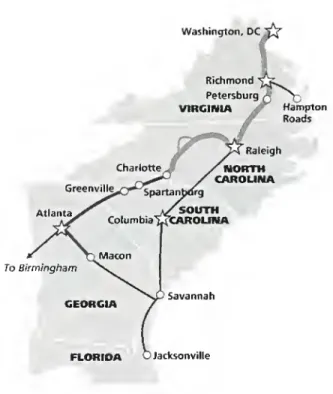
designated to run from Washington. D.C. through Richmond,
VA
and endinginCharlotte.NC
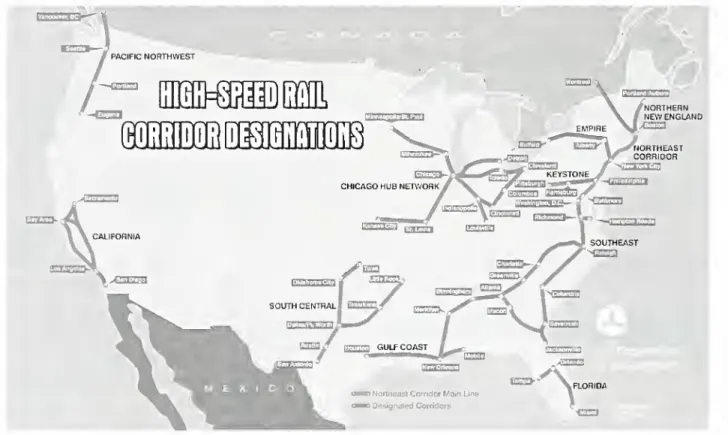
Itispartofan overall plan toextend servicefrom the existing
(
ACELA.
orAmtrak)high-speedrailontheNortheastCorridor (Boston to Washington) to points in the
Southeast (see Figure 1 ).
High-speedrailintheSoutheastwill
mean
a topspeed of110mph
andaveragespeedsbetween85to87mph.Virginia,NorthCarolina.SouthCarolina,andGeorgia
havejoined togetherwiththebusinesscommunitiesjx*.
eachstatetoformafour-statecoalitiontoplan,develop andimplementhigh-speedrail intheSoutheast. Under
the current plan, the
system
will bedeveloped
incrementally, upgrading existing rail rights-of-way.
PortionsoftheWashington-Charlotte
SEHSR
corridorcould be completed by 2010. depending on funding
availability.
The Need
forHigh-Speed
RailA
regionalapproachtotransportation willhelpstatesintheSoutheastern region to
meet
the challengesofTern" Chastam istheExecutiveDirector ottheSoutheastern
EconomicAlliance,acoalitionof14chamberstromacrosssix
Southeastern states thatrepresents business leaders in cities
locatedon or nearthe FederallydesignatedSoutheast
High-speedRailCorridortromAtlantato Charlotte.
growth, whileimprovingairquality.
The
highwaysofthe region and the airports along the Eastern
seaboard simply cannot handle the present traffic
volumes,letalone
accommodate
futuretravelneeds.The
South has the highestpercapita vehicle milestraveled ' and ranks second in carbon
monoxide
emissions
(USDOT,
2001). RecentfiguresfromtheUSDOT
reveal thegrowing
transportationneedsofthe Southeastern states.
As
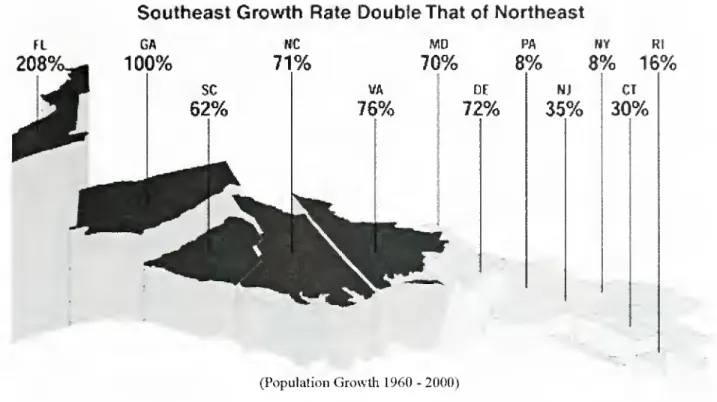
implied in Figure 2,traffic
congestion
on urban freeways
in theSoutheastern region isexpected to increaseby
400
percentby
2020
(SoutheastHigh-SpeedRail,2003).centers. Refurbished and
expanded
stations couldbe transformedintomixed-usefacilities,and
SEHSR
could also encourage significant public/private
investments.
Compared
to air travel under three hundred miles.HSR
hasmany
advantages. First,most
airports arelocatedmiles
away
fromcitycenters,whereasHSR
could connectdirectly to
downtown
areas. Second,a business traveler could
make
use ofelectronicequipment(cellphones,laptops,etc.)the entiretrip,
thus
providing
anopportunity
for increasedEESJEja-—
l:l.'I.'.IV
2522E23-*
NORTHERN
NEWENGLAND
IORTHEAST
CORRIDOR
^.m,1 ..rem
Figure 1. High-speed rail corridordestinations.
Image
courtesyof
Terry Chastain.Meanwhile, $4.5 billion must be spent
on
roads toaccommodate
existing levels ofcongestion.From
aneconomic development
perspective,SEHSR
could facilitate urban revitalizationby
bringing
more
travelers directly todowntown
productivity. Third,
HSR
could arguably be lessNtivssliilih,inthean experience giventoday's current
security situation.
As
congestion continues to increase along majorSoutheast
Growth
Rate
Double
That
of
Northeast
MO
70%
nr
72%
(PopulationGrowth1960-2000)
PA
8%
35%
NY Kl
8%
16%
CT
30%
Figure2.Southeast
growth
ratesand
implicationsfortrafficcongestion.Image
courtesyof
TerryChastain.continuetoimproveincomparisontodrivingtimes.
The
intercitybusinesstravelerchoosingtheautofortransportation willoftenhavetocompensateforthe
unpredictable natureofinterstatecongestiondueto
accidents, construction, or
volume
byleavingearlierthan otherwise necessary.
High-speed rail will allowfortime-efficient travel
between
cities in the Southeast (see Figure 3).Assuming
only an average speed of75mph
and a45 minutecheckinallowance,
HSR
fromRichmond
toWashington
would
bealittleovertwo
hours;four andahalfhoursfromRaleightoWashington;threehours from Charlotte to Raleigh; four hours from Atlanta to Charlotte;
two
hoursand
forty-fiveminutes fromAtlanta toGreenville; and
two
hoursandforty-fiveminutesfrom
Birmingham
toAtlanta(seeFigure 3).
A New
BusinessModel
forHigh-Speed
RailThis
new
model
calls for the privatizationof
operations, user, and marketdriven route planning,
and changesinfunding,withafocusonrapid service
to major population and financial centers with a
minimum
ofstops. ;Currently.
Amtrak
operatesallpassengerrailservicein the Southeast. Amtrak.
known
officially as theNational Railroad Passenger Corporation, began
servicein 1971. Itsroute
map
andbudgetaresubjectto Congressional oversight
and
appropriations,which
could be described as too little to allowsuccess and too
much
to force insolvency.Few
routes turn an operating profit, and in fact
most
routes operate in the red to a shocking degree.
SEHSR.
however, will benefit from competitionExample
Routes
Chattanooga-Atlanta
Birmingham-Atlanta
Atlanta-Greenville
Atlanta-Charlotte
Charlotte-Raleigh
Raleigh-Washington
Richmond-Washington
Travel
time
!h
58m-2hl9m
2h3Pm
3h0rh
TilpTimeloBusinessDestination
Road
Air
High-SpeedRail
3h IQjn
2hJ4m
2h 45m >
3PT
2b_4Sm
Hn
?h ji'n
4h 10m
3h 54ml
zh NJm
3h~5r)i
?h Stun
4h
7m
1|h
46m
J2H
3h Ori
4-i I'm
Improvedreliability,
abilityto use laptops
&
cellphones,coupled with spacious seating resultsin
more
efficient useoftime
J
_m
Figure3. Travelsavings forhigh-speed rail users.
Image
courtestyof
Terry Chastain.the profitable routes andstops ratherthan havethe
government
choose them.The
Alliance'smodel
proposes that the operatorchoose theroutesand stops,
which
will be dictatedby
demand.
As
opposed tothe current system,theoperator will not be forced to run on unprofitable
routes or
make
stopswhicharecounter-productive.Also,thetargeted ridersoftheAlliance'smodelare
time-sensitive to business persons and short-haul
leisure travelers.
Finally, the Alliance's
model
calls fora change infunding.
Under
theSEHSR
proposal, the Federalgovernment
willmake
the initial investment ininfrastructure for
SEHSR,
while operational costswill be maintainedby the operator.
Cost
The
Alliance'smodel
estimates that totalconstruction of the first phase of
SEHSR,
from
Washington.
D.C. toBirmingham,
would
costapproximately S5.5 billion dollars. Initial studies
indicate tickets will costabout20-22centsper mile
(basedon calculated
demand
forthe service). This compares to air travel at 22-75 cents per mile andauto travelat 30-35 centspermile.
The
U.S.Department ofTransportation,inreviewingthe high-speed rail plans for23 states,
came
to theconclusion thatthe
SEHSR
routewill producemore
revenue than any other proposed corridor. It isestimatedthatitwillgenerateS2.54inpublic benefits
foreachdollarspenttobuildandoperatethecorridor.
SEHSR
is the only proposed corridor projected toGrowing
Support
forHigh-Speed
Rail in theSoutheast
Numerous
studies eonducted to date reveal thebenefitsofahigh-speedrailserviceintheSoutheast.
Accordingtoa
USDOT
study,High-SpeedGround
Transportation for
America
', the Southeast is thebestinvestmentfor
new
high-speedrailservice.The
reportconcluded
that, as an extensionof
theNortheastCorridor.
SEHSR
operatedatatop speedof 110
mph
will "generatemore
revenue than anyother" proposed expansion.
The
ratio of publicbenefitstopubliccostsis27 timesgreaterthanany
other corridor.
The
average tripwould
be longerand generate
more
revenue than any other route.SEHSR
willalsoprovideeconomic
benefitsbothtoSoutheaststatesandtheNortheastCorridor sinceit
"would
increase traffic levels on the NortheastCorridoritself...thuscreating synergistic ridership.
revenue, expense, and
income
effects" for bothregions.
North Carolina
hascompleted
an
extensiveeconomic
development study on the impact oftheconstruction and operation of
SEHSR
(SoutheastHigh-Speed
Rail Cooridor. 1999).The
project isexpected to generate
S700
million innew
taxes;approximatelyS10.5billioninemployee
wages
over20 years; over 31,000
new
one-year jobsfrom
construction;over800 permanentrailroadoperating
positions; and nearly 19.000 permanent full-time
jobs
from
businesseswhich
choose to locate or expand in thestateas aresultofSEHSR.
In addition. North Carolina. Georgia, and South
Carolinahaverecentlycompleteda
HSR
feasibilitystudy
from
Macon
to Charlotte, via Atlanta.Greenville, andSpartanburg.
The
reportconcludedthat
HSR
trains are feasible in the corridor.Now,
thestatesareinnegotiationswith Norfolk Southern-the railroad
company
thatowns
the line-
for adetailed capacity study tosee
how
implementationof
SEHSR
would
impact thecompany's
freightbusiness. Followingthat, the states arecommitted
tobeginning
work
onaTierIEnvironmental ImpactStatement (EIS) alongthe route.
Key
Advances
Virginiais
making
great strides to
extend
SEHSR
from
Washington
to
Richmond
(seeFigure4. Existing Rail Figure 4).
A
totalStatjon
m
Ashland
,V
A.of S21 million in Source: TimetoAct (South-funds
have been
eastHigh-Speed
RailCooridor, 2003).
committed
torinfrastructure
improvements
along
the line.Agreement
hasbeenreached with the railroadsanda timetable for constructionhas been set.
The
Cityof
Richmond
has recentlycompleted a S50millionrenovationandconversionofthe
Main
StreetStationinto amultimodal facilityinanticipationofservice
in the nearfuture.
For S71million.NorthCarolinapurchasedtheNorth
Carolina Railroad,
which
owns
the Raleigh toCharlotte section of
SEHSR.
The
state is also innegotiations with
CSX
topurchasethe railroadlinefromRaleightotheVirginiaborder. NorthCarolina
has also spent close to SI00 million ofstate and Federal funds to refurbish
and
reconstruct railIn2000.NorthCarolinaandVirginiapreparedaTier
I EIS,
examined
theneedforthe projeet,andlookedat potential impacts
on
both naturaland
builtenvironments along nine possible routes. Public
involvement
was
critical during this phase with26public information
workshops
and
18 publichearings that solicited feedback about the project.
Citizens, political leaders, planners, resource
agencies, railroad officials, and other interested
parties
were
among
themany
participants of theworkshops
and hearings.The
Final EIS,whichoutlineswhy
therecommended
alternative
was
selected,was
completedinJune2002and a formal
Record
of Decisionwas
issued inOctober2002. This Federal
document
confirmsandapprovesthecorridor
recommendation
by theTierIEIS. Virginia
and North Carolina
arenow
proceeding with the next phase. Tier II,
which
providesa detailed analysisontheimpacts,including
track location, station arrangement, and detailed
design. Rather thana single largedocument,smaller
TierIIenvironmental studies willbe conducted for
specificsegments oftheroute
where
trackwork
willbeneeded.
The document
should be available forpublic review in early 2005. At that time, public
hearingswillbe heldalongtheaffected corridor. In
2005, the final Tier II
EIS
isexpected
to becompleted andtheRecord ofDecision obtained for
thePetersburgtoRaleighsegment. Right-of-wayand permitacquisitioncan beginatthat time.
remainder
of theSEHSR
intoSouth
Carolina.Georgiaand Florida will follow by several years. 4
Conclusion
Leaders in
North
Carolinaand
Virginiahave
committed a great deal ofpolitical and financial
capital into laying the foundation for the futureof
SEHSR.
Georgia,SouthCarolina,andAlabama
arethemselves
becoming
convinced that theSEHSR
will be operational at least
from
Washington
toCharlotte in the foreseeable future and have thus
began
preparations for future extensionsfrom
Charlotte to
Birmingham
(see Figure5).Washington.DC
-fa
Richmond"^S^ Petersburg/J
^^
RGIN1A Hampton
Roads
Charlotte
6rMnv
'JJ>Cr
£
spartan)*fr'gAtlanta.
Raleigh
NORTH
CAROLINAToBirmingham
FLORIDA
Savannah
Jacksonville
The
Washington, D.C. to Charlotte portion oftheSEHSR
corridor could be implemented by 2010,depending
upon funding
availability. In themeantime, other projects will reduce travel time
within the next few years. Implementation ofthe
Figure 5.Possible routeforhigh-speed railline
A
Business
Case
forSoutheast
High-Speed
Rail 31The
eventual completion oftheSEHSR
corridorisinevitable due to the commercial viability of the
trainsthemselves,theregion'scontinued population growth and environmental challenges.
The main
questionsthatremainare:
when
willitbebuilt;who
willoperate it; and
where
will theroutes andstopsbe located?
Endnotes
1. Regional miles per capita:
South
—
11,057;Midwest—
9,812;West—
9,806.Northeast—
8.218.Source:
from
website
http://
www.southeastalliance.com/files/businesscase2-28-03.pdf
About
the AllianceFormed
in2000,
the SoutheasternEconomic
Alliance (Alliance)is a coalitionof15chambers of
commerce
from
6 states: Atlanta,Birmingham,
Charlotte. Charleston. Chattanooga.
Columbia,
Greensboro, Greenville,
Hampton
Roads,Macon,
Raleigh.
Richmond,
Savannah, Spartanburg, andWinston-Salem.
The
Alliance recognizes thatimplementation ofthe Southeast High-Speed Rail
(SEHSR)
corridorwould
efficiently link businesscenters in order for the Southeast to
compete
inglobalandregionaleconomicmarkets.
The
Alliancedoesnot select routes, arenotrailtechnical experts,
andis not linkedto Amtrak.
2. For
more
detailon
the business model, seewww.southeastalliance.com.
3.
For
acopy
of the report, see: http://www.fra.dot.gov/us/content/515. This study
focusedontheWashingtontoCharlotteleg,because
Charlotteto
Birmingham
has yet tobedesignated aHSR
corridor.4.
For
amore
detailchronology,
see http://www.sehsr.org/history.html.
References
Southeast High-SpeedRailCorridor.
A
TimetoAct.1999. Available online at http://www.sehsr.org/ reports/time2act/time2act.html. accessed January
2005.
SoutheastHigh-SpeedRail Corridor.
A
TimetoAct.(updated) October2003. Available onlineat http:
www.sehsr.org/reports/TimeAct%204page.pdf.
accessedJanuary2005.