György Polczer. Redesigning the University of North Carolina Herbarium Flora of the Southeast Website and Database to Allow for Multiple Taxonomical Authorities and Their Versioning. A Master’s Paper for the M.S. in IS degree. April, 2009. 39 pages. Advisor: Jane Greenberg.
Proper classification of specimens is vital for electronic repositories that maintain
information about biological subjects. Using multiple taxonomic authorities’ concepts to classify specimens and identify flora information creates ambiguities during the handling of the records. The University of North Carolina Herbarium Flora of the Southeast website faces the same challenges as it is providing its users flora distribution information from multiple data sources. This paper presents the research and development work conducted to re-design the Flora of the Southeast website and its databases to allow for the use of multiple taxon authorities with their versioning with minimal ambiguity. The results support a design that recommends the databases to be built upon standards-based schemas and to be utilizing both the VegBank XML and TDWG’s Taxonomic Concept Transfer Schema as guidelines.
Headings: Database design Plants -- Classification Web databases
REDESIGNING THE UNIVERSITY OF NORTH CAROLINA HERBARIUM FLORA OF THE SOUTHEAST WEBSITE AND DATABASE TO ALLOW FOR MULTIPLE
TAXONOMICAL AUTHORITIES AND THEIR VERSIONING
by György Polczer
A Master’s paper submitted to the faculty of the School of Information and Library Science of the University of North Carolina at Chapel Hill
in partial fulfillment of the requirements for the degree of Master of Science in
Information Science.
Chapel Hill, North Carolina April 2009
Approved by
Introduction
We maintain already an unimaginable amount of information from all aspects of our lives, and this amount continues to increase daily. We can not manage this vast amount of information and associated repositories without the structured organization and classification of the information and the objects they are associated with. This holds for many disciplines, and it is especially true for biological sciences. Structuring and classifying information is necessary for referencing biological entities. This activity would be relatively simple if everyone used one single classification system that was managed centrally. Unfortunately, this is not the case. There are many classifications in use for the same biological systems, and they change over time.
When biologists work with biological terms or taxas, they need to know exactly which or whose taxonomy scheme it is based on to know for sure what the terms are referencing. Users of the University of North Carolina Herbarium (NCU) Flora of the Southeast website (Herbarium) have to face the same challenge. When they look up a biological term, it may include different species based on different taxonomies and their time of reference. Could the appropriate design for a new underlying database and user interface allow for multiple taxonomical authorities and their versioning for the Flora of the Southeast website? What procedure should be followed for the design and
organized as follows. The next section provides a description of the problem of working with multiple taxonomic authorities in biology specimen information collections.
Following this, the paper presents the objectives of the re-design process. Then the methodology for the project progress is presented, followed by the discussion of the project results. The final part of the paper includes the conclusions about the project.
Background and Status
The classification of objects is not a new invention. People have been naming and classifying things scientifically since the eighteenth century (Knapp 2009).
Taxonomy is the practice and science of classification and uses taxonomic units, known as taxa (McKelvey 1982). More specifically, the “science of taxonomy and systematics involves classifying organisms according to natural and evolutionary relationships” and “identifying and naming species and organizing them into systems of classification” (Natural). This is where classification becomes so crucial in biological sciences. For example, Linnaean taxonomy offers a classification hierarchy for organisms.
views on how they should be done. Although, they might use the same terms or taxonomic names, they might not use them for the same taxonomic concepts. In other words, the different taxonomic concepts referenced by the same name might not include the same organisms based on different authorities’ decisions. A taxonomic concept is specified by Franz et al. (2008) as an “underlying meaning, or referential extension, of a scientific name as stated by a particular author in a particular publication. This approach connects taxonomic concepts to specifications through references in publications. It is sort of like prototype theory for the organism names, but the prototype is a specific publication by an author.
These taxonomic concepts are specific to these publications and authors. Without specifying who and where referenced this concepts by the specific taxonomic name, we will not know its precise meaning. Thus, a collection of information referenced with only one taxonomic scheme will only be able to give proper results if used with only the taxonomic concepts and names of that scheme. For example, two different collectors will not be able to use both of their own taxonomic names for the same collection, only the one it has been classified by. They have to reference the appropriate taxonomic names by the authority’s scheme. Geoffroy & Berendsohn (2003) discussed the same taxonomic name problem in their paper “The concept problem in taxonomy”. They state that problems arise from the same taxon concept being represented by multiple names, and the same taxon names referencing multiple taxon concepts by different schemes.
Franz et al. (2008) explore a similar ambiguity resulting from taxon name collisions in multiple taxon authorities. In their example, researchers try to find all records of a possible species in a geographic area. There might be two possible
discrepancies from name collisions. Some records might be under a different name that would be included under a different scheme. Also, the taxon name in use might include records that would be categorized under a different name by other authorities. These two glitches could alter the final number of records resulted from a search, thus, making the outcome faulty. In all these cases, even if the classification process was perfect under one taxonomic scheme and authority, the problems will exist until the mapping of all the scheme authorities among all entries for taxon names and concepts will be accomplished.
Biological sciences are not the only to face this challenge. In information and library science, the same problem of the use of multiple names by different authorities for the same item exists also. In cataloguing, authority control is used to identify the
authorized concept to be used as the main term to attempt to resolve this problem. All other names are designated as synonyms or lead-in terms to link information on the target person, place or topic together (Calhoun 1998).
The SEFlora web site provides information about the collection records, their ecology and geographic distribution of the vascular flora of the region. The SEFlora site also provides taxonomic concepts of the flora records (Herbarium). Presently, all
“external” taxon concepts are mapped onto the taxonomic scheme of Weakley 2006. These mappings and relationships are viewed for the users on the result pages. “Weakley 2006 includes all vascular plant taxa known for Virginia, North Carolina, South Carolina, and Georgia (the primary flora area), all species known for a secondary flora area
consisting of the adjoining states of Alabama, Mississippi, Tennessee, Kentucky, West Virginia, the District of Columbia, Maryland, and Delaware, and portions of the additional states of New Jersey (southern New Jersey), Louisiana (the Florida Parishes being those east of the Mississippi River), and Florida (the Panhandle and northeastern Florida)” (Herbarium). Weakley 2006’s thorough classification of the southeastern region’s flora, it was an appropriate scheme to be the central taxon to be mapped to. For all other authorities’ taxon concepts are mapped to the Weakley 2006, some of the concepts are simplified where the original concepts was narrower than Weakley’s. This is one of the main reasons for the need for a more robust and comprehensive management of taxonomic information.
of North Carolina Herbarium (NCU), the North Carolina Botanical Garden, the
University of North Carolina Curriculum in Ecology and the Carolina Vegetation Survey (CVS) (Herbarium).
Presently, in the SEFlora system, there are multiple databases and their tables are not coherent. The actual records and management data have to be separated and have to be better organized. Multiple databases and tables with the same purpose have to be joined together into as few tables as it is most logical. Multi-directional taxon concept mapping needs to be implemented, so, all concepts are mapped to all other concepts and not just to one central one to maintain concept specificity and fine details. Taxon concept versioning needs to be implemented to keep up with the ever-changing taxon concept changes. Versioning and concept history will allow for searching for a concept within a specific authority and time frame.
Without a standardized taxon entry management it would be hard to maintain a large amount of concept mappings and would be almost impossible to allow for simple taxon information import for the system later. The user interface also needs to be updated to allow for the new features of the system. The search needs to allow for multiple taxon authorities’ concepts and for the identification of a time period of the taxon concept being valid.
Furthermore, for the near future, some additional features desired. For
time or in a cashed mode. Another possibility is to develop an automated mapping system of taxon information and actual data records to be imported into a cashing database for faster searches of all records from multiple databases. The more standard-based the system the smoother the interactions will be among its components or with external sources. This approach would also better allow for presently unknown features and needs of the system. This master's paper addresses these challenges through research and development on the University of North Carolina Herbarium Flora of the Southeast system.
Objectives
The above review of the literature speaks to a key issue that mapping multiple taxon authority schemes to all data has emerged as an essential feature of the NCU Flora of the Southeast system. The goal of this master’s paper work is to address this challenge and to develop a fully featured multi-directional mapping requires the entire present database to be re-designed and re-structured. As part of this goal, the proposed work includes the following changes required operations:
1. A general clean-up of the databases
2. Join multiple local databases to include unified records, but factor out logically autonomic information
5. Standardize taxon info
6. Upgrade the user interface to allow multiple authorities and versioning searches
Methodology
To address these challenges and to accomplish the proposed objectives, I have pursued the following actions. After I familiarized myself with the present SEFlora system as described earlier, I have met numerous times with the development team to further understand the system content and discuss desired features for the system. With a better understanding of the content, I decided to examine the problem from both present and future content and features perspective. The content analysis lead me to the decision that simple expansion of the SEFlora database was not going to be sufficient to achieve all goals, but besides making changes in the web application coding, the database had to be re-designed. To accomplish these I created the above six action steps for objectives. The present system accomplishes the original goals of offering a unified interface for these various databases and limited taxon relationship information based on Weakley 2006, however, for the future expandability and more complete records information the system needs to be redesigned from its foundation. Some of the design steps are very straightforward, but others need thorough analysis. To unify the different records
similar efforts. To begin, I looked at some similar systems and their proposed solutions to our problems along with literature I found about the subject. I did this mostly by
analyzing database schemas and table relationships implemented by comparable systems. Different systems address the ambiguity problem about multiple taxon authorities various ways. They all attempt to solve this problem by finding a way to specify the origin of the taxon concept as clearly as possible. They might not try to find relationships among the different concepts, but they try to make sure that the concept is used as its author intended it. Thus, identifying the taxonomic authority of the concept is always the first step.
The Hierarchical Classification System (HICLAS) by Zhong et al. (1999), although somewhat earlier, seems to use a very similar organizing arrangement. They use something that is similar to the above mentioned Assertion, but they refer to it as Taxon View. The Taxon View is a four-element specification that includes a taxon name, an author or authority, a year and a publication number. Although, the HICLAS classification is much stricter on its allowed publication or source references, but the main theory behind their model is very similar to the Taxonomer (Lee 2004).
Franz et al. are more interested in finding a solution to taxon concept and name ambiguity through the relationships among these. They identified five basic relationship types that may connect taxon concepts of different origins. These relationships have foundations in set theory (Franz 2008). The possible relationships are:
• One taxon concept is equal to another (=)
• The concept on the right side is included in the one on the left (>)
• The concept on the right side includes the one on the left (<)
• The two concepts overlap (>< or |)
• Relationship is uncertain (?)
Through these relationships, Franz et al. hopes to eliminate the uncertainty that routed in using a different taxon concept than the original. I found Franz et al.’s approach to maintain manageable multiple taxon authorities through relationships appealing, since, the present SEFlora system had relationship in place to some extent.
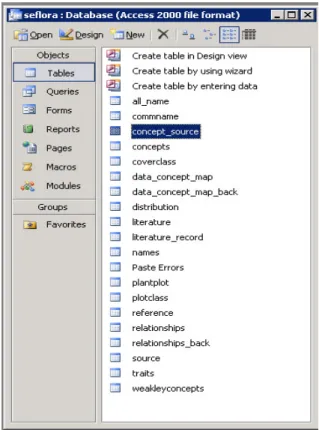
The present SEFlora system shows various similarities with the VegBank model, although, its taxon support is not as robust. Based on the similarities I found between these two systems I decided that the VegBank schema will be appropriate as a guide for my database design process. To start my database design, I took a more detailed look at the present SEFlora databases. I found, that there is not one central database that holds all key information, but the SEFlora site gets its information from two distinct databases. The operational or management information is stored in an MS Access database, which also stores the data collected by the Carolina Vegetation Survey in two separate database tables. The rest of the actual flora records come from the MS SQL based Specify
relational database maintained by NCU. Specify maintains the electronic information mainly for the UNC Herbarium’s specimens, but external entities also use the database (NCSU Herbarium).
PlotClass PlantPlot
plot_id plantName class_id family
plot_id
coverage
Table 1. Plot information in the SEFlora DB
Figure 2. Tables of the SEFlora MS Access Database
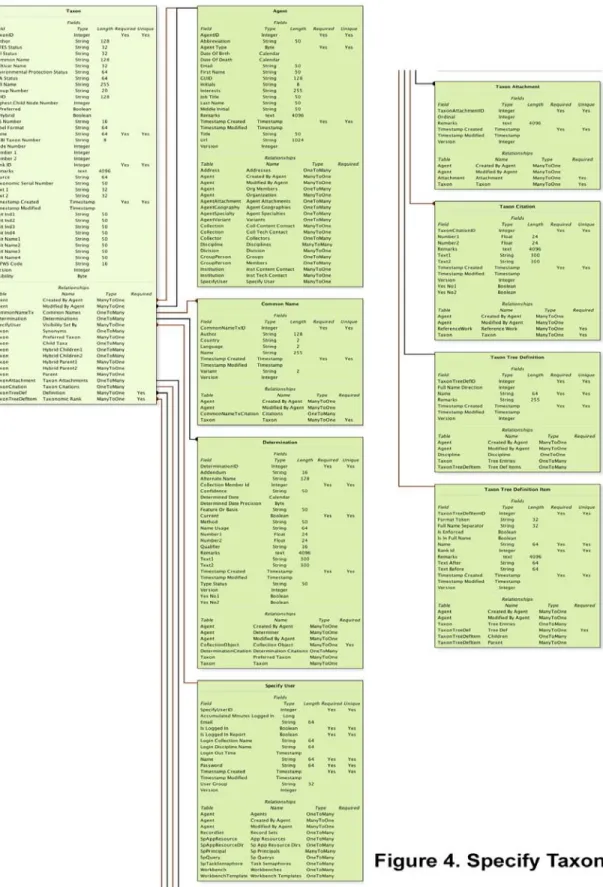
The tables in Figure 4 carry out the following functions (Specify 6):
• Taxon: Describes the taxonomy of a Determination.
• Taxon Attachment: Refers to an attachment and provides order.
• Taxon Citation: Linkage from the Taxonomic record to a published
document.
• Taxon Tree Definition: Defines the levels of the tree.
• Taxon Tree Definition Item: Describes a level in the definition of the
tree.
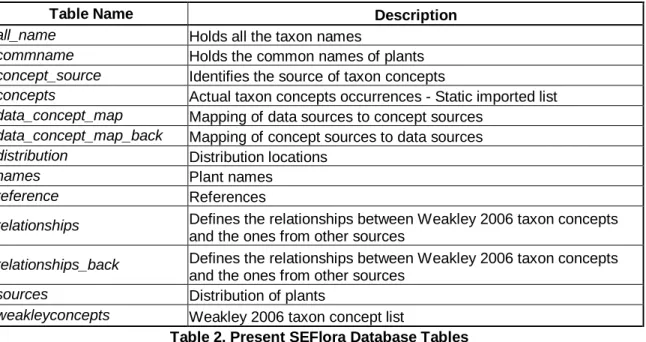
Although, the present SEFlora database handles taxonomic information somewhat differently, but I decided that making some changes to make SEFlora more compatible with the Specify database is something to take into account. Table 2 explains the present tables used for taxa processing and their functions. Some of the table names are
somewhat misleading, but their description should clear up these ambiguities. The database maintains ids for each entity to be able to refer to entries through them. For example, concepts are always referred to by concept ids.
Table Name Description all_name Holds all the taxon names
commname Holds the common names of plants concept_source Identifies the source of taxon concepts
concepts Actual taxon concepts occurrences - Static imported list data_concept_map Mapping of data sources to concept sources
data_concept_map_back Mapping of concept sources to data sources distribution Distribution locations
names Plant names
reference References
relationships Defines the relationships between Weakley 2006 taxon concepts and the ones from other sources
relationships_back Defines the relationships between Weakley 2006 taxon concepts and the ones from other sources
sources Distribution of plants
weakleyconcepts Weakley 2006 taxon concept list
Table 2. Present SEFlora Database Tables
The concept_source table maintains a short name and a full name for each
concept source or taxonomic authority, which can be referenced by the assigned ids from other tables as foreign keys. Data_concept_map assists with the concept identification during data import form pre-specified data sources. Some sources always use the same taxonomic authority scheme, so, a direct mapping can be applied to them. For example, data records from the USDA will always use Kartesz 1999 taxon authority. The
For the present SEFlora system, only Specify and the plot tables provide flora information, but there is a definite hope to build a more streamlined and standardized interaction with databases to be allow to access other external data sources. I believe with a more modularized structure, the SEFlora application could use various databases with the appropriate interfaces (Specify). Presently, the application has hardcoded routines that query either the MS SQL-based Specify or the MS Access SEFlora
database, but with adjustable modules practically any database connection may be created in the new system.
The present SEFlora system makes use of an assortment of technology resources. As mentioned earlier, the database backend utilizes Microsoft SQL 2006 and Access. The users access the SEFlora system through a web interface. The web or http server is Microsoft IIS with the open source Apache Tomcat to allow the running of Java Servlet and JSP applications. The ArcGIS software provides the processing and viewing of GIS plot information. All these server applications run on a Windows 2003 Server operating system. The scripting and programming languages used are html, SQL and Java (Servlet and JSP). The server software architecture seems appropriate for the goals of re-designed system, so, I decide to keep them in place.
concept specific relationships between Weakley 2006 and other taxonomic authorities (Figure 6).
Figure 5. Results of a SEFlora search
In the present application, the QueryRelationship Java code processes the query of the database for relationship entries and computes the relationships using the relationship symbols from the database entries. Even though the SEFlora application views and handle these relationships efficiently, a I found that a new design for the databases and for the application code is needed to accomplish the updated functionality requirements and implement new desired services as they were described in the Objectives section.
To accomplish these changes I recommend the execution of a seven step action plan to take place. These steps will most likely affect each others depending on their final implementation forms, but my recommended high level guidelines for their realization and the plan steps follow.
1. Unifying databases
2. Factoring plot data (flora distribution) out from the central SEFlora database
3. Design a new database schema that allows for multiple taxonomic sources (authorities) and their versioning
4. Optimizing the database schema for future system improvements 5. Adjusting Java code to query new databases
6. Adjusting Java code to handle querying of multiple sources (authorities) and their versioning
7. Revising web-based user interface to allow for searching in multiple taxonomic sources (authorities) and their versioning
can be maintained on the present MS SQL 2006 server that is housed on the Herbarium server along with SEFlora. This SWL server already stores the NCU Specify system, so, it is a convenient location for all others also. This should allow fast and simple access to all databases from the SEFlora application. Figure 7 illustrates the recommended
architecture for database management.
In Step 2, plot and flora distribution data should receive its own database. All CVS distribution records and non-management information should be factored out into tables that allow for easy updating detached form SEFlora administration. These tables should be designed to be easy to handle along with NCU Specify data. Figure 8
PlantObservation Plot ObservationID
Common Name
ObsStartDate N hasObservation 1
hasTaxon N 1 TaxonConcept PlotID Longitude Latitude Area
Figure 8. CVS Database ER
ObsEndDate Coverage Place PlaceID PlaceName NamedPlace NamedPlaceID hasName N 1 hasPlot N 1
For this project, the most significant change in the SEFlora system is step 3, the design changes to allow for multiple taxonomy sources or authorities and their
versioning. The present system already handles multiple authorities, but they only reference one central authority in their relationships, which is Weakley 2006. The taxon concepts already list their authors and the publication information with publication dates in them, but this does not permit for a simple per authority and year querying of the taxon data. The design recommendation for taxon management in the SEFlora database
Each taxon concept should also have a reference to a taxon source entry with a short name, a full name, a start year and an end year for that authority, at least. This way of versioning of the taxon sources allow for a clear beginning and ending time for the period that specific taxon source to be valid and in use. For example, Weakley 2006 might become short name Weakley 2006, long name: Flora of the Carolinas, Virginia, Georgia, and surrounding areas 2006, start year: 2006 and end year 2006, for Dr. Alan Weakley revising his taxon scheme on a yearly basis. Figure 9 shows the proposed taxon management and its tables for the SEFlora database.
TaxonConcept Taxon Source TaxonID SourceName TaxonName hasConcept N 1 TaxonSourceID EndYear StartYear
Figure 9. SEFlora Taxon Tables
Family
NCCode Common
Name
distribution records have to reference a specific taxon source along with their data source. Relationships have to be represented in a way that it allows for real bidirectional
connection between concepts in different authority schemes. Every taxon concept needs a relationship specified with all other authority schemes. For instance, Kartesz 1999 concepts have to have relationships specified to all other maintained authorities, and not only with Weakley 2006. This way, true bidirectional connections are implemented, where there is no ambiguity going from a concept specified in Kartesz 1999 to Boufford 2005. With the present system, firs going to Weakley 2006 and than finding the Weakley concept’s relationship to Boufford 2005 may introduce ambiguity, unless the concepts are identical throughout the three authorities. Figure 10 offers a solution to maintain these relationships in the SEFlora Relationships table.
Relationship Taxon Source RelationshipID Relationship hasSource1 N 1
Figure 10. SEFlora Relationship Table
To prevent from having to re-design the SEFlora database schema again in the near future, the schema should have built-in support of future features and additions as in proposed in step 4. The best way to attempt this hard to achieve goal is to try to
The Biodiversity Information Standards (TDWG), or previously called
for exchanging taxonomic information and was specifically designed to be used with specimen records for biological collections. The Taxonomic Concept Transfer Schema provides the means to transfer taxonomic information using a wide-known and respected standard. Figure 13 shows an XML example based on the Taxonomic Concept Transfer Schema (Hyam 2007).
These XML standards (VegBank and TWDG Taxonomic Concept Transfer Schema) can be utilized to make the SEFlora database more prepared for future
As the SEFlora databases went through some serious structural changes, the SEFlora application has to be adjusted also. During step 5, the Java code needs to be altered, so, the application could access and query the new databases. This step should not be terribly difficult, since the present system already has a module that reads NCU Specify data from the MS SQL server. The taxon and plot data routines have to be modified to read the SQL server instead of the Access database.
Somewhat more challenging step 6 is, where the Java code needs to be changed to access the re-designed database tables, especially the taxon and relationships data. The application has to find the appropriate taxon concepts as they are referred to from the flora records. Then, using the Relationships table the appropriate equivalences and connections have to be established using the relationship markers in the table. The code has to map these different taxon concepts and use them as appropriate to user selections. During the querying, the application has to include the versioning years for the different taxon concepts, which is important change form the previous versions.
For the implementation of the intermediate system improvement other major programming logic changes are not necessary.
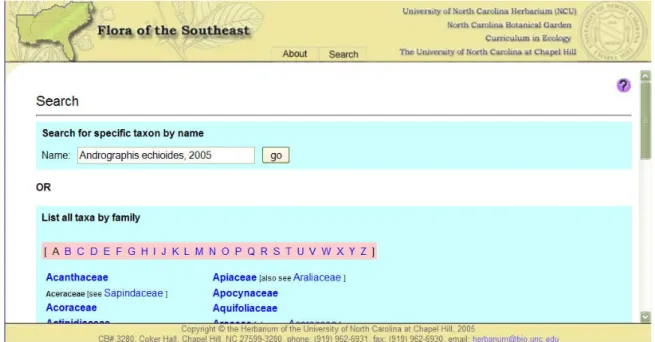
Figure 15a. Searching SEFlora for “Andrographis echioides”
Figure 15c. Searching SEFlora for “Andrographis echioides” with concept year
Figure 15d. Selecting the desired taxon concept
After my discussion of my recommended seven step system re-design process, I would like to discuss some possible future upgrades of the SEFlora system. The
recommended standards-based data structure I explained previously will help support the future goal of seamless data import from other databases. This data import module is promising to be a significant probable feature of the system, so, taxon and flora
information can be easily transferred into the SEFlora databases. This module will help to develop another desired functionality that will allow the standards-based direct querying of other databases and applications. This will be easier to implement of the other systems also adapt the same standards for data communication as the SEFlora system. This feature may be extended later to include data caching by importing data form other databases to be stored locally and allowing for direct and more rapid querying. This process may be done automatically with peer databases. Another module that would be extremely beneficial to develop in the future is the automation of taxonomic
information population for the records. Being able to associate the appropriate taxon concepts and taxon authorities along with the setup of the proper relationships would relieve a tremendous amount of manual labor.
Discussion
database structure allows for all taxon concepts to be stored with their original authority’s classification, but to be mapped to all other taxonomy schemes used by the system. With the starting and ending years stored, the system will also be able to manage versioning for the different taxon concept by knowing what year’s taxon scheme the authority classified the concept by.
The recommended separation of the plot and flora distribution tables to a different database and their more standardized format (VegBank XML) will also help the
communication of flora records with other databases. This will be true for the taxon tables after my suggested design, because by using a taxon data structure that is based on the TWDG Taxonomic Concept Transfer Schema standard will make taxon information exchange feasible. Using standards to bas all schema changes on will allow more future features to be implemented with less effort.
Conclusions
Although, possibilities for futures improvements are countless, the implementation of my recommended changes will make the NCU Flora of the
TWDG Taxonomic Concept Transfer Schema, the system will be able to handle data interactions among its databases and external entities more seamlessly. This groundwork will also allow for future improvements like direct interactions with external databases and similar systems.
References
Biodiversity Information Standards. (2009). Taxonomic Concept Transfer Schema (Cover Page). Retrieved Apr. 24, 2009, from http://www.tdwg.org/standards/117/
Calhoun, K. (1998). Bird's Eye View of Authority Control in Cataloging, A: Workshop on Taxonomic Authority Files. Retrieved Apr. 26, 2009, from
http://ecommons.library.cornell.edu/handle/1813/2233
Ecological Society of America's Panel. (2009). VegBank. Retrieved Apr. 24, 2009, from http://vegbank.org
Ecological Society of America. (2009). VegBank XML. Retrieved Apr. 24, 2009, from http://vegbank.org/vegdocs/xml/vegbank-xml-index.html
ESRI - Environmental Systems Research Institute, Inc. (2009). ArcGIS: A Complete Integrated System. Retrieved Apr. 24, 2009, from
http://www.esri.com/software/arcgis/
Franz, N., Peet, R. K., & Weakley, A. S. (2008). Chapter 5: On the Use of Taxonomic Concepts in Support of Biodiversity Research and Taxonomy. In Q. . Wheeler (Ed.), The New Taxonomy (pp. 61-84). New York, NY: CRC Press.
Geoffroy, M. and W.G. Berendsohn. 2003. The concept problem in taxonomy:
Schriftenreihe für Vegetationskunde, Vol. 39. Federal Agency for Nature Conservation, Bonn, Germany. 113+xvii pp.
Herbarium of the University of North Carolina at Chapel Hill. (2005). NCU Flora of the Southeastern United States. Retrieved Apr. 24, 2009, from
http://www.herbarium.unc.edu/Seflora/
Hyam, R., & Kennedy, J. (2007). Taxon Concept Schema – User Guide. Retrieved Apr. 24, 2009, from
http://www.tdwg.org/standards/117/files/TCS101/UserGuidev_1.3.pdf
Knapp, S. (2009). What's in a Name? a History of Taxonomy. Retrieved Apr. 24, 2009, from http://www.nhm.ac.uk/nature-online/science-of-natural-history/taxonomy-systematics/history-taxonomy/index.html
Lee, M. (2004). VegBank Database System Entity Relationship Diagram (ERD). Retrieved Apr. 24, 2009, from
http://vegbank.org/vegdocs/design/erd/vegbank_erd.pdf
McKelvey, B. (1982). Organizational systematics--taxonomy, evolution, classification. Berkeley, CA: University of California Press.
McNeill, JF, Barrie, F, Burdet, HM, Demoulin, V, Hawksworth, DL, Marhold, K, Nicolson, DH, Prado, J, Silva, PC, Skog, JE, Wiersema, J, & Turland NJ, eds (2006). International Code of Botanical Nomenclature (Vienna Code). Regnum Vegetabile 146. Koeltz Scientific Books, Königstein
Specify 6 Software Project, Biodiversity Research Center, University of Kansas. (2009). Specify 6. Retrieved Apr. 24, 2009, from http://specify6.specifysoftware.org
Specify Software Project, Biodiversity Research Center, University of Kansas. (2009). Specify 6. Retrieved Apr. 24, 2009, from http://specifysoftware.org/
The Natural History Museum. (2009). Taxonomy and Systematics. Retrieved Apr. 24, 2009, from
http://www.nhm.ac.uk/nature-online/science-of-natural-history/taxonomy-systematics/index.html
Weakley, A. S. (2006). Flora of the Carolinas, Virginia, Georgia, and surrounding areas. Retrieved Apr. 24, 2009, from
http://www.herbarium.unc.edu/FloraArchives/WeakleyFlora_2006-Jan.pdf Zhong, Y., Y. Luo, S. Pramanik and J.H. Beaman. (1999). HICLAS: a taxonomic